Worked
Examples
Project


         Jennifer
Kaupke

         October
7,
2012

            EDT
503


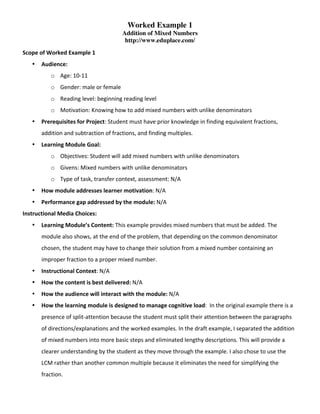
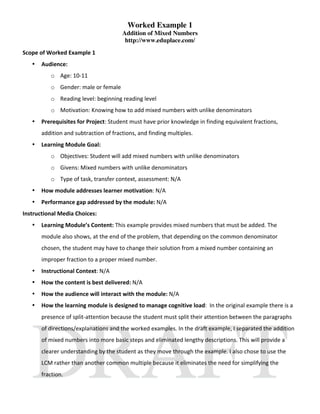
Worked Example 1
                                       Addition of Mixed Numbers
                                        http://www.eduplace.com/
Scope
of
Worked
Example
1


   •   Audience:


           o Age:
10‐11

           o Gender:
male
or
female

           o Reading
level:
beginning
reading
level

           o Motivation:
Knowing
how
to
add
mixed
numbers
with
unlike
denominators

   •   Prerequisites
for
Project:
Student
must
have
prior
knowledge
in
finding
equivalent
fractions,

       addition
and
subtraction
of
fractions,
and
finding
multiples.

   •   Learning
Module
Goal:

           o Objectives:
Student
will
add
mixed
numbers
with
unlike
denominators

           o Givens:
Mixed
numbers
with
unlike
denominators

           o Type
of
task,
transfer
context,
assessment:
N/A

   •   How
module
addresses
learner
motivation:
N/A

   •   Performance
gap
addressed
by
the
module:
N/A

Instructional
Media
Choices:


   •   Learning
Module’s
Content:
This
example
provides
mixed
numbers
that
must
be
added.
The

       module
also
shows,
at
the
end
of
the
problem,
that
depending
on
the
common
denominator

       chosen,
the
student
may
have
to
change
their
solution
from
a
mixed
number
containing
an

       improper
fraction
to
a
proper
mixed
number.


   •   Instructional
Context:
N/A

   •   How
the
content
is
best
delivered:
N/A

   •   How
the
audience
will
interact
with
the
module:
N/A

   •   How
the
learning
module
is
designed
to
manage
cognitive
load:

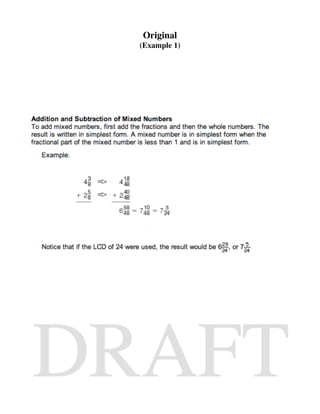
In
the
original
example
there
is
a

       presence
of
split‐attention
because
the
student
must
split
their
attention
between
the
paragraphs

       of
directions/explanations
and
the
worked
examples.
In
the
draft
example,
I
separated
the
addition

       of
mixed
numbers
into
more
basic
steps
and
eliminated
lengthy
descriptions.
This
will
provide
a

       clearer
understanding
by
the
student
as
they
move
through
the
example.
I
also
chose
to
use
the

       LCM
rather
than
another
common
multiple
because
it
eliminates
the
need
for
simplifying
the

       fraction.

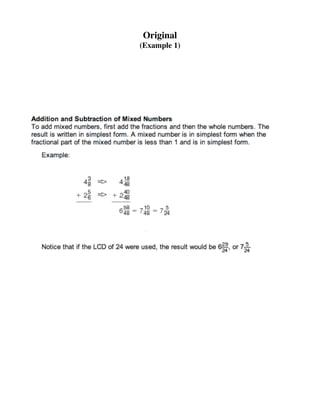
Original
(Example 1)
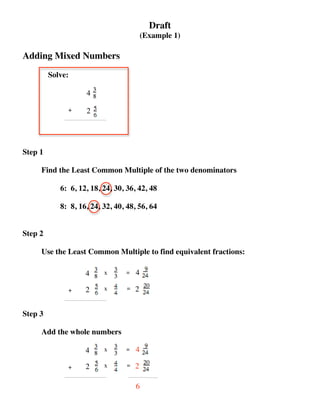
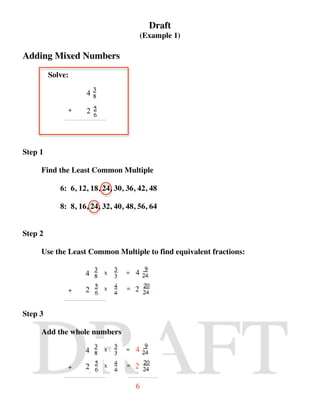
Draft
                                          (Example 1)

Adding Mixed Numbers
         Solve:

                    4

              +     2


Step 1

     Find the Least Common Multiple of the two denominators

            6: 6, 12, 18, 24, 30, 36, 42, 48

            8: 8, 16, 24, 32, 40, 48, 56, 64


Step 2

     Use the Least Common Multiple to find equivalent fractions:

                    4     x      =    4

              +     2     x       =   2


Step 3

     Add the whole numbers

                    4     x      =    4

              +     2     x       =   2

                                      6
Step 4

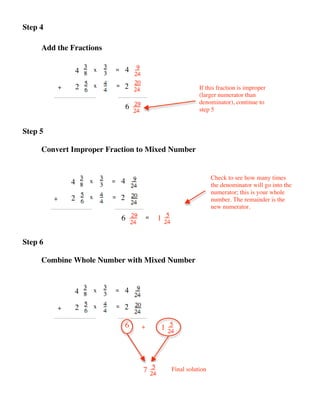
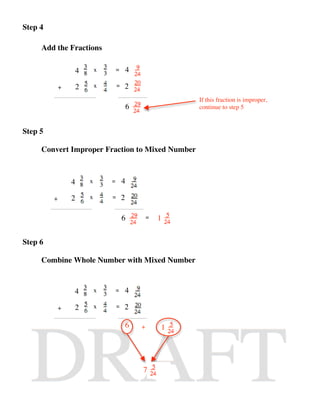
     Add the Fractions

                  4       x       =       4

             +    2       x       =   2                              If this fraction is improper
                                                                     (larger numerator than
                                                                     denominator), continue to
                                          6                          step 5


Step 5

     Convert Improper Fraction to Mixed Number


                                                                           Check to see how many times
                 4    x       =       4                                    the denominator will go into the
                                                                           numerator; this is your whole
         +       2    x       =       2                                    number. The remainder is the
                                                                           new numerator.
                                      6           =   1


Step 6

     Combine Whole Number with Mixed Number


                 4        x       =       4

             +   2        x       =   2

                                          6   +       1


                                              7           Final solution
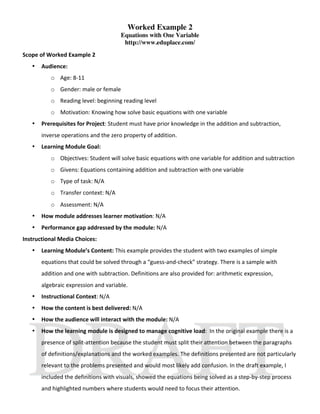
Worked Example 2
                                      Equations with One Variable
                                       http://www.eduplace.com/
Scope
of
Worked
Example
2

   •   Audience:


          o Age:
8‐11

          o Gender:
male
or
female

          o Reading
level:
beginning
reading
level

          o Motivation:
Knowing
how
solve
basic
equations
with
one
variable

   •   Prerequisites
for
Project:
Student
must
have
prior
knowledge
in
the
addition
and
subtraction,

       inverse
operations
and
the
zero
property
of
addition.

   •   Learning
Module
Goal:

          o Objectives:
Student
will
solve
basic
equations
with
one
variable
for
addition
and
subtraction

          o Givens:
Equations
containing
addition
and
subtraction
with
one
variable

          o Type
of
task:
N/A

          o Transfer
context:
N/A

          o Assessment:
N/A

   •   How
module
addresses
learner
motivation:
N/A

   •   Performance
gap
addressed
by
the
module:
N/A

Instructional
Media
Choices:

   •   Learning
Module’s
Content:
This
example
provides
the
student
with
two
examples
of
simple

       equations
that
could
be
solved
through
a
“guess‐and‐check”
strategy.
There
is
a
sample
with

       addition
and
one
with
subtraction.
Definitions
are
also
provided
for:
arithmetic
expression,

       algebraic
expression
and
variable.

   •   Instructional
Context:
N/A

   •   How
the
content
is
best
delivered:
N/A

   •   How
the
audience
will
interact
with
the
module:
N/A

   •   How
the
learning
module
is
designed
to
manage
cognitive
load:

In
the
original
example
there
is
a

       presence
of
split‐attention
because
the
student
must
split
their
attention
between
the
paragraphs

       of
definitions/explanations
and
the
worked
examples.
The
definitions
presented
are
not
particularly

       relevant
to
the
problems
presented
and
would
most
likely
add
confusion.
In
the
draft
example,
I

       included
the
definitions
with
visuals,
showed
the
equations
being
solved
as
a
step‐by‐step
process

       and
highlighted
numbers
where
students
would
need
to
focus
their
attention.

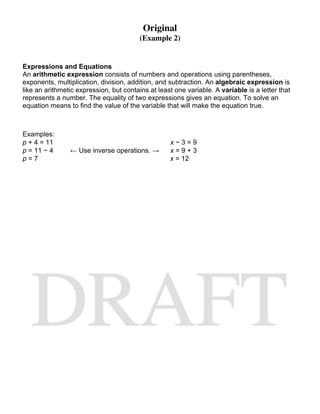
Original
                                         (Example 2)


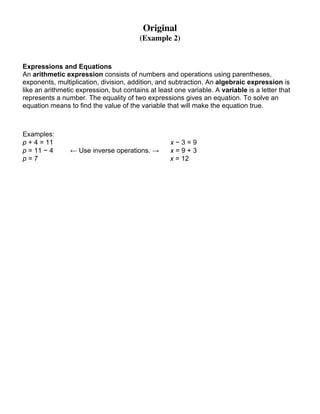
Expressions and Equations
An arithmetic expression consists of numbers and operations using parentheses,
exponents, multiplication, division, addition, and subtraction. An algebraic expression is
like an arithmetic expression, but contains at least one variable. A variable is a letter that
represents a number. The equality of two expressions gives an equation. To solve an
equation means to find the value of the variable that will make the equation true.


Examples:
p + 4 = 11                                         x−3=9
p = 11 − 4      ← Use inverse operations. →        x=9+3
p=7                                                x = 12
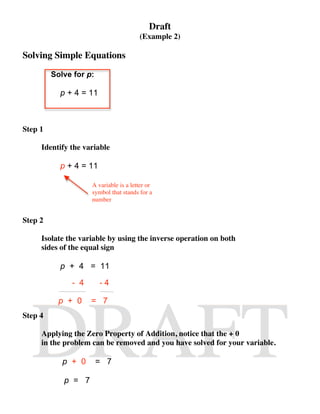
Draft
                                       (Example 2)

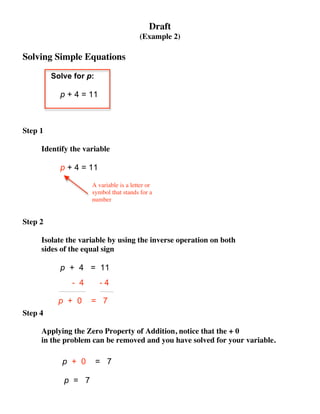
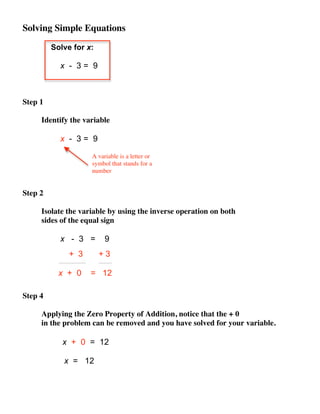
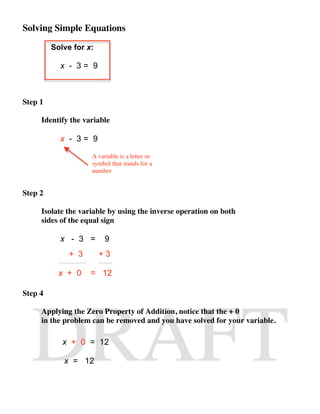
Solving Simple Equations

         Solve for p:

           p + 4 = 11


Step 1

     Identify the variable

           p + 4 = 11

                    A variable is a letter or
                    symbol that stands for a
                    number


Step 2

     Isolate the variable by using the inverse operation on both
     sides of the equal sign

           p + 4 = 11
              - 4       -4

           p + 0    = 7
Step 4

     Applying the Zero Property of Addition, notice that the + 0
     in the problem can be removed and you have solved for your variable.

            p + 0       = 7

            p = 7
Solving Simple Equations

         Solve for x:

           x - 3= 9


Step 1

     Identify the variable

           x - 3= 9

                    A variable is a letter or
                    symbol that stands for a
                    number


Step 2

     Isolate the variable by using the inverse operation on both
     sides of the equal sign

           x - 3 =       9
              + 3       +3

           x + 0    = 12

Step 4

     Applying the Zero Property of Addition, notice that the + 0
     in the problem can be removed and you have solved for your variable.

            x + 0 = 12

            x = 12
Worked Example 3
                                       Making a Double Bar Graph
                                        http://www.eduplace.com/
Scope
of
Worked
Example
3

   •   Audience:


          o Age:
9‐13

          o Gender:
male
or
female

          o Reading
level:
beginning
reading
level

          o Motivation:
Knowing
how
to
create
a
double
bar
graph

   •   Prerequisites
for
Project:
Student
must
have
prior
knowledge
in
reading
tables.

   •   Learning
Module
Goal:

          o Objectives:
Students
will
create
a
double
bar
graph
using
the
provided
table
of
data.

          o Type
of
task:
N/A

          o Transfer
context:
N/A

          o Assessment:
N/A

   •   How
module
addresses
learner
motivation:
N/A

   •   Performance
gap
addressed
by
the
module:
N/A

Instructional
Media
Choices:

   •   Learning
Module’s
Content:
This
example
provides
the
student
with
the
steps
required
to
create
a

       double
bar
graph
with
a
provided
table
of
data.
It
also
includes
a
finished
double
bar
graph.

   •   Instructional
Context:
N/A

   •   How
the
content
is
best
delivered:
N/A

   •   How
the
audience
will
interact
with
the
module:
N/A

   •   How
the
learning
module
is
designed
to
manage
cognitive
load:

In
the
original
example
there
is
a

       presence
of
split‐attention
because
the
student
must
split
their
attention
between
table,
the

       introduction
paragraphs,
the
steps
listed,
and
the
double
bar
graph
provided.
In
the
draft
example,
I

       included
the
definitions
with
visuals,
showed
the
equations
being
solved
as
a
step‐by‐step
process

       and
highlighted
numbers
where
students
would
need
to
focus
their
attention.
Presenting
the

       information
in
this
manner
will
allow
students
to
see
each
step
as
they
move
through
the
creation

       of
their
double
bar
graph
rather
than
only
seeing
the
finished
product
and
trying
to
decipher
which

       steps
relates
to
each
part
of
the
finished
product.

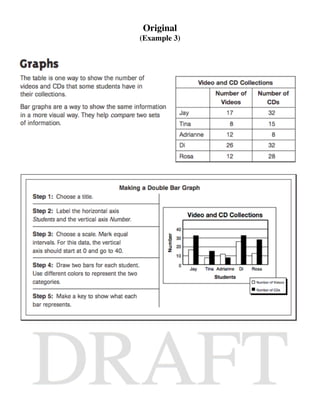
Original
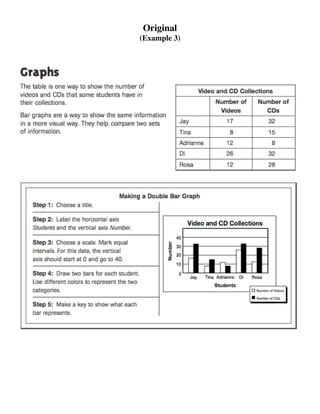
(Example 3)
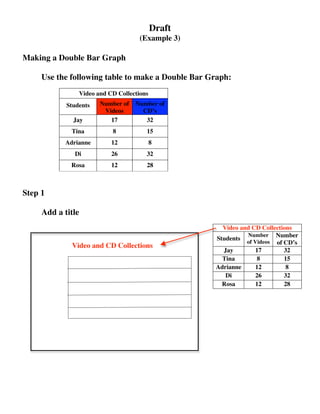
Draft
                                     (Example 3)

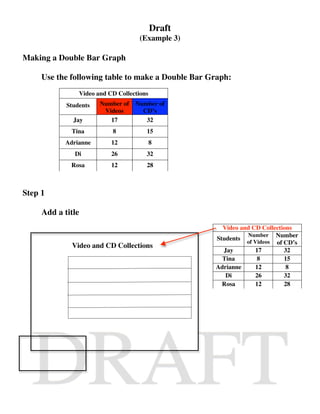
Making a Double Bar Graph

     Use the following table to make a Double Bar Graph:
                Video and CD Collections
            Students   Number of   Number of
                        Videos       CD’s
              Jay         17          32
             Tina          8           15
           Adrianne        12              8
              Di           26          32
             Rosa          12          28


Step 1

     Add a title
                                                     Video and CD Collections
                                                             Number Number
                                                   Students
                                                             of Videos of CD’s
             Video and CD Collections
                                                     Jay        17        32
                                                     Tina        8        15
                                                   Adrianne     12         8
                                                      Di        26        32
                                                     Rosa       12        28
Step 2

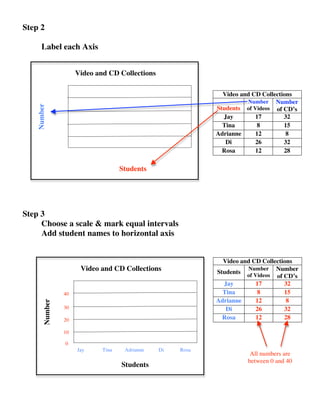
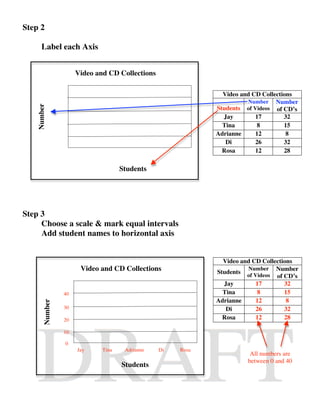
      Label each Axis


                      Video and CD Collections

                                                               Video and CD Collections
                                                                       Number Number
    Number


                                                             Students of Videos of CD’s
                                                               Jay        17        32
                                                               Tina        8        15
                                                             Adrianne     12         8
                                                                Di        26        32
                                                               Rosa       12        28

                                     Students


Step 3
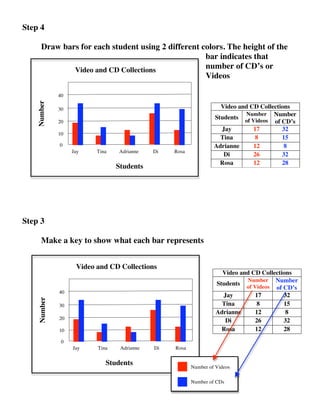
     Choose a scale & mark equal intervals
     Add student names to horizontal axis


                                                               Video and CD Collections
                       Video and CD Collections              Students of Videos Number
                                                                       Number
                                                                                 of CD’s
                                                               Jay        17        32
                 40                                            Tina        8        15
                                                             Adrianne     12         8
        Number


                 30                                             Di        26        32
                 20                                            Rosa       12        28

                 10

                 0
                      Jay     Tina    Adrianne   Di   Rosa
                                                                        All numbers are
                                                                       between 0 and 40
                                     Students
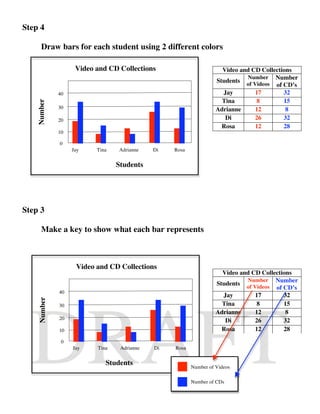
Step 4

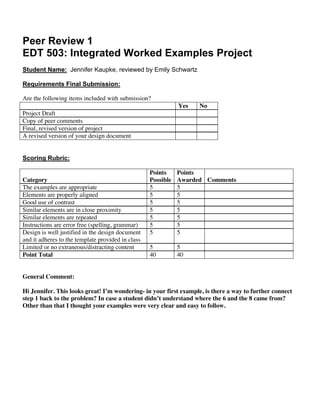
      Draw bars for each student using 2 different colors. The height of the
                                                    bar indicates that
              Video and CD Collections
                                                    number of CD’s or
                                                    Videos

             40
    Number


             30                                                    Video and CD Collections
                                                                 Students of Videos Number
                                                                           Number
             20                                                                      of CD’s
                                                                   Jay        17        32
             10
                                                                   Tina        8        15
             0                                                   Adrianne     12         8
                  Jay    Tina   Adrianne    Di   Rosa
                                                                    Di        26        32
                                                                   Rosa       12        28
                                Students


Step 3

      Make a key to show what each bar represents


                   Video and CD Collections
                                                                    Video and CD Collections
                                                                  Students of Videos Number
                                                                            Number
                                                                                      of CD’s
             40
                                                                    Jay        17        32
    Number


             30                                                     Tina        8        15
                                                                  Adrianne     12         8
             20                                                      Di        26        32
             10                                                     Rosa       12        28
              0
                  Jay    Tina    Adrianne   Di   Rosa


                            Students                    Number of Videos

                                                        Number of CDs
Peer Review 1
EDT 503: Integrated Worked Examples Project
Student Name: Jennifer Kaupke, reviewed by Emily Schwartz

Requirements Final Submission:

Are the following items included with submission?
                                                              Yes   No
Project Draft
Copy of peer comments
Final, revised version of project
A revised version of your design document


Scoring Rubric:

                                                   Points     Points
Category                                           Possible   Awarded Comments
The examples are appropriate                       5          5
Elements are properly aligned                      5          5
Good use of contrast                               5          5
Similar elements are in close proximity            5          5
Similar elements are repeated                      5          5
Instructions are error free (spelling, grammar)    5          5
Design is well justified in the design document    5          5
and it adheres to the template provided in class
Limited or no extraneous/distracting content       5          5
Point Total                                        40         40


General Comment:

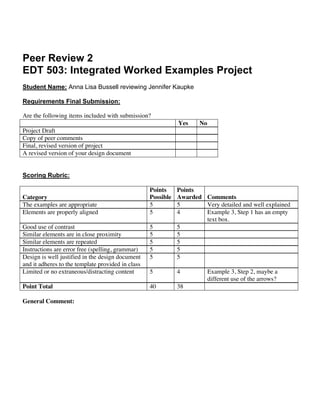
Hi Jennifer. This looks great! I’m wondering- in your first example, is there a way to further connect
step 1 back to the problem? In case a student didn’t understand where the 6 and the 8 came from?
Other than that I thought your examples were very clear and easy to follow.
Peer Review 2
EDT 503: Integrated Worked Examples Project
Student Name: Anna Lisa Bussell reviewing Jennifer Kaupke

Requirements Final Submission:

Are the following items included with submission?
                                                              Yes    No
Project Draft
Copy of peer comments
Final, revised version of project
A revised version of your design document


Scoring Rubric:

                                                   Points     Points
Category                                           Possible   Awarded Comments
The examples are appropriate                       5          5       Very detailed and well explained
Elements are properly aligned                      5          4       Example 3, Step 1 has an empty
                                                                      text box.
Good use of contrast                               5          5
Similar elements are in close proximity            5          5
Similar elements are repeated                      5          5
Instructions are error free (spelling, grammar)    5          5
Design is well justified in the design document    5          5
and it adheres to the template provided in class
Limited or no extraneous/distracting content       5          4           Example 3, Step 2, maybe a
                                                                          different use of the arrows?
Point Total                                        40         38

General Comment:
Peer Review 3
EDT 503: Integrated Worked Examples Project
Student Name: For Jennifer Kaupke (Reviewed by Amy Tregre)

Requirements Final Submission:
Are the following items included with submission?
                                                       Yes   No
Project Draft
Copy of peer comments
Final, revised version of project
A revised version of your design document

Scoring Rubric:

                                            Points     Points
Category                                    Possible   Awarded Comments
The examples are appropriate                5          5
Elements are properly aligned               5          5
Good use of contrast                        5          5
Similar elements are in close proximity     5          5
Similar elements are repeated               5          5
Instructions are error free (spelling,      5          5
grammar)
Design is well justified in the design      5          5
document and it adheres to the template
provided in class
Limited or no extraneous/distracting        5          5
content
Point Total                                 40         40         See notes below

General Comment:

Jennifer,
These were great examples with good use of color and sequencing!
#1:
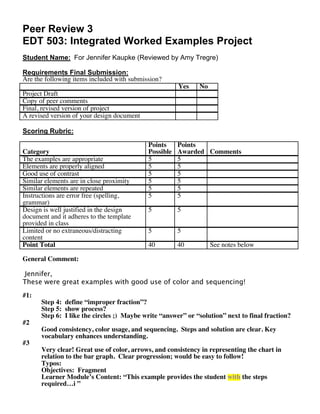
      Step 4: define “improper fraction”?
      Step 5: show process?
      Step 6: I like the circles ;) Maybe write “answer” or “solution” next to final fraction?
#2
      Good consistency, color usage, and sequencing. Steps and solution are clear. Key
      vocabulary enhances understanding.
#3
      Very clear! Great use of color, arrows, and consistency in representing the chart in
      relation to the bar graph. Clear progression; would be easy to follow!
      Typos:
      Objectives: Fragment
      Learner Module’s Content: “This example provides the student with the steps
      required…i ”
Worked Example 1
                                       Addition of Mixed Numbers
                                        http://www.eduplace.com/
Scope
of
Worked
Example
1


   •   Audience:


           o Age:
10‐11

           o Gender:
male
or
female

           o Reading
level:
beginning
reading
level

           o Motivation:
Knowing
how
to
add
mixed
numbers
with
unlike
denominators

   •   Prerequisites
for
Project:
Student
must
have
prior
knowledge
in
finding
equivalent
fractions,

       addition
and
subtraction
of
fractions,
and
finding
multiples.

   •   Learning
Module
Goal:

           o Objectives:
Student
will
add
mixed
numbers
with
unlike
denominators

           o Givens:
Mixed
numbers
with
unlike
denominators

           o Type
of
task,
transfer
context,
assessment:
N/A

   •   How
module
addresses
learner
motivation:
N/A

   •   Performance
gap
addressed
by
the
module:
N/A

Instructional
Media
Choices:


   •   Learning
Module’s
Content:
This
example
provides
mixed
numbers
that
must
be
added.
The

       module
also
shows,
at
the
end
of
the
problem,
that
depending
on
the
common
denominator

       chosen,
the
student
may
have
to
change
their
solution
from
a
mixed
number
containing
an

       improper
fraction
to
a
proper
mixed
number.


   •   Instructional
Context:
N/A

   •   How
the
content
is
best
delivered:
N/A

   •   How
the
audience
will
interact
with
the
module:
N/A

   •   How
the
learning
module
is
designed
to
manage
cognitive
load:

In
the
original
example
there
is
a

       presence
of
split‐attention
because
the
student
must
split
their
attention
between
the
paragraphs

       of
directions/explanations
and
the
worked
examples.
In
the
draft
example,
I
separated
the
addition

       of
mixed
numbers
into
more
basic
steps
and
eliminated
lengthy
descriptions.
This
will
provide
a

       clearer
understanding
by
the
student
as
they
move
through
the
example.
I
also
chose
to
use
the

       LCM
rather
than
another
common
multiple
because
it
eliminates
the
need
for
simplifying
the

       fraction.

Original
(Example 1)
Draft
                                          (Example 1)

Adding Mixed Numbers
         Solve:

                    4

              +     2


Step 1

     Find the Least Common Multiple

            6: 6, 12, 18, 24, 30, 36, 42, 48

            8: 8, 16, 24, 32, 40, 48, 56, 64


Step 2

     Use the Least Common Multiple to find equivalent fractions:

                    4     x      =    4

              +     2     x       =   2


Step 3

     Add the whole numbers

                    4     x      =    4

              +     2     x       =   2

                                      6
Step 4

     Add the Fractions

                  4       x       =       4

             +    2       x       =   2
                                                          If this fraction is improper,
                                          6               continue to step 5


Step 5

     Convert Improper Fraction to Mixed Number


                 4    x       =       4

         +       2    x       =       2

                                      6           =   1


Step 6

     Combine Whole Number with Mixed Number


                 4        x       =       4

             +   2        x       =   2

                                          6   +       1


                                              7
Worked Example 2
                                      Equations with One Variable
                                       http://www.eduplace.com/
Scope
of
Worked
Example
2

   •   Audience:


          o Age:
8‐11

          o Gender:
male
or
female

          o Reading
level:
beginning
reading
level

          o Motivation:
Knowing
how
solve
basic
equations
with
one
variable

   •   Prerequisites
for
Project:
Student
must
have
prior
knowledge
in
the
addition
and
subtraction,

       inverse
operations
and
the
zero
property
of
addition.

   •   Learning
Module
Goal:

          o Objectives:
Student
will
solve
basic
equations
with
one
variable
for
addition
and
subtraction

          o Givens:
Equations
containing
addition
and
subtraction
with
one
variable

          o Type
of
task:
N/A

          o Transfer
context:
N/A

          o Assessment:
N/A

   •   How
module
addresses
learner
motivation:
N/A

   •   Performance
gap
addressed
by
the
module:
N/A

Instructional
Media
Choices:

   •   Learning
Module’s
Content:
This
example
provides
the
student
with
two
examples
of
simple

       equations
that
could
be
solved
through
a
“guess‐and‐check”
strategy.
There
is
a
sample
with

       addition
and
one
with
subtraction.
Definitions
are
also
provided
for:
arithmetic
expression,

       algebraic
expression
and
variable.

   •   Instructional
Context:
N/A

   •   How
the
content
is
best
delivered:
N/A

   •   How
the
audience
will
interact
with
the
module:
N/A

   •   How
the
learning
module
is
designed
to
manage
cognitive
load:

In
the
original
example
there
is
a

       presence
of
split‐attention
because
the
student
must
split
their
attention
between
the
paragraphs

       of
definitions/explanations
and
the
worked
examples.
The
definitions
presented
are
not
particularly

       relevant
to
the
problems
presented
and
would
most
likely
add
confusion.
In
the
draft
example,
I

       included
the
definitions
with
visuals,
showed
the
equations
being
solved
as
a
step‐by‐step
process

       and
highlighted
numbers
where
students
would
need
to
focus
their
attention.

Original
                                         (Example 2)


Expressions and Equations
An arithmetic expression consists of numbers and operations using parentheses,
exponents, multiplication, division, addition, and subtraction. An algebraic expression is
like an arithmetic expression, but contains at least one variable. A variable is a letter that
represents a number. The equality of two expressions gives an equation. To solve an
equation means to find the value of the variable that will make the equation true.


Examples:
p + 4 = 11                                         x−3=9
p = 11 − 4      ← Use inverse operations. →        x=9+3
p=7                                                x = 12
Draft
                                       (Example 2)

Solving Simple Equations
         Solve for p:

           p + 4 = 11


Step 1

     Identify the variable

           p + 4 = 11

                    A variable is a letter or
                    symbol that stands for a
                    number


Step 2

     Isolate the variable by using the inverse operation on both
     sides of the equal sign

           p + 4 = 11
              - 4       -4

           p + 0    = 7
Step 4

     Applying the Zero Property of Addition, notice that the + 0
     in the problem can be removed and you have solved for your variable.

            p + 0       = 7

            p = 7
Solving Simple Equations

         Solve for x:

           x - 3= 9


Step 1

     Identify the variable

           x - 3= 9

                    A variable is a letter or
                    symbol that stands for a
                    number


Step 2

     Isolate the variable by using the inverse operation on both
     sides of the equal sign

           x - 3 =       9
              + 3       +3

           x + 0    = 12

Step 4

     Applying the Zero Property of Addition, notice that the + 0
     in the problem can be removed and you have solved for your variable.

            x + 0 = 12

            x = 12
Worked Example 3
                                       Making a Double Bar Graph
                                        http://www.eduplace.com/
Scope
of
Worked
Example
3

   •   Audience:


          o Age:
9‐13

          o Gender:
male
or
female

          o Reading
level:
beginning
reading
level

          o Motivation:
Knowing
how
to
create
a
double
bar
graph

   •   Prerequisites
for
Project:
Student
must
have
prior
knowledge
in
reading
tables.

   •   Learning
Module
Goal:

          o Objectives:
Student
will
create
a
double
bar
graph
using
provided
table
of
data.

          o Type
of
task:
N/A

          o Transfer
context:
N/A

          o Assessment:
N/A

   •   How
module
addresses
learner
motivation:
N/A

   •   Performance
gap
addressed
by
the
module:
N/A

Instructional
Media
Choices:

   •   Learning
Module’s
Content:
This
example
provides
the
student
the
steps
required
to
create
a

       double
bar
graph
with
a
provided
table
of
data.
It
also
includes
a
finished
double
bar
graph.

   •   Instructional
Context:
N/A

   •   How
the
content
is
best
delivered:
N/A

   •   How
the
audience
will
interact
with
the
module:
N/A

   •   How
the
learning
module
is
designed
to
manage
cognitive
load:

In
the
original
example
there
is
a

       presence
of
split‐attention
because
the
student
must
split
their
attention
between
table,
the

       introduction
paragraphs,
the
steps
listed,
and
the
double
bar
graph
provided.
In
the
draft
example,
I

       included
the
definitions
with
visuals,
showed
the
equations
being
solved
as
a
step‐by‐step
process

       and
highlighted
numbers
where
students
would
need
to
focus
their
attention.
Presenting
the

       information
in
this
manner
will
allow
students
to
see
each
step
as
they
move
through
the
creation

       of
their
double
bar
graph
rather
than
only
seeing
the
finished
product
and
trying
to
decipher
which

       steps
relates
to
each
part
of
the
finished
product.

Original
(Example 3)
Draft
                                     (Example 3)

Making a Double Bar Graph

     Use the following table to make a Double Bar Graph:
                Video and CD Collections
            Students   Number of   Number of
                        Videos       CD’s
              Jay         17          32
             Tina          8           15
           Adrianne        12              8
              Di           26          32
             Rosa          12          28


Step 1

     Add a title
                                                     Video and CD Collections
                                                             Number Number
                                                   Students
                                                             of Videos of CD’s
             Video and CD Collections
                                                     Jay        17        32
                                                     Tina        8        15
                                                   Adrianne     12         8
                                                      Di        26        32
                                                     Rosa       12        28
Step 2

      Label each Axis


                      Video and CD Collections

                                                               Video and CD Collections
                                                                       Number Number
    Number


                                                             Students of Videos of CD’s
                                                               Jay        17        32
                                                               Tina        8        15
                                                             Adrianne     12         8
                                                                Di        26        32
                                                               Rosa       12        28

                                     Students


Step 3
     Choose a scale & mark equal intervals
     Add student names to horizontal axis


                                                               Video and CD Collections
                       Video and CD Collections              Students of Videos Number
                                                                       Number
                                                                                 of CD’s
                                                               Jay        17        32
                 40                                            Tina        8        15
                                                             Adrianne     12         8
        Number


                 30                                             Di        26        32
                 20                                            Rosa       12        28

                 10

                 0
                      Jay     Tina    Adrianne   Di   Rosa
                                                                        All numbers are
                                                                       between 0 and 40
                                     Students
Step 4

      Draw bars for each student using 2 different colors

                   Video and CD Collections                         Video and CD Collections
                                                                  Students of Videos Number
                                                                            Number
                                                                                      of CD’s
             40                                                     Jay        17        32
                                                                    Tina        8        15
    Number


             30                                                   Adrianne     12         8
             20                                                      Di        26        32
                                                                    Rosa       12        28
             10

             0
                  Jay    Tina   Adrianne    Di   Rosa

                                Students


Step 3

      Make a key to show what each bar represents


                   Video and CD Collections
                                                                    Video and CD Collections
                                                                  Students of Videos Number
                                                                            Number
                                                                                      of CD’s
             40
                                                                    Jay        17        32
    Number


             30                                                     Tina        8        15
                                                                  Adrianne     12         8
             20                                                      Di        26        32
             10                                                     Rosa       12        28
              0
                  Jay    Tina    Adrianne   Di   Rosa


                            Students                    Number of Videos

                                                        Number of CDs

Worked examples project

  • 1.
    Worked
Examples
Project
 
 
 Jennifer
Kaupke
 October
7,
2012
 EDT
503
 

  • 2.
    Worked Example 1 Addition of Mixed Numbers http://www.eduplace.com/ Scope
of
Worked
Example
1

 • Audience:

 o Age:
10‐11
 o Gender:
male
or
female
 o Reading
level:
beginning
reading
level
 o Motivation:
Knowing
how
to
add
mixed
numbers
with
unlike
denominators
 • Prerequisites
for
Project:
Student
must
have
prior
knowledge
in
finding
equivalent
fractions,
 addition
and
subtraction
of
fractions,
and
finding
multiples.
 • Learning
Module
Goal:
 o Objectives:
Student
will
add
mixed
numbers
with
unlike
denominators
 o Givens:
Mixed
numbers
with
unlike
denominators
 o Type
of
task,
transfer
context,
assessment:
N/A
 • How
module
addresses
learner
motivation:
N/A
 • Performance
gap
addressed
by
the
module:
N/A
 Instructional
Media
Choices:

 • Learning
Module’s
Content:
This
example
provides
mixed
numbers
that
must
be
added.
The
 module
also
shows,
at
the
end
of
the
problem,
that
depending
on
the
common
denominator
 chosen,
the
student
may
have
to
change
their
solution
from
a
mixed
number
containing
an
 improper
fraction
to
a
proper
mixed
number.

 • Instructional
Context:
N/A
 • How
the
content
is
best
delivered:
N/A
 • How
the
audience
will
interact
with
the
module:
N/A
 • How
the
learning
module
is
designed
to
manage
cognitive
load:

In
the
original
example
there
is
a
 presence
of
split‐attention
because
the
student
must
split
their
attention
between
the
paragraphs
 of
directions/explanations
and
the
worked
examples.
In
the
draft
example,
I
separated
the
addition
 of
mixed
numbers
into
more
basic
steps
and
eliminated
lengthy
descriptions.
This
will
provide
a
 clearer
understanding
by
the
student
as
they
move
through
the
example.
I
also
chose
to
use
the
 LCM
rather
than
another
common
multiple
because
it
eliminates
the
need
for
simplifying
the
 fraction.

  • 3.
  • 4.
    Draft (Example 1) Adding Mixed Numbers Solve: 4 + 2 Step 1 Find the Least Common Multiple of the two denominators 6: 6, 12, 18, 24, 30, 36, 42, 48 8: 8, 16, 24, 32, 40, 48, 56, 64 Step 2 Use the Least Common Multiple to find equivalent fractions: 4 x = 4 + 2 x = 2 Step 3 Add the whole numbers 4 x = 4 + 2 x = 2 6
  • 5.
    Step 4 Add the Fractions 4 x = 4 + 2 x = 2 If this fraction is improper (larger numerator than denominator), continue to 6 step 5 Step 5 Convert Improper Fraction to Mixed Number Check to see how many times 4 x = 4 the denominator will go into the numerator; this is your whole + 2 x = 2 number. The remainder is the new numerator. 6 = 1 Step 6 Combine Whole Number with Mixed Number 4 x = 4 + 2 x = 2 6 + 1 7 Final solution
  • 6.
    Worked Example 2 Equations with One Variable http://www.eduplace.com/ Scope
of
Worked
Example
2
 • Audience:

 o Age:
8‐11
 o Gender:
male
or
female
 o Reading
level:
beginning
reading
level
 o Motivation:
Knowing
how
solve
basic
equations
with
one
variable
 • Prerequisites
for
Project:
Student
must
have
prior
knowledge
in
the
addition
and
subtraction,
 inverse
operations
and
the
zero
property
of
addition.
 • Learning
Module
Goal:
 o Objectives:
Student
will
solve
basic
equations
with
one
variable
for
addition
and
subtraction
 o Givens:
Equations
containing
addition
and
subtraction
with
one
variable
 o Type
of
task:
N/A
 o Transfer
context:
N/A
 o Assessment:
N/A
 • How
module
addresses
learner
motivation:
N/A
 • Performance
gap
addressed
by
the
module:
N/A
 Instructional
Media
Choices:
 • Learning
Module’s
Content:
This
example
provides
the
student
with
two
examples
of
simple
 equations
that
could
be
solved
through
a
“guess‐and‐check”
strategy.
There
is
a
sample
with
 addition
and
one
with
subtraction.
Definitions
are
also
provided
for:
arithmetic
expression,
 algebraic
expression
and
variable.
 • Instructional
Context:
N/A
 • How
the
content
is
best
delivered:
N/A
 • How
the
audience
will
interact
with
the
module:
N/A
 • How
the
learning
module
is
designed
to
manage
cognitive
load:

In
the
original
example
there
is
a
 presence
of
split‐attention
because
the
student
must
split
their
attention
between
the
paragraphs
 of
definitions/explanations
and
the
worked
examples.
The
definitions
presented
are
not
particularly
 relevant
to
the
problems
presented
and
would
most
likely
add
confusion.
In
the
draft
example,
I
 included
the
definitions
with
visuals,
showed
the
equations
being
solved
as
a
step‐by‐step
process
 and
highlighted
numbers
where
students
would
need
to
focus
their
attention.

  • 7.
    Original (Example 2) Expressions and Equations An arithmetic expression consists of numbers and operations using parentheses, exponents, multiplication, division, addition, and subtraction. An algebraic expression is like an arithmetic expression, but contains at least one variable. A variable is a letter that represents a number. The equality of two expressions gives an equation. To solve an equation means to find the value of the variable that will make the equation true. Examples: p + 4 = 11 x−3=9 p = 11 − 4 ← Use inverse operations. → x=9+3 p=7 x = 12
  • 8.
    Draft (Example 2) Solving Simple Equations Solve for p: p + 4 = 11 Step 1 Identify the variable p + 4 = 11 A variable is a letter or symbol that stands for a number Step 2 Isolate the variable by using the inverse operation on both sides of the equal sign p + 4 = 11 - 4 -4 p + 0 = 7 Step 4 Applying the Zero Property of Addition, notice that the + 0 in the problem can be removed and you have solved for your variable. p + 0 = 7 p = 7
  • 9.
    Solving Simple Equations Solve for x: x - 3= 9 Step 1 Identify the variable x - 3= 9 A variable is a letter or symbol that stands for a number Step 2 Isolate the variable by using the inverse operation on both sides of the equal sign x - 3 = 9 + 3 +3 x + 0 = 12 Step 4 Applying the Zero Property of Addition, notice that the + 0 in the problem can be removed and you have solved for your variable. x + 0 = 12 x = 12
  • 10.
    Worked Example 3 Making a Double Bar Graph http://www.eduplace.com/ Scope
of
Worked
Example
3
 • Audience:

 o Age:
9‐13
 o Gender:
male
or
female
 o Reading
level:
beginning
reading
level
 o Motivation:
Knowing
how
to
create
a
double
bar
graph
 • Prerequisites
for
Project:
Student
must
have
prior
knowledge
in
reading
tables.
 • Learning
Module
Goal:
 o Objectives:
Students
will
create
a
double
bar
graph
using
the
provided
table
of
data.
 o Type
of
task:
N/A
 o Transfer
context:
N/A
 o Assessment:
N/A
 • How
module
addresses
learner
motivation:
N/A
 • Performance
gap
addressed
by
the
module:
N/A
 Instructional
Media
Choices:
 • Learning
Module’s
Content:
This
example
provides
the
student
with
the
steps
required
to
create
a
 double
bar
graph
with
a
provided
table
of
data.
It
also
includes
a
finished
double
bar
graph.
 • Instructional
Context:
N/A
 • How
the
content
is
best
delivered:
N/A
 • How
the
audience
will
interact
with
the
module:
N/A
 • How
the
learning
module
is
designed
to
manage
cognitive
load:

In
the
original
example
there
is
a
 presence
of
split‐attention
because
the
student
must
split
their
attention
between
table,
the
 introduction
paragraphs,
the
steps
listed,
and
the
double
bar
graph
provided.
In
the
draft
example,
I
 included
the
definitions
with
visuals,
showed
the
equations
being
solved
as
a
step‐by‐step
process
 and
highlighted
numbers
where
students
would
need
to
focus
their
attention.
Presenting
the
 information
in
this
manner
will
allow
students
to
see
each
step
as
they
move
through
the
creation
 of
their
double
bar
graph
rather
than
only
seeing
the
finished
product
and
trying
to
decipher
which
 steps
relates
to
each
part
of
the
finished
product.

  • 11.
  • 12.
    Draft (Example 3) Making a Double Bar Graph Use the following table to make a Double Bar Graph: Video and CD Collections Students Number of Number of Videos CD’s Jay 17 32 Tina 8 15 Adrianne 12 8 Di 26 32 Rosa 12 28 Step 1 Add a title Video and CD Collections Number Number Students of Videos of CD’s Video and CD Collections Jay 17 32 Tina 8 15 Adrianne 12 8 Di 26 32 Rosa 12 28
  • 13.
    Step 2 Label each Axis Video and CD Collections Video and CD Collections Number Number Number Students of Videos of CD’s Jay 17 32 Tina 8 15 Adrianne 12 8 Di 26 32 Rosa 12 28 Students Step 3 Choose a scale & mark equal intervals Add student names to horizontal axis Video and CD Collections Video and CD Collections Students of Videos Number Number of CD’s Jay 17 32 40 Tina 8 15 Adrianne 12 8 Number 30 Di 26 32 20 Rosa 12 28 10 0 Jay Tina Adrianne Di Rosa All numbers are between 0 and 40 Students
  • 14.
    Step 4 Draw bars for each student using 2 different colors. The height of the bar indicates that Video and CD Collections number of CD’s or Videos 40 Number 30 Video and CD Collections Students of Videos Number Number 20 of CD’s Jay 17 32 10 Tina 8 15 0 Adrianne 12 8 Jay Tina Adrianne Di Rosa Di 26 32 Rosa 12 28 Students Step 3 Make a key to show what each bar represents Video and CD Collections Video and CD Collections Students of Videos Number Number of CD’s 40 Jay 17 32 Number 30 Tina 8 15 Adrianne 12 8 20 Di 26 32 10 Rosa 12 28 0 Jay Tina Adrianne Di Rosa Students Number of Videos Number of CDs
  • 15.
    Peer Review 1 EDT503: Integrated Worked Examples Project Student Name: Jennifer Kaupke, reviewed by Emily Schwartz Requirements Final Submission: Are the following items included with submission? Yes No Project Draft Copy of peer comments Final, revised version of project A revised version of your design document Scoring Rubric: Points Points Category Possible Awarded Comments The examples are appropriate 5 5 Elements are properly aligned 5 5 Good use of contrast 5 5 Similar elements are in close proximity 5 5 Similar elements are repeated 5 5 Instructions are error free (spelling, grammar) 5 5 Design is well justified in the design document 5 5 and it adheres to the template provided in class Limited or no extraneous/distracting content 5 5 Point Total 40 40 General Comment: Hi Jennifer. This looks great! I’m wondering- in your first example, is there a way to further connect step 1 back to the problem? In case a student didn’t understand where the 6 and the 8 came from? Other than that I thought your examples were very clear and easy to follow.
  • 16.
    Peer Review 2 EDT503: Integrated Worked Examples Project Student Name: Anna Lisa Bussell reviewing Jennifer Kaupke Requirements Final Submission: Are the following items included with submission? Yes No Project Draft Copy of peer comments Final, revised version of project A revised version of your design document Scoring Rubric: Points Points Category Possible Awarded Comments The examples are appropriate 5 5 Very detailed and well explained Elements are properly aligned 5 4 Example 3, Step 1 has an empty text box. Good use of contrast 5 5 Similar elements are in close proximity 5 5 Similar elements are repeated 5 5 Instructions are error free (spelling, grammar) 5 5 Design is well justified in the design document 5 5 and it adheres to the template provided in class Limited or no extraneous/distracting content 5 4 Example 3, Step 2, maybe a different use of the arrows? Point Total 40 38 General Comment:
  • 17.
    Peer Review 3 EDT503: Integrated Worked Examples Project Student Name: For Jennifer Kaupke (Reviewed by Amy Tregre) Requirements Final Submission: Are the following items included with submission? Yes No Project Draft Copy of peer comments Final, revised version of project A revised version of your design document Scoring Rubric: Points Points Category Possible Awarded Comments The examples are appropriate 5 5 Elements are properly aligned 5 5 Good use of contrast 5 5 Similar elements are in close proximity 5 5 Similar elements are repeated 5 5 Instructions are error free (spelling, 5 5 grammar) Design is well justified in the design 5 5 document and it adheres to the template provided in class Limited or no extraneous/distracting 5 5 content Point Total 40 40 See notes below General Comment: Jennifer, These were great examples with good use of color and sequencing! #1: Step 4: define “improper fraction”? Step 5: show process? Step 6: I like the circles ;) Maybe write “answer” or “solution” next to final fraction? #2 Good consistency, color usage, and sequencing. Steps and solution are clear. Key vocabulary enhances understanding. #3 Very clear! Great use of color, arrows, and consistency in representing the chart in relation to the bar graph. Clear progression; would be easy to follow! Typos: Objectives: Fragment Learner Module’s Content: “This example provides the student with the steps required…i ”
  • 18.
    Worked Example 1 Addition of Mixed Numbers http://www.eduplace.com/ Scope
of
Worked
Example
1

 • Audience:

 o Age:
10‐11
 o Gender:
male
or
female
 o Reading
level:
beginning
reading
level
 o Motivation:
Knowing
how
to
add
mixed
numbers
with
unlike
denominators
 • Prerequisites
for
Project:
Student
must
have
prior
knowledge
in
finding
equivalent
fractions,
 addition
and
subtraction
of
fractions,
and
finding
multiples.
 • Learning
Module
Goal:
 o Objectives:
Student
will
add
mixed
numbers
with
unlike
denominators
 o Givens:
Mixed
numbers
with
unlike
denominators
 o Type
of
task,
transfer
context,
assessment:
N/A
 • How
module
addresses
learner
motivation:
N/A
 • Performance
gap
addressed
by
the
module:
N/A
 Instructional
Media
Choices:

 • Learning
Module’s
Content:
This
example
provides
mixed
numbers
that
must
be
added.
The
 module
also
shows,
at
the
end
of
the
problem,
that
depending
on
the
common
denominator
 chosen,
the
student
may
have
to
change
their
solution
from
a
mixed
number
containing
an
 improper
fraction
to
a
proper
mixed
number.

 • Instructional
Context:
N/A
 • How
the
content
is
best
delivered:
N/A
 • How
the
audience
will
interact
with
the
module:
N/A
 • How
the
learning
module
is
designed
to
manage
cognitive
load:

In
the
original
example
there
is
a
 presence
of
split‐attention
because
the
student
must
split
their
attention
between
the
paragraphs
 of
directions/explanations
and
the
worked
examples.
In
the
draft
example,
I
separated
the
addition
 of
mixed
numbers
into
more
basic
steps
and
eliminated
lengthy
descriptions.
This
will
provide
a
 clearer
understanding
by
the
student
as
they
move
through
the
example.
I
also
chose
to
use
the
 LCM
rather
than
another
common
multiple
because
it
eliminates
the
need
for
simplifying
the
 fraction.

  • 19.
  • 20.
    Draft (Example 1) Adding Mixed Numbers Solve: 4 + 2 Step 1 Find the Least Common Multiple 6: 6, 12, 18, 24, 30, 36, 42, 48 8: 8, 16, 24, 32, 40, 48, 56, 64 Step 2 Use the Least Common Multiple to find equivalent fractions: 4 x = 4 + 2 x = 2 Step 3 Add the whole numbers 4 x = 4 + 2 x = 2 6
  • 21.
    Step 4 Add the Fractions 4 x = 4 + 2 x = 2 If this fraction is improper, 6 continue to step 5 Step 5 Convert Improper Fraction to Mixed Number 4 x = 4 + 2 x = 2 6 = 1 Step 6 Combine Whole Number with Mixed Number 4 x = 4 + 2 x = 2 6 + 1 7
  • 22.
    Worked Example 2 Equations with One Variable http://www.eduplace.com/ Scope
of
Worked
Example
2
 • Audience:

 o Age:
8‐11
 o Gender:
male
or
female
 o Reading
level:
beginning
reading
level
 o Motivation:
Knowing
how
solve
basic
equations
with
one
variable
 • Prerequisites
for
Project:
Student
must
have
prior
knowledge
in
the
addition
and
subtraction,
 inverse
operations
and
the
zero
property
of
addition.
 • Learning
Module
Goal:
 o Objectives:
Student
will
solve
basic
equations
with
one
variable
for
addition
and
subtraction
 o Givens:
Equations
containing
addition
and
subtraction
with
one
variable
 o Type
of
task:
N/A
 o Transfer
context:
N/A
 o Assessment:
N/A
 • How
module
addresses
learner
motivation:
N/A
 • Performance
gap
addressed
by
the
module:
N/A
 Instructional
Media
Choices:
 • Learning
Module’s
Content:
This
example
provides
the
student
with
two
examples
of
simple
 equations
that
could
be
solved
through
a
“guess‐and‐check”
strategy.
There
is
a
sample
with
 addition
and
one
with
subtraction.
Definitions
are
also
provided
for:
arithmetic
expression,
 algebraic
expression
and
variable.
 • Instructional
Context:
N/A
 • How
the
content
is
best
delivered:
N/A
 • How
the
audience
will
interact
with
the
module:
N/A
 • How
the
learning
module
is
designed
to
manage
cognitive
load:

In
the
original
example
there
is
a
 presence
of
split‐attention
because
the
student
must
split
their
attention
between
the
paragraphs
 of
definitions/explanations
and
the
worked
examples.
The
definitions
presented
are
not
particularly
 relevant
to
the
problems
presented
and
would
most
likely
add
confusion.
In
the
draft
example,
I
 included
the
definitions
with
visuals,
showed
the
equations
being
solved
as
a
step‐by‐step
process
 and
highlighted
numbers
where
students
would
need
to
focus
their
attention.

  • 23.
    Original (Example 2) Expressions and Equations An arithmetic expression consists of numbers and operations using parentheses, exponents, multiplication, division, addition, and subtraction. An algebraic expression is like an arithmetic expression, but contains at least one variable. A variable is a letter that represents a number. The equality of two expressions gives an equation. To solve an equation means to find the value of the variable that will make the equation true. Examples: p + 4 = 11 x−3=9 p = 11 − 4 ← Use inverse operations. → x=9+3 p=7 x = 12
  • 24.
    Draft (Example 2) Solving Simple Equations Solve for p: p + 4 = 11 Step 1 Identify the variable p + 4 = 11 A variable is a letter or symbol that stands for a number Step 2 Isolate the variable by using the inverse operation on both sides of the equal sign p + 4 = 11 - 4 -4 p + 0 = 7 Step 4 Applying the Zero Property of Addition, notice that the + 0 in the problem can be removed and you have solved for your variable. p + 0 = 7 p = 7
  • 25.
    Solving Simple Equations Solve for x: x - 3= 9 Step 1 Identify the variable x - 3= 9 A variable is a letter or symbol that stands for a number Step 2 Isolate the variable by using the inverse operation on both sides of the equal sign x - 3 = 9 + 3 +3 x + 0 = 12 Step 4 Applying the Zero Property of Addition, notice that the + 0 in the problem can be removed and you have solved for your variable. x + 0 = 12 x = 12
  • 26.
    Worked Example 3 Making a Double Bar Graph http://www.eduplace.com/ Scope
of
Worked
Example
3
 • Audience:

 o Age:
9‐13
 o Gender:
male
or
female
 o Reading
level:
beginning
reading
level
 o Motivation:
Knowing
how
to
create
a
double
bar
graph
 • Prerequisites
for
Project:
Student
must
have
prior
knowledge
in
reading
tables.
 • Learning
Module
Goal:
 o Objectives:
Student
will
create
a
double
bar
graph
using
provided
table
of
data.
 o Type
of
task:
N/A
 o Transfer
context:
N/A
 o Assessment:
N/A
 • How
module
addresses
learner
motivation:
N/A
 • Performance
gap
addressed
by
the
module:
N/A
 Instructional
Media
Choices:
 • Learning
Module’s
Content:
This
example
provides
the
student
the
steps
required
to
create
a
 double
bar
graph
with
a
provided
table
of
data.
It
also
includes
a
finished
double
bar
graph.
 • Instructional
Context:
N/A
 • How
the
content
is
best
delivered:
N/A
 • How
the
audience
will
interact
with
the
module:
N/A
 • How
the
learning
module
is
designed
to
manage
cognitive
load:

In
the
original
example
there
is
a
 presence
of
split‐attention
because
the
student
must
split
their
attention
between
table,
the
 introduction
paragraphs,
the
steps
listed,
and
the
double
bar
graph
provided.
In
the
draft
example,
I
 included
the
definitions
with
visuals,
showed
the
equations
being
solved
as
a
step‐by‐step
process
 and
highlighted
numbers
where
students
would
need
to
focus
their
attention.
Presenting
the
 information
in
this
manner
will
allow
students
to
see
each
step
as
they
move
through
the
creation
 of
their
double
bar
graph
rather
than
only
seeing
the
finished
product
and
trying
to
decipher
which
 steps
relates
to
each
part
of
the
finished
product.

  • 27.
  • 28.
    Draft (Example 3) Making a Double Bar Graph Use the following table to make a Double Bar Graph: Video and CD Collections Students Number of Number of Videos CD’s Jay 17 32 Tina 8 15 Adrianne 12 8 Di 26 32 Rosa 12 28 Step 1 Add a title Video and CD Collections Number Number Students of Videos of CD’s Video and CD Collections Jay 17 32 Tina 8 15 Adrianne 12 8 Di 26 32 Rosa 12 28
  • 29.
    Step 2 Label each Axis Video and CD Collections Video and CD Collections Number Number Number Students of Videos of CD’s Jay 17 32 Tina 8 15 Adrianne 12 8 Di 26 32 Rosa 12 28 Students Step 3 Choose a scale & mark equal intervals Add student names to horizontal axis Video and CD Collections Video and CD Collections Students of Videos Number Number of CD’s Jay 17 32 40 Tina 8 15 Adrianne 12 8 Number 30 Di 26 32 20 Rosa 12 28 10 0 Jay Tina Adrianne Di Rosa All numbers are between 0 and 40 Students
  • 30.
    Step 4 Draw bars for each student using 2 different colors Video and CD Collections Video and CD Collections Students of Videos Number Number of CD’s 40 Jay 17 32 Tina 8 15 Number 30 Adrianne 12 8 20 Di 26 32 Rosa 12 28 10 0 Jay Tina Adrianne Di Rosa Students Step 3 Make a key to show what each bar represents Video and CD Collections Video and CD Collections Students of Videos Number Number of CD’s 40 Jay 17 32 Number 30 Tina 8 15 Adrianne 12 8 20 Di 26 32 10 Rosa 12 28 0 Jay Tina Adrianne Di Rosa Students Number of Videos Number of CDs