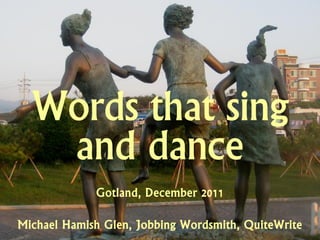
Words that sing and dance
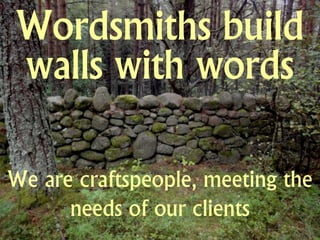
We are craftspeople, meeting the
      needs of our clients
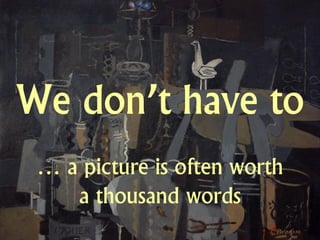
… a picture is often worth
   a thousand words
but … words can often
conjure up a thousand pictures
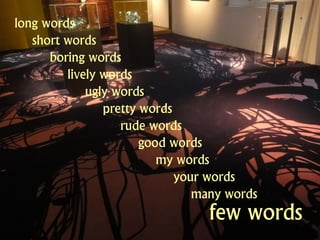
long words
   short words
      boring words
         lively words
             ugly words
                pretty words
                   rude words
                       good words
                          my words
                             your words
                                many words
                                 few words
But they must be the right ones
And that’s the challenge
The choice of words
     is crucial
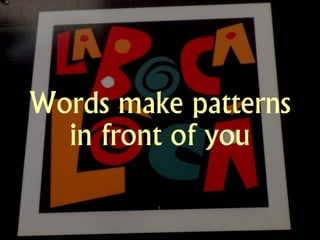
Words make patterns
  in front of you
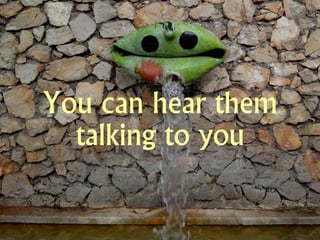
You can hear them
  talking to you
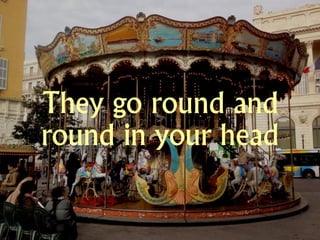
They go round and
round in your head
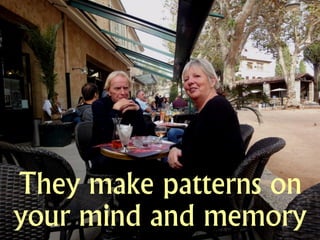
They make patterns on
your mind and memory
You need to create a
little piece of drama…
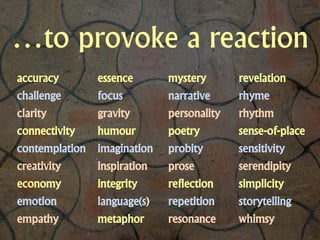
…to provoke a reaction
accuracy        essence       mystery       revelation
challenge       focus         narrative     rhyme
clarity         gravity       personality   rhythm
connectivity    humour        poetry        sense-of-place
contemplation   imagination   probity       sensitivity
creativity      inspiration   prose         serendipity
economy         integrity     reflection    simplicity
emotion         language(s)   repetition    storytelling
empathy         metaphor      resonance     whimsy
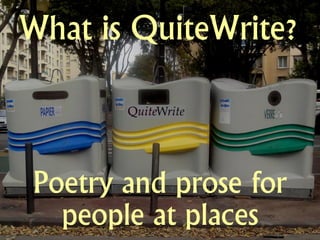
What is QuiteWrite?


Poetry and prose for
  people at places
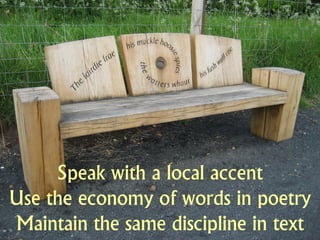
Speak with a local accent
Use the economy of words in poetry
Maintain the same discipline in text
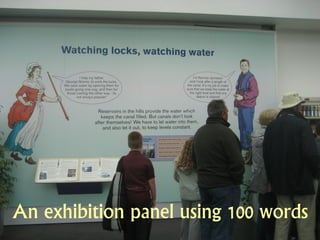
An exhibition panel using 100 words
?


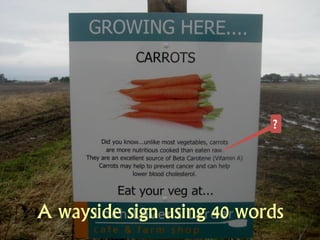
A wayside sign using 40 words
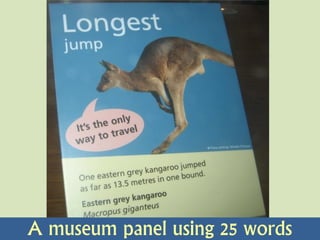
A museum panel using 25 words
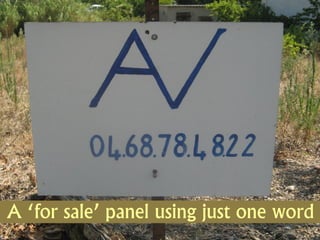
A ‘for sale’ panel using just one word
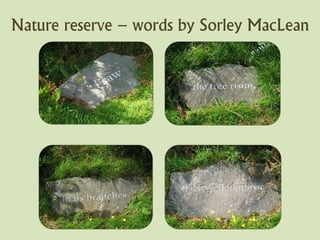
Nature reserve – words by Sorley MacLean
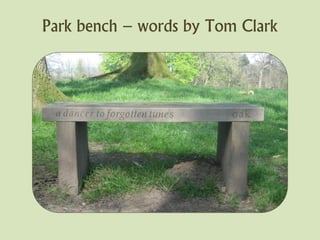
Park bench – words by Tom Clark
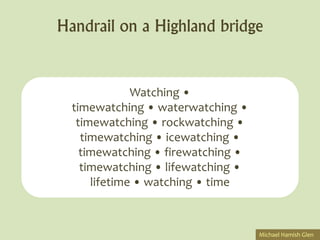
Handrail on a Highland bridge


              Watching •
  timewatching • waterwatching •
   timewatching • rockwatching •
    timewatching • icewatching •
    timewatching • firewatching •
    timewatching • lifewatching •
      lifetime • watching • time


                                    Michael Hamish Glen
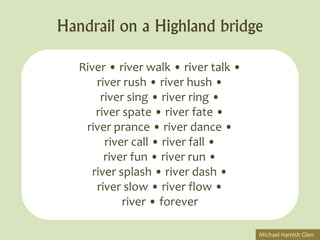
Handrail on a Highland bridge

   River • river walk • river talk •
       river rush • river hush •
        river sing • river ring •
       river spate • river fate •
    river prance • river dance •
         river call • river fall •
         river fun • river run •
      river splash • river dash •
       river slow • river flow •
             river • forever

                                       Michael Hamish Glen
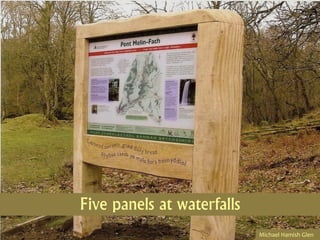
Five panels at waterfalls
                            Michael Hamish Glen
Five panels at waterfalls

Toiling rivers turn mighty engines
             Nerth afonydd yn troi peiriannau mawr
Captured currents grind daily bread
             Ffrydiau caeth yn malu bara beunyddiol
Sudden torrents drown tumbling steps
               Llifiannau sydyn yn boddi grisiau serth
Searching waters carve dark secrets
           Dyfroedd chwilgar yn cerfio tywyllwch cêl
Seeping streams reach thirsty roots
             Nentydd yn treiddio i wreiddiau sychion

                                               Michael Hamish Glen
Six handrails on a new bridge


Languid Leven loch, lowered for working water
         Snaking Leven river, replaced by working water
Sluice-curbed Leven cut, carved out for working water
        Sturdy Leven bridge, braced over working water
Thirsty Leven mills, maintained by working water
        Fertile Leven lands, left free from working water

                                               Michael Hamish Glen
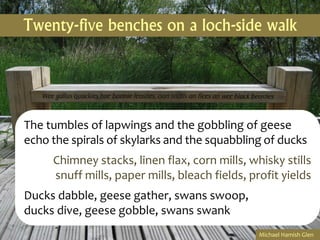
Twenty-five benches on a loch-side walk


The tumbles of lapwings and the gobbling of geese
echo the spirals of skylarks and the squabbling of ducks
     Chimney stacks, linen flax, corn mills, whisky stills
     snuff mills, paper mills, bleach fields, profit yields
Ducks dabble, geese gather, swans swoop,
ducks dive, geese gobble, swans swank
                                                Michael Hamish Glen
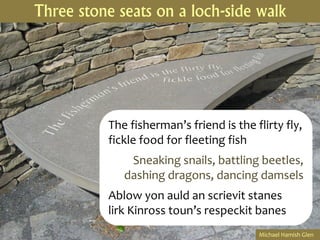
Three stone seats on a loch-side walk


          The fisherman’s friend is the flirty fly,
          fickle food for fleeting fish
              Sneaking snails, battling beetles,
             dashing dragons, dancing damsels
          Ablow yon auld an scrievit stanes
          lirk Kinross toun’s respeckit banes
                                         Michael Hamish Glen
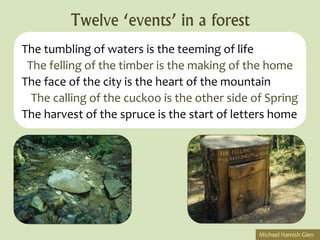
Twelve ‘events’ in a forest
The tumbling of waters is the teeming of life
 The felling of the timber is the making of the home
The face of the city is the heart of the mountain
  The calling of the cuckoo is the other side of Spring
The harvest of the spruce is the start of letters home


                                               Michael Hamish Glen
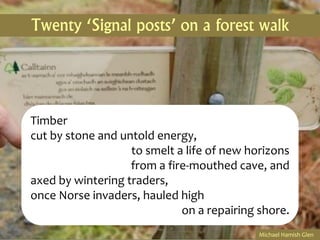
Twenty ‘Signal posts’ on a forest walk


Timber
cut by stone and untold energy,
                   to smelt a life of new horizons
                   from a fire-mouthed cave, and
axed by wintering traders,
once Norse invaders, hauled high
                             on a repairing shore.
                                            Michael Hamish Glen
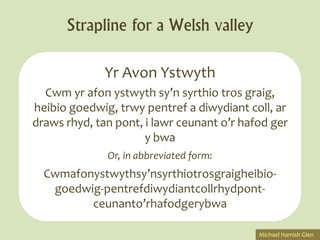
Strapline for a Welsh valley

              Yr Avon Ystwyth
  Cwm yr afon ystwyth sy’n syrthio tros graig,
heibio goedwig, trwy pentref a diwydiant coll, ar
draws rhyd, tan pont, i lawr ceunant o’r hafod ger
                      y bwa
              Or, in abbreviated form:
  Cwmafonystwythsy’nsyrthiotrosgraigheibio-
   goedwig-pentrefdiwydiantcollrhydpont-
         ceunanto’rhafodgerybwa

                                            Michael Hamish Glen
Strapline for a Welsh valley

           The Ystwyth Valley
 The valley of the agile river that tumbles over
 rock, past woodland, village and lost industry,
across the ford, under the bridge and down the
   ravine from the upland farm near the arch
             Or, in abbreviated form:
 Thevalleyoftheagileriverthattumblesoverrock-
  pastwoodlandvillagelostindustryfordbridge-
    ravinefromtheuplandfarmnearthearch

                                           Michael Hamish Glen
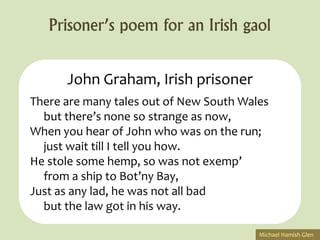
Prisoner’s poem for an Irish gaol


      John Graham, Irish prisoner
There are many tales out of New South Wales
  but there’s none so strange as now,
When you hear of John who was on the run;
  just wait till I tell you how.
He stole some hemp, so was not exemp’
  from a ship to Bot’ny Bay,
Just as any lad, he was not all bad
  but the law got in his way.

                                         Michael Hamish Glen
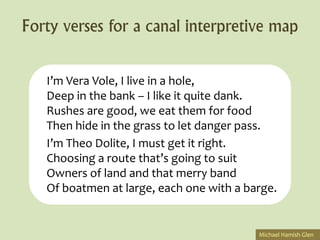
Forty verses for a canal interpretive map

   I’m Vera Vole, I live in a hole,
   Deep in the bank – I like it quite dank.
   Rushes are good, we eat them for food
   Then hide in the grass to let danger pass.
   I’m Theo Dolite, I must get it right.
   Choosing a route that’s going to suit
   Owners of land and that merry band
   Of boatmen at large, each one with a barge.


                                          Michael Hamish Glen
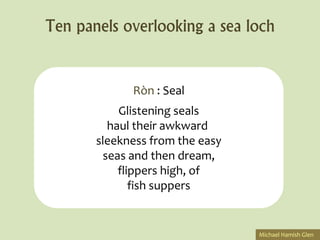
Ten panels overlooking a sea loch


             Ròn : Seal
           Glistening seals
         haul their awkward
       sleekness from the easy
        seas and then dream,
           flippers high, of
              fish suppers


                                 Michael Hamish Glen
A few guidelines
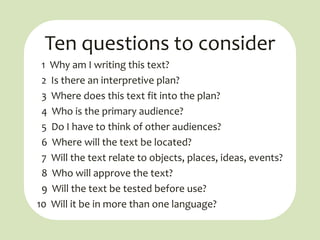
Ten questions to consider
 1 Why am I writing this text?
 2 Is there an interpretive plan?
 3 Where does this text fit into the plan?
 4 Who is the primary audience?
 5 Do I have to think of other audiences?
 6 Where will the text be located?
 7 Will the text relate to objects, places, ideas, events?
 8 Who will approve the text?
 9 Will the text be tested before use?
10 Will it be in more than one language?
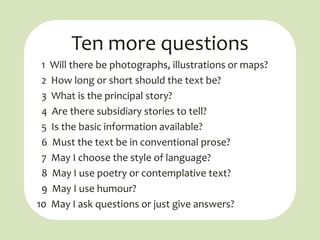
Ten more questions
 1 Will there be photographs, illustrations or maps?
 2 How long or short should the text be?
 3 What is the principal story?
 4 Are there subsidiary stories to tell?
 5 Is the basic information available?
 6 Must the text be in conventional prose?
 7 May I choose the style of language?
 8 May I use poetry or contemplative text?
 9 May I use humour?
10 May I ask questions or just give answers?
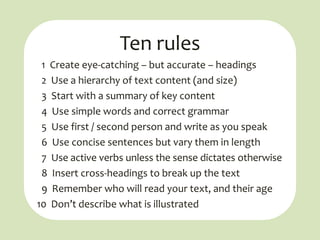
Ten rules
 1 Create eye-catching – but accurate – headings
 2 Use a hierarchy of text content (and size)
 3 Start with a summary of key content
 4 Use simple words and correct grammar
 5 Use first / second person and write as you speak
 6 Use concise sentences but vary them in length
 7 Use active verbs unless the sense dictates otherwise
 8 Insert cross-headings to break up the text
 9 Remember who will read your text, and their age
10 Don’t describe what is illustrated
Another ten rules
 1 Avoid lots of dates and unnecessary details
 2 Avoid capitals, semi-colons; and exclamation marks!
 3 Avoid Latin and other abbreviations
 4 Explain technical terms where necessary
 5 Provide contexts, comparisons and relationships
 6 Consider using quotations and questions
 7 Consider using local and / or dialect words
 8 Consider using bullet points ()
 9 Consider using the Ekarv Method
10 Remember designers can help with good layout
The Ekarv Method
 1 Use simple language to express complex ideas
 2 Write in short sentences
 3 Use the word order of normal speech
 4 Include one main idea only on each line
 5 End lines at the natural end of phrases
 6 Restrict lines to about 45 letters
 7 Always align text to the left
 8 Break text into paragraphs of four or five lines
 9 Read your text aloud and note the natural pauses
10 Adjust wording and punctuation to reflect speech
Sourcing
       Accuracy
        Balance
         Speed
      Significance
        25 words
     Granny-friendly


Journalists’ rules
Sourcing
        Accuracy
         Balance
          Clarity
       Significance
         50 words
      Visitor-friendly


Interpreters’ rules
Michael’s rules
  Make it short and simple
 Make people want to read it
     Make it fun to read
Make the words sing and dance
     Make it memorable
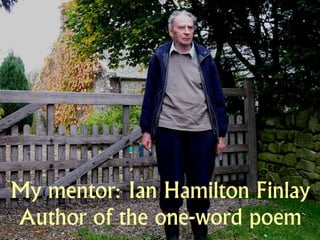
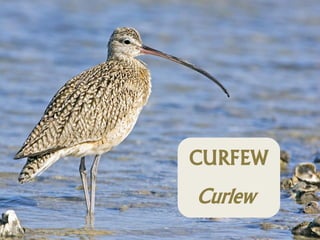
My mentor: Ian Hamilton Finlay
Author of the one-word poem
CURFEW
Curlew
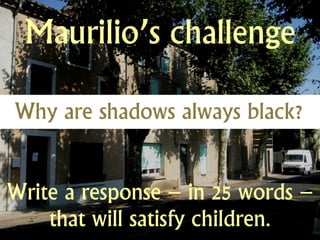
Maurilio’s challenge

Why are shadows always black?


Write a response – in 25 words –
    that will satisfy children.
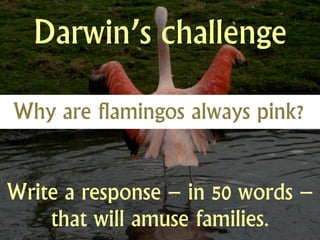
Darwin’s challenge

Why are flamingos always pink?


Write a response – in 50 words –
    that will amuse families.
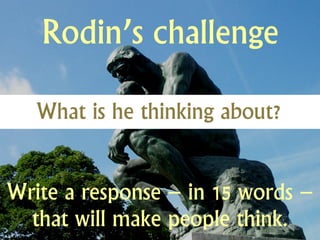
Rodin’s challenge

   What is he thinking about?


Write a response – in 15 words –
  that will make people think.
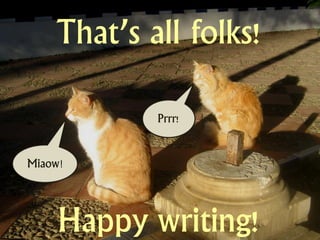
That’s all folks!

            Prrr!


Miaow!


     Happy writing!

Intensivdagarna Words that sing and dance michael h glen

  • 1.
    Words that singand dance
  • 4.
    We are craftspeople,meeting the needs of our clients
  • 6.
    … a pictureis often worth a thousand words
  • 7.
    but … wordscan often conjure up a thousand pictures
  • 8.
    long words short words boring words lively words ugly words pretty words rude words good words my words your words many words few words
  • 9.
    But they mustbe the right ones
  • 10.
  • 11.
    The choice ofwords is crucial
  • 12.
    Words make patterns in front of you
  • 13.
    You can hearthem talking to you
  • 14.
    They go roundand round in your head
  • 15.
    They make patternson your mind and memory
  • 16.
    You need tocreate a little piece of drama…
  • 17.
    …to provoke areaction accuracy essence mystery revelation challenge focus narrative rhyme clarity gravity personality rhythm connectivity humour poetry sense-of-place contemplation imagination probity sensitivity creativity inspiration prose serendipity economy integrity reflection simplicity emotion language(s) repetition storytelling empathy metaphor resonance whimsy
  • 18.
    What is QuiteWrite? Poetryand prose for people at places
  • 19.
    Speak with alocal accent Use the economy of words in poetry Maintain the same discipline in text
  • 20.
    An exhibition panelusing 100 words
  • 21.
    ? A wayside signusing 40 words
  • 22.
    A museum panelusing 25 words
  • 23.
    A ‘for sale’panel using just one word
  • 24.
    Nature reserve –words by Sorley MacLean
  • 25.
    Park bench –words by Tom Clark
  • 26.
    Handrail on aHighland bridge Watching • timewatching • waterwatching • timewatching • rockwatching • timewatching • icewatching • timewatching • firewatching • timewatching • lifewatching • lifetime • watching • time Michael Hamish Glen
  • 27.
    Handrail on aHighland bridge River • river walk • river talk • river rush • river hush • river sing • river ring • river spate • river fate • river prance • river dance • river call • river fall • river fun • river run • river splash • river dash • river slow • river flow • river • forever Michael Hamish Glen
  • 28.
    Five panels atwaterfalls Michael Hamish Glen
  • 29.
    Five panels atwaterfalls Toiling rivers turn mighty engines Nerth afonydd yn troi peiriannau mawr Captured currents grind daily bread Ffrydiau caeth yn malu bara beunyddiol Sudden torrents drown tumbling steps Llifiannau sydyn yn boddi grisiau serth Searching waters carve dark secrets Dyfroedd chwilgar yn cerfio tywyllwch cêl Seeping streams reach thirsty roots Nentydd yn treiddio i wreiddiau sychion Michael Hamish Glen
  • 30.
    Six handrails ona new bridge Languid Leven loch, lowered for working water Snaking Leven river, replaced by working water Sluice-curbed Leven cut, carved out for working water Sturdy Leven bridge, braced over working water Thirsty Leven mills, maintained by working water Fertile Leven lands, left free from working water Michael Hamish Glen
  • 31.
    Twenty-five benches ona loch-side walk The tumbles of lapwings and the gobbling of geese echo the spirals of skylarks and the squabbling of ducks Chimney stacks, linen flax, corn mills, whisky stills snuff mills, paper mills, bleach fields, profit yields Ducks dabble, geese gather, swans swoop, ducks dive, geese gobble, swans swank Michael Hamish Glen
  • 32.
    Three stone seatson a loch-side walk The fisherman’s friend is the flirty fly, fickle food for fleeting fish Sneaking snails, battling beetles, dashing dragons, dancing damsels Ablow yon auld an scrievit stanes lirk Kinross toun’s respeckit banes Michael Hamish Glen
  • 33.
    Twelve ‘events’ ina forest The tumbling of waters is the teeming of life The felling of the timber is the making of the home The face of the city is the heart of the mountain The calling of the cuckoo is the other side of Spring The harvest of the spruce is the start of letters home Michael Hamish Glen
  • 34.
    Twenty ‘Signal posts’on a forest walk Timber cut by stone and untold energy, to smelt a life of new horizons from a fire-mouthed cave, and axed by wintering traders, once Norse invaders, hauled high on a repairing shore. Michael Hamish Glen
  • 35.
    Strapline for aWelsh valley Yr Avon Ystwyth Cwm yr afon ystwyth sy’n syrthio tros graig, heibio goedwig, trwy pentref a diwydiant coll, ar draws rhyd, tan pont, i lawr ceunant o’r hafod ger y bwa Or, in abbreviated form: Cwmafonystwythsy’nsyrthiotrosgraigheibio- goedwig-pentrefdiwydiantcollrhydpont- ceunanto’rhafodgerybwa Michael Hamish Glen
  • 36.
    Strapline for aWelsh valley The Ystwyth Valley The valley of the agile river that tumbles over rock, past woodland, village and lost industry, across the ford, under the bridge and down the ravine from the upland farm near the arch Or, in abbreviated form: Thevalleyoftheagileriverthattumblesoverrock- pastwoodlandvillagelostindustryfordbridge- ravinefromtheuplandfarmnearthearch Michael Hamish Glen
  • 37.
    Prisoner’s poem foran Irish gaol John Graham, Irish prisoner There are many tales out of New South Wales but there’s none so strange as now, When you hear of John who was on the run; just wait till I tell you how. He stole some hemp, so was not exemp’ from a ship to Bot’ny Bay, Just as any lad, he was not all bad but the law got in his way. Michael Hamish Glen
  • 38.
    Forty verses fora canal interpretive map I’m Vera Vole, I live in a hole, Deep in the bank – I like it quite dank. Rushes are good, we eat them for food Then hide in the grass to let danger pass. I’m Theo Dolite, I must get it right. Choosing a route that’s going to suit Owners of land and that merry band Of boatmen at large, each one with a barge. Michael Hamish Glen
  • 39.
    Ten panels overlookinga sea loch Ròn : Seal Glistening seals haul their awkward sleekness from the easy seas and then dream, flippers high, of fish suppers Michael Hamish Glen
  • 40.
  • 41.
    Ten questions toconsider 1 Why am I writing this text? 2 Is there an interpretive plan? 3 Where does this text fit into the plan? 4 Who is the primary audience? 5 Do I have to think of other audiences? 6 Where will the text be located? 7 Will the text relate to objects, places, ideas, events? 8 Who will approve the text? 9 Will the text be tested before use? 10 Will it be in more than one language?
  • 42.
    Ten more questions 1 Will there be photographs, illustrations or maps? 2 How long or short should the text be? 3 What is the principal story? 4 Are there subsidiary stories to tell? 5 Is the basic information available? 6 Must the text be in conventional prose? 7 May I choose the style of language? 8 May I use poetry or contemplative text? 9 May I use humour? 10 May I ask questions or just give answers?
  • 43.
    Ten rules 1Create eye-catching – but accurate – headings 2 Use a hierarchy of text content (and size) 3 Start with a summary of key content 4 Use simple words and correct grammar 5 Use first / second person and write as you speak 6 Use concise sentences but vary them in length 7 Use active verbs unless the sense dictates otherwise 8 Insert cross-headings to break up the text 9 Remember who will read your text, and their age 10 Don’t describe what is illustrated
  • 44.
    Another ten rules 1 Avoid lots of dates and unnecessary details 2 Avoid capitals, semi-colons; and exclamation marks! 3 Avoid Latin and other abbreviations 4 Explain technical terms where necessary 5 Provide contexts, comparisons and relationships 6 Consider using quotations and questions 7 Consider using local and / or dialect words 8 Consider using bullet points () 9 Consider using the Ekarv Method 10 Remember designers can help with good layout
  • 45.
    The Ekarv Method 1 Use simple language to express complex ideas 2 Write in short sentences 3 Use the word order of normal speech 4 Include one main idea only on each line 5 End lines at the natural end of phrases 6 Restrict lines to about 45 letters 7 Always align text to the left 8 Break text into paragraphs of four or five lines 9 Read your text aloud and note the natural pauses 10 Adjust wording and punctuation to reflect speech
  • 46.
    Sourcing Accuracy Balance Speed Significance 25 words Granny-friendly Journalists’ rules
  • 47.
    Sourcing Accuracy Balance Clarity Significance 50 words Visitor-friendly Interpreters’ rules
  • 48.
    Michael’s rules Make it short and simple Make people want to read it Make it fun to read Make the words sing and dance Make it memorable
  • 49.
    My mentor: IanHamilton Finlay Author of the one-word poem
  • 50.
  • 51.
    Maurilio’s challenge Why areshadows always black? Write a response – in 25 words – that will satisfy children.
  • 52.
    Darwin’s challenge Why areflamingos always pink? Write a response – in 50 words – that will amuse families.
  • 53.
    Rodin’s challenge What is he thinking about? Write a response – in 15 words – that will make people think.
  • 54.
    That’s all folks! Prrr! Miaow! Happy writing!