
WordPress Template Hierarchy
Jason Yingling
Post vs Page vs Webpage
• Webpage – an HTML document being served
to a web browser. The final output of your
PHP into HTML, CSS, and JS.
Post vs Page vs Webpage
• “post” – content stored in the database in the
wp_posts table
Post vs Page vs Webpage
• Post – A default WordPress post of type “Post”
• Page – A default WordPress post of type
“Page”
• Posts, Pages, and Custom Post Types are all
stored together in the wp_posts table of the
database with different types (Post, Page,
Product, etc.)
Template Terminology
• Template Files – PHP files that determine the site’s
markup.
• Page Templates – “those that apply only to pages to
change their look and feel. A page template can be
applied to a single page, a page section, or a class of
pages.”
• Template Tags – Functions used within template files to
retrieve and return data. (ex. the_title() or
the_content()
• Template Hierarchy – The logic WordPress uses to
determine which template file to use to display certain
data
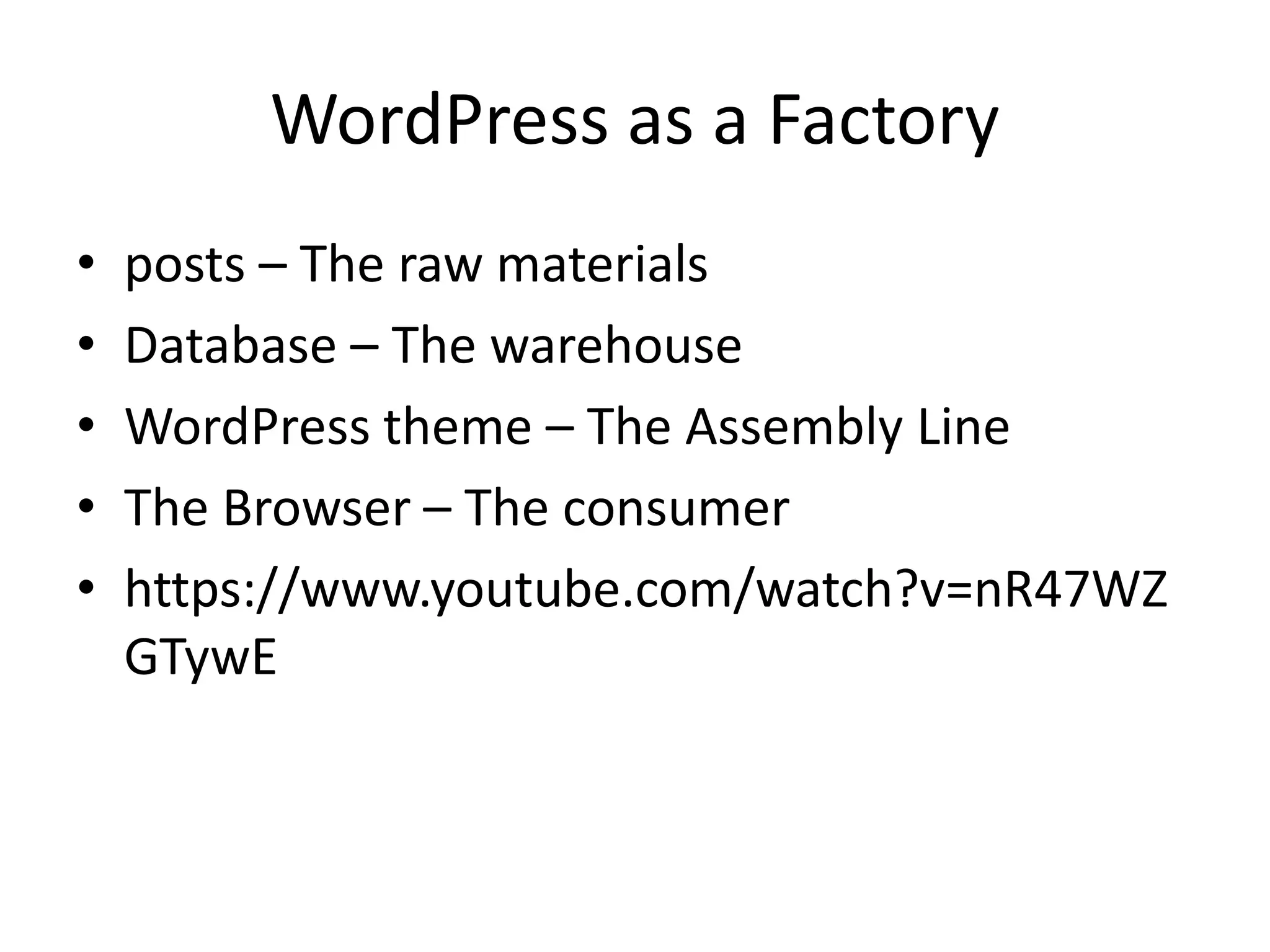
WordPress as a Factory
• posts – The raw materials
• Database – The warehouse
• WordPress theme – The Assembly Line
• The Browser – The consumer
• https://www.youtube.com/watch?v=nR47WZ
GTywE
Crucial Templates
• style.css – determines the theme’s visual
appearance and registers the theme with
WordPress
• functions.php – used for presentational
functionality.
• Template Files – determine the site’s markup.
Uses PHP to convert data from the database
into the HTML output to the browser.
style.css
• (image of registration header)
• Required by WordPress to register the theme
functions.php
• Enqueuing additional stylesheets and scripts
• Creating widgetized areas and menus
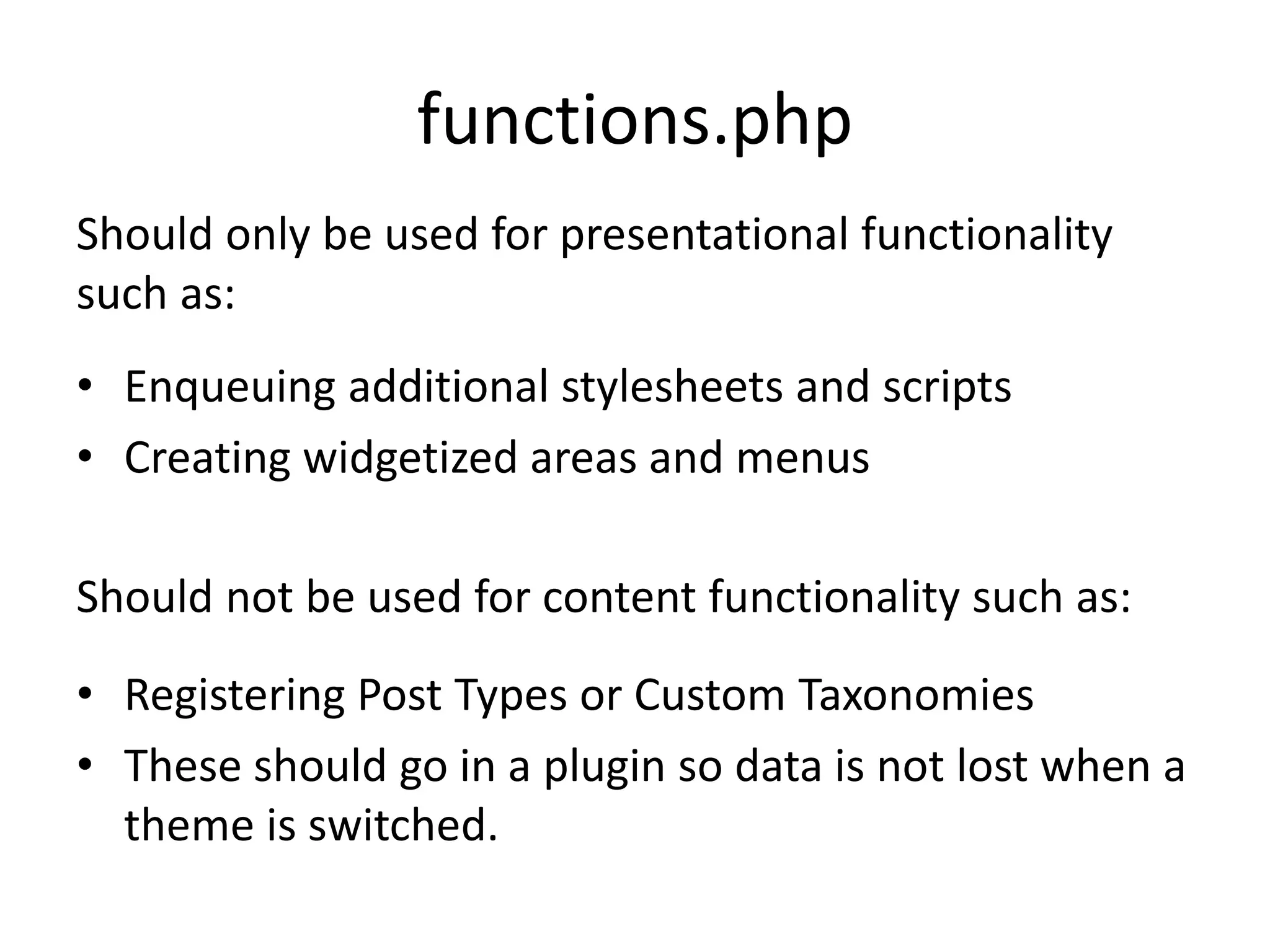
Should only be used for presentational functionality
such as:
• Registering Post Types or Custom Taxonomies
• These should go in a plugin so data is not lost when a
theme is switched.
Should not be used for content functionality such as:
Template Files
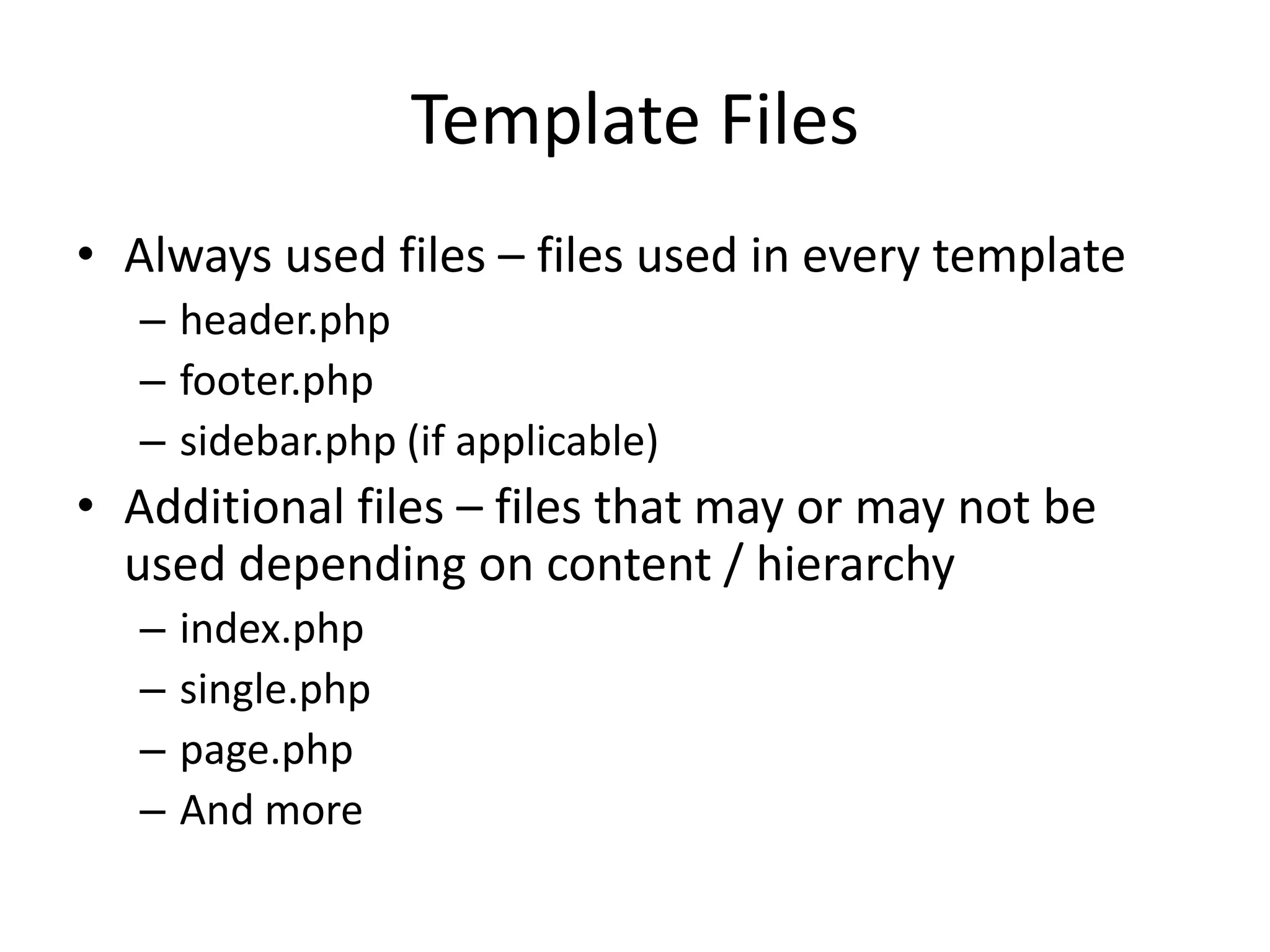
• Always used files – files used in every template
– header.php
– footer.php
– sidebar.php (if applicable)
• Additional files – files that may or may not be
used depending on content / hierarchy
– index.php
– single.php
– page.php
– And more
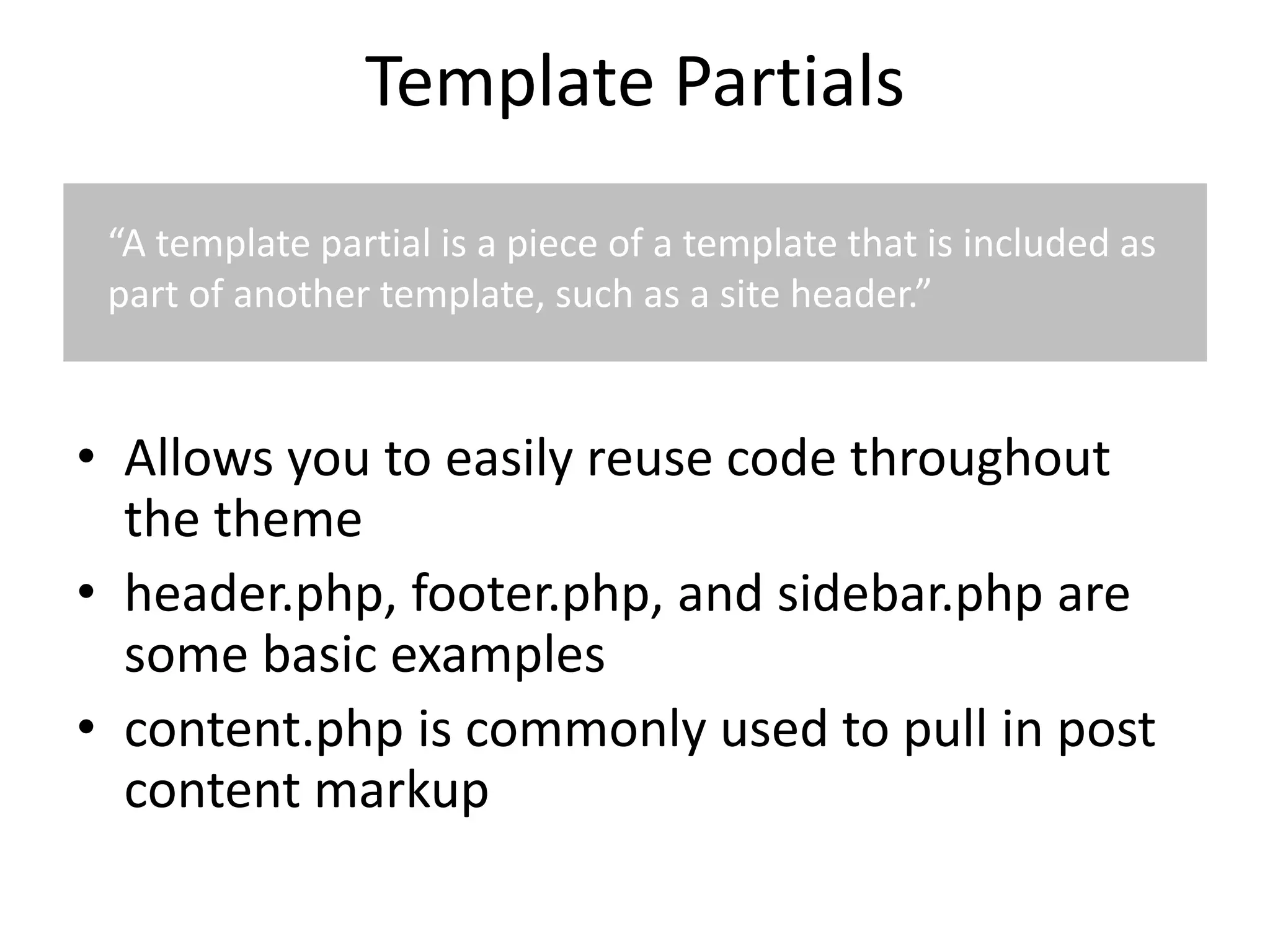
Template Partials
• Allows you to easily reuse code throughout
the theme
• header.php, footer.php, and sidebar.php are
some basic examples
• content.php is commonly used to pull in post
content markup
“A template partial is a piece of a template that is included as
part of another template, such as a site header.”
Common Template Files
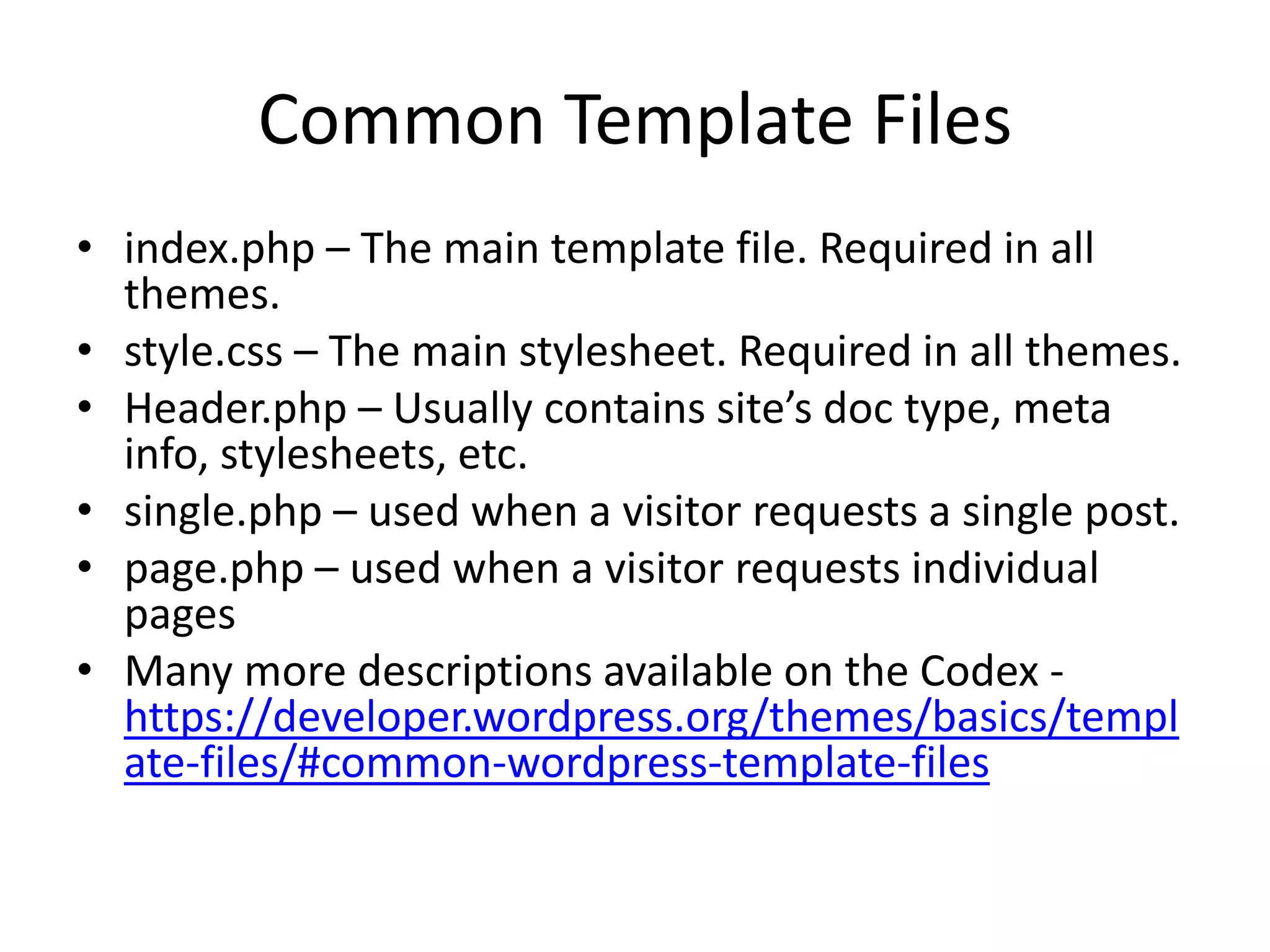
• index.php – The main template file. Required in all
themes.
• style.css – The main stylesheet. Required in all themes.
• Header.php – Usually contains site’s doc type, meta
info, stylesheets, etc.
• single.php – used when a visitor requests a single post.
• page.php – used when a visitor requests individual
pages
• Many more descriptions available on the Codex -
https://developer.wordpress.org/themes/basics/templ
ate-files/#common-wordpress-template-files
Template Hierarchy
• The logic WordPress uses to determine which
template file to use to return requested post
data
Everything goes back to index.php
• No single.php template? WordPress will use
index.php
• No page.php template? WordPress will use
index.php
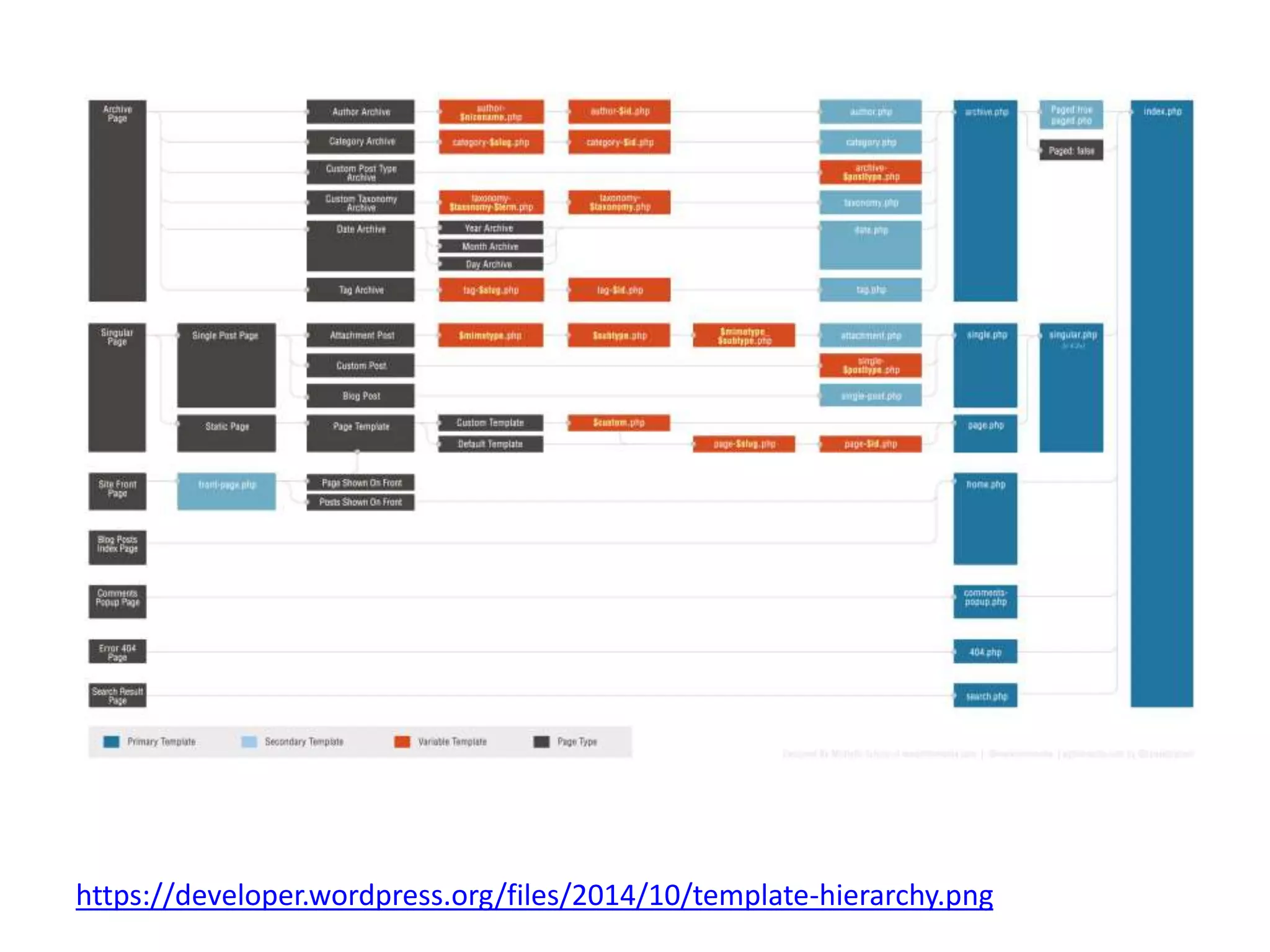
https://developer.wordpress.org/files/2014/10/template-hierarchy.png
Single Post
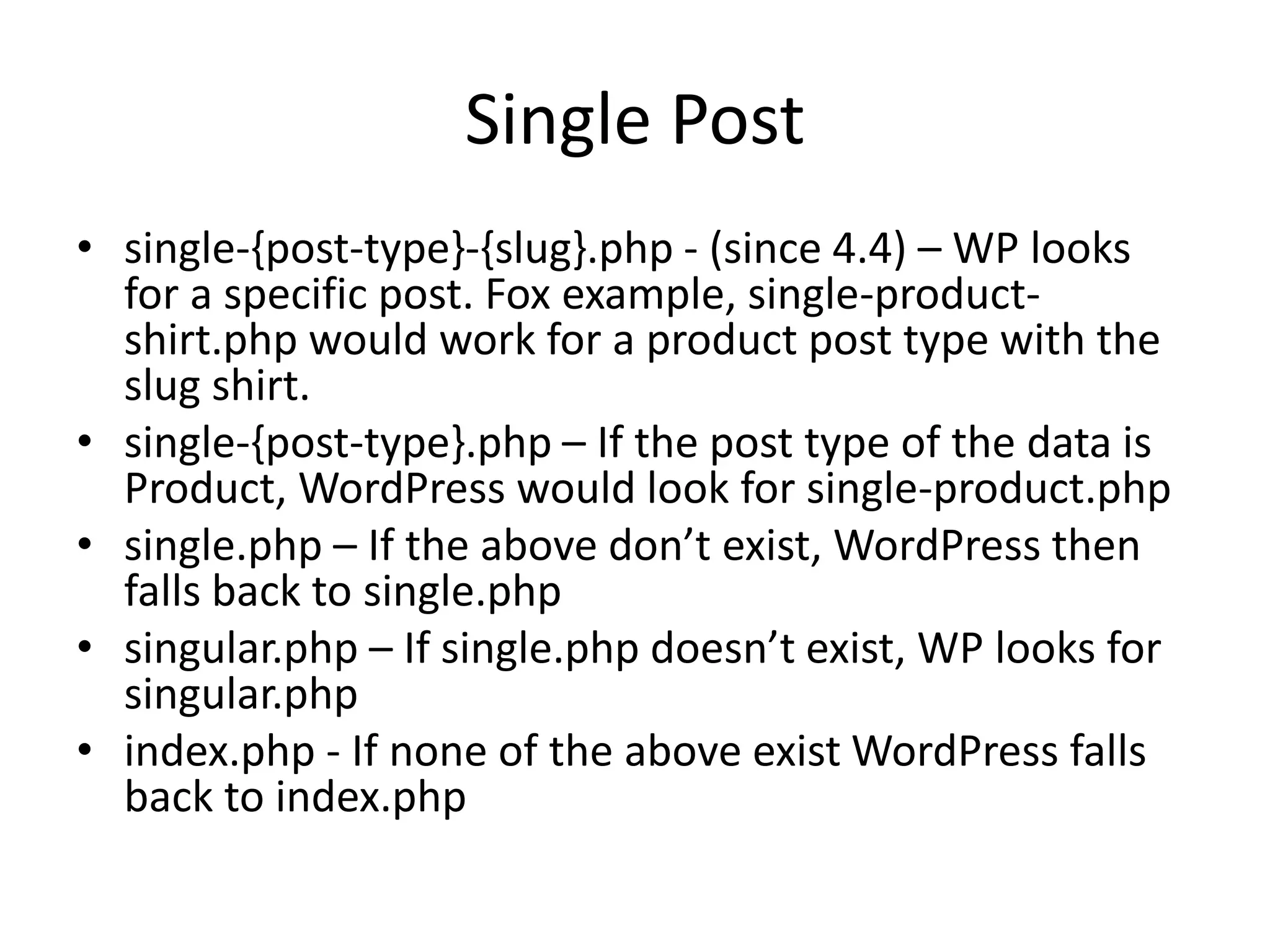
• single-{post-type}-{slug}.php - (since 4.4) – WP looks
for a specific post. Fox example, single-product-
shirt.php would work for a product post type with the
slug shirt.
• single-{post-type}.php – If the post type of the data is
Product, WordPress would look for single-product.php
• single.php – If the above don’t exist, WordPress then
falls back to single.php
• singular.php – If single.php doesn’t exist, WP looks for
singular.php
• index.php - If none of the above exist WordPress falls
back to index.php
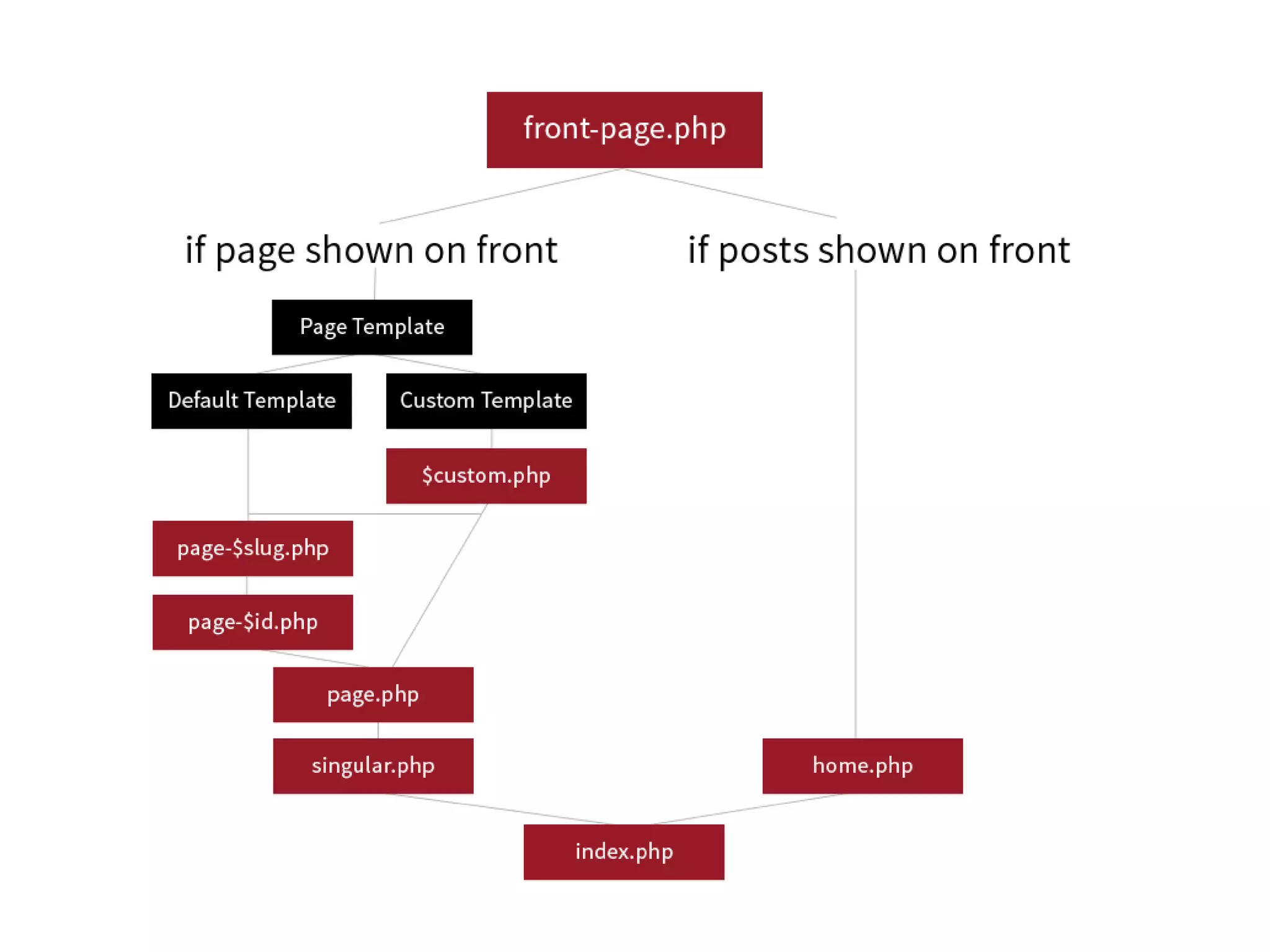
Page
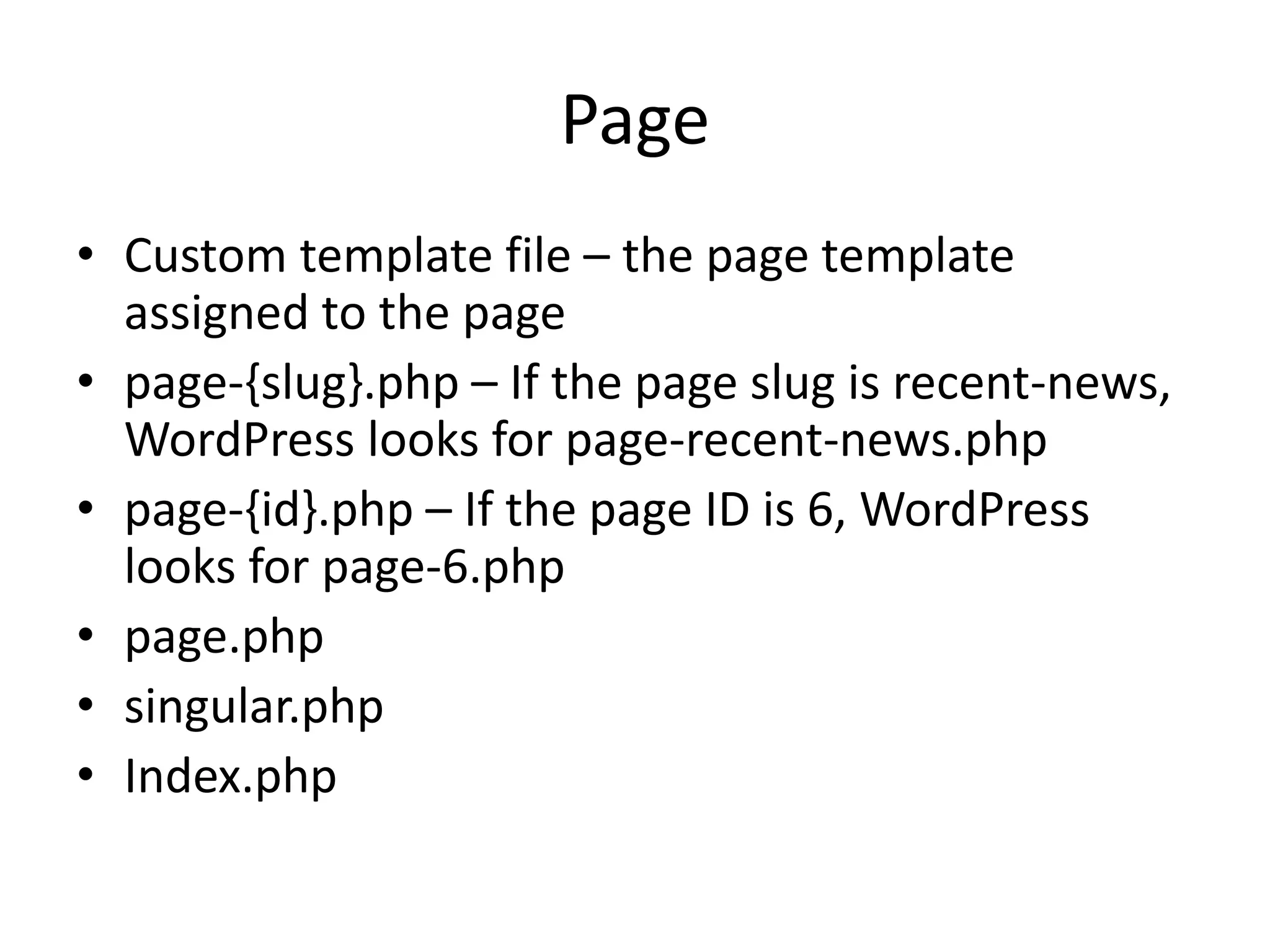
• Custom template file – the page template
assigned to the page
• page-{slug}.php – If the page slug is recent-news,
WordPress looks for page-recent-news.php
• page-{id}.php – If the page ID is 6, WordPress
looks for page-6.php
• page.php
• singular.php
• Index.php
Template Hierarchy Resources
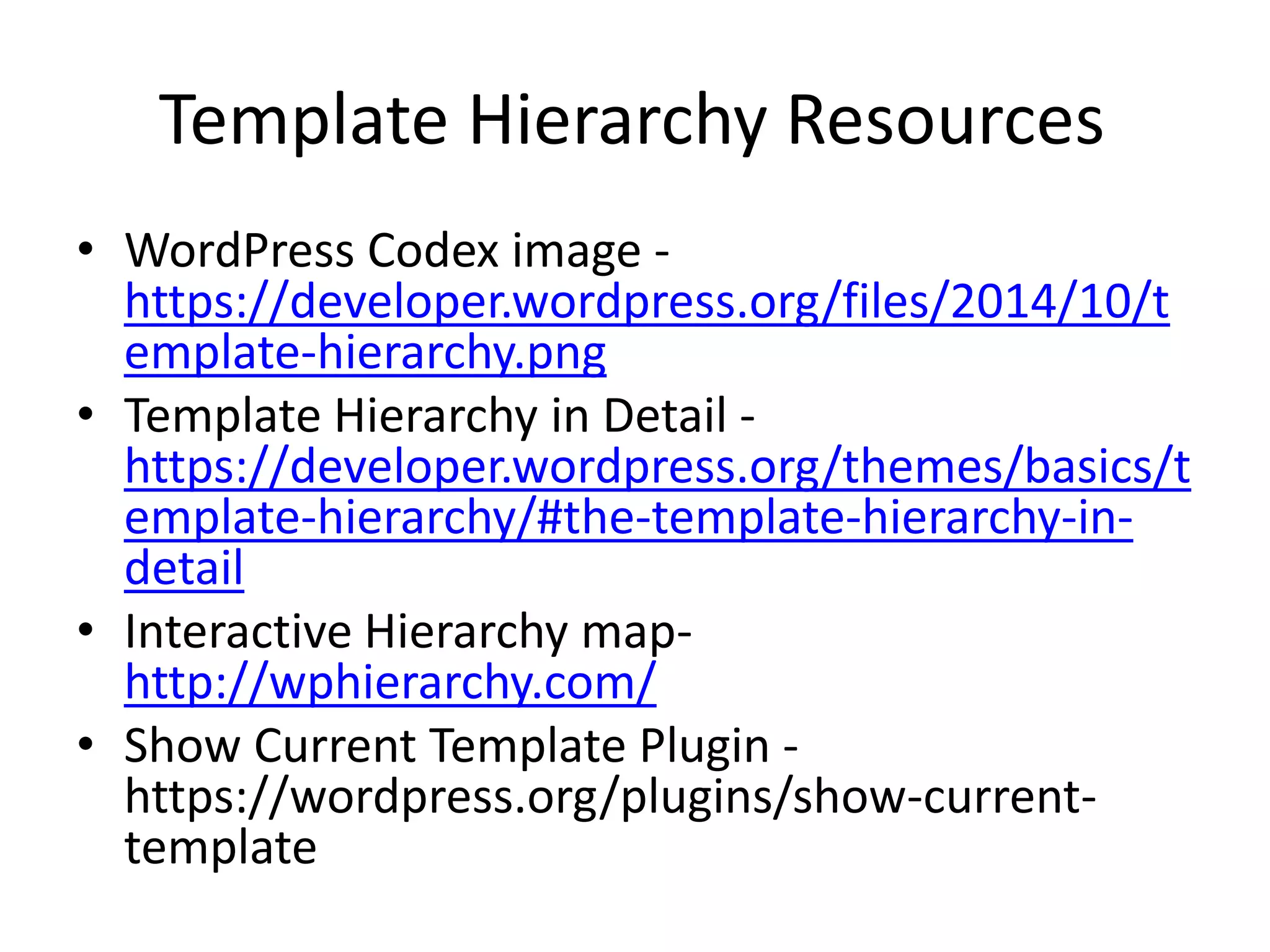
• WordPress Codex image -
https://developer.wordpress.org/files/2014/10/t
emplate-hierarchy.png
• Template Hierarchy in Detail -
https://developer.wordpress.org/themes/basics/t
emplate-hierarchy/#the-template-hierarchy-in-
detail
• Interactive Hierarchy map-
http://wphierarchy.com/
• Show Current Template Plugin -
https://wordpress.org/plugins/show-current-
template
WordPress Template hierarchy

WordPress Template hierarchy

  • 1.
  • 2.
    Post vs Pagevs Webpage • Webpage – an HTML document being served to a web browser. The final output of your PHP into HTML, CSS, and JS.
  • 3.
    Post vs Pagevs Webpage • “post” – content stored in the database in the wp_posts table
  • 4.
    Post vs Pagevs Webpage • Post – A default WordPress post of type “Post” • Page – A default WordPress post of type “Page” • Posts, Pages, and Custom Post Types are all stored together in the wp_posts table of the database with different types (Post, Page, Product, etc.)
  • 5.
    Template Terminology • TemplateFiles – PHP files that determine the site’s markup. • Page Templates – “those that apply only to pages to change their look and feel. A page template can be applied to a single page, a page section, or a class of pages.” • Template Tags – Functions used within template files to retrieve and return data. (ex. the_title() or the_content() • Template Hierarchy – The logic WordPress uses to determine which template file to use to display certain data
  • 6.
    WordPress as aFactory • posts – The raw materials • Database – The warehouse • WordPress theme – The Assembly Line • The Browser – The consumer • https://www.youtube.com/watch?v=nR47WZ GTywE
  • 7.
    Crucial Templates • style.css– determines the theme’s visual appearance and registers the theme with WordPress • functions.php – used for presentational functionality. • Template Files – determine the site’s markup. Uses PHP to convert data from the database into the HTML output to the browser.
  • 8.
    style.css • (image ofregistration header) • Required by WordPress to register the theme
  • 9.
    functions.php • Enqueuing additionalstylesheets and scripts • Creating widgetized areas and menus Should only be used for presentational functionality such as: • Registering Post Types or Custom Taxonomies • These should go in a plugin so data is not lost when a theme is switched. Should not be used for content functionality such as:
  • 10.
    Template Files • Alwaysused files – files used in every template – header.php – footer.php – sidebar.php (if applicable) • Additional files – files that may or may not be used depending on content / hierarchy – index.php – single.php – page.php – And more
  • 11.
    Template Partials • Allowsyou to easily reuse code throughout the theme • header.php, footer.php, and sidebar.php are some basic examples • content.php is commonly used to pull in post content markup “A template partial is a piece of a template that is included as part of another template, such as a site header.”
  • 12.
    Common Template Files •index.php – The main template file. Required in all themes. • style.css – The main stylesheet. Required in all themes. • Header.php – Usually contains site’s doc type, meta info, stylesheets, etc. • single.php – used when a visitor requests a single post. • page.php – used when a visitor requests individual pages • Many more descriptions available on the Codex - https://developer.wordpress.org/themes/basics/templ ate-files/#common-wordpress-template-files
  • 13.
    Template Hierarchy • Thelogic WordPress uses to determine which template file to use to return requested post data
  • 14.
    Everything goes backto index.php • No single.php template? WordPress will use index.php • No page.php template? WordPress will use index.php
  • 15.
  • 17.
    Single Post • single-{post-type}-{slug}.php- (since 4.4) – WP looks for a specific post. Fox example, single-product- shirt.php would work for a product post type with the slug shirt. • single-{post-type}.php – If the post type of the data is Product, WordPress would look for single-product.php • single.php – If the above don’t exist, WordPress then falls back to single.php • singular.php – If single.php doesn’t exist, WP looks for singular.php • index.php - If none of the above exist WordPress falls back to index.php
  • 18.
    Page • Custom templatefile – the page template assigned to the page • page-{slug}.php – If the page slug is recent-news, WordPress looks for page-recent-news.php • page-{id}.php – If the page ID is 6, WordPress looks for page-6.php • page.php • singular.php • Index.php
  • 19.
    Template Hierarchy Resources •WordPress Codex image - https://developer.wordpress.org/files/2014/10/t emplate-hierarchy.png • Template Hierarchy in Detail - https://developer.wordpress.org/themes/basics/t emplate-hierarchy/#the-template-hierarchy-in- detail • Interactive Hierarchy map- http://wphierarchy.com/ • Show Current Template Plugin - https://wordpress.org/plugins/show-current- template