
Creative development
research that actually helps you
make amazing ads
THE SOUND
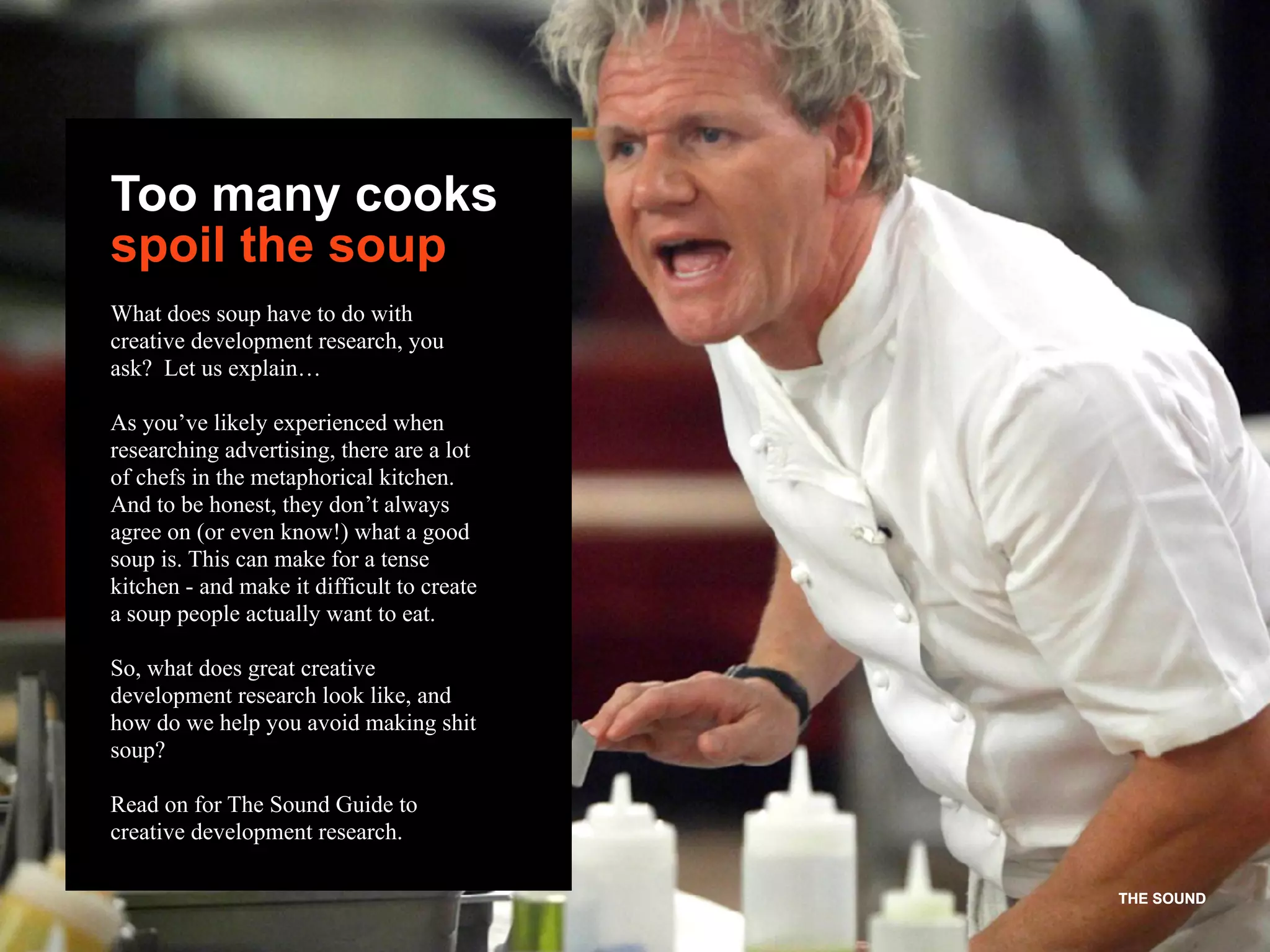
Too many cooks
spoil the soup
What does soup have to do with
creative development research, you
ask? Let us explain…
As you’ve likely experienced when
researching advertising, there are a lot
of chefs in the metaphorical kitchen.
And to be honest, they don’t always
agree on (or even know!) what a good
soup is. This can make for a tense
kitchen - and make it difficult to create
a soup people actually want to eat.
So, what does great creative
development research look like, and
how do we help you avoid making shit
soup?
Read on for The Sound Guide to
creative development research.
THE SOUND
THE SOUND
Why to
bother with
research
at all
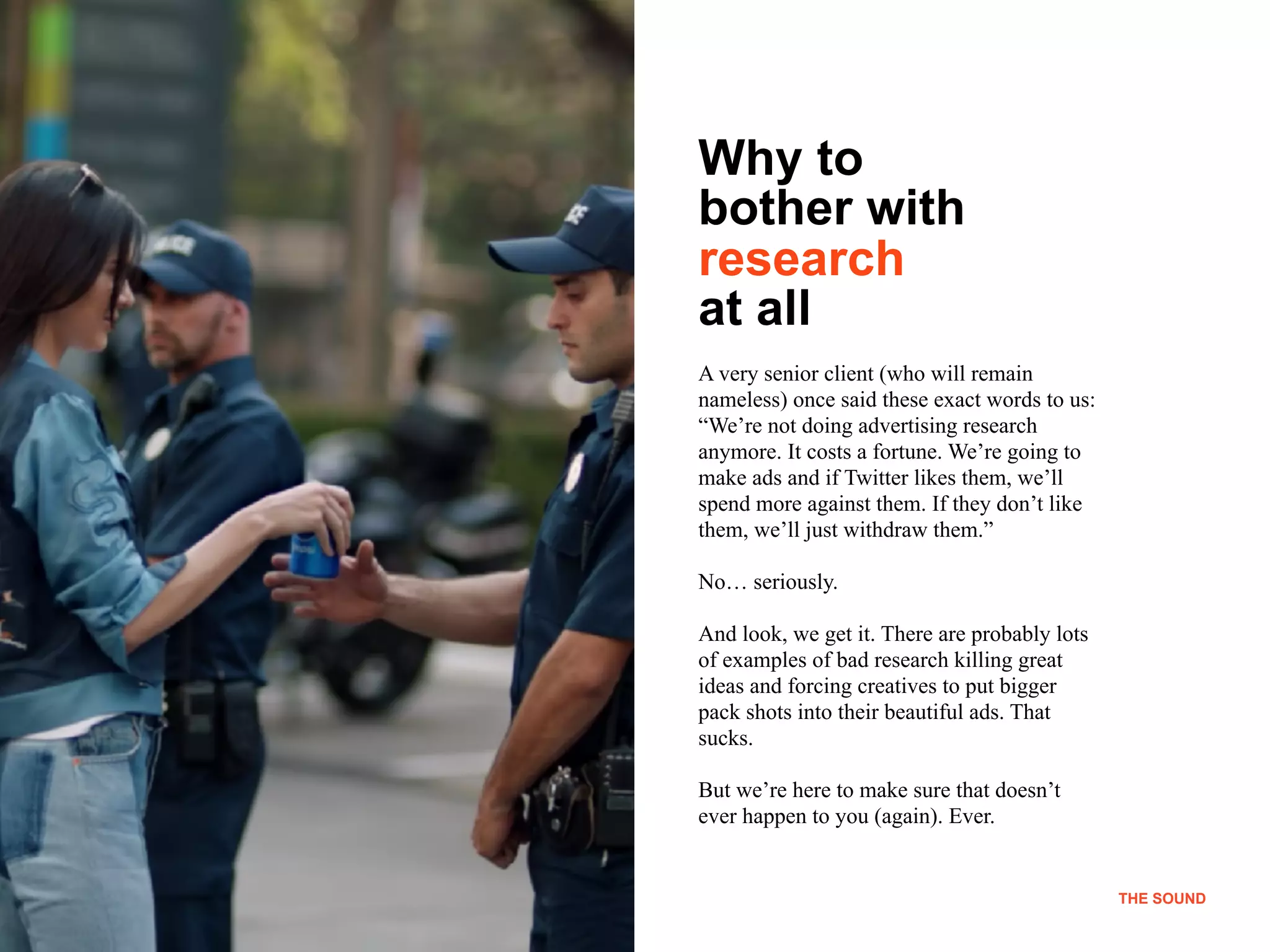
A very senior client (who will remain
nameless) once said these exact words to us:
“We’re not doing advertising research
anymore. It costs a fortune. We’re going to
make ads and if Twitter likes them, we’ll
spend more against them. If they don’t like
them, we’ll just withdraw them.”
No… seriously.
And look, we get it. There are probably lots
of examples of bad research killing great
ideas and forcing creatives to put bigger
pack shots into their beautiful ads. That
sucks.
But we’re here to make sure that doesn’t
ever happen to you (again). Ever.
THE SOUND
!4
THE SOUND
The role of
research in the
creative process
So, let’s say you’ve got three great advertising
ideas for a new soup. You love all of them (one
secretly more than the others, just like your
kids...) but you want to know which one to
make. What better way than asking people
what they like the best and going with that?
Wrong. Like, really wrong.
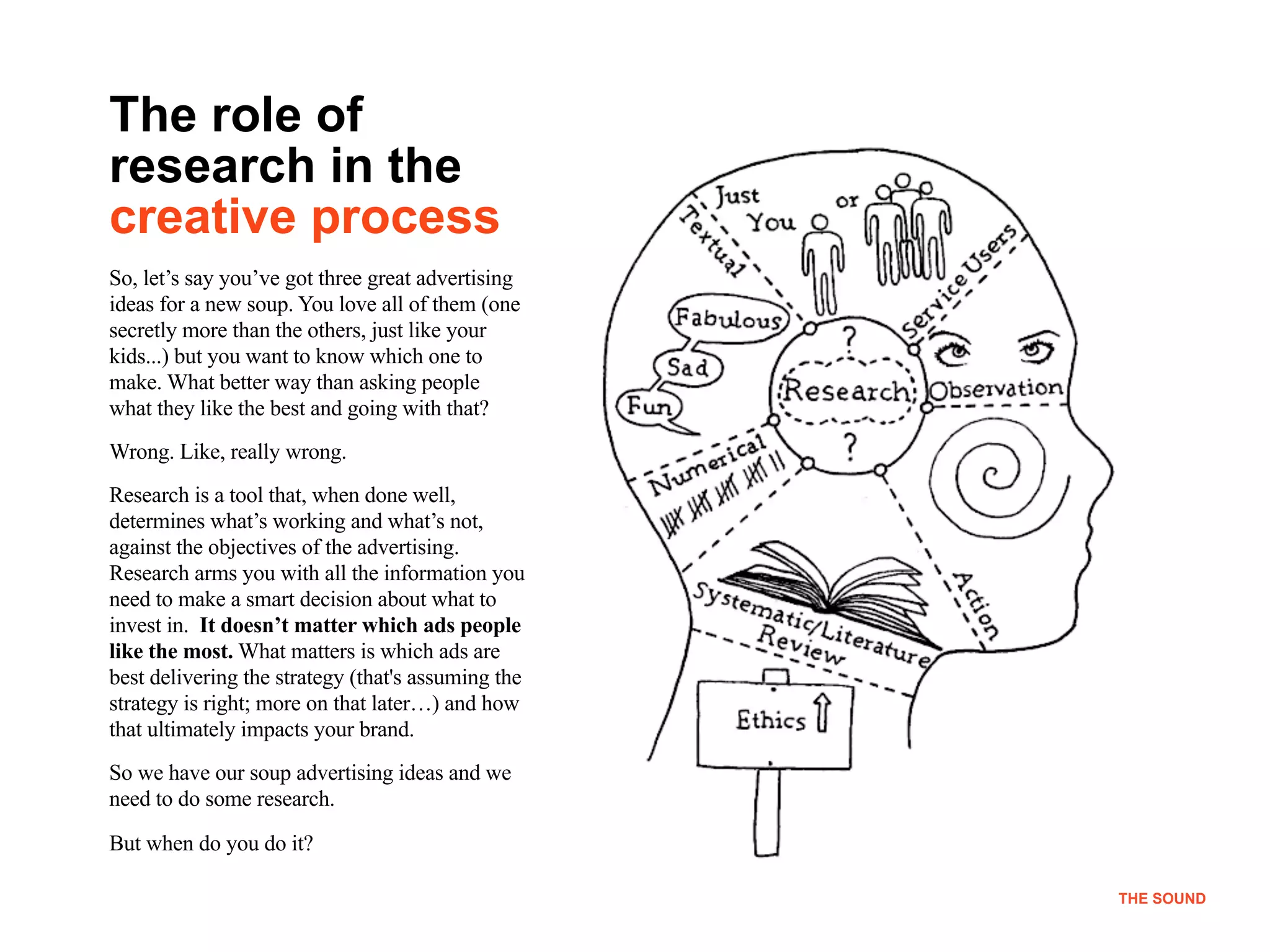
Research is a tool that, when done well,
determines what’s working and what’s not,
against the objectives of the advertising.
Research arms you with all the information you
need to make a smart decision about what to
invest in. It doesn’t matter which ads people
like the most. What matters is which ads are
best delivering the strategy (that's assuming the
strategy is right; more on that later…) and how
that ultimately impacts your brand.
So we have our soup advertising ideas and we
need to do some research.
But when do you do it?
THE SOUND
!5
THE SOUND
When to actually do it
When Developing
The Strategic Idea
When Developing
The Creative Ideas
When Refining
The Executional Ideas
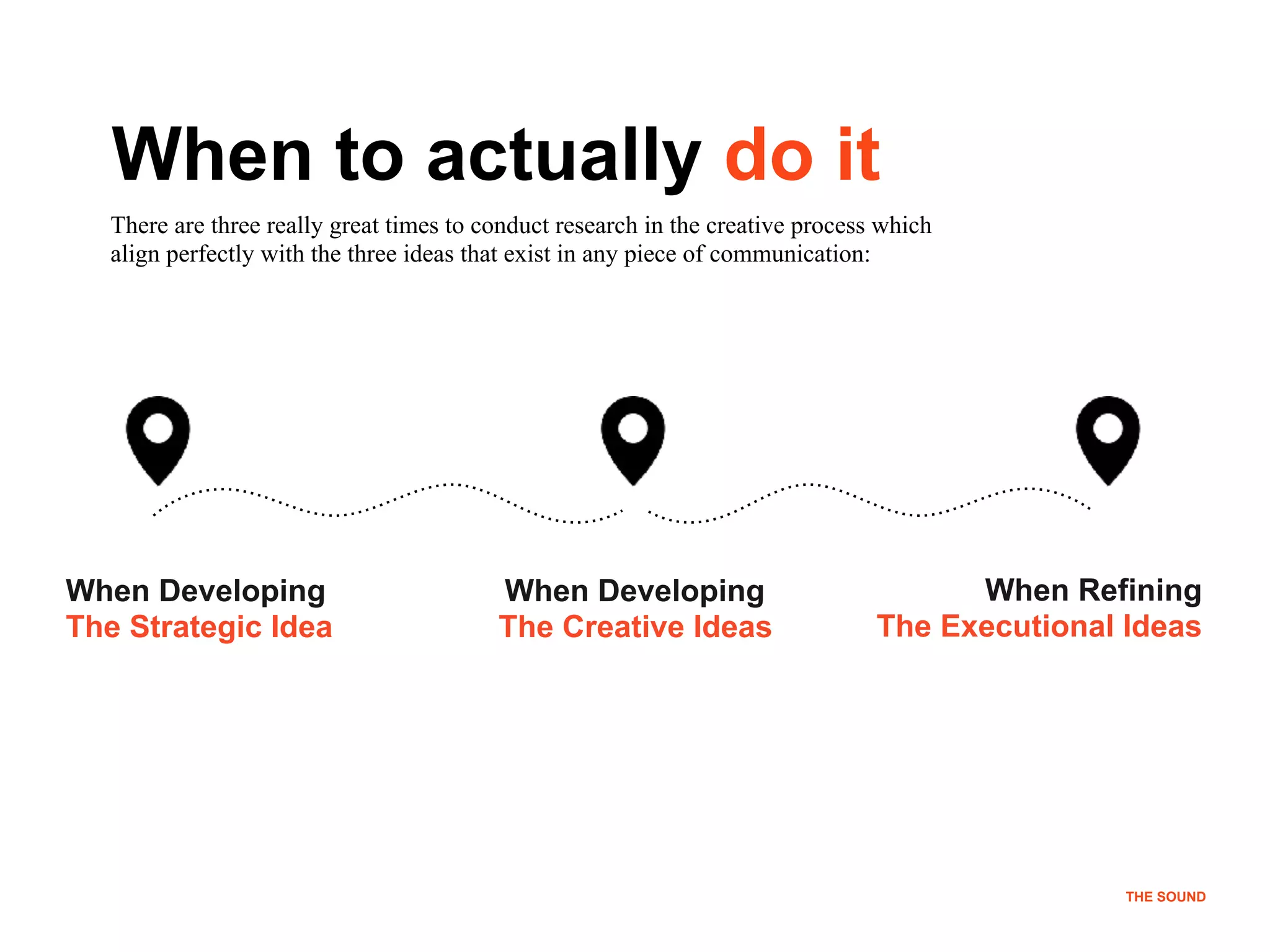
There are three really great times to conduct research in the creative process which
align perfectly with the three ideas that exist in any piece of communication:
THE SOUND
THE SOUND
The difference between ideas
Er - just making sure everyone here knows the difference between the three ideas within any
piece of communication. Right? You do? Good. Well, just to be sure, a quick recap…
Strategic Idea
Usually closely related to the
positioning, a convergence
of product benefits,
consumer insight and brand
role. So, for example, let’s
say our soup strategy is to
communicate how soup
brings the family together.
Creative Ideas
Creative ideas are broad
concepts which are designed to
bring the strategy to life in an
engaging way. For example,
one of our soup creative ideas
is that there is a world shortage
of soup and as a result, family
life has broken down.
Executional Ideas
Executions are easiest to understand,
since they’re the concrete expression of
the creative idea captured in things like
scripts and posters and activation ideas.
But of course, any execution needs to
clearly ladder up to both the creative
idea and strategy to work.
For example, one of the soup scripts for
the above creative idea is called Soup
Zombies, where family members
become zombies, wandering around the
house in zombie-like states, because
they have no soup. They just say,
‘sooooooup’ as they wander past each
other.
Probably best we didn’t go into
advertising…
THE SOUNDTHE SOUND
Research when
developing the
Strategic Idea
The strategic idea is very rarely researched for
the first time after creative ideas have been
developed. Rather, it’s typically done when
developing the brand positioning. In this way,
research has usually fed into its articulation
much earlier. Ideally.
Obvious point, but it’s important to know that
your strategy is built on solid foundations before
going off and developing creative. A solid
foundation is a strategic idea built from an
understanding of your consumer, your category,
and your brand. (But you knew that, of course.)
We know there are times when this doesn’t
happen and we can work with it. But seriously…
try to avoid this, because it can result in a lot of
wasted time and money.
Research your strategy and get it right before
briefing the agency.
THE SOUND
Research when
developing the
Creative Ideas
Assuming the strategy has been explored,
developed and validated, we can move
into creative development research… the
focus of this deck!
So, we have three creative ideas to bring
the strategy to life and the agency has
developed a couple of executions for
each. One of the creative ideas is Soup
Shortage and of course includes the Soup
Zombies execution (which is definitely in
the running to win a Cannes Lion, but
that's another story…).
Given we want to develop each creative
idea to its fullest potential so you can
decide which to invest in, we want to do
some discussion groups. Why groups?
Well, they’re one of the best ways of
exploring and building ideas, and that’s
exactly what we want to do at this stage.
THE SOUND
!9
THE SOUND
Before we moderate the groups, we need a proper
briefing about the strategic idea and how each
creative idea is meant to bring the strategy to life.
We also need a walk through of all the executions
and the type of stimuli the team is planning to
provide. Finally, we love hearing about any key
questions or concerns the team has to make sure we
address them in our discussion guide.
As intelligent researchers, we of course have
developed our own hypotheses about how the
work is functioning against the objectives, and are
happy to share those with you once we see the work.
But during this briefing process, please don’t ask
us which our favorite idea is. Why not?
1. It’s our job to be completely unbiased. That’s part of
why you’ve hired us and aren’t relying on the junior
planner to do the job!
2. Favorites are truly besides the point. As we said,
liking has nothing to do with how the work is
delivering against its objectives.
3. We’re almost never the target for your advertising, so
what we like, for real, just doesn’t matter.
Briefing and
hypotheses
THE SOUND
THE SOUND
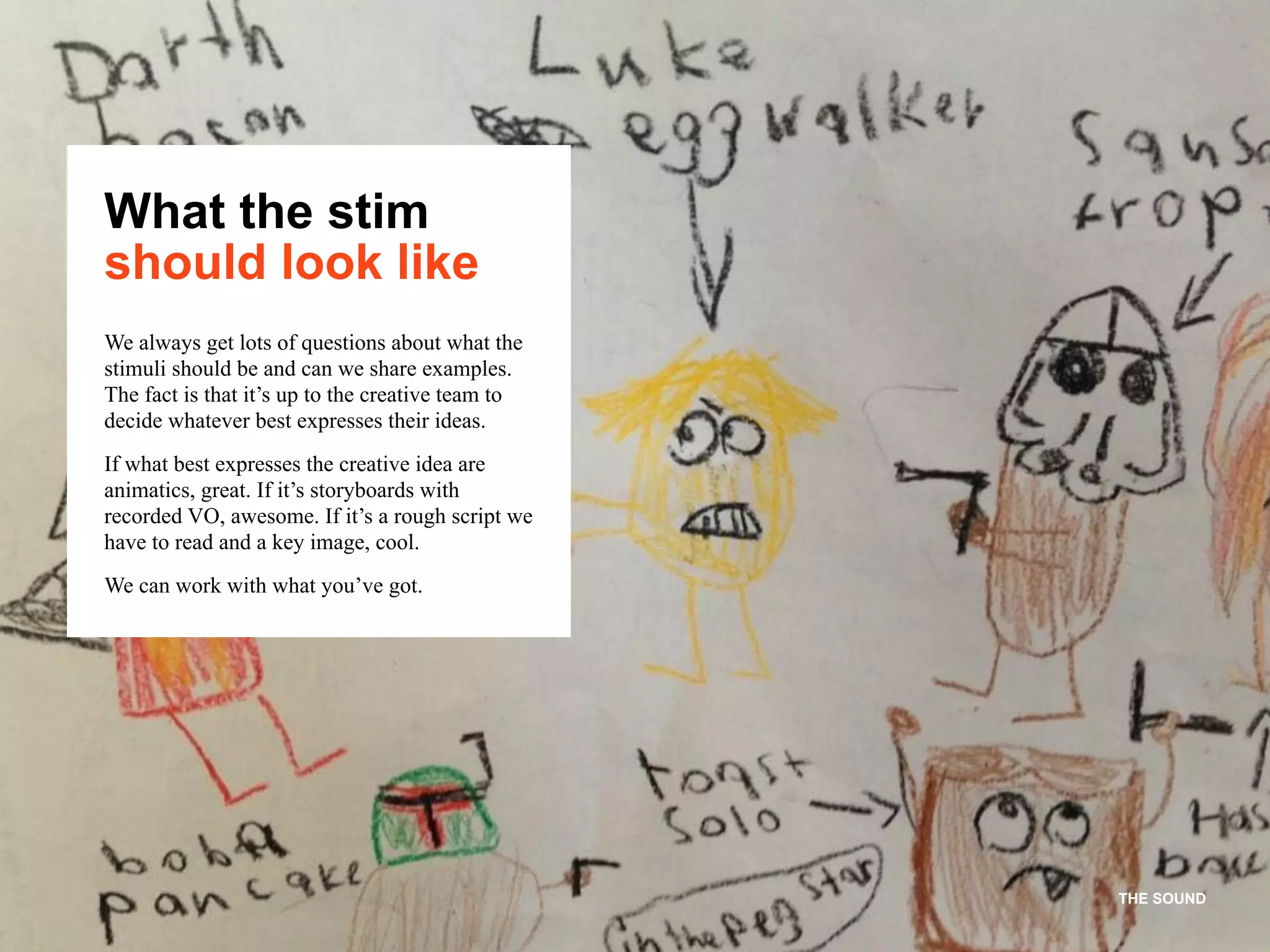
What the stim
should look like
We always get lots of questions about what the
stimuli should be and can we share examples.
The fact is that it’s up to the creative team to
decide whatever best expresses their ideas.
If what best expresses the creative idea are
animatics, great. If it’s storyboards with
recorded VO, awesome. If it’s a rough script we
have to read and a key image, cool.
We can work with what you’ve got.
!11
THE SOUND
Group Think
To avoid this, we ensure everyone in
the group knows their individual
opinions are worthwhile and that
there are no right or wrong answers.


After showing the work, we start by
asking each individual their overall
impressions and what they took away
as the main idea before opening up
the conversation to the group. This
gives us a clear sense of everyone’s
starting point, and allows us to track
if people are just going with the flow
of the other participants.
Also, we’re bomb-ass moderators and
know how to navigate things like
participants who try to act as the self-
appointed spokesperson for the group.
Stimulus Effect
With this sort of research, you’re
exploring abstract concepts. This can
mean that a lot of what people say in
the groups is confused, confusing and
meaningless (and the answer rarely
reveals itself before four groups have
been conducted - often six).
So we always remind the team
watching that what they’re hearing
isn’t always what people mean, and
we’ll disentangle that in analysis.
We never report back on stim-related
issues; these are all weeded out so
we’re just focusing on the creative
idea and intended execution.
Low Energy
Creative development groups can
often lack the vibrant reactions to the
work the team is hoping for…
especially if the ideas are somewhat
flawed. Unfortunately this can make
the groups hard to watch. But don’t
be disheartened if things look grey at
this stage! It’s all about the message
at this point - not the execution.
We’ve seen advertising research
horribly that ultimately turned out
amazing.
The good news is that the idea related
to Soup Zombies is doing really
well… so let’s head into the back
room after a couple of groups and
see what’s going on in there.
Moderating groups and what we keep in mind
When researching advertising ideas, we’re interested in understanding the message relevance and clarity, how it
makes people feel and the impact on the brand. The goal is to understand how each creative idea achieves the
objectives of the brief. There’s more than one challenge to getting there…
THE SOUND
!12
THE SOUND
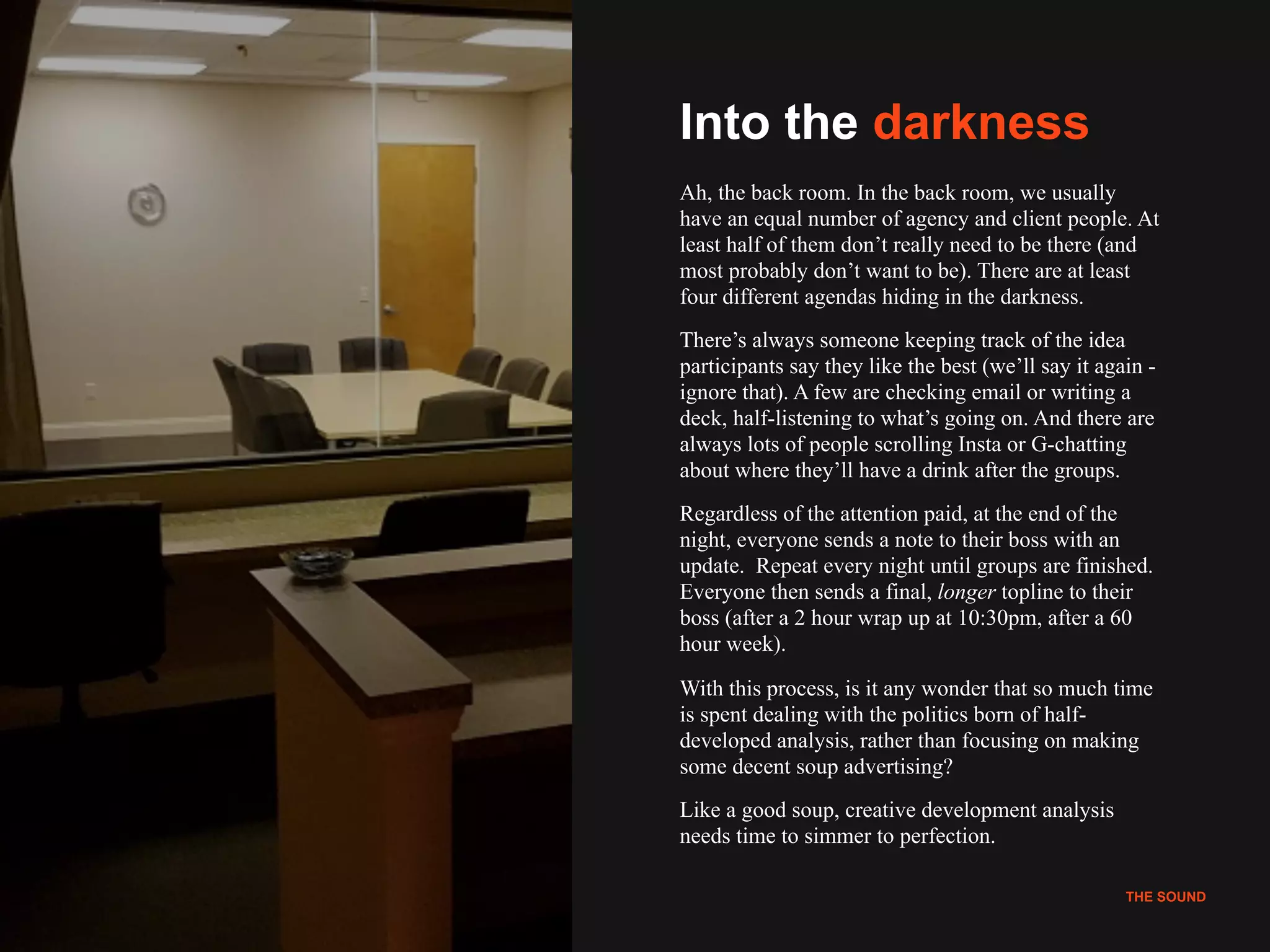
Into the darkness
Ah, the back room. In the back room, we usually
have an equal number of agency and client people. At
least half of them don’t really need to be there (and
most probably don’t want to be). There are at least
four different agendas hiding in the darkness.
There’s always someone keeping track of the idea
participants say they like the best (we’ll say it again -
ignore that). A few are checking email or writing a
deck, half-listening to what’s going on. And there are
always lots of people scrolling Insta or G-chatting
about where they’ll have a drink after the groups.
Regardless of the attention paid, at the end of the
night, everyone sends a note to their boss with an
update. Repeat every night until groups are finished.
Everyone then sends a final, longer topline to their
boss (after a 2 hour wrap up at 10:30pm, after a 60
hour week).
With this process, is it any wonder that so much time
is spent dealing with the politics born of half-
developed analysis, rather than focusing on making
some decent soup advertising?
Like a good soup, creative development analysis
needs time to simmer to perfection.
THE SOUND
THE SOUND
It happens. Sometimes, people just don’t get what
you’re trying to say. This can trigger panic in the back
room because the strategy is fixed and you absolutely
need some ideas that deliver against it. Like,
tomorrow.
This is often where we really earn our money.
Experienced creative development researchers know
how to find a way forward.
If the ideas aren’t landing, it might be that the idea is
articulated badly. Then we will work with participants
to try and understand why, and if there’s some way of
articulating it better. Knowing when to take a few
steps back can help unlock new ways of expressing the
ideas. Change the articulation of the idea for the next
group, and try again.
Or it might be the executions. So, at this stage, it’s OK
to explain what the execution is trying to do.
Otherwise, the idea dies because of an executional fail.
We can’t let ideas get killed because the stimuli is shit.
You have to think on your feet sometimes. Earlier we
mentioned hypotheses; having them helps us do this.
Not having them makes us look even sweatier and
more agitated than usual.
What if they just
don’t get it?
!14
THE SOUND
Analysis and
reporting
Please remember, the role of the research is not to
give you the answer. The role of research is to
inform you of what is working and what’s not, so
you can make the best decision for the business.
For this reason, we work with a nice simple analysis
and reporting structure:
1. A quick check on the strategy relevance (this should
always be a big yes since you’ll have vetted the
strategy already, right?)
2. Exploring the creative ideas and how well they are
bringing the strategy to life
3. Sharing any relevant executional details that can help
the creative team continue to shape their ideas
Our recommendations are candid and pointed,
focusing on how to optimize the ideas, and which
idea(s) emerging from the research has the most
potential to achieve your objectives.
Sorry, no jokes on this slide (because soup
advertising is really no laughing matter).
THE SOUND
THE SOUND
Research when 

refining the
Executional
Ideas
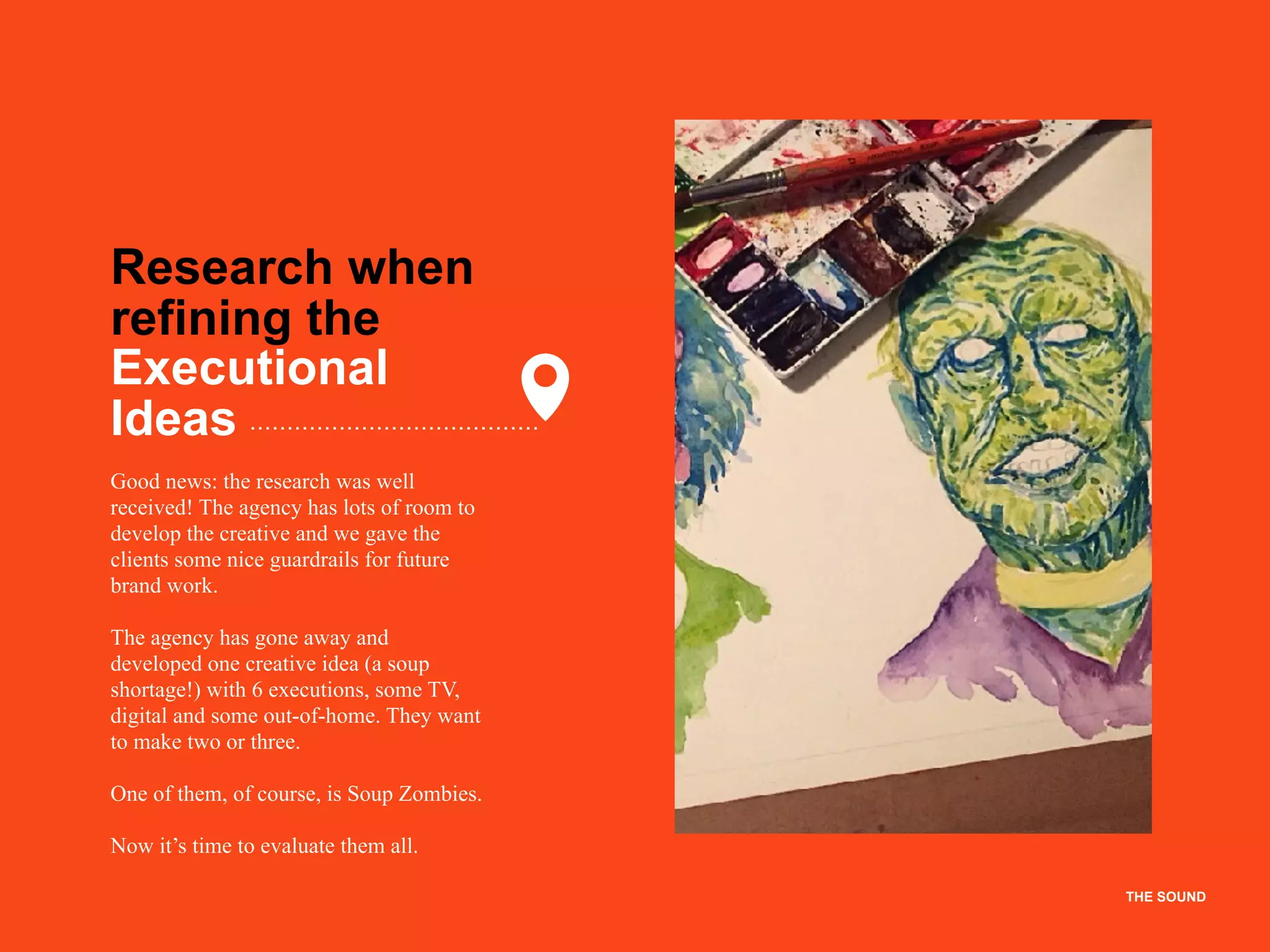
Good news: the research was well
received! The agency has lots of room to
develop the creative and we gave the
clients some nice guardrails for future
brand work.
The agency has gone away and
developed one creative idea (a soup
shortage!) with 6 executions, some TV,
digital and some out-of-home. They want
to make two or three.
One of them, of course, is Soup Zombies.
Now it’s time to evaluate them all.
THE SOUND
!16
THE SOUND
The nitty gritty
of executional
research
Rather than groups, we recommend one-on-ones
(or triads at most) for this stage. This is because
we no longer need to explore and build. Now,
we need detailed individual response.
The value of research at this late stage is to
identify anything that gets in the way of
comprehension or enjoyment, before it’s too late
to do anything about it. Increasingly, we’re also
identifying things that could be culturally
questionable and make the Twitter-verse go all
aggro on your brand.
In these conversations, we’re getting into lots of
detail and really trying to determine the message
takeaway, and what in the execution is driving it.
We’ll need to have lots of hypotheses about the
executions and the specific issues we think
might emerge. If, for example, we think our
Zombies might be misinterpreted as homeless
people, we’re going to watch out for that.
We understand that an executional element can
make or break a campaign, or completely
change the message.
THE SOUND
THE SOUND
Recommending
the way forward
Final decisions must be left to the client
and agency teams, but in the reporting and
Sound Advice, we will be candid.
We will always remain loyal to the brand
and to the people you’re trying to engage.
There may be politics and pressure, but if
we believe the research is telling us none
of the executions is doing what it needs to
do, we’ll tell you.
Where there is risk, we will point it out.
Where there is optimization required, we
will be clear. Where there is big
opportunity, we will point you there.
But we will always tell you to make Soup
Zombies.
VANCOUVER | NEW YORK | LONDON | TORONTO | CHICAGO | MUMBAI
WWW.THESOUNDHQ.COM
SLIDE SITE
1 https://static.independent.co.uk/s3fs-public/thumbnails/image/2017/04/05/13/kendall-pepsi.jpg
2 http://www.rover-time.com/wp-content/uploads/2017/12/image-4.jpg
3 http://www.vstars.pl/wp-content/uploads/2017/04/pepsi-e1491598729596.png
4 http://artisautobiographical.blogspot.com/2012/10/chapter-2-overview-of-research.html
7 https://hbr.org/2015/06/developing-employees-who-think-for-themselves
8 https://www.verportugal.net/vp/images/cms-image-000011596.jpg
10 https://am23.akamaized.net/tms/cnt/uploads/2013/06/star-wars-breakfast-puns-580x435.jpg
12 https://www.greenbook.org/slides/Focus%20Group%20Room%201,%20backroom%20view_pp9102489636764265774053088.jpg
13 https://www.telegraph.co.uk/content/dam/gardening/2018/06/07/TELEMMGLPICT000165573825_trans_NvBQzQNjv4BqaxhR1vC4M3eHXTZuhDlJp-
iBvoxkJnxoIp2wzaVi5fo.jpeg?imwidth=450
15 https://scontent-sea1-1.cdninstagram.com/vp/9fe37d845c816eab6e7c6f98a55f5efb/5D71DD10/t51.2885-15/
e35/13573611_1794270717469323_2026965961_n.jpg?_nc_ht=scontent-
17 https://images.unsplash.com/photo-1530127796739-53cf66b0e64d?ixlib=rb-1.2.1&ixid=eyJhcHBfaWQiOjEyMDd9&auto=format&fit=crop&w=1000&q=80
THE SOUND
Image references

The Sound's Approach to Creative Development Research

  • 1.
    Creative development research thatactually helps you make amazing ads
  • 2.
    THE SOUND Too manycooks spoil the soup What does soup have to do with creative development research, you ask? Let us explain… As you’ve likely experienced when researching advertising, there are a lot of chefs in the metaphorical kitchen. And to be honest, they don’t always agree on (or even know!) what a good soup is. This can make for a tense kitchen - and make it difficult to create a soup people actually want to eat. So, what does great creative development research look like, and how do we help you avoid making shit soup? Read on for The Sound Guide to creative development research. THE SOUND
  • 3.
    THE SOUND Why to botherwith research at all A very senior client (who will remain nameless) once said these exact words to us: “We’re not doing advertising research anymore. It costs a fortune. We’re going to make ads and if Twitter likes them, we’ll spend more against them. If they don’t like them, we’ll just withdraw them.” No… seriously. And look, we get it. There are probably lots of examples of bad research killing great ideas and forcing creatives to put bigger pack shots into their beautiful ads. That sucks. But we’re here to make sure that doesn’t ever happen to you (again). Ever. THE SOUND
  • 4.
    !4 THE SOUND The roleof research in the creative process So, let’s say you’ve got three great advertising ideas for a new soup. You love all of them (one secretly more than the others, just like your kids...) but you want to know which one to make. What better way than asking people what they like the best and going with that? Wrong. Like, really wrong. Research is a tool that, when done well, determines what’s working and what’s not, against the objectives of the advertising. Research arms you with all the information you need to make a smart decision about what to invest in. It doesn’t matter which ads people like the most. What matters is which ads are best delivering the strategy (that's assuming the strategy is right; more on that later…) and how that ultimately impacts your brand. So we have our soup advertising ideas and we need to do some research. But when do you do it? THE SOUND
  • 5.
    !5 THE SOUND When toactually do it When Developing The Strategic Idea When Developing The Creative Ideas When Refining The Executional Ideas There are three really great times to conduct research in the creative process which align perfectly with the three ideas that exist in any piece of communication: THE SOUND
  • 6.
    THE SOUND The differencebetween ideas Er - just making sure everyone here knows the difference between the three ideas within any piece of communication. Right? You do? Good. Well, just to be sure, a quick recap… Strategic Idea Usually closely related to the positioning, a convergence of product benefits, consumer insight and brand role. So, for example, let’s say our soup strategy is to communicate how soup brings the family together. Creative Ideas Creative ideas are broad concepts which are designed to bring the strategy to life in an engaging way. For example, one of our soup creative ideas is that there is a world shortage of soup and as a result, family life has broken down. Executional Ideas Executions are easiest to understand, since they’re the concrete expression of the creative idea captured in things like scripts and posters and activation ideas. But of course, any execution needs to clearly ladder up to both the creative idea and strategy to work. For example, one of the soup scripts for the above creative idea is called Soup Zombies, where family members become zombies, wandering around the house in zombie-like states, because they have no soup. They just say, ‘sooooooup’ as they wander past each other. Probably best we didn’t go into advertising…
  • 7.
    THE SOUNDTHE SOUND Researchwhen developing the Strategic Idea The strategic idea is very rarely researched for the first time after creative ideas have been developed. Rather, it’s typically done when developing the brand positioning. In this way, research has usually fed into its articulation much earlier. Ideally. Obvious point, but it’s important to know that your strategy is built on solid foundations before going off and developing creative. A solid foundation is a strategic idea built from an understanding of your consumer, your category, and your brand. (But you knew that, of course.) We know there are times when this doesn’t happen and we can work with it. But seriously… try to avoid this, because it can result in a lot of wasted time and money. Research your strategy and get it right before briefing the agency.
  • 8.
    THE SOUND Research when developingthe Creative Ideas Assuming the strategy has been explored, developed and validated, we can move into creative development research… the focus of this deck! So, we have three creative ideas to bring the strategy to life and the agency has developed a couple of executions for each. One of the creative ideas is Soup Shortage and of course includes the Soup Zombies execution (which is definitely in the running to win a Cannes Lion, but that's another story…). Given we want to develop each creative idea to its fullest potential so you can decide which to invest in, we want to do some discussion groups. Why groups? Well, they’re one of the best ways of exploring and building ideas, and that’s exactly what we want to do at this stage. THE SOUND
  • 9.
    !9 THE SOUND Before wemoderate the groups, we need a proper briefing about the strategic idea and how each creative idea is meant to bring the strategy to life. We also need a walk through of all the executions and the type of stimuli the team is planning to provide. Finally, we love hearing about any key questions or concerns the team has to make sure we address them in our discussion guide. As intelligent researchers, we of course have developed our own hypotheses about how the work is functioning against the objectives, and are happy to share those with you once we see the work. But during this briefing process, please don’t ask us which our favorite idea is. Why not? 1. It’s our job to be completely unbiased. That’s part of why you’ve hired us and aren’t relying on the junior planner to do the job! 2. Favorites are truly besides the point. As we said, liking has nothing to do with how the work is delivering against its objectives. 3. We’re almost never the target for your advertising, so what we like, for real, just doesn’t matter. Briefing and hypotheses THE SOUND
  • 10.
    THE SOUND What thestim should look like We always get lots of questions about what the stimuli should be and can we share examples. The fact is that it’s up to the creative team to decide whatever best expresses their ideas. If what best expresses the creative idea are animatics, great. If it’s storyboards with recorded VO, awesome. If it’s a rough script we have to read and a key image, cool. We can work with what you’ve got.
  • 11.
    !11 THE SOUND Group Think Toavoid this, we ensure everyone in the group knows their individual opinions are worthwhile and that there are no right or wrong answers. 
 After showing the work, we start by asking each individual their overall impressions and what they took away as the main idea before opening up the conversation to the group. This gives us a clear sense of everyone’s starting point, and allows us to track if people are just going with the flow of the other participants. Also, we’re bomb-ass moderators and know how to navigate things like participants who try to act as the self- appointed spokesperson for the group. Stimulus Effect With this sort of research, you’re exploring abstract concepts. This can mean that a lot of what people say in the groups is confused, confusing and meaningless (and the answer rarely reveals itself before four groups have been conducted - often six). So we always remind the team watching that what they’re hearing isn’t always what people mean, and we’ll disentangle that in analysis. We never report back on stim-related issues; these are all weeded out so we’re just focusing on the creative idea and intended execution. Low Energy Creative development groups can often lack the vibrant reactions to the work the team is hoping for… especially if the ideas are somewhat flawed. Unfortunately this can make the groups hard to watch. But don’t be disheartened if things look grey at this stage! It’s all about the message at this point - not the execution. We’ve seen advertising research horribly that ultimately turned out amazing. The good news is that the idea related to Soup Zombies is doing really well… so let’s head into the back room after a couple of groups and see what’s going on in there. Moderating groups and what we keep in mind When researching advertising ideas, we’re interested in understanding the message relevance and clarity, how it makes people feel and the impact on the brand. The goal is to understand how each creative idea achieves the objectives of the brief. There’s more than one challenge to getting there… THE SOUND
  • 12.
    !12 THE SOUND Into thedarkness Ah, the back room. In the back room, we usually have an equal number of agency and client people. At least half of them don’t really need to be there (and most probably don’t want to be). There are at least four different agendas hiding in the darkness. There’s always someone keeping track of the idea participants say they like the best (we’ll say it again - ignore that). A few are checking email or writing a deck, half-listening to what’s going on. And there are always lots of people scrolling Insta or G-chatting about where they’ll have a drink after the groups. Regardless of the attention paid, at the end of the night, everyone sends a note to their boss with an update. Repeat every night until groups are finished. Everyone then sends a final, longer topline to their boss (after a 2 hour wrap up at 10:30pm, after a 60 hour week). With this process, is it any wonder that so much time is spent dealing with the politics born of half- developed analysis, rather than focusing on making some decent soup advertising? Like a good soup, creative development analysis needs time to simmer to perfection. THE SOUND
  • 13.
    THE SOUND It happens.Sometimes, people just don’t get what you’re trying to say. This can trigger panic in the back room because the strategy is fixed and you absolutely need some ideas that deliver against it. Like, tomorrow. This is often where we really earn our money. Experienced creative development researchers know how to find a way forward. If the ideas aren’t landing, it might be that the idea is articulated badly. Then we will work with participants to try and understand why, and if there’s some way of articulating it better. Knowing when to take a few steps back can help unlock new ways of expressing the ideas. Change the articulation of the idea for the next group, and try again. Or it might be the executions. So, at this stage, it’s OK to explain what the execution is trying to do. Otherwise, the idea dies because of an executional fail. We can’t let ideas get killed because the stimuli is shit. You have to think on your feet sometimes. Earlier we mentioned hypotheses; having them helps us do this. Not having them makes us look even sweatier and more agitated than usual. What if they just don’t get it?
  • 14.
    !14 THE SOUND Analysis and reporting Pleaseremember, the role of the research is not to give you the answer. The role of research is to inform you of what is working and what’s not, so you can make the best decision for the business. For this reason, we work with a nice simple analysis and reporting structure: 1. A quick check on the strategy relevance (this should always be a big yes since you’ll have vetted the strategy already, right?) 2. Exploring the creative ideas and how well they are bringing the strategy to life 3. Sharing any relevant executional details that can help the creative team continue to shape their ideas Our recommendations are candid and pointed, focusing on how to optimize the ideas, and which idea(s) emerging from the research has the most potential to achieve your objectives. Sorry, no jokes on this slide (because soup advertising is really no laughing matter). THE SOUND
  • 15.
    THE SOUND Research when
 refining the Executional Ideas Good news: the research was well received! The agency has lots of room to develop the creative and we gave the clients some nice guardrails for future brand work. The agency has gone away and developed one creative idea (a soup shortage!) with 6 executions, some TV, digital and some out-of-home. They want to make two or three. One of them, of course, is Soup Zombies. Now it’s time to evaluate them all. THE SOUND
  • 16.
    !16 THE SOUND The nittygritty of executional research Rather than groups, we recommend one-on-ones (or triads at most) for this stage. This is because we no longer need to explore and build. Now, we need detailed individual response. The value of research at this late stage is to identify anything that gets in the way of comprehension or enjoyment, before it’s too late to do anything about it. Increasingly, we’re also identifying things that could be culturally questionable and make the Twitter-verse go all aggro on your brand. In these conversations, we’re getting into lots of detail and really trying to determine the message takeaway, and what in the execution is driving it. We’ll need to have lots of hypotheses about the executions and the specific issues we think might emerge. If, for example, we think our Zombies might be misinterpreted as homeless people, we’re going to watch out for that. We understand that an executional element can make or break a campaign, or completely change the message. THE SOUND
  • 17.
    THE SOUND Recommending the wayforward Final decisions must be left to the client and agency teams, but in the reporting and Sound Advice, we will be candid. We will always remain loyal to the brand and to the people you’re trying to engage. There may be politics and pressure, but if we believe the research is telling us none of the executions is doing what it needs to do, we’ll tell you. Where there is risk, we will point it out. Where there is optimization required, we will be clear. Where there is big opportunity, we will point you there. But we will always tell you to make Soup Zombies.
  • 18.
    VANCOUVER | NEWYORK | LONDON | TORONTO | CHICAGO | MUMBAI WWW.THESOUNDHQ.COM
  • 19.
    SLIDE SITE 1 https://static.independent.co.uk/s3fs-public/thumbnails/image/2017/04/05/13/kendall-pepsi.jpg 2http://www.rover-time.com/wp-content/uploads/2017/12/image-4.jpg 3 http://www.vstars.pl/wp-content/uploads/2017/04/pepsi-e1491598729596.png 4 http://artisautobiographical.blogspot.com/2012/10/chapter-2-overview-of-research.html 7 https://hbr.org/2015/06/developing-employees-who-think-for-themselves 8 https://www.verportugal.net/vp/images/cms-image-000011596.jpg 10 https://am23.akamaized.net/tms/cnt/uploads/2013/06/star-wars-breakfast-puns-580x435.jpg 12 https://www.greenbook.org/slides/Focus%20Group%20Room%201,%20backroom%20view_pp9102489636764265774053088.jpg 13 https://www.telegraph.co.uk/content/dam/gardening/2018/06/07/TELEMMGLPICT000165573825_trans_NvBQzQNjv4BqaxhR1vC4M3eHXTZuhDlJp- iBvoxkJnxoIp2wzaVi5fo.jpeg?imwidth=450 15 https://scontent-sea1-1.cdninstagram.com/vp/9fe37d845c816eab6e7c6f98a55f5efb/5D71DD10/t51.2885-15/ e35/13573611_1794270717469323_2026965961_n.jpg?_nc_ht=scontent- 17 https://images.unsplash.com/photo-1530127796739-53cf66b0e64d?ixlib=rb-1.2.1&ixid=eyJhcHBfaWQiOjEyMDd9&auto=format&fit=crop&w=1000&q=80 THE SOUND Image references