Interprovincial Program Guide 
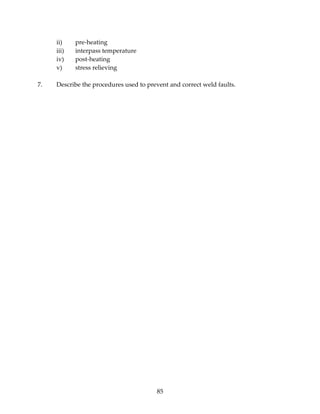
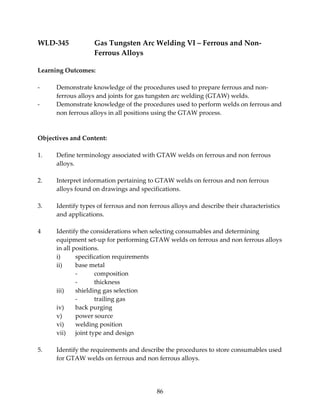
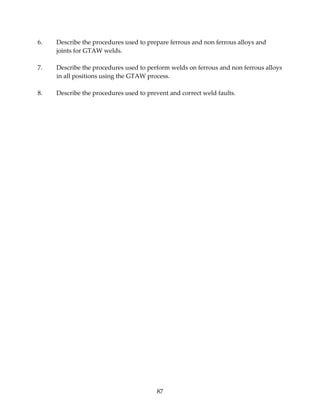
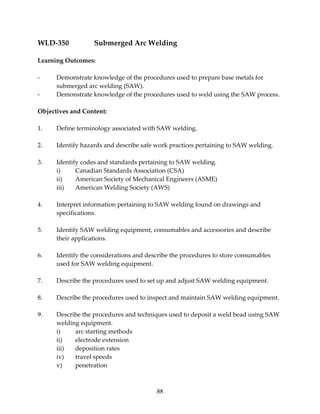
Welder 
2011
You can order this publication by contacting: 
Trades and Apprenticeship Division 
Workplace Partnership Directorate 
Human Resources and Skills Development Canada 
140 Promenade du Portage, Phase IV, 5th Floor 
Gatineau, Quebec K1A 0J9 
Online: www.red‐seal.ca 
This document is available on demand in alternative formats (Large Print, Braille, 
Audio Cassette, Audio CD, e‐Text Diskette, e‐Text CD, or DAISY), by contacting 
1 800 O‐Canada (1 800 622‐6232). If you have a hearing or speech impairment and use a 
teletypewriter (TTY), call 1 800 926‐9105. 
© Her Majesty the Queen in Right of Canada, 2011 
Paper 
Cat. No.: HS42‐2/21‐2011E 
ISBN 978‐1‐100‐17790‐8 
PDF 
Cat. No.: HS42‐2/21‐2011E‐PDF 
ISBN 978‐1‐100‐17791‐5
The CCDA Executive Committee recognizes this Interprovincial Program 
Guide as the national curriculum for the occupation of Welder.
2 
Acknowledgements 
The CCDA Executive Committee and the Interprovincial Program Guide Working 
Group wishes to acknowledge the contributions of the following industry and 
instructional representatives who participated in the development of this document. 
Jim Burgess Newfoundland and Labrador 
Jim Carson British Columbia 
John Fisher New Brunswick 
John Fraser Manitoba 
Chris Kenny Prince Edward Island 
Walter Lacey Nova Scotia 
Kent Morrison Prince Edward Island 
Peter Ryan New Brunswick 
Brad Zerr Saskatchewan 
In addition to the representatives above, various federal, provincial and territorial 
representatives contributed to the development of this document including Ken Jordan 
representing the host province of New Brunswick.
3 
Table of Contents 
Acknowledgements ..................................................................................................................... 2 
Introduction .................................................................................................................................. 4 
User Guide .................................................................................................................................... 5 
IPG Glossary of Terms ................................................................................................................ 7 
Essential Skills Profiles................................................................................................................ 9 
Profile Chart................................................................................................................................ 10 
Recommended Level Structure................................................................................................ 12 
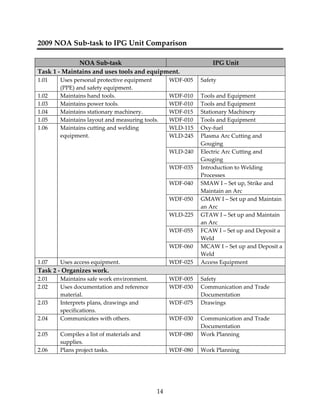
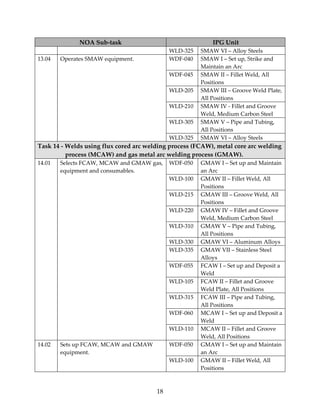
2009 NOA Sub‐Task to IPG Unit Comparison ...................................................................... 14 
PROGRAM CONTENT 
Level 1.......................................................................................................................................... 23 
Level 2.......................................................................................................................................... 49 
Level 3.......................................................................................................................................... 71
4 
Introduction 
Jurisdictions have long recognized the benefit of pooling resources in the development 
and maintenance of apprenticeship training standards. A successful example of this is 
the Interprovincial Standards Red Seal Program itself. Essential to the establishment of 
standards is the development of suitable training systems and programs which enable 
tradespeople to acquire certification based on these standards. While certification is the 
responsibility of Apprenticeship administrators throughout Canada, the development 
and delivery of technical training is the responsibility of jurisdictions. 
In 1999, work to develop common training for apprenticeship programs within the 
Atlantic Provinces began. To date, 22 Curriculum Standards have been developed 
through the Atlantic Standards Partnership (ASP) project to assist programming staff 
and instructors in the design and delivery of technical training. Similarly, the Canadian 
Council of Directors of Apprenticeship (CCDA) embarked on a process for the 
development of national Interprovincial Program Guides (IPGs) for the Boilermaker, 
Carpenter and Sprinkler System Installer trades. At its January 2005 strategic planning 
session, the CCDA identified developing common training standards as one of key 
activities in moving towards a more cohesive apprenticeship system. 
With the support of Human Resources and Skills Development Canada (HRSDC), 
several provinces and territories have partnered to build on the ASP and the CCDA 
processes to further develop IPGs to be used across the country. This partnership will 
create efficiencies in time and resources and promote consistency in training and 
apprentice mobility.
5 
User Guide 
According to the Canadian Apprenticeship Forum, the Interprovincial Program 
Guide (IPG) is: ʺa list of validated technical training outcomes, based upon those sub‐tasks 
identified as common core in the National Occupational Analysis (NOA), and 
validated by industry in the provinces and territories as incorporating the essential 
tasks, knowledge and skills associated with a given trade.ʺ 
Learning outcomes contained in the IPG represent the minimum common core content 
for the development of jurisdictional training standards and outlines. IPGs are 
developed based on the NOAs and extensive industry consultation. The IPG is 
intended to assist program development staff in the design of jurisdictional plans of 
training. Each jurisdiction has the flexibility to add additional content. 
The IPG was deliberately constructed for ease of use and flexibility of structure in order 
to adapt to all delivery requirements. It details units of training, unit outcomes and 
objectives. It does not impose a delivery model or teaching format. 
Jurisdictions and/or training providers will select and develop delivery materials and 
techniques that accommodate a variety of learning styles and delivery patterns. The 
IPG does not dictate study materials, textbooks or learning activities to be used in 
delivery. 
The IPG document includes a recommended leveling structure to facilitate mobility for 
apprentices moving from one jurisdiction to another. Because of difference in 
jurisdictional regulations and program durations, levels are offered as suggestions only. 
Structure 
The IPG is divided into units. The unit codes are used as a means of identification and 
are not intended to convey the order of delivery. Prerequisites have not been detailed. 
Each unit consists of Learning Outcomes and Objectives and Content. 
The Learning Outcomes are the specific performances that must be evaluated. Wording 
of the learning outcomes, ʺDemonstrate knowledge of…ʺ, acknowledges the broad 
spectrum of ways in which knowledge can be shown. It is at the discretion of each 
jurisdiction to determine the manner in which learning outcomes are evaluated; 
theoretically, practically or a combination of both.
6 
User Guide (continued) 
The Objectives and Content for the unit details the information to be covered in order to 
achieve the performances specified in the Learning Outcomes. These objectives can be 
either theoretical or practical in nature, based on the requirements identified through 
the industry consultation process. The learning activities used to cover the objectives 
are at the discretion of the jurisdiction; however, practically worded objective 
statements have been used where industry indicated a need for the apprentices to 
receive exposure to performing the task or skill outlined while attending technical 
training. For example, this exposure could be done through instructor demonstration 
or individual or group performance of the skill or task. This practical training will help 
to reinforce the theoretical component of the technical training. 
Detailed content for each objective has not been developed. Where detail is required for 
clarity, content has been provided. The content listed within the IPG document is not 
intended to represent an inclusive list; rather, it is included to illustrate the intended 
direction for the objective. Content may be added or extended in jurisdictional training 
plans as required. 
Jurisdictions are free to deliver the IPG units one at a time or concurrently, provided 
that all Learning Outcomes are met. The IPG does not indicate the amount of time to be 
spent on a particular unit as the length of time required to deliver the Learning Outcomes 
successfully will depend upon the learning activities and teaching methods used.
7 
IPG Glossary of Terms 
These definitions are intended as a guide to how language is used in the IPGs. 
ADJUST To put in good working order; regulate; bring to a proper 
state or position. 
APPLICATION The use to which something is put and/or the circumstance 
in which you would use it. 
CHARACTERISTIC A feature that helps to identify, tell apart, or describe 
recognizably; a distinguishing mark or trait. 
COMPONENT A part that can be separated from or attached to a system; a 
segment or unit. 
DEFINE To state the meaning of (a word, phrase, etc.). 
DESCRIBE To give a verbal account of; tell about in detail. 
EXPLAIN To make plain or clear; illustrate; rationalize. 
IDENTIFY To point out or name objectives or types. 
INTERPRET To translate information from observation, charts, tables, 
graphs, and written material. 
MAINTAIN To keep in a condition of good repair or efficiency. 
METHOD A means or manner of doing something that has 
procedures attached to it. 
OPERATE How an object works; to control or direct the functioning 
of. 
PROCEDURE A prescribed series of steps taken to accomplish an end. 
PURPOSE The reason for which something exists or is done, made or 
used.
8 
IPG Glossary of Terms (continued) 
TECHNIQUE Within a procedure, the manner in which technical skills 
are applied. 
TEST v. To subject to a procedure that ascertains effectiveness, 
value, proper function, or other quality. 
n. A way of examining something to determine its 
characteristics or properties, or to determine whether or 
not it is working correctly. 
TROUBLESHOOT To follow a systematic procedure to identify and locate a 
problem or malfunction and its cause.
9 
Essential Skills Profiles 
Essential Skills are the skills needed for work, learning and life. They provide the 
foundation for learning all the other skills that enable people to evolve within their jobs 
and adapt to workplace change. 
Over the past several years, the Government of Canada has conducted research 
examining the skills people use at work. From this research, Essential Skills Profiles 
have been developed for various occupations. 
For more information regarding Essential Skills and to access Essential Skills Profiles for 
specific occupations, visit Human Resources and Skills Development Canada’s Essential 
Skills website at: 
www.hrsdc.gc.ca/eng/workplaceskills/essential_skills/general/home.shtml
10 
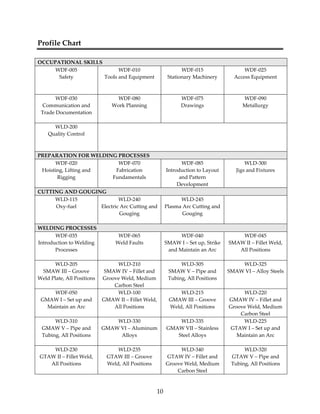
Profile Chart 
OCCUPATIONAL SKILLS 
WDF‐005 
Safety 
WDF‐010 
Tools and Equipment 
WDF‐015 
Stationary Machinery 
WDF‐025 
Access Equipment 
WDF‐030 
Communication and 
Trade Documentation 
WDF‐080 
Work Planning 
WDF‐075 
Drawings 
WDF‐090 
Metallurgy 
WLD‐200 
Quality Control 
PREPARATION FOR WELDING PROCESSES 
WDF‐020 
Hoisting, Lifting and 
Rigging 
WDF‐070 
Fabrication 
Fundamentals 
WDF‐085 
Introduction to Layout 
and Pattern 
Development 
WLD‐300 
Jigs and Fixtures 
CUTTING AND GOUGING 
WLD‐115 
Oxy‐fuel 
WLD‐240 
Electric Arc Cutting and 
Gouging 
WLD‐245 
Plasma Arc Cutting and 
Gouging 
WELDING PROCESSES 
WDF‐035 
Introduction to Welding 
Processes 
WDF‐065 
Weld Faults 
WDF‐040 
SMAW I – Set up, Strike 
and Maintain an Arc 
WDF‐045 
SMAW II – Fillet Weld, 
All Positions 
WLD‐205 
SMAW III – Groove 
Weld Plate, All Positions 
WLD‐210 
SMAW IV – Fillet and 
Groove Weld, Medium 
Carbon Steel 
WLD‐305 
SMAW V – Pipe and 
Tubing, All Positions 
WLD‐325 
SMAW VI – Alloy Steels 
WDF‐050 
GMAW I – Set up and 
Maintain an Arc 
WLD‐100 
GMAW II – Fillet Weld, 
All Positions 
WLD‐215 
GMAW III – Groove 
Weld, All Positions 
WLD‐220 
GMAW IV – Fillet and 
Groove Weld, Medium 
Carbon Steel 
WLD‐310 
GMAW V – Pipe and 
Tubing, All Positions 
WLD‐330 
GMAW VI – Aluminum 
Alloys 
WLD‐335 
GMAW VII – Stainless 
Steel Alloys 
WLD‐225 
GTAW I – Set up and 
Maintain an Arc 
WLD‐230 
GTAW II – Fillet Weld, 
All Positions 
WLD‐235 
GTAW III – Groove 
Weld, All Positions 
WLD‐340 
GTAW IV – Fillet and 
Groove Weld, Medium 
Carbon Steel 
WLD‐320 
GTAW V – Pipe and 
Tubing, All Positions
11 
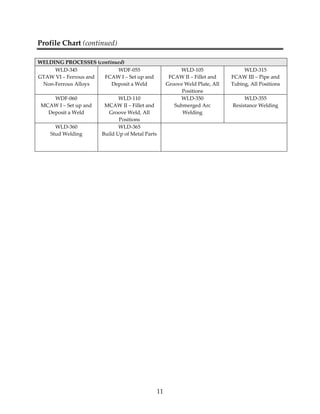
Profile Chart (continued) 
WELDING PROCESSES (continued) 
WLD‐345 
GTAW VI – Ferrous and 
Non‐Ferrous Alloys 
WDF‐055 
FCAW I – Set up and 
Deposit a Weld 
WLD‐105 
FCAW II – Fillet and 
Groove Weld Plate, All 
Positions 
WLD‐315 
FCAW III – Pipe and 
Tubing, All Positions 
WDF‐060 
MCAW I – Set up and 
Deposit a Weld 
WLD‐110 
MCAW II – Fillet and 
Groove Weld, All 
Positions 
WLD‐350 
Submerged Arc 
Welding 
WLD‐355 
Resistance Welding 
WLD‐360 
Stud Welding 
WLD‐365 
Build Up of Metal Parts
12 
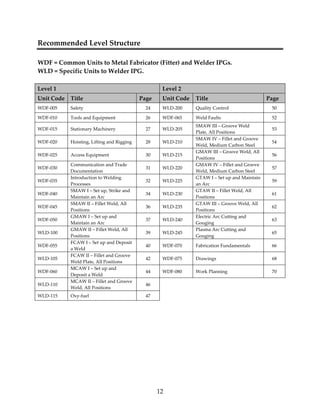
Recommended Level Structure 
WDF = Common Units to Metal Fabricator (Fitter) and Welder IPGs. 
WLD = Specific Units to Welder IPG. 
Level 1 Level 2 
Unit Code Title Page Unit Code Title Page 
WDF‐005 Safety 24 WLD‐200 Quality Control 50 
WDF‐010 Tools and Equipment 26 WDF‐065 Weld Faults 52 
WDF‐015 Stationary Machinery 27 WLD‐205 
SMAW III – Groove Weld 
Plate, All Positions 
53 
WDF‐020 Hoisting, Lifting and Rigging 28 WLD‐210 
SMAW IV – Fillet and Groove 
Weld, Medium Carbon Steel 
54 
WDF‐025 Access Equipment 30 WLD‐215 
GMAW III – Groove Weld, All 
Positions 
56 
WDF‐030 
Communication and Trade 
Documentation 
31 WLD‐220 
GMAW IV – Fillet and Groove 
Weld, Medium Carbon Steel 
57 
WDF‐035 
Introduction to Welding 
Processes 
32 WLD‐225 
GTAW I – Set up and Maintain 
an Arc 
59 
WDF‐040 
SMAW I – Set up, Strike and 
Maintain an Arc 
34 WLD‐230 
GTAW II – Fillet Weld, All 
Positions 
61 
WDF‐045 
SMAW II – Fillet Weld, All 
Positions 
36 WLD‐235 
GTAW III – Groove Weld, All 
Positions 
62 
WDF‐050 
GMAW I – Set up and 
Maintain an Arc 
37 WLD‐240 
Electric Arc Cutting and 
Gouging 
63 
WLD‐100 
GMAW II – Fillet Weld, All 
Positions 
39 WLD‐245 
Plasma Arc Cutting and 
Gouging 
65 
WDF‐055 
FCAW I – Set up and Deposit 
a Weld 
40 WDF‐070 Fabrication Fundamentals 66 
WLD‐105 
FCAW II – Fillet and Groove 
Weld Plate, All Positions 
42 WDF‐075 Drawings 68 
WDF‐060 
MCAW I – Set up and 
Deposit a Weld 
44 WDF‐080 Work Planning 70 
WLD‐110 
MCAW II – Fillet and Groove 
Weld, All Positions 
46 
WLD‐115 Oxy‐fuel 47
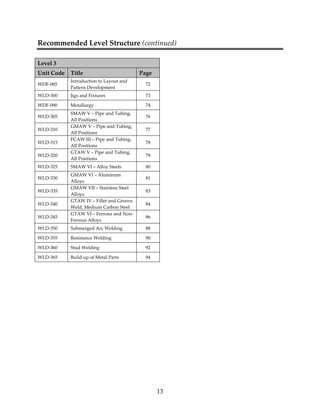
Recommended Level Structure (continued) 
13 
Level 3 
Unit Code Title Page 
WDF‐085 
Introduction to Layout and 
Pattern Development 
72 
WLD‐300 Jigs and Fixtures 73 
WDF‐090 Metallurgy 74 
WLD‐305 
SMAW V – Pipe and Tubing, 
All Positions 
76 
WLD‐310 
GMAW V – Pipe and Tubing, 
All Positions 
77 
WLD‐315 
FCAW III – Pipe and Tubing, 
All Positions 
78 
WLD‐320 
GTAW V – Pipe and Tubing, 
All Positions 
79 
WLD‐325 SMAW VI – Alloy Steels 80 
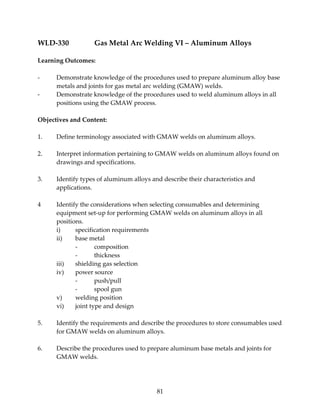
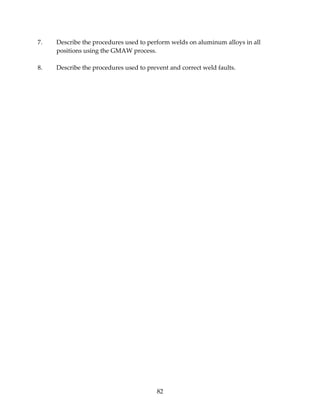
WLD‐330 
GMAW VI – Aluminum 
Alloys 
81 
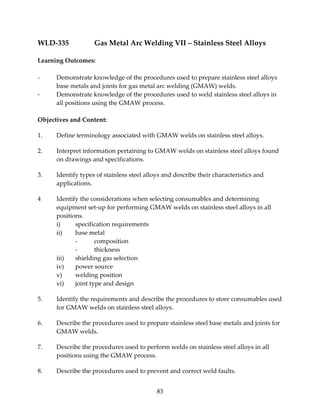
WLD‐335 
GMAW VII – Stainless Steel 
Alloys 
83 
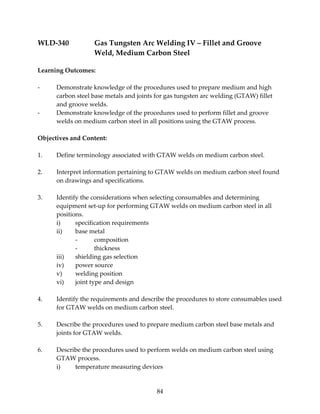
WLD‐340 
GTAW IV – Fillet and Groove 
Weld, Medium Carbon Steel 
84 
WLD‐345 
GTAW VI – Ferrous and Non‐ 
Ferrous Alloys 
86 
WLD‐350 Submerged Arc Welding 88 
WLD‐355 Resistance Welding 90 
WLD‐360 Stud Welding 92 
WLD‐365 Build up of Metal Parts 94
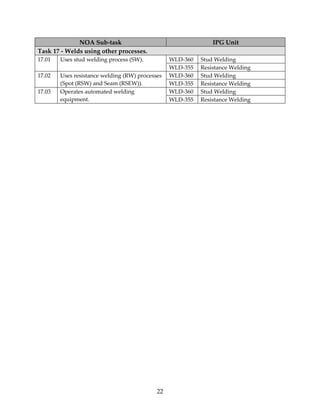
2009 NOA Sub‐task to IPG Unit Comparison 
NOA Sub‐task IPG Unit 
Task 1 ‐ Maintains and uses tools and equipment. 
1.01 Uses personal protective equipment 
14 
(PPE) and safety equipment. 
WDF‐005 Safety 
1.02 Maintains hand tools. WDF‐010 Tools and Equipment 
1.03 Maintains power tools. WDF‐010 Tools and Equipment 
1.04 Maintains stationary machinery. WDF‐015 Stationary Machinery 
1.05 Maintains layout and measuring tools. WDF‐010 Tools and Equipment 
WLD‐115 Oxy‐fuel 
WLD‐245 Plasma Arc Cutting and 
Gouging 
WLD‐240 Electric Arc Cutting and 
Gouging 
WDF‐035 Introduction to Welding 
Processes 
WDF‐040 SMAW I – Set up, Strike and 
Maintain an Arc 
WDF‐050 GMAW I – Set up and Maintain 
an Arc 
WLD‐225 GTAW I – Set up and Maintain 
an Arc 
WDF‐055 FCAW I – Set up and Deposit a 
Weld 
1.06 Maintains cutting and welding 
equipment. 
WDF‐060 MCAW I – Set up and Deposit a 
Weld 
1.07 Uses access equipment. WDF‐025 Access Equipment 
Task 2 ‐ Organizes work. 
2.01 Maintains safe work environment. WDF‐005 Safety 
2.02 Uses documentation and reference 
material. 
WDF‐030 Communication and Trade 
Documentation 
2.03 Interprets plans, drawings and 
specifications. 
WDF‐075 Drawings 
2.04 Communicates with others. WDF‐030 Communication and Trade 
Documentation 
2.05 Compiles a list of materials and 
supplies. 
WDF‐080 Work Planning 
2.06 Plans project tasks. WDF‐080 Work Planning
NOA Sub‐task IPG Unit 
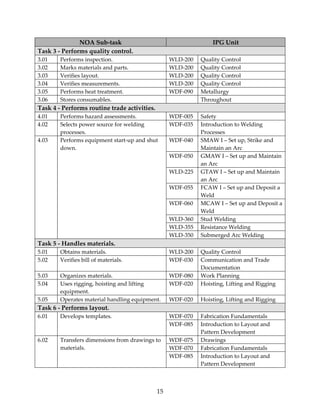
Task 3 ‐ Performs quality control. 
3.01 Performs inspection. WLD‐200 Quality Control 
3.02 Marks materials and parts. WLD‐200 Quality Control 
3.03 Verifies layout. WLD‐200 Quality Control 
3.04 Verifies measurements. WLD‐200 Quality Control 
3.05 Performs heat treatment. WDF‐090 Metallurgy 
3.06 Stores consumables. Throughout 
Task 4 ‐ Performs routine trade activities. 
4.01 Performs hazard assessments. WDF‐005 Safety 
4.02 Selects power source for welding 
15 
processes. 
WDF‐035 Introduction to Welding 
Processes 
WDF‐040 SMAW I – Set up, Strike and 
Maintain an Arc 
WDF‐050 GMAW I – Set up and Maintain 
an Arc 
WLD‐225 GTAW I – Set up and Maintain 
an Arc 
WDF‐055 FCAW I – Set up and Deposit a 
Weld 
WDF‐060 MCAW I – Set up and Deposit a 
Weld 
WLD‐360 Stud Welding 
WLD‐355 Resistance Welding 
4.03 Performs equipment start‐up and shut 
down. 
WLD‐350 Submerged Arc Welding 
Task 5 ‐ Handles materials. 
5.01 Obtains materials. WLD‐200 Quality Control 
5.02 Verifies bill of materials. WDF‐030 Communication and Trade 
Documentation 
5.03 Organizes materials. WDF‐080 Work Planning 
5.04 Uses rigging, hoisting and lifting 
equipment. 
WDF‐020 Hoisting, Lifting and Rigging 
5.05 Operates material handling equipment. WDF‐020 Hoisting, Lifting and Rigging 
Task 6 ‐ Performs layout. 
6.01 Develops templates. WDF‐070 Fabrication Fundamentals 
WDF‐085 Introduction to Layout and 
Pattern Development 
WDF‐075 Drawings 
WDF‐070 Fabrication Fundamentals 
6.02 Transfers dimensions from drawings to 
materials. 
WDF‐085 Introduction to Layout and 
Pattern Development
NOA Sub‐task IPG Unit 
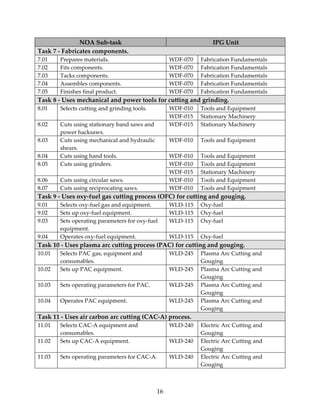
Task 7 ‐ Fabricates components. 
7.01 Prepares materials. WDF‐070 Fabrication Fundamentals 
7.02 Fits components. WDF‐070 Fabrication Fundamentals 
7.03 Tacks components. WDF‐070 Fabrication Fundamentals 
7.04 Assembles components. WDF‐070 Fabrication Fundamentals 
7.05 Finishes final product. WDF‐070 Fabrication Fundamentals 
Task 8 ‐ Uses mechanical and power tools for cutting and grinding. 
8.01 Selects cutting and grinding tools. WDF‐010 Tools and Equipment 
16 
WDF‐015 Stationary Machinery 
8.02 Cuts using stationary band saws and 
power hacksaws. 
WDF‐015 Stationary Machinery 
8.03 Cuts using mechanical and hydraulic 
shears. 
WDF‐010 Tools and Equipment 
8.04 Cuts using hand tools. WDF‐010 Tools and Equipment 
8.05 Cuts using grinders. WDF‐010 Tools and Equipment 
WDF‐015 Stationary Machinery 
8.06 Cuts using circular saws. WDF‐010 Tools and Equipment 
8.07 Cuts using reciprocating saws. WDF‐010 Tools and Equipment 
Task 9 ‐ Uses oxy‐fuel gas cutting process (OFC) for cutting and gouging. 
9.01 Selects oxy‐fuel gas and equipment. WLD‐115 Oxy‐fuel 
9.02 Sets up oxy‐fuel equipment. WLD‐115 Oxy‐fuel 
9.03 Sets operating parameters for oxy‐fuel 
equipment. 
WLD‐115 Oxy‐fuel 
9.04 Operates oxy‐fuel equipment. WLD‐115 Oxy‐fuel 
Task 10 ‐ Uses plasma arc cutting process (PAC) for cutting and gouging. 
10.01 Selects PAC gas, equipment and 
consumables. 
WLD‐245 Plasma Arc Cutting and 
Gouging 
10.02 Sets up PAC equipment. WLD‐245 Plasma Arc Cutting and 
Gouging 
10.03 Sets operating parameters for PAC. WLD‐245 Plasma Arc Cutting and 
Gouging 
10.04 Operates PAC equipment. WLD‐245 Plasma Arc Cutting and 
Gouging 
Task 11 ‐ Uses air carbon arc cutting (CAC‐A) process. 
11.01 Selects CAC‐A equipment and 
consumables. 
WLD‐240 Electric Arc Cutting and 
Gouging 
11.02 Sets up CAC‐A equipment. WLD‐240 Electric Arc Cutting and 
Gouging 
11.03 Sets operating parameters for CAC‐A. WLD‐240 Electric Arc Cutting and 
Gouging
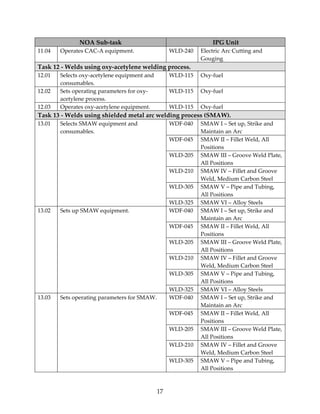
NOA Sub‐task IPG Unit 
11.04 Operates CAC‐A equipment. WLD‐240 Electric Arc Cutting and 
17 
Gouging 
Task 12 ‐ Welds using oxy‐acetylene welding process. 
12.01 Selects oxy‐acetylene equipment and 
consumables. 
WLD‐115 Oxy‐fuel 
12.02 Sets operating parameters for oxy‐acetylene 
process. 
WLD‐115 Oxy‐fuel 
12.03 Operates oxy‐acetylene equipment. WLD‐115 Oxy‐fuel 
Task 13 ‐ Welds using shielded metal arc welding process (SMAW). 
WDF‐040 SMAW I – Set up, Strike and 
Maintain an Arc 
WDF‐045 SMAW II – Fillet Weld, All 
Positions 
WLD‐205 SMAW III – Groove Weld Plate, 
All Positions 
WLD‐210 SMAW IV – Fillet and Groove 
Weld, Medium Carbon Steel 
WLD‐305 SMAW V – Pipe and Tubing, 
All Positions 
13.01 Selects SMAW equipment and 
consumables. 
WLD‐325 SMAW VI – Alloy Steels 
WDF‐040 SMAW I – Set up, Strike and 
Maintain an Arc 
WDF‐045 SMAW II – Fillet Weld, All 
Positions 
WLD‐205 SMAW III – Groove Weld Plate, 
All Positions 
WLD‐210 SMAW IV – Fillet and Groove 
Weld, Medium Carbon Steel 
WLD‐305 SMAW V – Pipe and Tubing, 
All Positions 
13.02 Sets up SMAW equipment. 
WLD‐325 SMAW VI – Alloy Steels 
WDF‐040 SMAW I – Set up, Strike and 
Maintain an Arc 
WDF‐045 SMAW II – Fillet Weld, All 
Positions 
WLD‐205 SMAW III – Groove Weld Plate, 
All Positions 
WLD‐210 SMAW IV – Fillet and Groove 
Weld, Medium Carbon Steel 
13.03 Sets operating parameters for SMAW. 
WLD‐305 SMAW V – Pipe and Tubing, 
All Positions
NOA Sub‐task IPG Unit 
18 
WLD‐325 SMAW VI – Alloy Steels 
WDF‐040 SMAW I – Set up, Strike and 
Maintain an Arc 
WDF‐045 SMAW II – Fillet Weld, All 
Positions 
WLD‐205 SMAW III – Groove Weld Plate, 
All Positions 
WLD‐210 SMAW IV ‐ Fillet and Groove 
Weld, Medium Carbon Steel 
WLD‐305 SMAW V – Pipe and Tubing, 
All Positions 
13.04 Operates SMAW equipment. 
WLD‐325 SMAW VI – Alloy Steels 
Task 14 ‐ Welds using flux cored arc welding process (FCAW), metal core arc welding 
process (MCAW) and gas metal arc welding process (GMAW). 
WDF‐050 GMAW I – Set up and Maintain 
an Arc 
WLD‐100 GMAW II – Fillet Weld, All 
Positions 
WLD‐215 GMAW III – Groove Weld, All 
Positions 
WLD‐220 GMAW IV – Fillet and Groove 
Weld, Medium Carbon Steel 
WLD‐310 GMAW V – Pipe and Tubing, 
All Positions 
WLD‐330 GMAW VI – Aluminum Alloys 
WLD‐335 GMAW VII – Stainless Steel 
Alloys 
WDF‐055 FCAW I – Set up and Deposit a 
Weld 
WLD‐105 FCAW II – Fillet and Groove 
Weld Plate, All Positions 
WLD‐315 FCAW III – Pipe and Tubing, 
All Positions 
WDF‐060 MCAW I – Set up and Deposit a 
Weld 
14.01 Selects FCAW, MCAW and GMAW gas, 
equipment and consumables. 
WLD‐110 MCAW II – Fillet and Groove 
Weld, All Positions 
WDF‐050 GMAW I – Set up and Maintain 
an Arc 
14.02 Sets up FCAW, MCAW and GMAW 
equipment. 
WLD‐100 GMAW II – Fillet Weld, All 
Positions
NOA Sub‐task IPG Unit 
19 
WLD‐215 GMAW III – Groove Weld, All 
Positions 
WLD‐220 GMAW IV – Fillet and Groove 
Weld, Medium Carbon Steel 
WLD‐310 GMAW V – Pipe and Tubing, 
All Positions 
WLD‐330 GMAW VI – Aluminum Alloys 
WLD‐335 GMAW VII – Stainless Steel 
Alloys 
WDF‐055 FCAW I – Set up and Deposit a 
Weld 
WLD‐105 FCAW II – Fillet and Groove 
Weld Plate, All Positions 
WLD‐315 FCAW III – Pipe and Tubing, 
All Positions 
WDF‐060 MCAW I – Set up and Deposit a 
Weld 
WLD‐110 MCAW II – Fillet and Groove 
Weld, All Positions 
WDF‐050 GMAW I – Set up and Maintain 
an Arc 
WLD‐100 GMAW II – Fillet Weld, All 
Positions 
WLD‐215 GMAW III – Groove Weld, All 
Positions 
WLD‐220 GMAW IV – Fillet and Groove 
Weld, Medium Carbon Steel 
WLD‐310 GMAW V – Pipe and Tubing, 
All Positions 
WLD‐330 GMAW VI – Aluminum Alloys 
WLD‐335 GMAW VII – Stainless Steel 
Alloys 
WDF‐055 FCAW I – Set up and Deposit a 
Weld 
WLD‐105 FCAW II – Fillet and Groove 
Weld Plate, All Positions 
WLD‐315 FCAW III – Pipe and Tubing, 
All Positions 
14.03 Sets operating parameters for FCAW, 
MCAW and GMAW. 
WDF‐060 MCAW I – Set up and Deposit a 
Weld
NOA Sub‐task IPG Unit 
20 
WLD‐110 MCAW II – Fillet and Groove 
Weld, All Positions 
WDF‐050 GMAW I – Set up and Maintain 
an Arc 
WLD‐100 GMAW II – Fillet Weld, All 
Positions 
WLD‐215 GMAW III – Groove Weld, All 
Positions 
WLD‐220 GMAW IV – Fillet and Groove 
Weld, Medium Carbon Steel 
WLD‐310 GMAW V – Pipe and Tubing, 
All Positions 
WLD‐330 GMAW VI – Aluminum Alloys 
WLD‐335 GMAW VII – Stainless Steel 
Alloys 
WDF‐055 FCAW I – Set up and Deposit a 
Weld 
WLD‐105 FCAW II – Fillet and Groove 
Weld Plate, All Positions 
WLD‐315 FCAW III – Pipe and Tubing, 
All Positions 
WDF‐060 MCAW I – Set up and Deposit a 
Weld 
14.04 Operates FCAW, MCAW and GMAW 
equipment. 
WLD‐110 MCAW II – Fillet and Groove 
Weld, All Positions 
Task 15 ‐ Welds using gas tungsten arc welding process (GTAW). 
WLD‐225 GTAW I – Set up and Maintain 
an Arc 
WLD‐230 GTAW II – Fillet Weld, All 
Positions 
WLD‐235 GTAW III – Groove Weld, All 
Positions 
WLD‐340 GTAW IV – Fillet and Groove 
Weld, Medium Carbon Steel 
WLD‐320 GTAW V – Pipe and Tubing, 
All Positions 
15.01 Selects GTAW gas, equipment and 
consumables. 
WLD‐345 GTAW VI – Ferrous and Non‐ 
Ferrous Alloys 
15.02 Sets up GTAW equipment. WLD‐225 GTAW I – Set up and Maintain 
an Arc
NOA Sub‐task IPG Unit 
21 
WLD‐230 GTAW II – Fillet Weld, All 
Positions 
WLD‐235 GTAW III – Groove Weld, All 
Positions 
WLD‐340 GTAW IV – Fillet and Groove 
Weld, Medium Carbon Steel 
WLD‐320 GTAW V – Pipe and Tubing, 
All Positions 
WLD‐345 GTAW VI – Ferrous and Non‐ 
Ferrous Alloys 
WLD‐225 GTAW I – Set up and Maintain 
an Arc 
WLD‐230 GTAW II – Fillet Weld, All 
Positions 
WLD‐235 GTAW III – Groove Weld, All 
Positions 
WLD‐340 GTAW IV – Fillet and Groove 
Weld, Medium Carbon Steel 
WLD‐320 GTAW V – Pipe and Tubing, 
All Positions 
15.03 Sets operating parameters for GTAW. 
WLD‐345 GTAW VI – Ferrous and Non‐ 
Ferrous Alloys 
WLD‐225 GTAW I – Set up and Maintain 
an Arc 
WLD‐230 GTAW II – Fillet Weld, All 
Positions 
WLD‐235 GTAW III – Groove Weld, All 
Positions 
WLD‐340 GTAW IV – Fillet and Groove 
Weld, Medium Carbon Steel 
WLD‐320 GTAW V – Pipe and Tubing, 
All Positions 
15.04 Operates GTAW equipment. 
WLD‐345 GTAW VI – Ferrous and Non‐ 
Ferrous Alloys 
Task 16 ‐ Welds using submerged arc welding process (SAW). 
16.01 Selects SAW equipment and 
consumables. 
WLD‐350 Submerged Arc Welding 
16.02 Sets up SAW equipment. WLD‐350 Submerged Arc Welding 
16.03 Sets operating parameters for SAW. WLD‐350 Submerged Arc Welding 
16.04 Operates SAW equipment. WLD‐350 Submerged Arc Welding
NOA Sub‐task IPG Unit 
Task 17 ‐ Welds using other processes. 
17.01 Uses stud welding process (SW). WLD‐360 Stud Welding 
22 
WLD‐355 Resistance Welding 
17.02 Uses resistance welding (RW) processes WLD‐360 Stud Welding 
(Spot (RSW) and Seam (RSEW)). WLD‐355 Resistance Welding 
17.03 Operates automated welding WLD‐360 Stud Welding 
equipment. WLD‐355 Resistance Welding
LEVEL 1
24 
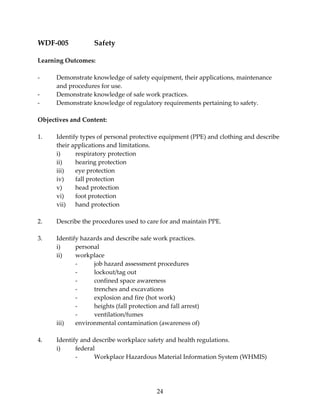
WDF‐005 Safety 
Learning Outcomes: 
‐ Demonstrate knowledge of safety equipment, their applications, maintenance 
and procedures for use. 
‐ Demonstrate knowledge of safe work practices. 
‐ Demonstrate knowledge of regulatory requirements pertaining to safety. 
Objectives and Content: 
1. Identify types of personal protective equipment (PPE) and clothing and describe 
their applications and limitations. 
i) respiratory protection 
ii) hearing protection 
iii) eye protection 
iv) fall protection 
v) head protection 
vi) foot protection 
vii) hand protection 
2. Describe the procedures used to care for and maintain PPE. 
3. Identify hazards and describe safe work practices. 
i) personal 
ii) workplace 
‐ job hazard assessment procedures 
‐ lockout/tag out 
‐ confined space awareness 
‐ trenches and excavations 
‐ explosion and fire (hot work) 
‐ heights (fall protection and fall arrest) 
‐ ventilation/fumes 
iii) environmental contamination (awareness of) 
4. Identify and describe workplace safety and health regulations. 
i) federal 
‐ Workplace Hazardous Material Information System (WHMIS)
25 
ii) provincial/territorial 
‐ occupational health and safety 
iii) municipal 
iv) work site specific (awareness of)
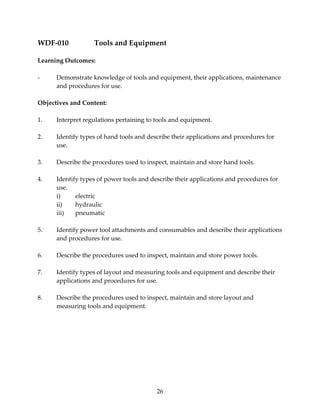
WDF‐010 Tools and Equipment 
26 
Learning Outcomes: 
‐ Demonstrate knowledge of tools and equipment, their applications, maintenance 
and procedures for use. 
Objectives and Content: 
1. Interpret regulations pertaining to tools and equipment. 
2. Identify types of hand tools and describe their applications and procedures for 
use. 
3. Describe the procedures used to inspect, maintain and store hand tools. 
4. Identify types of power tools and describe their applications and procedures for 
use. 
i) electric 
ii) hydraulic 
iii) pneumatic 
5. Identify power tool attachments and consumables and describe their applications 
and procedures for use. 
6. Describe the procedures used to inspect, maintain and store power tools. 
7. Identify types of layout and measuring tools and equipment and describe their 
applications and procedures for use. 
8. Describe the procedures used to inspect, maintain and store layout and 
measuring tools and equipment.
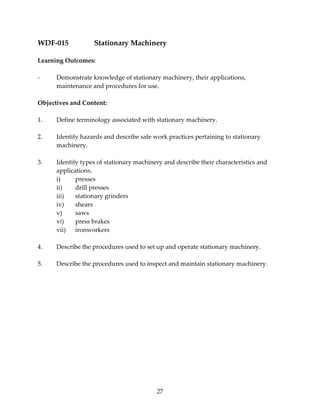
WDF‐015 Stationary Machinery 
27 
Learning Outcomes: 
‐ Demonstrate knowledge of stationary machinery, their applications, 
maintenance and procedures for use. 
Objectives and Content: 
1. Define terminology associated with stationary machinery. 
2. Identify hazards and describe safe work practices pertaining to stationary 
machinery. 
3. Identify types of stationary machinery and describe their characteristics and 
applications. 
i) presses 
ii) drill presses 
iii) stationary grinders 
iv) shears 
v) saws 
vi) press brakes 
vii) ironworkers 
4. Describe the procedures used to set up and operate stationary machinery. 
5. Describe the procedures used to inspect and maintain stationary machinery.
WDF‐020 Hoisting, Lifting and Rigging 
28 
Learning Outcomes: 
‐ Demonstrate knowledge of hoisting, lifting and rigging equipment, their 
applications, limitations and procedures for use. 
‐ Demonstrate knowledge of the procedures used to perform hoisting and lifting 
operations. 
‐ Demonstrate knowledge of calculations required prior to hoisting and lifting 
operations. 
Objectives and Content: 
1. Define terminology associated with hoisting, lifting and rigging. 
2. Identify hazards and describe safe work practices pertaining to hoisting, lifting 
and rigging. 
3. Identify regulations pertaining to hoisting, lifting and rigging. 
4. Identify types of rigging equipment and accessories and describe their 
limitations, applications and procedures for use. 
5. Identify types of hoisting and lifting equipment and accessories and describe 
their applications and procedures for use. 
i) jacks 
ii) hoists 
iii) cranes 
‐ overhead travelling cranes (OTC) 
‐ gantry 
6. Describe the procedures used to inspect, maintain and store hoisting, lifting and 
rigging equipment. 
7. Describe the procedures used to rig material/equipment for lifting. 
8. Describe the procedures to attach and use tag lines.
9. Describe the procedures used to ensure the work area is safe for lifting. 
29 
i) supervision of lift 
ii) securing work area 
iii) communication 
10. Identify and describe the procedures used to communicate during hoisting, 
lifting and rigging operations. 
i) hand signals 
ii) electronic communications 
iii) audible and visual warnings 
11. Identify the factors to consider when selecting rigging equipment. 
i) load characteristics 
ii) sling angle 
iii) environment 
‐ chemical hazards 
‐ grounding requirements 
‐ weather conditions 
iv) working load limit 
12. Describe the procedures used to perform a lift. 
i) pre‐lift checks 
ii) lifting load 
iii) placement of load 
iv) post‐lift inspection
30 
WDF‐025 Access Equipment 
Learning Outcomes: 
‐ Demonstrate knowledge of access equipment, their applications, limitations and 
procedures for use. 
Objectives and Content: 
1. Define terminology associated with access equipment. 
2. Identify hazards and describe safe work practices pertaining to access 
equipment. 
3. Identify regulations pertaining to access equipment. 
4. Identify types of access equipment and describe their characteristics and 
applications. 
i) scaffolding 
ii) ladders 
iii) man lifts 
iv) elevated work platforms 
5. Identify types of fall protection and fall arrest equipment and describe their 
applications and procedures for use. 
6. Describe the procedures used to erect and dismantle access equipment. 
7. Describe the procedures used to inspect and maintain access equipment.
WDF‐030 Communication and Trade Documentation 
31 
Learning Outcomes: 
‐ Demonstrate knowledge of effective communication practices. 
‐ Demonstrate knowledge of trade related documentation and its use. 
Objectives and Content: 
1. Describe effective verbal and non‐verbal communication. 
2. Identify types of communication devices and describe their applications. 
3. Identify types of trade related documentation and describe their applications and 
procedures for use. 
i) manufacturers’ specifications 
ii) safety/hazard assessment forms 
iii) mill certificates 
iv) heat numbers 
v) customer specifications 
vi) codes and standards 
vii) manuals/catalogues 
viii) work orders 
ix) requisitions/purchase orders 
x) permits 
xi) procedure sheets
WDF‐035 Introduction to Welding Processes 
32 
Learning Outcomes: 
‐ Demonstrate knowledge of welding processes and their applications. 
‐ Demonstrate knowledge of welding equipment and accessories. 
Objectives and Content: 
1. Define terminology associated with welding. 
2. Interpret information pertaining to welding found on drawings. 
i) symbols 
ii) abbreviations 
3. Identify hazards and describe safe work practices pertaining to welding. 
i) personal 
ii) shop/facility 
iii) fire and explosion 
iv) equipment 
v) ventilation/fumes 
vi) storage, handling and transportation 
4. Identify codes and standards pertaining to welding. 
i) Canadian Standards Association (CSA) 
ii) American Society of Mechanical Engineers (ASME) 
iii) American Welding Society (AWS) 
5. Identify welding processes and describe their characteristics and applications. 
i) shielded metal arc welding (SMAW) 
ii) gas metal arc welding (GMAW) 
iii) metal core arc welding (MCAW) 
iv) flux core arc welding (FCAW) 
v) gas tungsten arc welding (GTAW) 
vi) stud welding 
vii) resistance welding (RW) 
viii) submerged arc welding (SAW)
6. Identify types of power sources for welding equipment and describe their 
33 
applications and limitations. 
i) AC transformer 
ii) AC/DC rectifier 
iii) DC generator 
iv) engine driven 
‐ alternators 
‐ generators 
v) inverters 
7. Identify the types of beads and describe their characteristics and applications. 
i) stringer 
ii) weave 
8. Identify types of welds and describe their characteristics and applications. 
i) fillet 
ii) groove 
iii) surfacing 
iv) plug or slot 
9. Identify welding positions and describe their applications. 
i) flat (1F or 1G) 
ii) horizontal (2F or 2 G) 
iii) vertical (3F or 3G) 
iv) overhead (4F or 4G) 
v) pipe fixed – horizontal (5F or 5G) 
vi) pipe fixed – 45 degree plane (6F or 6G) 
10. Identify welding test positions and describe their characteristics and restrictions.
WDF‐040 Shielded Metal Arc Welding I – Set up, Strike and 
34 
Maintain an Arc 
Learning Outcomes: 
‐ Demonstrate knowledge of shielded metal arc welding (SMAW) welding 
equipment, consumables and accessories. 
‐ Demonstrate knowledge of the procedures used to set up, adjust, operate, inspect 
and maintain SMAW welding equipment. 
‐ Demonstrate knowledge of the procedures used to deposit a weld bead using 
SMAW welding equipment. 
Objectives and Content: 
1. Define terminology associated with SMAW welding. 
2. Identify hazards and describe safe work practices pertaining to SMAW welding. 
i) personal 
ii) shop/facility 
iii) fire and explosion 
iv) equipment 
v) ventilation/fumes 
vi) storage/handling 
3. Identify codes and standards pertaining to SMAW welding. 
i) Canadian Standards Association (CSA) 
ii) American Society of Mechanical Engineers (ASME) 
iii) American Welding Society (AWS) 
4. Identify SMAW welding equipment, consumables and accessories and describe 
their applications. 
5. Describe the procedures used to set up and adjust SMAW welding equipment. 
6. Describe the procedures used to strike and maintain an arc using SMAW 
welding equipment.
7. Describe the procedures and techniques used to deposit a weld bead using 
35 
SMAW welding equipment. 
i) arc length 
ii) travel speed 
iii) work and travel angles 
8. Describe the procedures used to inspect and maintain SMAW welding 
equipment. 
9. Strike and maintain an arc.
WDF‐045 Shielded Metal Arc Welding II – Fillet Weld, All 
36 
Positions 
Learning Outcomes: 
‐ Demonstrate knowledge of the procedures used to prepare base metals and 
joints for shielded metal arc welding (SMAW) fillet welds. 
‐ Demonstrate knowledge of the procedures used to perform fillet welds on low 
carbon steel in all positions using the SMAW process. 
Objectives and Content: 
1. Define terminology associated with SMAW fillet welds. 
2. Interpret information pertaining to SMAW fillet welds found on drawings and 
specifications. 
3. Identify the considerations when selecting consumables and determining 
equipment set‐up for performing SMAW fillet welds in all positions. 
i) specification requirements 
ii) base metal 
‐ composition 
‐ thickness 
iii) power source 
iv) welding position 
v) joint type and design 
4. Identify the requirements and describe the procedures to store consumables used 
for SMAW fillet welds on low carbon steel. 
5. Describe the procedures used to prepare base metals and joints for SMAW fillet 
welds. 
6. Describe the procedures used to perform fillet welds on low carbon steel in all 
positions using the SMAW process. 
7. Describe the procedures used to prevent and correct weld faults. 
8. Perform fillet welds on low carbon steel in all positions.
WDF‐050 Gas Metal Arc Welding I – Set up and Maintain an Arc 
37 
Learning Outcomes: 
‐ Demonstrate knowledge of gas metal arc welding (GMAW) welding equipment, 
consumables and accessories. 
‐ Demonstrate knowledge of the procedures used to set up, adjust, operate, inspect 
and maintain GMAW welding equipment. 
‐ Demonstrate knowledge of the procedures used to deposit a weld bead using 
GMAW welding equipment. 
Objectives and Content: 
1. Define terminology associated with GMAW welding. 
2. Identify hazards and describe safe work practices pertaining to GMAW welding. 
i) personal 
ii) shop/facility 
iii) fire and explosion 
iv) equipment 
v) ventilation/fumes 
vi) storage, handling and transportation 
3. Identify codes and standards pertaining to GMAW welding. 
i) Canadian Standards Association (CSA) 
ii) American Society of Mechanical Engineers (ASME) 
iii) American Welding Society (AWS) 
4. Identify GMAW welding equipment, consumables and accessories and describe 
their applications. 
5. Describe the procedures used to assemble and disassemble GMAW welding 
equipment. 
6. Describe the procedures used to establish and maintain an arc using GMAW 
welding equipment.
7. Identify the modes of transfer relating to GMAW welding and describe their 
38 
characteristics and applications. 
i) short circuiting 
ii) globular 
iii) spray 
iv) pulse 
8. Describe the procedures and techniques used to deposit a weld bead using 
GMAW welding equipment. 
i) electrode extension 
ii) travel speed 
iii) work and travel angles 
iv) flow rates 
9. Describe the procedures used to inspect, maintain and troubleshoot GMAW 
welding equipment. 
10. Establish and maintain an arc.
WLD‐100 Gas Metal Arc Welding II – Fillet Weld, All Positions 
39 
Learning Outcomes: 
‐ Demonstrate knowledge of the procedures used to prepare base metals and 
joints for gas metal arc welding (GMAW) fillet welds. 
‐ Demonstrate knowledge of the procedures used to perform fillet welds on low 
carbon steel plate in all positions using the GMAW process. 
Objectives and Content: 
1. Define terminology associated with GMAW fillet welds. 
2. Interpret information pertaining to GMAW fillet welds found on drawings and 
specifications. 
3. Identify the considerations when selecting consumables and determining 
equipment set‐up for performing GMAW fillet welds on low carbon steel in all 
positions. 
i) specification requirements 
ii) base metal 
‐ composition 
‐ thickness 
iii) shielding gas selection 
iv) power source 
v) welding position 
vi) joint type and design 
4. Identify the requirements and describe the procedures to store consumables used 
for GMAW fillet welds on low carbon steel plate. 
5. Describe the procedures used to prepare base metals and joints for GMAW fillet 
welds. 
6. Describe the procedures used to perform fillet welds on low carbon steel plate in 
all positions using the GMAW process. 
7. Describe the procedures used to prevent and correct weld faults. 
8. Perform fillet welds on low carbon steel plate in all positions.
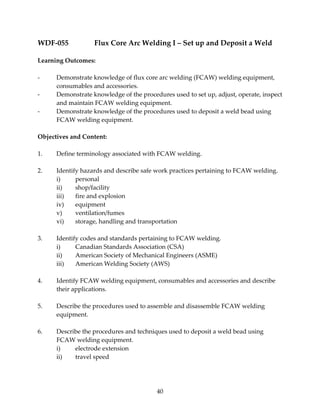
WDF‐055 Flux Core Arc Welding I – Set up and Deposit a Weld 
40 
Learning Outcomes: 
‐ Demonstrate knowledge of flux core arc welding (FCAW) welding equipment, 
consumables and accessories. 
‐ Demonstrate knowledge of the procedures used to set up, adjust, operate, inspect 
and maintain FCAW welding equipment. 
‐ Demonstrate knowledge of the procedures used to deposit a weld bead using 
FCAW welding equipment. 
Objectives and Content: 
1. Define terminology associated with FCAW welding. 
2. Identify hazards and describe safe work practices pertaining to FCAW welding. 
i) personal 
ii) shop/facility 
iii) fire and explosion 
iv) equipment 
v) ventilation/fumes 
vi) storage, handling and transportation 
3. Identify codes and standards pertaining to FCAW welding. 
i) Canadian Standards Association (CSA) 
ii) American Society of Mechanical Engineers (ASME) 
iii) American Welding Society (AWS) 
4. Identify FCAW welding equipment, consumables and accessories and describe 
their applications. 
5. Describe the procedures used to assemble and disassemble FCAW welding 
equipment. 
6. Describe the procedures and techniques used to deposit a weld bead using 
FCAW welding equipment. 
i) electrode extension 
ii) travel speed
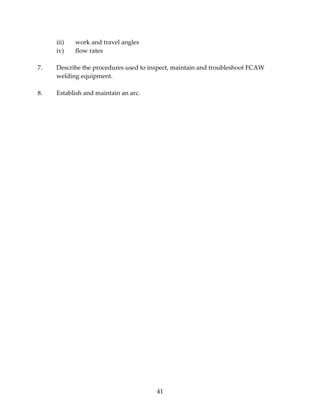
41 
iii) work and travel angles 
iv) flow rates 
7. Describe the procedures used to inspect, maintain and troubleshoot FCAW 
welding equipment. 
8. Establish and maintain an arc.
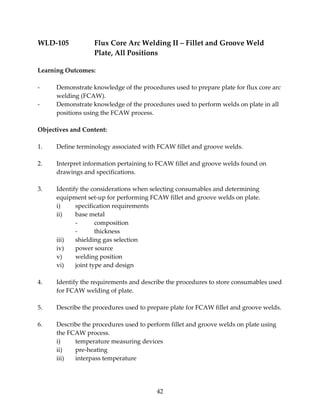
WLD‐105 Flux Core Arc Welding II – Fillet and Groove Weld 
Plate, All Positions 
42 
Learning Outcomes: 
‐ Demonstrate knowledge of the procedures used to prepare plate for flux core arc 
welding (FCAW). 
‐ Demonstrate knowledge of the procedures used to perform welds on plate in all 
positions using the FCAW process. 
Objectives and Content: 
1. Define terminology associated with FCAW fillet and groove welds. 
2. Interpret information pertaining to FCAW fillet and groove welds found on 
drawings and specifications. 
3. Identify the considerations when selecting consumables and determining 
equipment set‐up for performing FCAW fillet and groove welds on plate. 
i) specification requirements 
ii) base metal 
‐ composition 
‐ thickness 
iii) shielding gas selection 
iv) power source 
v) welding position 
vi) joint type and design 
4. Identify the requirements and describe the procedures to store consumables used 
for FCAW welding of plate. 
5. Describe the procedures used to prepare plate for FCAW fillet and groove welds. 
6. Describe the procedures used to perform fillet and groove welds on plate using 
the FCAW process. 
i) temperature measuring devices 
ii) pre‐heating 
iii) interpass temperature
43 
iv) post‐heating 
v) stress relieving 
7. Describe the procedures used to prevent and correct weld faults. 
8. Perform welds on plate.
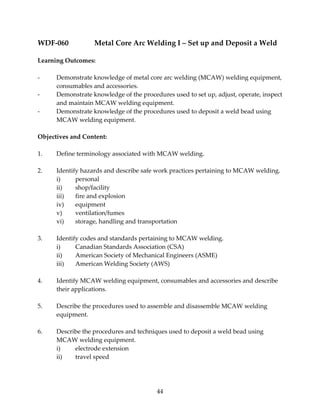
WDF‐060 Metal Core Arc Welding I – Set up and Deposit a Weld 
44 
Learning Outcomes: 
‐ Demonstrate knowledge of metal core arc welding (MCAW) welding equipment, 
consumables and accessories. 
‐ Demonstrate knowledge of the procedures used to set up, adjust, operate, inspect 
and maintain MCAW welding equipment. 
‐ Demonstrate knowledge of the procedures used to deposit a weld bead using 
MCAW welding equipment. 
Objectives and Content: 
1. Define terminology associated with MCAW welding. 
2. Identify hazards and describe safe work practices pertaining to MCAW welding. 
i) personal 
ii) shop/facility 
iii) fire and explosion 
iv) equipment 
v) ventilation/fumes 
vi) storage, handling and transportation 
3. Identify codes and standards pertaining to MCAW welding. 
i) Canadian Standards Association (CSA) 
ii) American Society of Mechanical Engineers (ASME) 
iii) American Welding Society (AWS) 
4. Identify MCAW welding equipment, consumables and accessories and describe 
their applications. 
5. Describe the procedures used to assemble and disassemble MCAW welding 
equipment. 
6. Describe the procedures and techniques used to deposit a weld bead using 
MCAW welding equipment. 
i) electrode extension 
ii) travel speed
45 
iii) work and travel angles 
iv) flow rates 
7. Describe the procedures used to inspect, maintain and troubleshoot MCAW 
welding equipment. 
8. Establish and maintain an arc.
WLD‐110 Metal Core Arc Welding II – Fillet and Groove Weld, 
46 
All Positions 
Learning Outcomes: 
‐ Demonstrate knowledge of the procedures used to prepare base metals for metal 
core arc welding (MCAW). 
‐ Demonstrate knowledge of the procedures used to perform welds using the 
MCAW process. 
Objectives and Content: 
1. Define terminology associated with MCAW fillet and groove welds. 
2. Interpret information pertaining to MCAW fillet and groove welds found on 
drawings and specifications. 
3. Identify the considerations when selecting consumables and determining 
equipment set‐up for performing MCAW fillet and groove welds. 
i) specification requirements 
ii) base metal 
‐ composition 
‐ thickness 
iii) shielding gas selection 
iv) power source 
v) welding position 
vi) joint type and design 
4. Identify requirements and describe the procedures to store consumables used for 
MCAW welding. 
5. Describe the procedures used to prepare base metals and joints for MCAW fillet 
and groove welds. 
6. Describe the procedures used to perform fillet and groove welds using the 
MCAW process. 
7. Describe the procedures used to prevent and correct weld faults.
47 
WLD‐115 Oxy‐fuel 
Learning Outcomes: 
‐ Demonstrate knowledge of oxy‐fuel equipment and accessories. 
‐ Demonstrate knowledge of the procedures used to cut with oxy‐fuel equipment. 
‐ Demonstrate knowledge of the procedures used to gouge with oxy‐fuel 
equipment. 
‐ Demonstrate knowledge of the procedures used to weld with oxy‐fuel 
equipment. 
‐ Demonstrate knowledge of the procedures used to braze with oxy‐fuel 
equipment. 
Objectives and Content: 
1. Define terminology associated with oxy‐fuel cutting, gouging and welding. 
2. Identify hazards and describe safe work practices pertaining to oxy‐fuel cutting, 
gouging and welding. 
i) personal 
ii) shop/facility 
iii) fire and explosion 
iv) equipment 
v) ventilation/fumes 
vi) storage, handling and transportation 
3. Identify and interpret codes and regulations pertaining to oxy‐fuel cutting, 
gouging and welding equipment and operations. 
4. Identify oxy‐fuel equipment and accessories and describe their applications and 
limitations. 
i) cutting 
ii) gouging 
iii) welding 
iv) brazing/braze‐welding 
v) heating
5. Identify types of flames and describe their application and the procedures for 
48 
flame adjustment. 
i) oxidizing 
ii) carburizing 
iii) neutral 
6. Describe the procedures used to set up, adjust and shut down oxy‐fuel 
equipment. 
i) manufacturers’ recommendations 
7. Describe the procedures used to inspect and maintain oxy‐fuel equipment. 
8. Describe the procedures used to cut materials using oxy‐fuel equipment. 
i) free hand 
ii) guided 
‐ straight edge 
‐ pattern 
iii) automated/semi‐automated 
9. Identify common cutting faults and describe the procedures to prevent and 
correct them. 
10. Describe the procedures used to gouge using oxy‐fuel equipment. 
11. Describe the procedures used to weld using oxy‐fuel equipment. 
12. Describe the procedures used to braze/braze‐weld using oxy‐fuel equipment. 
13. Set up, operate and shut down oxy‐fuel equipment.
LEVEL 2
50 
WLD‐200 Quality Control 
Learning Outcomes: 
‐ Demonstrate knowledge of quality control measures used to verify compliance 
with design and code specifications. 
‐ Demonstrate knowledge of inspection and testing methods and their 
applications. 
Objectives and Content: 
1. Define terminology associated with quality control. 
2. Interpret codes and standards pertaining to quality control. 
3. Interpret information pertaining to quality control found on drawings and 
specifications. 
4. Identify tools and equipment relating to quality control and describe their 
applications and procedures for use. 
5. Explain quality control, its purpose and applications. 
6. Explain the methods used to identify and verify materials. 
i) codes, standards and specifications 
ii) mill certificates 
iii) colour coding of materials 
7. Identify methods of inspection and testing and describe their characteristics, 
limitations and applications. 
i) destructive 
ii) non‐destructive 
8. Describe the procedures used to verify compliance with design and code 
specifications. 
i) perform visual inspections 
ii) verify measurements 
iii) perform post welding checks
51 
iv) mark materials and parts 
v) verify layout 
9. Describe the procedures used to document quality control measures.
52 
WDF‐065 Weld Faults 
Learning Outcomes: 
‐ Demonstrate knowledge of weld faults, their characteristics and effect on welds. 
Objectives and Content: 
1. Define terminology associated with weld faults. 
2. Interpret standards and documentation relating to welds and weld faults. 
3. Identify tools and equipment used to identify weld faults and describe their 
applications and procedures for use. 
4. Identify the classifications of weld faults and describe their characteristics. 
i) dimensional defects 
ii) structural discontinuities 
iii) defective properties (weld metal and base metal) 
5. Identify the causes of weld faults and describe their effect on welds.
WLD‐205 Shielded Metal Arc Welding III – Groove Weld Plate, 
53 
All Positions 
Learning Outcomes: 
‐ Demonstrate knowledge of the procedures used to prepare base metals and 
joints for shielded metal arc welding (SMAW) groove welds. 
‐ Demonstrate knowledge of the procedures used to perform groove welds on low 
carbon steel plate in all positions using the SMAW process. 
Objectives and Content: 
1. Define terminology associated with SMAW groove welds. 
2. Interpret information pertaining to SMAW groove welds found on drawings and 
specifications. 
3. Identify the considerations when selecting consumables and determining 
equipment set‐up for performing SMAW groove welds on low carbon steel plate. 
i) specification requirements 
ii) base metal 
‐ composition 
‐ thickness 
iii) power source 
iv) welding position 
v) joint type and design 
4. Identify the requirements and describe the procedures to store consumables used 
for SMAW groove welds on low carbon steel plate. 
5. Describe the procedures used to prepare base metals and joints for SMAW 
groove welds. 
6. Describe the procedures used to perform groove welds on low carbon steel plate 
in all positions using SMAW process. 
7. Describe the procedures used to prevent and correct weld faults. 
8. Perform groove welds on low carbon steel plate in all positions.
WLD‐210 Shielded Metal Arc Welding IV – Fillet and Groove 
Weld, Medium Carbon Steel 
54 
Learning Outcomes: 
‐ Demonstrate knowledge of the procedures used to prepare medium carbon steel 
plate and joints for shielded metal arc welding (SMAW) fillet and groove welds. 
‐ Demonstrate knowledge of the procedures used to perform fillet and groove 
welds on medium carbon steel plate in all positions using the SMAW process. 
Objectives and Content: 
1. Define terminology associated with SMAW fillet and groove welds on medium 
carbon steel plate. 
2. Interpret information pertaining to SMAW fillet and groove welds on medium 
carbon steel plate found on drawings and specifications. 
3. Identify the considerations when selecting consumables and determining 
equipment set‐up for performing SMAW fillet and groove welds on medium 
carbon steel plate. 
i) specification requirements 
ii) base metals 
‐ composition 
‐ thickness 
iii) power source 
iv) welding position 
v) joint type and design 
4. Identify the requirements and describe the procedures to store consumables used 
for SMAW fillet and groove welds on medium carbon steel plate. 
5. Describe the procedures used to prepare medium carbon steel plate and joints for 
SMAW fillet and groove welds. 
6. Describe the procedures used to perform fillet and groove welds on medium 
carbon steel plate using SMAW process. 
i) temperature measuring devices 
ii) pre‐heating
55 
iii) interpass temperature 
iv) post‐heating 
v) stress relieving 
7. Describe the procedures used to prevent and correct weld faults.
WLD‐215 Gas Metal Arc Welding III – Groove Weld, All Positions 
56 
Learning Outcomes: 
‐ Demonstrate knowledge of the procedures used to prepare base metals and 
joints for gas metal arc welding (GMAW) groove welds. 
‐ Demonstrate knowledge of the procedures used to perform groove welds on low 
carbon steel plate in all positions using the GMAW process. 
Objectives and Content: 
1. Define terminology associated with GMAW groove welds. 
2. Interpret information pertaining to GMAW groove welds found on drawings 
and specifications. 
3. Identify the considerations when selecting consumables and determining 
equipment set‐up for performing GMAW groove welds on low carbon steel plate 
in all positions. 
i) specification requirements 
ii) base metal 
‐ composition 
‐ thickness 
iii) shielding gas selection 
iv) power source 
v) welding position 
vi) joint type and design 
4. Identify the requirements and describe the procedures to store consumables used 
for GMAW groove welds on low carbon steel plate. 
5. Describe the procedures used to prepare base metal and joints for GMAW 
groove welds. 
6. Describe the procedures used to perform groove welds on low carbon steel plate 
in all positions using GMAW process. 
7. Describe the procedures used to prevent and correct weld faults. 
8. Perform groove welds on low carbon steel plate in all positions.
WLD‐220 Gas Metal Arc Welding IV – Fillet and Groove Weld, 
Medium Carbon Steel 
57 
Learning Outcomes: 
‐ Demonstrate knowledge of the procedures used to prepare medium carbon steel 
base metals and joints for gas metal arc welding (GMAW) fillet and groove 
welds. 
‐ Demonstrate knowledge of the procedures used to perform fillet and groove 
welds on medium carbon steel in all positions using the GMAW process. 
Objectives and Content: 
1. Define terminology associated with GMAW fillet and groove welds on medium 
carbon steel. 
2. Interpret information pertaining to GMAW fillet and groove welds on medium 
carbon steel found on drawings and specifications. 
3. Identify the considerations when selecting consumables and determining 
equipment set‐up for performing GMAW fillet and groove welds on medium 
carbon steel. 
i) specification requirements 
base metals 
‐ composition 
‐ thickness 
ii) shielding gas selection 
iii) power source 
iv) welding position 
v) joint type and design 
4. Identify the requirements and describe the procedures to store consumables used 
for GMAW fillet and groove welds on medium carbon steel. 
5. Describe the procedures used to prepare medium carbon steel base metals and 
joints for GMAW fillet and groove welds.
6. Describe the procedures used to perform GMAW fillet and groove welds on 
medium carbon steel. 
i) temperature measuring devices 
ii) pre‐heating 
iii) interpass temperature 
iv) post‐heating 
v) stress relieving 
7. Describe the procedures used to prevent and correct weld faults. 
58
WLD‐225 Gas Tungsten Arc Welding I – Set up and Maintain an 
59 
Arc 
Learning Outcomes: 
‐ Demonstrate knowledge of gas tungsten arc welding (GTAW) equipment, 
consumables and accessories. 
‐ Demonstrate knowledge of the procedures used to set up, adjust, operate, inspect 
and maintain GTAW welding equipment. 
‐ Demonstrate knowledge of the procedures used to deposit a weld bead using 
GTAW equipment. 
Objectives and Content: 
1. Define terminology associated with GTAW welding. 
2. Identify hazards and describe safe work practices pertaining to GTAW welding. 
i) personal 
ii) shop/facility 
iii) fire and explosion 
iv) equipment 
v) ventilation/fumes 
vi) storage, handling and transportation 
3. Identify codes and standards pertaining to GTAW welding. 
i) Canadian Standards Association (CSA) 
ii) American Society of Mechanical Engineers (ASME) 
iii) American Welding Society (AWS) 
4. Identify GTAW welding equipment, consumables and accessories and describe 
their applications. 
5. Describe the procedures used to assemble and disassemble GTAW welding 
equipment. 
6. Describe the procedures used to establish and maintain an arc using GTAW 
welding equipment.
7. Describe the procedures and techniques used to deposit a weld bead using 
60 
GTAW welding equipment. 
i) with filler metal 
ii) without filler metal 
8. Describe the procedures used to inspect, maintain and troubleshoot GTAW 
welding equipment. 
9. Establish and maintain an arc.
WLD‐230 Gas Tungsten Arc Welding II – Fillet Weld, All 
61 
Positions 
Learning Outcomes: 
‐ Demonstrate knowledge of the procedures used to prepare base metals and 
joints for gas tungsten arc welding (GTAW) fillet welds. 
‐ Demonstrate knowledge of the procedures used to perform fillet welds on low 
carbon steel sheet and plate in all positions using the GTAW process. 
Objectives and Content: 
1. Define terminology associated with GTAW fillet welds. 
2. Interpret information pertaining to GTAW fillet welds found on drawings and 
specifications. 
3. Identify the considerations when selecting consumables and determining 
equipment set‐up for performing GTAW fillet welds in all positions. 
i) specification requirements 
ii) base metals 
‐ composition 
‐ thickness 
iii) shielding gas selection 
iv) power source 
v) welding position 
vi) joint type and design 
4. Identify the requirements and describe the procedures to store consumables used 
for GTAW fillet welds on low carbon steel sheet and plate. 
5. Describe the procedures used to prepare base metals and joints for GTAW fillet 
welds. 
6. Describe the procedures used to perform fillet welds on low carbon steel sheet 
and plate in all positions using the GTAW process. 
7. Describe the procedures used to prevent and correct weld faults. 
8. Perform fillet welds on low carbon steel sheet and plate.
WLD‐235 Gas Tungsten Arc Welding III – Groove Weld, All 
62 
Positions 
Learning Outcomes: 
‐ Demonstrate knowledge of the procedures used to prepare base metals and 
joints for gas tungsten arc welding (GTAW) groove welds. 
‐ Demonstrate knowledge of the procedures used to perform groove welds on low 
carbon steel sheet and plate in all positions using the GTAW process. 
Objectives and Content: 
1. Define terminology associated with GTAW groove welds. 
2. Interpret information pertaining to GTAW groove welds found on drawings and 
specifications. 
3. Identify the considerations when selecting consumables and determining 
equipment set‐up for performing GTAW groove welds in all positions. 
i) specification requirements 
ii) base metal 
‐ composition 
‐ thickness 
iii) shielding gas selection 
iv) power source 
v) welding position 
vi) joint type and design 
4. Identify the requirements and describe the procedures to store consumables used 
for GTAW groove welds on low carbon steel sheet and plate. 
5. Describe the procedures used to prepare base metals and joints for GTAW 
groove welds. 
6. Describe the procedures used to perform groove welds on low carbon steel sheet 
and plate in all positions using GTAW process. 
7. Describe the procedures used to prevent and correct weld faults.
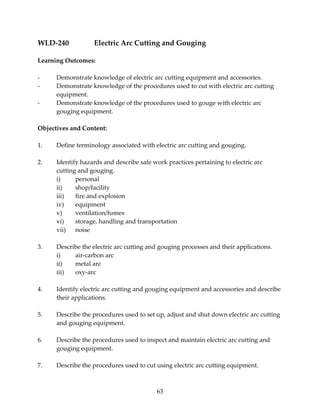
WLD‐240 Electric Arc Cutting and Gouging 
63 
Learning Outcomes: 
‐ Demonstrate knowledge of electric arc cutting equipment and accessories. 
‐ Demonstrate knowledge of the procedures used to cut with electric arc cutting 
equipment. 
‐ Demonstrate knowledge of the procedures used to gouge with electric arc 
gouging equipment. 
Objectives and Content: 
1. Define terminology associated with electric arc cutting and gouging. 
2. Identify hazards and describe safe work practices pertaining to electric arc 
cutting and gouging. 
i) personal 
ii) shop/facility 
iii) fire and explosion 
iv) equipment 
v) ventilation/fumes 
vi) storage, handling and transportation 
vii) noise 
3. Describe the electric arc cutting and gouging processes and their applications. 
i) air‐carbon arc 
ii) metal arc 
iii) oxy‐arc 
4. Identify electric arc cutting and gouging equipment and accessories and describe 
their applications. 
5. Describe the procedures used to set up, adjust and shut down electric arc cutting 
and gouging equipment. 
6. Describe the procedures used to inspect and maintain electric arc cutting and 
gouging equipment. 
7. Describe the procedures used to cut using electric arc cutting equipment.
8. Describe the procedures used to gouge using electric arc gouging equipment. 
64 
9. Perform air‐carbon arc gouging.
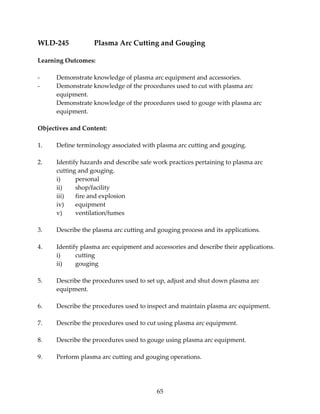
WLD‐245 Plasma Arc Cutting and Gouging 
65 
Learning Outcomes: 
‐ Demonstrate knowledge of plasma arc equipment and accessories. 
‐ Demonstrate knowledge of the procedures used to cut with plasma arc 
equipment. 
Demonstrate knowledge of the procedures used to gouge with plasma arc 
equipment. 
Objectives and Content: 
1. Define terminology associated with plasma arc cutting and gouging. 
2. Identify hazards and describe safe work practices pertaining to plasma arc 
cutting and gouging. 
i) personal 
ii) shop/facility 
iii) fire and explosion 
iv) equipment 
v) ventilation/fumes 
3. Describe the plasma arc cutting and gouging process and its applications. 
4. Identify plasma arc equipment and accessories and describe their applications. 
i) cutting 
ii) gouging 
5. Describe the procedures used to set up, adjust and shut down plasma arc 
equipment. 
6. Describe the procedures used to inspect and maintain plasma arc equipment. 
7. Describe the procedures used to cut using plasma arc equipment. 
8. Describe the procedures used to gouge using plasma arc equipment. 
9. Perform plasma arc cutting and gouging operations.
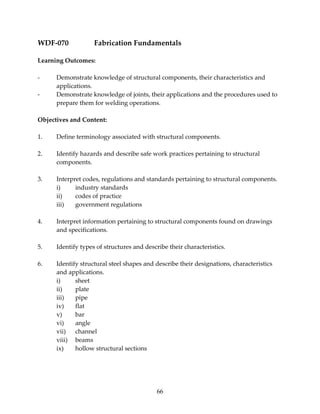
WDF‐070 Fabrication Fundamentals 
66 
Learning Outcomes: 
‐ Demonstrate knowledge of structural components, their characteristics and 
applications. 
‐ Demonstrate knowledge of joints, their applications and the procedures used to 
prepare them for welding operations. 
Objectives and Content: 
1. Define terminology associated with structural components. 
2. Identify hazards and describe safe work practices pertaining to structural 
components. 
3. Interpret codes, regulations and standards pertaining to structural components. 
i) industry standards 
ii) codes of practice 
iii) government regulations 
4. Interpret information pertaining to structural components found on drawings 
and specifications. 
5. Identify types of structures and describe their characteristics. 
6. Identify structural steel shapes and describe their designations, characteristics 
and applications. 
i) sheet 
ii) plate 
iii) pipe 
iv) flat 
v) bar 
vi) angle 
vii) channel 
viii) beams 
ix) hollow structural sections
7. Identify types of joints and describe their characteristics and applications. 
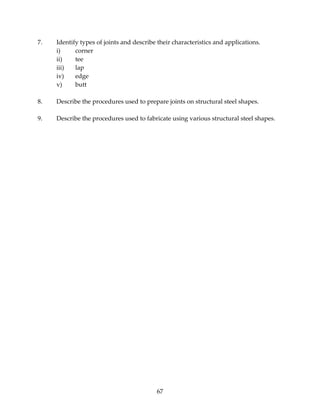
67 
i) corner 
ii) tee 
iii) lap 
iv) edge 
v) butt 
8. Describe the procedures used to prepare joints on structural steel shapes. 
9. Describe the procedures used to fabricate using various structural steel shapes.
68 
WDF‐075 Drawings 
Learning Outcomes: 
‐ Demonstrate knowledge of drawings and their applications. 
‐ Demonstrate knowledge of interpreting and extracting information from 
drawings. 
Objectives and Content: 
1. Define terminology associated with drawings and sketches. 
2. Describe metric and imperial systems of measurement and the procedures used 
to perform conversions. 
3. Identify the types of drawings and describe their applications. 
i) architectural 
ii) engineering 
iii) erection 
iv) assembly 
v) shop (detail) 
4. Identify drawing projections and views and describe their applications. 
i) projections 
‐ orthographic (1st and 3rd angle) 
‐ oblique 
‐ isometric 
ii) views 
‐ plan 
‐ section 
‐ detail 
‐ elevation 
5. Describe the use of scales. 
6. Interpret information on drawings. 
i) welding symbols 
ii) lines 
iii) legend
iv) other symbols and abbreviations 
v) notes and specifications 
vi) schedules 
vii) scales 
7. Describe basic sketching techniques. 
8. Describe dimensioning systems, their purpose and applications. 
69 
i) datum/baseline 
ii) elevation 
iii) conventional 
iv) running 
v) aligned 
vi) unidirectional 
vii) group 
9. Describe the procedures used for the care, handling and storage of drawings. 
10. Interpret basic shop drawings.
70 
WDF‐080 Work Planning 
Learning Outcomes: 
‐ Demonstrate knowledge of the procedures used to plan and organize work tasks. 
Objectives and Content: 
1. Identify sources of information relevant to work task planning. 
i) supervisor 
ii) documentation 
iii) drawings 
iv) related professionals 
v) suppliers 
vi) clients 
2. Identify the considerations when planning work tasks. 
i) scheduling 
ii) sequence 
iii) material selection and handling 
iv) equipment selection 
3. Describe the procedures used to organize, move and store tools, equipment, 
materials and supplies.
LEVEL 3
WLD‐085 Introduction to Layout and Pattern Development 
72 
Learning Outcomes: 
‐ Demonstrate knowledge of pattern and template development and its purpose. 
‐ Demonstrate knowledge of the procedures used to develop simple templates. 
Objectives and Content: 
1. Define terminology associated with layout and pattern development. 
2. Identify tools and equipment relating to layout and pattern development and 
describe their applications and procedures for use. 
3. Explain the purpose of pattern and template development. 
4. Identify materials used in pattern and template development and describe their 
characteristics and applications. 
5. Identify the geometric operations used in performing layout and describe their 
applications. 
6. Develop simple templates.
73 
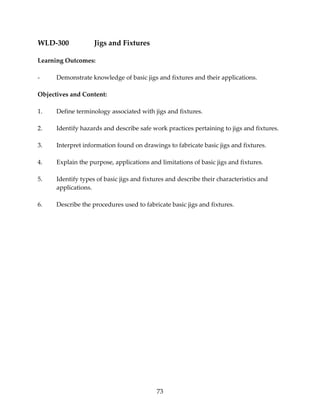
WLD‐300 Jigs and Fixtures 
Learning Outcomes: 
‐ Demonstrate knowledge of basic jigs and fixtures and their applications. 
Objectives and Content: 
1. Define terminology associated with jigs and fixtures. 
2. Identify hazards and describe safe work practices pertaining to jigs and fixtures. 
3. Interpret information found on drawings to fabricate basic jigs and fixtures. 
4. Explain the purpose, applications and limitations of basic jigs and fixtures. 
5. Identify types of basic jigs and fixtures and describe their characteristics and 
applications. 
6. Describe the procedures used to fabricate basic jigs and fixtures.
74 
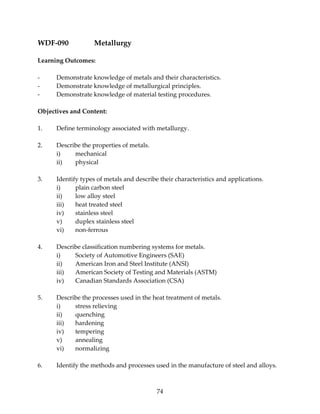
WDF‐090 Metallurgy 
Learning Outcomes: 
‐ Demonstrate knowledge of metals and their characteristics. 
‐ Demonstrate knowledge of metallurgical principles. 
‐ Demonstrate knowledge of material testing procedures. 
Objectives and Content: 
1. Define terminology associated with metallurgy. 
2. Describe the properties of metals. 
i) mechanical 
ii) physical 
3. Identify types of metals and describe their characteristics and applications. 
i) plain carbon steel 
ii) low alloy steel 
iii) heat treated steel 
iv) stainless steel 
v) duplex stainless steel 
vi) non‐ferrous 
4. Describe classification numbering systems for metals. 
i) Society of Automotive Engineers (SAE) 
ii) American Iron and Steel Institute (ANSI) 
iii) American Society of Testing and Materials (ASTM) 
iv) Canadian Standards Association (CSA) 
5. Describe the processes used in the heat treatment of metals. 
i) stress relieving 
ii) quenching 
iii) hardening 
iv) tempering 
v) annealing 
vi) normalizing 
6. Identify the methods and processes used in the manufacture of steel and alloys.
7. Describe forging and casting processes. 
8. Describe the effects of hot and cold working of metals. 
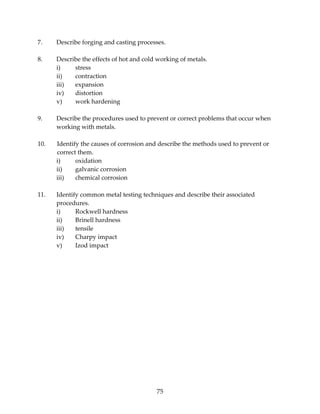
75 
i) stress 
ii) contraction 
iii) expansion 
iv) distortion 
v) work hardening 
9. Describe the procedures used to prevent or correct problems that occur when 
working with metals. 
10. Identify the causes of corrosion and describe the methods used to prevent or 
correct them. 
i) oxidation 
ii) galvanic corrosion 
iii) chemical corrosion 
11. Identify common metal testing techniques and describe their associated 
procedures. 
i) Rockwell hardness 
ii) Brinell hardness 
iii) tensile 
iv) Charpy impact 
v) Izod impact
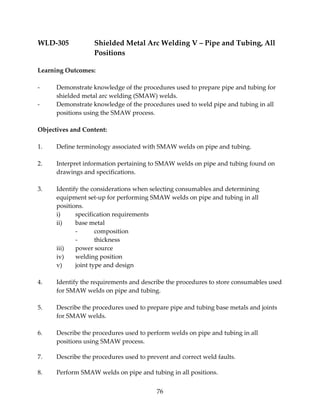
WLD‐305 Shielded Metal Arc Welding V – Pipe and Tubing, All 
76 
Positions 
Learning Outcomes: 
‐ Demonstrate knowledge of the procedures used to prepare pipe and tubing for 
shielded metal arc welding (SMAW) welds. 
‐ Demonstrate knowledge of the procedures used to weld pipe and tubing in all 
positions using the SMAW process. 
Objectives and Content: 
1. Define terminology associated with SMAW welds on pipe and tubing. 
2. Interpret information pertaining to SMAW welds on pipe and tubing found on 
drawings and specifications. 
3. Identify the considerations when selecting consumables and determining 
equipment set‐up for performing SMAW welds on pipe and tubing in all 
positions. 
i) specification requirements 
ii) base metal 
‐ composition 
‐ thickness 
iii) power source 
iv) welding position 
v) joint type and design 
4. Identify the requirements and describe the procedures to store consumables used 
for SMAW welds on pipe and tubing. 
5. Describe the procedures used to prepare pipe and tubing base metals and joints 
for SMAW welds. 
6. Describe the procedures used to perform welds on pipe and tubing in all 
positions using SMAW process. 
7. Describe the procedures used to prevent and correct weld faults. 
8. Perform SMAW welds on pipe and tubing in all positions.
WLD‐310 Gas Metal Arc Welding V – Pipe and Tubing, All 
77 
Positions 
Learning Outcomes: 
‐ Demonstrate knowledge of the procedures used to prepare pipe and tubing for 
gas metal arc welding (GMAW) welds. 
‐ Demonstrate knowledge of the procedures used to weld pipe and tubing in all 
positions using the GMAW process. 
Objectives and Content: 
1. Define terminology associated with GMAW welds on pipe and tubing. 
2. Interpret information pertaining to GMAW welds on pipe and tubing found on 
drawings and specifications. 
3. Identify the considerations when selecting consumables and determining 
equipment set‐up for performing GMAW welds on pipe and tubing in all 
positions. 
i) specification requirements 
ii) base metals 
‐ composition 
‐ thickness 
iii) shielding gas selection 
iv) power source 
v) welding position 
vi) joint type and design 
4. Identify the requirements and describe the procedures to store consumables used 
for GMAW welds on pipe and tubing. 
5. Describe the procedures used to prepare pipe and tubing base metals and joints 
for GMAW welds. 
6. Describe the procedures used to perform welds on pipe and tubing in all 
positions using GMAW process. 
7. Describe the procedures used to prevent and correct weld faults.
WLD‐315 Flux Core Arc Welding III – Pipe and Tubing, All 
78 
Positions 
Learning Outcomes: 
‐ Demonstrate knowledge of the procedures used to prepare pipe and tubing for 
flux core arc welding (FCAW) welds. 
‐ Demonstrate knowledge of the procedures used to weld pipe and tubing in all 
positions using the FCAW process. 
Objectives and Content: 
1. Define terminology associated with FCAW welds on pipe and tubing. 
2. Interpret information pertaining to FCAW welds on pipe and tubing found on 
drawings and specifications. 
3. Identify the considerations when selecting consumables and determining 
equipment set‐up for performing FCAW welds on pipe and tubing in all 
positions. 
i) specification requirements 
ii) base metal 
‐ composition 
‐ thickness 
iii) shielding gas selection 
iv) power source 
v) welding position 
vi) joint type and design 
4. Identify the requirements and describe the procedures to store consumables used 
for FCAW welds on pipe and tubing. 
5. Describe the procedures used to prepare pipe and tubing base metals and joints 
for FCAW welds. 
6. Describe the procedures used to perform welds on pipe and tubing in all 
positions using the FCAW process. 
7. Describe the procedures used to prevent and correct weld faults.
WLD‐320 Gas Tungsten Arc Welding V – Pipe and Tubing, All 
79 
Positions 
Learning Outcomes: 
‐ Demonstrate knowledge of the procedures used to prepare pipe and tubing for 
gas tungsten arc welding (GTAW) welds. 
‐ Demonstrate knowledge of the procedures used to perform welds on pipe and 
tubing in all positions using the GTAW process. 
Objectives and Content: 
1. Define terminology associated with GTAW welds on pipe and tubing. 
2. Interpret information pertaining to GTAW welds on pipe and tubing found on 
drawings and specifications. 
3. Identify the considerations when selecting consumables and determining 
equipment set‐up for performing GTAW welds on pipe and tubing. 
i) specification requirements 
ii) base metal 
‐ composition 
‐ thickness 
iii) shielding gas selection 
iv) insert selection 
v) power source 
vi) welding position 
vii) joint type and design 
4. Identify the requirements and describe the procedures to store consumables used 
for GTAW welds on pipe and tubing. 
5. Describe the procedures used to prepare pipe and tubing base metals and joints 
for GTAW welds. 
6. Describe the procedures used to perform welds on pipe and tubing in all 
positions using GTAW process. 
7. Describe the procedures used to prevent and correct weld faults.
WLD‐325 Shielded Metal Arc Welding VI – Alloy Steels 
80 
Learning Outcomes: 
‐ Demonstrate knowledge of the procedures used to prepare alloy steel base 
metals and joints for shielded metal arc welding (SMAW). 
‐ Demonstrate knowledge of the procedures used to weld alloy steels in all 
positions using the SMAW process. 
Objectives and Content: 
1. Define terminology associated with SMAW welds on alloy steels. 
2. Interpret information pertaining to SMAW welds on alloy steels found on 
drawings and specifications. 
3. Identify types of alloy steels and describe their characteristics and applications. 
4 Identify the considerations when selecting consumables and determining 
equipment set‐up for performing SMAW welds on alloy steels in all positions. 
i) specification requirements 
ii) base metal 
‐ composition 
‐ carbon equivalents 
‐ thickness 
iii) power source 
iv) welding position 
v) joint type and design 
5. Identify the requirements and describe the procedures to store consumables used 
for SMAW welds on alloy steels. 
6. Describe the procedures used to prepare alloy steel base metals and joints for 
SMAW welds. 
7. Describe the procedures used to perform welds on alloy steels in all positions 
using the SMAW process. 
8. Describe the procedures used to prevent and correct weld faults.
WLD‐330 Gas Metal Arc Welding VI – Aluminum Alloys 
81 
Learning Outcomes: 
‐ Demonstrate knowledge of the procedures used to prepare aluminum alloy base 
metals and joints for gas metal arc welding (GMAW) welds. 
‐ Demonstrate knowledge of the procedures used to weld aluminum alloys in all 
positions using the GMAW process. 
Objectives and Content: 
1. Define terminology associated with GMAW welds on aluminum alloys. 
2. Interpret information pertaining to GMAW welds on aluminum alloys found on 
drawings and specifications. 
3. Identify types of aluminum alloys and describe their characteristics and 
applications. 
4 Identify the considerations when selecting consumables and determining 
equipment set‐up for performing GMAW welds on aluminum alloys in all 
positions. 
i) specification requirements 
ii) base metal 
‐ composition 
‐ thickness 
iii) shielding gas selection 
iv) power source 
‐ push/pull 
‐ spool gun 
v) welding position 
vi) joint type and design 
5. Identify the requirements and describe the procedures to store consumables used 
for GMAW welds on aluminum alloys. 
6. Describe the procedures used to prepare aluminum base metals and joints for 
GMAW welds.
7. Describe the procedures used to perform welds on aluminum alloys in all 
82 
positions using the GMAW process. 
8. Describe the procedures used to prevent and correct weld faults.
WLD‐335 Gas Metal Arc Welding VII – Stainless Steel Alloys 
83 
Learning Outcomes: 
‐ Demonstrate knowledge of the procedures used to prepare stainless steel alloys 
base metals and joints for gas metal arc welding (GMAW) welds. 
‐ Demonstrate knowledge of the procedures used to weld stainless steel alloys in 
all positions using the GMAW process. 
Objectives and Content: 
1. Define terminology associated with GMAW welds on stainless steel alloys. 
2. Interpret information pertaining to GMAW welds on stainless steel alloys found 
on drawings and specifications. 
3. Identify types of stainless steel alloys and describe their characteristics and 
applications. 
4 Identify the considerations when selecting consumables and determining 
equipment set‐up for performing GMAW welds on stainless steel alloys in all 
positions. 
i) specification requirements 
ii) base metal 
‐ composition 
‐ thickness 
iii) shielding gas selection 
iv) power source 
v) welding position 
vi) joint type and design 
5. Identify the requirements and describe the procedures to store consumables used 
for GMAW welds on stainless steel alloys. 
6. Describe the procedures used to prepare stainless steel base metals and joints for 
GMAW welds. 
7. Describe the procedures used to perform welds on stainless steel alloys in all 
positions using the GMAW process. 
8. Describe the procedures used to prevent and correct weld faults.
WLD‐340 Gas Tungsten Arc Welding IV – Fillet and Groove 
Weld, Medium Carbon Steel 
84 
Learning Outcomes: 
‐ Demonstrate knowledge of the procedures used to prepare medium and high 
carbon steel base metals and joints for gas tungsten arc welding (GTAW) fillet 
and groove welds. 
‐ Demonstrate knowledge of the procedures used to perform fillet and groove 
welds on medium carbon steel in all positions using the GTAW process. 
Objectives and Content: 
1. Define terminology associated with GTAW welds on medium carbon steel. 
2. Interpret information pertaining to GTAW welds on medium carbon steel found 
on drawings and specifications. 
3. Identify the considerations when selecting consumables and determining 
equipment set‐up for performing GTAW welds on medium carbon steel in all 
positions. 
i) specification requirements 
ii) base metal 
‐ composition 
‐ thickness 
iii) shielding gas selection 
iv) power source 
v) welding position 
vi) joint type and design 
4. Identify the requirements and describe the procedures to store consumables used 
for GTAW welds on medium carbon steel. 
5. Describe the procedures used to prepare medium carbon steel base metals and 
joints for GTAW welds. 
6. Describe the procedures used to perform welds on medium carbon steel using 
GTAW process. 
i) temperature measuring devices
85 
ii) pre‐heating 
iii) interpass temperature 
iv) post‐heating 
v) stress relieving 
7. Describe the procedures used to prevent and correct weld faults.
WLD‐345 Gas Tungsten Arc Welding VI – Ferrous and Non‐ 
86 
Ferrous Alloys 
Learning Outcomes: 
‐ Demonstrate knowledge of the procedures used to prepare ferrous and non‐ferrous 
alloys and joints for gas tungsten arc welding (GTAW) welds. 
‐ Demonstrate knowledge of the procedures used to perform welds on ferrous and 
non ferrous alloys in all positions using the GTAW process. 
Objectives and Content: 
1. Define terminology associated with GTAW welds on ferrous and non ferrous 
alloys. 
2. Interpret information pertaining to GTAW welds on ferrous and non ferrous 
alloys found on drawings and specifications. 
3. Identify types of ferrous and non ferrous alloys and describe their characteristics 
and applications. 
4 Identify the considerations when selecting consumables and determining 
equipment set‐up for performing GTAW welds on ferrous and non ferrous alloys 
in all positions. 
i) specification requirements 
ii) base metal 
‐ composition 
‐ thickness 
iii) shielding gas selection 
‐ trailing gas 
iv) back purging 
v) power source 
vi) welding position 
vii) joint type and design 
5. Identify the requirements and describe the procedures to store consumables used 
for GTAW welds on ferrous and non ferrous alloys.
6. Describe the procedures used to prepare ferrous and non ferrous alloys and 
87 
joints for GTAW welds. 
7. Describe the procedures used to perform welds on ferrous and non ferrous alloys 
in all positions using the GTAW process. 
8. Describe the procedures used to prevent and correct weld faults.
WLD‐350 Submerged Arc Welding 
88 
Learning Outcomes: 
‐ Demonstrate knowledge of the procedures used to prepare base metals for 
submerged arc welding (SAW). 
‐ Demonstrate knowledge of the procedures used to weld using the SAW process. 
Objectives and Content: 
1. Define terminology associated with SAW welding. 
2. Identify hazards and describe safe work practices pertaining to SAW welding. 
3. Identify codes and standards pertaining to SAW welding. 
i) Canadian Standards Association (CSA) 
ii) American Society of Mechanical Engineers (ASME) 
iii) American Welding Society (AWS) 
4. Interpret information pertaining to SAW welding found on drawings and 
specifications. 
5. Identify SAW welding equipment, consumables and accessories and describe 
their applications. 
6. Identify the considerations and describe the procedures to store consumables 
used for SAW welding equipment. 
7. Describe the procedures used to set up and adjust SAW welding equipment. 
8. Describe the procedures used to inspect and maintain SAW welding equipment. 
9. Describe the procedures and techniques used to deposit a weld bead using SAW 
welding equipment. 
i) arc starting methods 
ii) electrode extension 
iii) deposition rates 
iv) travel speeds 
v) penetration
10. Identify the considerations when selecting consumables and determining 
equipment set‐up for SAW welding. 
i) specification requirements 
ii) base metal 
89 
‐ properties 
‐ thickness 
iii) flux types 
iv) filler metal types 
v) welding position 
vi) joint type and design 
11. Describe the procedures used to prepare base metals and joints for SAW 
welding. 
12. Describe the procedures used to weld using the SAW process. 
13. Describe the procedures used to prevent and correct weld faults.
WLD‐355 Resistance Welding 
90 
Learning Outcomes: 
‐ Demonstrate knowledge of resistance welding (RW) equipment, consumables 
and accessories. 
‐ Demonstrate knowledge of the procedures used to set up, adjust, operate, inspect 
and maintain RW welding equipment. 
Objectives and Content: 
1. Define terminology associated with RW welding. 
2. Identify hazards and describe safe work practices pertaining to RW welding. 
3. Identify codes and standards pertaining to RW welding. 
i) Canadian Standards Association (CSA) 
4. Interpret information pertaining to RW welding found on drawings and 
specifications. 
5. Identify RW welding processes and describe their applications. 
i) spot 
ii) seam 
iii) projection 
6. Identify RW welding equipment and accessories and describe their applications. 
7. Identify the considerations when determining RW welding equipment set‐up. 
i) specification requirements 
ii) base metal 
‐ properties 
‐ thickness 
iii) electrode size 
8. Describe the procedures used to set up and adjust RW welding equipment. 
i) time 
ii) amperage 
iii) pressure
9. Describe the procedures used to inspect and maintain RW welding equipment. 
10. Describe the procedures used to prepare base metals for RW welding. 
11. Describe the procedures used to weld using the RW process. 
91
92 
WLD‐360 Stud Welding 
Learning Outcomes: 
‐ Demonstrate knowledge of stud welding equipment, consumables and 
accessories. 
‐ Demonstrate knowledge of the procedures used to set up, adjust, operate, inspect 
and maintain stud welding equipment. 
Objectives and Content: 
1. Define terminology associated with stud welding. 
2. Identify hazards and describe safe work practices pertaining to stud welding. 
3. Identify codes and standards pertaining to stud welding. 
i) Canadian Standards Association (CSA) 
ii) American Society of Mechanical Engineers (ASME) 
iii) American Welding Society (AWS) 
4. Interpret information pertaining to stud welding found on drawings and 
specifications. 
5. Identify stud welding equipment, consumables and accessories and describe 
their applications. 
6. Identify the requirements and describe the procedures to store consumables used 
for stud welding. 
7. Describe the procedures used to set up and adjust stud welding equipment. 
i) time 
ii) amperage 
iii) lift 
iv) plunge 
8. Describe the procedures used to inspect and maintain stud welding equipment.
9. Identify the considerations when selecting stud welding consumables and 
93 
determining equipment set‐up. 
i) specification requirements 
ii) base metal 
‐ properties 
‐ thickness 
iii) stud 
‐ type 
‐ size 
10. Describe the procedures used to prepare base metals for stud welding. 
11. Describe the procedures used to perform stud welding. 
12. Describe the procedures used to prevent and correct weld faults. 
13. Describe the procedures used to test welded studs.
WLD‐365 Build up of Metal Parts 
94 
Learning Outcomes: 
‐ Demonstrate knowledge of the procedures used to build up metal parts. 
‐ Demonstrate knowledge of the procedures used to surface base metals. 
Objectives and Content: 
1. Define terminology associated with build up and surfacing of metal parts. 
2. Identify hazards and describe safe work practices pertaining to build up and 
surfacing metal parts. 
3. Interpret codes and standards pertaining to build up and surfacing of metal 
parts. 
i) Canadian Standards Association (CSA) 
ii) American Society of Mechanical Engineers (ASME) 
iii) American Welding Society (AWS) 
4. Interpret information pertaining to build up and surfacing of metal parts found 
on drawings and specifications. 
5. Identify tools and equipment relating to building up and surfacing of metal parts 
and describe their applications. 
6. Explain the purpose and applications of building up and surfacing of metal 
parts. 
7. Identify the processes used to build up and surface metal parts and describe the 
considerations used to select them. 
i) shielded metal arc welding (SMAW) 
ii) gas metal arc welding (GMAW) 
iii) flux core arc welding (FCAW) 
iv) metal core arc welding (MCAW) 
v) gas tungsten arc welding (GTAW) 
vi) submerged arc welding (SAW) 
vii) oxyfuel gas welding (OFW)
8. Identify types of wear requiring hard surfacing. 
95 
i) abrasion 
ii) impact 
iii) corrosion 
iv) erosion 
9. Describe the procedures used to build up and surface metal parts using welding 
processes. 
i) identify base metal 
ii) identify effects of heating and cooling 
iii) identify effects of dilution 
iv) select process 
v) select filler material 
vi) determine sequence

Wld d10 en

  • 1.
  • 2.
    You can orderthis publication by contacting: Trades and Apprenticeship Division Workplace Partnership Directorate Human Resources and Skills Development Canada 140 Promenade du Portage, Phase IV, 5th Floor Gatineau, Quebec K1A 0J9 Online: www.red‐seal.ca This document is available on demand in alternative formats (Large Print, Braille, Audio Cassette, Audio CD, e‐Text Diskette, e‐Text CD, or DAISY), by contacting 1 800 O‐Canada (1 800 622‐6232). If you have a hearing or speech impairment and use a teletypewriter (TTY), call 1 800 926‐9105. © Her Majesty the Queen in Right of Canada, 2011 Paper Cat. No.: HS42‐2/21‐2011E ISBN 978‐1‐100‐17790‐8 PDF Cat. No.: HS42‐2/21‐2011E‐PDF ISBN 978‐1‐100‐17791‐5
  • 3.
    The CCDA ExecutiveCommittee recognizes this Interprovincial Program Guide as the national curriculum for the occupation of Welder.
  • 4.
    2 Acknowledgements TheCCDA Executive Committee and the Interprovincial Program Guide Working Group wishes to acknowledge the contributions of the following industry and instructional representatives who participated in the development of this document. Jim Burgess Newfoundland and Labrador Jim Carson British Columbia John Fisher New Brunswick John Fraser Manitoba Chris Kenny Prince Edward Island Walter Lacey Nova Scotia Kent Morrison Prince Edward Island Peter Ryan New Brunswick Brad Zerr Saskatchewan In addition to the representatives above, various federal, provincial and territorial representatives contributed to the development of this document including Ken Jordan representing the host province of New Brunswick.
  • 5.
    3 Table ofContents Acknowledgements ..................................................................................................................... 2 Introduction .................................................................................................................................. 4 User Guide .................................................................................................................................... 5 IPG Glossary of Terms ................................................................................................................ 7 Essential Skills Profiles................................................................................................................ 9 Profile Chart................................................................................................................................ 10 Recommended Level Structure................................................................................................ 12 2009 NOA Sub‐Task to IPG Unit Comparison ...................................................................... 14 PROGRAM CONTENT Level 1.......................................................................................................................................... 23 Level 2.......................................................................................................................................... 49 Level 3.......................................................................................................................................... 71
  • 6.
    4 Introduction Jurisdictionshave long recognized the benefit of pooling resources in the development and maintenance of apprenticeship training standards. A successful example of this is the Interprovincial Standards Red Seal Program itself. Essential to the establishment of standards is the development of suitable training systems and programs which enable tradespeople to acquire certification based on these standards. While certification is the responsibility of Apprenticeship administrators throughout Canada, the development and delivery of technical training is the responsibility of jurisdictions. In 1999, work to develop common training for apprenticeship programs within the Atlantic Provinces began. To date, 22 Curriculum Standards have been developed through the Atlantic Standards Partnership (ASP) project to assist programming staff and instructors in the design and delivery of technical training. Similarly, the Canadian Council of Directors of Apprenticeship (CCDA) embarked on a process for the development of national Interprovincial Program Guides (IPGs) for the Boilermaker, Carpenter and Sprinkler System Installer trades. At its January 2005 strategic planning session, the CCDA identified developing common training standards as one of key activities in moving towards a more cohesive apprenticeship system. With the support of Human Resources and Skills Development Canada (HRSDC), several provinces and territories have partnered to build on the ASP and the CCDA processes to further develop IPGs to be used across the country. This partnership will create efficiencies in time and resources and promote consistency in training and apprentice mobility.
  • 7.
    5 User Guide According to the Canadian Apprenticeship Forum, the Interprovincial Program Guide (IPG) is: ʺa list of validated technical training outcomes, based upon those sub‐tasks identified as common core in the National Occupational Analysis (NOA), and validated by industry in the provinces and territories as incorporating the essential tasks, knowledge and skills associated with a given trade.ʺ Learning outcomes contained in the IPG represent the minimum common core content for the development of jurisdictional training standards and outlines. IPGs are developed based on the NOAs and extensive industry consultation. The IPG is intended to assist program development staff in the design of jurisdictional plans of training. Each jurisdiction has the flexibility to add additional content. The IPG was deliberately constructed for ease of use and flexibility of structure in order to adapt to all delivery requirements. It details units of training, unit outcomes and objectives. It does not impose a delivery model or teaching format. Jurisdictions and/or training providers will select and develop delivery materials and techniques that accommodate a variety of learning styles and delivery patterns. The IPG does not dictate study materials, textbooks or learning activities to be used in delivery. The IPG document includes a recommended leveling structure to facilitate mobility for apprentices moving from one jurisdiction to another. Because of difference in jurisdictional regulations and program durations, levels are offered as suggestions only. Structure The IPG is divided into units. The unit codes are used as a means of identification and are not intended to convey the order of delivery. Prerequisites have not been detailed. Each unit consists of Learning Outcomes and Objectives and Content. The Learning Outcomes are the specific performances that must be evaluated. Wording of the learning outcomes, ʺDemonstrate knowledge of…ʺ, acknowledges the broad spectrum of ways in which knowledge can be shown. It is at the discretion of each jurisdiction to determine the manner in which learning outcomes are evaluated; theoretically, practically or a combination of both.
  • 8.
    6 User Guide(continued) The Objectives and Content for the unit details the information to be covered in order to achieve the performances specified in the Learning Outcomes. These objectives can be either theoretical or practical in nature, based on the requirements identified through the industry consultation process. The learning activities used to cover the objectives are at the discretion of the jurisdiction; however, practically worded objective statements have been used where industry indicated a need for the apprentices to receive exposure to performing the task or skill outlined while attending technical training. For example, this exposure could be done through instructor demonstration or individual or group performance of the skill or task. This practical training will help to reinforce the theoretical component of the technical training. Detailed content for each objective has not been developed. Where detail is required for clarity, content has been provided. The content listed within the IPG document is not intended to represent an inclusive list; rather, it is included to illustrate the intended direction for the objective. Content may be added or extended in jurisdictional training plans as required. Jurisdictions are free to deliver the IPG units one at a time or concurrently, provided that all Learning Outcomes are met. The IPG does not indicate the amount of time to be spent on a particular unit as the length of time required to deliver the Learning Outcomes successfully will depend upon the learning activities and teaching methods used.
  • 9.
    7 IPG Glossaryof Terms These definitions are intended as a guide to how language is used in the IPGs. ADJUST To put in good working order; regulate; bring to a proper state or position. APPLICATION The use to which something is put and/or the circumstance in which you would use it. CHARACTERISTIC A feature that helps to identify, tell apart, or describe recognizably; a distinguishing mark or trait. COMPONENT A part that can be separated from or attached to a system; a segment or unit. DEFINE To state the meaning of (a word, phrase, etc.). DESCRIBE To give a verbal account of; tell about in detail. EXPLAIN To make plain or clear; illustrate; rationalize. IDENTIFY To point out or name objectives or types. INTERPRET To translate information from observation, charts, tables, graphs, and written material. MAINTAIN To keep in a condition of good repair or efficiency. METHOD A means or manner of doing something that has procedures attached to it. OPERATE How an object works; to control or direct the functioning of. PROCEDURE A prescribed series of steps taken to accomplish an end. PURPOSE The reason for which something exists or is done, made or used.
  • 10.
    8 IPG Glossaryof Terms (continued) TECHNIQUE Within a procedure, the manner in which technical skills are applied. TEST v. To subject to a procedure that ascertains effectiveness, value, proper function, or other quality. n. A way of examining something to determine its characteristics or properties, or to determine whether or not it is working correctly. TROUBLESHOOT To follow a systematic procedure to identify and locate a problem or malfunction and its cause.
  • 11.
    9 Essential SkillsProfiles Essential Skills are the skills needed for work, learning and life. They provide the foundation for learning all the other skills that enable people to evolve within their jobs and adapt to workplace change. Over the past several years, the Government of Canada has conducted research examining the skills people use at work. From this research, Essential Skills Profiles have been developed for various occupations. For more information regarding Essential Skills and to access Essential Skills Profiles for specific occupations, visit Human Resources and Skills Development Canada’s Essential Skills website at: www.hrsdc.gc.ca/eng/workplaceskills/essential_skills/general/home.shtml
  • 12.
    10 Profile Chart OCCUPATIONAL SKILLS WDF‐005 Safety WDF‐010 Tools and Equipment WDF‐015 Stationary Machinery WDF‐025 Access Equipment WDF‐030 Communication and Trade Documentation WDF‐080 Work Planning WDF‐075 Drawings WDF‐090 Metallurgy WLD‐200 Quality Control PREPARATION FOR WELDING PROCESSES WDF‐020 Hoisting, Lifting and Rigging WDF‐070 Fabrication Fundamentals WDF‐085 Introduction to Layout and Pattern Development WLD‐300 Jigs and Fixtures CUTTING AND GOUGING WLD‐115 Oxy‐fuel WLD‐240 Electric Arc Cutting and Gouging WLD‐245 Plasma Arc Cutting and Gouging WELDING PROCESSES WDF‐035 Introduction to Welding Processes WDF‐065 Weld Faults WDF‐040 SMAW I – Set up, Strike and Maintain an Arc WDF‐045 SMAW II – Fillet Weld, All Positions WLD‐205 SMAW III – Groove Weld Plate, All Positions WLD‐210 SMAW IV – Fillet and Groove Weld, Medium Carbon Steel WLD‐305 SMAW V – Pipe and Tubing, All Positions WLD‐325 SMAW VI – Alloy Steels WDF‐050 GMAW I – Set up and Maintain an Arc WLD‐100 GMAW II – Fillet Weld, All Positions WLD‐215 GMAW III – Groove Weld, All Positions WLD‐220 GMAW IV – Fillet and Groove Weld, Medium Carbon Steel WLD‐310 GMAW V – Pipe and Tubing, All Positions WLD‐330 GMAW VI – Aluminum Alloys WLD‐335 GMAW VII – Stainless Steel Alloys WLD‐225 GTAW I – Set up and Maintain an Arc WLD‐230 GTAW II – Fillet Weld, All Positions WLD‐235 GTAW III – Groove Weld, All Positions WLD‐340 GTAW IV – Fillet and Groove Weld, Medium Carbon Steel WLD‐320 GTAW V – Pipe and Tubing, All Positions
  • 13.
    11 Profile Chart(continued) WELDING PROCESSES (continued) WLD‐345 GTAW VI – Ferrous and Non‐Ferrous Alloys WDF‐055 FCAW I – Set up and Deposit a Weld WLD‐105 FCAW II – Fillet and Groove Weld Plate, All Positions WLD‐315 FCAW III – Pipe and Tubing, All Positions WDF‐060 MCAW I – Set up and Deposit a Weld WLD‐110 MCAW II – Fillet and Groove Weld, All Positions WLD‐350 Submerged Arc Welding WLD‐355 Resistance Welding WLD‐360 Stud Welding WLD‐365 Build Up of Metal Parts
  • 14.
    12 Recommended LevelStructure WDF = Common Units to Metal Fabricator (Fitter) and Welder IPGs. WLD = Specific Units to Welder IPG. Level 1 Level 2 Unit Code Title Page Unit Code Title Page WDF‐005 Safety 24 WLD‐200 Quality Control 50 WDF‐010 Tools and Equipment 26 WDF‐065 Weld Faults 52 WDF‐015 Stationary Machinery 27 WLD‐205 SMAW III – Groove Weld Plate, All Positions 53 WDF‐020 Hoisting, Lifting and Rigging 28 WLD‐210 SMAW IV – Fillet and Groove Weld, Medium Carbon Steel 54 WDF‐025 Access Equipment 30 WLD‐215 GMAW III – Groove Weld, All Positions 56 WDF‐030 Communication and Trade Documentation 31 WLD‐220 GMAW IV – Fillet and Groove Weld, Medium Carbon Steel 57 WDF‐035 Introduction to Welding Processes 32 WLD‐225 GTAW I – Set up and Maintain an Arc 59 WDF‐040 SMAW I – Set up, Strike and Maintain an Arc 34 WLD‐230 GTAW II – Fillet Weld, All Positions 61 WDF‐045 SMAW II – Fillet Weld, All Positions 36 WLD‐235 GTAW III – Groove Weld, All Positions 62 WDF‐050 GMAW I – Set up and Maintain an Arc 37 WLD‐240 Electric Arc Cutting and Gouging 63 WLD‐100 GMAW II – Fillet Weld, All Positions 39 WLD‐245 Plasma Arc Cutting and Gouging 65 WDF‐055 FCAW I – Set up and Deposit a Weld 40 WDF‐070 Fabrication Fundamentals 66 WLD‐105 FCAW II – Fillet and Groove Weld Plate, All Positions 42 WDF‐075 Drawings 68 WDF‐060 MCAW I – Set up and Deposit a Weld 44 WDF‐080 Work Planning 70 WLD‐110 MCAW II – Fillet and Groove Weld, All Positions 46 WLD‐115 Oxy‐fuel 47
  • 15.
    Recommended Level Structure(continued) 13 Level 3 Unit Code Title Page WDF‐085 Introduction to Layout and Pattern Development 72 WLD‐300 Jigs and Fixtures 73 WDF‐090 Metallurgy 74 WLD‐305 SMAW V – Pipe and Tubing, All Positions 76 WLD‐310 GMAW V – Pipe and Tubing, All Positions 77 WLD‐315 FCAW III – Pipe and Tubing, All Positions 78 WLD‐320 GTAW V – Pipe and Tubing, All Positions 79 WLD‐325 SMAW VI – Alloy Steels 80 WLD‐330 GMAW VI – Aluminum Alloys 81 WLD‐335 GMAW VII – Stainless Steel Alloys 83 WLD‐340 GTAW IV – Fillet and Groove Weld, Medium Carbon Steel 84 WLD‐345 GTAW VI – Ferrous and Non‐ Ferrous Alloys 86 WLD‐350 Submerged Arc Welding 88 WLD‐355 Resistance Welding 90 WLD‐360 Stud Welding 92 WLD‐365 Build up of Metal Parts 94
  • 16.
    2009 NOA Sub‐taskto IPG Unit Comparison NOA Sub‐task IPG Unit Task 1 ‐ Maintains and uses tools and equipment. 1.01 Uses personal protective equipment 14 (PPE) and safety equipment. WDF‐005 Safety 1.02 Maintains hand tools. WDF‐010 Tools and Equipment 1.03 Maintains power tools. WDF‐010 Tools and Equipment 1.04 Maintains stationary machinery. WDF‐015 Stationary Machinery 1.05 Maintains layout and measuring tools. WDF‐010 Tools and Equipment WLD‐115 Oxy‐fuel WLD‐245 Plasma Arc Cutting and Gouging WLD‐240 Electric Arc Cutting and Gouging WDF‐035 Introduction to Welding Processes WDF‐040 SMAW I – Set up, Strike and Maintain an Arc WDF‐050 GMAW I – Set up and Maintain an Arc WLD‐225 GTAW I – Set up and Maintain an Arc WDF‐055 FCAW I – Set up and Deposit a Weld 1.06 Maintains cutting and welding equipment. WDF‐060 MCAW I – Set up and Deposit a Weld 1.07 Uses access equipment. WDF‐025 Access Equipment Task 2 ‐ Organizes work. 2.01 Maintains safe work environment. WDF‐005 Safety 2.02 Uses documentation and reference material. WDF‐030 Communication and Trade Documentation 2.03 Interprets plans, drawings and specifications. WDF‐075 Drawings 2.04 Communicates with others. WDF‐030 Communication and Trade Documentation 2.05 Compiles a list of materials and supplies. WDF‐080 Work Planning 2.06 Plans project tasks. WDF‐080 Work Planning
  • 17.
    NOA Sub‐task IPGUnit Task 3 ‐ Performs quality control. 3.01 Performs inspection. WLD‐200 Quality Control 3.02 Marks materials and parts. WLD‐200 Quality Control 3.03 Verifies layout. WLD‐200 Quality Control 3.04 Verifies measurements. WLD‐200 Quality Control 3.05 Performs heat treatment. WDF‐090 Metallurgy 3.06 Stores consumables. Throughout Task 4 ‐ Performs routine trade activities. 4.01 Performs hazard assessments. WDF‐005 Safety 4.02 Selects power source for welding 15 processes. WDF‐035 Introduction to Welding Processes WDF‐040 SMAW I – Set up, Strike and Maintain an Arc WDF‐050 GMAW I – Set up and Maintain an Arc WLD‐225 GTAW I – Set up and Maintain an Arc WDF‐055 FCAW I – Set up and Deposit a Weld WDF‐060 MCAW I – Set up and Deposit a Weld WLD‐360 Stud Welding WLD‐355 Resistance Welding 4.03 Performs equipment start‐up and shut down. WLD‐350 Submerged Arc Welding Task 5 ‐ Handles materials. 5.01 Obtains materials. WLD‐200 Quality Control 5.02 Verifies bill of materials. WDF‐030 Communication and Trade Documentation 5.03 Organizes materials. WDF‐080 Work Planning 5.04 Uses rigging, hoisting and lifting equipment. WDF‐020 Hoisting, Lifting and Rigging 5.05 Operates material handling equipment. WDF‐020 Hoisting, Lifting and Rigging Task 6 ‐ Performs layout. 6.01 Develops templates. WDF‐070 Fabrication Fundamentals WDF‐085 Introduction to Layout and Pattern Development WDF‐075 Drawings WDF‐070 Fabrication Fundamentals 6.02 Transfers dimensions from drawings to materials. WDF‐085 Introduction to Layout and Pattern Development
  • 18.
    NOA Sub‐task IPGUnit Task 7 ‐ Fabricates components. 7.01 Prepares materials. WDF‐070 Fabrication Fundamentals 7.02 Fits components. WDF‐070 Fabrication Fundamentals 7.03 Tacks components. WDF‐070 Fabrication Fundamentals 7.04 Assembles components. WDF‐070 Fabrication Fundamentals 7.05 Finishes final product. WDF‐070 Fabrication Fundamentals Task 8 ‐ Uses mechanical and power tools for cutting and grinding. 8.01 Selects cutting and grinding tools. WDF‐010 Tools and Equipment 16 WDF‐015 Stationary Machinery 8.02 Cuts using stationary band saws and power hacksaws. WDF‐015 Stationary Machinery 8.03 Cuts using mechanical and hydraulic shears. WDF‐010 Tools and Equipment 8.04 Cuts using hand tools. WDF‐010 Tools and Equipment 8.05 Cuts using grinders. WDF‐010 Tools and Equipment WDF‐015 Stationary Machinery 8.06 Cuts using circular saws. WDF‐010 Tools and Equipment 8.07 Cuts using reciprocating saws. WDF‐010 Tools and Equipment Task 9 ‐ Uses oxy‐fuel gas cutting process (OFC) for cutting and gouging. 9.01 Selects oxy‐fuel gas and equipment. WLD‐115 Oxy‐fuel 9.02 Sets up oxy‐fuel equipment. WLD‐115 Oxy‐fuel 9.03 Sets operating parameters for oxy‐fuel equipment. WLD‐115 Oxy‐fuel 9.04 Operates oxy‐fuel equipment. WLD‐115 Oxy‐fuel Task 10 ‐ Uses plasma arc cutting process (PAC) for cutting and gouging. 10.01 Selects PAC gas, equipment and consumables. WLD‐245 Plasma Arc Cutting and Gouging 10.02 Sets up PAC equipment. WLD‐245 Plasma Arc Cutting and Gouging 10.03 Sets operating parameters for PAC. WLD‐245 Plasma Arc Cutting and Gouging 10.04 Operates PAC equipment. WLD‐245 Plasma Arc Cutting and Gouging Task 11 ‐ Uses air carbon arc cutting (CAC‐A) process. 11.01 Selects CAC‐A equipment and consumables. WLD‐240 Electric Arc Cutting and Gouging 11.02 Sets up CAC‐A equipment. WLD‐240 Electric Arc Cutting and Gouging 11.03 Sets operating parameters for CAC‐A. WLD‐240 Electric Arc Cutting and Gouging
  • 19.
    NOA Sub‐task IPGUnit 11.04 Operates CAC‐A equipment. WLD‐240 Electric Arc Cutting and 17 Gouging Task 12 ‐ Welds using oxy‐acetylene welding process. 12.01 Selects oxy‐acetylene equipment and consumables. WLD‐115 Oxy‐fuel 12.02 Sets operating parameters for oxy‐acetylene process. WLD‐115 Oxy‐fuel 12.03 Operates oxy‐acetylene equipment. WLD‐115 Oxy‐fuel Task 13 ‐ Welds using shielded metal arc welding process (SMAW). WDF‐040 SMAW I – Set up, Strike and Maintain an Arc WDF‐045 SMAW II – Fillet Weld, All Positions WLD‐205 SMAW III – Groove Weld Plate, All Positions WLD‐210 SMAW IV – Fillet and Groove Weld, Medium Carbon Steel WLD‐305 SMAW V – Pipe and Tubing, All Positions 13.01 Selects SMAW equipment and consumables. WLD‐325 SMAW VI – Alloy Steels WDF‐040 SMAW I – Set up, Strike and Maintain an Arc WDF‐045 SMAW II – Fillet Weld, All Positions WLD‐205 SMAW III – Groove Weld Plate, All Positions WLD‐210 SMAW IV – Fillet and Groove Weld, Medium Carbon Steel WLD‐305 SMAW V – Pipe and Tubing, All Positions 13.02 Sets up SMAW equipment. WLD‐325 SMAW VI – Alloy Steels WDF‐040 SMAW I – Set up, Strike and Maintain an Arc WDF‐045 SMAW II – Fillet Weld, All Positions WLD‐205 SMAW III – Groove Weld Plate, All Positions WLD‐210 SMAW IV – Fillet and Groove Weld, Medium Carbon Steel 13.03 Sets operating parameters for SMAW. WLD‐305 SMAW V – Pipe and Tubing, All Positions
  • 20.
    NOA Sub‐task IPGUnit 18 WLD‐325 SMAW VI – Alloy Steels WDF‐040 SMAW I – Set up, Strike and Maintain an Arc WDF‐045 SMAW II – Fillet Weld, All Positions WLD‐205 SMAW III – Groove Weld Plate, All Positions WLD‐210 SMAW IV ‐ Fillet and Groove Weld, Medium Carbon Steel WLD‐305 SMAW V – Pipe and Tubing, All Positions 13.04 Operates SMAW equipment. WLD‐325 SMAW VI – Alloy Steels Task 14 ‐ Welds using flux cored arc welding process (FCAW), metal core arc welding process (MCAW) and gas metal arc welding process (GMAW). WDF‐050 GMAW I – Set up and Maintain an Arc WLD‐100 GMAW II – Fillet Weld, All Positions WLD‐215 GMAW III – Groove Weld, All Positions WLD‐220 GMAW IV – Fillet and Groove Weld, Medium Carbon Steel WLD‐310 GMAW V – Pipe and Tubing, All Positions WLD‐330 GMAW VI – Aluminum Alloys WLD‐335 GMAW VII – Stainless Steel Alloys WDF‐055 FCAW I – Set up and Deposit a Weld WLD‐105 FCAW II – Fillet and Groove Weld Plate, All Positions WLD‐315 FCAW III – Pipe and Tubing, All Positions WDF‐060 MCAW I – Set up and Deposit a Weld 14.01 Selects FCAW, MCAW and GMAW gas, equipment and consumables. WLD‐110 MCAW II – Fillet and Groove Weld, All Positions WDF‐050 GMAW I – Set up and Maintain an Arc 14.02 Sets up FCAW, MCAW and GMAW equipment. WLD‐100 GMAW II – Fillet Weld, All Positions
  • 21.
    NOA Sub‐task IPGUnit 19 WLD‐215 GMAW III – Groove Weld, All Positions WLD‐220 GMAW IV – Fillet and Groove Weld, Medium Carbon Steel WLD‐310 GMAW V – Pipe and Tubing, All Positions WLD‐330 GMAW VI – Aluminum Alloys WLD‐335 GMAW VII – Stainless Steel Alloys WDF‐055 FCAW I – Set up and Deposit a Weld WLD‐105 FCAW II – Fillet and Groove Weld Plate, All Positions WLD‐315 FCAW III – Pipe and Tubing, All Positions WDF‐060 MCAW I – Set up and Deposit a Weld WLD‐110 MCAW II – Fillet and Groove Weld, All Positions WDF‐050 GMAW I – Set up and Maintain an Arc WLD‐100 GMAW II – Fillet Weld, All Positions WLD‐215 GMAW III – Groove Weld, All Positions WLD‐220 GMAW IV – Fillet and Groove Weld, Medium Carbon Steel WLD‐310 GMAW V – Pipe and Tubing, All Positions WLD‐330 GMAW VI – Aluminum Alloys WLD‐335 GMAW VII – Stainless Steel Alloys WDF‐055 FCAW I – Set up and Deposit a Weld WLD‐105 FCAW II – Fillet and Groove Weld Plate, All Positions WLD‐315 FCAW III – Pipe and Tubing, All Positions 14.03 Sets operating parameters for FCAW, MCAW and GMAW. WDF‐060 MCAW I – Set up and Deposit a Weld
  • 22.
    NOA Sub‐task IPGUnit 20 WLD‐110 MCAW II – Fillet and Groove Weld, All Positions WDF‐050 GMAW I – Set up and Maintain an Arc WLD‐100 GMAW II – Fillet Weld, All Positions WLD‐215 GMAW III – Groove Weld, All Positions WLD‐220 GMAW IV – Fillet and Groove Weld, Medium Carbon Steel WLD‐310 GMAW V – Pipe and Tubing, All Positions WLD‐330 GMAW VI – Aluminum Alloys WLD‐335 GMAW VII – Stainless Steel Alloys WDF‐055 FCAW I – Set up and Deposit a Weld WLD‐105 FCAW II – Fillet and Groove Weld Plate, All Positions WLD‐315 FCAW III – Pipe and Tubing, All Positions WDF‐060 MCAW I – Set up and Deposit a Weld 14.04 Operates FCAW, MCAW and GMAW equipment. WLD‐110 MCAW II – Fillet and Groove Weld, All Positions Task 15 ‐ Welds using gas tungsten arc welding process (GTAW). WLD‐225 GTAW I – Set up and Maintain an Arc WLD‐230 GTAW II – Fillet Weld, All Positions WLD‐235 GTAW III – Groove Weld, All Positions WLD‐340 GTAW IV – Fillet and Groove Weld, Medium Carbon Steel WLD‐320 GTAW V – Pipe and Tubing, All Positions 15.01 Selects GTAW gas, equipment and consumables. WLD‐345 GTAW VI – Ferrous and Non‐ Ferrous Alloys 15.02 Sets up GTAW equipment. WLD‐225 GTAW I – Set up and Maintain an Arc
  • 23.
    NOA Sub‐task IPGUnit 21 WLD‐230 GTAW II – Fillet Weld, All Positions WLD‐235 GTAW III – Groove Weld, All Positions WLD‐340 GTAW IV – Fillet and Groove Weld, Medium Carbon Steel WLD‐320 GTAW V – Pipe and Tubing, All Positions WLD‐345 GTAW VI – Ferrous and Non‐ Ferrous Alloys WLD‐225 GTAW I – Set up and Maintain an Arc WLD‐230 GTAW II – Fillet Weld, All Positions WLD‐235 GTAW III – Groove Weld, All Positions WLD‐340 GTAW IV – Fillet and Groove Weld, Medium Carbon Steel WLD‐320 GTAW V – Pipe and Tubing, All Positions 15.03 Sets operating parameters for GTAW. WLD‐345 GTAW VI – Ferrous and Non‐ Ferrous Alloys WLD‐225 GTAW I – Set up and Maintain an Arc WLD‐230 GTAW II – Fillet Weld, All Positions WLD‐235 GTAW III – Groove Weld, All Positions WLD‐340 GTAW IV – Fillet and Groove Weld, Medium Carbon Steel WLD‐320 GTAW V – Pipe and Tubing, All Positions 15.04 Operates GTAW equipment. WLD‐345 GTAW VI – Ferrous and Non‐ Ferrous Alloys Task 16 ‐ Welds using submerged arc welding process (SAW). 16.01 Selects SAW equipment and consumables. WLD‐350 Submerged Arc Welding 16.02 Sets up SAW equipment. WLD‐350 Submerged Arc Welding 16.03 Sets operating parameters for SAW. WLD‐350 Submerged Arc Welding 16.04 Operates SAW equipment. WLD‐350 Submerged Arc Welding
  • 24.
    NOA Sub‐task IPGUnit Task 17 ‐ Welds using other processes. 17.01 Uses stud welding process (SW). WLD‐360 Stud Welding 22 WLD‐355 Resistance Welding 17.02 Uses resistance welding (RW) processes WLD‐360 Stud Welding (Spot (RSW) and Seam (RSEW)). WLD‐355 Resistance Welding 17.03 Operates automated welding WLD‐360 Stud Welding equipment. WLD‐355 Resistance Welding
  • 25.
  • 26.
    24 WDF‐005 Safety Learning Outcomes: ‐ Demonstrate knowledge of safety equipment, their applications, maintenance and procedures for use. ‐ Demonstrate knowledge of safe work practices. ‐ Demonstrate knowledge of regulatory requirements pertaining to safety. Objectives and Content: 1. Identify types of personal protective equipment (PPE) and clothing and describe their applications and limitations. i) respiratory protection ii) hearing protection iii) eye protection iv) fall protection v) head protection vi) foot protection vii) hand protection 2. Describe the procedures used to care for and maintain PPE. 3. Identify hazards and describe safe work practices. i) personal ii) workplace ‐ job hazard assessment procedures ‐ lockout/tag out ‐ confined space awareness ‐ trenches and excavations ‐ explosion and fire (hot work) ‐ heights (fall protection and fall arrest) ‐ ventilation/fumes iii) environmental contamination (awareness of) 4. Identify and describe workplace safety and health regulations. i) federal ‐ Workplace Hazardous Material Information System (WHMIS)
  • 27.
    25 ii) provincial/territorial ‐ occupational health and safety iii) municipal iv) work site specific (awareness of)
  • 28.
    WDF‐010 Tools andEquipment 26 Learning Outcomes: ‐ Demonstrate knowledge of tools and equipment, their applications, maintenance and procedures for use. Objectives and Content: 1. Interpret regulations pertaining to tools and equipment. 2. Identify types of hand tools and describe their applications and procedures for use. 3. Describe the procedures used to inspect, maintain and store hand tools. 4. Identify types of power tools and describe their applications and procedures for use. i) electric ii) hydraulic iii) pneumatic 5. Identify power tool attachments and consumables and describe their applications and procedures for use. 6. Describe the procedures used to inspect, maintain and store power tools. 7. Identify types of layout and measuring tools and equipment and describe their applications and procedures for use. 8. Describe the procedures used to inspect, maintain and store layout and measuring tools and equipment.
  • 29.
    WDF‐015 Stationary Machinery 27 Learning Outcomes: ‐ Demonstrate knowledge of stationary machinery, their applications, maintenance and procedures for use. Objectives and Content: 1. Define terminology associated with stationary machinery. 2. Identify hazards and describe safe work practices pertaining to stationary machinery. 3. Identify types of stationary machinery and describe their characteristics and applications. i) presses ii) drill presses iii) stationary grinders iv) shears v) saws vi) press brakes vii) ironworkers 4. Describe the procedures used to set up and operate stationary machinery. 5. Describe the procedures used to inspect and maintain stationary machinery.
  • 30.
    WDF‐020 Hoisting, Liftingand Rigging 28 Learning Outcomes: ‐ Demonstrate knowledge of hoisting, lifting and rigging equipment, their applications, limitations and procedures for use. ‐ Demonstrate knowledge of the procedures used to perform hoisting and lifting operations. ‐ Demonstrate knowledge of calculations required prior to hoisting and lifting operations. Objectives and Content: 1. Define terminology associated with hoisting, lifting and rigging. 2. Identify hazards and describe safe work practices pertaining to hoisting, lifting and rigging. 3. Identify regulations pertaining to hoisting, lifting and rigging. 4. Identify types of rigging equipment and accessories and describe their limitations, applications and procedures for use. 5. Identify types of hoisting and lifting equipment and accessories and describe their applications and procedures for use. i) jacks ii) hoists iii) cranes ‐ overhead travelling cranes (OTC) ‐ gantry 6. Describe the procedures used to inspect, maintain and store hoisting, lifting and rigging equipment. 7. Describe the procedures used to rig material/equipment for lifting. 8. Describe the procedures to attach and use tag lines.
  • 31.
    9. Describe theprocedures used to ensure the work area is safe for lifting. 29 i) supervision of lift ii) securing work area iii) communication 10. Identify and describe the procedures used to communicate during hoisting, lifting and rigging operations. i) hand signals ii) electronic communications iii) audible and visual warnings 11. Identify the factors to consider when selecting rigging equipment. i) load characteristics ii) sling angle iii) environment ‐ chemical hazards ‐ grounding requirements ‐ weather conditions iv) working load limit 12. Describe the procedures used to perform a lift. i) pre‐lift checks ii) lifting load iii) placement of load iv) post‐lift inspection
  • 32.
    30 WDF‐025 AccessEquipment Learning Outcomes: ‐ Demonstrate knowledge of access equipment, their applications, limitations and procedures for use. Objectives and Content: 1. Define terminology associated with access equipment. 2. Identify hazards and describe safe work practices pertaining to access equipment. 3. Identify regulations pertaining to access equipment. 4. Identify types of access equipment and describe their characteristics and applications. i) scaffolding ii) ladders iii) man lifts iv) elevated work platforms 5. Identify types of fall protection and fall arrest equipment and describe their applications and procedures for use. 6. Describe the procedures used to erect and dismantle access equipment. 7. Describe the procedures used to inspect and maintain access equipment.
  • 33.
    WDF‐030 Communication andTrade Documentation 31 Learning Outcomes: ‐ Demonstrate knowledge of effective communication practices. ‐ Demonstrate knowledge of trade related documentation and its use. Objectives and Content: 1. Describe effective verbal and non‐verbal communication. 2. Identify types of communication devices and describe their applications. 3. Identify types of trade related documentation and describe their applications and procedures for use. i) manufacturers’ specifications ii) safety/hazard assessment forms iii) mill certificates iv) heat numbers v) customer specifications vi) codes and standards vii) manuals/catalogues viii) work orders ix) requisitions/purchase orders x) permits xi) procedure sheets
  • 34.
    WDF‐035 Introduction toWelding Processes 32 Learning Outcomes: ‐ Demonstrate knowledge of welding processes and their applications. ‐ Demonstrate knowledge of welding equipment and accessories. Objectives and Content: 1. Define terminology associated with welding. 2. Interpret information pertaining to welding found on drawings. i) symbols ii) abbreviations 3. Identify hazards and describe safe work practices pertaining to welding. i) personal ii) shop/facility iii) fire and explosion iv) equipment v) ventilation/fumes vi) storage, handling and transportation 4. Identify codes and standards pertaining to welding. i) Canadian Standards Association (CSA) ii) American Society of Mechanical Engineers (ASME) iii) American Welding Society (AWS) 5. Identify welding processes and describe their characteristics and applications. i) shielded metal arc welding (SMAW) ii) gas metal arc welding (GMAW) iii) metal core arc welding (MCAW) iv) flux core arc welding (FCAW) v) gas tungsten arc welding (GTAW) vi) stud welding vii) resistance welding (RW) viii) submerged arc welding (SAW)
  • 35.
    6. Identify typesof power sources for welding equipment and describe their 33 applications and limitations. i) AC transformer ii) AC/DC rectifier iii) DC generator iv) engine driven ‐ alternators ‐ generators v) inverters 7. Identify the types of beads and describe their characteristics and applications. i) stringer ii) weave 8. Identify types of welds and describe their characteristics and applications. i) fillet ii) groove iii) surfacing iv) plug or slot 9. Identify welding positions and describe their applications. i) flat (1F or 1G) ii) horizontal (2F or 2 G) iii) vertical (3F or 3G) iv) overhead (4F or 4G) v) pipe fixed – horizontal (5F or 5G) vi) pipe fixed – 45 degree plane (6F or 6G) 10. Identify welding test positions and describe their characteristics and restrictions.
  • 36.
    WDF‐040 Shielded MetalArc Welding I – Set up, Strike and 34 Maintain an Arc Learning Outcomes: ‐ Demonstrate knowledge of shielded metal arc welding (SMAW) welding equipment, consumables and accessories. ‐ Demonstrate knowledge of the procedures used to set up, adjust, operate, inspect and maintain SMAW welding equipment. ‐ Demonstrate knowledge of the procedures used to deposit a weld bead using SMAW welding equipment. Objectives and Content: 1. Define terminology associated with SMAW welding. 2. Identify hazards and describe safe work practices pertaining to SMAW welding. i) personal ii) shop/facility iii) fire and explosion iv) equipment v) ventilation/fumes vi) storage/handling 3. Identify codes and standards pertaining to SMAW welding. i) Canadian Standards Association (CSA) ii) American Society of Mechanical Engineers (ASME) iii) American Welding Society (AWS) 4. Identify SMAW welding equipment, consumables and accessories and describe their applications. 5. Describe the procedures used to set up and adjust SMAW welding equipment. 6. Describe the procedures used to strike and maintain an arc using SMAW welding equipment.
  • 37.
    7. Describe theprocedures and techniques used to deposit a weld bead using 35 SMAW welding equipment. i) arc length ii) travel speed iii) work and travel angles 8. Describe the procedures used to inspect and maintain SMAW welding equipment. 9. Strike and maintain an arc.
  • 38.
    WDF‐045 Shielded MetalArc Welding II – Fillet Weld, All 36 Positions Learning Outcomes: ‐ Demonstrate knowledge of the procedures used to prepare base metals and joints for shielded metal arc welding (SMAW) fillet welds. ‐ Demonstrate knowledge of the procedures used to perform fillet welds on low carbon steel in all positions using the SMAW process. Objectives and Content: 1. Define terminology associated with SMAW fillet welds. 2. Interpret information pertaining to SMAW fillet welds found on drawings and specifications. 3. Identify the considerations when selecting consumables and determining equipment set‐up for performing SMAW fillet welds in all positions. i) specification requirements ii) base metal ‐ composition ‐ thickness iii) power source iv) welding position v) joint type and design 4. Identify the requirements and describe the procedures to store consumables used for SMAW fillet welds on low carbon steel. 5. Describe the procedures used to prepare base metals and joints for SMAW fillet welds. 6. Describe the procedures used to perform fillet welds on low carbon steel in all positions using the SMAW process. 7. Describe the procedures used to prevent and correct weld faults. 8. Perform fillet welds on low carbon steel in all positions.
  • 39.
    WDF‐050 Gas MetalArc Welding I – Set up and Maintain an Arc 37 Learning Outcomes: ‐ Demonstrate knowledge of gas metal arc welding (GMAW) welding equipment, consumables and accessories. ‐ Demonstrate knowledge of the procedures used to set up, adjust, operate, inspect and maintain GMAW welding equipment. ‐ Demonstrate knowledge of the procedures used to deposit a weld bead using GMAW welding equipment. Objectives and Content: 1. Define terminology associated with GMAW welding. 2. Identify hazards and describe safe work practices pertaining to GMAW welding. i) personal ii) shop/facility iii) fire and explosion iv) equipment v) ventilation/fumes vi) storage, handling and transportation 3. Identify codes and standards pertaining to GMAW welding. i) Canadian Standards Association (CSA) ii) American Society of Mechanical Engineers (ASME) iii) American Welding Society (AWS) 4. Identify GMAW welding equipment, consumables and accessories and describe their applications. 5. Describe the procedures used to assemble and disassemble GMAW welding equipment. 6. Describe the procedures used to establish and maintain an arc using GMAW welding equipment.
  • 40.
    7. Identify themodes of transfer relating to GMAW welding and describe their 38 characteristics and applications. i) short circuiting ii) globular iii) spray iv) pulse 8. Describe the procedures and techniques used to deposit a weld bead using GMAW welding equipment. i) electrode extension ii) travel speed iii) work and travel angles iv) flow rates 9. Describe the procedures used to inspect, maintain and troubleshoot GMAW welding equipment. 10. Establish and maintain an arc.
  • 41.
    WLD‐100 Gas MetalArc Welding II – Fillet Weld, All Positions 39 Learning Outcomes: ‐ Demonstrate knowledge of the procedures used to prepare base metals and joints for gas metal arc welding (GMAW) fillet welds. ‐ Demonstrate knowledge of the procedures used to perform fillet welds on low carbon steel plate in all positions using the GMAW process. Objectives and Content: 1. Define terminology associated with GMAW fillet welds. 2. Interpret information pertaining to GMAW fillet welds found on drawings and specifications. 3. Identify the considerations when selecting consumables and determining equipment set‐up for performing GMAW fillet welds on low carbon steel in all positions. i) specification requirements ii) base metal ‐ composition ‐ thickness iii) shielding gas selection iv) power source v) welding position vi) joint type and design 4. Identify the requirements and describe the procedures to store consumables used for GMAW fillet welds on low carbon steel plate. 5. Describe the procedures used to prepare base metals and joints for GMAW fillet welds. 6. Describe the procedures used to perform fillet welds on low carbon steel plate in all positions using the GMAW process. 7. Describe the procedures used to prevent and correct weld faults. 8. Perform fillet welds on low carbon steel plate in all positions.
  • 42.
    WDF‐055 Flux CoreArc Welding I – Set up and Deposit a Weld 40 Learning Outcomes: ‐ Demonstrate knowledge of flux core arc welding (FCAW) welding equipment, consumables and accessories. ‐ Demonstrate knowledge of the procedures used to set up, adjust, operate, inspect and maintain FCAW welding equipment. ‐ Demonstrate knowledge of the procedures used to deposit a weld bead using FCAW welding equipment. Objectives and Content: 1. Define terminology associated with FCAW welding. 2. Identify hazards and describe safe work practices pertaining to FCAW welding. i) personal ii) shop/facility iii) fire and explosion iv) equipment v) ventilation/fumes vi) storage, handling and transportation 3. Identify codes and standards pertaining to FCAW welding. i) Canadian Standards Association (CSA) ii) American Society of Mechanical Engineers (ASME) iii) American Welding Society (AWS) 4. Identify FCAW welding equipment, consumables and accessories and describe their applications. 5. Describe the procedures used to assemble and disassemble FCAW welding equipment. 6. Describe the procedures and techniques used to deposit a weld bead using FCAW welding equipment. i) electrode extension ii) travel speed
  • 43.
    41 iii) workand travel angles iv) flow rates 7. Describe the procedures used to inspect, maintain and troubleshoot FCAW welding equipment. 8. Establish and maintain an arc.
  • 44.
    WLD‐105 Flux CoreArc Welding II – Fillet and Groove Weld Plate, All Positions 42 Learning Outcomes: ‐ Demonstrate knowledge of the procedures used to prepare plate for flux core arc welding (FCAW). ‐ Demonstrate knowledge of the procedures used to perform welds on plate in all positions using the FCAW process. Objectives and Content: 1. Define terminology associated with FCAW fillet and groove welds. 2. Interpret information pertaining to FCAW fillet and groove welds found on drawings and specifications. 3. Identify the considerations when selecting consumables and determining equipment set‐up for performing FCAW fillet and groove welds on plate. i) specification requirements ii) base metal ‐ composition ‐ thickness iii) shielding gas selection iv) power source v) welding position vi) joint type and design 4. Identify the requirements and describe the procedures to store consumables used for FCAW welding of plate. 5. Describe the procedures used to prepare plate for FCAW fillet and groove welds. 6. Describe the procedures used to perform fillet and groove welds on plate using the FCAW process. i) temperature measuring devices ii) pre‐heating iii) interpass temperature
  • 45.
    43 iv) post‐heating v) stress relieving 7. Describe the procedures used to prevent and correct weld faults. 8. Perform welds on plate.
  • 46.
    WDF‐060 Metal CoreArc Welding I – Set up and Deposit a Weld 44 Learning Outcomes: ‐ Demonstrate knowledge of metal core arc welding (MCAW) welding equipment, consumables and accessories. ‐ Demonstrate knowledge of the procedures used to set up, adjust, operate, inspect and maintain MCAW welding equipment. ‐ Demonstrate knowledge of the procedures used to deposit a weld bead using MCAW welding equipment. Objectives and Content: 1. Define terminology associated with MCAW welding. 2. Identify hazards and describe safe work practices pertaining to MCAW welding. i) personal ii) shop/facility iii) fire and explosion iv) equipment v) ventilation/fumes vi) storage, handling and transportation 3. Identify codes and standards pertaining to MCAW welding. i) Canadian Standards Association (CSA) ii) American Society of Mechanical Engineers (ASME) iii) American Welding Society (AWS) 4. Identify MCAW welding equipment, consumables and accessories and describe their applications. 5. Describe the procedures used to assemble and disassemble MCAW welding equipment. 6. Describe the procedures and techniques used to deposit a weld bead using MCAW welding equipment. i) electrode extension ii) travel speed
  • 47.
    45 iii) workand travel angles iv) flow rates 7. Describe the procedures used to inspect, maintain and troubleshoot MCAW welding equipment. 8. Establish and maintain an arc.
  • 48.
    WLD‐110 Metal CoreArc Welding II – Fillet and Groove Weld, 46 All Positions Learning Outcomes: ‐ Demonstrate knowledge of the procedures used to prepare base metals for metal core arc welding (MCAW). ‐ Demonstrate knowledge of the procedures used to perform welds using the MCAW process. Objectives and Content: 1. Define terminology associated with MCAW fillet and groove welds. 2. Interpret information pertaining to MCAW fillet and groove welds found on drawings and specifications. 3. Identify the considerations when selecting consumables and determining equipment set‐up for performing MCAW fillet and groove welds. i) specification requirements ii) base metal ‐ composition ‐ thickness iii) shielding gas selection iv) power source v) welding position vi) joint type and design 4. Identify requirements and describe the procedures to store consumables used for MCAW welding. 5. Describe the procedures used to prepare base metals and joints for MCAW fillet and groove welds. 6. Describe the procedures used to perform fillet and groove welds using the MCAW process. 7. Describe the procedures used to prevent and correct weld faults.
  • 49.
    47 WLD‐115 Oxy‐fuel Learning Outcomes: ‐ Demonstrate knowledge of oxy‐fuel equipment and accessories. ‐ Demonstrate knowledge of the procedures used to cut with oxy‐fuel equipment. ‐ Demonstrate knowledge of the procedures used to gouge with oxy‐fuel equipment. ‐ Demonstrate knowledge of the procedures used to weld with oxy‐fuel equipment. ‐ Demonstrate knowledge of the procedures used to braze with oxy‐fuel equipment. Objectives and Content: 1. Define terminology associated with oxy‐fuel cutting, gouging and welding. 2. Identify hazards and describe safe work practices pertaining to oxy‐fuel cutting, gouging and welding. i) personal ii) shop/facility iii) fire and explosion iv) equipment v) ventilation/fumes vi) storage, handling and transportation 3. Identify and interpret codes and regulations pertaining to oxy‐fuel cutting, gouging and welding equipment and operations. 4. Identify oxy‐fuel equipment and accessories and describe their applications and limitations. i) cutting ii) gouging iii) welding iv) brazing/braze‐welding v) heating
  • 50.
    5. Identify typesof flames and describe their application and the procedures for 48 flame adjustment. i) oxidizing ii) carburizing iii) neutral 6. Describe the procedures used to set up, adjust and shut down oxy‐fuel equipment. i) manufacturers’ recommendations 7. Describe the procedures used to inspect and maintain oxy‐fuel equipment. 8. Describe the procedures used to cut materials using oxy‐fuel equipment. i) free hand ii) guided ‐ straight edge ‐ pattern iii) automated/semi‐automated 9. Identify common cutting faults and describe the procedures to prevent and correct them. 10. Describe the procedures used to gouge using oxy‐fuel equipment. 11. Describe the procedures used to weld using oxy‐fuel equipment. 12. Describe the procedures used to braze/braze‐weld using oxy‐fuel equipment. 13. Set up, operate and shut down oxy‐fuel equipment.
  • 51.
  • 52.
    50 WLD‐200 QualityControl Learning Outcomes: ‐ Demonstrate knowledge of quality control measures used to verify compliance with design and code specifications. ‐ Demonstrate knowledge of inspection and testing methods and their applications. Objectives and Content: 1. Define terminology associated with quality control. 2. Interpret codes and standards pertaining to quality control. 3. Interpret information pertaining to quality control found on drawings and specifications. 4. Identify tools and equipment relating to quality control and describe their applications and procedures for use. 5. Explain quality control, its purpose and applications. 6. Explain the methods used to identify and verify materials. i) codes, standards and specifications ii) mill certificates iii) colour coding of materials 7. Identify methods of inspection and testing and describe their characteristics, limitations and applications. i) destructive ii) non‐destructive 8. Describe the procedures used to verify compliance with design and code specifications. i) perform visual inspections ii) verify measurements iii) perform post welding checks
  • 53.
    51 iv) markmaterials and parts v) verify layout 9. Describe the procedures used to document quality control measures.
  • 54.
    52 WDF‐065 WeldFaults Learning Outcomes: ‐ Demonstrate knowledge of weld faults, their characteristics and effect on welds. Objectives and Content: 1. Define terminology associated with weld faults. 2. Interpret standards and documentation relating to welds and weld faults. 3. Identify tools and equipment used to identify weld faults and describe their applications and procedures for use. 4. Identify the classifications of weld faults and describe their characteristics. i) dimensional defects ii) structural discontinuities iii) defective properties (weld metal and base metal) 5. Identify the causes of weld faults and describe their effect on welds.
  • 55.
    WLD‐205 Shielded MetalArc Welding III – Groove Weld Plate, 53 All Positions Learning Outcomes: ‐ Demonstrate knowledge of the procedures used to prepare base metals and joints for shielded metal arc welding (SMAW) groove welds. ‐ Demonstrate knowledge of the procedures used to perform groove welds on low carbon steel plate in all positions using the SMAW process. Objectives and Content: 1. Define terminology associated with SMAW groove welds. 2. Interpret information pertaining to SMAW groove welds found on drawings and specifications. 3. Identify the considerations when selecting consumables and determining equipment set‐up for performing SMAW groove welds on low carbon steel plate. i) specification requirements ii) base metal ‐ composition ‐ thickness iii) power source iv) welding position v) joint type and design 4. Identify the requirements and describe the procedures to store consumables used for SMAW groove welds on low carbon steel plate. 5. Describe the procedures used to prepare base metals and joints for SMAW groove welds. 6. Describe the procedures used to perform groove welds on low carbon steel plate in all positions using SMAW process. 7. Describe the procedures used to prevent and correct weld faults. 8. Perform groove welds on low carbon steel plate in all positions.
  • 56.
    WLD‐210 Shielded MetalArc Welding IV – Fillet and Groove Weld, Medium Carbon Steel 54 Learning Outcomes: ‐ Demonstrate knowledge of the procedures used to prepare medium carbon steel plate and joints for shielded metal arc welding (SMAW) fillet and groove welds. ‐ Demonstrate knowledge of the procedures used to perform fillet and groove welds on medium carbon steel plate in all positions using the SMAW process. Objectives and Content: 1. Define terminology associated with SMAW fillet and groove welds on medium carbon steel plate. 2. Interpret information pertaining to SMAW fillet and groove welds on medium carbon steel plate found on drawings and specifications. 3. Identify the considerations when selecting consumables and determining equipment set‐up for performing SMAW fillet and groove welds on medium carbon steel plate. i) specification requirements ii) base metals ‐ composition ‐ thickness iii) power source iv) welding position v) joint type and design 4. Identify the requirements and describe the procedures to store consumables used for SMAW fillet and groove welds on medium carbon steel plate. 5. Describe the procedures used to prepare medium carbon steel plate and joints for SMAW fillet and groove welds. 6. Describe the procedures used to perform fillet and groove welds on medium carbon steel plate using SMAW process. i) temperature measuring devices ii) pre‐heating
  • 57.
    55 iii) interpasstemperature iv) post‐heating v) stress relieving 7. Describe the procedures used to prevent and correct weld faults.
  • 58.
    WLD‐215 Gas MetalArc Welding III – Groove Weld, All Positions 56 Learning Outcomes: ‐ Demonstrate knowledge of the procedures used to prepare base metals and joints for gas metal arc welding (GMAW) groove welds. ‐ Demonstrate knowledge of the procedures used to perform groove welds on low carbon steel plate in all positions using the GMAW process. Objectives and Content: 1. Define terminology associated with GMAW groove welds. 2. Interpret information pertaining to GMAW groove welds found on drawings and specifications. 3. Identify the considerations when selecting consumables and determining equipment set‐up for performing GMAW groove welds on low carbon steel plate in all positions. i) specification requirements ii) base metal ‐ composition ‐ thickness iii) shielding gas selection iv) power source v) welding position vi) joint type and design 4. Identify the requirements and describe the procedures to store consumables used for GMAW groove welds on low carbon steel plate. 5. Describe the procedures used to prepare base metal and joints for GMAW groove welds. 6. Describe the procedures used to perform groove welds on low carbon steel plate in all positions using GMAW process. 7. Describe the procedures used to prevent and correct weld faults. 8. Perform groove welds on low carbon steel plate in all positions.
  • 59.
    WLD‐220 Gas MetalArc Welding IV – Fillet and Groove Weld, Medium Carbon Steel 57 Learning Outcomes: ‐ Demonstrate knowledge of the procedures used to prepare medium carbon steel base metals and joints for gas metal arc welding (GMAW) fillet and groove welds. ‐ Demonstrate knowledge of the procedures used to perform fillet and groove welds on medium carbon steel in all positions using the GMAW process. Objectives and Content: 1. Define terminology associated with GMAW fillet and groove welds on medium carbon steel. 2. Interpret information pertaining to GMAW fillet and groove welds on medium carbon steel found on drawings and specifications. 3. Identify the considerations when selecting consumables and determining equipment set‐up for performing GMAW fillet and groove welds on medium carbon steel. i) specification requirements base metals ‐ composition ‐ thickness ii) shielding gas selection iii) power source iv) welding position v) joint type and design 4. Identify the requirements and describe the procedures to store consumables used for GMAW fillet and groove welds on medium carbon steel. 5. Describe the procedures used to prepare medium carbon steel base metals and joints for GMAW fillet and groove welds.
  • 60.
    6. Describe theprocedures used to perform GMAW fillet and groove welds on medium carbon steel. i) temperature measuring devices ii) pre‐heating iii) interpass temperature iv) post‐heating v) stress relieving 7. Describe the procedures used to prevent and correct weld faults. 58
  • 61.
    WLD‐225 Gas TungstenArc Welding I – Set up and Maintain an 59 Arc Learning Outcomes: ‐ Demonstrate knowledge of gas tungsten arc welding (GTAW) equipment, consumables and accessories. ‐ Demonstrate knowledge of the procedures used to set up, adjust, operate, inspect and maintain GTAW welding equipment. ‐ Demonstrate knowledge of the procedures used to deposit a weld bead using GTAW equipment. Objectives and Content: 1. Define terminology associated with GTAW welding. 2. Identify hazards and describe safe work practices pertaining to GTAW welding. i) personal ii) shop/facility iii) fire and explosion iv) equipment v) ventilation/fumes vi) storage, handling and transportation 3. Identify codes and standards pertaining to GTAW welding. i) Canadian Standards Association (CSA) ii) American Society of Mechanical Engineers (ASME) iii) American Welding Society (AWS) 4. Identify GTAW welding equipment, consumables and accessories and describe their applications. 5. Describe the procedures used to assemble and disassemble GTAW welding equipment. 6. Describe the procedures used to establish and maintain an arc using GTAW welding equipment.
  • 62.
    7. Describe theprocedures and techniques used to deposit a weld bead using 60 GTAW welding equipment. i) with filler metal ii) without filler metal 8. Describe the procedures used to inspect, maintain and troubleshoot GTAW welding equipment. 9. Establish and maintain an arc.
  • 63.
    WLD‐230 Gas TungstenArc Welding II – Fillet Weld, All 61 Positions Learning Outcomes: ‐ Demonstrate knowledge of the procedures used to prepare base metals and joints for gas tungsten arc welding (GTAW) fillet welds. ‐ Demonstrate knowledge of the procedures used to perform fillet welds on low carbon steel sheet and plate in all positions using the GTAW process. Objectives and Content: 1. Define terminology associated with GTAW fillet welds. 2. Interpret information pertaining to GTAW fillet welds found on drawings and specifications. 3. Identify the considerations when selecting consumables and determining equipment set‐up for performing GTAW fillet welds in all positions. i) specification requirements ii) base metals ‐ composition ‐ thickness iii) shielding gas selection iv) power source v) welding position vi) joint type and design 4. Identify the requirements and describe the procedures to store consumables used for GTAW fillet welds on low carbon steel sheet and plate. 5. Describe the procedures used to prepare base metals and joints for GTAW fillet welds. 6. Describe the procedures used to perform fillet welds on low carbon steel sheet and plate in all positions using the GTAW process. 7. Describe the procedures used to prevent and correct weld faults. 8. Perform fillet welds on low carbon steel sheet and plate.
  • 64.
    WLD‐235 Gas TungstenArc Welding III – Groove Weld, All 62 Positions Learning Outcomes: ‐ Demonstrate knowledge of the procedures used to prepare base metals and joints for gas tungsten arc welding (GTAW) groove welds. ‐ Demonstrate knowledge of the procedures used to perform groove welds on low carbon steel sheet and plate in all positions using the GTAW process. Objectives and Content: 1. Define terminology associated with GTAW groove welds. 2. Interpret information pertaining to GTAW groove welds found on drawings and specifications. 3. Identify the considerations when selecting consumables and determining equipment set‐up for performing GTAW groove welds in all positions. i) specification requirements ii) base metal ‐ composition ‐ thickness iii) shielding gas selection iv) power source v) welding position vi) joint type and design 4. Identify the requirements and describe the procedures to store consumables used for GTAW groove welds on low carbon steel sheet and plate. 5. Describe the procedures used to prepare base metals and joints for GTAW groove welds. 6. Describe the procedures used to perform groove welds on low carbon steel sheet and plate in all positions using GTAW process. 7. Describe the procedures used to prevent and correct weld faults.
  • 65.
    WLD‐240 Electric ArcCutting and Gouging 63 Learning Outcomes: ‐ Demonstrate knowledge of electric arc cutting equipment and accessories. ‐ Demonstrate knowledge of the procedures used to cut with electric arc cutting equipment. ‐ Demonstrate knowledge of the procedures used to gouge with electric arc gouging equipment. Objectives and Content: 1. Define terminology associated with electric arc cutting and gouging. 2. Identify hazards and describe safe work practices pertaining to electric arc cutting and gouging. i) personal ii) shop/facility iii) fire and explosion iv) equipment v) ventilation/fumes vi) storage, handling and transportation vii) noise 3. Describe the electric arc cutting and gouging processes and their applications. i) air‐carbon arc ii) metal arc iii) oxy‐arc 4. Identify electric arc cutting and gouging equipment and accessories and describe their applications. 5. Describe the procedures used to set up, adjust and shut down electric arc cutting and gouging equipment. 6. Describe the procedures used to inspect and maintain electric arc cutting and gouging equipment. 7. Describe the procedures used to cut using electric arc cutting equipment.
  • 66.
    8. Describe theprocedures used to gouge using electric arc gouging equipment. 64 9. Perform air‐carbon arc gouging.
  • 67.
    WLD‐245 Plasma ArcCutting and Gouging 65 Learning Outcomes: ‐ Demonstrate knowledge of plasma arc equipment and accessories. ‐ Demonstrate knowledge of the procedures used to cut with plasma arc equipment. Demonstrate knowledge of the procedures used to gouge with plasma arc equipment. Objectives and Content: 1. Define terminology associated with plasma arc cutting and gouging. 2. Identify hazards and describe safe work practices pertaining to plasma arc cutting and gouging. i) personal ii) shop/facility iii) fire and explosion iv) equipment v) ventilation/fumes 3. Describe the plasma arc cutting and gouging process and its applications. 4. Identify plasma arc equipment and accessories and describe their applications. i) cutting ii) gouging 5. Describe the procedures used to set up, adjust and shut down plasma arc equipment. 6. Describe the procedures used to inspect and maintain plasma arc equipment. 7. Describe the procedures used to cut using plasma arc equipment. 8. Describe the procedures used to gouge using plasma arc equipment. 9. Perform plasma arc cutting and gouging operations.
  • 68.
    WDF‐070 Fabrication Fundamentals 66 Learning Outcomes: ‐ Demonstrate knowledge of structural components, their characteristics and applications. ‐ Demonstrate knowledge of joints, their applications and the procedures used to prepare them for welding operations. Objectives and Content: 1. Define terminology associated with structural components. 2. Identify hazards and describe safe work practices pertaining to structural components. 3. Interpret codes, regulations and standards pertaining to structural components. i) industry standards ii) codes of practice iii) government regulations 4. Interpret information pertaining to structural components found on drawings and specifications. 5. Identify types of structures and describe their characteristics. 6. Identify structural steel shapes and describe their designations, characteristics and applications. i) sheet ii) plate iii) pipe iv) flat v) bar vi) angle vii) channel viii) beams ix) hollow structural sections
  • 69.
    7. Identify typesof joints and describe their characteristics and applications. 67 i) corner ii) tee iii) lap iv) edge v) butt 8. Describe the procedures used to prepare joints on structural steel shapes. 9. Describe the procedures used to fabricate using various structural steel shapes.
  • 70.
    68 WDF‐075 Drawings Learning Outcomes: ‐ Demonstrate knowledge of drawings and their applications. ‐ Demonstrate knowledge of interpreting and extracting information from drawings. Objectives and Content: 1. Define terminology associated with drawings and sketches. 2. Describe metric and imperial systems of measurement and the procedures used to perform conversions. 3. Identify the types of drawings and describe their applications. i) architectural ii) engineering iii) erection iv) assembly v) shop (detail) 4. Identify drawing projections and views and describe their applications. i) projections ‐ orthographic (1st and 3rd angle) ‐ oblique ‐ isometric ii) views ‐ plan ‐ section ‐ detail ‐ elevation 5. Describe the use of scales. 6. Interpret information on drawings. i) welding symbols ii) lines iii) legend
  • 71.
    iv) other symbolsand abbreviations v) notes and specifications vi) schedules vii) scales 7. Describe basic sketching techniques. 8. Describe dimensioning systems, their purpose and applications. 69 i) datum/baseline ii) elevation iii) conventional iv) running v) aligned vi) unidirectional vii) group 9. Describe the procedures used for the care, handling and storage of drawings. 10. Interpret basic shop drawings.
  • 72.
    70 WDF‐080 WorkPlanning Learning Outcomes: ‐ Demonstrate knowledge of the procedures used to plan and organize work tasks. Objectives and Content: 1. Identify sources of information relevant to work task planning. i) supervisor ii) documentation iii) drawings iv) related professionals v) suppliers vi) clients 2. Identify the considerations when planning work tasks. i) scheduling ii) sequence iii) material selection and handling iv) equipment selection 3. Describe the procedures used to organize, move and store tools, equipment, materials and supplies.
  • 73.
  • 74.
    WLD‐085 Introduction toLayout and Pattern Development 72 Learning Outcomes: ‐ Demonstrate knowledge of pattern and template development and its purpose. ‐ Demonstrate knowledge of the procedures used to develop simple templates. Objectives and Content: 1. Define terminology associated with layout and pattern development. 2. Identify tools and equipment relating to layout and pattern development and describe their applications and procedures for use. 3. Explain the purpose of pattern and template development. 4. Identify materials used in pattern and template development and describe their characteristics and applications. 5. Identify the geometric operations used in performing layout and describe their applications. 6. Develop simple templates.
  • 75.
    73 WLD‐300 Jigsand Fixtures Learning Outcomes: ‐ Demonstrate knowledge of basic jigs and fixtures and their applications. Objectives and Content: 1. Define terminology associated with jigs and fixtures. 2. Identify hazards and describe safe work practices pertaining to jigs and fixtures. 3. Interpret information found on drawings to fabricate basic jigs and fixtures. 4. Explain the purpose, applications and limitations of basic jigs and fixtures. 5. Identify types of basic jigs and fixtures and describe their characteristics and applications. 6. Describe the procedures used to fabricate basic jigs and fixtures.
  • 76.
    74 WDF‐090 Metallurgy Learning Outcomes: ‐ Demonstrate knowledge of metals and their characteristics. ‐ Demonstrate knowledge of metallurgical principles. ‐ Demonstrate knowledge of material testing procedures. Objectives and Content: 1. Define terminology associated with metallurgy. 2. Describe the properties of metals. i) mechanical ii) physical 3. Identify types of metals and describe their characteristics and applications. i) plain carbon steel ii) low alloy steel iii) heat treated steel iv) stainless steel v) duplex stainless steel vi) non‐ferrous 4. Describe classification numbering systems for metals. i) Society of Automotive Engineers (SAE) ii) American Iron and Steel Institute (ANSI) iii) American Society of Testing and Materials (ASTM) iv) Canadian Standards Association (CSA) 5. Describe the processes used in the heat treatment of metals. i) stress relieving ii) quenching iii) hardening iv) tempering v) annealing vi) normalizing 6. Identify the methods and processes used in the manufacture of steel and alloys.
  • 77.
    7. Describe forgingand casting processes. 8. Describe the effects of hot and cold working of metals. 75 i) stress ii) contraction iii) expansion iv) distortion v) work hardening 9. Describe the procedures used to prevent or correct problems that occur when working with metals. 10. Identify the causes of corrosion and describe the methods used to prevent or correct them. i) oxidation ii) galvanic corrosion iii) chemical corrosion 11. Identify common metal testing techniques and describe their associated procedures. i) Rockwell hardness ii) Brinell hardness iii) tensile iv) Charpy impact v) Izod impact
  • 78.
    WLD‐305 Shielded MetalArc Welding V – Pipe and Tubing, All 76 Positions Learning Outcomes: ‐ Demonstrate knowledge of the procedures used to prepare pipe and tubing for shielded metal arc welding (SMAW) welds. ‐ Demonstrate knowledge of the procedures used to weld pipe and tubing in all positions using the SMAW process. Objectives and Content: 1. Define terminology associated with SMAW welds on pipe and tubing. 2. Interpret information pertaining to SMAW welds on pipe and tubing found on drawings and specifications. 3. Identify the considerations when selecting consumables and determining equipment set‐up for performing SMAW welds on pipe and tubing in all positions. i) specification requirements ii) base metal ‐ composition ‐ thickness iii) power source iv) welding position v) joint type and design 4. Identify the requirements and describe the procedures to store consumables used for SMAW welds on pipe and tubing. 5. Describe the procedures used to prepare pipe and tubing base metals and joints for SMAW welds. 6. Describe the procedures used to perform welds on pipe and tubing in all positions using SMAW process. 7. Describe the procedures used to prevent and correct weld faults. 8. Perform SMAW welds on pipe and tubing in all positions.
  • 79.
    WLD‐310 Gas MetalArc Welding V – Pipe and Tubing, All 77 Positions Learning Outcomes: ‐ Demonstrate knowledge of the procedures used to prepare pipe and tubing for gas metal arc welding (GMAW) welds. ‐ Demonstrate knowledge of the procedures used to weld pipe and tubing in all positions using the GMAW process. Objectives and Content: 1. Define terminology associated with GMAW welds on pipe and tubing. 2. Interpret information pertaining to GMAW welds on pipe and tubing found on drawings and specifications. 3. Identify the considerations when selecting consumables and determining equipment set‐up for performing GMAW welds on pipe and tubing in all positions. i) specification requirements ii) base metals ‐ composition ‐ thickness iii) shielding gas selection iv) power source v) welding position vi) joint type and design 4. Identify the requirements and describe the procedures to store consumables used for GMAW welds on pipe and tubing. 5. Describe the procedures used to prepare pipe and tubing base metals and joints for GMAW welds. 6. Describe the procedures used to perform welds on pipe and tubing in all positions using GMAW process. 7. Describe the procedures used to prevent and correct weld faults.
  • 80.
    WLD‐315 Flux CoreArc Welding III – Pipe and Tubing, All 78 Positions Learning Outcomes: ‐ Demonstrate knowledge of the procedures used to prepare pipe and tubing for flux core arc welding (FCAW) welds. ‐ Demonstrate knowledge of the procedures used to weld pipe and tubing in all positions using the FCAW process. Objectives and Content: 1. Define terminology associated with FCAW welds on pipe and tubing. 2. Interpret information pertaining to FCAW welds on pipe and tubing found on drawings and specifications. 3. Identify the considerations when selecting consumables and determining equipment set‐up for performing FCAW welds on pipe and tubing in all positions. i) specification requirements ii) base metal ‐ composition ‐ thickness iii) shielding gas selection iv) power source v) welding position vi) joint type and design 4. Identify the requirements and describe the procedures to store consumables used for FCAW welds on pipe and tubing. 5. Describe the procedures used to prepare pipe and tubing base metals and joints for FCAW welds. 6. Describe the procedures used to perform welds on pipe and tubing in all positions using the FCAW process. 7. Describe the procedures used to prevent and correct weld faults.
  • 81.
    WLD‐320 Gas TungstenArc Welding V – Pipe and Tubing, All 79 Positions Learning Outcomes: ‐ Demonstrate knowledge of the procedures used to prepare pipe and tubing for gas tungsten arc welding (GTAW) welds. ‐ Demonstrate knowledge of the procedures used to perform welds on pipe and tubing in all positions using the GTAW process. Objectives and Content: 1. Define terminology associated with GTAW welds on pipe and tubing. 2. Interpret information pertaining to GTAW welds on pipe and tubing found on drawings and specifications. 3. Identify the considerations when selecting consumables and determining equipment set‐up for performing GTAW welds on pipe and tubing. i) specification requirements ii) base metal ‐ composition ‐ thickness iii) shielding gas selection iv) insert selection v) power source vi) welding position vii) joint type and design 4. Identify the requirements and describe the procedures to store consumables used for GTAW welds on pipe and tubing. 5. Describe the procedures used to prepare pipe and tubing base metals and joints for GTAW welds. 6. Describe the procedures used to perform welds on pipe and tubing in all positions using GTAW process. 7. Describe the procedures used to prevent and correct weld faults.
  • 82.
    WLD‐325 Shielded MetalArc Welding VI – Alloy Steels 80 Learning Outcomes: ‐ Demonstrate knowledge of the procedures used to prepare alloy steel base metals and joints for shielded metal arc welding (SMAW). ‐ Demonstrate knowledge of the procedures used to weld alloy steels in all positions using the SMAW process. Objectives and Content: 1. Define terminology associated with SMAW welds on alloy steels. 2. Interpret information pertaining to SMAW welds on alloy steels found on drawings and specifications. 3. Identify types of alloy steels and describe their characteristics and applications. 4 Identify the considerations when selecting consumables and determining equipment set‐up for performing SMAW welds on alloy steels in all positions. i) specification requirements ii) base metal ‐ composition ‐ carbon equivalents ‐ thickness iii) power source iv) welding position v) joint type and design 5. Identify the requirements and describe the procedures to store consumables used for SMAW welds on alloy steels. 6. Describe the procedures used to prepare alloy steel base metals and joints for SMAW welds. 7. Describe the procedures used to perform welds on alloy steels in all positions using the SMAW process. 8. Describe the procedures used to prevent and correct weld faults.
  • 83.
    WLD‐330 Gas MetalArc Welding VI – Aluminum Alloys 81 Learning Outcomes: ‐ Demonstrate knowledge of the procedures used to prepare aluminum alloy base metals and joints for gas metal arc welding (GMAW) welds. ‐ Demonstrate knowledge of the procedures used to weld aluminum alloys in all positions using the GMAW process. Objectives and Content: 1. Define terminology associated with GMAW welds on aluminum alloys. 2. Interpret information pertaining to GMAW welds on aluminum alloys found on drawings and specifications. 3. Identify types of aluminum alloys and describe their characteristics and applications. 4 Identify the considerations when selecting consumables and determining equipment set‐up for performing GMAW welds on aluminum alloys in all positions. i) specification requirements ii) base metal ‐ composition ‐ thickness iii) shielding gas selection iv) power source ‐ push/pull ‐ spool gun v) welding position vi) joint type and design 5. Identify the requirements and describe the procedures to store consumables used for GMAW welds on aluminum alloys. 6. Describe the procedures used to prepare aluminum base metals and joints for GMAW welds.
  • 84.
    7. Describe theprocedures used to perform welds on aluminum alloys in all 82 positions using the GMAW process. 8. Describe the procedures used to prevent and correct weld faults.
  • 85.
    WLD‐335 Gas MetalArc Welding VII – Stainless Steel Alloys 83 Learning Outcomes: ‐ Demonstrate knowledge of the procedures used to prepare stainless steel alloys base metals and joints for gas metal arc welding (GMAW) welds. ‐ Demonstrate knowledge of the procedures used to weld stainless steel alloys in all positions using the GMAW process. Objectives and Content: 1. Define terminology associated with GMAW welds on stainless steel alloys. 2. Interpret information pertaining to GMAW welds on stainless steel alloys found on drawings and specifications. 3. Identify types of stainless steel alloys and describe their characteristics and applications. 4 Identify the considerations when selecting consumables and determining equipment set‐up for performing GMAW welds on stainless steel alloys in all positions. i) specification requirements ii) base metal ‐ composition ‐ thickness iii) shielding gas selection iv) power source v) welding position vi) joint type and design 5. Identify the requirements and describe the procedures to store consumables used for GMAW welds on stainless steel alloys. 6. Describe the procedures used to prepare stainless steel base metals and joints for GMAW welds. 7. Describe the procedures used to perform welds on stainless steel alloys in all positions using the GMAW process. 8. Describe the procedures used to prevent and correct weld faults.
  • 86.
    WLD‐340 Gas TungstenArc Welding IV – Fillet and Groove Weld, Medium Carbon Steel 84 Learning Outcomes: ‐ Demonstrate knowledge of the procedures used to prepare medium and high carbon steel base metals and joints for gas tungsten arc welding (GTAW) fillet and groove welds. ‐ Demonstrate knowledge of the procedures used to perform fillet and groove welds on medium carbon steel in all positions using the GTAW process. Objectives and Content: 1. Define terminology associated with GTAW welds on medium carbon steel. 2. Interpret information pertaining to GTAW welds on medium carbon steel found on drawings and specifications. 3. Identify the considerations when selecting consumables and determining equipment set‐up for performing GTAW welds on medium carbon steel in all positions. i) specification requirements ii) base metal ‐ composition ‐ thickness iii) shielding gas selection iv) power source v) welding position vi) joint type and design 4. Identify the requirements and describe the procedures to store consumables used for GTAW welds on medium carbon steel. 5. Describe the procedures used to prepare medium carbon steel base metals and joints for GTAW welds. 6. Describe the procedures used to perform welds on medium carbon steel using GTAW process. i) temperature measuring devices
  • 87.
    85 ii) pre‐heating iii) interpass temperature iv) post‐heating v) stress relieving 7. Describe the procedures used to prevent and correct weld faults.
  • 88.
    WLD‐345 Gas TungstenArc Welding VI – Ferrous and Non‐ 86 Ferrous Alloys Learning Outcomes: ‐ Demonstrate knowledge of the procedures used to prepare ferrous and non‐ferrous alloys and joints for gas tungsten arc welding (GTAW) welds. ‐ Demonstrate knowledge of the procedures used to perform welds on ferrous and non ferrous alloys in all positions using the GTAW process. Objectives and Content: 1. Define terminology associated with GTAW welds on ferrous and non ferrous alloys. 2. Interpret information pertaining to GTAW welds on ferrous and non ferrous alloys found on drawings and specifications. 3. Identify types of ferrous and non ferrous alloys and describe their characteristics and applications. 4 Identify the considerations when selecting consumables and determining equipment set‐up for performing GTAW welds on ferrous and non ferrous alloys in all positions. i) specification requirements ii) base metal ‐ composition ‐ thickness iii) shielding gas selection ‐ trailing gas iv) back purging v) power source vi) welding position vii) joint type and design 5. Identify the requirements and describe the procedures to store consumables used for GTAW welds on ferrous and non ferrous alloys.
  • 89.
    6. Describe theprocedures used to prepare ferrous and non ferrous alloys and 87 joints for GTAW welds. 7. Describe the procedures used to perform welds on ferrous and non ferrous alloys in all positions using the GTAW process. 8. Describe the procedures used to prevent and correct weld faults.
  • 90.
    WLD‐350 Submerged ArcWelding 88 Learning Outcomes: ‐ Demonstrate knowledge of the procedures used to prepare base metals for submerged arc welding (SAW). ‐ Demonstrate knowledge of the procedures used to weld using the SAW process. Objectives and Content: 1. Define terminology associated with SAW welding. 2. Identify hazards and describe safe work practices pertaining to SAW welding. 3. Identify codes and standards pertaining to SAW welding. i) Canadian Standards Association (CSA) ii) American Society of Mechanical Engineers (ASME) iii) American Welding Society (AWS) 4. Interpret information pertaining to SAW welding found on drawings and specifications. 5. Identify SAW welding equipment, consumables and accessories and describe their applications. 6. Identify the considerations and describe the procedures to store consumables used for SAW welding equipment. 7. Describe the procedures used to set up and adjust SAW welding equipment. 8. Describe the procedures used to inspect and maintain SAW welding equipment. 9. Describe the procedures and techniques used to deposit a weld bead using SAW welding equipment. i) arc starting methods ii) electrode extension iii) deposition rates iv) travel speeds v) penetration
  • 91.
    10. Identify theconsiderations when selecting consumables and determining equipment set‐up for SAW welding. i) specification requirements ii) base metal 89 ‐ properties ‐ thickness iii) flux types iv) filler metal types v) welding position vi) joint type and design 11. Describe the procedures used to prepare base metals and joints for SAW welding. 12. Describe the procedures used to weld using the SAW process. 13. Describe the procedures used to prevent and correct weld faults.
  • 92.
    WLD‐355 Resistance Welding 90 Learning Outcomes: ‐ Demonstrate knowledge of resistance welding (RW) equipment, consumables and accessories. ‐ Demonstrate knowledge of the procedures used to set up, adjust, operate, inspect and maintain RW welding equipment. Objectives and Content: 1. Define terminology associated with RW welding. 2. Identify hazards and describe safe work practices pertaining to RW welding. 3. Identify codes and standards pertaining to RW welding. i) Canadian Standards Association (CSA) 4. Interpret information pertaining to RW welding found on drawings and specifications. 5. Identify RW welding processes and describe their applications. i) spot ii) seam iii) projection 6. Identify RW welding equipment and accessories and describe their applications. 7. Identify the considerations when determining RW welding equipment set‐up. i) specification requirements ii) base metal ‐ properties ‐ thickness iii) electrode size 8. Describe the procedures used to set up and adjust RW welding equipment. i) time ii) amperage iii) pressure
  • 93.
    9. Describe theprocedures used to inspect and maintain RW welding equipment. 10. Describe the procedures used to prepare base metals for RW welding. 11. Describe the procedures used to weld using the RW process. 91
  • 94.
    92 WLD‐360 StudWelding Learning Outcomes: ‐ Demonstrate knowledge of stud welding equipment, consumables and accessories. ‐ Demonstrate knowledge of the procedures used to set up, adjust, operate, inspect and maintain stud welding equipment. Objectives and Content: 1. Define terminology associated with stud welding. 2. Identify hazards and describe safe work practices pertaining to stud welding. 3. Identify codes and standards pertaining to stud welding. i) Canadian Standards Association (CSA) ii) American Society of Mechanical Engineers (ASME) iii) American Welding Society (AWS) 4. Interpret information pertaining to stud welding found on drawings and specifications. 5. Identify stud welding equipment, consumables and accessories and describe their applications. 6. Identify the requirements and describe the procedures to store consumables used for stud welding. 7. Describe the procedures used to set up and adjust stud welding equipment. i) time ii) amperage iii) lift iv) plunge 8. Describe the procedures used to inspect and maintain stud welding equipment.
  • 95.
    9. Identify theconsiderations when selecting stud welding consumables and 93 determining equipment set‐up. i) specification requirements ii) base metal ‐ properties ‐ thickness iii) stud ‐ type ‐ size 10. Describe the procedures used to prepare base metals for stud welding. 11. Describe the procedures used to perform stud welding. 12. Describe the procedures used to prevent and correct weld faults. 13. Describe the procedures used to test welded studs.
  • 96.
    WLD‐365 Build upof Metal Parts 94 Learning Outcomes: ‐ Demonstrate knowledge of the procedures used to build up metal parts. ‐ Demonstrate knowledge of the procedures used to surface base metals. Objectives and Content: 1. Define terminology associated with build up and surfacing of metal parts. 2. Identify hazards and describe safe work practices pertaining to build up and surfacing metal parts. 3. Interpret codes and standards pertaining to build up and surfacing of metal parts. i) Canadian Standards Association (CSA) ii) American Society of Mechanical Engineers (ASME) iii) American Welding Society (AWS) 4. Interpret information pertaining to build up and surfacing of metal parts found on drawings and specifications. 5. Identify tools and equipment relating to building up and surfacing of metal parts and describe their applications. 6. Explain the purpose and applications of building up and surfacing of metal parts. 7. Identify the processes used to build up and surface metal parts and describe the considerations used to select them. i) shielded metal arc welding (SMAW) ii) gas metal arc welding (GMAW) iii) flux core arc welding (FCAW) iv) metal core arc welding (MCAW) v) gas tungsten arc welding (GTAW) vi) submerged arc welding (SAW) vii) oxyfuel gas welding (OFW)
  • 97.
    8. Identify typesof wear requiring hard surfacing. 95 i) abrasion ii) impact iii) corrosion iv) erosion 9. Describe the procedures used to build up and surface metal parts using welding processes. i) identify base metal ii) identify effects of heating and cooling iii) identify effects of dilution iv) select process v) select filler material vi) determine sequence