Wells Fargo ATM & Debit
Card Claims Department
Process Manager Implementation
Erica Patino
This presentation was prepared for EDUC-6105-5
Walden University
Abstract
This presentation explains the change process that the ATM &
Debit Card Claims (ADCC) department implemented after a
company merger, referred to as “Process Manager.” It discusses
the entire change process through its full cycle, from its inception
to how the department is sustaining the change today. Some of
the information included was obtained from a personal interview
with one of the departments Financial Crimes Managers and
change agent for this process, Dana Croschere.
History
• 2008 Wells Fargo & Wachovia merged (Wells Fargo, 2014)
• Merger prompted ADCC leadership change
• Structural change is proposed
• “Stated” & “unstated” goals were revisited (Laureate, Inc.)
• Function, structure, leadership, and culture played
key roles in the implementation of this change
(D. Croschere, personal communication, March 26th, 2014).
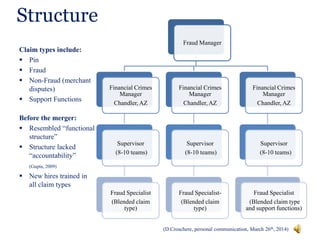
Structure
Claim types include:
 Pin
 Fraud
 Non-Fraud (merchant
disputes)
 Support Functions
Before the merger:
 Resembled “functional
structure”
 Structure lacked
“accountability”
(Gupta, 2009)
 New hires trained in
all claim types
Fraud Manager
Financial Crimes
Manager
Chandler, AZ
Supervisor
(8-10 teams)
Fraud Specialist
(Blended claim
type)
Financial Crimes
Manager
Chandler, AZ
Supervisor
(8-10 teams)
Fraud Specialist-
(Blended claim
type)
Financial Crimes
Manager
Chandler, AZ
Supervisor
(8-10 teams)
Fraud Specialist
(Blended claim type
and support functions)
(D.Croschere, personal communication, March 26th, 2014)
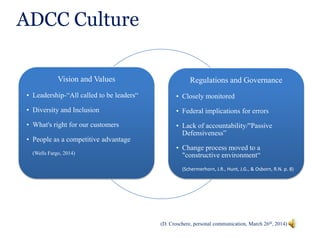
ADCC Culture
Vision and Values
• Leadership-“All called to be leaders“
• Diversity and Inclusion
• What's right for our customers
• People as a competitive advantage
(Wells Fargo, 2014)
Regulations and Governance
• Closely monitored
• Federal implications for errors
• Lack of accountability/"Passive
Defensiveness”
• Change process moved to a
"constructive environment“
(Schermerhorn, J.R., Hunt, J.G., & Osborn, R.N. p. 8)
(D. Croschere, personal communication, March 26th, 2014)
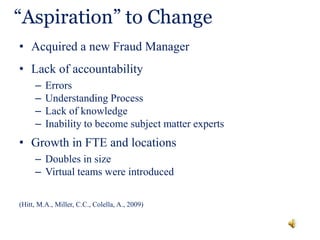
“Aspiration” to Change
• Acquired a new Fraud Manager
• Lack of accountability
– Errors
– Understanding Process
– Lack of knowledge
– Inability to become subject matter experts
• Growth in FTE and locations
– Doubles in size
– Virtual teams were introduced
(Hitt, M.A., Miller, C.C., Colella, A., 2009)
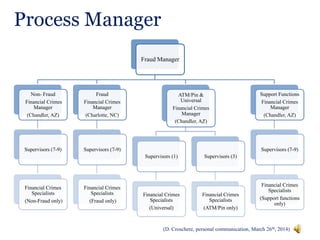
Process Manager
Fraud Manager
Non- Fraud
Financial Crimes
Manager
(Chandler, AZ)
Supervisors (7-9)
Financial Crimes
Specialists
(Non-Fraud only)
Fraud
Financial Crimes
Manager
(Charlotte, NC)
Supervisors (7-9)
Financial Crimes
Specialists
(Fraud only)
ATM/Pin &
Universal
Financial Crimes
Manager
(Chandler, AZ)
Supervisors (1)
Financial Crimes
Specialists
(Universal)
Supervisors (3)
Financial Crimes
Specialists
(ATM/Pin only)
Support Functions
Financial Crimes
Manager
(Chandler, AZ)
Supervisors (7-9)
Financial Crimes
Specialists
(Support functions
only)
(D. Croschere, personal communication, March 26th, 2014)
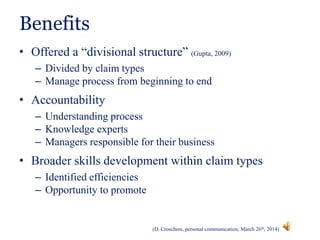
Benefits
• Offered a “divisional structure” (Gupta, 2009)
– Divided by claim types
– Manage process from beginning to end
• Accountability
– Understanding process
– Knowledge experts
– Managers responsible for their business
• Broader skills development within claim types
– Identified efficiencies
– Opportunity to promote
(D. Croschere, personal communication, March 26th, 2014)
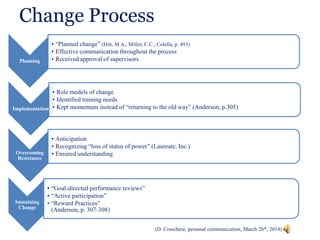
Change Process
Planning
• “Planned change” (Hitt, M.A., Miller, C.C., Colella, p. 493)
• Effective communication throughout the process
• Received approval of supervisors
Implementation
• Role models of change
• Identified training needs
• Kept momentum instead of “returning to the old way” (Anderson, p.305)
Overcoming
Resistance
• Anticipation
• Recognizing “loss of status of power” (Laureate, Inc.)
• Ensured understanding
Sustaining
Change
• “Goal-directed performance reviews”
• “Active participation”
• “Reward Practices”
(Anderson, p. 307-308)
(D. Croschere, personal communication, March 26th, 2014)
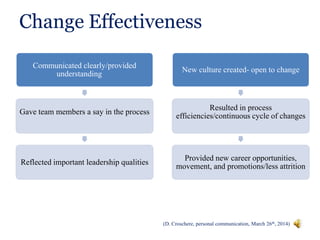
Change Effectiveness
Communicated clearly/provided
understanding
Gave team members a say in the process
Reflected important leadership qualities
New culture created- open to change
Resulted in process
efficiencies/continuous cycle of changes
Provided new career opportunities,
movement, and promotions/less attrition
(D. Croschere, personal communication, March 26th, 2014)
Looking Back
• Universal team was developed to work all claim types
for business continuity
• Seasoned agents could be promoted to this team
• Only one team was created; should have created one
universal team for each Manager
– Stronger continuity plan
– More opportunity for growth/promotions
– Should have been part of the initial change in structure;
now trying to implement after
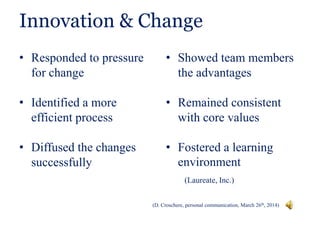
Innovation & Change
• Responded to pressure
for change
• Identified a more
efficient process
• Diffused the changes
successfully
• Showed team members
the advantages
• Remained consistent
with core values
• Fostered a learning
environment
(Laureate, Inc.)
(D. Croschere, personal communication, March 26th, 2014)
References
Gupta, A. (2009) Functional vs. Divisional Structure. Retrieved from, http://www.practical-management.com/Organization-
Development/Functional-Vs-Divisional-Structure.html
Hitt, M.A., Miller, C.C., Colella. Organizational Behavior. A Strategic Approach. Excerpt from Organizational Change and
Development. Retrieved from,
https://class.waldenu.edu/bbcswebdav/institution/USW1/201440_04/MS_INDT/EDUC_6105/Week%203/Resources/Resources/e
mbedded/Hitt_Ch14OrgChangeDev_OrgBehvr_484_497.pdf
Laureate Education, Inc. (n.d) Introduction to Organizations. [Video File]. Retrieved from
https://class.waldenu.edu/webapps/portal/frameset.jsp?tab_tab_group_id=_2_1&url=%2Fwebapps%2Fblackboard%2Fexecute%
2Flauncher%3Ftype%3DCourse%26id%3D_4775264_1%26url%3D
Laureate, Inc. (n.d) Fostering Innovation. [Video File] Retrieved from,
https://class.waldenu.edu/webapps/portal/frameset.jsp?tab_tab_group_id=_2_1&url=%2Fwebapps%2Fblackboard%2Fexecute%2F
launcher%3Ftype%3DCourse%26id%3D_4775264_1%26url%3D
Schermerhorn, J.R., Hunt, J.G., & Osborn, R.N. (2008). Organizational Behavior: Excerpt from
Chapter 1, “Introducing Organizational Behavior.” Retrieved from
https://class.waldenu.edu/bbcswebdav/institution/USW1/201440_04/MS_INDT/EDUC_6105/Week%201/Resources/Resources/em
bedded/Schermerhorn_Ch1IntroOrgBehav_4_12[1].pdf.
Wells Fargo (2014). News Release: Wells Fargo and Wachovia Merger Completed. Retrieved from,
https://www.wellsfargo.com/press/2009/20090101_Wachovia_Merger.
Wells Fargo (2014). Our Values. Retrieve from, https://www.wellsfargo.com/invest_relations/vision_values/4.

Wk7 assgnpatinoe.doc

  • 1.
    Wells Fargo ATM& Debit Card Claims Department Process Manager Implementation Erica Patino This presentation was prepared for EDUC-6105-5 Walden University
  • 2.
    Abstract This presentation explainsthe change process that the ATM & Debit Card Claims (ADCC) department implemented after a company merger, referred to as “Process Manager.” It discusses the entire change process through its full cycle, from its inception to how the department is sustaining the change today. Some of the information included was obtained from a personal interview with one of the departments Financial Crimes Managers and change agent for this process, Dana Croschere.
  • 3.
    History • 2008 WellsFargo & Wachovia merged (Wells Fargo, 2014) • Merger prompted ADCC leadership change • Structural change is proposed • “Stated” & “unstated” goals were revisited (Laureate, Inc.) • Function, structure, leadership, and culture played key roles in the implementation of this change (D. Croschere, personal communication, March 26th, 2014).
  • 4.
    Structure Claim types include: Pin  Fraud  Non-Fraud (merchant disputes)  Support Functions Before the merger:  Resembled “functional structure”  Structure lacked “accountability” (Gupta, 2009)  New hires trained in all claim types Fraud Manager Financial Crimes Manager Chandler, AZ Supervisor (8-10 teams) Fraud Specialist (Blended claim type) Financial Crimes Manager Chandler, AZ Supervisor (8-10 teams) Fraud Specialist- (Blended claim type) Financial Crimes Manager Chandler, AZ Supervisor (8-10 teams) Fraud Specialist (Blended claim type and support functions) (D.Croschere, personal communication, March 26th, 2014)
  • 5.
    ADCC Culture Vision andValues • Leadership-“All called to be leaders“ • Diversity and Inclusion • What's right for our customers • People as a competitive advantage (Wells Fargo, 2014) Regulations and Governance • Closely monitored • Federal implications for errors • Lack of accountability/"Passive Defensiveness” • Change process moved to a "constructive environment“ (Schermerhorn, J.R., Hunt, J.G., & Osborn, R.N. p. 8) (D. Croschere, personal communication, March 26th, 2014)
  • 6.
    “Aspiration” to Change •Acquired a new Fraud Manager • Lack of accountability – Errors – Understanding Process – Lack of knowledge – Inability to become subject matter experts • Growth in FTE and locations – Doubles in size – Virtual teams were introduced (Hitt, M.A., Miller, C.C., Colella, A., 2009)
  • 7.
    Process Manager Fraud Manager Non-Fraud Financial Crimes Manager (Chandler, AZ) Supervisors (7-9) Financial Crimes Specialists (Non-Fraud only) Fraud Financial Crimes Manager (Charlotte, NC) Supervisors (7-9) Financial Crimes Specialists (Fraud only) ATM/Pin & Universal Financial Crimes Manager (Chandler, AZ) Supervisors (1) Financial Crimes Specialists (Universal) Supervisors (3) Financial Crimes Specialists (ATM/Pin only) Support Functions Financial Crimes Manager (Chandler, AZ) Supervisors (7-9) Financial Crimes Specialists (Support functions only) (D. Croschere, personal communication, March 26th, 2014)
  • 8.
    Benefits • Offered a“divisional structure” (Gupta, 2009) – Divided by claim types – Manage process from beginning to end • Accountability – Understanding process – Knowledge experts – Managers responsible for their business • Broader skills development within claim types – Identified efficiencies – Opportunity to promote (D. Croschere, personal communication, March 26th, 2014)
  • 9.
    Change Process Planning • “Plannedchange” (Hitt, M.A., Miller, C.C., Colella, p. 493) • Effective communication throughout the process • Received approval of supervisors Implementation • Role models of change • Identified training needs • Kept momentum instead of “returning to the old way” (Anderson, p.305) Overcoming Resistance • Anticipation • Recognizing “loss of status of power” (Laureate, Inc.) • Ensured understanding Sustaining Change • “Goal-directed performance reviews” • “Active participation” • “Reward Practices” (Anderson, p. 307-308) (D. Croschere, personal communication, March 26th, 2014)
  • 10.
    Change Effectiveness Communicated clearly/provided understanding Gaveteam members a say in the process Reflected important leadership qualities New culture created- open to change Resulted in process efficiencies/continuous cycle of changes Provided new career opportunities, movement, and promotions/less attrition (D. Croschere, personal communication, March 26th, 2014)
  • 11.
    Looking Back • Universalteam was developed to work all claim types for business continuity • Seasoned agents could be promoted to this team • Only one team was created; should have created one universal team for each Manager – Stronger continuity plan – More opportunity for growth/promotions – Should have been part of the initial change in structure; now trying to implement after
  • 12.
    Innovation & Change •Responded to pressure for change • Identified a more efficient process • Diffused the changes successfully • Showed team members the advantages • Remained consistent with core values • Fostered a learning environment (Laureate, Inc.) (D. Croschere, personal communication, March 26th, 2014)
  • 13.
    References Gupta, A. (2009)Functional vs. Divisional Structure. Retrieved from, http://www.practical-management.com/Organization- Development/Functional-Vs-Divisional-Structure.html Hitt, M.A., Miller, C.C., Colella. Organizational Behavior. A Strategic Approach. Excerpt from Organizational Change and Development. Retrieved from, https://class.waldenu.edu/bbcswebdav/institution/USW1/201440_04/MS_INDT/EDUC_6105/Week%203/Resources/Resources/e mbedded/Hitt_Ch14OrgChangeDev_OrgBehvr_484_497.pdf Laureate Education, Inc. (n.d) Introduction to Organizations. [Video File]. Retrieved from https://class.waldenu.edu/webapps/portal/frameset.jsp?tab_tab_group_id=_2_1&url=%2Fwebapps%2Fblackboard%2Fexecute% 2Flauncher%3Ftype%3DCourse%26id%3D_4775264_1%26url%3D Laureate, Inc. (n.d) Fostering Innovation. [Video File] Retrieved from, https://class.waldenu.edu/webapps/portal/frameset.jsp?tab_tab_group_id=_2_1&url=%2Fwebapps%2Fblackboard%2Fexecute%2F launcher%3Ftype%3DCourse%26id%3D_4775264_1%26url%3D Schermerhorn, J.R., Hunt, J.G., & Osborn, R.N. (2008). Organizational Behavior: Excerpt from Chapter 1, “Introducing Organizational Behavior.” Retrieved from https://class.waldenu.edu/bbcswebdav/institution/USW1/201440_04/MS_INDT/EDUC_6105/Week%201/Resources/Resources/em bedded/Schermerhorn_Ch1IntroOrgBehav_4_12[1].pdf. Wells Fargo (2014). News Release: Wells Fargo and Wachovia Merger Completed. Retrieved from, https://www.wellsfargo.com/press/2009/20090101_Wachovia_Merger. Wells Fargo (2014). Our Values. Retrieve from, https://www.wellsfargo.com/invest_relations/vision_values/4.

Editor's Notes

  • #6 Make sure to cite work
  • #8 Highlight what the changes would do
  • #9 Page 7- paper 1
  • #10 Reference for parapharasing
  • #11 Cite for paraphrasing