Employee Development Initiatives:Employee Development Initiatives:
Making the Case for Employee DevelopmentMaking the Case for Employee Development
A Presentation by Traci Johnson
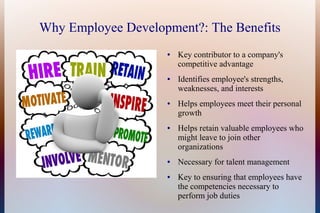
Why Employee Development?: The Benefits
● Key contributor to a company's
competitive advantage
● Identifies employee's strengths,
weaknesses, and interests
● Helps employees meet their personal
growth
● Helps retain valuable employees who
might leave to join other
organizations
● Necessary for talent management
● Key to ensuring that employees have
the competencies necessary to
perform job duties
“Employee development programs make positive
contributions to organizational performance. A more
highly skilled workforce can accomplish more as the
individuals gain in experience and knowledge.
In addition, retaining an employee saves the
organization a great deal of money. One method of
retention is to provide opportunities to develop new
skills. In research conducted to assess what retained
employees, development was one of the top three
retention items.”
(University of Minnesota , 2009, para. 3-4)
The Need for an Employee Development Plan
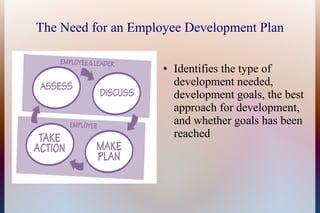
● Identifies the type of
development needed,
development goals, the best
approach for development,
and whether goals has been
reached
Types of Employee Development
Initiatives
● Formal Education ● Assessment
● Interpersonal
relationships
● Job Experience
Formal Education
● Off-site and On-site Training Programs
● Short Courses Offered by Colleges and Universities
● Executive MBA Programs
● Tuition Reimbursement
Assessment
● Collecting information and providing feedback to employees about their behavior,
communication style, or skills (Noe, 2013, p.380)
● Identifies employees with managerial potential
● Measure current manager's strengths and weaknesses
● Help employees their tendencies, needs, the type of work environment they prefer,
and the type of work they might prefer to do.
● Help employees decide what type of development goals might be most appropriate
for them.
● Types of Assessments: Personality Test, Performance Appraisal, 360-Degree
Feedback Systems.
Job Experiences
● “Relationships, problems, demands, tasks, or other features that employees face in their jobs”
(Noe, p. 386)
● Employees must learn news skills, apply their skills in a new way, and master new experiences
● New Job Assignments = Utilize existing skills while developing new ones
● Job Enlargement = adding challenges or new responsibilities to current jobs
● Job Rotation = Series of job assignments in various functional areas of the company. (Gain
appreciation and understanding of other areas in the company)
● Transfers, Promotions, Downward Moves, Temporary Assignments, Projects, Volunteer Work,
and Sabbaticals
“Positive meaning has been proposed as universal human need, and well-established relationships
Interpersonal Relationships
● Interacting with a more experienced employee
● Mentoring = an experience employee helps develop a less experienced
employee
– Both mentor and mentee can benefit from the relationship
– Career and Psychosocial Support
– Provide opportunity to develop interpersonal skills, increase self-
esteem and worth
● Coaching = peer or manager who works with employees to motivate,
develop skills, and provide feedback
“Positive relationships are those that are a generative source of enrichment, vitality,
and learning for both individuals and organizations” (Pace, 2010, p.43)
References
● Noe, R. A. (2013). Employee training and development (6th ed.). New York,
NY: McGraw Hill.
● Pace, A. (2010). Unleashing positivity in the workplace. Training and
Development, 64(1), 40-44.
● University of Minnesota (Office of Human Resources): Employee Development
(2009). Located at http://www1.umn.edu/ohr/toolkit/development/index.html

Wk7 assgn johnson wiggins, t (presentation)

  • 1.
    Employee Development Initiatives:EmployeeDevelopment Initiatives: Making the Case for Employee DevelopmentMaking the Case for Employee Development A Presentation by Traci Johnson
  • 2.
    Why Employee Development?:The Benefits ● Key contributor to a company's competitive advantage ● Identifies employee's strengths, weaknesses, and interests ● Helps employees meet their personal growth ● Helps retain valuable employees who might leave to join other organizations ● Necessary for talent management ● Key to ensuring that employees have the competencies necessary to perform job duties
  • 3.
    “Employee development programsmake positive contributions to organizational performance. A more highly skilled workforce can accomplish more as the individuals gain in experience and knowledge. In addition, retaining an employee saves the organization a great deal of money. One method of retention is to provide opportunities to develop new skills. In research conducted to assess what retained employees, development was one of the top three retention items.” (University of Minnesota , 2009, para. 3-4)
  • 4.
    The Need foran Employee Development Plan ● Identifies the type of development needed, development goals, the best approach for development, and whether goals has been reached
  • 5.
    Types of EmployeeDevelopment Initiatives ● Formal Education ● Assessment ● Interpersonal relationships ● Job Experience
  • 6.
    Formal Education ● Off-siteand On-site Training Programs ● Short Courses Offered by Colleges and Universities ● Executive MBA Programs ● Tuition Reimbursement
  • 7.
    Assessment ● Collecting informationand providing feedback to employees about their behavior, communication style, or skills (Noe, 2013, p.380) ● Identifies employees with managerial potential ● Measure current manager's strengths and weaknesses ● Help employees their tendencies, needs, the type of work environment they prefer, and the type of work they might prefer to do. ● Help employees decide what type of development goals might be most appropriate for them. ● Types of Assessments: Personality Test, Performance Appraisal, 360-Degree Feedback Systems.
  • 8.
    Job Experiences ● “Relationships,problems, demands, tasks, or other features that employees face in their jobs” (Noe, p. 386) ● Employees must learn news skills, apply their skills in a new way, and master new experiences ● New Job Assignments = Utilize existing skills while developing new ones ● Job Enlargement = adding challenges or new responsibilities to current jobs ● Job Rotation = Series of job assignments in various functional areas of the company. (Gain appreciation and understanding of other areas in the company) ● Transfers, Promotions, Downward Moves, Temporary Assignments, Projects, Volunteer Work, and Sabbaticals “Positive meaning has been proposed as universal human need, and well-established relationships
  • 9.
    Interpersonal Relationships ● Interactingwith a more experienced employee ● Mentoring = an experience employee helps develop a less experienced employee – Both mentor and mentee can benefit from the relationship – Career and Psychosocial Support – Provide opportunity to develop interpersonal skills, increase self- esteem and worth ● Coaching = peer or manager who works with employees to motivate, develop skills, and provide feedback “Positive relationships are those that are a generative source of enrichment, vitality, and learning for both individuals and organizations” (Pace, 2010, p.43)
  • 10.
    References ● Noe, R.A. (2013). Employee training and development (6th ed.). New York, NY: McGraw Hill. ● Pace, A. (2010). Unleashing positivity in the workplace. Training and Development, 64(1), 40-44. ● University of Minnesota (Office of Human Resources): Employee Development (2009). Located at http://www1.umn.edu/ohr/toolkit/development/index.html