Planning a Healthy DietPlanning a Healthy Diet
Principles and GuidelinesPrinciples and Guidelines
• Adequacy
• Sufficient energy
• Adequate nutrients for healthy people
• Balance
• Enough but not too much
• kCalorie (energy) control
• Energy in = energy out
• High nutrient density foods
Principles and GuidelinesPrinciples and Guidelines
• Nutrient density
• The most nutrients for the fewest calories
• Low-nutrient density foods
• Moderation
• Food selections – low in fat & added sugars
• Variety
• Among and within food groups
• Benefits of a varied diet
Nutrient Density of Two
Breakfast Options Compared
Principles and GuidelinesPrinciples and Guidelines
• Dietary Guidelines for Americans
• Evidence-based advice
• Attain and maintain a healthy weight
• Reduce risk of chronic disease
• Promote overall health
• Reviewed and revised every five years
Principles and Guidelines
• Dietary Guidelines for Americans
• Four major topic areas
• Balancing kcalories to manage weight
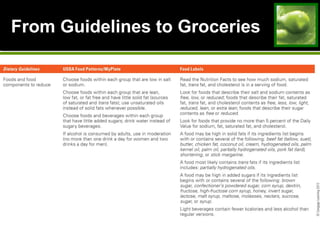
• Foods and food components to reduce
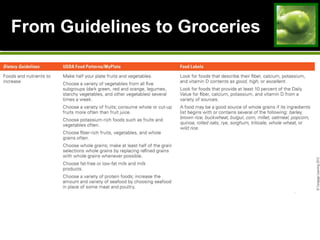
• Foods and nutrients to increase
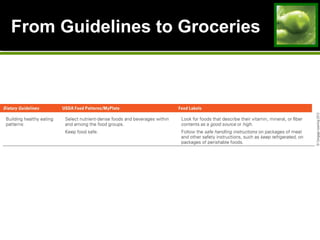
• Building healthy eating patterns
Diet-Planning GuidesDiet-Planning Guides
• Need tools and knowledge to plan an ideal
diet
• USDA Food Patterns
• Five major food groups
• Fruits, vegetables, grains, protein foods, milk
and milk products
• Recommended daily amounts for each group
• Daily selection from each group
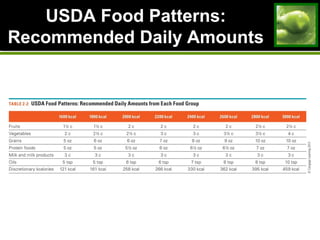
USDA Food Patterns:
Recommended Daily Amounts
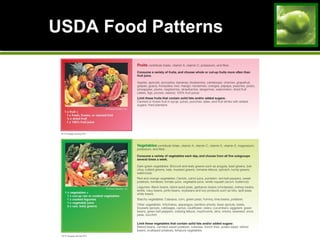
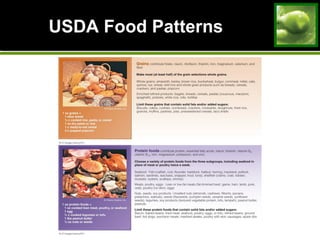
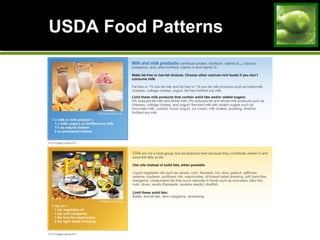
USDA Food PatternsUSDA Food Patterns
USDA Food Patterns
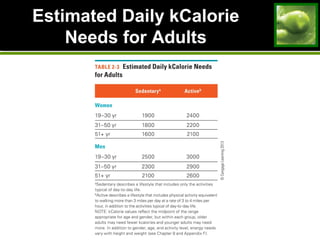
Estimated Daily kCalorie
Needs for Adults
Diet-Planning GuidesDiet-Planning Guides
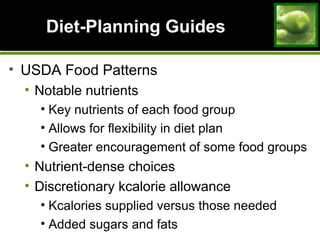
• USDA Food Patterns
• Notable nutrients
• Key nutrients of each food group
• Allows for flexibility in diet plan
• Greater encouragement of some food groups
• Nutrient-dense choices
• Discretionary kcalorie allowance
• Kcalories supplied versus those needed
• Added sugars and fats
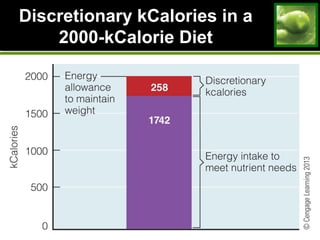
Discretionary kCalories in a
2000-kCalorie Diet
Diet-Planning GuidesDiet-Planning Guides
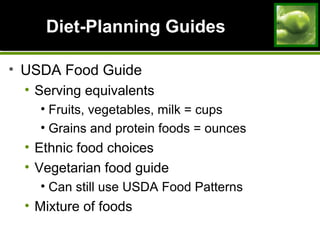
• USDA Food Guide
• Serving equivalents
• Fruits, vegetables, milk = cups
• Grains and protein foods = ounces
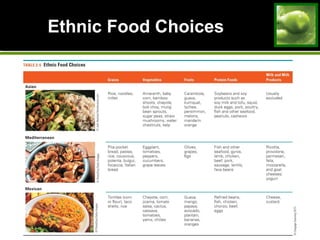
• Ethnic food choices
• Vegetarian food guide
• Can still use USDA Food Patterns
• Mixture of foods
Ethnic Food Choices
Diet-Planning GuidesDiet-Planning Guides
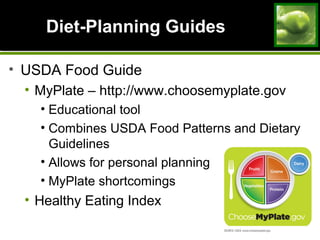
• USDA Food Guide
• MyPlate – http://www.choosemyplate.gov
• Educational tool
• Combines USDA Food Patterns and Dietary
Guidelines
• Allows for personal planning
• MyPlate shortcomings
• Healthy Eating Index
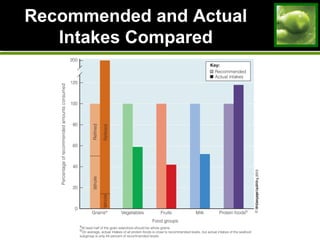
Recommended and ActualRecommended and Actual
Intakes ComparedIntakes Compared
Diet-Planning GuidesDiet-Planning Guides
• Exchange lists
• Help in achieving kcalorie control and
moderation
• Sorting of foods
• Energy-nutrient contents
• Examples
Diet-Planning GuidesDiet-Planning Guides
• Putting the plan into action
• Familiarize yourself with each food group
• From guidelines to groceries
• Consider foods you enjoy
• Make improvements little by little
• Processed foods
• Disadvantages
• Advantages
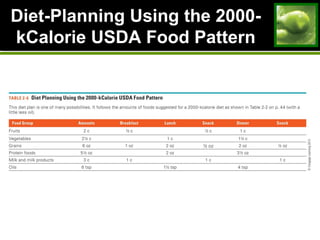
Diet-Planning Using the 2000-
kCalorie USDA Food Pattern
Diet-Planning Guides –Diet-Planning Guides –
Grocery ShoppingGrocery Shopping
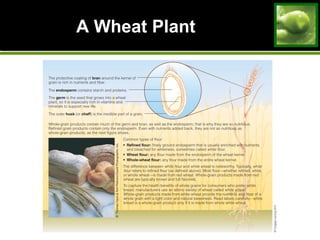
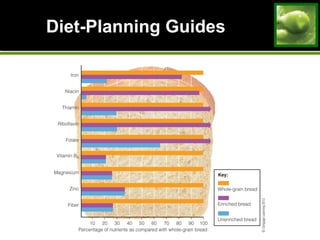
• Grains
• Whole-grain
products
• Fortification &
enrichment
• Vegetables
• Fresh vs. canned or
frozen
• Milk and milk
products
• Fruits
• Colors
• Fruit juices
• Protein foods
• Lean cuts
• Soy products
• Portion sizes
• Cooking techniques
A Wheat PlantA Wheat Plant
Diet-Planning GuidesDiet-Planning Guides
Food LabelsFood Labels
• Reasons for food label use
• Product not required to have food labels
• Voluntary use of labels
• Restaurant food labeling
• Portion sizes
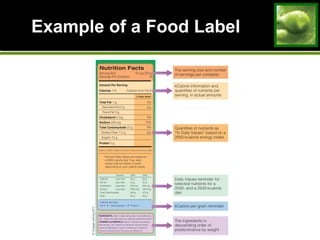
Example of a Food LabelExample of a Food Label
Food LabelsFood Labels
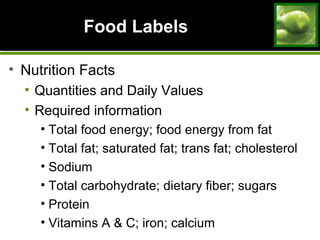
• Ingredient list
• Listing of all ingredients
• Descending order of predominance by weight
• Serving sizes
• Food and Drug Administration (FDA) role
• Adjust calculations according to amount
consumed
• Sizes listed vs. USDA Food Pattern sizes
Food LabelsFood Labels
• Nutrition Facts
• Quantities and Daily Values
• Required information
• Total food energy; food energy from fat
• Total fat; saturated fat; trans fat; cholesterol
• Sodium
• Total carbohydrate; dietary fiber; sugars
• Protein
• Vitamins A & C; iron; calcium
Food LabelsFood Labels
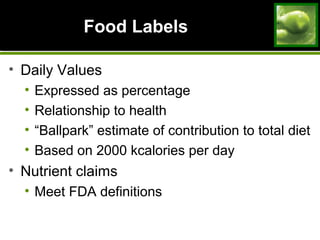
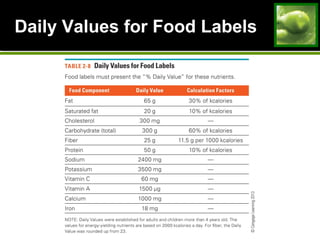
• Daily Values
• Expressed as percentage
• Relationship to health
• “Ballpark” estimate of contribution to total diet
• Based on 2000 kcalories per day
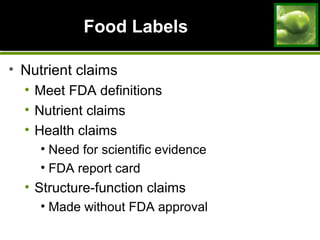
• Nutrient claims
• Meet FDA definitions
Daily Values for Food Labels
Food LabelsFood Labels
• Nutrient claims
• Meet FDA definitions
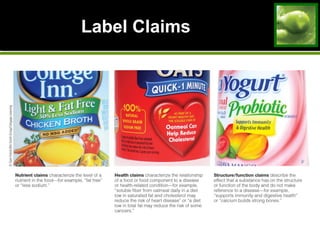
• Nutrient claims
• Health claims
• Need for scientific evidence
• FDA report card
• Structure-function claims
• Made without FDA approval
Label Claims
Food Labels
• Consumer education
• Coordination of USDA Food Patterns, Dietary
Guidelines, and food labels
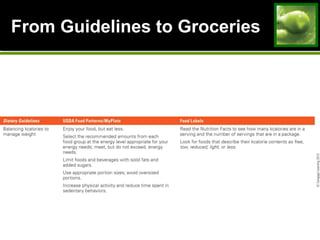
From Guidelines to GroceriesFrom Guidelines to Groceries
Vegetarian DietsVegetarian Diets
Highlight 2
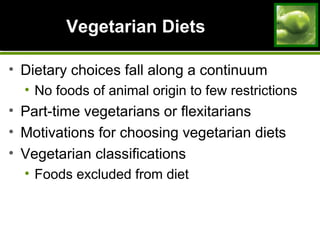
Vegetarian DietsVegetarian Diets
• Dietary choices fall along a continuum
• No foods of animal origin to few restrictions
• Part-time vegetarians or flexitarians
• Motivations for choosing vegetarian diets
• Vegetarian classifications
• Foods excluded from diet
Health Benefits of VegetarianHealth Benefits of Vegetarian
DietsDiets
• Vegetarian lifestyle factors
• Obesity
• Lower and healthier body weight
• Diabetes
• Hypertension
• Heart disease
• Plant-based diets and tofu
• Cancer
• Other diseases
Vegetarian Diet PlanningVegetarian Diet Planning
• Task
• Use variety of foods within an energy
allowance that maintains a healthy body
weight
• USDA Food Patterns
• MyPlate
• Nutrient intakes
Vegetarian Diet PlanningVegetarian Diet Planning
• Protein
• Sources
• Requirements
• Meat replacements
• Iron
• RDA is higher
• Absorption
• Zinc
• Calcium
• Food choices
• Vitamin B12
• Only in animal-
derived foods
• Vitamin D
• Omega-3 fatty acids
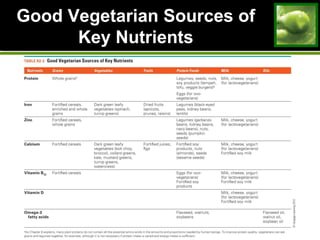
Good Vegetarian Sources of
Key Nutrients
Healthy Food ChoicesHealthy Food Choices
• Vegetarian diets
• Lower risk of mortality from several chronic
diseases
• Nutritionally sound choices
• Variety is key to nutritional adequacy
• Macrobiotic diet
• Way of life, not just a meal plan

Wk5ch2

  • 1.
    Planning a HealthyDietPlanning a Healthy Diet
  • 2.
    Principles and GuidelinesPrinciplesand Guidelines • Adequacy • Sufficient energy • Adequate nutrients for healthy people • Balance • Enough but not too much • kCalorie (energy) control • Energy in = energy out • High nutrient density foods
  • 3.
    Principles and GuidelinesPrinciplesand Guidelines • Nutrient density • The most nutrients for the fewest calories • Low-nutrient density foods • Moderation • Food selections – low in fat & added sugars • Variety • Among and within food groups • Benefits of a varied diet
  • 4.
    Nutrient Density ofTwo Breakfast Options Compared
  • 5.
    Principles and GuidelinesPrinciplesand Guidelines • Dietary Guidelines for Americans • Evidence-based advice • Attain and maintain a healthy weight • Reduce risk of chronic disease • Promote overall health • Reviewed and revised every five years
  • 6.
    Principles and Guidelines •Dietary Guidelines for Americans • Four major topic areas • Balancing kcalories to manage weight • Foods and food components to reduce • Foods and nutrients to increase • Building healthy eating patterns
  • 7.
    Diet-Planning GuidesDiet-Planning Guides •Need tools and knowledge to plan an ideal diet • USDA Food Patterns • Five major food groups • Fruits, vegetables, grains, protein foods, milk and milk products • Recommended daily amounts for each group • Daily selection from each group
  • 8.
  • 9.
  • 10.
  • 11.
  • 12.
  • 13.
    Diet-Planning GuidesDiet-Planning Guides •USDA Food Patterns • Notable nutrients • Key nutrients of each food group • Allows for flexibility in diet plan • Greater encouragement of some food groups • Nutrient-dense choices • Discretionary kcalorie allowance • Kcalories supplied versus those needed • Added sugars and fats
  • 14.
    Discretionary kCalories ina 2000-kCalorie Diet
  • 15.
    Diet-Planning GuidesDiet-Planning Guides •USDA Food Guide • Serving equivalents • Fruits, vegetables, milk = cups • Grains and protein foods = ounces • Ethnic food choices • Vegetarian food guide • Can still use USDA Food Patterns • Mixture of foods
  • 16.
  • 17.
    Diet-Planning GuidesDiet-Planning Guides •USDA Food Guide • MyPlate – http://www.choosemyplate.gov • Educational tool • Combines USDA Food Patterns and Dietary Guidelines • Allows for personal planning • MyPlate shortcomings • Healthy Eating Index
  • 18.
    Recommended and ActualRecommendedand Actual Intakes ComparedIntakes Compared
  • 19.
    Diet-Planning GuidesDiet-Planning Guides •Exchange lists • Help in achieving kcalorie control and moderation • Sorting of foods • Energy-nutrient contents • Examples
  • 20.
    Diet-Planning GuidesDiet-Planning Guides •Putting the plan into action • Familiarize yourself with each food group • From guidelines to groceries • Consider foods you enjoy • Make improvements little by little • Processed foods • Disadvantages • Advantages
  • 21.
    Diet-Planning Using the2000- kCalorie USDA Food Pattern
  • 22.
    Diet-Planning Guides –Diet-PlanningGuides – Grocery ShoppingGrocery Shopping • Grains • Whole-grain products • Fortification & enrichment • Vegetables • Fresh vs. canned or frozen • Milk and milk products • Fruits • Colors • Fruit juices • Protein foods • Lean cuts • Soy products • Portion sizes • Cooking techniques
  • 23.
    A Wheat PlantAWheat Plant
  • 24.
  • 25.
    Food LabelsFood Labels •Reasons for food label use • Product not required to have food labels • Voluntary use of labels • Restaurant food labeling • Portion sizes
  • 26.
    Example of aFood LabelExample of a Food Label
  • 27.
    Food LabelsFood Labels •Ingredient list • Listing of all ingredients • Descending order of predominance by weight • Serving sizes • Food and Drug Administration (FDA) role • Adjust calculations according to amount consumed • Sizes listed vs. USDA Food Pattern sizes
  • 28.
    Food LabelsFood Labels •Nutrition Facts • Quantities and Daily Values • Required information • Total food energy; food energy from fat • Total fat; saturated fat; trans fat; cholesterol • Sodium • Total carbohydrate; dietary fiber; sugars • Protein • Vitamins A & C; iron; calcium
  • 29.
    Food LabelsFood Labels •Daily Values • Expressed as percentage • Relationship to health • “Ballpark” estimate of contribution to total diet • Based on 2000 kcalories per day • Nutrient claims • Meet FDA definitions
  • 30.
    Daily Values forFood Labels
  • 31.
    Food LabelsFood Labels •Nutrient claims • Meet FDA definitions • Nutrient claims • Health claims • Need for scientific evidence • FDA report card • Structure-function claims • Made without FDA approval
  • 32.
  • 33.
    Food Labels • Consumereducation • Coordination of USDA Food Patterns, Dietary Guidelines, and food labels
  • 34.
    From Guidelines toGroceriesFrom Guidelines to Groceries
  • 35.
    From Guidelines toGroceriesFrom Guidelines to Groceries
  • 36.
    From Guidelines toGroceriesFrom Guidelines to Groceries
  • 37.
    From Guidelines toGroceriesFrom Guidelines to Groceries
  • 38.
  • 39.
    Vegetarian DietsVegetarian Diets •Dietary choices fall along a continuum • No foods of animal origin to few restrictions • Part-time vegetarians or flexitarians • Motivations for choosing vegetarian diets • Vegetarian classifications • Foods excluded from diet
  • 40.
    Health Benefits ofVegetarianHealth Benefits of Vegetarian DietsDiets • Vegetarian lifestyle factors • Obesity • Lower and healthier body weight • Diabetes • Hypertension • Heart disease • Plant-based diets and tofu • Cancer • Other diseases
  • 41.
    Vegetarian Diet PlanningVegetarianDiet Planning • Task • Use variety of foods within an energy allowance that maintains a healthy body weight • USDA Food Patterns • MyPlate • Nutrient intakes
  • 42.
    Vegetarian Diet PlanningVegetarianDiet Planning • Protein • Sources • Requirements • Meat replacements • Iron • RDA is higher • Absorption • Zinc • Calcium • Food choices • Vitamin B12 • Only in animal- derived foods • Vitamin D • Omega-3 fatty acids
  • 43.
    Good Vegetarian Sourcesof Key Nutrients
  • 44.
    Healthy Food ChoicesHealthyFood Choices • Vegetarian diets • Lower risk of mortality from several chronic diseases • Nutritionally sound choices • Variety is key to nutritional adequacy • Macrobiotic diet • Way of life, not just a meal plan