A. Readings/Discussions
L.O. 2 NETWORK CABLES
Cable is the medium through wich information usually moves from one network device to
another. There are several types of cable, which are commonly used with LANS. Cables were
the only medium used to connect devices on networks. A wide variety of networking cables
are available. Coaxial and twisted-pair cables use copper to transmit data. Fiber-optic cables
use glass or plastic to transmit data. These cables differ in bandwidth, size, and cost. You
need to know what type of cable to use based on the job requirements. You also need to be
able to troubleshoot and repair problems along theway
EXAMPLE OF NETWORK MEDIA
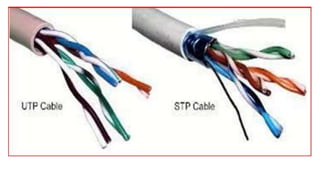
1. UNSHIELDED TWISTED PAIR ( UTP) CABLE - is the cable that has two or four pairs of
wires. This type of cable relies solely on the cancellation effect produced by the twisted-wire
pairs that limits signal degradation caused by electromagnetic interface (EMI) and radio
frequency interference (RFI). UTP is the most commonly used cabling in networks. UTP
cables have a range of 328 feet (100m).it is also the less expensive and most popular network
media.
1. SHIELDED TWISTED PAIR ( STP ) CABLE- With shielded twisted pair (STP), each
pair of wire is wrapped in metallic foil to better shield the wires from noise. Four pairs
of wires are then wrapped in an overall metallic braid or foil. STP reduces electrical
noise from within the cable. It also reduces EMI and RFIfrom outside the cable.
Although STP prevents interference better than UTP, STP is more expensive because
of the extra shielding. It is also more difficult to install because of the thickness. In
addition, the metallic shielding must be grounded at both ends. If it is improperly
grounded, the shield acts like an antenna, picking up unwanted signals.
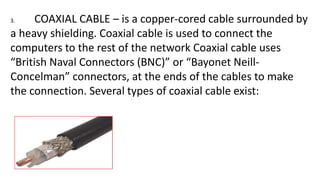
3. COAXIAL CABLE – is a copper-cored cable surrounded by
a heavy shielding. Coaxial cable is used to connect the
computers to the rest of the network Coaxial cable uses
“British Naval Connectors (BNC)” or “Bayonet Neill-
Concelman” connectors, at the ends of the cables to make
the connection. Several types of coaxial cable exist:
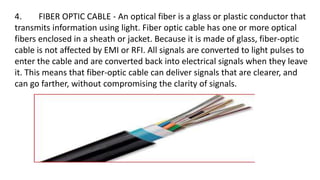
4. FIBER OPTIC CABLE - An optical fiber is a glass or plastic conductor that
transmits information using light. Fiber optic cable has one or more optical
fibers enclosed in a sheath or jacket. Because it is made of glass, fiber-optic
cable is not affected by EMI or RFI. All signals are converted to light pulses to
enter the cable and are converted back into electrical signals when they leave
it. This means that fiber-optic cable can deliver signals that are clearer, and
can go farther, without compromising the clarity of signals.
WIRELESS LANs – more and more networks are operating
without cables, in the wireless mode,it uses high frequency
radio signals, infrared slight beams, or lasers to
communicate between the work staion, servers or hub
CABLE INSTALLATION GUIDES
The two most common installation guides
1. STRAIGHT THROUGH CABLE – connected from the pc to switch/ hub
2. CROSSOVER CABLE – connected from PC to PC
WHAT IS RJ - 45?
RJ stands for Registered Jacks – These are used in telephone and data jack wiring
registered with fcc, rj-11 is a 6 position, 4 conductor jack used in telephone
wiring, and rj 45- is a 8 position, 8 conductor jack used in 10base/t AND 100
BASE/T ETHERNET Wiring.
Wiring standards for RJ45
1. T568A
2. T568B
wirings.pptx

wirings.pptx

  • 1.
    A. Readings/Discussions L.O. 2NETWORK CABLES Cable is the medium through wich information usually moves from one network device to another. There are several types of cable, which are commonly used with LANS. Cables were the only medium used to connect devices on networks. A wide variety of networking cables are available. Coaxial and twisted-pair cables use copper to transmit data. Fiber-optic cables use glass or plastic to transmit data. These cables differ in bandwidth, size, and cost. You need to know what type of cable to use based on the job requirements. You also need to be able to troubleshoot and repair problems along theway
  • 2.
    EXAMPLE OF NETWORKMEDIA 1. UNSHIELDED TWISTED PAIR ( UTP) CABLE - is the cable that has two or four pairs of wires. This type of cable relies solely on the cancellation effect produced by the twisted-wire pairs that limits signal degradation caused by electromagnetic interface (EMI) and radio frequency interference (RFI). UTP is the most commonly used cabling in networks. UTP cables have a range of 328 feet (100m).it is also the less expensive and most popular network media. 1. SHIELDED TWISTED PAIR ( STP ) CABLE- With shielded twisted pair (STP), each pair of wire is wrapped in metallic foil to better shield the wires from noise. Four pairs of wires are then wrapped in an overall metallic braid or foil. STP reduces electrical noise from within the cable. It also reduces EMI and RFIfrom outside the cable. Although STP prevents interference better than UTP, STP is more expensive because of the extra shielding. It is also more difficult to install because of the thickness. In addition, the metallic shielding must be grounded at both ends. If it is improperly grounded, the shield acts like an antenna, picking up unwanted signals.
  • 4.
    3. COAXIAL CABLE– is a copper-cored cable surrounded by a heavy shielding. Coaxial cable is used to connect the computers to the rest of the network Coaxial cable uses “British Naval Connectors (BNC)” or “Bayonet Neill- Concelman” connectors, at the ends of the cables to make the connection. Several types of coaxial cable exist:
  • 5.
    4. FIBER OPTICCABLE - An optical fiber is a glass or plastic conductor that transmits information using light. Fiber optic cable has one or more optical fibers enclosed in a sheath or jacket. Because it is made of glass, fiber-optic cable is not affected by EMI or RFI. All signals are converted to light pulses to enter the cable and are converted back into electrical signals when they leave it. This means that fiber-optic cable can deliver signals that are clearer, and can go farther, without compromising the clarity of signals.
  • 6.
    WIRELESS LANs –more and more networks are operating without cables, in the wireless mode,it uses high frequency radio signals, infrared slight beams, or lasers to communicate between the work staion, servers or hub
  • 7.
    CABLE INSTALLATION GUIDES Thetwo most common installation guides 1. STRAIGHT THROUGH CABLE – connected from the pc to switch/ hub 2. CROSSOVER CABLE – connected from PC to PC WHAT IS RJ - 45? RJ stands for Registered Jacks – These are used in telephone and data jack wiring registered with fcc, rj-11 is a 6 position, 4 conductor jack used in telephone wiring, and rj 45- is a 8 position, 8 conductor jack used in 10base/t AND 100 BASE/T ETHERNET Wiring. Wiring standards for RJ45 1. T568A 2. T568B