POOL BILLIARDS:
The Rules of Play
Nine Ball
Nine ball is played with nine object
balls numbered one through nine and
the cue ball. The balls are played in
ascending numerical order. The player
legally pocketing the nine ball wins
the rack.
The player who wins the lag chooses who
will break the first rack. (See 1.2 Lagging
to Determine Order of Play.) The standard
format is to alternate the break, but see
Regulation 16, Subsequent Break Shots.
Add a footer 3
Determining the Break
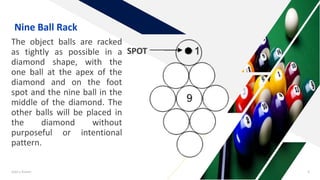
The object balls are racked
as tightly as possible in a
diamond shape, with the
one ball at the apex of the
diamond and on the foot
spot and the nine ball in the
middle of the diamond. The
other balls will be placed in
the diamond without
purposeful or intentional
pattern.
Add a footer 4
Nine Ball Rack
SPOT
The following rules apply to the break shot:
• the cue ball begins in hand behind the head string;
• if no ball is pocketed, at least four object balls must be
driven to one or more rails, or the shot is a foul
• additionally, and only when Three Point Break Rule is
used, if no ball is pocketed, three balls must cross the
head string, or the break is considered ‘dry break’. (See
Regulation 18, Three Point Break Rule.)
Add a footer 5
Legal Break Shot
If no foul is committed on the break shot,
the shooter may choose to play a “push
out” as his shot. He must make his intention
known to the referee, and then rules 6.2
Wrong Ball First and 6.3 No Rail after
Contact are suspended for the shot. If no
foul is committed on a push out, the other
player chooses who will shoot next.
Add a footer 6
Second Shot of the Rack – Push Out
If the shooter legally pockets any ball on a shot
(except a push out, see 2.4 Second Shot of the
Rack – Push Out), he continues at the table for
the next shot. If he legally pockets the nine ball
on any shot (except a push out), he wins the rack.
If the shooter fails to pocket a ball or fouls, play
passes to the other player, and if no foul was
committed, the incoming player must play the
cue ball from the position left by the other player.
Add a footer 7
Continuing Play
If the nine ball is pocketed on a foul or push
out, or driven off the table, it is spotted.
(See 1.4 Spotting Balls.) No other object ball
is ever spotted.
Add a footer 8
Spotting Balls
If the shooter commits a standard foul, play
passes to his opponent. The cue ball is in
hand, and the incoming player may place it
anywhere on the playing surface. (See 1.5
Cue Ball in Hand)
Add a footer 9
Standard Fouls
The following are standard fouls at nine
ball:
• 1. Cue Ball Scratch or off the Table
• 2. Wrong Ball First The first object ball contacted
by the cue ball on each shot must be the lowest-
numbered ball remaining on the table.
• 3. No Rail after Contact
• 4. No Foot on Floor
• 5. Ball Driven off the Table The only jumped object
ball that is spotted is the nine.
• 6. Touched Ball
Add a footer 10
• 7. Double Hit / Frozen Balls
• 8. Push Shot
• 9. Balls Still Moving
• 10. Bad Cue Ball Placement
• 12. Cue Stick on the Table
• 13. Playing out of Turn
• 15. Slow Play
• 16. Ball Rack Template Foul
Add a footer 11
For 6.14 Three Consecutive Fouls, the penalty is
loss of the current rack.
For 6.17 Unsportsmanlike Conduct, the referee
will choose a penalty appropriate given the
nature of the offense.
Add a footer 12
Serious Fouls
If a stalemate occurs the original breaker of
the rack will break again. (See 1.12
Stalemate.)
Add a footer 13
Stalemate
Thank You.
elyuke13

9-BALL.pptx

  • 1.
  • 2.
    Nine Ball Nine ballis played with nine object balls numbered one through nine and the cue ball. The balls are played in ascending numerical order. The player legally pocketing the nine ball wins the rack.
  • 3.
    The player whowins the lag chooses who will break the first rack. (See 1.2 Lagging to Determine Order of Play.) The standard format is to alternate the break, but see Regulation 16, Subsequent Break Shots. Add a footer 3 Determining the Break
  • 4.
    The object ballsare racked as tightly as possible in a diamond shape, with the one ball at the apex of the diamond and on the foot spot and the nine ball in the middle of the diamond. The other balls will be placed in the diamond without purposeful or intentional pattern. Add a footer 4 Nine Ball Rack SPOT
  • 5.
    The following rulesapply to the break shot: • the cue ball begins in hand behind the head string; • if no ball is pocketed, at least four object balls must be driven to one or more rails, or the shot is a foul • additionally, and only when Three Point Break Rule is used, if no ball is pocketed, three balls must cross the head string, or the break is considered ‘dry break’. (See Regulation 18, Three Point Break Rule.) Add a footer 5 Legal Break Shot
  • 6.
    If no foulis committed on the break shot, the shooter may choose to play a “push out” as his shot. He must make his intention known to the referee, and then rules 6.2 Wrong Ball First and 6.3 No Rail after Contact are suspended for the shot. If no foul is committed on a push out, the other player chooses who will shoot next. Add a footer 6 Second Shot of the Rack – Push Out
  • 7.
    If the shooterlegally pockets any ball on a shot (except a push out, see 2.4 Second Shot of the Rack – Push Out), he continues at the table for the next shot. If he legally pockets the nine ball on any shot (except a push out), he wins the rack. If the shooter fails to pocket a ball or fouls, play passes to the other player, and if no foul was committed, the incoming player must play the cue ball from the position left by the other player. Add a footer 7 Continuing Play
  • 8.
    If the nineball is pocketed on a foul or push out, or driven off the table, it is spotted. (See 1.4 Spotting Balls.) No other object ball is ever spotted. Add a footer 8 Spotting Balls
  • 9.
    If the shootercommits a standard foul, play passes to his opponent. The cue ball is in hand, and the incoming player may place it anywhere on the playing surface. (See 1.5 Cue Ball in Hand) Add a footer 9 Standard Fouls
  • 10.
    The following arestandard fouls at nine ball: • 1. Cue Ball Scratch or off the Table • 2. Wrong Ball First The first object ball contacted by the cue ball on each shot must be the lowest- numbered ball remaining on the table. • 3. No Rail after Contact • 4. No Foot on Floor • 5. Ball Driven off the Table The only jumped object ball that is spotted is the nine. • 6. Touched Ball Add a footer 10
  • 11.
    • 7. DoubleHit / Frozen Balls • 8. Push Shot • 9. Balls Still Moving • 10. Bad Cue Ball Placement • 12. Cue Stick on the Table • 13. Playing out of Turn • 15. Slow Play • 16. Ball Rack Template Foul Add a footer 11
  • 12.
    For 6.14 ThreeConsecutive Fouls, the penalty is loss of the current rack. For 6.17 Unsportsmanlike Conduct, the referee will choose a penalty appropriate given the nature of the offense. Add a footer 12 Serious Fouls
  • 13.
    If a stalemateoccurs the original breaker of the rack will break again. (See 1.12 Stalemate.) Add a footer 13 Stalemate
  • 14.