Networks are everywhere in today's world. Nearly every
computer connects to some type of network, whether it is a
direct link to the Internet or a local LAN composed of many
different devices. In any case, communication is the key.
Wireless has several advantages over traditional physically
connected networks. Most visibly, it helps to reduce chaos
caused by tangled cables. More importantly, wireless seeks to
address two issues that are becoming increasingly critical:
portability and mobility. Portability refers to the ability to easily
move from one fixed location to another.
Wireless has the potential to make this easy, eliminating the
need for pre-planned jacks and extra cables. Mobility is the
concept of being able to maintain a connection even while on
the move. Can I access my email while on the bus, or while
walking down the street?
No technology is perfect, though. Despite rapid improvement
over the last several years, wireless still has lower transfer rates
than even low-end cable connections. There is the risk of
increased interference, both from background noise and from
competing wireless broadcasts; while signals can collide on cable
networks, it is much easier to regulate traffic in order to prevent
problems.
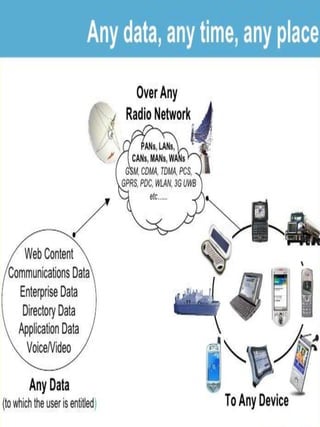
Modern cellular handset designs are incorporating a wide
variety of wireless interfaces. Wide area network (WAN)
technologies are rapidly migrating from second generation voice
interfaces to GPRS, EDGE, CDMA2000, WCDMA, and HSDPA that
offer voice along with high speed data. WLAN technology,
IEEE802.11a/b/g, is finding its way into handset designs and
offers an attractive interface for high speed wireless data and
voice over IP (VOIP) services. Wireless personal area networks
(PAN) such as Bluetooth are also finding wide adoption. On top
of this, GPS now ships in millions of handsets each year, digital
broadcast television holds promise for widespread adoption
within a few years, UWB products are coming to market, and
advanced interfaces such as 4G WANs and cognitive radios are
under discussion for the future. This offers a view of how all
these standards will impact wireless services and what it will
mean for handset design.
Examples- Computer, car, airplane, etc.. because these
technologies will be always asymptotically approaching the
highest functional performance for their functionality but the
technology themselves do not alter the actual purpose
The U.S. has long been a leader in wireless technology and
spectrum innovation, and we currently occupy the top spot in
fourth generation (4G) wireless penetration worldwide.
However, even as countries around the world are still
deploying 4G wireless networks, the race is on to develop the
framework for fifth generation (5G) wireless communications
services and technologies.
5G networks offer the promise of dramatically faster wireless
broadband services, but perhaps as importantly, they will
enable a vast universe of wirelessly enabled devices, and
facilitate tremendous advances in manufacturing,
transportation and many other fields. As such, public and
private sector stakeholders from countries around the world
have begun to put "stakes in the ground" in an effort to
shape the 5G landscape to benefit their national and
commercial interests.
Chairman Wheeler outlined an American vision for 5G that
relies on competition, regulatory flexibility, and efficient free
market solutions so the U.S. can continue to lead the world in
wireless and deliver the benefits of next-generation wireless
networks to consumers and businesses alike.

wireless trends

  • 2.
    Networks are everywherein today's world. Nearly every computer connects to some type of network, whether it is a direct link to the Internet or a local LAN composed of many different devices. In any case, communication is the key. Wireless has several advantages over traditional physically connected networks. Most visibly, it helps to reduce chaos caused by tangled cables. More importantly, wireless seeks to address two issues that are becoming increasingly critical: portability and mobility. Portability refers to the ability to easily move from one fixed location to another. Wireless has the potential to make this easy, eliminating the need for pre-planned jacks and extra cables. Mobility is the concept of being able to maintain a connection even while on the move. Can I access my email while on the bus, or while walking down the street? No technology is perfect, though. Despite rapid improvement over the last several years, wireless still has lower transfer rates than even low-end cable connections. There is the risk of increased interference, both from background noise and from competing wireless broadcasts; while signals can collide on cable networks, it is much easier to regulate traffic in order to prevent problems.
  • 6.
    Modern cellular handsetdesigns are incorporating a wide variety of wireless interfaces. Wide area network (WAN) technologies are rapidly migrating from second generation voice interfaces to GPRS, EDGE, CDMA2000, WCDMA, and HSDPA that offer voice along with high speed data. WLAN technology, IEEE802.11a/b/g, is finding its way into handset designs and offers an attractive interface for high speed wireless data and voice over IP (VOIP) services. Wireless personal area networks (PAN) such as Bluetooth are also finding wide adoption. On top of this, GPS now ships in millions of handsets each year, digital broadcast television holds promise for widespread adoption within a few years, UWB products are coming to market, and advanced interfaces such as 4G WANs and cognitive radios are under discussion for the future. This offers a view of how all these standards will impact wireless services and what it will mean for handset design. Examples- Computer, car, airplane, etc.. because these technologies will be always asymptotically approaching the highest functional performance for their functionality but the technology themselves do not alter the actual purpose
  • 7.
    The U.S. haslong been a leader in wireless technology and spectrum innovation, and we currently occupy the top spot in fourth generation (4G) wireless penetration worldwide. However, even as countries around the world are still deploying 4G wireless networks, the race is on to develop the framework for fifth generation (5G) wireless communications services and technologies. 5G networks offer the promise of dramatically faster wireless broadband services, but perhaps as importantly, they will enable a vast universe of wirelessly enabled devices, and facilitate tremendous advances in manufacturing, transportation and many other fields. As such, public and private sector stakeholders from countries around the world have begun to put "stakes in the ground" in an effort to shape the 5G landscape to benefit their national and commercial interests. Chairman Wheeler outlined an American vision for 5G that relies on competition, regulatory flexibility, and efficient free market solutions so the U.S. can continue to lead the world in wireless and deliver the benefits of next-generation wireless networks to consumers and businesses alike.