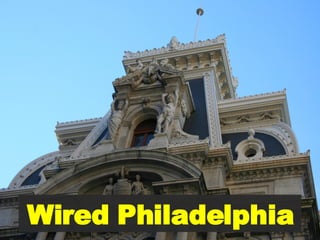
Wired Philadelphia
A little   background… 6th largest city (7th poorest densely populated). Declaration of Independence. Drafting of Constitution. Once considered “one of nation’s leading cities”. 70’s - 90’s: economic/population decline. Consistently appears on worst ten lists (crime, education, health).
Mayor’s Office of  Information Services Early 2000’s, positive period. Mayor creates new office of IS. IS office gets attention. IS Discovers: 40% of Philadelphia are non-internet users. Only 45% have internet access @ home. 72% dial-up. Office of IS suggests city create a Municipal Wireless Network (MWN).
What is an MWN? Municipal Wireless Network is basically a city-wide WIFI zone. Uses “meshed” network of wireless access points. Many access points are located outside on city-owned structures such as street lamp poles.
Arguments for MWNs Private Enterprise doesn’t care about the poor. Local governments already run municipal projects for citizens, why not MWNs? Already have a lot of assets you can use. Socioeconomic gain.
RISKS! High-technology ventures are considered “high risk”. Some people think that technology used for MWN isn’t robust enough to handle larger networks. The minute you obtain technology it’s obsolete. ISP’s don’t like the idea of local governments encroaching into “their” territory. Can we trust our local government not to screw it up? Powerful members of already established forms of communication (i.e.: TV, telephone companies, radio) don’t necessarily support MWNs.
Why do they care? Why would a city like Philadelphia care about about the population’s lack of connectivity? How do you feel about a local government getting involved in such a project? Why would it be advantageous to the city?
Creation of Wired Philadelphia Wired Philadelphia born in August, 2004. Non-profit organization that partners with a Private ISP. Partners with Earthlink to create MWN. Compromise: Free service to under privileged. Free service in public areas. Charge to local businesses Low cost to local government & profitable to ISP

Wired Philadelphia

  • 1.
  • 2.
    A little background… 6th largest city (7th poorest densely populated). Declaration of Independence. Drafting of Constitution. Once considered “one of nation’s leading cities”. 70’s - 90’s: economic/population decline. Consistently appears on worst ten lists (crime, education, health).
  • 3.
    Mayor’s Office of Information Services Early 2000’s, positive period. Mayor creates new office of IS. IS office gets attention. IS Discovers: 40% of Philadelphia are non-internet users. Only 45% have internet access @ home. 72% dial-up. Office of IS suggests city create a Municipal Wireless Network (MWN).
  • 4.
    What is anMWN? Municipal Wireless Network is basically a city-wide WIFI zone. Uses “meshed” network of wireless access points. Many access points are located outside on city-owned structures such as street lamp poles.
  • 5.
    Arguments for MWNsPrivate Enterprise doesn’t care about the poor. Local governments already run municipal projects for citizens, why not MWNs? Already have a lot of assets you can use. Socioeconomic gain.
  • 6.
    RISKS! High-technology venturesare considered “high risk”. Some people think that technology used for MWN isn’t robust enough to handle larger networks. The minute you obtain technology it’s obsolete. ISP’s don’t like the idea of local governments encroaching into “their” territory. Can we trust our local government not to screw it up? Powerful members of already established forms of communication (i.e.: TV, telephone companies, radio) don’t necessarily support MWNs.
  • 7.
    Why do theycare? Why would a city like Philadelphia care about about the population’s lack of connectivity? How do you feel about a local government getting involved in such a project? Why would it be advantageous to the city?
  • 8.
    Creation of WiredPhiladelphia Wired Philadelphia born in August, 2004. Non-profit organization that partners with a Private ISP. Partners with Earthlink to create MWN. Compromise: Free service to under privileged. Free service in public areas. Charge to local businesses Low cost to local government & profitable to ISP