Wireless Communication:
Shaping the Future
Wireless communication has revolutionized the way we connect and interact
with the world. From mobile phones to the Internet of Things, wireless
technology is constantly evolving and expanding its reach.
JA
by Joe Adam
Evolution of Wireless Technology
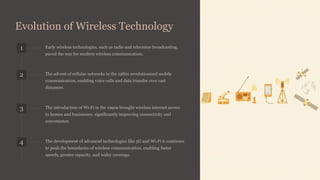
1 Early wireless technologies, such as radio and television broadcasting,
paved the way for modern wireless communication.
2 The advent of cellular networks in the 1980s revolutionized mobile
communication, enabling voice calls and data transfer over vast
distances.
3 The introduction of Wi-Fi in the 1990s brought wireless internet access
to homes and businesses, significantly improving connectivity and
convenience.
4 The development of advanced technologies like 5G and Wi-Fi 6 continues
to push the boundaries of wireless communication, enabling faster
speeds, greater capacity, and wider coverage.
Fundamentals of Wireless Signals
Electromagnetic
Spectrum
Wireless signals travel
through the electromagnetic
spectrum, a range of
frequencies with varying
characteristics.
Frequency and
Wavelength
Wireless signals are
characterized by their
frequency, which determines
the speed and wavelength of
the signal.
Modulation and
Demodulation
Modulation converts digital
data into analog signals
suitable for wireless
transmission, while
demodulation reverses the
process.
Signal Propagation
Wireless signals propagate
through the air, with their
strength and range
influenced by factors like
distance, obstacles, and
interference.
Wireless Protocols and Standards
IEEE 802.11 (Wi-Fi)
The most popular wireless protocol for local area networks (LANs),
enabling high-speed internet access in homes, businesses, and
public spaces.
Bluetooth
A short-range wireless protocol used for connecting devices like
smartphones, headsets, and smart home appliances.
Cellular Standards (GSM, CDMA, LTE, 5G)
Wireless protocols for mobile communication, enabling voice calls,
data transfer, and mobile internet access.
Zigbee and Z-Wave
Low-power wireless protocols used in smart home applications for
connecting sensors, actuators, and other devices.
Wireless Network Topologies
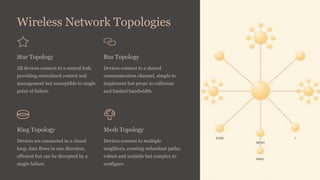
Star Topology
All devices connect to a central hub,
providing centralized control and
management but susceptible to single
point of failure.
Bus Topology
Devices connect to a shared
communication channel, simple to
implement but prone to collisions
and limited bandwidth.
Ring Topology
Devices are connected in a closed
loop, data flows in one direction,
efficient but can be disrupted by a
single failure.
Mesh Topology
Devices connect to multiple
neighbors, creating redundant paths,
robust and scalable but complex to
configure.
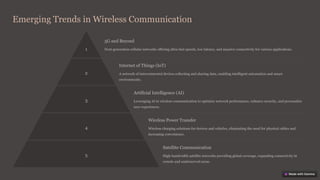
Emerging Trends in Wireless Communication
1
5G and Beyond
Next-generation cellular networks offering ultra-fast speeds, low latency, and massive connectivity for various applications.
2
Internet of Things (IoT)
A network of interconnected devices collecting and sharing data, enabling intelligent automation and smart
environments.
3
Artificial Intelligence (AI)
Leveraging AI in wireless communication to optimize network performance, enhance security, and personalize
user experiences.
4
Wireless Power Transfer
Wireless charging solutions for devices and vehicles, eliminating the need for physical cables and
increasing convenience.
5
Satellite Communication
High-bandwidth satellite networks providing global coverage, expanding connectivity in
remote and underserved areas.
Wireless Security Considerations
1
Authentication and Access Control
Ensuring that only authorized users can access the network, preventing unauthorized access and data breaches.
2
Data Encryption
Protecting sensitive information transmitted over the network using encryption algorithms to scramble data
and make it unreadable.
3
Firewall and Intrusion Detection
Implementing security measures to prevent unauthorized access and detect and block
malicious activity on the network.
4
Regular Updates and Patches
Staying updated with the latest security patches and updates to protect
against known vulnerabilities and emerging threats.
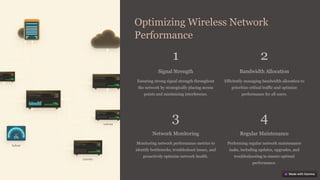
Optimizing Wireless Network
Performance
1
Signal Strength
Ensuring strong signal strength throughout
the network by strategically placing access
points and minimizing interference.
2
Bandwidth Allocation
Efficiently managing bandwidth allocation to
prioritize critical traffic and optimize
performance for all users.
3
Network Monitoring
Monitoring network performance metrics to
identify bottlenecks, troubleshoot issues, and
proactively optimize network health.
4
Regular Maintenance
Performing regular network maintenance
tasks, including updates, upgrades, and
troubleshooting to ensure optimal
performance.

Wireless-Communication-Shaping-the-Future (1).pptx

  • 1.
    Wireless Communication: Shaping theFuture Wireless communication has revolutionized the way we connect and interact with the world. From mobile phones to the Internet of Things, wireless technology is constantly evolving and expanding its reach. JA by Joe Adam
  • 2.
    Evolution of WirelessTechnology 1 Early wireless technologies, such as radio and television broadcasting, paved the way for modern wireless communication. 2 The advent of cellular networks in the 1980s revolutionized mobile communication, enabling voice calls and data transfer over vast distances. 3 The introduction of Wi-Fi in the 1990s brought wireless internet access to homes and businesses, significantly improving connectivity and convenience. 4 The development of advanced technologies like 5G and Wi-Fi 6 continues to push the boundaries of wireless communication, enabling faster speeds, greater capacity, and wider coverage.
  • 3.
    Fundamentals of WirelessSignals Electromagnetic Spectrum Wireless signals travel through the electromagnetic spectrum, a range of frequencies with varying characteristics. Frequency and Wavelength Wireless signals are characterized by their frequency, which determines the speed and wavelength of the signal. Modulation and Demodulation Modulation converts digital data into analog signals suitable for wireless transmission, while demodulation reverses the process. Signal Propagation Wireless signals propagate through the air, with their strength and range influenced by factors like distance, obstacles, and interference.
  • 4.
    Wireless Protocols andStandards IEEE 802.11 (Wi-Fi) The most popular wireless protocol for local area networks (LANs), enabling high-speed internet access in homes, businesses, and public spaces. Bluetooth A short-range wireless protocol used for connecting devices like smartphones, headsets, and smart home appliances. Cellular Standards (GSM, CDMA, LTE, 5G) Wireless protocols for mobile communication, enabling voice calls, data transfer, and mobile internet access. Zigbee and Z-Wave Low-power wireless protocols used in smart home applications for connecting sensors, actuators, and other devices.
  • 5.
    Wireless Network Topologies StarTopology All devices connect to a central hub, providing centralized control and management but susceptible to single point of failure. Bus Topology Devices connect to a shared communication channel, simple to implement but prone to collisions and limited bandwidth. Ring Topology Devices are connected in a closed loop, data flows in one direction, efficient but can be disrupted by a single failure. Mesh Topology Devices connect to multiple neighbors, creating redundant paths, robust and scalable but complex to configure.
  • 6.
    Emerging Trends inWireless Communication 1 5G and Beyond Next-generation cellular networks offering ultra-fast speeds, low latency, and massive connectivity for various applications. 2 Internet of Things (IoT) A network of interconnected devices collecting and sharing data, enabling intelligent automation and smart environments. 3 Artificial Intelligence (AI) Leveraging AI in wireless communication to optimize network performance, enhance security, and personalize user experiences. 4 Wireless Power Transfer Wireless charging solutions for devices and vehicles, eliminating the need for physical cables and increasing convenience. 5 Satellite Communication High-bandwidth satellite networks providing global coverage, expanding connectivity in remote and underserved areas.
  • 7.
    Wireless Security Considerations 1 Authenticationand Access Control Ensuring that only authorized users can access the network, preventing unauthorized access and data breaches. 2 Data Encryption Protecting sensitive information transmitted over the network using encryption algorithms to scramble data and make it unreadable. 3 Firewall and Intrusion Detection Implementing security measures to prevent unauthorized access and detect and block malicious activity on the network. 4 Regular Updates and Patches Staying updated with the latest security patches and updates to protect against known vulnerabilities and emerging threats.
  • 8.
    Optimizing Wireless Network Performance 1 SignalStrength Ensuring strong signal strength throughout the network by strategically placing access points and minimizing interference. 2 Bandwidth Allocation Efficiently managing bandwidth allocation to prioritize critical traffic and optimize performance for all users. 3 Network Monitoring Monitoring network performance metrics to identify bottlenecks, troubleshoot issues, and proactively optimize network health. 4 Regular Maintenance Performing regular network maintenance tasks, including updates, upgrades, and troubleshooting to ensure optimal performance.