Mobile robots in wireless sensor networks
Student: Perevechenkov V. V.
Group: РИ-370004
Project manager: Kiseleva M. V.
Teacher: Ponomareva E. V.
Yekaterinburg 2020
Rationale
Significant growth of
Wireless communications.
01
Robots can provide flexibility
with respect to the
installation of the network
sensors and allow active
information gathering.
03
Increased opportunities,
new challenges. How to
efficiently collect the
distributed sensory data.
02
Purpose
 To study current developments in the field of mobile robots and
wireless sensor networks and choose the most reliable methods
for implementing in real life tasks.
To find possibilities for reducing energy consumption for robots.
To research how to improve the wireless communication
performance.
To consider a way to solve the max flow problem.
01
02
03
Research questions
Message Queue Telemetry Transport
protocol
• Using TCP or UDP as upper layer protocols is not very good choice.
• MQTT is simple application layer protocol and not demanding for memory
and computing resources.
• The ability to manage the quality of service by implementing QoS. It allows
you to manage the way to deliver a message and confirmation of its
receipt.
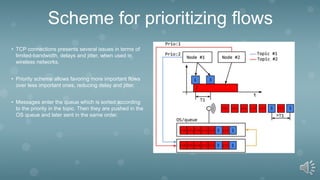
Scheme for prioritizing flows
• TCP connections presents several issues in terms of
limited-bandwidth, delays and jitter, when used in
wireless networks.
• Priority scheme allows favoring more important flows
over less important ones, reducing delay and jitter.
• Messages enter the queue which is sorted according
to the priority in the topic. Then they are pushed in the
OS queue and later sent in the same order.
Algorithm for solving max flow
problem
• Nodes with poor energy have bad effect on the data rate or
max flow. These nodes are called bottleneck nodes.
• Solution is to charge the bottlenode on each path to increase
the data rate.
• Algorithm deploys mobile chargers to paths, then searches
for bottlenodes and places it on the same set with
corresponding mobile charger that charges it.
Conclusion
• The MQTT protocol simplifies software development and the maintenance process.
• Flow prioritization is necessary for the reduction of jitter. Proposed system allows
favoring more important flows over less important ones.
• BottleNeck algorithm can effectively increase the max flow at sinks and
implemented to schedule mobile chargers.
References
• Energy harvesting algorithm considering max flow problem in wireless sensor networks.
https://www.sciencedirect.com/science/article/pii/S0140366419314938
• Pound: A ROS node for Reducing Delay and Jitter in Wireless Multi-Robot Networks.
https://www.sciencedirect.com/science/article/pii/S0921889017309144
• Wireless Network for Mobile Robot Applications
https://www.sciencedirect.com/science/article/pii/S2405896315027123
• Mobile robots in wireless sensor networks: A survey on tasks.
https://www.sciencedirect.com/science/article/pii/S138912861830255X
THANK YOU
for your attention

wireless sensor network and robotics technology

  • 1.
    Mobile robots inwireless sensor networks Student: Perevechenkov V. V. Group: РИ-370004 Project manager: Kiseleva M. V. Teacher: Ponomareva E. V. Yekaterinburg 2020
  • 2.
    Rationale Significant growth of Wirelesscommunications. 01 Robots can provide flexibility with respect to the installation of the network sensors and allow active information gathering. 03 Increased opportunities, new challenges. How to efficiently collect the distributed sensory data. 02
  • 3.
    Purpose  To studycurrent developments in the field of mobile robots and wireless sensor networks and choose the most reliable methods for implementing in real life tasks.
  • 4.
    To find possibilitiesfor reducing energy consumption for robots. To research how to improve the wireless communication performance. To consider a way to solve the max flow problem. 01 02 03 Research questions
  • 5.
    Message Queue TelemetryTransport protocol • Using TCP or UDP as upper layer protocols is not very good choice. • MQTT is simple application layer protocol and not demanding for memory and computing resources. • The ability to manage the quality of service by implementing QoS. It allows you to manage the way to deliver a message and confirmation of its receipt.
  • 6.
    Scheme for prioritizingflows • TCP connections presents several issues in terms of limited-bandwidth, delays and jitter, when used in wireless networks. • Priority scheme allows favoring more important flows over less important ones, reducing delay and jitter. • Messages enter the queue which is sorted according to the priority in the topic. Then they are pushed in the OS queue and later sent in the same order.
  • 7.
    Algorithm for solvingmax flow problem • Nodes with poor energy have bad effect on the data rate or max flow. These nodes are called bottleneck nodes. • Solution is to charge the bottlenode on each path to increase the data rate. • Algorithm deploys mobile chargers to paths, then searches for bottlenodes and places it on the same set with corresponding mobile charger that charges it.
  • 8.
    Conclusion • The MQTTprotocol simplifies software development and the maintenance process. • Flow prioritization is necessary for the reduction of jitter. Proposed system allows favoring more important flows over less important ones. • BottleNeck algorithm can effectively increase the max flow at sinks and implemented to schedule mobile chargers.
  • 9.
    References • Energy harvestingalgorithm considering max flow problem in wireless sensor networks. https://www.sciencedirect.com/science/article/pii/S0140366419314938 • Pound: A ROS node for Reducing Delay and Jitter in Wireless Multi-Robot Networks. https://www.sciencedirect.com/science/article/pii/S0921889017309144 • Wireless Network for Mobile Robot Applications https://www.sciencedirect.com/science/article/pii/S2405896315027123 • Mobile robots in wireless sensor networks: A survey on tasks. https://www.sciencedirect.com/science/article/pii/S138912861830255X
  • 10.