ICT for Disabled - What
we Academicians have
        to offer?


    Aniruddha Chandra
   ECE Department, NIT Durgapur
    aniruddha.chandra@ieee.org
IEI Durgapur
                                                                 May 17, 2008


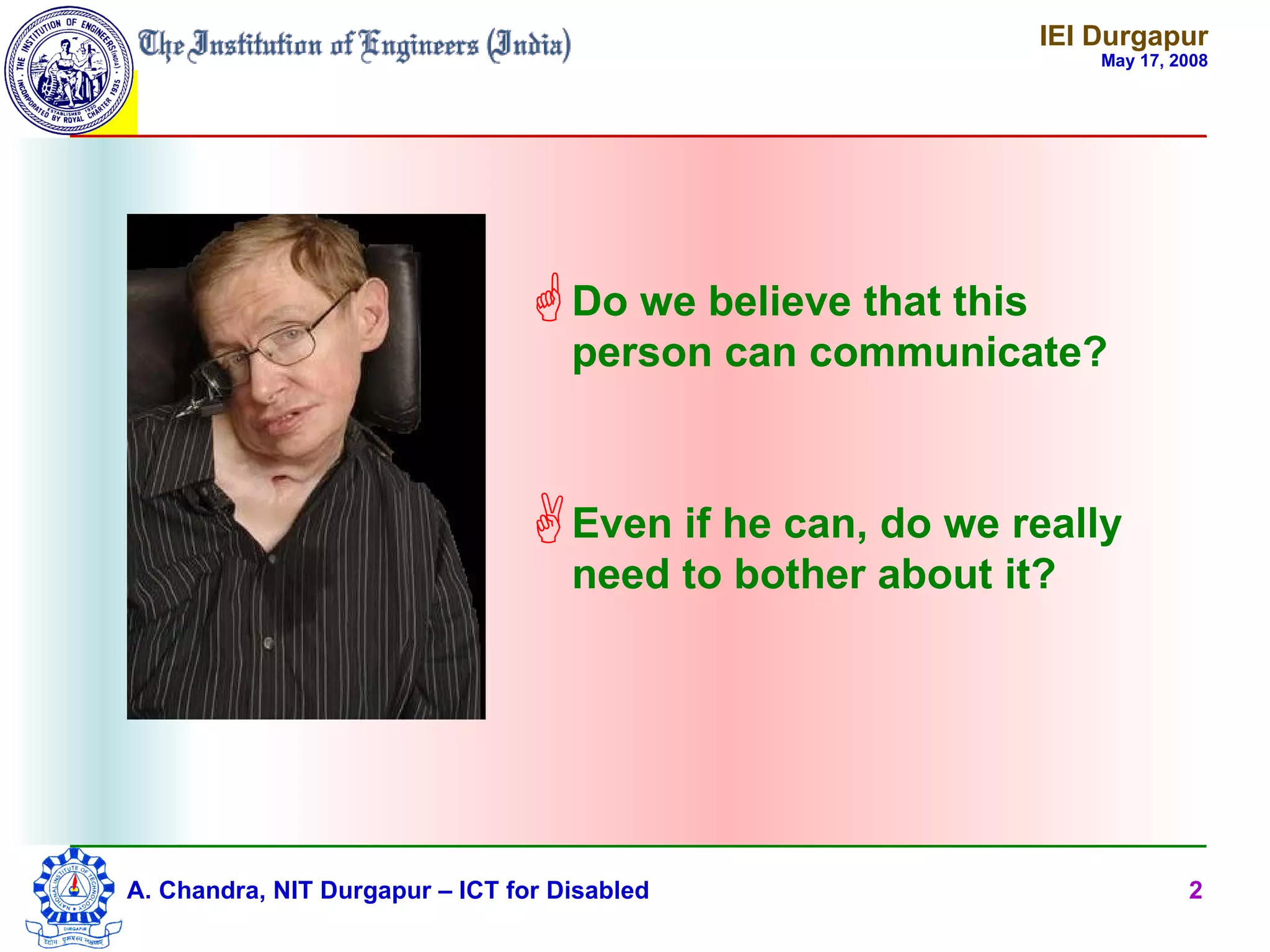
                                  Do we believe that this
                                    person can communicate?


                                  Even if he can, do we really
                                    need to bother about it?


A. Chandra, NIT Durgapur – ICT for Disabled                               2
IEI Durgapur
                                                                                  May 17, 2008


                                The answer is an emphatic
                                                  “YES”

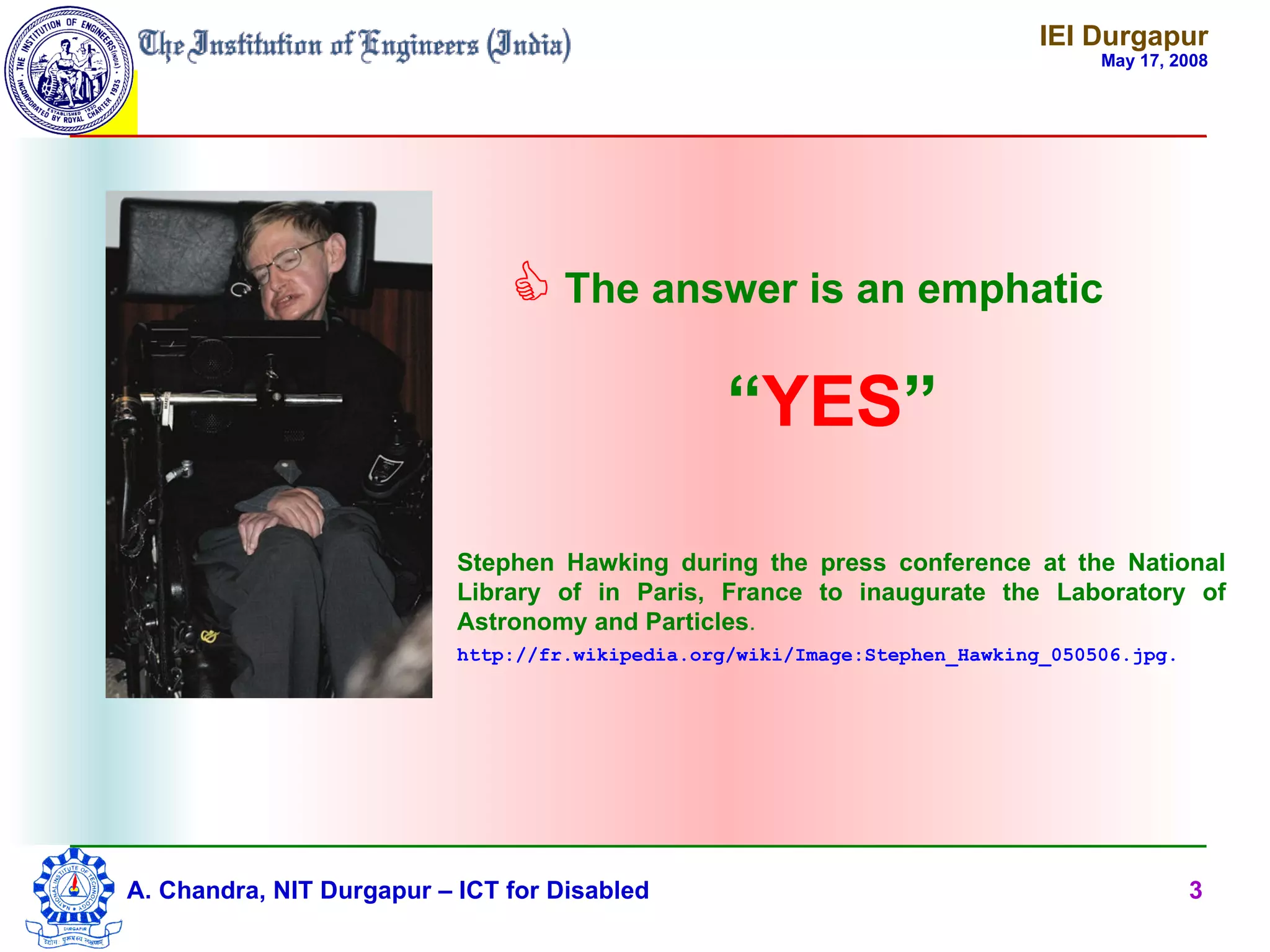
                           Stephen Hawking during the press conference at the National
                           Library of in Paris, France to inaugurate the Laboratory of
                           Astronomy and Particles.
                           http://fr.wikipedia.org/wiki/Image:Stephen_Hawking_050506.jpg.


A. Chandra, NIT Durgapur – ICT for Disabled                                                 3
IEI Durgapur
                                                                                           May 17, 2008


Professor Hawking suffers from Amyotrophic Lateral Sclerosis (ALS) which is a kind of Motor
Neurone Disease (MND). He can’t speak, get off from bed, have difficulties in swallowing and
even breathing.

Yet he has written two bestsellers, dozens of scientific papers, gave numerous lectures.


                                         HOW?
With the help of some software developed by Walt Woltosz of
Simulations Plus Inc., he can select words from a series of
menus on the screen, by pressing a switch. The program
could also be controlled by a switch, operated by head or eye
movement.

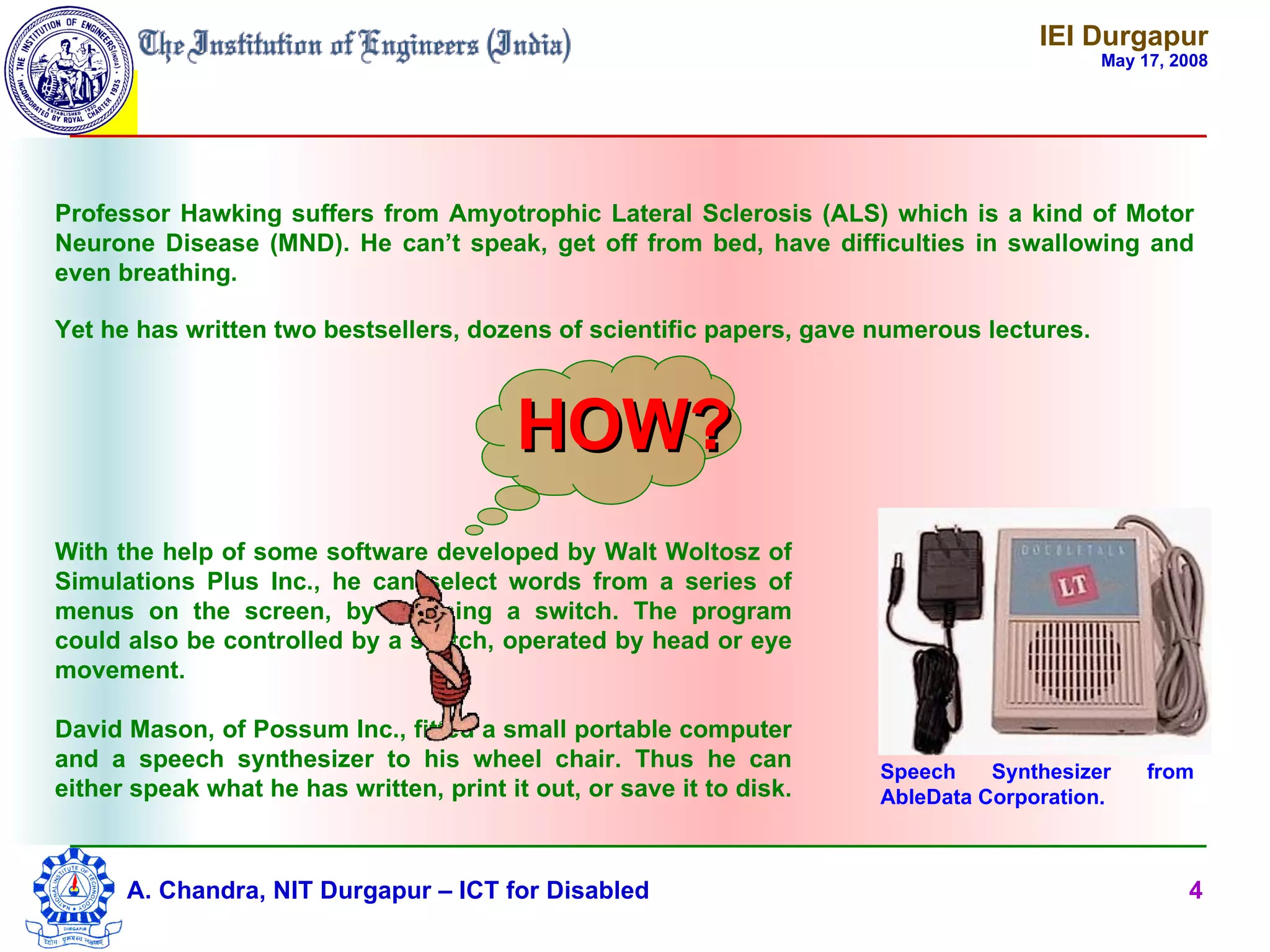
David Mason, of Possum Inc., fitted a small portable computer
and a speech synthesizer to his wheel chair. Thus he can              Speech    Synthesizer     from
either speak what he has written, print it out, or save it to disk.   AbleData Corporation.


      A. Chandra, NIT Durgapur – ICT for Disabled                                                   4
IEI Durgapur
                                                     May 17, 2008


 We have seen how practicing engineers helped an
academician.


                                   NOW
 Let us see how we academicians can reciprocate.


   A. Chandra, NIT Durgapur – ICT for Disabled                5
IEI Durgapur
                                                                                       May 17, 2008


Case Study I
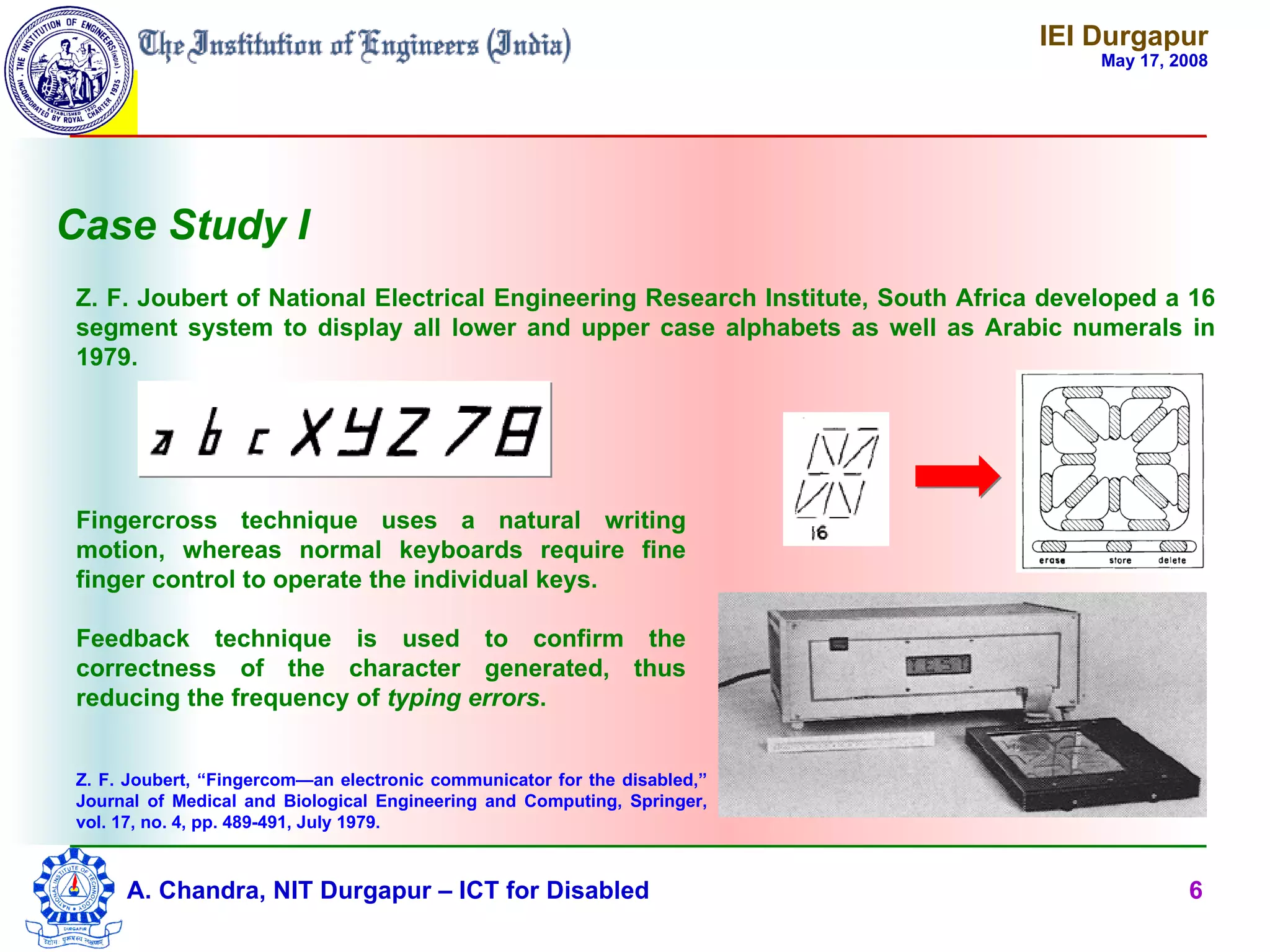
 Z. F. Joubert of National Electrical Engineering Research Institute, South Africa developed a 16
 segment system to display all lower and upper case alphabets as well as Arabic numerals in
 1979.


 Fingercross technique uses a natural writing
 motion, whereas normal keyboards require fine
 finger control to operate the individual keys.

 Feedback technique is used to confirm the
 correctness of the character generated, thus
 reducing the frequency of typing errors.


 Z. F. Joubert, “Fingercom—an electronic communicator for the disabled,”
 Journal of Medical and Biological Engineering and Computing, Springer,
 vol. 17, no. 4, pp. 489-491, July 1979.


      A. Chandra, NIT Durgapur – ICT for Disabled                                               6
IEI Durgapur
                                                                                      May 17, 2008


Case Study II
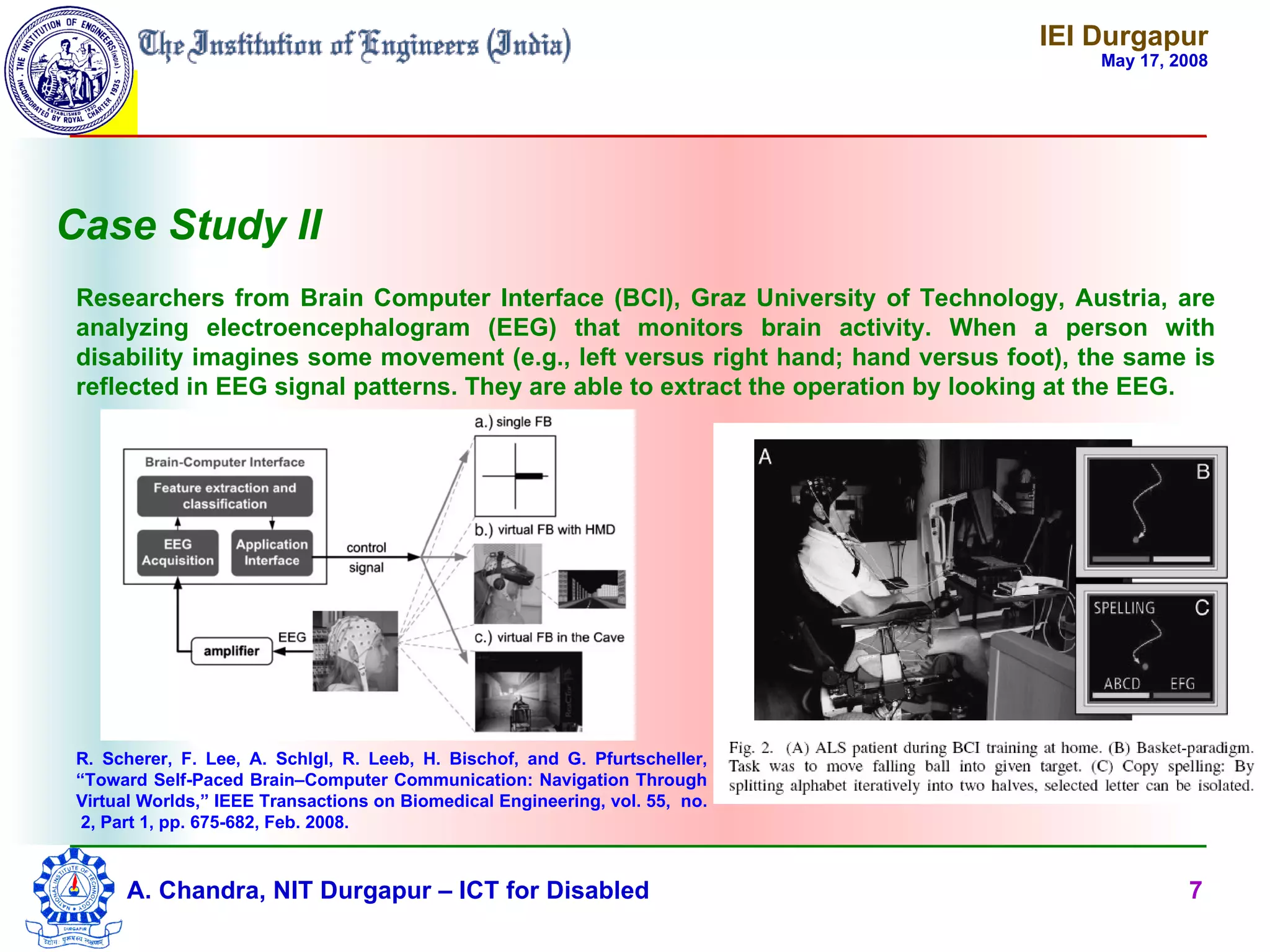
 Researchers from Brain Computer Interface (BCI), Graz University of Technology, Austria, are
 analyzing electroencephalogram (EEG) that monitors brain activity. When a person with
 disability imagines some movement (e.g., left versus right hand; hand versus foot), the same is
 reflected in EEG signal patterns. They are able to extract the operation by looking at the EEG.


 R. Scherer, F. Lee, A. Schlgl, R. Leeb, H. Bischof, and G. Pfurtscheller,
 “Toward Self-Paced Brain–Computer Communication: Navigation Through
 Virtual Worlds,” IEEE Transactions on Biomedical Engineering, vol. 55, no.
  2, Part 1, pp. 675-682, Feb. 2008.


      A. Chandra, NIT Durgapur – ICT for Disabled                                              7
IEI Durgapur
                                                     May 17, 2008


 Sounds Big, Costly, Complex, and Sophisticated.
 Possible in first-world developed countries.

                                         SO
 Let us see what is going on in our own country.


   A. Chandra, NIT Durgapur – ICT for Disabled                8
IEI Durgapur
                                                                                         May 17, 2008


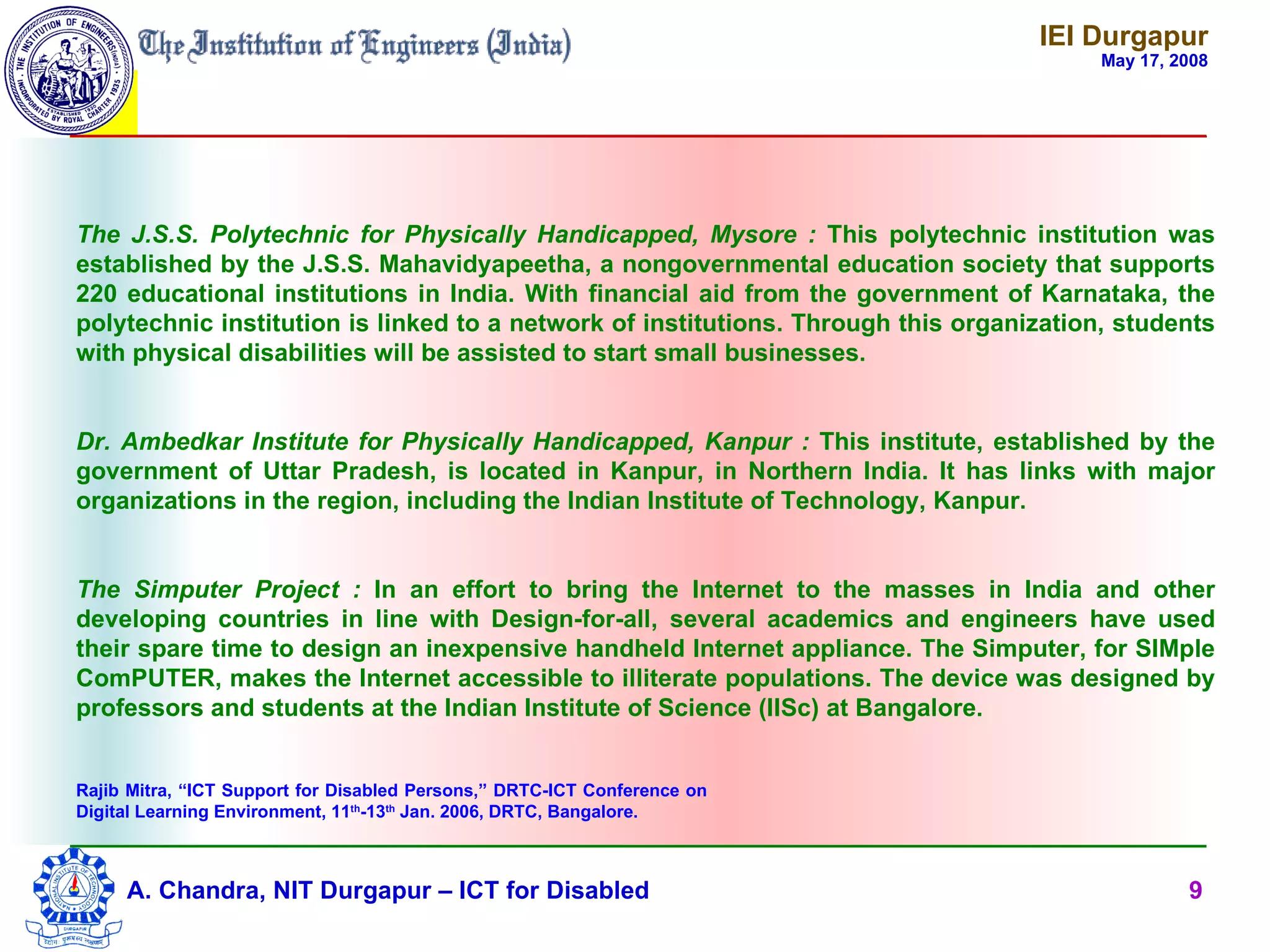
The J.S.S. Polytechnic for Physically Handicapped, Mysore : This polytechnic institution was
established by the J.S.S. Mahavidyapeetha, a nongovernmental education society that supports
220 educational institutions in India. With financial aid from the government of Karnataka, the
polytechnic institution is linked to a network of institutions. Through this organization, students
with physical disabilities will be assisted to start small businesses.


Dr. Ambedkar Institute for Physically Handicapped, Kanpur : This institute, established by the
government of Uttar Pradesh, is located in Kanpur, in Northern India. It has links with major
organizations in the region, including the Indian Institute of Technology, Kanpur.


The Simputer Project : In an effort to bring the Internet to the masses in India and other
developing countries in line with Design-for-all, several academics and engineers have used
their spare time to design an inexpensive handheld Internet appliance. The Simputer, for SIMple
ComPUTER, makes the Internet accessible to illiterate populations. The device was designed by
professors and students at the Indian Institute of Science (IISc) at Bangalore.


Rajib Mitra, “ICT Support for Disabled Persons,” DRTC-ICT Conference on
Digital Learning Environment, 11th-13th Jan. 2006, DRTC, Bangalore.


     A. Chandra, NIT Durgapur – ICT for Disabled                                                  9
IEI Durgapur
                                                                                     May 17, 2008


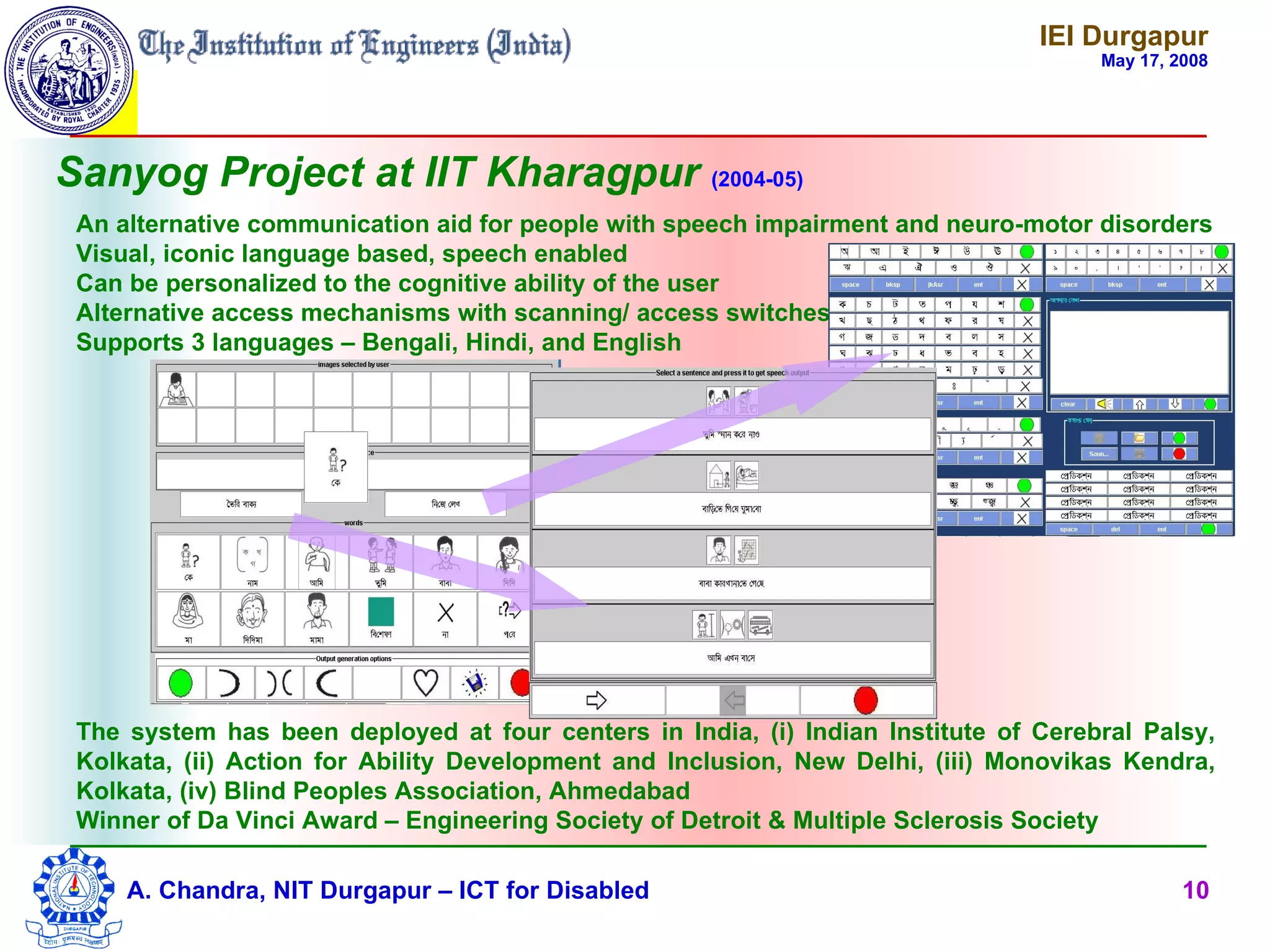
Sanyog Project at IIT Kharagpur (2004-05)
 An alternative communication aid for people with speech impairment and neuro-motor disorders
 Visual, iconic language based, speech enabled
 Can be personalized to the cognitive ability of the user
 Alternative access mechanisms with scanning/ access switches
 Supports 3 languages – Bengali, Hindi, and English


 The system has been deployed at four centers in India, (i) Indian Institute of Cerebral Palsy,
 Kolkata, (ii) Action for Ability Development and Inclusion, New Delhi, (iii) Monovikas Kendra,
 Kolkata, (iv) Blind Peoples Association, Ahmedabad
 Winner of Da Vinci Award – Engineering Society of Detroit & Multiple Sclerosis Society

     A. Chandra, NIT Durgapur – ICT for Disabled                                              10
IEI Durgapur
                                                                                         May 17, 2008


IIT Kanpur & University of Ulster (U.K.) Collaboration
(Nov. 2007)

  SCIENTISTS from the University of Ulster and the Indian Institute of Technology in Kanpur have
  teamed up to investigate how to develop intelligent low-cost assistive robotic devices that could
  help people suffering from neuro-muscular disabilities such as motor neurone disease (MND)
  and spinal cord injury (SCI), achieve greater independence by providing means of
  communicating with the external world .

  The three-year £145,000 project funded by the UK-India Education and Research Initiative
  (UKIERI) has the following three main objectives:

   A brain-computer interface (BCI) that allows a disabled person to control a smart wheelchair
    and robotic manipulator combination by thinking.
   A visual tracking system for operating the wheelchair as an automated guided vehicle (AGV)
    to provide mobility.
   The development of a robotic arm for the natural execution of actions desired by the disabled
    user.


      A. Chandra, NIT Durgapur – ICT for Disabled                                                 11
IEI Durgapur
                                                                                        May 17, 2008


.... and the Saga continues
 IIIT, Hyderabad: International Institute of Information Technology, Hyderabad in association with
 National Association for the Blind (NAB) has released a screen reading software for Hindi and is
 developing an OCR for Indian scripts and languages.

 Vidya Vrikshah: A Chennai based organization which promotes the multi-lingual IITM software
 developed by Professor R. Kalyanakrishnan and his students at Indian Institute of Technology,
 Chennai.


     A. Chandra, NIT Durgapur – ICT for Disabled                                                 12
IEI Durgapur
                                                                  May 17, 2008


         Thank You!for patient hearing in a weekend evening


A. Chandra, NIT Durgapur – ICT for Disabled                                13

Information & Communication Technology for disabled

  • 1.
    ICT for Disabled- What we Academicians have to offer? Aniruddha Chandra ECE Department, NIT Durgapur aniruddha.chandra@ieee.org
  • 2.
    IEI Durgapur May 17, 2008  Do we believe that this person can communicate?  Even if he can, do we really need to bother about it? A. Chandra, NIT Durgapur – ICT for Disabled 2
  • 3.
    IEI Durgapur May 17, 2008  The answer is an emphatic “YES” Stephen Hawking during the press conference at the National Library of in Paris, France to inaugurate the Laboratory of Astronomy and Particles. http://fr.wikipedia.org/wiki/Image:Stephen_Hawking_050506.jpg. A. Chandra, NIT Durgapur – ICT for Disabled 3
  • 4.
    IEI Durgapur May 17, 2008 Professor Hawking suffers from Amyotrophic Lateral Sclerosis (ALS) which is a kind of Motor Neurone Disease (MND). He can’t speak, get off from bed, have difficulties in swallowing and even breathing. Yet he has written two bestsellers, dozens of scientific papers, gave numerous lectures. HOW? With the help of some software developed by Walt Woltosz of Simulations Plus Inc., he can select words from a series of menus on the screen, by pressing a switch. The program could also be controlled by a switch, operated by head or eye movement. David Mason, of Possum Inc., fitted a small portable computer and a speech synthesizer to his wheel chair. Thus he can Speech Synthesizer from either speak what he has written, print it out, or save it to disk. AbleData Corporation. A. Chandra, NIT Durgapur – ICT for Disabled 4
  • 5.
    IEI Durgapur May 17, 2008  We have seen how practicing engineers helped an academician. NOW  Let us see how we academicians can reciprocate. A. Chandra, NIT Durgapur – ICT for Disabled 5
  • 6.
    IEI Durgapur May 17, 2008 Case Study I Z. F. Joubert of National Electrical Engineering Research Institute, South Africa developed a 16 segment system to display all lower and upper case alphabets as well as Arabic numerals in 1979. Fingercross technique uses a natural writing motion, whereas normal keyboards require fine finger control to operate the individual keys. Feedback technique is used to confirm the correctness of the character generated, thus reducing the frequency of typing errors. Z. F. Joubert, “Fingercom—an electronic communicator for the disabled,” Journal of Medical and Biological Engineering and Computing, Springer, vol. 17, no. 4, pp. 489-491, July 1979. A. Chandra, NIT Durgapur – ICT for Disabled 6
  • 7.
    IEI Durgapur May 17, 2008 Case Study II Researchers from Brain Computer Interface (BCI), Graz University of Technology, Austria, are analyzing electroencephalogram (EEG) that monitors brain activity. When a person with disability imagines some movement (e.g., left versus right hand; hand versus foot), the same is reflected in EEG signal patterns. They are able to extract the operation by looking at the EEG. R. Scherer, F. Lee, A. Schlgl, R. Leeb, H. Bischof, and G. Pfurtscheller, “Toward Self-Paced Brain–Computer Communication: Navigation Through Virtual Worlds,” IEEE Transactions on Biomedical Engineering, vol. 55, no. 2, Part 1, pp. 675-682, Feb. 2008. A. Chandra, NIT Durgapur – ICT for Disabled 7
  • 8.
    IEI Durgapur May 17, 2008  Sounds Big, Costly, Complex, and Sophisticated.  Possible in first-world developed countries. SO  Let us see what is going on in our own country. A. Chandra, NIT Durgapur – ICT for Disabled 8
  • 9.
    IEI Durgapur May 17, 2008 The J.S.S. Polytechnic for Physically Handicapped, Mysore : This polytechnic institution was established by the J.S.S. Mahavidyapeetha, a nongovernmental education society that supports 220 educational institutions in India. With financial aid from the government of Karnataka, the polytechnic institution is linked to a network of institutions. Through this organization, students with physical disabilities will be assisted to start small businesses. Dr. Ambedkar Institute for Physically Handicapped, Kanpur : This institute, established by the government of Uttar Pradesh, is located in Kanpur, in Northern India. It has links with major organizations in the region, including the Indian Institute of Technology, Kanpur. The Simputer Project : In an effort to bring the Internet to the masses in India and other developing countries in line with Design-for-all, several academics and engineers have used their spare time to design an inexpensive handheld Internet appliance. The Simputer, for SIMple ComPUTER, makes the Internet accessible to illiterate populations. The device was designed by professors and students at the Indian Institute of Science (IISc) at Bangalore. Rajib Mitra, “ICT Support for Disabled Persons,” DRTC-ICT Conference on Digital Learning Environment, 11th-13th Jan. 2006, DRTC, Bangalore. A. Chandra, NIT Durgapur – ICT for Disabled 9
  • 10.
    IEI Durgapur May 17, 2008 Sanyog Project at IIT Kharagpur (2004-05) An alternative communication aid for people with speech impairment and neuro-motor disorders Visual, iconic language based, speech enabled Can be personalized to the cognitive ability of the user Alternative access mechanisms with scanning/ access switches Supports 3 languages – Bengali, Hindi, and English The system has been deployed at four centers in India, (i) Indian Institute of Cerebral Palsy, Kolkata, (ii) Action for Ability Development and Inclusion, New Delhi, (iii) Monovikas Kendra, Kolkata, (iv) Blind Peoples Association, Ahmedabad Winner of Da Vinci Award – Engineering Society of Detroit & Multiple Sclerosis Society A. Chandra, NIT Durgapur – ICT for Disabled 10
  • 11.
    IEI Durgapur May 17, 2008 IIT Kanpur & University of Ulster (U.K.) Collaboration (Nov. 2007) SCIENTISTS from the University of Ulster and the Indian Institute of Technology in Kanpur have teamed up to investigate how to develop intelligent low-cost assistive robotic devices that could help people suffering from neuro-muscular disabilities such as motor neurone disease (MND) and spinal cord injury (SCI), achieve greater independence by providing means of communicating with the external world . The three-year £145,000 project funded by the UK-India Education and Research Initiative (UKIERI) has the following three main objectives:  A brain-computer interface (BCI) that allows a disabled person to control a smart wheelchair and robotic manipulator combination by thinking.  A visual tracking system for operating the wheelchair as an automated guided vehicle (AGV) to provide mobility.  The development of a robotic arm for the natural execution of actions desired by the disabled user. A. Chandra, NIT Durgapur – ICT for Disabled 11
  • 12.
    IEI Durgapur May 17, 2008 .... and the Saga continues IIIT, Hyderabad: International Institute of Information Technology, Hyderabad in association with National Association for the Blind (NAB) has released a screen reading software for Hindi and is developing an OCR for Indian scripts and languages. Vidya Vrikshah: A Chennai based organization which promotes the multi-lingual IITM software developed by Professor R. Kalyanakrishnan and his students at Indian Institute of Technology, Chennai. A. Chandra, NIT Durgapur – ICT for Disabled 12
  • 13.
    IEI Durgapur May 17, 2008 Thank You!for patient hearing in a weekend evening A. Chandra, NIT Durgapur – ICT for Disabled 13