1st and 2ndGeneration Cellular Systems Overview
U101 UMTS Network Systems
Overview
1
1st and 2nd Generation Cellular Systems
Overview
2.
Contents and SessionAims
1st and 2nd Generation Cellular Systems Overview
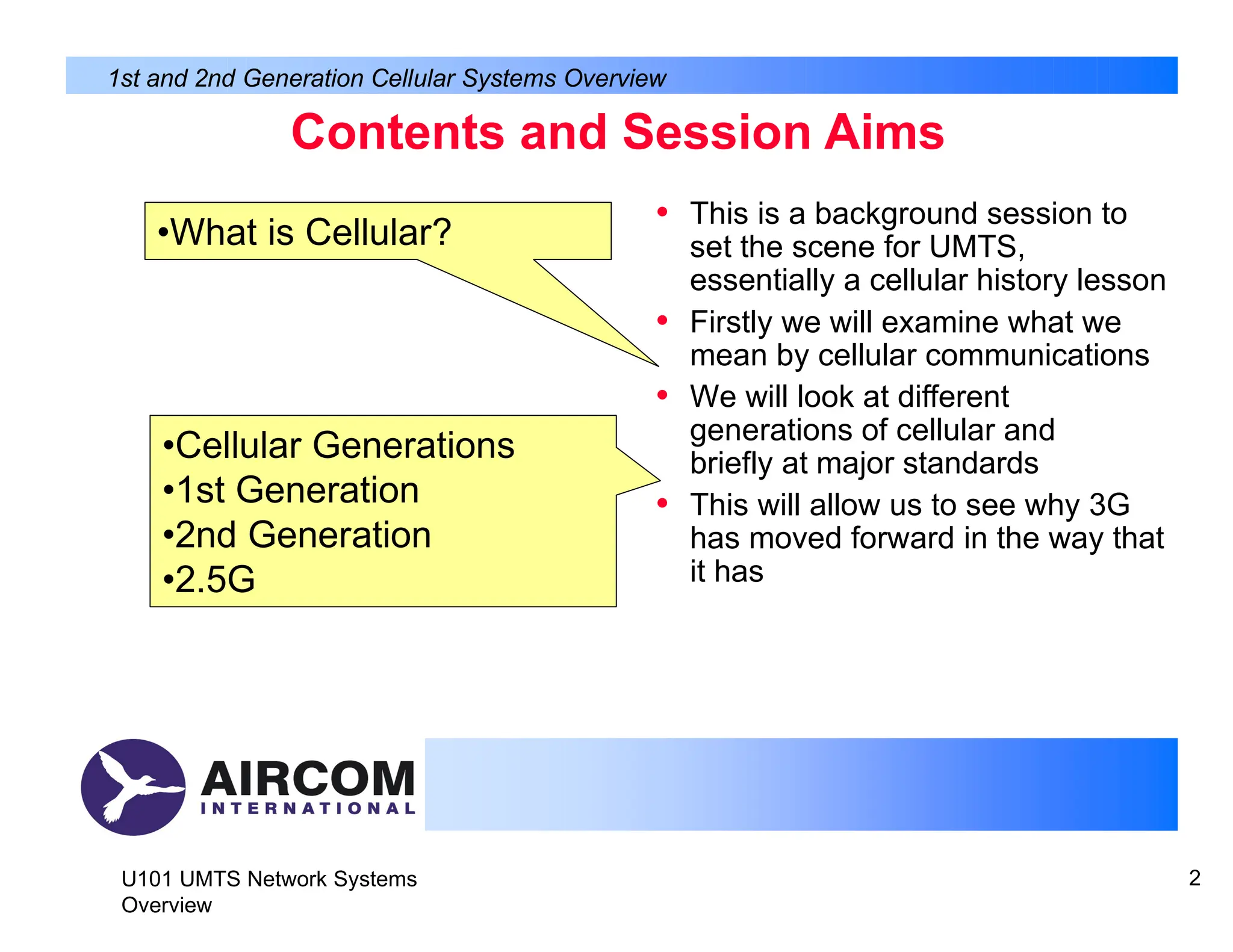
• This is a background session to
set the scene for UMTS,
essentially a cellular history lesson
• Firstly we will examine what we
mean by cellular communications
• We will look at different
generations of cellular and
briefly at major standards
• This will allow us to see why 3G
has moved forward in the way that
it has
•What is Cellular?
•Cellular Generations
•1st Generation
•2nd Generation
•2.5G
U101 UMTS Network Systems
Overview
2
3.
What is Cellular?
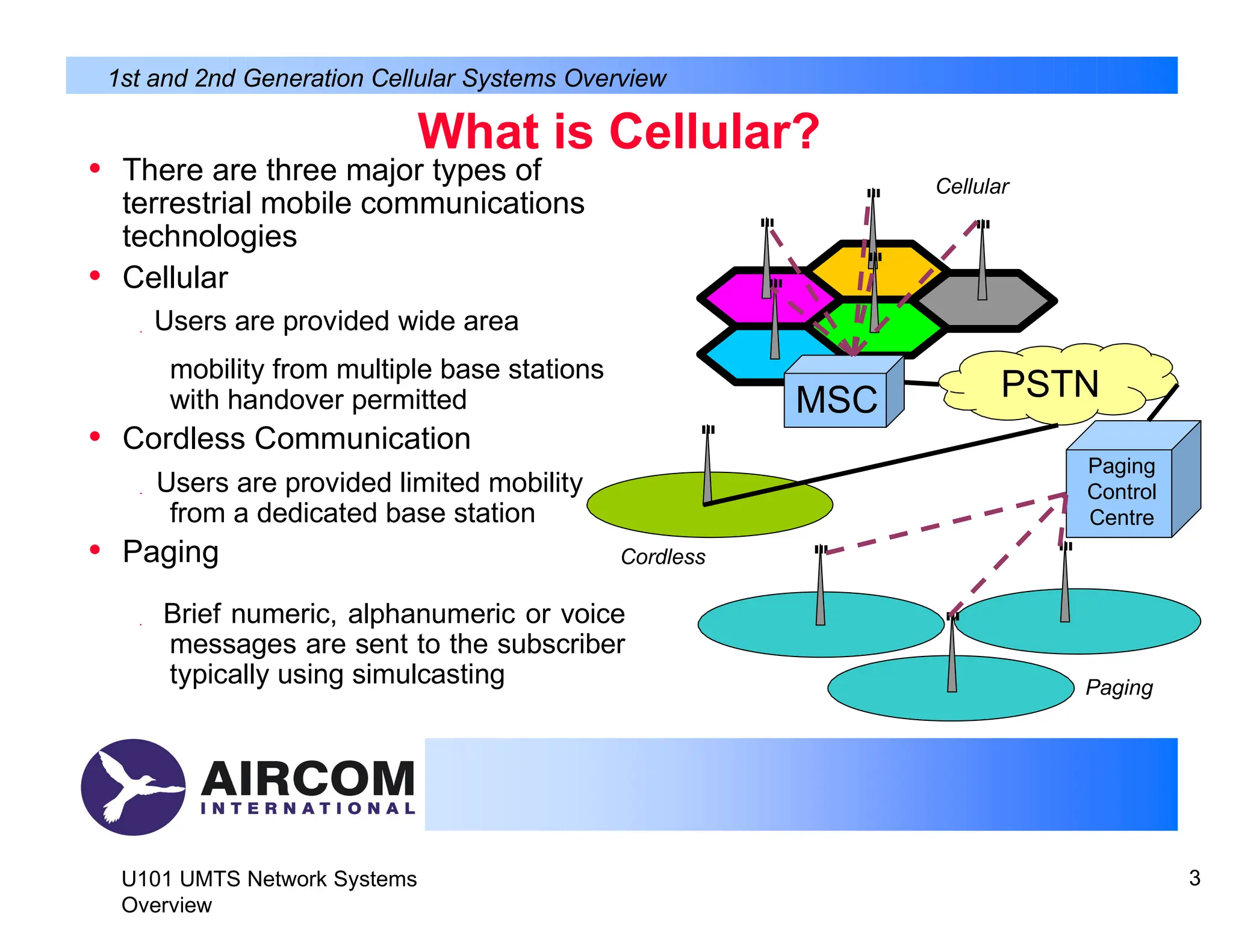
•There are three major types of
terrestrial mobile communications
technologies
• Cellular
Users are provided wide area
mobility from multiple base stations
with handover permitted
• Cordless Communication
Users are provided limited mobility
from a dedicated base station
• Paging
Brief numeric, alphanumeric or voice
messages are sent to the subscriber
typically using simulcasting
1st and 2nd Generation Cellular Systems Overview
PSTN
MSC
Paging
Control
Centre
Cellular
U101 UMTS Network Systems
Overview
3
Cordless
Paging
4.
Cellular Generations
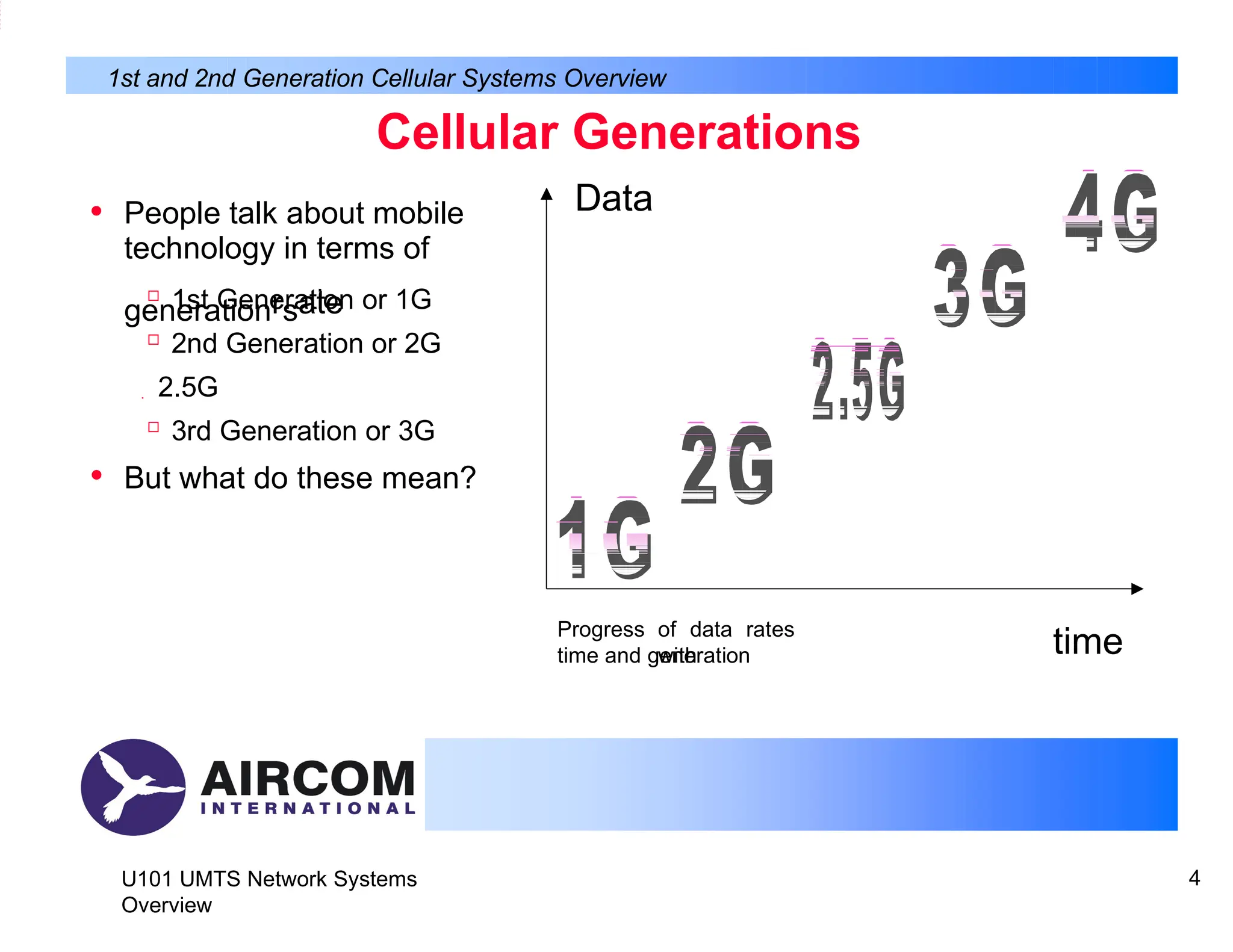
• Peopletalk about mobile
technology in terms of
generationrsate
U101 UMTS Network Systems
Overview
4
1st Generation or 1G
2nd Generation or 2G
2.5G
3rd Generation or 3G
But what do these mean?
•
1st and 2nd Generation Cellular Systems Overview
time
Data
Progress of data rates
with
time and generation
5.
1st Generation
• 1976+,though really the
technology of the 1980’s
• Analogue modulation
• Frequency Division
Multiple Access
• Voice traffic only
• No inter-network roaming
possible
• Insecure air interface
1st and 2nd Generation Cellular Systems Overview
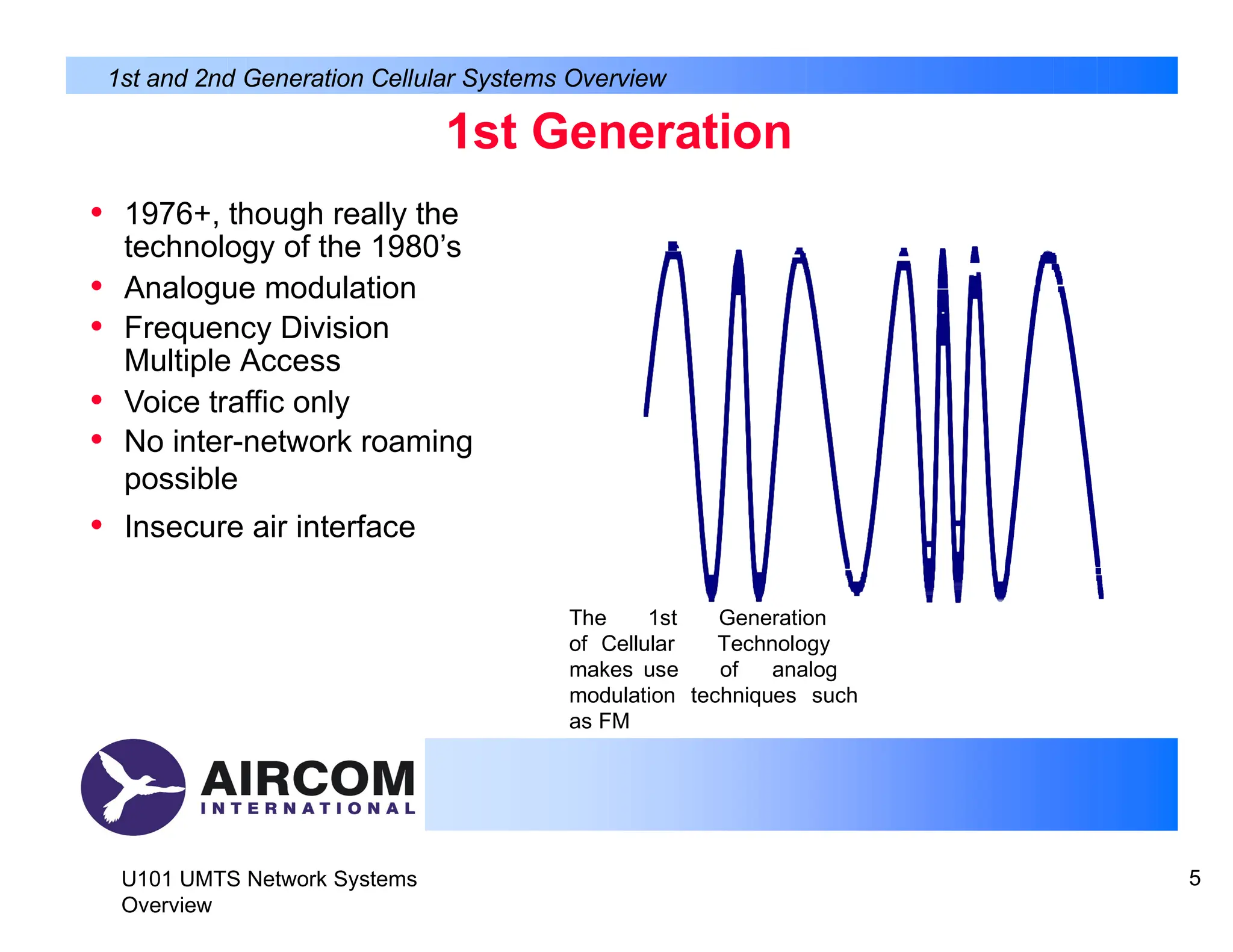
The 1st Generation
of Cellular Technology
makes use of analog
modulation techniques such
as FM
U101 UMTS Network Systems
Overview
5
6.
1st Generation Standards
U101UMTS Network Systems
Overview
6
• AMPS (Analogue Mobile Telephony System)
North American Standard in cellular band (800MHz)
• TACS (Total Access Communications System)
UK originated Standard based on AMPS in 900MHz band
• NMT (Nordic Mobile Telephony System)
Scandinavian Standard in 450MHz and 900MHz bands
• C-450
German Standard in 450MHz band
• JTACS (Japanese Total Access Communications System)
Japanese Standard in 900MHz band
1st and 2nd Generation Cellular Systems Overview
7.
1st Generation Planning
•Macrocellular
High sites for coverage driven
planning
Antennas above roof height
• Frequency planning required
• Large cell size
Order 30km
• Hard handover
Only ever connected to a single
cell
1st and 2nd Generation Cellular Systems Overview
U101 UMTS Network Systems
Overview
7
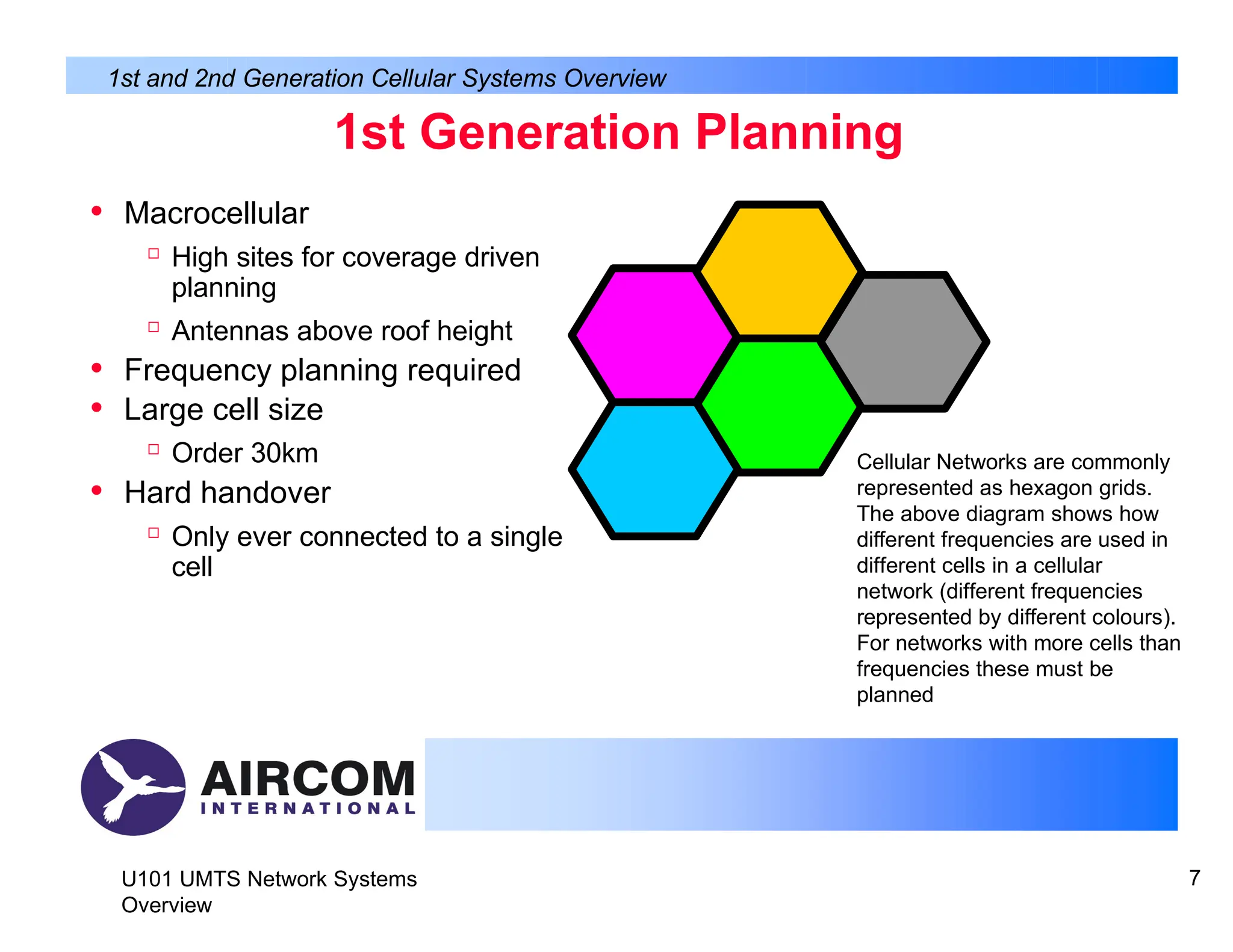
Cellular Networks are commonly
represented as hexagon grids.
The above diagram shows how
different frequencies are used in
different cells in a cellular
network (different frequencies
represented by different colours).
For networks with more cells than
frequencies these must be
planned
8.
2nd Generation
U101 UMTSNetwork Systems
Overview
8
• 1990’s
• Digital modulation
• Variety of Multiple Access
strategies
• Voice and low rate circuit switched
data
• Same technology roaming
• Secure air interface
1st and 2nd Generation Cellular Systems Overview
000110100110
1
1
1
0
0
1
0
0
1
1
1
1
0
0
0
0010010111100
1111000101100000100100
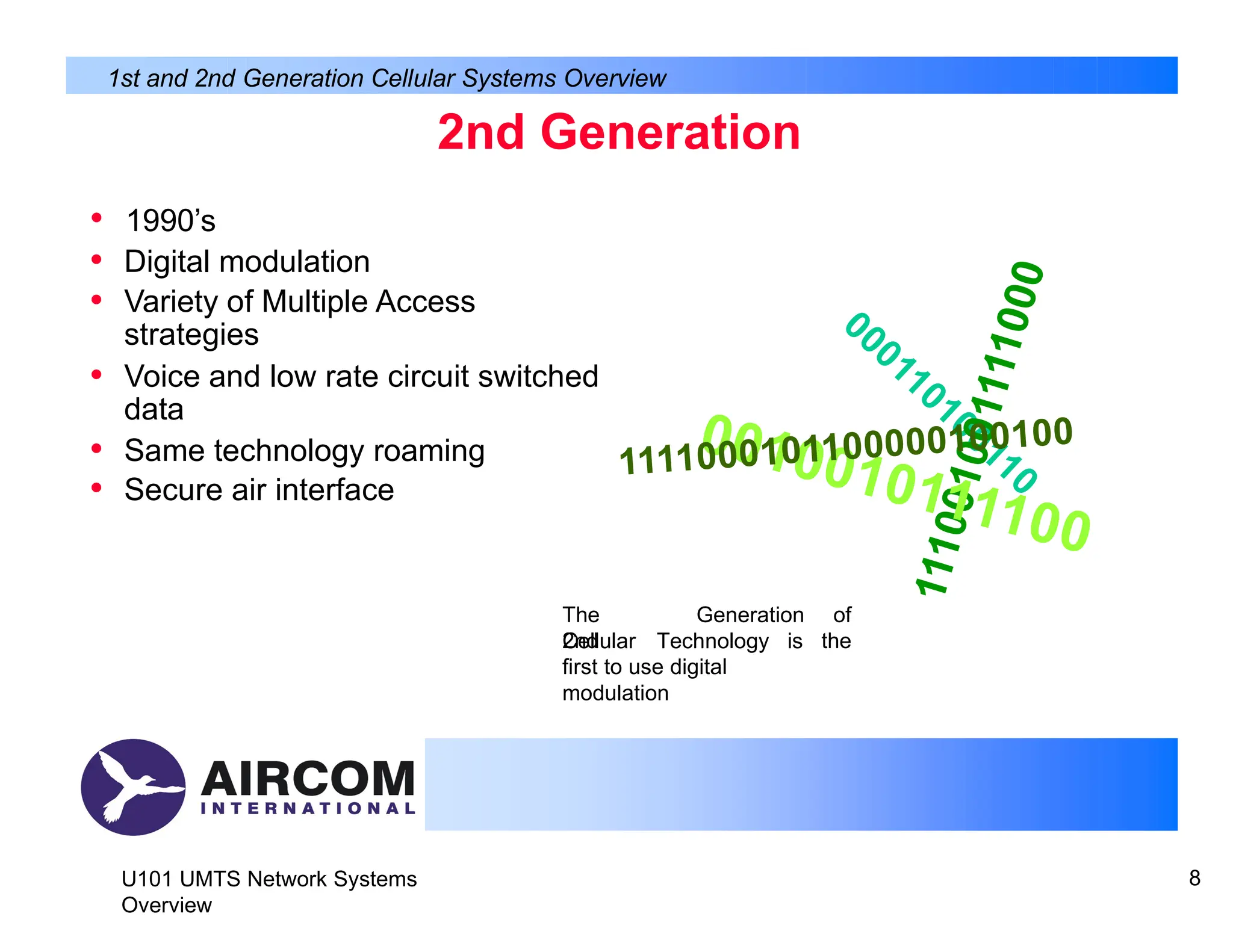
The
2nd
Generation of
the
Cellular Technology is
first to use digital
modulation
9.
1st and 2ndGeneration Cellular Systems Overview
GSM
• First networks in 1992
• European developed standard, but
with worldwide subscriber base
• Different frequency bands
GSM450, GSM900, GSM1800,
GSM1900
• Largest 2nd Generation subscriber
base
• Frequency/Time Division Multiple
Access
• Open/Standardised Interfaces
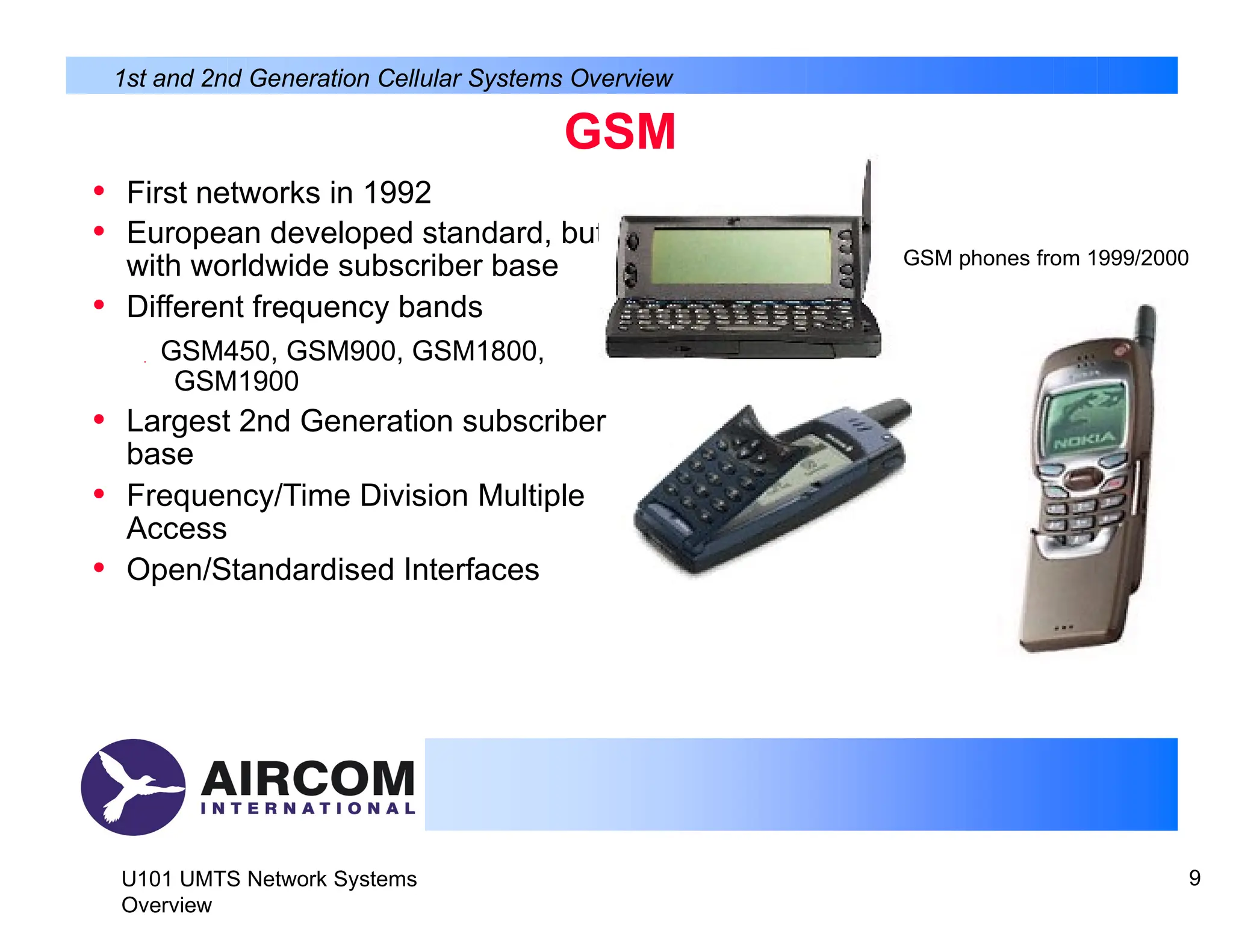
GSM phones from 1999/2000
U101 UMTS Network Systems
Overview
9
10.
GSM Planning
• Macrocellsand microcells
Capacity driven planning
• Frequency planning required
• Optional parameters
requiring planning
Hierarchical Cell Structures
Frequency Hopping
Discontinuous Transmission
Power Control
• Simple subscriber/traffic
analysis
Capacity limited by number of
TRX’s
• Hard Handover
1st and 2nd Generation Cellular Systems Overview
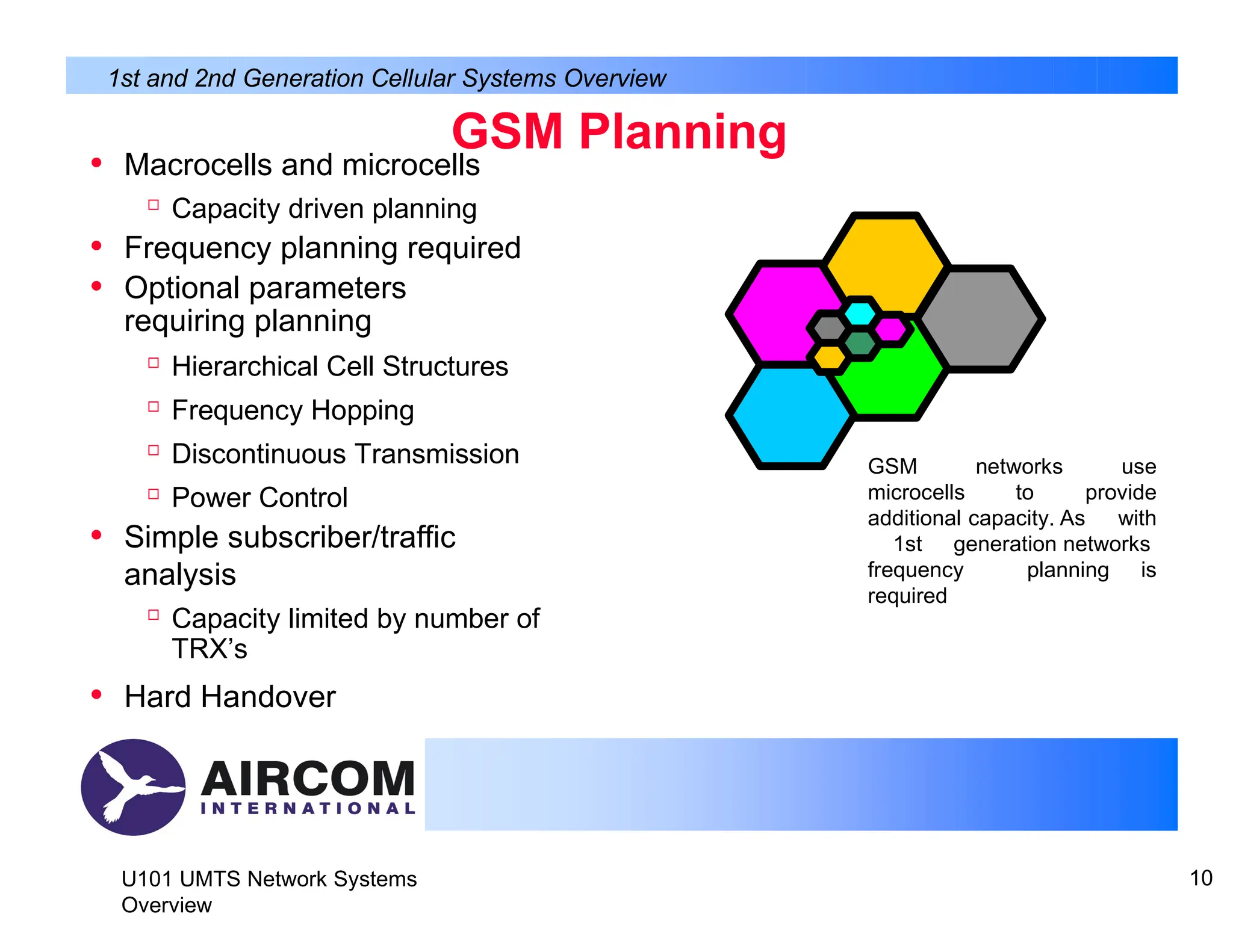
GSM networks use
microcells to provide
additional capacity. As with
1st generation networks
frequency planning is
required
U101 UMTS Network Systems
Overview
10
11.
D-AMPS/PDC
• TDMA (D-AMPS)
NorthAmerican TDMA/FDMA
based standard based upon AMPS
Predominantly used in North and
South America
ANSI-41 Core Network
Planning Similar to GSM
• PDC
Japanese TDMA/FDMA based
standard
Predominantly used in Asia
Planning Similar to GSM
1st and 2nd Generation Cellular Systems Overview
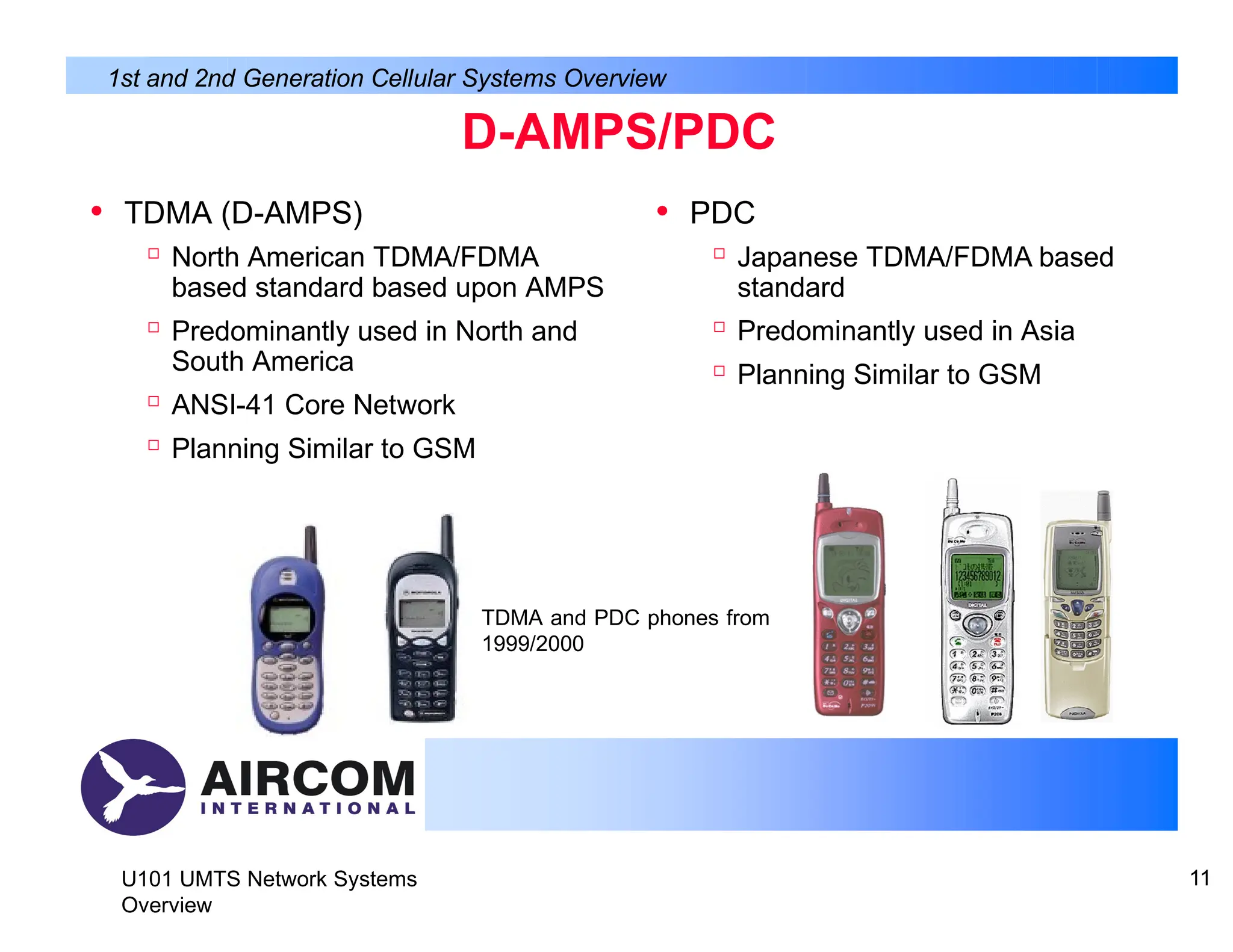
TDMA and PDC phones from
1999/2000
U101 UMTS Network Systems
Overview
11
12.
cdmaOne
• First networksin 1996
• Derived from Qualcomm IS-95
air interface
• Largely American subscriber
base with some Asian networks
• Code Division Multiple Access
This is in many ways the closest
2nd generation standard to many
of the 3rd generation standards
• ANSI-41 core network
• Chip rate of 1.2288Mcps
1st and 2nd Generation Cellular Systems Overview
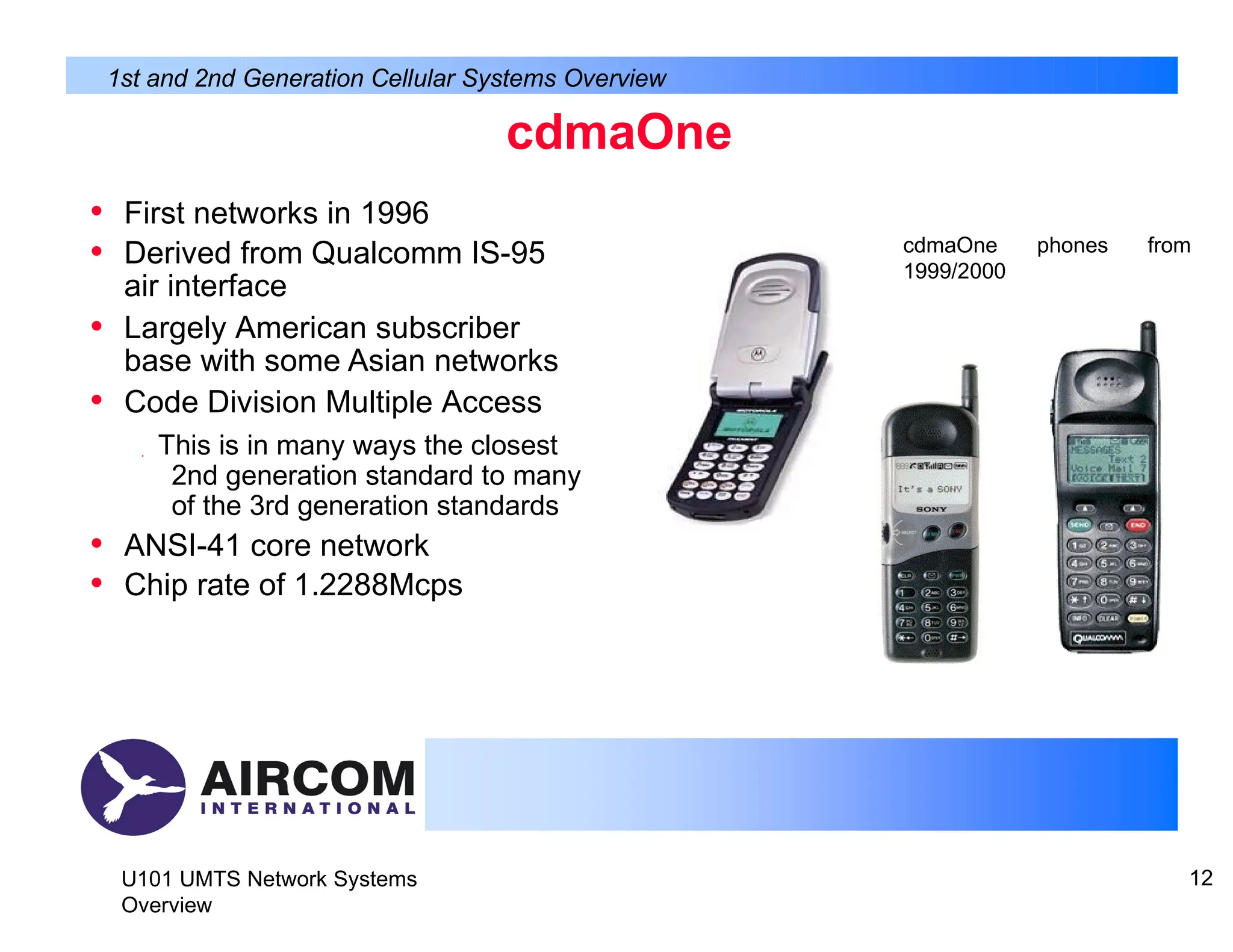
cdmaOne
1999/2000
phones from
U101 UMTS Network Systems
Overview
12
13.
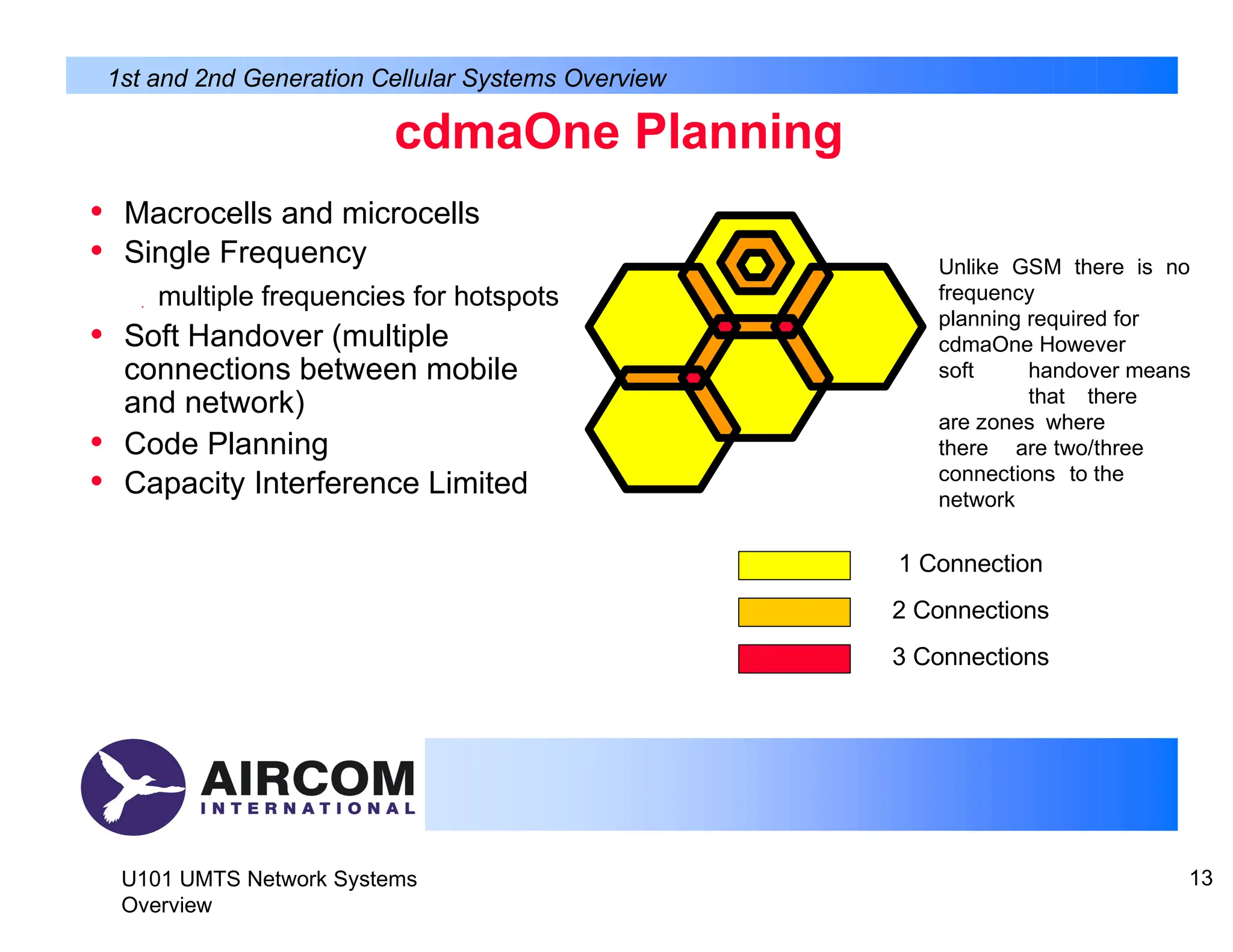
cdmaOne Planning
• Macrocellsand microcells
• Single Frequency
multiple frequencies for hotspots
• Soft Handover (multiple
connections between mobile
and network)
• Code Planning
• Capacity Interference Limited
1 Connection
2 Connections
3 Connections
U101 UMTS Network Systems
Overview
13
1st and 2nd Generation Cellular Systems Overview
Unlike GSM there is no
frequency
planning required for
cdmaOne However
soft handover means
that there
are zones where
there are two/three
connections to the
network
14.
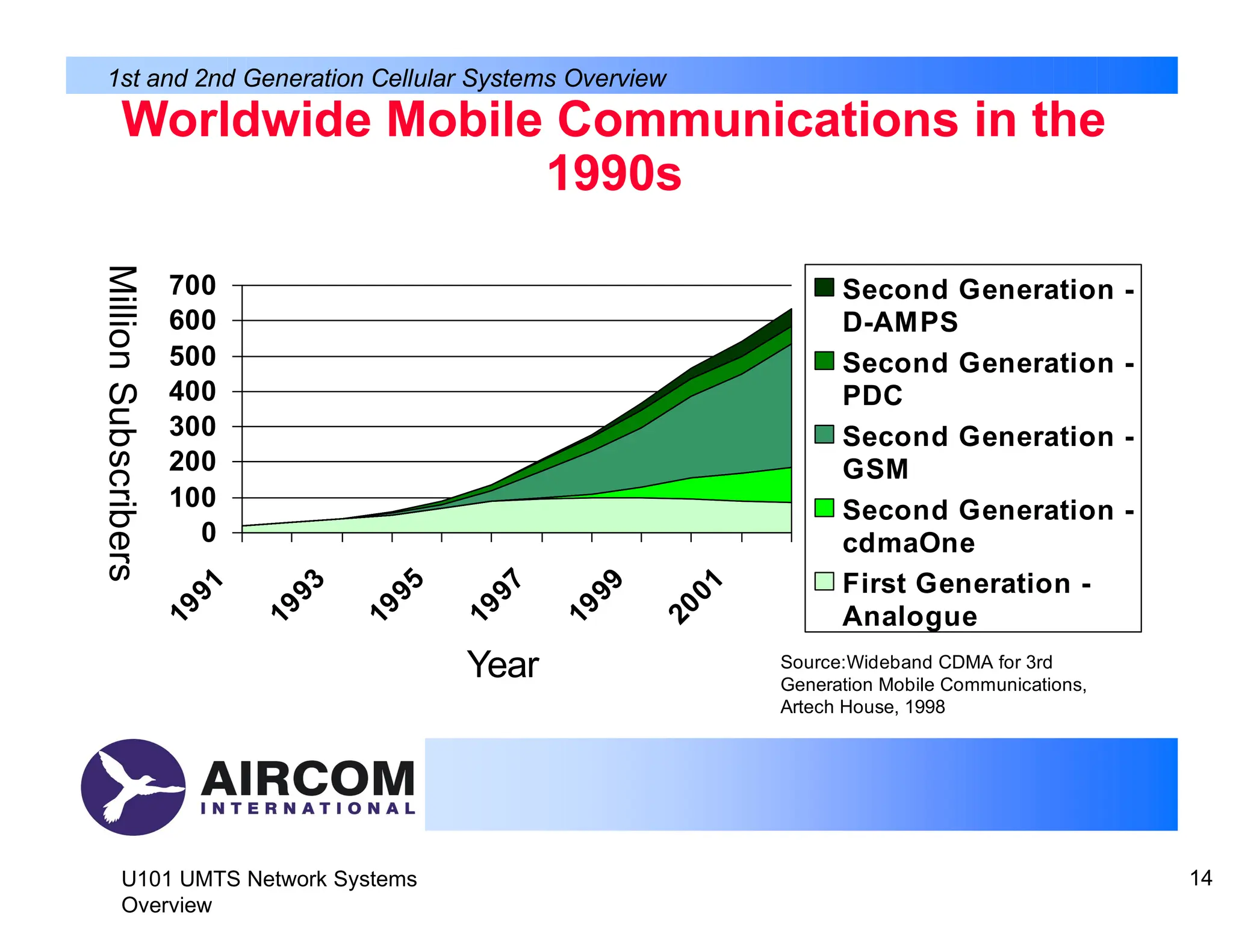
Worldwide Mobile Communicationsin the
1990s
700
600
500
400
300
200
100
0
1
9
9
1
1
9
9
3
1
9
9
5
1
9
9
7
1
9
9
9
2
0
0
1
Second Generation -
D-AMPS
Second Generation -
PDC
Second Generation -
GSM
Second Generation -
cdmaOne
First Generation -
Analogue
U101 UMTS Network Systems
Overview
14
Million
Subscribers
Year Source:Wideband CDMA for 3rd
Generation Mobile Communications,
Artech House, 1998
1st and 2nd Generation Cellular Systems Overview
15.
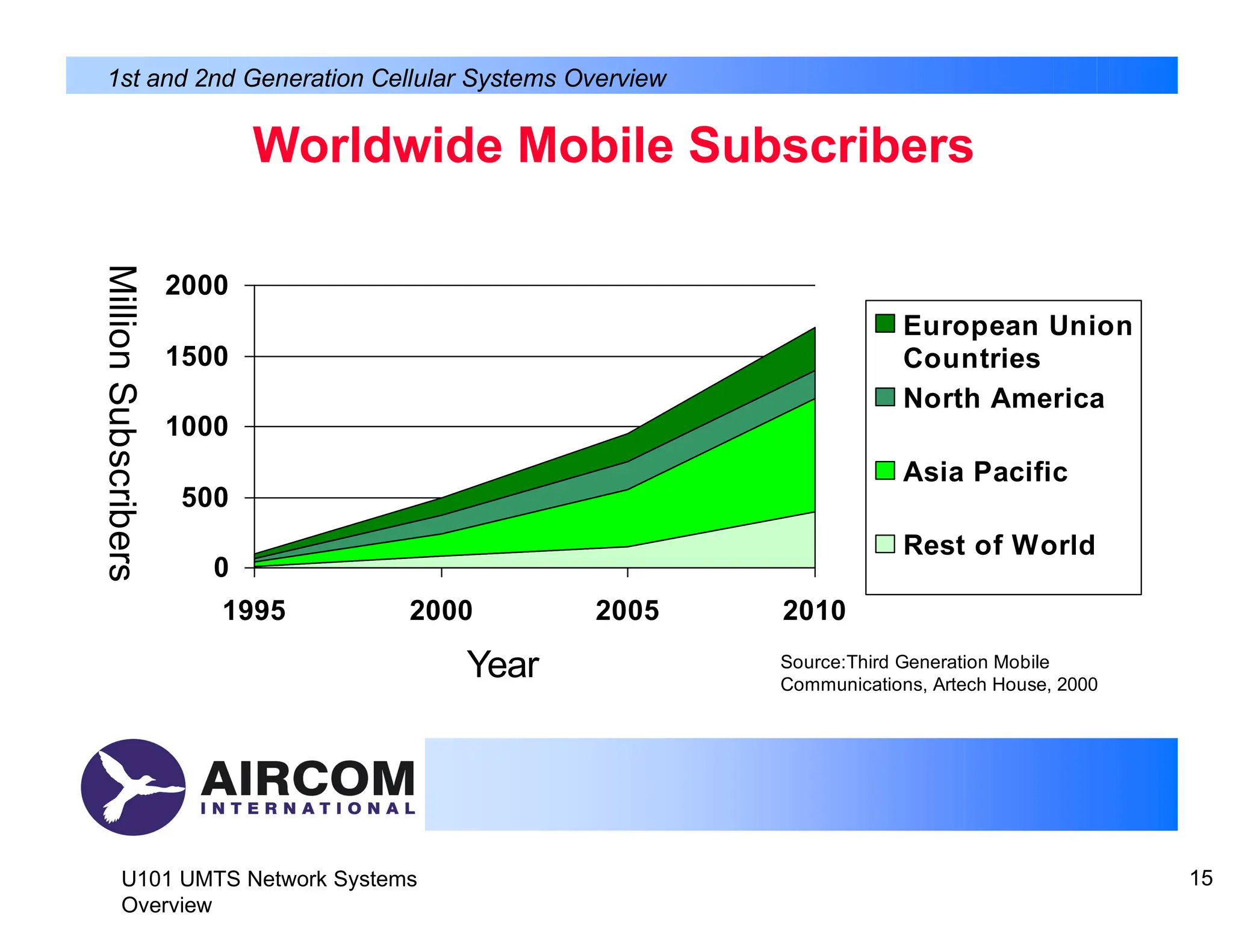
Worldwide Mobile Subscribers
0
500
1000
1500
2000
19952000
Year
2005 2010
Source:Third Generation Mobile
Communications, Artech House, 2000
European Union
Countries
North America
Asia Pacific
Rest of World
U101 UMTS Network Systems
Overview
15
Million
Subscribers
1st and 2nd Generation Cellular Systems Overview
16.
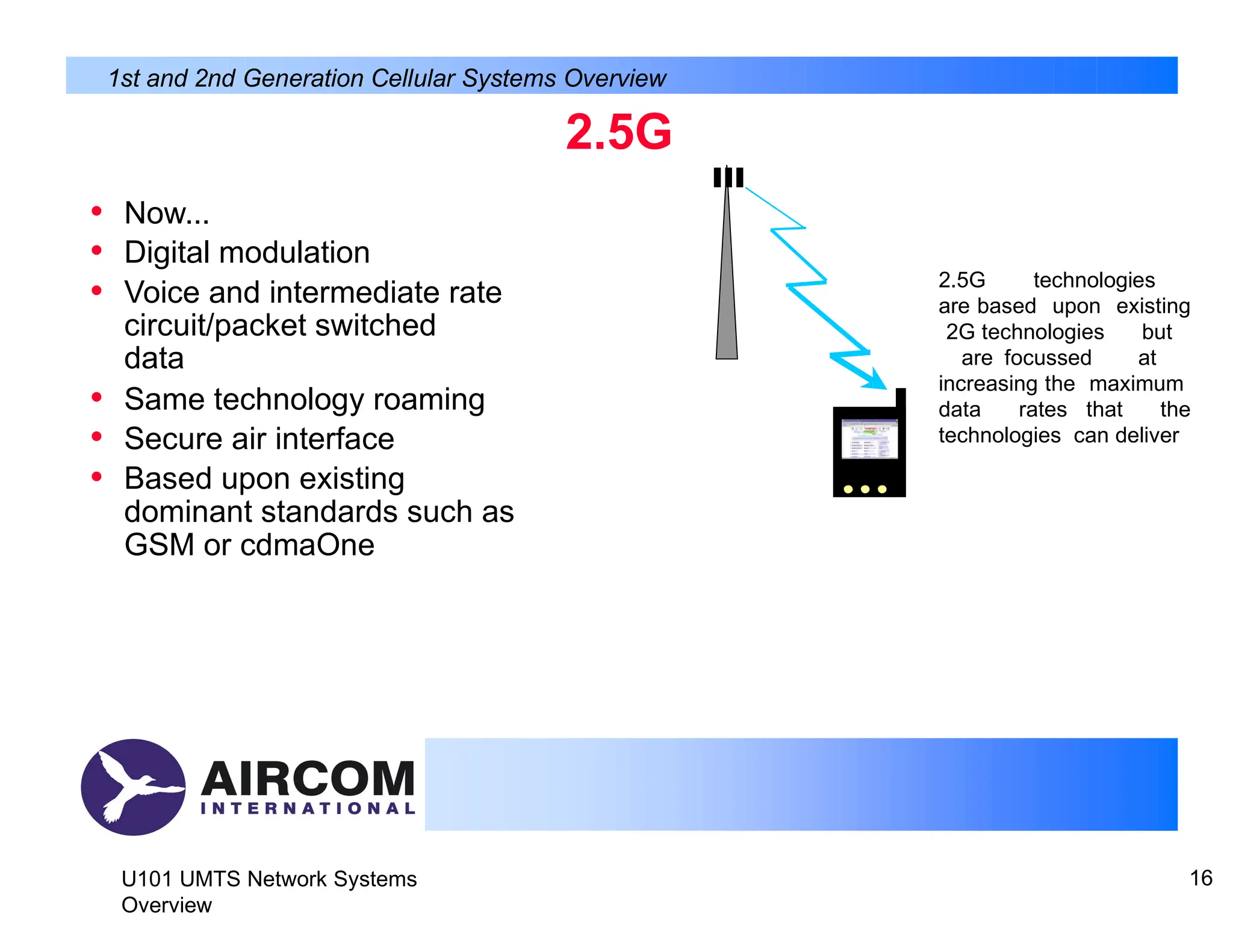
2.5G
• Now...
• Digitalmodulation
• Voice and intermediate rate
circuit/packet switched
data
• Same technology roaming
• Secure air interface
• Based upon existing
dominant standards such as
GSM or cdmaOne
1st and 2nd Generation Cellular Systems Overview
2.5G technologies
are based upon existing
2G technologies but
are focussed at
increasing the maximum
data rates that the
technologies can deliver
U101 UMTS Network Systems
Overview
16
17.
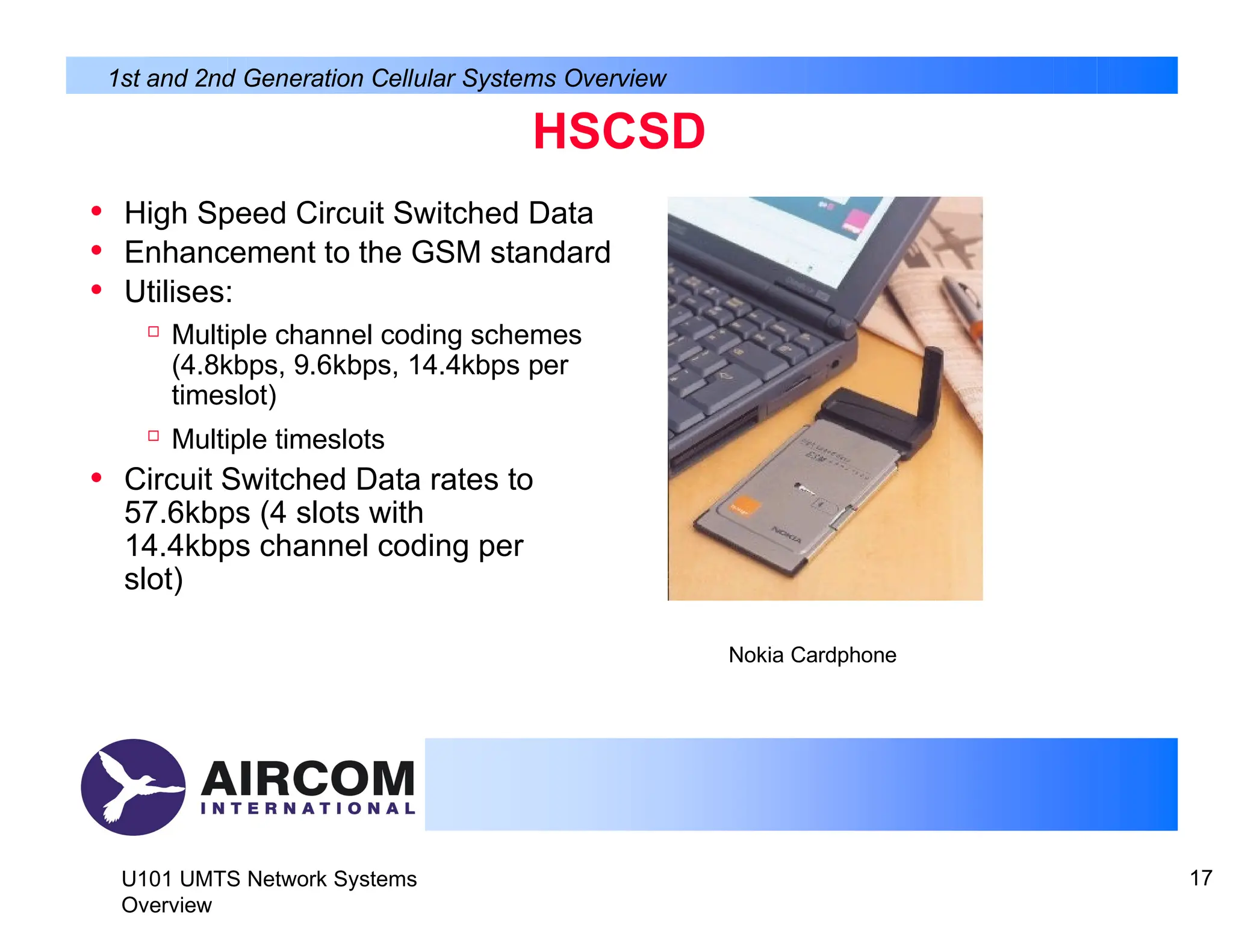
HSCSD
• High SpeedCircuit Switched Data
• Enhancement to the GSM standard
• Utilises:
Multiple channel coding schemes
(4.8kbps, 9.6kbps, 14.4kbps per
timeslot)
Multiple timeslots
• Circuit Switched Data rates to
57.6kbps (4 slots with
14.4kbps channel coding per
slot)
Nokia Cardphone
U101 UMTS Network Systems
Overview
17
1st and 2nd Generation Cellular Systems Overview
18.
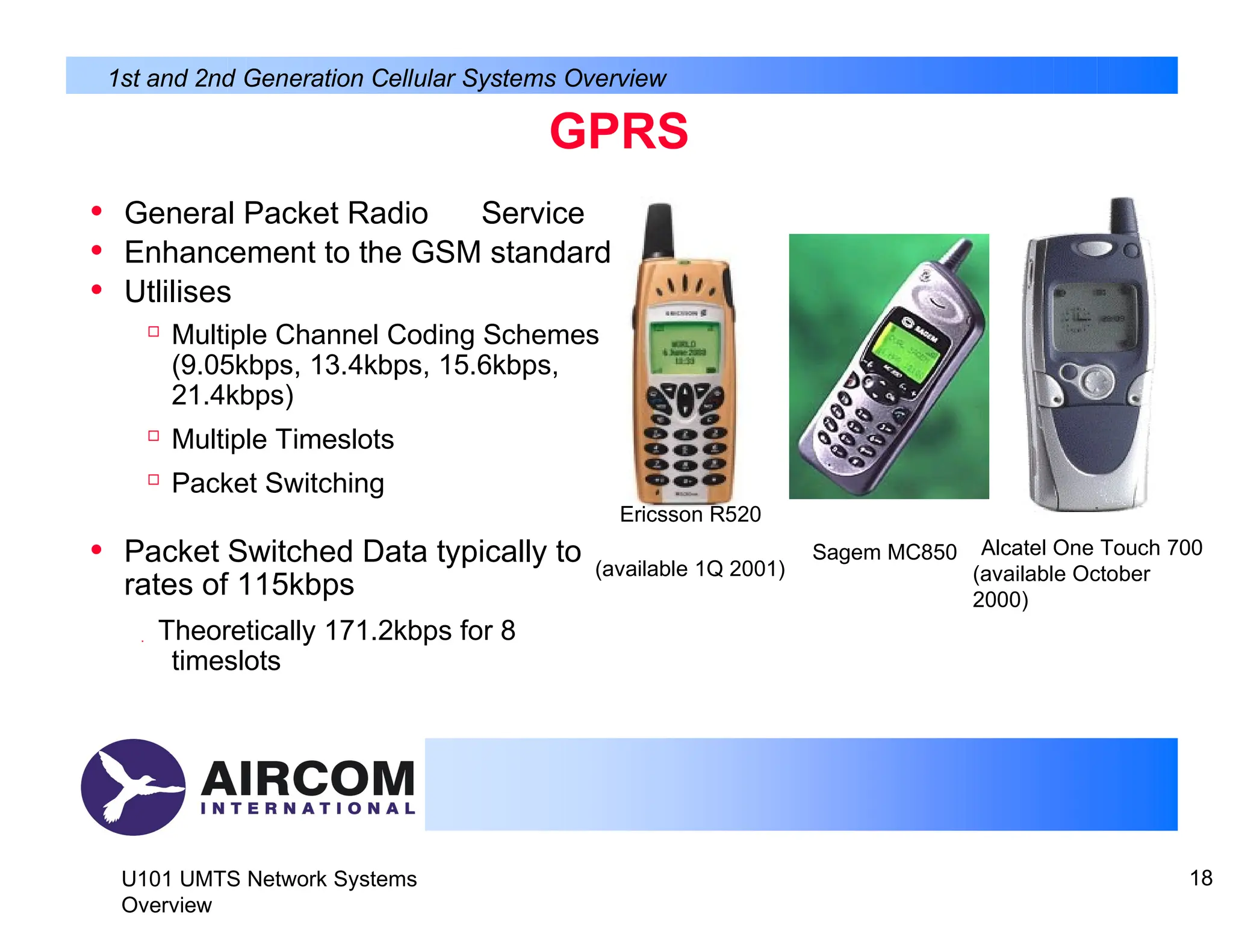
GPRS
• General PacketRadio Service
• Enhancement to the GSM standard
• Utlilises
Multiple Channel Coding Schemes
(9.05kbps, 13.4kbps, 15.6kbps,
21.4kbps)
Multiple Timeslots
Packet Switching
Ericsson R520
• Packet Switched Data typically to
rates of 115kbps
Theoretically 171.2kbps for 8
timeslots
(available 1Q 2001)
Sagem MC850 Alcatel One Touch 700
(available October
2000)
U101 UMTS Network Systems
Overview
18
1st and 2nd Generation Cellular Systems Overview
19.
IS-95B
• Enhancement tocdmaOne
standard
• Utilises
High rate coding scheme
Combined code channels
packet switching
• Packet Switched Data to rates of
114kbps
1st and 2nd Generation Cellular Systems Overview
Qualcomm PDQ
Smartphone
U101 UMTS Network Systems
Overview
19
20.
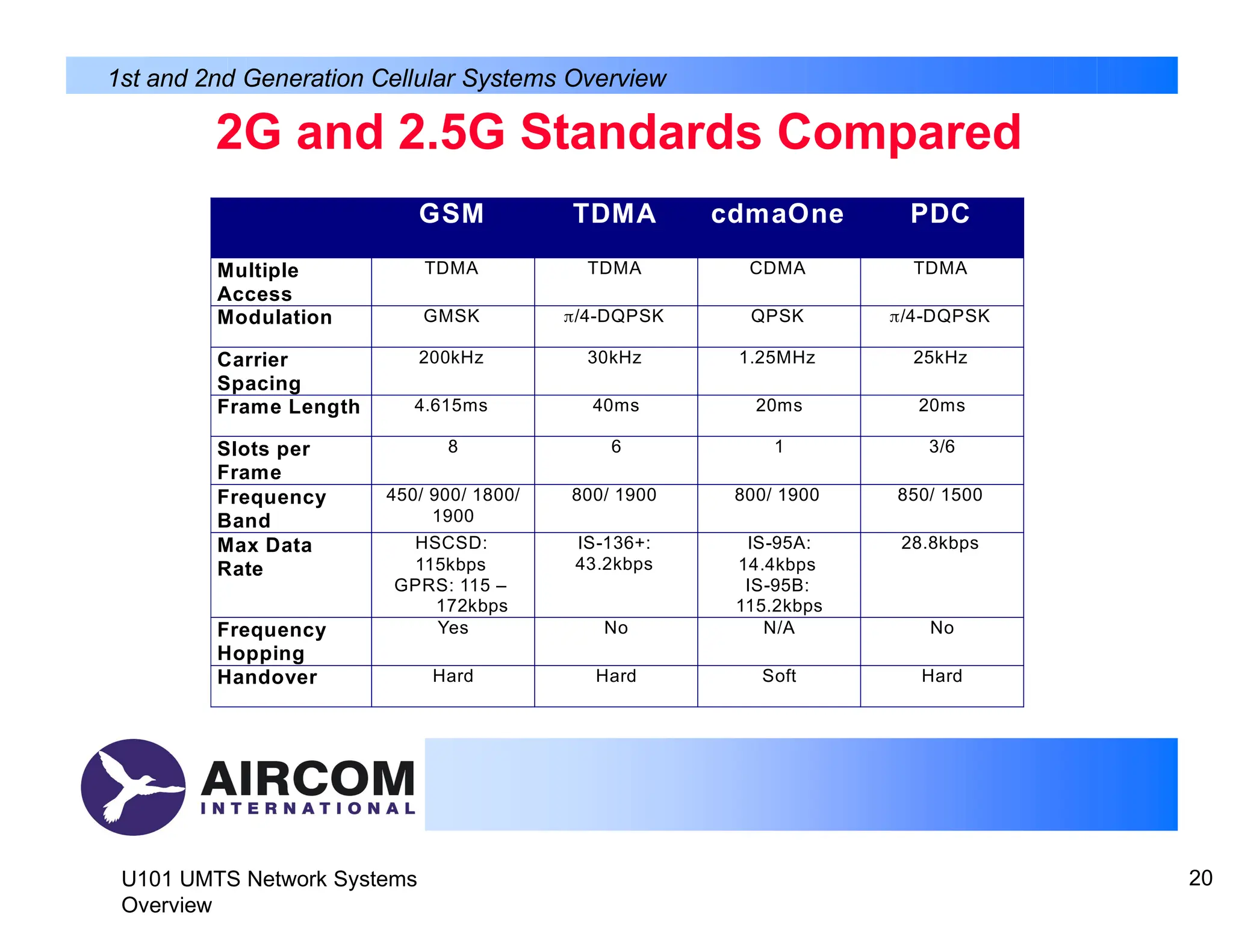
2G and 2.5GStandards Compared
U101 UMTS Network Systems
Overview
20
1st and 2nd Generation Cellular Systems Overview
GSM TDMA cdmaOne PDC
Multiple
Access
TDMA TDMA CDMA TDMA
Modulation GMSK π/4-DQPSK QPSK π/4-DQPSK
Carrier
Spacing
200kHz 30kHz 1.25MHz 25kHz
Frame Length 4.615ms 40ms 20ms 20ms
Slots per
Frame
8 6 1 3/6
Frequency
Band
450/ 900/ 1800/
1900
800/ 1900 800/ 1900 850/ 1500
Max Data
Rate
HSCSD:
115kbps
GPRS: 115 –
172kbps
IS-136+:
43.2kbps
IS-95A:
14.4kbps
IS-95B:
115.2kbps
28.8kbps
Frequency
Hopping
Yes No N/A No
Handover Hard Hard Soft Hard
21.
Questions
U101 UMTS NetworkSystems
Overview
21
• What defines a 1st generation technology and a 2nd generation
technology?
• What is are the main differences between GSM and cdmaOne?
• How do 2.5G standards relate to 2G standards?
1st and 2nd Generation Cellular Systems Overview
22.
Session Summary
U101 UMTSNetwork Systems
Overview
22
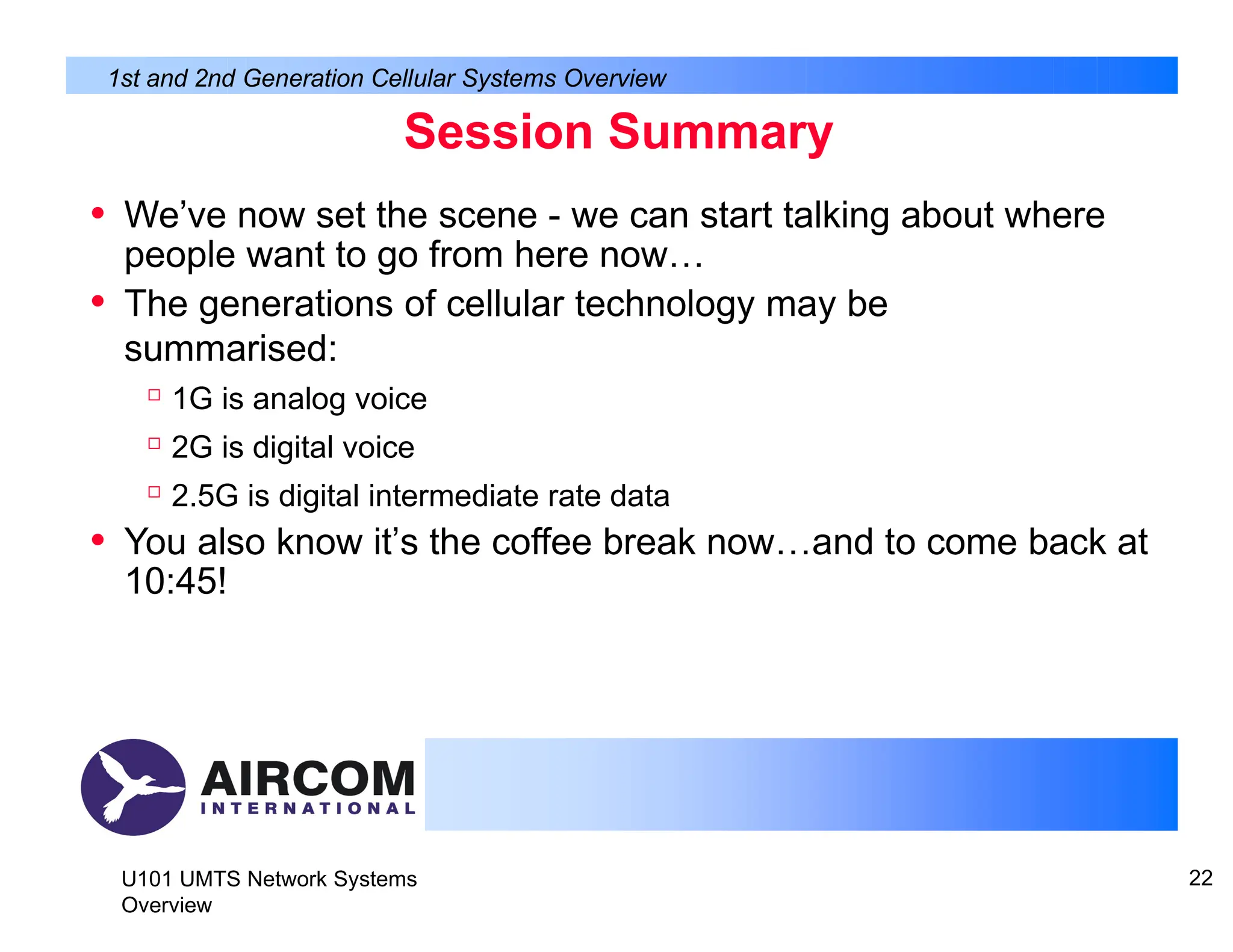
• We’ve now set the scene - we can start talking about where
people want to go from here now…
• The generations of cellular technology may be
summarised:
1G is analog voice
2G is digital voice
2.5G is digital intermediate rate data
• You also know it’s the coffee break now…and to come back at
10:45!
1st and 2nd Generation Cellular Systems Overview
23.
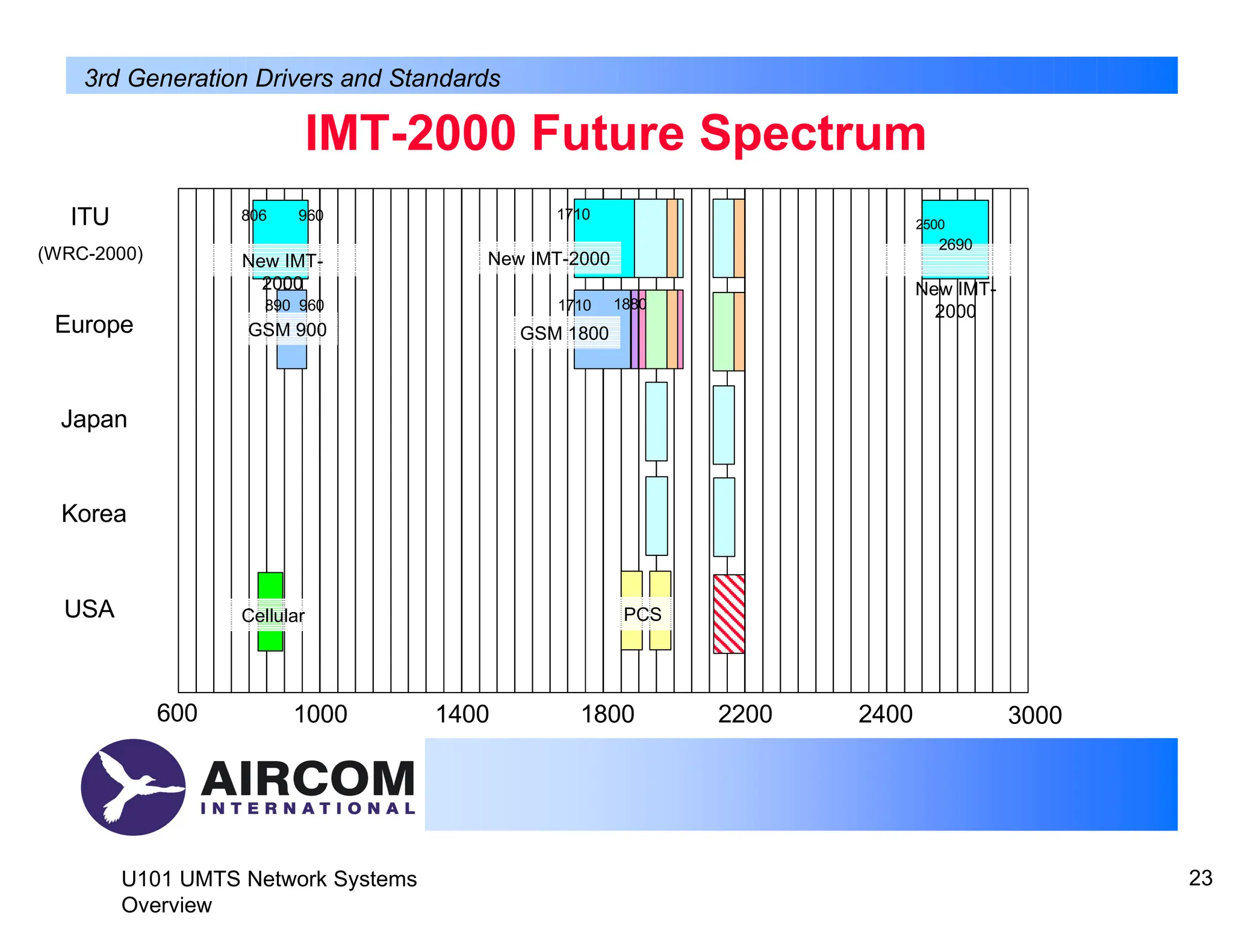
IMT-2000 Future Spectrum
ITU
(WRC-2000)
Europe
Japan
Korea
USA
22003000
600 1000 1400 1800 2400
806 960
New IMT-
2000
1710
1880
2500
2690
New IMT-
2000
890 960 1710
GSM 1800
GSM 900
New IMT-2000
Cellular PCS
U101 UMTS Network Systems
Overview
23
3rd Generation Drivers and Standards
24.
IMT-2000 Candidate TechnologyEvaluation
U101 UMTS Network Systems
Overview
24
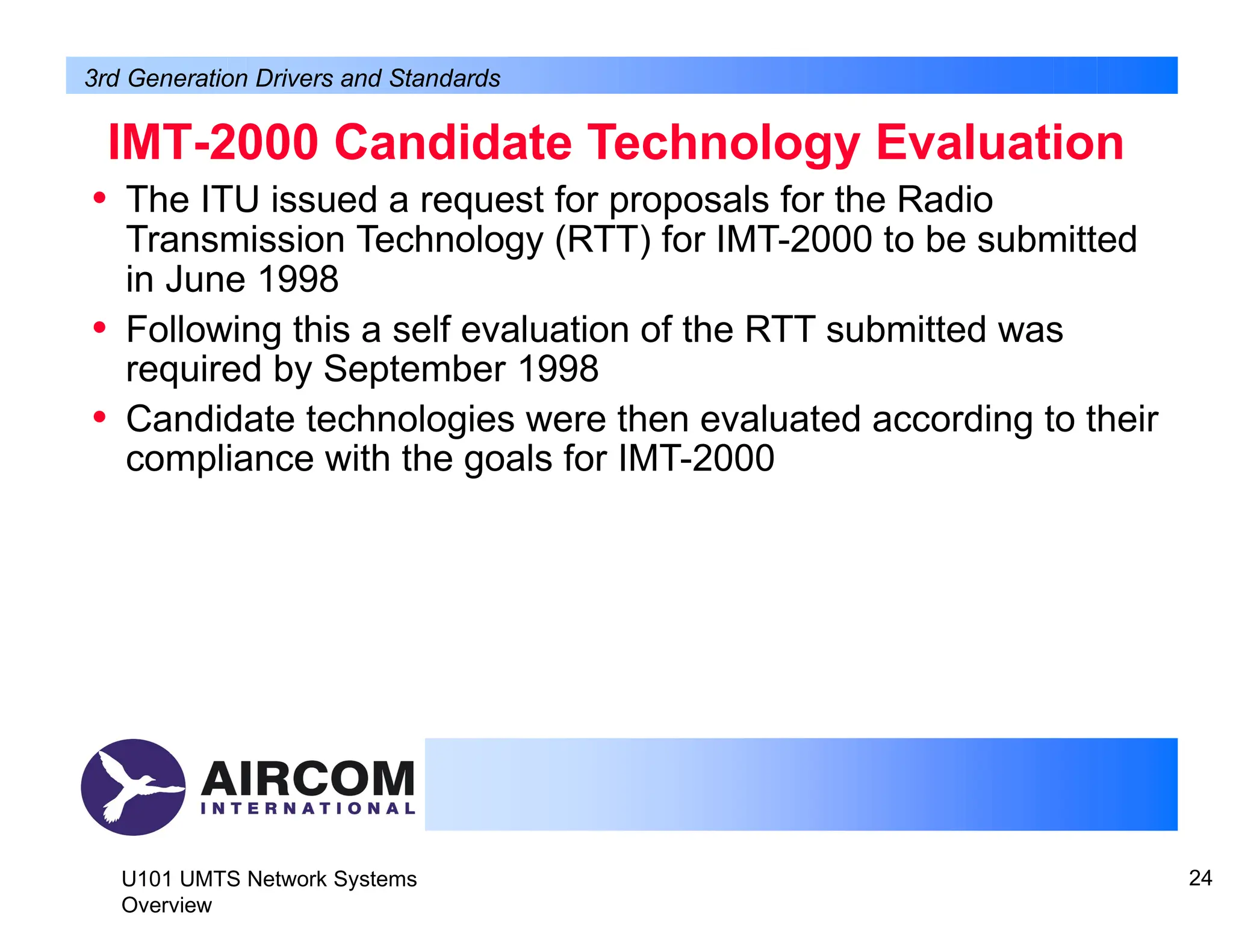
• The ITU issued a request for proposals for the Radio
Transmission Technology (RTT) for IMT-2000 to be submitted
in June 1998
• Following this a self evaluation of the RTT submitted was
required by September 1998
• Candidate technologies were then evaluated according to their
compliance with the goals for IMT-2000
3rd Generation Drivers and Standards
25.
IMT-2000 Candidate Harmonisation
U101UMTS Network Systems
Overview
25
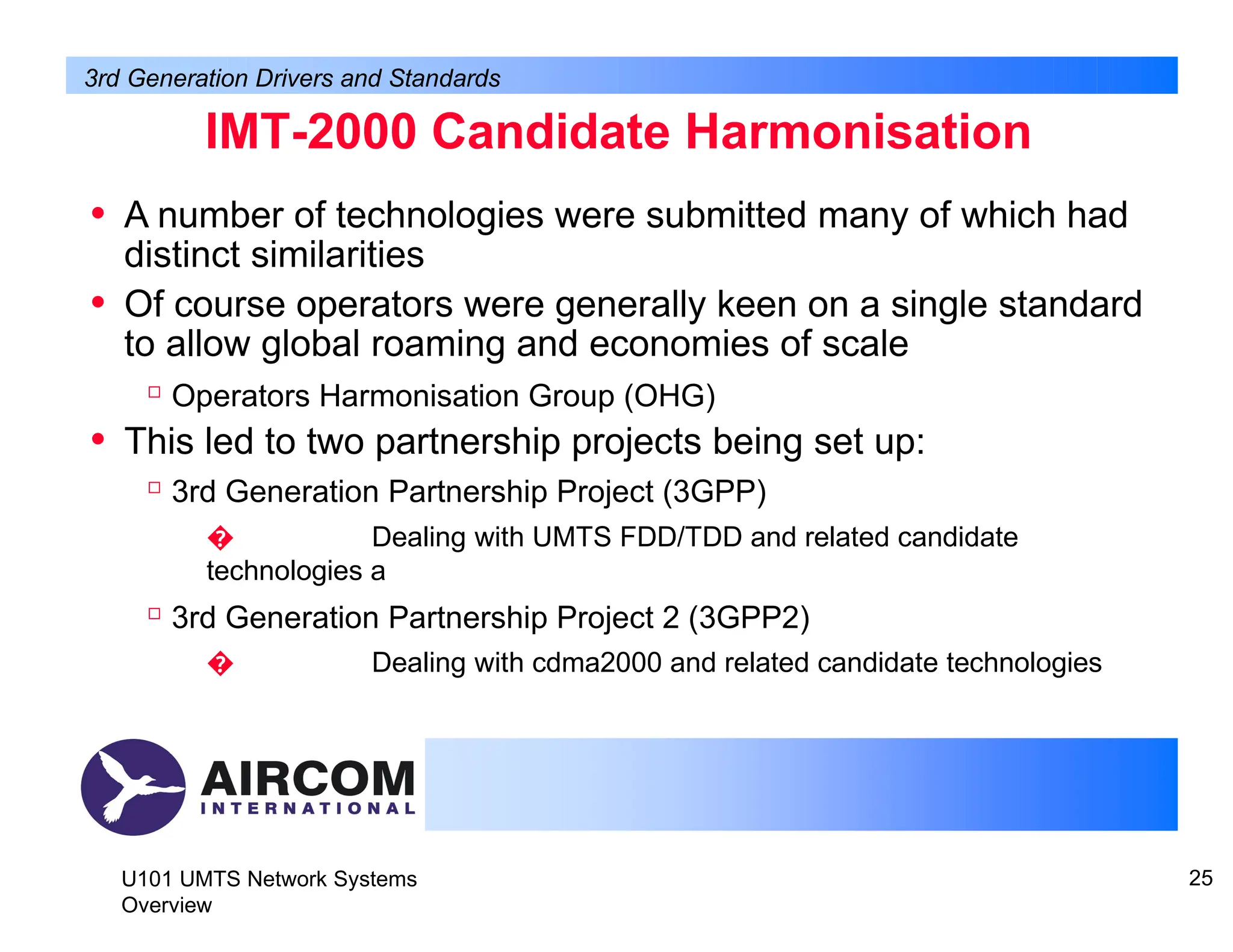
• A number of technologies were submitted many of which had
distinct similarities
• Of course operators were generally keen on a single standard
to allow global roaming and economies of scale
Operators Harmonisation Group (OHG)
• This led to two partnership projects being set up:
3rd Generation Partnership Project (3GPP)
� Dealing with UMTS FDD/TDD and related candidate
technologies a
3rd Generation Partnership Project 2 (3GPP2)
� Dealing with cdma2000 and related candidate technologies
3rd Generation Drivers and Standards
26.
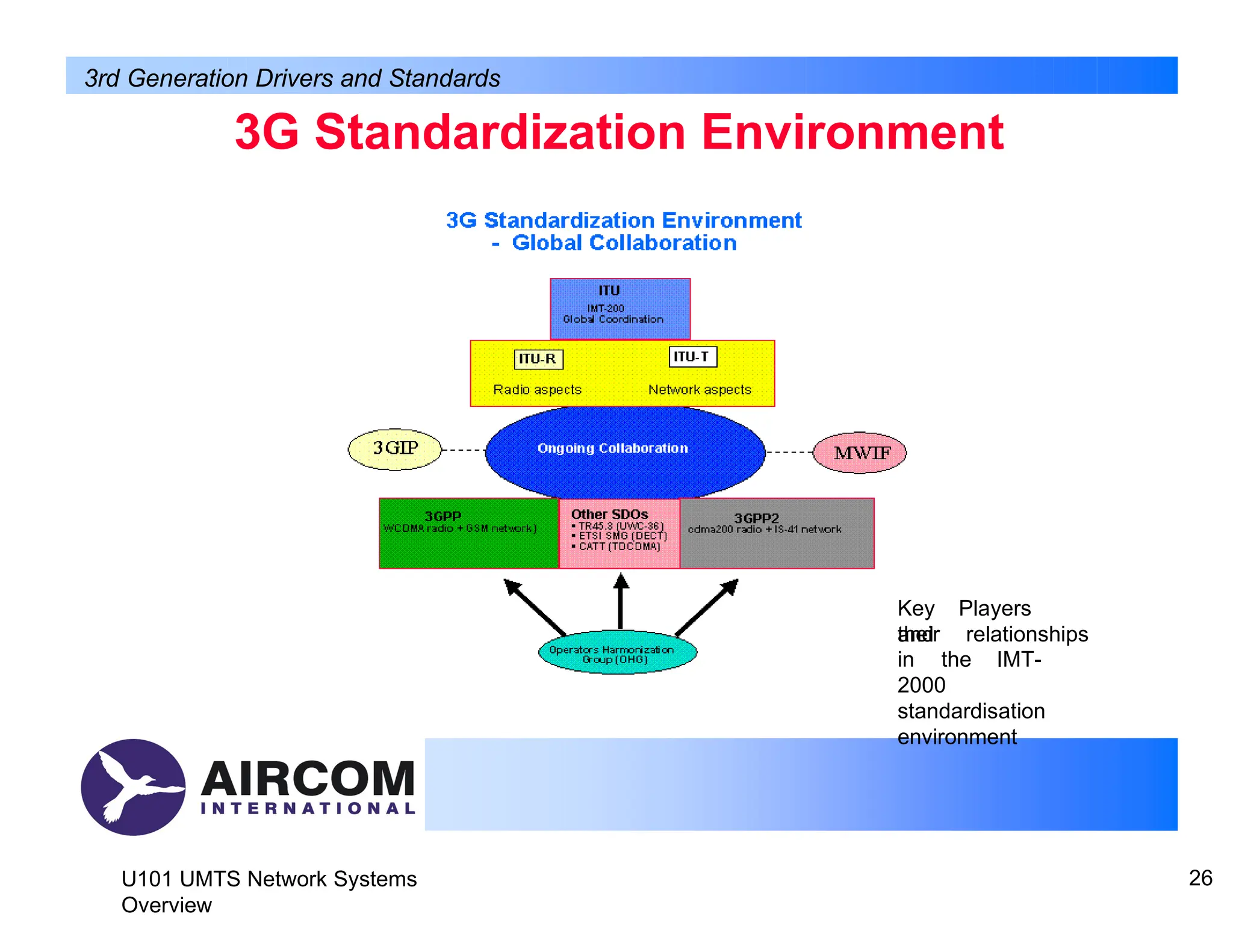
3G Standardization Environment
3rdGeneration Drivers and Standards
U101 UMTS Network Systems
Overview
26
Key Players
and
their relationships
in the IMT-
2000
standardisation
environment
27.
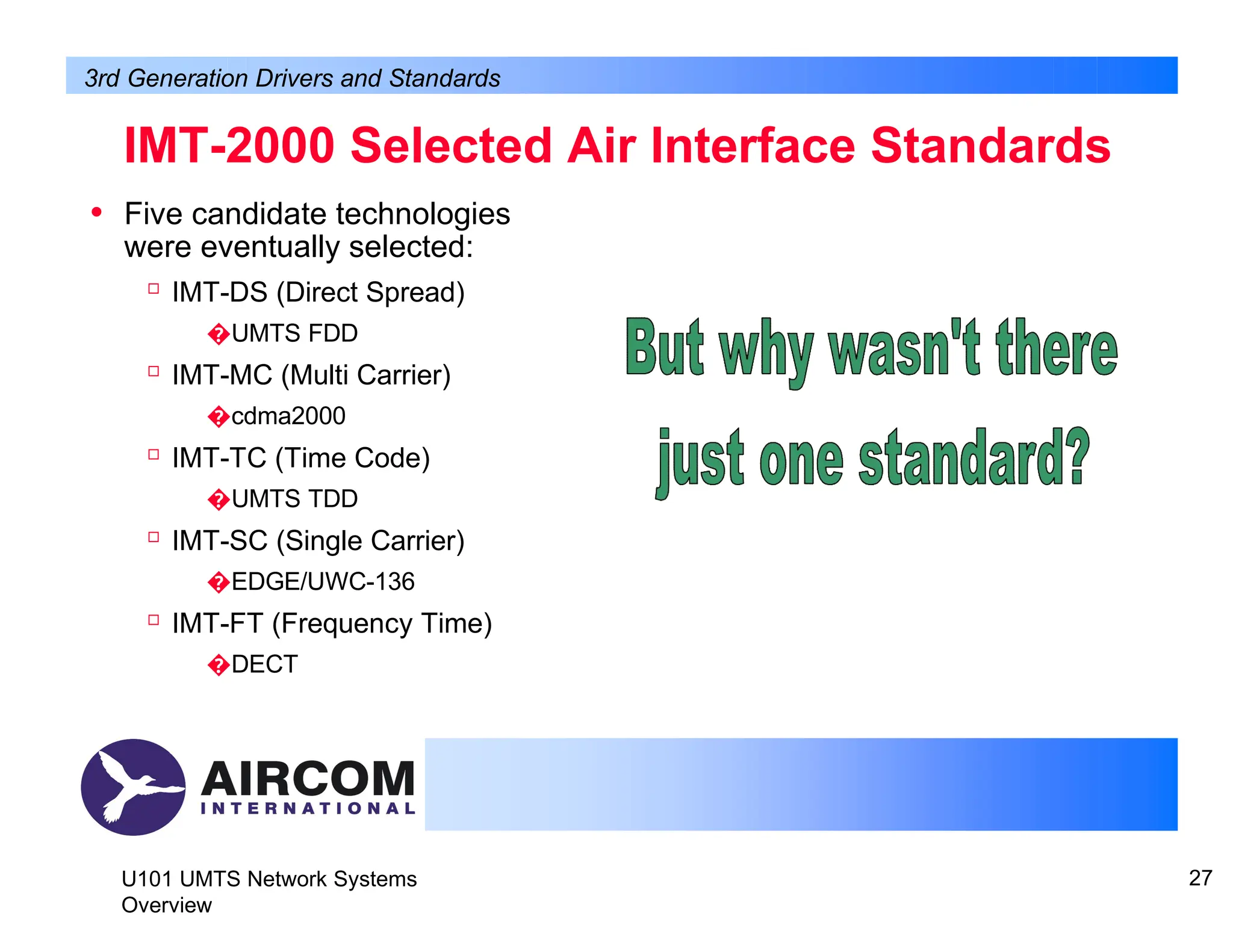
• Five candidatetechnologies
were eventually selected:
IMT-DS (Direct Spread)
�UMTS FDD
IMT-MC (Multi Carrier)
�cdma2000
IMT-TC (Time Code)
�UMTS TDD
IMT-SC (Single Carrier)
�EDGE/UWC-136
IMT-FT (Frequency Time)
�DECT
IMT-2000 Selected Air Interface Standards
3rd Generation Drivers and Standards
U101 UMTS Network Systems
Overview
27
28.
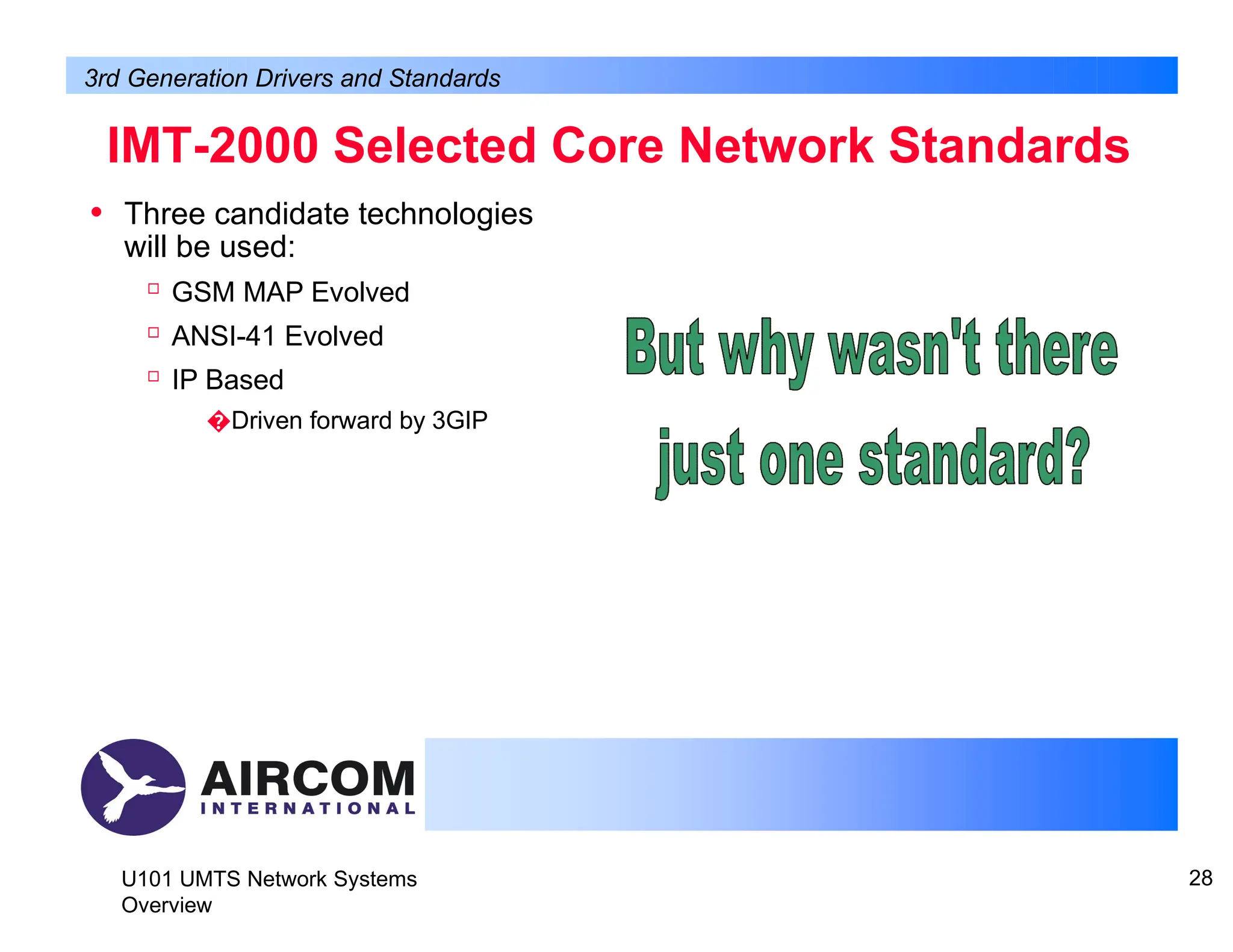
• Three candidatetechnologies
will be used:
GSM MAP Evolved
ANSI-41 Evolved
IP Based
�Driven forward by 3GIP
IMT-2000 Selected Core Network Standards
3rd Generation Drivers and Standards
U101 UMTS Network Systems
Overview
28
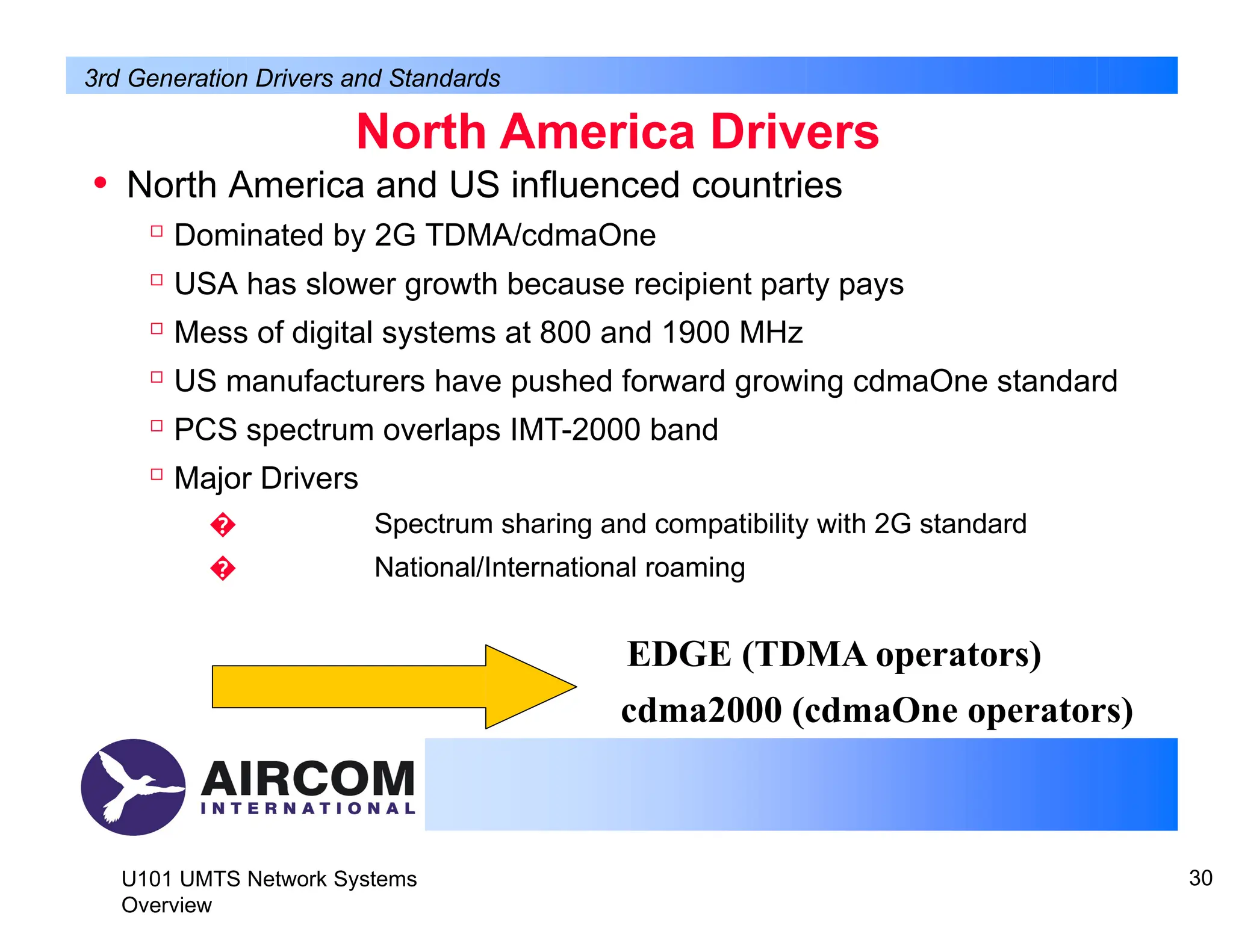
• North Americaand US influenced countries
Dominated by 2G TDMA/cdmaOne
USA has slower growth because recipient party pays
Mess of digital systems at 800 and 1900 MHz
US manufacturers have pushed forward growing cdmaOne standard
PCS spectrum overlaps IMT-2000 band
Major Drivers
� Spectrum sharing and compatibility with 2G standard
� National/International roaming
EDGE (TDMA operators)
cdma2000 (cdmaOne operators)
U101 UMTS Network Systems
Overview
30
North America Drivers
3rd Generation Drivers and Standards
31.
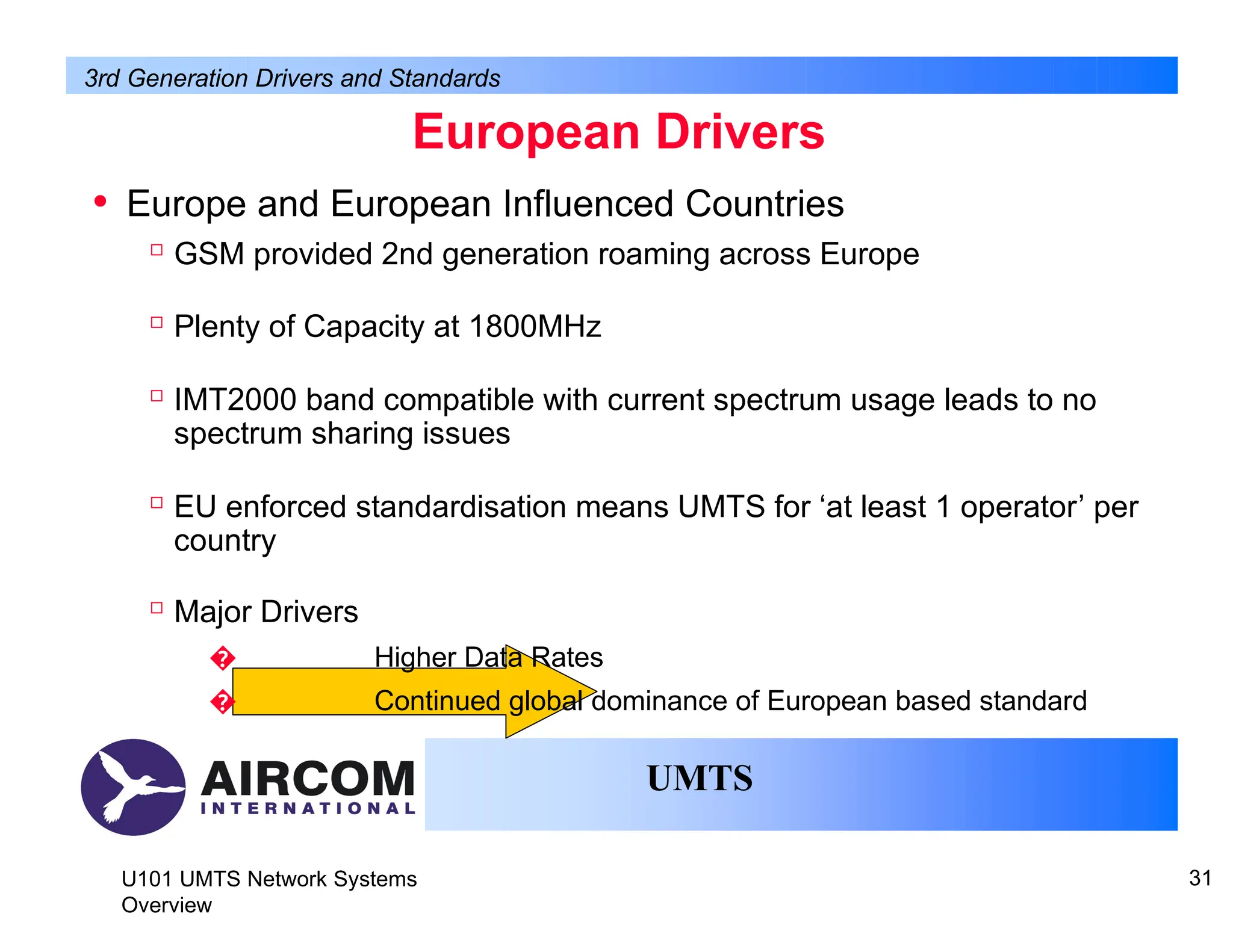
• Europe andEuropean Influenced Countries
GSM provided 2nd generation roaming across Europe
Plenty of Capacity at 1800MHz
IMT2000 band compatible with current spectrum usage leads to no
spectrum sharing issues
EU enforced standardisation means UMTS for ‘at least 1 operator’ per
country
Major Drivers
� Higher Data Rates
� Continued global dominance of European based standard
UMTS
U101 UMTS Network Systems
Overview
31
European Drivers
3rd Generation Drivers and Standards
32.
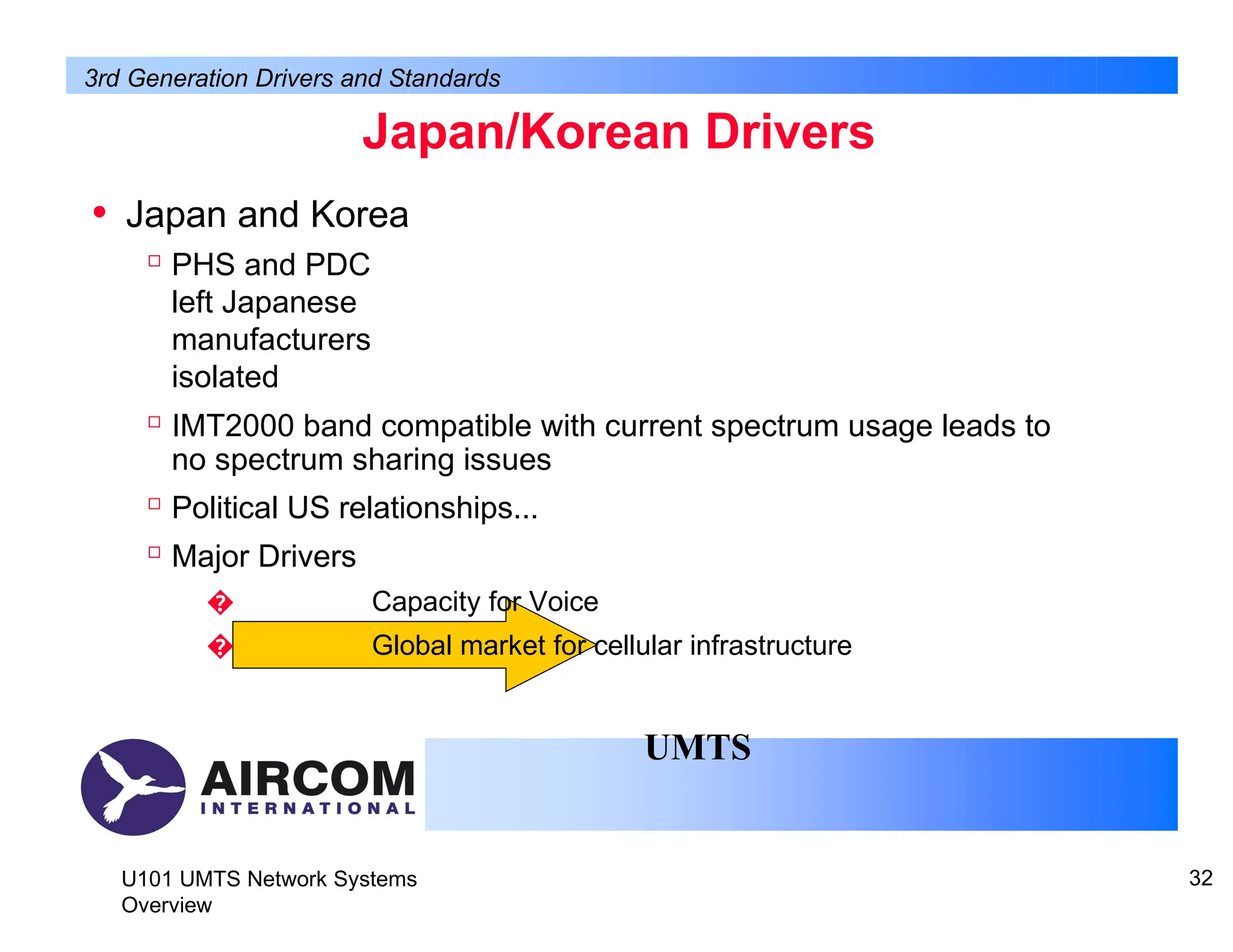
Japan/Korean Drivers
• Japanand Korea
PHS and PDC
left Japanese
manufacturers
isolated
IMT2000 band compatible with current spectrum usage leads to
no spectrum sharing issues
Political US relationships...
Major Drivers
� Capacity for Voice
� Global market for cellular infrastructure
UMTS
U101 UMTS Network Systems
Overview
32
3rd Generation Drivers and Standards
33.
Cordless Drivers
U101 UMTSNetwork Systems
Overview
33
• You can’t get 2Mbps out of the cellular standards
• Hence a requirement for cordless style standards
UMTS TDD Mode
DECT
3rd Generation Drivers and Standards
34.
Industry Bodies -Radio Regulatory
U101 UMTS Network Systems
Overview
34
• ITU (International)
http://www.itu.int/
ERO (EU)
European Radio Office
http://www.ero.dk/
• RA (UK)
Radiocommunications Agency
http://www.radio.gov.uk/
FCC (USA)
Federal Communications
Commission
http://www.fcc.gov/
•
•
3rd Generation Drivers and Standards
35.
Industry Bodies -Trade Associations
U101 UMTS Network Systems
Overview
35
• UMTS Forum
http://www.umts-forum.org/
GSM Association
http://www.gsmworld.com/index1.html
• CDMA Development Group
http://www.cdg.org/
• GSM Suppliers Association
http://www.gsacom.com/home.html
• Universal Wireless Communications
Consortium
http://www.uwcc.org/
•
3rd Generation Drivers and Standards
36.
Industry Bodies -Standards Groups
• 3GPP
UMTS FDD and TDD
Standards Development
http://www.3gpp.org/
• 3GPP2
cdma2000
Standards Development
http://www.3gpp2.org/
• 3GIP
IP Core Network
http://www.3gip.org/
3rd Generation Drivers and Standards
U101 UMTS Network Systems
Overview
36
37.
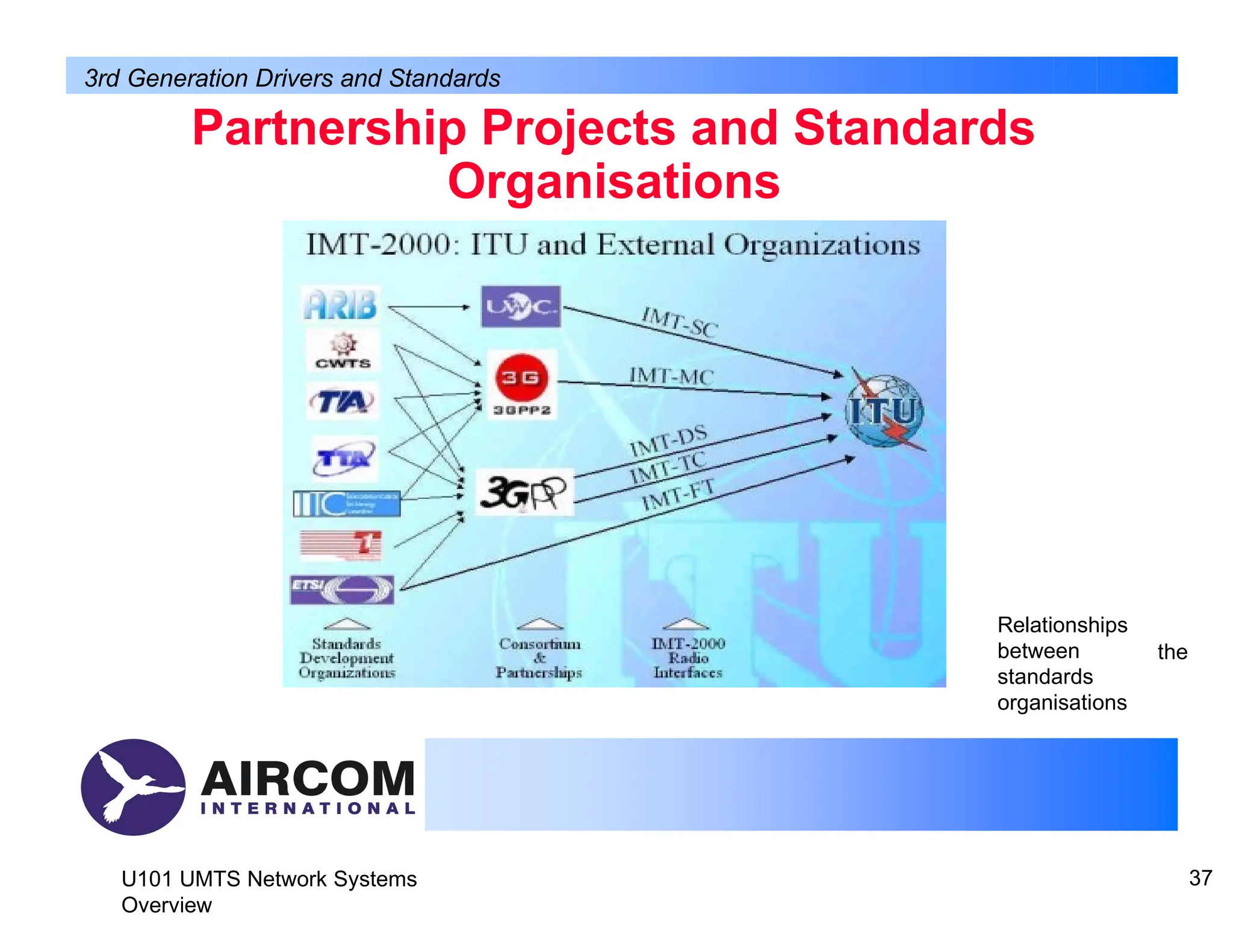
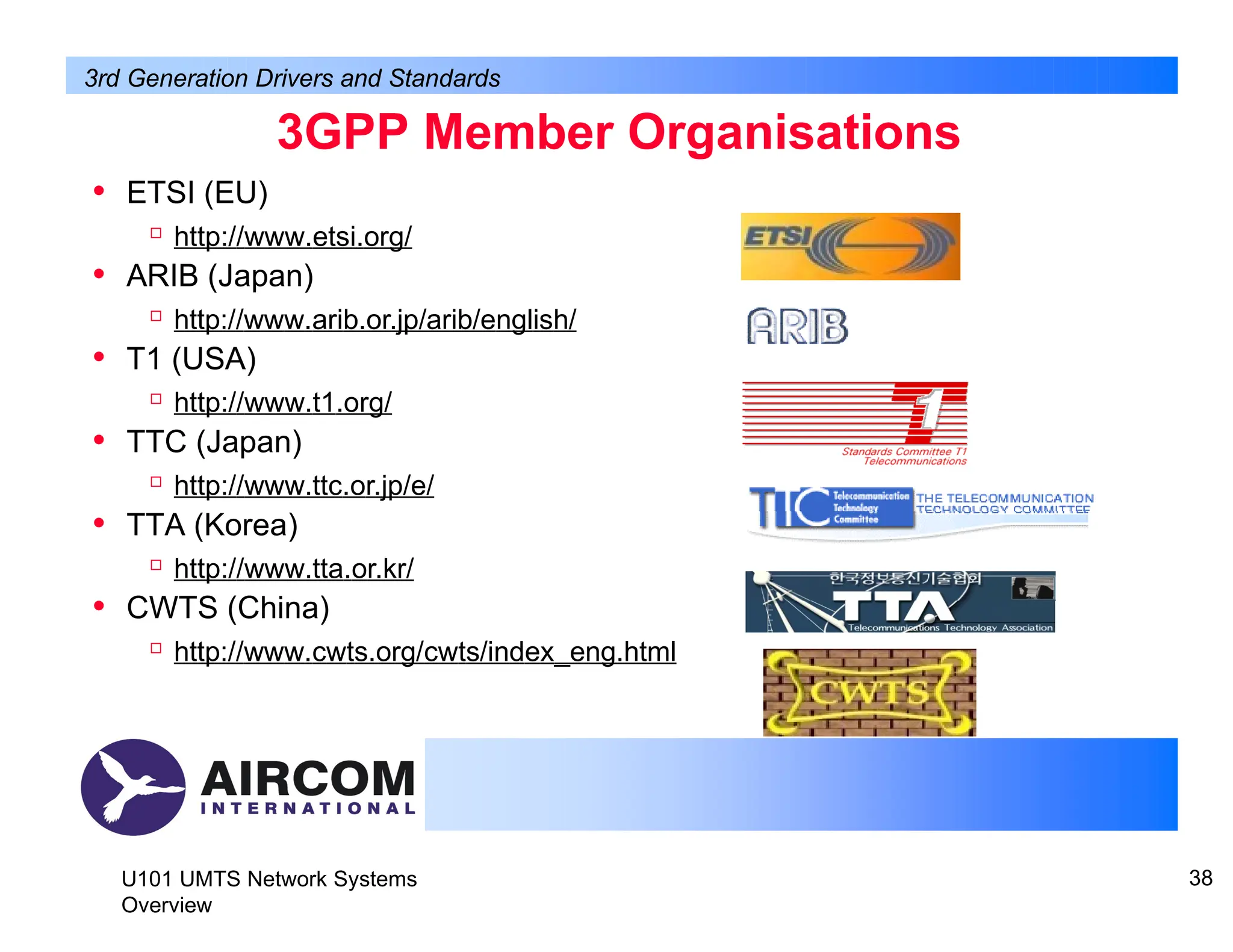
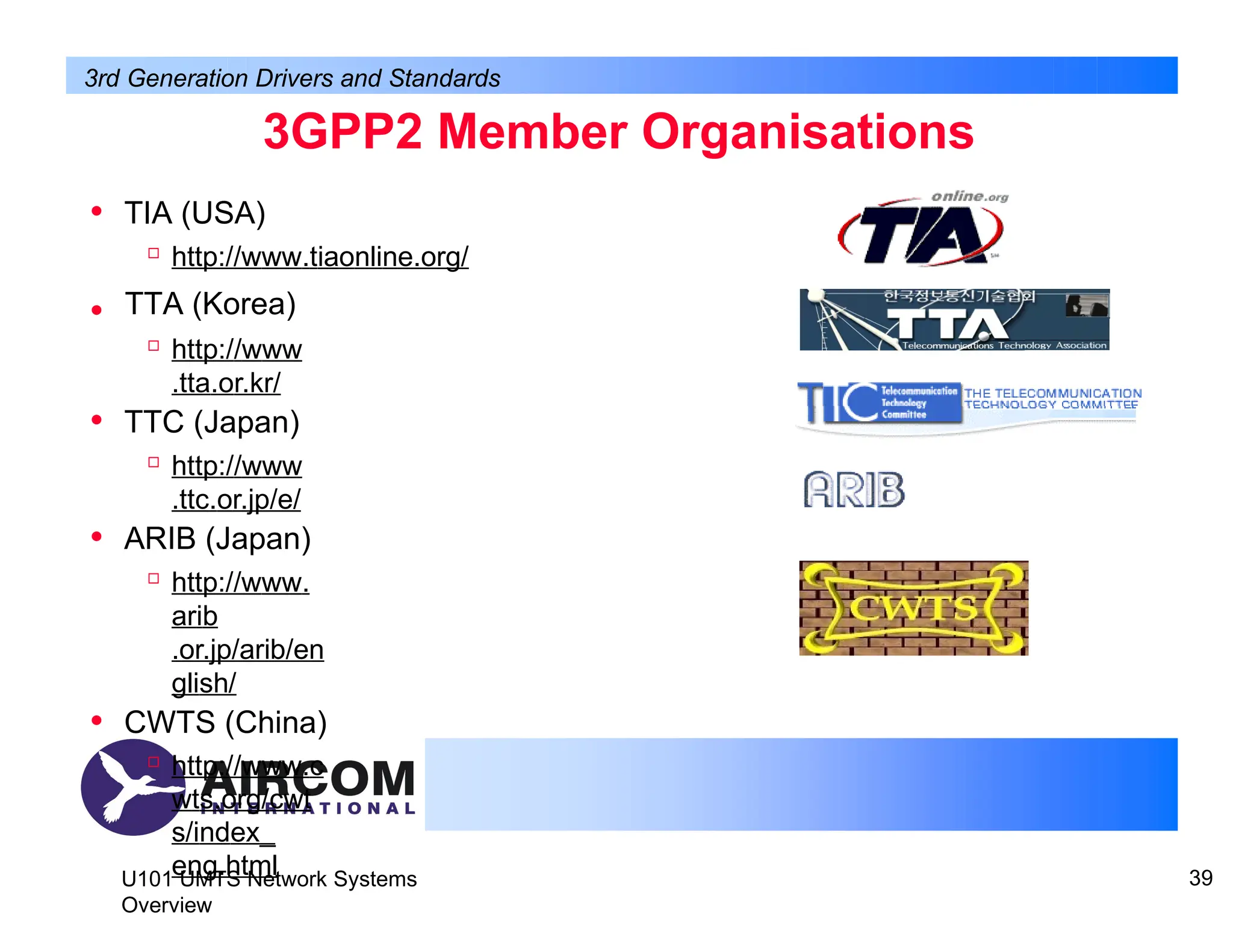
Partnership Projects andStandards
Organisations
3rd Generation Drivers and Standards
U101 UMTS Network Systems
Overview
37
Relationships
between
standards
organisations
the
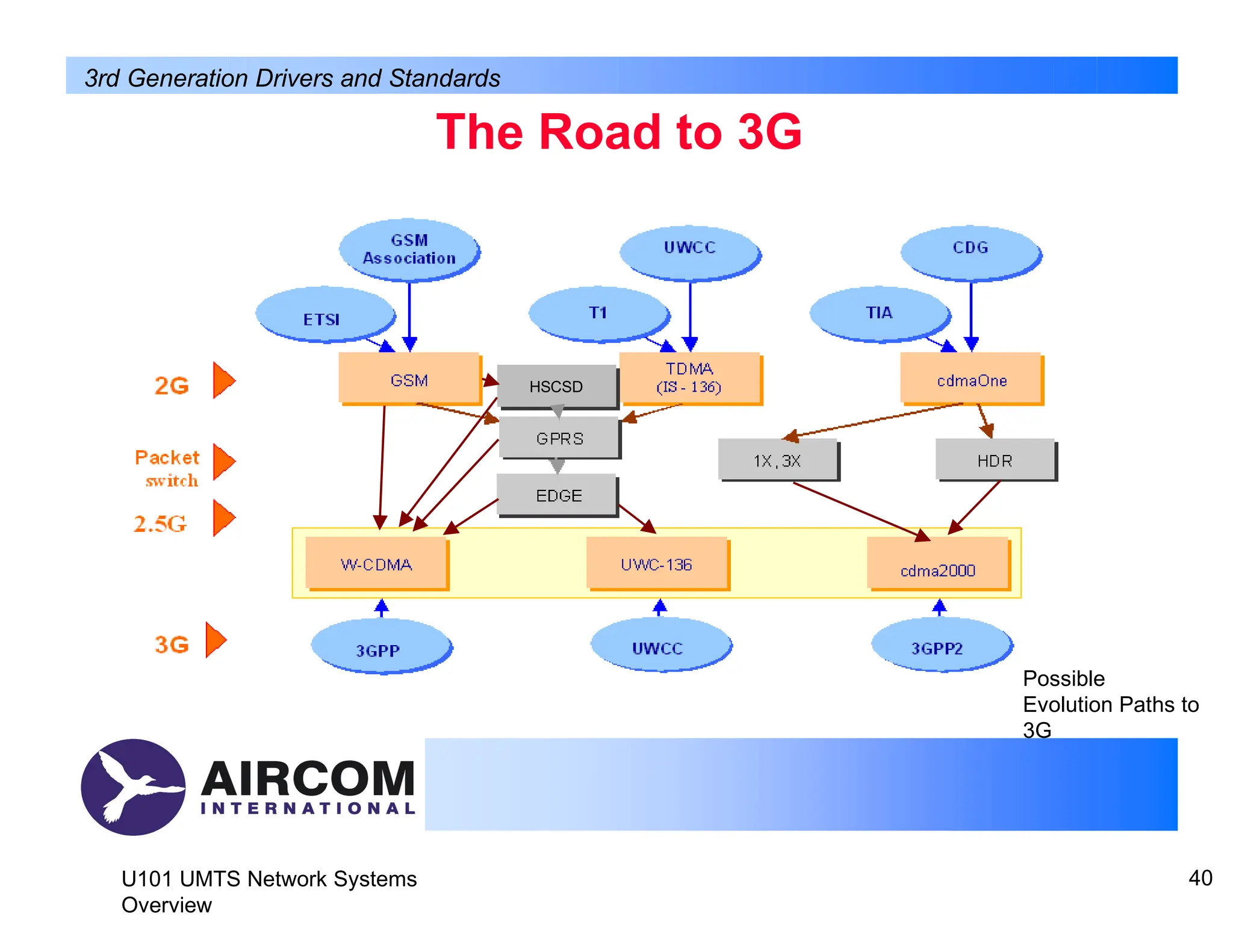
The Road to3G
3rd Generation Drivers and Standards
Possible
Evolution Paths to
3G
HSCSD
U101 UMTS Network Systems
Overview
40
41.
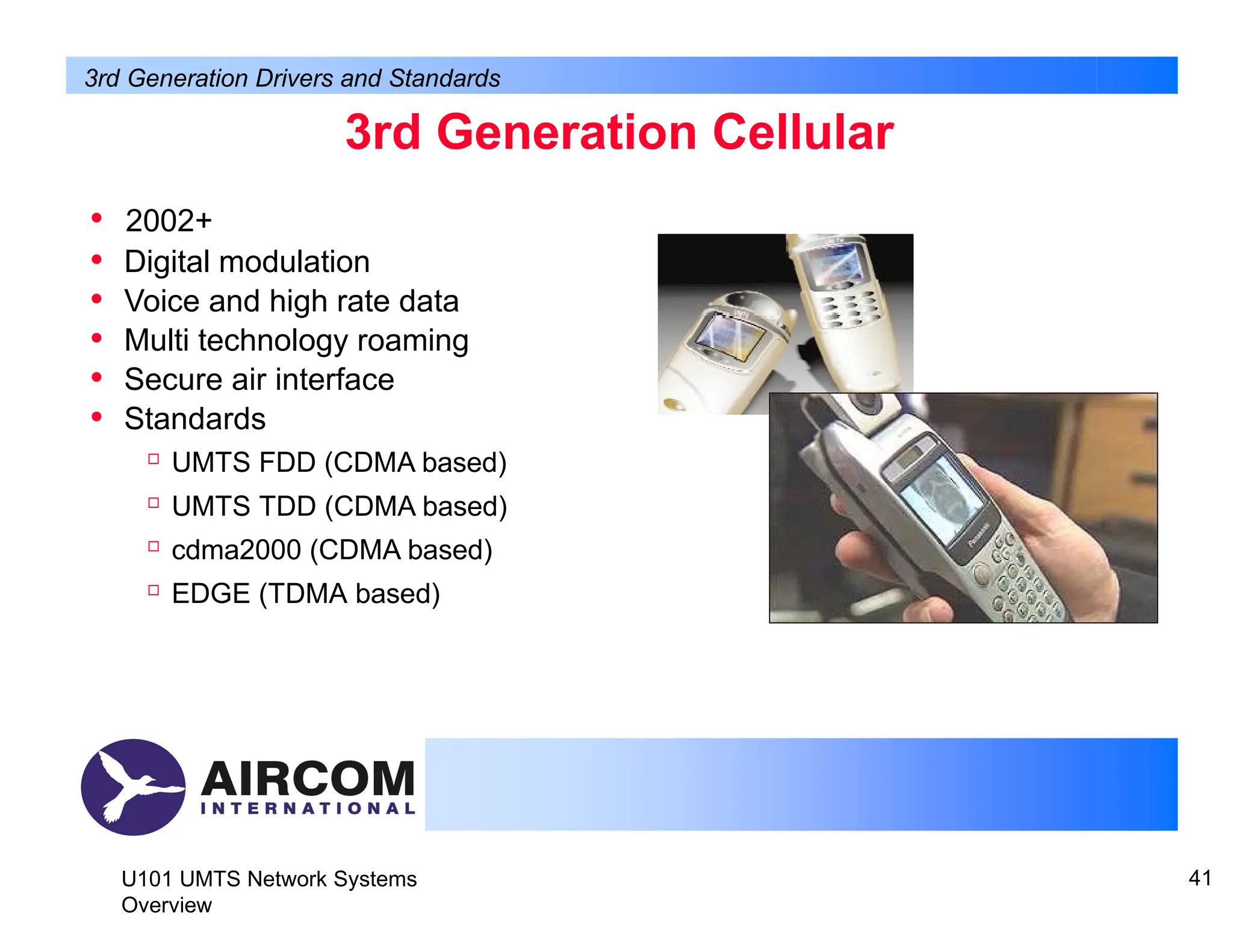
3rd Generation Cellular
•2002+
• Digital modulation
• Voice and high rate data
• Multi technology roaming
• Secure air interface
• Standards
UMTS FDD (CDMA based)
UMTS TDD (CDMA based)
cdma2000 (CDMA based)
EDGE (TDMA based)
3rd Generation Drivers and Standards
U101 UMTS Network Systems
Overview
41
42.
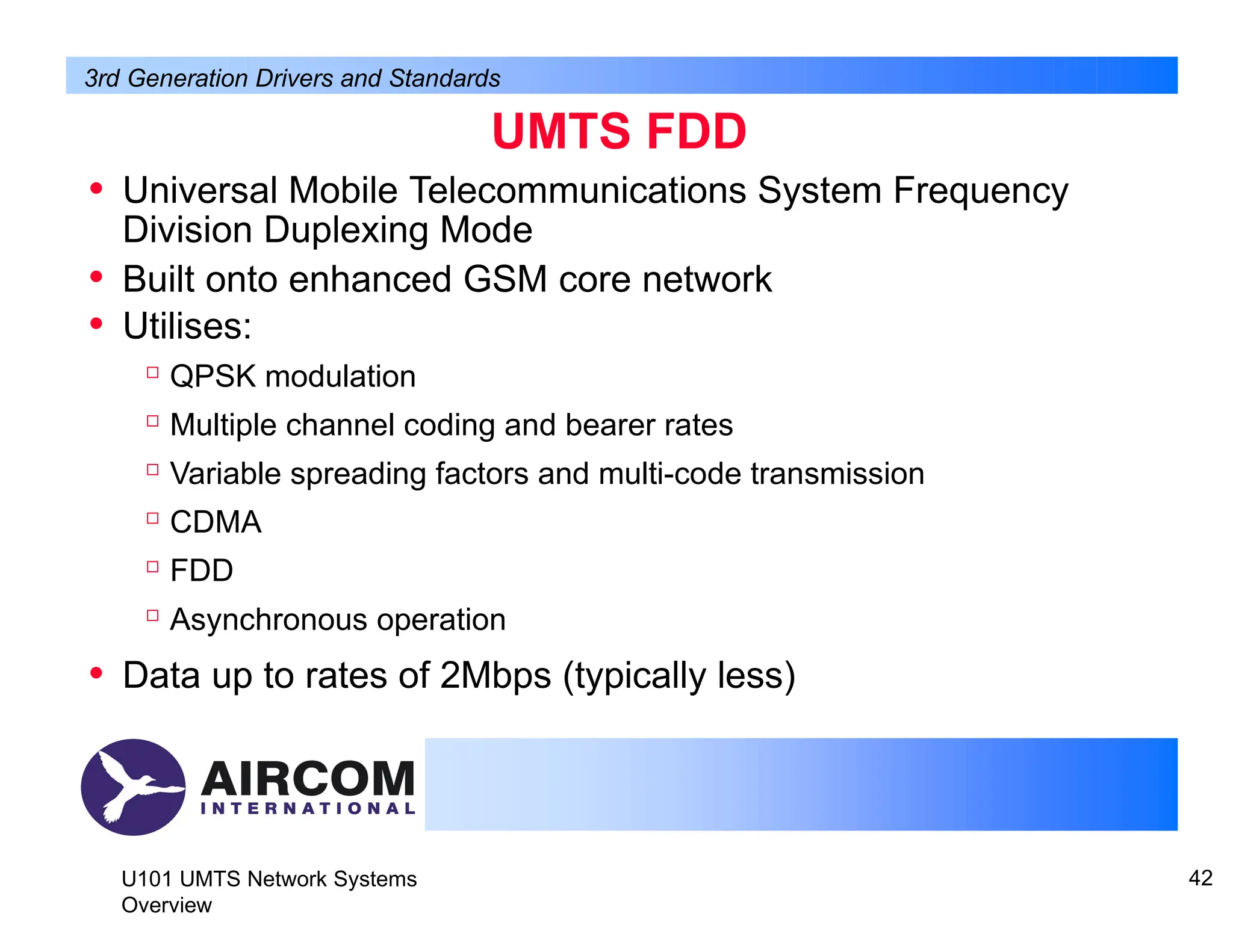
UMTS FDD
U101 UMTSNetwork Systems
Overview
42
• Universal Mobile Telecommunications System Frequency
Division Duplexing Mode
• Built onto enhanced GSM core network
• Utilises:
QPSK modulation
Multiple channel coding and bearer rates
Variable spreading factors and multi-code transmission
CDMA
FDD
Asynchronous operation
• Data up to rates of 2Mbps (typically less)
3rd Generation Drivers and Standards
43.
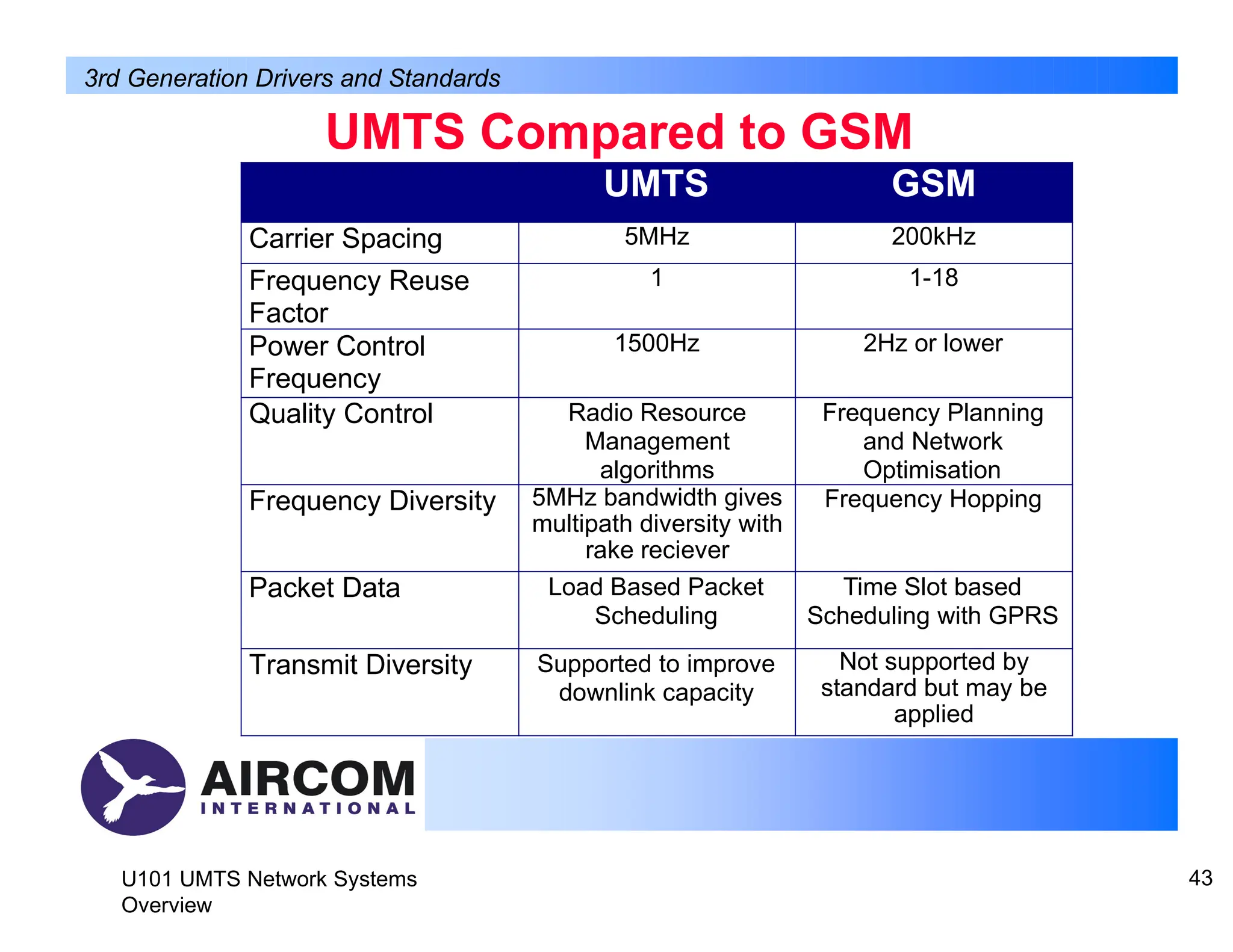
UMTS Compared toGSM
U101 UMTS Network Systems
Overview
43
3rd Generation Drivers and Standards
UMTS GSM
Carrier Spacing 5MHz 200kHz
Frequency Reuse
Factor
1 1-18
Power Control
Frequency
1500Hz 2Hz or lower
Quality Control Radio Resource
Management
algorithms
Frequency Planning
and Network
Optimisation
Frequency Diversity 5MHz bandwidth gives
multipath diversity with
rake reciever
Frequency Hopping
Packet Data Load Based Packet
Scheduling
Time Slot based
Scheduling with GPRS
Transmit Diversity Supported to improve
downlink capacity
Not supported by
standard but may be
applied
44.
UMTS Compared toIS95
U101 UMTS Network Systems
Overview
44
3rd Generation Drivers and Standards
UMTS IS-95
Carrier Spacing 5MHz 1.25MHz
Chip Rate 3.84Mcps 1.2288Mcps
Power Control
Frequency
1500Hz Uplink 800Hz,
Downlink slow
Base Station
Synchronisation
No Yes via GPS
Frequency Inter
Frequency
Handovers
Yes, slotted mode
measurements
Possible but
measurements not
specified
Packet Data Load Based Packet
Scheduling
Packets as short CS
calls
Radio Resource
Management
Efficient algorithms to
provide QoS
Not required for
speech only
Transmit Diversity Supported to improve
downlink capacity
Not supported by
standard
45.
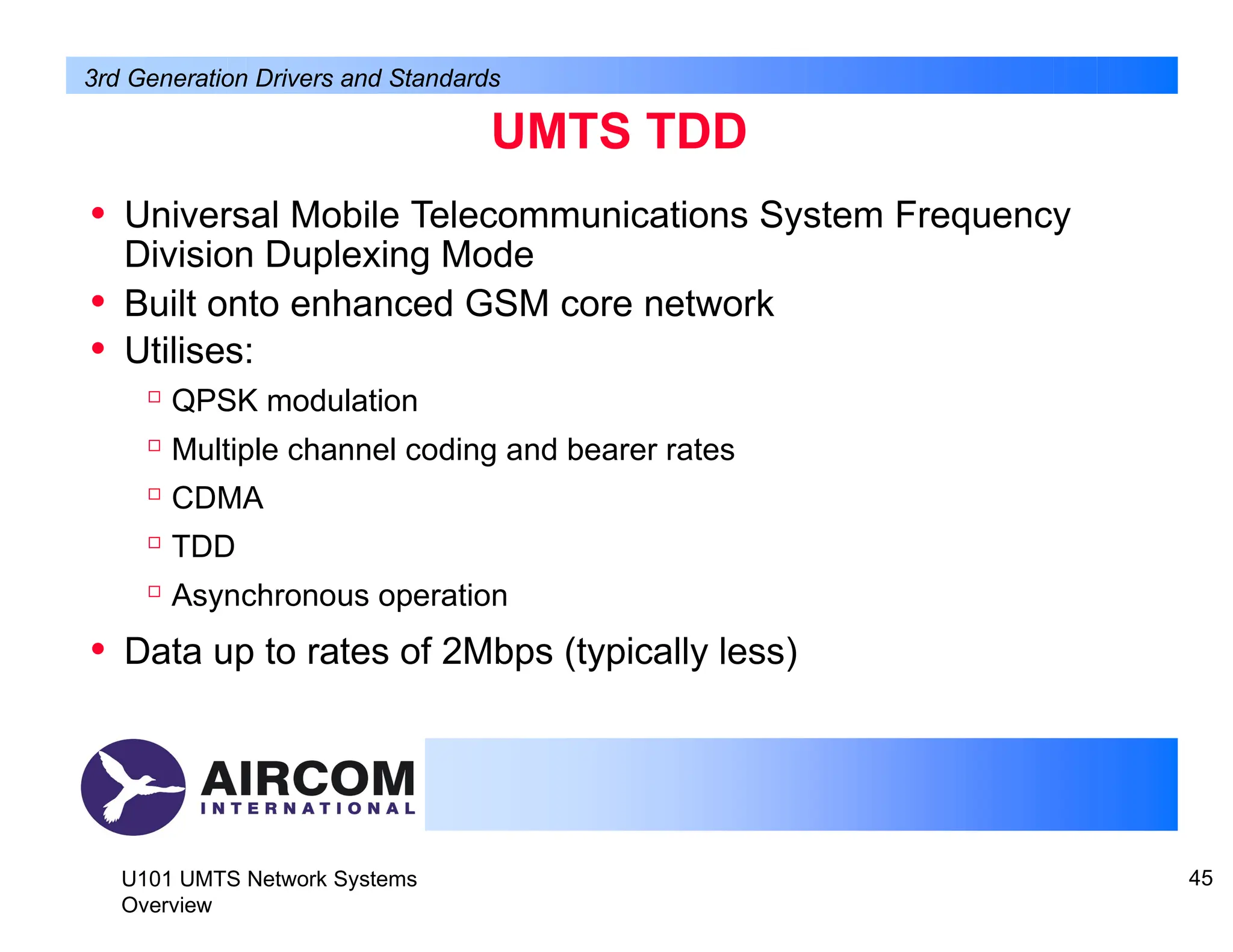
UMTS TDD
U101 UMTSNetwork Systems
Overview
45
• Universal Mobile Telecommunications System Frequency
Division Duplexing Mode
• Built onto enhanced GSM core network
• Utilises:
QPSK modulation
Multiple channel coding and bearer rates
CDMA
TDD
Asynchronous operation
• Data up to rates of 2Mbps (typically less)
3rd Generation Drivers and Standards
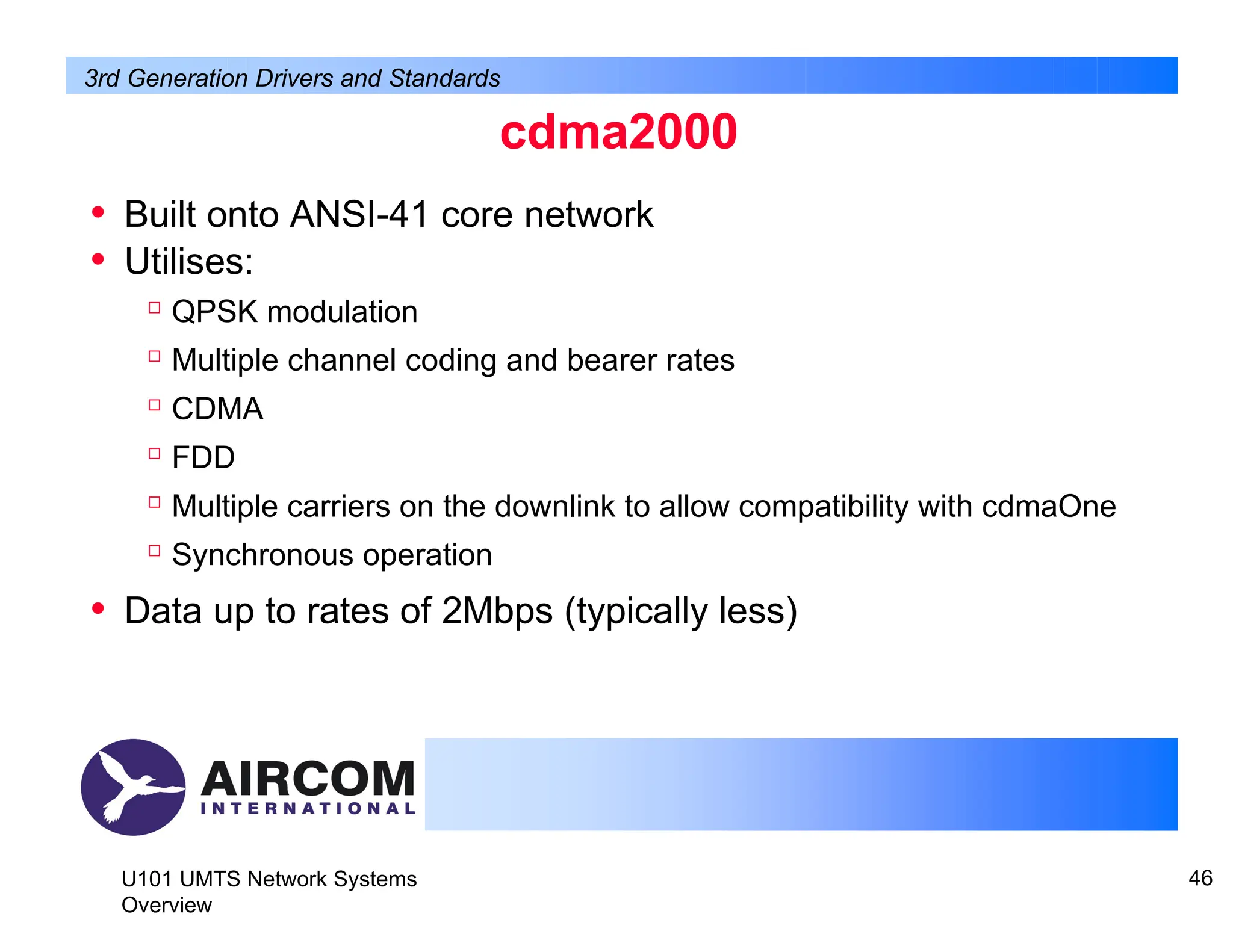
46.
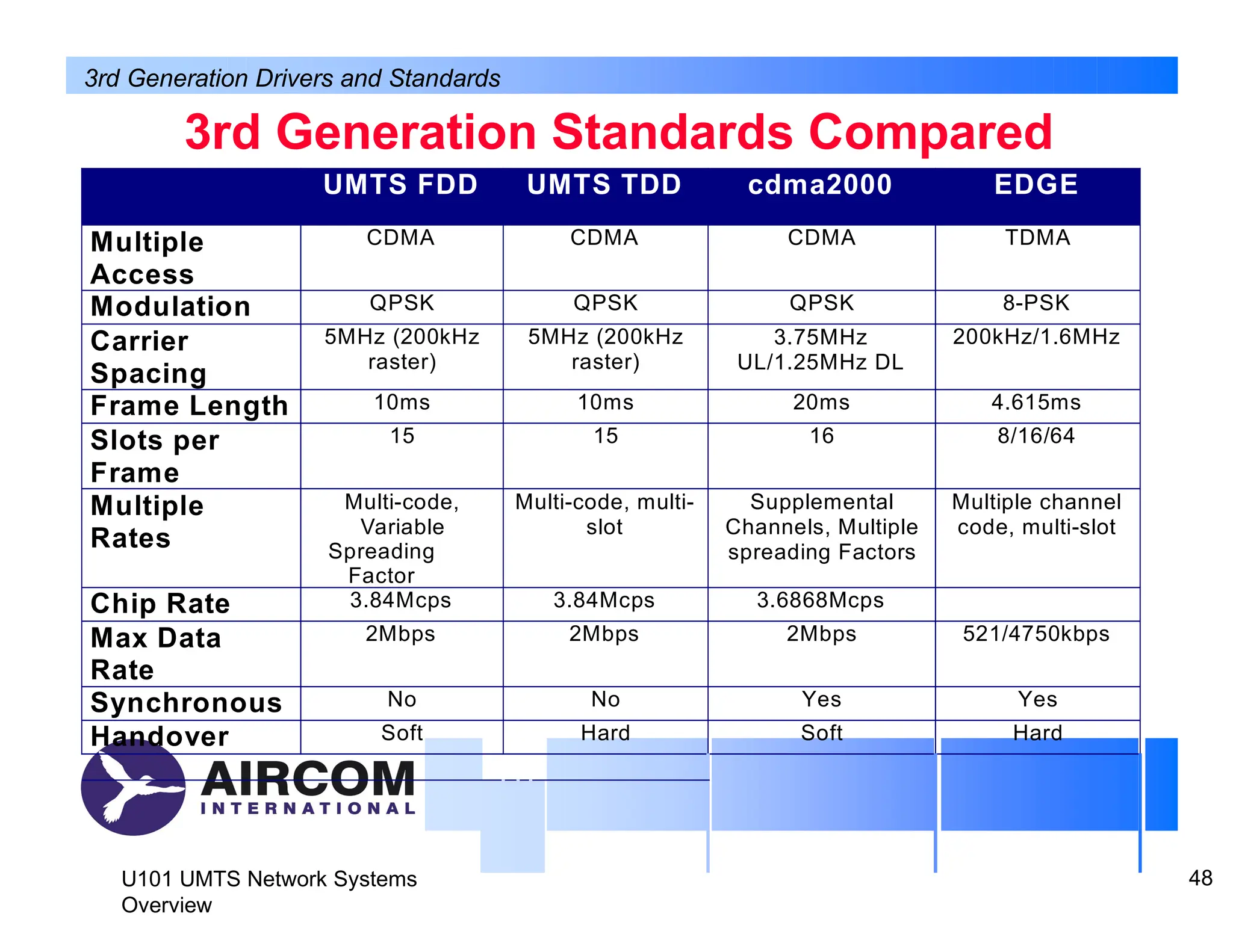
cdma2000
U101 UMTS NetworkSystems
Overview
46
• Built onto ANSI-41 core network
• Utilises:
QPSK modulation
Multiple channel coding and bearer rates
CDMA
FDD
Multiple carriers on the downlink to allow compatibility with cdmaOne
Synchronous operation
• Data up to rates of 2Mbps (typically less)
3rd Generation Drivers and Standards
47.
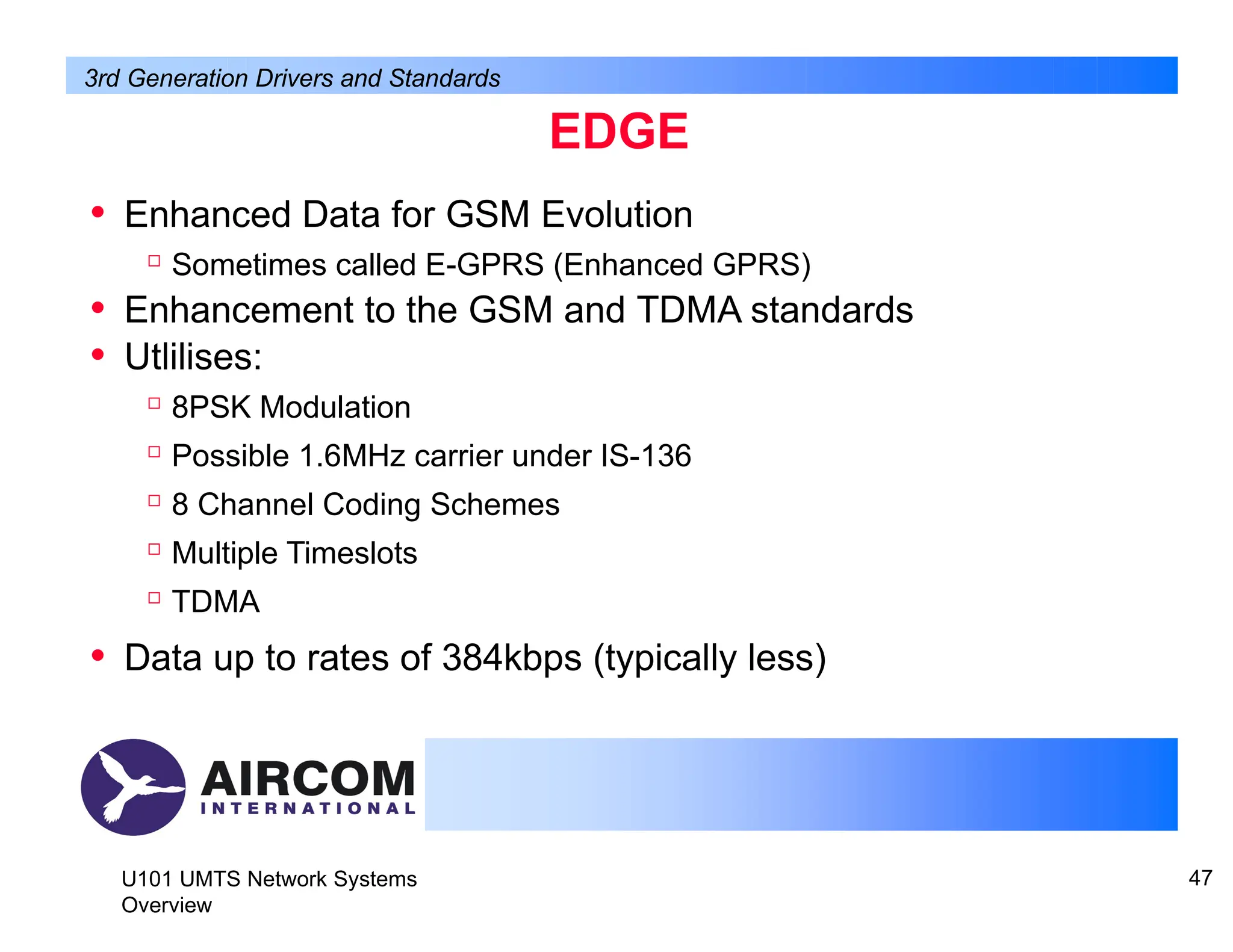
EDGE
U101 UMTS NetworkSystems
Overview
47
• Enhanced Data for GSM Evolution
Sometimes called E-GPRS (Enhanced GPRS)
• Enhancement to the GSM and TDMA standards
• Utlilises:
8PSK Modulation
Possible 1.6MHz carrier under IS-136
8 Channel Coding Schemes
Multiple Timeslots
TDMA
• Data up to rates of 384kbps (typically less)
3rd Generation Drivers and Standards
4th Generation...
• Probably2005-2007
• Broadband data rates in excess
of 1Mbps
• Probably 10MHz+ carriers
• ...
U101 UMTS Network Systems
Overview
49
3rd Generation Drivers and Standards
50.
Questions
U101 UMTS NetworkSystems
Overview
50
• What is IMT-2000 and why is it related to UMTS?
• Why do the American operators want cdma2000 and EDGE?
• What is the major difference between UMTS and cdma2000?
3rd Generation Drivers and Standards
51.
Session Summary
U101 UMTSNetwork Systems
Overview
51
• In this session we have discussed:
The key goals of IMT-2000
The drivers for 3rd generation from the regions
The key industry bodies and their relationships
The four cellular air interfaces for IMT-2000 are:
� UMTS FDD
� UMTS TDD
� cdma2000
� EDGE
3rd Generation Drivers and Standards