Wills Clinical Vision Research Training and
Mentoring Program: Implementation and Evaluation
Julia A. Haller MD, Ann P. Murchison MD, Lisa Hark PhD
January 29, 2016
Clinician Investigators as an
Endangered Species
Over the past 50 years, there has been a decline in
the number of physicians pursuing careers in clinical
research.
Causes:
Focus on basic science over patient-oriented research
Lack of clinical research introduction early in medical
education
Lack of Clinician Investigators
in Ophthalmology
Only 2% of ophthalmologists are actively involved
in research activities.
Yet the need for clinician investigators
continues to grow with the increasing eye
care demands of the aging population.
The Bridgetender:
Francis D. Moore, MD 1958
The surgical investigator must be a bridgetender, channeling knowledge from
basic science to the patient’s bedside and back again. He traces his origin
from both sides of the bridge. He is thus a bastard, and is called this by
everybody. Those at one end of the bridge say that he is not a very good
scientist, and those at the other say that he does not perform enough
operations. It is much harder to stay in the middle of the bridge than it is to
retreat to one end or the other. But all of the fundamental advances in
surgery from Vesalius to Halsted to Cushing have been made by those willing
to maintain this uncomfortable posture - the bridgetender.
Potential Solution
Expert panels have recommended exposing
students early in their training to structured, didactic
curricula with clinical research experience and
mentoring opportunities.
Wills Vision Research Program Purpose
To develop, implement, and evaluate a full-time,
8-week Clinical Vision Research Training and Mentoring
Program for undergraduate and medical students.
The program provides a structured, didactic vision
research curriculum to enhance students’
understanding of vision research methods.
Wills Vision Research Program Activities
Participate in a vision research project
Conduct vision-related literature reviews
Recruit patients for research studies
Perform electronic medical records review
Write and submit a paper for a peer-reviewed journal
Receive mentoring from faculty and research staff
Summer 2014 and 2015 Enrollment
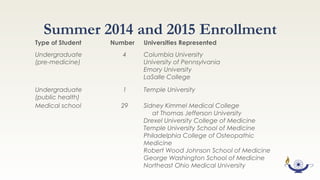
Type of Student Number Universities Represented
Undergraduate
(pre-medicine)
4 Columbia University
University of Pennsylvania
Emory University
LaSalle College
Undergraduate
(public health)
1 Temple University
Medical school 29 Sidney Kimmel Medical College
at Thomas Jefferson University
Drexel University College of Medicine
Temple University School of Medicine
Philadelphia College of Osteopathic
Medicine
Robert Wood Johnson School of Medicine
George Washington School of Medicine
Northeast Ohio Medical University
Eye Research-Related Lectures
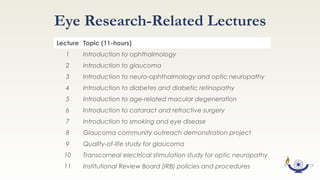
Lecture Topic (11-hours)
1 Introduction to ophthalmology
2 Introduction to glaucoma
3 Introduction to neuro-ophthalmology and optic neuropathy
4 Introduction to diabetes and diabetic retinopathy
5 Introduction to age-related macular degeneration
6 Introduction to cataract and refractive surgery
7 Introduction to smoking and eye disease
8 Glaucoma community outreach demonstration project
9 Quality-of-life study for glaucoma
10 Transcorneal electrical stimulation study for optic neuropathy
11 Institutional Review Board (IRB) policies and procedures
Manuscript-Writing Workshops
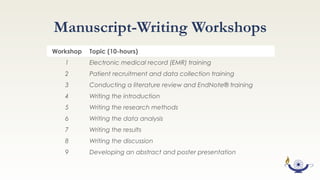
Workshop Topic (10-hours)
1 Electronic medical record (EMR) training
2 Patient recruitment and data collection training
3 Conducting a literature review and EndNote® training
4 Writing the introduction
5 Writing the research methods
6 Writing the data analysis
7 Writing the results
8 Writing the discussion
9 Developing an abstract and poster presentation
Evaluation Methods
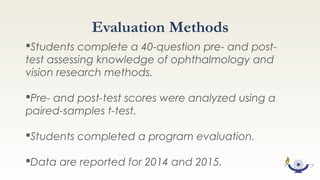
Students complete a 40-question pre- and post-
test assessing knowledge of ophthalmology and
vision research methods.
Pre- and post-test scores were analyzed using a
paired-samples t-test.
Students completed a program evaluation.
Data are reported for 2014 and 2015.
Evaluation Results
Students scored significantly higher on the
knowledge post-test (M=79.78%, SD=6.25) than on
the pre-test (M=71.43%, SD=8.43); P<0.001.
Results of the pre- and post-test analysis indicate
that lecture material supplemented with hands-on
experience can lead to better understanding of
ophthalmology and research.
Evaluation Results
The program evaluations indicate that students
were very satisfied with the program and that the
lecture series and manuscript-writing workshops
enhanced their learning.
All mean scores >4 (Scale 0-5).
Evaluation Results: Scale 0-5
Evaluation Questions M (SD)
I was satisfied with the program.
4.6 (0.51)
Program goals and objectives were clear.
4.3 (0.63)
Program was organized in a manner consistent with its stated goals.
4.3 (0.68)
Pre- and post-test questions were fair.
4.2 (0.82)
Adequate review mechanisms were provided for manuscript development.
4.5 (0.56)
The course materials were valuable for learning.
4.4 (0.73)
The lecture series and pre-residency lectures enhanced my learning.
4.6 (0.60)
I was satisfied with the lecture series overall.
4.3 (0.71)
The manuscript-workshop series enhanced my learning.
4.0 (0.80)
I was satisfied with the manuscript workshop series overall.
4.6 (0.88)
The abstract and poster development sessions enhanced my learning.
4.0 (0.79)
I was satisfied with the editing/feedback process to prepare the
manuscript.
4.4 (0.67)
I was satisfied with the program supervision.
4.5 (0.61)
Evaluation Conclusions
The Wills Eye Clinical Vision Research Training and
Mentoring Program provided an evidence-based
foundation in critical thinking, research methods,
and manuscript development for students
interested in careers in ophthalmology.
Students emerge with clinical research skills and an
increased understanding and appreciation of vision
research.
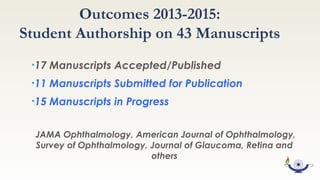
Outcomes 2013-2015:
Student Authorship on 43 Manuscripts
  
•17 Manuscripts Accepted/Published
•11 Manuscripts Submitted for Publication
•15 Manuscripts in Progress
 JAMA Ophthalmology, American Journal of Ophthalmology,
Survey of Ophthalmology, Journal of Glaucoma, Retina and
others
 
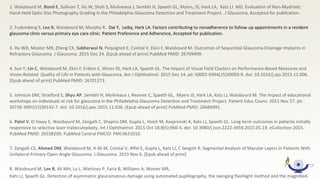
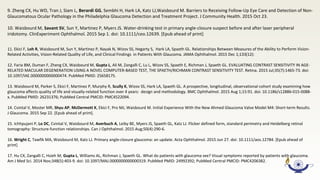
1. Waisbourd M, Bond E, Sullivan T, Hu W, Shah S, Molineaux J, Sembhi H, Spaeth GL, Myers, JS; Hark LA,  Katz LJ  MD. Evaluation of Non-Mydriatic 
Hand-Held Optic Disc Photography Grading in the Philadelphia Glaucoma Detection and Treatment Project . J Glaucoma, Accepted for publication. 
 
2. Fudemberg S, Lee B, Waisbourd M, Murphy R,  Dai Y,  Leiby, Hark LA. Factors contributing to nonadherence to follow-up appointments in a resident 
glaucoma clinic versus primary eye care clinic. Patient Preference and Adherence, Accepted for publication.
 
3. Hu WD, Moster MR, Zheng CX, Sabherwal N, Pequignot E, Cvintal V, Ekici F, Waisbourd M. Outcomes of Sequential Glaucoma Drainage Implants in 
Refractory Glaucoma. J Glaucoma. 2015 Dec 24. [Epub ahead of print] PubMed PMID: 26709499.   
 
4. Sun Y, Lin C, Waisbourd M, Ekici F, Erdem E, Wizov SS, Hark LA, Spaeth GL. The Impact of Visual Field Clusters on Performance-Based Measures and 
Vision-Related  Quality of Life in Patients with Glaucoma. Am J Ophthalmol. 2015 Dec 14. pii: S0002-9394(15)30003-9. doi: 10.1016/j.ajo.2015.12.006. 
[Epub ahead of print] PubMed PMID: 26701273.   
 
5. Johnson DM, Stratford S, Shyu AP, Sembhi H, Molineaux J, Reamer C, Spaeth GL,  Myers JS, Hark LA, Katz LJ, Waisbourd M. The impact of educational 
workshops on individuals at risk for glaucoma in the Philadelphia Glaucoma Detection and Treatment Project. Patient Educ Couns. 2015 Nov 27. pii: 
S0738-3991(15)30142-7. doi: 10.1016/j.pec.2015.11.026. [Epub ahead of print] PubMed PMID: 26686991. 
 
6. Patel V, El Hawy E, Waisbourd M, Zangalli C, Shapiro DM, Gupta L, Hsieh M, Kasprenski A, Katz LJ, Spaeth GL. Long-term outcomes in patients initially 
responsive to selective laser trabeculoplasty. Int J Ophthalmol. 2015 Oct 18;8(5):960-4. doi: 10.3980/j.issn.2222-3959.2015.05.19. eCollection 2015. 
PubMed PMID: 26558209; PubMed Central PMCID: PMC4631010. 
 
7. Zangalli CS, Ahmed OM, Waisbourd M, H Ali M, Cvintal V, Affel E, Gupta L, Katz LJ, C Sergott R. Segmental Analysis of Macular Layers in Patients With 
Unilateral Primary Open-Angle Glaucoma. J Glaucoma. 2015 Nov 6. [Epub ahead of print]
 
8. Waisbourd M, Lee B, Ali MH, Lu L, Martinez P, Faria B, Williams A, Moster MR, 
Katz LJ, Spaeth GL. Detection of asymmetric glaucomatous damage using automated pupillography, the swinging flashlight method and the magnified-
9. Zheng CX, Hu WD, Tran J, Siam L, Berardi GG, Sembhi H, Hark LA, Katz LJ,Waisbourd M. Barriers to Receiving Follow-Up Eye Care and Detection of Non-
Glaucomatous Ocular Pathology in the Philadelphia Glaucoma Detection and Treatment Project. J Community Health. 2015 Oct 23. 
 
10. Waisbourd M, Savant SV, Sun Y, Martinez P, Myers JS. Water-drinking test in primary angle-closure suspect before and after laser peripheral 
iridotomy. ClinExperiment Ophthalmol. 2015 Sep 1. doi: 10.1111/ceo.12639. [Epub ahead of print]
 
11. Ekici F, Loh R, Waisbourd M, Sun Y, Martinez P, Nayak N, Wizov SS, Hegarty S,  Hark LA, Spaeth GL. Relationships Between Measures of the Ability to Perform Vision-
Related Activities, Vision-Related Quality of Life, and Clinical Findings  in Patients With Glaucoma. JAMA Ophthalmol. 2015 Dec 1;133(12):
 
12. Faria BM, Duman F, Zheng CX, Waisbourd M, Gupta L, Ali M, Zangalli C, Lu L, Wizov SS, Spaeth E, Richman J, Spaeth GL. EVALUATING CONTRAST SENSITIVITY IN AGE-
RELATED MACULAR DEGENERATION USING A NOVEL COMPUTER-BASED TEST, THE SPAETH/RICHMAN CONTRAST SENSITIVITY TEST. Retina. 2015 Jul;35(7):1465-73. doi: 
10.1097/IAE.0000000000000474. PubMed PMID: 25658175. 
 
13. Waisbourd M, Parker S, Ekici F, Martinez P, Murphy R, Scully K, Wizov SS, Hark LA, Spaeth GL. A prospective, longitudinal, observational cohort study examining how 
glaucoma affects quality of life and visually-related function over 4 years:  design and methodology. BMC Ophthalmol. 2015 Aug 1;15:91. doi: 10.1186/s12886-015-0088-
x. PubMed PMID: 26231376; PubMed Central PMCID: PMC4522094. 
 
14. Cvintal V, Moster MR, Shyu AP, McDermott K, Ekici F, Pro MJ, Waisbourd M. Initial Experience With the New Ahmed Glaucoma Valve Model M4: Short-term Results. 
J Glaucoma. 2015 Sep 22. [Epub ahead of print].
 
15. Ichhpujani P, Lo DC, Cvintal V, Waisbourd M, Averbuch A, Leiby BE, Myers JS, Spaeth GL, Katz LJ. Flicker defined form, standard perimetry and Heidelberg retinal 
tomography: Structure-function relationships. Can J Ophthalmol. 2015 Aug;50(4):290-6. 
 
16. Wright C, Tawfik MA, Waisbourd M, Katz LJ. Primary angle-closure glaucoma: an update. Acta Ophthalmol. 2015 Jun 27. doi: 10.1111/aos.12784. [Epub ahead of 
print] 
 
17. Hu CX, Zangalli C, Hsieh M, Gupta L, Williams AL, Richman J, Spaeth GL. What do patients with glaucoma see? Visual symptoms reported by patients with glaucoma. 
Am J Med Sci. 2014 Nov;348(5):403-9. doi: 10.1097/MAJ.0000000000000319. PubMed PMID: 24992392; PubMed Central PMCID: PMC4206382. 
Outcomes 2013-2015:
Student Authorship on 43 Manuscripts
  
•17 Manuscripts Accepted/Published
•11 Manuscripts Submitted for Publication
•15 Manuscripts in Progress
 JAMA Ophthalmology, American Journal of Ophthalmology,
Survey of Ophthalmology, Journal of Glaucoma, Retina and
others
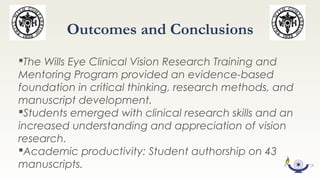
Outcomes and Conclusions
The Wills Eye Clinical Vision Research Training and
Mentoring Program provided an evidence-based
foundation in critical thinking, research methods, and
manuscript development.
Students emerged with clinical research skills and an
increased understanding and appreciation of vision
research.
Academic productivity: Student authorship on 43
manuscripts.
Outcomes and Conclusions
Ultimately the success of the program will be
judged by whether students pursue careers as
clinician-scientists.
Potential model for developing clinician-scientists
in ophthalmology and other medical and surgical
subspecialties.
As long as there is an unconquered disease, an injury that
cannot be repaired, or a method of prevention that remains
beyond reach, we have an obligation to conduct research.
Research represents HOPE, and for many patients and
families, hope is the best thing we have to offer. We pursue
investigations so that one day we can offer health.
Judah Folkman, M.D
Thank you
www.aupo.org

Wills Clinical Vision Research Training and Mentoring Program: Implementation and Evaluation

  • 1.
    Wills Clinical VisionResearch Training and Mentoring Program: Implementation and Evaluation Julia A. Haller MD, Ann P. Murchison MD, Lisa Hark PhD January 29, 2016
  • 2.
    Clinician Investigators asan Endangered Species Over the past 50 years, there has been a decline in the number of physicians pursuing careers in clinical research. Causes: Focus on basic science over patient-oriented research Lack of clinical research introduction early in medical education
  • 3.
    Lack of ClinicianInvestigators in Ophthalmology Only 2% of ophthalmologists are actively involved in research activities. Yet the need for clinician investigators continues to grow with the increasing eye care demands of the aging population.
  • 4.
    The Bridgetender: Francis D.Moore, MD 1958 The surgical investigator must be a bridgetender, channeling knowledge from basic science to the patient’s bedside and back again. He traces his origin from both sides of the bridge. He is thus a bastard, and is called this by everybody. Those at one end of the bridge say that he is not a very good scientist, and those at the other say that he does not perform enough operations. It is much harder to stay in the middle of the bridge than it is to retreat to one end or the other. But all of the fundamental advances in surgery from Vesalius to Halsted to Cushing have been made by those willing to maintain this uncomfortable posture - the bridgetender.
  • 5.
    Potential Solution Expert panelshave recommended exposing students early in their training to structured, didactic curricula with clinical research experience and mentoring opportunities.
  • 6.
    Wills Vision ResearchProgram Purpose To develop, implement, and evaluate a full-time, 8-week Clinical Vision Research Training and Mentoring Program for undergraduate and medical students. The program provides a structured, didactic vision research curriculum to enhance students’ understanding of vision research methods.
  • 7.
    Wills Vision ResearchProgram Activities Participate in a vision research project Conduct vision-related literature reviews Recruit patients for research studies Perform electronic medical records review Write and submit a paper for a peer-reviewed journal Receive mentoring from faculty and research staff
  • 8.
    Summer 2014 and2015 Enrollment Type of Student Number Universities Represented Undergraduate (pre-medicine) 4 Columbia University University of Pennsylvania Emory University LaSalle College Undergraduate (public health) 1 Temple University Medical school 29 Sidney Kimmel Medical College at Thomas Jefferson University Drexel University College of Medicine Temple University School of Medicine Philadelphia College of Osteopathic Medicine Robert Wood Johnson School of Medicine George Washington School of Medicine Northeast Ohio Medical University
  • 9.
    Eye Research-Related Lectures LectureTopic (11-hours) 1 Introduction to ophthalmology 2 Introduction to glaucoma 3 Introduction to neuro-ophthalmology and optic neuropathy 4 Introduction to diabetes and diabetic retinopathy 5 Introduction to age-related macular degeneration 6 Introduction to cataract and refractive surgery 7 Introduction to smoking and eye disease 8 Glaucoma community outreach demonstration project 9 Quality-of-life study for glaucoma 10 Transcorneal electrical stimulation study for optic neuropathy 11 Institutional Review Board (IRB) policies and procedures
  • 10.
    Manuscript-Writing Workshops Workshop Topic(10-hours) 1 Electronic medical record (EMR) training 2 Patient recruitment and data collection training 3 Conducting a literature review and EndNote® training 4 Writing the introduction 5 Writing the research methods 6 Writing the data analysis 7 Writing the results 8 Writing the discussion 9 Developing an abstract and poster presentation
  • 11.
    Evaluation Methods Students completea 40-question pre- and post- test assessing knowledge of ophthalmology and vision research methods. Pre- and post-test scores were analyzed using a paired-samples t-test. Students completed a program evaluation. Data are reported for 2014 and 2015.
  • 12.
    Evaluation Results Students scoredsignificantly higher on the knowledge post-test (M=79.78%, SD=6.25) than on the pre-test (M=71.43%, SD=8.43); P<0.001. Results of the pre- and post-test analysis indicate that lecture material supplemented with hands-on experience can lead to better understanding of ophthalmology and research.
  • 13.
    Evaluation Results The programevaluations indicate that students were very satisfied with the program and that the lecture series and manuscript-writing workshops enhanced their learning. All mean scores >4 (Scale 0-5).
  • 14.
    Evaluation Results: Scale0-5 Evaluation Questions M (SD) I was satisfied with the program. 4.6 (0.51) Program goals and objectives were clear. 4.3 (0.63) Program was organized in a manner consistent with its stated goals. 4.3 (0.68) Pre- and post-test questions were fair. 4.2 (0.82) Adequate review mechanisms were provided for manuscript development. 4.5 (0.56) The course materials were valuable for learning. 4.4 (0.73) The lecture series and pre-residency lectures enhanced my learning. 4.6 (0.60) I was satisfied with the lecture series overall. 4.3 (0.71) The manuscript-workshop series enhanced my learning. 4.0 (0.80) I was satisfied with the manuscript workshop series overall. 4.6 (0.88) The abstract and poster development sessions enhanced my learning. 4.0 (0.79) I was satisfied with the editing/feedback process to prepare the manuscript. 4.4 (0.67) I was satisfied with the program supervision. 4.5 (0.61)
  • 15.
    Evaluation Conclusions The WillsEye Clinical Vision Research Training and Mentoring Program provided an evidence-based foundation in critical thinking, research methods, and manuscript development for students interested in careers in ophthalmology. Students emerge with clinical research skills and an increased understanding and appreciation of vision research.
  • 16.
    Outcomes 2013-2015: Student Authorshipon 43 Manuscripts    •17 Manuscripts Accepted/Published •11 Manuscripts Submitted for Publication •15 Manuscripts in Progress  JAMA Ophthalmology, American Journal of Ophthalmology, Survey of Ophthalmology, Journal of Glaucoma, Retina and others
  • 17.
      1. Waisbourd M, Bond E, Sullivan T, Hu W, Shah S, Molineaux J, Sembhi H, Spaeth GL, Myers, JS; Hark LA,  Katz LJ  MD. Evaluation of Non-Mydriatic  Hand-Held Optic Disc Photography Grading in the Philadelphia Glaucoma Detection and Treatment Project . J Glaucoma, Accepted for publication.    2. Fudemberg S, Lee B, Waisbourd M, Murphy R,  Dai Y,  Leiby, Hark LA. Factors contributing to nonadherence to follow-up appointments in a resident  glaucoma clinic versus primary eye care clinic. Patient Preference and Adherence, Accepted for publication.   3. Hu WD, Moster MR, Zheng CX, SabherwalN, Pequignot E, Cvintal V, Ekici F, Waisbourd M. Outcomes of Sequential Glaucoma Drainage Implants in  Refractory Glaucoma. J Glaucoma. 2015 Dec 24. [Epub ahead of print] PubMed PMID: 26709499.      4. Sun Y, Lin C, Waisbourd M, Ekici F, Erdem E, Wizov SS, Hark LA, Spaeth GL. The Impact of Visual Field Clusters on Performance-Based Measures and  Vision-Related  Quality of Life in Patients with Glaucoma. Am J Ophthalmol. 2015 Dec 14. pii: S0002-9394(15)30003-9. doi: 10.1016/j.ajo.2015.12.006.  [Epub ahead of print] PubMed PMID: 26701273.      5. Johnson DM, Stratford S, Shyu AP, Sembhi H, Molineaux J, Reamer C, Spaeth GL,  Myers JS, Hark LA, Katz LJ, Waisbourd M. The impact of educational  workshops on individuals at risk for glaucoma in the Philadelphia Glaucoma Detection and Treatment Project. Patient Educ Couns. 2015 Nov 27. pii:  S0738-3991(15)30142-7. doi: 10.1016/j.pec.2015.11.026. [Epub ahead of print] PubMed PMID: 26686991.    6. Patel V, El Hawy E, Waisbourd M, Zangalli C, Shapiro DM, Gupta L, Hsieh M, Kasprenski A, Katz LJ, Spaeth GL. Long-term outcomes in patients initially  responsive to selective laser trabeculoplasty. Int J Ophthalmol. 2015 Oct 18;8(5):960-4. doi: 10.3980/j.issn.2222-3959.2015.05.19. eCollection 2015.  PubMed PMID: 26558209; PubMed Central PMCID: PMC4631010.    7. Zangalli CS, Ahmed OM, Waisbourd M, H Ali M, Cvintal V, Affel E, Gupta L, Katz LJ, C Sergott R. Segmental Analysis of Macular Layers in Patients With  Unilateral Primary Open-Angle Glaucoma. J Glaucoma. 2015 Nov 6. [Epub ahead of print]   8. Waisbourd M, Lee B, Ali MH, Lu L, Martinez P, Faria B, Williams A, Moster MR,  Katz LJ, Spaeth GL. Detection of asymmetric glaucomatous damage using automated pupillography, the swinging flashlight method and the magnified-
  • 18.
    9. Zheng CX, Hu WD, Tran J, Siam L, Berardi GG, Sembhi H, Hark LA, Katz LJ,Waisbourd M. Barriers to Receiving Follow-Up Eye Care and Detection of Non- Glaucomatous Ocular Pathology in the Philadelphia Glaucoma Detection and Treatment Project. J Community Health. 2015 Oct 23.    10. Waisbourd M, Savant SV, Sun Y, Martinez P, Myers JS. Water-drinking test in primary angle-closure suspect before and after laser peripheral  iridotomy. ClinExperiment Ophthalmol. 2015 Sep 1. doi: 10.1111/ceo.12639. [Epub ahead of print]   11. Ekici F, LohR, Waisbourd M, Sun Y, Martinez P, Nayak N, Wizov SS, Hegarty S,  Hark LA, Spaeth GL. Relationships Between Measures of the Ability to Perform Vision- Related Activities, Vision-Related Quality of Life, and Clinical Findings  in Patients With Glaucoma. JAMA Ophthalmol. 2015 Dec 1;133(12):   12. Faria BM, Duman F, Zheng CX, Waisbourd M, Gupta L, Ali M, Zangalli C, Lu L, Wizov SS, Spaeth E, Richman J, Spaeth GL. EVALUATING CONTRAST SENSITIVITY IN AGE- RELATED MACULAR DEGENERATION USING A NOVEL COMPUTER-BASED TEST, THE SPAETH/RICHMAN CONTRAST SENSITIVITY TEST. Retina. 2015 Jul;35(7):1465-73. doi:  10.1097/IAE.0000000000000474. PubMed PMID: 25658175.    13. Waisbourd M, Parker S, Ekici F, Martinez P, Murphy R, Scully K, Wizov SS, Hark LA, Spaeth GL. A prospective, longitudinal, observational cohort study examining how  glaucoma affects quality of life and visually-related function over 4 years:  design and methodology. BMC Ophthalmol. 2015 Aug 1;15:91. doi: 10.1186/s12886-015-0088- x. PubMed PMID: 26231376; PubMed Central PMCID: PMC4522094.    14. Cvintal V, Moster MR, Shyu AP, McDermott K, Ekici F, Pro MJ, Waisbourd M. Initial Experience With the New Ahmed Glaucoma Valve Model M4: Short-term Results.  J Glaucoma. 2015 Sep 22. [Epub ahead of print].   15. Ichhpujani P, Lo DC, Cvintal V, Waisbourd M, Averbuch A, Leiby BE, Myers JS, Spaeth GL, Katz LJ. Flicker defined form, standard perimetry and Heidelberg retinal  tomography: Structure-function relationships. Can J Ophthalmol. 2015 Aug;50(4):290-6.    16. Wright C, Tawfik MA, Waisbourd M, Katz LJ. Primary angle-closure glaucoma: an update. Acta Ophthalmol. 2015 Jun 27. doi: 10.1111/aos.12784. [Epub ahead of  print]    17. Hu CX, Zangalli C, Hsieh M, Gupta L, Williams AL, Richman J, Spaeth GL. What do patients with glaucoma see? Visual symptoms reported by patients with glaucoma.  Am J Med Sci. 2014 Nov;348(5):403-9. doi: 10.1097/MAJ.0000000000000319. PubMed PMID: 24992392; PubMed Central PMCID: PMC4206382. 
  • 19.
    Outcomes 2013-2015: Student Authorshipon 43 Manuscripts    •17 Manuscripts Accepted/Published •11 Manuscripts Submitted for Publication •15 Manuscripts in Progress  JAMA Ophthalmology, American Journal of Ophthalmology, Survey of Ophthalmology, Journal of Glaucoma, Retina and others
  • 20.
    Outcomes and Conclusions TheWills Eye Clinical Vision Research Training and Mentoring Program provided an evidence-based foundation in critical thinking, research methods, and manuscript development. Students emerged with clinical research skills and an increased understanding and appreciation of vision research. Academic productivity: Student authorship on 43 manuscripts.
  • 21.
    Outcomes and Conclusions Ultimatelythe success of the program will be judged by whether students pursue careers as clinician-scientists. Potential model for developing clinician-scientists in ophthalmology and other medical and surgical subspecialties.
  • 22.
    As long asthere is an unconquered disease, an injury that cannot be repaired, or a method of prevention that remains beyond reach, we have an obligation to conduct research. Research represents HOPE, and for many patients and families, hope is the best thing we have to offer. We pursue investigations so that one day we can offer health. Judah Folkman, M.D
  • 23.