I do not have enough context to answer the open-book quiz questions. My role is to summarize the key points of the provided document, not to answer specific questions about its content.
William James
1842-1910
Pragmatic American School of
Psychology:
Humanistic, Conscious Psychology
2.
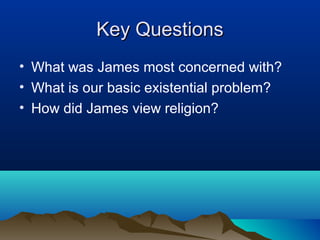
Key Questions
• Whatwas James most concerned with?
• What is our basic existential problem?
• How did James view religion?
3.
Intro William James
• Concern?
• The worth and growth of the self
• We need to become ourselves
• Key insight?
• b/c of our need for acceptance by others,
we are willing to deny the growth of true
self
4.
Our Problem?
• Needso much to be loved by significant
other, we deny or distort or needs
• Therapy? A process of getting in touch
with what and how we actually feel about
our experiences
• Religion? Helps us get in touch with our
experience of God (which we distort);
something we cling to when desperate
5.
Biography
• Famous family:brother, the novelist Henry
James, sister Alice
• Family: grandfather William one of
wealthiest in America: Father Henry bit of
mystic; did not work
• depressive
• Long interested in the paranormal
6.
Biography continued
• Giftedartist
• Graduated Harvard 1860
• Medical Doctor; taught at Harvard 1872
• Best known for Varieties of Religious
Experience (1901)
• Wrote Principles of Psychology (1883-
1889): most used textbook in psychology
7.
Characteristics of James
• Open-minded w/eye of scientist
• Many friends but depressive; always sick
• Deep need to understand experience
• Asked: What is experience trying to teach us?
• Father’s influence; “bizarre” but powerful religion
• James puzzled/fascinated by this
• Varieties attempt to understand this
8.
Views on Religion
•Distrustful of organized religion
• Sensed something there (God), but no
strong sense
• Reduced religion to ideals: Goodness,
Truth, Simplicity
• saw as desirable and valuable but
incapable of inspiring any passion
9.
Views on Religioncont
• Religion Man’s most important function
• Pragmatic: What does religion do for us?
• Believed nothing can do for a person what
religion can do for a person
10.
James’ Philosophy
• Howdoes James’ overall philosophy
influence his understanding of religion?
• Pragmatism and Pluralism
• Varieties of Religious Experience grew
out of series of lectures given in Scotland
(Gifford Lectures)
11.
Goal of GiffordLectures
• Understand experience of religion by the
person
• Scientific approach
• Approached as Non-believer
• Describes nature of conversionary
experience
12.
Lecture #1
• Wantsto distinguish (not separate)
between:
• Existential judgment (judgment of facts)
and…Spiritual fact (judgment of value)
• The “facts” of Bible and its value two
different things
• *judgment of fact cannot determine
judgment of value
13.
Religion as “AcuteFever”
• Studied religious experience of founding
figures of religions
• Interested in religion as an “acute fever”
rather than dull habit
• So many living with “second hand
religion”, or someone else’s experience
14.
What makes somethingTrue?
• “roots” of religion (facts) and fruits (value)
of religion
• To know one is not to know the other
• Truth of something is really a spiritual
matter
• Truth not in origins but in way it works out
as a whole over time (Pragmatic)
15.
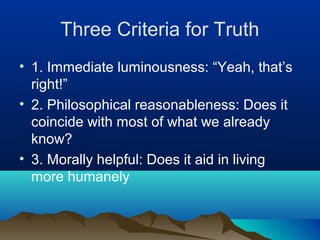
Three Criteria forTruth
• 1. Immediate luminousness: “Yeah, that’s
right!”
• 2. Philosophical reasonableness: Does it
coincide with most of what we already
know?
• 3. Morally helpful: Does it aid in living
more humanely
16.
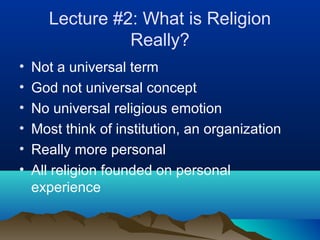
Lecture #2: Whatis Religion
Really?
• Not a universal term
• God not universal concept
• No universal religious emotion
• Most think of institution, an organization
• Really more personal
• All religion founded on personal
experience
17.
James’ Definition ofReligion
• the feelings, acts, and experiences of
[individuals] in their solitude, so far as they
apprehend themselves in relation to the
Divine
• very American
• Religious person has surrendered to
‘Higher Power’
• Religious happiness very unique: no
happiness like religious happiness
18.
Lecture #3: Conversionary,
“Mystical” Experience
• Heart of James
• We can all sense reality in way that
goes beyond the senses. Meaning?
• Extrasensory “sense of a presence”
• Leads to “deep understanding” of
reality
19.
Religion About Feeling
•Need to understand God in conceptual
terms: God as Father, God as One, Trinity
• James: not how it works: is about feeling
• Connected to our body: “organismically”
connected to God
• *Note: opposite to what Freud says about
religious experience
20.
Religion as Feeling:Four Keys
Things
• 1. Primacy of Feelings: concepts (reason)
ultimately based on feelings
• 2. Depth of Feeling: unreasoned, intuition,
“sense” of truth: concepts only a surface
manifestation of this deeper feeling
• 3. Feelings as Facts: by themselves
concepts have no meaning w/o being
based on deeper “felt experience”
21.
Religion as Feelingcont.
• 4. Feelings as Knowledge and Truth:
feelings are “source of knowledge: Jung
took this from James
22.
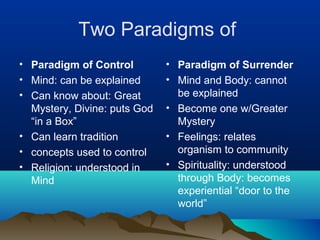
Two Paradigms of
•Paradigm of Control • Paradigm of Surrender
• Mind: can be explained • Mind and Body: cannot
• Can know about: Great be explained
Mystery, Divine: puts God • Become one w/Greater
“in a Box” Mystery
• Can learn tradition • Feelings: relates
• concepts used to control organism to community
• Religion: understood in • Spirituality: understood
Mind through Body: becomes
experiential “door to the
world”
23.
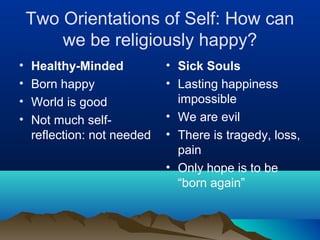
Two Orientations ofSelf: How can
we be religiously happy?
• Healthy-Minded • Sick Souls
• Born happy • Lasting happiness
• World is good impossible
• Not much self- • We are evil
reflection: not needed • There is tragedy, loss,
pain
• Only hope is to be
“born again”
24.
Models of Conversion
•From: feelings of loss, depression, lack of
meaning,
• To feelings of unity with self, God
25.
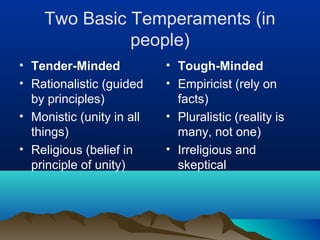
Two Basic Temperaments(in
people)
• Tender-Minded • Tough-Minded
• Rationalistic (guided • Empiricist (rely on
by principles) facts)
• Monistic (unity in all • Pluralistic (reality is
things) many, not one)
• Religious (belief in • Irreligious and
principle of unity) skeptical
26.
• Philosophically, Jameswas empiricist and
pluralistic
• Goal: combining tough-minded approach
(scientific, loyal to observable facts) with
tender-minded religious sensibilities
27.
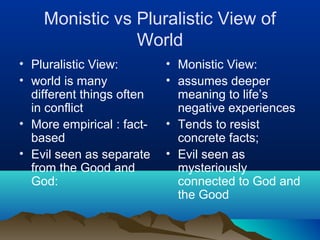
Monistic vs PluralisticView of
World
• Pluralistic View: • Monistic View:
• world is many • assumes deeper
different things often meaning to life’s
in conflict negative experiences
• More empirical : fact- • Tends to resist
based concrete facts;
• Evil seen as separate • Evil seen as
from the Good and mysteriously
God: connected to God and
the Good
28.
Philosophical Context
• Pragmatism:adopted in U.S. more than
anywhere else: looks at practical
consequences of supposed truths and
actions
• What is a pragmatic view of life?
• What is a pragmatic approach to religious
truth?
• Practical consequences of viewing world
as one or many?
29.
Nature of Truth:Religious and
Otherwise
• What difference does it make if this is true
and that is not?
– What is true is what works
• But what is goal of held truths (religious)?
– Answer must come from somewhere other
than reason and rational: deepest human
conviction
• What is true is what proves itself over time
30.
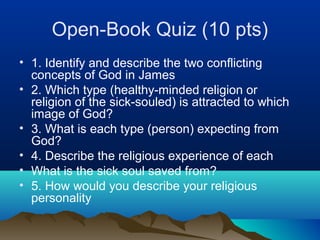
Open-Book Quiz (10pts)
• 1. Identify and describe the two conflicting
concepts of God in James
• 2. Which type (healthy-minded religion or
religion of the sick-souled) is attracted to which
image of God?
• 3. What is each type (person) expecting from
God?
• 4. Describe the religious experience of each
• What is the sick soul saved from?
• 5. How would you describe your religious
personality
![James’ Definition of Religion
• the feelings, acts, and experiences of
[individuals] in their solitude, so far as they
apprehend themselves in relation to the
Divine
• very American
• Religious person has surrendered to
‘Higher Power’
• Religious happiness very unique: no
happiness like religious happiness](https://image.slidesharecdn.com/willjames1-120927074522-phpapp01/85/Will-james-1-17-320.jpg)