WILDLIFE CONSERVATION
PROJECTS IN INDIA
By : Nida Anwar
Wildlife Conservation Projects
■ Wildlife Conservation projects aim to preserve and use natural resources in
a sustainable manner. This is done to ensure that future generations can
benefit from these resources. Wildlife is an essential element of nature, so
it must be protected.
■ The government of India has initiated many wildlife conservation
projects like Project Elephant, Project Tiger, Indian Rhino Vision
2020, Project Hangul, Crocodile Conservation Initiative, etc.
Project Tiger
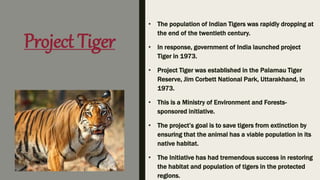
• The population of Indian Tigers was rapidly dropping at
the end of the twentieth century.
• In response, government of India launched project
Tiger in 1973.
• Project Tiger was established in the Palamau Tiger
Reserve, Jim Corbett National Park, Uttarakhand, in
1973.
• This is a Ministry of Environment and Forests-
sponsored initiative.
• The project’s goal is to save tigers from extinction by
ensuring that the animal has a viable population in its
native habitat.
• The Initiative has had tremendous success in restoring
the habitat and population of tigers in the protected
regions.
TigerTaskForce
■ To ensure the proper implementation of the project Tiger , it
required the need for statuary authority to ensure tiger
conservation.
■ The Tiger Task Force was Set up to look after the problems of
Tiger conservation in India, on the recommendations of the
national board for wildlife.
■ The TTF proposed the formation of the National Tiger
Conservation Authority (NTCA).
■ National Board for Wildlife 》Tiger Task Force 》 NTCA
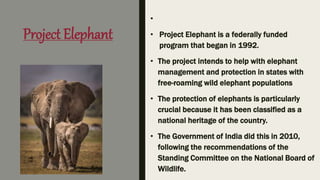
Project Elephant
•
• Project Elephant is a federally funded
program that began in 1992.
• The project intends to help with elephant
management and protection in states with
free-roaming wild elephant populations
• The protection of elephants is particularly
crucial because it has been classified as a
national heritage of the country.
• The Government of India did this in 2010,
following the recommendations of the
Standing Committee on the National Board of
Wildlife.
The project’s goals are as follows:
■ Preservation of elephants,
elephant corridors, and their
habitats; prevention of man-
animal conflicts; and
protection of domesticated
elephants.
■ This initiative is critical
because it protects elephants
from poachers and hunters,
hence reducing illegal ivory
trade.
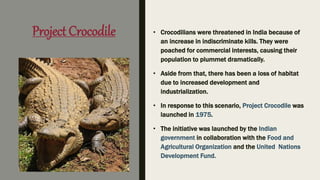
Project Crocodile • Crocodilians were threatened in India because of
an increase in indiscriminate kills. They were
poached for commercial interests, causing their
population to plummet dramatically.
• Aside from that, there has been a loss of habitat
due to increased development and
industrialization.
• In response to this scenario, Project Crocodile was
launched in 1975.
• The initiative was launched by the Indian
government in collaboration with the Food and
Agricultural Organization and the United Nations
Development Fund.
■ The project include an intensive captive rearing and
breeding program intended to restock depleted
Gharial habitat.
■ Crocodile populations have increased as a result of the
project’s implementation, saving them from extinction.
■ National Chambal Sanctuary and Katerniaghat wildlife
Sanctuary are two of the protected sites.
Project Hangul
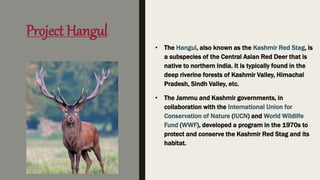
• The Hangul, also known as the Kashmir Red Stag, is
a subspecies of the Central Asian Red Deer that is
native to northern India. It is typically found in the
deep riverine forests of Kashmir Valley, Himachal
Pradesh, Sindh Valley, etc.
• The Jammu and Kashmir governments, in
collaboration with the International Union for
Conservation of Nature (IUCN) and World Wildlife
Fund (WWF), developed a program in the 1970s to
protect and conserve the Kashmir Red Stag and its
habitat.
• It has been considered one of the most endangered mammal
species in the Indian subcontinent since the 1950s.
• Threats to Hangul: Habitat destruction, Overgrazing, infection
and poaching.
• The project’s goal was to build enclosures for the species’
artificial breeding.
Indian Rhino Vision
2020
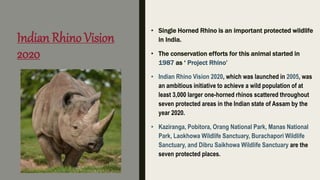
• Single Horned Rhino is an important protected wildlife
in India.
• The conservation efforts for this animal started in
1987 as ‘ Project Rhino’
• Indian Rhino Vision 2020, which was launched in 2005, was
an ambitious initiative to achieve a wild population of at
least 3,000 larger one-horned rhinos scattered throughout
seven protected areas in the Indian state of Assam by the
year 2020.
• Kaziranga, Pobitora, Orang National Park, Manas National
Park, Laokhowa Wildlife Sanctuary, Burachapori Wildlife
Sanctuary, and Dibru Saikhowa Wildlife Sanctuary are the
seven protected places.
Some other projects are :
■ Project Gangetic River Dolphin (1986)
■ Project Snow Leopard (2009)
■ Project Vulture (2006)
■ The Gur Lion Sanctuary Project (1972)
■ Project Himalayan Musk Deer (1981)
■ Project Cheetah (2022)
Thank you

Wildlife conservation projects in INDIA

  • 1.
    WILDLIFE CONSERVATION PROJECTS ININDIA By : Nida Anwar
  • 2.
    Wildlife Conservation Projects ■Wildlife Conservation projects aim to preserve and use natural resources in a sustainable manner. This is done to ensure that future generations can benefit from these resources. Wildlife is an essential element of nature, so it must be protected. ■ The government of India has initiated many wildlife conservation projects like Project Elephant, Project Tiger, Indian Rhino Vision 2020, Project Hangul, Crocodile Conservation Initiative, etc.
  • 3.
    Project Tiger • Thepopulation of Indian Tigers was rapidly dropping at the end of the twentieth century. • In response, government of India launched project Tiger in 1973. • Project Tiger was established in the Palamau Tiger Reserve, Jim Corbett National Park, Uttarakhand, in 1973. • This is a Ministry of Environment and Forests- sponsored initiative. • The project’s goal is to save tigers from extinction by ensuring that the animal has a viable population in its native habitat. • The Initiative has had tremendous success in restoring the habitat and population of tigers in the protected regions.
  • 4.
    TigerTaskForce ■ To ensurethe proper implementation of the project Tiger , it required the need for statuary authority to ensure tiger conservation. ■ The Tiger Task Force was Set up to look after the problems of Tiger conservation in India, on the recommendations of the national board for wildlife. ■ The TTF proposed the formation of the National Tiger Conservation Authority (NTCA). ■ National Board for Wildlife 》Tiger Task Force 》 NTCA
  • 5.
    Project Elephant • • ProjectElephant is a federally funded program that began in 1992. • The project intends to help with elephant management and protection in states with free-roaming wild elephant populations • The protection of elephants is particularly crucial because it has been classified as a national heritage of the country. • The Government of India did this in 2010, following the recommendations of the Standing Committee on the National Board of Wildlife.
  • 6.
    The project’s goalsare as follows: ■ Preservation of elephants, elephant corridors, and their habitats; prevention of man- animal conflicts; and protection of domesticated elephants. ■ This initiative is critical because it protects elephants from poachers and hunters, hence reducing illegal ivory trade.
  • 7.
    Project Crocodile •Crocodilians were threatened in India because of an increase in indiscriminate kills. They were poached for commercial interests, causing their population to plummet dramatically. • Aside from that, there has been a loss of habitat due to increased development and industrialization. • In response to this scenario, Project Crocodile was launched in 1975. • The initiative was launched by the Indian government in collaboration with the Food and Agricultural Organization and the United Nations Development Fund.
  • 8.
    ■ The projectinclude an intensive captive rearing and breeding program intended to restock depleted Gharial habitat. ■ Crocodile populations have increased as a result of the project’s implementation, saving them from extinction. ■ National Chambal Sanctuary and Katerniaghat wildlife Sanctuary are two of the protected sites.
  • 9.
    Project Hangul • TheHangul, also known as the Kashmir Red Stag, is a subspecies of the Central Asian Red Deer that is native to northern India. It is typically found in the deep riverine forests of Kashmir Valley, Himachal Pradesh, Sindh Valley, etc. • The Jammu and Kashmir governments, in collaboration with the International Union for Conservation of Nature (IUCN) and World Wildlife Fund (WWF), developed a program in the 1970s to protect and conserve the Kashmir Red Stag and its habitat.
  • 10.
    • It hasbeen considered one of the most endangered mammal species in the Indian subcontinent since the 1950s. • Threats to Hangul: Habitat destruction, Overgrazing, infection and poaching. • The project’s goal was to build enclosures for the species’ artificial breeding.
  • 11.
    Indian Rhino Vision 2020 •Single Horned Rhino is an important protected wildlife in India. • The conservation efforts for this animal started in 1987 as ‘ Project Rhino’ • Indian Rhino Vision 2020, which was launched in 2005, was an ambitious initiative to achieve a wild population of at least 3,000 larger one-horned rhinos scattered throughout seven protected areas in the Indian state of Assam by the year 2020. • Kaziranga, Pobitora, Orang National Park, Manas National Park, Laokhowa Wildlife Sanctuary, Burachapori Wildlife Sanctuary, and Dibru Saikhowa Wildlife Sanctuary are the seven protected places.
  • 12.
    Some other projectsare : ■ Project Gangetic River Dolphin (1986) ■ Project Snow Leopard (2009) ■ Project Vulture (2006) ■ The Gur Lion Sanctuary Project (1972) ■ Project Himalayan Musk Deer (1981) ■ Project Cheetah (2022)
  • 13.