WIKIMEDIA AUSTRALIA
A COLLABORATIVE COMMUNITY
WHY AND HOW TO GET INVOLVED IN COLLABORATIONS WITH WIKIPEDIA
DR THOMAS SHAFEE
CC BY 4.0
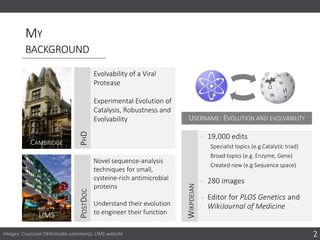
MY
BACKGROUND
2Images: Cruccone (Wikimedia commons), LIMS website
‐ 19,000 edits
Specialist topics (e.g Catalytic triad)
Broad topics (e.g. Enzyme, Gene)
Created new (e.g Sequence space)
‐ 280 images
‐ Editor for PLOS Genetics and
WikiJournal of Medicine
WIKPDEIAN
USERNAME: EVOLUTION AND EVOLVABILITY
Evolvability of a Viral
Protease
Experimental Evolution of
Catalysis, Robustness and
Evolvability
PHD
Novel sequence-analysis
techniques for small,
cysteine-rich antimicrobial
proteins
Understand their evolution
to engineer their function
POSTDOC
CAMBRIDGE
LIMS
WIKIPEDIA
A KEY TOOL ROUTE OF INFORMATION DISSEMINATION
3
0
1,000
2,000
3,000
4,000
5,000
6,000
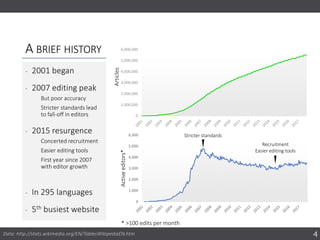
A BRIEF HISTORY
‐ 2001 began
‐ 2007 editing peak
But poor accuracy
Stricter standards lead
to fall-off in editors
‐ 2015 resurgence
Concerted recruitment
Easier editing tools
First year since 2007
with editor growth
‐ In 295 languages
‐ 5th busiest website
4Data: http://stats.wikimedia.org/EN/TablesWikipediaEN.htm
Stricter standards
Activeeditors*
Articles
Recruitment
Easier editing tools
* >100 edits per month
0
1,000,000
2,000,000
3,000,000
4,000,000
5,000,000
6,000,000
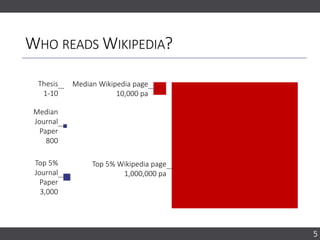
WHO READS WIKIPEDIA?
5
Thesis
1-10
Median
Journal
Paper
800
Top 5%
Journal
Paper
3,000
Median Wikipedia page
10,000 pa
Top 5% Wikipedia page
1,000,000 pa
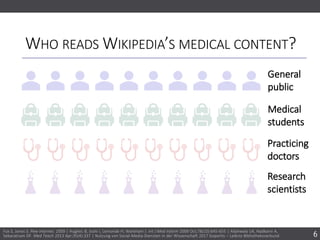
WHO READS WIKIPEDIA’S MEDICAL CONTENT?
6
Fox S, Jones S. Pew Internet. 2009 | Hughes B, Joshi I, Lemonde H, Wareham J. Int J Med Inform 2009 Oct;78(10):645-655 | Allahwala UK, Nadkarni A,
Sebaratnam DF. Med Teach 2013 Apr;35(4):337 | Nutzung von Social-Media-Diensten in der Wissenschaft 2017 Goportis – Leibniz-Bibliotheksverbund
General
public
Practicing
doctors
Medical
students
Research
scientists
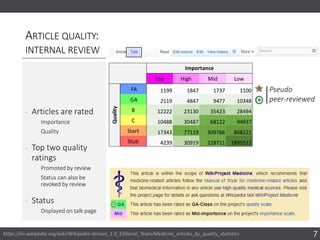
ARTICLE QUALITY:
INTERNAL REVIEW
‐ Articles are rated
Importance
Quality
‐ Top two quality
ratings
Promoted by review
Status can also be
revoked by review
‐ Status
Displayed on talk page
7https://en.wikipedia.org/wiki/Wikipedia:Version_1.0_Editorial_Team/Medicine_articles_by_quality_statistics
Top High Mid Low
FA 1199 1847 1737 1100
GA 2119 4847 9477 10348
B 12222 23130 35423 28494
C 10488 30487 68122 94937
Start 17343 77119 309766 808221
Stub 4239 30919 228711 1895512
Importance
Quality
Pseudo
peer-reviewed
ARTICLE QUALITY:
EXTERNAL REVIEW
‐ Quality comparable to encyclopedia Britannica even back in 2005
‐ Accuracy varies by topic, but broad trends:
Inconsistent coverage
Missing / out of date information
Missing illustration
Difficult readability
‐ Accuracy has immediate, real-world impact
Internet medical data influences the healthcare decisions of >50% of readers
Many articles are read a million times per year
‐ Yet is has been consistently difficult to engage academics,
experts and health professionals
8Nature 2005 438:900 | S Fox, M Duggan Pew internet 2013
SISTER PROJECTS
WIKIMEDIA COMMONS, WIKIDATA, WIKIJOURNALS
A MASSIVE MEDIA REPOSITORY
‐ Multimedia file repository
Images
Video
Sound
‐ Public domain / Freely-licensed
Creative commons licenses
‐ Content scope
Educational
Informative
Instructional
‐ Like all Wikimedia projects, free and volunteer-run
10
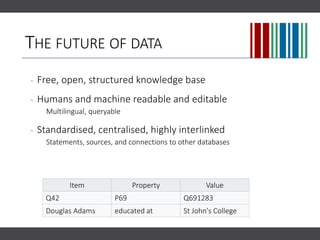
THE FUTURE OF DATA
‐ Free, open, structured knowledge base
‐ Humans and machine readable and editable
Multilingual, queryable
‐ Standardised, centralised, highly interlinked
Statements, sources, and connections to other databases
Item Property Value
Q42 P69 Q691283
Douglas Adams educated at St John's College
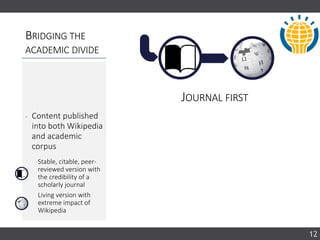
BRIDGING THE
ACADEMIC DIVIDE
12
JOURNAL FIRST
‐ Content published
into both Wikipedia
and academic
corpus
Stable, citable, peer-
reviewed version with
the credibility of a
scholarly journal
Living version with
extreme impact of
Wikipedia
DUAL-PUBLISHING
MODELS
13
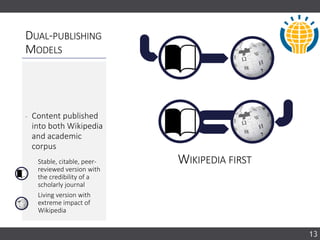
WIKIPEDIA FIRST
‐ Content published
into both Wikipedia
and academic
corpus
Stable, citable, peer-
reviewed version with
the credibility of a
scholarly journal
Living version with
extreme impact of
Wikipedia
DUAL-PUBLISHING
MODELS
14
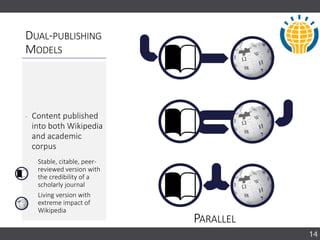
PARALLEL
‐ Content published
into both Wikipedia
and academic
corpus
Stable, citable, peer-
reviewed version with
the credibility of a
scholarly journal
Living version with
extreme impact of
Wikipedia
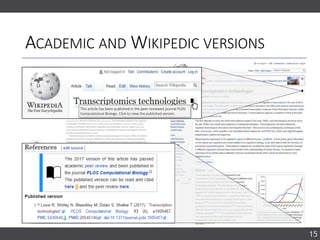
ACADEMIC AND WIKIPEDIC VERSIONS
15
This article has been published in the peer-reviewed journal PLOS
Computational Biology. Click to view the published version
WHY AND HOW TO
COLLABORATE
TEAMING UP WITH EXPERIENCED EXPERTS
1
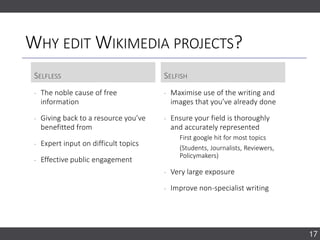
WHY EDIT WIKIMEDIA PROJECTS?
SELFLESS SELFISH
‐ The noble cause of free
information
‐ Giving back to a resource you’ve
benefitted from
‐ Expert input on difficult topics
‐ Effective public engagement
‐ Maximise use of the writing and
images that you’ve already done
‐ Ensure your field is thoroughly
and accurately represented
First google hit for most topics
(Students, Journalists, Reviewers,
Policymakers)
‐ Very large exposure
‐ Improve non-specialist writing
17
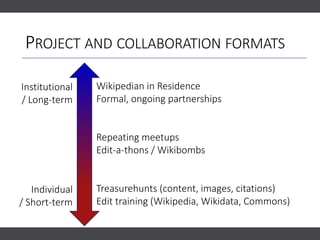
PROJECT AND COLLABORATION FORMATS
Institutional
/ Long-term
Wikipedian in Residence
Formal, ongoing partnerships
Repeating meetups
Edit-a-thons / Wikibombs
Treasurehunts (content, images, citations)
Edit training (Wikipedia, Wikidata, Commons)
Individual
/ Short-term
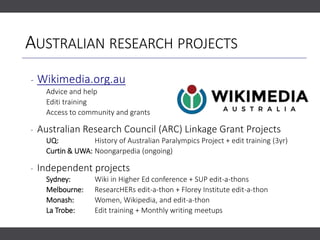
AUSTRALIAN RESEARCH PROJECTS
‐ Wikimedia.org.au
Advice and help
Editi training
Access to community and grants
‐ Australian Research Council (ARC) Linkage Grant Projects
UQ: History of Australian Paralympics Project + edit training (3yr)
Curtin & UWA: Noongarpedia (ongoing)
‐ Independent projects
Sydney: Wiki in Higher Ed conference + SUP edit-a-thons
Melbourne: ResearcHERs edit-a-thon + Florey Institute edit-a-thon
Monash: Women, Wikipedia, and edit-a-thon
La Trobe: Edit training + Monthly writing meetups
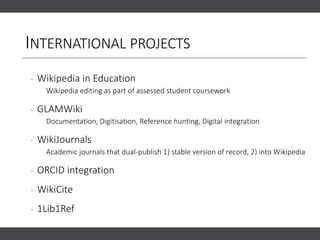
INTERNATIONAL PROJECTS
‐ Wikipedia in Education
Wikipedia editing as part of assessed student coursework
‐ GLAMWiki
Documentation, Digitisation, Reference hunting, Digital integration
‐ WikiJournals
Academic journals that dual-publish 1) stable version of record, 2) into Wikipedia
‐ ORCID integration
‐ WikiCite
‐ 1Lib1Ref
WHAT DOES THE
FUTURE HOLD?
AND WHAT SHOULD IT?
2
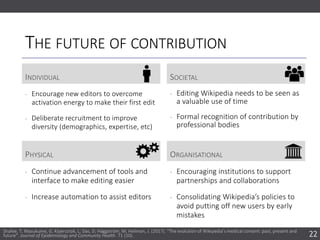
THE FUTURE OF CONTRIBUTION
INDIVIDUAL SOCIETAL
‐ Encourage new editors to overcome
activation energy to make their first edit
‐ Deliberate recruitment to improve
diversity (demographics, expertise, etc)
‐ Editing Wikipedia needs to be seen as
a valuable use of time
‐ Formal recognition of contribution by
professional bodies
22
Shafee, T; Masukume, G; Kipersztok, L; Das, D; Häggström, M; Heilman, J. (2017). “The evolution of Wikipedia’s medical content: past, present and
future“. Journal of Epidemiology and Community Health. 71 (10).
PHYSICAL ORGANISATIONAL
‐ Continue advancement of tools and
interface to make editing easier
‐ Increase automation to assist editors
‐ Encouraging institutions to support
partnerships and collaborations
‐ Consolidating Wikipedia’s policies to
avoid putting off new users by early
mistakes
23
Contact WikiMedia Australia
Website Wikimedia.org.au
Email Contact@Wikimedia.org.au
Contact me
Email Thomas.Shafee@gmail.com
ResearchGate Thomas Shafee
LinkedIn Thomas Shafee
Wikipedia user Search “User:Tshafee”
Journals
WikiJournal of Medicine WikiJMed.org
WikiJournal of Science WikiJSci.org
WikiJournal of Humanities WikiJHum.org (pending)
PLOS TopicPagesWiki.plos.org

Wikimedia Australia rscd2018

  • 1.
    WIKIMEDIA AUSTRALIA A COLLABORATIVECOMMUNITY WHY AND HOW TO GET INVOLVED IN COLLABORATIONS WITH WIKIPEDIA DR THOMAS SHAFEE CC BY 4.0
  • 2.
    MY BACKGROUND 2Images: Cruccone (Wikimediacommons), LIMS website ‐ 19,000 edits Specialist topics (e.g Catalytic triad) Broad topics (e.g. Enzyme, Gene) Created new (e.g Sequence space) ‐ 280 images ‐ Editor for PLOS Genetics and WikiJournal of Medicine WIKPDEIAN USERNAME: EVOLUTION AND EVOLVABILITY Evolvability of a Viral Protease Experimental Evolution of Catalysis, Robustness and Evolvability PHD Novel sequence-analysis techniques for small, cysteine-rich antimicrobial proteins Understand their evolution to engineer their function POSTDOC CAMBRIDGE LIMS
  • 3.
    WIKIPEDIA A KEY TOOLROUTE OF INFORMATION DISSEMINATION 3
  • 4.
    0 1,000 2,000 3,000 4,000 5,000 6,000 A BRIEF HISTORY ‐2001 began ‐ 2007 editing peak But poor accuracy Stricter standards lead to fall-off in editors ‐ 2015 resurgence Concerted recruitment Easier editing tools First year since 2007 with editor growth ‐ In 295 languages ‐ 5th busiest website 4Data: http://stats.wikimedia.org/EN/TablesWikipediaEN.htm Stricter standards Activeeditors* Articles Recruitment Easier editing tools * >100 edits per month 0 1,000,000 2,000,000 3,000,000 4,000,000 5,000,000 6,000,000
  • 5.
    WHO READS WIKIPEDIA? 5 Thesis 1-10 Median Journal Paper 800 Top5% Journal Paper 3,000 Median Wikipedia page 10,000 pa Top 5% Wikipedia page 1,000,000 pa
  • 6.
    WHO READS WIKIPEDIA’SMEDICAL CONTENT? 6 Fox S, Jones S. Pew Internet. 2009 | Hughes B, Joshi I, Lemonde H, Wareham J. Int J Med Inform 2009 Oct;78(10):645-655 | Allahwala UK, Nadkarni A, Sebaratnam DF. Med Teach 2013 Apr;35(4):337 | Nutzung von Social-Media-Diensten in der Wissenschaft 2017 Goportis – Leibniz-Bibliotheksverbund General public Practicing doctors Medical students Research scientists
  • 7.
    ARTICLE QUALITY: INTERNAL REVIEW ‐Articles are rated Importance Quality ‐ Top two quality ratings Promoted by review Status can also be revoked by review ‐ Status Displayed on talk page 7https://en.wikipedia.org/wiki/Wikipedia:Version_1.0_Editorial_Team/Medicine_articles_by_quality_statistics Top High Mid Low FA 1199 1847 1737 1100 GA 2119 4847 9477 10348 B 12222 23130 35423 28494 C 10488 30487 68122 94937 Start 17343 77119 309766 808221 Stub 4239 30919 228711 1895512 Importance Quality Pseudo peer-reviewed
  • 8.
    ARTICLE QUALITY: EXTERNAL REVIEW ‐Quality comparable to encyclopedia Britannica even back in 2005 ‐ Accuracy varies by topic, but broad trends: Inconsistent coverage Missing / out of date information Missing illustration Difficult readability ‐ Accuracy has immediate, real-world impact Internet medical data influences the healthcare decisions of >50% of readers Many articles are read a million times per year ‐ Yet is has been consistently difficult to engage academics, experts and health professionals 8Nature 2005 438:900 | S Fox, M Duggan Pew internet 2013
  • 9.
    SISTER PROJECTS WIKIMEDIA COMMONS,WIKIDATA, WIKIJOURNALS
  • 10.
    A MASSIVE MEDIAREPOSITORY ‐ Multimedia file repository Images Video Sound ‐ Public domain / Freely-licensed Creative commons licenses ‐ Content scope Educational Informative Instructional ‐ Like all Wikimedia projects, free and volunteer-run 10
  • 11.
    THE FUTURE OFDATA ‐ Free, open, structured knowledge base ‐ Humans and machine readable and editable Multilingual, queryable ‐ Standardised, centralised, highly interlinked Statements, sources, and connections to other databases Item Property Value Q42 P69 Q691283 Douglas Adams educated at St John's College
  • 12.
    BRIDGING THE ACADEMIC DIVIDE 12 JOURNALFIRST ‐ Content published into both Wikipedia and academic corpus Stable, citable, peer- reviewed version with the credibility of a scholarly journal Living version with extreme impact of Wikipedia
  • 13.
    DUAL-PUBLISHING MODELS 13 WIKIPEDIA FIRST ‐ Contentpublished into both Wikipedia and academic corpus Stable, citable, peer- reviewed version with the credibility of a scholarly journal Living version with extreme impact of Wikipedia
  • 14.
    DUAL-PUBLISHING MODELS 14 PARALLEL ‐ Content published intoboth Wikipedia and academic corpus Stable, citable, peer- reviewed version with the credibility of a scholarly journal Living version with extreme impact of Wikipedia
  • 15.
    ACADEMIC AND WIKIPEDICVERSIONS 15 This article has been published in the peer-reviewed journal PLOS Computational Biology. Click to view the published version
  • 16.
    WHY AND HOWTO COLLABORATE TEAMING UP WITH EXPERIENCED EXPERTS 1
  • 17.
    WHY EDIT WIKIMEDIAPROJECTS? SELFLESS SELFISH ‐ The noble cause of free information ‐ Giving back to a resource you’ve benefitted from ‐ Expert input on difficult topics ‐ Effective public engagement ‐ Maximise use of the writing and images that you’ve already done ‐ Ensure your field is thoroughly and accurately represented First google hit for most topics (Students, Journalists, Reviewers, Policymakers) ‐ Very large exposure ‐ Improve non-specialist writing 17
  • 18.
    PROJECT AND COLLABORATIONFORMATS Institutional / Long-term Wikipedian in Residence Formal, ongoing partnerships Repeating meetups Edit-a-thons / Wikibombs Treasurehunts (content, images, citations) Edit training (Wikipedia, Wikidata, Commons) Individual / Short-term
  • 19.
    AUSTRALIAN RESEARCH PROJECTS ‐Wikimedia.org.au Advice and help Editi training Access to community and grants ‐ Australian Research Council (ARC) Linkage Grant Projects UQ: History of Australian Paralympics Project + edit training (3yr) Curtin & UWA: Noongarpedia (ongoing) ‐ Independent projects Sydney: Wiki in Higher Ed conference + SUP edit-a-thons Melbourne: ResearcHERs edit-a-thon + Florey Institute edit-a-thon Monash: Women, Wikipedia, and edit-a-thon La Trobe: Edit training + Monthly writing meetups
  • 20.
    INTERNATIONAL PROJECTS ‐ Wikipediain Education Wikipedia editing as part of assessed student coursework ‐ GLAMWiki Documentation, Digitisation, Reference hunting, Digital integration ‐ WikiJournals Academic journals that dual-publish 1) stable version of record, 2) into Wikipedia ‐ ORCID integration ‐ WikiCite ‐ 1Lib1Ref
  • 21.
    WHAT DOES THE FUTUREHOLD? AND WHAT SHOULD IT? 2
  • 22.
    THE FUTURE OFCONTRIBUTION INDIVIDUAL SOCIETAL ‐ Encourage new editors to overcome activation energy to make their first edit ‐ Deliberate recruitment to improve diversity (demographics, expertise, etc) ‐ Editing Wikipedia needs to be seen as a valuable use of time ‐ Formal recognition of contribution by professional bodies 22 Shafee, T; Masukume, G; Kipersztok, L; Das, D; Häggström, M; Heilman, J. (2017). “The evolution of Wikipedia’s medical content: past, present and future“. Journal of Epidemiology and Community Health. 71 (10). PHYSICAL ORGANISATIONAL ‐ Continue advancement of tools and interface to make editing easier ‐ Increase automation to assist editors ‐ Encouraging institutions to support partnerships and collaborations ‐ Consolidating Wikipedia’s policies to avoid putting off new users by early mistakes
  • 23.
    23 Contact WikiMedia Australia WebsiteWikimedia.org.au Email Contact@Wikimedia.org.au Contact me Email Thomas.Shafee@gmail.com ResearchGate Thomas Shafee LinkedIn Thomas Shafee Wikipedia user Search “User:Tshafee” Journals WikiJournal of Medicine WikiJMed.org WikiJournal of Science WikiJSci.org WikiJournal of Humanities WikiJHum.org (pending) PLOS TopicPagesWiki.plos.org

Editor's Notes

  • #2 Average 1 min per slide  20 mins
  • #3 Edits across hundreds of pages. Broad articles get million hits per year Specialist still get 10s of thousands
  • #5 2007 lowest average quality and highest reversion rate
  • #7 Also 87% of teachers Also 35% of pharmacists Policymakers and Journalists Lawmakers have cited Wikipedia in >400 judicial decisions
  • #18 Probably best public engagement you’ll ever do (e.g. grant writing?) If your topic is not covered, it can make your research look more obscure than it really is If your paper is reviewed by a scientist outside your field what are the odds they’ll check Wikipedia? Get PhDs and Postdocs involved. Order of magnitude more views than highest review paper.
  • #20 UQ: Australian Research Council (ARC) Linkage Grant Project: 2013-2016. Creating Histories of the Australian Paralympic Movement: A New Relationship between Researchers and the Community. Murray G. Phillips, Gary Osmond, and Tony Naar (Australian Paralympic Committee) This project includes a traditional historical book, an electronic history book and a Wikipedia dimension that details the emergence, development and contemporary features of disability sport in Australia. Article; https://doi-org/10.1080/13642529.2015.1091566 Curtin & UWA Noongarpedia (ARC) project to develop the first Australian Indigenous language Wikipedia Journal: http://cultural-science.org/journal/index.php/culturalscience Wiki: https://incubator.wikimedia.org/wiki/Wp/nys/Main_Page (due to move to mainspace in 2018) Sydney: Wikipedia in Higher Education symposium organised by the Writing Hub Event page: https://en.wikiversity.org/wiki/Wikimedia_in_higher_education/2013/University_of_Sydney Also edit-a-thons organised by University of Sydney Press and university library. University of Melbourne: ResearcHERs Wikipedia edit-a-thon organised by library staff with support from the National Foundation for Australian Women, the School of Historical Studies and the University's eScholarship Research Centre. An ongoing community of practice. http://library.unimelb.edu.au/research/researcher-library-week/researcHERs-@-UoM-Wikipedia-edit-athon Monash: Women, Wikipedia, Design project. Funding to manage the Australian component of this global project to increase the articles on women in built design in Wikipedia http://archiparlour.org/wikid-women-wikipedia-design  La Trobe: Wikipedia editing for scientists and academics workshops with ongoing meetups
  • #23 Probably best public engagement you’ll ever do (e.g. grant writing?) If your topic is not covered, it can make your research look more obscure than it really is If your paper is reviewed by a scientist outside your field what are the odds they’ll check Wikipedia? Get PhDs and Postdocs involved. Order of magnitude more views than highest review paper.