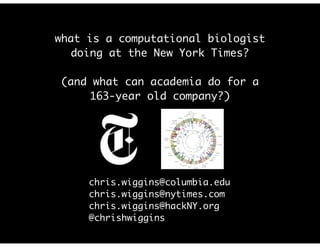
what is a computational biologist
doing at the New York Times?	
!
(and what can academia do for a
163-year old company?)
chris.wiggins@columbia.edu	
chris.wiggins@nytimes.com	
chris.wiggins@hackNY.org	
@chrishwiggins
context/background
context/background
(before ‘the talk’)
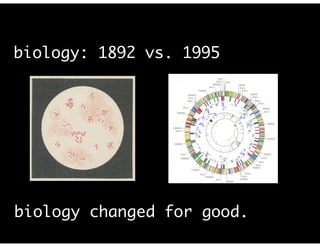
biology: 1892 vs. 1995
biology changed for good.
genetics: 1837 vs. 2012
from “segments” to algorithms
genetics: 1837 vs. 2012
from intuition to prediction
data science: web scale
example:
163 yr old
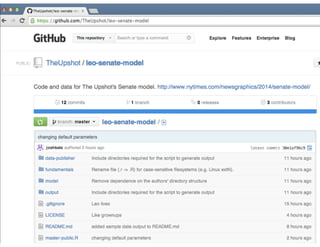
bit.ly/nyt-interactive-2013
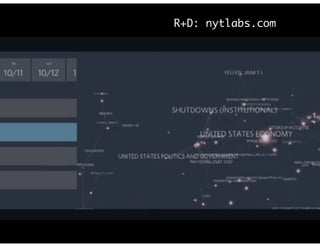
R+D: nytlabs.com
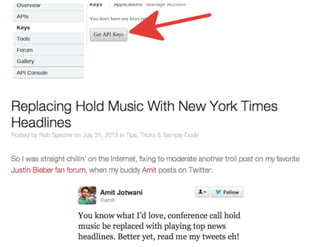
developer.nytimes.com: 2008
example:
millions of views per hour
from “segments” to algorithms
insert figure here
from intuition to prediction
insert figure here
data science: the web
is your “online presence”
data science: the web
is a microscope
data science: the web
is an experimental tool
data science: the web
is an optimization tool
</header>
</header>
i.e., <body>
common requirements
in data science:
common requirements
in data science:
1. practices	
2. skills	
3. culture
common requirements
in data science:
1. practices	
2. skills	
3. culture
common requirements
in data science:
1. practices	
2. skills	
3. culture
data science: practice
- reframe domain questions	
as machine learning tasks
data science: practice
- better wrong than "nice"
data science: practice
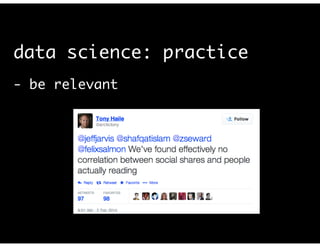
- be relevant	
!
data science: practice
- be relevant	
!
data science: practice
- be relevant	
!
data science: practice
- hypotheses are not data jeopardy	
!
data science: practice
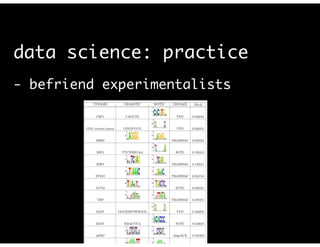
- befriend experimentalists	
!
data science: practice
- befriend experimentalists	
!
data science: practice
- befriend experimentalists	
!
data science: skills
- find quantifiables 	
!
data science: skills
- find quantifiables (choose carefully) 	
!
data science: skills
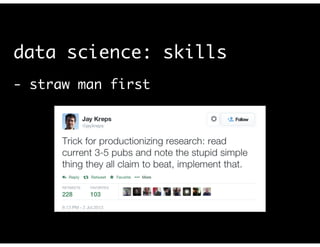
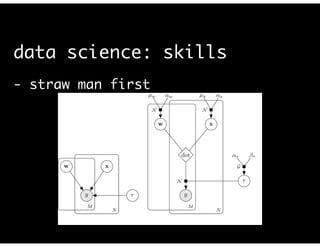
- straw man first	
!
data science: skills
- straw man first	
!
data science: skills
- small wins before feature engineering	
!
data science: skills
- data engineering before data science	
!
data science: culture
- be communicative	
!
data science: culture
- be communicative 	
	 (promote rhetorical literacy)
data science: culture
- be communicative 	
	 (promote rhetorical literacy)	
- related: strive to build models	
which are both predictive and
interpretable
data science: culture
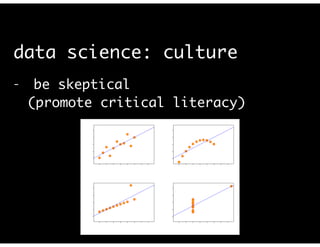
- be skeptical 	
	 (promote critical literacy)
data science: culture
- be empowering	
!
data science: culture
- be transparent	
!
data science: culture
- promote literacy:	
functional	
critical	
rhetorical	
!
(cf. Selber, Multiliteracies for a Digital Age. 2004)
data science: culture
- promote literacies:	
1. functional	
2. critical	
3. rhetorical	
!
(cf. Selber, Multiliteracies for a Digital Age. 2004)
data science: culture
- promote literacies:	
1. functional	
2. critical	
3. rhetorical	
!
(cf. Selber, Multiliteracies for a Digital Age. 2004)
data science: culture
- promote literacies:	
1. functional	
2. critical	
3. rhetorical	
!
(cf. Selber, Multiliteracies for a Digital Age. 2004)
data science: culture
- promote literacies:	
1. functional	
2. critical	
3. rhetorical	
!
(cf. Selber, Multiliteracies for a Digital Age. 2004)
</body>
i.e., <footer>
summary:
summary:	
pay attention to:
1. practices	
2. skills	
3. culture
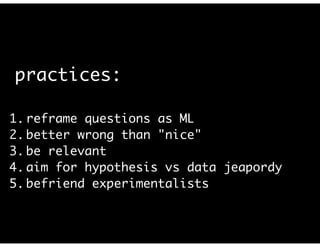
practices:
1. reframe questions as ML	
2. better wrong than "nice"	
3. be relevant	
4. aim for hypothesis vs data jeapordy	
5. befriend experimentalists
skills:
1. find quantifiables 	
2. straw man first	
3. small wins before feature engineering	
4. data engineering before data science	
!
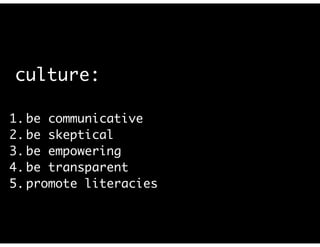
culture:
1. be communicative	
2. be skeptical 	
3. be empowering	
4. be transparent	
5. promote literacies
find out more!
1. postdoc/student opportunities:	
chris.wiggins@columbia.edu	
!
2. always hiring:	
chris.wiggins@nytimes.com	
!
3. let’s talk:	
- @chrishwiggins	
- gist.github.com/chrishwiggins/
what is a computational biologist
doing at the New York Times?	
!
(and what can academia do for a
163-year old company?)
chris.wiggins@columbia.edu	
chris.wiggins@nytimes.com	
chris.wiggins@hackNY.org	
@chrishwiggins

data science in academia and the real world