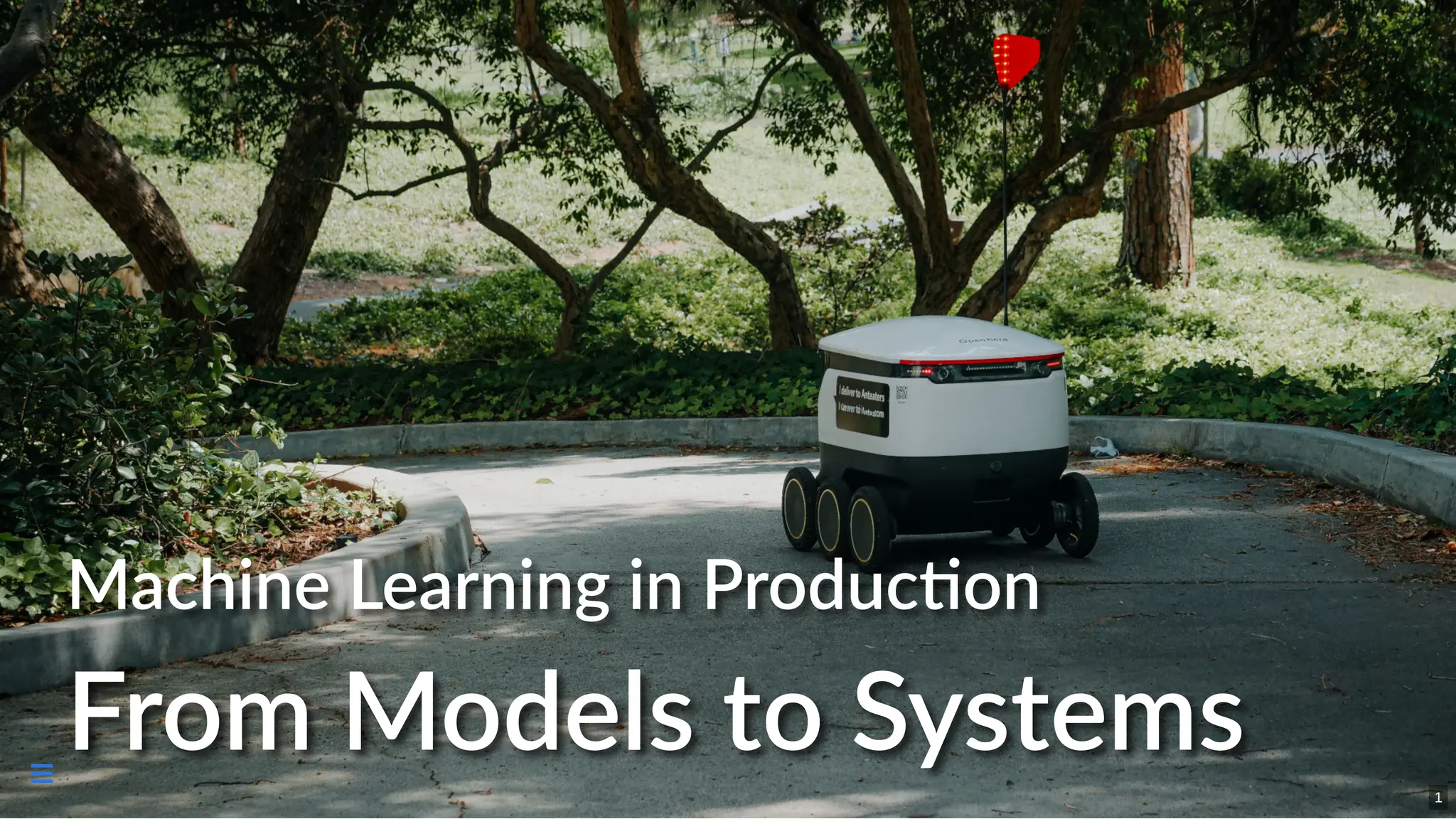
From models to systems (Machine Learning in Production)
1.
Machine Learning inProduction
Machine Learning in Production
From Models to Systems
From Models to Systems 1
2.
Administrativa
Still waiting forregistrar to add another section
Follow up on syllabus discussion:
When not feeling well -- please stay home and get well, and
email us for accommodation
When using generative AI to generate responses (or email/slack
messages) -- please ask it to be brief and to the point!
2
3.
Learning goals
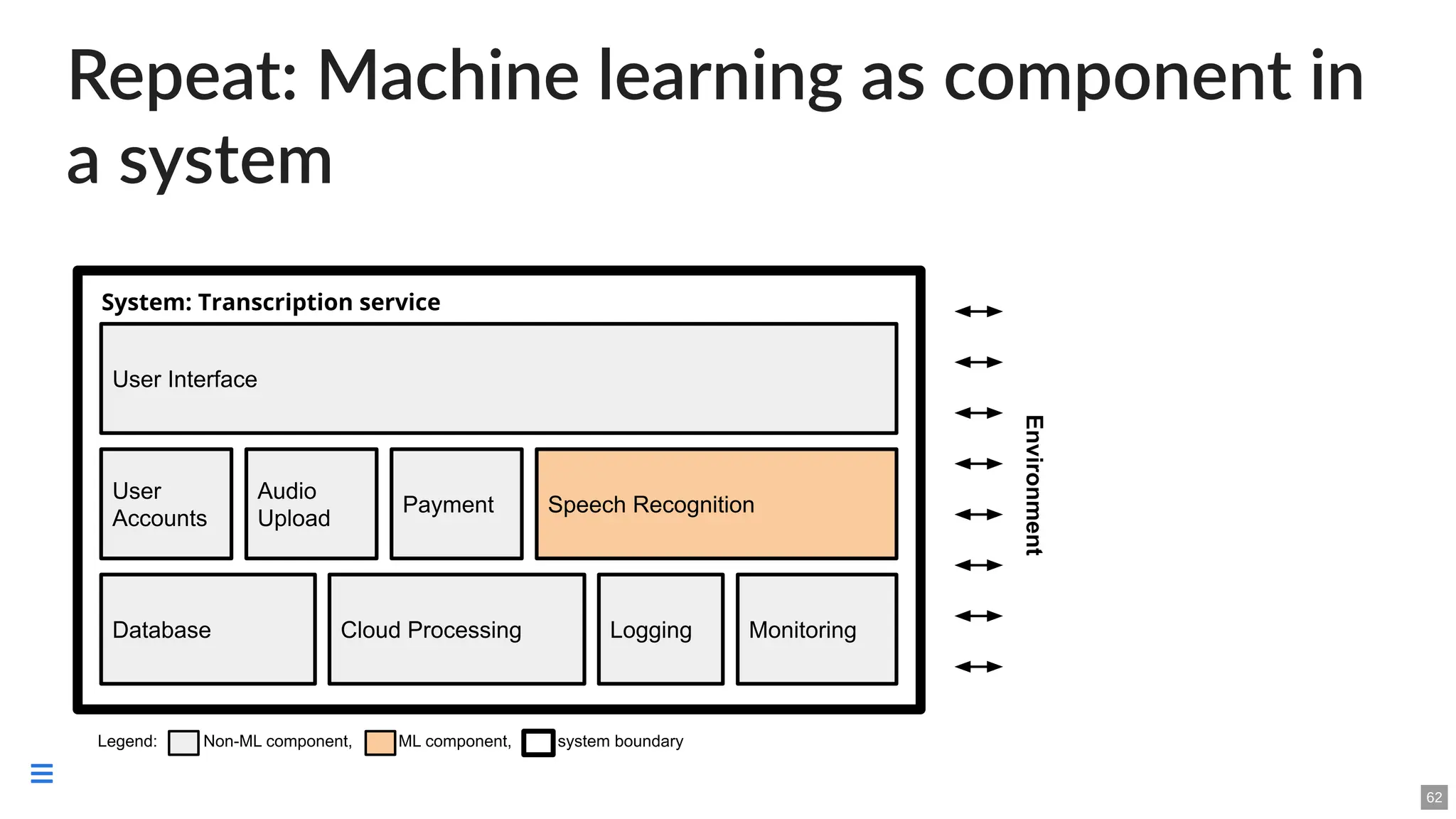
Understand howML components are a (small or large) part of a
larger system
Explain how machine learning fits into the larger picture of building
and maintaining production systems
Define system goals and map them to goals for ML components
Describe the typical components relating to AI in an AI-enabled
system and typical design decisions to be made
3
4.
Required Readings
Chapters 4(Goals), 5 (Components), and 7 (Experiences) from the
book "Building Intelligent Systems: A Guide to Machine Learning
Engineering" by Hulten
4
Many more examplesof ML in products:
Product recommendations on Amazon
Surge price calculation for Uber
Inventory planning in Walmart
Search for new oil fields by Shell
Adaptive cruise control in a car
Smart app suggestion in Android
Fashion trends prediction with social media data
Suggesting whom to talk to in a presidential campain
Tracking and predicting infections in a pandemic
Adaptively reacting to network issues by a cell phone provider
Matching players in a computer game by skill
...
Some for end users, some for employees, some for expert users
Big and small components of a larger system
More or less non-ML code around the model
20
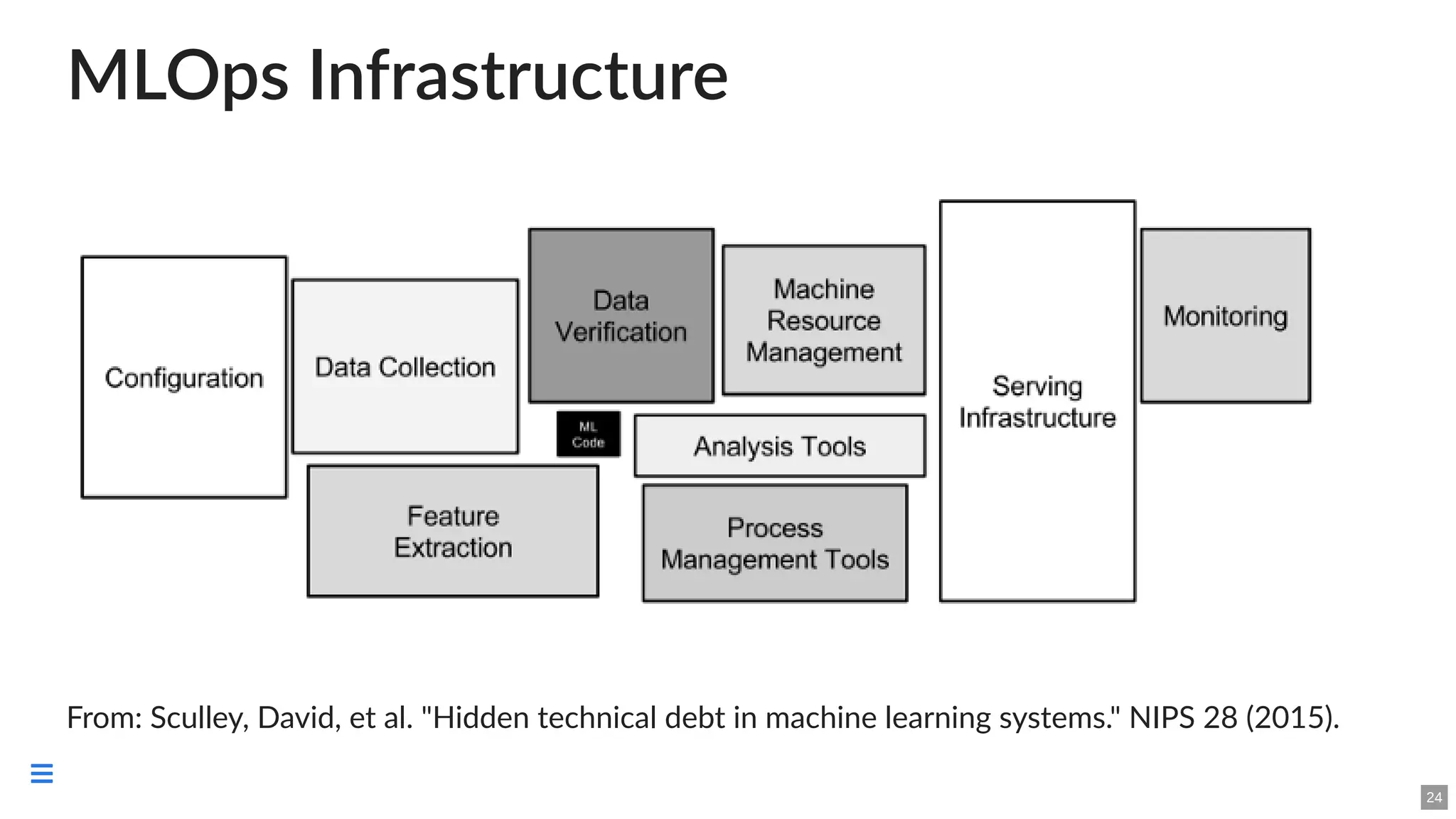
Figure from Google’s2015 technical debt paper, indicating that the amount of code for actual model training is comparably small compared to lots of infrastructure code
needed to automate model training, serving, and monitoring. These days, much of this infrastructure is readily available through competing MLOps tools (e.g., serving
infrastructure, feature stores, cloud resource management, monitoring).
Speaker notes
28.
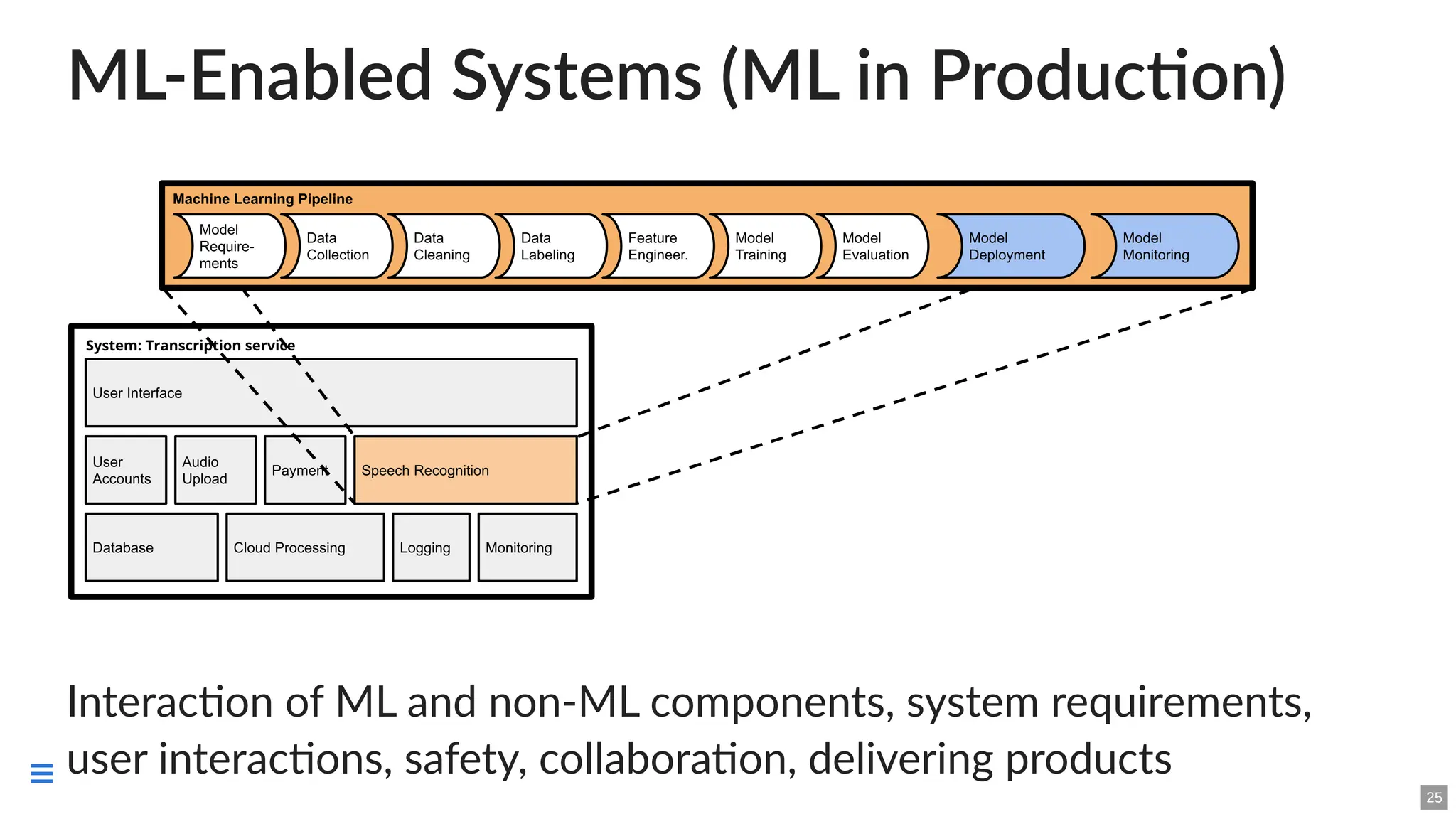
ML-Enabled Systems (MLin Production)
Interaction of ML and non-ML components, system requirements,
user interactions, safety, collaboration, delivering products
25
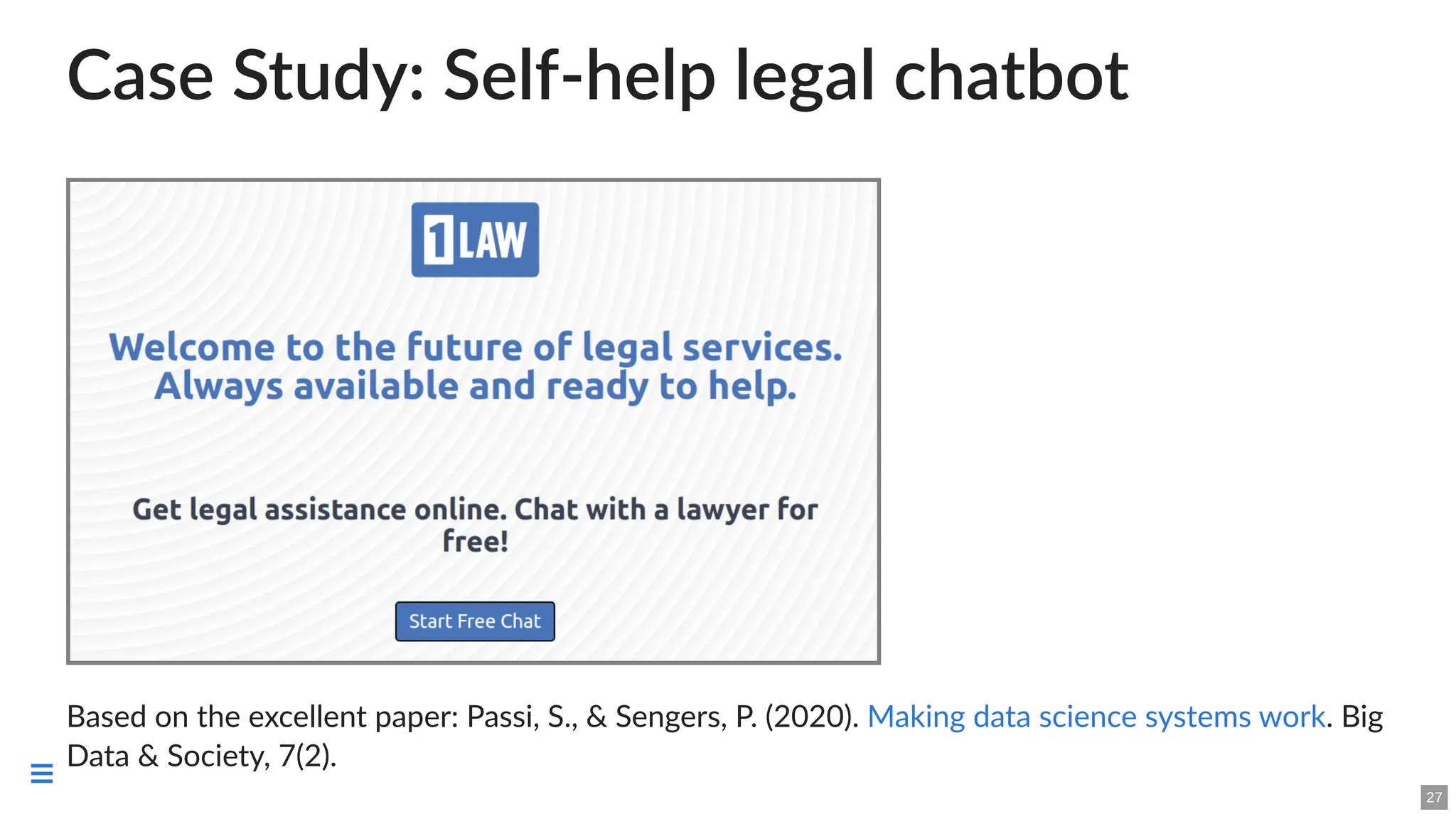
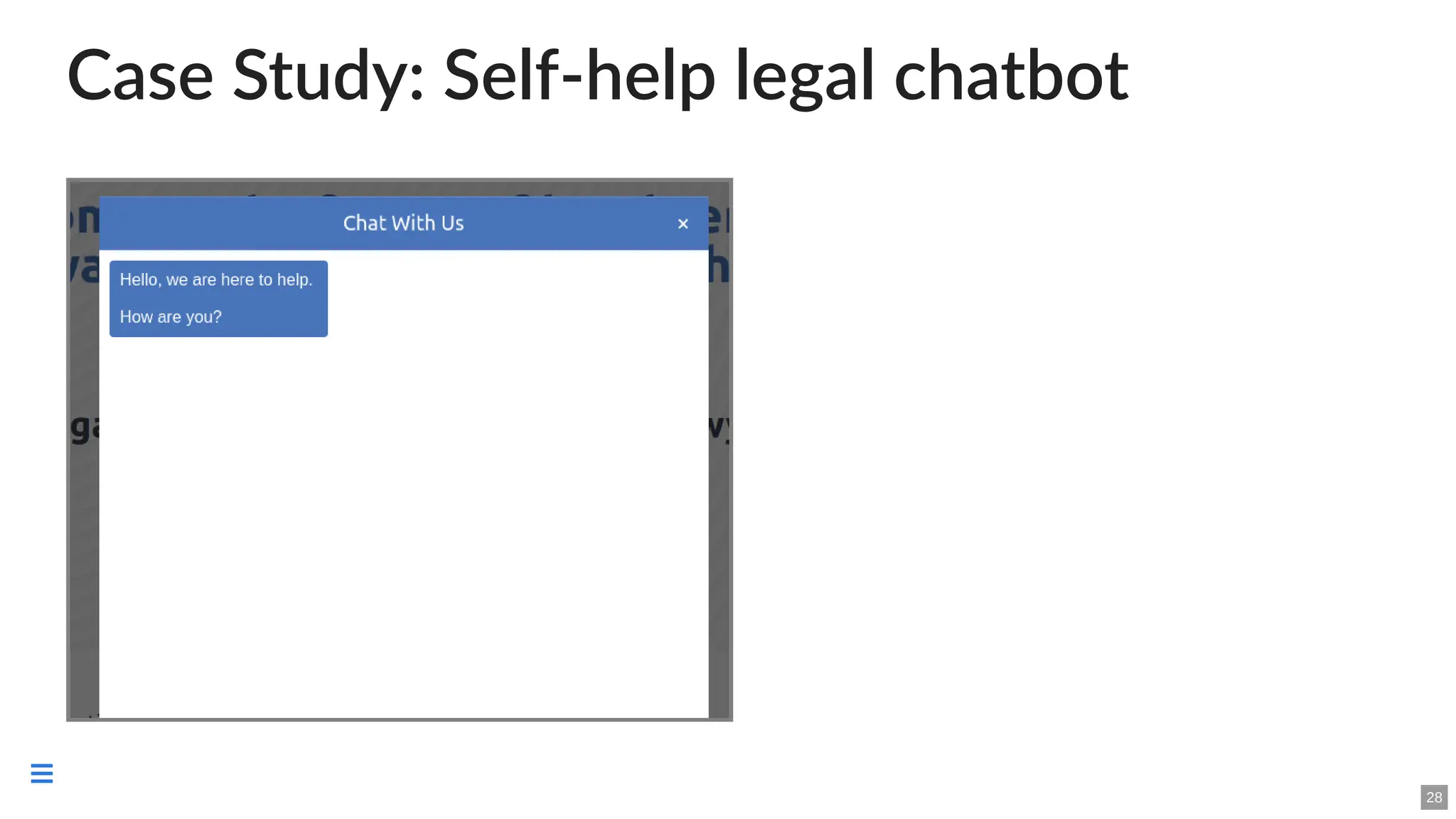
Case Study: Self-helplegal chatbot
Based on the excellent paper: Passi, S., & Sengers, P. (2020). . Big
Data & Society, 7(2).
Making data science systems work
27
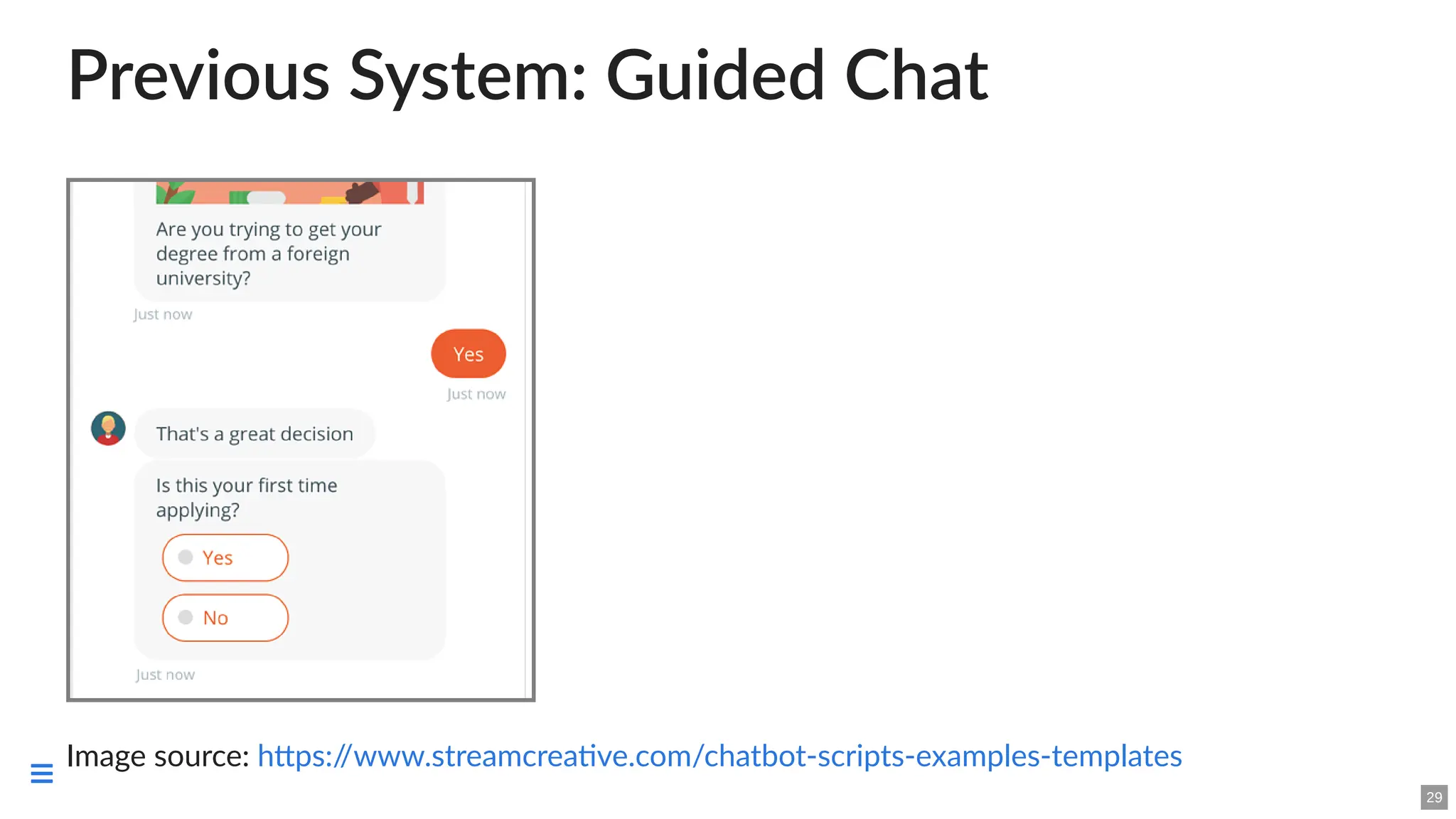
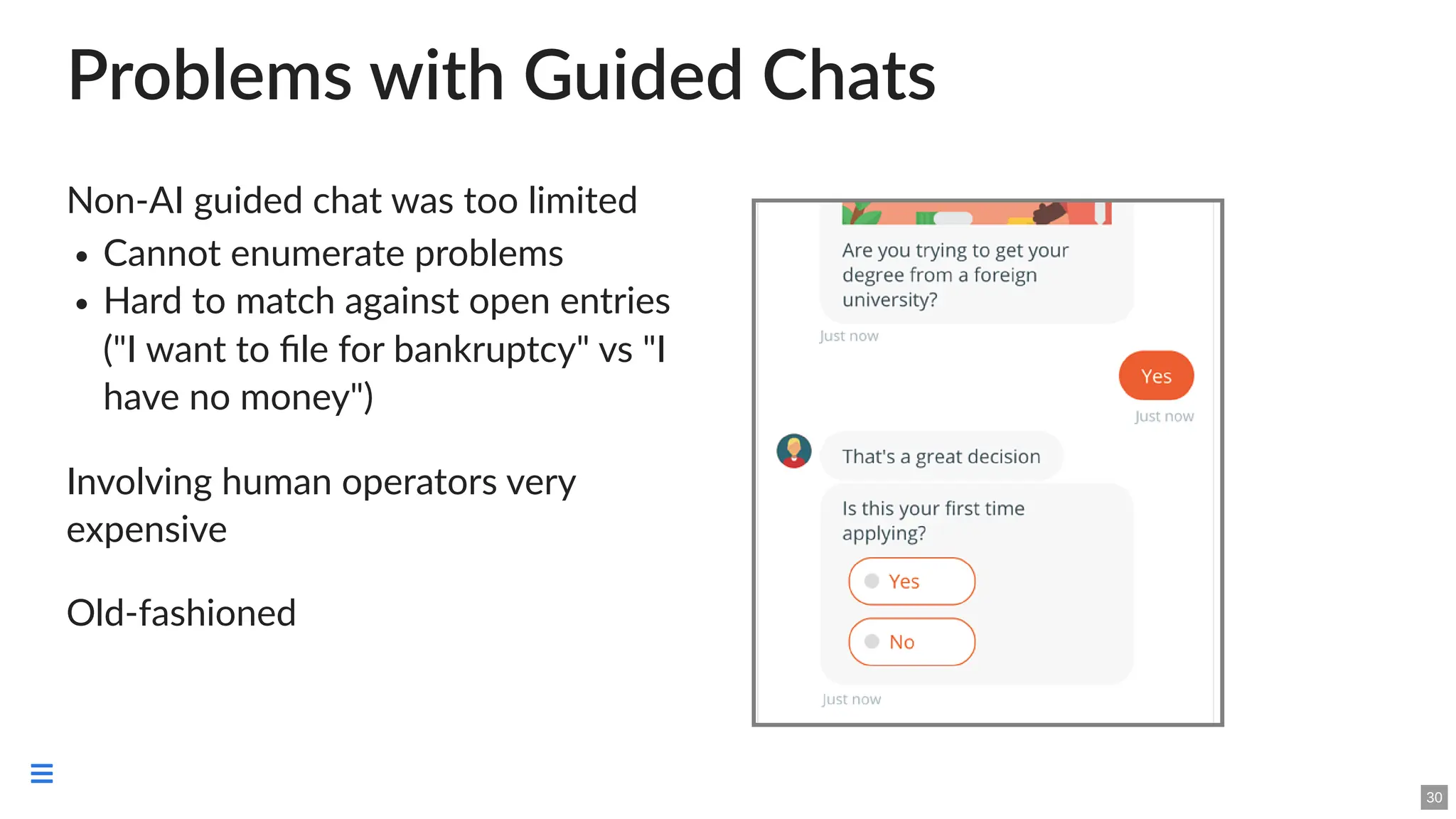
Problems with GuidedChats
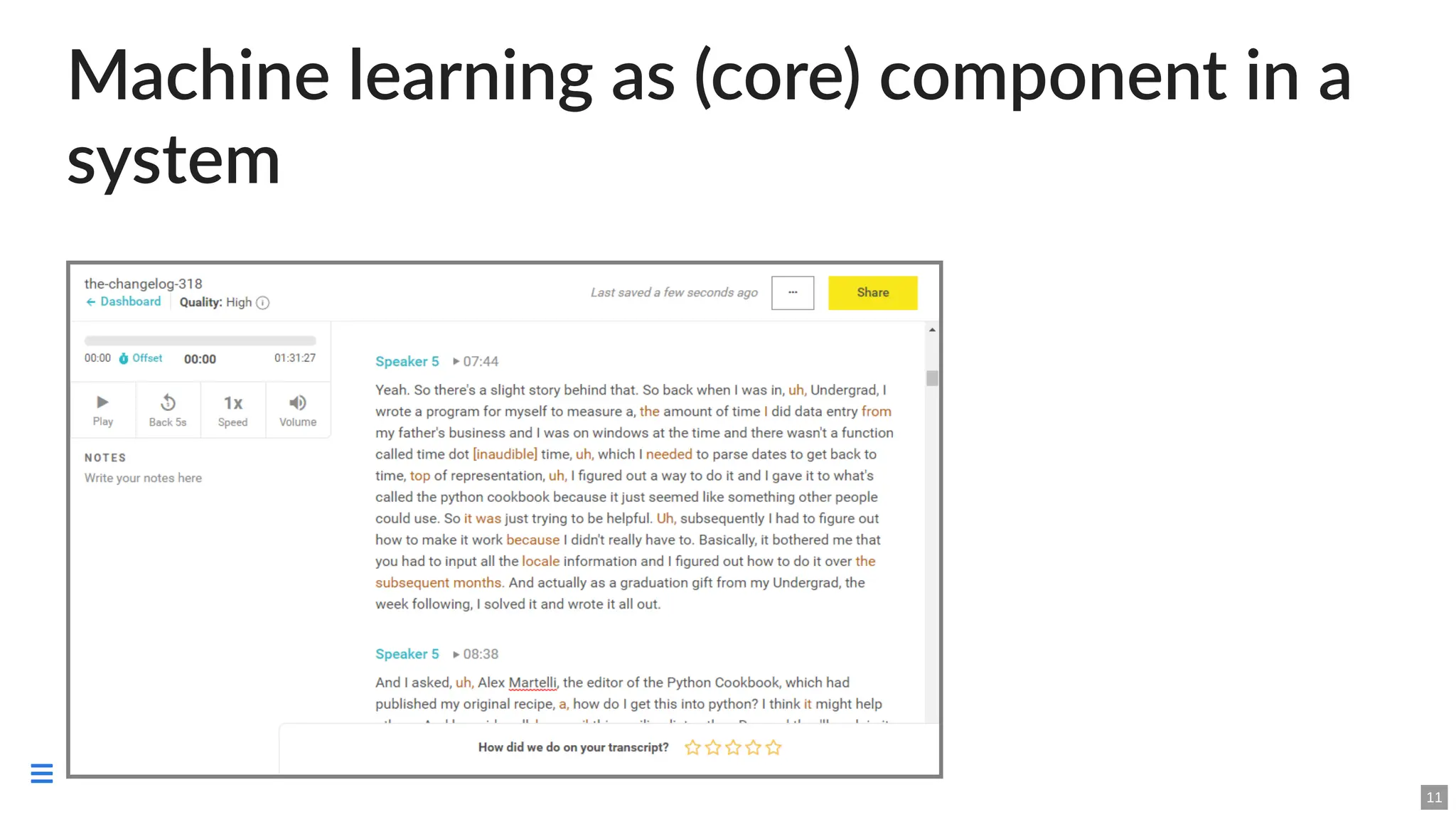
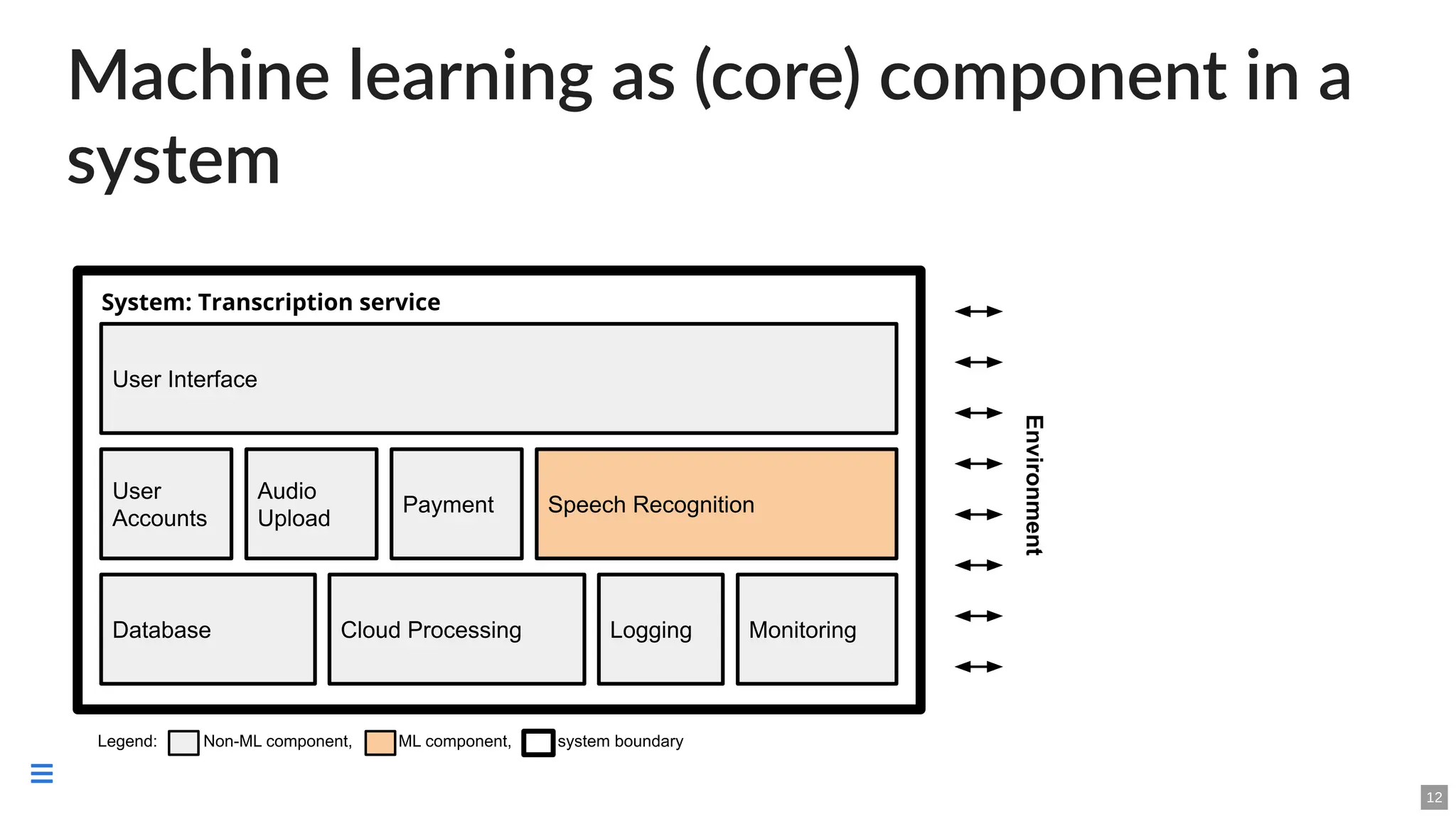
Non-AI guided chat was too limited
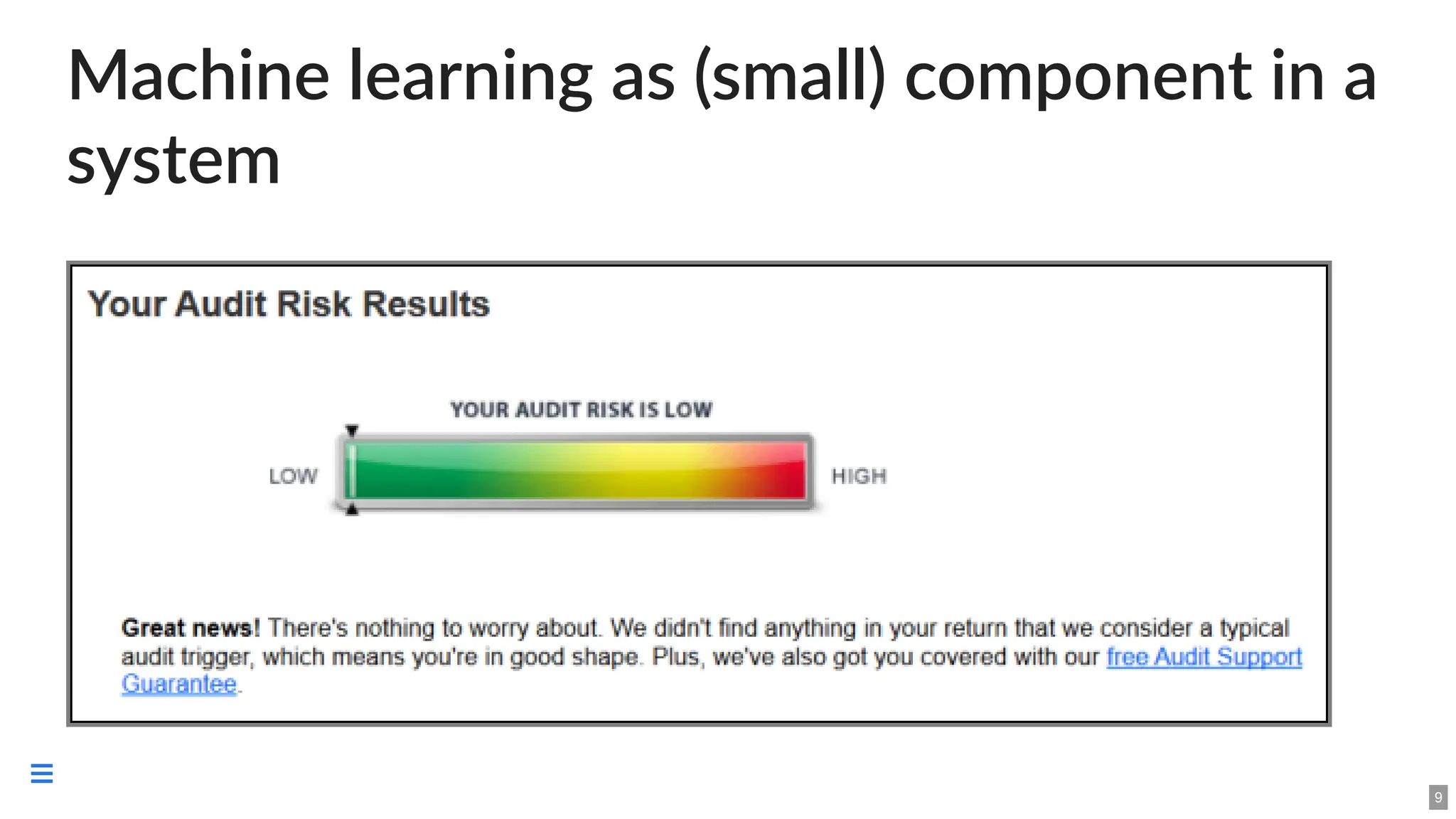
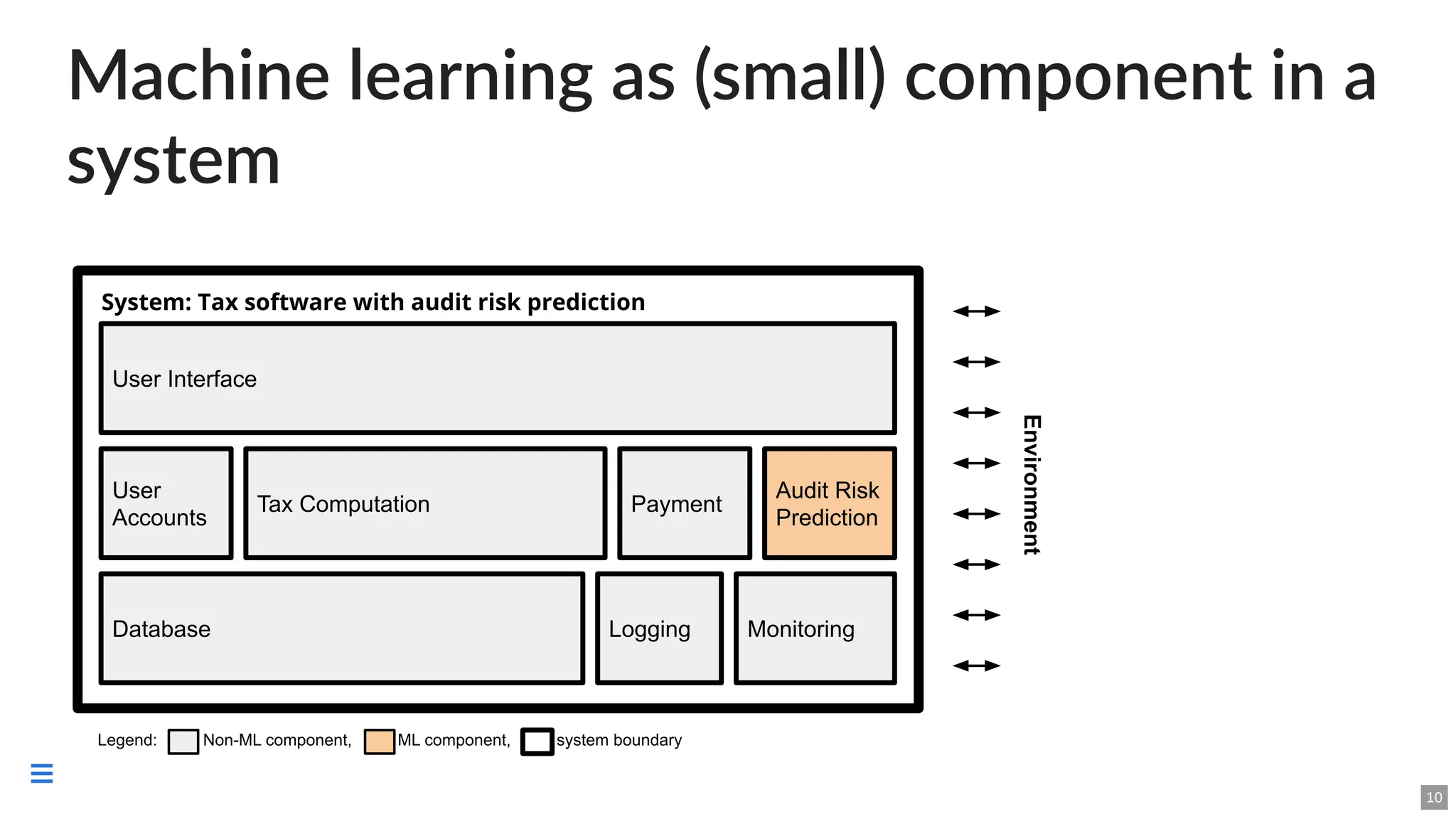
Cannot enumerate problems
Hard to match against open entries
("I want to file for bankruptcy" vs "I
have no money")
Involving human operators very
expensive
Old-fashioned
30
35.
Initial Goal: BetterChatbot
Help users with simple task
Connect them with lawyers when needed
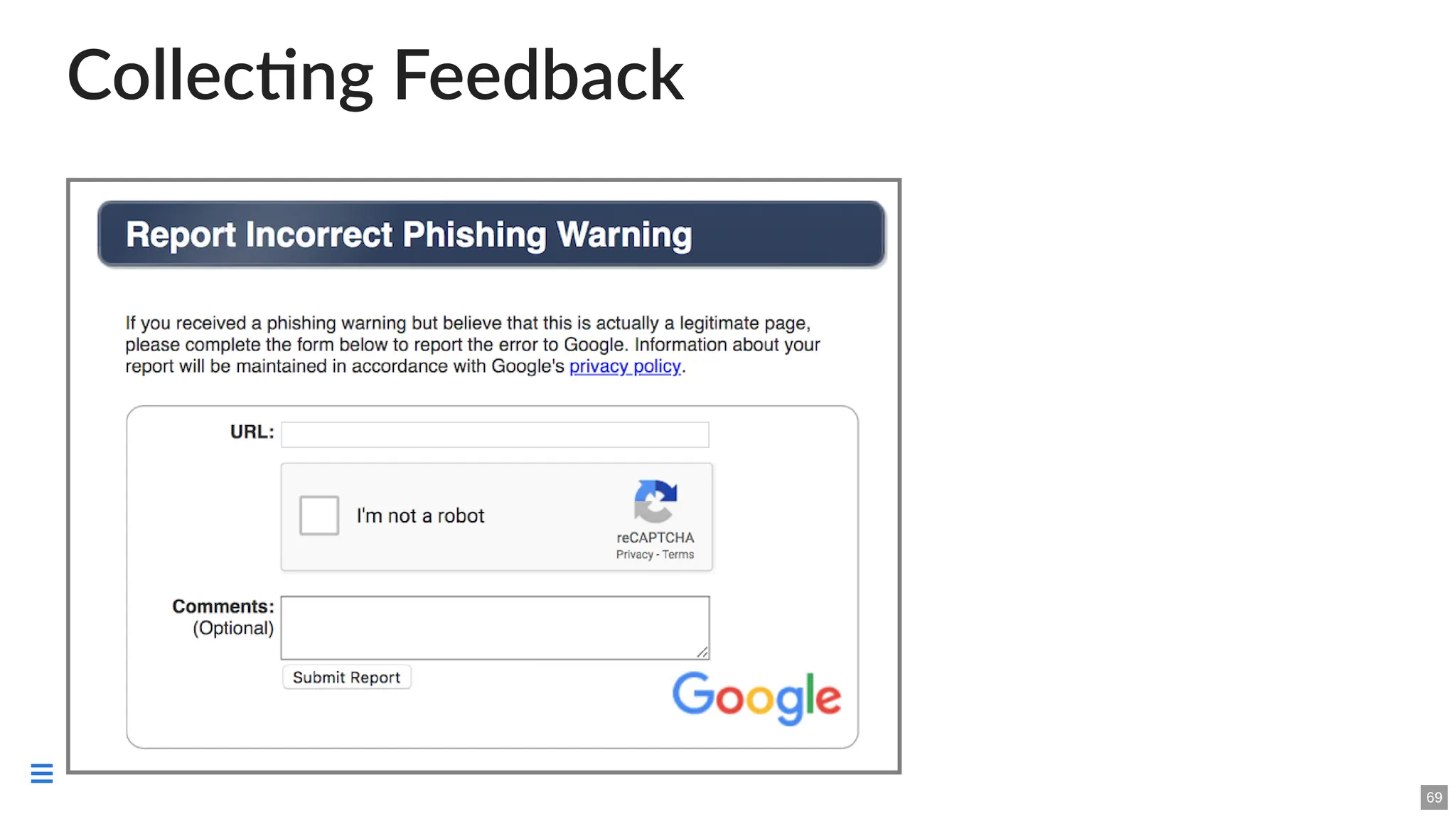
Modernize appearence; "future of digital marketing"
31
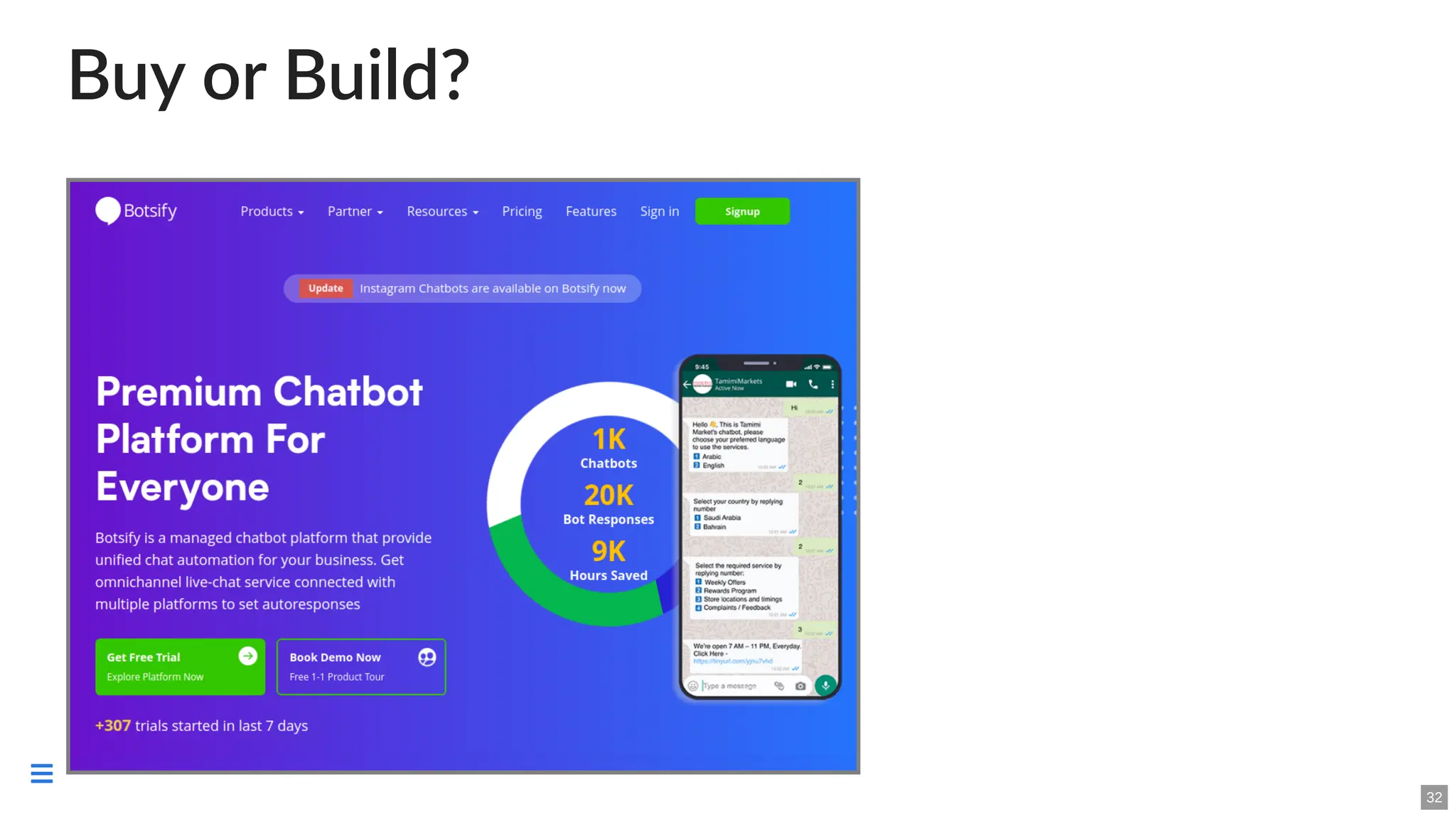
One of manycommercial frameworks for building AI chatbots
Speaker notes
38.
Data scientists' challenges
Infrastructure:Understand chat bot infrastructure and its capabilities
Knowing topics: Identify what users talk about, train/test concepts with past chat
logs
"We fed VocabX a line deliberately trying to confuse it. We wrote, ‘I am thinking
about chapter 13 in Boston divorce filing.’ VocabX figured out the two topics: (1)
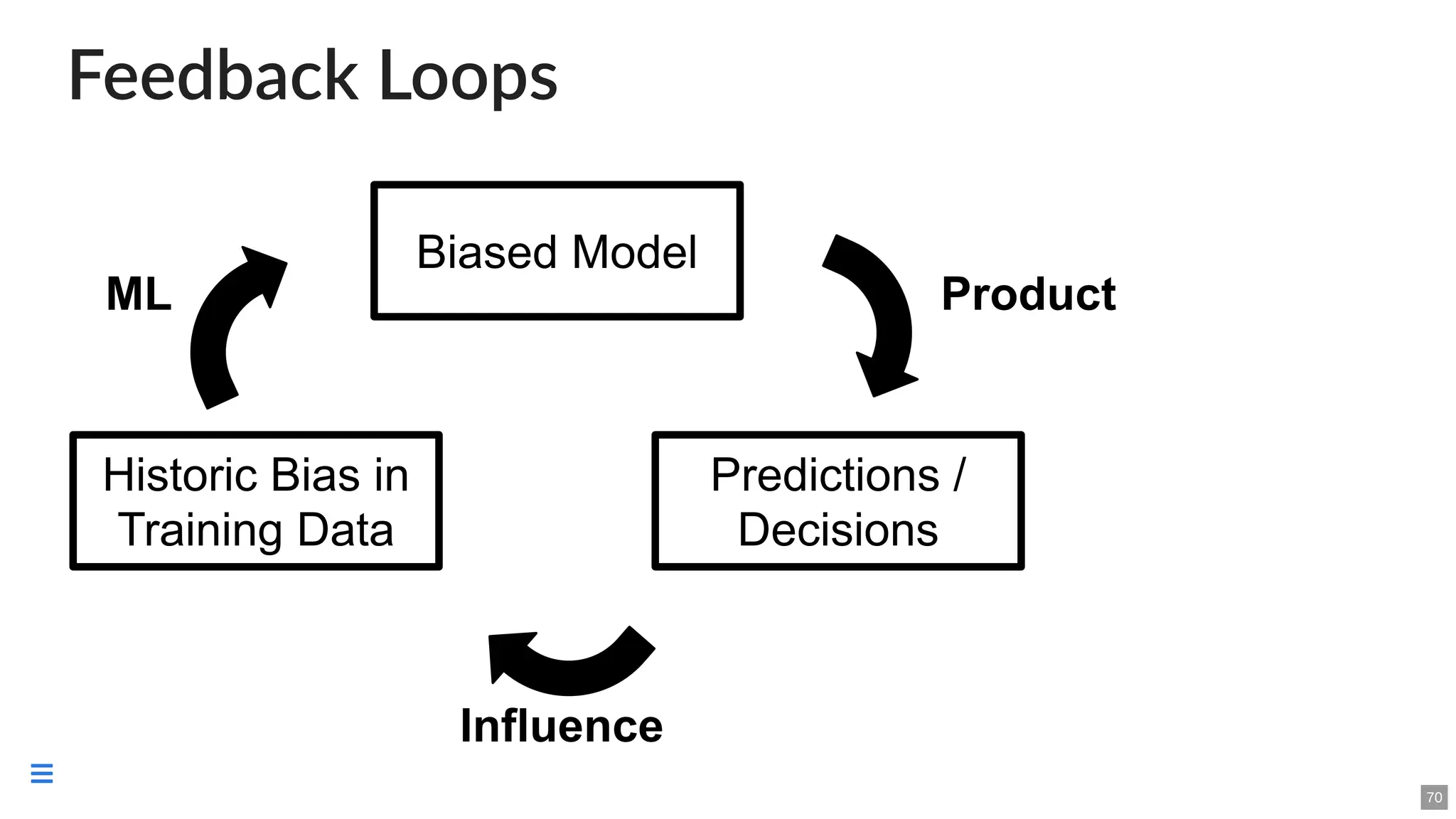
business and industrial/company/bankruptcy (2) society/social institution/divorce."
Guiding conversations: Supporting open-ended conversations requires detecting
what's on topic and finding a good response; intent-topic modeling
Is talk about parents and children on topic when discussing divorce?
Data gathering/labeling very challenging -- too many corner cases
33
Status meeting with(inhouse) Customer
The chatbot performed better than before but was far from ready for deployment. There were “too
many edge cases” in which conversations did not go as planned.
Customer: "Maybe we need to think about it like an 80/20 rule. In some cases, it works well, but for
some, it is harder. 80% everything is fine, and in the remaining 20%, we try to do our best."
Data science lead: The trouble is how to automatically recognize what is 80 and what is 20.
Data scientist: It is harder than it sounds. One of the models is a matching model trained on pairs of legal
questions and answers. 60,000 of them. It seems large but is small for ML.
Customer: That’s a lot. Can it answer a question about say visa renewal?
Data scientist: If there exists a question like that in training data, then yes. But with just 60,000, the
model can easily overfit, and then for anything outside, it would just fail.
Customer: I see what you are saying. Edge cases are interesting from an academic perspective, but for a
business the first and foremost thing is value. You are trying to solve an interesting problem. I get it. But I
feel that you may have already solved it enough to gain business value.
35
41.
Adapted from Passi,S., & Sengers, P. (2020). . Big Data & Society, 7(2).
Speaker notes
Making data science systems work
42.
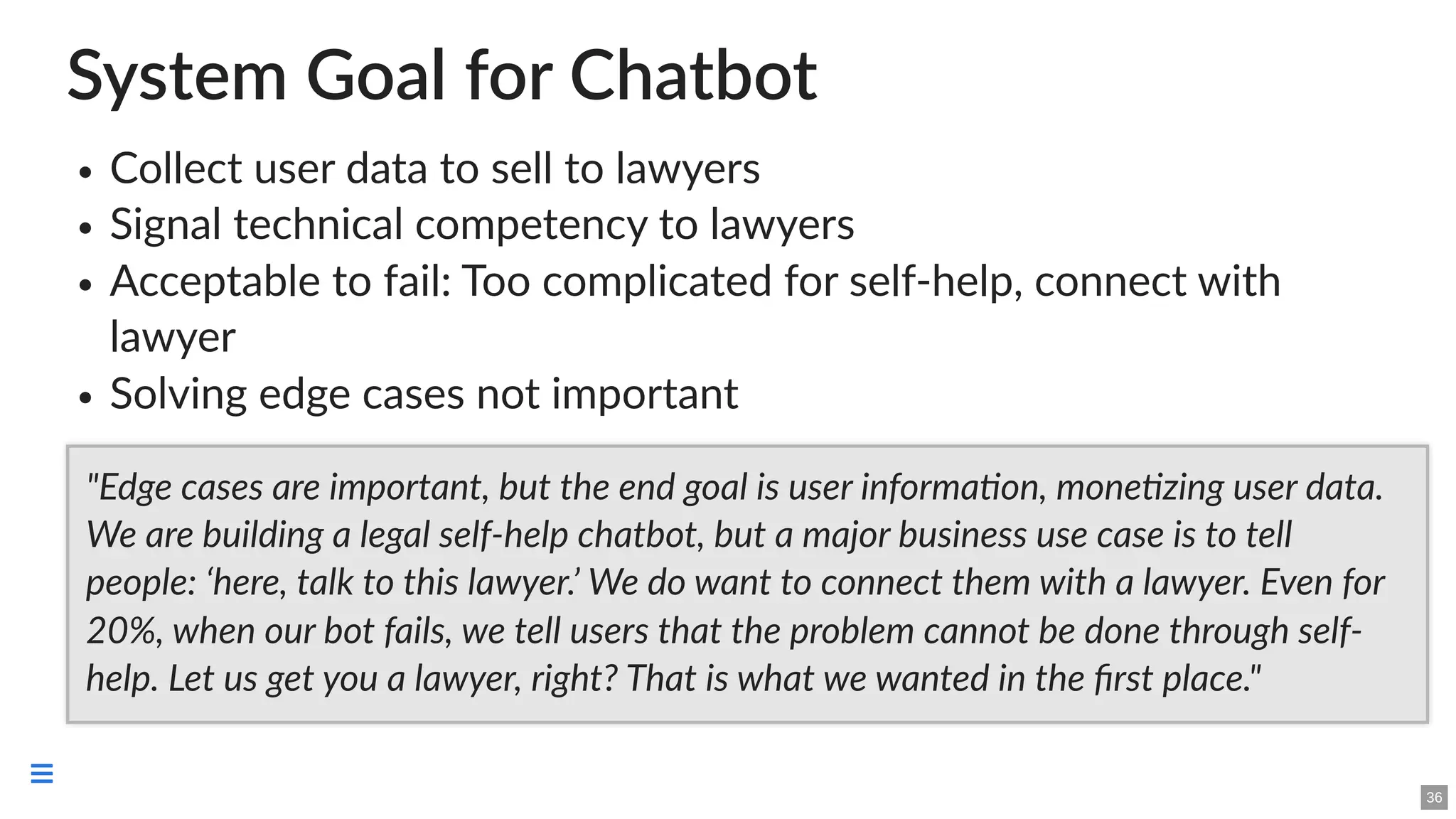
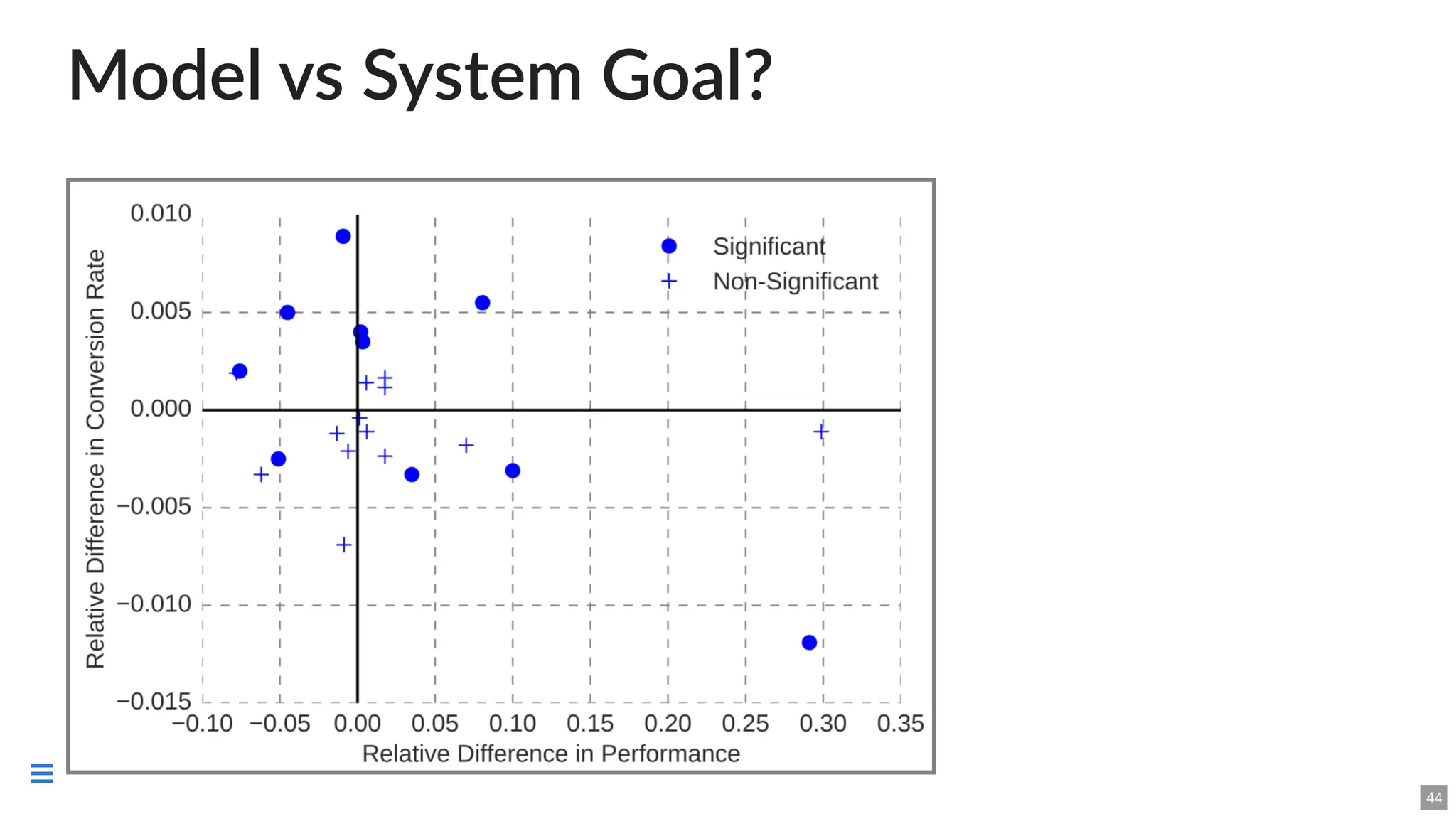
System Goal forChatbot
Collect user data to sell to lawyers
Signal technical competency to lawyers
Acceptable to fail: Too complicated for self-help, connect with
lawyer
Solving edge cases not important
"Edge cases are important, but the end goal is user information, monetizing user data.
We are building a legal self-help chatbot, but a major business use case is to tell
people: ‘here, talk to this lawyer.’ We do want to connect them with a lawyer. Even for
20%, when our bot fails, we tell users that the problem cannot be done through self-
help. Let us get you a lawyer, right? That is what we wanted in the first place."
36
43.
See Passi, S.,& Sengers, P. (2020). . Big Data & Society, 7(2).
Speaker notes
Making data science systems work
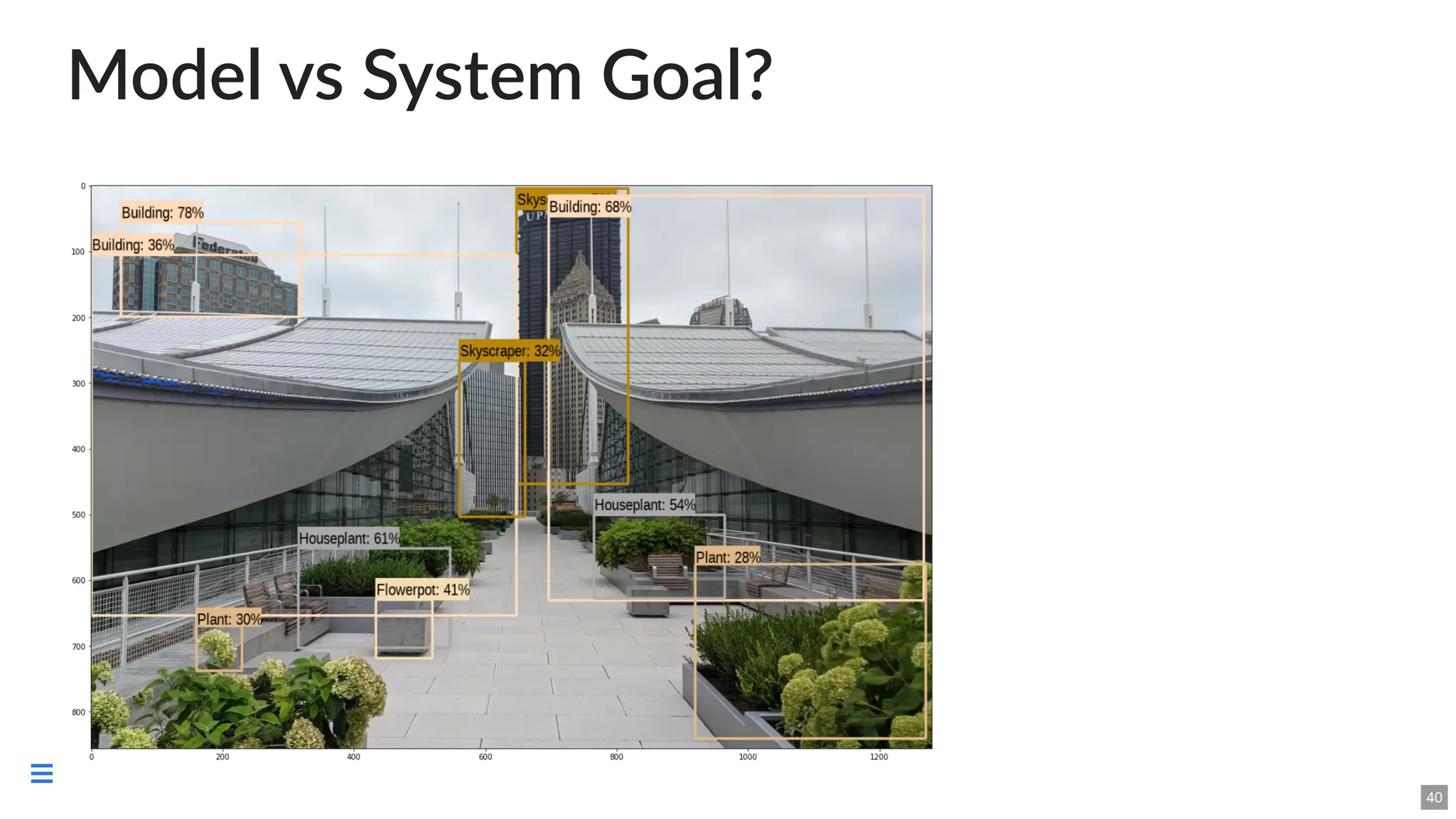
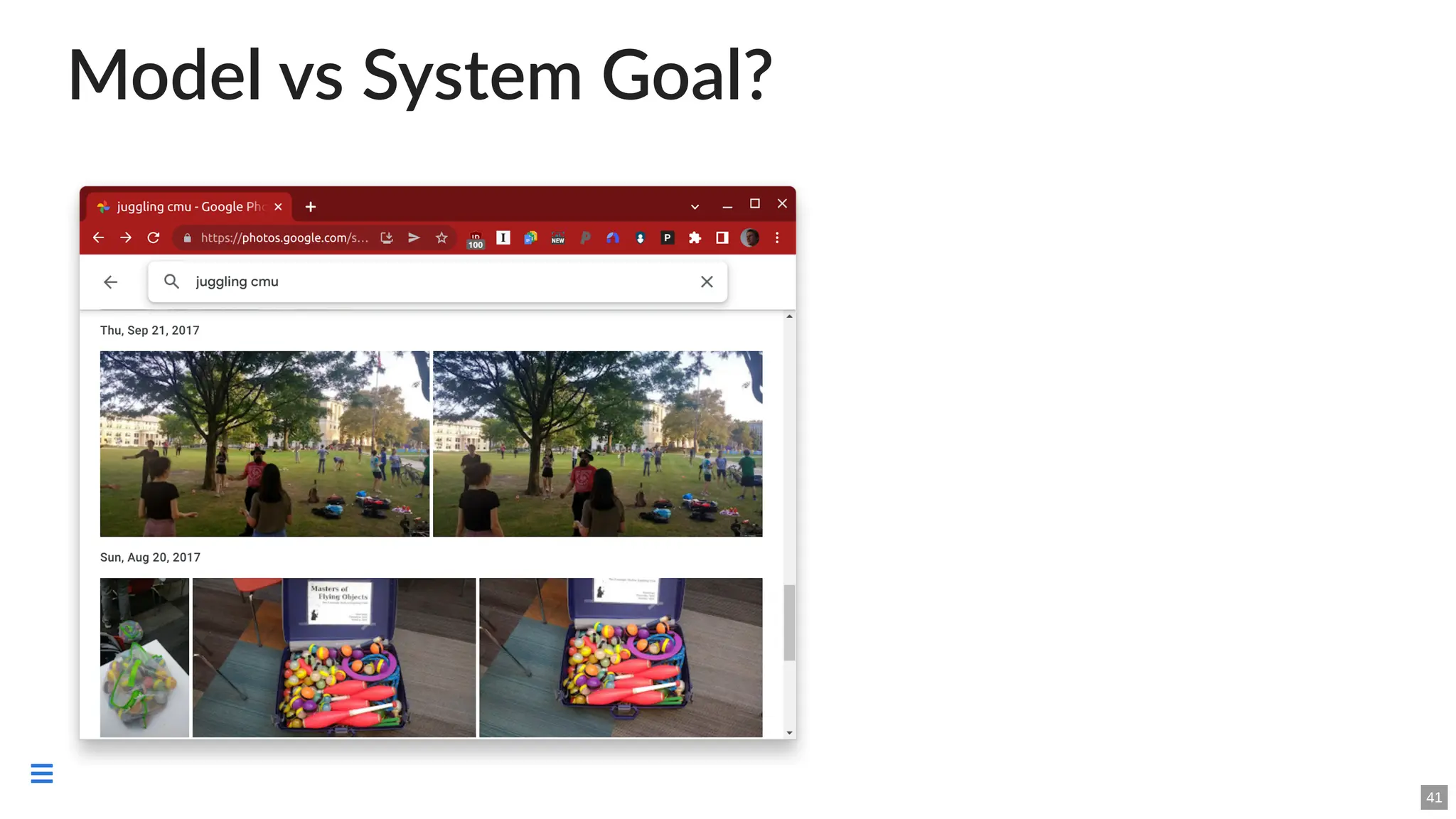
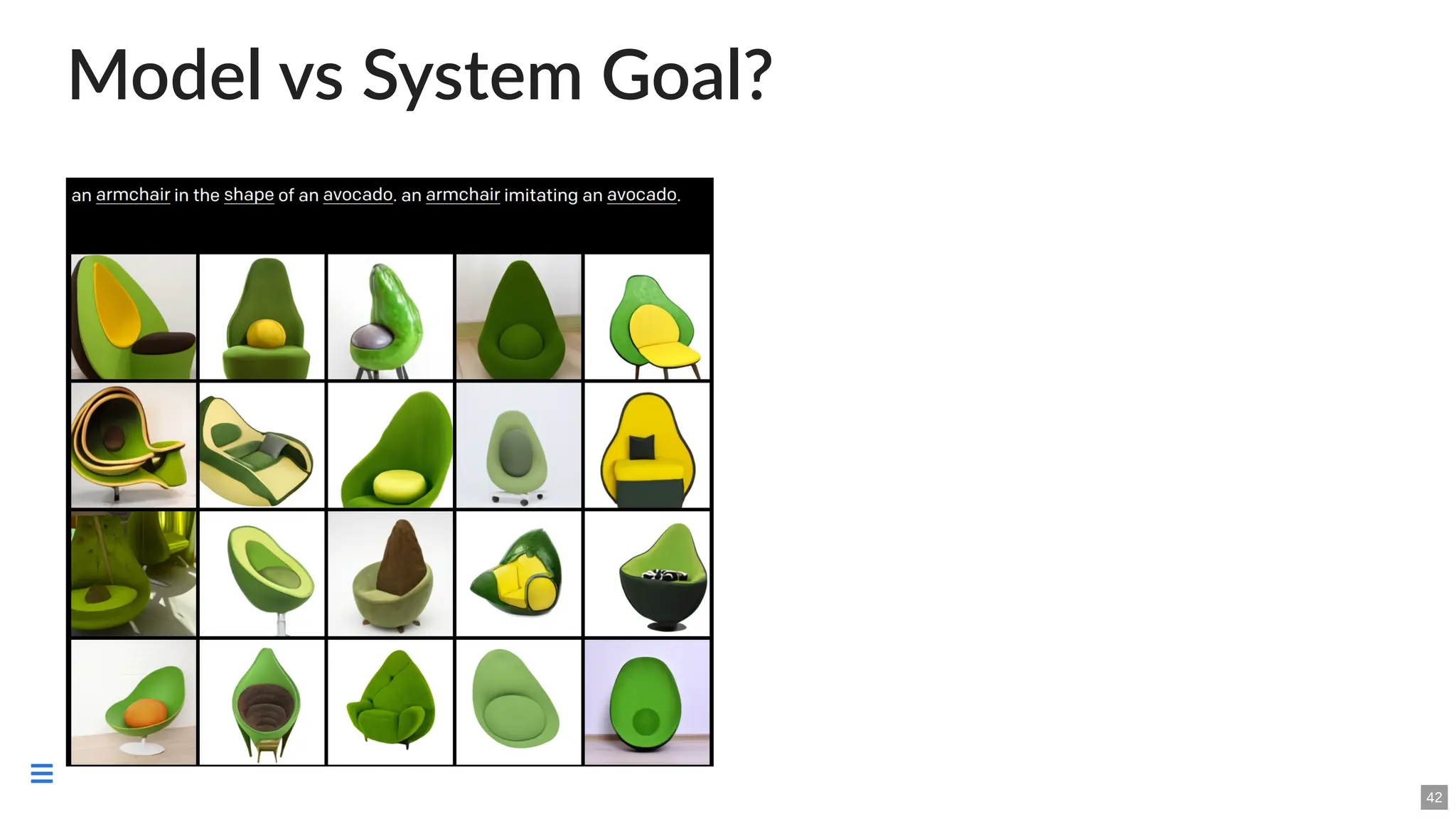
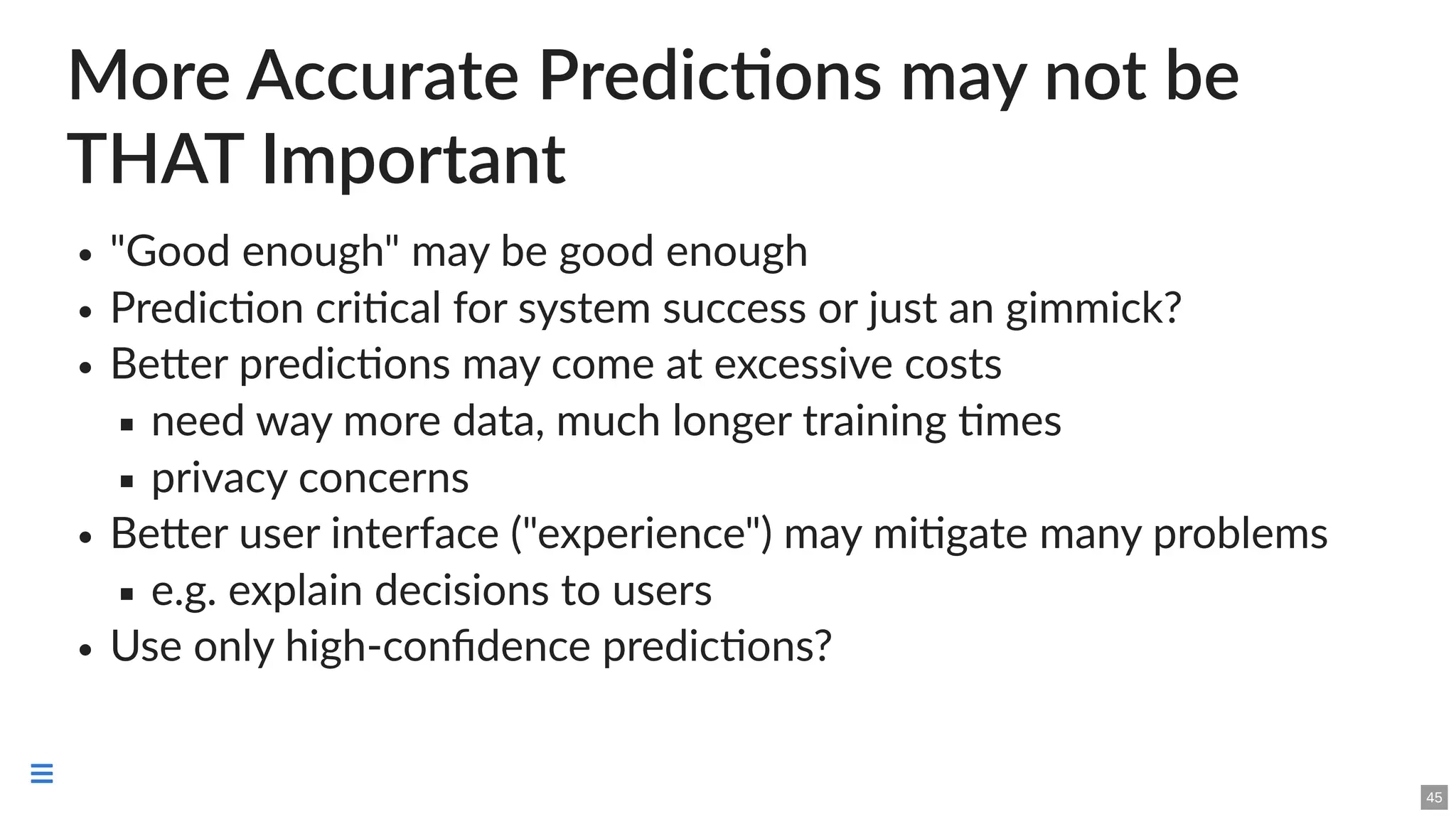
More Accurate Predictionsmay not be
THAT Important
"Good enough" may be good enough
Prediction critical for system success or just an gimmick?
Better predictions may come at excessive costs
need way more data, much longer training times
privacy concerns
Better user interface ("experience") may mitigate many problems
e.g. explain decisions to users
Use only high-confidence predictions?
45
53.
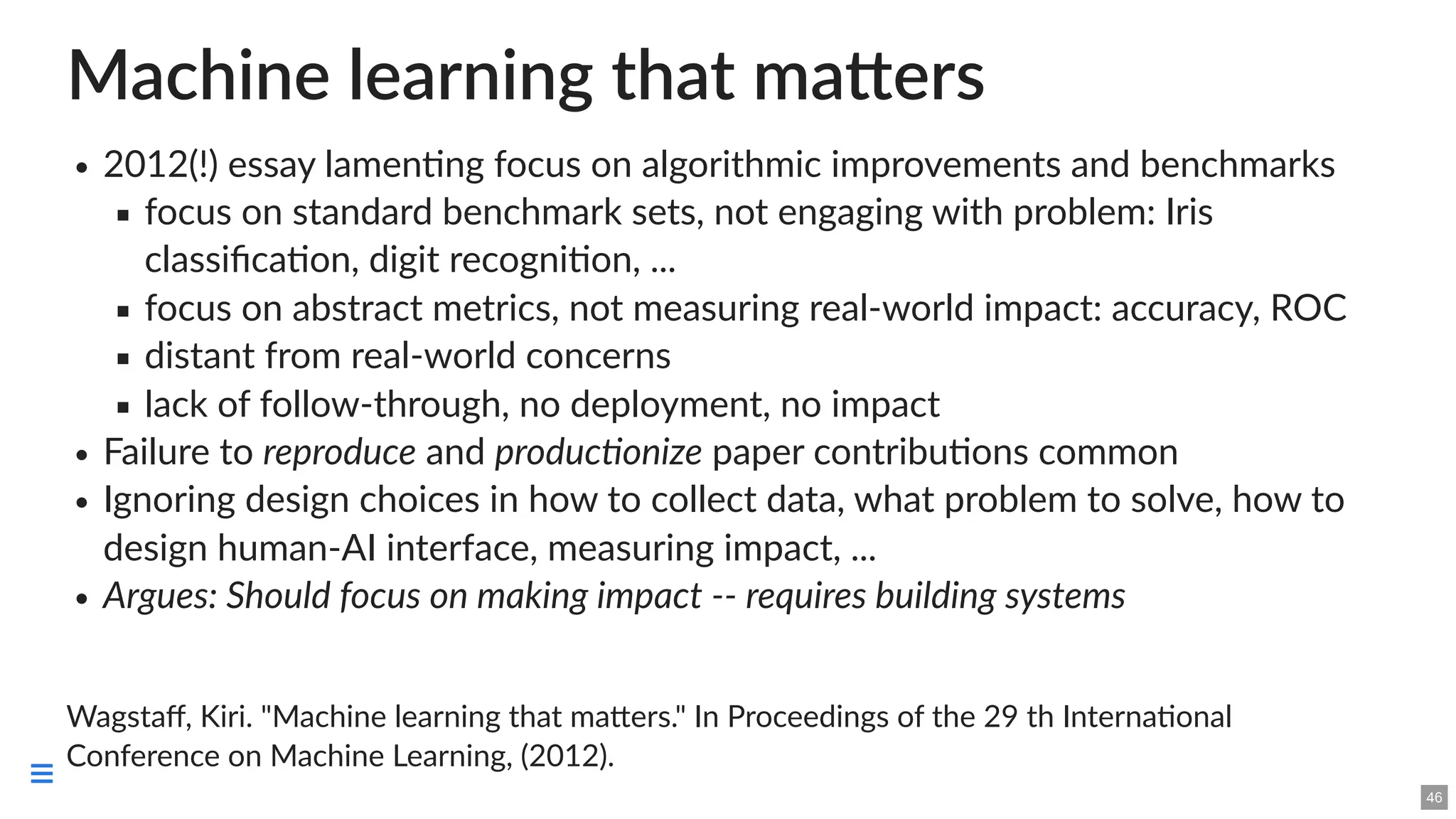
Machine learning thatmatters
2012(!) essay lamenting focus on algorithmic improvements and benchmarks
focus on standard benchmark sets, not engaging with problem: Iris
classification, digit recognition, ...
focus on abstract metrics, not measuring real-world impact: accuracy, ROC
distant from real-world concerns
lack of follow-through, no deployment, no impact
Failure to reproduce and productionize paper contributions common
Ignoring design choices in how to collect data, what problem to solve, how to
design human-AI interface, measuring impact, ...
Argues: Should focus on making impact -- requires building systems
Wagstaff, Kiri. "Machine learning that matters." In Proceedings of the 29 th International
Conference on Machine Learning, (2012).
46
54.
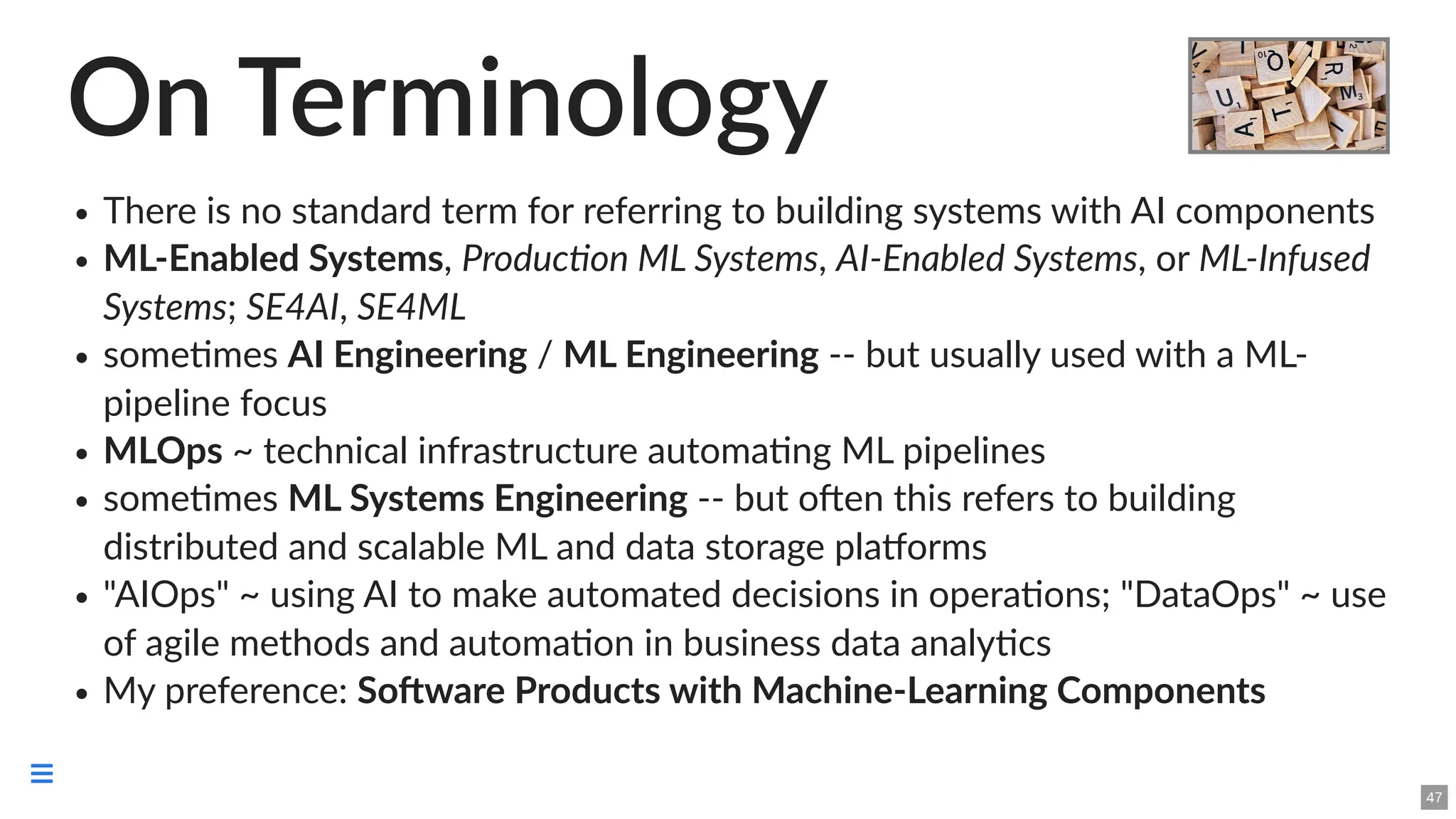
On Terminology
There isno standard term for referring to building systems with AI components
ML-Enabled Systems, Production ML Systems, AI-Enabled Systems, or ML-Infused
Systems; SE4AI, SE4ML
sometimes AI Engineering / ML Engineering -- but usually used with a ML-
pipeline focus
MLOps ~ technical infrastructure automating ML pipelines
sometimes ML Systems Engineering -- but often this refers to building
distributed and scalable ML and data storage platforms
"AIOps" ~ using AI to make automated decisions in operations; "DataOps" ~ use
of agile methods and automation in business data analytics
My preference: Software Products with Machine-Learning Components
47
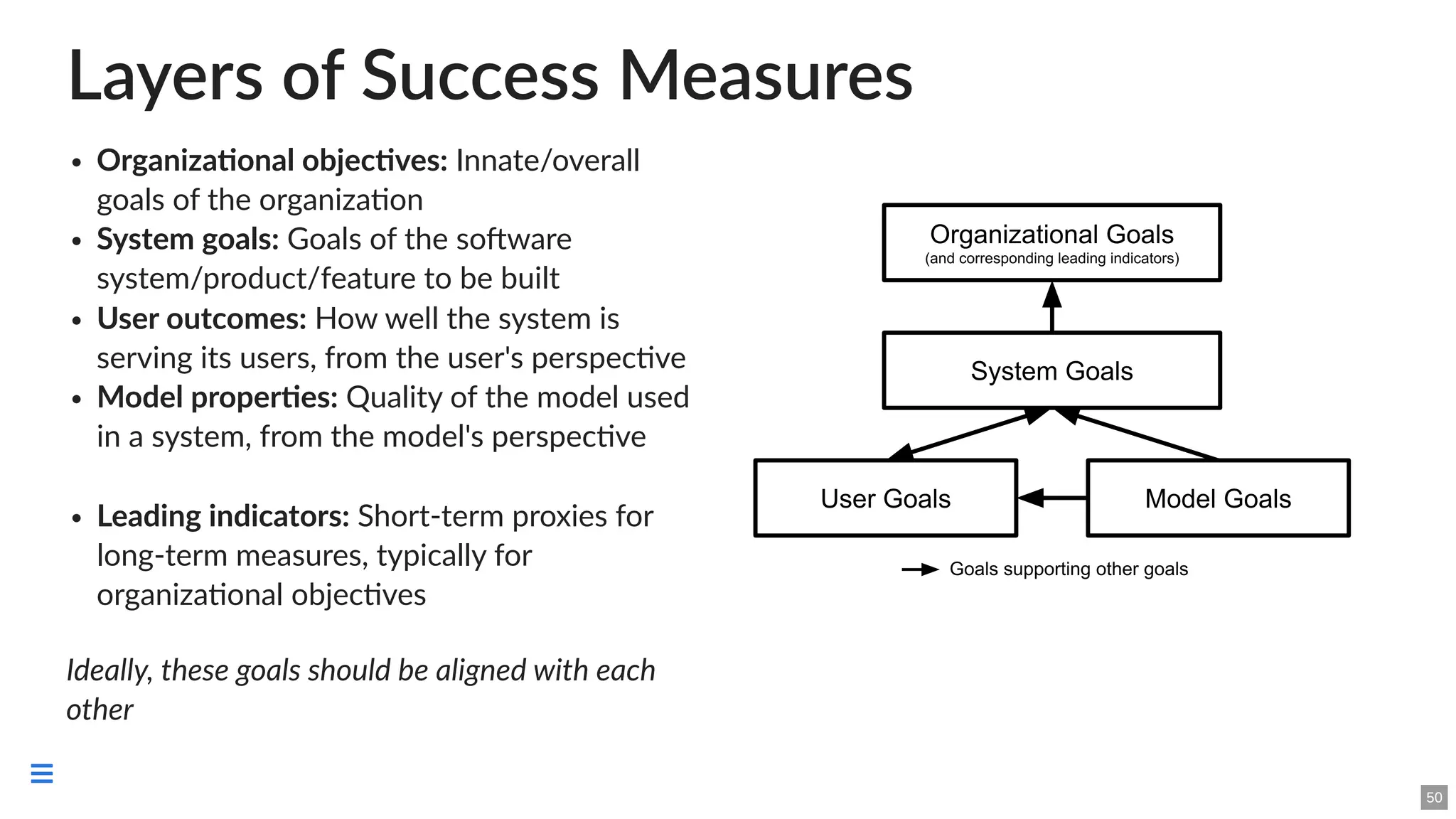
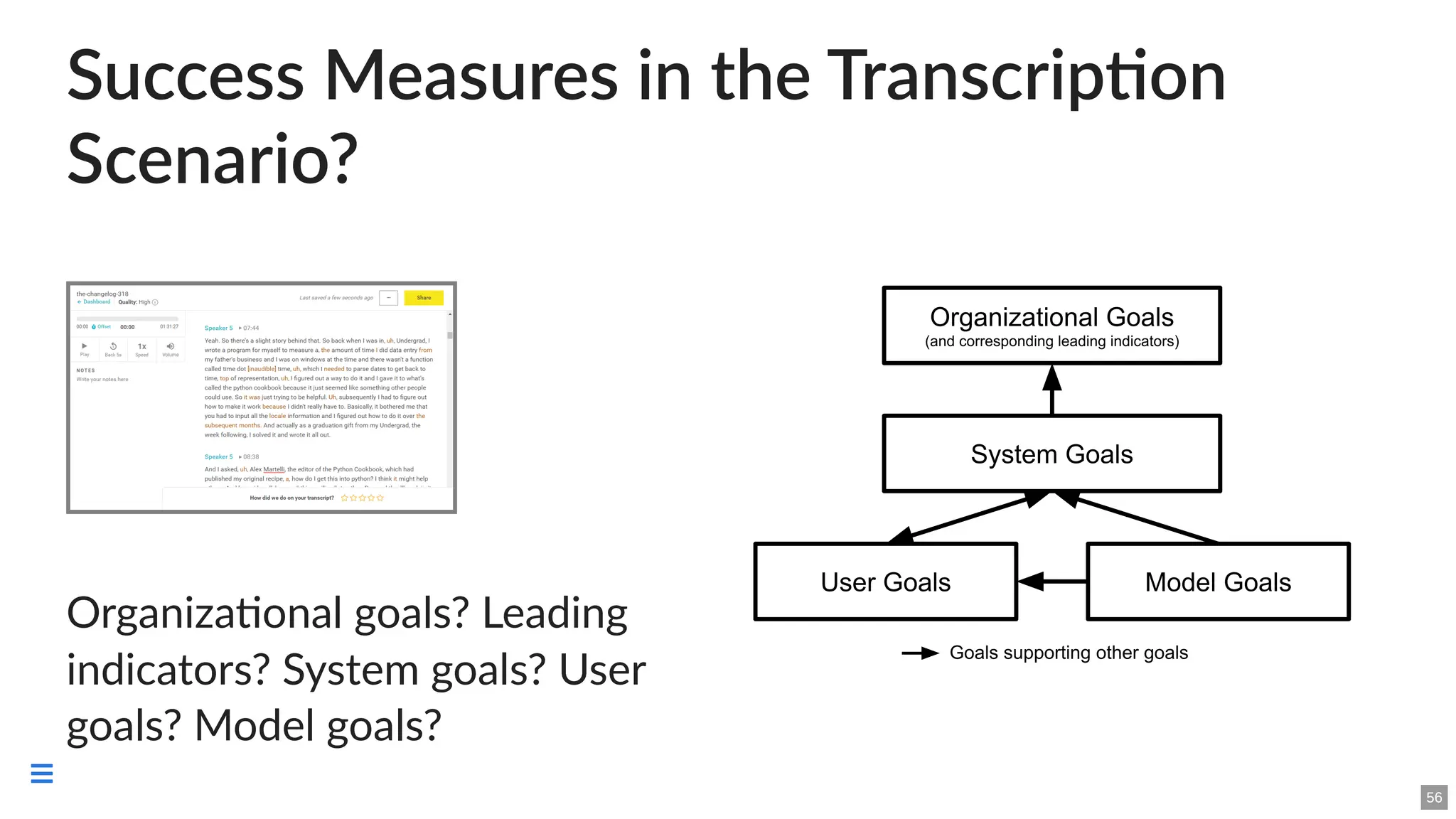
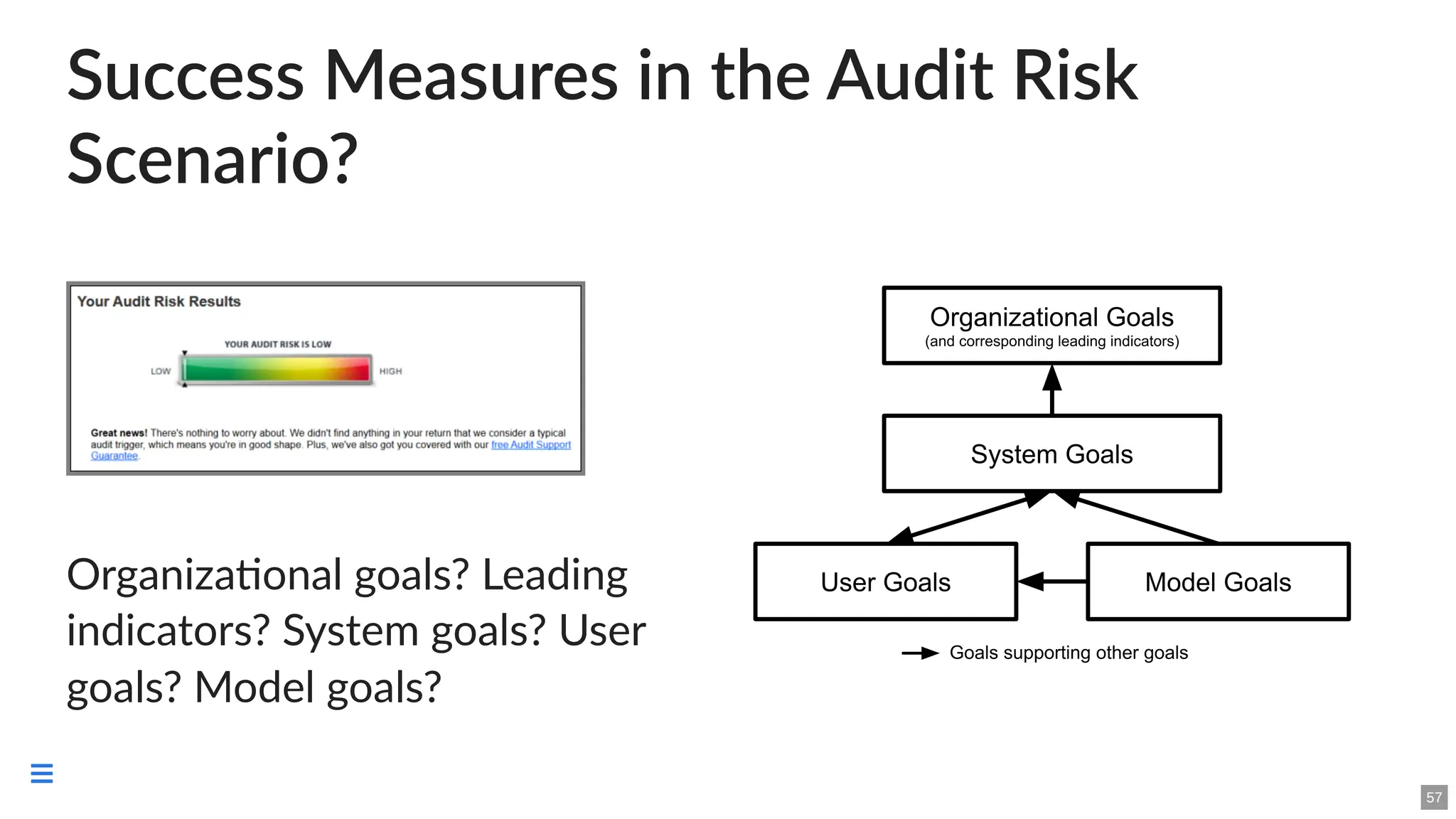
Layers of SuccessMeasures
Organizational objectives: Innate/overall
goals of the organization
System goals: Goals of the software
system/product/feature to be built
User outcomes: How well the system is
serving its users, from the user's perspective
Model properties: Quality of the model used
in a system, from the model's perspective
Leading indicators: Short-term proxies for
long-term measures, typically for
organizational objectives
Ideally, these goals should be aligned with each
other
50
58.
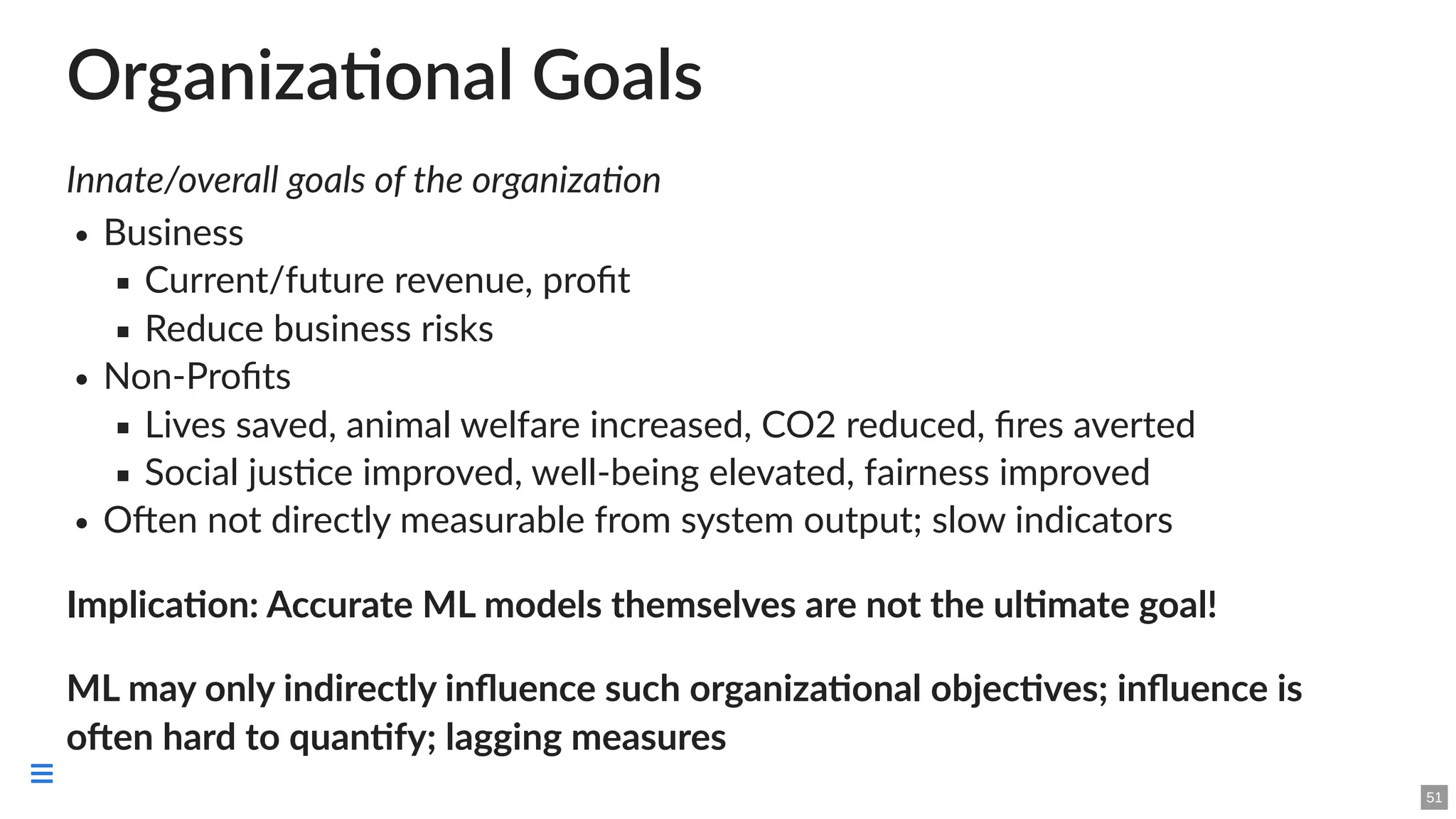
Organizational Goals
Innate/overall goalsof the organization
Business
Current/future revenue, profit
Reduce business risks
Non-Profits
Lives saved, animal welfare increased, CO2 reduced, fires averted
Social justice improved, well-being elevated, fairness improved
Often not directly measurable from system output; slow indicators
Implication: Accurate ML models themselves are not the ultimate goal!
ML may only indirectly influence such organizational objectives; influence is
often hard to quantify; lagging measures
51
59.
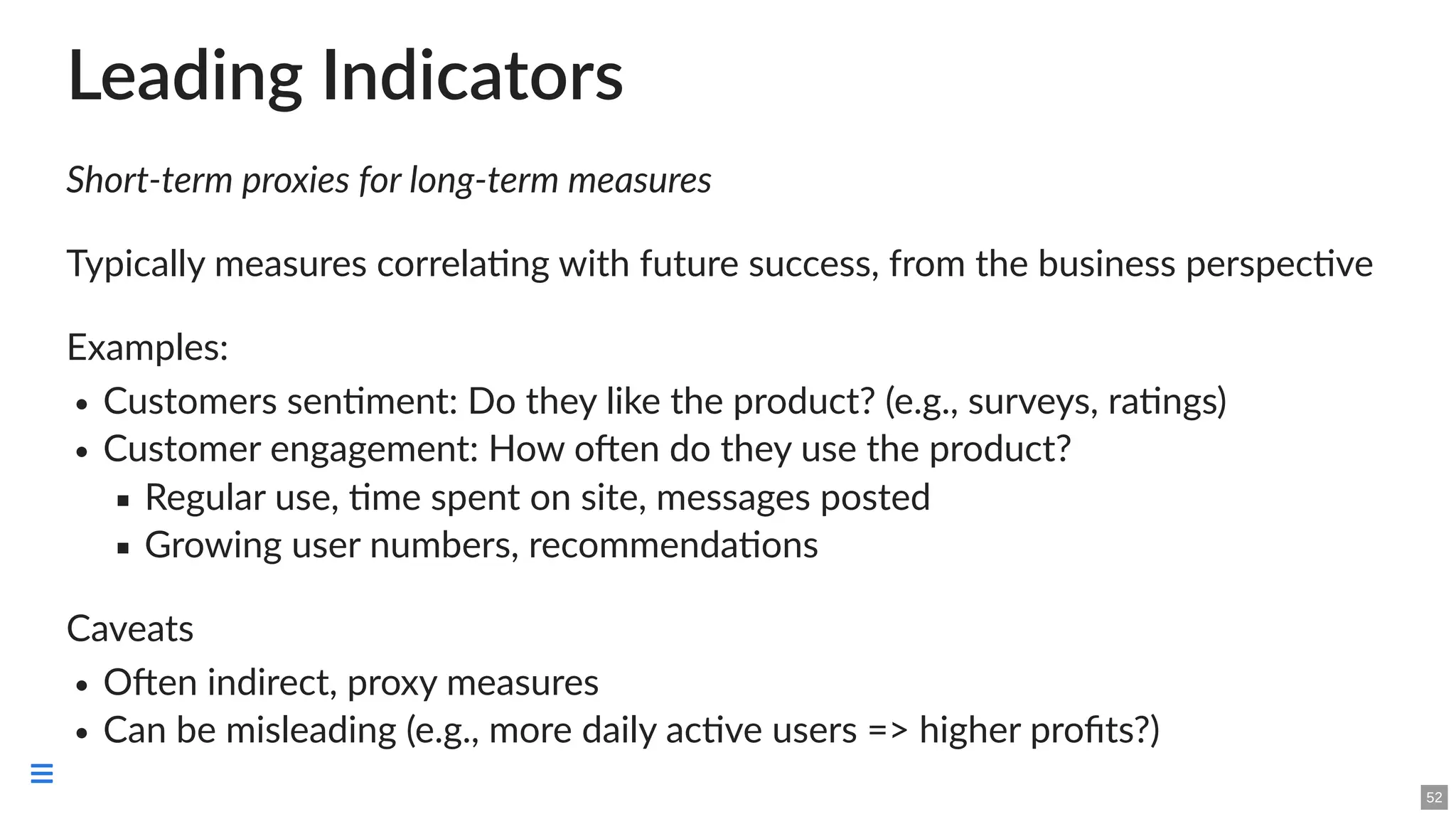
Leading Indicators
Short-term proxiesfor long-term measures
Typically measures correlating with future success, from the business perspective
Examples:
Customers sentiment: Do they like the product? (e.g., surveys, ratings)
Customer engagement: How often do they use the product?
Regular use, time spent on site, messages posted
Growing user numbers, recommendations
Caveats
Often indirect, proxy measures
Can be misleading (e.g., more daily active users => higher profits?)
52
60.
System/Feature Goals
Concrete outputsthe system (or a feature of the system) should produce
Relates to system requirements
Examples:
Detect cancer in radiology scans
Provide and recommend music to stream
Make personalized music recommendations
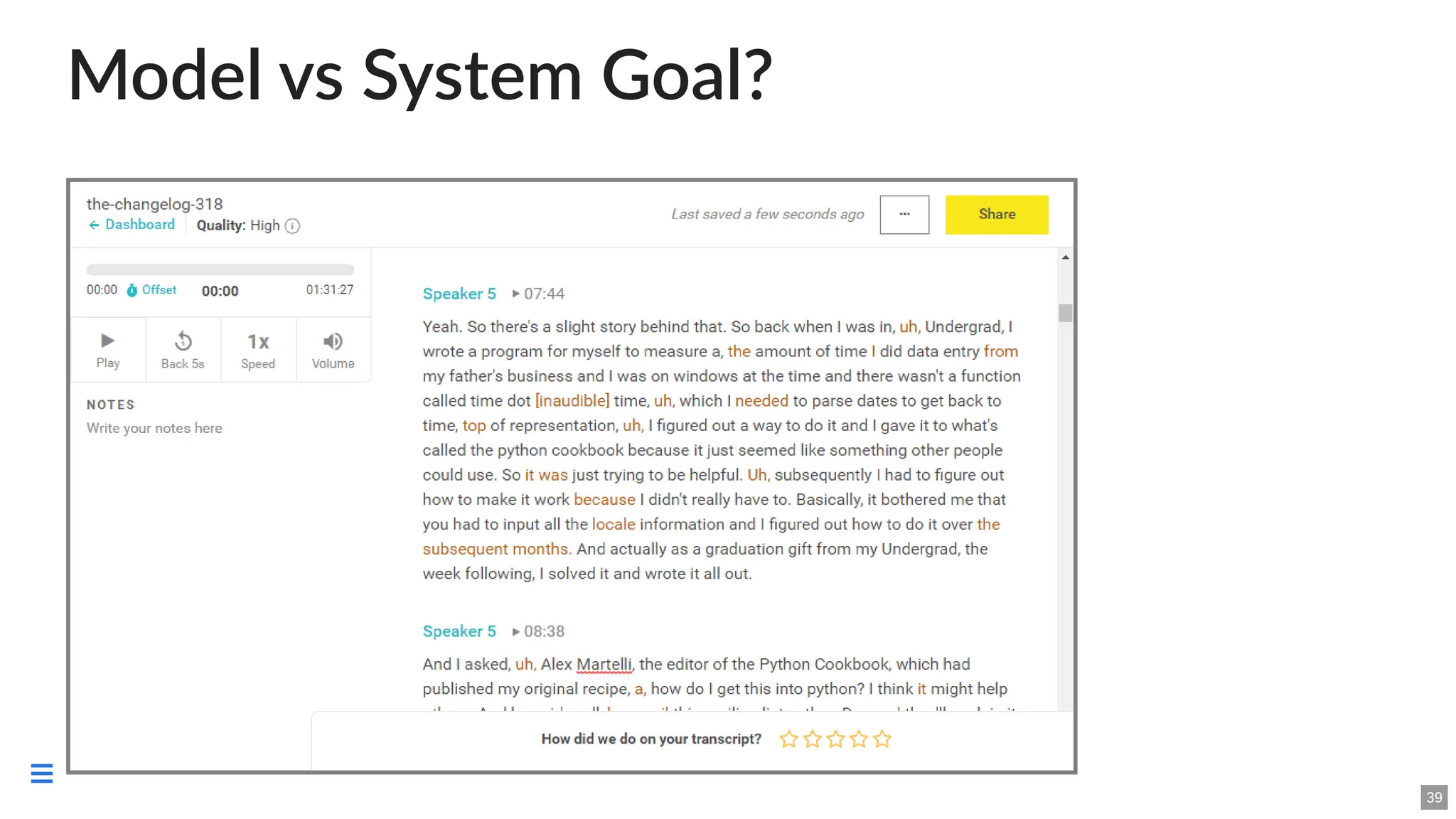
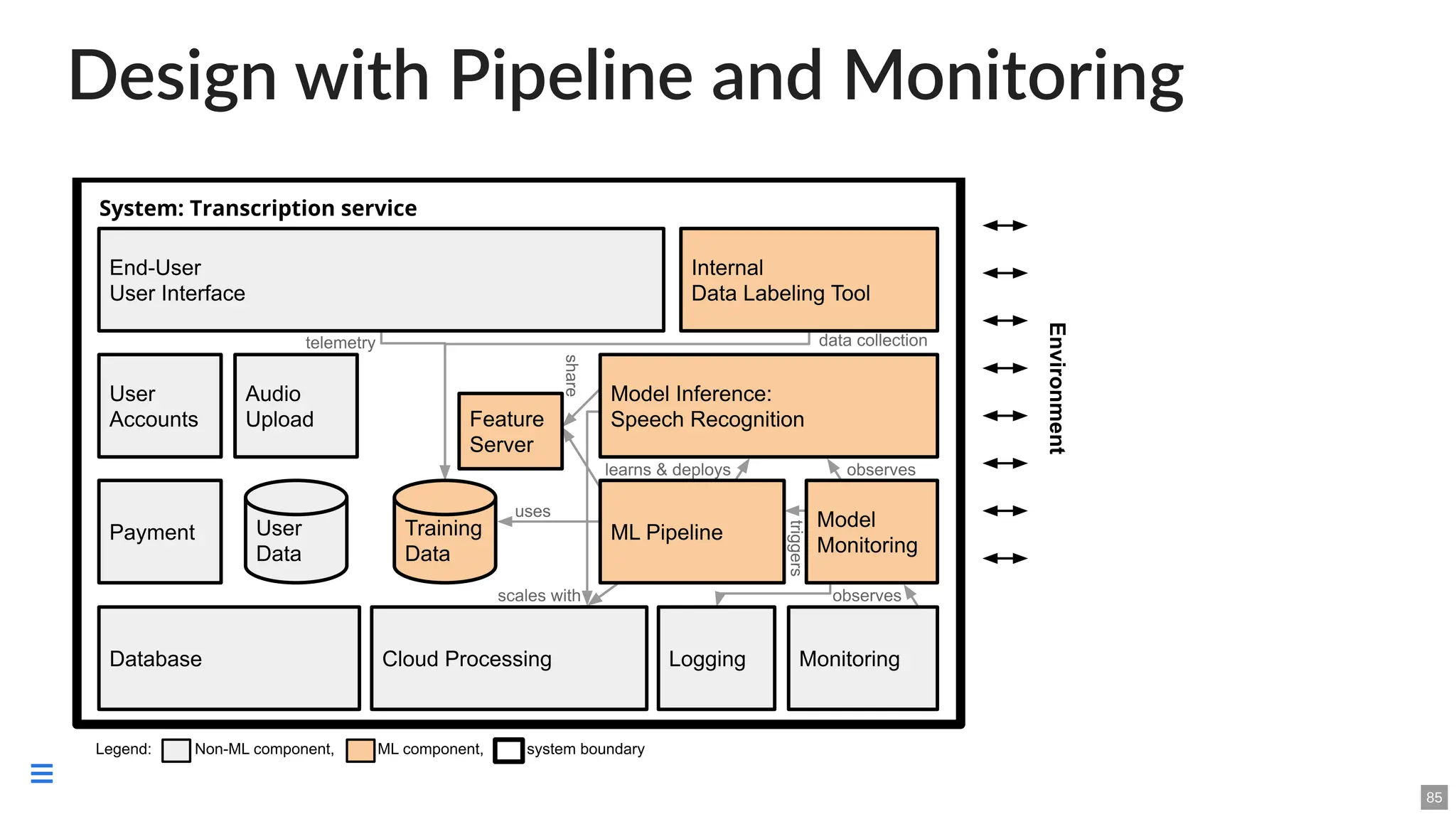
Transcribe audio files
Provide legal help with a self-service chatbot
53
61.
User Goals
How wellthe system is serving its users, from the user's perspective
Examples:
Users choosing recommended items and enjoying them
Users making better decisions
Users saving time thanks to the system
Users achieving their goals
Easier and more granular to measure, but possibly only indirect
relation to organization/system objectives
54
62.
Model Goals
Quality ofthe model used in a system, from the model's perspective
Model accuracy
Rate and kinds of mistakes
Successful user interactions
Inference time
Training cost
Often not directly linked to organizational/system/user goals
55
63.
Success Measures inthe Transcription
Scenario?
Organizational goals? Leading
indicators? System goals? User
goals? Model goals?
56
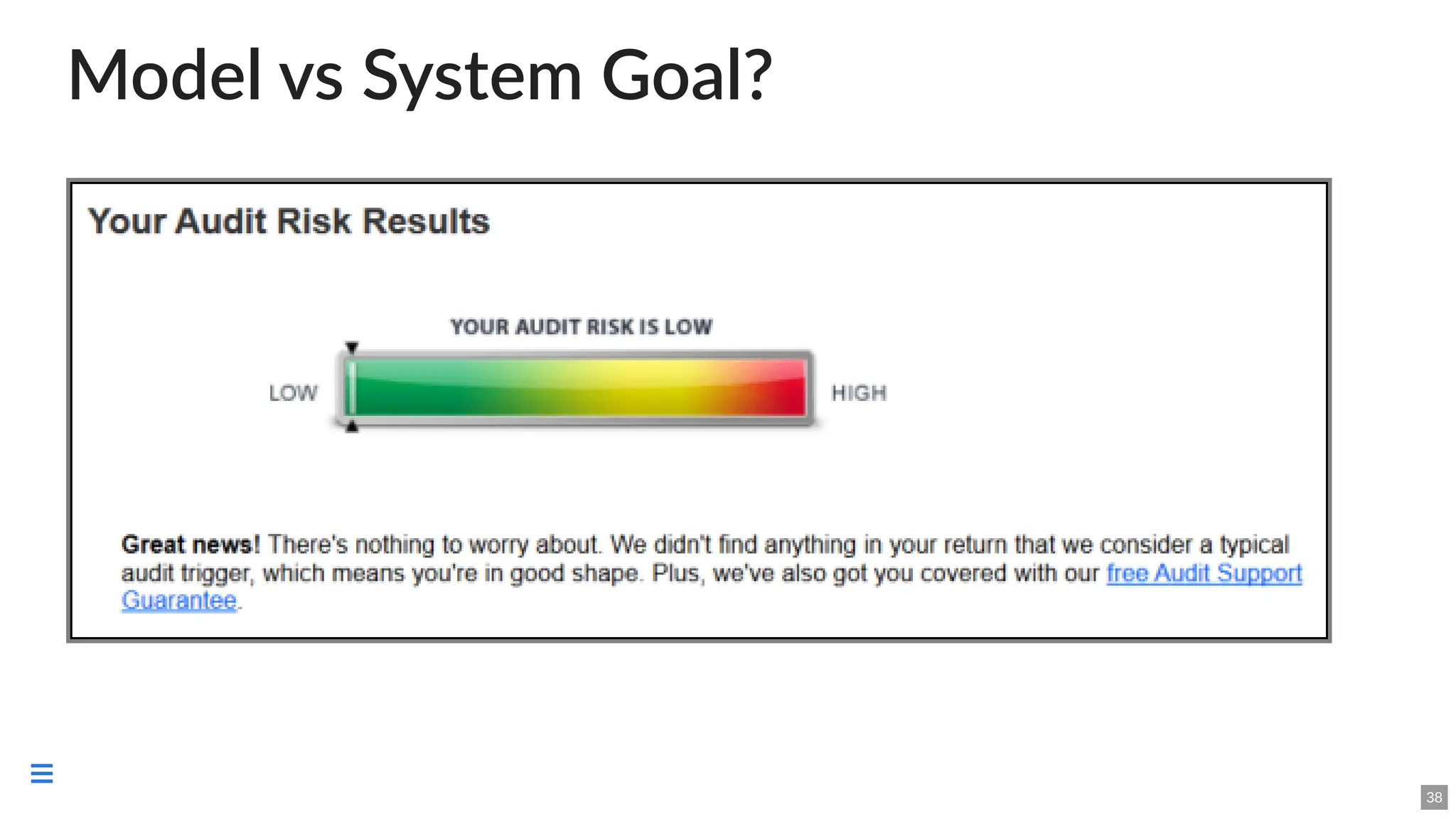
64.
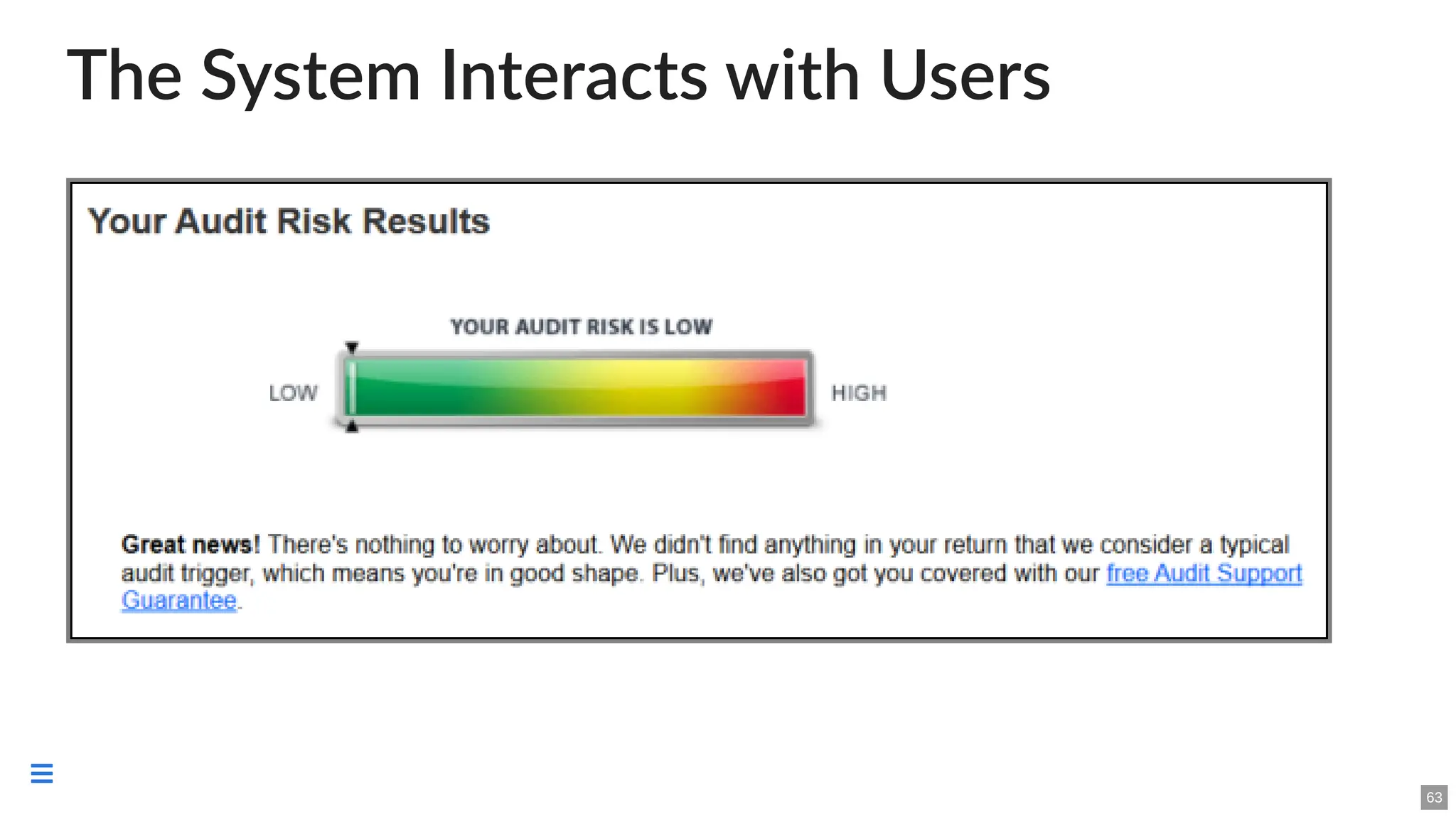
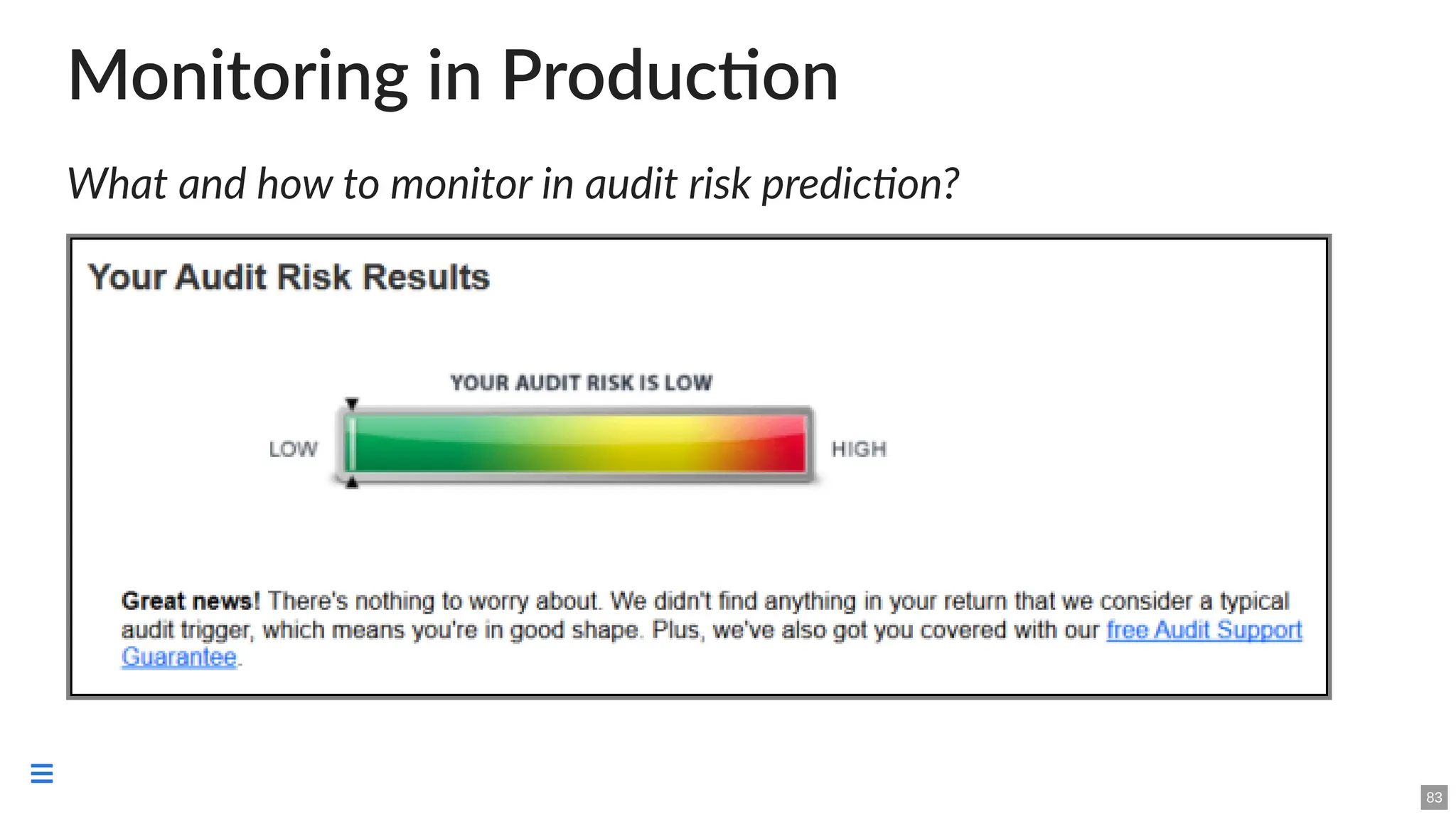
Success Measures inthe Audit Risk
Scenario?
Organizational goals? Leading
indicators? System goals? User
goals? Model goals?
57
65.
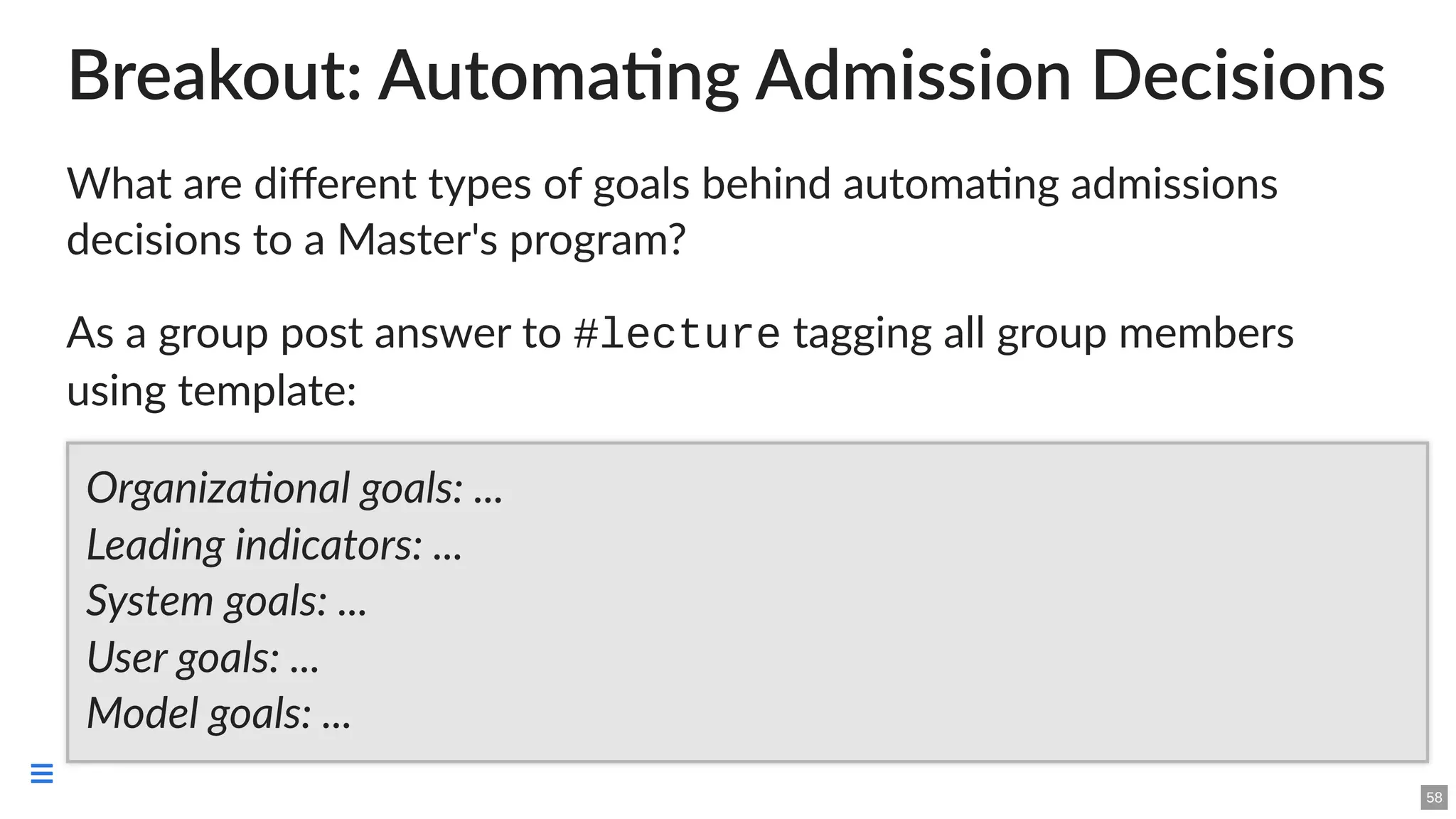
Breakout: Automating AdmissionDecisions
What are different types of goals behind automating admissions
decisions to a Master's program?
As a group post answer to #lecture tagging all group members
using template:
Organizational goals: ...
Leading indicators: ...
System goals: ...
User goals: ...
Model goals: ...
58
66.
Academic Integrity Issue
Pleasedo not cover for people not participating in discussion
Easy to detect discrepancy between # answers and # people in
classroom
Please let's not have to have unpleasant meetings.
59
67.
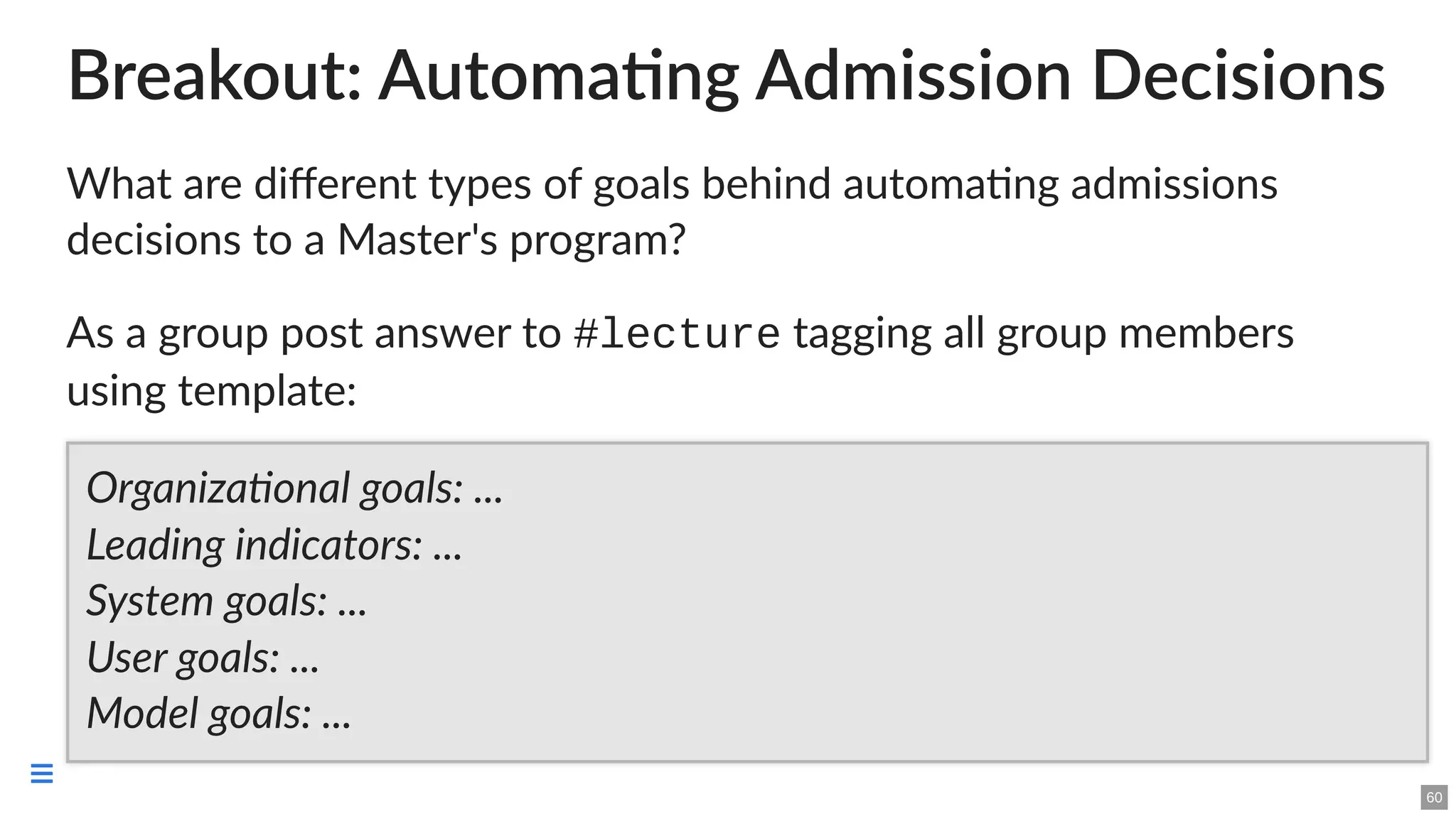
Breakout: Automating AdmissionDecisions
What are different types of goals behind automating admissions
decisions to a Master's program?
As a group post answer to #lecture tagging all group members
using template:
Organizational goals: ...
Leading indicators: ...
System goals: ...
User goals: ...
Model goals: ...
60
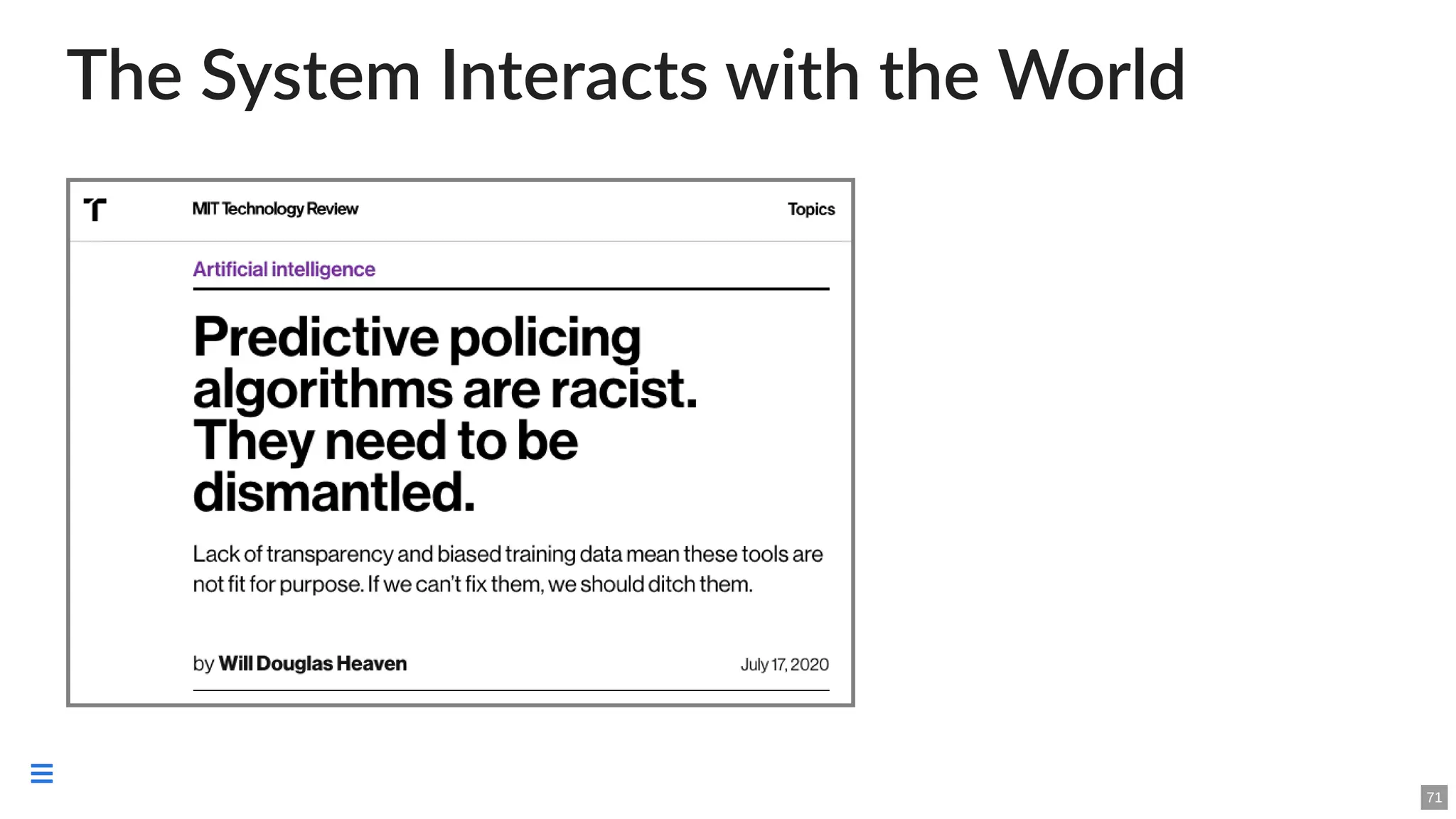
The System Interactswith the World
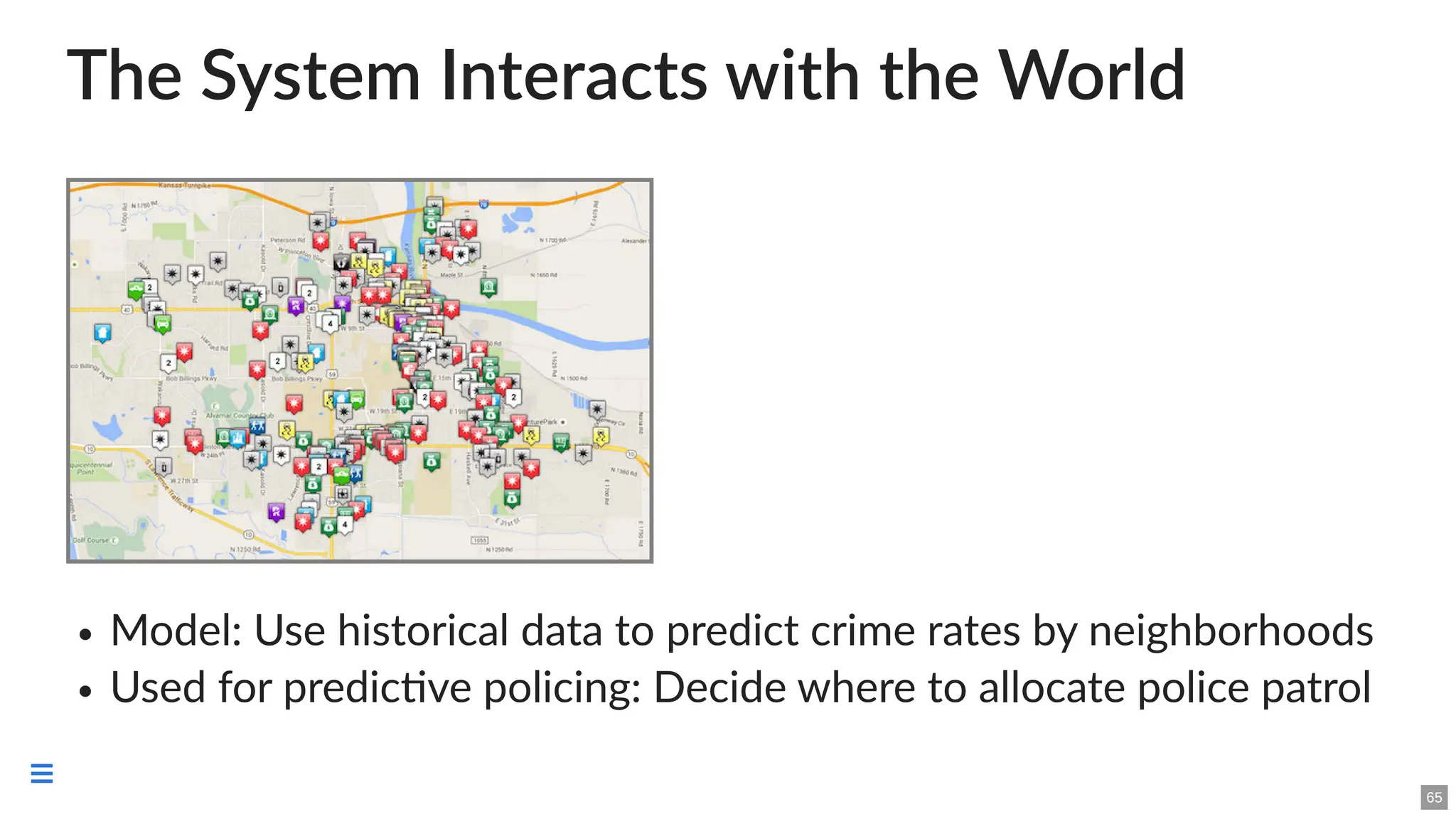
Model: Use historical data to predict crime rates by neighborhoods
Used for predictive policing: Decide where to allocate police patrol
65
74.
User Interaction Design
Often:System interact with the world through by influencing people
("human in the loop")
Automate: Take action on user's behalf
Prompt: Ask the user if an action should be taken
Organize/Annotate/Augment: Add information to a display
Hybrids of these
66
75.
Factors to Consider(from Reading)
Forcefulness: How strongly to encourage taking an action (or even
automate it)?
Frequency: How often to interact with the user?
Value: How much does a user (think to) benefit from the prediction?
Cost: What is the damage of a wrong prediction?
67
76.
Discussion: Safe Browsing
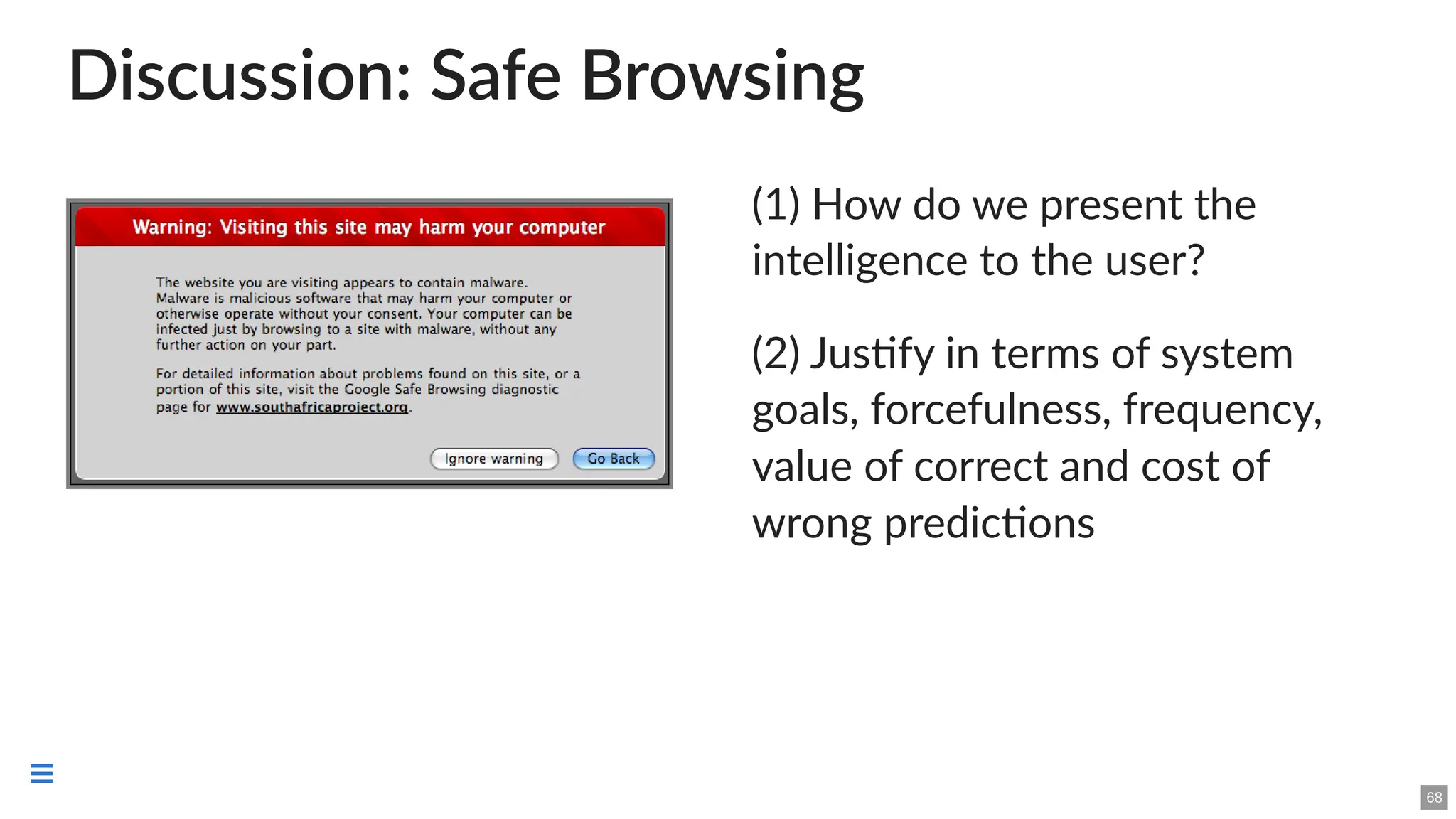
(1)How do we present the
intelligence to the user?
(2) Justify in terms of system
goals, forcefulness, frequency,
value of correct and cost of
wrong predictions
68
77.
Devices for olderadults to detect falls and alert caretaker or emergency responders automatically or after interaction. Uses various inputs to detect falls. Read more:
, MobiHealthNews, 2019
Speaker notes
How
fall detection is moving beyond the pendant
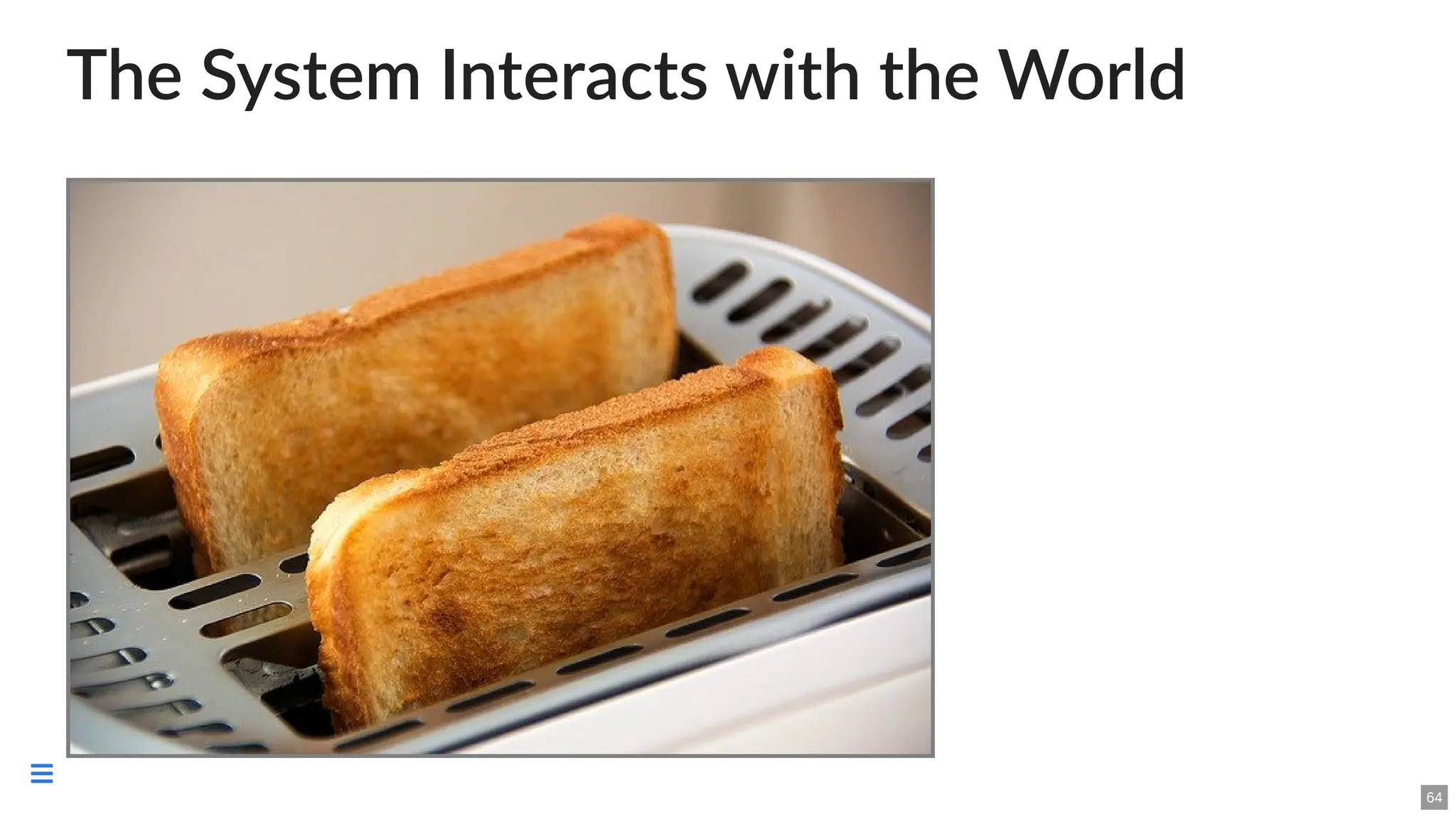
Safety Assurance in/outsidethe Model
In the model
Ensure maximum toasting time
Use heat sensor and past outputs for
prediction
Hard to make guarantees
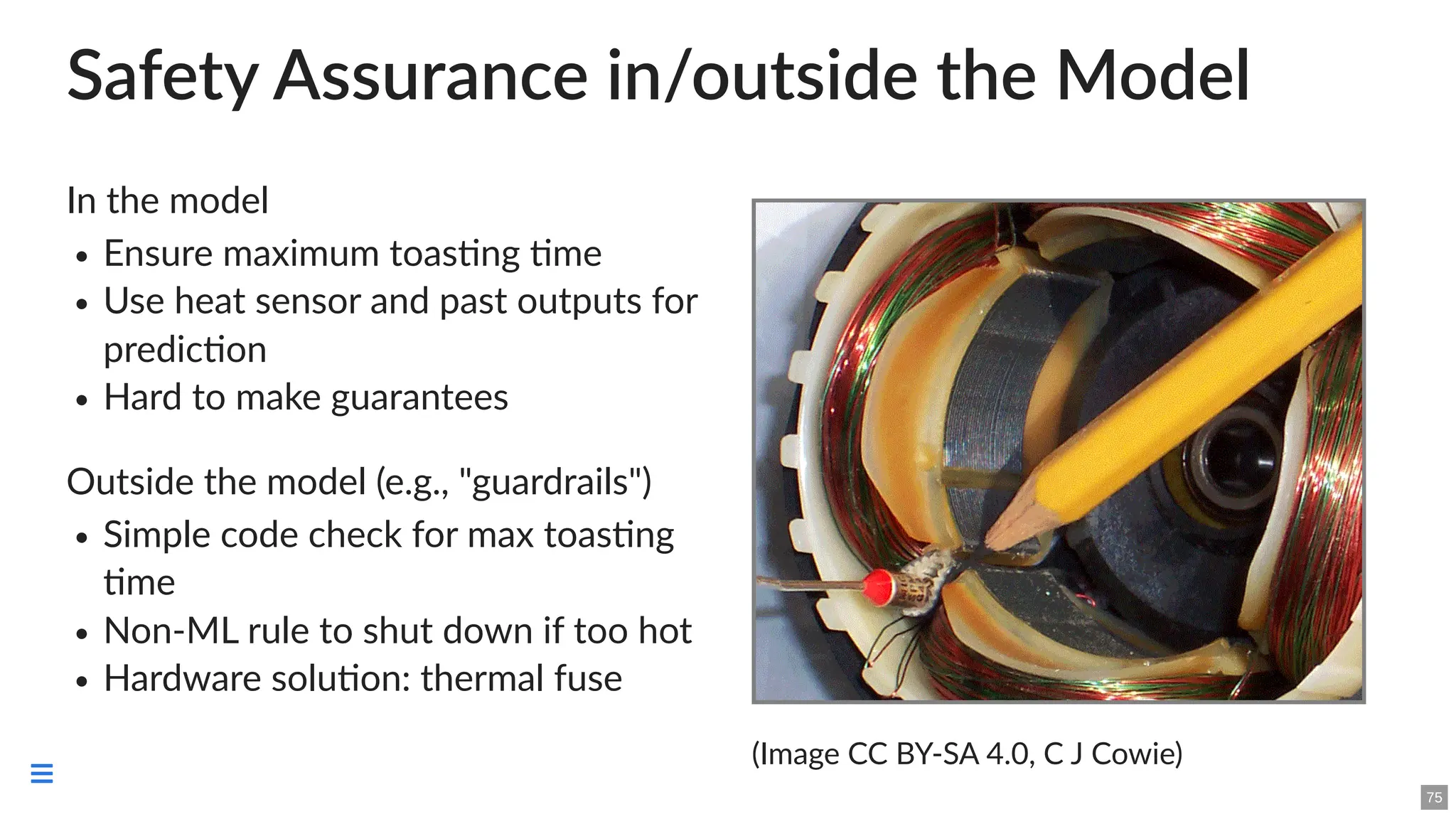
Outside the model (e.g., "guardrails")
Simple code check for max toasting
time
Non-ML rule to shut down if too hot
Hardware solution: thermal fuse
(Image CC BY-SA 4.0, C J Cowie)
75
85.
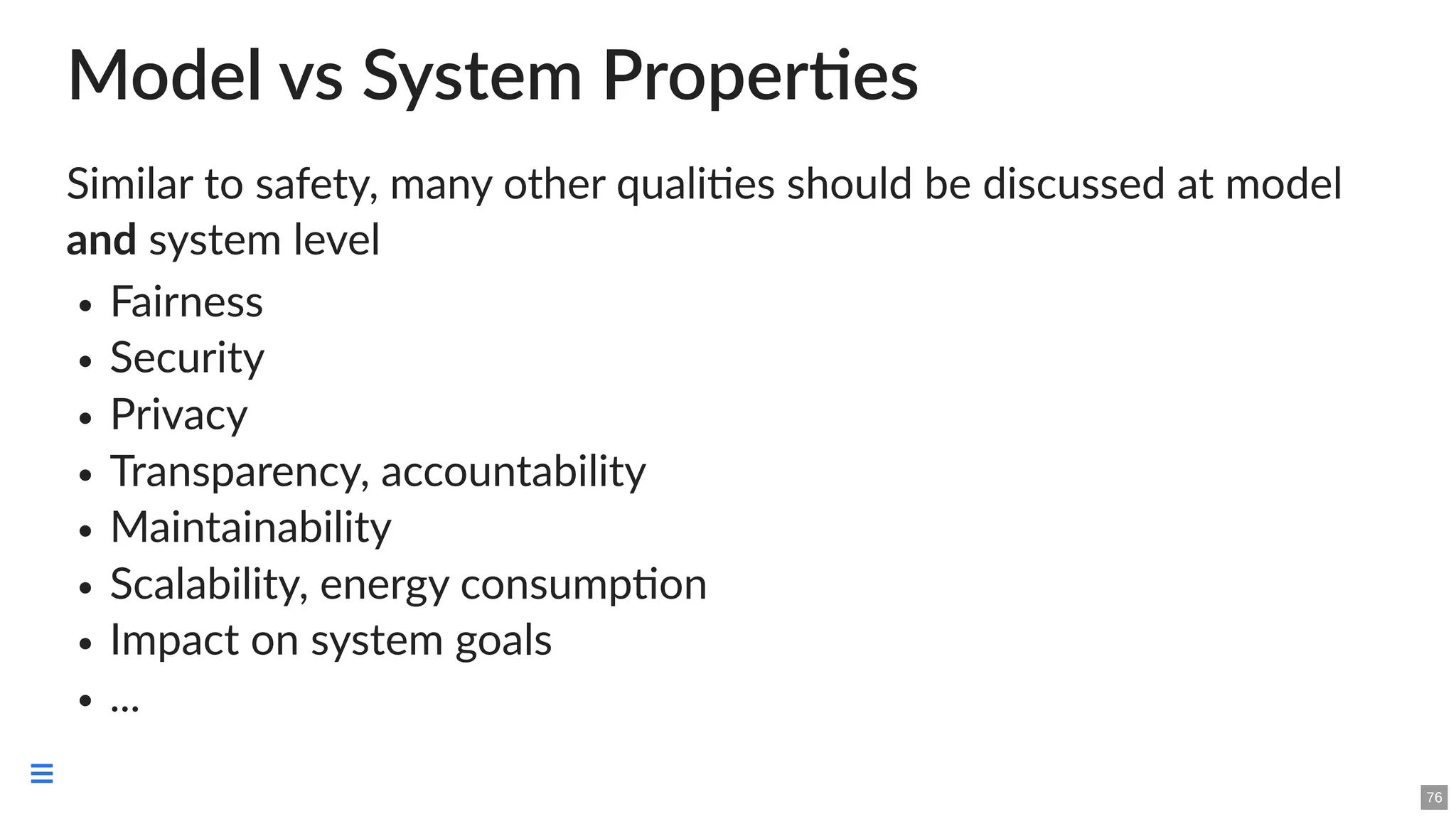
Model vs SystemProperties
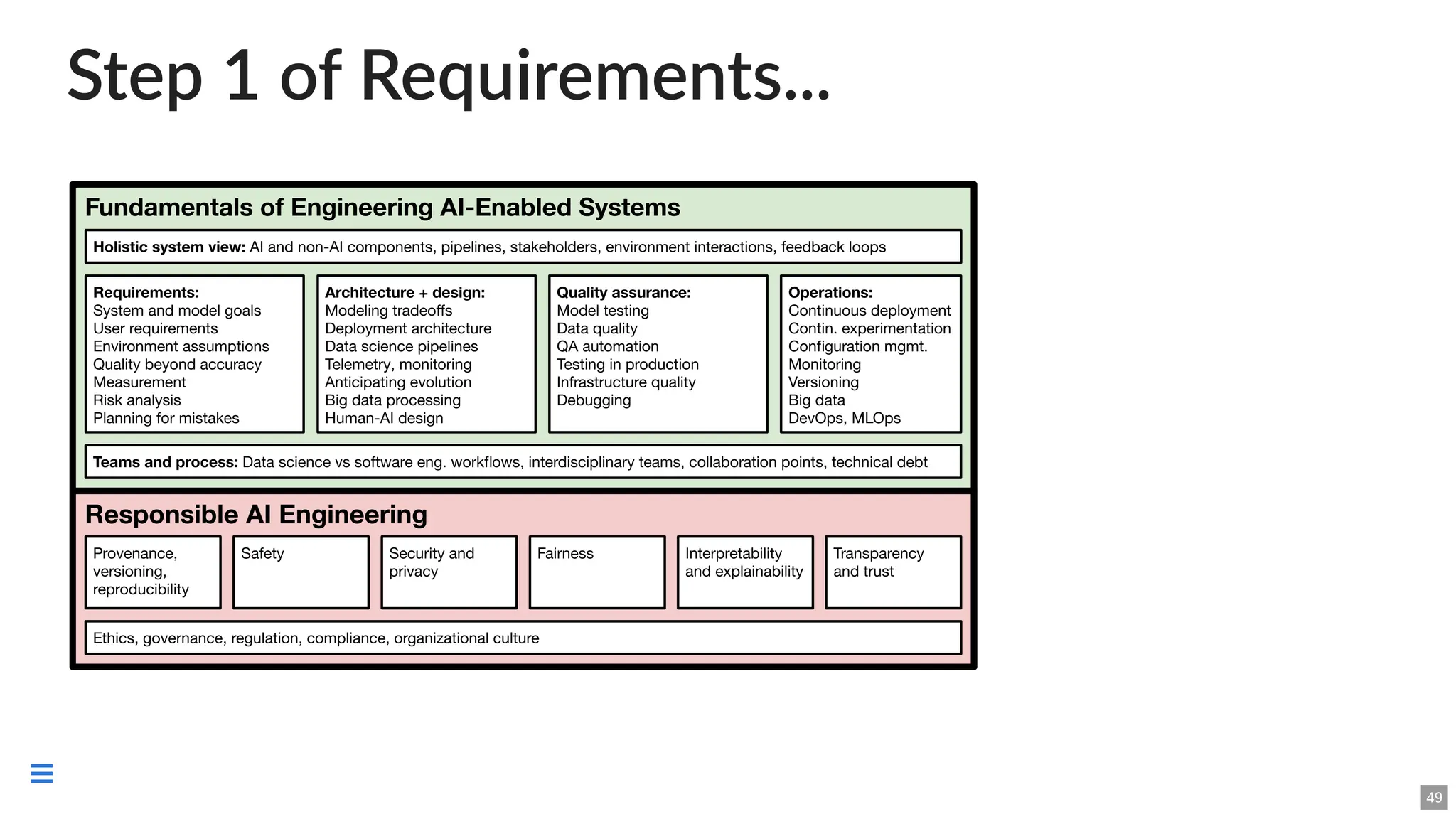
Similar to safety, many other qualities should be discussed at model
and system level
Fairness
Security
Privacy
Transparency, accountability
Maintainability
Scalability, energy consumption
Impact on system goals
...
76
86.
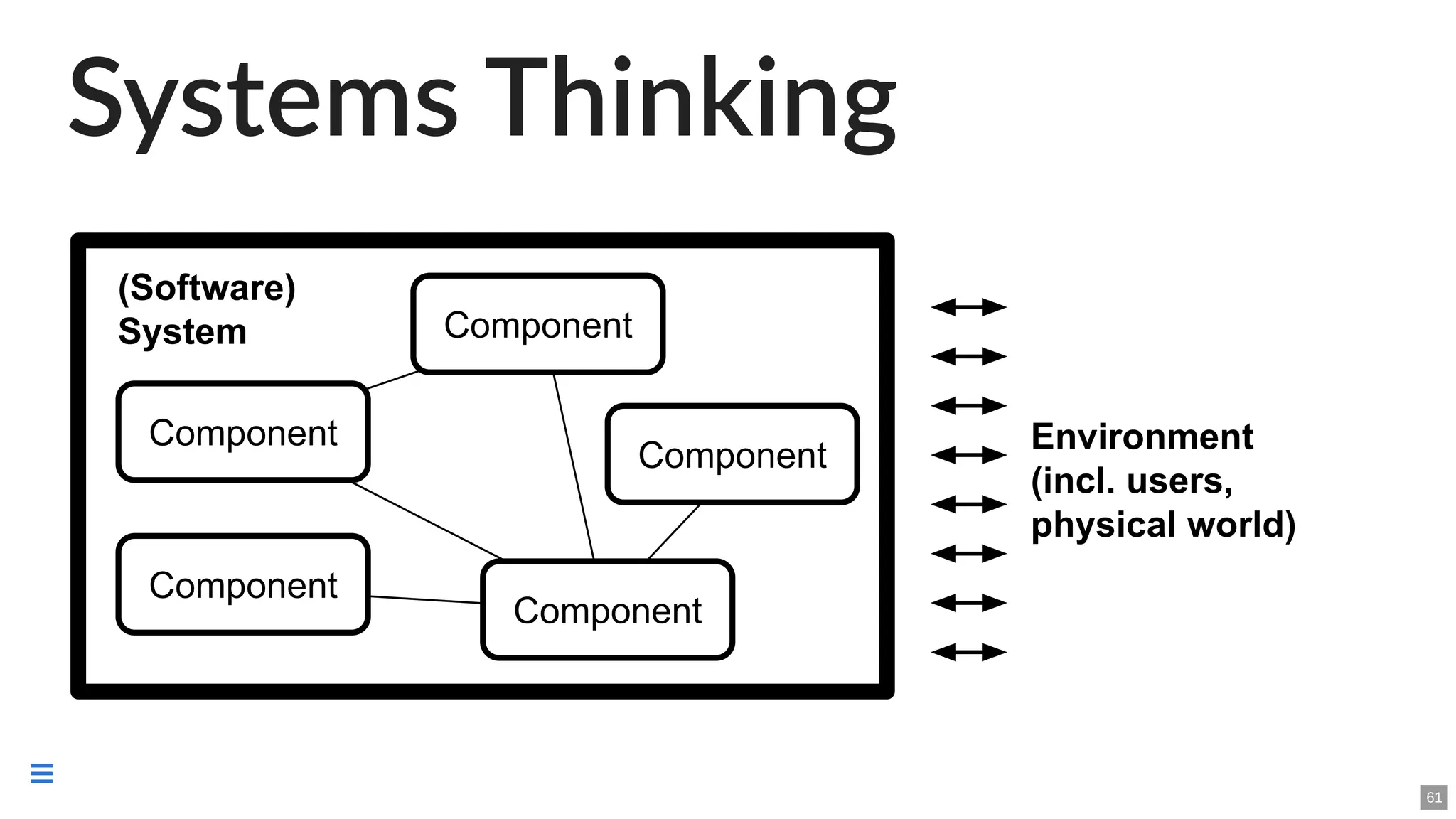
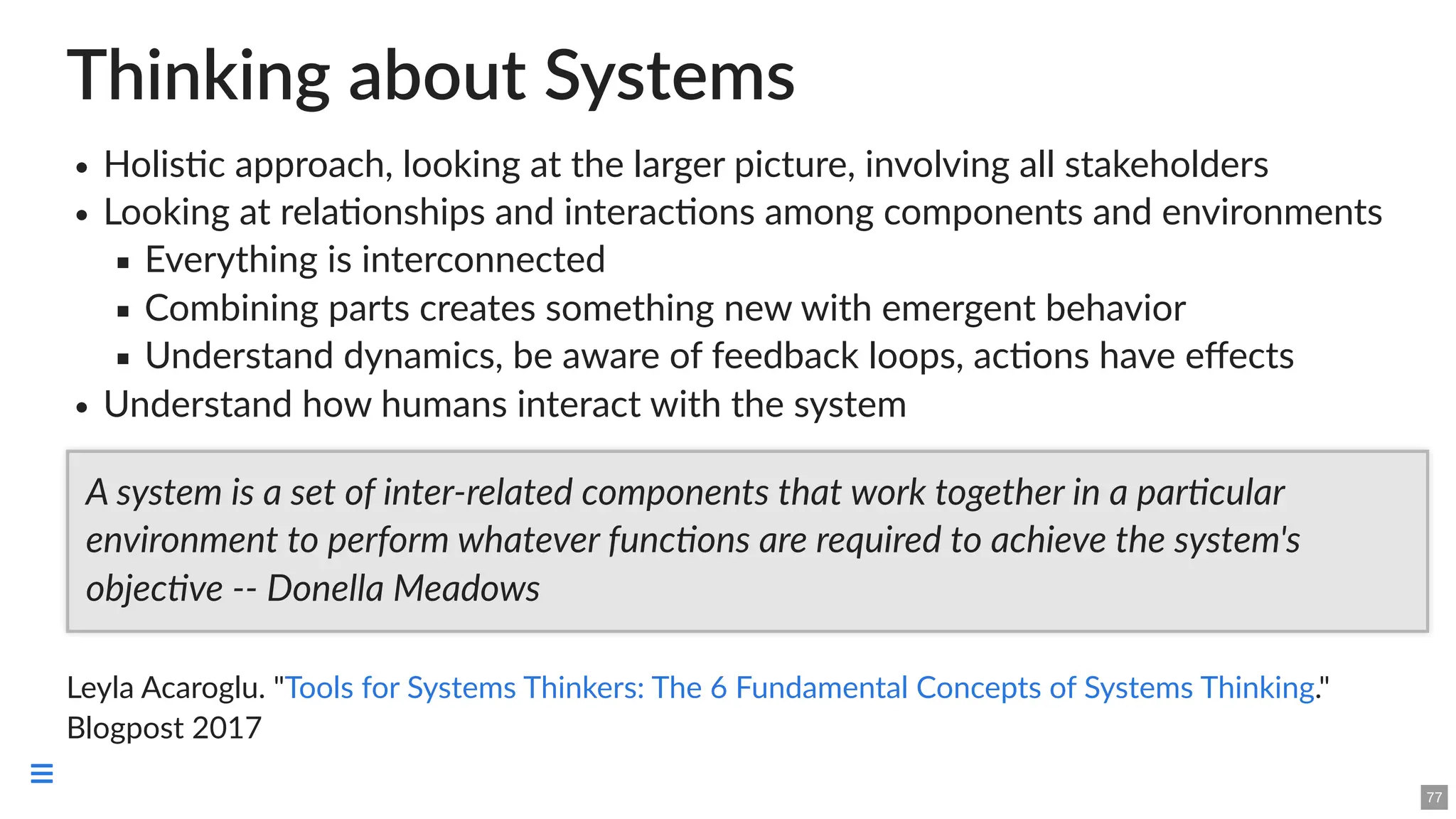
Thinking about Systems
Holisticapproach, looking at the larger picture, involving all stakeholders
Looking at relationships and interactions among components and environments
Everything is interconnected
Combining parts creates something new with emergent behavior
Understand dynamics, be aware of feedback loops, actions have effects
Understand how humans interact with the system
Leyla Acaroglu. " ."
Blogpost 2017
A system is a set of inter-related components that work together in a particular
environment to perform whatever functions are required to achieve the system's
objective -- Donella Meadows
Tools for Systems Thinkers: The 6 Fundamental Concepts of Systems Thinking
77
87.
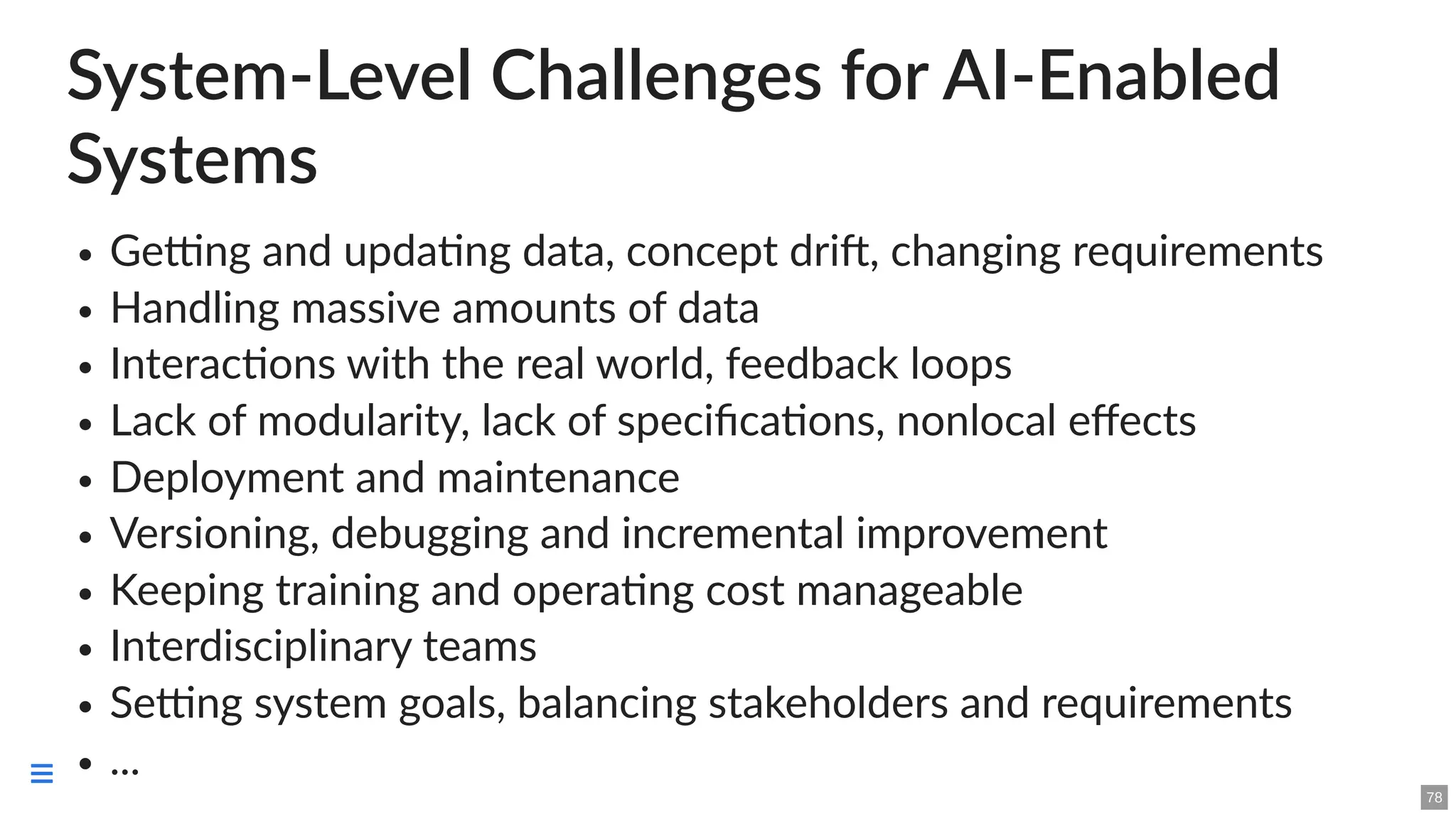
System-Level Challenges forAI-Enabled
Systems
Getting and updating data, concept drift, changing requirements
Handling massive amounts of data
Interactions with the real world, feedback loops
Lack of modularity, lack of specifications, nonlocal effects
Deployment and maintenance
Versioning, debugging and incremental improvement
Keeping training and operating cost manageable
Interdisciplinary teams
Setting system goals, balancing stakeholders and requirements
...
78
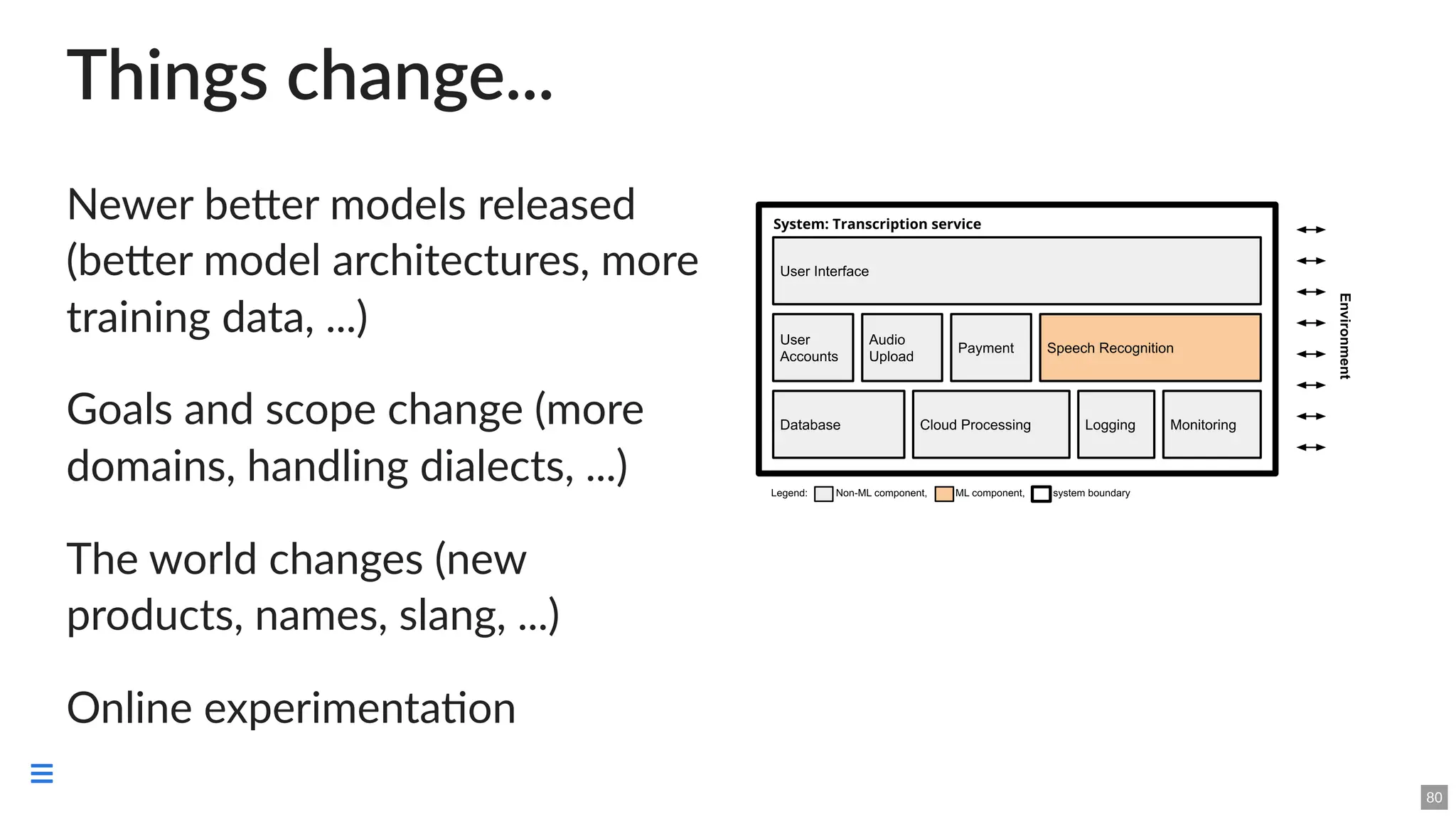
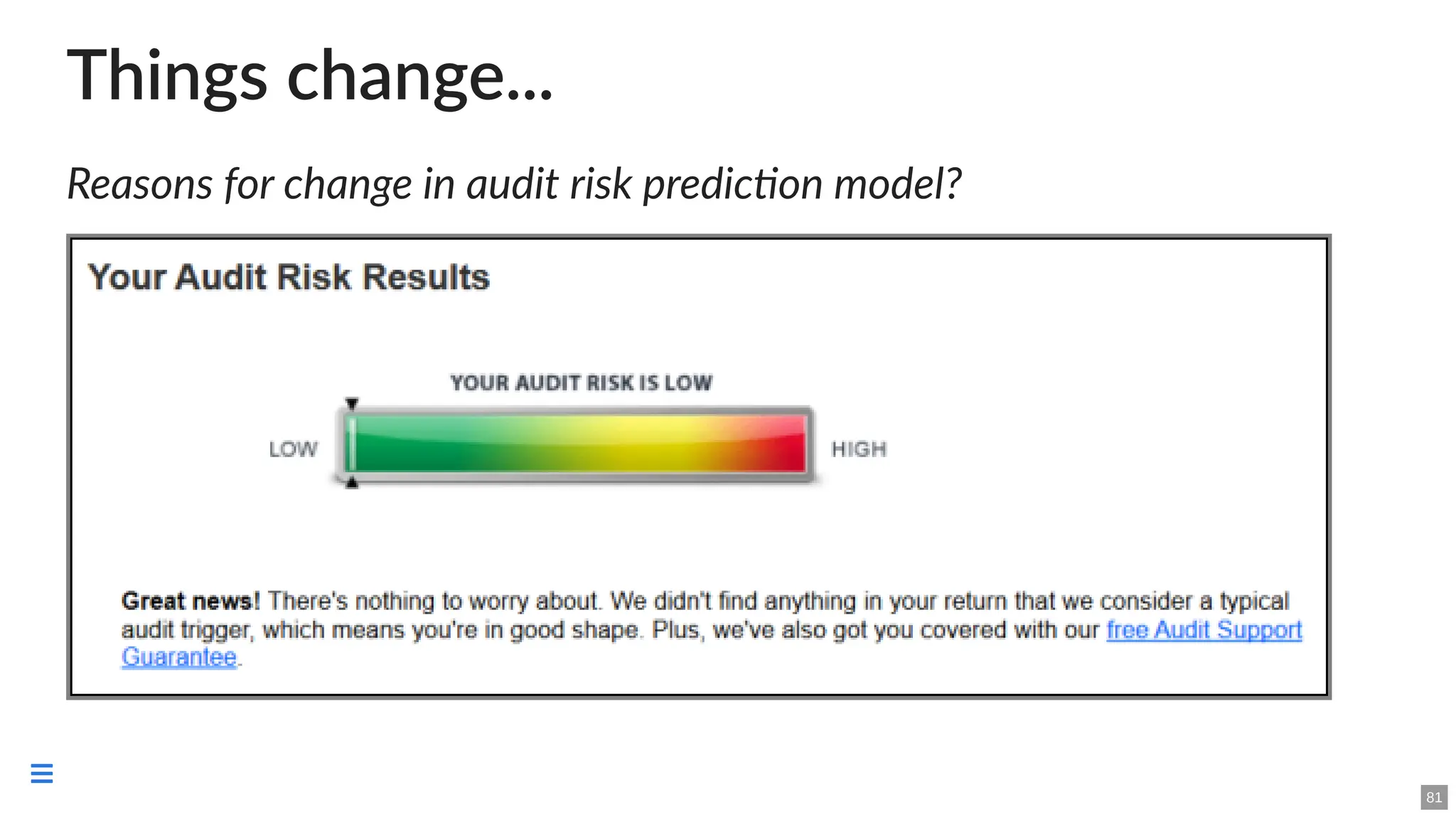
Things change...
Newer bettermodels released
(better model architectures, more
training data, ...)
Goals and scope change (more
domains, handling dialects, ...)
The world changes (new
products, names, slang, ...)
Online experimentation
80
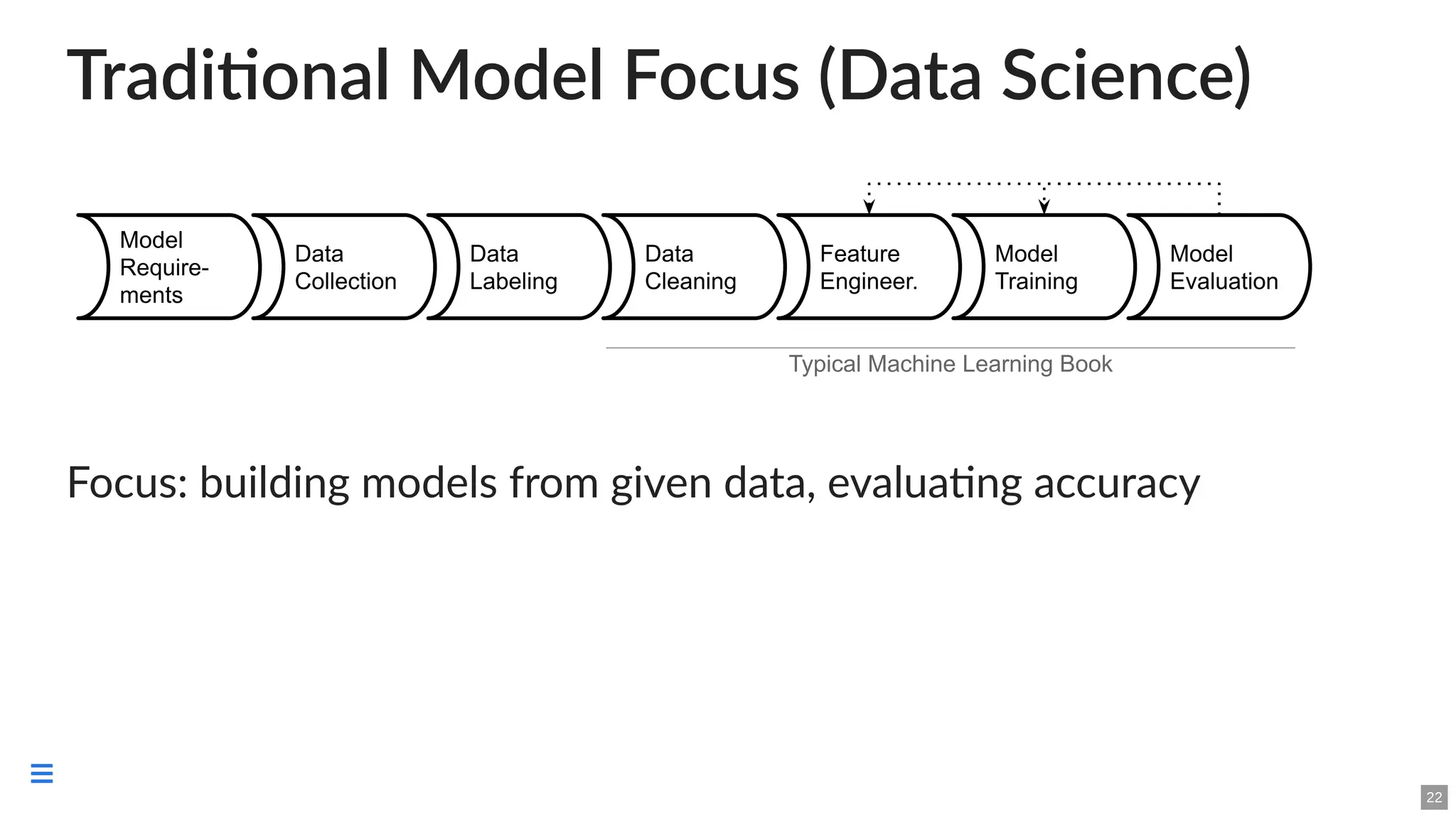
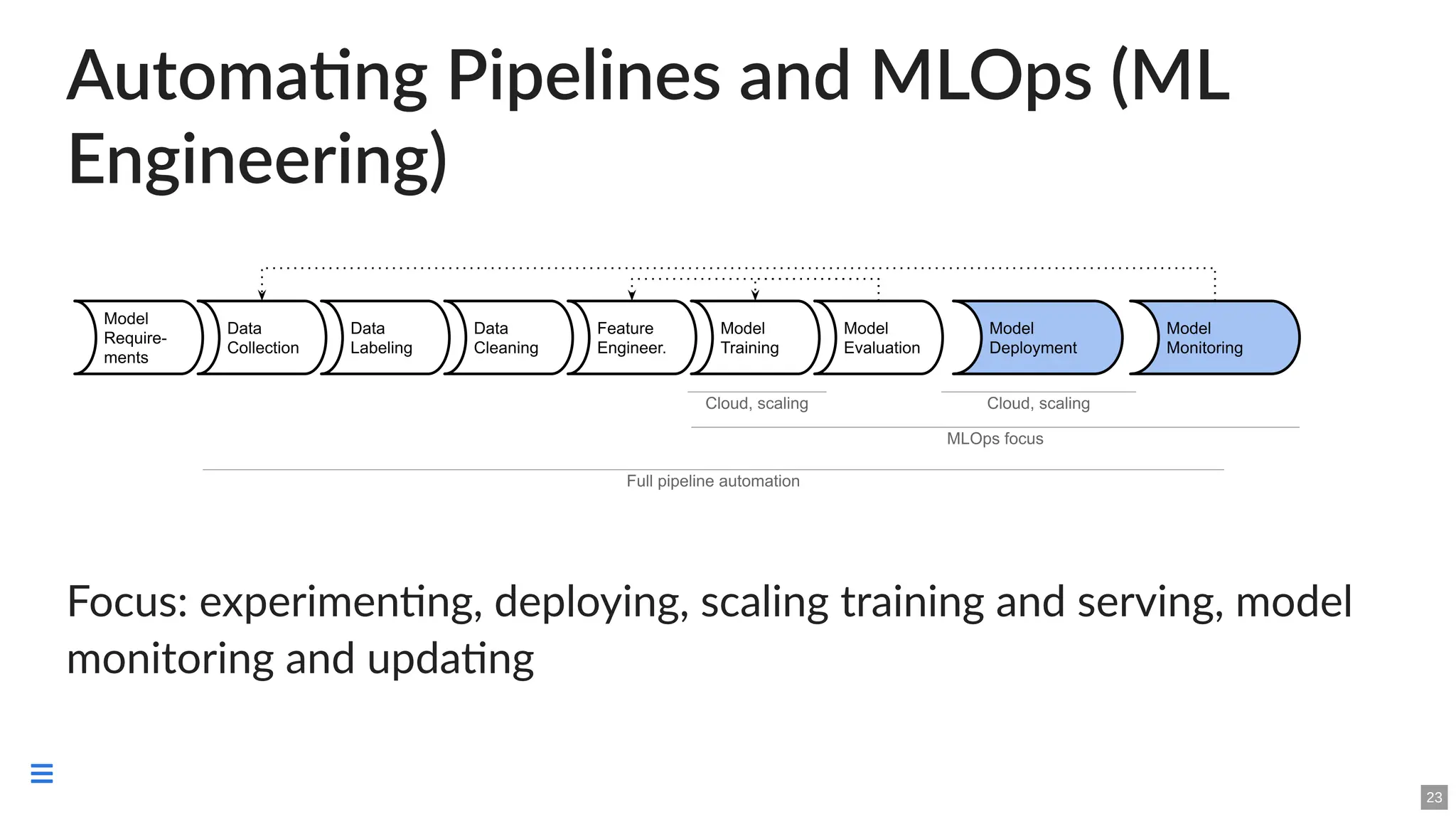
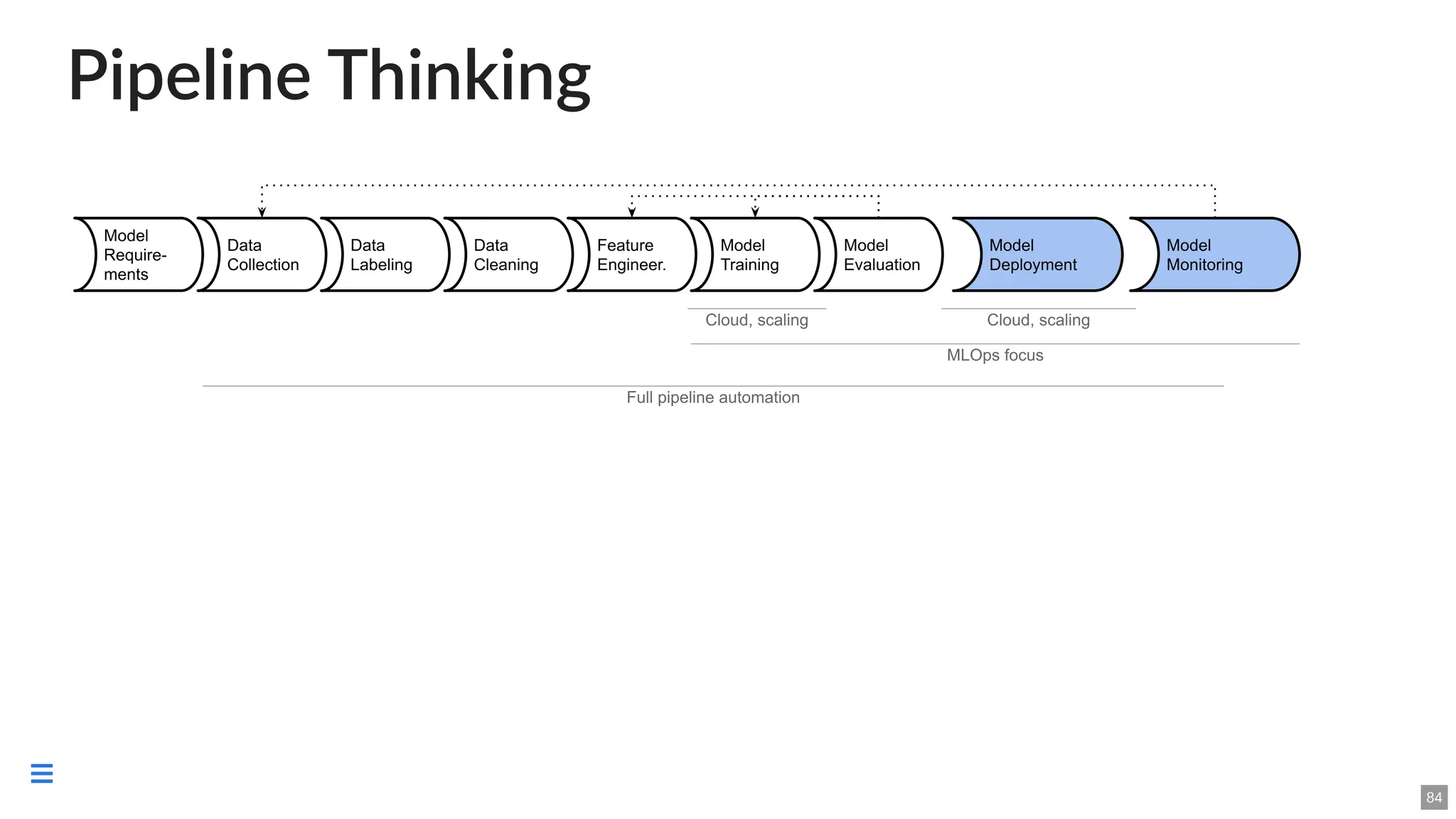
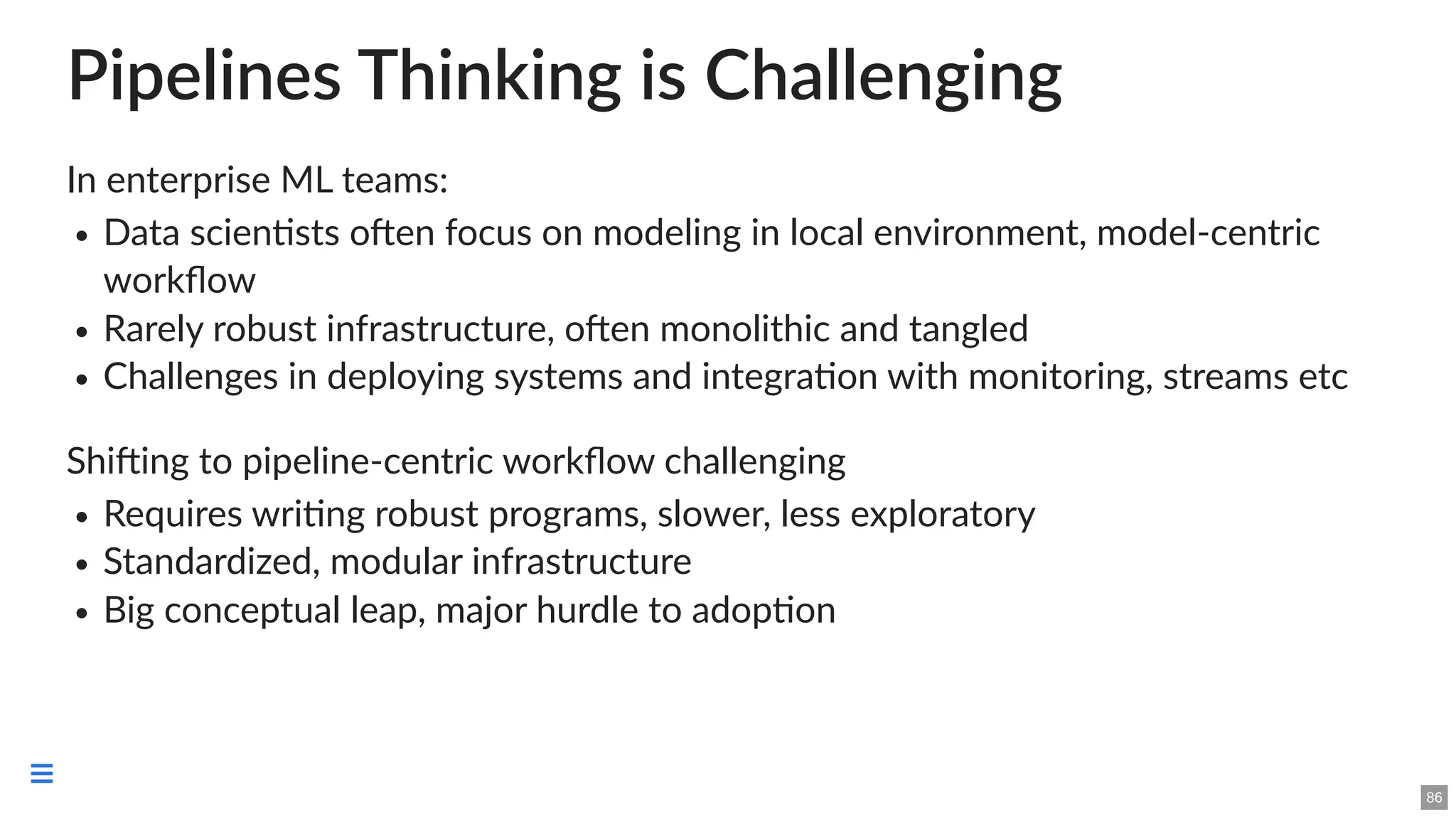
Pipelines Thinking isChallenging
In enterprise ML teams:
Data scientists often focus on modeling in local environment, model-centric
workflow
Rarely robust infrastructure, often monolithic and tangled
Challenges in deploying systems and integration with monitoring, streams etc
Shifting to pipeline-centric workflow challenging
Requires writing robust programs, slower, less exploratory
Standardized, modular infrastructure
Big conceptual leap, major hurdle to adoption
86
96.
Summary
Production AI-enabled systemsrequire a whole system perspective,
beyond just the model or the pipeline
Distinguish goals: organization, system, user, model goals
Quality at a system level: safety beyond the model, beyond accuracy
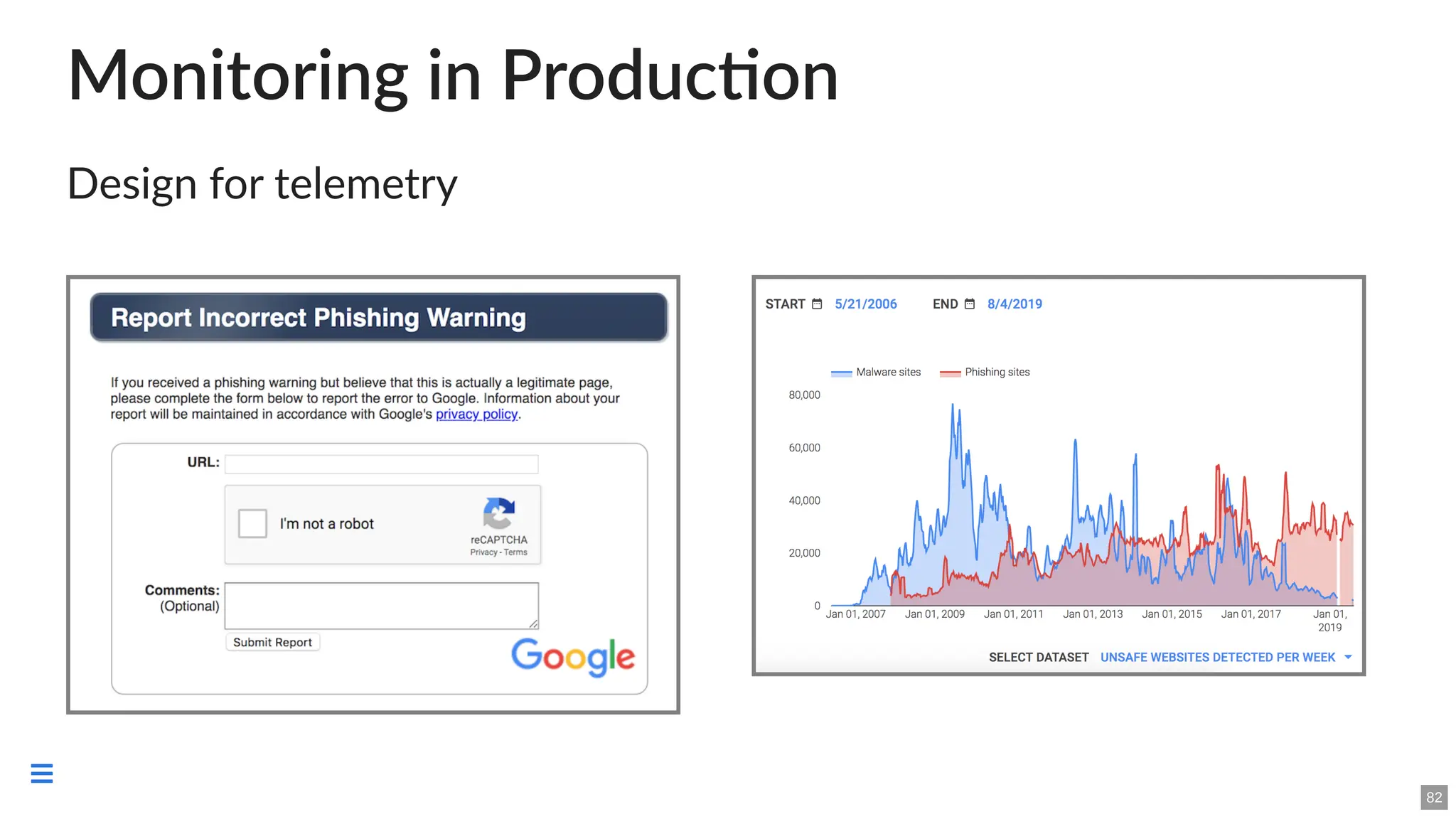
Large design space for user interface (intelligent experience):
forcefulness, frequency, telemetry
Plan for operations (telemetry, updates)
87
97.
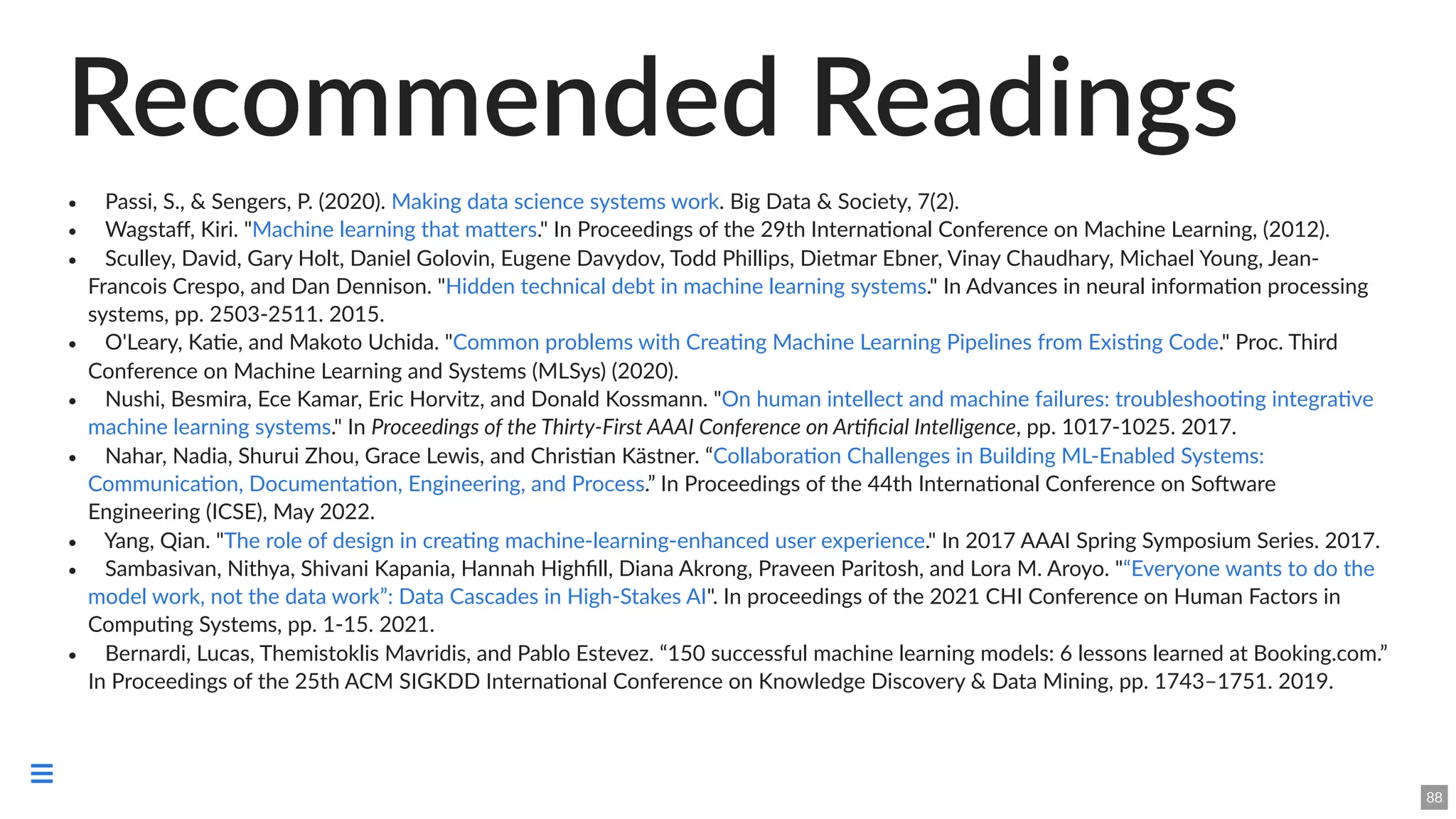
Recommended Readings
🗎 Passi,S., & Sengers, P. (2020). . Big Data & Society, 7(2).
🗎 Wagstaff, Kiri. " ." In Proceedings of the 29th International Conference on Machine Learning, (2012).
🗎 Sculley, David, Gary Holt, Daniel Golovin, Eugene Davydov, Todd Phillips, Dietmar Ebner, Vinay Chaudhary, Michael Young, Jean-
Francois Crespo, and Dan Dennison. " ." In Advances in neural information processing
systems, pp. 2503-2511. 2015.
🗎 O'Leary, Katie, and Makoto Uchida. " ." Proc. Third
Conference on Machine Learning and Systems (MLSys) (2020).
🗎 Nushi, Besmira, Ece Kamar, Eric Horvitz, and Donald Kossmann. "
." In Proceedings of the Thirty-First AAAI Conference on Artificial Intelligence, pp. 1017-1025. 2017.
🗎 Nahar, Nadia, Shurui Zhou, Grace Lewis, and Christian Kästner. “
.” In Proceedings of the 44th International Conference on Software
Engineering (ICSE), May 2022.
🗎 Yang, Qian. " ." In 2017 AAAI Spring Symposium Series. 2017.
🗎 Sambasivan, Nithya, Shivani Kapania, Hannah Highfill, Diana Akrong, Praveen Paritosh, and Lora M. Aroyo. "
". In proceedings of the 2021 CHI Conference on Human Factors in
Computing Systems, pp. 1-15. 2021.
🗎 Bernardi, Lucas, Themistoklis Mavridis, and Pablo Estevez. “150 successful machine learning models: 6 lessons learned at Booking.com.”
In Proceedings of the 25th ACM SIGKDD International Conference on Knowledge Discovery & Data Mining, pp. 1743–1751. 2019.
Making data science systems work
Machine learning that matters
Hidden technical debt in machine learning systems
Common problems with Creating Machine Learning Pipelines from Existing Code
On human intellect and machine failures: troubleshooting integrative
machine learning systems
Collaboration Challenges in Building ML-Enabled Systems:
Communication, Documentation, Engineering, and Process
The role of design in creating machine-learning-enhanced user experience
“Everyone wants to do the
model work, not the data work”: Data Cascades in High-Stakes AI
88
98.
Machine Learning inProduction/AI Engineering • Claire Le Goues & Christian Kaestner, Carnegie Mellon University • Spring 2024











![[DSC Europe 25] Jovan Bogicevic - Legacy to AI-Driven Defense: Transforming D...](https://cdn.slidesharecdn.com/ss_thumbnails/rsarluadt563hntyfc8q-3-251211083849-3e7bc4c0-thumbnail.jpg?width=640&height=640&fit=bounds)
![[DSC Europe 25] Debmalya Biswas - Agentification: the art of transforming man...](https://cdn.slidesharecdn.com/ss_thumbnails/r5azlggvtqiaiiusrqdr-4-251212103249-5a12c89b-thumbnail.jpg?width=640&height=640&fit=bounds)
![[DSC Europe 25] Dusan Nesic - Securing Tomorrow’s Infrastructure: Why Cyber-P...](https://cdn.slidesharecdn.com/ss_thumbnails/qikbszfftyowjm2q6duw-1-251211083848-8f2ead6b-thumbnail.jpg?width=640&height=640&fit=bounds)

![[DSC Europe 25] Miodrag Pesovic & Vladislav Radonjic - Federated Data Archite...](https://cdn.slidesharecdn.com/ss_thumbnails/gsbe3y5it5uhndi4e08e-1-251212103249-f1008e0c-thumbnail.jpg?width=640&height=640&fit=bounds)
![[DSC Europe 25] Kaja Kandare - LLM as a judge.pptx](https://cdn.slidesharecdn.com/ss_thumbnails/arxyccaxsdsd1ba99wjw-7-251212104007-2b4e3f64-thumbnail.jpg?width=640&height=640&fit=bounds)


![[DSC Europe 25] Branko Dzakula - From Defense to Attack: How AI Redefines Cyb...](https://cdn.slidesharecdn.com/ss_thumbnails/80bdzdxpr3ky2g0qvyk9-8-251211083048-ce5fc1ee-thumbnail.jpg?width=640&height=640&fit=bounds)
![[DSC Europe 25] Uros Pesic - The Reality of AI in Marketing.pdf](https://cdn.slidesharecdn.com/ss_thumbnails/rtkodnmtycovsllvzsyn-9-251215095918-b0c6bfe3-thumbnail.jpg?width=640&height=640&fit=bounds)
![[DSC Europe 25] Hans Kleinsman - The Compliance Gearbox: How Tax Tech Mediate...](https://cdn.slidesharecdn.com/ss_thumbnails/dxdytie1toel0hr90bjs-2-251212103250-174fdbe7-thumbnail.jpg?width=640&height=640&fit=bounds)


