International Journal of Computer Science & Information Technology (IJCSIT) Vol 11, No 1, February 2019
DOI: 10.5121/ijcsit.2019.11105 61
WI-FI MICROCONTROLLER BASED SMART MENU
Sherif Kamel Hussein
Associate Professor- Department of Communications and Computer Engineering,
University for Modern Sciences and Arts, Giza, Egypt
Head of Computer Science Department Arab East Colleges, KSA
ABSTRACT
Nowadays the technology is embedded in every utilized application to increase the reliability and minimize
the human errors caused by the conventional methods. The traditional methods usually been used in
restaurant is by taking the customer’s orders and write it down on a piece of paper. Many ordering systems
have been proposed in order to solve this issue. In this paper a newly proposed model called Smart Menu is
designed basedon the Wi-Fi technology as the communication medium and Peripheral Interface Controller
( ARM Cortex – m7 processor ) as the hardware which implements faster ordering system. The aim for the
smart menu model is to build and design both hardware and software for the ordering and delivering
system at restaurants by using TFT LCD connected to the kitchen through WI-Fi technology. Result shows
that the hardware and software are successfully functional and able to be used as a smart ordering system.
The proposed model is able to handle the lack number of the workers, reduce the lateness and the error on
ordering foods by the customers.
KEYWORDS AND ABBREVIATIONS
Thick Film Transistor (TFT), Advanced Risk Machine Microcontroller (ARM) cortex-M7, wireless Fidelity
(Wi-Fi), Graphically Liquid Crystal Display (GLCD), Secure Digital (SD) Card.
1. INTRODUCTION
A restaurant is a place which is used for providing food and drinks. But why do we prefer a
restaurant over another one that serves the same food?. Is it because the waiter always forgets to
remove the tomatoes from your sandwich? Or is it because the order takes forever to be ready?
Having your detailed order submitted directly to the chef was a hard obstacle in the past. Today,
you can have exactly what you want just in few clicks. The restaurant menu has developed from
its modest beginnings on carte writing slates and picture less print to today's point by point, bright
shows. So, the digital image for a new meal will attract more people than just its name placed
within the list. People rather buying a product they already familiar with than a new one, but with
having the item on display, it will attract them and let them enjoy trying the new experience. Both
the owner and the customer will find it more convenient and hence values will be added from the
good impression and the efficient administration and management of the entrepreneurs.
The proposed Smart Menu system uses a TFT LCD display module which is placed on each
customer’s table for them to make orders. Order will be made by selecting the items displayed on
LCD. The order will be sent from the customer section using WI-FI communication, and
automatically will be displayed on a screen at the kitchen. The bill will be displayed with table
number at the manager/billing office. The proposed model will reduce the time spent on making
the orders and paying the bills, whereby the cost and man power also can be reduced. As an
extension for this model in the future, many features will be included as of booking table
remotely by mobile phone.
International Journal of Computer Science & Information Technology (IJCSIT) Vol 11, No 1, February 2019
62
2. LITERATURE REVIEW
2.1 E-TABLE: THE UNIQUE RESTAURANT INTERACTIVE ORDERING SYSTEM [1]
An ARM cortex-M3 is used for driving the Graphically Liquid Crystal Display (GLCD)screen
which is used for displaying the menu. The order will be sent using ZIGBEE module along with
the table number. A buzzer is then set to high in the kitchen's area. This system provides speech
recognition method as an input as shown in fig.1.
Figure 1. The E-Table's block diagram
2.2 WIRELESS TWO-WAY RESTAURANT ORDERING SYSTEM VIA TOUCH SCREEN
(WTROSTS) [2]
This system prioritizes the customers by "first come, first serve" and only one customer can
connect to the server at a time. The cooking room has a push button for sending back an
acknowledgment to the customer's table as an indication for placing the order as shown in fig 2
and fig 3.
Figure 2. The WTROSTS block diagram for the table
International Journal of Computer Science & Information Technology (IJCSIT) Vol 11, No 1, February 2019
63
Figure 3. The WTROSTS block diagram for the kitchen
2.3 DESIGN AND DEVELOPMENT OF AN E-RESTAURANT USING RTOS PROGRAMMING
TO ENHANCE THE QUALITY OF SERVICE [3]
A touch screen graphical liquid crystal display (GLCD) acts as a menu recommender, the ARM
controller module is placed at the kitchen section and a PC with real time operating system
(RTOS) at the billing counter. The ZIGBEE technology is used for communication as shown in
fig 4.
Figure 4. ERRTOS frame work
2.4 DESIGN OF THE RESTAURANT SELF-ORDERING SYSTEM BASED ON ZIGBEE
TECHNOLOGY. (USING ARM CORTEX MICROCONTROLLER AND COLOR GLCD) [4]
This system includes two ARM microcontrollers one for the customer (transmitter) for making
orders and the other for the kitchen (receiver) to receive the order showing the information of the
order and the number of table that requested the order using ZigBee as the way of communication
between the transmitter and receiver as shown in fig 5 and 6
International Journal of Computer Science & Information Technology (IJCSIT) Vol 11, No 1, February 2019
64
Figure 5. Block diagram of RSOS's transmitter
Figure 6. Block diagram of RSOS's receiver
2.5 TOUCH SCREEN BASED ADVANCED MENU DISPLAY AND ORDERING SYSTEM FOR
RESTAURANTS [5]
The aim from this system from the cost wise aspect is to save spending a lot of money for similar
systems especially for restaurants that work on a small scale. A Graphically Liquid Crystal
Display (GLCD) provided with a touch screen that will display the menu items of the restaurant
and it connects with the receiver that contains Liquid Crystal Display (LCD) screen using RF
module as shown in fig 7 and fig 8.
Figure 7. AMDOS transmitter block diagram
International Journal of Computer Science & Information Technology (IJCSIT) Vol 11, No 1, February 2019
65
Figure 8. AMDOS receiver block diagram
2.6 SMART ORDERING SYSTEM VIA BLUETOOTH [6]
In this system the customer will make the order using keypad that will be placed on the table.
There will be a code with menu where the customer has to type the code to order the item he / she
wants and this code will be decrypted by the microcontroller. The order will be transmitted to the
computer in the kitchen through Bluetooth for preparing the order and to the counter computer for
the billing procedure as shown in fig 9
Figure 9. Block diagram of the Smart Ordering System
2. COMPARISON BETWEEN THE PROPOSED AND THE EXISTING SYSTEMS
Table 1 shows the features of the proposed system (Smart Menu) compared to the existing
systems.
Table 1. Performance comparison
Project Name
Calling
waiter
Feedback/
Rating
Order
status
Priority
Table
Number
Video
Display
Voice
Recognition
E-TABLE: ✗ ✗ ✗ ✗ ✗ ✗ ✓
WTROSTS ✓ ✗ ✓ ✓ ✗ ✗ ✓
ERRTOS ✗ ✗ ✓ ✗ ✗ ✗ ✗
RSOS ✗ ✗ ✓ ✗ ✓ ✗ ✗
AMDOS ✗ ✓ ✓ ✗ ✓ ✗ ✓
Smart Ordering
System
✗ ✗ ✗ ✗ ✓ ✗ ✗
Smart Menu ✓ ✓ ✓ ✓ ✓ ✓ ✓
International Journal of Computer Science & Information Technology (IJCSIT) Vol 11, No 1, February 2019
66
3. THE NEWLY PROPOSED SYSTEM (SMART MENU)
In this section the features ofthe proposed system (Smart Menu), the methodology andthe flow
chart will be discussed
.
3.1 MAIN FEATURES
The microprocessor is using a 32 bit ARM Cortex-M7, Adaptive Real-Time Accelerator (ART) ,
a 4KB data cache and a 4KB instruction cache, with 0-wait state execution from the external
memories and the embedded flash memory. The frequency is above 216 MHz, with Digital Signal
Progressing (DSP) instructions.
The Micro Controller (MC) programming tool with 5 V power supplied by a USB connector
operates between 0 to 50 °C. It is used to interface the TFT LCD which has a resolution of
480xRGBx272, and as high as 16.7M colors.
3.2 METHODOLOGY
First the total idea is broken down into several technology points such as touch controller, power
management, LCD, etc. Then each point will be searched separately till we find out the best
suited components for each of the technology points. Designing the usage of the pin out of the
microcontroller is then done using CubeMX software which is specialized in STM32F ARM
Microcontrollers. Therefore a microcontroller (Arm Cortex-M7) is selected to drive the TFT LCD
using Keil micro vision software. The TFT LCD is provided with a touch screen to display the
menu of the restaurant explaining each item with its description. The customer can select the
items he/she wants from the menu then the order is submitted. The data of order will be
transmitted to the kitchen using Wi-Fi connection to save time and provide a good service for the
customer. In addition, the system can be provided with external Secure Digital (SD) memory card
for future updates.
3.3 SYSTEM DESCRIPTION
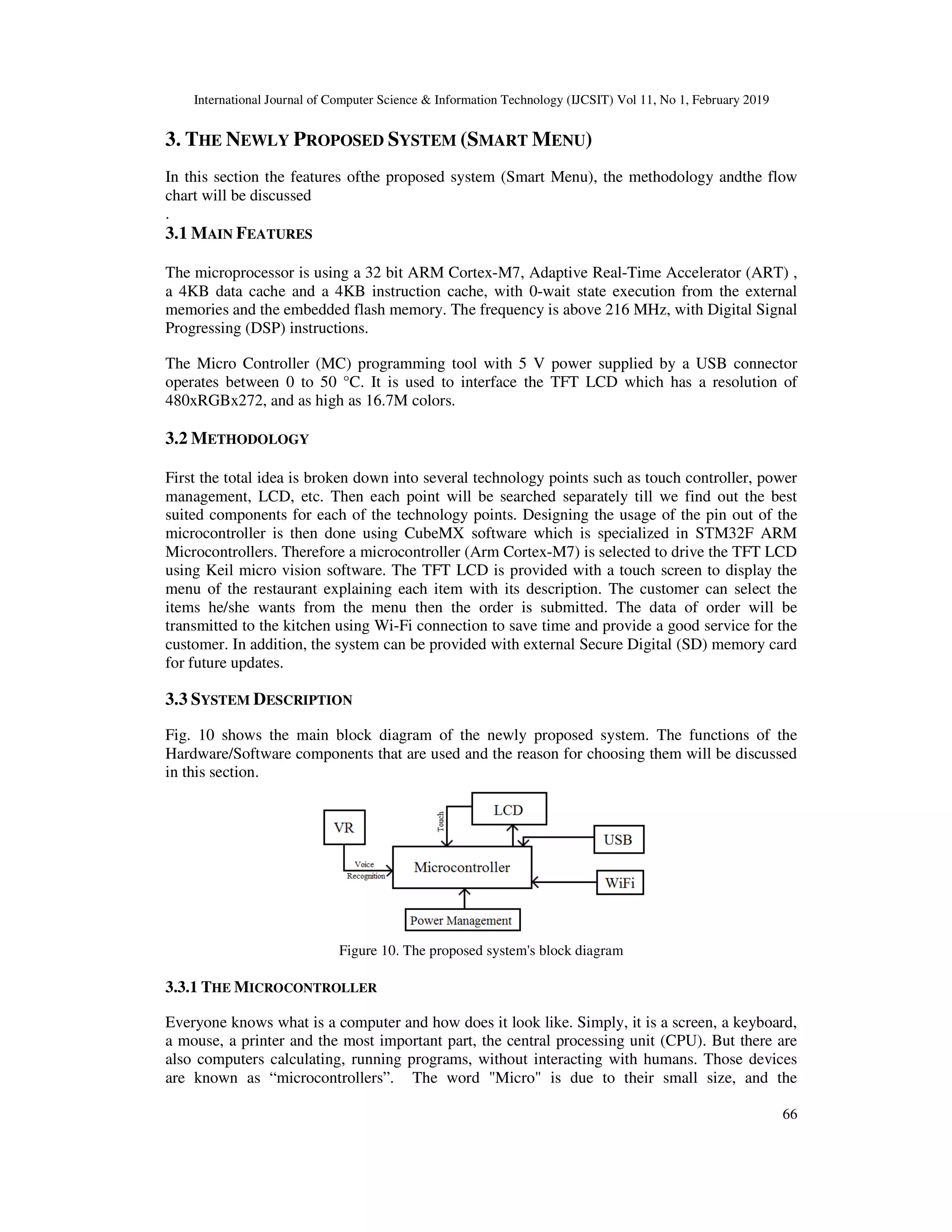
Fig. 10 shows the main block diagram of the newly proposed system. The functions of the
Hardware/Software components that are used and the reason for choosing them will be discussed
in this section.
Figure 10. The proposed system's block diagram
3.3.1 THE MICROCONTROLLER
Everyone knows what is a computer and how does it look like. Simply, it is a screen, a keyboard,
a mouse, a printer and the most important part, the central processing unit (CPU). But there are
also computers calculating, running programs, without interacting with humans. Those devices
are known as “microcontrollers”. The word "Micro" is due to their small size, and the
International Journal of Computer Science & Information Technology (IJCSIT) Vol 11, No 1, February 2019
67
"controller" part is because they are used to control gadgets, machines and else. They are
designed for controlling machine applications, rather than a human interaction [7].
Microcontrollers are divided into categories according to their architecture, memory, number of
bits and the instruction sets used. Many microcontrollers have completely different features.
ARM Cortex-M7 microcontroller will be used in The proposed system which has many features
as shown below:
• A 6-stage pipeline that can execute up to two instructions per a clock cycle.
• Instruction cache from 4KB to 64KB
• Data cache from 4KB to 64KB
• Optional ECC (Error Correction Code) support for the cache memories
• A 64-bit AXI system bus interface
• A 64-bit instruction tightly coupled memory (ITCM)
• An optional dual 32-bit Data Tightly-Coupled Memory (TCM) with Error-Correcting
Code(ECC) support for customer and implementing the TCM memory arrays.
• Low latency Advanced High-Performance (AHB) peripheral bus interface that allows fast
access and deterministic to peripherals in real-time applications.
The reason for choosing this type of the microprocessor because of its specifications and
objectives mentioned before. Besides that, this item was available to be ordered online with a
great price according to its features. The ARM Cortex-M3 was another competitive for having
similar features but the ARM Cortex-M7 is chosen to be used in the proposed Smart Menu Model
3.3.2 THE LCD
As innovation included, a touch screen LCD will probably pull in more clients. The touch screens
are classified into two types’ single touch and multi touch. The single touch is not prone to be
utilized these days for its absence of capacities while the multi touch screens have two types,
capacitive touch screens and resistive touch screens [8]
The capacitive touch panels are made of n insulator which consists of glass coated with a
transparent conductor which is made of indium tin oxide (ITO) and since the body of a human
acts a good conductor of electricity therefore when contact is occurred between the human body
and the Capacitive Touch Panel that will cause a distortion to electrostatic field of the touch
panel. The display will respond according to the reading of touch panel’s distortion.
The resistive touch panel is made up of many different layers. Pressing down onto the touch panel
with a finger or a stylus, the layer on the top flexes and then pushes the layer behind it. As a
result, a complete circuit will be created and then it notifies the controller which part of the touch
panel has been press on.
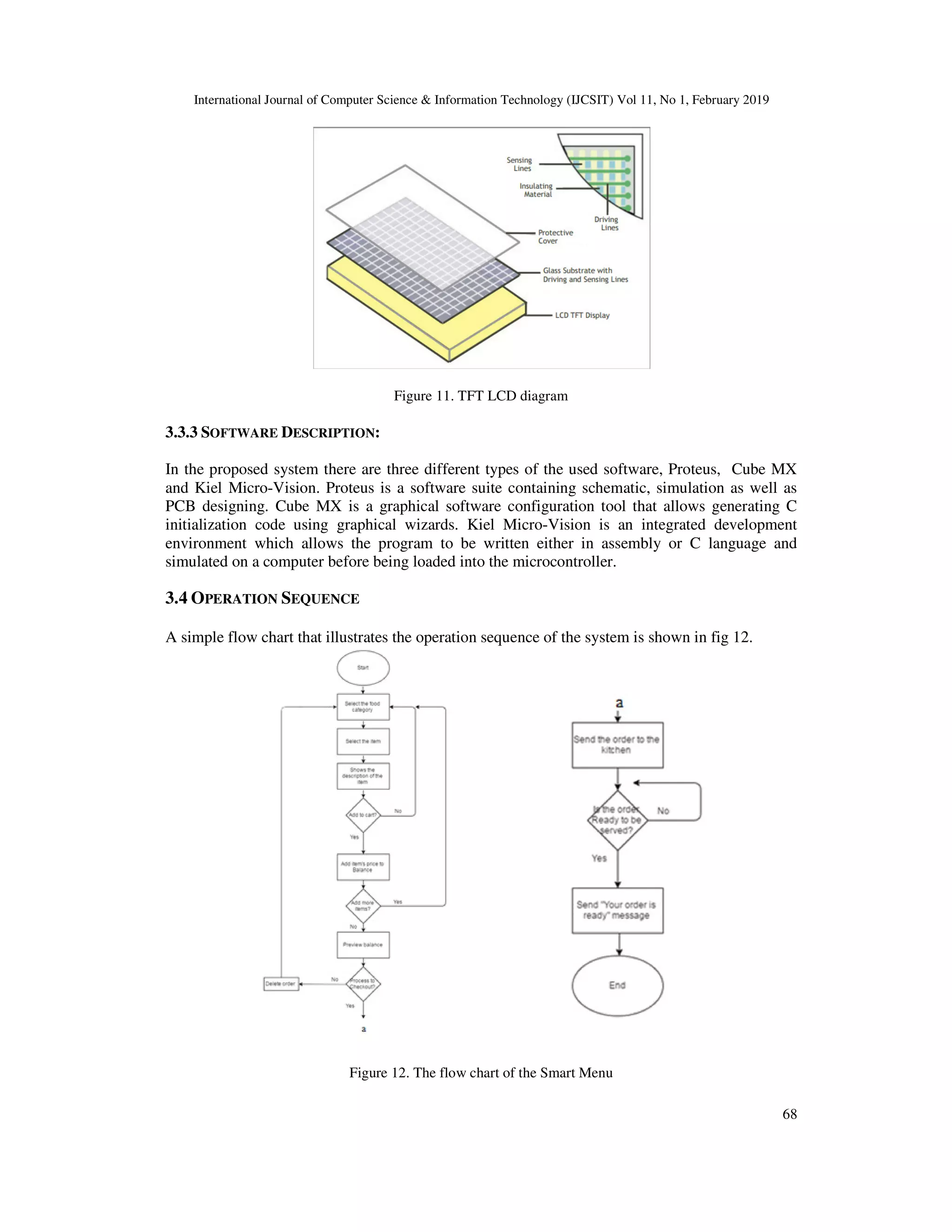
In the proposed system a TFT LCD will be used which is a resistive touch screen as seen in Fig
11. The most common TFT design is the inverse staggered structure. This structure presents high
electron mobility and many advantages of a simple fabrication process. The first step in the TFT
array fabrication consists of gate and storage-capacitor electrodes construction with 2000-3000 A
of a metal such as, chromium, aluminum, tungsten or tantalum layer deposition then a triple layer
of amorphous silicon and silicon nitride. It is then deposited using plasma-enhanced chemical
vapor deposition (PECVD).
International Journal of Computer Science & Information Technology (IJCSIT) Vol 11, No 1, February 2019
68
Figure 11. TFT LCD diagram
3.3.3 SOFTWARE DESCRIPTION:
In the proposed system there are three different types of the used software, Proteus, Cube MX
and Kiel Micro-Vision. Proteus is a software suite containing schematic, simulation as well as
PCB designing. Cube MX is a graphical software configuration tool that allows generating C
initialization code using graphical wizards. Kiel Micro-Vision is an integrated development
environment which allows the program to be written either in assembly or C language and
simulated on a computer before being loaded into the microcontroller.
3.4 OPERATION SEQUENCE
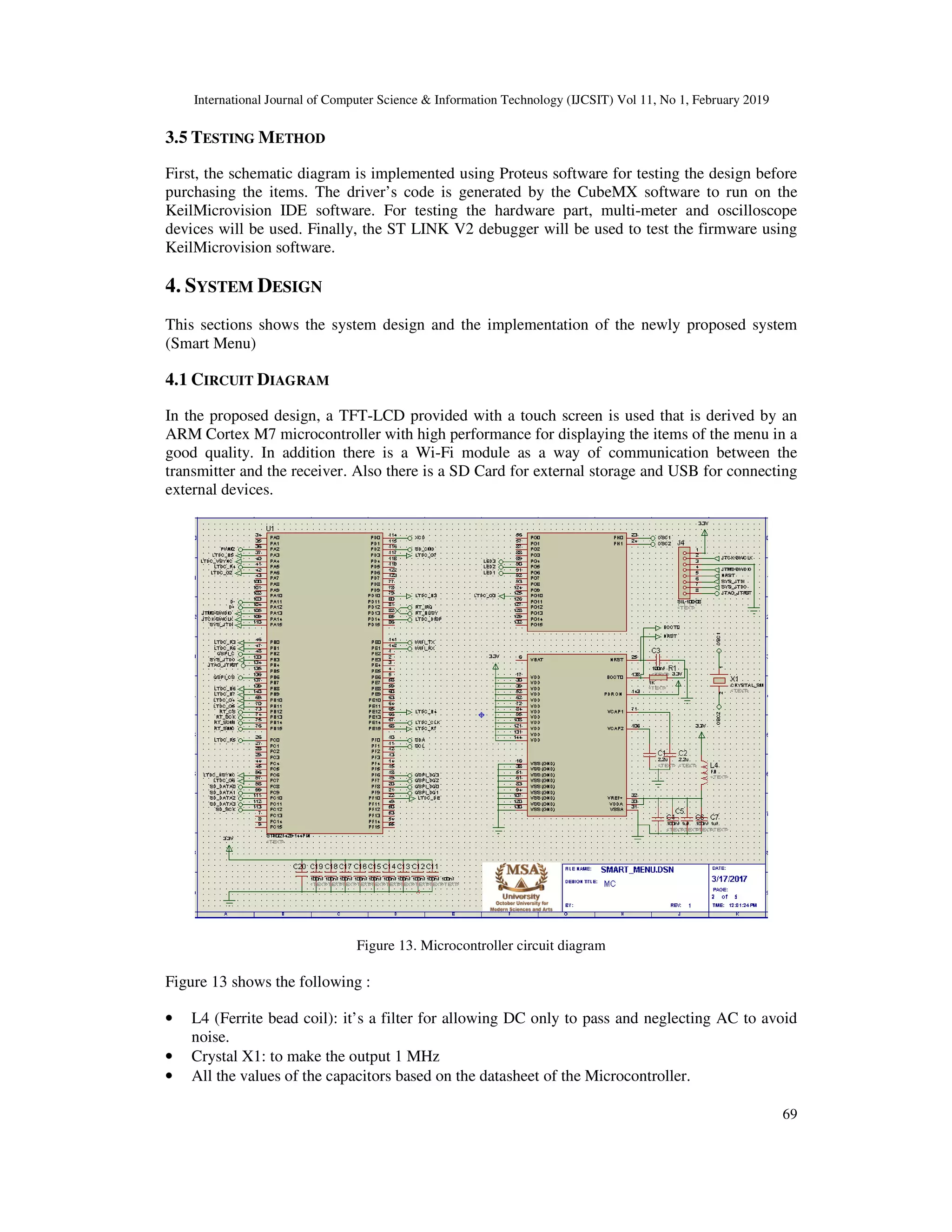
A simple flow chart that illustrates the operation sequence of the system is shown in fig 12.
Figure 12. The flow chart of the Smart Menu
International Journal of Computer Science & Information Technology (IJCSIT) Vol 11, No 1, February 2019
69
3.5 TESTING METHOD
First, the schematic diagram is implemented using Proteus software for testing the design before
purchasing the items. The driver’s code is generated by the CubeMX software to run on the
KeilMicrovision IDE software. For testing the hardware part, multi-meter and oscilloscope
devices will be used. Finally, the ST LINK V2 debugger will be used to test the firmware using
KeilMicrovision software.
4. SYSTEM DESIGN
This sections shows the system design and the implementation of the newly proposed system
(Smart Menu)
4.1 CIRCUIT DIAGRAM
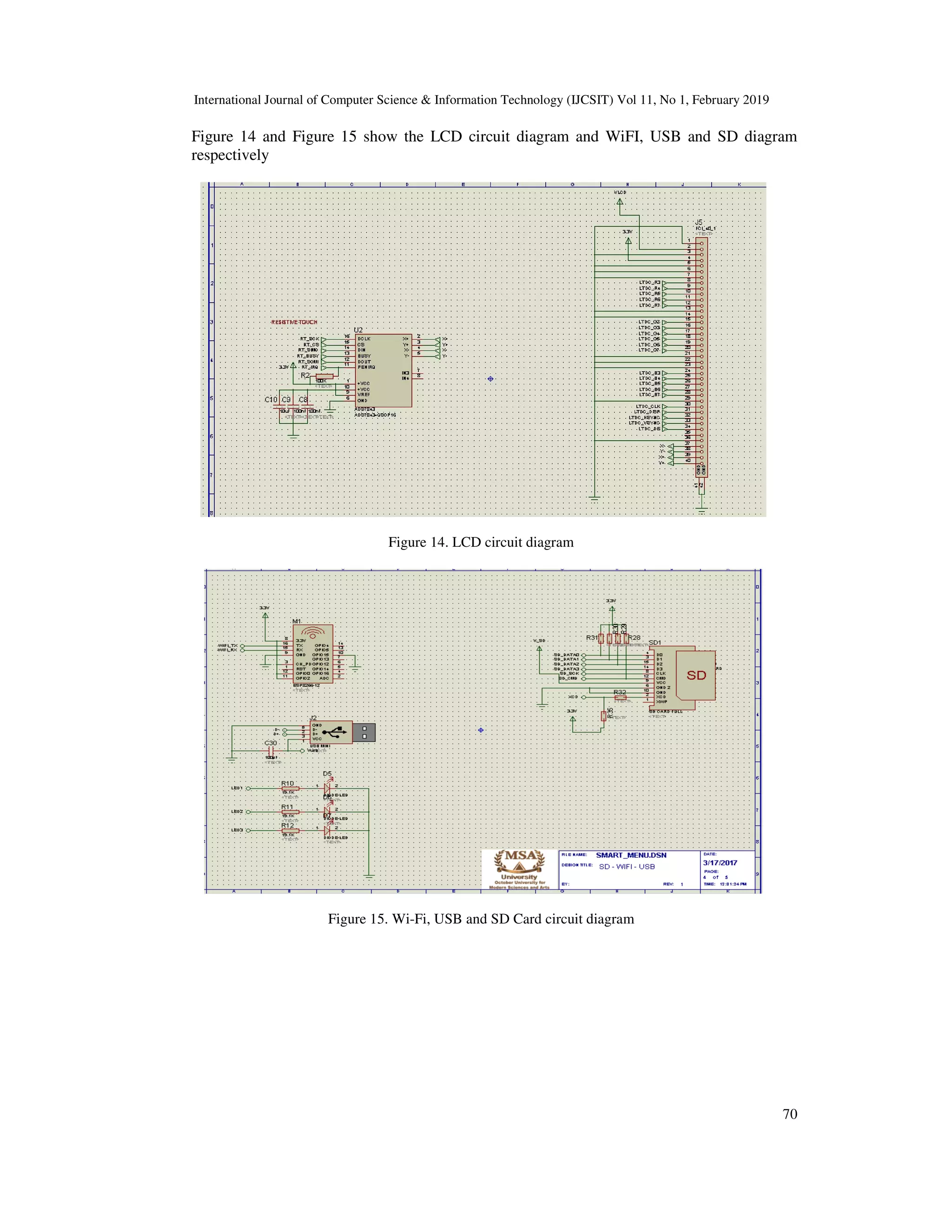
In the proposed design, a TFT-LCD provided with a touch screen is used that is derived by an
ARM Cortex M7 microcontroller with high performance for displaying the items of the menu in a
good quality. In addition there is a Wi-Fi module as a way of communication between the
transmitter and the receiver. Also there is a SD Card for external storage and USB for connecting
external devices.
Figure 13. Microcontroller circuit diagram
Figure 13 shows the following :
• L4 (Ferrite bead coil): it’s a filter for allowing DC only to pass and neglecting AC to avoid
noise.
• Crystal X1: to make the output 1 MHz
• All the values of the capacitors based on the datasheet of the Microcontroller.
International Journal of Computer Science & Information Technology (IJCSIT) Vol 11, No 1, February 2019
70
Figure 14 and Figure 15 show the LCD circuit diagram and WiFI, USB and SD diagram
respectively
Figure 14. LCD circuit diagram
Figure 15. Wi-Fi, USB and SD Card circuit diagram
International Journal of Computer Science & Information Technology (IJCSIT) Vol 11, No 1, February 2019
71
Figure 16. Power Management circuit diagram
Figure 16 shows
• Switcher: for controlling the output voltage
• DC Socket has 2 capacitors:
1. Capacitor22 (0.1 uF): for filtering noises
2. Capacitor23(1000 uF): for controlling sudden voltage drop
4.2 POWER MANAGEMENT
For power management, a Low Drop Out (LDO) is used to have an output voltage of 3.3 V which
is the input voltage for the microcontroller. As for the LCD, it needs an input voltage of 26V. So,
aDC/DC booster will be used to change the 5V input to a 26V output. Figure 17 shows the block
diagram power management
Figure 17. Power Management block diagram
The R2 in fig 17 output voltage. For a 26 output voltage, doing simple calculation using this
formula:
Vout= 1.25*(1+ R1/R2)
International Journal of Computer Science & Information Technology (IJCSIT) Vol 11, No 1, February 2019
72
The value of R2 should be 100.98 kΩ, to get a value close to that it should be changed to 102 kΩ
which will also supply about 26V.
5. SYSTEM COMMISSIONING AND TESTING
First, the schematic diagram is implemented using Proteus software for testing the design before
purchasing the items. The driver’s code is generated by the CubeMX software to run on the
Keilmicrovision IDE software. For testing the hardware part, multi-meter and oscilloscope
devices are used . Finally, the ST LINK V2 will be used to download the code written using Keil
micro vision to the Micro controller . The Microcontroller will control all actions taken on the
LCD.
5.1 ORDER PROCEDURE
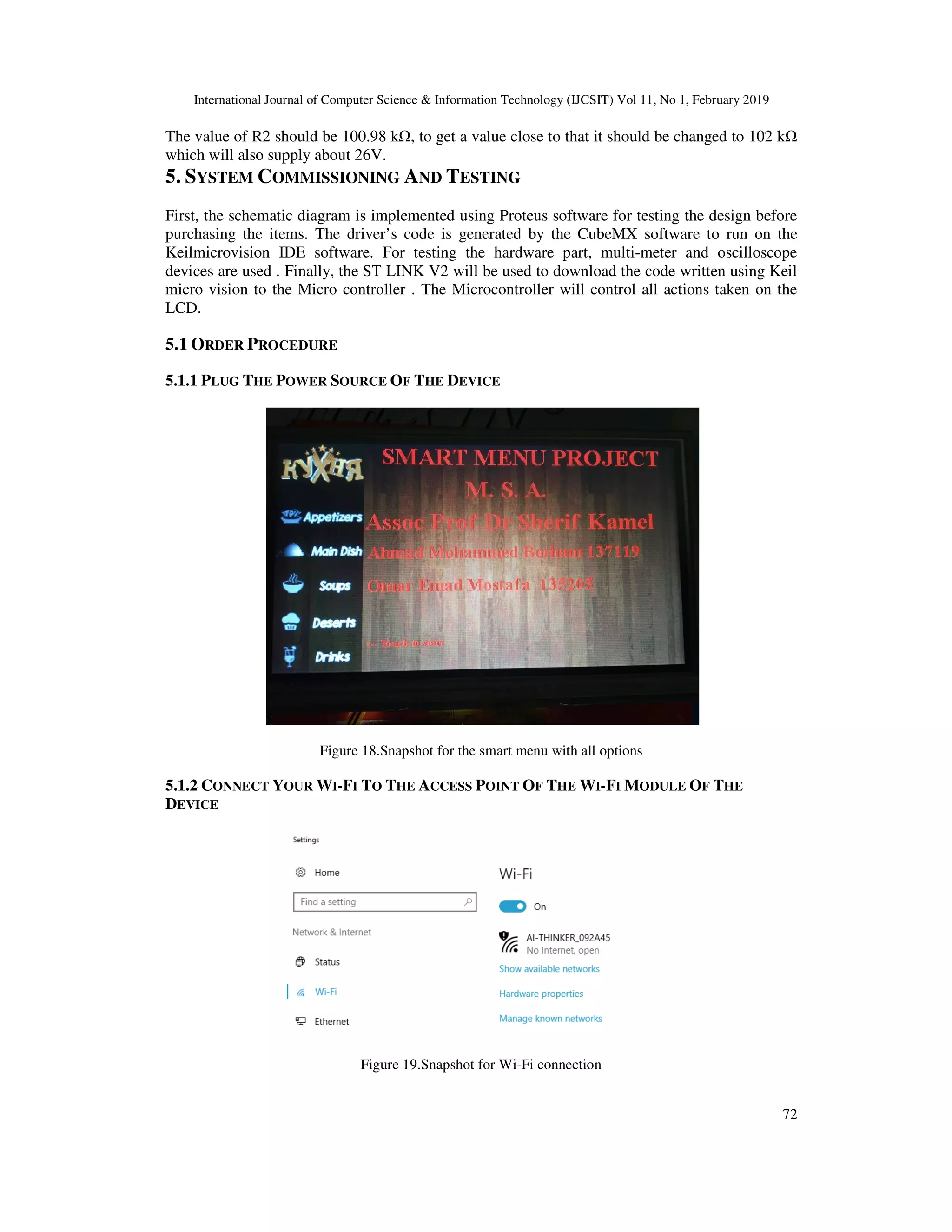
5.1.1 PLUG THE POWER SOURCE OF THE DEVICE
Figure 18.Snapshot for the smart menu with all options
5.1.2 CONNECT YOUR WI-FI TO THE ACCESS POINT OF THE WI-FI MODULE OF THE
DEVICE
Figure 19.Snapshot for Wi-Fi connection
International Journal of Computer Science & Information Technology (IJCSIT) Vol 11, No 1, February 2019
73
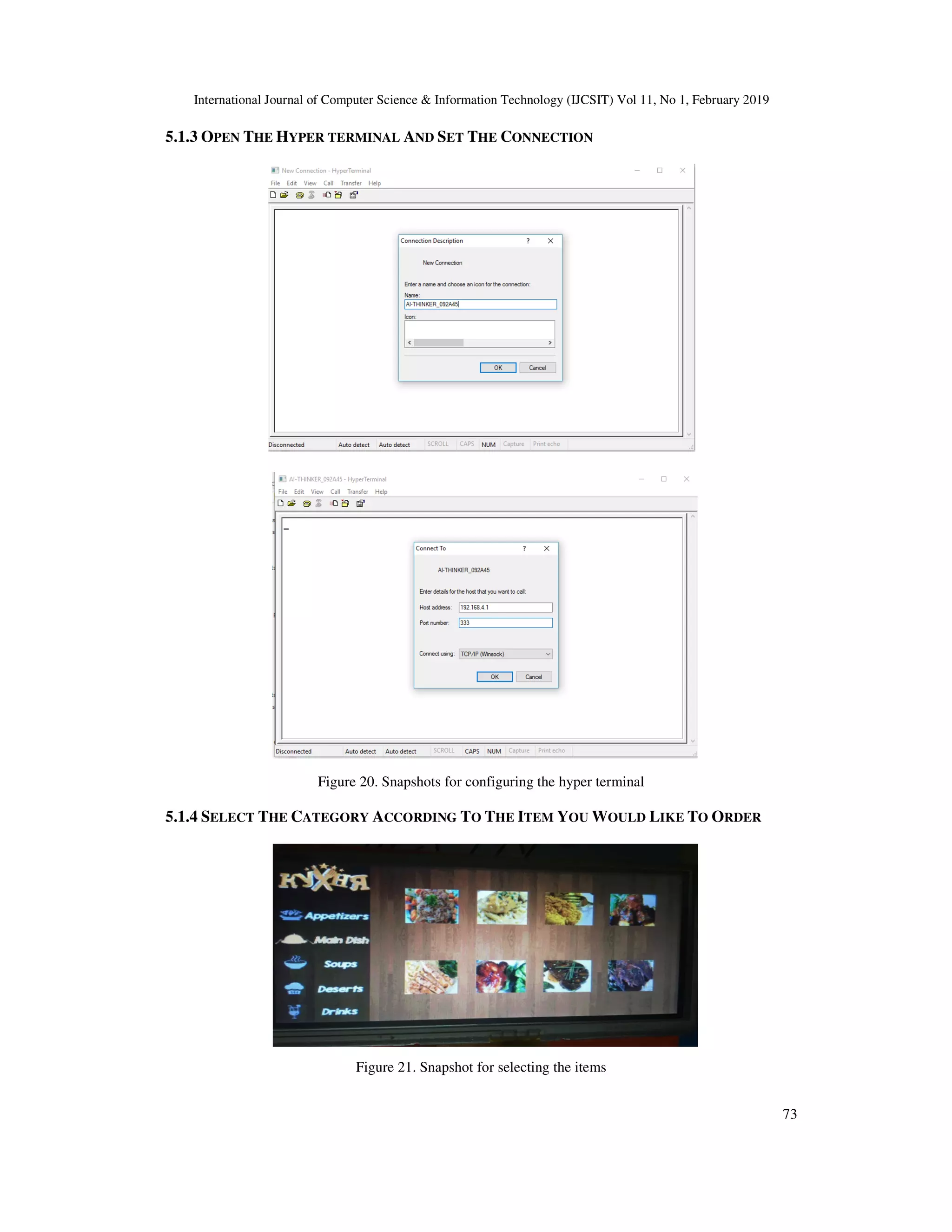
5.1.3 OPEN THE HYPER TERMINAL AND SET THE CONNECTION
Figure 20. Snapshots for configuring the hyper terminal
5.1.4 SELECT THE CATEGORY ACCORDING TO THE ITEM YOU WOULD LIKE TO ORDER
Figure 21. Snapshot for selecting the items
International Journal of Computer Science & Information Technology (IJCSIT) Vol 11, No 1, February 2019
74
5.1.5 AFTER CHOOSING THE ITEM SET THE QUANTITY OF THE ITEM AND THEN PRESS ON
THE GREEN RIGHT SIGN TO CONFIRM SELECTING THE ITEM.
Figure 22. Snapshot for selecting the quantity
5.1.6 FOR SELECTING THE LAST ITEM SELECT ORDER TO FINALIZE THE ORDER THEN A
NEW PAGE WILL APPEAR WITH THE FINAL PRICE AND FOR CONFIRMATION AND SENDING
THE ORDER SELECT THE GREEN RIGHT SIGN.
Figure 23.Snapshot for calculating the price.
International Journal of Computer Science & Information Technology (IJCSIT) Vol 11, No 1, February 2019
75
5.1.7 FINALLY THE ORDER WILL BE SENT TO THE HYPERTERMINAL
Figure 24. Snapshot for the final order.
6. ECONOMIC ANALYSIS
Table 2 shows the cost analysis for the newly proposed smart menu prototype model having all
used items
Table 2. Cost analysis of the proposed design
Component
Cost per unit
( $ )
Quantity
needed
Subtotal of the
proposed system
LCD 43 2 86
Microcontroller 17.07 2 34.14
MC Kit for testing 50 1 50
MC programming tool 22.61 1 22.61
PCB 44 1 44
Power solution 10 1 10
Touch Chip 4.53 2 9.06
Wi-Fi Module 26.25 2 52.5
Shipping - - 80
Handling fees - - 30
Total - 12 418.31
7. CONCLUSION AND FUTURE WORK
In this paper, some previous systems were discussed but the contribution proposed in those
systems are not enough for providing a good quality of performance to satisfy the customers. The
newly proposed system (Smart Menu) is introduced in this paper. The design and the
implementation of the smart menu have been discussed in details. The implementation of the
system is based on the Microcontroller (ARM Cortex M7), TFT LCD, SD card and WiFi module.
Having a Smart Menu in a restaurant will facilitate the process of ordering and charging food. As
the Smart Menu has a lot of outstanding features, but still there are a lot of features that can be
International Journal of Computer Science & Information Techno
added too to the system. For example, adding a credit card payment to the system will make the
process easier for many customers. Also, adding
using the mobile phone will help the customers to reserve their table before arriving to the
restaurant.
REFERENCES
[1] V. Chandra Sekhara Santosh, A. Shanker“
International Journal of Engineering and Science, Vol.4, No.8, pp.644
[2] B.Vinodhini, K.Abinaya, R.Roja, M.Rajeshwari “Wireless Two
Touch Screen” The International Journal Of Engineering And Scienc
[3] B.Vinodhini, K.Abinaya, R.Roja, M.Rajeshwari,”
RTOS programming to Enhance the Quality of Service”, International Journal of Inventions in
Electronics & Electrical Engine
[4] Dr. ShaikMeeravali ,K.Sudhakar, M.Swathi “Design of the Restaurant Self
on ZigBee Technology. (Using ARM cortex microcontroller and color GLCD)” International Journal
of Engineering Research & Technology, Vol.2, No.9, pp.730
[5] Venmathi.V, Eswari.M, Jasmine Jenita.R, Jayasri.S, Kavitha.R “Touch Screen Based Advanced
Menu Display and Ordering System for Restaurants” International Journal of Engineering Science
and Computing, Vol.6, No.4, pp.3482
[6] N. M. Z.Hashim, N. A. Ali, A.S. Jaafar, N.R.Mohamad, L.Salahuddin, N. A. Ishak, “Smart Ordering
System via Bluetooth”, International Journal of Computer Trends and Technology,pp.2253
2256,2013.
[7] Gracia, D. and Yiu, J. (2015) Exploring the ARM® Cortex®
Internet of Tomorrow. Available at: http://www.nxp.com/assets/documents/data/en/white
papers/CORTEXM7WP.pdf
[8] Lagerstam, C. (2016) Newhaven display international, Inc., high
LCDs and VFDs. Available at: http://www.newhavendisplay.com/app_notes/TPcompare.pdf
AUTHOR
Sherif Kamel Hussein Hassan Ratib
1989 Communications and Electronics
Diploma, MSc, and Doctorate in Computer Science
Technology and Networking. He has been working in many private and governmental
universities inside and outside Egypt for almost 15 years.
of many industrial courses. His research interest is GSM Based Control and Macro
mobility based Mobile IP. He is an Associate Professor and Faculty Member at
Communications and Computer Engineering department in October Universit
Modern Sciences and Arts - Egypt. Now he is working as head of Computer Science
department in Arab East Colleges for Postgraduate Studies in Riyadh
International Journal of Computer Science & Information Technology (IJCSIT) Vol 11, No 1, February 2019
added too to the system. For example, adding a credit card payment to the system will make the
for many customers. Also, adding the possibility of booking the table remotely
help the customers to reserve their table before arriving to the
V. Chandra Sekhara Santosh, A. Shanker“ The Unique Restaurant Interactive Ordering System
International Journal of Engineering and Science, Vol.4, No.8, pp.644-650, Aug 2014.
B.Vinodhini, K.Abinaya, R.Roja, M.Rajeshwari “Wireless Two-way Restaurant Ordering System via
Touch Screen” The International Journal Of Engineering And Science, Vol.3, No.7, pp. 01
B.Vinodhini, K.Abinaya, R.Roja, M.Rajeshwari,” Design and Development of an E- Restaurant using
RTOS programming to Enhance the Quality of Service”, International Journal of Inventions in
Electronics & Electrical Engineering, Vol.1, pp. 1-9, Jan-Dec 2015.
Dr. ShaikMeeravali ,K.Sudhakar, M.Swathi “Design of the Restaurant Self-Ordering System Based
on ZigBee Technology. (Using ARM cortex microcontroller and color GLCD)” International Journal
Technology, Vol.2, No.9, pp.730-733, Sep 2013.
Venmathi.V, Eswari.M, Jasmine Jenita.R, Jayasri.S, Kavitha.R “Touch Screen Based Advanced
Menu Display and Ordering System for Restaurants” International Journal of Engineering Science
.6, No.4, pp.3482-3485, Apr 2016.
N. M. Z.Hashim, N. A. Ali, A.S. Jaafar, N.R.Mohamad, L.Salahuddin, N. A. Ishak, “Smart Ordering
System via Bluetooth”, International Journal of Computer Trends and Technology,pp.2253
, J. (2015) Exploring the ARM® Cortex®-M7 Core: Providing Adaptability for the
Internet of Tomorrow. Available at: http://www.nxp.com/assets/documents/data/en/white
Lagerstam, C. (2016) Newhaven display international, Inc., high quality standard and custom OLEDs,
LCDs and VFDs. Available at: http://www.newhavendisplay.com/app_notes/TPcompare.pdf
Sherif Kamel Hussein Hassan Ratib: Graduated from the faculty of engineering in
1989 Communications and Electronics Department, Helwan University. He received his
and Doctorate in Computer Science-2007, Major Information
Technology and Networking. He has been working in many private and governmental
universities inside and outside Egypt for almost 15 years. He shared in the development
of many industrial courses. His research interest is GSM Based Control and Macro
mobility based Mobile IP. He is an Associate Professor and Faculty Member at
Communications and Computer Engineering department in October University for
Egypt. Now he is working as head of Computer Science
department in Arab East Colleges for Postgraduate Studies in Riyadh- KSA.
logy (IJCSIT) Vol 11, No 1, February 2019
76
added too to the system. For example, adding a credit card payment to the system will make the
the possibility of booking the table remotely
help the customers to reserve their table before arriving to the
The Unique Restaurant Interactive Ordering System”, The
way Restaurant Ordering System via
e, Vol.3, No.7, pp. 01-05, 2014.
Restaurant using
RTOS programming to Enhance the Quality of Service”, International Journal of Inventions in
Ordering System Based
on ZigBee Technology. (Using ARM cortex microcontroller and color GLCD)” International Journal
Venmathi.V, Eswari.M, Jasmine Jenita.R, Jayasri.S, Kavitha.R “Touch Screen Based Advanced
Menu Display and Ordering System for Restaurants” International Journal of Engineering Science
N. M. Z.Hashim, N. A. Ali, A.S. Jaafar, N.R.Mohamad, L.Salahuddin, N. A. Ishak, “Smart Ordering
System via Bluetooth”, International Journal of Computer Trends and Technology,pp.2253-
M7 Core: Providing Adaptability for the
Internet of Tomorrow. Available at: http://www.nxp.com/assets/documents/data/en/white-
quality standard and custom OLEDs,
LCDs and VFDs. Available at: http://www.newhavendisplay.com/app_notes/TPcompare.pdf

WI-FI MICROCONTROLLER BASED SMART MENU

  • 1.
    International Journal ofComputer Science & Information Technology (IJCSIT) Vol 11, No 1, February 2019 DOI: 10.5121/ijcsit.2019.11105 61 WI-FI MICROCONTROLLER BASED SMART MENU Sherif Kamel Hussein Associate Professor- Department of Communications and Computer Engineering, University for Modern Sciences and Arts, Giza, Egypt Head of Computer Science Department Arab East Colleges, KSA ABSTRACT Nowadays the technology is embedded in every utilized application to increase the reliability and minimize the human errors caused by the conventional methods. The traditional methods usually been used in restaurant is by taking the customer’s orders and write it down on a piece of paper. Many ordering systems have been proposed in order to solve this issue. In this paper a newly proposed model called Smart Menu is designed basedon the Wi-Fi technology as the communication medium and Peripheral Interface Controller ( ARM Cortex – m7 processor ) as the hardware which implements faster ordering system. The aim for the smart menu model is to build and design both hardware and software for the ordering and delivering system at restaurants by using TFT LCD connected to the kitchen through WI-Fi technology. Result shows that the hardware and software are successfully functional and able to be used as a smart ordering system. The proposed model is able to handle the lack number of the workers, reduce the lateness and the error on ordering foods by the customers. KEYWORDS AND ABBREVIATIONS Thick Film Transistor (TFT), Advanced Risk Machine Microcontroller (ARM) cortex-M7, wireless Fidelity (Wi-Fi), Graphically Liquid Crystal Display (GLCD), Secure Digital (SD) Card. 1. INTRODUCTION A restaurant is a place which is used for providing food and drinks. But why do we prefer a restaurant over another one that serves the same food?. Is it because the waiter always forgets to remove the tomatoes from your sandwich? Or is it because the order takes forever to be ready? Having your detailed order submitted directly to the chef was a hard obstacle in the past. Today, you can have exactly what you want just in few clicks. The restaurant menu has developed from its modest beginnings on carte writing slates and picture less print to today's point by point, bright shows. So, the digital image for a new meal will attract more people than just its name placed within the list. People rather buying a product they already familiar with than a new one, but with having the item on display, it will attract them and let them enjoy trying the new experience. Both the owner and the customer will find it more convenient and hence values will be added from the good impression and the efficient administration and management of the entrepreneurs. The proposed Smart Menu system uses a TFT LCD display module which is placed on each customer’s table for them to make orders. Order will be made by selecting the items displayed on LCD. The order will be sent from the customer section using WI-FI communication, and automatically will be displayed on a screen at the kitchen. The bill will be displayed with table number at the manager/billing office. The proposed model will reduce the time spent on making the orders and paying the bills, whereby the cost and man power also can be reduced. As an extension for this model in the future, many features will be included as of booking table remotely by mobile phone.
  • 2.
    International Journal ofComputer Science & Information Technology (IJCSIT) Vol 11, No 1, February 2019 62 2. LITERATURE REVIEW 2.1 E-TABLE: THE UNIQUE RESTAURANT INTERACTIVE ORDERING SYSTEM [1] An ARM cortex-M3 is used for driving the Graphically Liquid Crystal Display (GLCD)screen which is used for displaying the menu. The order will be sent using ZIGBEE module along with the table number. A buzzer is then set to high in the kitchen's area. This system provides speech recognition method as an input as shown in fig.1. Figure 1. The E-Table's block diagram 2.2 WIRELESS TWO-WAY RESTAURANT ORDERING SYSTEM VIA TOUCH SCREEN (WTROSTS) [2] This system prioritizes the customers by "first come, first serve" and only one customer can connect to the server at a time. The cooking room has a push button for sending back an acknowledgment to the customer's table as an indication for placing the order as shown in fig 2 and fig 3. Figure 2. The WTROSTS block diagram for the table
  • 3.
    International Journal ofComputer Science & Information Technology (IJCSIT) Vol 11, No 1, February 2019 63 Figure 3. The WTROSTS block diagram for the kitchen 2.3 DESIGN AND DEVELOPMENT OF AN E-RESTAURANT USING RTOS PROGRAMMING TO ENHANCE THE QUALITY OF SERVICE [3] A touch screen graphical liquid crystal display (GLCD) acts as a menu recommender, the ARM controller module is placed at the kitchen section and a PC with real time operating system (RTOS) at the billing counter. The ZIGBEE technology is used for communication as shown in fig 4. Figure 4. ERRTOS frame work 2.4 DESIGN OF THE RESTAURANT SELF-ORDERING SYSTEM BASED ON ZIGBEE TECHNOLOGY. (USING ARM CORTEX MICROCONTROLLER AND COLOR GLCD) [4] This system includes two ARM microcontrollers one for the customer (transmitter) for making orders and the other for the kitchen (receiver) to receive the order showing the information of the order and the number of table that requested the order using ZigBee as the way of communication between the transmitter and receiver as shown in fig 5 and 6
  • 4.
    International Journal ofComputer Science & Information Technology (IJCSIT) Vol 11, No 1, February 2019 64 Figure 5. Block diagram of RSOS's transmitter Figure 6. Block diagram of RSOS's receiver 2.5 TOUCH SCREEN BASED ADVANCED MENU DISPLAY AND ORDERING SYSTEM FOR RESTAURANTS [5] The aim from this system from the cost wise aspect is to save spending a lot of money for similar systems especially for restaurants that work on a small scale. A Graphically Liquid Crystal Display (GLCD) provided with a touch screen that will display the menu items of the restaurant and it connects with the receiver that contains Liquid Crystal Display (LCD) screen using RF module as shown in fig 7 and fig 8. Figure 7. AMDOS transmitter block diagram
  • 5.
    International Journal ofComputer Science & Information Technology (IJCSIT) Vol 11, No 1, February 2019 65 Figure 8. AMDOS receiver block diagram 2.6 SMART ORDERING SYSTEM VIA BLUETOOTH [6] In this system the customer will make the order using keypad that will be placed on the table. There will be a code with menu where the customer has to type the code to order the item he / she wants and this code will be decrypted by the microcontroller. The order will be transmitted to the computer in the kitchen through Bluetooth for preparing the order and to the counter computer for the billing procedure as shown in fig 9 Figure 9. Block diagram of the Smart Ordering System 2. COMPARISON BETWEEN THE PROPOSED AND THE EXISTING SYSTEMS Table 1 shows the features of the proposed system (Smart Menu) compared to the existing systems. Table 1. Performance comparison Project Name Calling waiter Feedback/ Rating Order status Priority Table Number Video Display Voice Recognition E-TABLE: ✗ ✗ ✗ ✗ ✗ ✗ ✓ WTROSTS ✓ ✗ ✓ ✓ ✗ ✗ ✓ ERRTOS ✗ ✗ ✓ ✗ ✗ ✗ ✗ RSOS ✗ ✗ ✓ ✗ ✓ ✗ ✗ AMDOS ✗ ✓ ✓ ✗ ✓ ✗ ✓ Smart Ordering System ✗ ✗ ✗ ✗ ✓ ✗ ✗ Smart Menu ✓ ✓ ✓ ✓ ✓ ✓ ✓
  • 6.
    International Journal ofComputer Science & Information Technology (IJCSIT) Vol 11, No 1, February 2019 66 3. THE NEWLY PROPOSED SYSTEM (SMART MENU) In this section the features ofthe proposed system (Smart Menu), the methodology andthe flow chart will be discussed . 3.1 MAIN FEATURES The microprocessor is using a 32 bit ARM Cortex-M7, Adaptive Real-Time Accelerator (ART) , a 4KB data cache and a 4KB instruction cache, with 0-wait state execution from the external memories and the embedded flash memory. The frequency is above 216 MHz, with Digital Signal Progressing (DSP) instructions. The Micro Controller (MC) programming tool with 5 V power supplied by a USB connector operates between 0 to 50 °C. It is used to interface the TFT LCD which has a resolution of 480xRGBx272, and as high as 16.7M colors. 3.2 METHODOLOGY First the total idea is broken down into several technology points such as touch controller, power management, LCD, etc. Then each point will be searched separately till we find out the best suited components for each of the technology points. Designing the usage of the pin out of the microcontroller is then done using CubeMX software which is specialized in STM32F ARM Microcontrollers. Therefore a microcontroller (Arm Cortex-M7) is selected to drive the TFT LCD using Keil micro vision software. The TFT LCD is provided with a touch screen to display the menu of the restaurant explaining each item with its description. The customer can select the items he/she wants from the menu then the order is submitted. The data of order will be transmitted to the kitchen using Wi-Fi connection to save time and provide a good service for the customer. In addition, the system can be provided with external Secure Digital (SD) memory card for future updates. 3.3 SYSTEM DESCRIPTION Fig. 10 shows the main block diagram of the newly proposed system. The functions of the Hardware/Software components that are used and the reason for choosing them will be discussed in this section. Figure 10. The proposed system's block diagram 3.3.1 THE MICROCONTROLLER Everyone knows what is a computer and how does it look like. Simply, it is a screen, a keyboard, a mouse, a printer and the most important part, the central processing unit (CPU). But there are also computers calculating, running programs, without interacting with humans. Those devices are known as “microcontrollers”. The word "Micro" is due to their small size, and the
  • 7.
    International Journal ofComputer Science & Information Technology (IJCSIT) Vol 11, No 1, February 2019 67 "controller" part is because they are used to control gadgets, machines and else. They are designed for controlling machine applications, rather than a human interaction [7]. Microcontrollers are divided into categories according to their architecture, memory, number of bits and the instruction sets used. Many microcontrollers have completely different features. ARM Cortex-M7 microcontroller will be used in The proposed system which has many features as shown below: • A 6-stage pipeline that can execute up to two instructions per a clock cycle. • Instruction cache from 4KB to 64KB • Data cache from 4KB to 64KB • Optional ECC (Error Correction Code) support for the cache memories • A 64-bit AXI system bus interface • A 64-bit instruction tightly coupled memory (ITCM) • An optional dual 32-bit Data Tightly-Coupled Memory (TCM) with Error-Correcting Code(ECC) support for customer and implementing the TCM memory arrays. • Low latency Advanced High-Performance (AHB) peripheral bus interface that allows fast access and deterministic to peripherals in real-time applications. The reason for choosing this type of the microprocessor because of its specifications and objectives mentioned before. Besides that, this item was available to be ordered online with a great price according to its features. The ARM Cortex-M3 was another competitive for having similar features but the ARM Cortex-M7 is chosen to be used in the proposed Smart Menu Model 3.3.2 THE LCD As innovation included, a touch screen LCD will probably pull in more clients. The touch screens are classified into two types’ single touch and multi touch. The single touch is not prone to be utilized these days for its absence of capacities while the multi touch screens have two types, capacitive touch screens and resistive touch screens [8] The capacitive touch panels are made of n insulator which consists of glass coated with a transparent conductor which is made of indium tin oxide (ITO) and since the body of a human acts a good conductor of electricity therefore when contact is occurred between the human body and the Capacitive Touch Panel that will cause a distortion to electrostatic field of the touch panel. The display will respond according to the reading of touch panel’s distortion. The resistive touch panel is made up of many different layers. Pressing down onto the touch panel with a finger or a stylus, the layer on the top flexes and then pushes the layer behind it. As a result, a complete circuit will be created and then it notifies the controller which part of the touch panel has been press on. In the proposed system a TFT LCD will be used which is a resistive touch screen as seen in Fig 11. The most common TFT design is the inverse staggered structure. This structure presents high electron mobility and many advantages of a simple fabrication process. The first step in the TFT array fabrication consists of gate and storage-capacitor electrodes construction with 2000-3000 A of a metal such as, chromium, aluminum, tungsten or tantalum layer deposition then a triple layer of amorphous silicon and silicon nitride. It is then deposited using plasma-enhanced chemical vapor deposition (PECVD).
  • 8.
    International Journal ofComputer Science & Information Technology (IJCSIT) Vol 11, No 1, February 2019 68 Figure 11. TFT LCD diagram 3.3.3 SOFTWARE DESCRIPTION: In the proposed system there are three different types of the used software, Proteus, Cube MX and Kiel Micro-Vision. Proteus is a software suite containing schematic, simulation as well as PCB designing. Cube MX is a graphical software configuration tool that allows generating C initialization code using graphical wizards. Kiel Micro-Vision is an integrated development environment which allows the program to be written either in assembly or C language and simulated on a computer before being loaded into the microcontroller. 3.4 OPERATION SEQUENCE A simple flow chart that illustrates the operation sequence of the system is shown in fig 12. Figure 12. The flow chart of the Smart Menu
  • 9.
    International Journal ofComputer Science & Information Technology (IJCSIT) Vol 11, No 1, February 2019 69 3.5 TESTING METHOD First, the schematic diagram is implemented using Proteus software for testing the design before purchasing the items. The driver’s code is generated by the CubeMX software to run on the KeilMicrovision IDE software. For testing the hardware part, multi-meter and oscilloscope devices will be used. Finally, the ST LINK V2 debugger will be used to test the firmware using KeilMicrovision software. 4. SYSTEM DESIGN This sections shows the system design and the implementation of the newly proposed system (Smart Menu) 4.1 CIRCUIT DIAGRAM In the proposed design, a TFT-LCD provided with a touch screen is used that is derived by an ARM Cortex M7 microcontroller with high performance for displaying the items of the menu in a good quality. In addition there is a Wi-Fi module as a way of communication between the transmitter and the receiver. Also there is a SD Card for external storage and USB for connecting external devices. Figure 13. Microcontroller circuit diagram Figure 13 shows the following : • L4 (Ferrite bead coil): it’s a filter for allowing DC only to pass and neglecting AC to avoid noise. • Crystal X1: to make the output 1 MHz • All the values of the capacitors based on the datasheet of the Microcontroller.
  • 10.
    International Journal ofComputer Science & Information Technology (IJCSIT) Vol 11, No 1, February 2019 70 Figure 14 and Figure 15 show the LCD circuit diagram and WiFI, USB and SD diagram respectively Figure 14. LCD circuit diagram Figure 15. Wi-Fi, USB and SD Card circuit diagram
  • 11.
    International Journal ofComputer Science & Information Technology (IJCSIT) Vol 11, No 1, February 2019 71 Figure 16. Power Management circuit diagram Figure 16 shows • Switcher: for controlling the output voltage • DC Socket has 2 capacitors: 1. Capacitor22 (0.1 uF): for filtering noises 2. Capacitor23(1000 uF): for controlling sudden voltage drop 4.2 POWER MANAGEMENT For power management, a Low Drop Out (LDO) is used to have an output voltage of 3.3 V which is the input voltage for the microcontroller. As for the LCD, it needs an input voltage of 26V. So, aDC/DC booster will be used to change the 5V input to a 26V output. Figure 17 shows the block diagram power management Figure 17. Power Management block diagram The R2 in fig 17 output voltage. For a 26 output voltage, doing simple calculation using this formula: Vout= 1.25*(1+ R1/R2)
  • 12.
    International Journal ofComputer Science & Information Technology (IJCSIT) Vol 11, No 1, February 2019 72 The value of R2 should be 100.98 kΩ, to get a value close to that it should be changed to 102 kΩ which will also supply about 26V. 5. SYSTEM COMMISSIONING AND TESTING First, the schematic diagram is implemented using Proteus software for testing the design before purchasing the items. The driver’s code is generated by the CubeMX software to run on the Keilmicrovision IDE software. For testing the hardware part, multi-meter and oscilloscope devices are used . Finally, the ST LINK V2 will be used to download the code written using Keil micro vision to the Micro controller . The Microcontroller will control all actions taken on the LCD. 5.1 ORDER PROCEDURE 5.1.1 PLUG THE POWER SOURCE OF THE DEVICE Figure 18.Snapshot for the smart menu with all options 5.1.2 CONNECT YOUR WI-FI TO THE ACCESS POINT OF THE WI-FI MODULE OF THE DEVICE Figure 19.Snapshot for Wi-Fi connection
  • 13.
    International Journal ofComputer Science & Information Technology (IJCSIT) Vol 11, No 1, February 2019 73 5.1.3 OPEN THE HYPER TERMINAL AND SET THE CONNECTION Figure 20. Snapshots for configuring the hyper terminal 5.1.4 SELECT THE CATEGORY ACCORDING TO THE ITEM YOU WOULD LIKE TO ORDER Figure 21. Snapshot for selecting the items
  • 14.
    International Journal ofComputer Science & Information Technology (IJCSIT) Vol 11, No 1, February 2019 74 5.1.5 AFTER CHOOSING THE ITEM SET THE QUANTITY OF THE ITEM AND THEN PRESS ON THE GREEN RIGHT SIGN TO CONFIRM SELECTING THE ITEM. Figure 22. Snapshot for selecting the quantity 5.1.6 FOR SELECTING THE LAST ITEM SELECT ORDER TO FINALIZE THE ORDER THEN A NEW PAGE WILL APPEAR WITH THE FINAL PRICE AND FOR CONFIRMATION AND SENDING THE ORDER SELECT THE GREEN RIGHT SIGN. Figure 23.Snapshot for calculating the price.
  • 15.
    International Journal ofComputer Science & Information Technology (IJCSIT) Vol 11, No 1, February 2019 75 5.1.7 FINALLY THE ORDER WILL BE SENT TO THE HYPERTERMINAL Figure 24. Snapshot for the final order. 6. ECONOMIC ANALYSIS Table 2 shows the cost analysis for the newly proposed smart menu prototype model having all used items Table 2. Cost analysis of the proposed design Component Cost per unit ( $ ) Quantity needed Subtotal of the proposed system LCD 43 2 86 Microcontroller 17.07 2 34.14 MC Kit for testing 50 1 50 MC programming tool 22.61 1 22.61 PCB 44 1 44 Power solution 10 1 10 Touch Chip 4.53 2 9.06 Wi-Fi Module 26.25 2 52.5 Shipping - - 80 Handling fees - - 30 Total - 12 418.31 7. CONCLUSION AND FUTURE WORK In this paper, some previous systems were discussed but the contribution proposed in those systems are not enough for providing a good quality of performance to satisfy the customers. The newly proposed system (Smart Menu) is introduced in this paper. The design and the implementation of the smart menu have been discussed in details. The implementation of the system is based on the Microcontroller (ARM Cortex M7), TFT LCD, SD card and WiFi module. Having a Smart Menu in a restaurant will facilitate the process of ordering and charging food. As the Smart Menu has a lot of outstanding features, but still there are a lot of features that can be
  • 16.
    International Journal ofComputer Science & Information Techno added too to the system. For example, adding a credit card payment to the system will make the process easier for many customers. Also, adding using the mobile phone will help the customers to reserve their table before arriving to the restaurant. REFERENCES [1] V. Chandra Sekhara Santosh, A. Shanker“ International Journal of Engineering and Science, Vol.4, No.8, pp.644 [2] B.Vinodhini, K.Abinaya, R.Roja, M.Rajeshwari “Wireless Two Touch Screen” The International Journal Of Engineering And Scienc [3] B.Vinodhini, K.Abinaya, R.Roja, M.Rajeshwari,” RTOS programming to Enhance the Quality of Service”, International Journal of Inventions in Electronics & Electrical Engine [4] Dr. ShaikMeeravali ,K.Sudhakar, M.Swathi “Design of the Restaurant Self on ZigBee Technology. (Using ARM cortex microcontroller and color GLCD)” International Journal of Engineering Research & Technology, Vol.2, No.9, pp.730 [5] Venmathi.V, Eswari.M, Jasmine Jenita.R, Jayasri.S, Kavitha.R “Touch Screen Based Advanced Menu Display and Ordering System for Restaurants” International Journal of Engineering Science and Computing, Vol.6, No.4, pp.3482 [6] N. M. Z.Hashim, N. A. Ali, A.S. Jaafar, N.R.Mohamad, L.Salahuddin, N. A. Ishak, “Smart Ordering System via Bluetooth”, International Journal of Computer Trends and Technology,pp.2253 2256,2013. [7] Gracia, D. and Yiu, J. (2015) Exploring the ARM® Cortex® Internet of Tomorrow. Available at: http://www.nxp.com/assets/documents/data/en/white papers/CORTEXM7WP.pdf [8] Lagerstam, C. (2016) Newhaven display international, Inc., high LCDs and VFDs. Available at: http://www.newhavendisplay.com/app_notes/TPcompare.pdf AUTHOR Sherif Kamel Hussein Hassan Ratib 1989 Communications and Electronics Diploma, MSc, and Doctorate in Computer Science Technology and Networking. He has been working in many private and governmental universities inside and outside Egypt for almost 15 years. of many industrial courses. His research interest is GSM Based Control and Macro mobility based Mobile IP. He is an Associate Professor and Faculty Member at Communications and Computer Engineering department in October Universit Modern Sciences and Arts - Egypt. Now he is working as head of Computer Science department in Arab East Colleges for Postgraduate Studies in Riyadh International Journal of Computer Science & Information Technology (IJCSIT) Vol 11, No 1, February 2019 added too to the system. For example, adding a credit card payment to the system will make the for many customers. Also, adding the possibility of booking the table remotely help the customers to reserve their table before arriving to the V. Chandra Sekhara Santosh, A. Shanker“ The Unique Restaurant Interactive Ordering System International Journal of Engineering and Science, Vol.4, No.8, pp.644-650, Aug 2014. B.Vinodhini, K.Abinaya, R.Roja, M.Rajeshwari “Wireless Two-way Restaurant Ordering System via Touch Screen” The International Journal Of Engineering And Science, Vol.3, No.7, pp. 01 B.Vinodhini, K.Abinaya, R.Roja, M.Rajeshwari,” Design and Development of an E- Restaurant using RTOS programming to Enhance the Quality of Service”, International Journal of Inventions in Electronics & Electrical Engineering, Vol.1, pp. 1-9, Jan-Dec 2015. Dr. ShaikMeeravali ,K.Sudhakar, M.Swathi “Design of the Restaurant Self-Ordering System Based on ZigBee Technology. (Using ARM cortex microcontroller and color GLCD)” International Journal Technology, Vol.2, No.9, pp.730-733, Sep 2013. Venmathi.V, Eswari.M, Jasmine Jenita.R, Jayasri.S, Kavitha.R “Touch Screen Based Advanced Menu Display and Ordering System for Restaurants” International Journal of Engineering Science .6, No.4, pp.3482-3485, Apr 2016. N. M. Z.Hashim, N. A. Ali, A.S. Jaafar, N.R.Mohamad, L.Salahuddin, N. A. Ishak, “Smart Ordering System via Bluetooth”, International Journal of Computer Trends and Technology,pp.2253 , J. (2015) Exploring the ARM® Cortex®-M7 Core: Providing Adaptability for the Internet of Tomorrow. Available at: http://www.nxp.com/assets/documents/data/en/white Lagerstam, C. (2016) Newhaven display international, Inc., high quality standard and custom OLEDs, LCDs and VFDs. Available at: http://www.newhavendisplay.com/app_notes/TPcompare.pdf Sherif Kamel Hussein Hassan Ratib: Graduated from the faculty of engineering in 1989 Communications and Electronics Department, Helwan University. He received his and Doctorate in Computer Science-2007, Major Information Technology and Networking. He has been working in many private and governmental universities inside and outside Egypt for almost 15 years. He shared in the development of many industrial courses. His research interest is GSM Based Control and Macro mobility based Mobile IP. He is an Associate Professor and Faculty Member at Communications and Computer Engineering department in October University for Egypt. Now he is working as head of Computer Science department in Arab East Colleges for Postgraduate Studies in Riyadh- KSA. logy (IJCSIT) Vol 11, No 1, February 2019 76 added too to the system. For example, adding a credit card payment to the system will make the the possibility of booking the table remotely help the customers to reserve their table before arriving to the The Unique Restaurant Interactive Ordering System”, The way Restaurant Ordering System via e, Vol.3, No.7, pp. 01-05, 2014. Restaurant using RTOS programming to Enhance the Quality of Service”, International Journal of Inventions in Ordering System Based on ZigBee Technology. (Using ARM cortex microcontroller and color GLCD)” International Journal Venmathi.V, Eswari.M, Jasmine Jenita.R, Jayasri.S, Kavitha.R “Touch Screen Based Advanced Menu Display and Ordering System for Restaurants” International Journal of Engineering Science N. M. Z.Hashim, N. A. Ali, A.S. Jaafar, N.R.Mohamad, L.Salahuddin, N. A. Ishak, “Smart Ordering System via Bluetooth”, International Journal of Computer Trends and Technology,pp.2253- M7 Core: Providing Adaptability for the Internet of Tomorrow. Available at: http://www.nxp.com/assets/documents/data/en/white- quality standard and custom OLEDs, LCDs and VFDs. Available at: http://www.newhavendisplay.com/app_notes/TPcompare.pdf