Why the world needs PhenoPacketeers,
and how to be one
Melissa Haendel, PhD
April , 2016
Biocuration 2016
@monarchinit @ontowonka
haendel@ohsu.edu
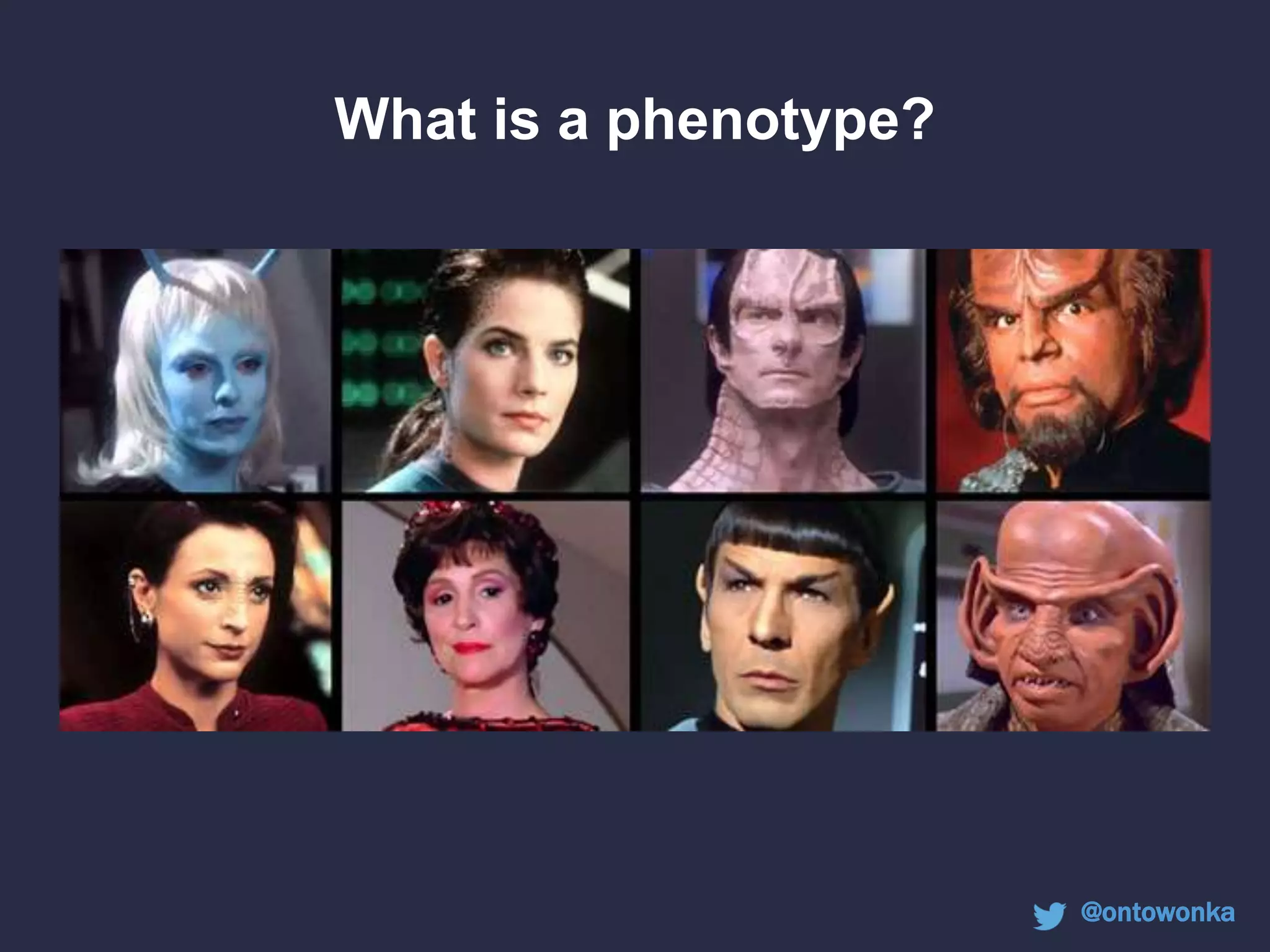
What is a phenotype?
@ontowonka
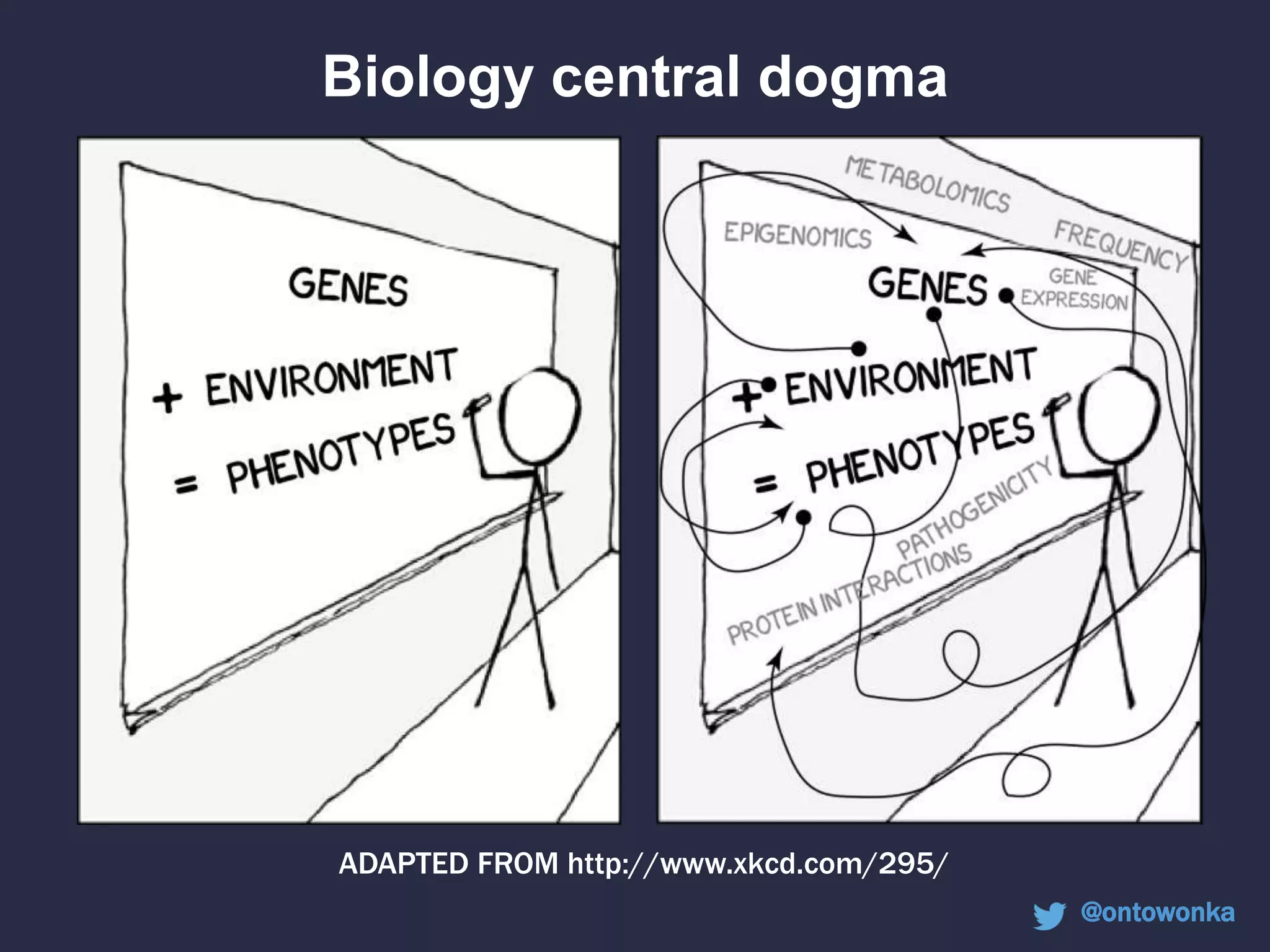
Biology central dogma
ADAPTED FROM http://www.xkcd.com/295/
@ontowonka
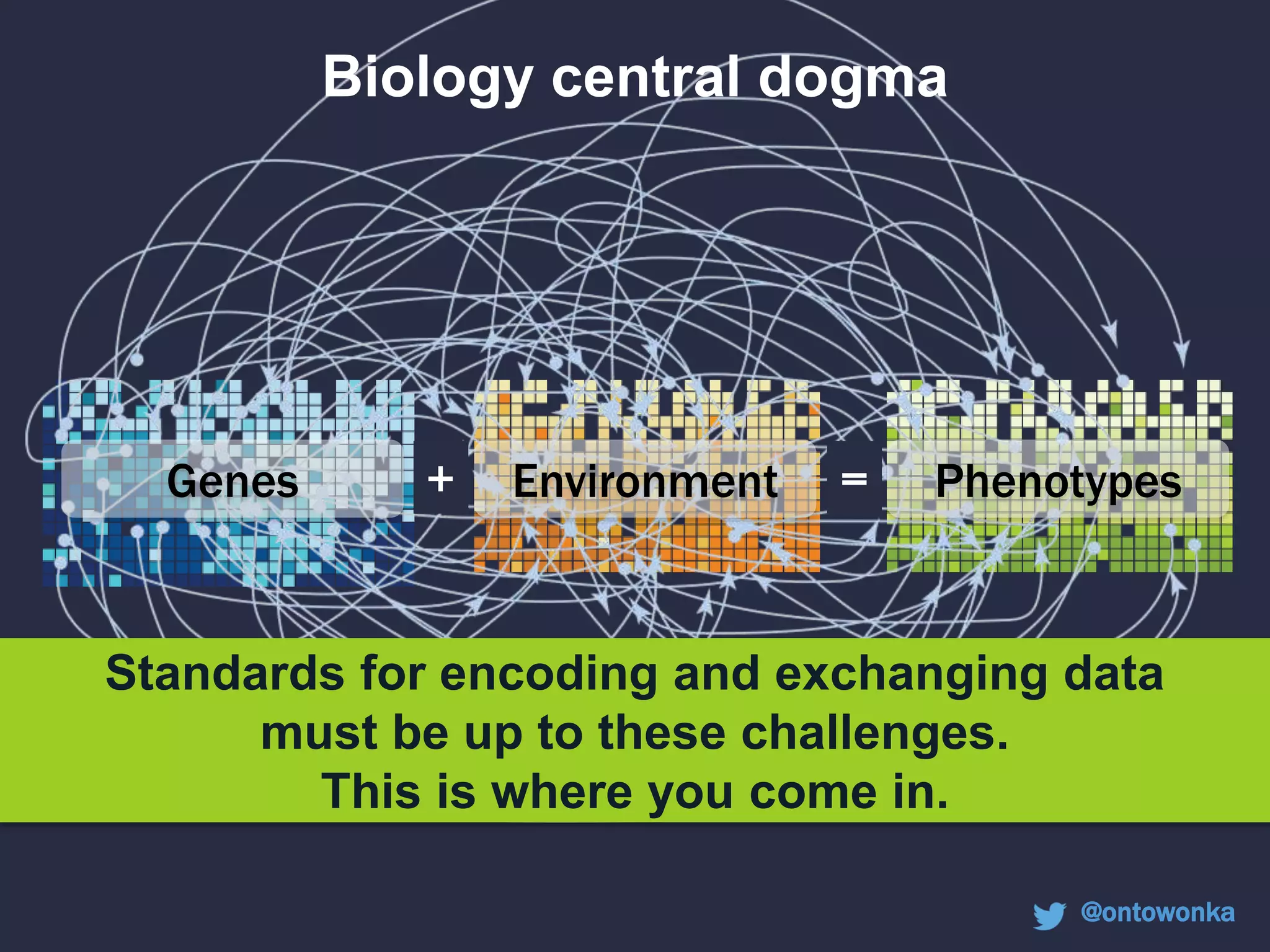
Genes Environment Phenotypes+ =
Biology central dogma
Standards for encoding and exchanging data
must be up to these challenges.
This is where you come in.
@ontowonka
Genes Environment Phenotypes+ =
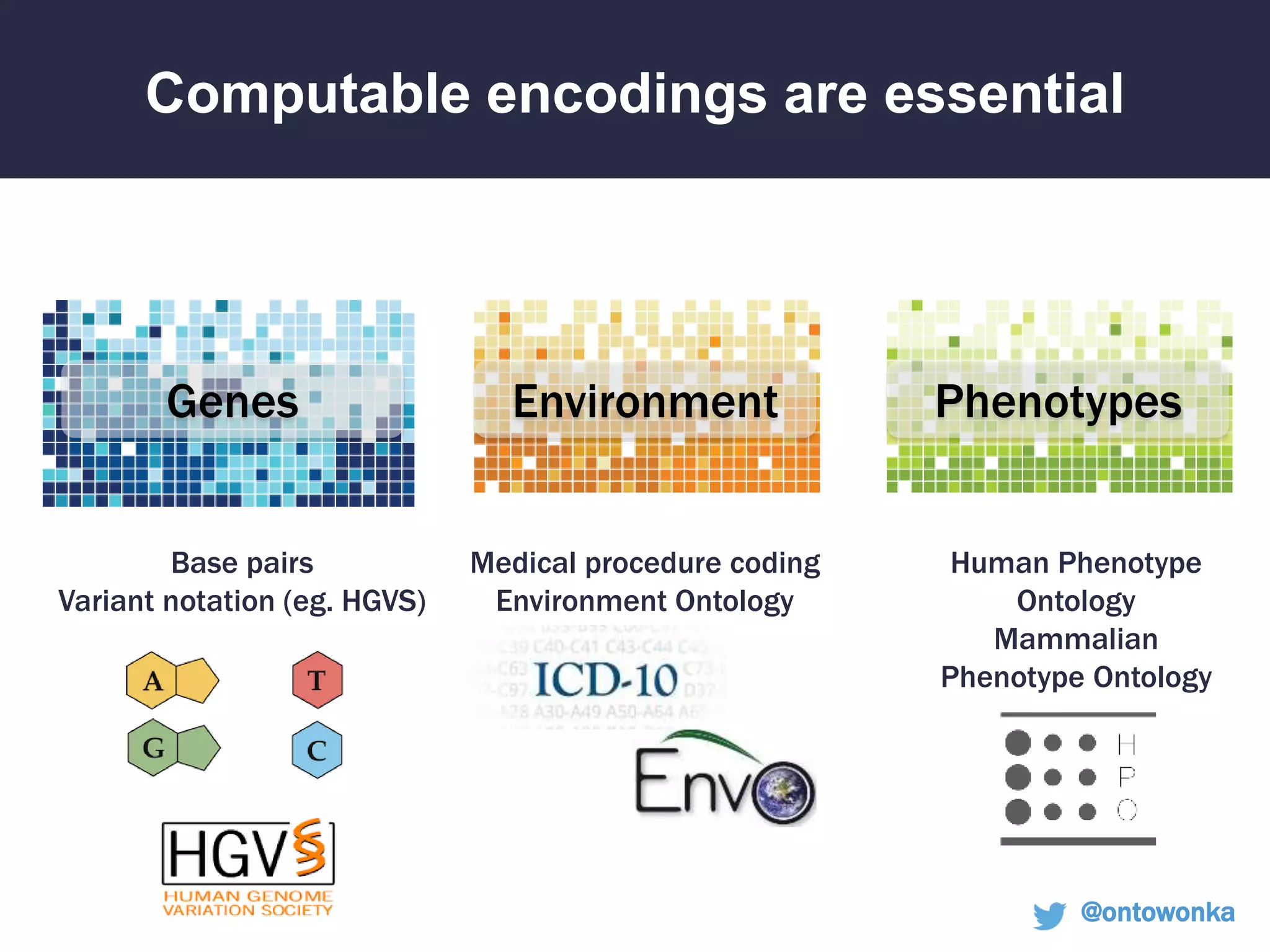
Computable encodings are essential
Base pairs
Variant notation (eg. HGVS)
Human Phenotype
Ontology
Mammalian
Phenotype Ontology
Medical procedure coding
Environment Ontology
@ontowonka
Genes Environment Phenotypes
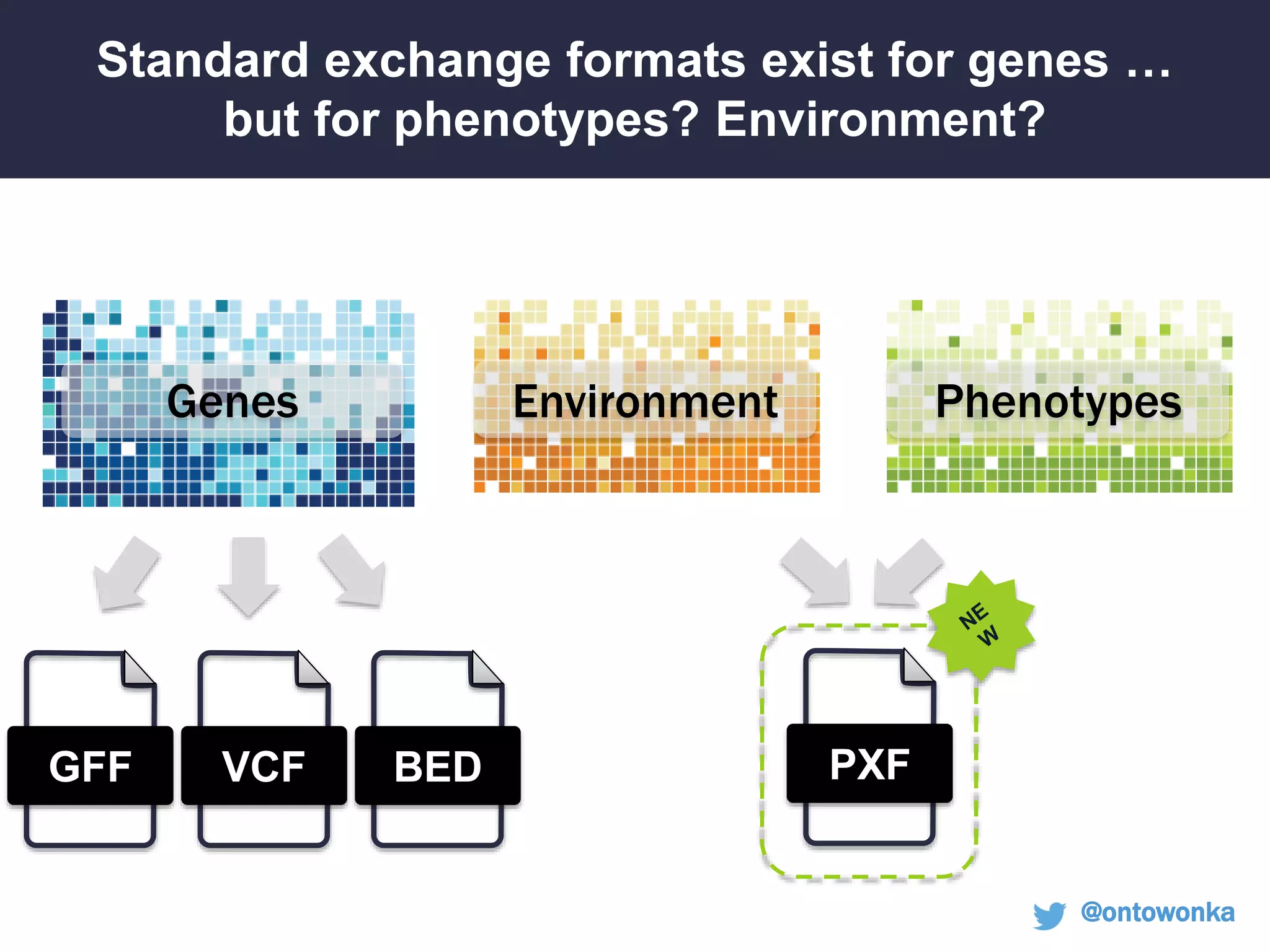
VCF PXFGFF
Standard exchange formats exist for genes …
but for phenotypes? Environment?
BED
@ontowonka
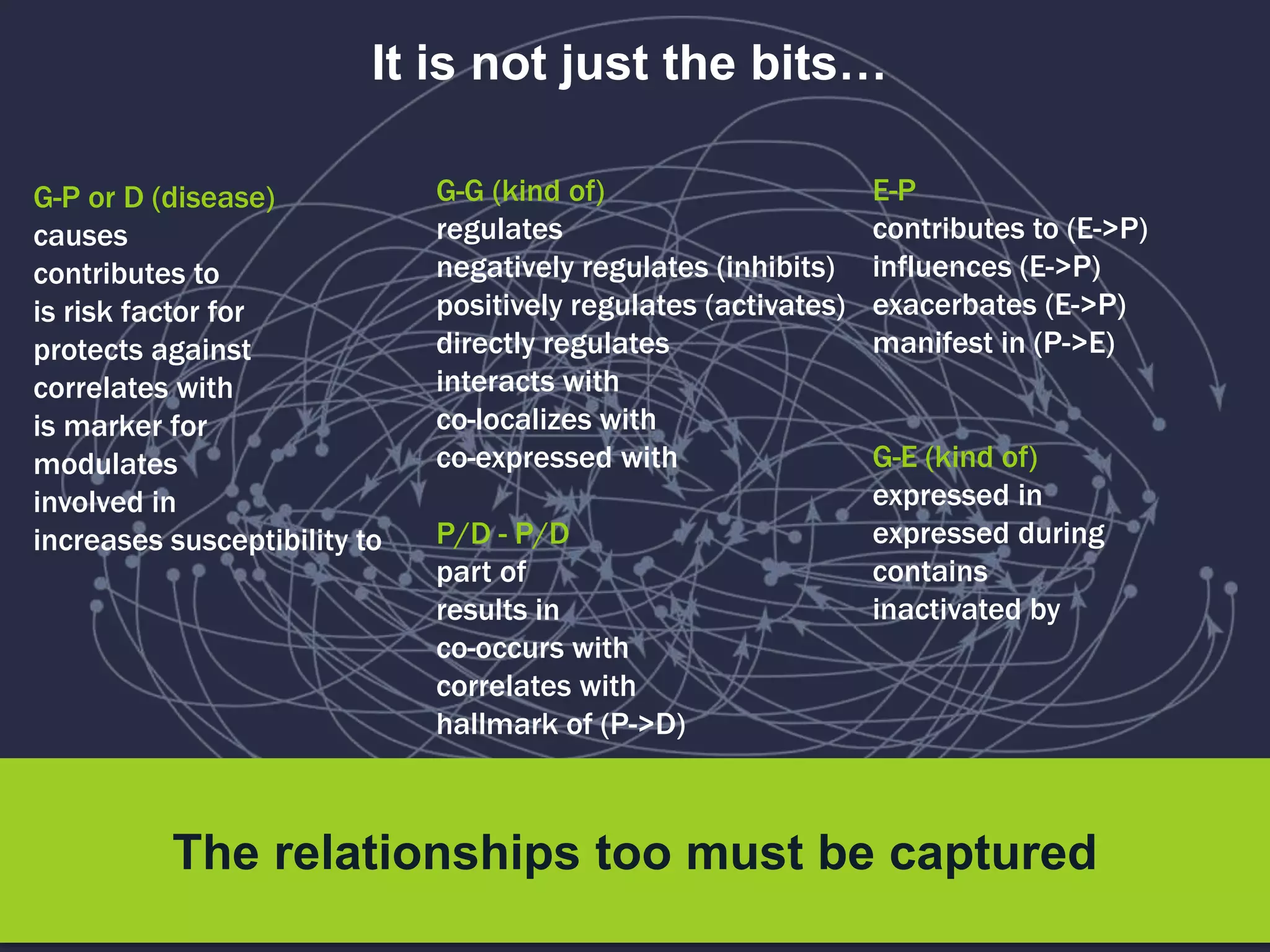
The relationships too must be captured
It is not just the bits…
G-P or D (disease)
causes
contributes to
is risk factor for
protects against
correlates with
is marker for
modulates
involved in
increases susceptibility to
G-G (kind of)
regulates
negatively regulates (inhibits)
positively regulates (activates)
directly regulates
interacts with
co-localizes with
co-expressed with
P/D - P/D
part of
results in
co-occurs with
correlates with
hallmark of (P->D)
E-P
contributes to (E->P)
influences (E->P)
exacerbates (E->P)
manifest in (P->E)
G-E (kind of)
expressed in
expressed during
contains
inactivated by
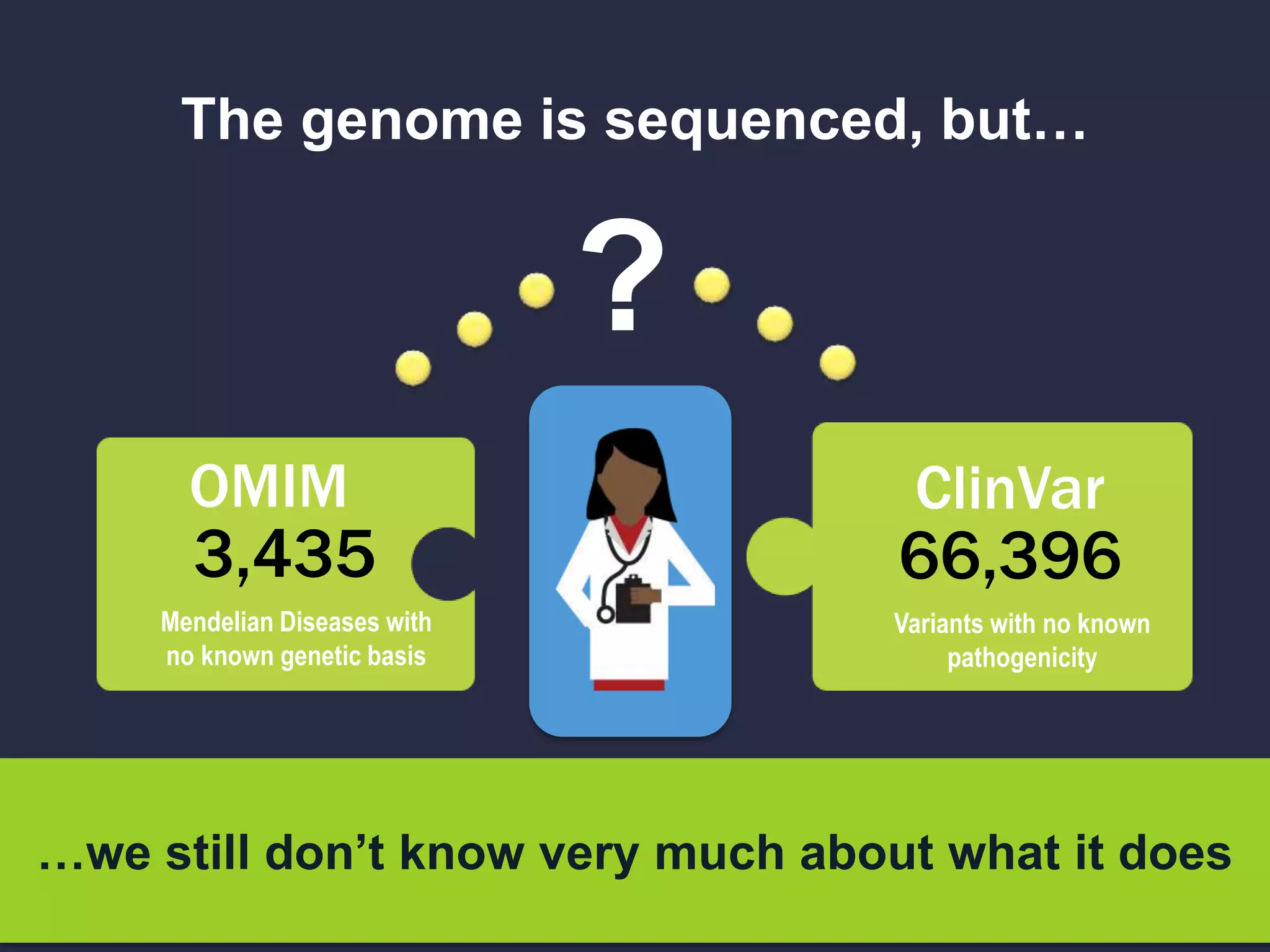
The genome is sequenced, but…
…we still don’t know very much about what it does
3,435
OMIM
Mendelian Diseases with
no known genetic basis
?
66,396
ClinVar
Variants with no known
pathogenicity
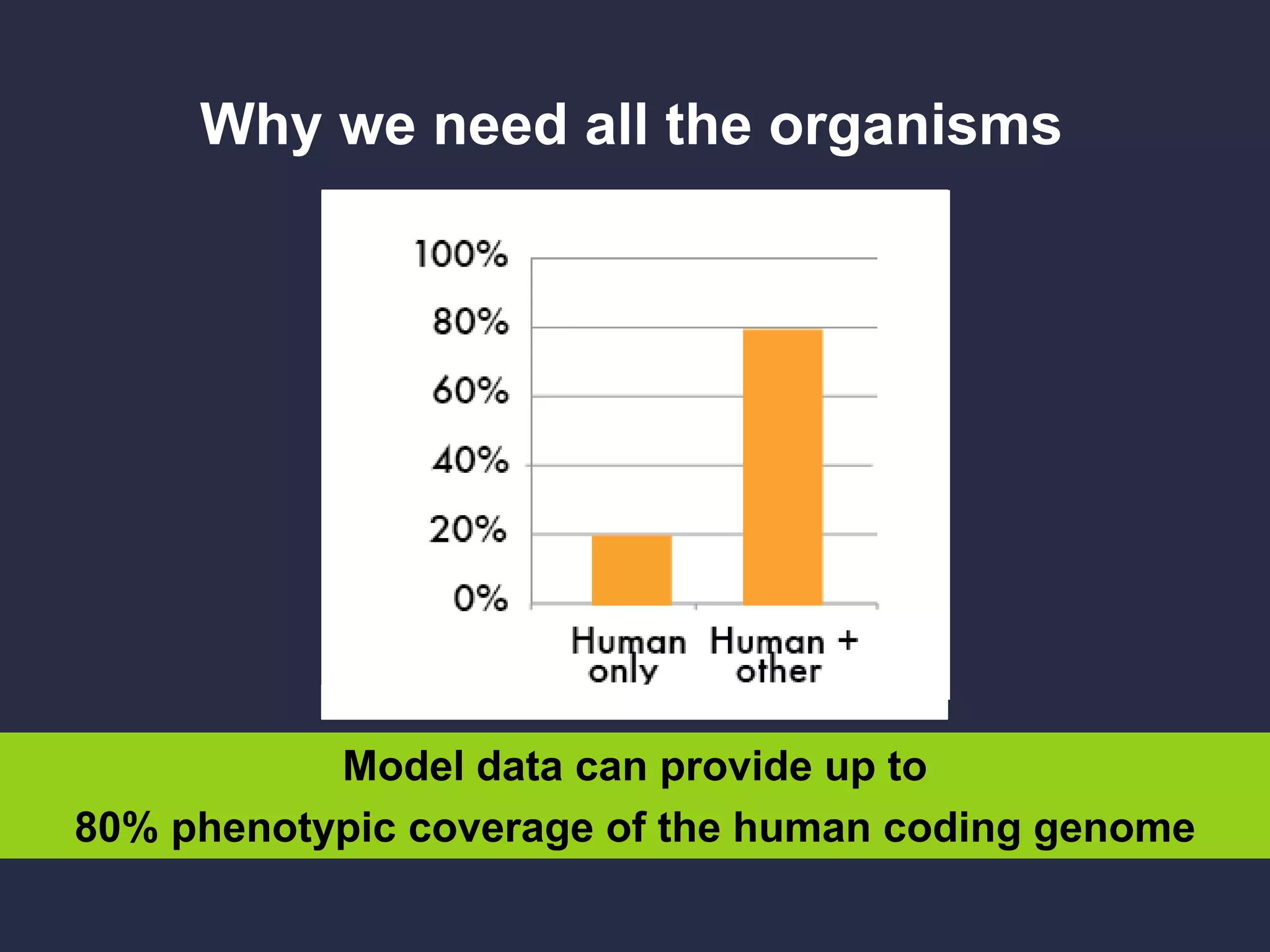
Why we need all the organisms
Model data can provide up to
80% phenotypic coverage of the human coding genome
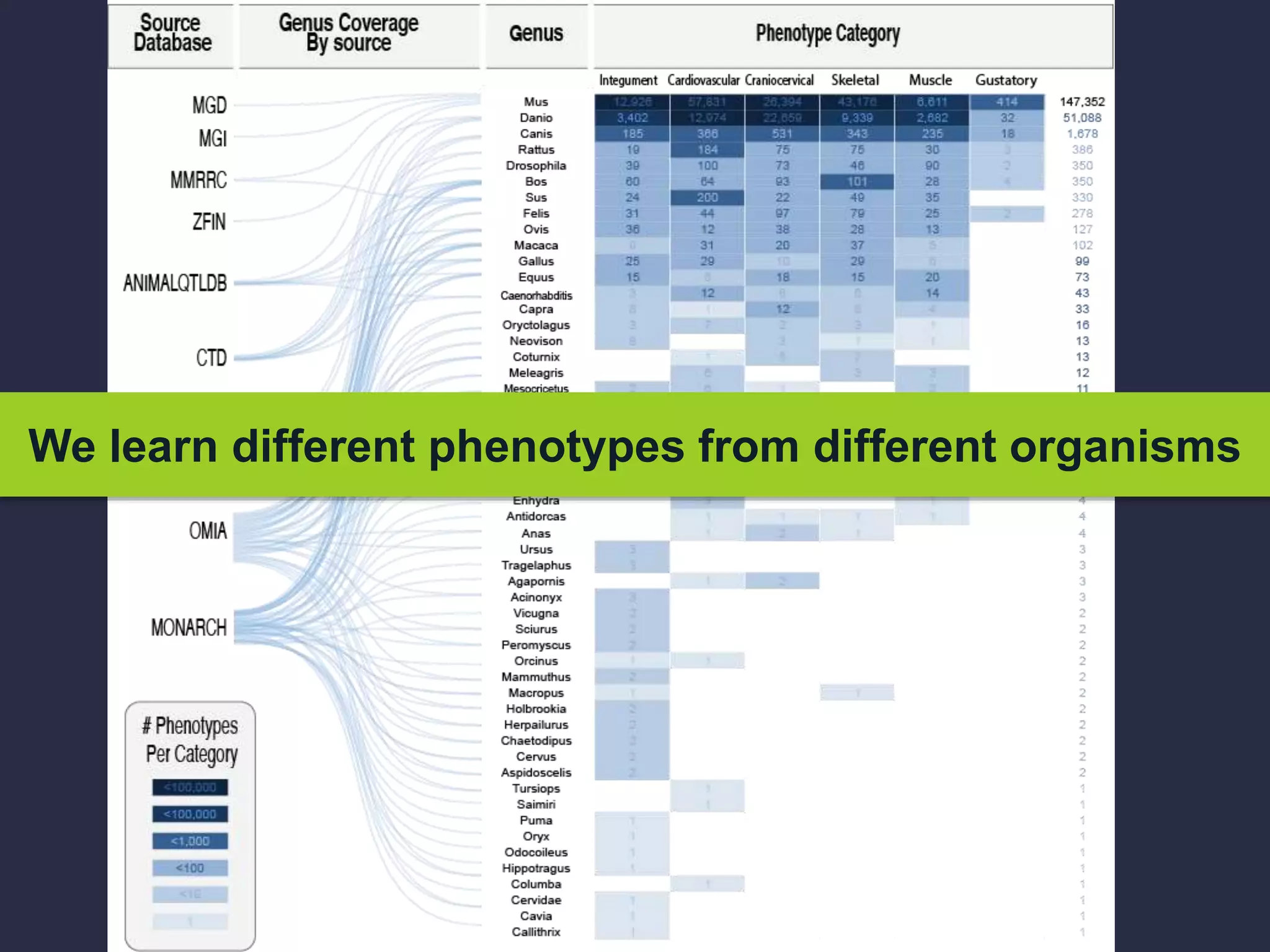
We learn different phenotypes from different organisms
B6.Cg-Alms1foz/fox/J
increased weight,
adipose tissue volume,
glucose homeostasis altered
ALSM1(NM_015120.4)
[c.10775delC] + [-]
GENOTYPE
PHENOTYPE
obesity,
diabetes mellitus,
insulin resistance
increased food intake,
hyperglycemia,
insulin resistance
kcnj11c14/c14; insrt143/+(AB)
Can we use model phenotypes to
inform genetic mechanisms of disease?
???
CC2.0 European Southern Observatory
https://www.flickr.com/photos/esoastronomy/6923443595
Crossing the language barrier
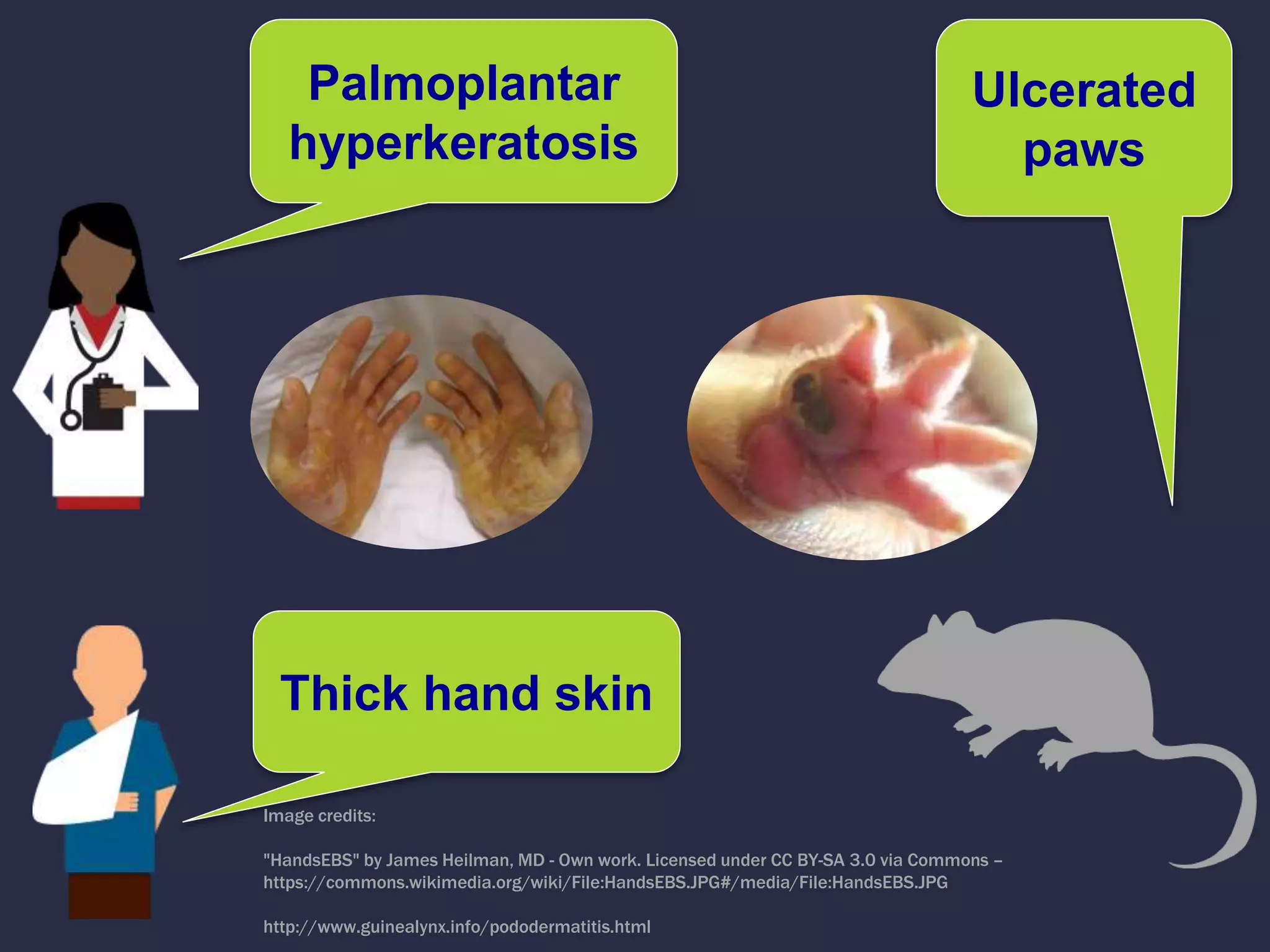
Ulcerated
paws
Palmoplantar
hyperkeratosis
Thick hand skin
Image credits:
"HandsEBS" by James Heilman, MD - Own work. Licensed under CC BY-SA 3.0 via Commons –
https://commons.wikimedia.org/wiki/File:HandsEBS.JPG#/media/File:HandsEBS.JPG
http://www.guinealynx.info/pododermatitis.html
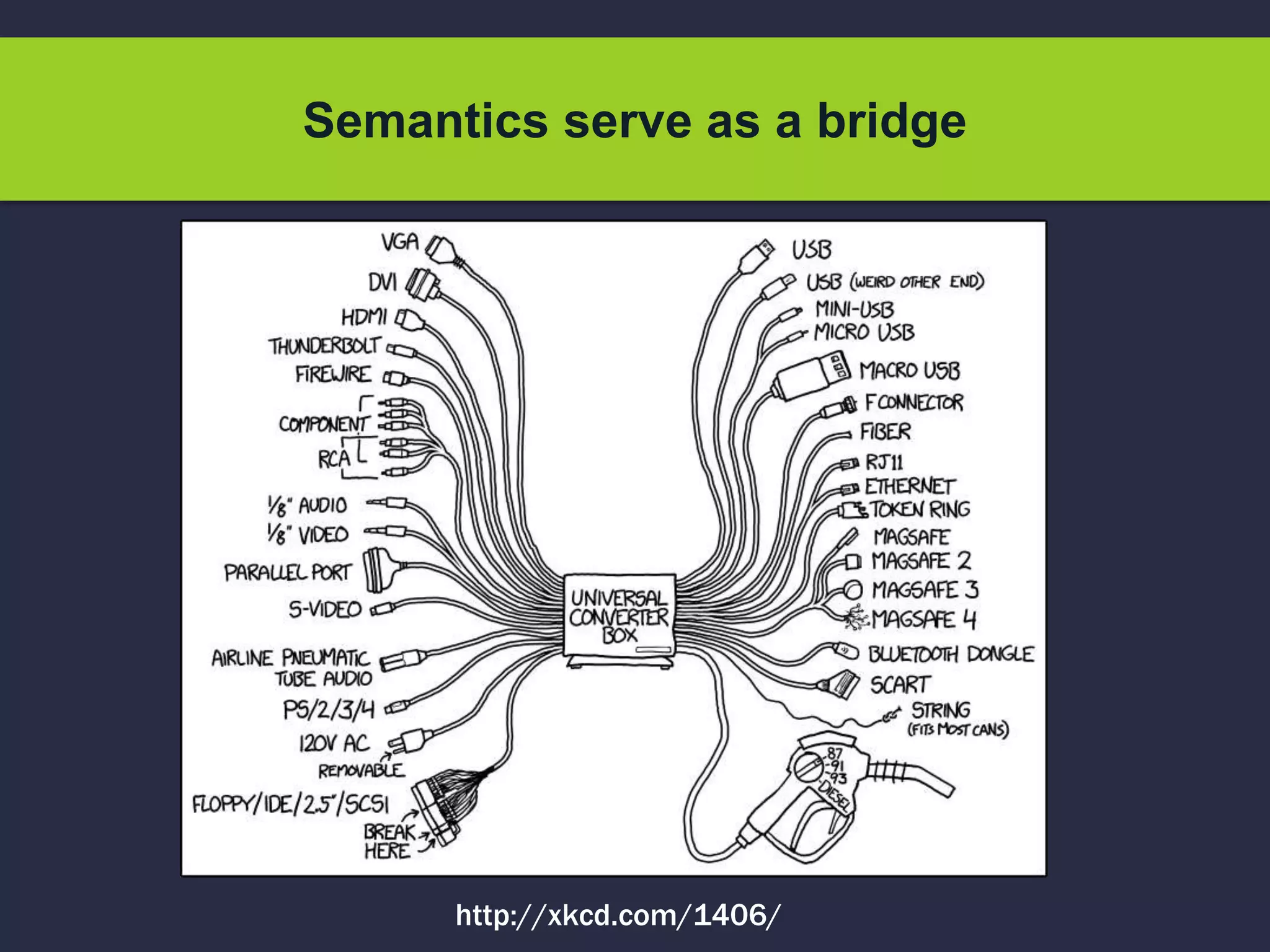
Semantics serve as a bridge
http://xkcd.com/1406/
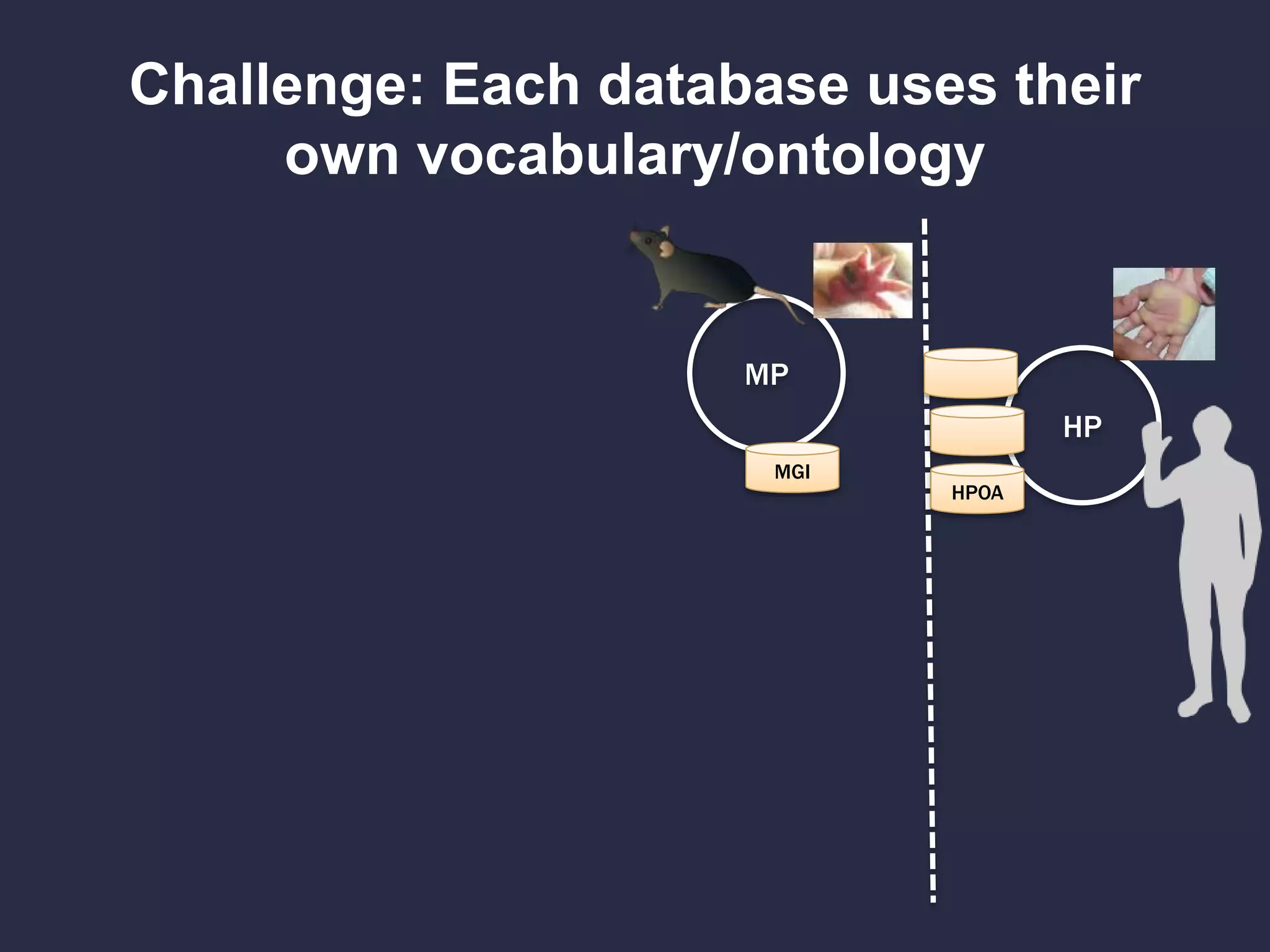
Challenge: Each database uses their
own vocabulary/ontology
MP
HP
MGI
HPOA
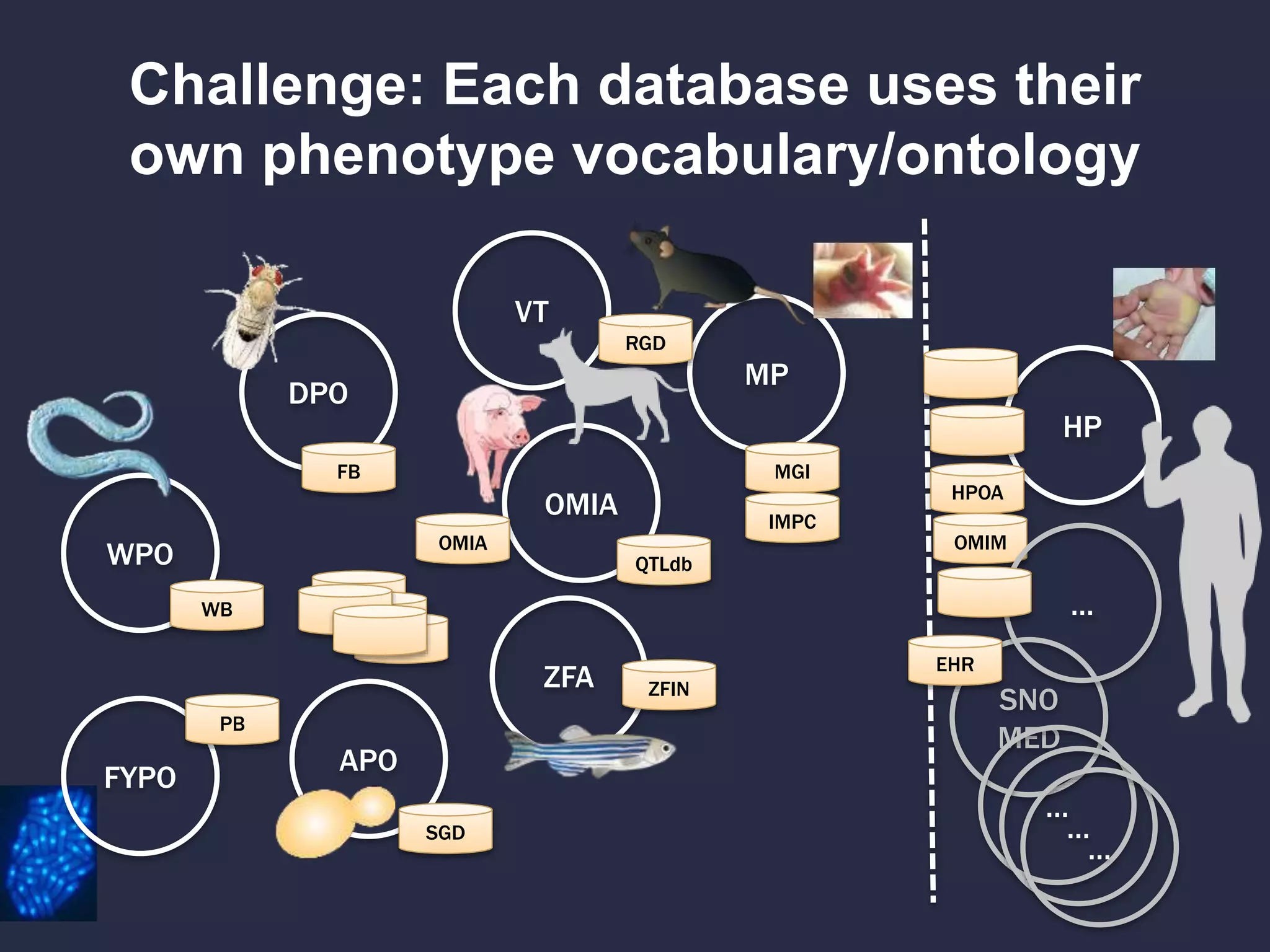
Challenge: Each database uses their
own phenotype vocabulary/ontology
ZFA
MP
DPO
WPO
HP
OMIA
VT
FYPO
APO
SNO
MED
…
…
…
WB
PB
FB
OMIA
MGI
RGD
ZFIN
SGD
HPOA
EHR
IMPC
OMIM
…
QTLdb
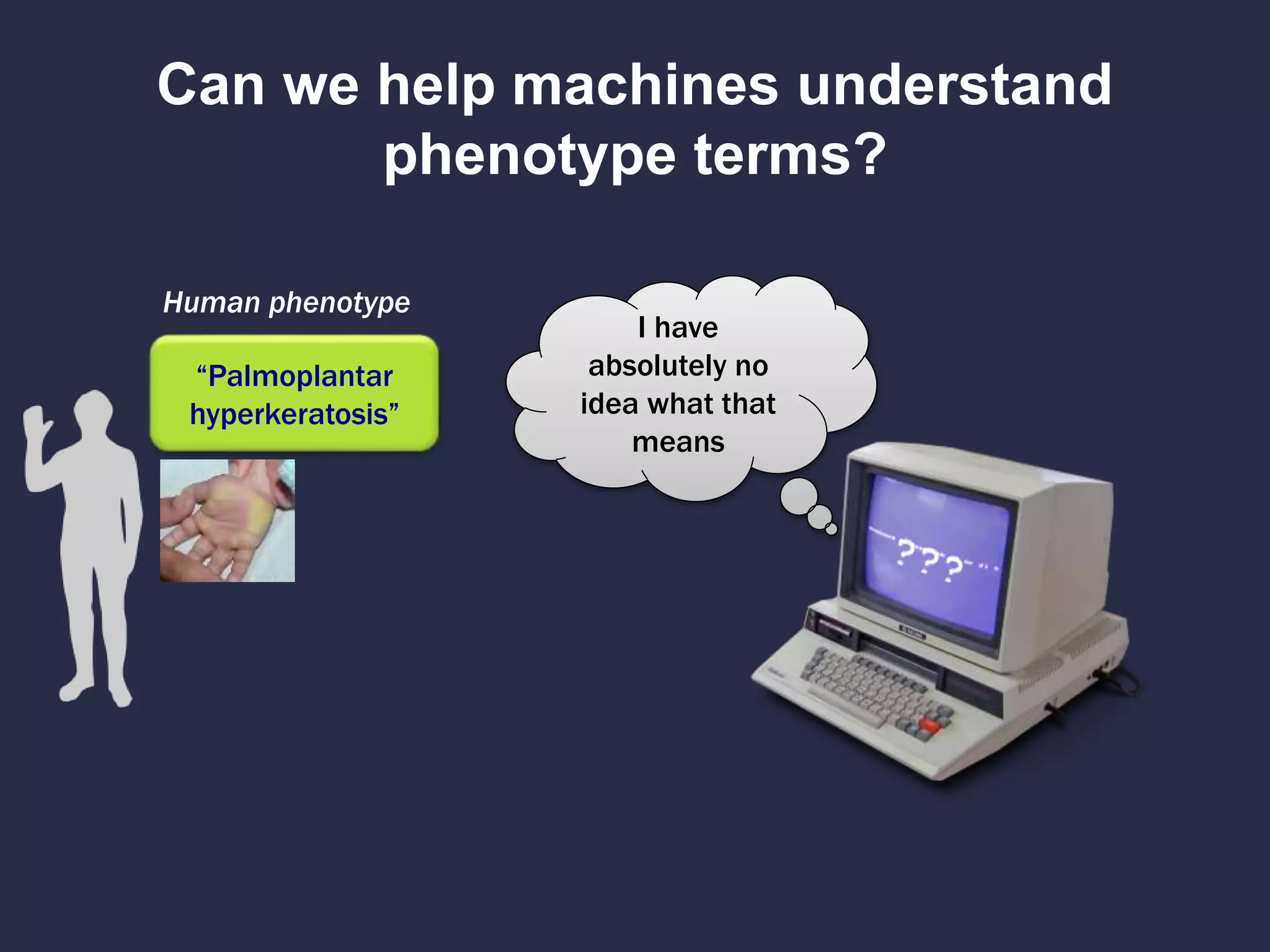
Can we help machines understand
phenotype terms?
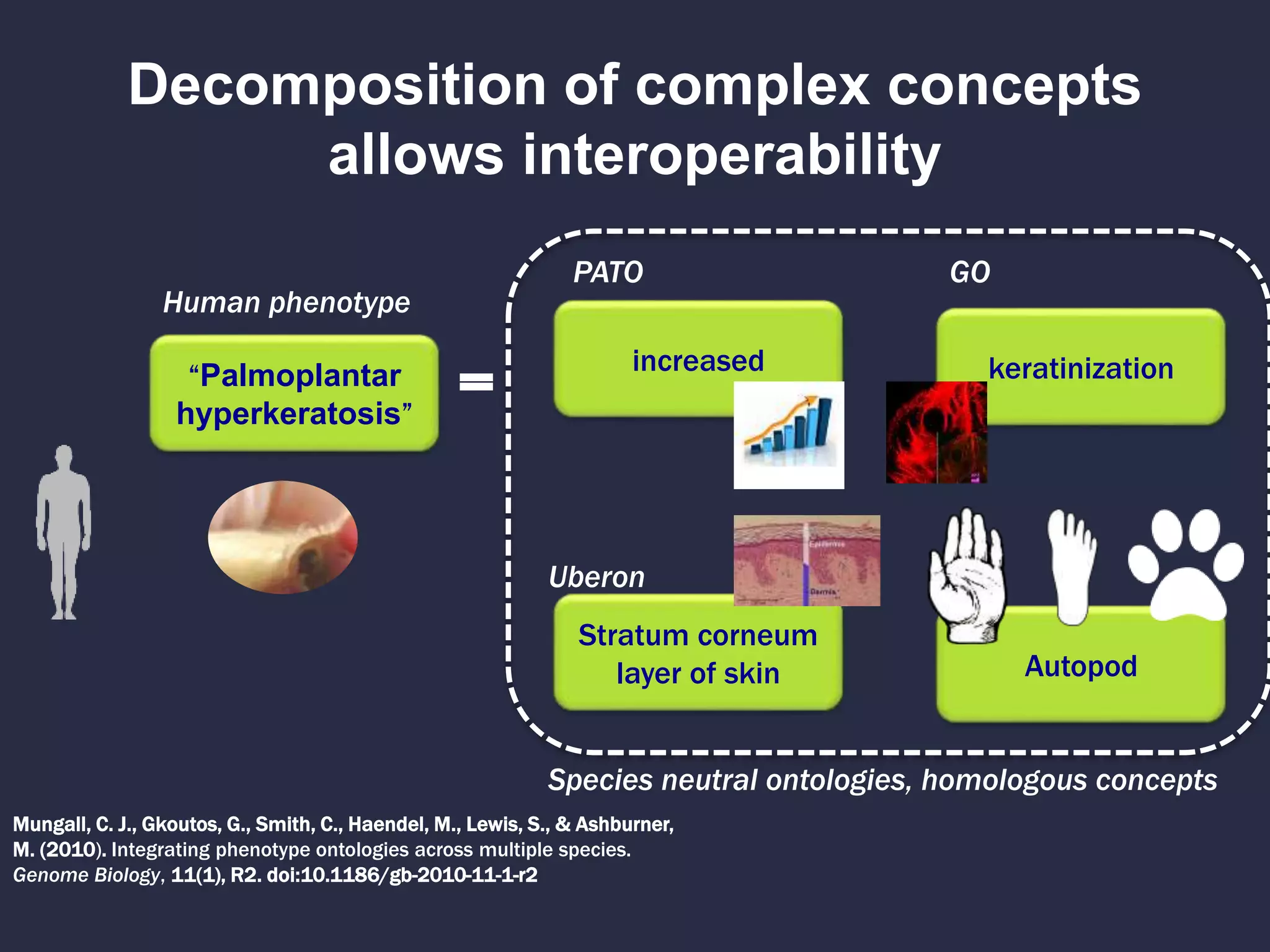
“Palmoplantar
hyperkeratosis”
Human phenotype
I have
absolutely no
idea what that
means
Decomposition of complex concepts
allows interoperability
Mungall, C. J., Gkoutos, G., Smith, C., Haendel, M., Lewis, S., & Ashburner,
M. (2010). Integrating phenotype ontologies across multiple species.
Genome Biology, 11(1), R2. doi:10.1186/gb-2010-11-1-r2
“Palmoplantar
hyperkeratosis”
increased
Stratum corneum
layer of skin
=
Human phenotype
PATO
Uberon
Species neutral ontologies, homologous concepts
Autopod
keratinization
GO
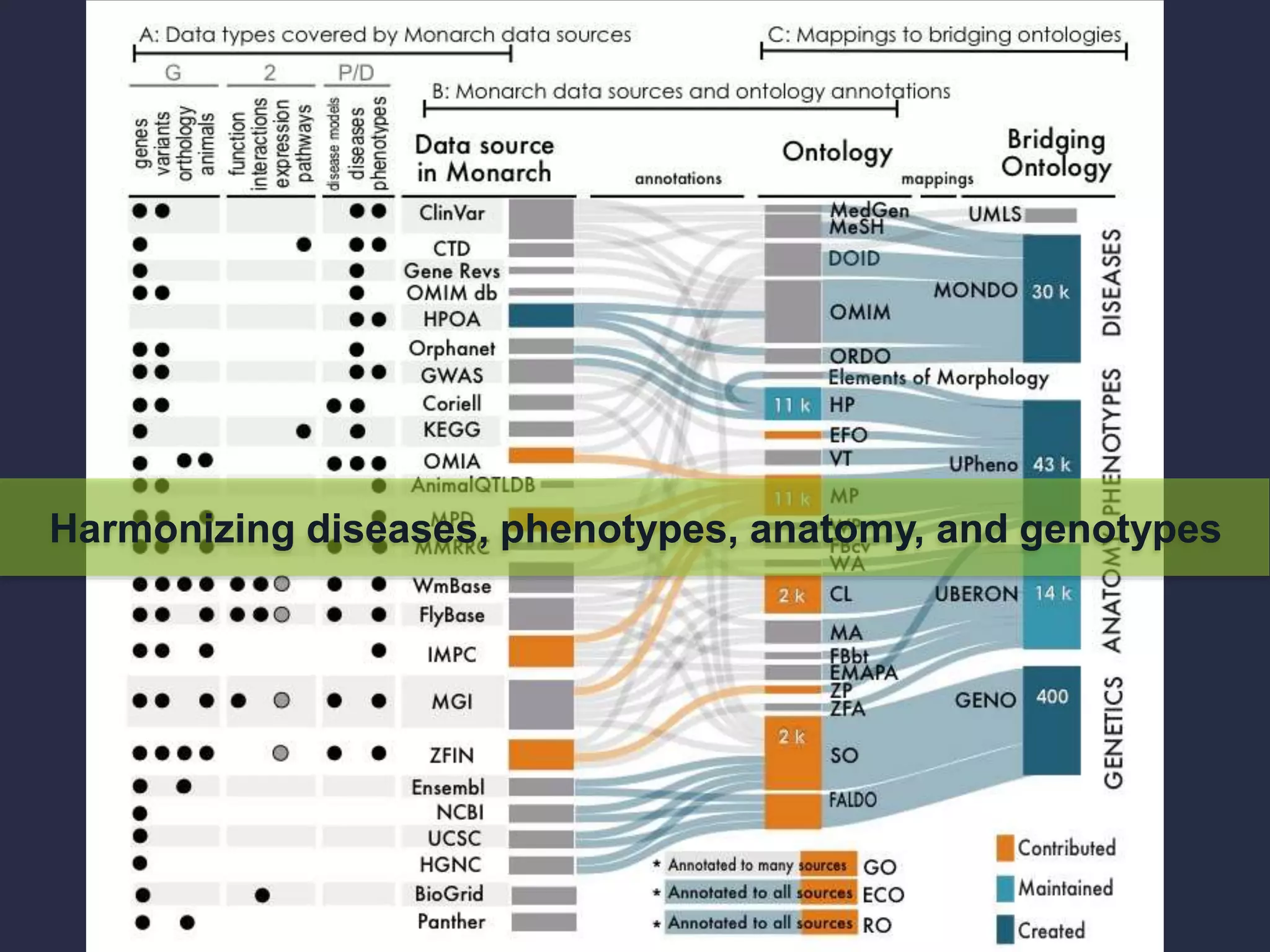
Harmonizing diseases, phenotypes, anatomy, and genotypes
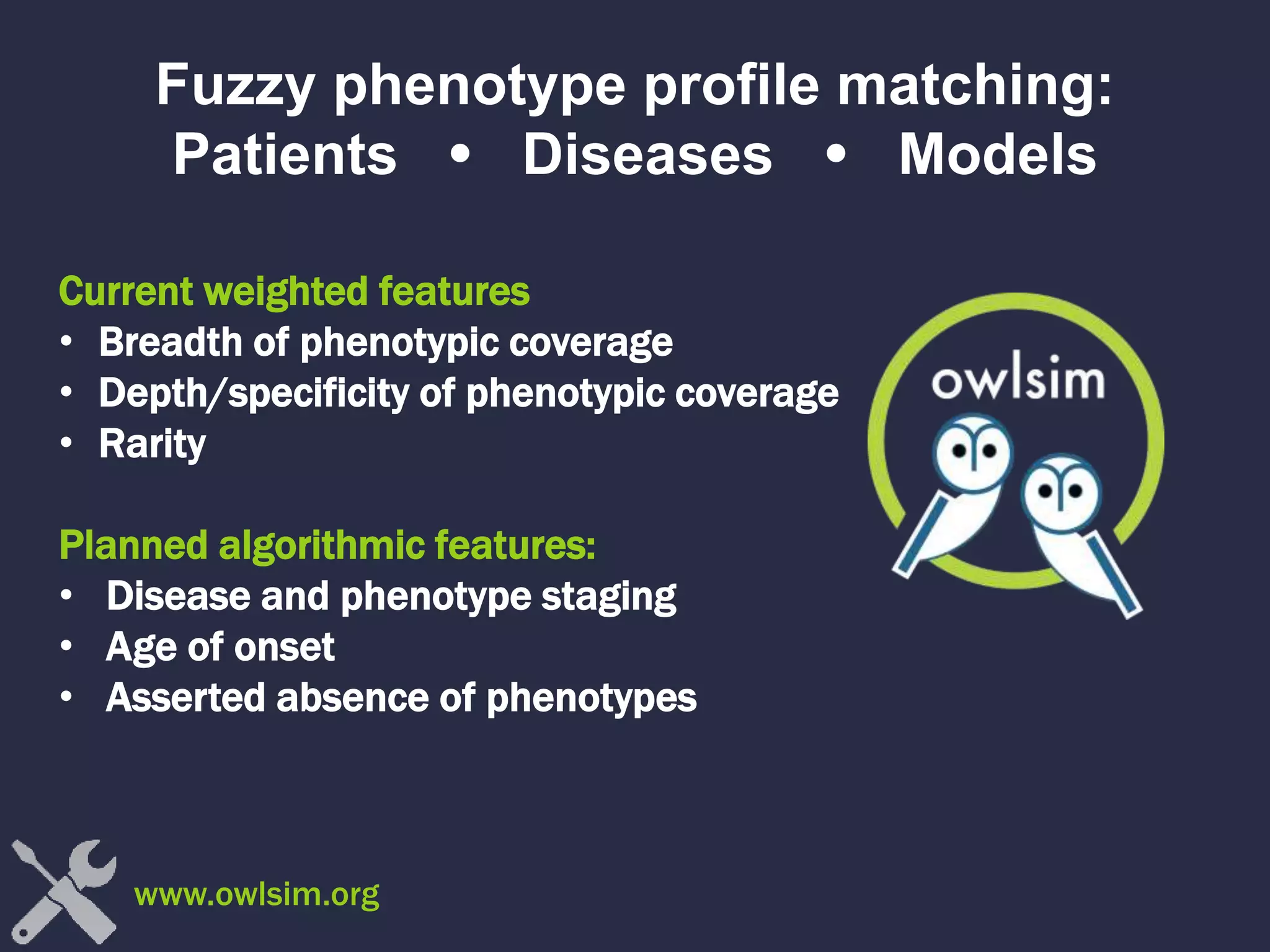
Current weighted features
• Breadth of phenotypic coverage
• Depth/specificity of phenotypic coverage
• Rarity
Planned algorithmic features:
• Disease and phenotype staging
• Age of onset
• Asserted absence of phenotypes
Fuzzy phenotype profile matching:
Patients  Diseases  Models
www.owlsim.org
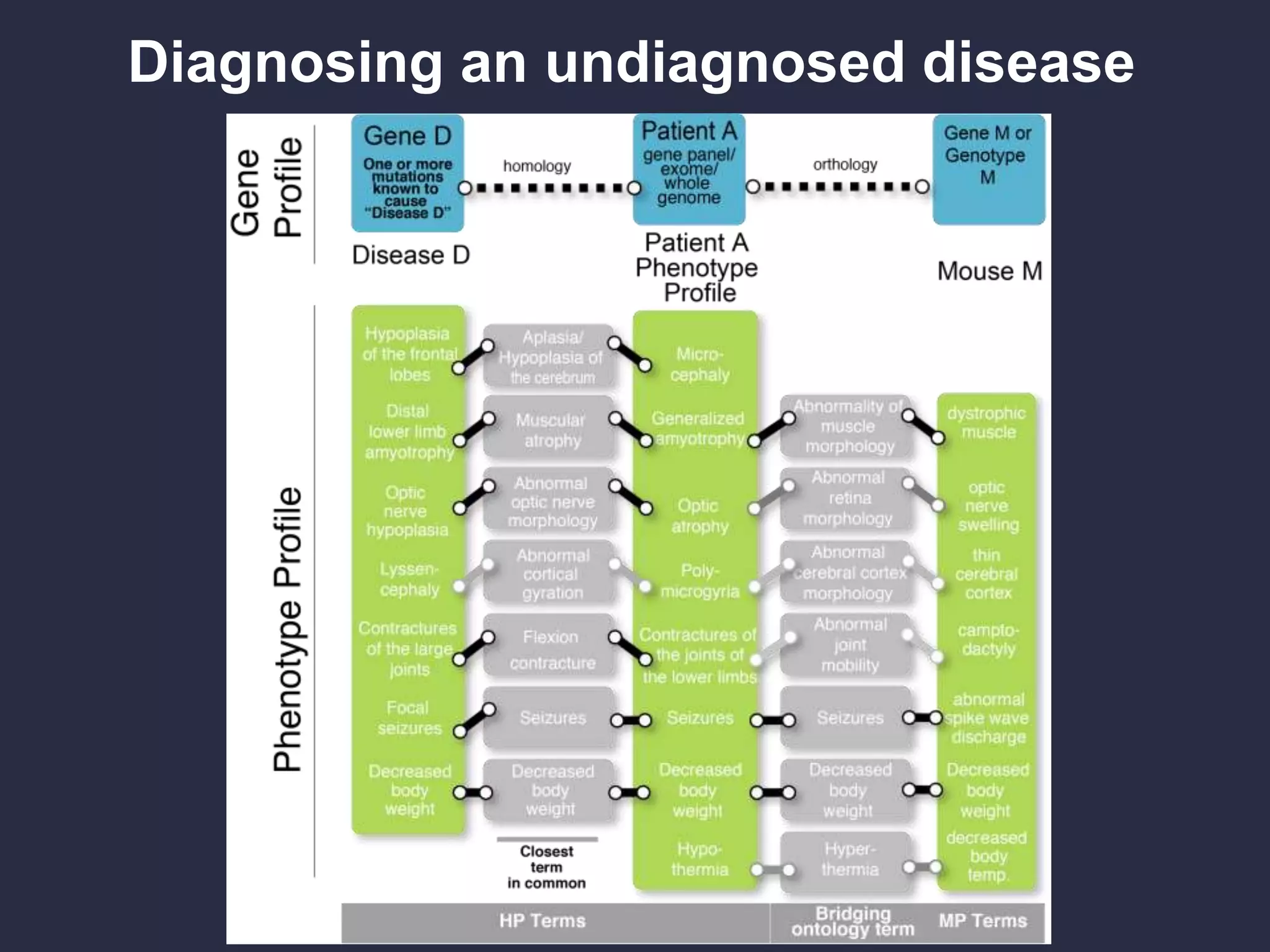
Diagnosing an undiagnosed disease
Why model organisms matter to patients
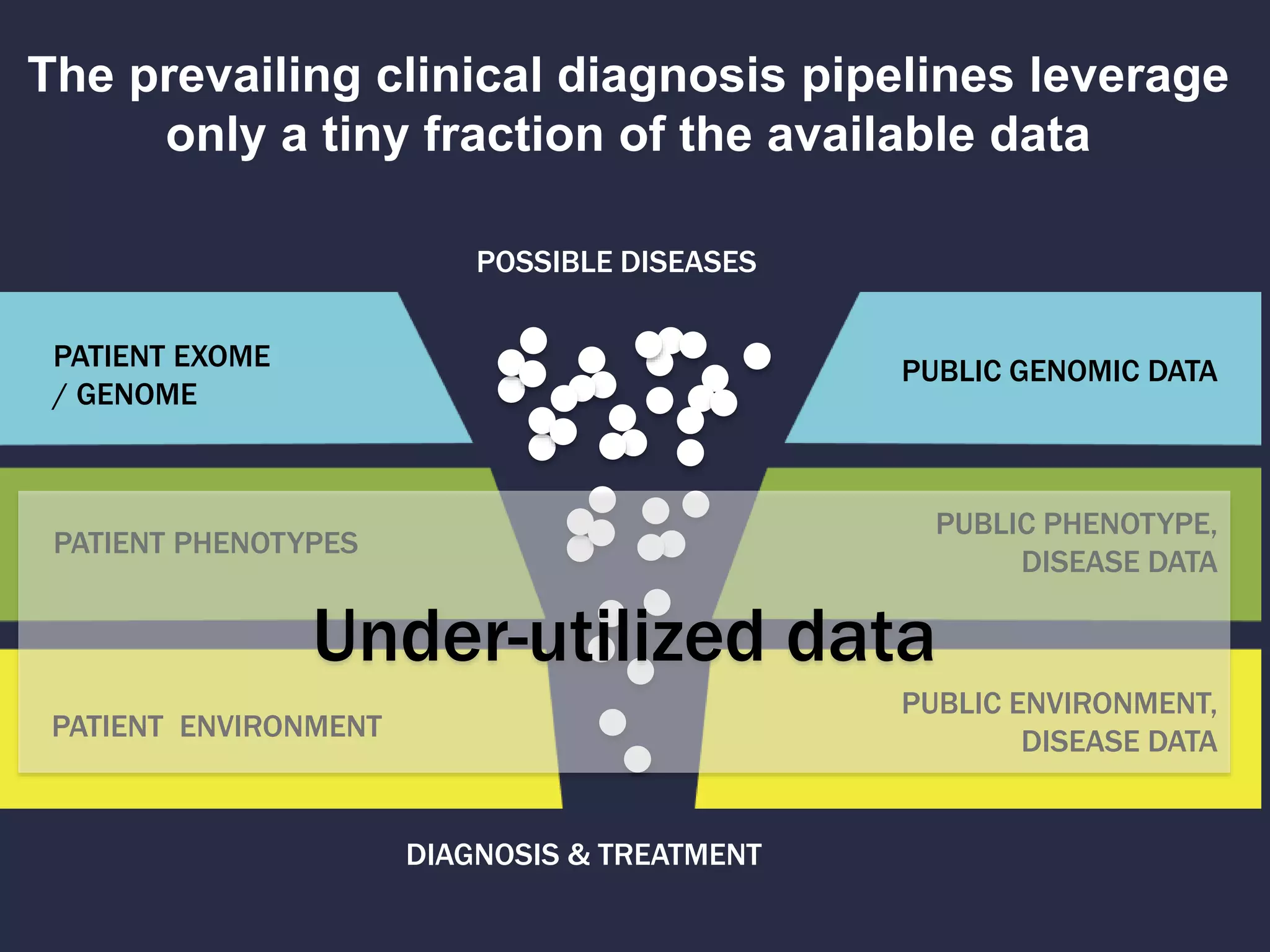
The prevailing clinical diagnosis pipelines leverage
only a tiny fraction of the available data
PATIENT EXOME
/ GENOME
PATIENT PHENOTYPES
PATIENT ENVIRONMENT
PUBLIC GENOMIC DATA
PUBLIC PHENOTYPE,
DISEASE DATA
PUBLIC ENVIRONMENT,
DISEASE DATA
POSSIBLE DISEASES
DIAGNOSIS & TREATMENT
Under-utilized data
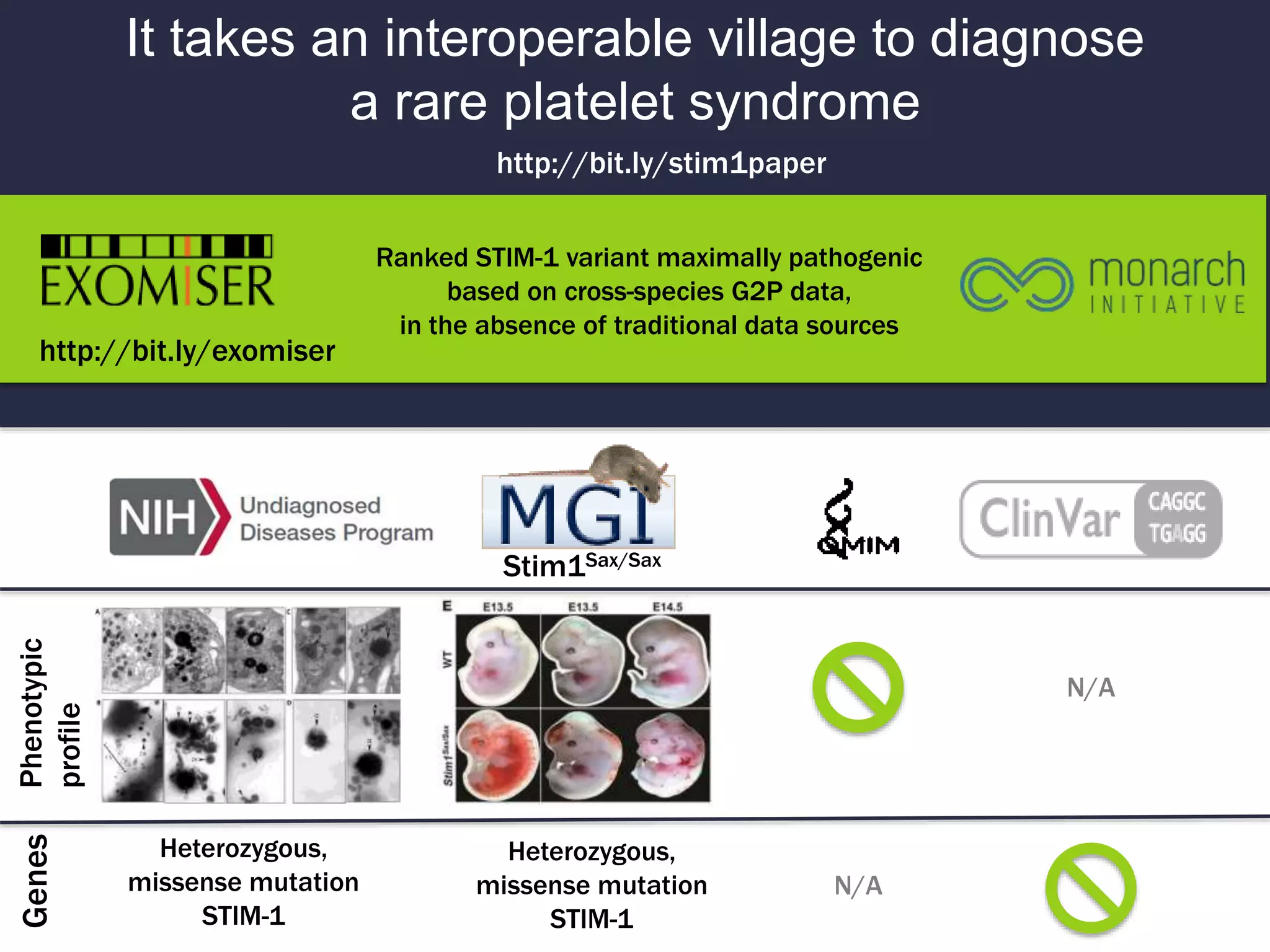
It takes an interoperable village to diagnose
a rare platelet syndrome
http://bit.ly/stim1paper
Phenotypic
profile
Genes
Heterozygous,
missense mutation
STIM-1
MGI mouse
N/A
Heterozygous,
missense mutation
STIM-1
N/A
Ranked STIM-1 variant maximally pathogenic
based on cross-species G2P data,
in the absence of traditional data sources
http://bit.ly/exomiser
Stim1Sax/Sax
Introducing PhenoPackets
It’s exactly what you think it is:
a packet of phenotype data to be used
anywhere, written by anyone
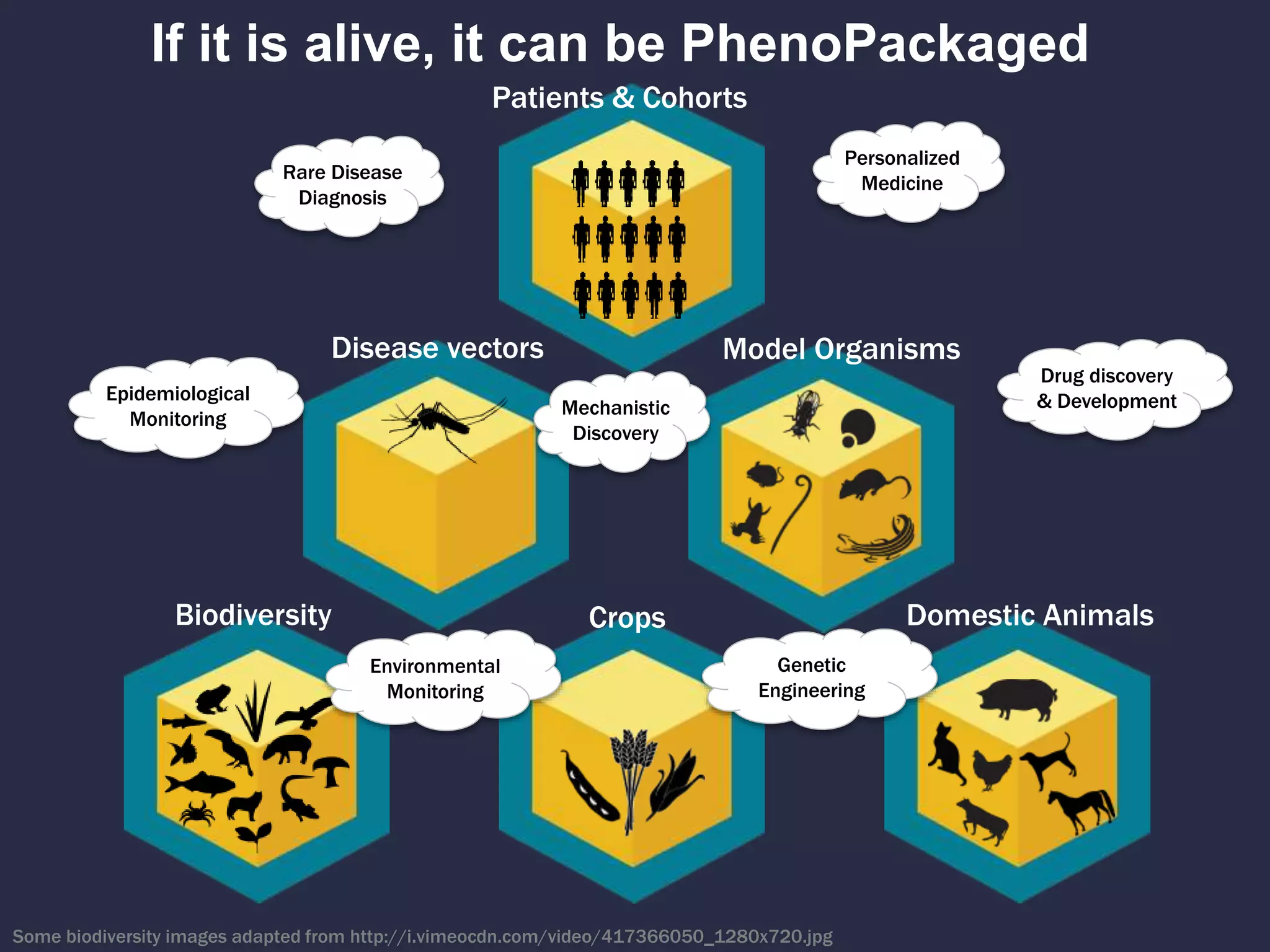
If it is alive, it can be PhenoPackaged
Some biodiversity images adapted from http://i.vimeocdn.com/video/417366050_1280x720.jpg
Model Organisms
Biodiversity Crops Domestic Animals
Disease vectors
Epidemiological
Monitoring
Drug discovery
& Development
Rare Disease
Diagnosis
Personalized
Medicine
Environmental
Monitoring
Patients & Cohorts
Genetic
Engineering
Mechanistic
Discovery
What is in a PhenoPacket?
This is “Maru”,
a 4-year-old, male
cat of the Scottish
Fold breed
abnormal
sheltering behavior
[MP:0014039]
(onset at birth)
Biography
Phenotypes
&qualifiers
youtube.com/user
/mugumogu
Weighs 6kg
Measurements
Source
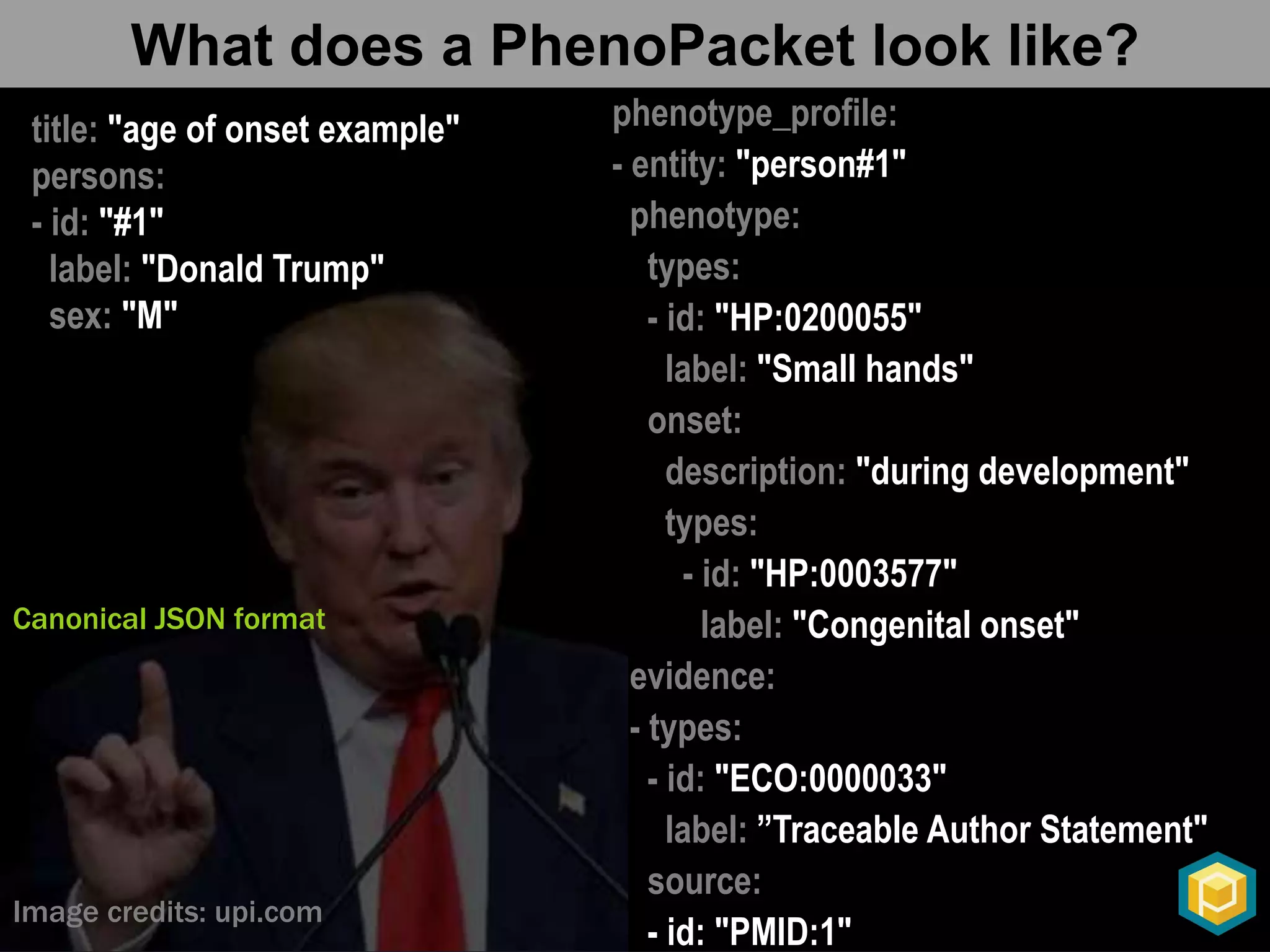
title: "age of onset example"
persons:
- id: "#1"
label: "Donald Trump"
sex: "M"
phenotype_profile:
- entity: "person#1"
phenotype:
types:
- id: "HP:0200055"
label: "Small hands"
onset:
description: "during development"
types:
- id: "HP:0003577"
label: "Congenital onset"
evidence:
- types:
- id: "ECO:0000033"
label: ”Traceable Author Statement"
source:
- id: "PMID:1"
Image credits: upi.com
What does a PhenoPacket look like?
Canonical JSON format
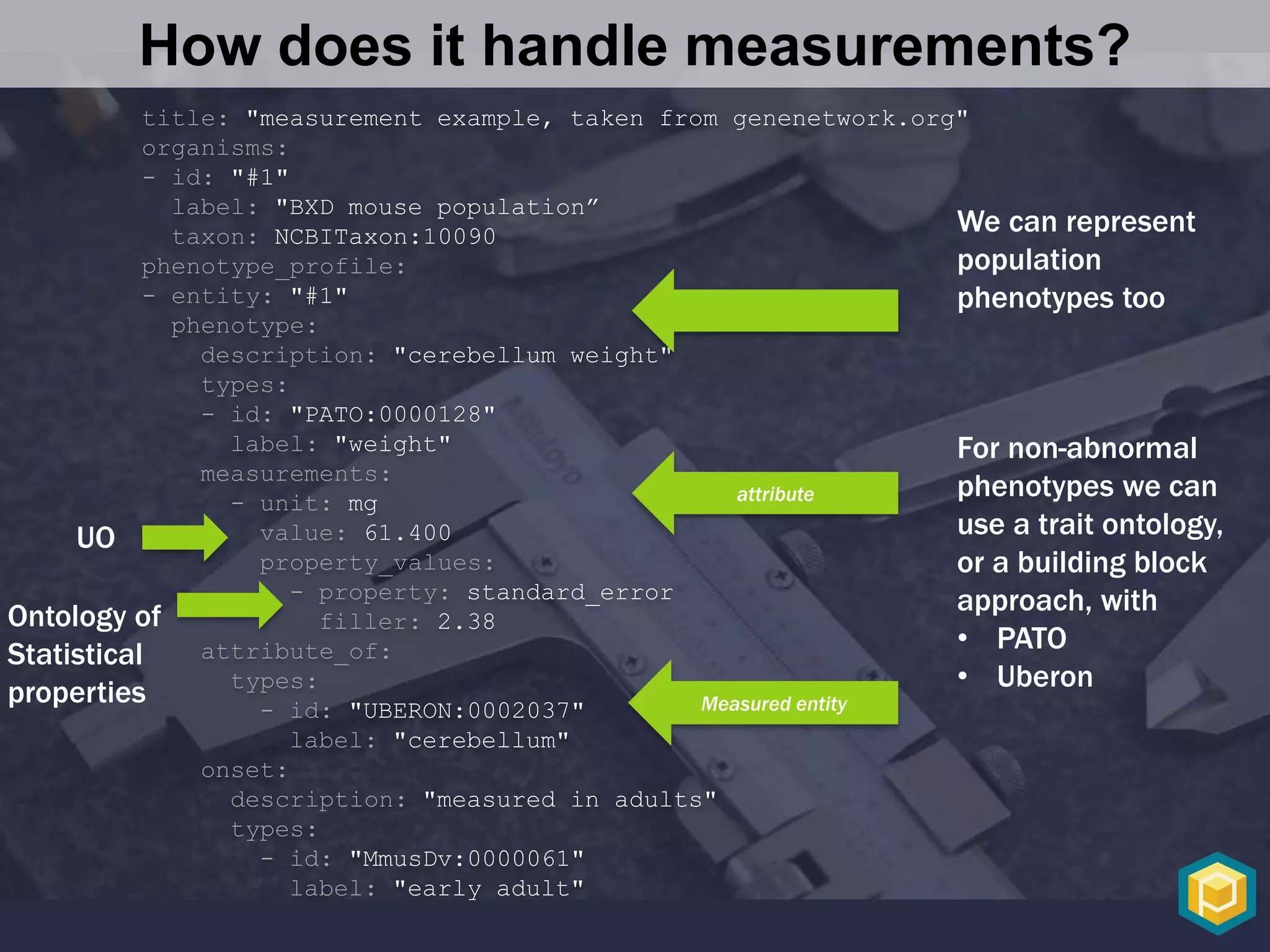
title: "measurement example, taken from genenetwork.org"
organisms:
- id: "#1"
label: "BXD mouse population”
taxon: NCBITaxon:10090
phenotype_profile:
- entity: "#1"
phenotype:
description: "cerebellum weight"
types:
- id: "PATO:0000128"
label: "weight"
measurements:
- unit: mg
value: 61.400
property_values:
- property: standard_error
filler: 2.38
attribute_of:
types:
- id: "UBERON:0002037"
label: "cerebellum"
onset:
description: "measured in adults"
types:
- id: "MmusDv:0000061"
label: "early adult"
Ontology of
Statistical
properties
We can represent
population
phenotypes too
attribute
For non-abnormal
phenotypes we can
use a trait ontology,
or a building block
approach, with
• PATO
• Uberon
Measured entity
UO
How does it handle measurements?
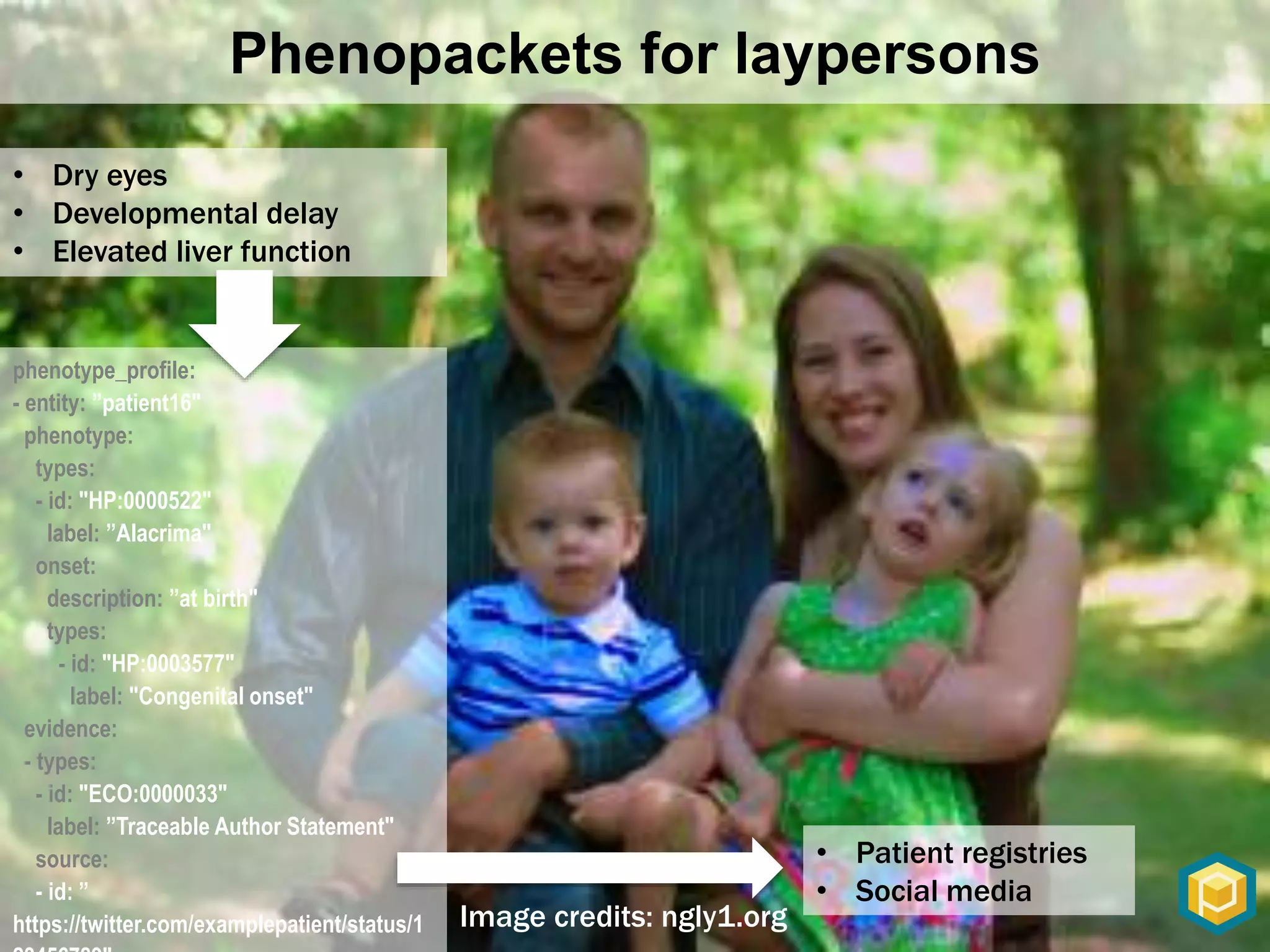
Phenopackets for laypersons
Image credits: ngly1.org
• Dry eyes
• Developmental delay
• Elevated liver function
phenotype_profile:
- entity: ”patient16"
phenotype:
types:
- id: "HP:0000522"
label: ”Alacrima"
onset:
description: ”at birth"
types:
- id: "HP:0003577"
label: "Congenital onset"
evidence:
- types:
- id: "ECO:0000033"
label: ”Traceable Author Statement"
source:
- id: ”
https://twitter.com/examplepatient/status/1
• Patient registries
• Social media
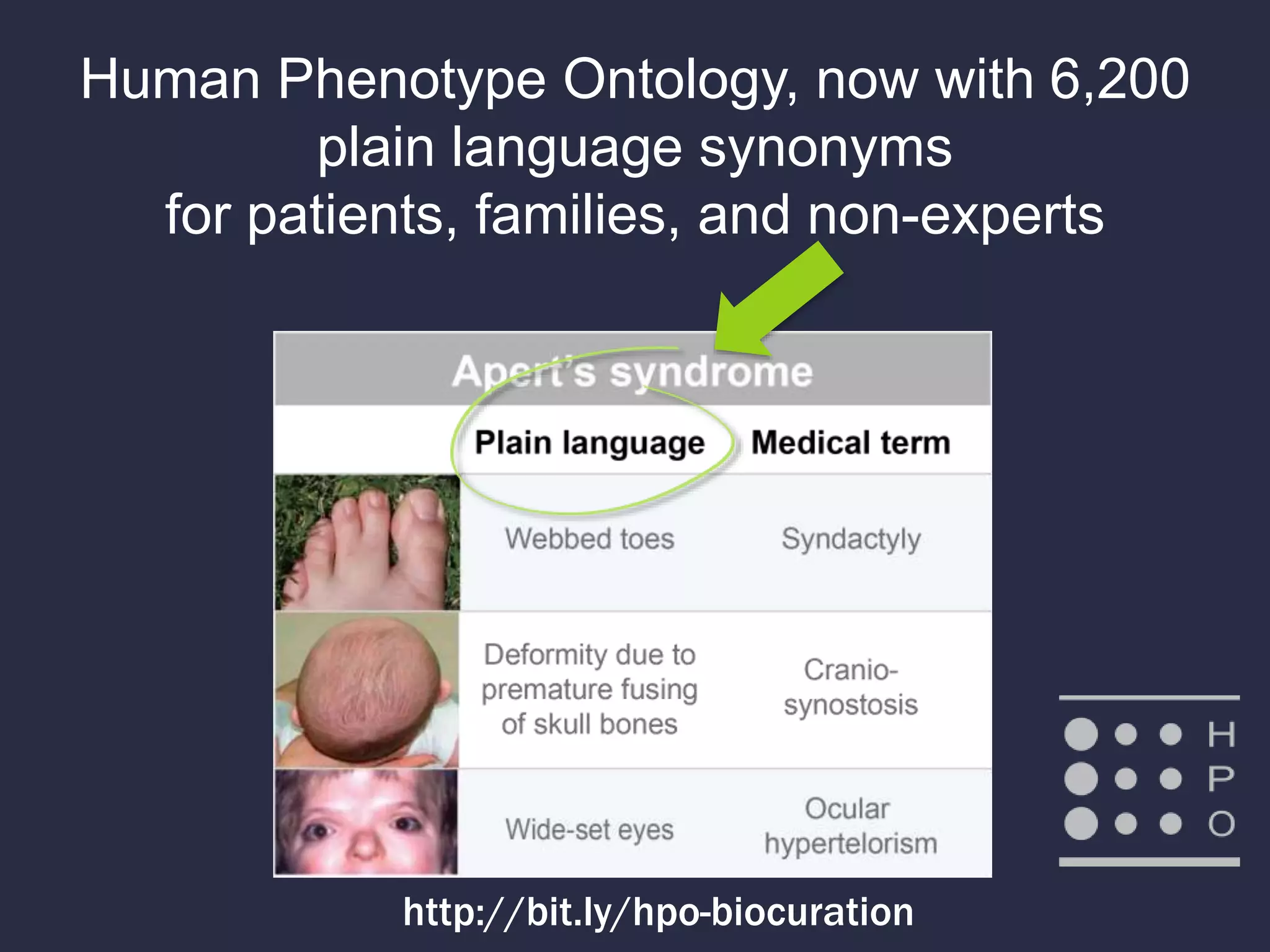
Human Phenotype Ontology, now with 6,200
plain language synonyms
for patients, families, and non-experts
http://bit.ly/hpo-biocuration
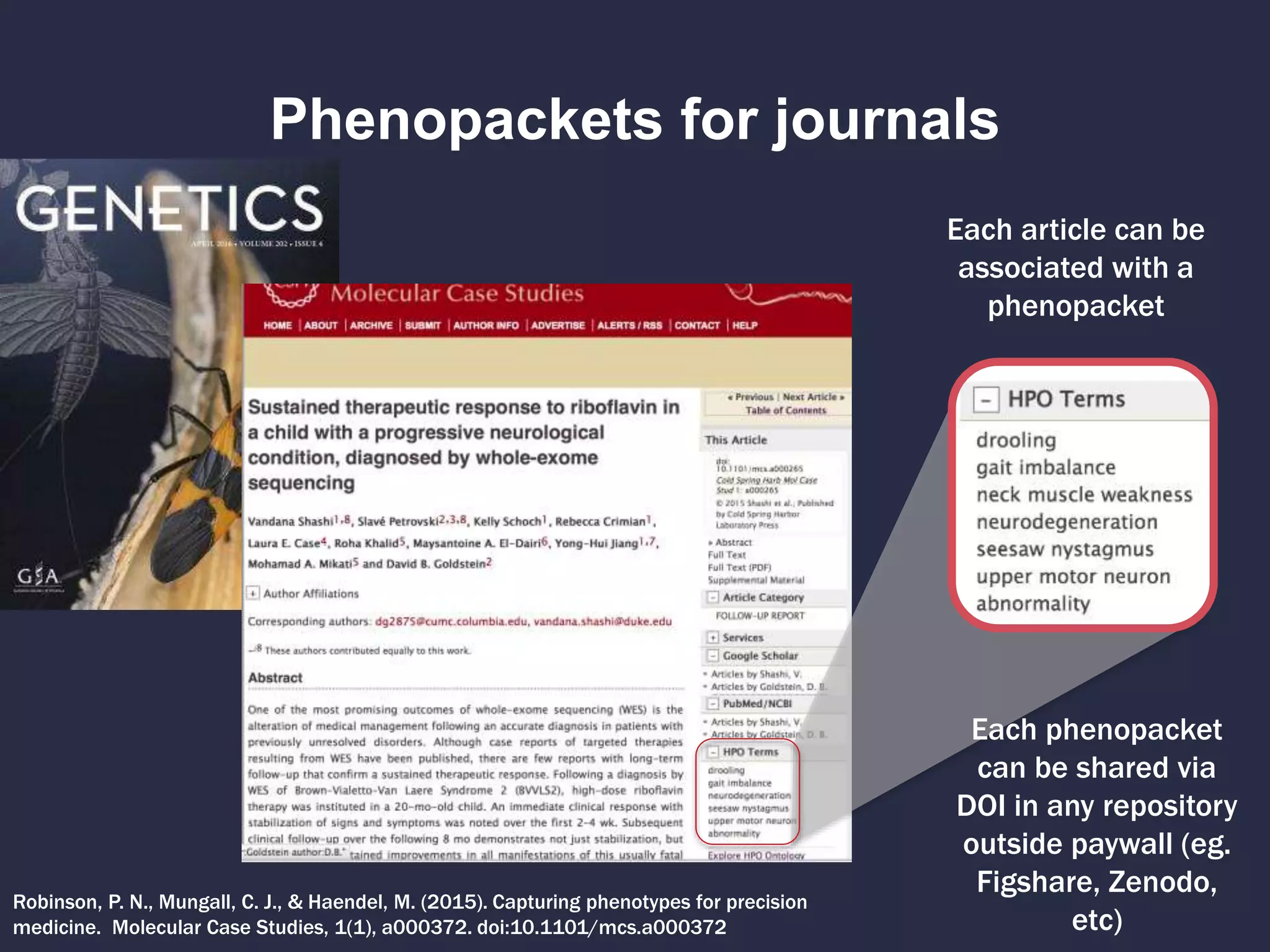
Phenopackets for journals
Each article can be
associated with a
phenopacket
Robinson, P. N., Mungall, C. J., & Haendel, M. (2015). Capturing phenotypes for precision
medicine. Molecular Case Studies, 1(1), a000372. doi:10.1101/mcs.a000372
Each phenopacket
can be shared via
DOI in any repository
outside paywall (eg.
Figshare, Zenodo,
etc)
So, do you expect us to put these together
ourselves?
Emerging tool: WebPhenote
(based on Phenote)
create.monarchinitiative.org
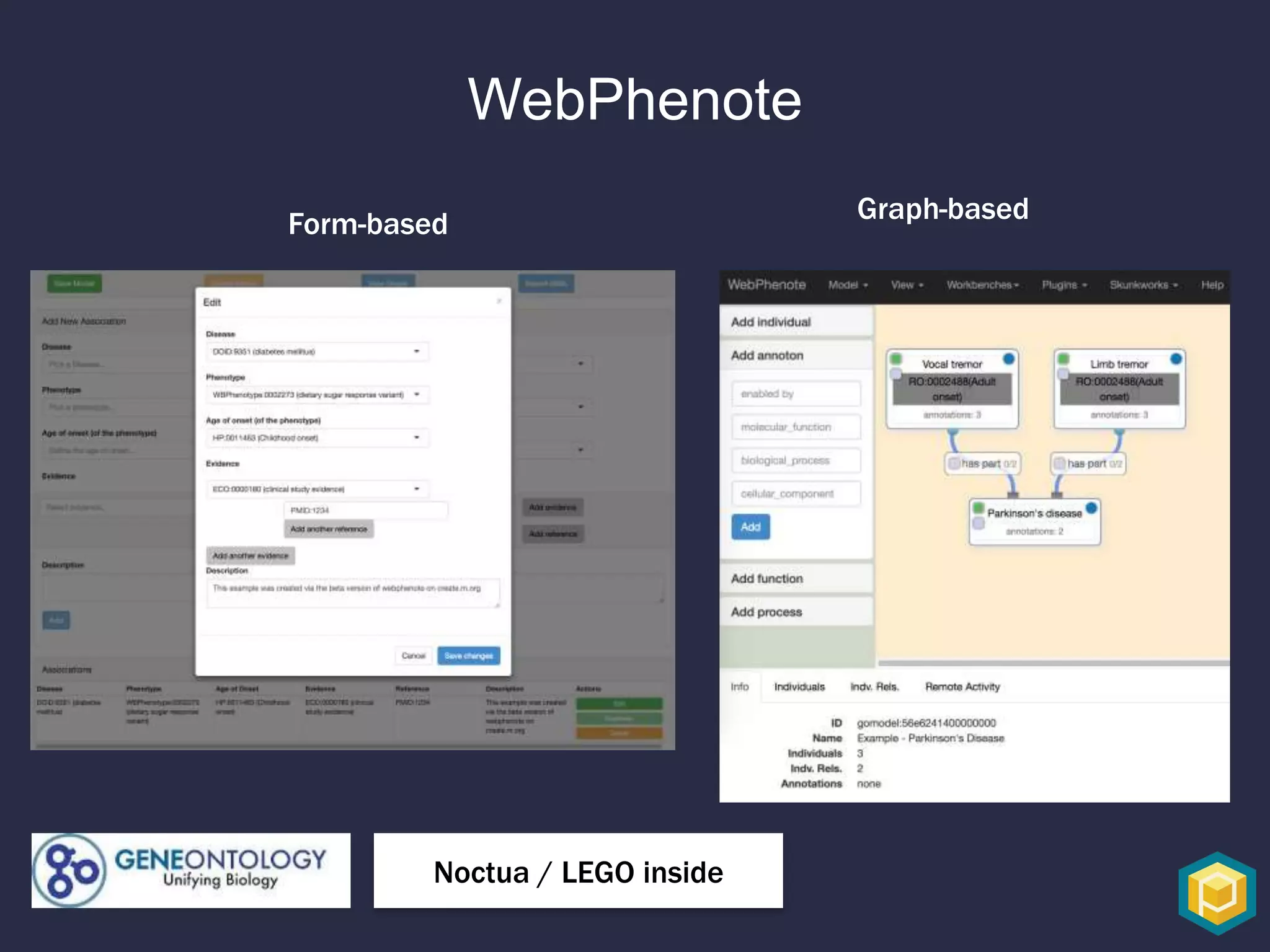
WebPhenote
Form-based Graph-based
Noctua / LEGO inside
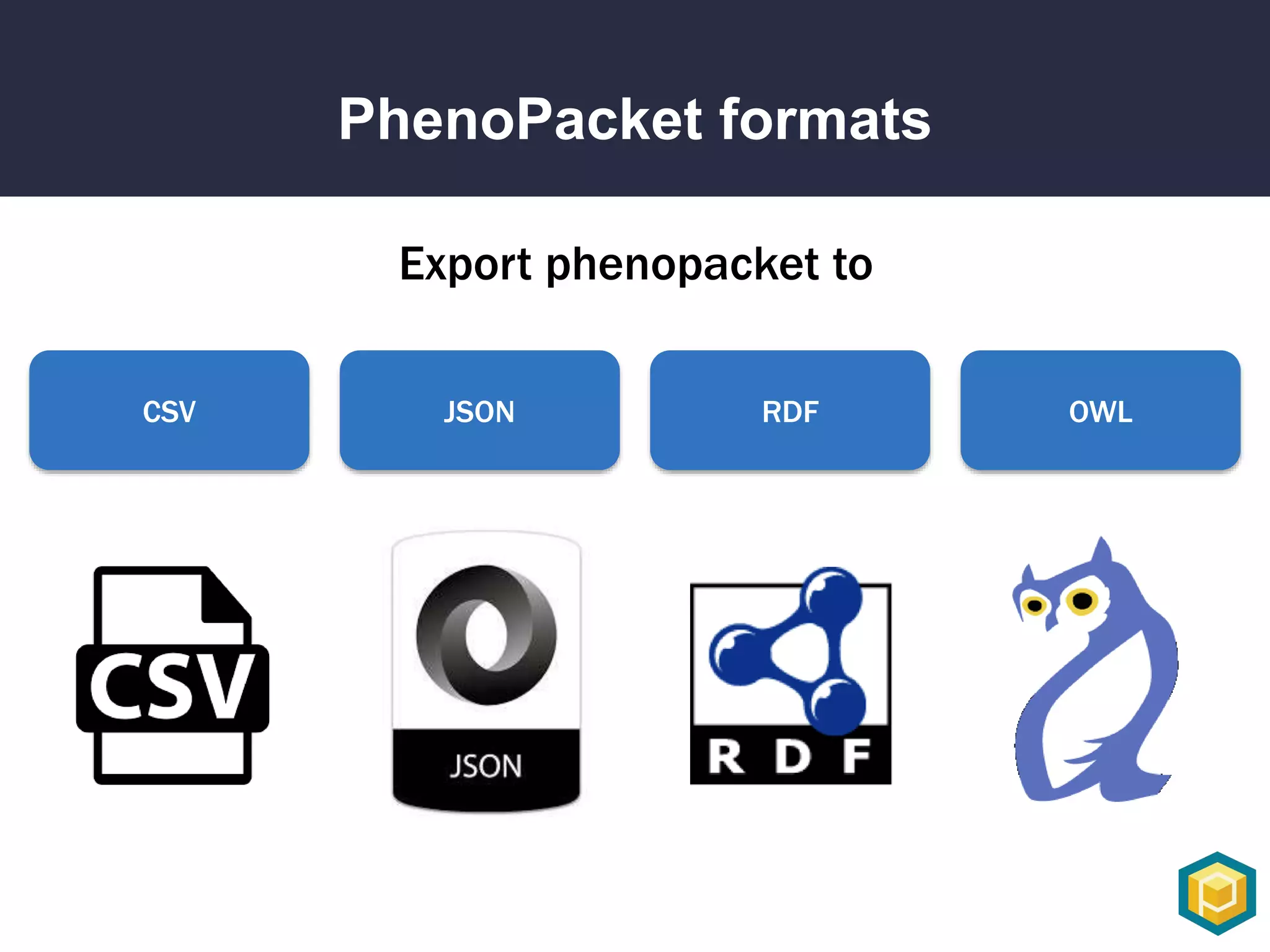
PhenoPacket formats
CSV JSON RDF OWL
Export phenopacket to
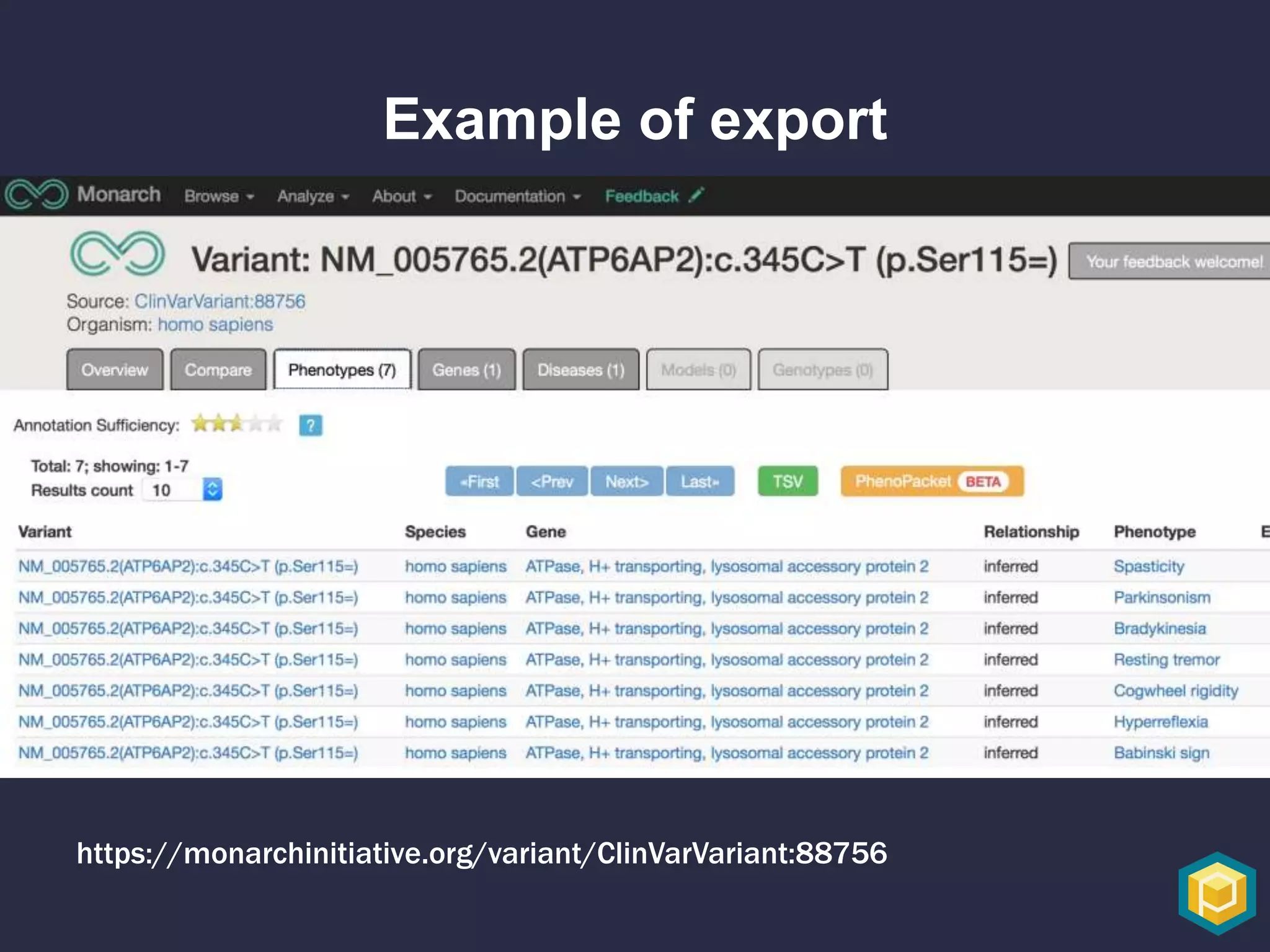
Example of export
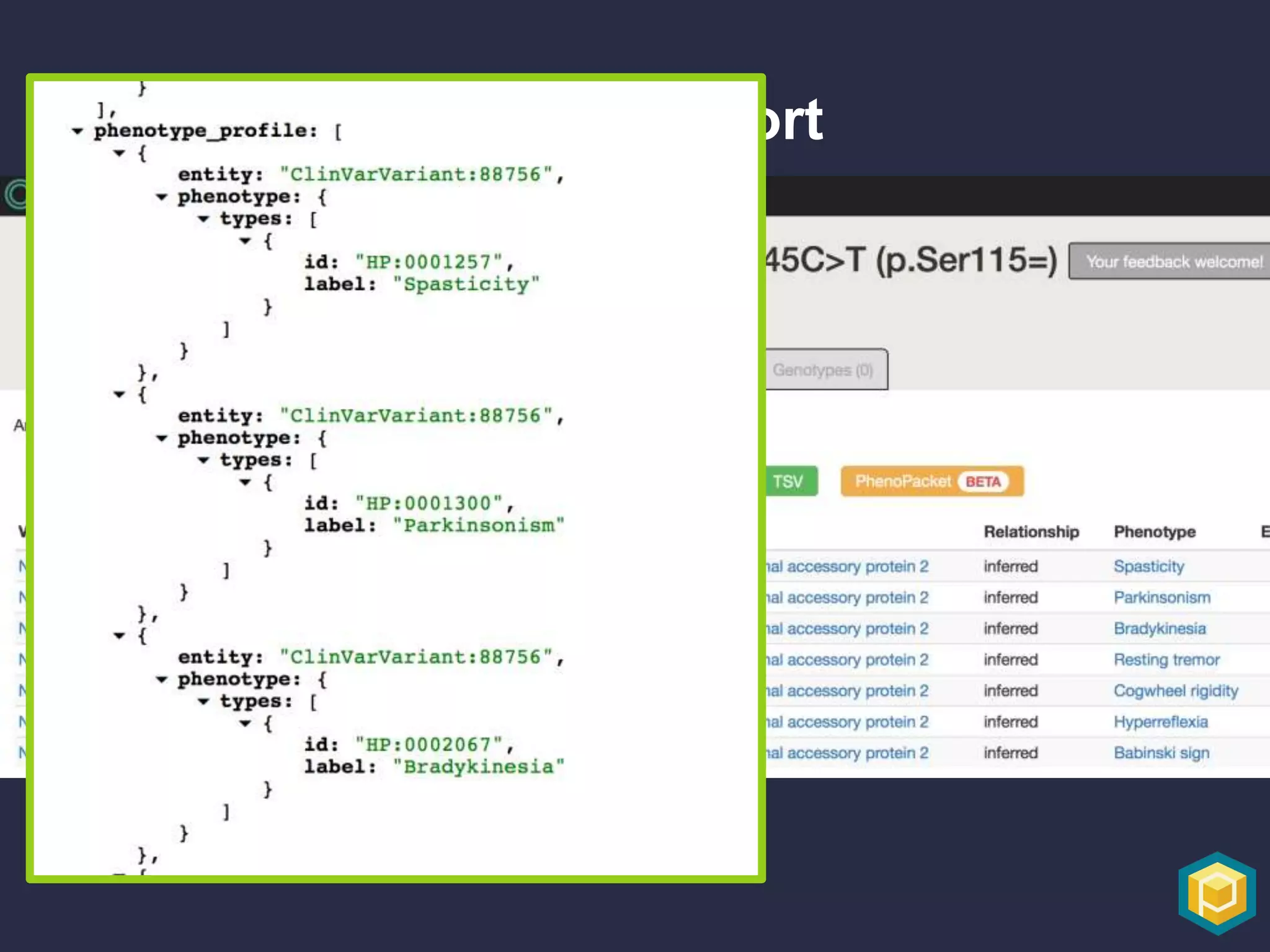
https://monarchinitiative.org/variant/ClinVarVariant:88756
Example of export
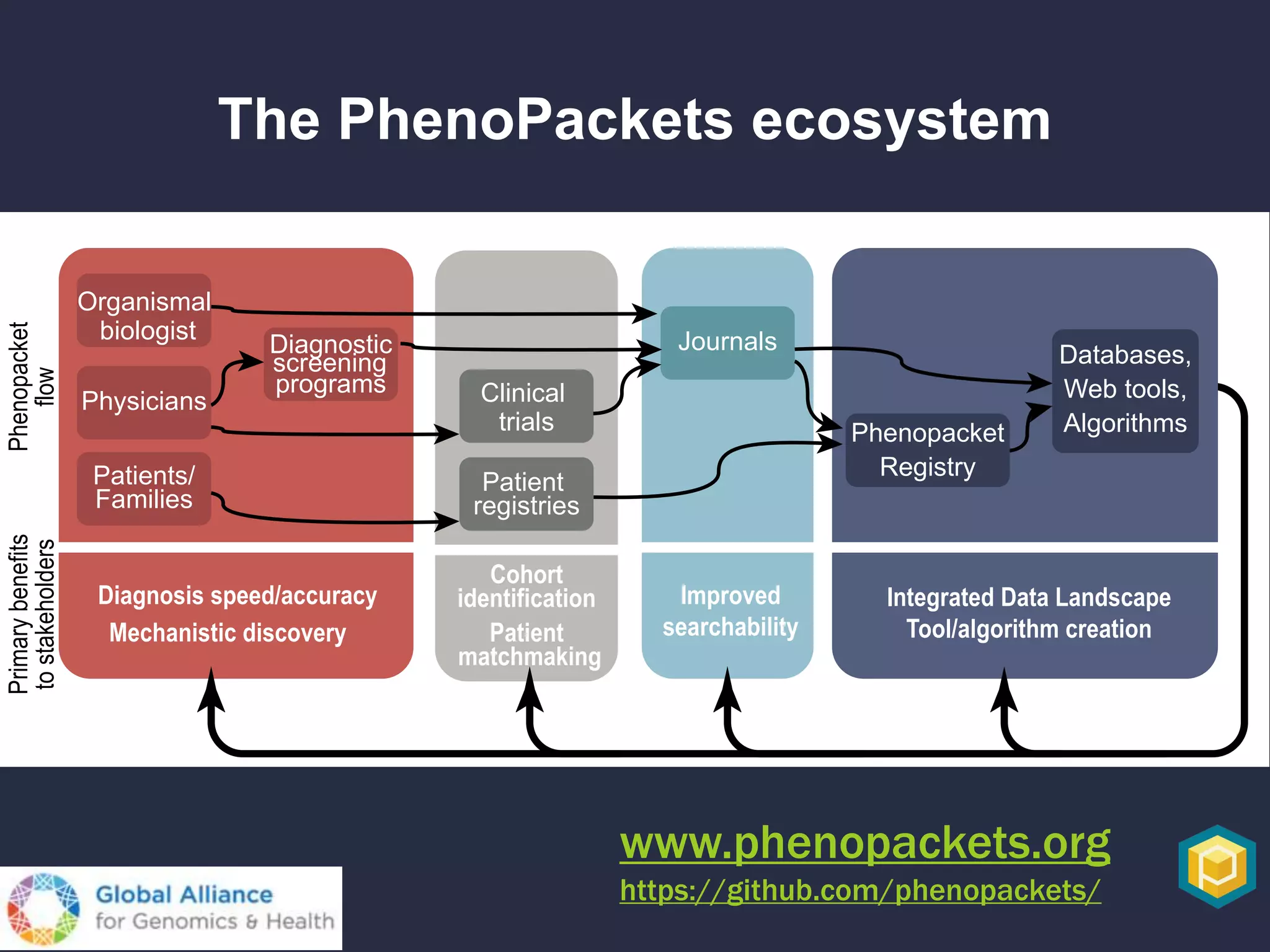
The PhenoPackets ecosystem
Mechanistic discovery
Improved
searchability
Integrated Data Landscape
Tool/algorithm creation
Cohort
identification
Patient
registries
Databases,
Web tools,
AlgorithmsPhenopacket
Registry
JournalsDiagnostic
screening
programs Clinical
trials
Phenopacket
flow
Primarybenefits
tostakeholders
Patients/
Families
Physicians
Patient
matchmaking
Diagnosis speed/accuracy
Organismal
biologist
www.phenopackets.org
https://github.com/phenopackets/
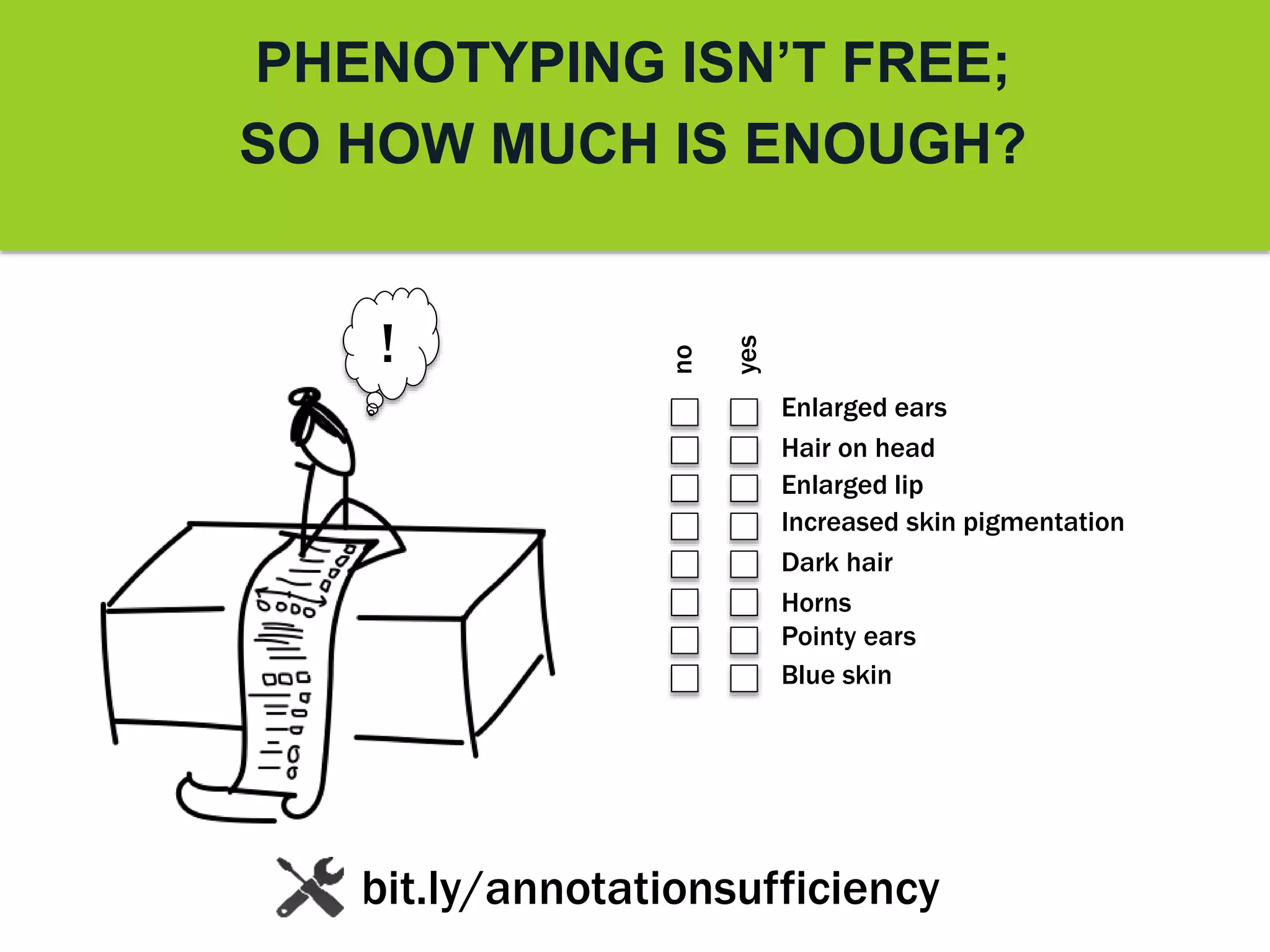
PHENOTYPING ISN’T FREE;
SO HOW MUCH IS ENOUGH?
bit.ly/annotationsufficiency
Enlarged ears
Dark hair
Blue skin
Pointy ears
Hair on head
Horns
Enlarged lip
Increased skin pigmentation
yes
no
!
THE MORE PHENOTYPE DATA WE HAVE,
THE BETTER ABLE WE ARE
TO ANSWER THAT QUESTION
bit.ly/annotationsufficiency
• Depth/specificity of phenotypic coverage
• Rarity
• Breadth of phenotypic coverage
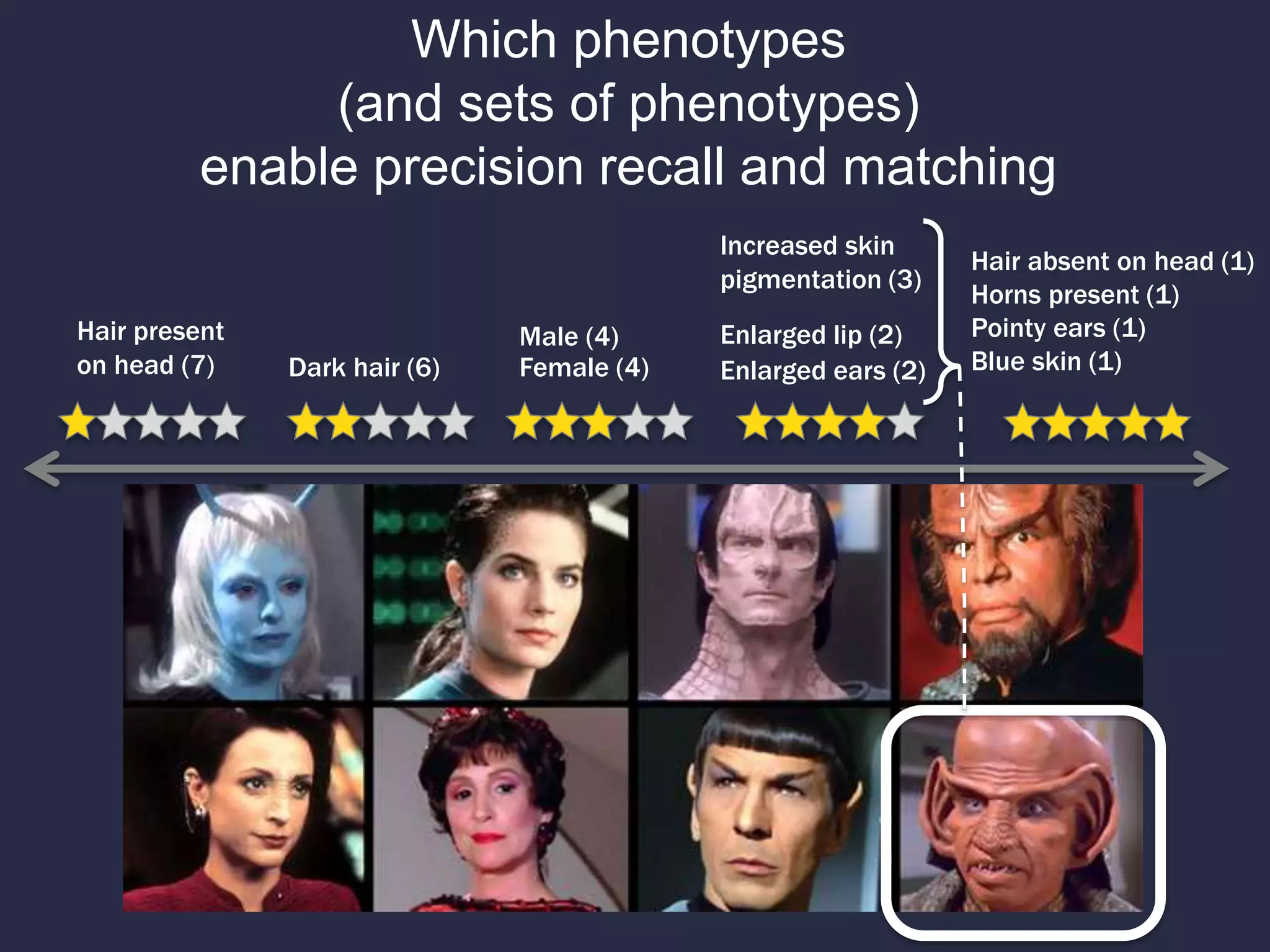
Which phenotypes
(and sets of phenotypes)
enable precision recall and matching
Enlarged ears (2)Dark hair (6) Female (4)
Male (4)
Blue skin (1)
Pointy ears (1)
Hair absent on head (1)
Horns present (1)
Hair present
on head (7)
Enlarged lip (2)
Increased skin
pigmentation (3)
PhenoPackets make phenotype data:
Findable
Accessible outside paywalls and private data sources
Attributable
Interoperable and Computable,
Reusable, exchangeable across contexts and disciplines
FAIR++
Sign up below to receive updates
Or to provide feedback and requirements
http://bit.ly/biocuration2016
Thank you!
Live Long and Phenotype
Acknowledgements
Lawrence Berkeley
Chris Mungall
Suzanna Lewis
Jeremy Nguyen
Seth Carbon
Charité
Peter Robinson
Sebastian Kohler
RTI
Jim Balhoff
Cyverse
Ramona Walls
U of Pittsburgh
Harry Hochheiser
OHSU
Matt Brush
Kent Shefchek
Julie McMurry
Tom Conlin
Nicole Vasilevsky
Queen Mary College
London
Damian Smedley
Jules Jacobson
Garvan
Tudor Groza
Alfred Wegener
Pier Buttigieg
FUNDING: NIH Office of Director: 1R24OD011883; NIH-UDP: HHSN268201300036C,
HHSN268201400093P, Phenotype Ontology Research Coordination Network (NSF-DEB-0956049)
With special thanks to Julie McMurry for excellent graphic design

Why the world needs phenopacketeers, and how to be one

  • 1.
    Why the worldneeds PhenoPacketeers, and how to be one Melissa Haendel, PhD April , 2016 Biocuration 2016 @monarchinit @ontowonka haendel@ohsu.edu
  • 2.
    What is aphenotype? @ontowonka
  • 3.
    Biology central dogma ADAPTEDFROM http://www.xkcd.com/295/ @ontowonka
  • 4.
    Genes Environment Phenotypes+= Biology central dogma Standards for encoding and exchanging data must be up to these challenges. This is where you come in. @ontowonka
  • 5.
    Genes Environment Phenotypes+= Computable encodings are essential Base pairs Variant notation (eg. HGVS) Human Phenotype Ontology Mammalian Phenotype Ontology Medical procedure coding Environment Ontology @ontowonka
  • 6.
    Genes Environment Phenotypes VCFPXFGFF Standard exchange formats exist for genes … but for phenotypes? Environment? BED @ontowonka
  • 7.
    The relationships toomust be captured It is not just the bits… G-P or D (disease) causes contributes to is risk factor for protects against correlates with is marker for modulates involved in increases susceptibility to G-G (kind of) regulates negatively regulates (inhibits) positively regulates (activates) directly regulates interacts with co-localizes with co-expressed with P/D - P/D part of results in co-occurs with correlates with hallmark of (P->D) E-P contributes to (E->P) influences (E->P) exacerbates (E->P) manifest in (P->E) G-E (kind of) expressed in expressed during contains inactivated by
  • 8.
    The genome issequenced, but… …we still don’t know very much about what it does 3,435 OMIM Mendelian Diseases with no known genetic basis ? 66,396 ClinVar Variants with no known pathogenicity
  • 9.
    Why we needall the organisms Model data can provide up to 80% phenotypic coverage of the human coding genome
  • 10.
    We learn differentphenotypes from different organisms
  • 11.
    B6.Cg-Alms1foz/fox/J increased weight, adipose tissuevolume, glucose homeostasis altered ALSM1(NM_015120.4) [c.10775delC] + [-] GENOTYPE PHENOTYPE obesity, diabetes mellitus, insulin resistance increased food intake, hyperglycemia, insulin resistance kcnj11c14/c14; insrt143/+(AB) Can we use model phenotypes to inform genetic mechanisms of disease? ???
  • 12.
    CC2.0 European SouthernObservatory https://www.flickr.com/photos/esoastronomy/6923443595 Crossing the language barrier
  • 13.
    Ulcerated paws Palmoplantar hyperkeratosis Thick hand skin Imagecredits: "HandsEBS" by James Heilman, MD - Own work. Licensed under CC BY-SA 3.0 via Commons – https://commons.wikimedia.org/wiki/File:HandsEBS.JPG#/media/File:HandsEBS.JPG http://www.guinealynx.info/pododermatitis.html
  • 14.
    Semantics serve asa bridge http://xkcd.com/1406/
  • 15.
    Challenge: Each databaseuses their own vocabulary/ontology MP HP MGI HPOA
  • 16.
    Challenge: Each databaseuses their own phenotype vocabulary/ontology ZFA MP DPO WPO HP OMIA VT FYPO APO SNO MED … … … WB PB FB OMIA MGI RGD ZFIN SGD HPOA EHR IMPC OMIM … QTLdb
  • 17.
    Can we helpmachines understand phenotype terms? “Palmoplantar hyperkeratosis” Human phenotype I have absolutely no idea what that means
  • 18.
    Decomposition of complexconcepts allows interoperability Mungall, C. J., Gkoutos, G., Smith, C., Haendel, M., Lewis, S., & Ashburner, M. (2010). Integrating phenotype ontologies across multiple species. Genome Biology, 11(1), R2. doi:10.1186/gb-2010-11-1-r2 “Palmoplantar hyperkeratosis” increased Stratum corneum layer of skin = Human phenotype PATO Uberon Species neutral ontologies, homologous concepts Autopod keratinization GO
  • 19.
    Harmonizing diseases, phenotypes,anatomy, and genotypes
  • 20.
    Current weighted features •Breadth of phenotypic coverage • Depth/specificity of phenotypic coverage • Rarity Planned algorithmic features: • Disease and phenotype staging • Age of onset • Asserted absence of phenotypes Fuzzy phenotype profile matching: Patients  Diseases  Models www.owlsim.org
  • 21.
  • 22.
    Why model organismsmatter to patients
  • 23.
    The prevailing clinicaldiagnosis pipelines leverage only a tiny fraction of the available data PATIENT EXOME / GENOME PATIENT PHENOTYPES PATIENT ENVIRONMENT PUBLIC GENOMIC DATA PUBLIC PHENOTYPE, DISEASE DATA PUBLIC ENVIRONMENT, DISEASE DATA POSSIBLE DISEASES DIAGNOSIS & TREATMENT Under-utilized data
  • 24.
    It takes aninteroperable village to diagnose a rare platelet syndrome http://bit.ly/stim1paper Phenotypic profile Genes Heterozygous, missense mutation STIM-1 MGI mouse N/A Heterozygous, missense mutation STIM-1 N/A Ranked STIM-1 variant maximally pathogenic based on cross-species G2P data, in the absence of traditional data sources http://bit.ly/exomiser Stim1Sax/Sax
  • 25.
    Introducing PhenoPackets It’s exactlywhat you think it is: a packet of phenotype data to be used anywhere, written by anyone
  • 26.
    If it isalive, it can be PhenoPackaged Some biodiversity images adapted from http://i.vimeocdn.com/video/417366050_1280x720.jpg Model Organisms Biodiversity Crops Domestic Animals Disease vectors Epidemiological Monitoring Drug discovery & Development Rare Disease Diagnosis Personalized Medicine Environmental Monitoring Patients & Cohorts Genetic Engineering Mechanistic Discovery
  • 27.
    What is ina PhenoPacket? This is “Maru”, a 4-year-old, male cat of the Scottish Fold breed abnormal sheltering behavior [MP:0014039] (onset at birth) Biography Phenotypes &qualifiers youtube.com/user /mugumogu Weighs 6kg Measurements Source
  • 28.
    title: "age ofonset example" persons: - id: "#1" label: "Donald Trump" sex: "M" phenotype_profile: - entity: "person#1" phenotype: types: - id: "HP:0200055" label: "Small hands" onset: description: "during development" types: - id: "HP:0003577" label: "Congenital onset" evidence: - types: - id: "ECO:0000033" label: ”Traceable Author Statement" source: - id: "PMID:1" Image credits: upi.com What does a PhenoPacket look like? Canonical JSON format
  • 29.
    title: "measurement example,taken from genenetwork.org" organisms: - id: "#1" label: "BXD mouse population” taxon: NCBITaxon:10090 phenotype_profile: - entity: "#1" phenotype: description: "cerebellum weight" types: - id: "PATO:0000128" label: "weight" measurements: - unit: mg value: 61.400 property_values: - property: standard_error filler: 2.38 attribute_of: types: - id: "UBERON:0002037" label: "cerebellum" onset: description: "measured in adults" types: - id: "MmusDv:0000061" label: "early adult" Ontology of Statistical properties We can represent population phenotypes too attribute For non-abnormal phenotypes we can use a trait ontology, or a building block approach, with • PATO • Uberon Measured entity UO How does it handle measurements?
  • 30.
    Phenopackets for laypersons Imagecredits: ngly1.org • Dry eyes • Developmental delay • Elevated liver function phenotype_profile: - entity: ”patient16" phenotype: types: - id: "HP:0000522" label: ”Alacrima" onset: description: ”at birth" types: - id: "HP:0003577" label: "Congenital onset" evidence: - types: - id: "ECO:0000033" label: ”Traceable Author Statement" source: - id: ” https://twitter.com/examplepatient/status/1 • Patient registries • Social media
  • 31.
    Human Phenotype Ontology,now with 6,200 plain language synonyms for patients, families, and non-experts http://bit.ly/hpo-biocuration
  • 32.
    Phenopackets for journals Eacharticle can be associated with a phenopacket Robinson, P. N., Mungall, C. J., & Haendel, M. (2015). Capturing phenotypes for precision medicine. Molecular Case Studies, 1(1), a000372. doi:10.1101/mcs.a000372 Each phenopacket can be shared via DOI in any repository outside paywall (eg. Figshare, Zenodo, etc)
  • 33.
    So, do youexpect us to put these together ourselves? Emerging tool: WebPhenote (based on Phenote) create.monarchinitiative.org
  • 34.
  • 35.
    PhenoPacket formats CSV JSONRDF OWL Export phenopacket to
  • 36.
  • 37.
  • 38.
    The PhenoPackets ecosystem Mechanisticdiscovery Improved searchability Integrated Data Landscape Tool/algorithm creation Cohort identification Patient registries Databases, Web tools, AlgorithmsPhenopacket Registry JournalsDiagnostic screening programs Clinical trials Phenopacket flow Primarybenefits tostakeholders Patients/ Families Physicians Patient matchmaking Diagnosis speed/accuracy Organismal biologist www.phenopackets.org https://github.com/phenopackets/
  • 39.
    PHENOTYPING ISN’T FREE; SOHOW MUCH IS ENOUGH? bit.ly/annotationsufficiency Enlarged ears Dark hair Blue skin Pointy ears Hair on head Horns Enlarged lip Increased skin pigmentation yes no !
  • 40.
    THE MORE PHENOTYPEDATA WE HAVE, THE BETTER ABLE WE ARE TO ANSWER THAT QUESTION bit.ly/annotationsufficiency • Depth/specificity of phenotypic coverage • Rarity • Breadth of phenotypic coverage
  • 41.
    Which phenotypes (and setsof phenotypes) enable precision recall and matching Enlarged ears (2)Dark hair (6) Female (4) Male (4) Blue skin (1) Pointy ears (1) Hair absent on head (1) Horns present (1) Hair present on head (7) Enlarged lip (2) Increased skin pigmentation (3)
  • 42.
    PhenoPackets make phenotypedata: Findable Accessible outside paywalls and private data sources Attributable Interoperable and Computable, Reusable, exchangeable across contexts and disciplines FAIR++
  • 43.
    Sign up belowto receive updates Or to provide feedback and requirements http://bit.ly/biocuration2016 Thank you! Live Long and Phenotype
  • 44.
    Acknowledgements Lawrence Berkeley Chris Mungall SuzannaLewis Jeremy Nguyen Seth Carbon Charité Peter Robinson Sebastian Kohler RTI Jim Balhoff Cyverse Ramona Walls U of Pittsburgh Harry Hochheiser OHSU Matt Brush Kent Shefchek Julie McMurry Tom Conlin Nicole Vasilevsky Queen Mary College London Damian Smedley Jules Jacobson Garvan Tudor Groza Alfred Wegener Pier Buttigieg FUNDING: NIH Office of Director: 1R24OD011883; NIH-UDP: HHSN268201300036C, HHSN268201400093P, Phenotype Ontology Research Coordination Network (NSF-DEB-0956049) With special thanks to Julie McMurry for excellent graphic design

Editor's Notes

  • #3 Trite answer: Something that can be represented by a class in a phenotype ontology MP HP .. But there is more This basic phenotype description can be adorned with… Natural language descriptions Temporal information (onset) Qualifiers Severity, progression Quantitative information Measurements (unit, value, error, etc) Environment …Much more!
  • #4 The classic G+E=P. But the = has a lot that can be applied to aid the linking.
  • #5 The classic G+E=P. But the = has a lot that can be applied to aid the linking.
  • #6 The classic G+E=P. But the = has a lot that can be applied to aid the linking.
  • #7 The classic G+E=P. But the = has a lot that can be applied to aid the linking.
  • #8 The classic G+E=P. But the = has a lot that can be applied to aid the linking.
  • #9 There is a lot we don’t know about the genome As of April 2016 OMIM updated number: 3435 ClinVar updated number: 66396
  • #10 Data from mouse, rat, zebrafish, worm, fruitfly Human:OMIM, clinvar Orthology via PANTHER v9
  • #11 Highlighting how we get different phenotypic information from different sources, species Data from MGI, ZFIN, & HPO, reasoned over with cross-species phenotype ontology https://code.google.com/p/phenotype-ontologies/ The distribution of phenotype information per model genotype is different compared to human disease annotations. For mouse, there’s a much higher representation of metabolic, cardiovascular, blood, and endocrine phenotypes available to compare; For fish, there’s increased nervous, skeletal, head and neck, and cardiovascular, and connective tissue. (Note that these do not include “normal” phenotypes for either diseases or genotypes.) What does it mean to replicate a phenotypic profile in a model organism? For many patients or diseases, we may need different models to fully recapitulate the disease. Further, some phenotypes are common in a given species and if present in the patient, would be a less significant result.
  • #16 2 issues: database integration, vocabulary integration
  • #17 Multiple databases
  • #18 Our approach is to try and get the machine to understand the terms so that it can assist us intelligently.
  • #19 We make things digestible. Complex concepts into simpler parts. We use ontologies that are comparative by design.
  • #20 If we include bridging ontologies, we can unify diseases across sources AND phenotypes across sources and organisms.
  • #25 This was the novel case we solved. The UDP patient had a number of signs and symptoms including various platelet abnormalities. The same heterozygous, missense mutation was seen in 2 patients and ranked top by Exomiser. It had never been seen in any of the SNP databases and was predicted maximally pathogenic. Finally a mouse curated by MGI involving a heterozygous, missense point mutation introduced by chemical mutagenesis exhibited strikingly similar platelet abnormalities.
  • #27 Mosquito image from https://pixabay.com/en/brazil-health-mosquito-news-virus-1300017/ no attribution required
  • #30 https://pixabay.com/en/instruments-measurement-measure-860912/
  • #31 Reeldx patientslikeme post phenopacket on facebook Same format
  • #40 https://pixabay.com/en/pencil-green-writing-tools-37254/
  • #42 Knowing what the normal distribution and clustering of phenotypes is helps us know that blue skin is rare and can reliably distinguish between phenotype profiles. Likewise to know that if the first phenotype entered is enlarged lip, the next one to ask for would be enlarged ears. The combination of 3 non-unique phenotypes offers a perfect match.
  • #45 There are a lot of people who have contributed to this work over many years. 