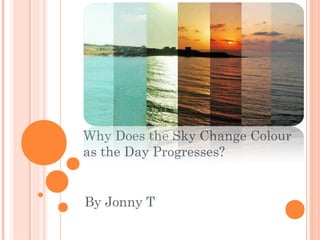
Why Does the Sky Change Colour
as the Day Progresses?
By Jonny T
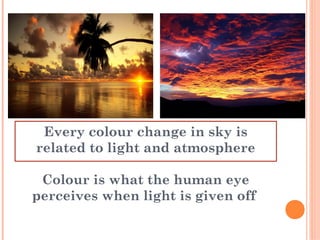
Every colour change in sky is
related to light and atmosphere
Colour is what the human eye
perceives when light is given off
1. Light
1. Light
 Light waves are
electromagnetic energies
(electromagnetic spectrum!)
 They have different waves
and frequencies
 Long wavelength = low
frequency + energy
 Travels at 299,792
km/sec (speed of light)
1. Light (cont’d)
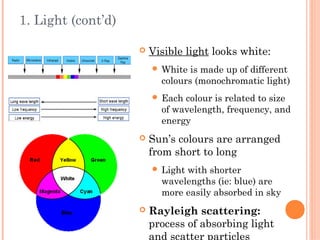
 Visible light looks white:
 White is made up of different
colours (monochromatic light)
 Each colour is related to size
of wavelength, frequency, and
energy
 Sun’s colours are arranged
from short to long
 Light with shorter
wavelengths (ie: blue) are
more easily absorbed in sky
 Rayleigh scattering:
process of absorbing light
and scatter particles
2. Atmosphere
2. Atmosphere
 Molecules present:
 Carbon dioxide
 Ozone
 Hydrogen gas
 Nitrogen gas
 Oxygen gas
 When light is shone, N2 gas and
O2 gas will absorb the most
energy…
Let’s focus on these
2. Atmosphere (cont’d)
 Called fluorescence
 Electrons in N2 gas and O2 gas will be excited
 Electrons become promoted to higher sublevel
 They have a time-frame for which they can stay excited
 Once reached, it may fall down energy sublevels or entire
energy levels
 Photon is released
F L U O R E S C E N
C E
2. Atmosphere – Fluorescence (cont’d)
 Oxygen gas and nitrogen gas bright-line emission
spectra
 This is [half of the reason] why sky is blue!
2. Atmosphere (cont’d)
 Atmosphere is thicker when it’s
closer to the Earth (gravitational
pull)
 This is why horizon is
another colour
 More atmosphere = more
molecules to scatter light
 Thickness determined by
weather patterns and human
factors
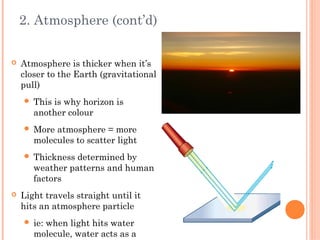
 Light travels straight until it
hits an atmosphere particle
 ie: when light hits water
molecule, water acts as a
We Must First
Understand…
[The other half of] Why sky is
blue.
Blue Sky
 When Sun is high in the sky,
it emits wavelengths at the
shortest angle
 What colour does the shortest
angle allow for…?
Blue Sky (Part 2)
Blue light is the
shortest distance in
atmosphere
Atmospheric gases
absorb blue and violet
colours and cause them
to scatter (more than any
other colour)
Rayleigh scattering
Human eyes do not
Blue never goes away… we just
cannot see it sometimes!
And finally…
Sunrise and Sunset
 When Sun reaches Earth,
there is a longer angle
 What colours does the
longest angle allow for…?
As Sun gets higher in sky, these
colours fade and blue light
becomes more scattered
 Blue sky returns
Sunrise
 Reverse sunrise… but
a bolder display
 Dust/debris is being
kicked around during
the day
 This filters light
 Polluted cities have the
most beautiful sunsets
Sunset
How are the Details
Determined?
Details
Dust
Pollution
Smog
Clouds
Water vapour or humidity
causes the sky to appear
gray because it deflects
light
The
End!

Why the Sky Changes Colour

  • 1.
    Why Does theSky Change Colour as the Day Progresses? By Jonny T
  • 2.
    Every colour changein sky is related to light and atmosphere Colour is what the human eye perceives when light is given off
  • 3.
  • 4.
    1. Light  Lightwaves are electromagnetic energies (electromagnetic spectrum!)  They have different waves and frequencies  Long wavelength = low frequency + energy  Travels at 299,792 km/sec (speed of light)
  • 5.
    1. Light (cont’d) Visible light looks white:  White is made up of different colours (monochromatic light)  Each colour is related to size of wavelength, frequency, and energy  Sun’s colours are arranged from short to long  Light with shorter wavelengths (ie: blue) are more easily absorbed in sky  Rayleigh scattering: process of absorbing light and scatter particles
  • 6.
  • 7.
    2. Atmosphere  Moleculespresent:  Carbon dioxide  Ozone  Hydrogen gas  Nitrogen gas  Oxygen gas  When light is shone, N2 gas and O2 gas will absorb the most energy… Let’s focus on these
  • 8.
    2. Atmosphere (cont’d) Called fluorescence  Electrons in N2 gas and O2 gas will be excited  Electrons become promoted to higher sublevel  They have a time-frame for which they can stay excited  Once reached, it may fall down energy sublevels or entire energy levels  Photon is released F L U O R E S C E N C E
  • 9.
    2. Atmosphere –Fluorescence (cont’d)  Oxygen gas and nitrogen gas bright-line emission spectra  This is [half of the reason] why sky is blue!
  • 10.
    2. Atmosphere (cont’d) Atmosphere is thicker when it’s closer to the Earth (gravitational pull)  This is why horizon is another colour  More atmosphere = more molecules to scatter light  Thickness determined by weather patterns and human factors  Light travels straight until it hits an atmosphere particle  ie: when light hits water molecule, water acts as a
  • 11.
    We Must First Understand… [Theother half of] Why sky is blue.
  • 12.
    Blue Sky  WhenSun is high in the sky, it emits wavelengths at the shortest angle  What colour does the shortest angle allow for…?
  • 13.
    Blue Sky (Part2) Blue light is the shortest distance in atmosphere Atmospheric gases absorb blue and violet colours and cause them to scatter (more than any other colour) Rayleigh scattering Human eyes do not
  • 14.
    Blue never goesaway… we just cannot see it sometimes!
  • 15.
  • 16.
     When Sunreaches Earth, there is a longer angle  What colours does the longest angle allow for…? As Sun gets higher in sky, these colours fade and blue light becomes more scattered  Blue sky returns Sunrise
  • 17.
     Reverse sunrise…but a bolder display  Dust/debris is being kicked around during the day  This filters light  Polluted cities have the most beautiful sunsets Sunset
  • 18.
    How are theDetails Determined?
  • 19.
    Details Dust Pollution Smog Clouds Water vapour orhumidity causes the sky to appear gray because it deflects light
  • 20.

Editor's Notes

  • #14 <number>