Why learning Arabic is important?
https://www.youtube.com/watch?v=ZrhOmQdBJ74
Arabic is...
One of the six official languages of the UN.
Spoken by some 250 million people.
The principal language in 22 countries in
Africa and the Middle East...
https://www.youtube.com/watch?v=R14aXK
H81PI
https://www.youtube.com/watch?v=R14aXK
H81PI Alex
…the Language of the
League of Arab States
https://www.youtube.com/watch?v=LL-Bn8aNIVU
Arabic is ranked #4 among the most
widely spoken languages in the world.
• Chinese Mandarin 885 million
• Spanish 332
• English 322
• Arabic 235
https://www.youtube.com/watch?v=6vf_Y_o1p3I
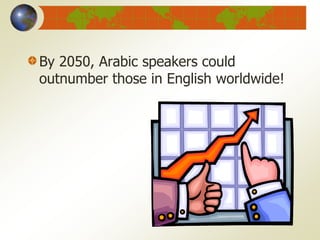
By 2050, Arabic speakers could
outnumber those in English worldwide!
…the Language of Islam
Arabic is the language of Scripture
and prayer for 1.2 billion Muslims
worldwide.
That includes approximately six
million Muslims in the US!
…a Language for Christians
Arabic is also the language of Scripture and prayer
for some 30 million Christians in Africa and the
Middle East.
…for Arab-Americans
Arabic is the mother tongue of some
three million people of Arab origin living
in the US.
…the fastest-growing spoken language of
study at U.S. colleges and universities.
A survey of the Modern Language
Association indicated that the number
of students studying Arabic at U.S.
colleges climbed 92.3% - to 10,584 –
between 1998 and 2002. The number
of undergraduate campuses teaching
Arabic jumped 48%, to 233.
Arabic Literature
There is a vast
body of Arabic
literature, both
secular and
sacred.
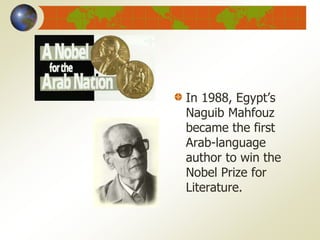
In 1988, Egypt’s
Naguib Mahfouz
became the first
Arab-language
author to win the
Nobel Prize for
Literature.
Business Interests & International Trade
According to the International Trade
Commission, in 2007 US exports to the
Middle East & North Africa World reached
$55.6 billion!
And US imports reached $102 billion!
International Affairs
Diplomatic
relations with
the Arab world
are an
important
aspect of US
foreign policy.
From Arabic to Spanish
Arabic words have made their way into
many European languages.
Some 4,000 words in Spanish, mostly
nouns, were borrowed from Arabic
• Aceite, Alfombra, Algodon, Arroz, etc.
From Arabic to Spanish to English
From Spanish, many Arabic words passed
into other languages, including English:
• admiral, alcohol, algebra, algorithm, almanac
• candy, chemistry, coffee, cotton, crimson
• magazine, mascara, mattress, mocha
• safari, sequin, sherbet, sofa, syrup
• zenith and zero
Arabic Script ‫خ‬ ‫ح‬ ‫ج‬ ‫ث‬ ‫ت‬ ‫ب‬ ‫أ‬
A number of other languages use or have
used a version of the Arabic script.
These include:
• Persian or Farsi (Iran)
• Pashto (Afghanistan, Iran, India)
• Urdu (India & Pakistan)
• Formerly Turkish
The Classification &
History of Arabic
The Classification of Arabic
Arabic is a Semitic language
It is related to languages such as:
Akkadian (ancient Mesopotamian language)
Hebrew & Aramaic
Ethiopic
Semitic Languages
Map of
Semitic
Languages
The History of Arabic ‫العربية‬ ‫تاريخ‬
Evidence for written Arabic before the
advent of Islam is quite limited.
The first inscription in a language
recognized as Arabic dates from 328 CE.
Arabic script is probably derived from a
cursive form of Nabataean, which is itself
derived from Aramaic.
The Origins of
Arabic Script
Some Basic Features of Arabic
An alphabet of 28 letters
Written from right to left
Three long & three short vowels (a, i, u)
Short vowels are not normally written
except in:
The Qur’an, Bible, children’s books,
dictionaries, etc.
Root and pattern system ‫درس‬
Most verbs and nouns are derived from
a 3-letter root
For example from the root D R S come:
• Darasa to study
• Darrasa to teach
• Dars lesson, class
• Madrasa school
• Mudarris teacher
Varieties of Arabic
Classical, Modern Standard & Colloquial
Diglossia
Modern Arabic is characterized by what is
called diglossia.
This means that modern Arabic virtually
comprises two languages:
Modern Standard Arabic and Colloquial Arabic.
Modern Standard Arabic (MSA)
Modern Standard Arabic (“fus-Ha”) is derived
from Classical Arabic and was developed in
the late 19th-early 20th centuries:
To guard the integrity of the Arabic language and
preserve it from foreign influences
To adapt the Arabic language to the needs of
modern times, especially to express modern
political ideas and technological terms
To unite the Arab world under a common
language
Modern Standard
Arabic ‫الفصحى‬
MSA is used for:
Print & electronic media
Formal speeches
TV and radio news
Colloquial Arabic (CA) ‫العامية‬
CA is the first language of Arabic-speakers.
It’s the everyday dialect.
CA is the ONLY language for many people.
Colloquial Arabic “is the mother
tongue of the Arab & remains
throughout his life the primary
medium of interpersonal
relationships.”
-Mary Catherine Bateson,
Arabic Language Handbook (2003)
Colloquial Arabic
There are over 30 varieties of CA in 5 groups:
North African (Morocco-Libya)
Egyptian (Egypt & the Sudan)
Levantine (Palestine, Leb., Syr. & Jordan)
Arabian (Saudi Arabia & the Gulf States)
Iraqi
They vary tremendously in grammar,
vocabulary & pronunciation, even within
a single country!
“How are you?”
In Syria, someone may ask: shlonak?
In Egypt, you will hear: izzayak?
In Morocco: kee deir?
Differences may be so great, speakers
from two different Arab countries may
have to resort to MSA or another
language (usually English or French) in
order to communicate.
“There can be no doubt that those who
want to have a real command of the
Arabic language in all situations need to
master both varieties.”
– Woidich, Kulla Tamam! (2004)
To introduce students to MSA for:
Reading
• signs, books, newspapers, etc.
Writing
• correspondence, completing forms, etc.
Speaking & Listening
• Formal addresses, news broadcasts, etc.
Introduce students to Colloquial Arabic
for:
everyday communication & conversation
But which colloquial?
Primarily Egyptian Colloquial
Why?
It’s the most widely understood Colloquial
Arabic due to Egyptian TV and movies
broadcast throughout the Arab world.
It’s time to begin your journey to the
Arabic-speaking world!
Or as we say in Arabic...
Ahlan wa sahlan
“WELCOME!”
Stereotypes
“of all the ethnic groups portrayed in Hollywood films, Arab culture
has been the most misunderstood and supplied with the worst
stereotypes":
Scott J. Simon
1-The three B syndrome
Billionaires, bombers, and belly dancers
Perpetuating movies
Iron Eagle( 1986)
Death before dishonor( 1987)
Patriot Games (1982)
Excutive Decision( 1996)
Black Hawk Down (2001)
Real Picture
Very few Arabs are rich
Arabs are peace talkers
Belly dancers are only found in one street in Cairo
Stereotype -2
Arabs are illiterates
Real Picture
51 university in Egypt, 150,000 students.
5 Nobel prizes awarded to Egyptian universities graduates.
there are more than 35,000 researchers of which 31.7% are PhD
holders.
http://en.wikipedia.org/wiki/List_of_Egyptian_universities
http://www.bibalex.org/cssp/researchs/index.htm
Stereotype -3
Arabs live in the middle ages
Real Picture
The world's tallest structure is the
Real Picture
Dubai sports city
Real Picture
Real Picture
Saudi arabia
Real Picture
Saudi arabia
Real Picture
Tunisia
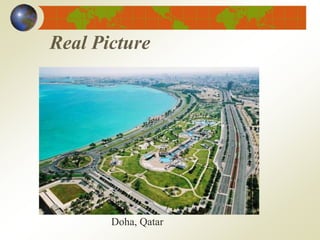
Real Picture
Doha, Qatar
Real Picture
Qatar
Real Picture
Alexandria,Egypt
Real Picture
Alexandria,Egypt
Real Picture
Cairo, Egypt
Questions
? ? ?

why learning Arabic is important.ppt

  • 1.
    Why learning Arabicis important? https://www.youtube.com/watch?v=ZrhOmQdBJ74
  • 2.
    Arabic is... One ofthe six official languages of the UN. Spoken by some 250 million people. The principal language in 22 countries in Africa and the Middle East... https://www.youtube.com/watch?v=R14aXK H81PI https://www.youtube.com/watch?v=R14aXK H81PI Alex
  • 3.
    …the Language ofthe League of Arab States https://www.youtube.com/watch?v=LL-Bn8aNIVU
  • 4.
    Arabic is ranked#4 among the most widely spoken languages in the world. • Chinese Mandarin 885 million • Spanish 332 • English 322 • Arabic 235 https://www.youtube.com/watch?v=6vf_Y_o1p3I
  • 5.
    By 2050, Arabicspeakers could outnumber those in English worldwide!
  • 6.
    …the Language ofIslam Arabic is the language of Scripture and prayer for 1.2 billion Muslims worldwide. That includes approximately six million Muslims in the US!
  • 7.
    …a Language forChristians Arabic is also the language of Scripture and prayer for some 30 million Christians in Africa and the Middle East.
  • 8.
    …for Arab-Americans Arabic isthe mother tongue of some three million people of Arab origin living in the US.
  • 9.
    …the fastest-growing spokenlanguage of study at U.S. colleges and universities.
  • 10.
    A survey ofthe Modern Language Association indicated that the number of students studying Arabic at U.S. colleges climbed 92.3% - to 10,584 – between 1998 and 2002. The number of undergraduate campuses teaching Arabic jumped 48%, to 233.
  • 11.
    Arabic Literature There isa vast body of Arabic literature, both secular and sacred.
  • 12.
    In 1988, Egypt’s NaguibMahfouz became the first Arab-language author to win the Nobel Prize for Literature.
  • 13.
    Business Interests &International Trade According to the International Trade Commission, in 2007 US exports to the Middle East & North Africa World reached $55.6 billion! And US imports reached $102 billion!
  • 14.
    International Affairs Diplomatic relations with theArab world are an important aspect of US foreign policy.
  • 15.
    From Arabic toSpanish Arabic words have made their way into many European languages. Some 4,000 words in Spanish, mostly nouns, were borrowed from Arabic • Aceite, Alfombra, Algodon, Arroz, etc.
  • 16.
    From Arabic toSpanish to English From Spanish, many Arabic words passed into other languages, including English: • admiral, alcohol, algebra, algorithm, almanac • candy, chemistry, coffee, cotton, crimson • magazine, mascara, mattress, mocha • safari, sequin, sherbet, sofa, syrup • zenith and zero
  • 17.
    Arabic Script ‫خ‬‫ح‬ ‫ج‬ ‫ث‬ ‫ت‬ ‫ب‬ ‫أ‬ A number of other languages use or have used a version of the Arabic script. These include: • Persian or Farsi (Iran) • Pashto (Afghanistan, Iran, India) • Urdu (India & Pakistan) • Formerly Turkish
  • 18.
  • 19.
    The Classification ofArabic Arabic is a Semitic language It is related to languages such as: Akkadian (ancient Mesopotamian language) Hebrew & Aramaic Ethiopic
  • 20.
  • 21.
  • 22.
    The History ofArabic ‫العربية‬ ‫تاريخ‬ Evidence for written Arabic before the advent of Islam is quite limited. The first inscription in a language recognized as Arabic dates from 328 CE. Arabic script is probably derived from a cursive form of Nabataean, which is itself derived from Aramaic.
  • 23.
  • 24.
    Some Basic Featuresof Arabic An alphabet of 28 letters Written from right to left Three long & three short vowels (a, i, u) Short vowels are not normally written except in: The Qur’an, Bible, children’s books, dictionaries, etc.
  • 25.
    Root and patternsystem ‫درس‬ Most verbs and nouns are derived from a 3-letter root For example from the root D R S come: • Darasa to study • Darrasa to teach • Dars lesson, class • Madrasa school • Mudarris teacher
  • 26.
    Varieties of Arabic Classical,Modern Standard & Colloquial
  • 27.
    Diglossia Modern Arabic ischaracterized by what is called diglossia. This means that modern Arabic virtually comprises two languages: Modern Standard Arabic and Colloquial Arabic.
  • 28.
    Modern Standard Arabic(MSA) Modern Standard Arabic (“fus-Ha”) is derived from Classical Arabic and was developed in the late 19th-early 20th centuries: To guard the integrity of the Arabic language and preserve it from foreign influences To adapt the Arabic language to the needs of modern times, especially to express modern political ideas and technological terms To unite the Arab world under a common language
  • 29.
    Modern Standard Arabic ‫الفصحى‬ MSAis used for: Print & electronic media Formal speeches TV and radio news
  • 30.
    Colloquial Arabic (CA)‫العامية‬ CA is the first language of Arabic-speakers. It’s the everyday dialect. CA is the ONLY language for many people.
  • 31.
    Colloquial Arabic “isthe mother tongue of the Arab & remains throughout his life the primary medium of interpersonal relationships.” -Mary Catherine Bateson, Arabic Language Handbook (2003)
  • 32.
    Colloquial Arabic There areover 30 varieties of CA in 5 groups: North African (Morocco-Libya) Egyptian (Egypt & the Sudan) Levantine (Palestine, Leb., Syr. & Jordan) Arabian (Saudi Arabia & the Gulf States) Iraqi
  • 33.
    They vary tremendouslyin grammar, vocabulary & pronunciation, even within a single country!
  • 34.
    “How are you?” InSyria, someone may ask: shlonak? In Egypt, you will hear: izzayak? In Morocco: kee deir?
  • 35.
    Differences may beso great, speakers from two different Arab countries may have to resort to MSA or another language (usually English or French) in order to communicate.
  • 36.
    “There can beno doubt that those who want to have a real command of the Arabic language in all situations need to master both varieties.” – Woidich, Kulla Tamam! (2004)
  • 37.
    To introduce studentsto MSA for: Reading • signs, books, newspapers, etc. Writing • correspondence, completing forms, etc. Speaking & Listening • Formal addresses, news broadcasts, etc.
  • 38.
    Introduce students toColloquial Arabic for: everyday communication & conversation
  • 39.
    But which colloquial? PrimarilyEgyptian Colloquial Why? It’s the most widely understood Colloquial Arabic due to Egyptian TV and movies broadcast throughout the Arab world.
  • 40.
    It’s time tobegin your journey to the Arabic-speaking world!
  • 41.
    Or as wesay in Arabic... Ahlan wa sahlan “WELCOME!”
  • 42.
    Stereotypes “of all theethnic groups portrayed in Hollywood films, Arab culture has been the most misunderstood and supplied with the worst stereotypes": Scott J. Simon
  • 43.
    1-The three Bsyndrome Billionaires, bombers, and belly dancers Perpetuating movies Iron Eagle( 1986) Death before dishonor( 1987) Patriot Games (1982) Excutive Decision( 1996) Black Hawk Down (2001)
  • 44.
    Real Picture Very fewArabs are rich Arabs are peace talkers Belly dancers are only found in one street in Cairo
  • 45.
  • 46.
    Real Picture 51 universityin Egypt, 150,000 students. 5 Nobel prizes awarded to Egyptian universities graduates. there are more than 35,000 researchers of which 31.7% are PhD holders. http://en.wikipedia.org/wiki/List_of_Egyptian_universities http://www.bibalex.org/cssp/researchs/index.htm
  • 47.
    Stereotype -3 Arabs livein the middle ages
  • 48.
    Real Picture The world'stallest structure is the
  • 49.
  • 50.
  • 51.
  • 52.
  • 53.
  • 54.
  • 55.
  • 56.
  • 57.
  • 58.
  • 59.