Why is obesity a political problem? Cheap food? Corporate profits?  Health care costs?
The debate over obesity, it turns out, is a lot like the debate over global warming. In both cases, major companies protect their profits not only by lobbying against policies they don't like, but also by financing advocacy groups devoted to debunking research whose conclusions they don't like.  - Paul Krugman  NY Times, “Girth of a Nation” July 5, 2005
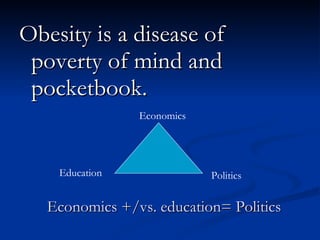
Economics +/vs. education= Politics Obesity is a disease of poverty of mind and pocketbook. Education Economics Politics
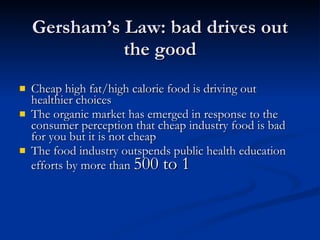
Gersham’s Law: bad drives out the good Cheap high fat/high calorie food is driving out healthier choices  The organic market has emerged in response to the consumer perception that cheap industry food is bad for you but it is not cheap The food industry outspends public health education efforts by more than  500 to 1
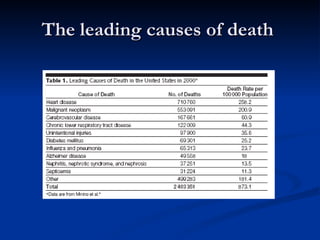
The leading causes of death
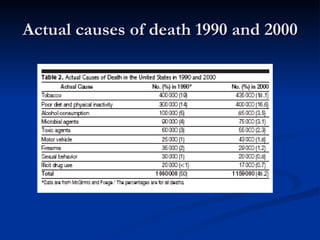
Actual causes of death 1990 and 2000
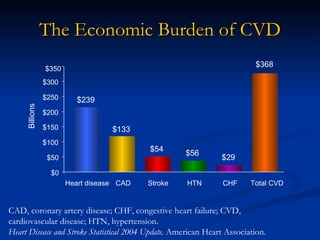
The Economic Burden of CVD Heart disease CAD Stroke HTN CHF Total CVD $0 $50 $100 $150 $200 $250 $300 $350 Billions $368 $239 $133 $54 $56 $29 CAD, coronary artery disease; CHF, congestive heart failure; CVD, cardiovascular disease; HTN, hypertension.  Heart Disease and Stroke Statistical 2004 Update.  American Heart Association. CAD, coronary artery disease; CHF, congestive heart failure; CVD, cardiovascular disease; HTN, hypertension.  Heart Disease and Stroke Statistical 2004 Update.  American Heart Association.
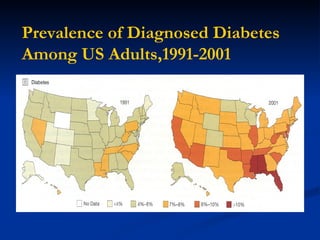
Prevalence of Diagnosed Diabetes Among US Adults,1991-2001
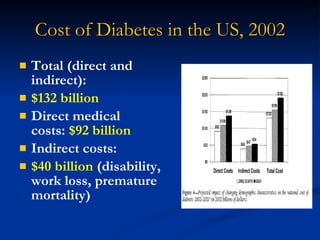
Cost of Diabetes in the US, 2002 Total (direct and indirect):  $132 billion Direct medical costs:  $92 billion Indirect costs:  $40 billion  (disability, work loss, premature mortality)
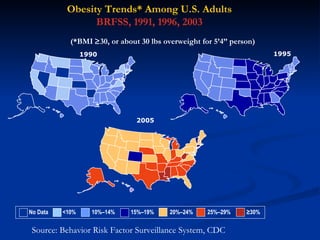
(*BMI   30, or about 30 lbs overweight for 5’4” person) 1995 200 1990 No Data  <10%  10%–14%   15%–19%  20%–24%  25%–29%  ≥30%   Obesity Trends* Among U.S. Adults BRFSS,   1991, 1996, 2003 2005 Source: Behavior Risk Factor Surveillance System, CDC
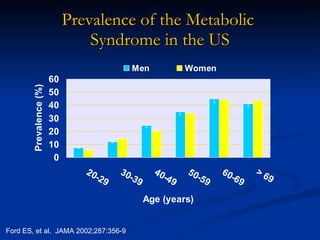
Prevalence of the Metabolic  Syndrome in the US Ford ES, et al.  JAMA 2002;287:356-9
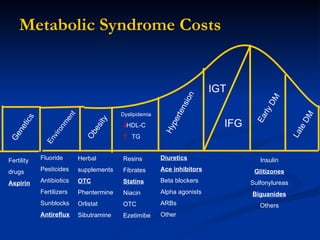
Metabolic Syndrome Costs Genetics Environment Hypertension IGT IFG Early DM Obesity Late DM Fertility drugs Aspirin Herbal supplements OTC Phentermine Orlistat Sibutramine Resins Fibrates Statins Niacin OTC Ezetimibe Diuretics Ace inhibitors Beta blockers Alpha agonists ARBs Other Insulin Glitizones Sulfonylureas Biguanides Others Fluoride Pesticides Antibiotics Fertilizers Sunblocks Antireflux Dyslipidemia HDL-C TG
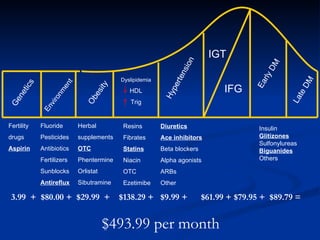
Genetics Environment Hypertension IGT IFG Early DM Obesity Late DM Fertility drugs Aspirin Fluoride Pesticides Antibiotics Fertilizers Sunblocks Antireflux Herbal supplements OTC Phentermine Orlistat Sibutramine Resins Fibrates Statins Niacin OTC Ezetimibe Diuretics Ace inhibitors Beta blockers Alpha agonists ARBs Other 3.99  +  $80.00   +  $29.99  +  $138.29 +  $9.99 +  $61.99 + $79.95 +  $89.79 = Insulin Glitizones Sulfonylureas Biguanides Others $493.99 per month Dyslipidemia HDL Trig
The yearly cost for this sample individual? $5927.88
All diseases are like a costly game of  Russian roulette  “ Genetics loads the gun;  the environment pulls the trigger.”  -George Bray
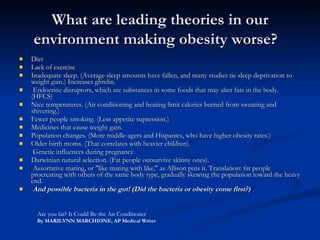
What are leading theories in our environment making obesity worse?   Diet  Lack of exercise  Inadequate sleep. (Average sleep amounts have fallen, and many studies tie sleep deprivation to weight gain.) Increases ghrelin.  Endocrine disruptors, which are substances in some foods that may alter fats in the body. (HFCS) Nice temperatures. (Air conditioning and heating limit calories burned from sweating and shivering.) Fewer people smoking. (Less appetite supression.) Medicines that cause weight gain. Population changes. (More middle-agers and Hispanics, who have higher obesity rates.) Older birth moms. (That correlates with heavier children).    Genetic influences during pregnancy.  Darwinian natural selection. (Fat people outsurvive skinny ones).  Assortative mating, or &quot;like mating with like,&quot; as Allison puts it. Translation: fat people procreating with others of the same body type, gradually skewing the population toward the heavy end.  And possible bacteria in the gut! (Did the bacteria or obesity come first?) Are you fat? It Could Be the Air Conditioner By MARILYNN MARCHIONE, AP Medical Writer
Anything but… Cheap high calorie/high fat  food and a lack of exercise
This is the sacred cow of dietary advice  And I am sad to say I have to kill this poor  cow. homework.uoregon.edu:8080/dchat/images/cow.gif
What if our losing weight battle is a combination of things (like a system)? Add nobody is completely to blame nor blameless Everyone is responsible because everybody bears some sort of burden from the cost of health care due to obesity
What has changed? Our politics has become more polarized  Our economy has become more centralized and profit driven  Our educational and public health systems need to focus on sustainable long-term needs for both individual and social growth
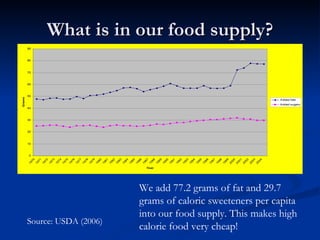
What is in our food supply? We add 77.2 grams of fat and 29.7 grams of caloric sweeteners per capita into our food supply. This makes high calorie food very cheap!  Source: USDA (2006)
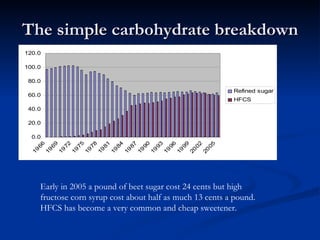
The simple carbohydrate breakdown Early in 2005 a pound of beet sugar cost 24 cents but high  fructose corn syrup cost about half as much 13 cents a pound. HFCS has become a very common and cheap sweetener.
There is a new scientific paradigm emerging… The problem is neither fat nor carbohydrates  The real problem is we are eating too much of the wrong type of  fat and carbohydrates with very little fiber in our diet
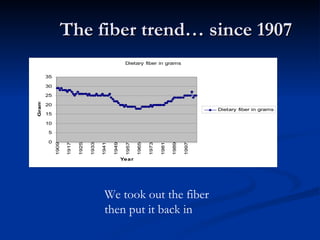
The fiber trend… since 1907 We took out the fiber then put it back in
Refined breads and cereals are designed to taste better. Some people kept eating the bread and cereal without the fiber. The greater the refinement the worse it is for you.
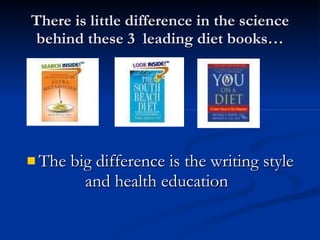
There is little difference in the science behind these 3  leading diet books… The big difference is the writing style and health education                                                             
Dietary advice has not changed much- In thirty years, the USDA has not significantly changed dietary advice .
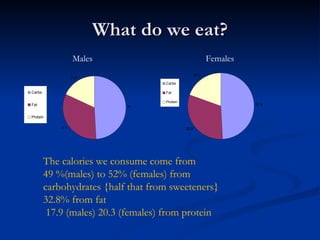
What do we eat? Males Females The calories we consume come from 49 %(males) to 52% (females) from carbohydrates {half that from sweeteners} 32.8% from fat 17.9 (males) 20.3 (females) from protein
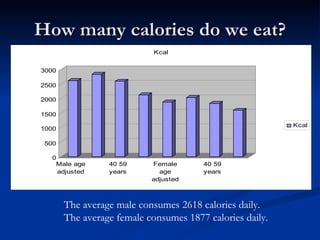
How many calories do we eat? The average male consumes 2618 calories daily. The average female consumes 1877 calories daily.
How many calories make a pound of fat?  About 3600 calories (above your resting metabolic rate) is a pound of fat (for the average person).
Cutting through the fat… There are good fats, bad fats and  very ugly fats in our nation’s food supply : a) the good fats are Omega 3 fatty acids, monounsaturated fats and polyunsaturated fats  c) the bad fats are saturated fats d) the ugly fats are trans-fat acids In the human body our liver turns these fats into  the good (HDL), the bad (LDL and triglycerides)  and the ugly (VLDL).
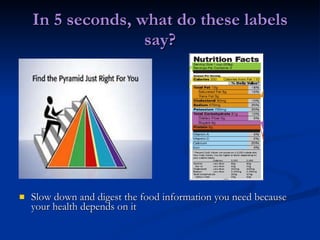
In 5 seconds, what do these labels say? Slow down and digest the food information you need because your health depends on it
The 3 stories about  High Fructose Corn Syrup It is liquid candy. It has no nutrients and will leave you hungry.  - my Nutrition instructor at WIU.
Beverages are less satiating than solid food. When consuming beverages, people don’t compensate by eating less food later simply because liquid calories do not register with appetite control. Cindy Goode, Hy Vee dietitian quoted in the Iowa City Press Citizen in December 2006.
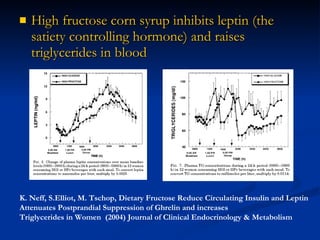
High fructose corn syrup inhibits leptin (the satiety controlling hormone) and raises triglycerides in blood  K. Neff, S.Elliot, M. Tschop, Dietary Fructose Reduce Circulating Insulin and Leptin  Attenuates Postprandial Suppression of Ghrelin and increases  Triglycerides in Women  (2004) Journal of Clinical Endocrinology & Metabolism
All three say pretty the same thing: Empty calories you consume in soda pop will make you fat and more hungry
Why don’t get rid of HFCS?  High fructose corn syrup is the cheapest thing in the food market. The profit margin is HUGE. Every restaurant in country sells it. We might have a recession without it.  Maybe even a famine…
Making moral choices in a system of systemic violence is no easy task but being part of the problem not an answer to systemic violence.

Why Is Obesity A Political Problem

  • 1.
    Why is obesitya political problem? Cheap food? Corporate profits? Health care costs?
  • 2.
    The debate overobesity, it turns out, is a lot like the debate over global warming. In both cases, major companies protect their profits not only by lobbying against policies they don't like, but also by financing advocacy groups devoted to debunking research whose conclusions they don't like. - Paul Krugman NY Times, “Girth of a Nation” July 5, 2005
  • 3.
    Economics +/vs. education=Politics Obesity is a disease of poverty of mind and pocketbook. Education Economics Politics
  • 4.
    Gersham’s Law: baddrives out the good Cheap high fat/high calorie food is driving out healthier choices The organic market has emerged in response to the consumer perception that cheap industry food is bad for you but it is not cheap The food industry outspends public health education efforts by more than 500 to 1
  • 5.
  • 6.
    Actual causes ofdeath 1990 and 2000
  • 7.
    The Economic Burdenof CVD Heart disease CAD Stroke HTN CHF Total CVD $0 $50 $100 $150 $200 $250 $300 $350 Billions $368 $239 $133 $54 $56 $29 CAD, coronary artery disease; CHF, congestive heart failure; CVD, cardiovascular disease; HTN, hypertension. Heart Disease and Stroke Statistical 2004 Update. American Heart Association. CAD, coronary artery disease; CHF, congestive heart failure; CVD, cardiovascular disease; HTN, hypertension. Heart Disease and Stroke Statistical 2004 Update. American Heart Association.
  • 8.
    Prevalence of DiagnosedDiabetes Among US Adults,1991-2001
  • 9.
    Cost of Diabetesin the US, 2002 Total (direct and indirect):  $132 billion Direct medical costs:  $92 billion Indirect costs:  $40 billion (disability, work loss, premature mortality)
  • 10.
    (*BMI 30, or about 30 lbs overweight for 5’4” person) 1995 200 1990 No Data <10% 10%–14% 15%–19% 20%–24% 25%–29% ≥30% Obesity Trends* Among U.S. Adults BRFSS, 1991, 1996, 2003 2005 Source: Behavior Risk Factor Surveillance System, CDC
  • 11.
    Prevalence of theMetabolic Syndrome in the US Ford ES, et al. JAMA 2002;287:356-9
  • 12.
    Metabolic Syndrome CostsGenetics Environment Hypertension IGT IFG Early DM Obesity Late DM Fertility drugs Aspirin Herbal supplements OTC Phentermine Orlistat Sibutramine Resins Fibrates Statins Niacin OTC Ezetimibe Diuretics Ace inhibitors Beta blockers Alpha agonists ARBs Other Insulin Glitizones Sulfonylureas Biguanides Others Fluoride Pesticides Antibiotics Fertilizers Sunblocks Antireflux Dyslipidemia HDL-C TG
  • 13.
    Genetics Environment HypertensionIGT IFG Early DM Obesity Late DM Fertility drugs Aspirin Fluoride Pesticides Antibiotics Fertilizers Sunblocks Antireflux Herbal supplements OTC Phentermine Orlistat Sibutramine Resins Fibrates Statins Niacin OTC Ezetimibe Diuretics Ace inhibitors Beta blockers Alpha agonists ARBs Other 3.99 + $80.00 + $29.99 + $138.29 + $9.99 + $61.99 + $79.95 + $89.79 = Insulin Glitizones Sulfonylureas Biguanides Others $493.99 per month Dyslipidemia HDL Trig
  • 14.
    The yearly costfor this sample individual? $5927.88
  • 15.
    All diseases arelike a costly game of Russian roulette “ Genetics loads the gun; the environment pulls the trigger.” -George Bray
  • 16.
    What are leadingtheories in our environment making obesity worse? Diet Lack of exercise Inadequate sleep. (Average sleep amounts have fallen, and many studies tie sleep deprivation to weight gain.) Increases ghrelin. Endocrine disruptors, which are substances in some foods that may alter fats in the body. (HFCS) Nice temperatures. (Air conditioning and heating limit calories burned from sweating and shivering.) Fewer people smoking. (Less appetite supression.) Medicines that cause weight gain. Population changes. (More middle-agers and Hispanics, who have higher obesity rates.) Older birth moms. (That correlates with heavier children). Genetic influences during pregnancy. Darwinian natural selection. (Fat people outsurvive skinny ones). Assortative mating, or &quot;like mating with like,&quot; as Allison puts it. Translation: fat people procreating with others of the same body type, gradually skewing the population toward the heavy end. And possible bacteria in the gut! (Did the bacteria or obesity come first?) Are you fat? It Could Be the Air Conditioner By MARILYNN MARCHIONE, AP Medical Writer

  • 17.
    Anything but… Cheaphigh calorie/high fat food and a lack of exercise
  • 18.
    This is thesacred cow of dietary advice And I am sad to say I have to kill this poor cow. homework.uoregon.edu:8080/dchat/images/cow.gif
  • 19.
    What if ourlosing weight battle is a combination of things (like a system)? Add nobody is completely to blame nor blameless Everyone is responsible because everybody bears some sort of burden from the cost of health care due to obesity
  • 20.
    What has changed?Our politics has become more polarized Our economy has become more centralized and profit driven Our educational and public health systems need to focus on sustainable long-term needs for both individual and social growth
  • 21.
    What is inour food supply? We add 77.2 grams of fat and 29.7 grams of caloric sweeteners per capita into our food supply. This makes high calorie food very cheap! Source: USDA (2006)
  • 22.
    The simple carbohydratebreakdown Early in 2005 a pound of beet sugar cost 24 cents but high fructose corn syrup cost about half as much 13 cents a pound. HFCS has become a very common and cheap sweetener.
  • 23.
    There is anew scientific paradigm emerging… The problem is neither fat nor carbohydrates The real problem is we are eating too much of the wrong type of fat and carbohydrates with very little fiber in our diet
  • 24.
    The fiber trend…since 1907 We took out the fiber then put it back in
  • 25.
    Refined breads andcereals are designed to taste better. Some people kept eating the bread and cereal without the fiber. The greater the refinement the worse it is for you.
  • 26.
    There is littledifference in the science behind these 3 leading diet books… The big difference is the writing style and health education                                                         
  • 27.
    Dietary advice hasnot changed much- In thirty years, the USDA has not significantly changed dietary advice .
  • 28.
    What do weeat? Males Females The calories we consume come from 49 %(males) to 52% (females) from carbohydrates {half that from sweeteners} 32.8% from fat 17.9 (males) 20.3 (females) from protein
  • 29.
    How many caloriesdo we eat? The average male consumes 2618 calories daily. The average female consumes 1877 calories daily.
  • 30.
    How many caloriesmake a pound of fat? About 3600 calories (above your resting metabolic rate) is a pound of fat (for the average person).
  • 31.
    Cutting through thefat… There are good fats, bad fats and very ugly fats in our nation’s food supply : a) the good fats are Omega 3 fatty acids, monounsaturated fats and polyunsaturated fats c) the bad fats are saturated fats d) the ugly fats are trans-fat acids In the human body our liver turns these fats into the good (HDL), the bad (LDL and triglycerides) and the ugly (VLDL).
  • 32.
    In 5 seconds,what do these labels say? Slow down and digest the food information you need because your health depends on it
  • 33.
    The 3 storiesabout High Fructose Corn Syrup It is liquid candy. It has no nutrients and will leave you hungry. - my Nutrition instructor at WIU.
  • 34.
    Beverages are lesssatiating than solid food. When consuming beverages, people don’t compensate by eating less food later simply because liquid calories do not register with appetite control. Cindy Goode, Hy Vee dietitian quoted in the Iowa City Press Citizen in December 2006.
  • 35.
    High fructose cornsyrup inhibits leptin (the satiety controlling hormone) and raises triglycerides in blood K. Neff, S.Elliot, M. Tschop, Dietary Fructose Reduce Circulating Insulin and Leptin Attenuates Postprandial Suppression of Ghrelin and increases Triglycerides in Women (2004) Journal of Clinical Endocrinology & Metabolism
  • 36.
    All three saypretty the same thing: Empty calories you consume in soda pop will make you fat and more hungry
  • 37.
    Why don’t getrid of HFCS? High fructose corn syrup is the cheapest thing in the food market. The profit margin is HUGE. Every restaurant in country sells it. We might have a recession without it. Maybe even a famine…
  • 38.
    Making moral choicesin a system of systemic violence is no easy task but being part of the problem not an answer to systemic violence.