Stephen Marquard
Tabisa Mayisela
University of Cape Town
Why do students use recorded lectures?
The Opencast Summit:
Open Source Lecture Capture & Video Management for Education
25-27 March 2015
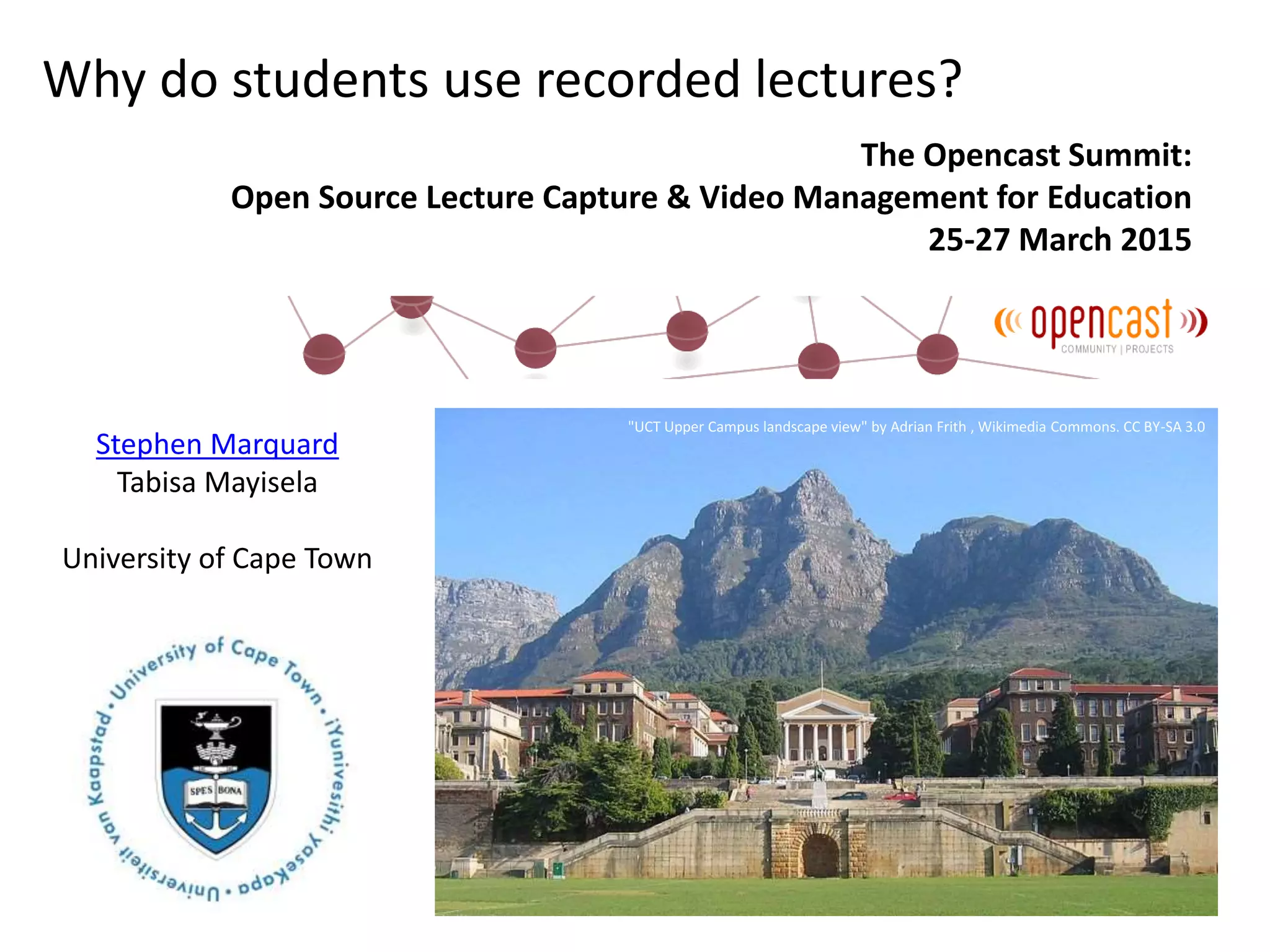
"UCT Upper Campus landscape view" by Adrian Frith , Wikimedia Commons. CC BY-SA 3.0
Opencast at UCT
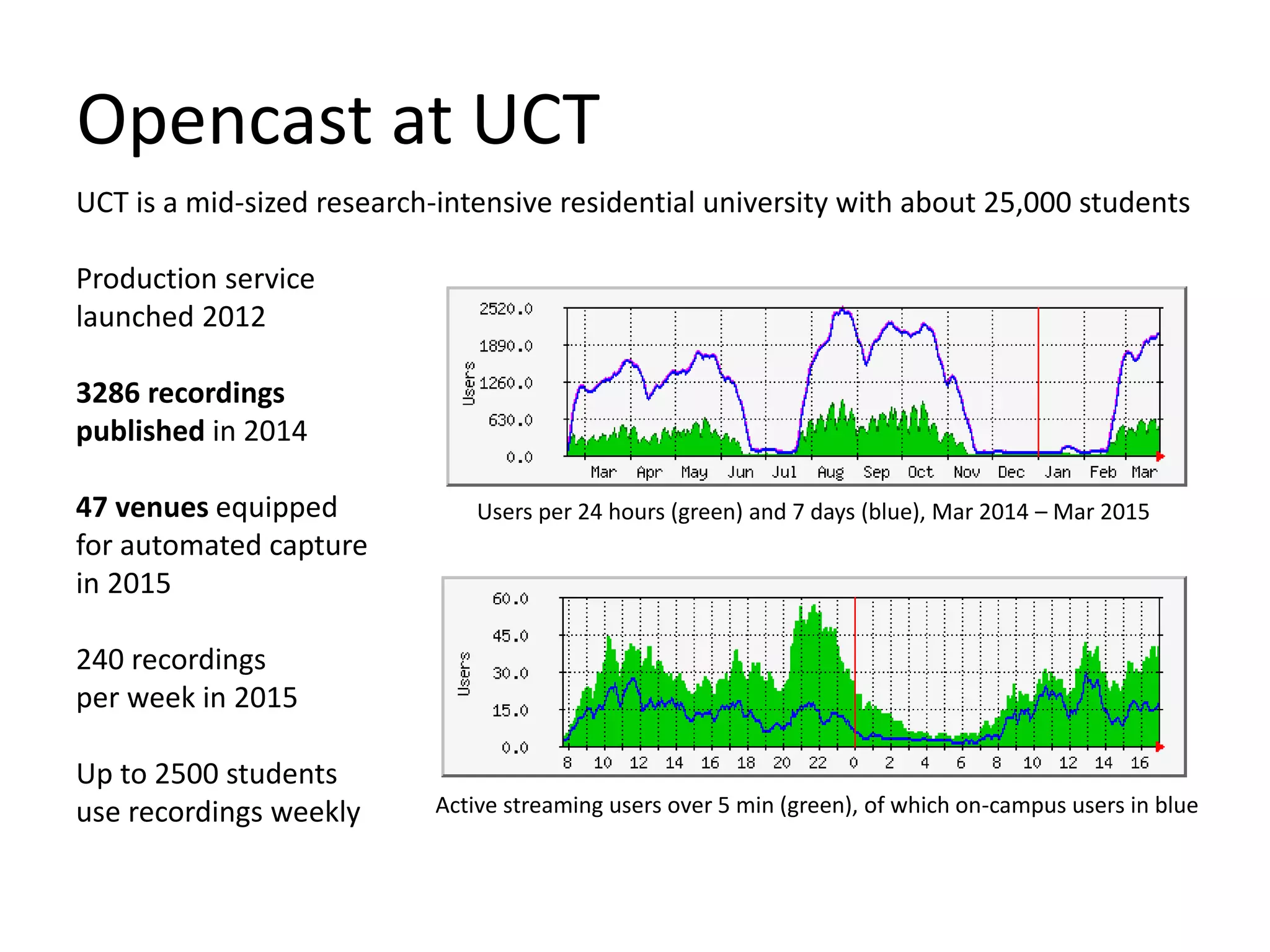
UCT is a mid-sized research-intensive residential university with about 25,000 students
Production service
launched 2012
3286 recordings
published in 2014
47 venues equipped
for automated capture
in 2015
240 recordings
per week in 2015
Up to 2500 students
use recordings weekly
Users per 24 hours (green) and 7 days (blue), Mar 2014 – Mar 2015
Active streaming users over 5 min (green), of which on-campus users in blue
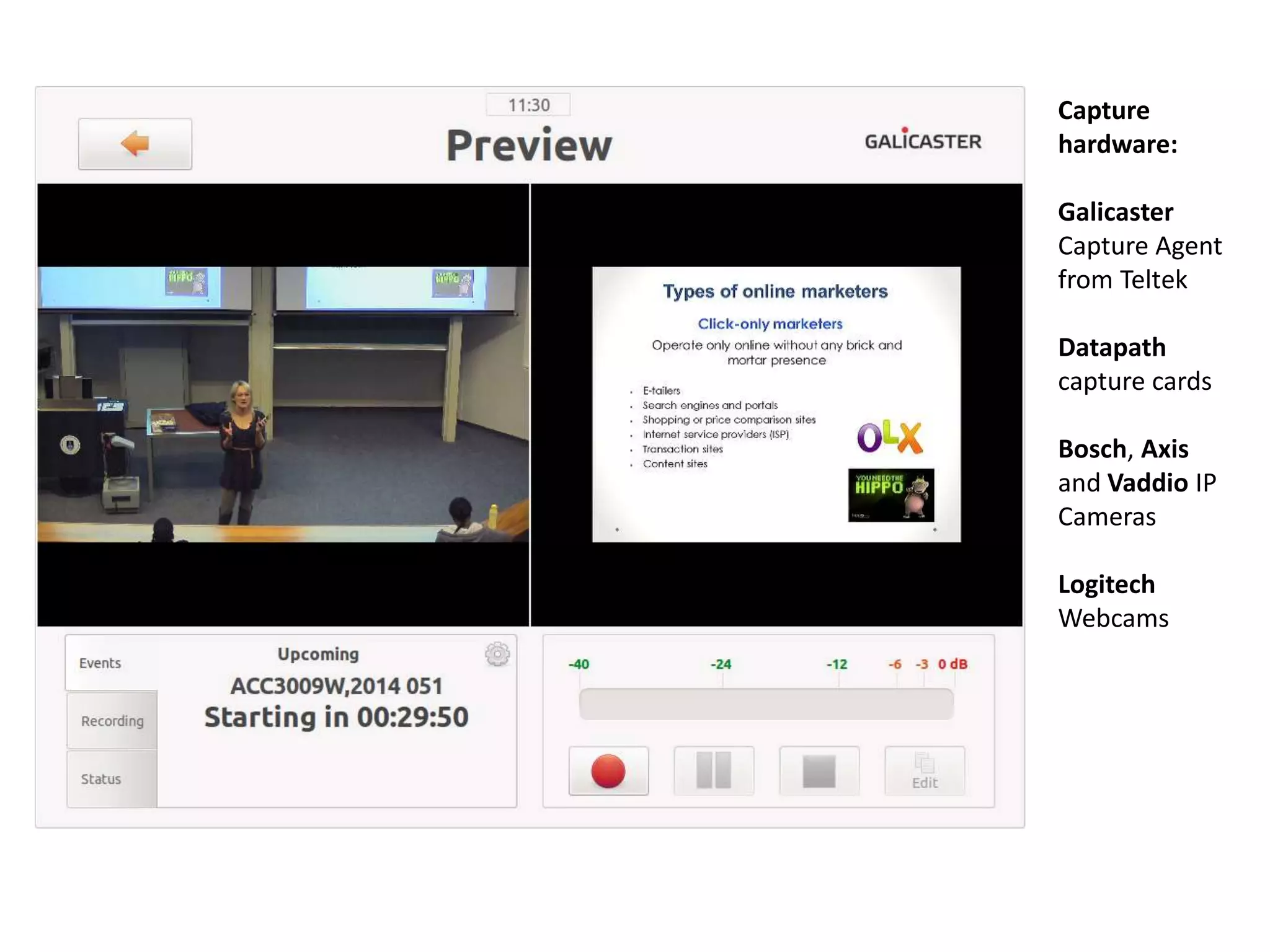
Capture
hardware:
Galicaster
Capture Agent
from Teltek
Datapath
capture cards
Bosch, Axis
and Vaddio IP
Cameras
Logitech
Webcams
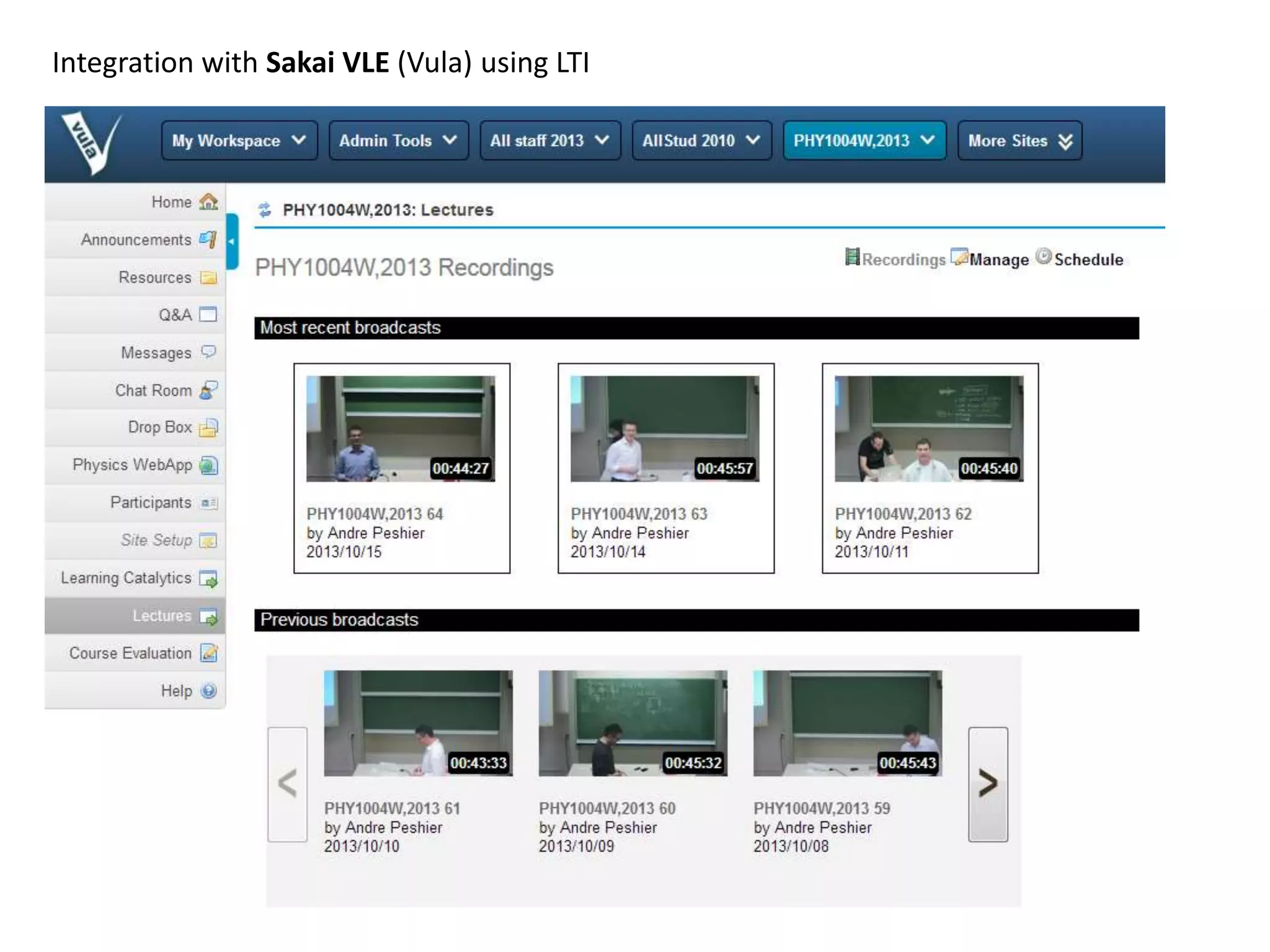
Integration with Sakai VLE (Vula) using LTI
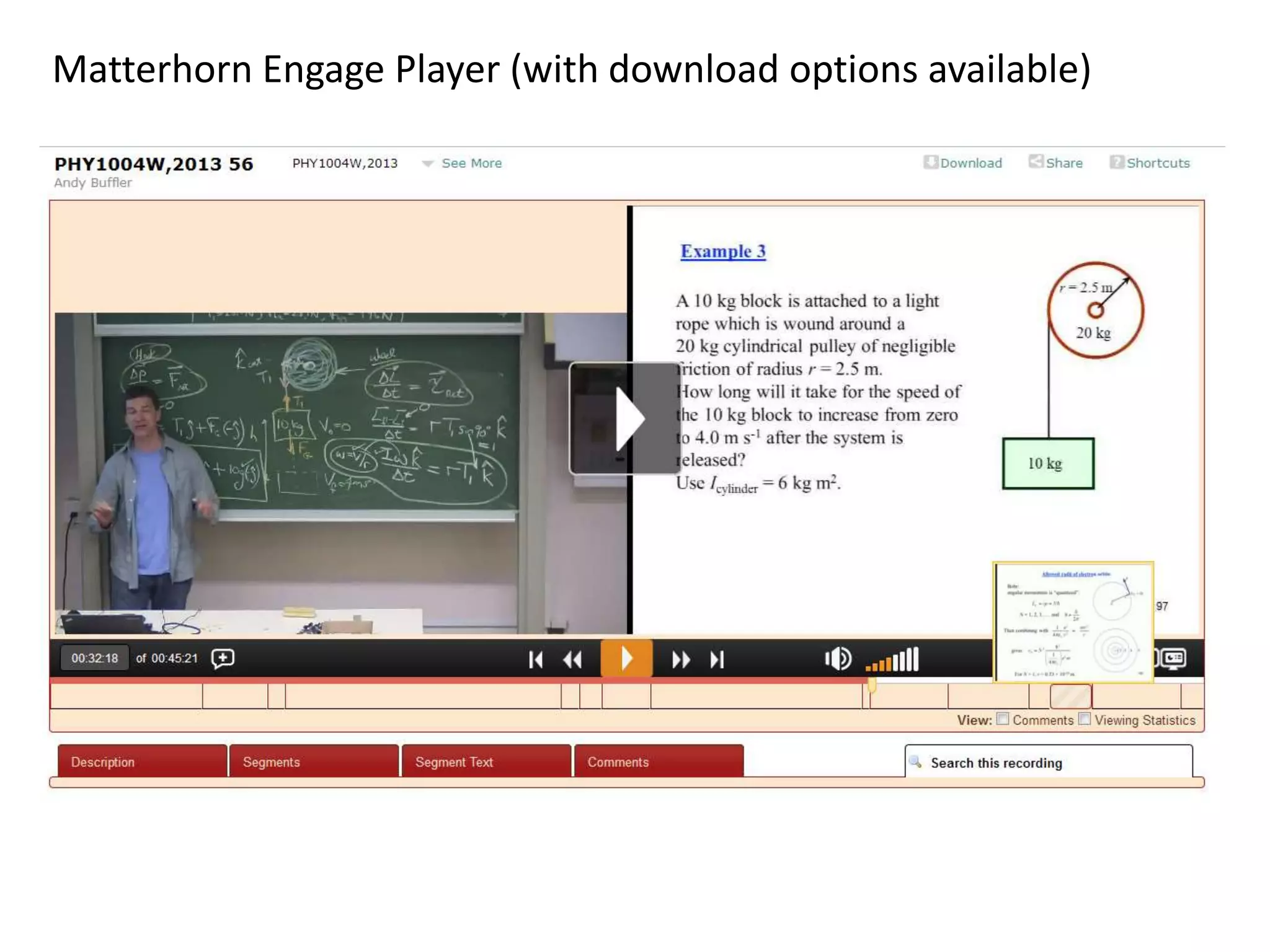
Matterhorn Engage Player (with download options available)
Why investigate?
Lecture recording project initiated in late 2009, prompted by:
a. Increased DIY activity (risk of fragmented solutions)
b. Informed assumptions about value to students (US surveys)
Helpful to understand teaching and learning value in more
depth after several years of implementation:
• Align development, operations and support efforts with
student needs
• Discussions with academics (encouraging opt-in, alleviating
fears, advice on appropriate use and advice to students)
• Understand return on investment (even if unquantifiable)
to make appropriate case for continued investment and
operational costs
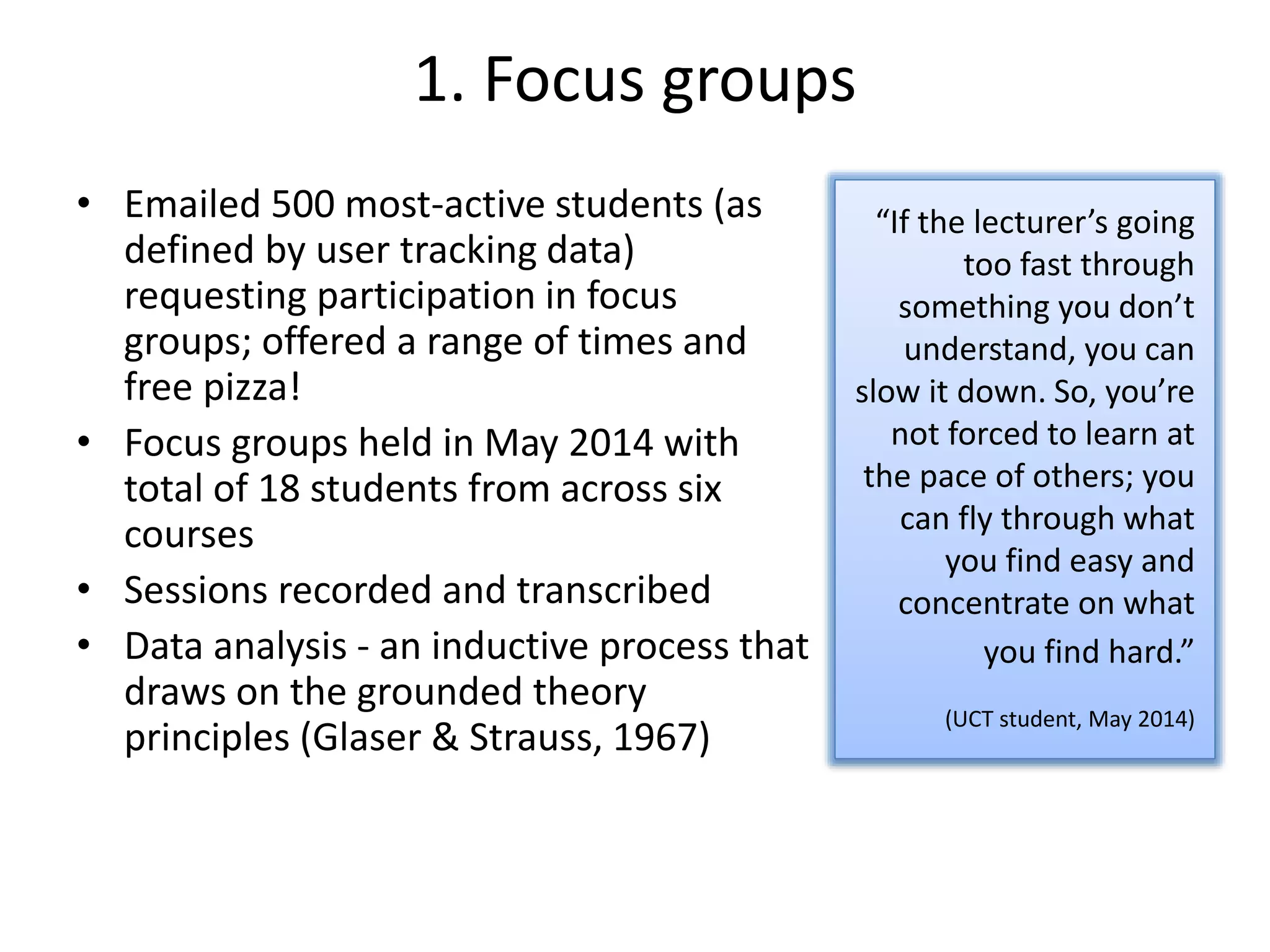
1. Focus groups
• Emailed 500 most-active students (as
defined by user tracking data)
requesting participation in focus
groups; offered a range of times and
free pizza!
• Focus groups held in May 2014 with
total of 18 students from across six
courses
• Sessions recorded and transcribed
• Data analysis - an inductive process that
draws on the grounded theory
principles (Glaser & Strauss, 1967)
“If the lecturer’s going
too fast through
something you don’t
understand, you can
slow it down. So, you’re
not forced to learn at
the pace of others; you
can fly through what
you find easy and
concentrate on what
you find hard.”
(UCT student, May 2014)
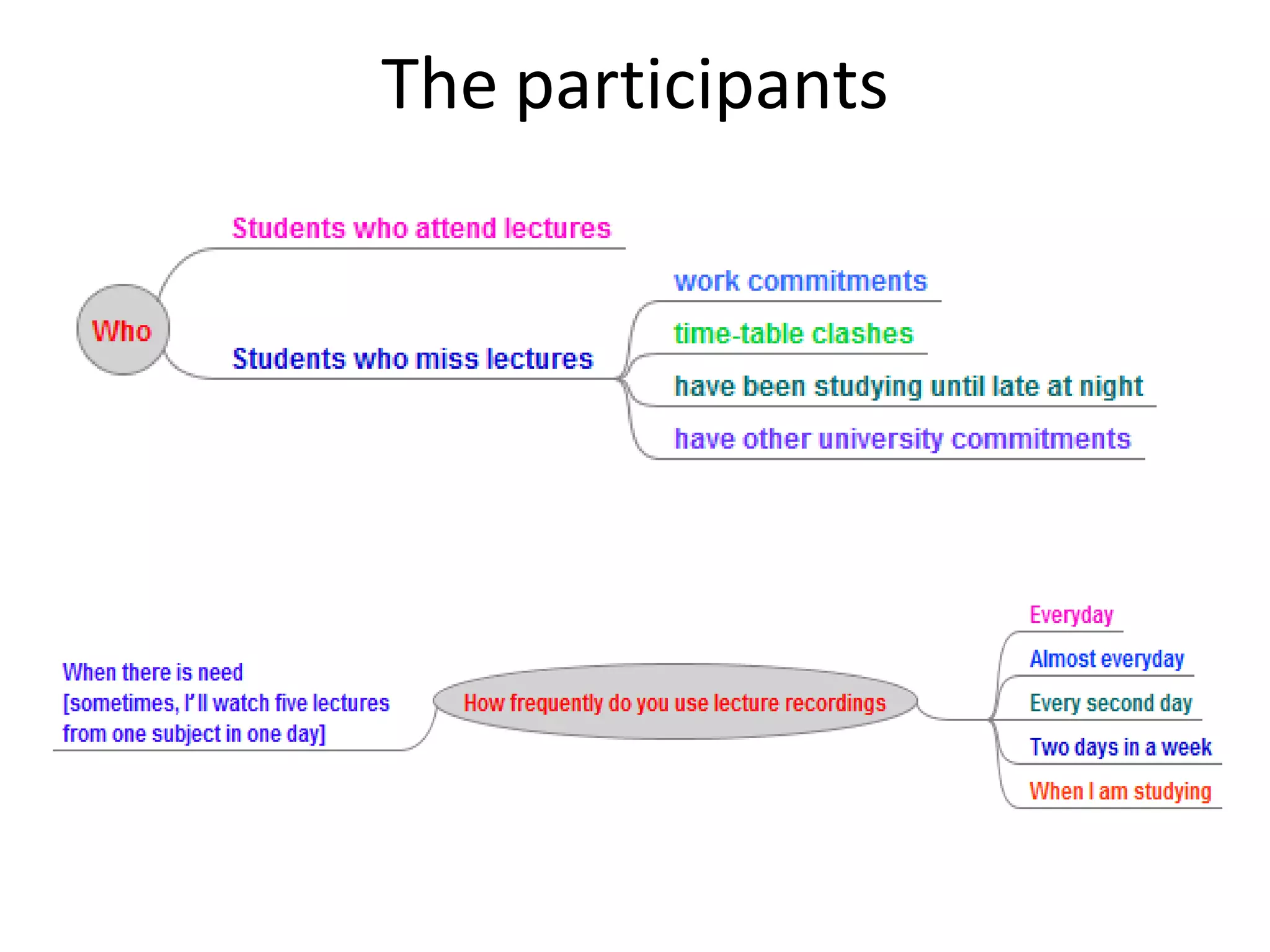
The participants
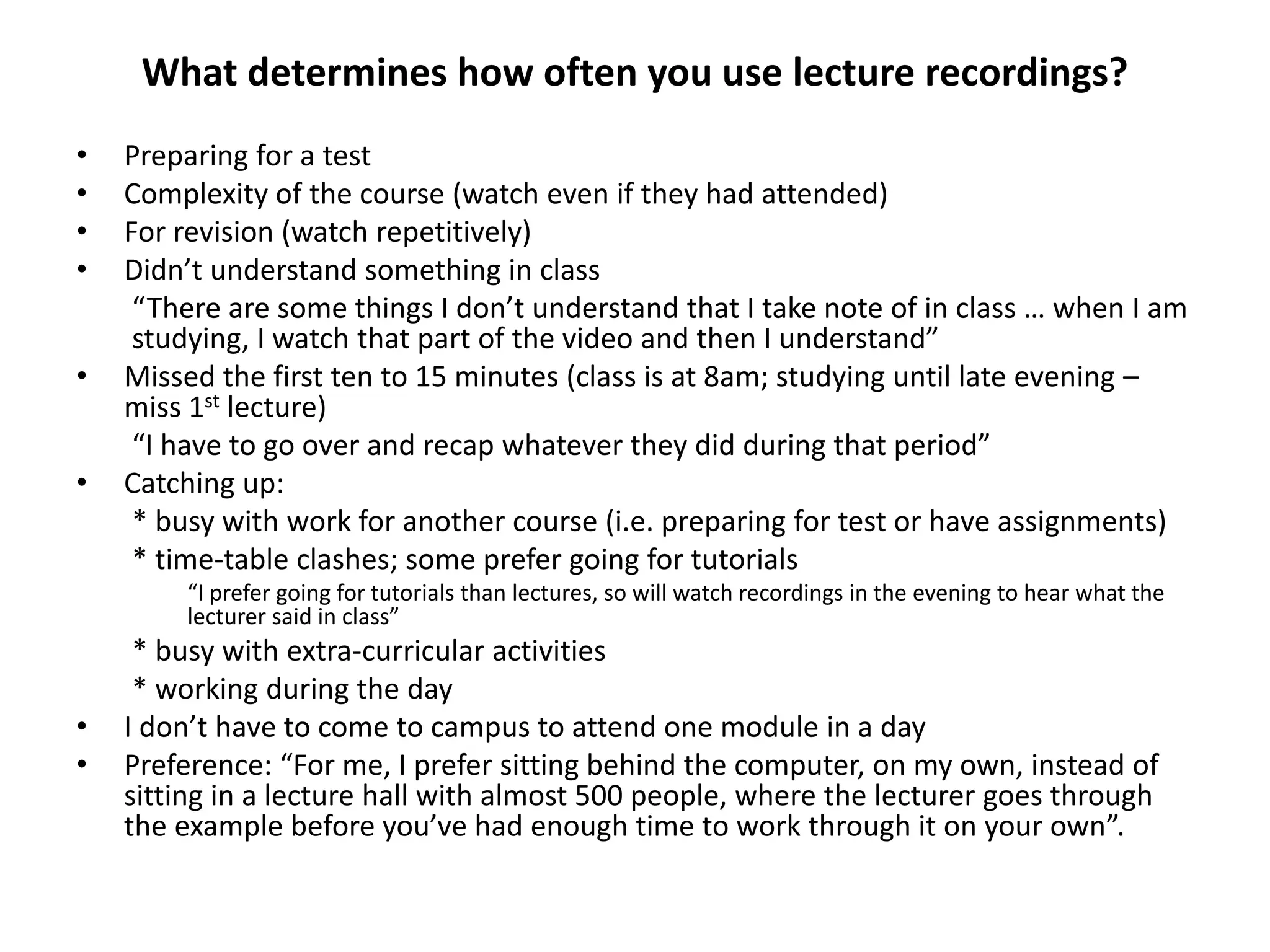
What determines how often you use lecture recordings?
• Preparing for a test
• Complexity of the course (watch even if they had attended)
• For revision (watch repetitively)
• Didn’t understand something in class
“There are some things I don’t understand that I take note of in class … when I am
studying, I watch that part of the video and then I understand”
• Missed the first ten to 15 minutes (class is at 8am; studying until late evening –
miss 1st lecture)
“I have to go over and recap whatever they did during that period”
• Catching up:
* busy with work for another course (i.e. preparing for test or have assignments)
* time-table clashes; some prefer going for tutorials
“I prefer going for tutorials than lectures, so will watch recordings in the evening to hear what the
lecturer said in class”
* busy with extra-curricular activities
* working during the day
• I don’t have to come to campus to attend one module in a day
• Preference: “For me, I prefer sitting behind the computer, on my own, instead of
sitting in a lecture hall with almost 500 people, where the lecturer goes through
the example before you’ve had enough time to work through it on your own”.
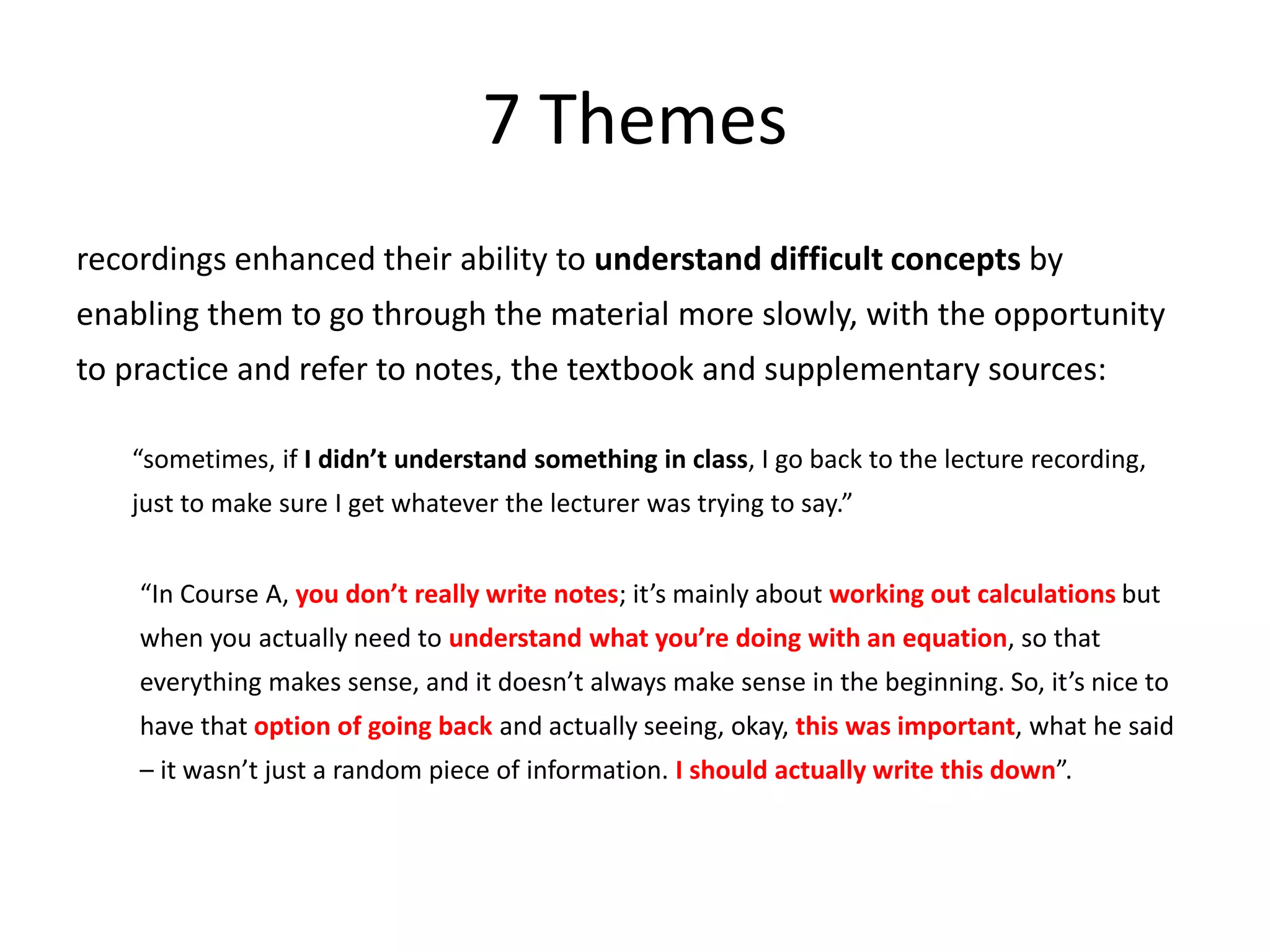
7 Themes
recordings enhanced their ability to understand difficult concepts by
enabling them to go through the material more slowly, with the opportunity
to practice and refer to notes, the textbook and supplementary sources:
“sometimes, if I didn’t understand something in class, I go back to the lecture recording,
just to make sure I get whatever the lecturer was trying to say.”
“In Course A, you don’t really write notes; it’s mainly about working out calculations but
when you actually need to understand what you’re doing with an equation, so that
everything makes sense, and it doesn’t always make sense in the beginning. So, it’s nice to
have that option of going back and actually seeing, okay, this was important, what he said
– it wasn’t just a random piece of information. I should actually write this down”.
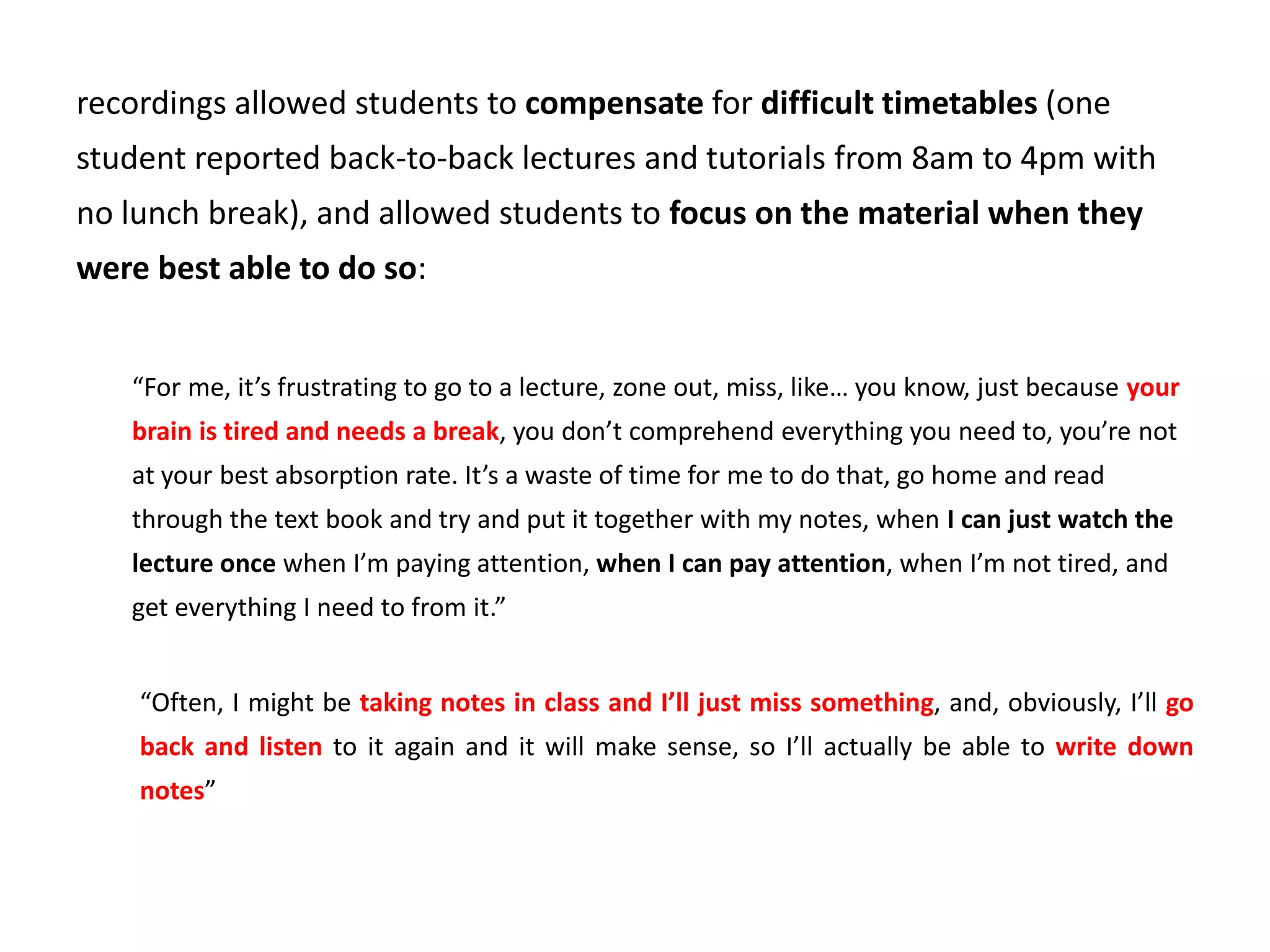
recordings allowed students to compensate for difficult timetables (one
student reported back-to-back lectures and tutorials from 8am to 4pm with
no lunch break), and allowed students to focus on the material when they
were best able to do so:
“For me, it’s frustrating to go to a lecture, zone out, miss, like… you know, just because your
brain is tired and needs a break, you don’t comprehend everything you need to, you’re not
at your best absorption rate. It’s a waste of time for me to do that, go home and read
through the text book and try and put it together with my notes, when I can just watch the
lecture once when I’m paying attention, when I can pay attention, when I’m not tired, and
get everything I need to from it.”
“Often, I might be taking notes in class and I’ll just miss something, and, obviously, I’ll go
back and listen to it again and it will make sense, so I’ll actually be able to write down
notes”
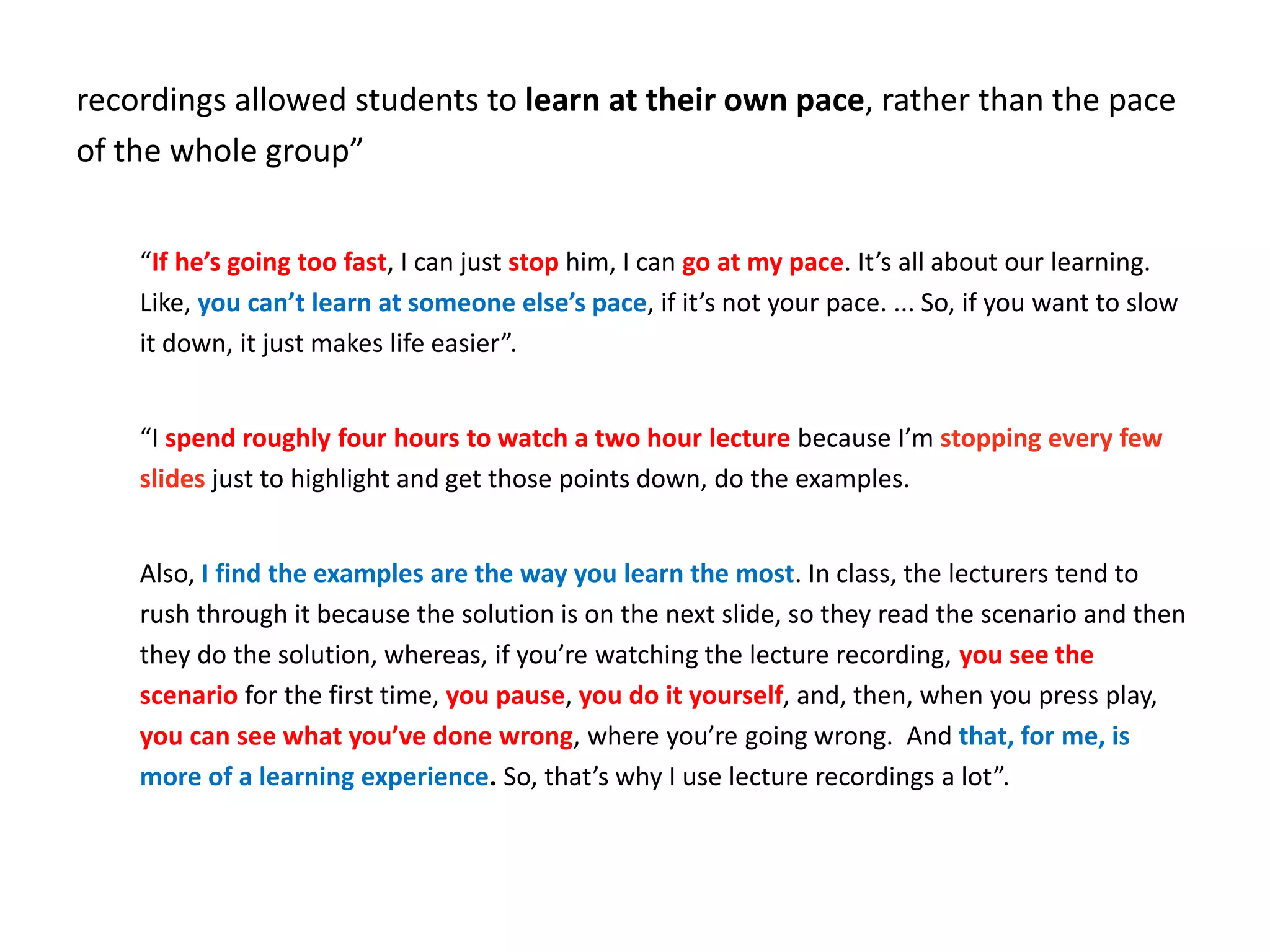
recordings allowed students to learn at their own pace, rather than the pace
of the whole group”
“If he’s going too fast, I can just stop him, I can go at my pace. It’s all about our learning.
Like, you can’t learn at someone else’s pace, if it’s not your pace. ... So, if you want to slow
it down, it just makes life easier”.
“I spend roughly four hours to watch a two hour lecture because I’m stopping every few
slides just to highlight and get those points down, do the examples.
Also, I find the examples are the way you learn the most. In class, the lecturers tend to
rush through it because the solution is on the next slide, so they read the scenario and then
they do the solution, whereas, if you’re watching the lecture recording, you see the
scenario for the first time, you pause, you do it yourself, and, then, when you press play,
you can see what you’ve done wrong, where you’re going wrong. And that, for me, is
more of a learning experience. So, that’s why I use lecture recordings a lot”.
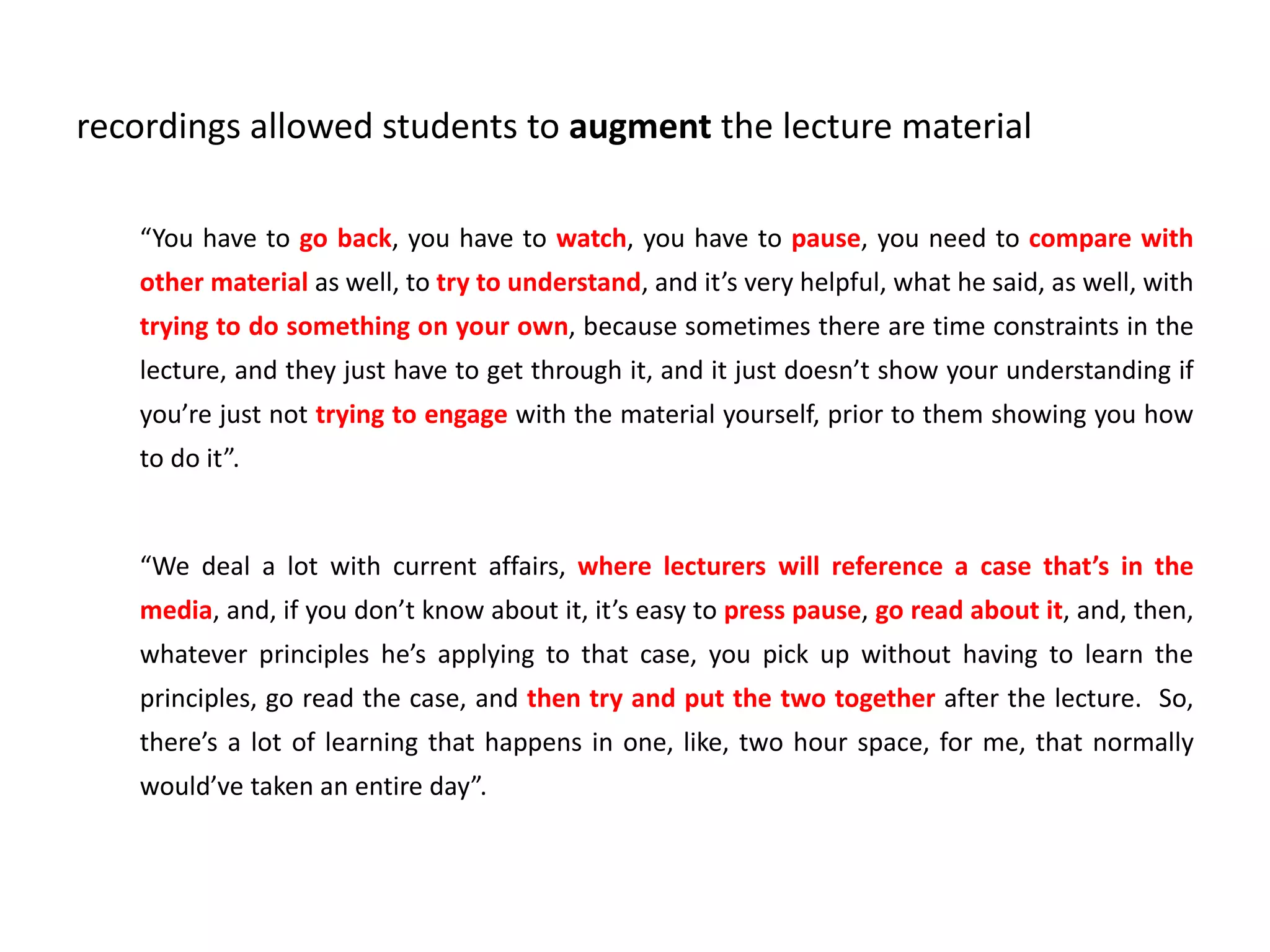
recordings made lectures easier to follow:
“It’s also… it’s nice to hear the lecturer quite audible in your ears, like, especially when
they’re talking fast, you can go back and replay it at your own speed. I think that’s what’s
the nice thing about lecture recordings; it’s like the lecturer’s lecturing one on one.”
recordings allowed lectures to be more efficient for both students and
lecturers:
“And, like, the lecture’s so big, there’s, like, about 400 students there, so you don’t want to
be that one that’s always asking the questions, to ask the lecturer to repeat himself, repeat
himself. So if you can just go back to the video and then, like, have it, you know, played over
again and then pretty much have the lecturer repeat himself then you can pretty much just
go back to it and then you’ll be able to understand it.”
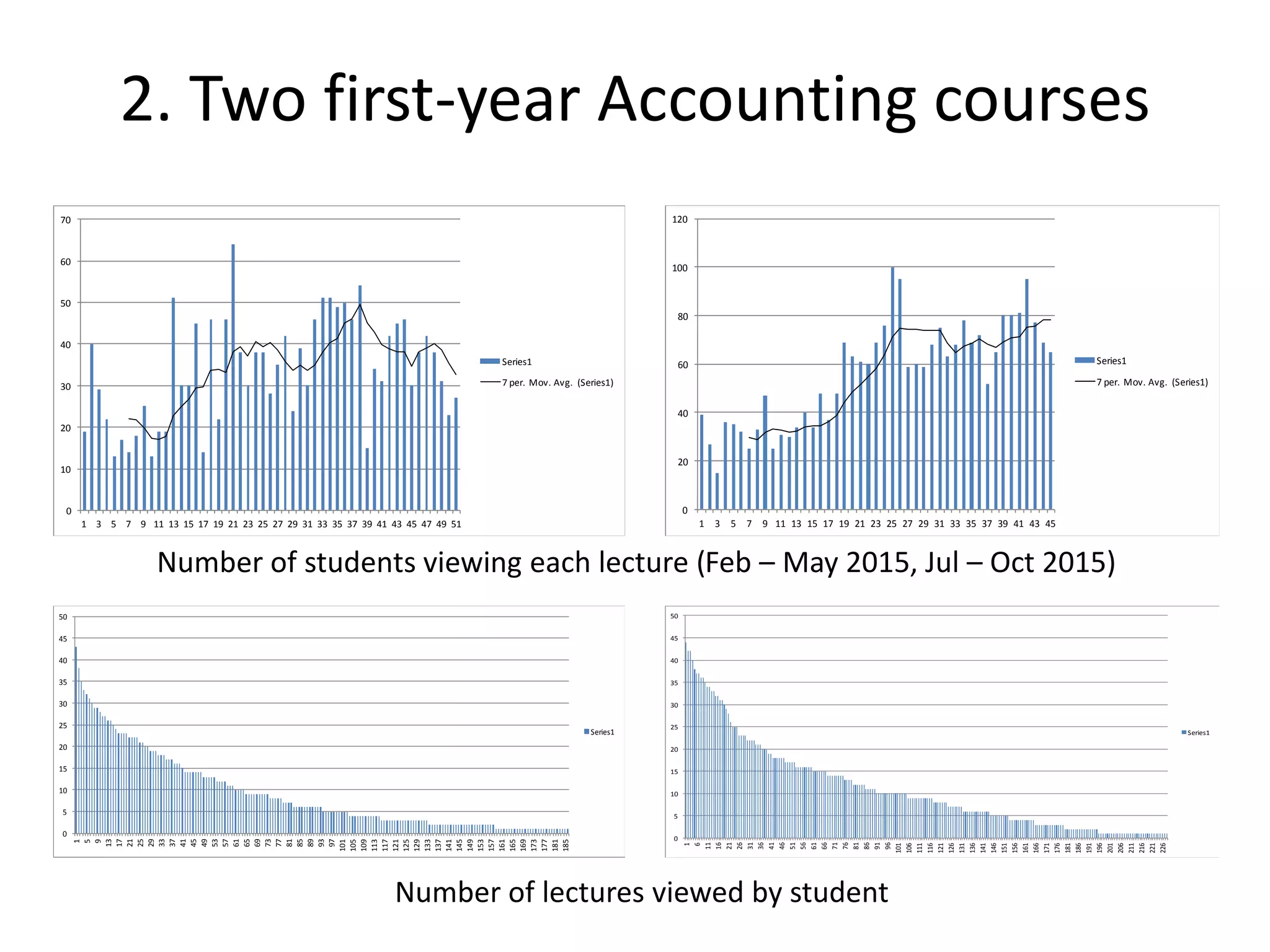
recordings allowed students to augment the lecture material
“You have to go back, you have to watch, you have to pause, you need to compare with
other material as well, to try to understand, and it’s very helpful, what he said, as well, with
trying to do something on your own, because sometimes there are time constraints in the
lecture, and they just have to get through it, and it just doesn’t show your understanding if
you’re just not trying to engage with the material yourself, prior to them showing you how
to do it”.
“We deal a lot with current affairs, where lecturers will reference a case that’s in the
media, and, if you don’t know about it, it’s easy to press pause, go read about it, and, then,
whatever principles he’s applying to that case, you pick up without having to learn the
principles, go read the case, and then try and put the two together after the lecture. So,
there’s a lot of learning that happens in one, like, two hour space, for me, that normally
would’ve taken an entire day”.
2. Two first-year Accounting courses
0
10
20
30
40
50
60
70
1 3 5 7 9 11 13 15 17 19 21 23 25 27 29 31 33 35 37 39 41 43 45 47 49 51
Series1
7 per. Mov. Avg. (Series1)
0
5
10
15
20
25
30
35
40
45
50
1
5
9
13
17
21
25
29
33
37
41
45
49
53
57
61
65
69
73
77
81
85
89
93
97
101
105
109
113
117
121
125
129
133
137
141
145
149
153
157
161
165
169
173
177
181
185
Series1
0
20
40
60
80
100
120
1 3 5 7 9 11 13 15 17 19 21 23 25 27 29 31 33 35 37 39 41 43 45
Series1
7 per. Mov. Avg. (Series1)
0
5
10
15
20
25
30
35
40
45
50
1
6
11
16
21
26
31
36
41
46
51
56
61
66
71
76
81
86
91
96
101
106
111
116
121
126
131
136
141
146
151
156
161
166
171
176
181
186
191
196
201
206
211
216
221
226
Series1
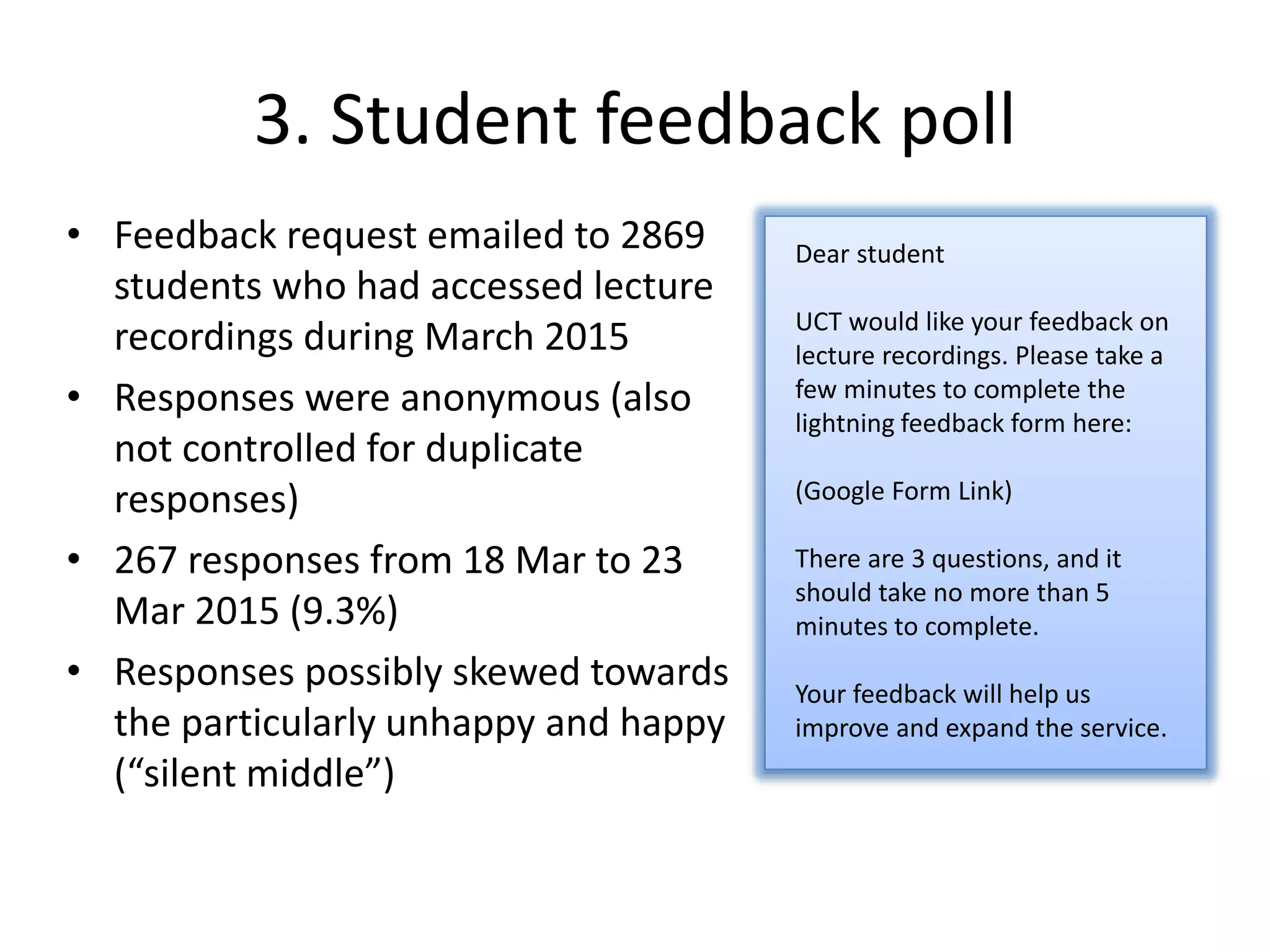
Number of students viewing each lecture (Feb – May 2015, Jul – Oct 2015)
Number of lectures viewed by student
3. Student feedback poll
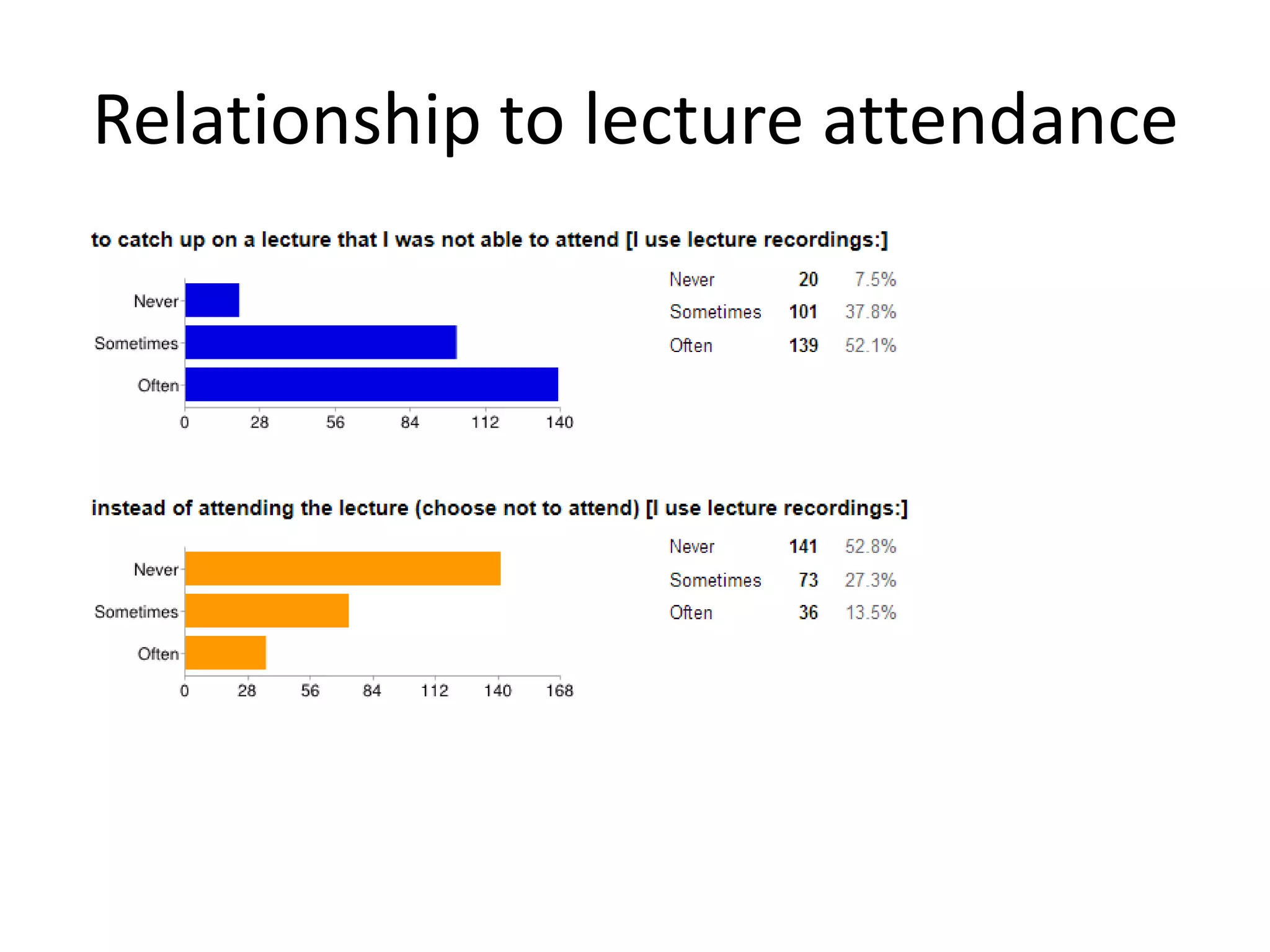
• Feedback request emailed to 2869
students who had accessed lecture
recordings during March 2015
• Responses were anonymous (also
not controlled for duplicate
responses)
• 267 responses from 18 Mar to 23
Mar 2015 (9.3%)
• Responses possibly skewed towards
the particularly unhappy and happy
(“silent middle”)
Dear student
UCT would like your feedback on
lecture recordings. Please take a
few minutes to complete the
lightning feedback form here:
(Google Form Link)
There are 3 questions, and it
should take no more than 5
minutes to complete.
Your feedback will help us
improve and expand the service.
Relationship to lecture attendance
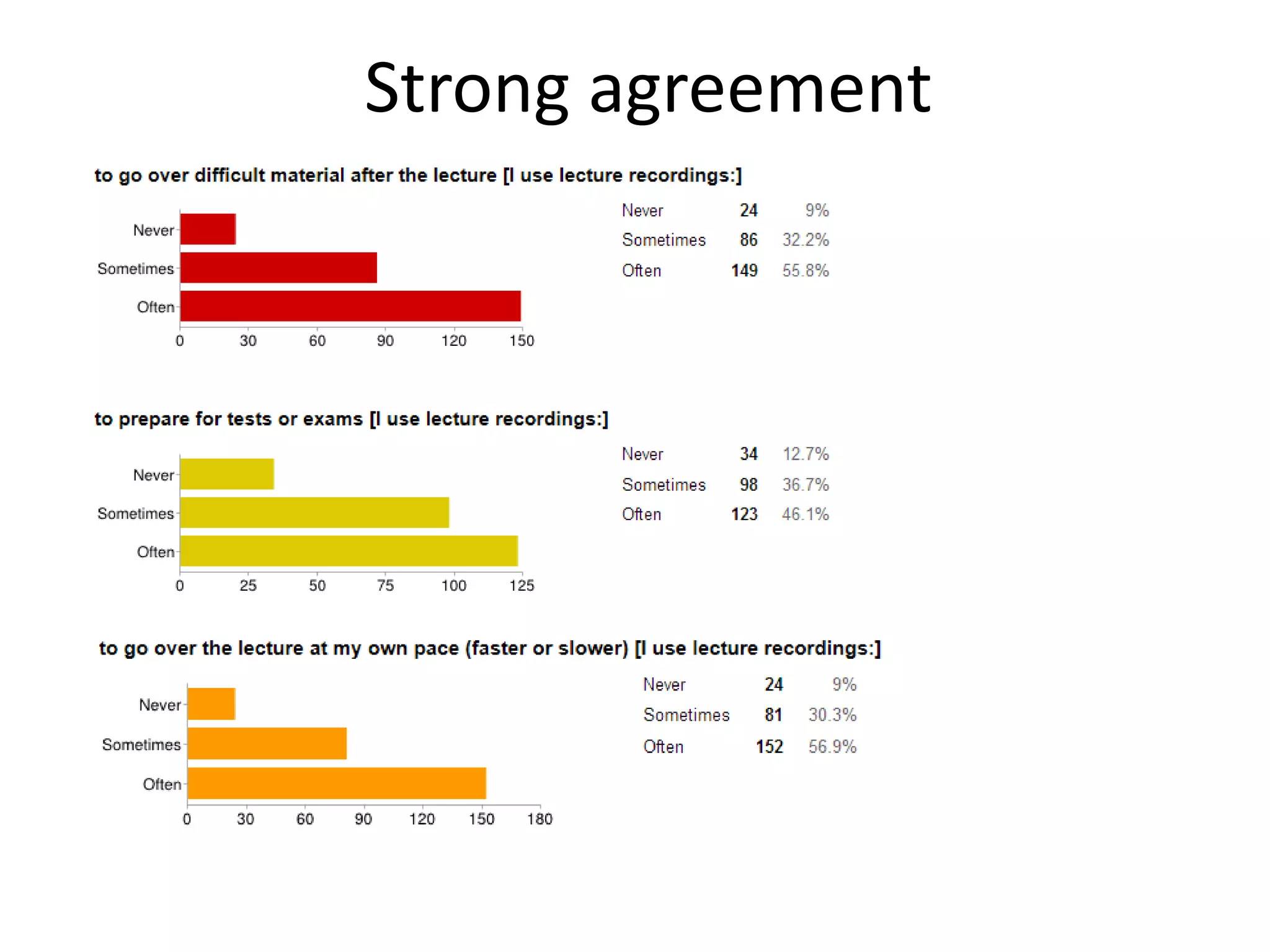
Strong agreement
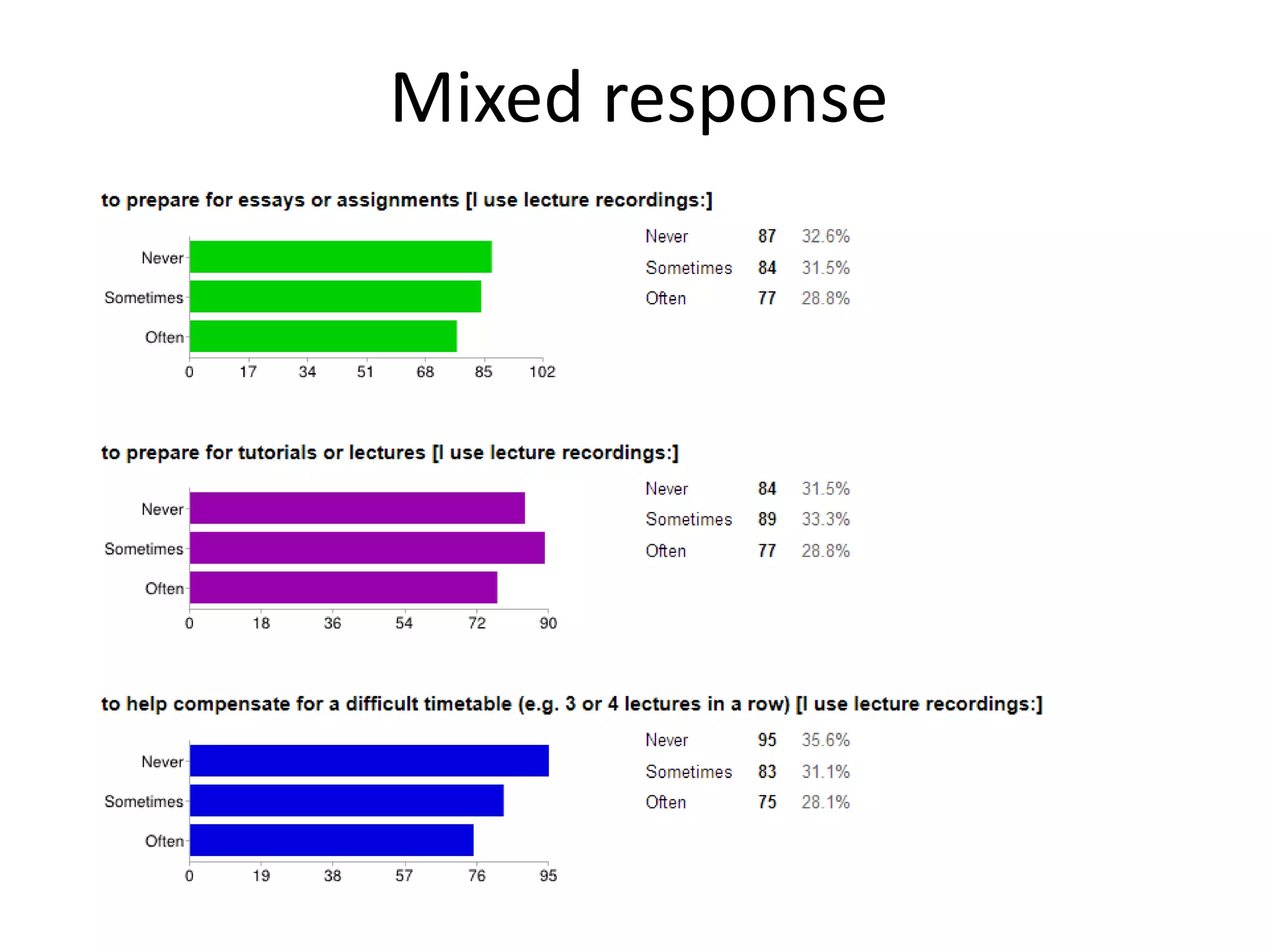
Mixed response
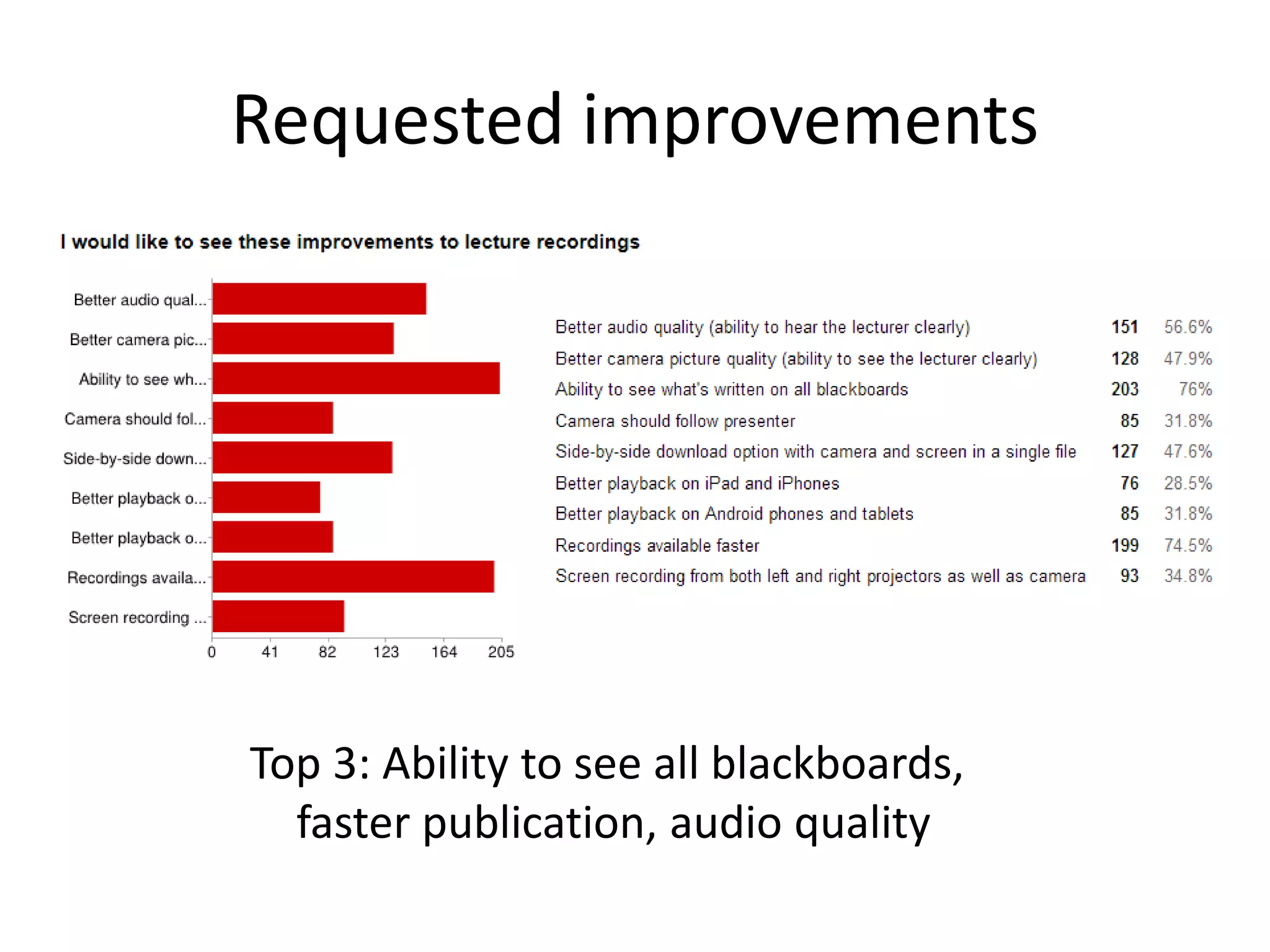
Requested improvements
Top 3: Ability to see all blackboards,
faster publication, audio quality
Conclusions
• Lecture recordings give students flexibility in how they
make use of lectures as a learning resource, and thus
enhance students’ learning experiences
• No single narrative: different students use recordings in
different ways (also expected to vary with
subject/discipline and teaching approaches)
• Lecture recordings more often supplement than
replace lecture attendance
• Usage is regular and spread across the semester, and
becomes more intense as the course progresses
• “It’s all about our learning”: lecture recordings are a
student-centred technology

Why do students use lecture recordings?

  • 1.
    Stephen Marquard Tabisa Mayisela Universityof Cape Town Why do students use recorded lectures? The Opencast Summit: Open Source Lecture Capture & Video Management for Education 25-27 March 2015 "UCT Upper Campus landscape view" by Adrian Frith , Wikimedia Commons. CC BY-SA 3.0
  • 2.
    Opencast at UCT UCTis a mid-sized research-intensive residential university with about 25,000 students Production service launched 2012 3286 recordings published in 2014 47 venues equipped for automated capture in 2015 240 recordings per week in 2015 Up to 2500 students use recordings weekly Users per 24 hours (green) and 7 days (blue), Mar 2014 – Mar 2015 Active streaming users over 5 min (green), of which on-campus users in blue
  • 3.
    Capture hardware: Galicaster Capture Agent from Teltek Datapath capturecards Bosch, Axis and Vaddio IP Cameras Logitech Webcams
  • 4.
    Integration with SakaiVLE (Vula) using LTI
  • 5.
    Matterhorn Engage Player(with download options available)
  • 6.
    Why investigate? Lecture recordingproject initiated in late 2009, prompted by: a. Increased DIY activity (risk of fragmented solutions) b. Informed assumptions about value to students (US surveys) Helpful to understand teaching and learning value in more depth after several years of implementation: • Align development, operations and support efforts with student needs • Discussions with academics (encouraging opt-in, alleviating fears, advice on appropriate use and advice to students) • Understand return on investment (even if unquantifiable) to make appropriate case for continued investment and operational costs
  • 7.
    1. Focus groups •Emailed 500 most-active students (as defined by user tracking data) requesting participation in focus groups; offered a range of times and free pizza! • Focus groups held in May 2014 with total of 18 students from across six courses • Sessions recorded and transcribed • Data analysis - an inductive process that draws on the grounded theory principles (Glaser & Strauss, 1967) “If the lecturer’s going too fast through something you don’t understand, you can slow it down. So, you’re not forced to learn at the pace of others; you can fly through what you find easy and concentrate on what you find hard.” (UCT student, May 2014)
  • 8.
  • 9.
    What determines howoften you use lecture recordings? • Preparing for a test • Complexity of the course (watch even if they had attended) • For revision (watch repetitively) • Didn’t understand something in class “There are some things I don’t understand that I take note of in class … when I am studying, I watch that part of the video and then I understand” • Missed the first ten to 15 minutes (class is at 8am; studying until late evening – miss 1st lecture) “I have to go over and recap whatever they did during that period” • Catching up: * busy with work for another course (i.e. preparing for test or have assignments) * time-table clashes; some prefer going for tutorials “I prefer going for tutorials than lectures, so will watch recordings in the evening to hear what the lecturer said in class” * busy with extra-curricular activities * working during the day • I don’t have to come to campus to attend one module in a day • Preference: “For me, I prefer sitting behind the computer, on my own, instead of sitting in a lecture hall with almost 500 people, where the lecturer goes through the example before you’ve had enough time to work through it on your own”.
  • 10.
    7 Themes recordings enhancedtheir ability to understand difficult concepts by enabling them to go through the material more slowly, with the opportunity to practice and refer to notes, the textbook and supplementary sources: “sometimes, if I didn’t understand something in class, I go back to the lecture recording, just to make sure I get whatever the lecturer was trying to say.” “In Course A, you don’t really write notes; it’s mainly about working out calculations but when you actually need to understand what you’re doing with an equation, so that everything makes sense, and it doesn’t always make sense in the beginning. So, it’s nice to have that option of going back and actually seeing, okay, this was important, what he said – it wasn’t just a random piece of information. I should actually write this down”.
  • 11.
    recordings allowed studentsto compensate for difficult timetables (one student reported back-to-back lectures and tutorials from 8am to 4pm with no lunch break), and allowed students to focus on the material when they were best able to do so: “For me, it’s frustrating to go to a lecture, zone out, miss, like… you know, just because your brain is tired and needs a break, you don’t comprehend everything you need to, you’re not at your best absorption rate. It’s a waste of time for me to do that, go home and read through the text book and try and put it together with my notes, when I can just watch the lecture once when I’m paying attention, when I can pay attention, when I’m not tired, and get everything I need to from it.” “Often, I might be taking notes in class and I’ll just miss something, and, obviously, I’ll go back and listen to it again and it will make sense, so I’ll actually be able to write down notes”
  • 12.
    recordings allowed studentsto learn at their own pace, rather than the pace of the whole group” “If he’s going too fast, I can just stop him, I can go at my pace. It’s all about our learning. Like, you can’t learn at someone else’s pace, if it’s not your pace. ... So, if you want to slow it down, it just makes life easier”. “I spend roughly four hours to watch a two hour lecture because I’m stopping every few slides just to highlight and get those points down, do the examples. Also, I find the examples are the way you learn the most. In class, the lecturers tend to rush through it because the solution is on the next slide, so they read the scenario and then they do the solution, whereas, if you’re watching the lecture recording, you see the scenario for the first time, you pause, you do it yourself, and, then, when you press play, you can see what you’ve done wrong, where you’re going wrong. And that, for me, is more of a learning experience. So, that’s why I use lecture recordings a lot”.
  • 13.
    recordings made lectureseasier to follow: “It’s also… it’s nice to hear the lecturer quite audible in your ears, like, especially when they’re talking fast, you can go back and replay it at your own speed. I think that’s what’s the nice thing about lecture recordings; it’s like the lecturer’s lecturing one on one.” recordings allowed lectures to be more efficient for both students and lecturers: “And, like, the lecture’s so big, there’s, like, about 400 students there, so you don’t want to be that one that’s always asking the questions, to ask the lecturer to repeat himself, repeat himself. So if you can just go back to the video and then, like, have it, you know, played over again and then pretty much have the lecturer repeat himself then you can pretty much just go back to it and then you’ll be able to understand it.”
  • 14.
    recordings allowed studentsto augment the lecture material “You have to go back, you have to watch, you have to pause, you need to compare with other material as well, to try to understand, and it’s very helpful, what he said, as well, with trying to do something on your own, because sometimes there are time constraints in the lecture, and they just have to get through it, and it just doesn’t show your understanding if you’re just not trying to engage with the material yourself, prior to them showing you how to do it”. “We deal a lot with current affairs, where lecturers will reference a case that’s in the media, and, if you don’t know about it, it’s easy to press pause, go read about it, and, then, whatever principles he’s applying to that case, you pick up without having to learn the principles, go read the case, and then try and put the two together after the lecture. So, there’s a lot of learning that happens in one, like, two hour space, for me, that normally would’ve taken an entire day”.
  • 15.
    2. Two first-yearAccounting courses 0 10 20 30 40 50 60 70 1 3 5 7 9 11 13 15 17 19 21 23 25 27 29 31 33 35 37 39 41 43 45 47 49 51 Series1 7 per. Mov. Avg. (Series1) 0 5 10 15 20 25 30 35 40 45 50 1 5 9 13 17 21 25 29 33 37 41 45 49 53 57 61 65 69 73 77 81 85 89 93 97 101 105 109 113 117 121 125 129 133 137 141 145 149 153 157 161 165 169 173 177 181 185 Series1 0 20 40 60 80 100 120 1 3 5 7 9 11 13 15 17 19 21 23 25 27 29 31 33 35 37 39 41 43 45 Series1 7 per. Mov. Avg. (Series1) 0 5 10 15 20 25 30 35 40 45 50 1 6 11 16 21 26 31 36 41 46 51 56 61 66 71 76 81 86 91 96 101 106 111 116 121 126 131 136 141 146 151 156 161 166 171 176 181 186 191 196 201 206 211 216 221 226 Series1 Number of students viewing each lecture (Feb – May 2015, Jul – Oct 2015) Number of lectures viewed by student
  • 16.
    3. Student feedbackpoll • Feedback request emailed to 2869 students who had accessed lecture recordings during March 2015 • Responses were anonymous (also not controlled for duplicate responses) • 267 responses from 18 Mar to 23 Mar 2015 (9.3%) • Responses possibly skewed towards the particularly unhappy and happy (“silent middle”) Dear student UCT would like your feedback on lecture recordings. Please take a few minutes to complete the lightning feedback form here: (Google Form Link) There are 3 questions, and it should take no more than 5 minutes to complete. Your feedback will help us improve and expand the service.
  • 17.
  • 18.
  • 19.
  • 20.
    Requested improvements Top 3:Ability to see all blackboards, faster publication, audio quality
  • 21.
    Conclusions • Lecture recordingsgive students flexibility in how they make use of lectures as a learning resource, and thus enhance students’ learning experiences • No single narrative: different students use recordings in different ways (also expected to vary with subject/discipline and teaching approaches) • Lecture recordings more often supplement than replace lecture attendance • Usage is regular and spread across the semester, and becomes more intense as the course progresses • “It’s all about our learning”: lecture recordings are a student-centred technology

Editor's Notes

  • #10 Yes, I mean, transport takes a lot of time and it’s also really expensive with petrol and that, so I find it really useful that I can just watch that one lecture at home and then I can do other things in the time that I would’ve spent going to university and coming back just for one lecture. So yes, I found that very useful. Preference Cont.. “I’ll get to a problem, or, [the lecturer] will pose the problem in the lecture, and I can press pause, work through it myself, see if I understand, and then get the answer afterwards and watch what he did, instead of just copying down the answers”.