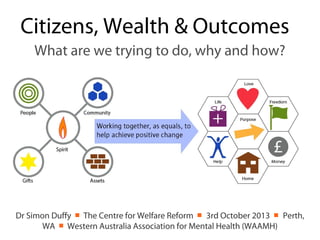
Citizens, Wealth & Outcomes
What are we trying to do, why and how?
Dr Simon Duffy ■ The Centre for Welfare Reform ■ 3rd October 2013 ■ Perth,
WA ■ Western Australia Association for Mental Health (WAAMH)
Citizenship is the right goal
At the end of the nineteenth and
the for most of the twentieth
century it was common for people
to think that people with
intellectual disabilities or mental
health problems were different -
they were not citizens.
The powerful eugenic movement
which spread across Europe,
America and the British Empire led
eventually to the murder of over
250,000 people with disabilities or
mental health problems in Nazi
Germany.
The process of de-humanisation had
seven steps:
The factors that weakened people’s
grasp on their shared humanity:
1. Mass morality
2. Rootlessness
3. State power
The factors that allowed people to
destroy the victims:
1. Rightlessness
2. Poverty
3. Segregation
After World War II the focus has changed.
Human rights, the demand for independence
and the welfare state have helped change
society.
But there is still a long way to go.
Big institutions have slowly closed across
Europe. But often they have been replaced
with other kinds of institutions.
If you have been doing things
wrong for a long time it is important
to think carefully and to be
confident that you know what to do
now.
What is wrong with institutions
1.Devalued lives - self-expression and personal development
threaten institutional thinking
2.No freedom or control - it is very hard to be heard when you
have no authority
3.Impoverishment - economic power is nullified
4.Sheltered, but homeless - a home is more than a roof - vital to
control privacy and security
5.‘Care’ not support - ‘care’ already assumes the passivity and
lower value of the person ‘in care’.
6.Disconnected- it is other citizens who report abuse and it is
structures of power within institutions that make that harder
7.Loveless - the shift to focusing on abuse not crime is a symptom
of institutional thinking
This shows spending in one part of England
after the institutions were closed:
Often English de-instutitionalisation
was institutions without the park
There is not just one kind of institution
we bring the institution with us
Being a citizen is better than being
‘normal’
it brings us together as equals
but also as unique free individuals
Equal and different
1.Direction - My life has meaning and value.
2.Freedom - I can communicate and direct my life.
3.Money - I have money and control my own money.
4.Home - I control who I live with, my home and my privacy.
5.Help - I help and I can control who helps me.
6.Life - I am a valued member of my community.
7.Love - I have friends and family.
How citizenship works
Citizenship is
also very
practical. We
can use the idea
of citizenship to
think about how
to help
someone.
Citizenship is
possible for
everyone
it just might
take some
extra thought
1. Purpose
Demanding of man that he assumes his condition and
not till his neighbour's field, he [Rebbe Yaakov-Yitzhak,
The Seer of Lublin] said: "There are many paths leading
to perfection; it is given to each of us to choose our own,
and by following it with great dedication, we can make it
become our truth, our only truth."
Elie Wiesel
2. Freedom
I used to think that freedom was freedom of speech,
freedom of the press, freedom of conscience. But
freedom needs to include all of the lives of all of the
people. Freedom is the right to sow what you want. It's
the right to make boots of shoes, it's the right to bake
bread from the grain you've sown and to sell it or not to
sell it as you choose. The same goes for a locksmith or
steelworker or an artist - freedom is the right to live and
work as you wish and not as you're ordered to. But these
days there's no freedom for anyone - whether you write
books, whether you sow grain or whether you make
boots.
Vassily Grossman
3. Money
You could no more make a city out of paupers than out
of slaves.
Aristotle
Self-interest is the most powerful engine for individual
and social development, in other words, social progress,
in other words social justice. It is when the most
disadvantaged in society have the opportunity to
improve their lives in their own self-interest that change
will take place.
Noel Pearson
4. Home
Then the old Vainamoinen put this into words:'Strange
food goes down the wrong wayeven in good lodging;in
his land a man's better at home loftier.If only sweet God
would grantthe kind creator allowme to come to my
own landsthe lands where I used to live!Better in your
own countryeven water off your solethan in a foreign
countryhoney from a golden bowl.'
The Kalevala
5. Help
There are eight degrees of charity, one higher than the
other. The highest degree, exceeded by none, is that of
the person who assists a poor Jew by providing him with
a gift or loan or by accepting him into a business
partnership or by helping him find employment - in a
word, by putting him where he can dispense with other
people's aid. With reference to such aid, it is said, “You
shall strengthen him, be he a stranger or a settler, he
shall live with you” (Lev. 25:35), which means strengthen
him in such manner that his falling into want is
prevented.
Maimonides
6. Life
True love leads a man to fulfilment, not by drawing
things to himself but by forcing him to transcend himself
and to be something greater than himself. True spiritual
love takes the isolated individual, exacts from him
labour, sacrifice, and the gift of himself.
Thomas Merton
7. Love
Resources multiply in networks created by intentionally
building relationships that cross boundaries & serve
people's deepest purposes.
Seymour Sarason
Citizenship is the full realisation of our interdependence
- the value we bring to each other in all our differences.
The lame rides a horsethe maimed drives the herdthe
deaf is brave in battle.A man is betterblind than
buried.A dead man is deft at nothing.
From Viking - Havamal
How
Our real wealth is the resource
How is by working together as citizens
citizenship is achieved through citizenship
Lots of free resources on all these topics and more:
@simonjduffy and @cforwr - follow
www.centreforwelfarereform.org.uk - subscribe
like The Centre for Welfare Reform on Facebook

Citizenship: why Its important, what It is and how its achieved

  • 1.
    Citizens, Wealth &Outcomes What are we trying to do, why and how? Dr Simon Duffy ■ The Centre for Welfare Reform ■ 3rd October 2013 ■ Perth, WA ■ Western Australia Association for Mental Health (WAAMH)
  • 3.
  • 5.
    At the endof the nineteenth and the for most of the twentieth century it was common for people to think that people with intellectual disabilities or mental health problems were different - they were not citizens.
  • 6.
    The powerful eugenicmovement which spread across Europe, America and the British Empire led eventually to the murder of over 250,000 people with disabilities or mental health problems in Nazi Germany.
  • 7.
    The process ofde-humanisation had seven steps:
  • 9.
    The factors thatweakened people’s grasp on their shared humanity: 1. Mass morality 2. Rootlessness 3. State power
  • 14.
    The factors thatallowed people to destroy the victims: 1. Rightlessness 2. Poverty 3. Segregation
  • 15.
    After World WarII the focus has changed. Human rights, the demand for independence and the welfare state have helped change society. But there is still a long way to go.
  • 16.
    Big institutions haveslowly closed across Europe. But often they have been replaced with other kinds of institutions.
  • 17.
    If you havebeen doing things wrong for a long time it is important to think carefully and to be confident that you know what to do now.
  • 18.
    What is wrongwith institutions 1.Devalued lives - self-expression and personal development threaten institutional thinking 2.No freedom or control - it is very hard to be heard when you have no authority 3.Impoverishment - economic power is nullified 4.Sheltered, but homeless - a home is more than a roof - vital to control privacy and security 5.‘Care’ not support - ‘care’ already assumes the passivity and lower value of the person ‘in care’. 6.Disconnected- it is other citizens who report abuse and it is structures of power within institutions that make that harder 7.Loveless - the shift to focusing on abuse not crime is a symptom of institutional thinking
  • 19.
    This shows spendingin one part of England after the institutions were closed:
  • 23.
    Often English de-instutitionalisation wasinstitutions without the park
  • 24.
    There is notjust one kind of institution we bring the institution with us
  • 26.
    Being a citizenis better than being ‘normal’ it brings us together as equals but also as unique free individuals Equal and different
  • 29.
    1.Direction - Mylife has meaning and value. 2.Freedom - I can communicate and direct my life. 3.Money - I have money and control my own money. 4.Home - I control who I live with, my home and my privacy. 5.Help - I help and I can control who helps me. 6.Life - I am a valued member of my community. 7.Love - I have friends and family. How citizenship works
  • 30.
    Citizenship is also very practical.We can use the idea of citizenship to think about how to help someone.
  • 31.
    Citizenship is possible for everyone itjust might take some extra thought
  • 32.
  • 33.
    Demanding of manthat he assumes his condition and not till his neighbour's field, he [Rebbe Yaakov-Yitzhak, The Seer of Lublin] said: "There are many paths leading to perfection; it is given to each of us to choose our own, and by following it with great dedication, we can make it become our truth, our only truth." Elie Wiesel
  • 36.
  • 37.
    I used tothink that freedom was freedom of speech, freedom of the press, freedom of conscience. But freedom needs to include all of the lives of all of the people. Freedom is the right to sow what you want. It's the right to make boots of shoes, it's the right to bake bread from the grain you've sown and to sell it or not to sell it as you choose. The same goes for a locksmith or steelworker or an artist - freedom is the right to live and work as you wish and not as you're ordered to. But these days there's no freedom for anyone - whether you write books, whether you sow grain or whether you make boots. Vassily Grossman
  • 41.
  • 42.
    You could nomore make a city out of paupers than out of slaves. Aristotle Self-interest is the most powerful engine for individual and social development, in other words, social progress, in other words social justice. It is when the most disadvantaged in society have the opportunity to improve their lives in their own self-interest that change will take place. Noel Pearson
  • 46.
  • 47.
    Then the oldVainamoinen put this into words:'Strange food goes down the wrong wayeven in good lodging;in his land a man's better at home loftier.If only sweet God would grantthe kind creator allowme to come to my own landsthe lands where I used to live!Better in your own countryeven water off your solethan in a foreign countryhoney from a golden bowl.' The Kalevala
  • 51.
  • 52.
    There are eightdegrees of charity, one higher than the other. The highest degree, exceeded by none, is that of the person who assists a poor Jew by providing him with a gift or loan or by accepting him into a business partnership or by helping him find employment - in a word, by putting him where he can dispense with other people's aid. With reference to such aid, it is said, “You shall strengthen him, be he a stranger or a settler, he shall live with you” (Lev. 25:35), which means strengthen him in such manner that his falling into want is prevented. Maimonides
  • 56.
  • 57.
    True love leadsa man to fulfilment, not by drawing things to himself but by forcing him to transcend himself and to be something greater than himself. True spiritual love takes the isolated individual, exacts from him labour, sacrifice, and the gift of himself. Thomas Merton
  • 62.
  • 63.
    Resources multiply innetworks created by intentionally building relationships that cross boundaries & serve people's deepest purposes. Seymour Sarason
  • 67.
    Citizenship is thefull realisation of our interdependence - the value we bring to each other in all our differences. The lame rides a horsethe maimed drives the herdthe deaf is brave in battle.A man is betterblind than buried.A dead man is deft at nothing. From Viking - Havamal
  • 68.
  • 70.
    Our real wealthis the resource
  • 71.
    How is byworking together as citizens citizenship is achieved through citizenship
  • 74.
    Lots of freeresources on all these topics and more: @simonjduffy and @cforwr - follow www.centreforwelfarereform.org.uk - subscribe like The Centre for Welfare Reform on Facebook