OVERCOMING THE
BARRIERS TO BUILDING
GREAT PRODUCTS
Mike Chowla Twitter: @mchowla
Silicon Valley Product Camp
March 14, 2015
Copyright © Mike Chowla 2015
Slides available at
http://www.slideshare.net/mchowla
My Background
• Education
• BS, Electrical Engineering and Computer Science, UC Berkeley
• MBA, Wharton
• Experience
• 10 years as software engineer and architect building high
performance infrastructure
• Previously Product Management for AOL Mail, StrongView, Aeris
• Currently Sr Director of Product Management at Rubicon Project
Copyright © Mike Chowla 2015
Can you win on product? [From Last Year]
Clearly yes, but seems to be the exception rather
the rule
Why is it rare?
My best answer is that it’s hard to build a culture
that creates a superior product
Culture Eats Strategy For Breakfast
Peter DruckerMark Fields, Ford Motor Company
Copyright © Mike Chowla 2014
We all believe in building great products
In 2015, everyone thinks that great products are good for
business
Every one says they want to make a great product
But very organizations succeed at it
Copyright © Mike Chowla 2015
Why?
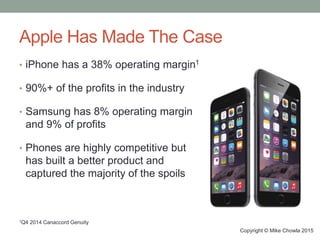
Apple Has Made The Case
• iPhone has a 38% operating margin1
• 90%+ of the profits in the industry
• Samsung has 8% operating margin
and 9% of profits
• Phones are highly competitive but
has built a better product and
captured the majority of the spoils
1Q4 2014 Canaccord Genuity
Copyright © Mike Chowla 2015
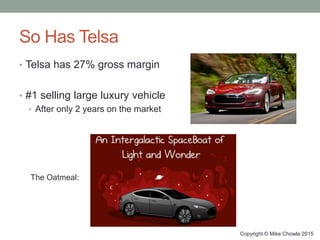
So Has Telsa
• Telsa has 27% gross margin
• #1 selling large luxury vehicle
• After only 2 years on the market
Copyright © Mike Chowla 2015
The Oatmeal:
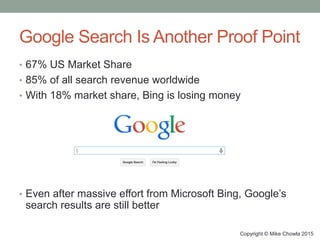
Google Search Is Another Proof Point
• 67% US Market Share
• 85% of all search revenue worldwide
• With 18% market share, Bing is losing money
Copyright © Mike Chowla 2015
• Even after massive effort from Microsoft Bing, Google’s
search results are still better
What is a great product?
(for the purposes of this talk)
A product that market the prefers because the experience
is better and that preference drives superior financial
results (in the absence of other competitive advantages).
Ability to charge higher prices for similar functionality is a
good indicator
Copyright © Mike Chowla 2015
Characteristics of Great Products
Frictionless
Great UX
Outstanding Support
Attention to detail
Emotional Connection
Just Works
Simplicity
Does the job it was
hired to do
Copyright © Mike Chowla 2015
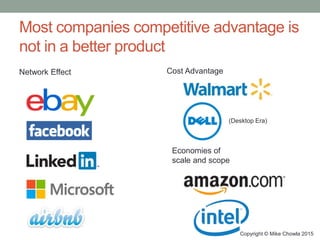
Most companies competitive advantage is
not in a better product
Copyright © Mike Chowla 2015
Network Effect Cost Advantage
Economies of
scale and scope
(Desktop Era)
How Rare Should Great Products Be?
• Exceptional products are by
definition well above average and
therefore rare
• But, it’s so extremely rare see a new
superior product take over a
category that it’s exceptional
Copyright © Mike Chowla 2015
• As product managers, we’ve all tried to make our
products excel over the competition
• But it’s really really hard
Why is it hard to win on product?
Copyright © Mike Chowla 2015
Is culture the problem?
Definition in Merriam-Webster
Culture (noun): the beliefs, customs, arts, etc., of a particular society,
group, place, or time
When people talk about culture and business, they usually mean
the culture of a particular company
Example: Company X has toxic culture
But for great products to be rare because of “culture”, it can not
be the idiosyncratic culture of particular businesses as the hand
of the market would reward the good cultures.
Has to stem from a common element of how businesses work
Copyright © Mike Chowla 2015
Classical Business Thinking
• What’s the ROI?
• Finance people compute Net Present Value (NPV)
• All activities need a business case
• Reductionist in nature
• Evaluates each activity isolation
• Difficult to evaluate second order effects especially
cumulative ones
• The first bad product decision is impossible to measure
• After a lot of them, your product is now a bad product that
customers hate
• And fixing one issue or even a few doesn’t solve anything
Copyright © Mike Chowla 2015
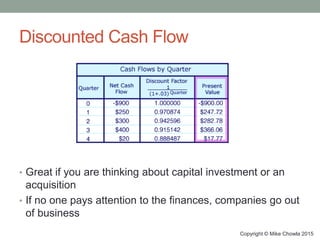
Discounted Cash Flow
• Great if you are thinking about capital investment or an
acquisition
• If no one pays attention to the finances, companies go out
of business
Copyright © Mike Chowla 2015
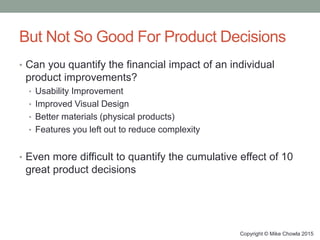
But Not So Good For Product Decisions
• Can you quantify the financial impact of an individual
product improvements?
• Usability Improvement
• Improved Visual Design
• Better materials (physical products)
• Features you left out to reduce complexity
• Even more difficult to quantify the cumulative effect of 10
great product decisions
Copyright © Mike Chowla 2015
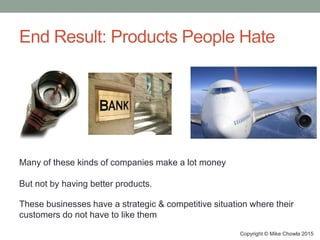
End Result: Products People Hate
Copyright © Mike Chowla 2015
Many of these kinds of companies make a lot money
But not by having better products.
These businesses have a strategic & competitive situation where their
customers do not have to like them
Back to great products that people love
Copyright © Mike Chowla 2015
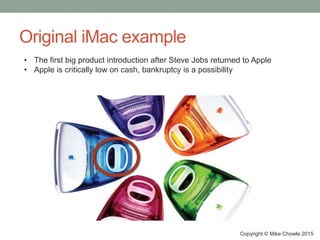
Original iMac example
Copyright © Mike Chowla 2015
• The first big product introduction after Steve Jobs returned to Apple
• Apple is critically low on cash, bankruptcy is a possibility
Extra Costs in the Case
• The cost of each case was more than $60 per unit, three times that of
a regular computer case.
• At other companies, there would probably have been
presentations and studies to show whether the translucent case
would increase sales enough to justify the extra cost. Jobs asked
for no such analysis.
• So I thought, if there’s this handle on it, it makes a relationship
possible. It’s approachable. It’s intuitive. It gives you permission to
touch. It gives a sense of its deference to you. Unfortunately,
manufacturing a recessed handle costs a lot of money. At the old
Apple, I would have lost the argument.
• What was really great about Steve is that he saw it and said, ‘That’s
cool!’ I didn’t explain all the thinking, but he intuitively got it. He just
knew that it was part of the iMac’s friendliness and playfulness.”
Copyright © Mike Chowla 2015
How Steve Jobs' Love of Simplicity Fueled A Design Revolution
Smithsonian Magazine, September 2012
Math on the Case
• An original iMac was around $1000
• So an extra $40 on the case, which lowers gross margin
by 4% points
• In 1998, Apple’s gross margin was 27%
• Four points is a lot!
• Your CFO is going to want to know how colors and a
handle justify 4 points of gross margin
• And your competitors will ridicule it:
The one thing Apple’s providing now is leadership in colors.
It won’t take long for us to catch up with that, I don’t think.
- Bill Gates
Copyright © Mike Chowla 2015
Was the case worth it?
• History say yes
• 800,000 units sold in 139 days
• Apple returned to profitability
• Market cap went from $4.1B in 1998 to $725B today (+17,500%)
• Microsoft went from $245B in 1998 to $335B today (+37%)
• But the problem is that you can not prove it
• Even in hindsight, how can you prove the extra $40 was
worth it. Maybe the iMac would have sold well with a
boring case
Copyright © Mike Chowla 2015
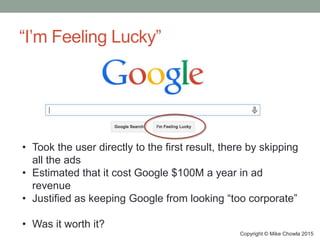
“I’m Feeling Lucky”
Copyright © Mike Chowla 2015
• Took the user directly to the first result, there by skipping
all the ads
• Estimated that it cost Google $100M a year in ad
revenue
• Justified as keeping Google from looking “too corporate”
• Was it worth it?
Products are more than the sum of their parts
• Your product is not a bundle of attributes with a price
• A great product has 10,000 good decisions, small & large,
that people make people love it
• No silver bullets to get there
• Not based on more functionality
• Great products often do less than the competition
Copyright © Mike Chowla 2015
Imitation
Copyright © Mike Chowla 2015
Imitation is the enemy of business strategy
If your strategy can be imitated, it ceases
to be a competitive advantage
Great Products are Beyond Imitation
• If the advantage of a great product was a few discrete
attributes, it could and would be easily imitated
Imitation being difficult is what makes winning on product a
defensible business strategy
Copyright © Mike Chowla 2015
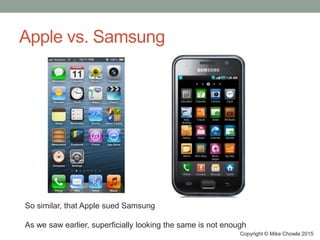
Apple vs. Samsung
Copyright © Mike Chowla 2015
So similar, that Apple sued Samsung
As we saw earlier, superficially looking the same is not enough
vs.
• Similar catalogs
• Both have original content
• Similar device reach
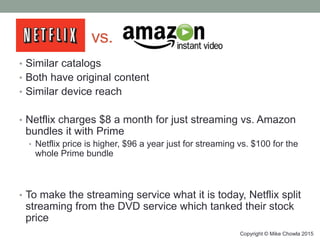
• Netflix charges $8 a month for just streaming vs. Amazon
bundles it with Prime
• Netflix price is higher, $96 a year just for streaming vs. $100 for the
whole Prime bundle
• To make the streaming service what it is today, Netflix split
streaming from the DVD service which tanked their stock
price
Copyright © Mike Chowla 2015
What kind of decisions are needed
for great products?
Copyright © Mike Chowla 2015
The Hard Product Decisions
• The hard ones make the product experience better but
have negative direct business impacts
• Drive cost or reduce revenue without direct offsetting impacts
• Example: Fewer ad slots in an ad supported product
• Example: No bloatware pre-installed on a laptop
• When product improvements have direct positive
business impact, these are easy decisions
• You & your competitors will make the same decisions
Copyright © Mike Chowla 2015
How do you even know you are right?
• Really understand the customer impact of your choices
• Resist thinking “more” is always better
• Keep an eye on the aggregate impact
• Monitor how your customers feel about your product
• Maybe you don’t
• Creative works (movies, books, etc) even for the best creators are
hit and miss
Copyright © Mike Chowla 2015
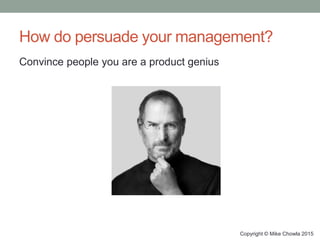
How do persuade your management?
Copyright © Mike Chowla 2015
Convince people you are a product genius
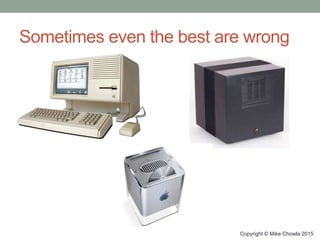
Sometimes even the best are wrong
Copyright © Mike Chowla 2015
Where does this leave us?
Copyright © Mike Chowla 2015
A Paradox
• Business thinking is necessary
• You have to care about profitability else you will go out of business
• All the roles that drive business focus are necessary
• Companies will go bankrupt without them
• Great products need decisions that go against business
thinking
• Too many of these that don’t pay off are disastrous
• Thinking too much about financial impacts makes it
impossible to generate superior financial results through a
better product
Copyright © Mike Chowla 2015
Ideas on What To Do
• Get the Product Management Fundamentals Right
• Really understand your customers, what they need
• Only way to know when it’s worth it to take the short run hit
• Sweat the details
• If do you don’t care about the little things, you’ll never get to a great
product
• Go as far as you can without endangering the business
• And be right that you are really improving the experience is a real
way
Copyright © Mike Chowla 2015
Things I’ve Said
• “That customer can’t leave because of X so I’m not going
to fix their problem”
• “The competition is not any better in this regard”
• “I have too many other product problems to fix that major
pain point with the product”
Copyright © Mike Chowla 2015
Was I being expedient or did I compromise
the product?
QUESTIONS?
mchowla@gmail.com
Twitter: @mchowla
www.linkedin.com/in/mchowla
Copyright © Mike Chowla 2015

Overcoming the Barriers To Building Great Products

  • 1.
    OVERCOMING THE BARRIERS TOBUILDING GREAT PRODUCTS Mike Chowla Twitter: @mchowla Silicon Valley Product Camp March 14, 2015 Copyright © Mike Chowla 2015 Slides available at http://www.slideshare.net/mchowla
  • 2.
    My Background • Education •BS, Electrical Engineering and Computer Science, UC Berkeley • MBA, Wharton • Experience • 10 years as software engineer and architect building high performance infrastructure • Previously Product Management for AOL Mail, StrongView, Aeris • Currently Sr Director of Product Management at Rubicon Project Copyright © Mike Chowla 2015
  • 3.
    Can you winon product? [From Last Year] Clearly yes, but seems to be the exception rather the rule Why is it rare? My best answer is that it’s hard to build a culture that creates a superior product Culture Eats Strategy For Breakfast Peter DruckerMark Fields, Ford Motor Company Copyright © Mike Chowla 2014
  • 4.
    We all believein building great products In 2015, everyone thinks that great products are good for business Every one says they want to make a great product But very organizations succeed at it Copyright © Mike Chowla 2015 Why?
  • 5.
    Apple Has MadeThe Case • iPhone has a 38% operating margin1 • 90%+ of the profits in the industry • Samsung has 8% operating margin and 9% of profits • Phones are highly competitive but has built a better product and captured the majority of the spoils 1Q4 2014 Canaccord Genuity Copyright © Mike Chowla 2015
  • 6.
    So Has Telsa •Telsa has 27% gross margin • #1 selling large luxury vehicle • After only 2 years on the market Copyright © Mike Chowla 2015 The Oatmeal:
  • 7.
    Google Search IsAnother Proof Point • 67% US Market Share • 85% of all search revenue worldwide • With 18% market share, Bing is losing money Copyright © Mike Chowla 2015 • Even after massive effort from Microsoft Bing, Google’s search results are still better
  • 8.
    What is agreat product? (for the purposes of this talk) A product that market the prefers because the experience is better and that preference drives superior financial results (in the absence of other competitive advantages). Ability to charge higher prices for similar functionality is a good indicator Copyright © Mike Chowla 2015
  • 9.
    Characteristics of GreatProducts Frictionless Great UX Outstanding Support Attention to detail Emotional Connection Just Works Simplicity Does the job it was hired to do Copyright © Mike Chowla 2015
  • 10.
    Most companies competitiveadvantage is not in a better product Copyright © Mike Chowla 2015 Network Effect Cost Advantage Economies of scale and scope (Desktop Era)
  • 11.
    How Rare ShouldGreat Products Be? • Exceptional products are by definition well above average and therefore rare • But, it’s so extremely rare see a new superior product take over a category that it’s exceptional Copyright © Mike Chowla 2015 • As product managers, we’ve all tried to make our products excel over the competition • But it’s really really hard
  • 12.
    Why is ithard to win on product? Copyright © Mike Chowla 2015
  • 13.
    Is culture theproblem? Definition in Merriam-Webster Culture (noun): the beliefs, customs, arts, etc., of a particular society, group, place, or time When people talk about culture and business, they usually mean the culture of a particular company Example: Company X has toxic culture But for great products to be rare because of “culture”, it can not be the idiosyncratic culture of particular businesses as the hand of the market would reward the good cultures. Has to stem from a common element of how businesses work Copyright © Mike Chowla 2015
  • 14.
    Classical Business Thinking •What’s the ROI? • Finance people compute Net Present Value (NPV) • All activities need a business case • Reductionist in nature • Evaluates each activity isolation • Difficult to evaluate second order effects especially cumulative ones • The first bad product decision is impossible to measure • After a lot of them, your product is now a bad product that customers hate • And fixing one issue or even a few doesn’t solve anything Copyright © Mike Chowla 2015
  • 15.
    Discounted Cash Flow •Great if you are thinking about capital investment or an acquisition • If no one pays attention to the finances, companies go out of business Copyright © Mike Chowla 2015
  • 16.
    But Not SoGood For Product Decisions • Can you quantify the financial impact of an individual product improvements? • Usability Improvement • Improved Visual Design • Better materials (physical products) • Features you left out to reduce complexity • Even more difficult to quantify the cumulative effect of 10 great product decisions Copyright © Mike Chowla 2015
  • 17.
    End Result: ProductsPeople Hate Copyright © Mike Chowla 2015 Many of these kinds of companies make a lot money But not by having better products. These businesses have a strategic & competitive situation where their customers do not have to like them
  • 18.
    Back to greatproducts that people love Copyright © Mike Chowla 2015
  • 19.
    Original iMac example Copyright© Mike Chowla 2015 • The first big product introduction after Steve Jobs returned to Apple • Apple is critically low on cash, bankruptcy is a possibility
  • 20.
    Extra Costs inthe Case • The cost of each case was more than $60 per unit, three times that of a regular computer case. • At other companies, there would probably have been presentations and studies to show whether the translucent case would increase sales enough to justify the extra cost. Jobs asked for no such analysis. • So I thought, if there’s this handle on it, it makes a relationship possible. It’s approachable. It’s intuitive. It gives you permission to touch. It gives a sense of its deference to you. Unfortunately, manufacturing a recessed handle costs a lot of money. At the old Apple, I would have lost the argument. • What was really great about Steve is that he saw it and said, ‘That’s cool!’ I didn’t explain all the thinking, but he intuitively got it. He just knew that it was part of the iMac’s friendliness and playfulness.” Copyright © Mike Chowla 2015 How Steve Jobs' Love of Simplicity Fueled A Design Revolution Smithsonian Magazine, September 2012
  • 21.
    Math on theCase • An original iMac was around $1000 • So an extra $40 on the case, which lowers gross margin by 4% points • In 1998, Apple’s gross margin was 27% • Four points is a lot! • Your CFO is going to want to know how colors and a handle justify 4 points of gross margin • And your competitors will ridicule it: The one thing Apple’s providing now is leadership in colors. It won’t take long for us to catch up with that, I don’t think. - Bill Gates Copyright © Mike Chowla 2015
  • 22.
    Was the caseworth it? • History say yes • 800,000 units sold in 139 days • Apple returned to profitability • Market cap went from $4.1B in 1998 to $725B today (+17,500%) • Microsoft went from $245B in 1998 to $335B today (+37%) • But the problem is that you can not prove it • Even in hindsight, how can you prove the extra $40 was worth it. Maybe the iMac would have sold well with a boring case Copyright © Mike Chowla 2015
  • 23.
    “I’m Feeling Lucky” Copyright© Mike Chowla 2015 • Took the user directly to the first result, there by skipping all the ads • Estimated that it cost Google $100M a year in ad revenue • Justified as keeping Google from looking “too corporate” • Was it worth it?
  • 24.
    Products are morethan the sum of their parts • Your product is not a bundle of attributes with a price • A great product has 10,000 good decisions, small & large, that people make people love it • No silver bullets to get there • Not based on more functionality • Great products often do less than the competition Copyright © Mike Chowla 2015
  • 25.
    Imitation Copyright © MikeChowla 2015 Imitation is the enemy of business strategy If your strategy can be imitated, it ceases to be a competitive advantage
  • 26.
    Great Products areBeyond Imitation • If the advantage of a great product was a few discrete attributes, it could and would be easily imitated Imitation being difficult is what makes winning on product a defensible business strategy Copyright © Mike Chowla 2015
  • 27.
    Apple vs. Samsung Copyright© Mike Chowla 2015 So similar, that Apple sued Samsung As we saw earlier, superficially looking the same is not enough
  • 28.
    vs. • Similar catalogs •Both have original content • Similar device reach • Netflix charges $8 a month for just streaming vs. Amazon bundles it with Prime • Netflix price is higher, $96 a year just for streaming vs. $100 for the whole Prime bundle • To make the streaming service what it is today, Netflix split streaming from the DVD service which tanked their stock price Copyright © Mike Chowla 2015
  • 29.
    What kind ofdecisions are needed for great products? Copyright © Mike Chowla 2015
  • 30.
    The Hard ProductDecisions • The hard ones make the product experience better but have negative direct business impacts • Drive cost or reduce revenue without direct offsetting impacts • Example: Fewer ad slots in an ad supported product • Example: No bloatware pre-installed on a laptop • When product improvements have direct positive business impact, these are easy decisions • You & your competitors will make the same decisions Copyright © Mike Chowla 2015
  • 31.
    How do youeven know you are right? • Really understand the customer impact of your choices • Resist thinking “more” is always better • Keep an eye on the aggregate impact • Monitor how your customers feel about your product • Maybe you don’t • Creative works (movies, books, etc) even for the best creators are hit and miss Copyright © Mike Chowla 2015
  • 32.
    How do persuadeyour management? Copyright © Mike Chowla 2015 Convince people you are a product genius
  • 33.
    Sometimes even thebest are wrong Copyright © Mike Chowla 2015
  • 34.
    Where does thisleave us? Copyright © Mike Chowla 2015
  • 35.
    A Paradox • Businessthinking is necessary • You have to care about profitability else you will go out of business • All the roles that drive business focus are necessary • Companies will go bankrupt without them • Great products need decisions that go against business thinking • Too many of these that don’t pay off are disastrous • Thinking too much about financial impacts makes it impossible to generate superior financial results through a better product Copyright © Mike Chowla 2015
  • 36.
    Ideas on WhatTo Do • Get the Product Management Fundamentals Right • Really understand your customers, what they need • Only way to know when it’s worth it to take the short run hit • Sweat the details • If do you don’t care about the little things, you’ll never get to a great product • Go as far as you can without endangering the business • And be right that you are really improving the experience is a real way Copyright © Mike Chowla 2015
  • 37.
    Things I’ve Said •“That customer can’t leave because of X so I’m not going to fix their problem” • “The competition is not any better in this regard” • “I have too many other product problems to fix that major pain point with the product” Copyright © Mike Chowla 2015 Was I being expedient or did I compromise the product?
  • 38.

Editor's Notes

  • #6 http://bgr.com/2014/09/17/iphone-6-and-iphone-6-plus-cost/ http://blogs.barrons.com/techtraderdaily/2015/02/09/apple-has-93-of-mobile-profits-650m-users-by-2018-says-canaccord/
  • #7 http://ycharts.com/companies/TSLA/gross_profit_margin http://cleantechnica.com/2015/02/22/luxury-cars-comparison-top-sellers-2014-usa/ http://marketrealist.com/2014/06/luxury-battery-vehicle-large-teslas-market/ http://en.wikipedia.org/wiki/Tesla_Model_S http://theoatmeal.com/comics/tesla_model_s
  • #8 http://searchenginewatch.com/sew/study/2345837/google-search-engine-market-share-nears-68 https://www.ventureharbour.com/visualising-size-google-bing-yahoo/ http://searchengineland.com/googles-2013-mobile-search-revenues-nearly-8-billion-globally-201227
  • #21 http://www.smithsonianmag.com/arts-culture/how-steve-jobs-love-of-simplicity-fueled-a-design-revolution-23868877/?no-ist=&onsite_source=relatedarticles&page=4
  • #22 http://investor.apple.com/secfiling.cfm?filingid=1047469-98-44981&cik=320193 http://www.nytimes.com/2003/05/12/technology/12SOFT.html
  • #23 http://lowendmac.com/musings/08mm/imac-g3-legacy.html http://en.wikipedia.org/wiki/Macintosh http://www.wikinvest.com/stock/Apple_%28AAPL%29/Data/Market_Capitalization/1998 http://www.wikinvest.com/stock/Microsoft_%28MSFT%29/Data/Market_Capitalization/1998
  • #24 http://www.businessinsider.com/google-just-effectively-killed-the-im-feeling-lucky-button-2010-9