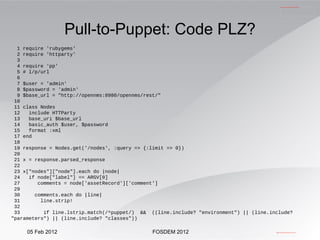
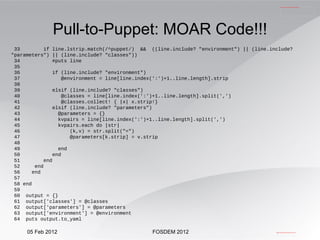
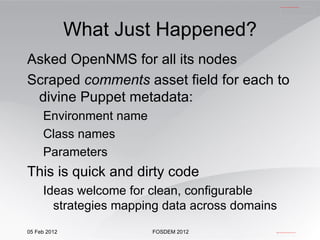
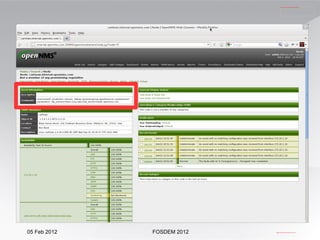
Who Pulls the Strings?  Integrating OpenNMS with Modern Configuration Management FOSDEM 2012, 05 Feb 2012 Jeff Gehlbach Ronny Trommer [email_address] [email_address]
Routers Switches Firewalls Load balancers WAN accelerators VPN concentrators ... does it have an IP address?* Network Management
Major distributions of Linux 2.6 and later Mac OS X *BSD (Open)?(Solaris|Indiana) 10+ Similar but different: AIX, HP-UX Even Windows! Systems Management
Big problem domain when many nodes are involved! How to add them all to be managed? Services up and responding quickly? Something happened, how to know? What's happening under the hood? Something shiny to show the boss? Monitoring and Managing
“ World's First Enterprise-Grade Network Management Platform Developed Under the Open Source Model” Started in 1999 by ex-OpenView hackers Maintained by the Order of the Green Polo Supported, sponsored by my employer Consistent model designed for huge scale 100% GPLv3 codebase Will never suck Will always be Free (as in Freedom) Enter OpenNMS   ® Fauxpen Source
Built from the ground up 100% GPLv3 code base, Java Makes extensive use of good libraries Does not duct-tape in other apps ->  That way lies the end of scalability ->  Not to mention maintainability Architectural decisions dictated by requirement to scale  huge . Not “Based On  Tool X ”
If you want a monitoring app that works just the way you want right out of the box, keep looking. OpenNMS is a platform, not a fixed-function application. It is designed to “front-load” the effort involved in a given task. The payoff comes in easy, automatic repetition of that task at scale. Sound familiar? Designed to Save You Time
If you're happy, don't mess with it. But maybe it wasn't designed for that... Use What Works For You Photo credit: Wikimedia Commons Analogy: Alex Finger <af@genevainformation.ch>
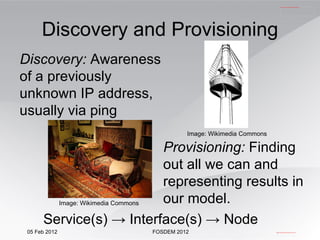
Discovery and Provisioning Service(s) -> Interface(s) -> Node Discovery:  Awareness of a previously unknown IP address, usually via ping Provisioning:  Finding out all we can and representing results in our model. Image: Wikimedia Commons Image: Wikimedia Commons
Provisioning Capsd:  Legacy capabilities scanner. Automatic Provisioning:  Seed an IP address; scan for interfaces and services. Directed Provisioning:  Seed an exact set of known IP interfaces and services. Policy-Based Provisioning:  Seed an IP address; scan for interfaces and services, deciding on persistence, data collection, service monitoring, categorization...
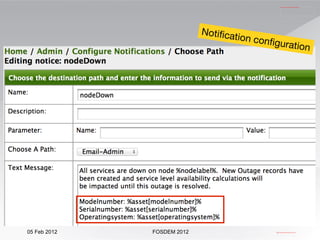
Provisioning (cont'd) External provisioning sources... DNS import:  Create nodes and interfaces from A / AAAA records in a zone ReST API:  Push-wise from outside Your DB:  Make a CGI that generates XML describing your systems, feed URL to Provisiond, watch magic happen This is shouting for a Puppet integration!
Directed Provisioning Every node created this way is part of a  requisition  and has: Foreign Source : a string that groups a set of nodes; identical to the name of the containing  requisition.  Slightly analogous to Puppet's  environments .
Foreign ID : a string that uniquely identifies a node within a requisition. Foreign-Source:Foreign-ID  makes an identifying tuple for a node.
CUE RONNY!
How we can get data from puppet?
What has to be written in OpenNMS?
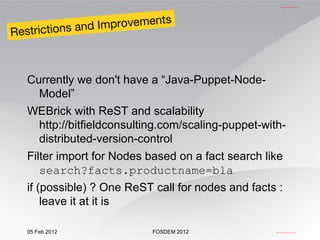
Restrictions?
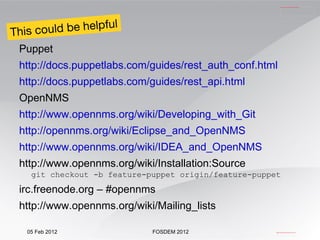
Further improvements? Thoughts for the FOSDEM hack
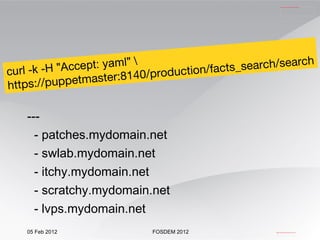
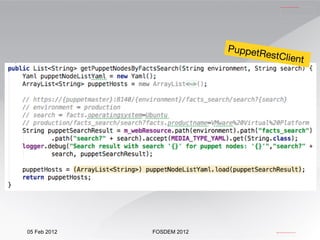
---  - patches.mydomain.net - swlab.mydomain.net - itchy.mydomain.net - scratchy.mydomain.net - lvps.mydomain.net curl -k -H &quot;Accept: yaml&quot; \  https://puppetmaster:8140/production/facts_search/search
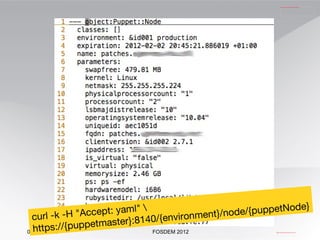
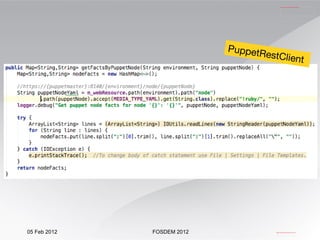
curl -k -H &quot;Accept: yaml&quot; \  https://{puppetmaster}:8140/{environment}/node/{puppetNode}
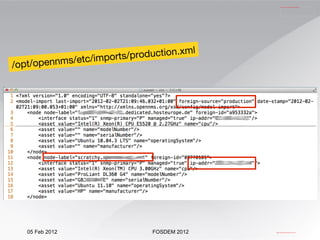
/opt/opennms/etc/imports/production.xml
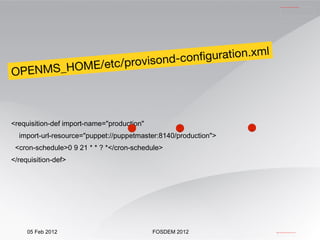
<requisition-def import-name=&quot;production&quot;  import-url-resource=&quot;puppet://puppetmaster:8140/production&quot;> <cron-schedule>0 9 21 * * ? *</cron-schedule> </requisition-def> OPENMS_HOME/etc/provisond-configuration.xml 2 1 3
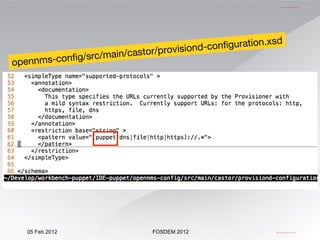
opennms-config/src/main/castor/provisiond-configuration.xsd
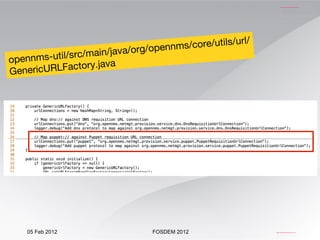
opennms-util/src/main/java/org/opennms/core/utils/url/ GenericURLFactory.java
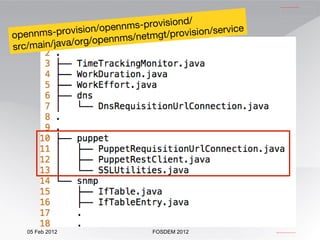
opennms-provision/opennms-provisiond/ src/main/java/org/opennms/netmgt/provision/service
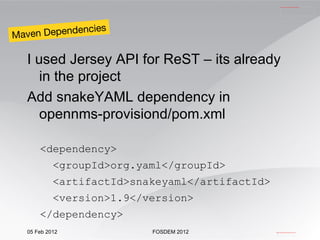
I used Jersey API for ReST – its already in the project
Add snakeYAML dependency in opennms-provisiond/pom.xml <dependency> <groupId>org.yaml</groupId> <artifactId>snakeyaml</artifactId> <version>1.9</version> </dependency> Maven Dependencies
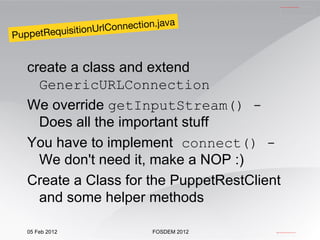
create a class and extend  GenericURLConnection
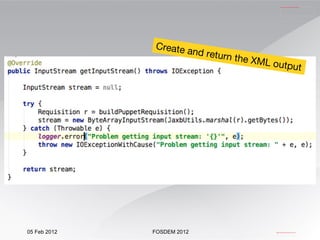
We override  getInputStream() -  Does all the important stuff
You have to implement  connect() -  We don't need it, make a NOP :)
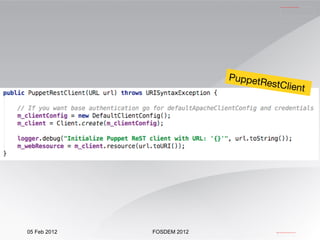
Create a Class for the PuppetRestClient and some helper methods PuppetRequisitionUrlConnection.java
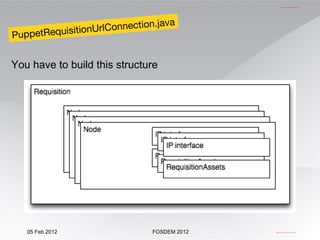
PuppetRequisitionUrlConnection.java You have to build this structure
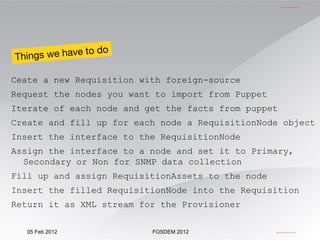
Ceate a new Requisition with foreign-source
Request the nodes you want to import from Puppet
Iterate of each node and get the facts from puppet
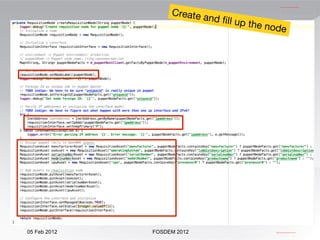
Create and fill up for each node a RequisitionNode object
Insert the interface to the RequisitionNode
Assign the interface to a node and set it to Primary, Secondary or Non for SNMP data collection
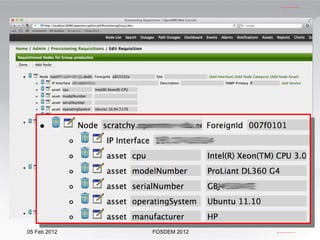
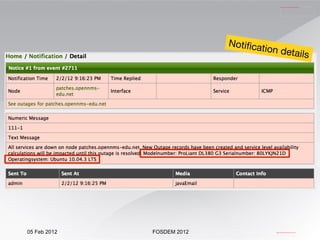
Fill up and assign RequisitionAssets to the node
Insert the filled RequisitionNode into the Requisition
Return it as XML stream for the Provisioner Things we have to do
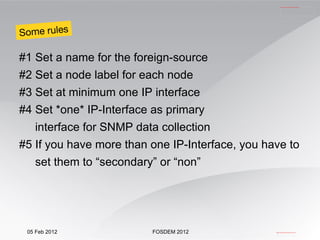
#1 Set a name for the foreign-source #2 Set a node label for each node #3 Set at minimum one IP interface #4 Set  *one*  IP-Interface as primary  interface for SNMP data collection #5 If you have more than one IP-Interface, you have to  set them to “secondary” or “non” Some rules
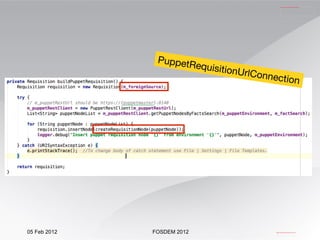
PuppetRequisitionUrlConnection
Create and fill up the node
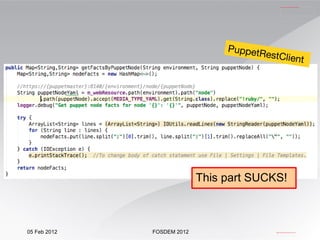
PuppetRestClient
PuppetRestClient
PuppetRestClient

Who pulls the strings?

  • 1.
    Who Pulls theStrings? Integrating OpenNMS with Modern Configuration Management FOSDEM 2012, 05 Feb 2012 Jeff Gehlbach Ronny Trommer [email_address] [email_address]
  • 2.
    Routers Switches FirewallsLoad balancers WAN accelerators VPN concentrators ... does it have an IP address?* Network Management
  • 3.
    Major distributions ofLinux 2.6 and later Mac OS X *BSD (Open)?(Solaris|Indiana) 10+ Similar but different: AIX, HP-UX Even Windows! Systems Management
  • 4.
    Big problem domainwhen many nodes are involved! How to add them all to be managed? Services up and responding quickly? Something happened, how to know? What's happening under the hood? Something shiny to show the boss? Monitoring and Managing
  • 5.
    “ World's FirstEnterprise-Grade Network Management Platform Developed Under the Open Source Model” Started in 1999 by ex-OpenView hackers Maintained by the Order of the Green Polo Supported, sponsored by my employer Consistent model designed for huge scale 100% GPLv3 codebase Will never suck Will always be Free (as in Freedom) Enter OpenNMS ® Fauxpen Source
  • 6.
    Built from theground up 100% GPLv3 code base, Java Makes extensive use of good libraries Does not duct-tape in other apps -> That way lies the end of scalability -> Not to mention maintainability Architectural decisions dictated by requirement to scale huge . Not “Based On Tool X ”
  • 7.
    If you wanta monitoring app that works just the way you want right out of the box, keep looking. OpenNMS is a platform, not a fixed-function application. It is designed to “front-load” the effort involved in a given task. The payoff comes in easy, automatic repetition of that task at scale. Sound familiar? Designed to Save You Time
  • 8.
    If you're happy,don't mess with it. But maybe it wasn't designed for that... Use What Works For You Photo credit: Wikimedia Commons Analogy: Alex Finger <af@genevainformation.ch>
  • 9.
    Discovery and ProvisioningService(s) -> Interface(s) -> Node Discovery: Awareness of a previously unknown IP address, usually via ping Provisioning: Finding out all we can and representing results in our model. Image: Wikimedia Commons Image: Wikimedia Commons
  • 10.
    Provisioning Capsd: Legacy capabilities scanner. Automatic Provisioning: Seed an IP address; scan for interfaces and services. Directed Provisioning: Seed an exact set of known IP interfaces and services. Policy-Based Provisioning: Seed an IP address; scan for interfaces and services, deciding on persistence, data collection, service monitoring, categorization...
  • 11.
    Provisioning (cont'd) Externalprovisioning sources... DNS import: Create nodes and interfaces from A / AAAA records in a zone ReST API: Push-wise from outside Your DB: Make a CGI that generates XML describing your systems, feed URL to Provisiond, watch magic happen This is shouting for a Puppet integration!
  • 12.
    Directed Provisioning Everynode created this way is part of a requisition and has: Foreign Source : a string that groups a set of nodes; identical to the name of the containing requisition. Slightly analogous to Puppet's environments .
  • 13.
    Foreign ID :a string that uniquely identifies a node within a requisition. Foreign-Source:Foreign-ID makes an identifying tuple for a node.
  • 14.
  • 15.
    How we canget data from puppet?
  • 16.
    What has tobe written in OpenNMS?
  • 17.
  • 18.
    Further improvements? Thoughtsfor the FOSDEM hack
  • 19.
    --- -patches.mydomain.net - swlab.mydomain.net - itchy.mydomain.net - scratchy.mydomain.net - lvps.mydomain.net curl -k -H &quot;Accept: yaml&quot; \ https://puppetmaster:8140/production/facts_search/search
  • 20.
    curl -k -H&quot;Accept: yaml&quot; \ https://{puppetmaster}:8140/{environment}/node/{puppetNode}
  • 21.
  • 22.
    <requisition-def import-name=&quot;production&quot; import-url-resource=&quot;puppet://puppetmaster:8140/production&quot;> <cron-schedule>0 9 21 * * ? *</cron-schedule> </requisition-def> OPENMS_HOME/etc/provisond-configuration.xml 2 1 3
  • 23.
  • 24.
  • 25.
  • 26.
    I used JerseyAPI for ReST – its already in the project
  • 27.
    Add snakeYAML dependencyin opennms-provisiond/pom.xml <dependency> <groupId>org.yaml</groupId> <artifactId>snakeyaml</artifactId> <version>1.9</version> </dependency> Maven Dependencies
  • 28.
    create a classand extend GenericURLConnection
  • 29.
    We override getInputStream() - Does all the important stuff
  • 30.
    You have toimplement connect() - We don't need it, make a NOP :)
  • 31.
    Create a Classfor the PuppetRestClient and some helper methods PuppetRequisitionUrlConnection.java
  • 32.
  • 33.
    Ceate a newRequisition with foreign-source
  • 34.
    Request the nodesyou want to import from Puppet
  • 35.
    Iterate of eachnode and get the facts from puppet
  • 36.
    Create and fillup for each node a RequisitionNode object
  • 37.
    Insert the interfaceto the RequisitionNode
  • 38.
    Assign the interfaceto a node and set it to Primary, Secondary or Non for SNMP data collection
  • 39.
    Fill up andassign RequisitionAssets to the node
  • 40.
    Insert the filledRequisitionNode into the Requisition
  • 41.
    Return it asXML stream for the Provisioner Things we have to do
  • 42.
    #1 Set aname for the foreign-source #2 Set a node label for each node #3 Set at minimum one IP interface #4 Set *one* IP-Interface as primary interface for SNMP data collection #5 If you have more than one IP-Interface, you have to set them to “secondary” or “non” Some rules
  • 43.
  • 44.
    Create and fillup the node
  • 45.
  • 46.
  • 47.