Presentation by: 
Ashwini Kamath U 
II MBA ‘A’
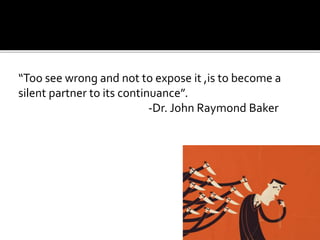
“Too see wrong and not to expose it ,is to become a 
silent partner to its continuance”. 
-Dr. John Raymond Baker
 A whistleblower is an employee, former employee, or 
member of an organization, especially a business or 
government agency, who reports misconduct to people or 
entities that have the power and presumed willingness to 
take corrective action. 
 Generally the misconduct is a violation of law, rule, 
regulation and/or a direct threat to public interest, such as 
fraud, health/safety violations, and corruption.
 Whistleblowing leads to good and bad results. First, the 
benefits of carefully considered whistleblowing can lead to 
the end of unethical business practices. The lives of 
individuals and whole communities have been saved by 
whistleblowers. 
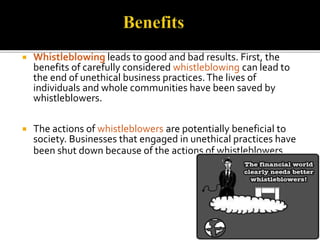
 The actions of whistleblowers are potentially beneficial to 
society. Businesses that engaged in unethical practices have 
been shut down because of the actions of whistleblowers.
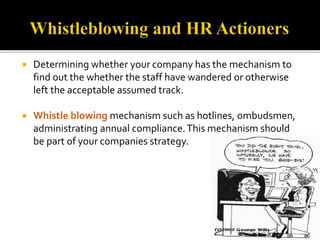
 Determining whether your company has the mechanism to 
find out the whether the staff have wandered or otherwise 
left the acceptable assumed track. 
 Whistle blowing mechanism such as hotlines, ombudsmen, 
administrating annual compliance. This mechanism should 
be part of your companies strategy.
 An employee who witness unethical business practice at 
work may want to think carefully before informing to the 
authorities. 
 Company loyalty is an internally held value. 
 When should an employee blow the whistle? When should he 
or she keep quiet?
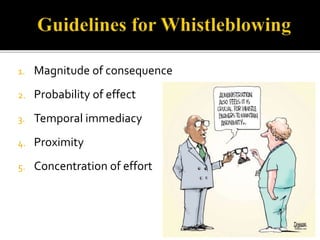
1. Magnitude of consequence 
2. Probability of effect 
3. Temporal immediacy 
4. Proximity 
5. Concentration of effort
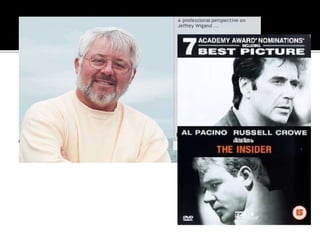
 Jeffrey Wigand- “The Insider” 
 FDA Whistleblower
 Jeffrey Wigand, vice president for tobacco research and 
development at Brown & Williamson: Wigand became the 
whistle-blower on Big Tobacco, telling how the industry 
minimized tobacco's health and safety issues. His story was 
told in the movie The Insider. The tale gets nasty. Wigand 
was fired in 1993. His former employer publicized 
unsubstantiated allegations of shoplifting and domestic 
abuse from his past. He went on to assist the U.S. Food and 
Drug Administration in its investigation of the tobacco 
industry. 
 Wigand now runs a nonprofit foundation in South Carolina 
devoted to educating children about health issues, including 
tobacco use and alcohol consumption.
Robert Misbin, medical officer, Food and Drug Administration: 
The scientist blew the whistle on the dangers of the diabetes 
drug Rezulin. He resigned from the FDA in the fall of 2000, 
complaining that politics and bureaucratic concerns had 
replaced sound medical judgment in approving drugs. At issue: 
that drug maker Warner-Lambert Inc. had pressured the FDA to 
approve Rezulin, despite a number of patient deaths from liver 
failure. Rezulin was recalled in 2000, the same year that Warner- 
Lambert was acquired by Pfizer.
An executive of a large company learns that the company is 
violating the state antipollution law by dumping chemicals into 
the lake bordering its plant. The state inspectors are being 
bribed to ignore the violation. What are the executive’s options? 
What are the consequences of each option? Which option 
should the executive choose?
Whistle blowing

Whistle blowing

  • 1.
    Presentation by: AshwiniKamath U II MBA ‘A’
  • 2.
    “Too see wrongand not to expose it ,is to become a silent partner to its continuance”. -Dr. John Raymond Baker
  • 3.
     A whistlebloweris an employee, former employee, or member of an organization, especially a business or government agency, who reports misconduct to people or entities that have the power and presumed willingness to take corrective action.  Generally the misconduct is a violation of law, rule, regulation and/or a direct threat to public interest, such as fraud, health/safety violations, and corruption.
  • 4.
     Whistleblowing leadsto good and bad results. First, the benefits of carefully considered whistleblowing can lead to the end of unethical business practices. The lives of individuals and whole communities have been saved by whistleblowers.  The actions of whistleblowers are potentially beneficial to society. Businesses that engaged in unethical practices have been shut down because of the actions of whistleblowers.
  • 5.
     Determining whetheryour company has the mechanism to find out the whether the staff have wandered or otherwise left the acceptable assumed track.  Whistle blowing mechanism such as hotlines, ombudsmen, administrating annual compliance. This mechanism should be part of your companies strategy.
  • 6.
     An employeewho witness unethical business practice at work may want to think carefully before informing to the authorities.  Company loyalty is an internally held value.  When should an employee blow the whistle? When should he or she keep quiet?
  • 7.
    1. Magnitude ofconsequence 2. Probability of effect 3. Temporal immediacy 4. Proximity 5. Concentration of effort
  • 8.
     Jeffrey Wigand-“The Insider”  FDA Whistleblower
  • 9.
     Jeffrey Wigand,vice president for tobacco research and development at Brown & Williamson: Wigand became the whistle-blower on Big Tobacco, telling how the industry minimized tobacco's health and safety issues. His story was told in the movie The Insider. The tale gets nasty. Wigand was fired in 1993. His former employer publicized unsubstantiated allegations of shoplifting and domestic abuse from his past. He went on to assist the U.S. Food and Drug Administration in its investigation of the tobacco industry.  Wigand now runs a nonprofit foundation in South Carolina devoted to educating children about health issues, including tobacco use and alcohol consumption.
  • 11.
    Robert Misbin, medicalofficer, Food and Drug Administration: The scientist blew the whistle on the dangers of the diabetes drug Rezulin. He resigned from the FDA in the fall of 2000, complaining that politics and bureaucratic concerns had replaced sound medical judgment in approving drugs. At issue: that drug maker Warner-Lambert Inc. had pressured the FDA to approve Rezulin, despite a number of patient deaths from liver failure. Rezulin was recalled in 2000, the same year that Warner- Lambert was acquired by Pfizer.
  • 12.
    An executive ofa large company learns that the company is violating the state antipollution law by dumping chemicals into the lake bordering its plant. The state inspectors are being bribed to ignore the violation. What are the executive’s options? What are the consequences of each option? Which option should the executive choose?