HERE WE ARE
Republic of Poland


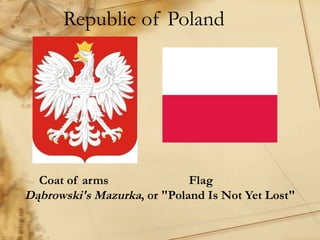
  Coat of arms               Flag
Dąbrowski's Mazurka, or "Poland Is Not Yet Lost"
Capital
       (and the largest city) Warsaw
     52°13′N 21°02′E / 52.217, 21.033
        Official languages - Polish
   Government Parliamentary republic  
    President – Bronisław Komorowski
      Prime Minister - Donald Tusk
Formation  -  Christianisation 14 April 966   
      Redeclared 11 November 1918 
         EU accession 1 May 2004
         Area  -  Total 312,679 km² 
          Population  -  38,116,000
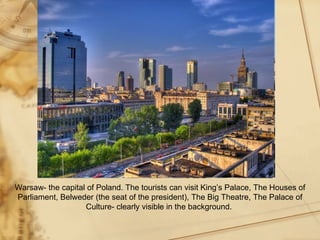
Warsaw- the capital of Poland. The tourists can visit King’s Palace, The Houses of
Parliament, Belweder (the seat of the president), The Big Theatre, The Palace of
                   Culture- clearly visible in the background.
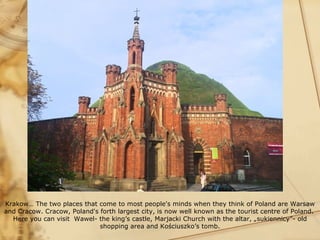
Krakow… The two places that come to most people's minds when they think of Poland are Warsaw
and Cracow. Cracow, Poland's forth largest city, is now well known as the tourist centre of Poland.
  Here you can visit Wawel- the king’s castle, Marjacki Church with the altar, „sukiennicy”- old
                             shopping area and Kościuszko’s tomb.
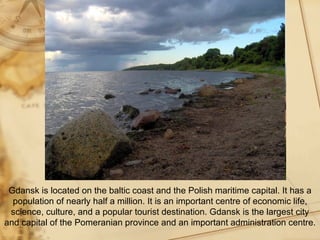
Gdansk is located on the baltic coast and the Polish maritime capital. It has a
  population of nearly half a million. It is an important centre of economic life,
 science, culture, and a popular tourist destination. Gdansk is the largest city
and capital of the Pomeranian province and an important administration centre.
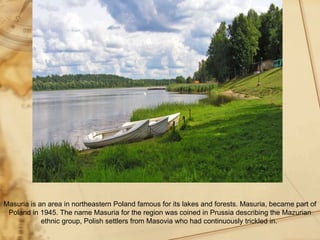
Masuria is an area in northeastern Poland famous for its lakes and forests. Masuria, became part of
 Poland in 1945. The name Masuria for the region was coined in Prussia describing the Mazurian
            ethnic group, Polish settlers from Masovia who had continuously trickled in.
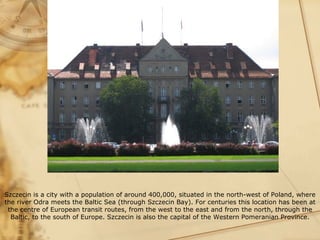
Szczecin is a city with a population of around 400,000, situated in the north-west of Poland, where
the river Odra meets the Baltic Sea (through Szczecin Bay). For centuries this location has been at
 the centre of European transit routes, from the west to the east and from the north, through the
  Baltic, to the south of Europe. Szczecin is also the capital of the Western Pomeranian Province.
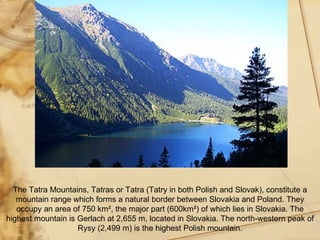
The Tatra Mountains, Tatras or Tatra (Tatry in both Polish and Slovak), constitute a
   mountain range which forms a natural border between Slovakia and Poland. They
   occupy an area of 750 km², the major part (600km²) of which lies in Slovakia. The
highest mountain is Gerlach at 2,655 m, located in Slovakia. The north-western peak of
                    Rysy (2,499 m) is the highest Polish mountain.
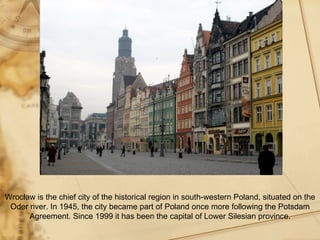
Wrocław is the chief city of the historical region in south-western Poland, situated on the
 Oder river. In 1945, the city became part of Poland once more following the Potsdam
      Agreement. Since 1999 it has been the capital of Lower Silesian province.
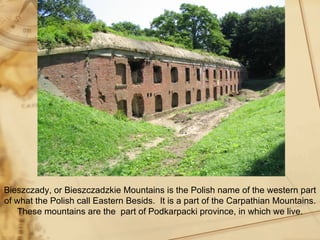
Bieszczady, or Bieszczadzkie Mountains is the Polish name of the western part
of what the Polish call Eastern Besids. It is a part of the Carpathian Mountains.
   These mountains are the part of Podkarpacki province, in which we live.
Yeahhhhh!!!!
HERE
WE ARE !
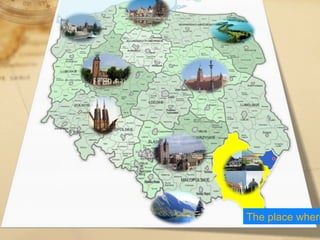
The place where
Where we live!

Where we live!

  • 1.
  • 2.
    Republic of Poland Coat of arms Flag Dąbrowski's Mazurka, or "Poland Is Not Yet Lost"
  • 3.
    Capital (and the largest city) Warsaw 52°13′N 21°02′E / 52.217, 21.033 Official languages - Polish Government Parliamentary republic   President – Bronisław Komorowski Prime Minister - Donald Tusk Formation  -  Christianisation 14 April 966    Redeclared 11 November 1918  EU accession 1 May 2004 Area  -  Total 312,679 km²  Population  -  38,116,000
  • 4.
    Warsaw- the capitalof Poland. The tourists can visit King’s Palace, The Houses of Parliament, Belweder (the seat of the president), The Big Theatre, The Palace of Culture- clearly visible in the background.
  • 5.
    Krakow… The twoplaces that come to most people's minds when they think of Poland are Warsaw and Cracow. Cracow, Poland's forth largest city, is now well known as the tourist centre of Poland. Here you can visit Wawel- the king’s castle, Marjacki Church with the altar, „sukiennicy”- old shopping area and Kościuszko’s tomb.
  • 6.
    Gdansk is locatedon the baltic coast and the Polish maritime capital. It has a population of nearly half a million. It is an important centre of economic life, science, culture, and a popular tourist destination. Gdansk is the largest city and capital of the Pomeranian province and an important administration centre.
  • 7.
    Masuria is anarea in northeastern Poland famous for its lakes and forests. Masuria, became part of Poland in 1945. The name Masuria for the region was coined in Prussia describing the Mazurian ethnic group, Polish settlers from Masovia who had continuously trickled in.
  • 8.
    Szczecin is acity with a population of around 400,000, situated in the north-west of Poland, where the river Odra meets the Baltic Sea (through Szczecin Bay). For centuries this location has been at the centre of European transit routes, from the west to the east and from the north, through the Baltic, to the south of Europe. Szczecin is also the capital of the Western Pomeranian Province.
  • 9.
    The Tatra Mountains,Tatras or Tatra (Tatry in both Polish and Slovak), constitute a mountain range which forms a natural border between Slovakia and Poland. They occupy an area of 750 km², the major part (600km²) of which lies in Slovakia. The highest mountain is Gerlach at 2,655 m, located in Slovakia. The north-western peak of Rysy (2,499 m) is the highest Polish mountain.
  • 10.
    Wrocław is thechief city of the historical region in south-western Poland, situated on the Oder river. In 1945, the city became part of Poland once more following the Potsdam Agreement. Since 1999 it has been the capital of Lower Silesian province.
  • 11.
    Bieszczady, or BieszczadzkieMountains is the Polish name of the western part of what the Polish call Eastern Besids. It is a part of the Carpathian Mountains. These mountains are the part of Podkarpacki province, in which we live.
  • 12.
  • 13.