AIESEC IN
KRAKOW
Reception
 Booklet
Few words at the beginning…


Welcome!!!
We are glad that you are interested in Krakow and
we invite you to participate in journey of your
lifetime. To encourage you to come we present you
our brand new polished and shining reception
booklet , in which you can find all the necessary
information.
So just enjoy…
Content
Poland - General Information .................................................................................................4
  Climate ...............................................................................................................................5
  Geography ..........................................................................................................................5
  History of Poland ................................................................................................................7
  Famous Polish People .........................................................................................................9
  Polish Politics ...................................................................................................................13
  Economy ..........................................................................................................................15
  Religion in Poland ............................................................................................................17
  Sports ...............................................................................................................................17
  Holidays ...........................................................................................................................19
Useful Information ...............................................................................................................20
  Fоod .................................................................................................................................20
  Currency ...........................................................................................................................22
  Time zone .........................................................................................................................22
  Prices ................................................................................................................................22
  Units .................................................................................................................................23
  Electricity .........................................................................................................................23
  Communication ................................................................................................................24
  Business Hours .................................................................................................................25
  Useful phrases ..................................................................................................................26
Krakow ................................................................................................................................29
  How to get here?...............................................................................................................29
  Location ...........................................................................................................................31
  Our City ...........................................................................................................................31
  History .............................................................................................................................33
  Universities ......................................................................................................................36
  Cultural life ......................................................................................................................39
  Night life ..........................................................................................................................43
  Places to visit in Krakow and nearby ................................................................................45
  Nearby Krakow ................................................................................................................49
Poland - General Information
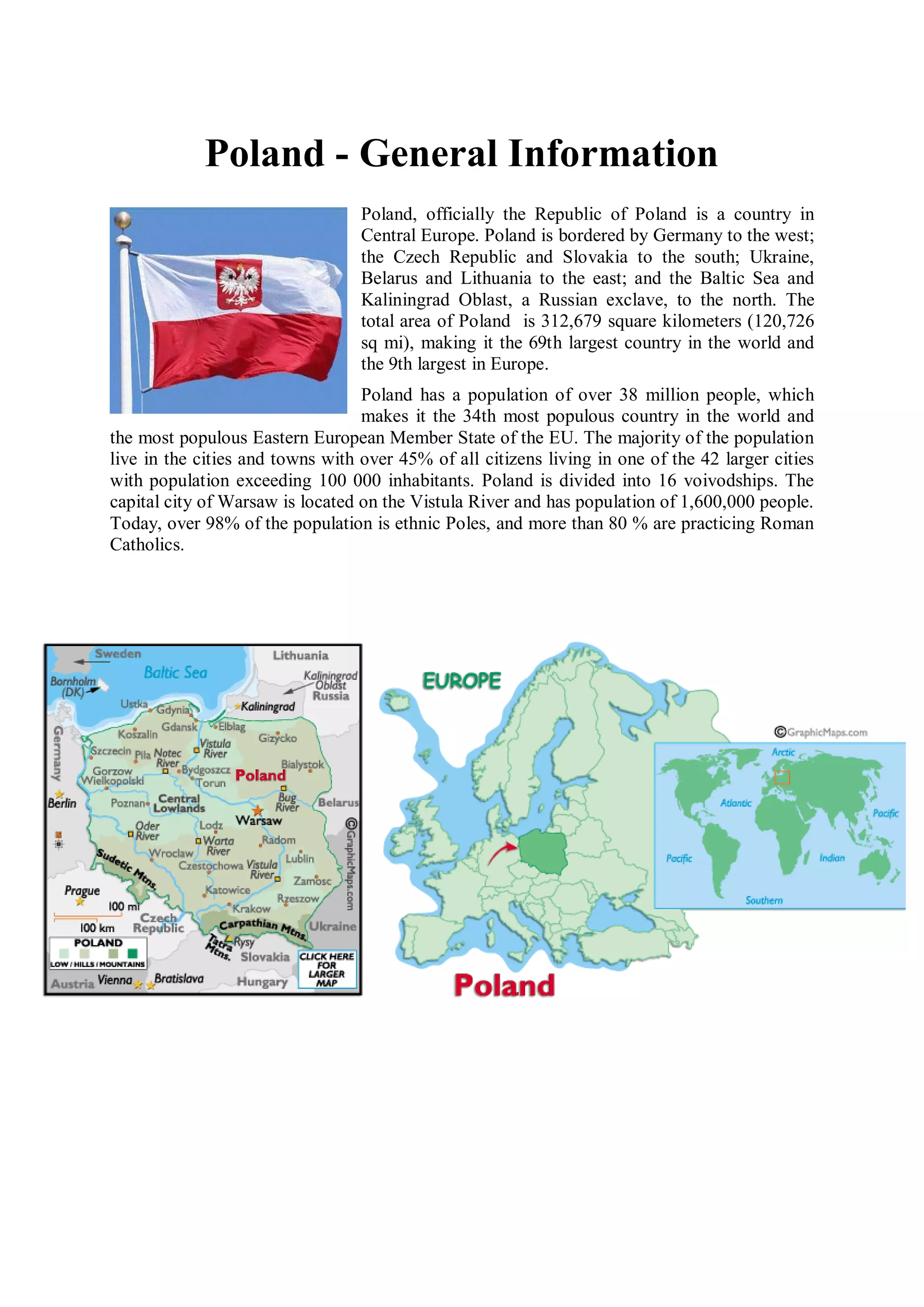
                                  Poland, officially the Republic of Poland is a country in
                                  Central Europe. Poland is bordered by Germany to the west;
                                  the Czech Republic and Slovakia to the south; Ukraine,
                                  Belarus and Lithuania to the east; and the Baltic Sea and
                                  Kaliningrad Oblast, a Russian exclave, to the north. The
                                  total area of Poland is 312,679 square kilometers (120,726
                                  sq mi), making it the 69th largest country in the world and
                                  the 9th largest in Europe.
                                  Poland has a population of over 38 million people, which
                                  makes it the 34th most populous country in the world and
the most populous Eastern European Member State of the EU. The majority of the population
live in the cities and towns with over 45% of all citizens living in one of the 42 larger cities
with population exceeding 100 000 inhabitants. Poland is divided into 16 voivodships. The
capital city of Warsaw is located on the Vistula River and has population of 1,600,000 people.
Today, over 98% of the population is ethnic Poles, and more than 80 % are practicing Roman
Catholics.
Climate
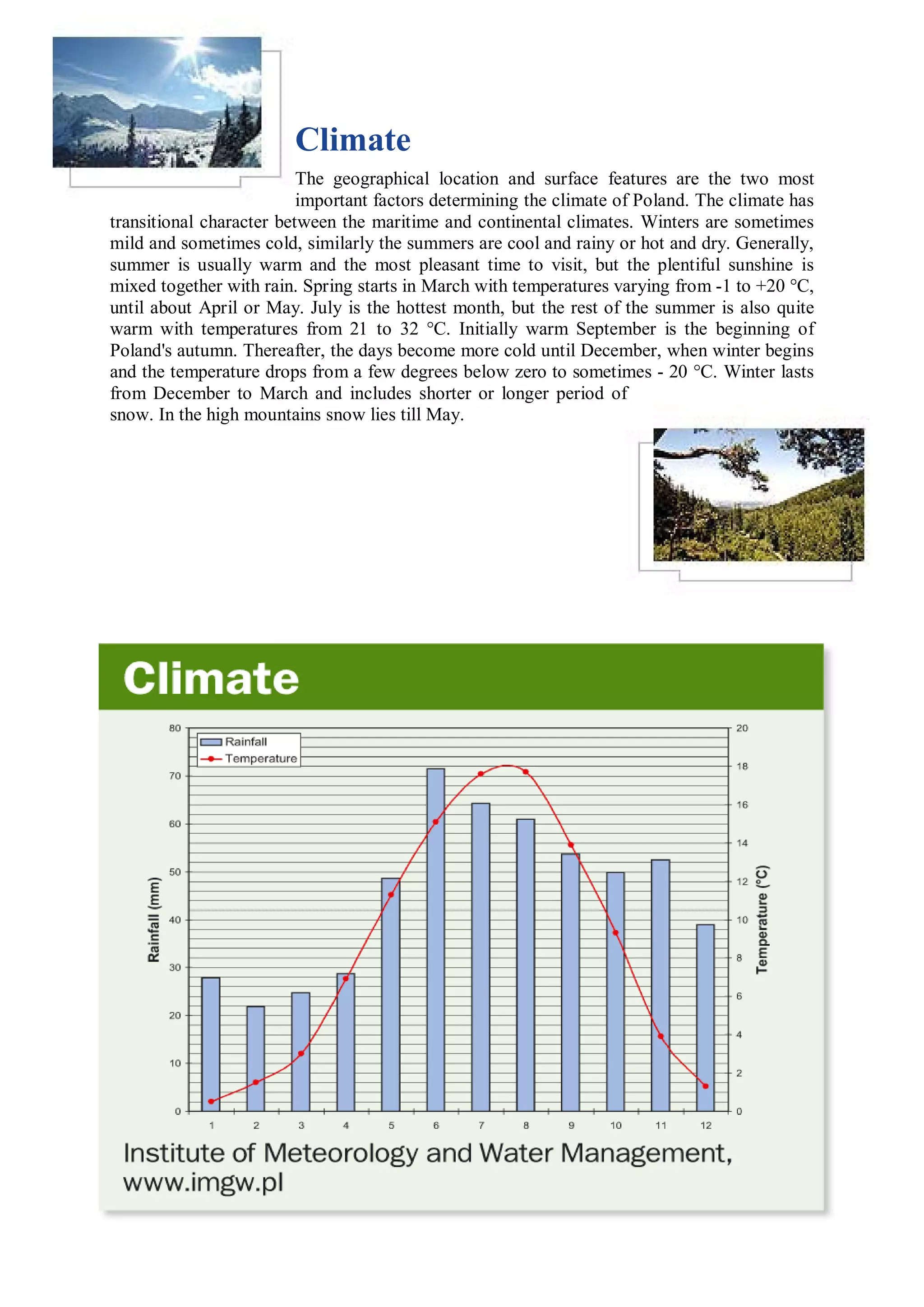
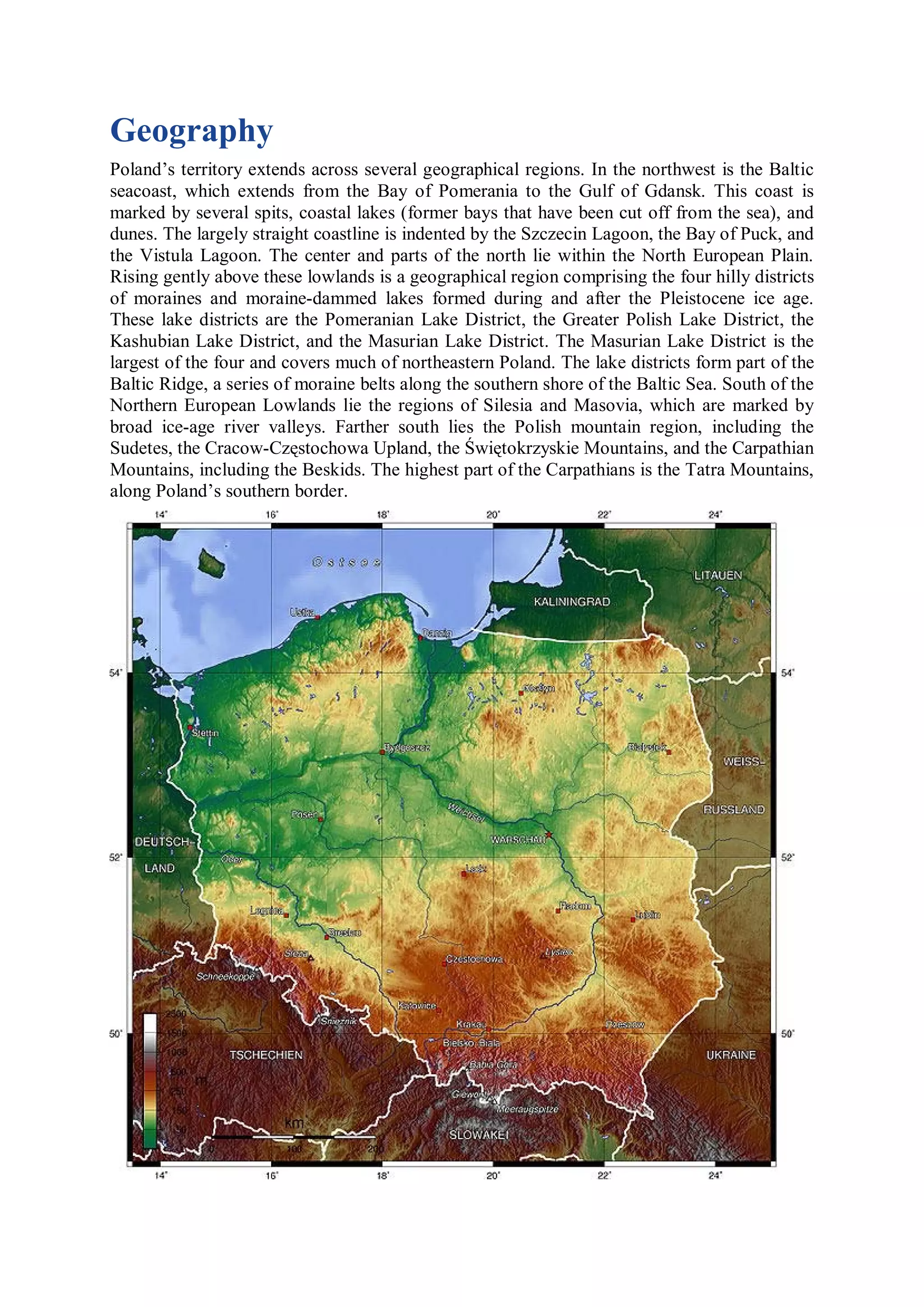
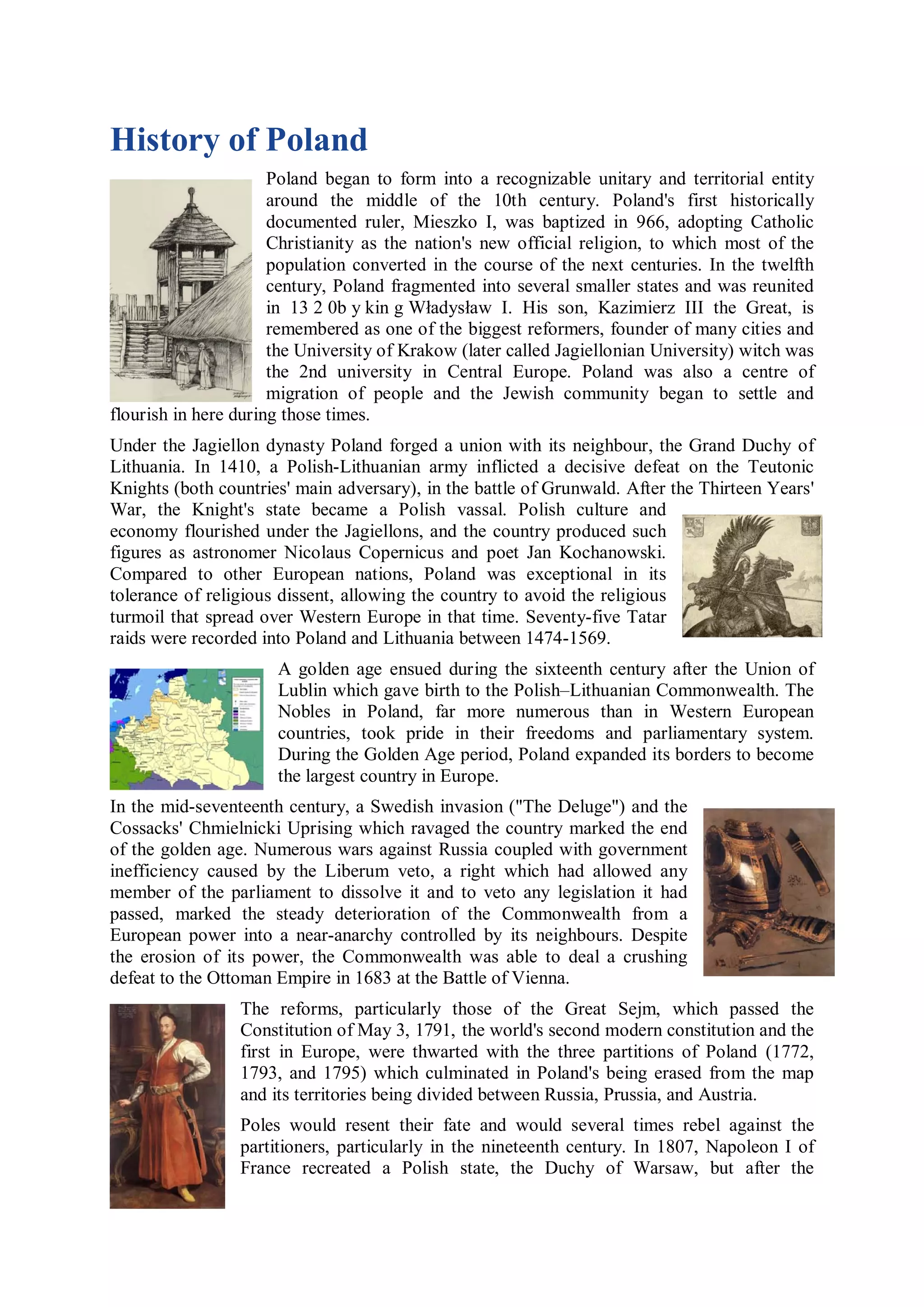
                          The geographical location and surface features are the two most
                          important factors determining the climate of Poland. The climate has
transitional character between the maritime and continental climates. Winters are sometimes
mild and sometimes cold, similarly the summers are cool and rainy or hot and dry. Generally,
summer is usually warm and the most pleasant time to visit, but the plentiful sunshine is
mixed together with rain. Spring starts in March with temperatures varying from -1 to +20 °C,
until about April or May. July is the hottest month, but the rest of the summer is also quite
warm with temperatures from 21 to 32 °C. Initially warm September is the beginning of
Poland's autumn. Thereafter, the days become more cold until December, when winter begins
and the temperature drops from a few degrees below zero to sometimes - 20 °C. Winter lasts
from December to March and includes shorter or longer period of
snow. In the high mountains snow lies till May.
Geography
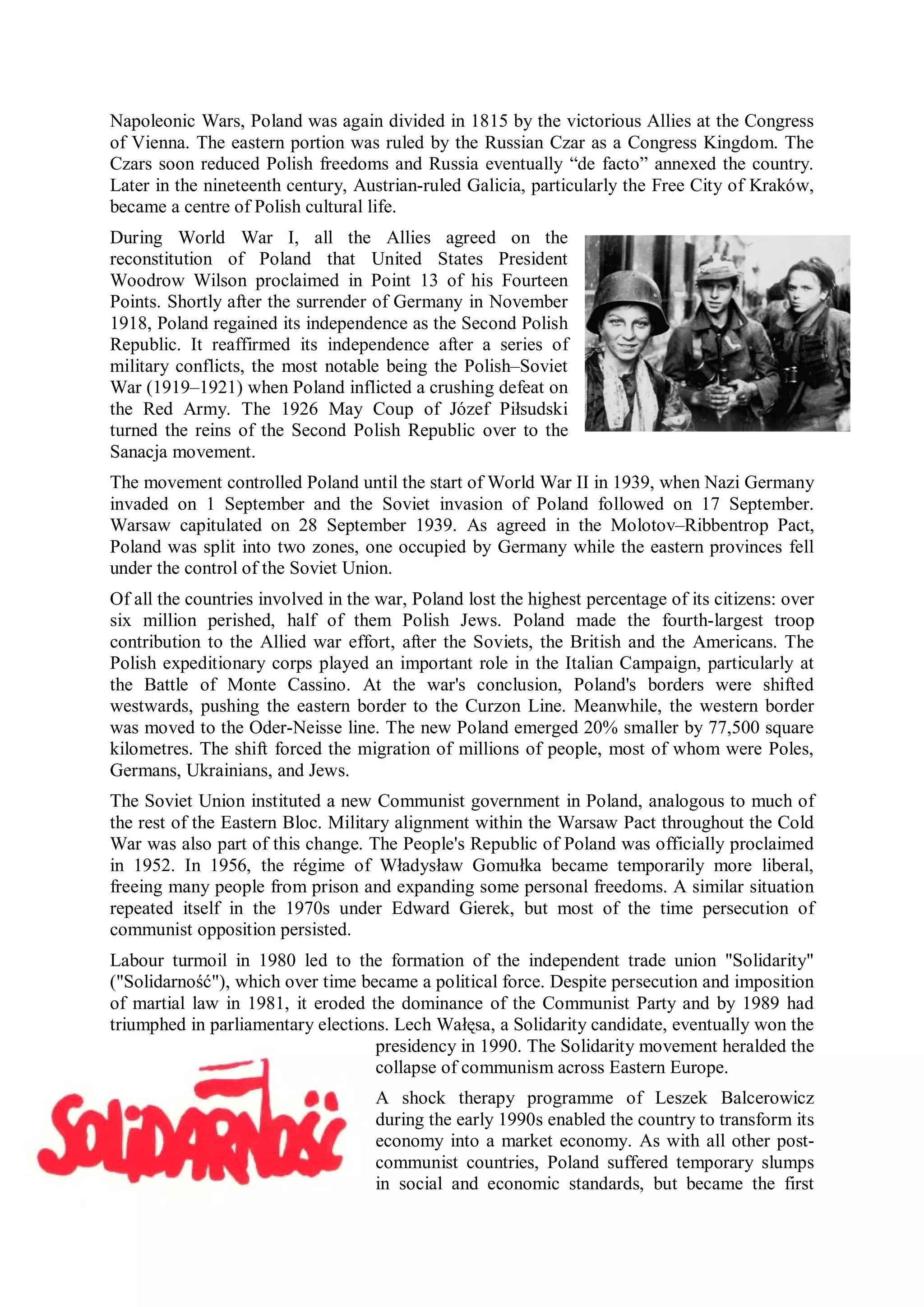
Poland’s territory extends across several geographical regions. In the northwest is the Baltic
seacoast, which extends from the Bay of Pomerania to the Gulf of Gdansk. This coast is
marked by several spits, coastal lakes (former bays that have been cut off from the sea), and
dunes. The largely straight coastline is indented by the Szczecin Lagoon, the Bay of Puck, and
the Vistula Lagoon. The center and parts of the north lie within the North European Plain.
Rising gently above these lowlands is a geographical region comprising the four hilly districts
of moraines and moraine-dammed lakes formed during and after the Pleistocene ice age.
These lake districts are the Pomeranian Lake District, the Greater Polish Lake District, the
Kashubian Lake District, and the Masurian Lake District. The Masurian Lake District is the
largest of the four and covers much of northeastern Poland. The lake districts form part of the
Baltic Ridge, a series of moraine belts along the southern shore of the Baltic Sea. South of the
Northern European Lowlands lie the regions of Silesia and Masovia, which are marked by
broad ice-age river valleys. Farther south lies the Polish mountain region, including the
Sudetes, the Cracow-Częstochowa Upland, the Świętokrzyskie Mountains, and the Carpathian
Mountains, including the Beskids. The highest part of the Carpathians is the Tatra Mountains,
along Poland’s southern border.
History of Poland
                      Poland began to form into a recognizable unitary and territorial entity
                      around the middle of the 10th century. Poland's first historically
                      documented ruler, Mieszko I, was baptized in 966, adopting Catholic
                      Christianity as the nation's new official religion, to which most of the
                      population converted in the course of the next centuries. In the twelfth
                      century, Poland fragmented into several smaller states and was reunited
                      in 13 2 0b y kin g Władysław I. His son, Kazimierz III the Great, is
                      remembered as one of the biggest reformers, founder of many cities and
                      the University of Krakow (later called Jagiellonian University) witch was
                      the 2nd university in Central Europe. Poland was also a centre of
                      migration of people and the Jewish community began to settle and
flourish in here during those times.
Under the Jagiellon dynasty Poland forged a union with its neighbour, the Grand Duchy of
Lithuania. In 1410, a Polish-Lithuanian army inflicted a decisive defeat on the Teutonic
Knights (both countries' main adversary), in the battle of Grunwald. After the Thirteen Years'
War, the Knight's state became a Polish vassal. Polish culture and
economy flourished under the Jagiellons, and the country produced such
figures as astronomer Nicolaus Copernicus and poet Jan Kochanowski.
Compared to other European nations, Poland was exceptional in its
tolerance of religious dissent, allowing the country to avoid the religious
turmoil that spread over Western Europe in that time. Seventy-five Tatar
raids were recorded into Poland and Lithuania between 1474-1569.
                      A golden age ensued during the sixteenth century after the Union of
                      Lublin which gave birth to the Polish–Lithuanian Commonwealth. The
                      Nobles in Poland, far more numerous than in Western European
                      countries, took pride in their freedoms and parliamentary system.
                      During the Golden Age period, Poland expanded its borders to become
                      the largest country in Europe.
In the mid-seventeenth century, a Swedish invasion ("The Deluge") and the
Cossacks' Chmielnicki Uprising which ravaged the country marked the end
of the golden age. Numerous wars against Russia coupled with government
inefficiency caused by the Liberum veto, a right which had allowed any
member of the parliament to dissolve it and to veto any legislation it had
passed, marked the steady deterioration of the Commonwealth from a
European power into a near-anarchy controlled by its neighbours. Despite
the erosion of its power, the Commonwealth was able to deal a crushing
defeat to the Ottoman Empire in 1683 at the Battle of Vienna.
                 The reforms, particularly those of the Great Sejm, which passed the
                 Constitution of May 3, 1791, the world's second modern constitution and the
                 first in Europe, were thwarted with the three partitions of Poland (1772,
                 1793, and 1795) which culminated in Poland's being erased from the map
                 and its territories being divided between Russia, Prussia, and Austria.
                 Poles would resent their fate and would several times rebel against the
                 partitioners, particularly in the nineteenth century. In 1807, Napoleon I of
                 France recreated a Polish state, the Duchy of Warsaw, but after the
Napoleonic Wars, Poland was again divided in 1815 by the victorious Allies at the Congress
of Vienna. The eastern portion was ruled by the Russian Czar as a Congress Kingdom. The
Czars soon reduced Polish freedoms and Russia eventually “de facto” annexed the country.
Later in the nineteenth century, Austrian-ruled Galicia, particularly the Free City of Kraków,
became a centre of Polish cultural life.
During World War I, all the Allies agreed on the
reconstitution of Poland that United States President
Woodrow Wilson proclaimed in Point 13 of his Fourteen
Points. Shortly after the surrender of Germany in November
1918, Poland regained its independence as the Second Polish
Republic. It reaffirmed its independence after a series of
military conflicts, the most notable being the Polish–Soviet
War (1919–1921) when Poland inflicted a crushing defeat on
the Red Army. The 1926 May Coup of Józef Piłsudski
turned the reins of the Second Polish Republic over to the
Sanacja movement.
The movement controlled Poland until the start of World War II in 1939, when Nazi Germany
invaded on 1 September and the Soviet invasion of Poland followed on 17 September.
Warsaw capitulated on 28 September 1939. As agreed in the Molotov–Ribbentrop Pact,
Poland was split into two zones, one occupied by Germany while the eastern provinces fell
under the control of the Soviet Union.
Of all the countries involved in the war, Poland lost the highest percentage of its citizens: over
six million perished, half of them Polish Jews. Poland made the fourth-largest troop
contribution to the Allied war effort, after the Soviets, the British and the Americans. The
Polish expeditionary corps played an important role in the Italian Campaign, particularly at
the Battle of Monte Cassino. At the war's conclusion, Poland's borders were shifted
westwards, pushing the eastern border to the Curzon Line. Meanwhile, the western border
was moved to the Oder-Neisse line. The new Poland emerged 20% smaller by 77,500 square
kilometres. The shift forced the migration of millions of people, most of whom were Poles,
Germans, Ukrainians, and Jews.
The Soviet Union instituted a new Communist government in Poland, analogous to much of
the rest of the Eastern Bloc. Military alignment within the Warsaw Pact throughout the Cold
War was also part of this change. The People's Republic of Poland was officially proclaimed
in 1952. In 1956, the régime of Władysław Gomułka became temporarily more liberal,
freeing many people from prison and expanding some personal freedoms. A similar situation
repeated itself in the 1970s under Edward Gierek, but most of the time persecution of
communist opposition persisted.
Labour turmoil in 1980 led to the formation of the independent trade union "Solidarity"
("Solidarność"), which over time became a political force. Despite persecution and imposition
of martial law in 1981, it eroded the dominance of the Communist Party and by 1989 had
triumphed in parliamentary elections. Lech Wałęsa, a Solidarity candidate, eventually won the
                                   presidency in 1990. The Solidarity movement heralded the
                                   collapse of communism across Eastern Europe.
                                    A shock therapy programme of Leszek Balcerowicz
                                    during the early 1990s enabled the country to transform its
                                    economy into a market economy. As with all other post-
                                    communist countries, Poland suffered temporary slumps
                                    in social and economic standards, but became the first
post-communist country to reach its pre-1989 GDP levels, which it achieved by 1995 due to
its booming economy. Most visibly, there were numerous improvements in other human
rights, such as the freedom of speech. In 1991, Poland became a member of the Visegrád
Group and joined the North Atlantic Treaty Organization (NATO) alliance in 1999 along with
the Czech Republic and Hungary. Poles then voted to join the European Union in a
referendum in June 2003, with Poland becoming a full member on 1 May 2004. In 2007
Poland joined Schengen Area.

 Famous Polish People
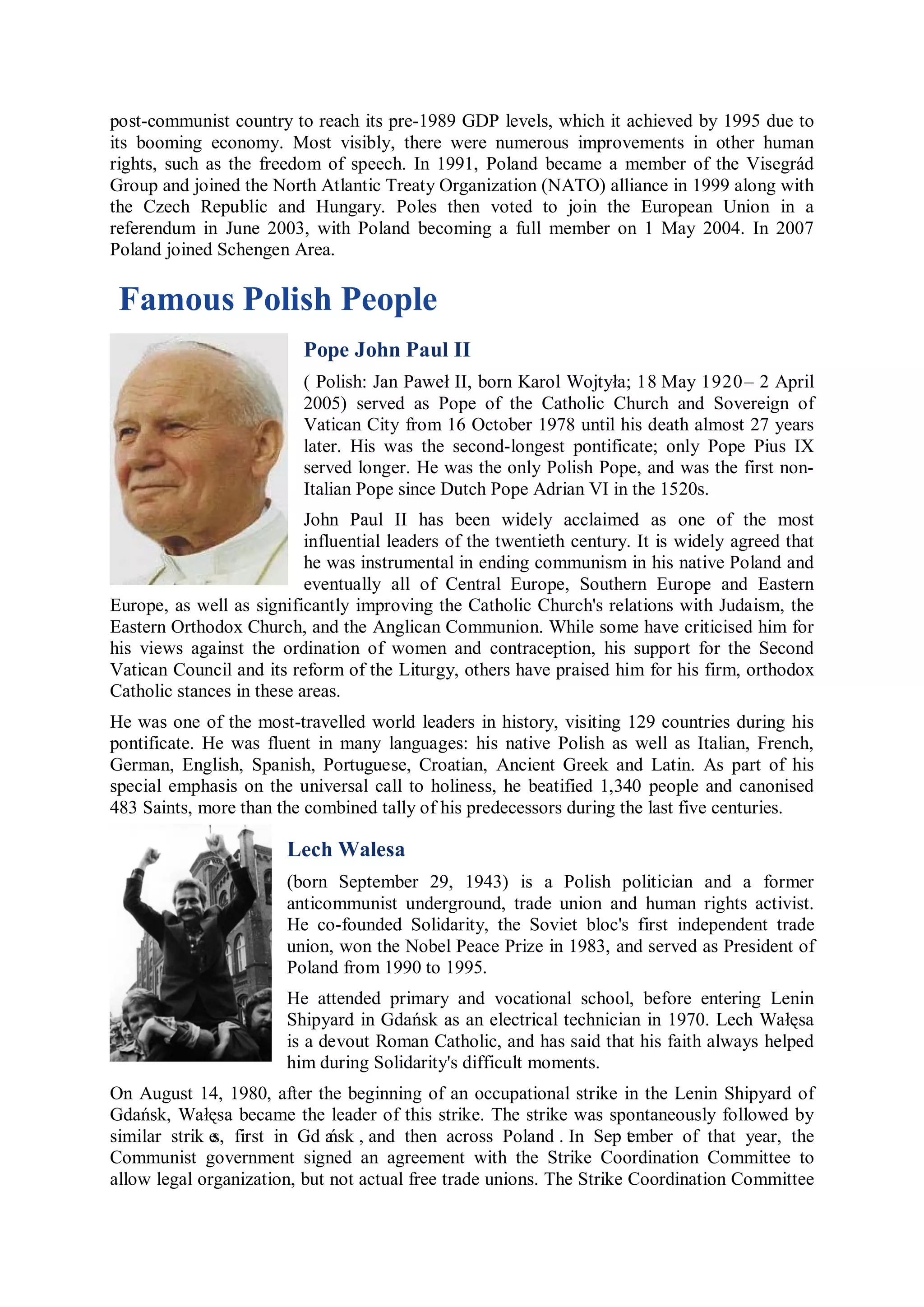
                          Pope John Paul II
                          ( Polish: Jan Paweł II, born Karol Wojtyła; 18 May 1920 – 2 April
                          2005) served as Pope of the Catholic Church and Sovereign of
                          Vatican City from 16 October 1978 until his death almost 27 years
                          later. His was the second-longest pontificate; only Pope Pius IX
                          served longer. He was the only Polish Pope, and was the first non-
                          Italian Pope since Dutch Pope Adrian VI in the 1520s.
                           John Paul II has been widely acclaimed as one of the most
                           influential leaders of the twentieth century. It is widely agreed that
                           he was instrumental in ending communism in his native Poland and
                           eventually all of Central Europe, Southern Europe and Eastern
Europe, as well as significantly improving the Catholic Church's relations with Judaism, the
Eastern Orthodox Church, and the Anglican Communion. While some have criticised him for
his views against the ordination of women and contraception, his support for the Second
Vatican Council and its reform of the Liturgy, others have praised him for his firm, orthodox
Catholic stances in these areas.
He was one of the most-travelled world leaders in history, visiting 129 countries during his
pontificate. He was fluent in many languages: his native Polish as well as Italian, French,
German, English, Spanish, Portuguese, Croatian, Ancient Greek and Latin. As part of his
special emphasis on the universal call to holiness, he beatified 1,340 people and canonised
483 Saints, more than the combined tally of his predecessors during the last five centuries.

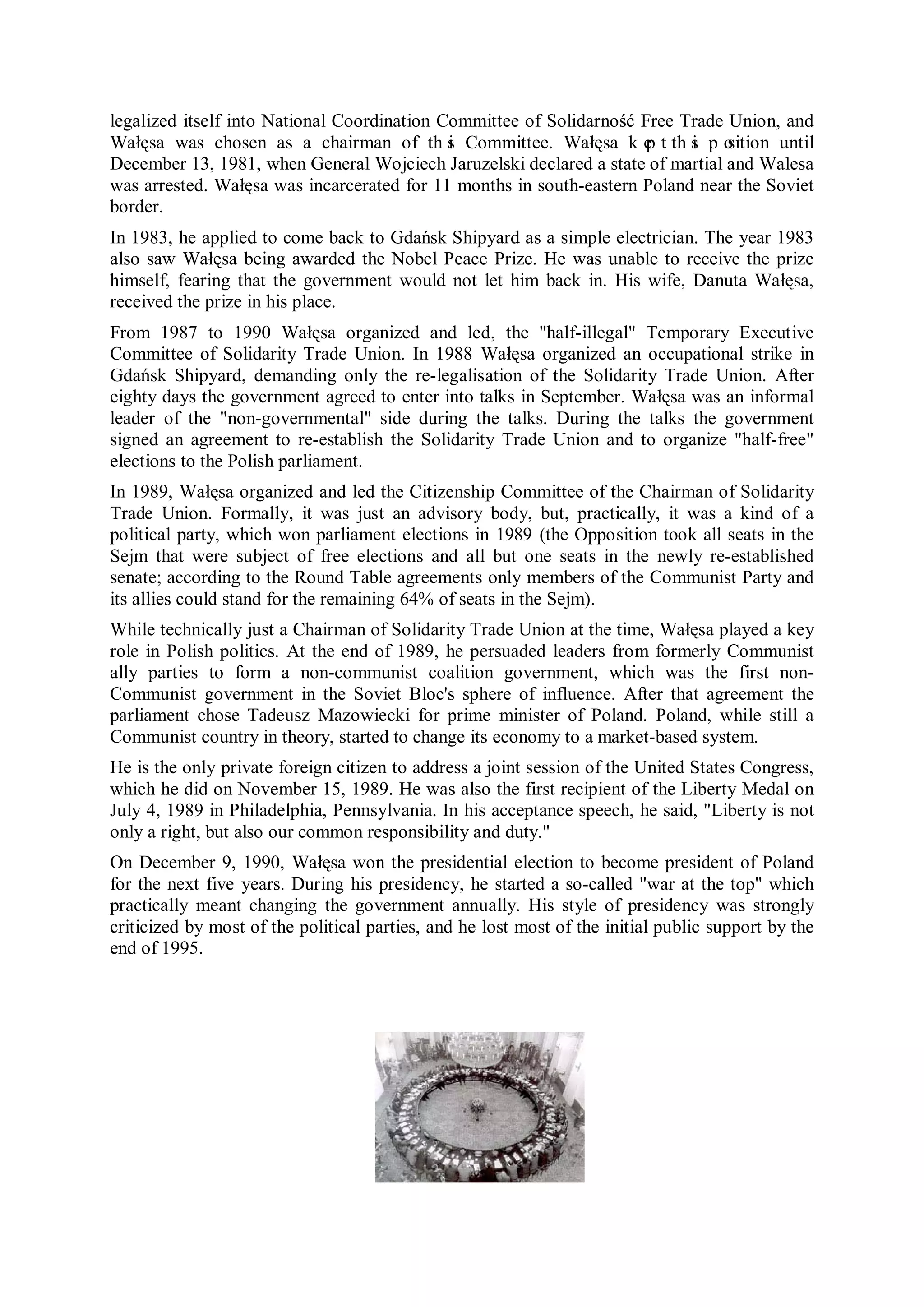
                        Lech Walesa
                        (born September 29, 1943) is a Polish politician and a former
                        anticommunist underground, trade union and human rights activist.
                        He co-founded Solidarity, the Soviet bloc's first independent trade
                        union, won the Nobel Peace Prize in 1983, and served as President of
                        Poland from 1990 to 1995.
                        He attended primary and vocational school, before entering Lenin
                        Shipyard in Gdańsk as an electrical technician in 1970. Lech Wałęsa
                        is a devout Roman Catholic, and has said that his faith always helped
                        him during Solidarity's difficult moments.
On August 14, 1980, after the beginning of an occupational strike in the Lenin Shipyard of
Gdańsk, Wałęsa became the leader of this strike. The strike was spontaneously followed by
similar strik e first in Gd a , and then across Poland . In Sep t mber of that year, the
              s,              ńsk                                      e
Communist government signed an agreement with the Strike Coordination Committee to
allow legal organization, but not actual free trade unions. The Strike Coordination Committee
legalized itself into National Coordination Committee of Solidarność Free Trade Union, and
Wałęsa was chosen as a chairman of th s Committee. Wałęsa k e t th s p o
                                             i                        p    i    sition until
December 13, 1981, when General Wojciech Jaruzelski declared a state of martial and Walesa
was arrested. Wałęsa was incarcerated for 11 months in south-eastern Poland near the Soviet
border.
In 1983, he applied to come back to Gdańsk Shipyard as a simple electrician. The year 1983
also saw Wałęsa being awarded the Nobel Peace Prize. He was unable to receive the prize
himself, fearing that the government would not let him back in. His wife, Danuta Wałęsa,
received the prize in his place.
From 1987 to 1990 Wałęsa organized and led, the "half-illegal" Temporary Executive
Committee of Solidarity Trade Union. In 1988 Wałęsa organized an occupational strike in
Gdańsk Shipyard, demanding only the re-legalisation of the Solidarity Trade Union. After
eighty days the government agreed to enter into talks in September. Wałęsa was an informal
leader of the "non-governmental" side during the talks. During the talks the government
signed an agreement to re-establish the Solidarity Trade Union and to organize "half-free"
elections to the Polish parliament.
In 1989, Wałęsa organized and led the Citizenship Committee of the Chairman of Solidarity
Trade Union. Formally, it was just an advisory body, but, practically, it was a kind of a
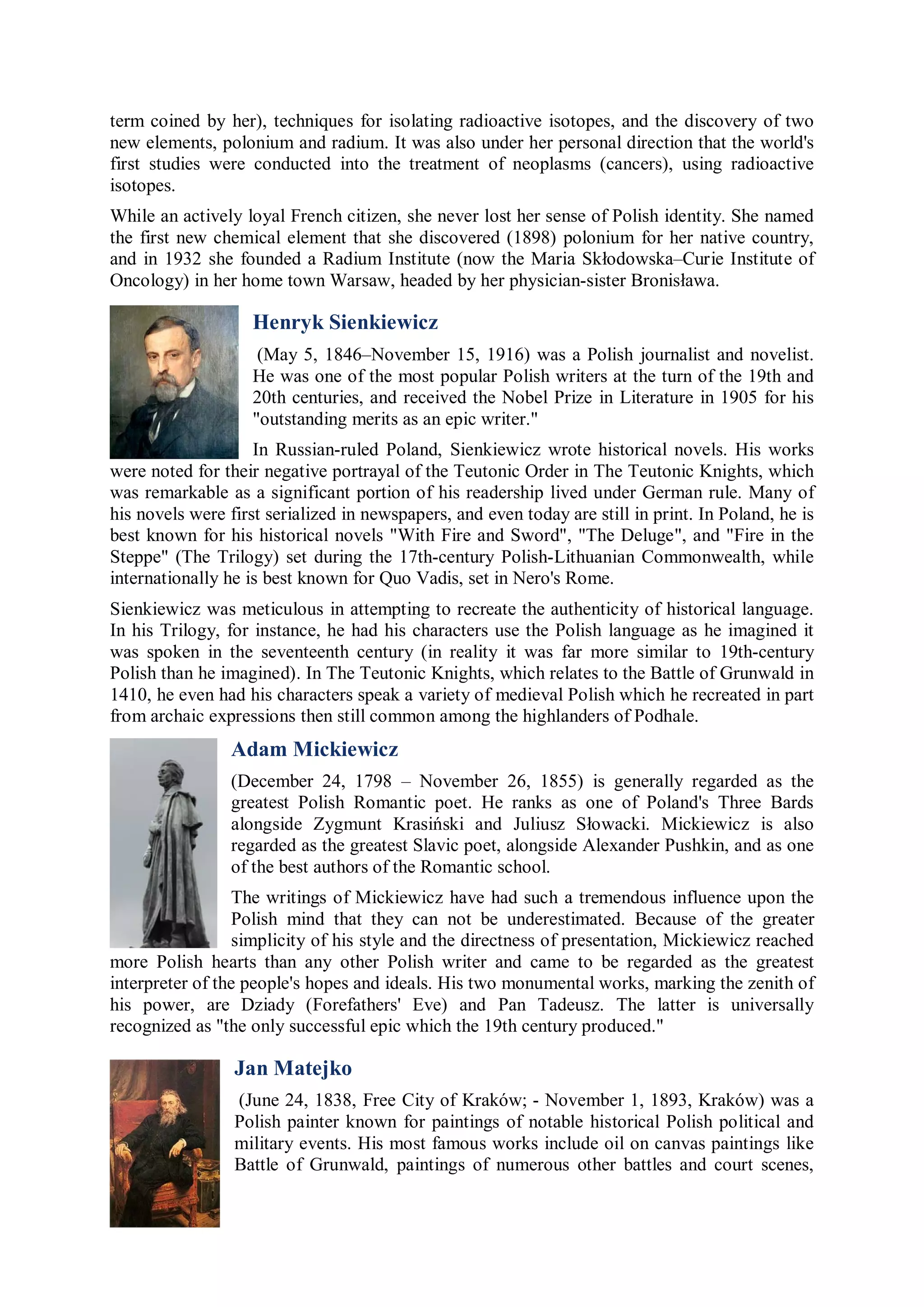
political party, which won parliament elections in 1989 (the Opposition took all seats in the
Sejm that were subject of free elections and all but one seats in the newly re-established
senate; according to the Round Table agreements only members of the Communist Party and
its allies could stand for the remaining 64% of seats in the Sejm).
While technically just a Chairman of Solidarity Trade Union at the time, Wałęsa played a key
role in Polish politics. At the end of 1989, he persuaded leaders from formerly Communist
ally parties to form a non-communist coalition government, which was the first non-
Communist government in the Soviet Bloc's sphere of influence. After that agreement the
parliament chose Tadeusz Mazowiecki for prime minister of Poland. Poland, while still a
Communist country in theory, started to change its economy to a market-based system.
He is the only private foreign citizen to address a joint session of the United States Congress,
which he did on November 15, 1989. He was also the first recipient of the Liberty Medal on
July 4, 1989 in Philadelphia, Pennsylvania. In his acceptance speech, he said, "Liberty is not
only a right, but also our common responsibility and duty."
On December 9, 1990, Wałęsa won the presidential election to become president of Poland
for the next five years. During his presidency, he started a so-called "war at the top" which
practically meant changing the government annually. His style of presidency was strongly
criticized by most of the political parties, and he lost most of the initial public support by the
end of 1995.
Mikolaj Kopernik
                                    (Nicolaus Copernicus, 19 February 1473 – 24 May 1543)
                                    was the first astronomer to formulate a comprehensive
                                    heliocentric cosmology, which displaced the Earth from
                                    the center of the universe. His epochal book, De
                                    revolutionibus orbium coelestium (On the Revolutions of
                                    the Celestial Spheres), published in 1543 just before he
                                    died, is often regarded as the starting point of modern
astronomy and the defining epiphany that began the Scientific Revolution. His heliocentric
model, with the sun at the center of the universe, demonstrated that the observed motions of
celestial objects can be explained without putting the Earth at rest in the center of the
universe. His work stimulated further scientific investigations, becoming a landmark in the
history of modern science that is now often referred to as the Copernican Revolution.
Among the great polymaths of the Renaissance, Copernicus was a mathematician,
astronomer, physician, quadrilingual polyglot, classical scholar, translator, artist, Catholic
cleric, jurist, governor, military leader, diplomat and economist. Among his many
responsibilities, astronomy figured as little more than an avocation — yet it was in that field
that he made his mark upon the world.

                       Fryderyk Chopin
                     (1 March 1810[1] – 17 October 1849) was a Polish composer and
                     virtuoso pianist. He was one of the great masters of Romantic music.
                     Chopin was born in the village of Żelazowa Wola, in the Duchy of
                     Warsaw, to a French-expatriate father and Polish mother, and was
                     regarded as a child-prodigy pianist. On 2 November 1830, he left for
                     Austria. Seven days later the Polish November Uprising, and
                     subsequent Russian victory, led to him becoming one of many
                     expatriates of the Polish Great Emigration. In Paris, Chopin made a
                     comfortable living as a composer and piano teacher, while giving few
public performances. From 1837 to 1847 he had a turbulent relationship with the French
writer George Sand.
Chopin's extant compositions were written primarily for the piano as a solo instrument.
Though they are technically demanding, his style emphasises nuance and expressive depth.
Chopin invented musical forms such as the instrumental ballade and was responsible for
major innovations in forms such as the piano sonata, mazurka, waltz, nocturne, étude,
impromptu and prélude. His works are masterpieces and mainstays of Romanticism in 19th-
century classical music.

                       Maria Sklodowska Curie
                       (November 7, 1867 – July 4, 1934) was a physicist and chemist of
                       Polish upbringing and, subsequently, French citizenship. She was a
                       pioneer in the field of radioactivity, the first person honored with two
                       Nobel Prizes, and the first female professor at the University of Paris.
                       Her husband Pierre Curie was a Nobel co-laureate of hers, and her
                       daughter Irène Joliot-Curie and son-in-law Frédéric Joliot-Curie also
                       received Nobel prizes.
                       Her achievements include the creation of a theory of radioactivity (a
term coined by her), techniques for isolating radioactive isotopes, and the discovery of two
new elements, polonium and radium. It was also under her personal direction that the world's
first studies were conducted into the treatment of neoplasms (cancers), using radioactive
isotopes.
While an actively loyal French citizen, she never lost her sense of Polish identity. She named
the first new chemical element that she discovered (1898) polonium for her native country,
and in 1932 she founded a Radium Institute (now the Maria Skłodowska–Curie Institute of
Oncology) in her home town Warsaw, headed by her physician-sister Bronisława.

                    Henryk Sienkiewicz
                     (May 5, 1846–November 15, 1916) was a Polish journalist and novelist.
                    He was one of the most popular Polish writers at the turn of the 19th and
                    20th centuries, and received the Nobel Prize in Literature in 1905 for his
                    "outstanding merits as an epic writer."
                    In Russian-ruled Poland, Sienkiewicz wrote historical novels. His works
were noted for their negative portrayal of the Teutonic Order in The Teutonic Knights, which
was remarkable as a significant portion of his readership lived under German rule. Many of
his novels were first serialized in newspapers, and even today are still in print. In Poland, he is
best known for his historical novels "With Fire and Sword", "The Deluge", and "Fire in the
Steppe" (The Trilogy) set during the 17th-century Polish-Lithuanian Commonwealth, while
internationally he is best known for Quo Vadis, set in Nero's Rome.
Sienkiewicz was meticulous in attempting to recreate the authenticity of historical language.
In his Trilogy, for instance, he had his characters use the Polish language as he imagined it
was spoken in the seventeenth century (in reality it was far more similar to 19th-century
Polish than he imagined). In The Teutonic Knights, which relates to the Battle of Grunwald in
1410, he even had his characters speak a variety of medieval Polish which he recreated in part
from archaic expressions then still common among the highlanders of Podhale.
                 Adam Mickiewicz
                 (December 24, 1798 – November 26, 1855) is generally regarded as the
                 greatest Polish Romantic poet. He ranks as one of Poland's Three Bards
                 alongside Zygmunt Krasiński and Juliusz Słowacki. Mickiewicz is also
                 regarded as the greatest Slavic poet, alongside Alexander Pushkin, and as one
                 of the best authors of the Romantic school.
                 The writings of Mickiewicz have had such a tremendous influence upon the
                 Polish mind that they can not be underestimated. Because of the greater
                 simplicity of his style and the directness of presentation, Mickiewicz reached
more Polish hearts than any other Polish writer and came to be regarded as the greatest
interpreter of the people's hopes and ideals. His two monumental works, marking the zenith of
his power, are Dziady (Forefathers' Eve) and Pan Tadeusz. The latter is universally
recognized as "the only successful epic which the 19th century produced."

                 Jan Matejko
                 (June 24, 1838, Free City of Kraków; - November 1, 1893, Kraków) was a
                 Polish painter known for paintings of notable historical Polish political and
                 military events. His most famous works include oil on canvas paintings like
                 Battle of Grunwald, paintings of numerous other battles and court scenes,
and a gallery of Polish kings. He is counted among the most famous Polish painters.

                Jozef Pilsudski
                 (December 5, 1867 – May 12, 1935) was Chief of State (1918–22), "First
                Marshal" (from 1920) and (1926–35) the authoritarian ruler of the Second
                Polish Republic. From mid-World War I he was a major influence in Poland's
                politics, and an important figure on the European political scene. He is
                considered largely responsible for Poland regaining independence in 1918,
                after a hundred twenty-three years of partitions.
Early in his political career, Pilsudski became a leader of the Polish Socialist Party.
Concluding, however, that Poland's independence would have to be won by force of arms, he
created the Polish Legions. In 1914 he anticipated the outbreak of a European war, the
Russian Empire's defeat by the Central Powers, and the Central Powers' defeat by the western
powers. When World War I broke out, he and his Legions fought alongside the Austro-
Hungarian and German Empires to ensure Russia's defeat. In 1917, with Russia faring badly
in the war, he withdrew his support from the Central Powers.
From November 1918, when Poland regained independence, until 1922, Pilsudski was
Poland's Chief of State. In 1919–21 he commanded Poland's forces in the Polish-Soviet War.
In 1923, with the Polish government dominated by his opponents, particularly the National
Democrats, he withdrew from active politics. Three years later he returned to power in the
May 1926 coup d'état, becoming de facto dictator of Poland. From then until his death in
1935, he concerned himself primarily with military and foreign affairs.

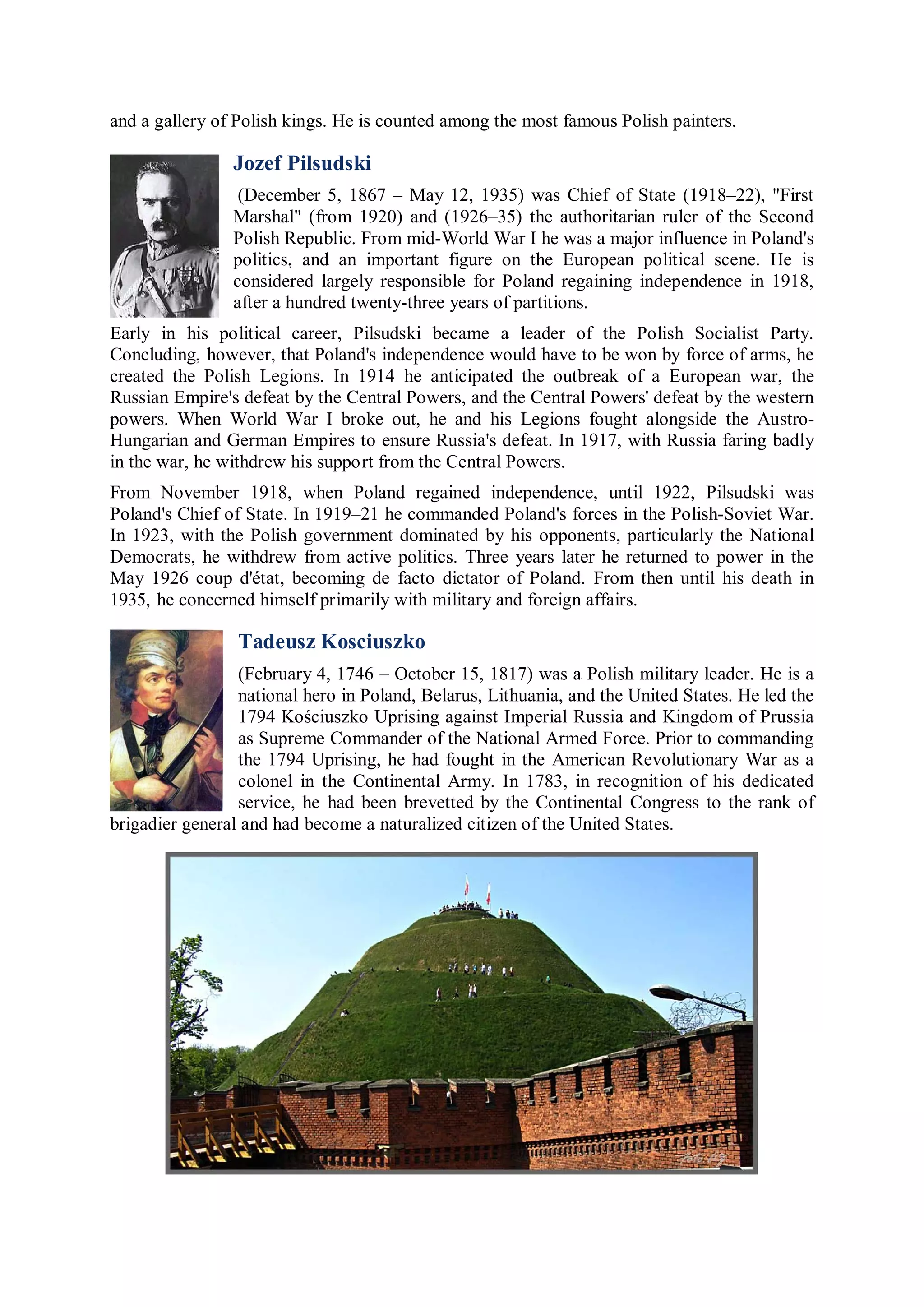
                 Tadeusz Kosciuszko
                 (February 4, 1746 – October 15, 1817) was a Polish military leader. He is a
                 national hero in Poland, Belarus, Lithuania, and the United States. He led the
                 1794 Kościuszko Uprising against Imperial Russia and Kingdom of Prussia
                 as Supreme Commander of the National Armed Force. Prior to commanding
                 the 1794 Uprising, he had fought in the American Revolutionary War as a
                 colonel in the Continental Army. In 1783, in recognition of his dedicated
                 service, he had been brevetted by the Continental Congress to the rank of
brigadier general and had become a naturalized citizen of the United States.
Polish Politics
Republic of Poland is a democracy, with a President as a Head of State, whose current
constitution dates from 1997. The government structure centres on the Council of Ministers,
led by a Prime Minister. The president appoints the cabinet according to the proposals of the
prime minister, typically from the majority coalition in the Sejm. The president is elected by
popular vote every five years. The current president is Lech Kaczyński, the current prime
minister is Donald Tusk.

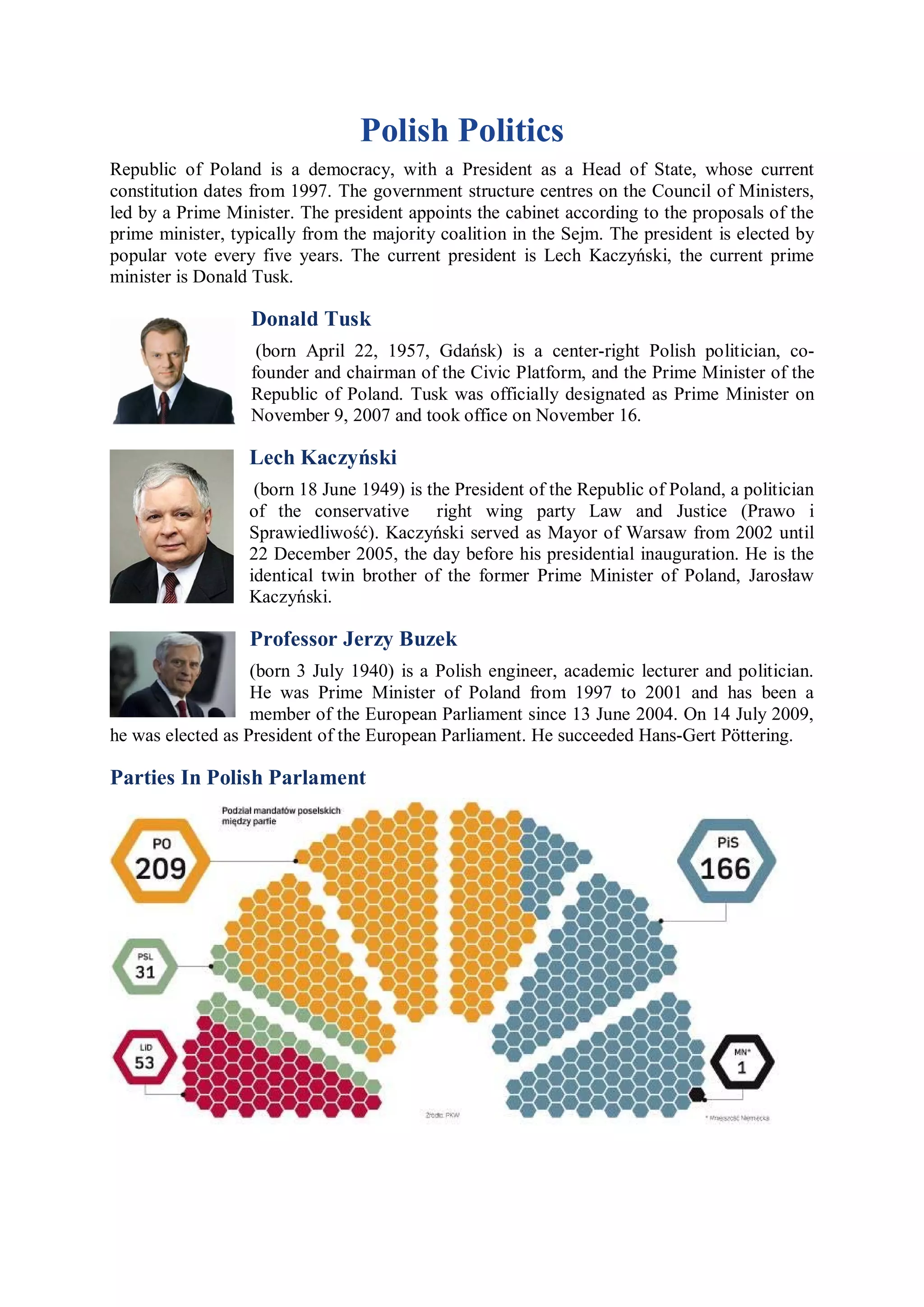
                  Donald Tusk
                   (born April 22, 1957, Gdańsk) is a center-right Polish politician, co-
                  founder and chairman of the Civic Platform, and the Prime Minister of the
                  Republic of Poland. Tusk was officially designated as Prime Minister on
                  November 9, 2007 and took office on November 16.

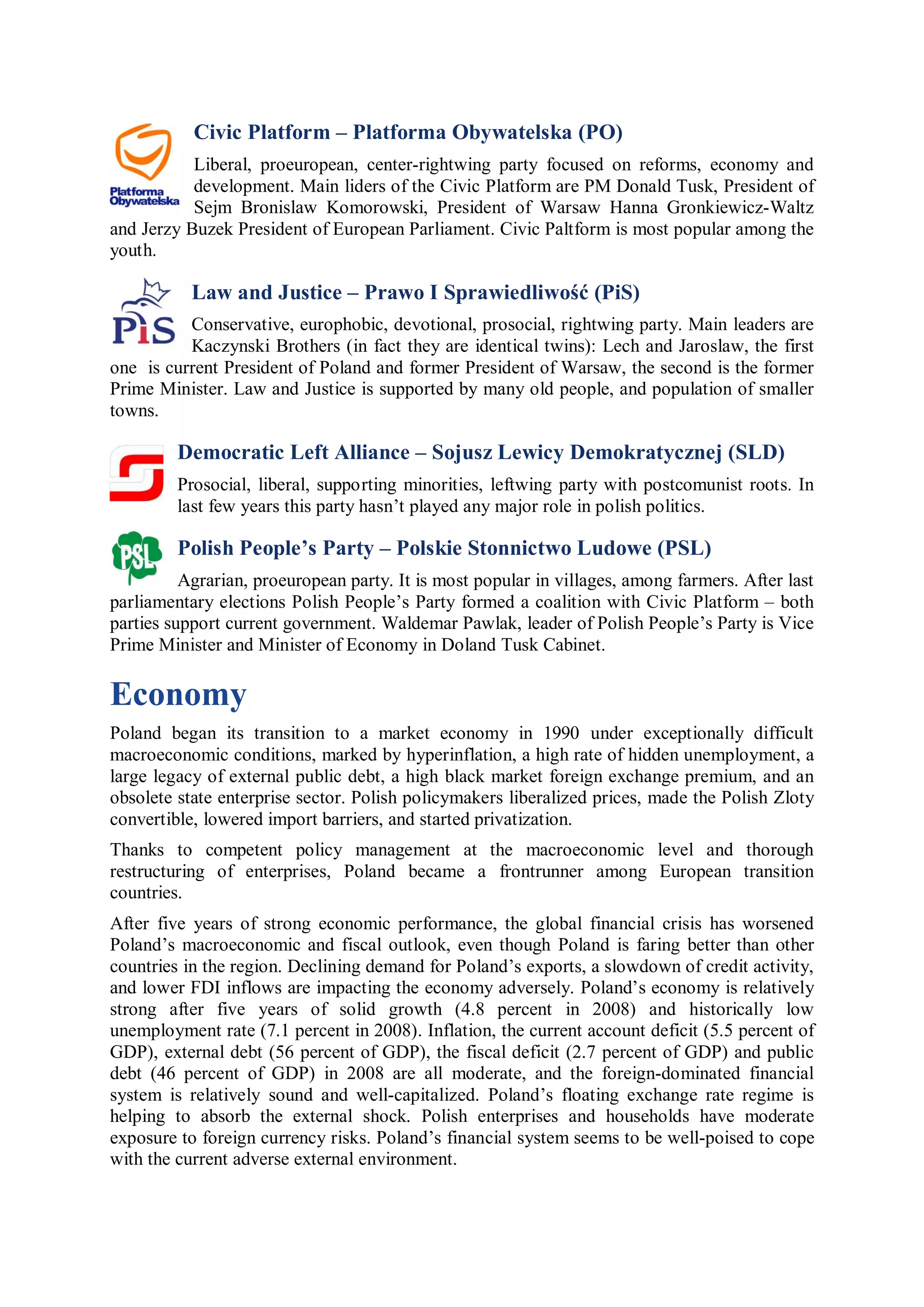
                  Lech Kaczyński
                   (born 18 June 1949) is the President of the Republic of Poland, a politician
                  of the conservative right wing party Law and Justice (Prawo i
                  Sprawiedliwość). Kaczyński served as Mayor of Warsaw from 2002 until
                  22 December 2005, the day before his presidential inauguration. He is the
                  identical twin brother of the former Prime Minister of Poland, Jarosław
                  Kaczyński.

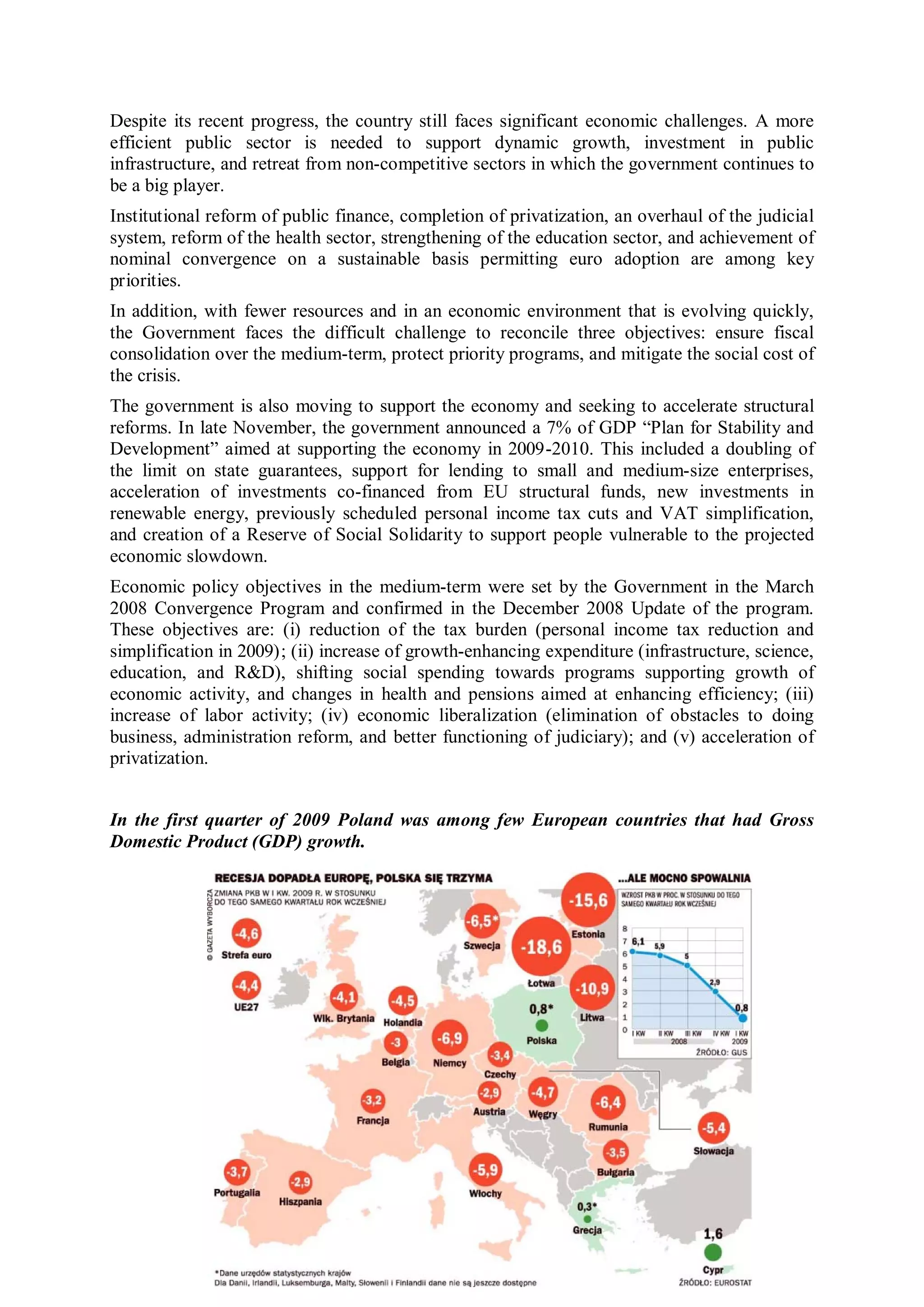
                  Professor Jerzy Buzek
                   (born 3 July 1940) is a Polish engineer, academic lecturer and politician.
                   He was Prime Minister of Poland from 1997 to 2001 and has been a
                   member of the European Parliament since 13 June 2004. On 14 July 2009,
he was elected as President of the European Parliament. He succeeded Hans-Gert Pöttering.

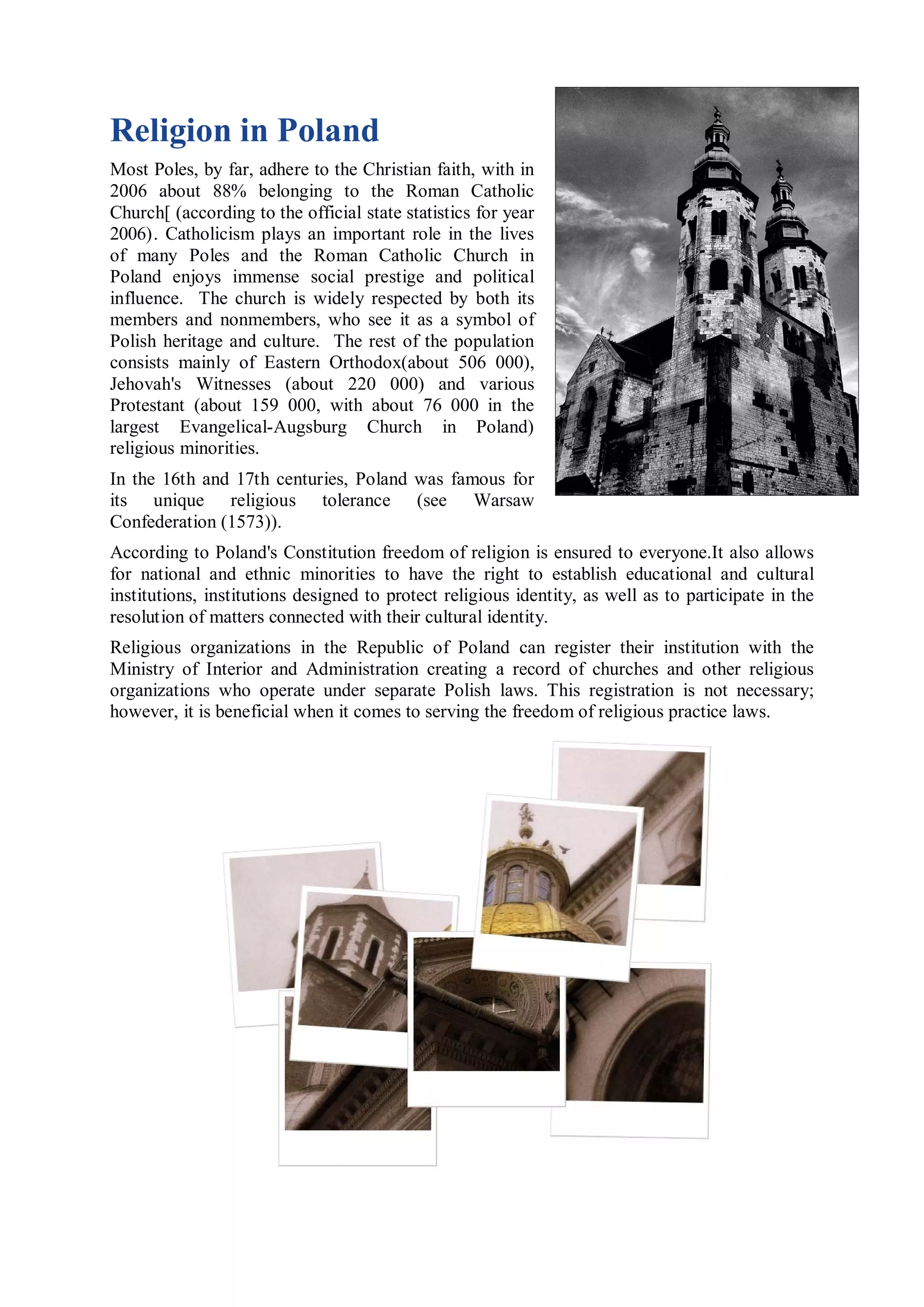
Parties In Polish Parlament
Civic Platform – Platforma Obywatelska (PO)
           Liberal, proeuropean, center-rightwing party focused on reforms, economy and
           development. Main liders of the Civic Platform are PM Donald Tusk, President of
           Sejm Bronislaw Komorowski, President of Warsaw Hanna Gronkiewicz-Waltz
and Jerzy Buzek President of European Parliament. Civic Paltform is most popular among the
youth.

           Law and Justice – Prawo I Sprawiedliwość (PiS)
          Conservative, europhobic, devotional, prosocial, rightwing party. Main leaders are
          Kaczynski Brothers (in fact they are identical twins): Lech and Jaroslaw, the first
one is current President of Poland and former President of Warsaw, the second is the former
Prime Minister. Law and Justice is supported by many old people, and population of smaller
towns.

         Democratic Left Alliance – Sojusz Lewicy Demokratycznej (SLD)
         Prosocial, liberal, supporting minorities, leftwing party with postcomunist roots. In
         last few years this party hasn’t played any major role in polish politics.

         Polish People’s Party – Polskie Stonnictwo Ludowe (PSL)
          Agrarian, proeuropean party. It is most popular in villages, among farmers. After last
parliamentary elections Polish People’s Party formed a coalition with Civic Platform – both
parties support current government. Waldemar Pawlak, leader of Polish People’s Party is Vice
Prime Minister and Minister of Economy in Doland Tusk Cabinet.

Economy
Poland began its transition to a market economy in 1990 under exceptionally difficult
macroeconomic conditions, marked by hyperinflation, a high rate of hidden unemployment, a
large legacy of external public debt, a high black market foreign exchange premium, and an
obsolete state enterprise sector. Polish policymakers liberalized prices, made the Polish Zloty
convertible, lowered import barriers, and started privatization.
Thanks to competent policy management at the macroeconomic level and thorough
restructuring of enterprises, Poland became a frontrunner among European transition
countries.
After five years of strong economic performance, the global financial crisis has worsened
Poland’s macroeconomic and fiscal outlook, even though Poland is faring better than other
countries in the region. Declining demand for Poland’s exports, a slowdown of credit activity,
and lower FDI inflows are impacting the economy adversely. Poland’s economy is relatively
strong after five years of solid growth (4.8 percent in 2008) and historically low
unemployment rate (7.1 percent in 2008). Inflation, the current account deficit (5.5 percent of
GDP), external debt (56 percent of GDP), the fiscal deficit (2.7 percent of GDP) and public
debt (46 percent of GDP) in 2008 are all moderate, and the foreign-dominated financial
system is relatively sound and well-capitalized. Poland’s floating exchange rate regime is
helping to absorb the external shock. Polish enterprises and households have moderate
exposure to foreign currency risks. Poland’s financial system seems to be well-poised to cope
with the current adverse external environment.
Despite its recent progress, the country still faces significant economic challenges. A more
efficient public sector is needed to support dynamic growth, investment in public
infrastructure, and retreat from non-competitive sectors in which the government continues to
be a big player.
Institutional reform of public finance, completion of privatization, an overhaul of the judicial
system, reform of the health sector, strengthening of the education sector, and achievement of
nominal convergence on a sustainable basis permitting euro adoption are among key
priorities.
In addition, with fewer resources and in an economic environment that is evolving quickly,
the Government faces the difficult challenge to reconcile three objectives: ensure fiscal
consolidation over the medium-term, protect priority programs, and mitigate the social cost of
the crisis.
The government is also moving to support the economy and seeking to accelerate structural
reforms. In late November, the government announced a 7% of GDP “Plan for Stability and
Development” aimed at supporting the economy in 2009-2010. This included a doubling of
the limit on state guarantees, support for lending to small and medium-size enterprises,
acceleration of investments co-financed from EU structural funds, new investments in
renewable energy, previously scheduled personal income tax cuts and VAT simplification,
and creation of a Reserve of Social Solidarity to support people vulnerable to the projected
economic slowdown.
Economic policy objectives in the medium-term were set by the Government in the March
2008 Convergence Program and confirmed in the December 2008 Update of the program.
These objectives are: (i) reduction of the tax burden (personal income tax reduction and
simplification in 2009); (ii) increase of growth-enhancing expenditure (infrastructure, science,
education, and R&D), shifting social spending towards programs supporting growth of
economic activity, and changes in health and pensions aimed at enhancing efficiency; (iii)
increase of labor activity; (iv) economic liberalization (elimination of obstacles to doing
business, administration reform, and better functioning of judiciary); and (v) acceleration of
privatization.


In the first quarter of 2009 Poland was among few European countries that had Gross
Domestic Product (GDP) growth.
Religion in Poland
Most Poles, by far, adhere to the Christian faith, with in
2006 about 88% belonging to the Roman Catholic
Church[ (according to the official state statistics for year
2006). Catholicism plays an important role in the lives
of many Poles and the Roman Catholic Church in
Poland enjoys immense social prestige and political
influence. The church is widely respected by both its
members and nonmembers, who see it as a symbol of
Polish heritage and culture. The rest of the population
consists mainly of Eastern Orthodox(about 506 000),
Jehovah's Witnesses (about 220 000) and various
Protestant (about 159 000, with about 76 000 in the
largest Evangelical-Augsburg Church in Poland)
religious minorities.
In the 16th and 17th centuries, Poland was famous for
its unique religious tolerance (see Warsaw
Confederation (1573)).
According to Poland's Constitution freedom of religion is ensured to everyone.It also allows
for national and ethnic minorities to have the right to establish educational and cultural
institutions, institutions designed to protect religious identity, as well as to participate in the
resolution of matters connected with their cultural identity.
Religious organizations in the Republic of Poland can register their institution with the
Ministry of Interior and Administration creating a record of churches and other religious
organizations who operate under separate Polish laws. This registration is not necessary;
however, it is beneficial when it comes to serving the freedom of religious practice laws.
Sports
Ski jumping
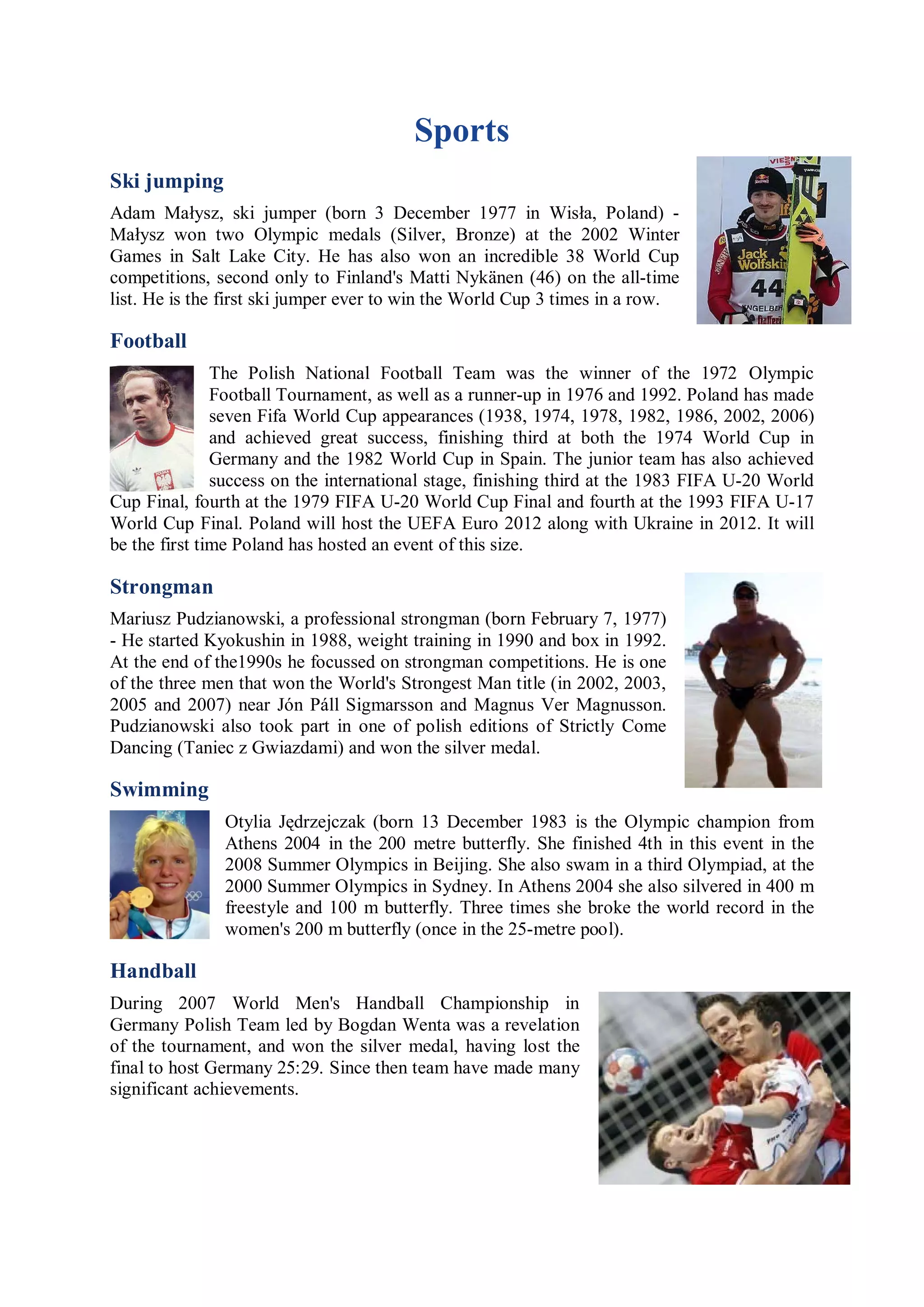
Adam Małysz, ski jumper (born 3 December 1977 in Wisła, Poland) -
Małysz won two Olympic medals (Silver, Bronze) at the 2002 Winter
Games in Salt Lake City. He has also won an incredible 38 World Cup
competitions, second only to Finland's Matti Nykänen (46) on the all-time
list. He is the first ski jumper ever to win the World Cup 3 times in a row.

Football
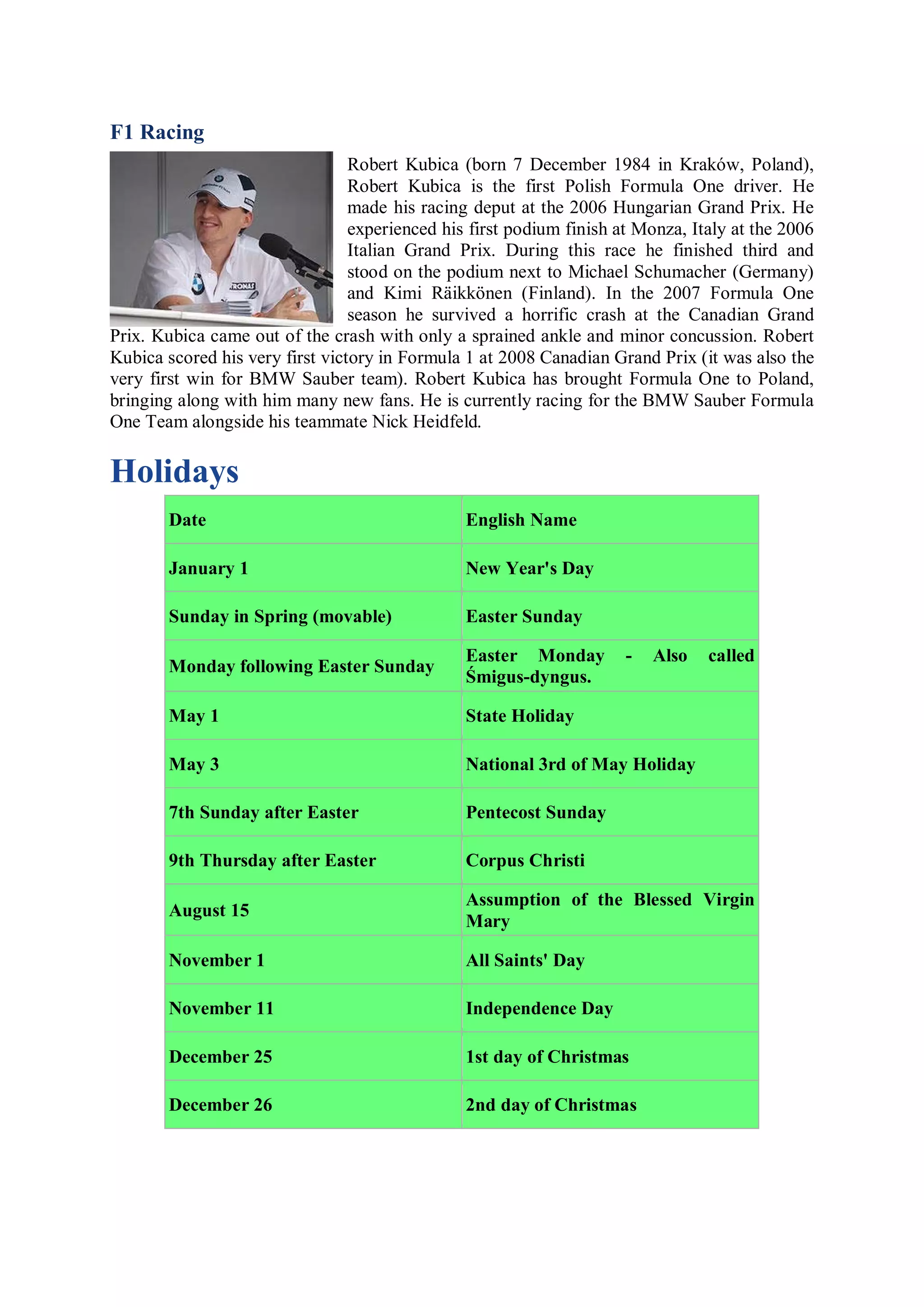
               The Polish National Football Team was the winner of the 1972 Olympic
               Football Tournament, as well as a runner-up in 1976 and 1992. Poland has made
               seven Fifa World Cup appearances (1938, 1974, 1978, 1982, 1986, 2002, 2006)
               and achieved great success, finishing third at both the 1974 World Cup in
               Germany and the 1982 World Cup in Spain. The junior team has also achieved
               success on the international stage, finishing third at the 1983 FIFA U-20 World
Cup Final, fourth at the 1979 FIFA U-20 World Cup Final and fourth at the 1993 FIFA U-17
World Cup Final. Poland will host the UEFA Euro 2012 along with Ukraine in 2012. It will
be the first time Poland has hosted an event of this size.

Strongman
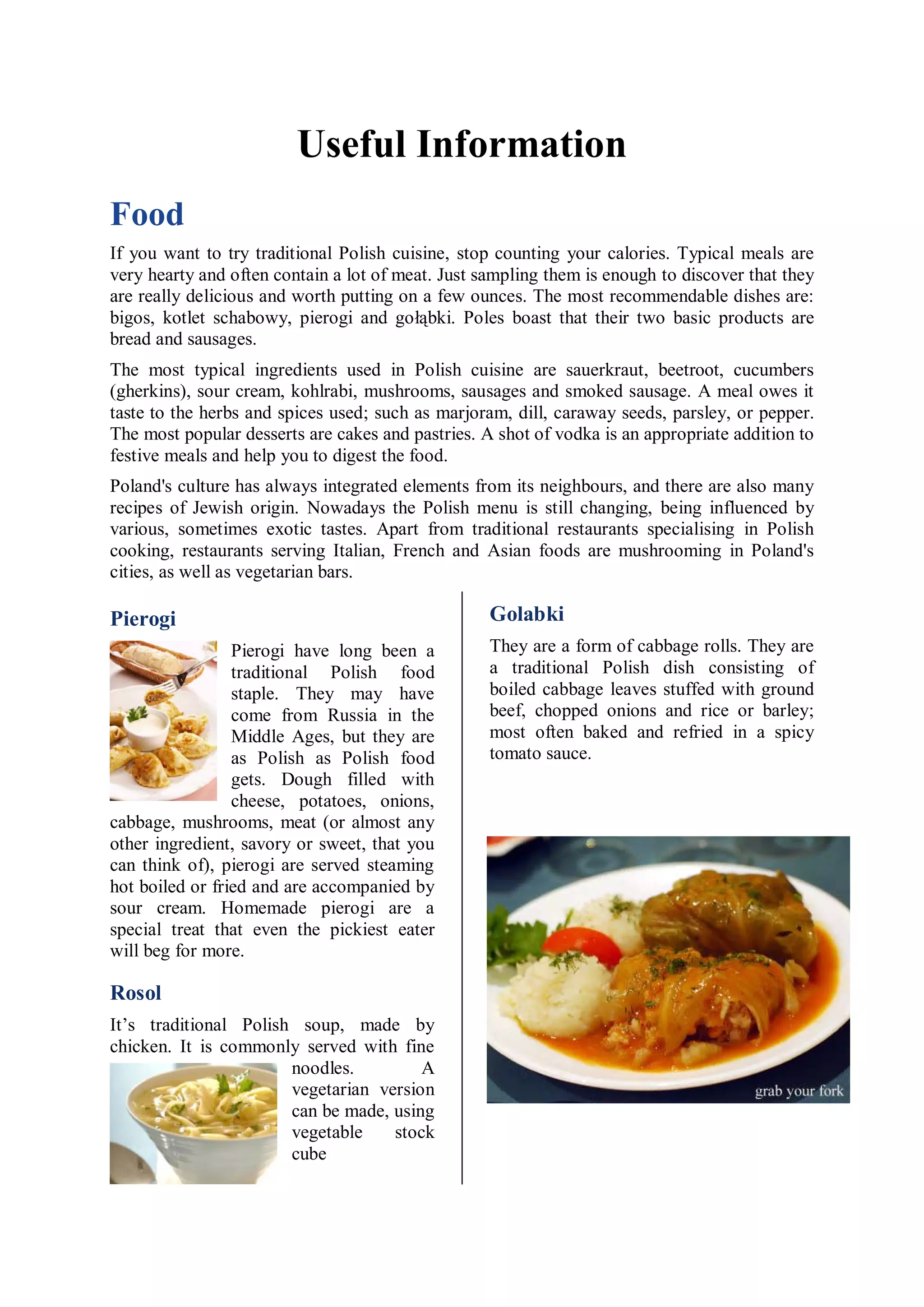
Mariusz Pudzianowski, a professional strongman (born February 7, 1977)
- He started Kyokushin in 1988, weight training in 1990 and box in 1992.
At the end of the1990s he focussed on strongman competitions. He is one
of the three men that won the World's Strongest Man title (in 2002, 2003,
2005 and 2007) near Jón Páll Sigmarsson and Magnus Ver Magnusson.
Pudzianowski also took part in one of polish editions of Strictly Come
Dancing (Taniec z Gwiazdami) and won the silver medal.

Swimming
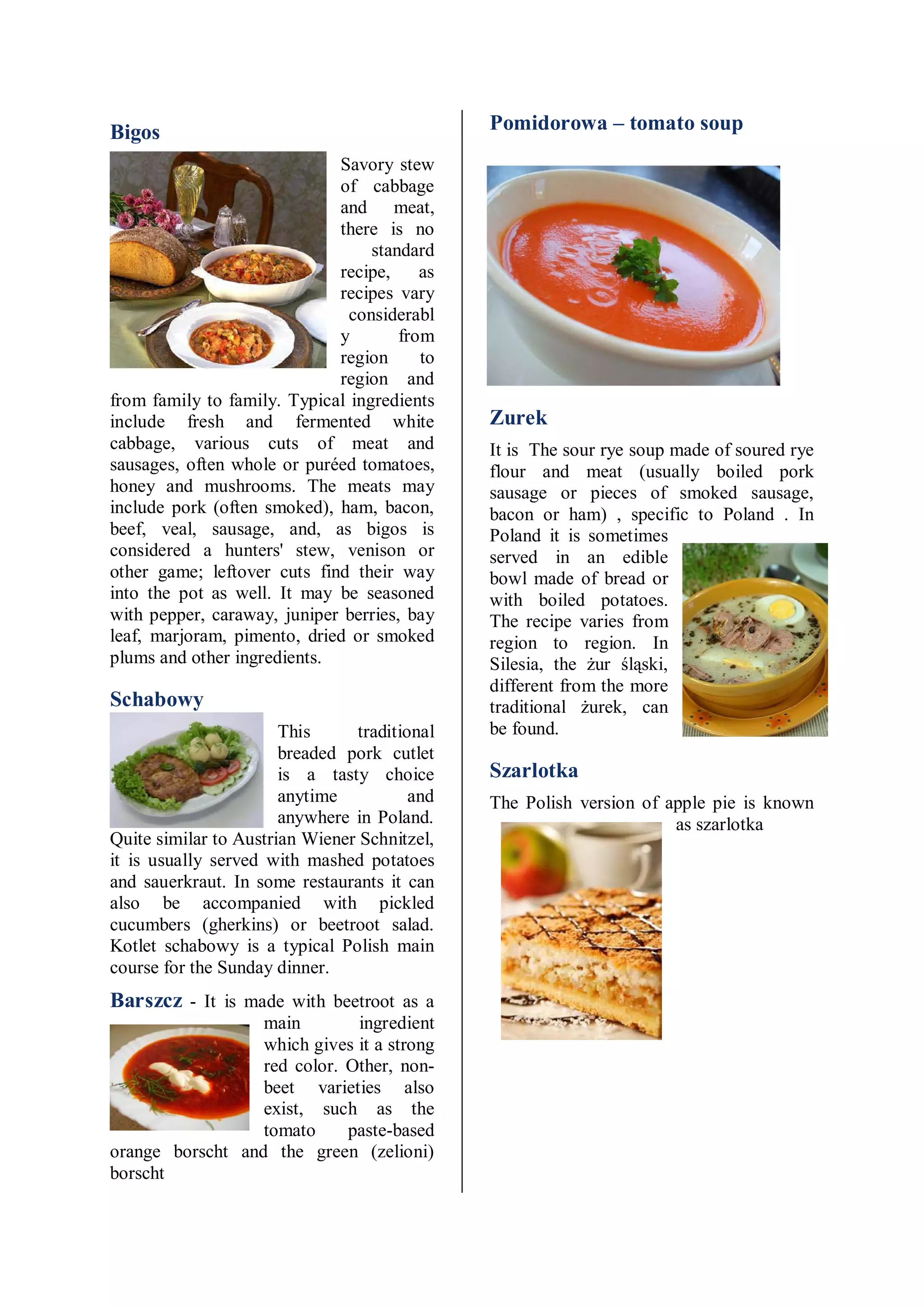
               Otylia Jędrzejczak (born 13 December 1983 is the Olympic champion from
               Athens 2004 in the 200 metre butterfly. She finished 4th in this event in the
               2008 Summer Olympics in Beijing. She also swam in a third Olympiad, at the
               2000 Summer Olympics in Sydney. In Athens 2004 she also silvered in 400 m
               freestyle and 100 m butterfly. Three times she broke the world record in the
               women's 200 m butterfly (once in the 25-metre pool).

Handball
During 2007 World Men's Handball Championship in
Germany Polish Team led by Bogdan Wenta was a revelation
of the tournament, and won the silver medal, having lost the
final to host Germany 25:29. Since then team have made many
significant achievements.
F1 Racing
                                 Robert Kubica (born 7 December 1984 in Kraków, Poland),
                                 Robert Kubica is the first Polish Formula One driver. He
                                 made his racing deput at the 2006 Hungarian Grand Prix. He
                                 experienced his first podium finish at Monza, Italy at the 2006
                                 Italian Grand Prix. During this race he finished third and
                                 stood on the podium next to Michael Schumacher (Germany)
                                 and Kimi Räikkönen (Finland). In the 2007 Formula One
                                 season he survived a horrific crash at the Canadian Grand
Prix. Kubica came out of the crash with only a sprained ankle and minor concussion. Robert
Kubica scored his very first victory in Formula 1 at 2008 Canadian Grand Prix (it was also the
very first win for BMW Sauber team). Robert Kubica has brought Formula One to Poland,
bringing along with him many new fans. He is currently racing for the BMW Sauber Formula
One Team alongside his teammate Nick Heidfeld.

Holidays
        Date                                    English Name

        January 1                               New Year's Day

        Sunday in Spring (movable)              Easter Sunday

                                                Easter Monday         -   Also   called
        Monday following Easter Sunday
                                                Śmigus-dyngus.

        May 1                                   State Holiday

        May 3                                   National 3rd of May Holiday

        7th Sunday after Easter                 Pentecost Sunday

        9th Thursday after Easter               Corpus Christi

                                                Assumption of the Blessed Virgin
        August 15
                                                Mary

        November 1                              All Saints' Day

        November 11                             Independence Day

        December 25                             1st day of Christmas

        December 26                             2nd day of Christmas
Useful Information
Fоod
If you want to try traditional Polish cuisine, stop counting your calories. Typical meals are
very hearty and often contain a lot of meat. Just sampling them is enough to discover that they
are really delicious and worth putting on a few ounces. The most recommendable dishes are:
bigos, kotlet schabowy, pierogi and gołąbki. Poles boast that their two basic products are
bread and sausages.
The most typical ingredients used in Polish cuisine are sauerkraut, beetroot, cucumbers
(gherkins), sour cream, kohlrabi, mushrooms, sausages and smoked sausage. A meal owes it
taste to the herbs and spices used; such as marjoram, dill, caraway seeds, parsley, or pepper.
The most popular desserts are cakes and pastries. A shot of vodka is an appropriate addition to
festive meals and help you to digest the food.
Poland's culture has always integrated elements from its neighbours, and there are also many
recipes of Jewish origin. Nowadays the Polish menu is still changing, being influenced by
various, sometimes exotic tastes. Apart from traditional restaurants specialising in Polish
cooking, restaurants serving Italian, French and Asian foods are mushrooming in Poland's
cities, as well as vegetarian bars.

Pierogi                                            Golabki
                 Pierogi have long been a          They are a form of cabbage rolls. They are
                 traditional Polish food           a traditional Polish dish consisting of
                 staple. They may have             boiled cabbage leaves stuffed with ground
                 come from Russia in the           beef, chopped onions and rice or barley;
                 Middle Ages, but they are         most often baked and refried in a spicy
                 as Polish as Polish food          tomato sauce.
                 gets. Dough filled with
                 cheese, potatoes, onions,
cabbage, mushrooms, meat (or almost any
other ingredient, savory or sweet, that you
can think of), pierogi are served steaming
hot boiled or fried and are accompanied by
sour cream. Homemade pierogi are a
special treat that even the pickiest eater
will beg for more.

Rosol
It’s traditional Polish soup, made by
chicken. It is commonly served with fine
                       noodles.         A
                       vegetarian version
                       can be made, using
                       vegetable    stock
                       cube
Bigos                                         Pomidorowa – tomato soup
                             Savory stew
                             of cabbage
                             and meat,
                             there is no
                                  standard
                             recipe,     as
                             recipes vary
                               considerabl
                             y        from
                             region      to
                             region and
from family to family. Typical ingredients
include fresh and fermented white             Zurek
cabbage, various cuts of meat and             It is The sour rye soup made of soured rye
sausages, often whole or puréed tomatoes,     flour and meat (usually boiled pork
honey and mushrooms. The meats may            sausage or pieces of smoked sausage,
include pork (often smoked), ham, bacon,      bacon or ham) , specific to Poland . In
beef, veal, sausage, and, as bigos is         Poland it is sometimes
considered a hunters' stew, venison or        served in an edible
other game; leftover cuts find their way      bowl made of bread or
into the pot as well. It may be seasoned      with boiled potatoes.
with pepper, caraway, juniper berries, bay    The recipe varies from
leaf, marjoram, pimento, dried or smoked      region to region. In
plums and other ingredients.                  Silesia, the żur śląski,
                                              different from the more
Schabowy                                      traditional żurek, can
                       This     traditional   be found.
                       breaded pork cutlet
                       is a tasty choice      Szarlotka
                       anytime          and   The Polish version of apple pie is known
                       anywhere in Poland.                           as szarlotka
Quite similar to Austrian Wiener Schnitzel,
it is usually served with mashed potatoes
and sauerkraut. In some restaurants it can
also be accompanied with pickled
cucumbers (gherkins) or beetroot salad.
Kotlet schabowy is a typical Polish main
course for the Sunday dinner.
Barszcz - It is made with beetroot as a
                  main        ingredient
                  which gives it a strong
                  red color. Other, non-
                  beet varieties also
                  exist, such as the
                  tomato     paste-based
orange borscht and the green (zelioni)
borscht
Currency
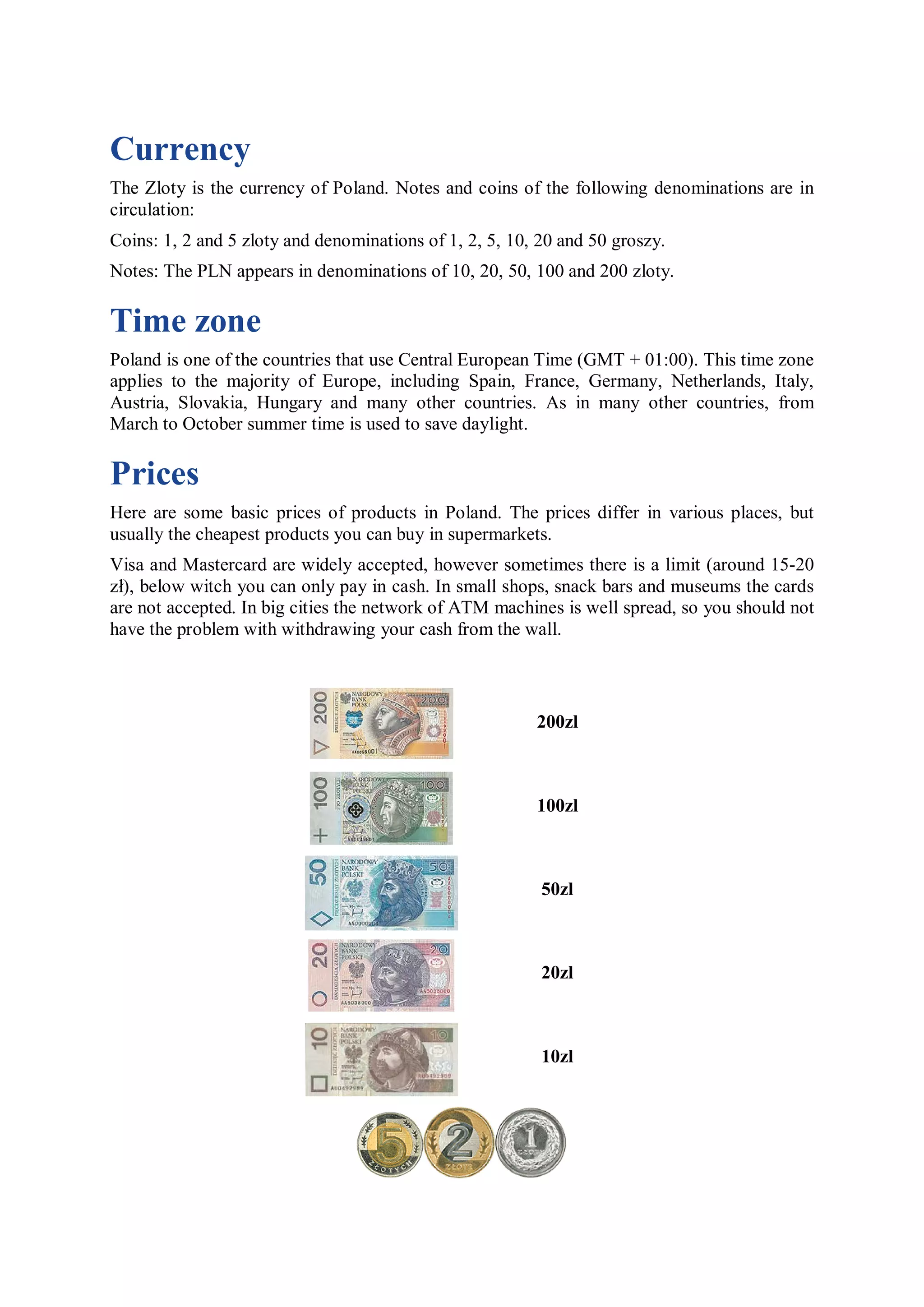
The Zloty is the currency of Poland. Notes and coins of the following denominations are in
circulation:
Coins: 1, 2 and 5 zloty and denominations of 1, 2, 5, 10, 20 and 50 groszy.
Notes: The PLN appears in denominations of 10, 20, 50, 100 and 200 zloty.

Time zone
Poland is one of the countries that use Central European Time (GMT + 01:00). This time zone
applies to the majority of Europe, including Spain, France, Germany, Netherlands, Italy,
Austria, Slovakia, Hungary and many other countries. As in many other countries, from
March to October summer time is used to save daylight.

Prices
Here are some basic prices of products in Poland. The prices differ in various places, but
usually the cheapest products you can buy in supermarkets.
Visa and Mastercard are widely accepted, however sometimes there is a limit (around 15-20
zł), below witch you can only pay in cash. In small shops, snack bars and museums the cards
are not accepted. In big cities the network of ATM machines is well spread, so you should not
have the problem with withdrawing your cash from the wall.


                                                         200zl


                                                         100zl


                                                          50zl


                                                          20zl


                                                          10zl
Units
Weights:
1 gram - 1g = 0.035 ounces
1 kilogram - 1 kg = 1000 g = 35 ounces
1 kg = 2.2 pounds

Lengths
1 centimeter - 1 cm = 0.39 inch
1 decimeter - 1dm = 3.9 inch
1 meter 1 m = 100 cm = 10 dm = 39 inch = 3.3 feet =1.1 yards
1 kilometer - 1km = 1000 m= 3 300 feet= 0.6 mile

Volumes
1 milliliter - 1 ml = 0.035 fluid ounce
1 deciliter - 1 dl = 0.35 fluid ounce
1 litter - 1 l = 1000 ml = 10 dl=3.5 fluid ounce = 0.26 US gallon

Temperature
temp[°C]=temp.[K]-273=5 x temp.[°F] /9 -17,8


Electricity
The voltage is 220V, 50 Hz. Plugs are the same as in the rest of
Continental Europe.
Communication
      In Poland there are 4 main mobile operators Orange, Era, Plus and Play. There is also Heyah,
      but it is property of Era. You should definitely buy yourself a Polish operator SIM card.
      To activate polish SIM card your phone should have the simlock removed. We recommend
      you to remove simlock from your phone in your home country so you can start using polish
      sim card immediately after arrival.
      You should use prepaid cards. You can charge them with more money by buying special
      scratch cards or getting special receipt printed. Both the scratch card and the receipt have
      special 14 digit code you’ve got to enter to charge your phone.


                                                                       HEYAH
 Charging
procedure      *123*CODE#        *125*CODE#       *111*CODE#       *109*CODE#         *100*CODE#
How much
credit left?     *100#              *124#            *101#            *108#              *101#


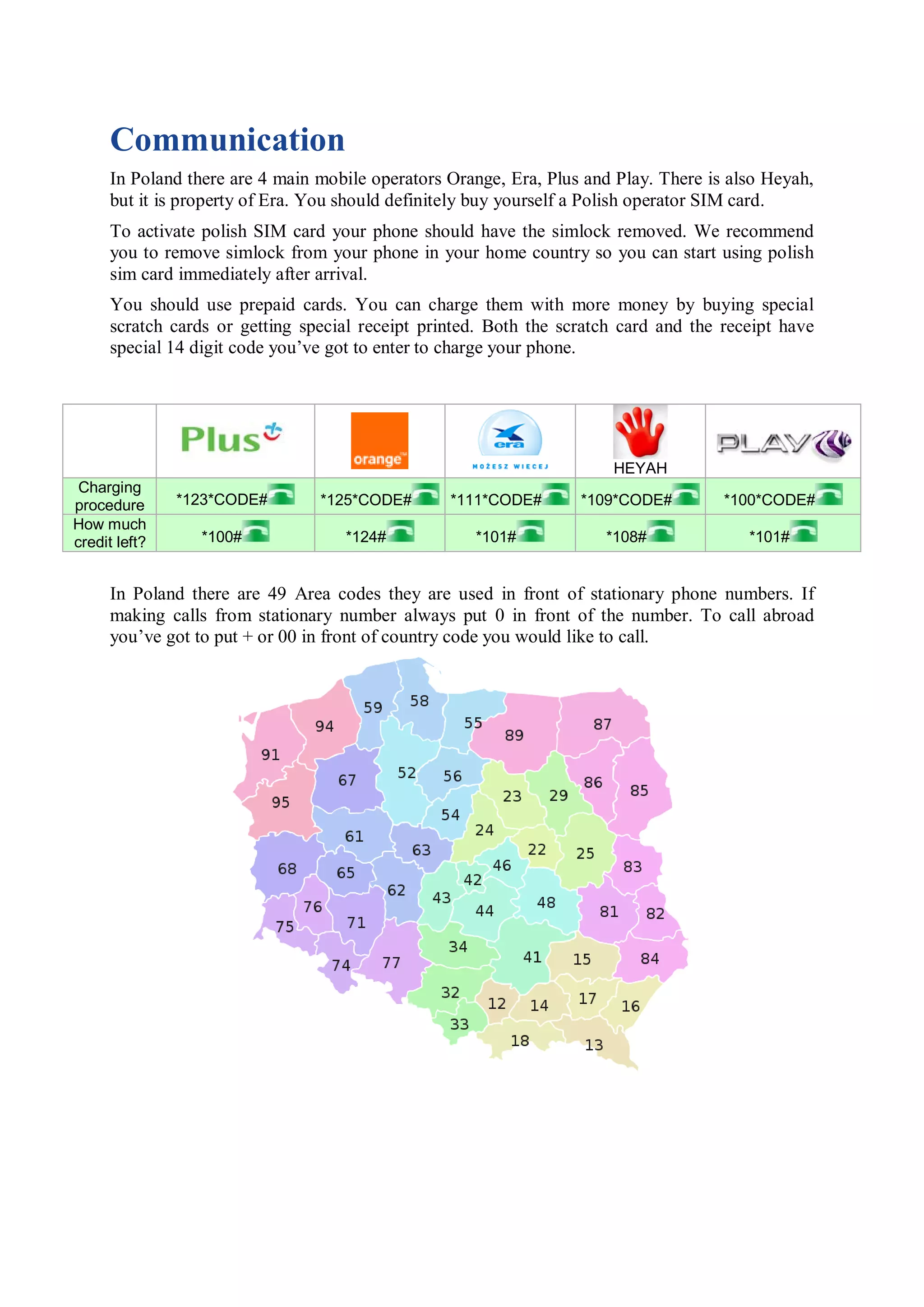
      In Poland there are 49 Area codes they are used in front of stationary phone numbers. If
      making calls from stationary number always put 0 in front of the number. To call abroad
      you’ve got to put + or 00 in front of country code you would like to call.
Emergency phone numbers
999: Ambulance
998: Fire Brigade
997: Police
981: Road Assistance
986: Municipal Police
Using mobile phones: remember to dial the local code before the number, for example:
12 - 997 to call the police in Krakow. Emergency calls from phone boxes are free of charge. If
you do not know the local code, dial the general emergency number for mobile phones: 112.
The operator will request the appropriate emergency unit. We recommend using direct
emergency numbers in the case of danger (997, 999, 998) because in some areas the general
emergency number (112) still does not work properly.
These numbers may also be useful:
Warsaw public transportation information (22) 94 84
Cracow public transportation information (12) 91 50
International flight departure information (22) 650 39 43
International flight arrival information (22) 650 42 20

Business Hours
Most common working hours are 8:00AM -4:00PM. Most banks and public institutions are
open those hours.

                    From         Till          Comments

Office Hours        8:00 AM      4:00 PM

Food Shops          7:00 AM      8:00 PM       There are some 24h/7 shops as well

Shopping Malls      10:00 AM 8:00 PM           Till 10:00 PM at the weekends

Pubs and Clubs      7:00 PM      2:00 PM       Till 5:00 PM at the weekends
Useful phrases
Polish is the official language of Poland. It has the second largest number of speakers among
Slavic languages after Russian. Polish is the main representative of the Lechitic branch of the
West Slavic languages. It originated in the areas of present-day Poland from several local
Western Slavic dialects, most notably those spoken in Greater Poland and Lesser Poland. It
shares some vocabulary with the languages of the neighboring Slavic nations, most notably
with Slovak, Czech, Ukrainian, and Belarusian.
Polish language was once known as a lingua franca in various regions of Central and Eastern
Europe, mostly due to the political, cultural, scientific, and military influence of the Polish-
Lithuanian Commonwealth. Today, Polish is spoken by over 38.5 million native speakers in
Poland and it is spoken as a second language in western parts of the Belarus, Lithuania, and
Ukraine. Because of the emigration from Poland during various time periods, millions of
Polish speakers can be found in countries including Australia, Brazil, Canada, United
Kingdom, United States, and so on. There are over 46 million Polish language speakers
around the world.

   English                                          Polish

   To Your Health! / Cheers!                        Na Zdrowie!
   How are you?                                     Jak się masz? / Co słychać?
   Hi / Bye                                         Czesc
   Hello / Welcome                                  Witam
   Good Morning / Good Afternoon                    Dzień dobry
   Good Evening                                     Dobry wieczor
   Good Night                                       Dobranoc
   Goodbye                                          Do widzenia
   How are you?                                     Jak sie masz?
   Good                                             Dobrze
   Yes                                              Tak
   No                                               Nie
   Please speak more slowly                         Proszę mówić wolniej
   I don't understand                               Nie rozumiem
   I don't speak Polish                             Nie mówię po polsku
   Do you speak English?                            Czy mówisz po angielsku?
   I am English (male)                              Jestem Anglikiem
   I am English (female)                            Jestem Angielką
   I'm from …                                       Jestem z …
   I live in …                                      Mieszkam w …
   Thanks                                           Dziekuję
Please                         Proszę
Excuse me / I am sorry         Przepraszam
Congratulations                Gratuluję
Merry Christmas                Wesołych Świąt
Happy New Year                 Szcześliwego Nowego Roku
Happy Birthday (100 years!)    Sto lat
Grandmother                    Babcia
Grandfather                    Dziadek
Mother                         Matka
Father                         Ojciec
Husband                        Mąż
Wife                           Żona
Girlfriend (sweetheart)        Dziewczyna
Fiance                         Narzeczona
Brother                        Brat
Sister                         Siostra
I like you                     Lubię Cię
I love you                     Kocham Cię
Are you married? (m to f)      Jesteś zamężna?
Will you marry me?             Wyjdziesz za mnie?
How much is it?                Ile to kosztuje?
Can I have the bill, please?   Rachunek, proszę
I'm looking for ...
                               Szukam ...

Rude Words and Phrases
Shut up!                       Zamknij się
Go away!                       Odejdż
Get Lost!                      Spadaj
Useful things to bring :


 • AC adapter if needed
 • ISIC student card
 • Passport and Copy of passport
  • photos for IDs
  • some Zlotys for the first day
  • phone without sim-lock
  • warm clothing
  • medicines
  • insurance/European Health Card
Krakow
How to get here?
By Plane
                                   John Paul II International Airport Kraków-Balice is an
                                   international airport located near Kraków, in the village of
                                   Balice, 11 km westof the city centre. The airport opened for
                                   civil aviation in 1964. Kraków Airport is the second busiest
airport in the country after Warsaw Frederic Chopin Airport. It is used by over 3.000.000
passengers and has nearly 35.000 plane departures each year. Most of the times we try to pick
up our new trainees from the airport or train station, so there should be some AIESECer
waiting for you. If there won’t be anyone available to pick you up we will inform you about
this fact at least one day before your arrival. From the Airport you can get to the town center
by various means of transport:
   •   By train You need to take the Shuttle Bus first it stops in front of each terminal and
       takes you 300m to the Balice Airport Railway Station . Then you have to take the train
       (       you      can        find      schedule         at       airport’s      website
       http://www.krakowairport.pl/en/3/176/35/en) The ticket costs 8 zl and the jurney will
       take 16 minutes.
   •   By city bus (292, 208, 902) Buses 292 and 208 are regular, but 902 is a night bus.
       Journey to the city centre (“Dworzec Glowny” Main Train Station bus stop) takes
       approximately 30-40 min. One-way normal fare is 3.00 zł Tickets may be purchased
       from a vending machine at the bus stop or on board (if available) or from the driver for
       at additional 0.50 zł. There is no fare for luggage.
   •   By Taxi The journey takes 20-30 min (depending on the route and traffic) and should
       cost about 70 zl.
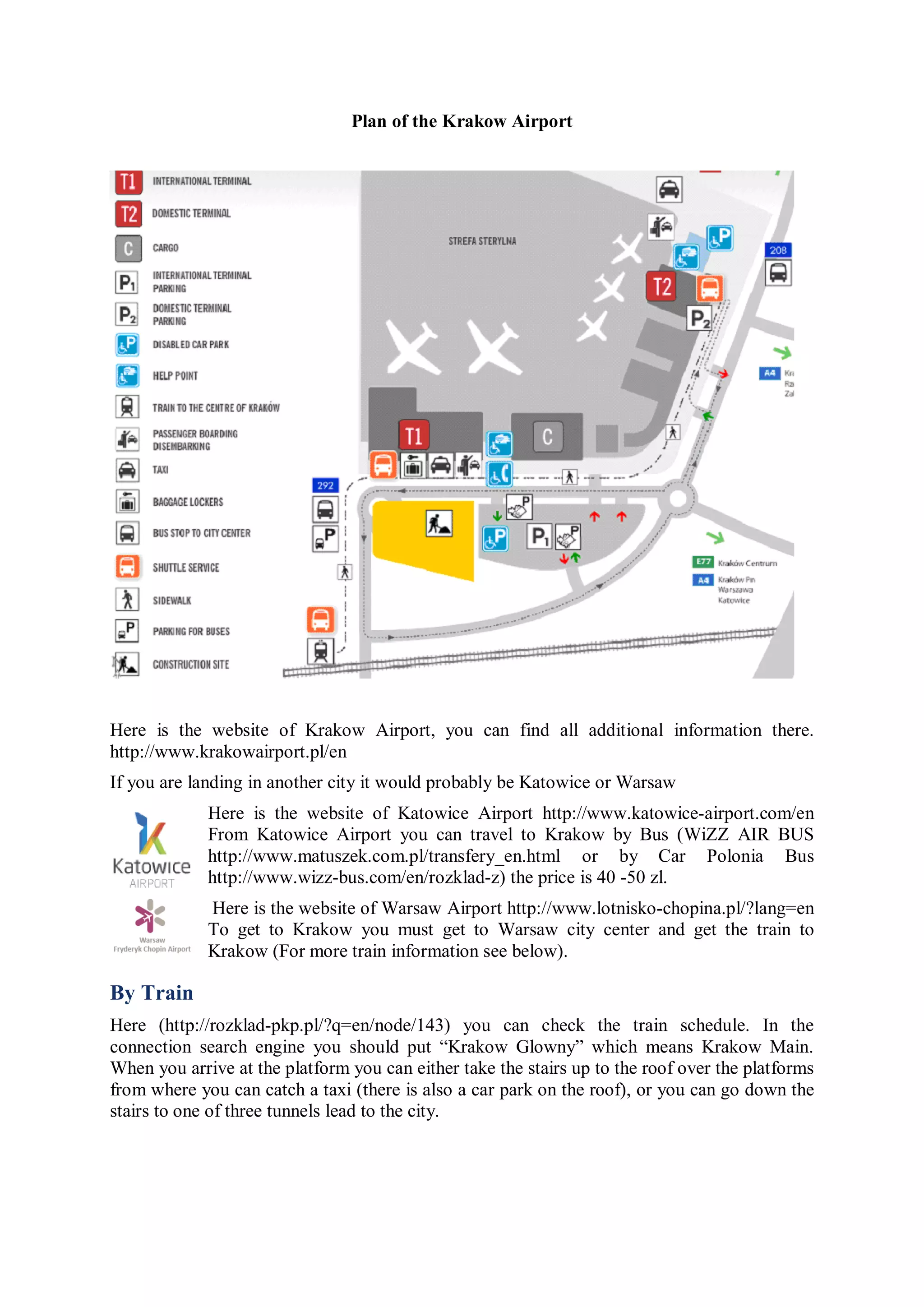
Plan of the Krakow Airport


Here is the website of Krakow Airport, you can find all additional information there.
http://www.krakowairport.pl/en
If you are landing in another city it would probably be Katowice or Warsaw
             Here is the website of Katowice Airport http://www.katowice-airport.com/en
             From Katowice Airport you can travel to Krakow by Bus (WiZZ AIR BUS
             http://www.matuszek.com.pl/transfery_en.html or by Car Polonia Bus
             http://www.wizz-bus.com/en/rozklad-z) the price is 40 -50 zl.
             Here is the website of Warsaw Airport http://www.lotnisko-chopina.pl/?lang=en
             To get to Krakow you must get to Warsaw city center and get the train to
             Krakow (For more train information see below).

By Train
Here (http://rozklad-pkp.pl/?q=en/node/143) you can check the train schedule. In the
connection search engine you should put “Krakow Glowny” which means Krakow Main.
When you arrive at the platform you can either take the stairs up to the roof over the platforms
from where you can catch a taxi (there is also a car park on the roof), or you can go down the
stairs to one of three tunnels lead to the city.
By Coach bus
(PKS) - Near the Main Train Station there is also Main Coach Station. You can check the
schedule here http://www.rda.krakow.pl/en/detale.php

Location
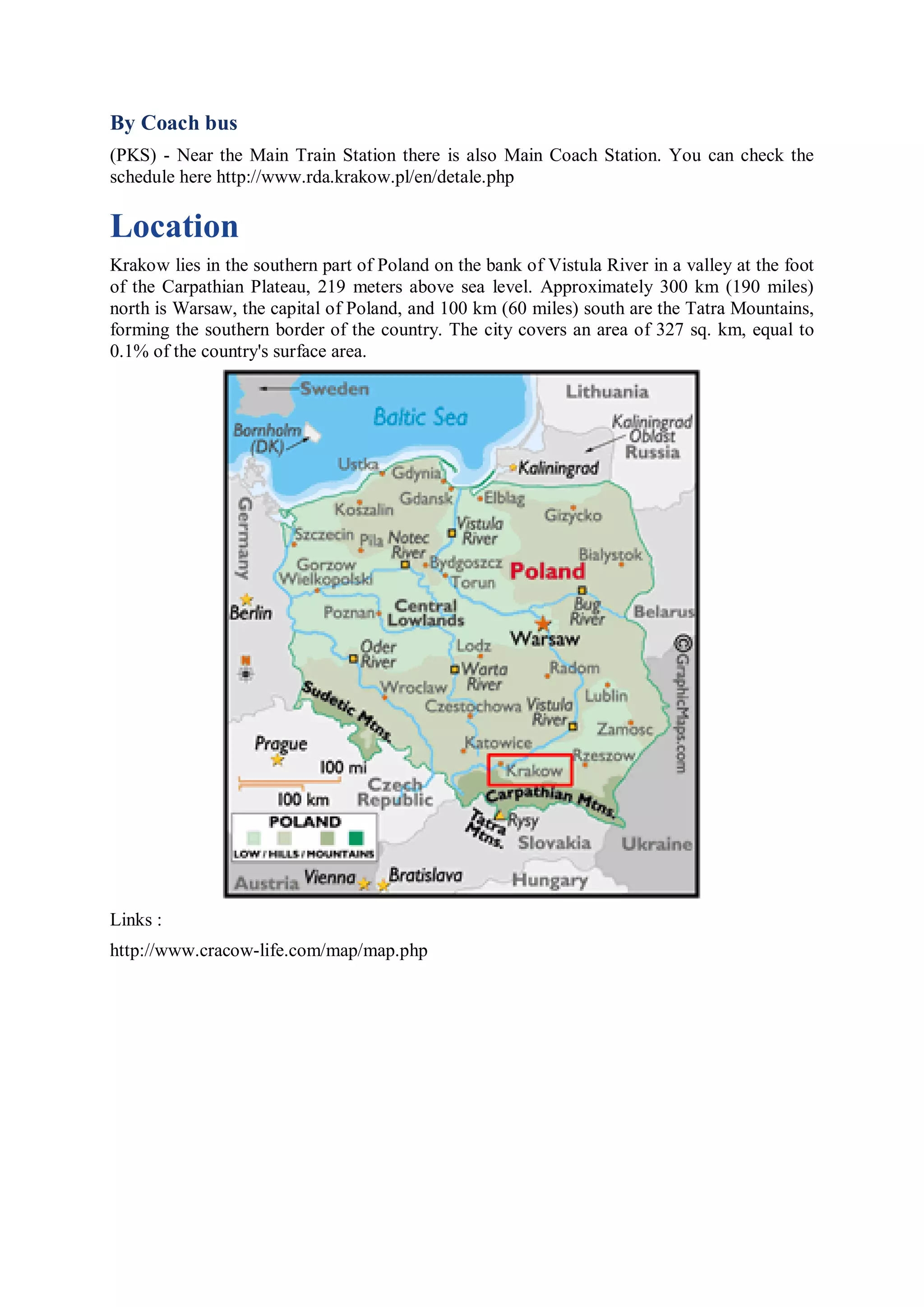
Krakow lies in the southern part of Poland on the bank of Vistula River in a valley at the foot
of the Carpathian Plateau, 219 meters above sea level. Approximately 300 km (190 miles)
north is Warsaw, the capital of Poland, and 100 km (60 miles) south are the Tatra Mountains,
forming the southern border of the country. The city covers an area of 327 sq. km, equal to
0.1% of the country's surface area.


Links :
http://www.cracow-life.com/map/map.php
Our City
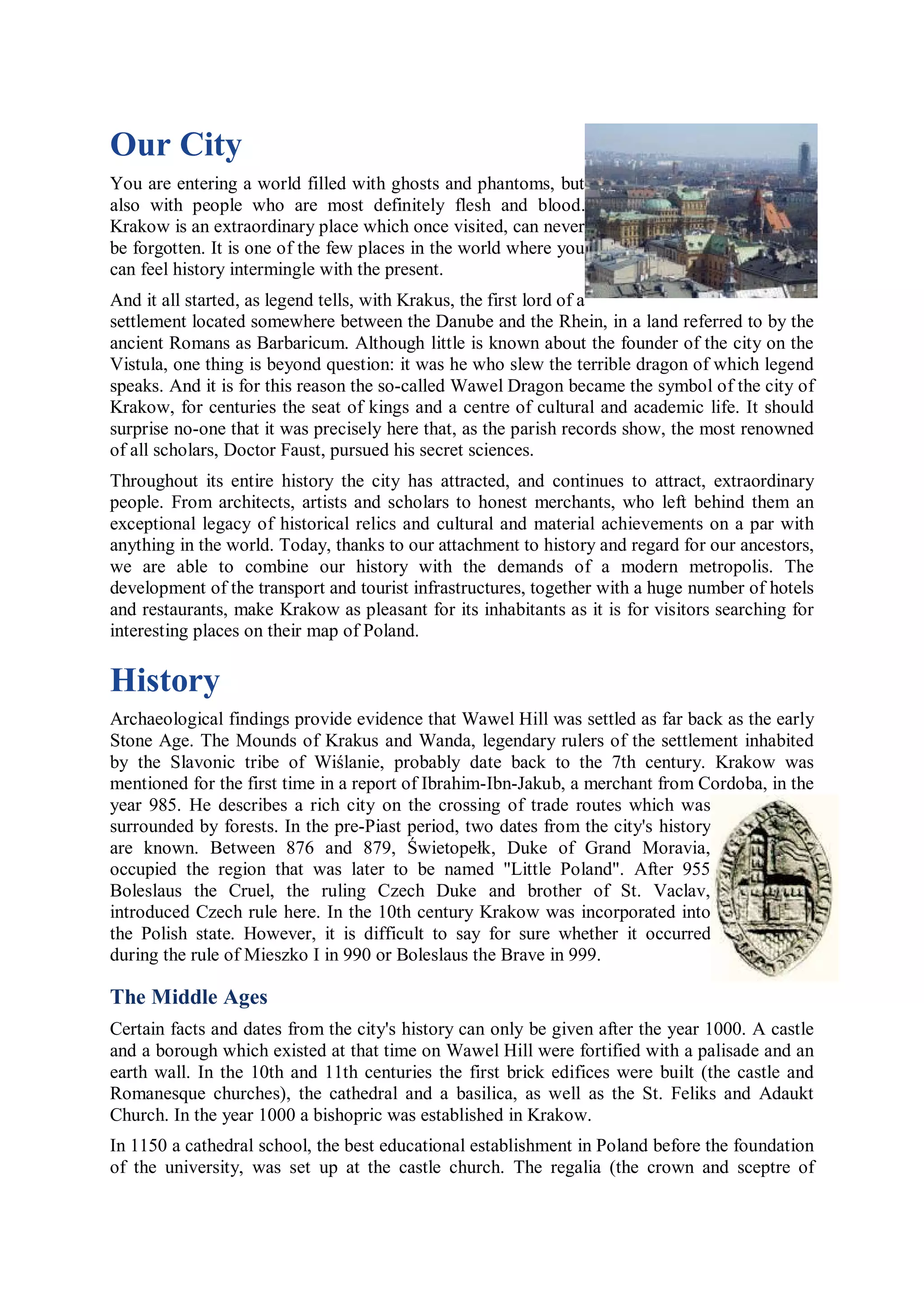
You are entering a world filled with ghosts and phantoms, but
also with people who are most definitely flesh and blood.
Krakow is an extraordinary place which once visited, can never
be forgotten. It is one of the few places in the world where you
can feel history intermingle with the present.
And it all started, as legend tells, with Krakus, the first lord of a
settlement located somewhere between the Danube and the Rhein, in a land referred to by the
ancient Romans as Barbaricum. Although little is known about the founder of the city on the
Vistula, one thing is beyond question: it was he who slew the terrible dragon of which legend
speaks. And it is for this reason the so-called Wawel Dragon became the symbol of the city of
Krakow, for centuries the seat of kings and a centre of cultural and academic life. It should
surprise no-one that it was precisely here that, as the parish records show, the most renowned
of all scholars, Doctor Faust, pursued his secret sciences.
Throughout its entire history the city has attracted, and continues to attract, extraordinary
people. From architects, artists and scholars to honest merchants, who left behind them an
exceptional legacy of historical relics and cultural and material achievements on a par with
anything in the world. Today, thanks to our attachment to history and regard for our ancestors,
we are able to combine our history with the demands of a modern metropolis. The
development of the transport and tourist infrastructures, together with a huge number of hotels
and restaurants, make Krakow as pleasant for its inhabitants as it is for visitors searching for
interesting places on their map of Poland.

History
Archaeological findings provide evidence that Wawel Hill was settled as far back as the early
Stone Age. The Mounds of Krakus and Wanda, legendary rulers of the settlement inhabited
by the Slavonic tribe of Wiślanie, probably date back to the 7th century. Krakow was
mentioned for the first time in a report of Ibrahim-Ibn-Jakub, a merchant from Cordoba, in the
year 985. He describes a rich city on the crossing of trade routes which was
surrounded by forests. In the pre-Piast period, two dates from the city's history
are known. Between 876 and 879, Świetopełk, Duke of Grand Moravia,
occupied the region that was later to be named "Little Poland". After 955
Boleslaus the Cruel, the ruling Czech Duke and brother of St. Vaclav,
introduced Czech rule here. In the 10th century Krakow was incorporated into
the Polish state. However, it is difficult to say for sure whether it occurred
during the rule of Mieszko I in 990 or Boleslaus the Brave in 999.

The Middle Ages
Certain facts and dates from the city's history can only be given after the year 1000. A castle
and a borough which existed at that time on Wawel Hill were fortified with a palisade and an
earth wall. In the 10th and 11th centuries the first brick edifices were built (the castle and
Romanesque churches), the cathedral and a basilica, as well as the St. Feliks and Adaukt
Church. In the year 1000 a bishopric was established in Krakow.
In 1150 a cathedral school, the best educational establishment in Poland before the foundation
of the university, was set up at the castle church. The regalia (the crown and sceptre of
Boleslaw the Brave) were kept in the cathedral treasury. A rich library, which had 28 books,
included classic literature along with religious works, comedies by Terence, elegies by Ovid,
and historical monographs by Sallust. Certain facts and dates from the city's history can only
be given as being 'after the year 1000'. A castle and a borough which existed at that time on
Wawel Hill were fortified with a palisade and an earth wall. In the 10th and 11th centuries the
first brick edifices were built (the castle and Romanesque churches), the cathedral and a
basilica, as well as the St. Felix and Adaukt Church. In the year 1000 a bishopric was
established in Krakow. In 1150 a cathedral school, the best educational establishment in
Poland before the foundation of the university, was set up at the castle church.
The regalia (the crown and sceptre of Boleslaus the Brave) were kept in the cathedral
treasury. It had a rich library, with 28 books, including classic literature along with religious
works, comedies by Terence, elegies by Ovid, and historical monographs by Sallust. In 1142,
Bishop Robert consecrated the "second" Wawel cathedral, which had been built to replace the
destroyed Romanesque church. The body of St. Stanislas, after it had been moved from the
church at Skałka, and the relicts of St. Florian, were solemnly laid to rest at the new cathedral.
The feudal division of Poland and continuous fighting between regional dukes did not
interrupt the city's rapid development.
In 1138, Krakow Castle became more important as the official home of the highest duke and,
to some degree, the capital of Poland, according to the last will of Boleslaus the Wry-
Mouthed. The buildings destroyed during the invasion of the Tatars in 1241 were replaced by
new ones built in Gothic style. The location of the city according to the Magdeburg law in
1257 gave it a new layout with a centrally situated marketplace. In the 13th century the city
was provided with a new fortification system of city walls, towers and fortified city gates.
This system was gradually added to and modernised over the next few centuries. January 20,
1320 was the date of the first coronation; others followed over the next five centuries. The
cathedral also became the Royal burial site. The reign of Casimir the Great (Casimir III 1310-
1370), patron of the arts and sciences, proved to be of great importance for the city. The king
founded two new cities, Kazimierz and Kleparz, which were closely connected with Krakow.
Gothic, Franciscan and Dominican churches were built. St. Mary's Church, as well as the
Corpus Christi Church and St. Catherine's Church were built in Kazimierz. Renovation of the
cathedral and castle on Wawel Hill, and the Cloth Hall, Town Hall and other public buildings
were continued. In 1364, Kazimierz the Great founded Krakow Academy, which was the
origin of the later Jagiellonian University.

Jagiellonian epoch
Sepulchral sculpture on the sarcophagus of King Kazimierz Jagiellonczyk in
Wawel Cathedral - masterpiece of Veit Stoss Sepulchral sculpture on the
sarcophagus of King Casimir Jagiellonczyk in Wawel Cathedral -
masterpiece of Veit Stoss
Ladislaus Jagiello, Grand Duke of Lithuania, was crowned King of Poland
in 1386 and started the greatest Polish dynasty, which ruled Poland for over
200 years. Krakow became the capital of a monarchy spreading over
genuinely Polish territories as well as vast Lithuanian-Russian areas. The
royal court played an important role in supporting artistic and cultural life.
Outstanding humanists, scientists and artists came here from Italy, Germany and other
countries. Famous sculptor Veit Stoss came from Nurnberg in 1477 to carve a large altar for
St. Mary's Church by order of the citizens. After further rebuilding between 1499 and 1536,
Wawel Castle was a pearl of Renaissance architecture, boasting the "Zygmuntowska" Chapel
- the most beautiful sepulchral chapel in Poland. The castle was decorated with a collection of
Arras tapestries ordered from Flanders. It proudly played the role of the royal seat of a
powerful country: well up in the fashionable world of its time.
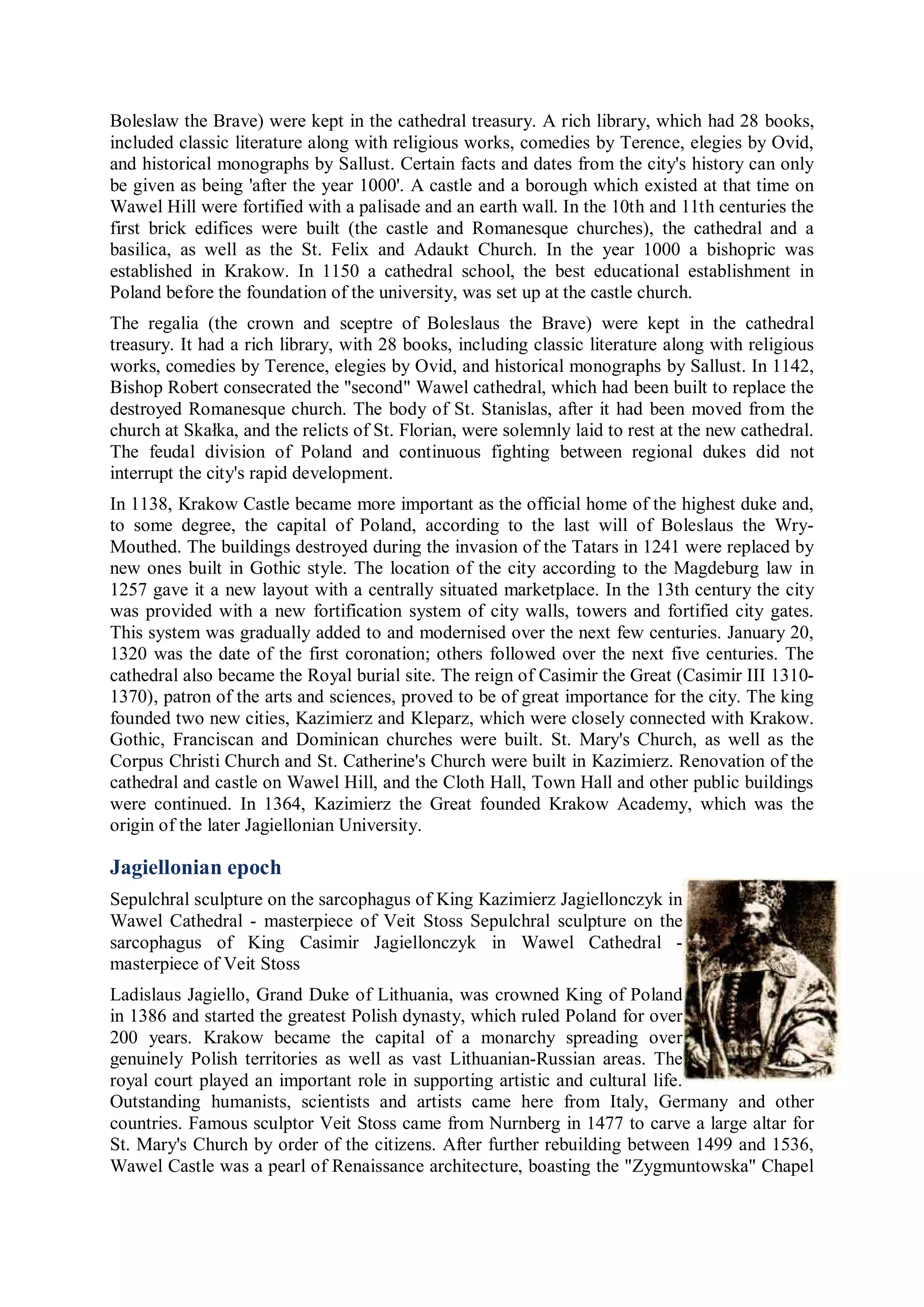
Cathedral seal (13th century) representing the Romanesque cathedral
founded by Ladislaus Herman
Cathedral seal (13th century) representing the Romanesque cathedral
founded by Wladyslaw Herman At the end of the 16th century
Warsaw became the capital of Poland. Krakow lost its importance
although it preserved its formal role as the site for royal coronations
and burials.

The 17th century
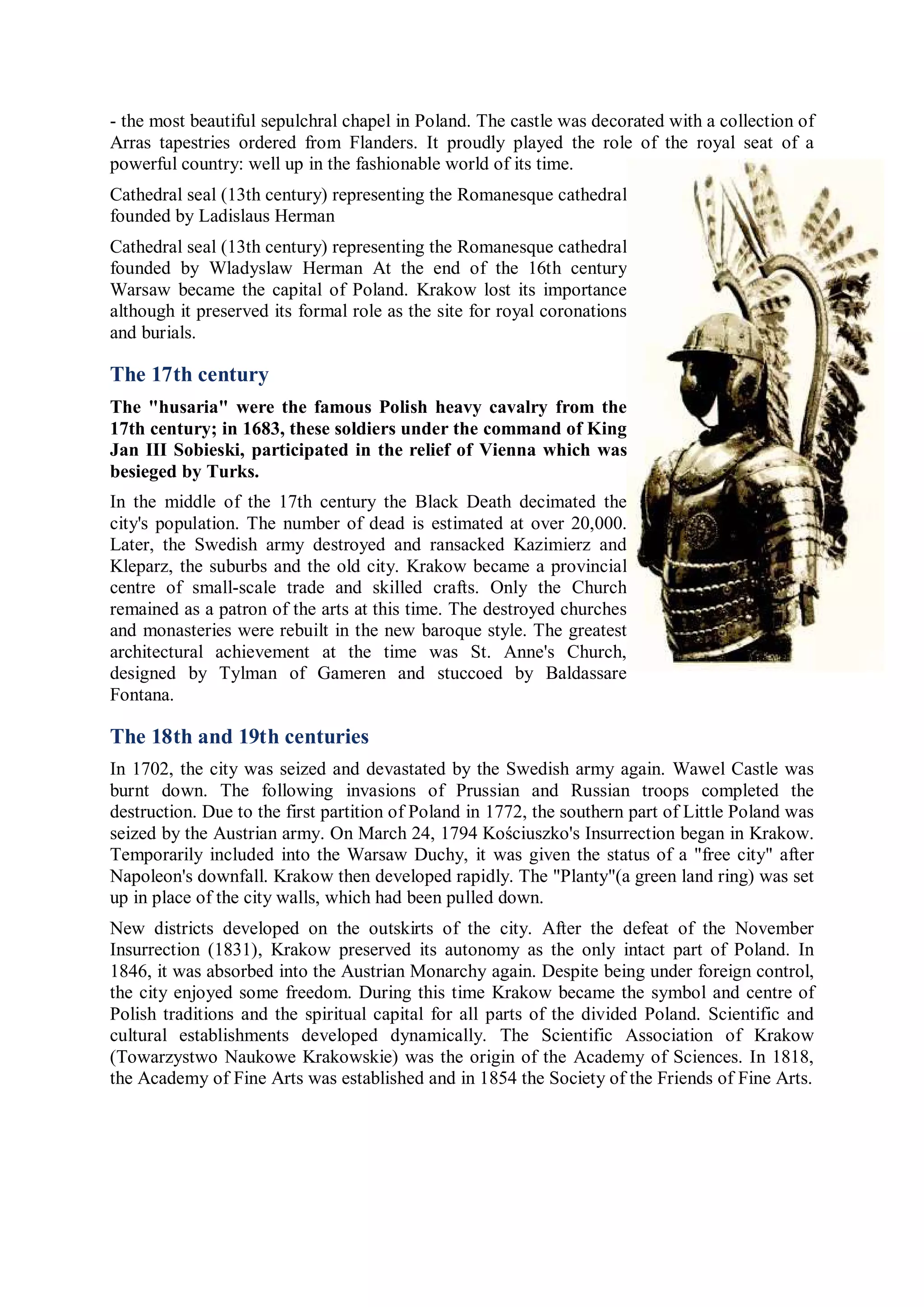
The "husaria" were the famous Polish heavy cavalry from the
17th century; in 1683, these soldiers under the command of King
Jan III Sobieski, participated in the relief of Vienna which was
besieged by Turks.
In the middle of the 17th century the Black Death decimated the
city's population. The number of dead is estimated at over 20,000.
Later, the Swedish army destroyed and ransacked Kazimierz and
Kleparz, the suburbs and the old city. Krakow became a provincial
centre of small-scale trade and skilled crafts. Only the Church
remained as a patron of the arts at this time. The destroyed churches
and monasteries were rebuilt in the new baroque style. The greatest
architectural achievement at the time was St. Anne's Church,
designed by Tylman of Gameren and stuccoed by Baldassare
Fontana.

The 18th and 19th centuries
In 1702, the city was seized and devastated by the Swedish army again. Wawel Castle was
burnt down. The following invasions of Prussian and Russian troops completed the
destruction. Due to the first partition of Poland in 1772, the southern part of Little Poland was
seized by the Austrian army. On March 24, 1794 Kościuszko's Insurrection began in Krakow.
Temporarily included into the Warsaw Duchy, it was given the status of a "free city" after
Napoleon's downfall. Krakow then developed rapidly. The "Planty"(a green land ring) was set
up in place of the city walls, which had been pulled down.
New districts developed on the outskirts of the city. After the defeat of the November
Insurrection (1831), Krakow preserved its autonomy as the only intact part of Poland. In
1846, it was absorbed into the Austrian Monarchy again. Despite being under foreign control,
the city enjoyed some freedom. During this time Krakow became the symbol and centre of
Polish traditions and the spiritual capital for all parts of the divided Poland. Scientific and
cultural establishments developed dynamically. The Scientific Association of Krakow
(Towarzystwo Naukowe Krakowskie) was the origin of the Academy of Sciences. In 1818,
the Academy of Fine Arts was established and in 1854 the Society of the Friends of Fine Arts.
The 20th century
The approaching war against Russia prompted the growth of independence movements.
Almost all political parties could act legally in Krakow, and in 1910, the paramilitary
"Strzelec" (Rifleman) Association was founded. On June 6, 1914, the First Company of
"Strzelcy" und er the command of Józef Piłsu d s i set off from the "Oleand ry" of Krak ow.
                                                  k
After independence was regained in 1918, Krakow became a significant administrative and
cultural centre. Industry started to develop rapidly. Although the Second World War did not
destroy Krakow's historical monuments, it ravaged the city in other ways.
On November 6, 1939, professors of Jagiellonian University and the most outstanding
representatives of the city's intellectual elite were arrested and transported to the concentration
camp in Sachsenhausen. After the war Krakow lost its privileged position. The communist
authorities wanted intellectual circles dominated by the working class. This aim was to be
fulfilled by the mass of construction workers who were attracted to Krakow. Today however,
it is artistic and scientific circles that create the image of the city, which now has over 800,000
inhabitants.

Universities
          Jagiellonian University (UJ- Uniwersytet Jagiellonski)Founded in 1364,
          Jagiellonian University is the oldest university in Poland, and the second oldest in
          Central Europe after the University of Prague. In the 15th century, the Jagiellonian
was one of most international universities in Europe with approximately 44% of the students
coming from abroad. Today, the university is once again attracting a
growing number of international students. Among its most prominent
graduates were Nicolaus Copernicus (1491-95) and Pope John Paul II
(1938-39, 1942-46).
          AGH University of Science and Technology. (AGH – Akademia
          Gorniczo-Hutnicza )
           The abbreviation AGH stands for polish historical name of the
           university -Academy of Mining and Metallurgy. AGH is the second
largest technical university in Poland, established in 1919. It educates
students at 15 Faculties and the Interfaculty School of Energy, at 20 fields of
study and over 100 specializations. The ambition of the University is to
enable its students to gain knowledge at the highest level, acknowledged all
over the world.
           Tadeusz Kosciuszko Krakow University of Technology (Politechnika
           Krakowska)
            The university was established in 1945 (at first as a part of the present AGH), to
become an independent entity in 1954. On the national scale the university is ranked between
the fifth and seventh position among over twenty universities of technology in the country.
Some of the faculties are ranked on higher positions and the faculties of Architecture, Civil
Engineering and Mechanical Engineering are among the best in Poland. Several interfaculty
units operate at University of Technologies including the Urban Educational Centre that
prepares foreign students intending to study at Polish universities with special emphasis on
architectural studies.
Krakow University of Economics (UEK – Uniwersytet Ekonomiczny)
         The Cracow University of Economics was established in 1925 and it was the third
         school of higher economic education in Poland after metropolitan Warsaw and Lviv.
It is a state-owned university, educating students at four Faculties:
Faculty of Economics and International Relations, Faculty of Finance,
Faculty of Management and Faculty of Commodity Science. University
owns modern sports facilities and houses and health service centre. The
AIESEC Krakow office is placed in the Sport Building of University of
Economics.
         Agricultural University in Krakow (UR – Uniwersytet Rolniczy)
         The University educates students at 7 faculties and Interfaculty Study of
         Biotechnology in 12 major fields and 24 specialisations. It offers full time and part-
         time Master and Bachelor programmes as well as supplementary Master studies. The
University academic staff has been developing programmes in English to create a wide
educational offer for foreign students.
University of Pope John Paul II (PAT - Papieska Akademia Teologiczna)
This university offers graduate degrees in theology, philosophy, and church history. It derives
from the theology faculty of Jagiellonian University, which was
established in 1397. The theology faculty was expelled from the
university by Communist authorities in 1954. Remaining under the
supervision of the Vatican, the faculty received the honorific title of
"Pontifical" in 1974 and was established as The Pontifical Academy
of Theology by Pope John Paul II in 1981. The name was changed
in 2009 to University of Pope John Paul II.
           Jan Matejko Academy of Fine Arts in Krakow (ASP – Akademia Sztuk
           Pieknych im. Jana Matejki)
           The Academy of Fine Arts is the oldest artistic university in Poland. Founded in
           1818, it was a subdivision of the Jagiellonian University and received the status of
           an independent institution in 1873. In the period of
           Modernism, the Faculty of Painting had the most
distinguished Polish painters as teachers. Among them were: Leon
Wyczolkowski, Teodor Axentowicz, Stanislaw Wyspianski, Jacek
Malczewski, Jan Stanislawski and Jozef Mehoffer, and after 1905
Jozef Pankiewicz, Ferdynand Ruszczyc and Wojciech Weiss. At that
time the Academy was at the time the main centre of Polish artistic
life. The Academy boasts many prominent graduates, who over the
decades shaped Polish art and culture.
                The Academy of Music in Krakow (Akademia Muzyczna)
               The Academy of Music in Krakow has its origins in the Kraków
               Conservatory, founded by eminent Polish composer Wladyslaw Zelenski on
7 February 1888. The Academy is known as the alma mater of the contemporary Polish
composer Krzysztof Penderecki.
Ludwik Solski Academy for the Dramatic Arts (PWST -Panstwowa
             Wyzsza Szkola Teatralna im. Ludwika Solskiego)
              Ludwik Solski Academy for the Dramatic Arts was founded in 1946 by a well-
known Polish actor, Juliusz Osterwa. Close links to the leading theatres in Kraków contribute
to the Academy's status. There is a direct correlation between the condition of the city's
theatres and the condition of the Academy with staff composed of a fair number of Cracovian
theatre personalities whose views on drama and the teaching methods cover a wide range of
philosophies. At present the Academy recruits new students for the Actors' Faculties in
Kraków and Wrocław, the Faculty of Play Directing in Kraków, and the Puppet Theatre
Faculty in Wrocław. Since 1946 well over a thousand students have graduated from the
Ludwik Solski Academy, and found employment on theatre stages in Poland and abroad.
           The Andrzej Frycz Modrzewski Krakow University Collage (KSW
           – Krakowska Szkola Wyzsza)
            The University provides education at the following faculties: law, economy,
            administration, international relations, political science, management, architecture,
computer science, sociology, environment protection, cultural studies,
English studies. It co-operates with foreign higher education
institutions, organises international conferences and participates in the
European programs like CEEPUS, Erasmus, Leonardo da Vinci etc. It
also conducts       cross-cultural and combined research with the
contribution of professors from various countries. The university also
offers semester-long lectures in foreign languages.
                              Tischner European University (WSE – Wyższa Szkola
                              Europejska)
TEU is a young, private and dynamic institution of higher education, founded in 2003. It
offers BA programmes in Sociology, International Relations, Philology - Applied Linguistics
and Information Technology. There is also the MA programme in International Relations in
Polish, and a full time BA programme in International Relations taught in English. Apart from
undergraduate programmes, the TEU Centre for Strategic Development offers a wide range of
postgraduate non-degree professional studies. Most classes are taught
by prominent Polish academics, who have also taught at many
European and American universities. The university’s international
contacts and exchange programmes provide students with
considerable opportunities for studying abroad. Every year an
increasing number of international students come to TEU to complete
part of their studies.
             The School of Banking and Management in Krakow (WSZiB –
             wyższa Szkola Zarządzania i Bankowosci)
             Founded in 1995, the school offers courses in Management, Finance &
             Accounting, Computer Science and Sociology. It offers also post-graduate
programmes , courses and training in accordance with the CISCO Academy and Microsoft
AATP curricula. The school holds the Quality Certificate of the Krakow Chamber of
Commerce and Industry and has been entered to their Book of Awards for Entrepreneurial
Activities. For many years, in the school rankings of major Polish magazines the school has
been ranked top places.
The Krakow School of Business and Commerce (WSH- Wyższa
             Szkoła Handlowa)
              The School is a private academic institution, established in 1994. Graduates of
the Cracow School of Business and Commerce acquire legal, economic and practical skills
necessary for the management of modern commercial, service and financial establishments.
They are equipped with the kind of knowledge which gives them the opportunity to
commence work in public administration and European Union institutions as well as tax
institutions and in financial audit.The profile of tuition at the Cracow School of Business and
Commerce is based on contemporary standards of management studies in leading universities
of international importance.
                                    School of Business – National Louis University
                                    in Nowy Sacz (WSB-NLU Wyzsza Szkola Biznesu)
                                    Established in 1991, WSB-NLU enjoys excellent
                                    reputation, confirmed by its graduates, whose knowledge
and qualifications have been recognized by top employers. The offers courses at four
faculties: management, computer science, psychology and MBA. WSB-NLU cooperates with
numerous universities all over the world. The cooperation mainly includes exchange of
students and lecturers, organization of mutual scientific projects, participation in seminars and
academic meetings, exchange of scientific publications and academic projects.
Cultural life
It's impossible to mention the word "Cracow" and not say "culture" the same sentence. In this
city you are absolutely immersed in all of life's finer things. Cherubs and gargoyles look down
from almost every ancient palace and townhouse - guarding the endless treasure troves of
everything cultural. From famous paintings, like Da Vinci's "Lady with an Ermine" to
Egyptian artefacts, to catacombs which easily break the thousand-year marker, you'll find
more culture and history here than in most cities on this planet. When you've satisfied your
museum-hunger, move right along to Cracow's many galleries. Showcasing the best of the old
as well as the brightest modern stars, you'll get more art than you can handle. And let's not
forget about the city's own, unique CracowCulture. There's not many places in the world
where "nie kulturalny" (uncultured) survives as a powerful cut-down. We've prepared an easy
to use directory of all of the city's finer things. Perfect for balancing out that"Drink" section!

Cinemas
Poland has a proud tradition in cinema, and figures such as Andrzej Wajda, Roman Polanski
and Krzyszstof Kieslowski are counted amongst the most interesting directors of our day.
With Cracow being something of a mecca for artists, it should come as little surprise then that
the city has a passionate interest in film, boasting an annual international shorts festival, and a
wide variety of cinemas to choose from.
It is likely that at any given time you will be able to find a good film being played, whether it
is an old classic or a recent blockbuster. The majority of English language films are sub-titled,
so there shouldn't be any problems for visitors to the city. Prices are very reasonable, and are
around 15 zloty at weekends but with
significant reductions at other times.
One of the best bets in the Old Town is the
gracious ARS complex, which is located in a
former mansion just off the main market
square. In the city centre, Kino Kijow is the
obvious choice, whilst for a full-on
blockbuster experience, MultiKino, a little
further out, should do the trick. Spread across
the city you will find a number of beguiling
little filmhouses, (some very ropey but
equally full of character!) usually with an arty
cafй attached. There you'll find old classics,
experimental shorts or pickings from
European and World Cinema.
http://www.cracow-life.com/poland/krakow-
cinemas
From the baroque sweep of its gables down to the gargoyles and Madonnas that peep out of
the street corners, Cracow is a resoundingly theatrical city. And the Rynek, (the largest market
square in Europe) is very much like a great open air stage in itself - a place to really savour
the diversity of life. Many skilful performers (and others less abundantly so), make their
living on the square, be they mime artists or buskers. This is no novelty, and street artists have
entertained people here since medieval times. The historic and vibrant processions of the
Roman Catholic Church, which sometimes take over whole swathes of the Old Town, are
themselves exquisitely honed pieces of performance art. Theatre is in the blood!
If you want to go and see a performance, the majority will of course be in Polish. However, if
you don't speak the lingo this may not be as big a problem as it sounds. Much experimental
drama does not involve speaking at all, so you don't need to worry about being left out in that
respect! This is also the case with the highly popular Groteska theatre which often jettisons
language in favour of colour, movement and imagery. Many of their works have a direct
appeal to children, exploring the worlds of myth and fantasy, and they regularly perform in
the Rynek during the Summer months.If it is opera that you want to see, (which is very
reasonably priced), you will probably already know the famous stories of troubled love
affairs, and spicy intrigues - they tend to be performed in the original languages. These
classics are staged at the magnificent Slowacki Theatre, where you can reserve the box that
was used by the Habsburg Emperor Franz Joseph and his wife. And why not indeed!

Theatres
From the baroque sweep of its gables down to the gargoyles and Madonnas that peep out of
the street corners, Cracow is a resoundingly theatrical city. And the Rynek, (the largest market
square in Europe) is very much like a great open air stage in itself - a place to really savour
the diversity of life. Many skillful performers (and others less abundantly so), make their
living on the square, be they mime artists or buskers. This is no novelty, and street artists have
entertained people here since medieval times. The historic and vibrant processions of the
Roman Catholic Church, which sometimes take over whole swathes of the Old Town, are
themselves exquisitely honed pieces of
performance art. Theatre is in the blood!
If you want to go and see a performance, the
majority will of course be in Polish. However,
if you don't speak the lingo this may not be as
big a problem as it sounds. Much
experimental drama does not involve speaking
at all, so you don't need to worry about being
left out in that respect! This is also the case
with the highly popular Groteska theatre
which often jettisons language in favour of
colour, movement and imagery. Many of their
works have a direct appeal to children,
exploring the worlds of myth and fantasy, and
they regularly perform in the Rynek during the Summer months.
If it is opera that you want to see, (which is very reasonably priced), you will probably already
know the famous stories of troubled love affairs, and spicy intrigues - they tend to be
performed in the original languages. These classics are staged at the magnificent Slowacki
Theatre, where you can reserve the box that was used by the Habsburg Emperor Franz Joseph
and his wife. And why not indeed!
http://www.cracow-life.com/poland/krakow-theatres
Annual Festivals in Krakow
                                                        When some people hear the word
                                                        "festival," they picture sweaty crowds
                                                        of youngsters listening to music on a
                                                        huge grassy field, downing brewskies
                                                        as their favourite rock band plays on
                                                        a massive stage several hundred
                                                        metres away. But you won't find any
                                                        Lollapalooza-like antics in Krakow
                                                        (or even anything close to the
                                                        Open'er Festival in Gdynia). Instead,
                                                        you'll get a more sophisticated
                                                        selection of festivities, exposing
                                                        Krakow's cultural depth. But don't
worry - even if a festival is celebrating soup in Krakow, the piwo will still be a'flowing, and
likely for the whole night! And as for music on massive stages - you don't have to look for a
field in the middle of nowhere to catch some big acts - many of them will be playing on giant
stages constructed in the middle of the Market Square or on Plac Nowy in Kazimierz
throughout the spring and summer months. So check our list of festivals to see what's going
on when you're here, and be sure to also check our events calendar for more specific
information.
http://www.cracow-life.com/poland/krakow-festivals

Museums
Whether it's Egyptian mummies, Samurai warriors or the indigenous (yet no less exotic!)
winged horsemen, all can be tracked down at one or another of Cracow's museums. There are
also some fine collections of paintings about town, especially at the National Museum, but
you can also find a few gems in the upstairs gallery of the Cloth Hall.
Generally, museums are open every day apart from Mondays, and the great majority offer free
access on Sundays. One slight pain though is that throughout the week most shut up shop
promptly at 3 pm, so it's worth planning ahead to avoid disappointments.
The Old Town is positively choc-a-bloc with museums, ranging from the venerable
Czartoryski Museum, Poland's oldest foundation of this kind, to the quaint Pharmacy museum
on ulica Florianska.
Over the river from Wawel Hill, you will find the rather special Manggha Japanese Centre,
which was built under the aegis of the film director, Andrzej Wajda. Here you can immerse
yourself in oriental style, rounding things off with a cup of green tea and a tremendous view
of the castle. Another short walk from the Old Town, yet still within the City Centre, takes
you to the main branch of the National Museum. It's just around the corner from the
Jagiellonian University Library, which houses many ancient relics.
Kazimierz, the former Jewish district, is also host to some important collections, particularly
the Jewish History museum in the Old Synagogue. There is also a moving museum of the
ghetto just over the bridge in Podgorze.
If you're feeling adventurous don't miss the lovely museum of Young Poland at Rydlowka, it's
a little further afield, but for Poles this is a mythic place if ever there was one....
http://www.cracow-life.com/poland/krakow-museums
Night life
Krakow is so rich in pubs, bars,
restaurants and clubs that it seems almost
impossible to count them all. Every old
tenement house near the Square Market
has at least one pub. Do not be misled by
the name "pub", as in Krakow it can mean
virtually anything and usually it means
something between a pub, nightclub and
even a live music club. They appear to be
in every yard, every cellar, behind every
window and now when the "underground" places are utterly adopted, there are more and more
clubs in private apartments.
The Main Market Square in Cracow and its environs have one of the most developed nightlife
in Europe. There are over 200 cafes, restaurants and clubs just around it. The parties goes all
week long, but of course the Friday and Saturday nights are the hottest. Everyone is able to
find a place for himself. There is a wide range of different types of clubs that play: jazz, rock,
modern pop as well as immortal evergreens. Moreover,Kazimierz district is not worse. It
develops very quickly now, and new clubs open frequently, but it still remains more peaceful.
Overall, Cracow is one of the most enjoyable destinations you can travel to.


Afera Pub                    ul. Slawkowska 13          Blitz it up at Afera

Alchemia                     ul. Estery 5               One of the hippest hangouts in Kazimierz

Art Club Bledne Kolo         ul. Bracka 4, 1st floor    Superior club on the popular ul. Bracka

Baccarat                     ul. Stolarska 13           Luxurious clubbing destination

Boom Bar Rush                ul. Golebia 6              Boom, Boom, Boom, let me hear you say ....

Cafe Avanti                  ul. Karmelicka 7           Attractive cafe on Karmelicka

Cafe Camelot                 ul. sw. Tomasza 17         English newspapers and fresh coffee

Cafe Golebia 3               ul. Golebia 3              Classic Cracow on a sleepy little street

                                                        Classy cafe with frequent photography
Cafe Mlynek                  Plac Wolnica 7
                                                        exhibitions

Camera Cafe                  ul. Wislna 5               Chocolate delight on Wislna

Carpe Diem                   ul. Marka                  Classic Cracovian cellar joint

Carpe Diem II                ul. Slawkowska 6           Take two....

Cien Klub                    ul. Jana 15                House music is in da house

CK Browar                    ul. Podwale 6-7            A beer hunter's delight

Club Clu                     ul. Szeroka 10             Crank it up at Clu
Club Lubu Dubu             ul. Wielopole 15 Ip.      Cult hangout on Wielopole

                                                     Legendary student club on the Market
Club Pod Jaszczurami       Rynek Glowny 8
                                                     Square

Club PRL                   ul. Garncarska 5          A return to rockin' communist times

Coffee Heaven              ul. Karmelicka 8          Coffee galore on Karmelicka

Coffee Republic            ul. Bracka 4              The finest republic in Cracow

Czekolada                  ul. Bracka 4              Hot chocolate, cocktails and comfy sofas

Dekafencja                 ul. Slawkowska 4          A cafe/pub in true Cracow style

Demmers Teehaus            ul. Kanonicza 21          More than just a teahouse - like a home

Drukarnia Podgorze         ul. Nadwislanska 1        A legend reborn

Dym                        ul. Tomasza 13            Popular, funky hangout near the Rynek

Heherbata.pl - Tea House   ul. Florianska 13         A heavenly assortment of tea

English Football Club      ul. Mikolajska 5          Don't miss a game!

                                                     From Cabaret to drum'n'bass - all in one
Faust Club                 Rynek Glowny 6
                                                     place!

Filmowa Cafe               al. Krasinskiego 34       Drinks by the Silver Screen

Folia Concept Club         Rynek Glowny 30           Great expectations

Frantic                    ul. Szewska 5             Lively club with regular events

Goraczka Freak Club        ul. Szewska 7             Fever pitch in Cracow's Old Town

Harris Piano Jazz Bar      Rynek Glowny 28           Jazz stalwart on the market square

Indigo                     ul. Florianska 26         Cellar club with a distinguished pedigree

Irish Arms                 ul. Poselska 18           The genuine Irish article

Irish Pub                  ul. Jana 18               Sample the best Guinness in Poland

Jama Michalika             ul. Florianska 45         Art nouveau splendour

Jazz Rock Cafe             ul. Slawkowska 12         Lively student hangout on Slawkowska

Kitsch                     ul. Wielopole 15/4 IIp.   Feeling blue? Feel pink!

La Habana Pub              ul. Miodowa 22            Cuba comes to Kazimierz

Le Pianka                  ul. Szeroka 10            Snack Stop on Szeroka

Le Scandale                Plac Nowy 9               Scandalous style on Plac Nowy

Les Couleurs               ul. Estery 10             A touch of Paris in the heart of Kazimierz
Places to visit in Krakow and nearby
Wawel
Kanonicza, the street usually taken to access the
famous Wawel Hill, is short and fairly narrow.
Yet it is one of the most important and ancient
streets of the city; a street whose look has hardly
changed over the centuries - authentic and very
much alive. Moreover, Kanonicza provides an
example of favourable changes that have
continued in Krakow in recent years: the complex
restoration of city's heritage and preservation
projects which unveil the city's true beauty layer
by layer.
A look at a plan of the city shows that the space
contained by the walls of the castle is similar to
that of the Main Market Square. In the castle's
many chambers, exhibitions that simply cannot be
missed await you: royal chambers and stately
rooms, collections of Oriental art and military
trophies, collections of Flemish tapestries of amazing beauty, as well as archaeological
specimens. They are testimony to more than a millennium of Christianity in Polish Lands. It
was here, in the Royal Castle, that the monumental exhibition entitled Wawel 1000-2000 was
organised in the year 2000 to illustrate the development of Polish statehood. Worth visiting in
the castle grounds are the Wawel Cathedral, the Royal Tombs - crypts containing royal
sarcophagi, where we walk among Poland's entire history, and the massive "Sigismund" Bell,
which peals only to commemorate events of the greatest importance to the country and the
city. Half a day is hardly sufficient to see all these even if you hurry.
Yet there is more to Wawel than just exhibitions. Even if you were to postpone visiting the
castle until your next, longer visit in Krakow, spend a while in the ring of castle walls late in
the afternoon. The gates are open much longer than the exhibitions, and you will have a
chance to see the arcaded courtyard of rare beauty, the cathedral, and to look across to the
other side of the Vistula River. Here is where the famous Manggha Centre of Japanese Art
and Technology stands, housing the Japonica gathered by one of the most famous European
collectors, Feliks "Manggha" Jasieński. Having descended to the banks of the river, we can
see the Dragon and the entrance to his den: a favourite destination on family strolls. During St
                                                         John's Night (June), this place
                                                         becomes the stage for the huge open-
                                                         air event: Wianki - the Floating of the
                                                         Garlands, continuing an ancient,
                                                         pagan tradition.
The Main Square - Rynek Główny
The Main Square (Rynek Główny) is the natural
centre of Krakow: a stage for various minor and
major events, a reference point, a meeting place,
and the starting point or destination for countless
walkers. Historically speaking, the Main Square
began to operate in a shape and size similar to
what we see today (a square with 200-metre-long
sides) already in the earliest days of the Chartered
City, i.e. after the granting of the Great Royal
Charter in 1257. The centrally located Cloth Hall (Sukiennice) has survived to this day; the
building was originally a commercial establishment for trading in cloth, and for over a century
has been the main seat, and later one of the branches, of the National Museum. Other
buildings standing to this day in the heart of the Main Market Square include the diminutive
Church of St Adalbert (also known as Wojciech or Voitek) - a site of important archaeological
discoveries, and the solitary tower - a remnant of the Town Hall demolished in the 19th
century. In the north-eastern corner of the square stands St Mary's Church, frequently referred
to as a basilica. With its two slender, spired towers reaching high above the whole city, it is
one of Krakow's landmarks. The Nuremberg master, Wit Stwosz (Veit Stoss) created his
magnum opus here - the monumental High Altar of St Mary's - a marvel that attracts
thousands of tourists every day.
Some Krakow legends and many historic events are
closely linked to the city's Main Square. These include
the bugle call played every full hour from one of the
towers of St Mary's, the passage of the Lajkonik - the
Hobby Horse of Krakow (in June), the Enthronement of
the Fowler King, and the December competition for the
most beautiful Krakow nativity scene (crib). Nearly all
the houses and palaces surrounding the Main Square
are of historical interest, with their histories reaching
back centuries. They house the Historical Museum of
the City of Krakow, the International Cultural Centre,
numerous shops, restaurants, and pubs. Imposing facades, splendidly decorated doorways,
windows, and roofs of the houses are worth your attention. It is not difficult to find perfectly
preserved interiors and carefully restored architectural elements.
The Main Square is a large area for people to meet during summer festivals, concerts, fairs,
presentations, and Poland's largest New Year's Party. Citizens of Krakow frequently meet
"pod Adasiem", that is at the foot of the Monument to Adam Mickiewicz, the poet. A longer
stay is encouraged by the ring of restaurant and café gardens surrounding the square, which
                                                   can easily provide a place to rest for
                                                   several thousand people. Some of them
                                                   operate from early in the morning into
                                                   the small hours in the night, nearly all
                                                   year round, with but a short break during
                                                   the fiercest frosts. In winter, patrons
                                                   move to the cellars so characteristic of
                                                   the centre of Krakow. In these cellars you
                                                   will often find live music. Krakow has
well deserved the title of the capital city of Polish jazz.
                                    Night life and clubbing also thrive here: after all, you are in
                                    a city of nearly 130,000 students.
                                    Those who begin visiting the city from the Main Square
                                    may employ one of Krakow's horse-drawn cabs or a melex
                                    electric car with a professional audio recording explaining
                                    the selected route in the language of your choice. A number
                                    of tourist companies offer coaches for visiting both the city
                                    and its surroundings.
                                    St Mary's Tower, also known as the Watch Tower, Wake,
                                    Alarm or Bugle Tower, it is the only tower in the world at
                                    which a bugle has been played every hour for six hundred
                                    years for the entire world to hear. To see and to hear these
                                    wonders one must climb 239 steps, to a floor 54 m above
                                    ground level. The trumpeter takes just two and a half
                                    minutes to ascend the tower but visitors do not need to
                                    hurry. At the top they will be heartily greeted by bugle
                                    players - members of the fire service, perhaps the last
                                    magicians of Krakow...
Bugles have always been played from Krakow towers and gates to announce the beginning
and the end of the day. Travellers had to stay outside the city walls if they were caught by
night near Krakow and wait until the gates were opened at sunrise.
What were the tunes played from the city's towers and the Royal Castle of Wawel? We will
never know. It is only known that the tradition of the
bugle call began in the late 14th Century, when
Krakow saw the influx of Hungarians, and queen
Jawiga, the future wife of king Jagiello was about to
ascend the throne. It came here and stayed to resound
in Krakow's skies forever. It was probably first
played by Hungarians, and later, when the guards of
the Wawel and St Mary's were changed, was taken
over by the Poles.
The higher tower of the Basilica of the Ascension of
the Holy Virgin Mary has pierced the sky of Krakow
for more than 600 years. It is 81 m tall, topped with a late-Gothic spire and a golden crown. A
tiny room 54 m above the level of the Main Square houses literally "the Highest Post" in
                               Poland: the highest meaning the most important one. Indeed it is
                               traditionally believed that all former Polish lands may be seen
                               from here - the white peaks of the Tatras in the south, the
                               smokestacks of Silesia to the west, the towers of Lvov churches
                               in the east and a dark blue line in the north - yes, it is the Baltic
                               sea!
                               St Mary's Tower is open for visitors from 3 May until 30
                               August:
                               Tuesday, Thursday, Saturday 9 am-11.30 am and 1 pm-5.30 pm.
                               Tickets available at the ticket office of St Mary's Church.
Kazimierz
                 Over the last few years, beside the area enclosed by The Planty garden Ring,
                 all maps of the city centre also cover Kazimierz: formerly an independent
                 city and, today, a neighbouring district, easily accessible from Wawel Hill.
                 Every corner of Kazimierz is witness to a very Krakowian tale: the history of
                 Polish Jews. It is visible in the system of narrow streets itself, in the
                 abundance of markets, in the small tenements, synagogues, and kirkuts -
                 Jewish cemeteries. Following the tragedy of the Second World War and the
                 extermination of Jews by Nazi invaders, Kazimierz was deserted and, for
                 decades, continued to fall into a desolate ruin. The changes that took place at
the turn of the 1980s triggered a change that continues to influence the fast-paced growth of
this part of the city. Having regained their property, heirs of former
inhabitants immediately took to renovation. Today, beautifully restored
buildings stand in close vicinity of those totally devastated, whose number
luckily continues to diminish.
Kazimierz found its way to the silver screen thanks to Steven Spielberg,
who came here to shoot Schindler's List (also known as Schindler's Ark), a
multiple-Oscar winner. Since the early 1990s, the focus of the world-famous
Jewish Culture Festival is the history and traditions of the people who once
lived here; with workshops, lectures, and exhibitions. Today, we can safely
claim that Kazimierz is experiencing a revival and acquiring a new face.
                   The key to the understanding of the popularity that Kazimierz enjoys today
                   is its unbelievable and lasting tolerance: two nations and two great
                   religions existed here for centuries in harmony. It is in Kazimierz that the
                   massive, Gothic churches of St Catherine's and Corpus Christi sprung up
                   alongside synagogues. Kazimierz is Krakow's centre of artistic and
                   intellectual ferment. It is enough to mention the famous Łaźnia Theatre,
                   which took its innovative projects to Kazimierz. The cafés, clubs, and
                   galleries recently opened here in great numbers attract all those who find
                   the Main Market Square and its close vicinity "too touristy". Everyone
                   discovers their own aspect of the charmingly unique Kazimierz.
                   Neighbours of exclusive hotels and classy restaurants include craftsmen's
workshops: leatherworkers, shoemakers, and engravers. Places of religious worship stand
alongside places that have recently acquired "cult" status. To experience this, simply take a
walk near Plac Nowy, along ul. Miodowa and ul. Podbrzezie, and visit ul. Szeroka, where the
Closing of Jewish Culture Festival - an open-air concert lasting into the small hours of the
morning - is held every year.
Having crossed the Vistula River into the district
of Podgórze, we enter places that, during the
Second World War, witnessed the Holocaust that
the Nazis brought upon the Jewish people of
Krakow: Plac Bohaterów Getta, Pharmacy Under
the Eagle, and the remnants of Płaszów
concentration camp.
Nearby Krakow
Wieliczka Salt Mine
The idea of a fun trip to a salt mine may sound a little
dubious. And as you head out through the suburbs
you may wonder just why you are leaving the glories
of the city behind. However, it is not just the antiquity
of these mines that makes them worth the trip (things
got fully underway here as early as the thirteenth century), they are also home to one of the
wonders of Poland. This is the chapel of the Blessed Kinga, which to all intents and purposes
                                   is a full blown church, the only difference being that it is
                                   200 metres undergound, and carved entirely from salt,
                                   (including the chandeliers that hang from the ceiling). It is a
                                   quite astounding sight, and all the more so as it was carved
                                   not by an outsider, but by a group of gifted miners
                                   themselves.
                                 Entering the mines involves a long descent by stairwell, and
                                 it feels very much like a Jules Verne Journey to the Centre
                                 of the Earth type adventure. The chapel of the Blessed
                                 Kinga is the undoubted show-stopper, yet it is only one of
several attractions. There are a handful more smaller chapels, including the seventeenth
century chapel of St. Anthony, and a huge underground salt lake. If Tolkien had seen this
place he would probably have got down on his knees
and kissed the salty ground. Venerable guests such as
Goethe and Emperor Franz Josef were themselves
suitably impressed. All tours are guided, which means
that sometimes you cannot linger in the more
captivating rooms for as long as you might like.
However, if you have more than two nights in the
Krakow, or bad weather strikes, the mines make a very
worthwhile trip.
Getting to the Wieliczka Salt Mines from Krakow
shouldn't prove too difficult or expensive. Regular
buses run from the top of Starowislna Street opposite
the Main Post Office, taking around forty minutes to get there. Be warned that buses are a
little cramped and we advise you check departure details at one of Krakow's tourist
information offices as these routes chop and change quite a bit. You're best asking a friendly
Pole where to get off too, as this is a public bus not a tourist service. If you don't fancy taking
                                          your chances on the public transport of fair Poland,
                                          then booking your transport with our friends at
                                          Krakow-tours.com takes all the headache away from
                                          your salt mines adventure for just a few extra zloty.
Auschwitz Concentration Camp
Auschwitz was the largest of Nazi Germany's
concentration camps and extermination camps,
established in Nazi German occupied Poland. The
camp took its German name from the nearby Polish
town of Oświęcim. Birkenau, the German translation
of Brzezinka (birch tree), refers to a small Polish
village nearby which later was mostly destroyed by
the Germans.
                 Following the German invasion of Poland in September 1939, Oświęcim
                 was annexed by Nazi Germany and renamed Auschwitz, the town's
                 German name.
                 The camp commandant, Rudolf Höss, testified at the Nuremberg Trials that
                 up to 3 million people had died at Auschwitz. The Auschwitz-Birkenau
                 State Museum has revised this figure to 1.1 million, about 90% of whom
                 were Jews from almost every country in Europe. Most victims were killed
                 in Auschwitz II's gas chambers using Zyklon B; other deaths were caused
                 by systematic starvation, forced labor, lack of disease control, individual
                 executions, and purported "medical experiments".
                   In 1947, in remembrance of the victims, Poland founded a museum at the
                   site of the first two camps. By 1994, some
                   22 million visitors - 700,000 annually -
had passed through the iron gate crowned with the motto
"Arbeit macht frei (Work brings freedom)". The anniversary
of the liberation of Auschwitz by Soviet troops on January
27, 1945 is celebrated on International Holocaust
Remembrance Day, Holocaust Memorial Day in the United
Kingdom, and other similar memorial days in various
countries.
Tatra Mountains
Tatra National Park is a National Park located in the Tatra
mountains in the Małopolska Region in southern Poland,
bordering Slovakia. It was created in 1954 on an area of
215.56 km², but it is currently slightly smaller, at 211.64
km2 (81.71 sq mi). Of this, 151.91 km² is forest and the
remainder mainly meadows. Strictly protected zones
account for 115.14 km², of which 61.49 km² are forest
ecosystems.
The Park has its headquarters in the town of Zakopane. There is also a similar national park
on the Slovakian side of the border, called Tatranský národný park.
The first calls for protection of the Tatras came at the end of the 19th century. In 1925 the first
efforts to create a national park, in cooperation with Slovakia, took place. Formally the park
was created in 1937, on an area that belonged to the state forests authority. In 1947, a separate
administrative unit, Tatra Park, was created. And in 1954, by decision of the Polish
Government, Tatra National Park was created. In 1992, the Polish and Slovakian national
parks in the Tatras were jointly designated a transboundary biosphere reserve by UNESCO
under its Man and the Biosphere
programme.
Ojcow National Park
It may be, with its area of mere 21.5 sq.
kilometers, the smallest of Poland’s twenty
national parks but the Ojcow National Park
(Ojcowski Park Narodowy in Polish) ranks
among the most attractive recreational areas in
the country, and it is just a 15 minutes’ drive –
or 24 kilometers – northwest of central
Krakow (road 794 via Zielonki to the town of
Skala, right turn to road 773 to the Pieskowa
Skala castle).
                                                    Few national parks in the world can
                                                    boast so many picturesque and worthy
                                                    architectural monuments as the Ojcow’s
                                                    one has within its limits. This and the
                                                    most scenic landscape with an
                                                    abundance of many-shaped limestone
                                                    rocks – some tall for fifty meters or more
                                                    – such as the park’s trademark 25-m-tall
                                                    ‘Hercules’ Bludgeon’, rather than
                                                    wildlife bring in here roughly 400,000
                                                    visitors a year. Most of them comes
                                                    between mid April and mid November.
                                                    Also numerous caves, often easily
                                                    accessible, prove to be a magnet for
                                                    many.
In other parts of Poland:
Gdańsk
is the city at the centre of the fourth-largest
metropolitan area in Poland.[1] It is Poland's
principal seaport as well as the capital of the
Pomeranian Voivodeship. It is also
historically the largest city of the Kashubian
region. The city is close to the former
boundary between West Slavic and Germanic
lands and it has a complex political history
with long spells of Polish rule interspersed
with periods of German control and two spells
as a free city. For much of its history the
majority of its inhabitants were German-
speakers who referred to their city as Danzig, but after World War II it again became part of
Poland.
The city lies on the southern edge of Gdańsk Bay (of the Baltic Sea), in a conurbation with the
spa town of Sopot, the city of Gdynia and suburban communities, which together form a
metropolitan area called the Tricity, with a population of over 800,000. Gdańsk itself has a
population of 458,053 (2006), making it the largest city in the Pomerania region of Northern
Poland.
Gdańsk is situated at the mouth of the Motława River, connected to the Leniwka, a branch in
the delta of the nearby Vistula River, whose waterway system supplies 60% of the area of
Poland and connects Gdańsk to the national capital in Warsaw. This gives the city a unique
                                        advantage as the center of Poland's sea trade.
                                        Together with the nearby port of Gdynia, Gdańsk is
                                        also an important industrial center. Historically an
                                        important seaport and shipbuilding center, Gdańsk
                                        was a member of the Hanseatic League.
                                            The city was the birthplace of the Solidarity
                                            movement which, under the leadership of Gdańsk
                                            political activist Lech Wałęsa, played a major role in
                                            bringing an end to Communist rule across Central
                                            Europe. It is also the home and birthplace of Polish
                                            Prime Minister Donald Tusk, who is of Kashubian
                                            origin.

Poznan
Poznań is a city in west-central Poland with
over 567,882 inhabitants (2006). Located on the
Warta River, it is one of the oldest cities in
Poland, making it an important historical centre
and a vibrant centre of trade, industry, and
education. Poznań is Poland's fifth largest city
and fourth biggest industrial centre. It is also the
administrative capital of the Greater Poland Voivodeship.
                  Poznań's cathedral is the oldest in the country, containing the tombs of the
                  first Polish rulers:Duke Mieszko I, King Boleslaus the Brave, King
                  Mieszko II, Duke Casimir I the Restorer, Duke Przemysł I, and King
                  Przemysł II.
                  Poznań was the host city for the United Nations
                  Climate Change Conference that took place in
                  December 2008. The conference was a key event in
                  the creation of a successor to the Kyoto Protocol.
                  Poznań has The Royal-Imperial Route in Poznań —
a tourist walk running through the most important parts of the city
showing the history, culture and identity of the city.


                                 Wroclaw
                                Wrocław is the chief city of the historical region of Lower
                                Silesia in south-western Poland, situated on the Oder river.
                                Over the centuries the city has been part of Poland,
                                Bohemia, Austria, Prussia, and Germany. In 1945, the city
                                became part of Poland following the Potsdam Agreement.
Since 1999 it has been the capital of Lower Silesian
Voivodeship. According to official population figures for
2006, its population is 635,280, making it the fourth
largest city in Poland.


Toruń
Touń is a city in northern Poland, on the Vistula River, with population over 207,190 as of
2006, making it the second-largest city of Kujawy-Pomerania Province, after Bydgoszcz. The
medieval old town of Toruń is the birthplace of Nicolaus Copernicus. In 1997 it was inscribed
onto UNESCO's World Heritage List as a World Heritage
Site.
Previously it was the capital of Toruń Voivodeship (1975-98)
and Pomeranian Voivodeship (1921-45). Since 1999, Toruń
has been a seat of the self-government of Kujawy-Pomerania
Province and, as such, one of its two capitals
(together with Bydgoszcz). The cities and
neighboring counties form the Bydgoszcz-
Toruń bipolar metropolitan area. In September
2004, Bydgoszcz Medical School joined
Toruń's Nicolaus Copernicus University as its
Collegium Medicum.


Warsaw


Warsaw is the capital and largest city of Poland. It is located on the Vistula River roughly 370
kilometers from both the Baltic Sea coast and the Carpathian Mountains. Its population as of
2007 was estimated at 1,706,624, and the Warsaw metropolitan area at approximately
2,785,000 The city area is 516.9 square
kilometers (199.6 sq mi), with an agglomeration
of 6,100.43 square kilometers (2,355.4 sq mi).
Warsaw is the 8th largest city in the European
Union.
Warszawianka (1831) is widely considered the
unofficial anthem of the Capital City of
Warsaw. On November 9, 1940 the City of
Warsaw was awarded with the highest military
decoration for courage in the face of the enemy - Order Virtuti Militari for the heroic defense
in 1939.
                                              Warsaw is also known as the "phoenix city", as
                                              it was completely destroyed during World War
                                              II, and rebuilt with the heroic effort of Polish
                                              citizens. Warsaw has given its name to the
                                              Warsaw Confederation, Warsaw Pact, Warsaw
                                              Convention, Treaty of Warsaw and the Warsaw
                                              Uprising.


Mazury lakes
Masuria and the Masurian Lakeland are known in
Polish as Kraina Tysiąca Jezior and in German as Land
der Tausend Seen, meaning "land of a thousand lakes."
These lakes were ground out of the land by glaciers
during the Pleistocene ice age, when ice covered
northeastern Europe. By 10,000 BC this ice started to melt. Great geological changes took
place and even in the last 500 years the maps showing the lagoons and peninsulas on the
Baltic Sea have greatly altered in appearance. As in other parts of northern Poland, such as
from Pomerania on the Oder River to the Vistula River, this continuous stretch of lakes is
                                       popular among tourists.
You can find us on:
www.myaiesec.net

www.krakow.aiesec.pl

www.traineesinkrakow.blogspot.com


AIESEC Executive Board Contacts:
LCP:                          Przemysław Kadula     przemek.kadula@gmail.com
LCVP ER:                      Wojciech Niestrój     wniestroj@gmail.com
LCVP Finance, ICX DT, OGX:    Agnieszka Grzechnik   agnieszka.grzechnik@gmail.com
LCVP TM:                      Filip Kwiatkowski     kwiatkowski.filip@gmail.com
LCVP ICX MT/TT:               Dawid Bychawski       dawid.bychawski@gmail.com


AIESEC in Poland
Local Committee Krakow
Rakowicka 27
31-510 Krakow

phone: +48 12 293 53 78, +48 12 293 56 78
fax: (+48 12) 293 50 17 (attn. AIESEC)
Prepared by:


                                   Reception Booklet

                                         Prepared by:

                           Marek Koczynski LC Krakow

               Tanya Otonova LC Sofia UNWE (Bulgaria)

                      Anna Soloid LC Odessa (Ukraine)

Krakow reception booklet

  • 1.
  • 2.
    Few words atthe beginning… Welcome!!! We are glad that you are interested in Krakow and we invite you to participate in journey of your lifetime. To encourage you to come we present you our brand new polished and shining reception booklet , in which you can find all the necessary information. So just enjoy…
  • 3.
    Content Poland - GeneralInformation .................................................................................................4 Climate ...............................................................................................................................5 Geography ..........................................................................................................................5 History of Poland ................................................................................................................7 Famous Polish People .........................................................................................................9 Polish Politics ...................................................................................................................13 Economy ..........................................................................................................................15 Religion in Poland ............................................................................................................17 Sports ...............................................................................................................................17 Holidays ...........................................................................................................................19 Useful Information ...............................................................................................................20 Fоod .................................................................................................................................20 Currency ...........................................................................................................................22 Time zone .........................................................................................................................22 Prices ................................................................................................................................22 Units .................................................................................................................................23 Electricity .........................................................................................................................23 Communication ................................................................................................................24 Business Hours .................................................................................................................25 Useful phrases ..................................................................................................................26 Krakow ................................................................................................................................29 How to get here?...............................................................................................................29 Location ...........................................................................................................................31 Our City ...........................................................................................................................31 History .............................................................................................................................33 Universities ......................................................................................................................36 Cultural life ......................................................................................................................39 Night life ..........................................................................................................................43 Places to visit in Krakow and nearby ................................................................................45 Nearby Krakow ................................................................................................................49
  • 4.
    Poland - GeneralInformation Poland, officially the Republic of Poland is a country in Central Europe. Poland is bordered by Germany to the west; the Czech Republic and Slovakia to the south; Ukraine, Belarus and Lithuania to the east; and the Baltic Sea and Kaliningrad Oblast, a Russian exclave, to the north. The total area of Poland is 312,679 square kilometers (120,726 sq mi), making it the 69th largest country in the world and the 9th largest in Europe. Poland has a population of over 38 million people, which makes it the 34th most populous country in the world and the most populous Eastern European Member State of the EU. The majority of the population live in the cities and towns with over 45% of all citizens living in one of the 42 larger cities with population exceeding 100 000 inhabitants. Poland is divided into 16 voivodships. The capital city of Warsaw is located on the Vistula River and has population of 1,600,000 people. Today, over 98% of the population is ethnic Poles, and more than 80 % are practicing Roman Catholics.
  • 5.
    Climate The geographical location and surface features are the two most important factors determining the climate of Poland. The climate has transitional character between the maritime and continental climates. Winters are sometimes mild and sometimes cold, similarly the summers are cool and rainy or hot and dry. Generally, summer is usually warm and the most pleasant time to visit, but the plentiful sunshine is mixed together with rain. Spring starts in March with temperatures varying from -1 to +20 °C, until about April or May. July is the hottest month, but the rest of the summer is also quite warm with temperatures from 21 to 32 °C. Initially warm September is the beginning of Poland's autumn. Thereafter, the days become more cold until December, when winter begins and the temperature drops from a few degrees below zero to sometimes - 20 °C. Winter lasts from December to March and includes shorter or longer period of snow. In the high mountains snow lies till May.
  • 6.
    Geography Poland’s territory extendsacross several geographical regions. In the northwest is the Baltic seacoast, which extends from the Bay of Pomerania to the Gulf of Gdansk. This coast is marked by several spits, coastal lakes (former bays that have been cut off from the sea), and dunes. The largely straight coastline is indented by the Szczecin Lagoon, the Bay of Puck, and the Vistula Lagoon. The center and parts of the north lie within the North European Plain. Rising gently above these lowlands is a geographical region comprising the four hilly districts of moraines and moraine-dammed lakes formed during and after the Pleistocene ice age. These lake districts are the Pomeranian Lake District, the Greater Polish Lake District, the Kashubian Lake District, and the Masurian Lake District. The Masurian Lake District is the largest of the four and covers much of northeastern Poland. The lake districts form part of the Baltic Ridge, a series of moraine belts along the southern shore of the Baltic Sea. South of the Northern European Lowlands lie the regions of Silesia and Masovia, which are marked by broad ice-age river valleys. Farther south lies the Polish mountain region, including the Sudetes, the Cracow-Częstochowa Upland, the Świętokrzyskie Mountains, and the Carpathian Mountains, including the Beskids. The highest part of the Carpathians is the Tatra Mountains, along Poland’s southern border.
  • 7.
    History of Poland Poland began to form into a recognizable unitary and territorial entity around the middle of the 10th century. Poland's first historically documented ruler, Mieszko I, was baptized in 966, adopting Catholic Christianity as the nation's new official religion, to which most of the population converted in the course of the next centuries. In the twelfth century, Poland fragmented into several smaller states and was reunited in 13 2 0b y kin g Władysław I. His son, Kazimierz III the Great, is remembered as one of the biggest reformers, founder of many cities and the University of Krakow (later called Jagiellonian University) witch was the 2nd university in Central Europe. Poland was also a centre of migration of people and the Jewish community began to settle and flourish in here during those times. Under the Jagiellon dynasty Poland forged a union with its neighbour, the Grand Duchy of Lithuania. In 1410, a Polish-Lithuanian army inflicted a decisive defeat on the Teutonic Knights (both countries' main adversary), in the battle of Grunwald. After the Thirteen Years' War, the Knight's state became a Polish vassal. Polish culture and economy flourished under the Jagiellons, and the country produced such figures as astronomer Nicolaus Copernicus and poet Jan Kochanowski. Compared to other European nations, Poland was exceptional in its tolerance of religious dissent, allowing the country to avoid the religious turmoil that spread over Western Europe in that time. Seventy-five Tatar raids were recorded into Poland and Lithuania between 1474-1569. A golden age ensued during the sixteenth century after the Union of Lublin which gave birth to the Polish–Lithuanian Commonwealth. The Nobles in Poland, far more numerous than in Western European countries, took pride in their freedoms and parliamentary system. During the Golden Age period, Poland expanded its borders to become the largest country in Europe. In the mid-seventeenth century, a Swedish invasion ("The Deluge") and the Cossacks' Chmielnicki Uprising which ravaged the country marked the end of the golden age. Numerous wars against Russia coupled with government inefficiency caused by the Liberum veto, a right which had allowed any member of the parliament to dissolve it and to veto any legislation it had passed, marked the steady deterioration of the Commonwealth from a European power into a near-anarchy controlled by its neighbours. Despite the erosion of its power, the Commonwealth was able to deal a crushing defeat to the Ottoman Empire in 1683 at the Battle of Vienna. The reforms, particularly those of the Great Sejm, which passed the Constitution of May 3, 1791, the world's second modern constitution and the first in Europe, were thwarted with the three partitions of Poland (1772, 1793, and 1795) which culminated in Poland's being erased from the map and its territories being divided between Russia, Prussia, and Austria. Poles would resent their fate and would several times rebel against the partitioners, particularly in the nineteenth century. In 1807, Napoleon I of France recreated a Polish state, the Duchy of Warsaw, but after the
  • 8.
    Napoleonic Wars, Polandwas again divided in 1815 by the victorious Allies at the Congress of Vienna. The eastern portion was ruled by the Russian Czar as a Congress Kingdom. The Czars soon reduced Polish freedoms and Russia eventually “de facto” annexed the country. Later in the nineteenth century, Austrian-ruled Galicia, particularly the Free City of Kraków, became a centre of Polish cultural life. During World War I, all the Allies agreed on the reconstitution of Poland that United States President Woodrow Wilson proclaimed in Point 13 of his Fourteen Points. Shortly after the surrender of Germany in November 1918, Poland regained its independence as the Second Polish Republic. It reaffirmed its independence after a series of military conflicts, the most notable being the Polish–Soviet War (1919–1921) when Poland inflicted a crushing defeat on the Red Army. The 1926 May Coup of Józef Piłsudski turned the reins of the Second Polish Republic over to the Sanacja movement. The movement controlled Poland until the start of World War II in 1939, when Nazi Germany invaded on 1 September and the Soviet invasion of Poland followed on 17 September. Warsaw capitulated on 28 September 1939. As agreed in the Molotov–Ribbentrop Pact, Poland was split into two zones, one occupied by Germany while the eastern provinces fell under the control of the Soviet Union. Of all the countries involved in the war, Poland lost the highest percentage of its citizens: over six million perished, half of them Polish Jews. Poland made the fourth-largest troop contribution to the Allied war effort, after the Soviets, the British and the Americans. The Polish expeditionary corps played an important role in the Italian Campaign, particularly at the Battle of Monte Cassino. At the war's conclusion, Poland's borders were shifted westwards, pushing the eastern border to the Curzon Line. Meanwhile, the western border was moved to the Oder-Neisse line. The new Poland emerged 20% smaller by 77,500 square kilometres. The shift forced the migration of millions of people, most of whom were Poles, Germans, Ukrainians, and Jews. The Soviet Union instituted a new Communist government in Poland, analogous to much of the rest of the Eastern Bloc. Military alignment within the Warsaw Pact throughout the Cold War was also part of this change. The People's Republic of Poland was officially proclaimed in 1952. In 1956, the régime of Władysław Gomułka became temporarily more liberal, freeing many people from prison and expanding some personal freedoms. A similar situation repeated itself in the 1970s under Edward Gierek, but most of the time persecution of communist opposition persisted. Labour turmoil in 1980 led to the formation of the independent trade union "Solidarity" ("Solidarność"), which over time became a political force. Despite persecution and imposition of martial law in 1981, it eroded the dominance of the Communist Party and by 1989 had triumphed in parliamentary elections. Lech Wałęsa, a Solidarity candidate, eventually won the presidency in 1990. The Solidarity movement heralded the collapse of communism across Eastern Europe. A shock therapy programme of Leszek Balcerowicz during the early 1990s enabled the country to transform its economy into a market economy. As with all other post- communist countries, Poland suffered temporary slumps in social and economic standards, but became the first
  • 9.
    post-communist country toreach its pre-1989 GDP levels, which it achieved by 1995 due to its booming economy. Most visibly, there were numerous improvements in other human rights, such as the freedom of speech. In 1991, Poland became a member of the Visegrád Group and joined the North Atlantic Treaty Organization (NATO) alliance in 1999 along with the Czech Republic and Hungary. Poles then voted to join the European Union in a referendum in June 2003, with Poland becoming a full member on 1 May 2004. In 2007 Poland joined Schengen Area. Famous Polish People Pope John Paul II ( Polish: Jan Paweł II, born Karol Wojtyła; 18 May 1920 – 2 April 2005) served as Pope of the Catholic Church and Sovereign of Vatican City from 16 October 1978 until his death almost 27 years later. His was the second-longest pontificate; only Pope Pius IX served longer. He was the only Polish Pope, and was the first non- Italian Pope since Dutch Pope Adrian VI in the 1520s. John Paul II has been widely acclaimed as one of the most influential leaders of the twentieth century. It is widely agreed that he was instrumental in ending communism in his native Poland and eventually all of Central Europe, Southern Europe and Eastern Europe, as well as significantly improving the Catholic Church's relations with Judaism, the Eastern Orthodox Church, and the Anglican Communion. While some have criticised him for his views against the ordination of women and contraception, his support for the Second Vatican Council and its reform of the Liturgy, others have praised him for his firm, orthodox Catholic stances in these areas. He was one of the most-travelled world leaders in history, visiting 129 countries during his pontificate. He was fluent in many languages: his native Polish as well as Italian, French, German, English, Spanish, Portuguese, Croatian, Ancient Greek and Latin. As part of his special emphasis on the universal call to holiness, he beatified 1,340 people and canonised 483 Saints, more than the combined tally of his predecessors during the last five centuries. Lech Walesa (born September 29, 1943) is a Polish politician and a former anticommunist underground, trade union and human rights activist. He co-founded Solidarity, the Soviet bloc's first independent trade union, won the Nobel Peace Prize in 1983, and served as President of Poland from 1990 to 1995. He attended primary and vocational school, before entering Lenin Shipyard in Gdańsk as an electrical technician in 1970. Lech Wałęsa is a devout Roman Catholic, and has said that his faith always helped him during Solidarity's difficult moments. On August 14, 1980, after the beginning of an occupational strike in the Lenin Shipyard of Gdańsk, Wałęsa became the leader of this strike. The strike was spontaneously followed by similar strik e first in Gd a , and then across Poland . In Sep t mber of that year, the s, ńsk e Communist government signed an agreement with the Strike Coordination Committee to allow legal organization, but not actual free trade unions. The Strike Coordination Committee
  • 10.
    legalized itself intoNational Coordination Committee of Solidarność Free Trade Union, and Wałęsa was chosen as a chairman of th s Committee. Wałęsa k e t th s p o i p i sition until December 13, 1981, when General Wojciech Jaruzelski declared a state of martial and Walesa was arrested. Wałęsa was incarcerated for 11 months in south-eastern Poland near the Soviet border. In 1983, he applied to come back to Gdańsk Shipyard as a simple electrician. The year 1983 also saw Wałęsa being awarded the Nobel Peace Prize. He was unable to receive the prize himself, fearing that the government would not let him back in. His wife, Danuta Wałęsa, received the prize in his place. From 1987 to 1990 Wałęsa organized and led, the "half-illegal" Temporary Executive Committee of Solidarity Trade Union. In 1988 Wałęsa organized an occupational strike in Gdańsk Shipyard, demanding only the re-legalisation of the Solidarity Trade Union. After eighty days the government agreed to enter into talks in September. Wałęsa was an informal leader of the "non-governmental" side during the talks. During the talks the government signed an agreement to re-establish the Solidarity Trade Union and to organize "half-free" elections to the Polish parliament. In 1989, Wałęsa organized and led the Citizenship Committee of the Chairman of Solidarity Trade Union. Formally, it was just an advisory body, but, practically, it was a kind of a political party, which won parliament elections in 1989 (the Opposition took all seats in the Sejm that were subject of free elections and all but one seats in the newly re-established senate; according to the Round Table agreements only members of the Communist Party and its allies could stand for the remaining 64% of seats in the Sejm). While technically just a Chairman of Solidarity Trade Union at the time, Wałęsa played a key role in Polish politics. At the end of 1989, he persuaded leaders from formerly Communist ally parties to form a non-communist coalition government, which was the first non- Communist government in the Soviet Bloc's sphere of influence. After that agreement the parliament chose Tadeusz Mazowiecki for prime minister of Poland. Poland, while still a Communist country in theory, started to change its economy to a market-based system. He is the only private foreign citizen to address a joint session of the United States Congress, which he did on November 15, 1989. He was also the first recipient of the Liberty Medal on July 4, 1989 in Philadelphia, Pennsylvania. In his acceptance speech, he said, "Liberty is not only a right, but also our common responsibility and duty." On December 9, 1990, Wałęsa won the presidential election to become president of Poland for the next five years. During his presidency, he started a so-called "war at the top" which practically meant changing the government annually. His style of presidency was strongly criticized by most of the political parties, and he lost most of the initial public support by the end of 1995.
  • 11.
    Mikolaj Kopernik (Nicolaus Copernicus, 19 February 1473 – 24 May 1543) was the first astronomer to formulate a comprehensive heliocentric cosmology, which displaced the Earth from the center of the universe. His epochal book, De revolutionibus orbium coelestium (On the Revolutions of the Celestial Spheres), published in 1543 just before he died, is often regarded as the starting point of modern astronomy and the defining epiphany that began the Scientific Revolution. His heliocentric model, with the sun at the center of the universe, demonstrated that the observed motions of celestial objects can be explained without putting the Earth at rest in the center of the universe. His work stimulated further scientific investigations, becoming a landmark in the history of modern science that is now often referred to as the Copernican Revolution. Among the great polymaths of the Renaissance, Copernicus was a mathematician, astronomer, physician, quadrilingual polyglot, classical scholar, translator, artist, Catholic cleric, jurist, governor, military leader, diplomat and economist. Among his many responsibilities, astronomy figured as little more than an avocation — yet it was in that field that he made his mark upon the world. Fryderyk Chopin (1 March 1810[1] – 17 October 1849) was a Polish composer and virtuoso pianist. He was one of the great masters of Romantic music. Chopin was born in the village of Żelazowa Wola, in the Duchy of Warsaw, to a French-expatriate father and Polish mother, and was regarded as a child-prodigy pianist. On 2 November 1830, he left for Austria. Seven days later the Polish November Uprising, and subsequent Russian victory, led to him becoming one of many expatriates of the Polish Great Emigration. In Paris, Chopin made a comfortable living as a composer and piano teacher, while giving few public performances. From 1837 to 1847 he had a turbulent relationship with the French writer George Sand. Chopin's extant compositions were written primarily for the piano as a solo instrument. Though they are technically demanding, his style emphasises nuance and expressive depth. Chopin invented musical forms such as the instrumental ballade and was responsible for major innovations in forms such as the piano sonata, mazurka, waltz, nocturne, étude, impromptu and prélude. His works are masterpieces and mainstays of Romanticism in 19th- century classical music. Maria Sklodowska Curie (November 7, 1867 – July 4, 1934) was a physicist and chemist of Polish upbringing and, subsequently, French citizenship. She was a pioneer in the field of radioactivity, the first person honored with two Nobel Prizes, and the first female professor at the University of Paris. Her husband Pierre Curie was a Nobel co-laureate of hers, and her daughter Irène Joliot-Curie and son-in-law Frédéric Joliot-Curie also received Nobel prizes. Her achievements include the creation of a theory of radioactivity (a
  • 12.
    term coined byher), techniques for isolating radioactive isotopes, and the discovery of two new elements, polonium and radium. It was also under her personal direction that the world's first studies were conducted into the treatment of neoplasms (cancers), using radioactive isotopes. While an actively loyal French citizen, she never lost her sense of Polish identity. She named the first new chemical element that she discovered (1898) polonium for her native country, and in 1932 she founded a Radium Institute (now the Maria Skłodowska–Curie Institute of Oncology) in her home town Warsaw, headed by her physician-sister Bronisława. Henryk Sienkiewicz (May 5, 1846–November 15, 1916) was a Polish journalist and novelist. He was one of the most popular Polish writers at the turn of the 19th and 20th centuries, and received the Nobel Prize in Literature in 1905 for his "outstanding merits as an epic writer." In Russian-ruled Poland, Sienkiewicz wrote historical novels. His works were noted for their negative portrayal of the Teutonic Order in The Teutonic Knights, which was remarkable as a significant portion of his readership lived under German rule. Many of his novels were first serialized in newspapers, and even today are still in print. In Poland, he is best known for his historical novels "With Fire and Sword", "The Deluge", and "Fire in the Steppe" (The Trilogy) set during the 17th-century Polish-Lithuanian Commonwealth, while internationally he is best known for Quo Vadis, set in Nero's Rome. Sienkiewicz was meticulous in attempting to recreate the authenticity of historical language. In his Trilogy, for instance, he had his characters use the Polish language as he imagined it was spoken in the seventeenth century (in reality it was far more similar to 19th-century Polish than he imagined). In The Teutonic Knights, which relates to the Battle of Grunwald in 1410, he even had his characters speak a variety of medieval Polish which he recreated in part from archaic expressions then still common among the highlanders of Podhale. Adam Mickiewicz (December 24, 1798 – November 26, 1855) is generally regarded as the greatest Polish Romantic poet. He ranks as one of Poland's Three Bards alongside Zygmunt Krasiński and Juliusz Słowacki. Mickiewicz is also regarded as the greatest Slavic poet, alongside Alexander Pushkin, and as one of the best authors of the Romantic school. The writings of Mickiewicz have had such a tremendous influence upon the Polish mind that they can not be underestimated. Because of the greater simplicity of his style and the directness of presentation, Mickiewicz reached more Polish hearts than any other Polish writer and came to be regarded as the greatest interpreter of the people's hopes and ideals. His two monumental works, marking the zenith of his power, are Dziady (Forefathers' Eve) and Pan Tadeusz. The latter is universally recognized as "the only successful epic which the 19th century produced." Jan Matejko (June 24, 1838, Free City of Kraków; - November 1, 1893, Kraków) was a Polish painter known for paintings of notable historical Polish political and military events. His most famous works include oil on canvas paintings like Battle of Grunwald, paintings of numerous other battles and court scenes,
  • 13.
    and a galleryof Polish kings. He is counted among the most famous Polish painters. Jozef Pilsudski (December 5, 1867 – May 12, 1935) was Chief of State (1918–22), "First Marshal" (from 1920) and (1926–35) the authoritarian ruler of the Second Polish Republic. From mid-World War I he was a major influence in Poland's politics, and an important figure on the European political scene. He is considered largely responsible for Poland regaining independence in 1918, after a hundred twenty-three years of partitions. Early in his political career, Pilsudski became a leader of the Polish Socialist Party. Concluding, however, that Poland's independence would have to be won by force of arms, he created the Polish Legions. In 1914 he anticipated the outbreak of a European war, the Russian Empire's defeat by the Central Powers, and the Central Powers' defeat by the western powers. When World War I broke out, he and his Legions fought alongside the Austro- Hungarian and German Empires to ensure Russia's defeat. In 1917, with Russia faring badly in the war, he withdrew his support from the Central Powers. From November 1918, when Poland regained independence, until 1922, Pilsudski was Poland's Chief of State. In 1919–21 he commanded Poland's forces in the Polish-Soviet War. In 1923, with the Polish government dominated by his opponents, particularly the National Democrats, he withdrew from active politics. Three years later he returned to power in the May 1926 coup d'état, becoming de facto dictator of Poland. From then until his death in 1935, he concerned himself primarily with military and foreign affairs. Tadeusz Kosciuszko (February 4, 1746 – October 15, 1817) was a Polish military leader. He is a national hero in Poland, Belarus, Lithuania, and the United States. He led the 1794 Kościuszko Uprising against Imperial Russia and Kingdom of Prussia as Supreme Commander of the National Armed Force. Prior to commanding the 1794 Uprising, he had fought in the American Revolutionary War as a colonel in the Continental Army. In 1783, in recognition of his dedicated service, he had been brevetted by the Continental Congress to the rank of brigadier general and had become a naturalized citizen of the United States.
  • 14.
    Polish Politics Republic ofPoland is a democracy, with a President as a Head of State, whose current constitution dates from 1997. The government structure centres on the Council of Ministers, led by a Prime Minister. The president appoints the cabinet according to the proposals of the prime minister, typically from the majority coalition in the Sejm. The president is elected by popular vote every five years. The current president is Lech Kaczyński, the current prime minister is Donald Tusk. Donald Tusk (born April 22, 1957, Gdańsk) is a center-right Polish politician, co- founder and chairman of the Civic Platform, and the Prime Minister of the Republic of Poland. Tusk was officially designated as Prime Minister on November 9, 2007 and took office on November 16. Lech Kaczyński (born 18 June 1949) is the President of the Republic of Poland, a politician of the conservative right wing party Law and Justice (Prawo i Sprawiedliwość). Kaczyński served as Mayor of Warsaw from 2002 until 22 December 2005, the day before his presidential inauguration. He is the identical twin brother of the former Prime Minister of Poland, Jarosław Kaczyński. Professor Jerzy Buzek (born 3 July 1940) is a Polish engineer, academic lecturer and politician. He was Prime Minister of Poland from 1997 to 2001 and has been a member of the European Parliament since 13 June 2004. On 14 July 2009, he was elected as President of the European Parliament. He succeeded Hans-Gert Pöttering. Parties In Polish Parlament
  • 15.
    Civic Platform –Platforma Obywatelska (PO) Liberal, proeuropean, center-rightwing party focused on reforms, economy and development. Main liders of the Civic Platform are PM Donald Tusk, President of Sejm Bronislaw Komorowski, President of Warsaw Hanna Gronkiewicz-Waltz and Jerzy Buzek President of European Parliament. Civic Paltform is most popular among the youth. Law and Justice – Prawo I Sprawiedliwość (PiS) Conservative, europhobic, devotional, prosocial, rightwing party. Main leaders are Kaczynski Brothers (in fact they are identical twins): Lech and Jaroslaw, the first one is current President of Poland and former President of Warsaw, the second is the former Prime Minister. Law and Justice is supported by many old people, and population of smaller towns. Democratic Left Alliance – Sojusz Lewicy Demokratycznej (SLD) Prosocial, liberal, supporting minorities, leftwing party with postcomunist roots. In last few years this party hasn’t played any major role in polish politics. Polish People’s Party – Polskie Stonnictwo Ludowe (PSL) Agrarian, proeuropean party. It is most popular in villages, among farmers. After last parliamentary elections Polish People’s Party formed a coalition with Civic Platform – both parties support current government. Waldemar Pawlak, leader of Polish People’s Party is Vice Prime Minister and Minister of Economy in Doland Tusk Cabinet. Economy Poland began its transition to a market economy in 1990 under exceptionally difficult macroeconomic conditions, marked by hyperinflation, a high rate of hidden unemployment, a large legacy of external public debt, a high black market foreign exchange premium, and an obsolete state enterprise sector. Polish policymakers liberalized prices, made the Polish Zloty convertible, lowered import barriers, and started privatization. Thanks to competent policy management at the macroeconomic level and thorough restructuring of enterprises, Poland became a frontrunner among European transition countries. After five years of strong economic performance, the global financial crisis has worsened Poland’s macroeconomic and fiscal outlook, even though Poland is faring better than other countries in the region. Declining demand for Poland’s exports, a slowdown of credit activity, and lower FDI inflows are impacting the economy adversely. Poland’s economy is relatively strong after five years of solid growth (4.8 percent in 2008) and historically low unemployment rate (7.1 percent in 2008). Inflation, the current account deficit (5.5 percent of GDP), external debt (56 percent of GDP), the fiscal deficit (2.7 percent of GDP) and public debt (46 percent of GDP) in 2008 are all moderate, and the foreign-dominated financial system is relatively sound and well-capitalized. Poland’s floating exchange rate regime is helping to absorb the external shock. Polish enterprises and households have moderate exposure to foreign currency risks. Poland’s financial system seems to be well-poised to cope with the current adverse external environment.
  • 16.
    Despite its recentprogress, the country still faces significant economic challenges. A more efficient public sector is needed to support dynamic growth, investment in public infrastructure, and retreat from non-competitive sectors in which the government continues to be a big player. Institutional reform of public finance, completion of privatization, an overhaul of the judicial system, reform of the health sector, strengthening of the education sector, and achievement of nominal convergence on a sustainable basis permitting euro adoption are among key priorities. In addition, with fewer resources and in an economic environment that is evolving quickly, the Government faces the difficult challenge to reconcile three objectives: ensure fiscal consolidation over the medium-term, protect priority programs, and mitigate the social cost of the crisis. The government is also moving to support the economy and seeking to accelerate structural reforms. In late November, the government announced a 7% of GDP “Plan for Stability and Development” aimed at supporting the economy in 2009-2010. This included a doubling of the limit on state guarantees, support for lending to small and medium-size enterprises, acceleration of investments co-financed from EU structural funds, new investments in renewable energy, previously scheduled personal income tax cuts and VAT simplification, and creation of a Reserve of Social Solidarity to support people vulnerable to the projected economic slowdown. Economic policy objectives in the medium-term were set by the Government in the March 2008 Convergence Program and confirmed in the December 2008 Update of the program. These objectives are: (i) reduction of the tax burden (personal income tax reduction and simplification in 2009); (ii) increase of growth-enhancing expenditure (infrastructure, science, education, and R&D), shifting social spending towards programs supporting growth of economic activity, and changes in health and pensions aimed at enhancing efficiency; (iii) increase of labor activity; (iv) economic liberalization (elimination of obstacles to doing business, administration reform, and better functioning of judiciary); and (v) acceleration of privatization. In the first quarter of 2009 Poland was among few European countries that had Gross Domestic Product (GDP) growth.
  • 17.
    Religion in Poland MostPoles, by far, adhere to the Christian faith, with in 2006 about 88% belonging to the Roman Catholic Church[ (according to the official state statistics for year 2006). Catholicism plays an important role in the lives of many Poles and the Roman Catholic Church in Poland enjoys immense social prestige and political influence. The church is widely respected by both its members and nonmembers, who see it as a symbol of Polish heritage and culture. The rest of the population consists mainly of Eastern Orthodox(about 506 000), Jehovah's Witnesses (about 220 000) and various Protestant (about 159 000, with about 76 000 in the largest Evangelical-Augsburg Church in Poland) religious minorities. In the 16th and 17th centuries, Poland was famous for its unique religious tolerance (see Warsaw Confederation (1573)). According to Poland's Constitution freedom of religion is ensured to everyone.It also allows for national and ethnic minorities to have the right to establish educational and cultural institutions, institutions designed to protect religious identity, as well as to participate in the resolution of matters connected with their cultural identity. Religious organizations in the Republic of Poland can register their institution with the Ministry of Interior and Administration creating a record of churches and other religious organizations who operate under separate Polish laws. This registration is not necessary; however, it is beneficial when it comes to serving the freedom of religious practice laws.
  • 18.
    Sports Ski jumping Adam Małysz,ski jumper (born 3 December 1977 in Wisła, Poland) - Małysz won two Olympic medals (Silver, Bronze) at the 2002 Winter Games in Salt Lake City. He has also won an incredible 38 World Cup competitions, second only to Finland's Matti Nykänen (46) on the all-time list. He is the first ski jumper ever to win the World Cup 3 times in a row. Football The Polish National Football Team was the winner of the 1972 Olympic Football Tournament, as well as a runner-up in 1976 and 1992. Poland has made seven Fifa World Cup appearances (1938, 1974, 1978, 1982, 1986, 2002, 2006) and achieved great success, finishing third at both the 1974 World Cup in Germany and the 1982 World Cup in Spain. The junior team has also achieved success on the international stage, finishing third at the 1983 FIFA U-20 World Cup Final, fourth at the 1979 FIFA U-20 World Cup Final and fourth at the 1993 FIFA U-17 World Cup Final. Poland will host the UEFA Euro 2012 along with Ukraine in 2012. It will be the first time Poland has hosted an event of this size. Strongman Mariusz Pudzianowski, a professional strongman (born February 7, 1977) - He started Kyokushin in 1988, weight training in 1990 and box in 1992. At the end of the1990s he focussed on strongman competitions. He is one of the three men that won the World's Strongest Man title (in 2002, 2003, 2005 and 2007) near Jón Páll Sigmarsson and Magnus Ver Magnusson. Pudzianowski also took part in one of polish editions of Strictly Come Dancing (Taniec z Gwiazdami) and won the silver medal. Swimming Otylia Jędrzejczak (born 13 December 1983 is the Olympic champion from Athens 2004 in the 200 metre butterfly. She finished 4th in this event in the 2008 Summer Olympics in Beijing. She also swam in a third Olympiad, at the 2000 Summer Olympics in Sydney. In Athens 2004 she also silvered in 400 m freestyle and 100 m butterfly. Three times she broke the world record in the women's 200 m butterfly (once in the 25-metre pool). Handball During 2007 World Men's Handball Championship in Germany Polish Team led by Bogdan Wenta was a revelation of the tournament, and won the silver medal, having lost the final to host Germany 25:29. Since then team have made many significant achievements.
  • 19.
    F1 Racing Robert Kubica (born 7 December 1984 in Kraków, Poland), Robert Kubica is the first Polish Formula One driver. He made his racing deput at the 2006 Hungarian Grand Prix. He experienced his first podium finish at Monza, Italy at the 2006 Italian Grand Prix. During this race he finished third and stood on the podium next to Michael Schumacher (Germany) and Kimi Räikkönen (Finland). In the 2007 Formula One season he survived a horrific crash at the Canadian Grand Prix. Kubica came out of the crash with only a sprained ankle and minor concussion. Robert Kubica scored his very first victory in Formula 1 at 2008 Canadian Grand Prix (it was also the very first win for BMW Sauber team). Robert Kubica has brought Formula One to Poland, bringing along with him many new fans. He is currently racing for the BMW Sauber Formula One Team alongside his teammate Nick Heidfeld. Holidays Date English Name January 1 New Year's Day Sunday in Spring (movable) Easter Sunday Easter Monday - Also called Monday following Easter Sunday Śmigus-dyngus. May 1 State Holiday May 3 National 3rd of May Holiday 7th Sunday after Easter Pentecost Sunday 9th Thursday after Easter Corpus Christi Assumption of the Blessed Virgin August 15 Mary November 1 All Saints' Day November 11 Independence Day December 25 1st day of Christmas December 26 2nd day of Christmas
  • 20.
    Useful Information Fоod If youwant to try traditional Polish cuisine, stop counting your calories. Typical meals are very hearty and often contain a lot of meat. Just sampling them is enough to discover that they are really delicious and worth putting on a few ounces. The most recommendable dishes are: bigos, kotlet schabowy, pierogi and gołąbki. Poles boast that their two basic products are bread and sausages. The most typical ingredients used in Polish cuisine are sauerkraut, beetroot, cucumbers (gherkins), sour cream, kohlrabi, mushrooms, sausages and smoked sausage. A meal owes it taste to the herbs and spices used; such as marjoram, dill, caraway seeds, parsley, or pepper. The most popular desserts are cakes and pastries. A shot of vodka is an appropriate addition to festive meals and help you to digest the food. Poland's culture has always integrated elements from its neighbours, and there are also many recipes of Jewish origin. Nowadays the Polish menu is still changing, being influenced by various, sometimes exotic tastes. Apart from traditional restaurants specialising in Polish cooking, restaurants serving Italian, French and Asian foods are mushrooming in Poland's cities, as well as vegetarian bars. Pierogi Golabki Pierogi have long been a They are a form of cabbage rolls. They are traditional Polish food a traditional Polish dish consisting of staple. They may have boiled cabbage leaves stuffed with ground come from Russia in the beef, chopped onions and rice or barley; Middle Ages, but they are most often baked and refried in a spicy as Polish as Polish food tomato sauce. gets. Dough filled with cheese, potatoes, onions, cabbage, mushrooms, meat (or almost any other ingredient, savory or sweet, that you can think of), pierogi are served steaming hot boiled or fried and are accompanied by sour cream. Homemade pierogi are a special treat that even the pickiest eater will beg for more. Rosol It’s traditional Polish soup, made by chicken. It is commonly served with fine noodles. A vegetarian version can be made, using vegetable stock cube
  • 21.
    Bigos Pomidorowa – tomato soup Savory stew of cabbage and meat, there is no standard recipe, as recipes vary considerabl y from region to region and from family to family. Typical ingredients include fresh and fermented white Zurek cabbage, various cuts of meat and It is The sour rye soup made of soured rye sausages, often whole or puréed tomatoes, flour and meat (usually boiled pork honey and mushrooms. The meats may sausage or pieces of smoked sausage, include pork (often smoked), ham, bacon, bacon or ham) , specific to Poland . In beef, veal, sausage, and, as bigos is Poland it is sometimes considered a hunters' stew, venison or served in an edible other game; leftover cuts find their way bowl made of bread or into the pot as well. It may be seasoned with boiled potatoes. with pepper, caraway, juniper berries, bay The recipe varies from leaf, marjoram, pimento, dried or smoked region to region. In plums and other ingredients. Silesia, the żur śląski, different from the more Schabowy traditional żurek, can This traditional be found. breaded pork cutlet is a tasty choice Szarlotka anytime and The Polish version of apple pie is known anywhere in Poland. as szarlotka Quite similar to Austrian Wiener Schnitzel, it is usually served with mashed potatoes and sauerkraut. In some restaurants it can also be accompanied with pickled cucumbers (gherkins) or beetroot salad. Kotlet schabowy is a typical Polish main course for the Sunday dinner. Barszcz - It is made with beetroot as a main ingredient which gives it a strong red color. Other, non- beet varieties also exist, such as the tomato paste-based orange borscht and the green (zelioni) borscht
  • 22.
    Currency The Zloty isthe currency of Poland. Notes and coins of the following denominations are in circulation: Coins: 1, 2 and 5 zloty and denominations of 1, 2, 5, 10, 20 and 50 groszy. Notes: The PLN appears in denominations of 10, 20, 50, 100 and 200 zloty. Time zone Poland is one of the countries that use Central European Time (GMT + 01:00). This time zone applies to the majority of Europe, including Spain, France, Germany, Netherlands, Italy, Austria, Slovakia, Hungary and many other countries. As in many other countries, from March to October summer time is used to save daylight. Prices Here are some basic prices of products in Poland. The prices differ in various places, but usually the cheapest products you can buy in supermarkets. Visa and Mastercard are widely accepted, however sometimes there is a limit (around 15-20 zł), below witch you can only pay in cash. In small shops, snack bars and museums the cards are not accepted. In big cities the network of ATM machines is well spread, so you should not have the problem with withdrawing your cash from the wall. 200zl 100zl 50zl 20zl 10zl
  • 23.
    Units Weights: 1 gram -1g = 0.035 ounces 1 kilogram - 1 kg = 1000 g = 35 ounces 1 kg = 2.2 pounds Lengths 1 centimeter - 1 cm = 0.39 inch 1 decimeter - 1dm = 3.9 inch 1 meter 1 m = 100 cm = 10 dm = 39 inch = 3.3 feet =1.1 yards 1 kilometer - 1km = 1000 m= 3 300 feet= 0.6 mile Volumes 1 milliliter - 1 ml = 0.035 fluid ounce 1 deciliter - 1 dl = 0.35 fluid ounce 1 litter - 1 l = 1000 ml = 10 dl=3.5 fluid ounce = 0.26 US gallon Temperature temp[°C]=temp.[K]-273=5 x temp.[°F] /9 -17,8 Electricity The voltage is 220V, 50 Hz. Plugs are the same as in the rest of Continental Europe.
  • 24.
    Communication In Poland there are 4 main mobile operators Orange, Era, Plus and Play. There is also Heyah, but it is property of Era. You should definitely buy yourself a Polish operator SIM card. To activate polish SIM card your phone should have the simlock removed. We recommend you to remove simlock from your phone in your home country so you can start using polish sim card immediately after arrival. You should use prepaid cards. You can charge them with more money by buying special scratch cards or getting special receipt printed. Both the scratch card and the receipt have special 14 digit code you’ve got to enter to charge your phone. HEYAH Charging procedure *123*CODE# *125*CODE# *111*CODE# *109*CODE# *100*CODE# How much credit left? *100# *124# *101# *108# *101# In Poland there are 49 Area codes they are used in front of stationary phone numbers. If making calls from stationary number always put 0 in front of the number. To call abroad you’ve got to put + or 00 in front of country code you would like to call.
  • 25.
    Emergency phone numbers 999:Ambulance 998: Fire Brigade 997: Police 981: Road Assistance 986: Municipal Police Using mobile phones: remember to dial the local code before the number, for example: 12 - 997 to call the police in Krakow. Emergency calls from phone boxes are free of charge. If you do not know the local code, dial the general emergency number for mobile phones: 112. The operator will request the appropriate emergency unit. We recommend using direct emergency numbers in the case of danger (997, 999, 998) because in some areas the general emergency number (112) still does not work properly. These numbers may also be useful: Warsaw public transportation information (22) 94 84 Cracow public transportation information (12) 91 50 International flight departure information (22) 650 39 43 International flight arrival information (22) 650 42 20 Business Hours Most common working hours are 8:00AM -4:00PM. Most banks and public institutions are open those hours. From Till Comments Office Hours 8:00 AM 4:00 PM Food Shops 7:00 AM 8:00 PM There are some 24h/7 shops as well Shopping Malls 10:00 AM 8:00 PM Till 10:00 PM at the weekends Pubs and Clubs 7:00 PM 2:00 PM Till 5:00 PM at the weekends
  • 26.
    Useful phrases Polish isthe official language of Poland. It has the second largest number of speakers among Slavic languages after Russian. Polish is the main representative of the Lechitic branch of the West Slavic languages. It originated in the areas of present-day Poland from several local Western Slavic dialects, most notably those spoken in Greater Poland and Lesser Poland. It shares some vocabulary with the languages of the neighboring Slavic nations, most notably with Slovak, Czech, Ukrainian, and Belarusian. Polish language was once known as a lingua franca in various regions of Central and Eastern Europe, mostly due to the political, cultural, scientific, and military influence of the Polish- Lithuanian Commonwealth. Today, Polish is spoken by over 38.5 million native speakers in Poland and it is spoken as a second language in western parts of the Belarus, Lithuania, and Ukraine. Because of the emigration from Poland during various time periods, millions of Polish speakers can be found in countries including Australia, Brazil, Canada, United Kingdom, United States, and so on. There are over 46 million Polish language speakers around the world. English Polish To Your Health! / Cheers! Na Zdrowie! How are you? Jak się masz? / Co słychać? Hi / Bye Czesc Hello / Welcome Witam Good Morning / Good Afternoon Dzień dobry Good Evening Dobry wieczor Good Night Dobranoc Goodbye Do widzenia How are you? Jak sie masz? Good Dobrze Yes Tak No Nie Please speak more slowly Proszę mówić wolniej I don't understand Nie rozumiem I don't speak Polish Nie mówię po polsku Do you speak English? Czy mówisz po angielsku? I am English (male) Jestem Anglikiem I am English (female) Jestem Angielką I'm from … Jestem z … I live in … Mieszkam w … Thanks Dziekuję
  • 27.
    Please Proszę Excuse me / I am sorry Przepraszam Congratulations Gratuluję Merry Christmas Wesołych Świąt Happy New Year Szcześliwego Nowego Roku Happy Birthday (100 years!) Sto lat Grandmother Babcia Grandfather Dziadek Mother Matka Father Ojciec Husband Mąż Wife Żona Girlfriend (sweetheart) Dziewczyna Fiance Narzeczona Brother Brat Sister Siostra I like you Lubię Cię I love you Kocham Cię Are you married? (m to f) Jesteś zamężna? Will you marry me? Wyjdziesz za mnie? How much is it? Ile to kosztuje? Can I have the bill, please? Rachunek, proszę I'm looking for ... Szukam ... Rude Words and Phrases Shut up! Zamknij się Go away! Odejdż Get Lost! Spadaj
  • 28.
    Useful things tobring : • AC adapter if needed • ISIC student card • Passport and Copy of passport • photos for IDs • some Zlotys for the first day • phone without sim-lock • warm clothing • medicines • insurance/European Health Card
  • 29.
    Krakow How to gethere? By Plane John Paul II International Airport Kraków-Balice is an international airport located near Kraków, in the village of Balice, 11 km westof the city centre. The airport opened for civil aviation in 1964. Kraków Airport is the second busiest airport in the country after Warsaw Frederic Chopin Airport. It is used by over 3.000.000 passengers and has nearly 35.000 plane departures each year. Most of the times we try to pick up our new trainees from the airport or train station, so there should be some AIESECer waiting for you. If there won’t be anyone available to pick you up we will inform you about this fact at least one day before your arrival. From the Airport you can get to the town center by various means of transport: • By train You need to take the Shuttle Bus first it stops in front of each terminal and takes you 300m to the Balice Airport Railway Station . Then you have to take the train ( you can find schedule at airport’s website http://www.krakowairport.pl/en/3/176/35/en) The ticket costs 8 zl and the jurney will take 16 minutes. • By city bus (292, 208, 902) Buses 292 and 208 are regular, but 902 is a night bus. Journey to the city centre (“Dworzec Glowny” Main Train Station bus stop) takes approximately 30-40 min. One-way normal fare is 3.00 zł Tickets may be purchased from a vending machine at the bus stop or on board (if available) or from the driver for at additional 0.50 zł. There is no fare for luggage. • By Taxi The journey takes 20-30 min (depending on the route and traffic) and should cost about 70 zl.
  • 30.
    Plan of theKrakow Airport Here is the website of Krakow Airport, you can find all additional information there. http://www.krakowairport.pl/en If you are landing in another city it would probably be Katowice or Warsaw Here is the website of Katowice Airport http://www.katowice-airport.com/en From Katowice Airport you can travel to Krakow by Bus (WiZZ AIR BUS http://www.matuszek.com.pl/transfery_en.html or by Car Polonia Bus http://www.wizz-bus.com/en/rozklad-z) the price is 40 -50 zl. Here is the website of Warsaw Airport http://www.lotnisko-chopina.pl/?lang=en To get to Krakow you must get to Warsaw city center and get the train to Krakow (For more train information see below). By Train Here (http://rozklad-pkp.pl/?q=en/node/143) you can check the train schedule. In the connection search engine you should put “Krakow Glowny” which means Krakow Main. When you arrive at the platform you can either take the stairs up to the roof over the platforms from where you can catch a taxi (there is also a car park on the roof), or you can go down the stairs to one of three tunnels lead to the city.
  • 31.
    By Coach bus (PKS)- Near the Main Train Station there is also Main Coach Station. You can check the schedule here http://www.rda.krakow.pl/en/detale.php Location Krakow lies in the southern part of Poland on the bank of Vistula River in a valley at the foot of the Carpathian Plateau, 219 meters above sea level. Approximately 300 km (190 miles) north is Warsaw, the capital of Poland, and 100 km (60 miles) south are the Tatra Mountains, forming the southern border of the country. The city covers an area of 327 sq. km, equal to 0.1% of the country's surface area. Links : http://www.cracow-life.com/map/map.php
  • 33.
    Our City You areentering a world filled with ghosts and phantoms, but also with people who are most definitely flesh and blood. Krakow is an extraordinary place which once visited, can never be forgotten. It is one of the few places in the world where you can feel history intermingle with the present. And it all started, as legend tells, with Krakus, the first lord of a settlement located somewhere between the Danube and the Rhein, in a land referred to by the ancient Romans as Barbaricum. Although little is known about the founder of the city on the Vistula, one thing is beyond question: it was he who slew the terrible dragon of which legend speaks. And it is for this reason the so-called Wawel Dragon became the symbol of the city of Krakow, for centuries the seat of kings and a centre of cultural and academic life. It should surprise no-one that it was precisely here that, as the parish records show, the most renowned of all scholars, Doctor Faust, pursued his secret sciences. Throughout its entire history the city has attracted, and continues to attract, extraordinary people. From architects, artists and scholars to honest merchants, who left behind them an exceptional legacy of historical relics and cultural and material achievements on a par with anything in the world. Today, thanks to our attachment to history and regard for our ancestors, we are able to combine our history with the demands of a modern metropolis. The development of the transport and tourist infrastructures, together with a huge number of hotels and restaurants, make Krakow as pleasant for its inhabitants as it is for visitors searching for interesting places on their map of Poland. History Archaeological findings provide evidence that Wawel Hill was settled as far back as the early Stone Age. The Mounds of Krakus and Wanda, legendary rulers of the settlement inhabited by the Slavonic tribe of Wiślanie, probably date back to the 7th century. Krakow was mentioned for the first time in a report of Ibrahim-Ibn-Jakub, a merchant from Cordoba, in the year 985. He describes a rich city on the crossing of trade routes which was surrounded by forests. In the pre-Piast period, two dates from the city's history are known. Between 876 and 879, Świetopełk, Duke of Grand Moravia, occupied the region that was later to be named "Little Poland". After 955 Boleslaus the Cruel, the ruling Czech Duke and brother of St. Vaclav, introduced Czech rule here. In the 10th century Krakow was incorporated into the Polish state. However, it is difficult to say for sure whether it occurred during the rule of Mieszko I in 990 or Boleslaus the Brave in 999. The Middle Ages Certain facts and dates from the city's history can only be given after the year 1000. A castle and a borough which existed at that time on Wawel Hill were fortified with a palisade and an earth wall. In the 10th and 11th centuries the first brick edifices were built (the castle and Romanesque churches), the cathedral and a basilica, as well as the St. Feliks and Adaukt Church. In the year 1000 a bishopric was established in Krakow. In 1150 a cathedral school, the best educational establishment in Poland before the foundation of the university, was set up at the castle church. The regalia (the crown and sceptre of
  • 34.
    Boleslaw the Brave)were kept in the cathedral treasury. A rich library, which had 28 books, included classic literature along with religious works, comedies by Terence, elegies by Ovid, and historical monographs by Sallust. Certain facts and dates from the city's history can only be given as being 'after the year 1000'. A castle and a borough which existed at that time on Wawel Hill were fortified with a palisade and an earth wall. In the 10th and 11th centuries the first brick edifices were built (the castle and Romanesque churches), the cathedral and a basilica, as well as the St. Felix and Adaukt Church. In the year 1000 a bishopric was established in Krakow. In 1150 a cathedral school, the best educational establishment in Poland before the foundation of the university, was set up at the castle church. The regalia (the crown and sceptre of Boleslaus the Brave) were kept in the cathedral treasury. It had a rich library, with 28 books, including classic literature along with religious works, comedies by Terence, elegies by Ovid, and historical monographs by Sallust. In 1142, Bishop Robert consecrated the "second" Wawel cathedral, which had been built to replace the destroyed Romanesque church. The body of St. Stanislas, after it had been moved from the church at Skałka, and the relicts of St. Florian, were solemnly laid to rest at the new cathedral. The feudal division of Poland and continuous fighting between regional dukes did not interrupt the city's rapid development. In 1138, Krakow Castle became more important as the official home of the highest duke and, to some degree, the capital of Poland, according to the last will of Boleslaus the Wry- Mouthed. The buildings destroyed during the invasion of the Tatars in 1241 were replaced by new ones built in Gothic style. The location of the city according to the Magdeburg law in 1257 gave it a new layout with a centrally situated marketplace. In the 13th century the city was provided with a new fortification system of city walls, towers and fortified city gates. This system was gradually added to and modernised over the next few centuries. January 20, 1320 was the date of the first coronation; others followed over the next five centuries. The cathedral also became the Royal burial site. The reign of Casimir the Great (Casimir III 1310- 1370), patron of the arts and sciences, proved to be of great importance for the city. The king founded two new cities, Kazimierz and Kleparz, which were closely connected with Krakow. Gothic, Franciscan and Dominican churches were built. St. Mary's Church, as well as the Corpus Christi Church and St. Catherine's Church were built in Kazimierz. Renovation of the cathedral and castle on Wawel Hill, and the Cloth Hall, Town Hall and other public buildings were continued. In 1364, Kazimierz the Great founded Krakow Academy, which was the origin of the later Jagiellonian University. Jagiellonian epoch Sepulchral sculpture on the sarcophagus of King Kazimierz Jagiellonczyk in Wawel Cathedral - masterpiece of Veit Stoss Sepulchral sculpture on the sarcophagus of King Casimir Jagiellonczyk in Wawel Cathedral - masterpiece of Veit Stoss Ladislaus Jagiello, Grand Duke of Lithuania, was crowned King of Poland in 1386 and started the greatest Polish dynasty, which ruled Poland for over 200 years. Krakow became the capital of a monarchy spreading over genuinely Polish territories as well as vast Lithuanian-Russian areas. The royal court played an important role in supporting artistic and cultural life. Outstanding humanists, scientists and artists came here from Italy, Germany and other countries. Famous sculptor Veit Stoss came from Nurnberg in 1477 to carve a large altar for St. Mary's Church by order of the citizens. After further rebuilding between 1499 and 1536, Wawel Castle was a pearl of Renaissance architecture, boasting the "Zygmuntowska" Chapel
  • 35.
    - the mostbeautiful sepulchral chapel in Poland. The castle was decorated with a collection of Arras tapestries ordered from Flanders. It proudly played the role of the royal seat of a powerful country: well up in the fashionable world of its time. Cathedral seal (13th century) representing the Romanesque cathedral founded by Ladislaus Herman Cathedral seal (13th century) representing the Romanesque cathedral founded by Wladyslaw Herman At the end of the 16th century Warsaw became the capital of Poland. Krakow lost its importance although it preserved its formal role as the site for royal coronations and burials. The 17th century The "husaria" were the famous Polish heavy cavalry from the 17th century; in 1683, these soldiers under the command of King Jan III Sobieski, participated in the relief of Vienna which was besieged by Turks. In the middle of the 17th century the Black Death decimated the city's population. The number of dead is estimated at over 20,000. Later, the Swedish army destroyed and ransacked Kazimierz and Kleparz, the suburbs and the old city. Krakow became a provincial centre of small-scale trade and skilled crafts. Only the Church remained as a patron of the arts at this time. The destroyed churches and monasteries were rebuilt in the new baroque style. The greatest architectural achievement at the time was St. Anne's Church, designed by Tylman of Gameren and stuccoed by Baldassare Fontana. The 18th and 19th centuries In 1702, the city was seized and devastated by the Swedish army again. Wawel Castle was burnt down. The following invasions of Prussian and Russian troops completed the destruction. Due to the first partition of Poland in 1772, the southern part of Little Poland was seized by the Austrian army. On March 24, 1794 Kościuszko's Insurrection began in Krakow. Temporarily included into the Warsaw Duchy, it was given the status of a "free city" after Napoleon's downfall. Krakow then developed rapidly. The "Planty"(a green land ring) was set up in place of the city walls, which had been pulled down. New districts developed on the outskirts of the city. After the defeat of the November Insurrection (1831), Krakow preserved its autonomy as the only intact part of Poland. In 1846, it was absorbed into the Austrian Monarchy again. Despite being under foreign control, the city enjoyed some freedom. During this time Krakow became the symbol and centre of Polish traditions and the spiritual capital for all parts of the divided Poland. Scientific and cultural establishments developed dynamically. The Scientific Association of Krakow (Towarzystwo Naukowe Krakowskie) was the origin of the Academy of Sciences. In 1818, the Academy of Fine Arts was established and in 1854 the Society of the Friends of Fine Arts.
  • 36.
    The 20th century Theapproaching war against Russia prompted the growth of independence movements. Almost all political parties could act legally in Krakow, and in 1910, the paramilitary "Strzelec" (Rifleman) Association was founded. On June 6, 1914, the First Company of "Strzelcy" und er the command of Józef Piłsu d s i set off from the "Oleand ry" of Krak ow. k After independence was regained in 1918, Krakow became a significant administrative and cultural centre. Industry started to develop rapidly. Although the Second World War did not destroy Krakow's historical monuments, it ravaged the city in other ways. On November 6, 1939, professors of Jagiellonian University and the most outstanding representatives of the city's intellectual elite were arrested and transported to the concentration camp in Sachsenhausen. After the war Krakow lost its privileged position. The communist authorities wanted intellectual circles dominated by the working class. This aim was to be fulfilled by the mass of construction workers who were attracted to Krakow. Today however, it is artistic and scientific circles that create the image of the city, which now has over 800,000 inhabitants. Universities Jagiellonian University (UJ- Uniwersytet Jagiellonski)Founded in 1364, Jagiellonian University is the oldest university in Poland, and the second oldest in Central Europe after the University of Prague. In the 15th century, the Jagiellonian was one of most international universities in Europe with approximately 44% of the students coming from abroad. Today, the university is once again attracting a growing number of international students. Among its most prominent graduates were Nicolaus Copernicus (1491-95) and Pope John Paul II (1938-39, 1942-46). AGH University of Science and Technology. (AGH – Akademia Gorniczo-Hutnicza ) The abbreviation AGH stands for polish historical name of the university -Academy of Mining and Metallurgy. AGH is the second largest technical university in Poland, established in 1919. It educates students at 15 Faculties and the Interfaculty School of Energy, at 20 fields of study and over 100 specializations. The ambition of the University is to enable its students to gain knowledge at the highest level, acknowledged all over the world. Tadeusz Kosciuszko Krakow University of Technology (Politechnika Krakowska) The university was established in 1945 (at first as a part of the present AGH), to become an independent entity in 1954. On the national scale the university is ranked between the fifth and seventh position among over twenty universities of technology in the country. Some of the faculties are ranked on higher positions and the faculties of Architecture, Civil Engineering and Mechanical Engineering are among the best in Poland. Several interfaculty units operate at University of Technologies including the Urban Educational Centre that prepares foreign students intending to study at Polish universities with special emphasis on architectural studies.
  • 37.
    Krakow University ofEconomics (UEK – Uniwersytet Ekonomiczny) The Cracow University of Economics was established in 1925 and it was the third school of higher economic education in Poland after metropolitan Warsaw and Lviv. It is a state-owned university, educating students at four Faculties: Faculty of Economics and International Relations, Faculty of Finance, Faculty of Management and Faculty of Commodity Science. University owns modern sports facilities and houses and health service centre. The AIESEC Krakow office is placed in the Sport Building of University of Economics. Agricultural University in Krakow (UR – Uniwersytet Rolniczy) The University educates students at 7 faculties and Interfaculty Study of Biotechnology in 12 major fields and 24 specialisations. It offers full time and part- time Master and Bachelor programmes as well as supplementary Master studies. The University academic staff has been developing programmes in English to create a wide educational offer for foreign students. University of Pope John Paul II (PAT - Papieska Akademia Teologiczna) This university offers graduate degrees in theology, philosophy, and church history. It derives from the theology faculty of Jagiellonian University, which was established in 1397. The theology faculty was expelled from the university by Communist authorities in 1954. Remaining under the supervision of the Vatican, the faculty received the honorific title of "Pontifical" in 1974 and was established as The Pontifical Academy of Theology by Pope John Paul II in 1981. The name was changed in 2009 to University of Pope John Paul II. Jan Matejko Academy of Fine Arts in Krakow (ASP – Akademia Sztuk Pieknych im. Jana Matejki) The Academy of Fine Arts is the oldest artistic university in Poland. Founded in 1818, it was a subdivision of the Jagiellonian University and received the status of an independent institution in 1873. In the period of Modernism, the Faculty of Painting had the most distinguished Polish painters as teachers. Among them were: Leon Wyczolkowski, Teodor Axentowicz, Stanislaw Wyspianski, Jacek Malczewski, Jan Stanislawski and Jozef Mehoffer, and after 1905 Jozef Pankiewicz, Ferdynand Ruszczyc and Wojciech Weiss. At that time the Academy was at the time the main centre of Polish artistic life. The Academy boasts many prominent graduates, who over the decades shaped Polish art and culture. The Academy of Music in Krakow (Akademia Muzyczna) The Academy of Music in Krakow has its origins in the Kraków Conservatory, founded by eminent Polish composer Wladyslaw Zelenski on 7 February 1888. The Academy is known as the alma mater of the contemporary Polish composer Krzysztof Penderecki.
  • 38.
    Ludwik Solski Academyfor the Dramatic Arts (PWST -Panstwowa Wyzsza Szkola Teatralna im. Ludwika Solskiego) Ludwik Solski Academy for the Dramatic Arts was founded in 1946 by a well- known Polish actor, Juliusz Osterwa. Close links to the leading theatres in Kraków contribute to the Academy's status. There is a direct correlation between the condition of the city's theatres and the condition of the Academy with staff composed of a fair number of Cracovian theatre personalities whose views on drama and the teaching methods cover a wide range of philosophies. At present the Academy recruits new students for the Actors' Faculties in Kraków and Wrocław, the Faculty of Play Directing in Kraków, and the Puppet Theatre Faculty in Wrocław. Since 1946 well over a thousand students have graduated from the Ludwik Solski Academy, and found employment on theatre stages in Poland and abroad. The Andrzej Frycz Modrzewski Krakow University Collage (KSW – Krakowska Szkola Wyzsza) The University provides education at the following faculties: law, economy, administration, international relations, political science, management, architecture, computer science, sociology, environment protection, cultural studies, English studies. It co-operates with foreign higher education institutions, organises international conferences and participates in the European programs like CEEPUS, Erasmus, Leonardo da Vinci etc. It also conducts cross-cultural and combined research with the contribution of professors from various countries. The university also offers semester-long lectures in foreign languages. Tischner European University (WSE – Wyższa Szkola Europejska) TEU is a young, private and dynamic institution of higher education, founded in 2003. It offers BA programmes in Sociology, International Relations, Philology - Applied Linguistics and Information Technology. There is also the MA programme in International Relations in Polish, and a full time BA programme in International Relations taught in English. Apart from undergraduate programmes, the TEU Centre for Strategic Development offers a wide range of postgraduate non-degree professional studies. Most classes are taught by prominent Polish academics, who have also taught at many European and American universities. The university’s international contacts and exchange programmes provide students with considerable opportunities for studying abroad. Every year an increasing number of international students come to TEU to complete part of their studies. The School of Banking and Management in Krakow (WSZiB – wyższa Szkola Zarządzania i Bankowosci) Founded in 1995, the school offers courses in Management, Finance & Accounting, Computer Science and Sociology. It offers also post-graduate programmes , courses and training in accordance with the CISCO Academy and Microsoft AATP curricula. The school holds the Quality Certificate of the Krakow Chamber of Commerce and Industry and has been entered to their Book of Awards for Entrepreneurial Activities. For many years, in the school rankings of major Polish magazines the school has been ranked top places.
  • 39.
    The Krakow Schoolof Business and Commerce (WSH- Wyższa Szkoła Handlowa) The School is a private academic institution, established in 1994. Graduates of the Cracow School of Business and Commerce acquire legal, economic and practical skills necessary for the management of modern commercial, service and financial establishments. They are equipped with the kind of knowledge which gives them the opportunity to commence work in public administration and European Union institutions as well as tax institutions and in financial audit.The profile of tuition at the Cracow School of Business and Commerce is based on contemporary standards of management studies in leading universities of international importance. School of Business – National Louis University in Nowy Sacz (WSB-NLU Wyzsza Szkola Biznesu) Established in 1991, WSB-NLU enjoys excellent reputation, confirmed by its graduates, whose knowledge and qualifications have been recognized by top employers. The offers courses at four faculties: management, computer science, psychology and MBA. WSB-NLU cooperates with numerous universities all over the world. The cooperation mainly includes exchange of students and lecturers, organization of mutual scientific projects, participation in seminars and academic meetings, exchange of scientific publications and academic projects.
  • 40.
    Cultural life It's impossibleto mention the word "Cracow" and not say "culture" the same sentence. In this city you are absolutely immersed in all of life's finer things. Cherubs and gargoyles look down from almost every ancient palace and townhouse - guarding the endless treasure troves of everything cultural. From famous paintings, like Da Vinci's "Lady with an Ermine" to Egyptian artefacts, to catacombs which easily break the thousand-year marker, you'll find more culture and history here than in most cities on this planet. When you've satisfied your museum-hunger, move right along to Cracow's many galleries. Showcasing the best of the old as well as the brightest modern stars, you'll get more art than you can handle. And let's not forget about the city's own, unique CracowCulture. There's not many places in the world where "nie kulturalny" (uncultured) survives as a powerful cut-down. We've prepared an easy to use directory of all of the city's finer things. Perfect for balancing out that"Drink" section! Cinemas Poland has a proud tradition in cinema, and figures such as Andrzej Wajda, Roman Polanski and Krzyszstof Kieslowski are counted amongst the most interesting directors of our day. With Cracow being something of a mecca for artists, it should come as little surprise then that the city has a passionate interest in film, boasting an annual international shorts festival, and a wide variety of cinemas to choose from. It is likely that at any given time you will be able to find a good film being played, whether it is an old classic or a recent blockbuster. The majority of English language films are sub-titled, so there shouldn't be any problems for visitors to the city. Prices are very reasonable, and are around 15 zloty at weekends but with significant reductions at other times. One of the best bets in the Old Town is the gracious ARS complex, which is located in a former mansion just off the main market square. In the city centre, Kino Kijow is the obvious choice, whilst for a full-on blockbuster experience, MultiKino, a little further out, should do the trick. Spread across the city you will find a number of beguiling little filmhouses, (some very ropey but equally full of character!) usually with an arty cafй attached. There you'll find old classics, experimental shorts or pickings from European and World Cinema. http://www.cracow-life.com/poland/krakow- cinemas From the baroque sweep of its gables down to the gargoyles and Madonnas that peep out of the street corners, Cracow is a resoundingly theatrical city. And the Rynek, (the largest market square in Europe) is very much like a great open air stage in itself - a place to really savour the diversity of life. Many skilful performers (and others less abundantly so), make their living on the square, be they mime artists or buskers. This is no novelty, and street artists have entertained people here since medieval times. The historic and vibrant processions of the Roman Catholic Church, which sometimes take over whole swathes of the Old Town, are themselves exquisitely honed pieces of performance art. Theatre is in the blood!
  • 41.
    If you wantto go and see a performance, the majority will of course be in Polish. However, if you don't speak the lingo this may not be as big a problem as it sounds. Much experimental drama does not involve speaking at all, so you don't need to worry about being left out in that respect! This is also the case with the highly popular Groteska theatre which often jettisons language in favour of colour, movement and imagery. Many of their works have a direct appeal to children, exploring the worlds of myth and fantasy, and they regularly perform in the Rynek during the Summer months.If it is opera that you want to see, (which is very reasonably priced), you will probably already know the famous stories of troubled love affairs, and spicy intrigues - they tend to be performed in the original languages. These classics are staged at the magnificent Slowacki Theatre, where you can reserve the box that was used by the Habsburg Emperor Franz Joseph and his wife. And why not indeed! Theatres From the baroque sweep of its gables down to the gargoyles and Madonnas that peep out of the street corners, Cracow is a resoundingly theatrical city. And the Rynek, (the largest market square in Europe) is very much like a great open air stage in itself - a place to really savour the diversity of life. Many skillful performers (and others less abundantly so), make their living on the square, be they mime artists or buskers. This is no novelty, and street artists have entertained people here since medieval times. The historic and vibrant processions of the Roman Catholic Church, which sometimes take over whole swathes of the Old Town, are themselves exquisitely honed pieces of performance art. Theatre is in the blood! If you want to go and see a performance, the majority will of course be in Polish. However, if you don't speak the lingo this may not be as big a problem as it sounds. Much experimental drama does not involve speaking at all, so you don't need to worry about being left out in that respect! This is also the case with the highly popular Groteska theatre which often jettisons language in favour of colour, movement and imagery. Many of their works have a direct appeal to children, exploring the worlds of myth and fantasy, and they regularly perform in the Rynek during the Summer months. If it is opera that you want to see, (which is very reasonably priced), you will probably already know the famous stories of troubled love affairs, and spicy intrigues - they tend to be performed in the original languages. These classics are staged at the magnificent Slowacki Theatre, where you can reserve the box that was used by the Habsburg Emperor Franz Joseph and his wife. And why not indeed! http://www.cracow-life.com/poland/krakow-theatres
  • 42.
    Annual Festivals inKrakow When some people hear the word "festival," they picture sweaty crowds of youngsters listening to music on a huge grassy field, downing brewskies as their favourite rock band plays on a massive stage several hundred metres away. But you won't find any Lollapalooza-like antics in Krakow (or even anything close to the Open'er Festival in Gdynia). Instead, you'll get a more sophisticated selection of festivities, exposing Krakow's cultural depth. But don't worry - even if a festival is celebrating soup in Krakow, the piwo will still be a'flowing, and likely for the whole night! And as for music on massive stages - you don't have to look for a field in the middle of nowhere to catch some big acts - many of them will be playing on giant stages constructed in the middle of the Market Square or on Plac Nowy in Kazimierz throughout the spring and summer months. So check our list of festivals to see what's going on when you're here, and be sure to also check our events calendar for more specific information. http://www.cracow-life.com/poland/krakow-festivals Museums Whether it's Egyptian mummies, Samurai warriors or the indigenous (yet no less exotic!) winged horsemen, all can be tracked down at one or another of Cracow's museums. There are also some fine collections of paintings about town, especially at the National Museum, but you can also find a few gems in the upstairs gallery of the Cloth Hall. Generally, museums are open every day apart from Mondays, and the great majority offer free access on Sundays. One slight pain though is that throughout the week most shut up shop promptly at 3 pm, so it's worth planning ahead to avoid disappointments. The Old Town is positively choc-a-bloc with museums, ranging from the venerable Czartoryski Museum, Poland's oldest foundation of this kind, to the quaint Pharmacy museum on ulica Florianska. Over the river from Wawel Hill, you will find the rather special Manggha Japanese Centre, which was built under the aegis of the film director, Andrzej Wajda. Here you can immerse yourself in oriental style, rounding things off with a cup of green tea and a tremendous view of the castle. Another short walk from the Old Town, yet still within the City Centre, takes you to the main branch of the National Museum. It's just around the corner from the Jagiellonian University Library, which houses many ancient relics. Kazimierz, the former Jewish district, is also host to some important collections, particularly the Jewish History museum in the Old Synagogue. There is also a moving museum of the ghetto just over the bridge in Podgorze. If you're feeling adventurous don't miss the lovely museum of Young Poland at Rydlowka, it's a little further afield, but for Poles this is a mythic place if ever there was one.... http://www.cracow-life.com/poland/krakow-museums
  • 43.
    Night life Krakow isso rich in pubs, bars, restaurants and clubs that it seems almost impossible to count them all. Every old tenement house near the Square Market has at least one pub. Do not be misled by the name "pub", as in Krakow it can mean virtually anything and usually it means something between a pub, nightclub and even a live music club. They appear to be in every yard, every cellar, behind every window and now when the "underground" places are utterly adopted, there are more and more clubs in private apartments. The Main Market Square in Cracow and its environs have one of the most developed nightlife in Europe. There are over 200 cafes, restaurants and clubs just around it. The parties goes all week long, but of course the Friday and Saturday nights are the hottest. Everyone is able to find a place for himself. There is a wide range of different types of clubs that play: jazz, rock, modern pop as well as immortal evergreens. Moreover,Kazimierz district is not worse. It develops very quickly now, and new clubs open frequently, but it still remains more peaceful. Overall, Cracow is one of the most enjoyable destinations you can travel to. Afera Pub ul. Slawkowska 13 Blitz it up at Afera Alchemia ul. Estery 5 One of the hippest hangouts in Kazimierz Art Club Bledne Kolo ul. Bracka 4, 1st floor Superior club on the popular ul. Bracka Baccarat ul. Stolarska 13 Luxurious clubbing destination Boom Bar Rush ul. Golebia 6 Boom, Boom, Boom, let me hear you say .... Cafe Avanti ul. Karmelicka 7 Attractive cafe on Karmelicka Cafe Camelot ul. sw. Tomasza 17 English newspapers and fresh coffee Cafe Golebia 3 ul. Golebia 3 Classic Cracow on a sleepy little street Classy cafe with frequent photography Cafe Mlynek Plac Wolnica 7 exhibitions Camera Cafe ul. Wislna 5 Chocolate delight on Wislna Carpe Diem ul. Marka Classic Cracovian cellar joint Carpe Diem II ul. Slawkowska 6 Take two.... Cien Klub ul. Jana 15 House music is in da house CK Browar ul. Podwale 6-7 A beer hunter's delight Club Clu ul. Szeroka 10 Crank it up at Clu
  • 44.
    Club Lubu Dubu ul. Wielopole 15 Ip. Cult hangout on Wielopole Legendary student club on the Market Club Pod Jaszczurami Rynek Glowny 8 Square Club PRL ul. Garncarska 5 A return to rockin' communist times Coffee Heaven ul. Karmelicka 8 Coffee galore on Karmelicka Coffee Republic ul. Bracka 4 The finest republic in Cracow Czekolada ul. Bracka 4 Hot chocolate, cocktails and comfy sofas Dekafencja ul. Slawkowska 4 A cafe/pub in true Cracow style Demmers Teehaus ul. Kanonicza 21 More than just a teahouse - like a home Drukarnia Podgorze ul. Nadwislanska 1 A legend reborn Dym ul. Tomasza 13 Popular, funky hangout near the Rynek Heherbata.pl - Tea House ul. Florianska 13 A heavenly assortment of tea English Football Club ul. Mikolajska 5 Don't miss a game! From Cabaret to drum'n'bass - all in one Faust Club Rynek Glowny 6 place! Filmowa Cafe al. Krasinskiego 34 Drinks by the Silver Screen Folia Concept Club Rynek Glowny 30 Great expectations Frantic ul. Szewska 5 Lively club with regular events Goraczka Freak Club ul. Szewska 7 Fever pitch in Cracow's Old Town Harris Piano Jazz Bar Rynek Glowny 28 Jazz stalwart on the market square Indigo ul. Florianska 26 Cellar club with a distinguished pedigree Irish Arms ul. Poselska 18 The genuine Irish article Irish Pub ul. Jana 18 Sample the best Guinness in Poland Jama Michalika ul. Florianska 45 Art nouveau splendour Jazz Rock Cafe ul. Slawkowska 12 Lively student hangout on Slawkowska Kitsch ul. Wielopole 15/4 IIp. Feeling blue? Feel pink! La Habana Pub ul. Miodowa 22 Cuba comes to Kazimierz Le Pianka ul. Szeroka 10 Snack Stop on Szeroka Le Scandale Plac Nowy 9 Scandalous style on Plac Nowy Les Couleurs ul. Estery 10 A touch of Paris in the heart of Kazimierz
  • 45.
    Places to visitin Krakow and nearby Wawel Kanonicza, the street usually taken to access the famous Wawel Hill, is short and fairly narrow. Yet it is one of the most important and ancient streets of the city; a street whose look has hardly changed over the centuries - authentic and very much alive. Moreover, Kanonicza provides an example of favourable changes that have continued in Krakow in recent years: the complex restoration of city's heritage and preservation projects which unveil the city's true beauty layer by layer. A look at a plan of the city shows that the space contained by the walls of the castle is similar to that of the Main Market Square. In the castle's many chambers, exhibitions that simply cannot be missed await you: royal chambers and stately rooms, collections of Oriental art and military trophies, collections of Flemish tapestries of amazing beauty, as well as archaeological specimens. They are testimony to more than a millennium of Christianity in Polish Lands. It was here, in the Royal Castle, that the monumental exhibition entitled Wawel 1000-2000 was organised in the year 2000 to illustrate the development of Polish statehood. Worth visiting in the castle grounds are the Wawel Cathedral, the Royal Tombs - crypts containing royal sarcophagi, where we walk among Poland's entire history, and the massive "Sigismund" Bell, which peals only to commemorate events of the greatest importance to the country and the city. Half a day is hardly sufficient to see all these even if you hurry. Yet there is more to Wawel than just exhibitions. Even if you were to postpone visiting the castle until your next, longer visit in Krakow, spend a while in the ring of castle walls late in the afternoon. The gates are open much longer than the exhibitions, and you will have a chance to see the arcaded courtyard of rare beauty, the cathedral, and to look across to the other side of the Vistula River. Here is where the famous Manggha Centre of Japanese Art and Technology stands, housing the Japonica gathered by one of the most famous European collectors, Feliks "Manggha" Jasieński. Having descended to the banks of the river, we can see the Dragon and the entrance to his den: a favourite destination on family strolls. During St John's Night (June), this place becomes the stage for the huge open- air event: Wianki - the Floating of the Garlands, continuing an ancient, pagan tradition.
  • 46.
    The Main Square- Rynek Główny The Main Square (Rynek Główny) is the natural centre of Krakow: a stage for various minor and major events, a reference point, a meeting place, and the starting point or destination for countless walkers. Historically speaking, the Main Square began to operate in a shape and size similar to what we see today (a square with 200-metre-long sides) already in the earliest days of the Chartered City, i.e. after the granting of the Great Royal Charter in 1257. The centrally located Cloth Hall (Sukiennice) has survived to this day; the building was originally a commercial establishment for trading in cloth, and for over a century has been the main seat, and later one of the branches, of the National Museum. Other buildings standing to this day in the heart of the Main Market Square include the diminutive Church of St Adalbert (also known as Wojciech or Voitek) - a site of important archaeological discoveries, and the solitary tower - a remnant of the Town Hall demolished in the 19th century. In the north-eastern corner of the square stands St Mary's Church, frequently referred to as a basilica. With its two slender, spired towers reaching high above the whole city, it is one of Krakow's landmarks. The Nuremberg master, Wit Stwosz (Veit Stoss) created his magnum opus here - the monumental High Altar of St Mary's - a marvel that attracts thousands of tourists every day. Some Krakow legends and many historic events are closely linked to the city's Main Square. These include the bugle call played every full hour from one of the towers of St Mary's, the passage of the Lajkonik - the Hobby Horse of Krakow (in June), the Enthronement of the Fowler King, and the December competition for the most beautiful Krakow nativity scene (crib). Nearly all the houses and palaces surrounding the Main Square are of historical interest, with their histories reaching back centuries. They house the Historical Museum of the City of Krakow, the International Cultural Centre, numerous shops, restaurants, and pubs. Imposing facades, splendidly decorated doorways, windows, and roofs of the houses are worth your attention. It is not difficult to find perfectly preserved interiors and carefully restored architectural elements. The Main Square is a large area for people to meet during summer festivals, concerts, fairs, presentations, and Poland's largest New Year's Party. Citizens of Krakow frequently meet "pod Adasiem", that is at the foot of the Monument to Adam Mickiewicz, the poet. A longer stay is encouraged by the ring of restaurant and café gardens surrounding the square, which can easily provide a place to rest for several thousand people. Some of them operate from early in the morning into the small hours in the night, nearly all year round, with but a short break during the fiercest frosts. In winter, patrons move to the cellars so characteristic of the centre of Krakow. In these cellars you will often find live music. Krakow has
  • 47.
    well deserved thetitle of the capital city of Polish jazz. Night life and clubbing also thrive here: after all, you are in a city of nearly 130,000 students. Those who begin visiting the city from the Main Square may employ one of Krakow's horse-drawn cabs or a melex electric car with a professional audio recording explaining the selected route in the language of your choice. A number of tourist companies offer coaches for visiting both the city and its surroundings. St Mary's Tower, also known as the Watch Tower, Wake, Alarm or Bugle Tower, it is the only tower in the world at which a bugle has been played every hour for six hundred years for the entire world to hear. To see and to hear these wonders one must climb 239 steps, to a floor 54 m above ground level. The trumpeter takes just two and a half minutes to ascend the tower but visitors do not need to hurry. At the top they will be heartily greeted by bugle players - members of the fire service, perhaps the last magicians of Krakow... Bugles have always been played from Krakow towers and gates to announce the beginning and the end of the day. Travellers had to stay outside the city walls if they were caught by night near Krakow and wait until the gates were opened at sunrise. What were the tunes played from the city's towers and the Royal Castle of Wawel? We will never know. It is only known that the tradition of the bugle call began in the late 14th Century, when Krakow saw the influx of Hungarians, and queen Jawiga, the future wife of king Jagiello was about to ascend the throne. It came here and stayed to resound in Krakow's skies forever. It was probably first played by Hungarians, and later, when the guards of the Wawel and St Mary's were changed, was taken over by the Poles. The higher tower of the Basilica of the Ascension of the Holy Virgin Mary has pierced the sky of Krakow for more than 600 years. It is 81 m tall, topped with a late-Gothic spire and a golden crown. A tiny room 54 m above the level of the Main Square houses literally "the Highest Post" in Poland: the highest meaning the most important one. Indeed it is traditionally believed that all former Polish lands may be seen from here - the white peaks of the Tatras in the south, the smokestacks of Silesia to the west, the towers of Lvov churches in the east and a dark blue line in the north - yes, it is the Baltic sea! St Mary's Tower is open for visitors from 3 May until 30 August: Tuesday, Thursday, Saturday 9 am-11.30 am and 1 pm-5.30 pm. Tickets available at the ticket office of St Mary's Church.
  • 48.
    Kazimierz Over the last few years, beside the area enclosed by The Planty garden Ring, all maps of the city centre also cover Kazimierz: formerly an independent city and, today, a neighbouring district, easily accessible from Wawel Hill. Every corner of Kazimierz is witness to a very Krakowian tale: the history of Polish Jews. It is visible in the system of narrow streets itself, in the abundance of markets, in the small tenements, synagogues, and kirkuts - Jewish cemeteries. Following the tragedy of the Second World War and the extermination of Jews by Nazi invaders, Kazimierz was deserted and, for decades, continued to fall into a desolate ruin. The changes that took place at the turn of the 1980s triggered a change that continues to influence the fast-paced growth of this part of the city. Having regained their property, heirs of former inhabitants immediately took to renovation. Today, beautifully restored buildings stand in close vicinity of those totally devastated, whose number luckily continues to diminish. Kazimierz found its way to the silver screen thanks to Steven Spielberg, who came here to shoot Schindler's List (also known as Schindler's Ark), a multiple-Oscar winner. Since the early 1990s, the focus of the world-famous Jewish Culture Festival is the history and traditions of the people who once lived here; with workshops, lectures, and exhibitions. Today, we can safely claim that Kazimierz is experiencing a revival and acquiring a new face. The key to the understanding of the popularity that Kazimierz enjoys today is its unbelievable and lasting tolerance: two nations and two great religions existed here for centuries in harmony. It is in Kazimierz that the massive, Gothic churches of St Catherine's and Corpus Christi sprung up alongside synagogues. Kazimierz is Krakow's centre of artistic and intellectual ferment. It is enough to mention the famous Łaźnia Theatre, which took its innovative projects to Kazimierz. The cafés, clubs, and galleries recently opened here in great numbers attract all those who find the Main Market Square and its close vicinity "too touristy". Everyone discovers their own aspect of the charmingly unique Kazimierz. Neighbours of exclusive hotels and classy restaurants include craftsmen's workshops: leatherworkers, shoemakers, and engravers. Places of religious worship stand alongside places that have recently acquired "cult" status. To experience this, simply take a walk near Plac Nowy, along ul. Miodowa and ul. Podbrzezie, and visit ul. Szeroka, where the Closing of Jewish Culture Festival - an open-air concert lasting into the small hours of the morning - is held every year. Having crossed the Vistula River into the district of Podgórze, we enter places that, during the Second World War, witnessed the Holocaust that the Nazis brought upon the Jewish people of Krakow: Plac Bohaterów Getta, Pharmacy Under the Eagle, and the remnants of Płaszów concentration camp.
  • 49.
    Nearby Krakow Wieliczka SaltMine The idea of a fun trip to a salt mine may sound a little dubious. And as you head out through the suburbs you may wonder just why you are leaving the glories of the city behind. However, it is not just the antiquity of these mines that makes them worth the trip (things got fully underway here as early as the thirteenth century), they are also home to one of the wonders of Poland. This is the chapel of the Blessed Kinga, which to all intents and purposes is a full blown church, the only difference being that it is 200 metres undergound, and carved entirely from salt, (including the chandeliers that hang from the ceiling). It is a quite astounding sight, and all the more so as it was carved not by an outsider, but by a group of gifted miners themselves. Entering the mines involves a long descent by stairwell, and it feels very much like a Jules Verne Journey to the Centre of the Earth type adventure. The chapel of the Blessed Kinga is the undoubted show-stopper, yet it is only one of several attractions. There are a handful more smaller chapels, including the seventeenth century chapel of St. Anthony, and a huge underground salt lake. If Tolkien had seen this place he would probably have got down on his knees and kissed the salty ground. Venerable guests such as Goethe and Emperor Franz Josef were themselves suitably impressed. All tours are guided, which means that sometimes you cannot linger in the more captivating rooms for as long as you might like. However, if you have more than two nights in the Krakow, or bad weather strikes, the mines make a very worthwhile trip. Getting to the Wieliczka Salt Mines from Krakow shouldn't prove too difficult or expensive. Regular buses run from the top of Starowislna Street opposite the Main Post Office, taking around forty minutes to get there. Be warned that buses are a little cramped and we advise you check departure details at one of Krakow's tourist information offices as these routes chop and change quite a bit. You're best asking a friendly Pole where to get off too, as this is a public bus not a tourist service. If you don't fancy taking your chances on the public transport of fair Poland, then booking your transport with our friends at Krakow-tours.com takes all the headache away from your salt mines adventure for just a few extra zloty.
  • 50.
    Auschwitz Concentration Camp Auschwitzwas the largest of Nazi Germany's concentration camps and extermination camps, established in Nazi German occupied Poland. The camp took its German name from the nearby Polish town of Oświęcim. Birkenau, the German translation of Brzezinka (birch tree), refers to a small Polish village nearby which later was mostly destroyed by the Germans. Following the German invasion of Poland in September 1939, Oświęcim was annexed by Nazi Germany and renamed Auschwitz, the town's German name. The camp commandant, Rudolf Höss, testified at the Nuremberg Trials that up to 3 million people had died at Auschwitz. The Auschwitz-Birkenau State Museum has revised this figure to 1.1 million, about 90% of whom were Jews from almost every country in Europe. Most victims were killed in Auschwitz II's gas chambers using Zyklon B; other deaths were caused by systematic starvation, forced labor, lack of disease control, individual executions, and purported "medical experiments". In 1947, in remembrance of the victims, Poland founded a museum at the site of the first two camps. By 1994, some 22 million visitors - 700,000 annually - had passed through the iron gate crowned with the motto "Arbeit macht frei (Work brings freedom)". The anniversary of the liberation of Auschwitz by Soviet troops on January 27, 1945 is celebrated on International Holocaust Remembrance Day, Holocaust Memorial Day in the United Kingdom, and other similar memorial days in various countries.
  • 51.
    Tatra Mountains Tatra NationalPark is a National Park located in the Tatra mountains in the Małopolska Region in southern Poland, bordering Slovakia. It was created in 1954 on an area of 215.56 km², but it is currently slightly smaller, at 211.64 km2 (81.71 sq mi). Of this, 151.91 km² is forest and the remainder mainly meadows. Strictly protected zones account for 115.14 km², of which 61.49 km² are forest ecosystems. The Park has its headquarters in the town of Zakopane. There is also a similar national park on the Slovakian side of the border, called Tatranský národný park. The first calls for protection of the Tatras came at the end of the 19th century. In 1925 the first efforts to create a national park, in cooperation with Slovakia, took place. Formally the park was created in 1937, on an area that belonged to the state forests authority. In 1947, a separate administrative unit, Tatra Park, was created. And in 1954, by decision of the Polish Government, Tatra National Park was created. In 1992, the Polish and Slovakian national parks in the Tatras were jointly designated a transboundary biosphere reserve by UNESCO under its Man and the Biosphere programme.
  • 52.
    Ojcow National Park Itmay be, with its area of mere 21.5 sq. kilometers, the smallest of Poland’s twenty national parks but the Ojcow National Park (Ojcowski Park Narodowy in Polish) ranks among the most attractive recreational areas in the country, and it is just a 15 minutes’ drive – or 24 kilometers – northwest of central Krakow (road 794 via Zielonki to the town of Skala, right turn to road 773 to the Pieskowa Skala castle). Few national parks in the world can boast so many picturesque and worthy architectural monuments as the Ojcow’s one has within its limits. This and the most scenic landscape with an abundance of many-shaped limestone rocks – some tall for fifty meters or more – such as the park’s trademark 25-m-tall ‘Hercules’ Bludgeon’, rather than wildlife bring in here roughly 400,000 visitors a year. Most of them comes between mid April and mid November. Also numerous caves, often easily accessible, prove to be a magnet for many.
  • 53.
    In other partsof Poland: Gdańsk is the city at the centre of the fourth-largest metropolitan area in Poland.[1] It is Poland's principal seaport as well as the capital of the Pomeranian Voivodeship. It is also historically the largest city of the Kashubian region. The city is close to the former boundary between West Slavic and Germanic lands and it has a complex political history with long spells of Polish rule interspersed with periods of German control and two spells as a free city. For much of its history the majority of its inhabitants were German- speakers who referred to their city as Danzig, but after World War II it again became part of Poland. The city lies on the southern edge of Gdańsk Bay (of the Baltic Sea), in a conurbation with the spa town of Sopot, the city of Gdynia and suburban communities, which together form a metropolitan area called the Tricity, with a population of over 800,000. Gdańsk itself has a population of 458,053 (2006), making it the largest city in the Pomerania region of Northern Poland. Gdańsk is situated at the mouth of the Motława River, connected to the Leniwka, a branch in the delta of the nearby Vistula River, whose waterway system supplies 60% of the area of Poland and connects Gdańsk to the national capital in Warsaw. This gives the city a unique advantage as the center of Poland's sea trade. Together with the nearby port of Gdynia, Gdańsk is also an important industrial center. Historically an important seaport and shipbuilding center, Gdańsk was a member of the Hanseatic League. The city was the birthplace of the Solidarity movement which, under the leadership of Gdańsk political activist Lech Wałęsa, played a major role in bringing an end to Communist rule across Central Europe. It is also the home and birthplace of Polish Prime Minister Donald Tusk, who is of Kashubian origin. Poznan Poznań is a city in west-central Poland with over 567,882 inhabitants (2006). Located on the Warta River, it is one of the oldest cities in Poland, making it an important historical centre and a vibrant centre of trade, industry, and education. Poznań is Poland's fifth largest city and fourth biggest industrial centre. It is also the
  • 54.
    administrative capital ofthe Greater Poland Voivodeship. Poznań's cathedral is the oldest in the country, containing the tombs of the first Polish rulers:Duke Mieszko I, King Boleslaus the Brave, King Mieszko II, Duke Casimir I the Restorer, Duke Przemysł I, and King Przemysł II. Poznań was the host city for the United Nations Climate Change Conference that took place in December 2008. The conference was a key event in the creation of a successor to the Kyoto Protocol. Poznań has The Royal-Imperial Route in Poznań — a tourist walk running through the most important parts of the city showing the history, culture and identity of the city. Wroclaw Wrocław is the chief city of the historical region of Lower Silesia in south-western Poland, situated on the Oder river. Over the centuries the city has been part of Poland, Bohemia, Austria, Prussia, and Germany. In 1945, the city became part of Poland following the Potsdam Agreement. Since 1999 it has been the capital of Lower Silesian Voivodeship. According to official population figures for 2006, its population is 635,280, making it the fourth largest city in Poland. Toruń Touń is a city in northern Poland, on the Vistula River, with population over 207,190 as of 2006, making it the second-largest city of Kujawy-Pomerania Province, after Bydgoszcz. The medieval old town of Toruń is the birthplace of Nicolaus Copernicus. In 1997 it was inscribed onto UNESCO's World Heritage List as a World Heritage Site. Previously it was the capital of Toruń Voivodeship (1975-98) and Pomeranian Voivodeship (1921-45). Since 1999, Toruń has been a seat of the self-government of Kujawy-Pomerania
  • 55.
    Province and, assuch, one of its two capitals (together with Bydgoszcz). The cities and neighboring counties form the Bydgoszcz- Toruń bipolar metropolitan area. In September 2004, Bydgoszcz Medical School joined Toruń's Nicolaus Copernicus University as its Collegium Medicum. Warsaw Warsaw is the capital and largest city of Poland. It is located on the Vistula River roughly 370 kilometers from both the Baltic Sea coast and the Carpathian Mountains. Its population as of 2007 was estimated at 1,706,624, and the Warsaw metropolitan area at approximately
  • 56.
    2,785,000 The cityarea is 516.9 square kilometers (199.6 sq mi), with an agglomeration of 6,100.43 square kilometers (2,355.4 sq mi). Warsaw is the 8th largest city in the European Union. Warszawianka (1831) is widely considered the unofficial anthem of the Capital City of Warsaw. On November 9, 1940 the City of Warsaw was awarded with the highest military decoration for courage in the face of the enemy - Order Virtuti Militari for the heroic defense in 1939. Warsaw is also known as the "phoenix city", as it was completely destroyed during World War II, and rebuilt with the heroic effort of Polish citizens. Warsaw has given its name to the Warsaw Confederation, Warsaw Pact, Warsaw Convention, Treaty of Warsaw and the Warsaw Uprising. Mazury lakes Masuria and the Masurian Lakeland are known in Polish as Kraina Tysiąca Jezior and in German as Land der Tausend Seen, meaning "land of a thousand lakes." These lakes were ground out of the land by glaciers during the Pleistocene ice age, when ice covered northeastern Europe. By 10,000 BC this ice started to melt. Great geological changes took place and even in the last 500 years the maps showing the lagoons and peninsulas on the Baltic Sea have greatly altered in appearance. As in other parts of northern Poland, such as from Pomerania on the Oder River to the Vistula River, this continuous stretch of lakes is popular among tourists.
  • 57.
    You can findus on: www.myaiesec.net www.krakow.aiesec.pl www.traineesinkrakow.blogspot.com AIESEC Executive Board Contacts: LCP: Przemysław Kadula przemek.kadula@gmail.com LCVP ER: Wojciech Niestrój wniestroj@gmail.com LCVP Finance, ICX DT, OGX: Agnieszka Grzechnik agnieszka.grzechnik@gmail.com LCVP TM: Filip Kwiatkowski kwiatkowski.filip@gmail.com LCVP ICX MT/TT: Dawid Bychawski dawid.bychawski@gmail.com AIESEC in Poland Local Committee Krakow Rakowicka 27 31-510 Krakow phone: +48 12 293 53 78, +48 12 293 56 78 fax: (+48 12) 293 50 17 (attn. AIESEC)
  • 58.
    Prepared by: Reception Booklet Prepared by: Marek Koczynski LC Krakow Tanya Otonova LC Sofia UNWE (Bulgaria) Anna Soloid LC Odessa (Ukraine)