
When Collaboration killsWhen Collaboration kills
CreativityCreativity
The Power of Working AloneThe Power of Working Alone
1
Why this topic?Why this topic?
Personal experience
Student support team
VC Learn
Quiet by Susan Cain
Acknowledgement of different students,
situations and learning environments
2
Innovative learning and teaching
Challenge mode of delivery of knowledge
Little change in academic content
Change and evolving of personality make-
up of students
3
Freedom of
choice of time
Place
Contribution
Needs to be driven
Offer opportunities not available in face to
face space
4
Online PortalsOnline Portals
Requires
Interaction
Team/group work
Participation
Collaboration
5
Face to FaceFace to Face
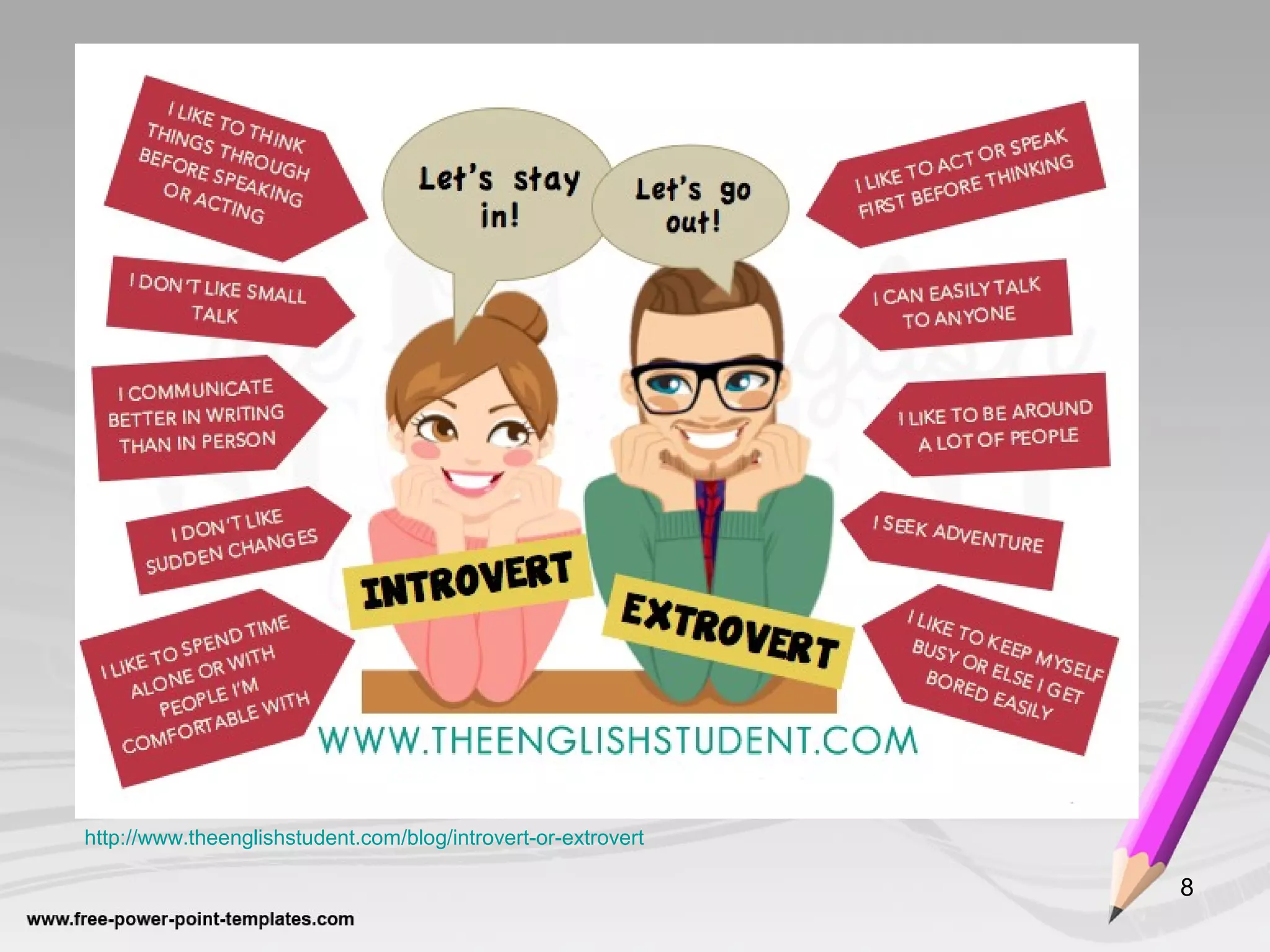
IntrovertsIntroverts
 Visual and physical withdrawal
 Fear of participation
 Fear of being ‘laughed at’
 Introspective
 Insightful
 Contribution online is
Safe
Creative
Intuitive
Academically sound
6
ExtrovertExtrovert
Verbally interaction
Confident
Noisy excitement of collaborative
interactions
Gregarious
Noisily participatory
7
8
http://www.theenglishstudent.com/blog/introvert-or-extrovert
CombinationCombination
Maximise both extrovert and introvert
students
Identify
Quiet
Sensitive
Serious
Creative
9
Loud
Confident
Expressive
10
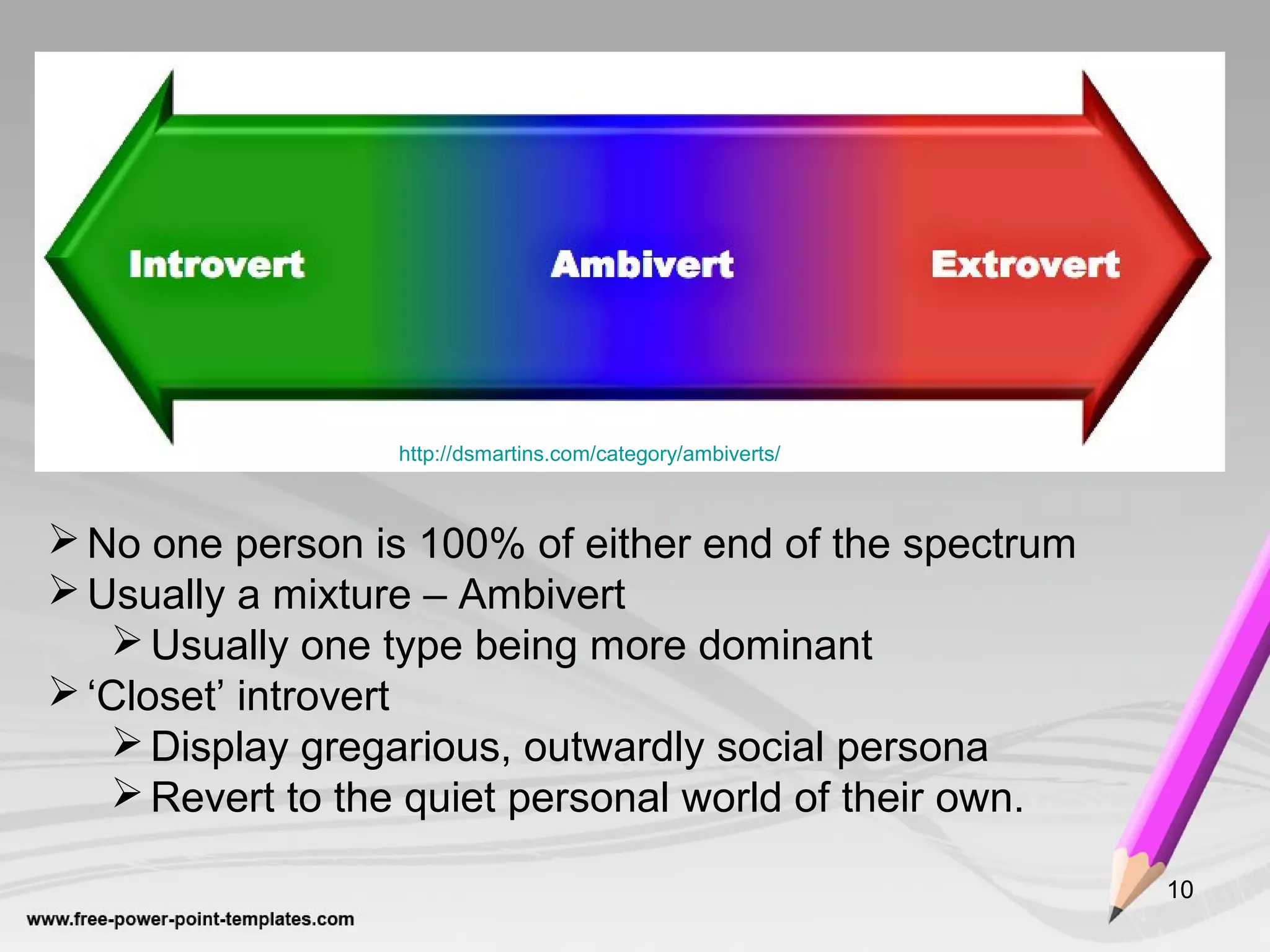
http://dsmartins.com/category/ambiverts/
No one person is 100% of either end of the spectrum
Usually a mixture – Ambivert
Usually one type being more dominant
‘Closet’ introvert
Display gregarious, outwardly social persona
Revert to the quiet personal world of their own.
Harness strengths of both extremes
To stretch academic and life skills
Create opportunities for
Academic
Individual
Collaborative learning
Acknowledge individuals
Strengths
Weakness
Values
Responsibilities
Accountabilities 11
ScreenagersScreenagers
Relationship with devices
Creative in an individualist environment
(online)
Virtual collaboration
Social strangers
Device driven gregarious animal
12
13Current cohort of educators
Currentstudents
Incoming!!!!!!
CollaborationCollaboration
“Collaboration in its simplest, and most
understandable form, is getting individuals,
who may or may not have similar interests,
to work together in an organised endeavour
to a satisfying and most appropriate group
end” (Royal, 2014).
14
15
http://www.ga.businessgrowthservice.greatbusiness.gov.uk
 Creativity is the act of turning new and imaginative ideas
into reality.
 Creativity is characterised by the ability to perceive the
world in new ways, to find hidden patterns, to make
connections between seemingly unrelated phenomena,
and to generate solutions.
 Creativity involves two processes:
thinking,
then producing.
 Imaginative – having ideas
 Creative – carrying out ideas.
16
CreativityCreativity
17
http://kclfarm.com/product/a-day-of-creativity-and-color/
18
“Groupthink occurs when a group makes faulty or
ineffective decisions for the sake of reaching a
consensus” (Hartzell, n.d.)
“The New Groupthink elevates teamwork above all
else” (Cain, 2013)
Participants are encouraged (coerced) to agree
with the majority viewpoint.
Peer pressure used to obtain conformity.
In my opinion Groupthink stifles individual
creativity, spontaneity and ‘out of the box’ thinking in
group members.
GroupthinkGroupthink
19
http://peterskeltonnlpcoach.com/group-think-company-organization-spell/
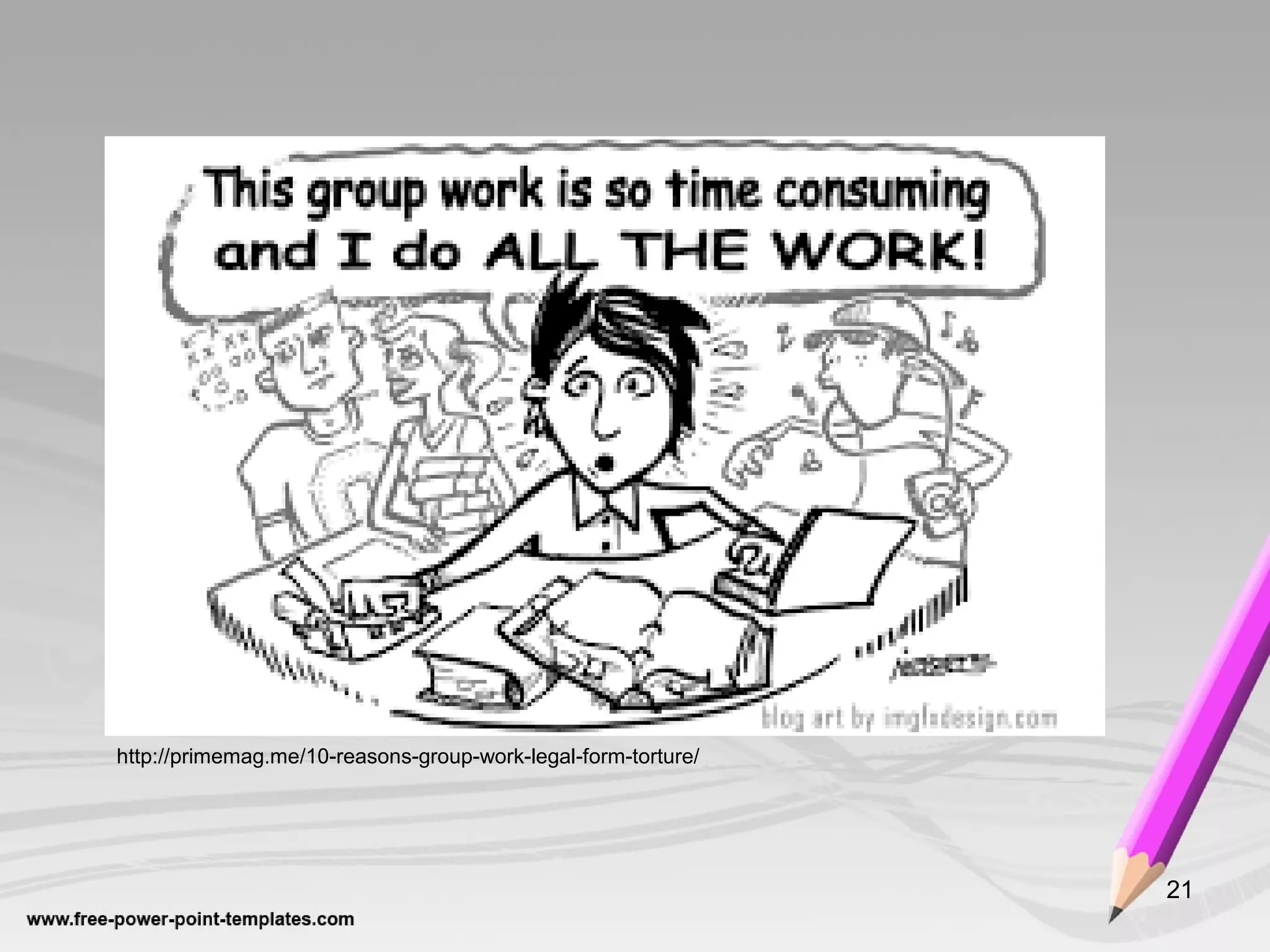
 Primary school – groups of desks
 Secondary school – assessments as a group
 Tertiary education – individual effort is diluted into
group final output.
 Stronger more confident participants over-rule
quiet less assertive participants.
 Consensus through domination
 Lazy student
20
Group WorkGroup Work
21
http://primemag.me/10-reasons-group-work-legal-form-torture/
Academic LearningAcademic Learning
Confident
Critical
Individualist thinking
Problem solving
Group thinking and team work is a critical
life skill
Not at the cost of compromise
22
Encourages electronic brainstorming
Anonymity of Blogs and Social Networks
Solitary thinker can safely
Offer opinions
Share information
Dave Plunkert offers the opinion that ‘this
is why the internet has yielded such
wondrous collective creations’
23
OnlineOnline
24
25
Collaborative vsCollaborative vs
Individual CreativityIndividual Creativity
 Diverse teaching platform
 Extroverts encouraged to
Listen
Understand
Acknowledge differing views
Introverts encouraged to
Offer opinions
Interact
Be different
Concentration:
exclusive attention to one object.
Attention:
a capacity to maintain selective or sustained
concentration
 http://dictionary.reference.com/
26
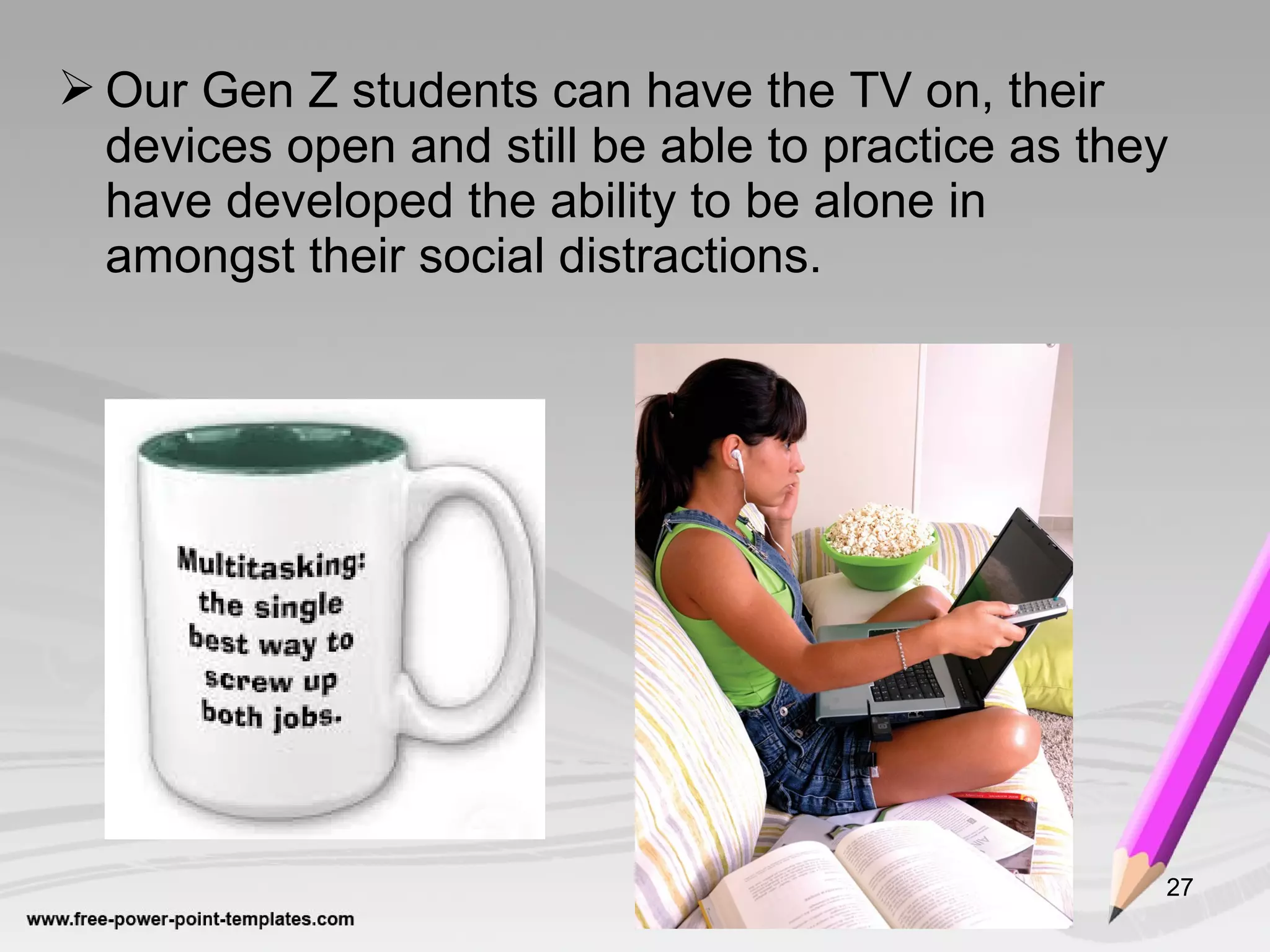
 Our Gen Z students can have the TV on, their
devices open and still be able to practice as they
have developed the ability to be alone in
amongst their social distractions.
27
Rethink delivery methods
Environment is dynamic
Current cohort of students:
Multitalented
Multiprocessing
Don’t retain information
Search for information
28
Learning and teachingLearning and teaching
29
Sample from ITSB - Learning Unit 6: Oral Presentations
‘Instructions:
1.As a group, research the topic above closely and carefully consider
the injustice that has already been done.
2.Return to this screen and click the link above the red arrow to open
the Wiki tool.
3.Create a wiki in which you, as a group:
– Indicate whether or not you agree with calls to exonerate all
convicts.
– who were affected by incorrect forensic assumptions.
•Show/submit evidence ………………..
NOTE: The final product will be a collective effort from everybody in
the group. If you do not agree with input from another student, make
changes and/or corrections and briefly motivate (in brackets) why you
have done so.’
30
Introverted quietly academic student
wanting challenges
Extrovert student busy socially – too busy
to study/practice – Dr Google
Superficial information only
Require innovation within and outside of
formal lectures
31
32
ConclusionConclusion
33
Introvert
Usually shy, gentle, creative, online participation,
1/3 of population
Hidden talents – lost through collaboration
Extrovert
Gregarious, participatory within noisy distractive
collaboration
Teaching is very much about ‘art’ and less
‘science’, where instinct, informed by
experience, is crucial.
34
References & ReadingsReferences & Readings
Cain, S., 2013. Quiet. London: Penguin Books.
Hartzell, S., n.d. Study.com. [Online]
Available at: http://study.com/academy/lesson/group-think-definition-examples.html
Learning, O., 2012. Online Learning Insights. [Online]
Available at: https://onlinelearninginsights.wordpress.com/2012/04/27/online-groups-cooperative-or-
collaborative/
[Accessed 2015].
Plunkert, D., 2012. Dallas News. [Online]
Available at: http://www.dallasnews.com/opinion/sunday-commentary/20120127-susan-cain-when-
collaboration-kills-creativity.ece
[Accessed 2015].
Royal, K., 2014. EdTech Review. [Online]
Available at: http://edtechreview.in/trends-insights/insights/1527-what-does-collaboration-in-education-
really-mean
[Accessed 2015].

When collaboration kills creativity

  • 1.
    When Collaboration killsWhenCollaboration kills CreativityCreativity The Power of Working AloneThe Power of Working Alone 1
  • 2.
    Why this topic?Whythis topic? Personal experience Student support team VC Learn Quiet by Susan Cain Acknowledgement of different students, situations and learning environments 2
  • 3.
    Innovative learning andteaching Challenge mode of delivery of knowledge Little change in academic content Change and evolving of personality make- up of students 3
  • 4.
    Freedom of choice oftime Place Contribution Needs to be driven Offer opportunities not available in face to face space 4 Online PortalsOnline Portals
  • 5.
  • 6.
    IntrovertsIntroverts  Visual andphysical withdrawal  Fear of participation  Fear of being ‘laughed at’  Introspective  Insightful  Contribution online is Safe Creative Intuitive Academically sound 6
  • 7.
    ExtrovertExtrovert Verbally interaction Confident Noisy excitementof collaborative interactions Gregarious Noisily participatory 7
  • 8.
  • 9.
    CombinationCombination Maximise both extrovertand introvert students Identify Quiet Sensitive Serious Creative 9 Loud Confident Expressive
  • 10.
    10 http://dsmartins.com/category/ambiverts/ No one personis 100% of either end of the spectrum Usually a mixture – Ambivert Usually one type being more dominant ‘Closet’ introvert Display gregarious, outwardly social persona Revert to the quiet personal world of their own.
  • 11.
    Harness strengths ofboth extremes To stretch academic and life skills Create opportunities for Academic Individual Collaborative learning Acknowledge individuals Strengths Weakness Values Responsibilities Accountabilities 11
  • 12.
    ScreenagersScreenagers Relationship with devices Creativein an individualist environment (online) Virtual collaboration Social strangers Device driven gregarious animal 12
  • 13.
    13Current cohort ofeducators Currentstudents Incoming!!!!!!
  • 14.
    CollaborationCollaboration “Collaboration in itssimplest, and most understandable form, is getting individuals, who may or may not have similar interests, to work together in an organised endeavour to a satisfying and most appropriate group end” (Royal, 2014). 14
  • 15.
  • 16.
     Creativity isthe act of turning new and imaginative ideas into reality.  Creativity is characterised by the ability to perceive the world in new ways, to find hidden patterns, to make connections between seemingly unrelated phenomena, and to generate solutions.  Creativity involves two processes: thinking, then producing.  Imaginative – having ideas  Creative – carrying out ideas. 16 CreativityCreativity
  • 17.
  • 18.
    18 “Groupthink occurs whena group makes faulty or ineffective decisions for the sake of reaching a consensus” (Hartzell, n.d.) “The New Groupthink elevates teamwork above all else” (Cain, 2013) Participants are encouraged (coerced) to agree with the majority viewpoint. Peer pressure used to obtain conformity. In my opinion Groupthink stifles individual creativity, spontaneity and ‘out of the box’ thinking in group members. GroupthinkGroupthink
  • 19.
  • 20.
     Primary school– groups of desks  Secondary school – assessments as a group  Tertiary education – individual effort is diluted into group final output.  Stronger more confident participants over-rule quiet less assertive participants.  Consensus through domination  Lazy student 20 Group WorkGroup Work
  • 21.
  • 22.
    Academic LearningAcademic Learning Confident Critical Individualistthinking Problem solving Group thinking and team work is a critical life skill Not at the cost of compromise 22
  • 23.
    Encourages electronic brainstorming Anonymityof Blogs and Social Networks Solitary thinker can safely Offer opinions Share information Dave Plunkert offers the opinion that ‘this is why the internet has yielded such wondrous collective creations’ 23 OnlineOnline
  • 24.
  • 25.
    25 Collaborative vsCollaborative vs IndividualCreativityIndividual Creativity  Diverse teaching platform  Extroverts encouraged to Listen Understand Acknowledge differing views Introverts encouraged to Offer opinions Interact Be different
  • 26.
    Concentration: exclusive attention toone object. Attention: a capacity to maintain selective or sustained concentration  http://dictionary.reference.com/ 26
  • 27.
     Our GenZ students can have the TV on, their devices open and still be able to practice as they have developed the ability to be alone in amongst their social distractions. 27
  • 28.
    Rethink delivery methods Environmentis dynamic Current cohort of students: Multitalented Multiprocessing Don’t retain information Search for information 28 Learning and teachingLearning and teaching
  • 29.
  • 30.
    Sample from ITSB- Learning Unit 6: Oral Presentations ‘Instructions: 1.As a group, research the topic above closely and carefully consider the injustice that has already been done. 2.Return to this screen and click the link above the red arrow to open the Wiki tool. 3.Create a wiki in which you, as a group: – Indicate whether or not you agree with calls to exonerate all convicts. – who were affected by incorrect forensic assumptions. •Show/submit evidence ……………….. NOTE: The final product will be a collective effort from everybody in the group. If you do not agree with input from another student, make changes and/or corrections and briefly motivate (in brackets) why you have done so.’ 30
  • 31.
    Introverted quietly academicstudent wanting challenges Extrovert student busy socially – too busy to study/practice – Dr Google Superficial information only Require innovation within and outside of formal lectures 31
  • 32.
  • 33.
    ConclusionConclusion 33 Introvert Usually shy, gentle,creative, online participation, 1/3 of population Hidden talents – lost through collaboration Extrovert Gregarious, participatory within noisy distractive collaboration Teaching is very much about ‘art’ and less ‘science’, where instinct, informed by experience, is crucial.
  • 34.
    34 References & ReadingsReferences& Readings Cain, S., 2013. Quiet. London: Penguin Books. Hartzell, S., n.d. Study.com. [Online] Available at: http://study.com/academy/lesson/group-think-definition-examples.html Learning, O., 2012. Online Learning Insights. [Online] Available at: https://onlinelearninginsights.wordpress.com/2012/04/27/online-groups-cooperative-or- collaborative/ [Accessed 2015]. Plunkert, D., 2012. Dallas News. [Online] Available at: http://www.dallasnews.com/opinion/sunday-commentary/20120127-susan-cain-when- collaboration-kills-creativity.ece [Accessed 2015]. Royal, K., 2014. EdTech Review. [Online] Available at: http://edtechreview.in/trends-insights/insights/1527-what-does-collaboration-in-education- really-mean [Accessed 2015].