Wheat Disease
Identification and Control
MELVIN NEWMAN, Professor
Plant Pathologist
Entomology and Plant Pathology
Department
UNIVERSITY OF TENNESSEE
2009
Objectives
 To present detailed information on
key identification symptoms of wheat
diseases.
 To discuss control measures of the
most important wheat disease.
 To present related research data for
control.
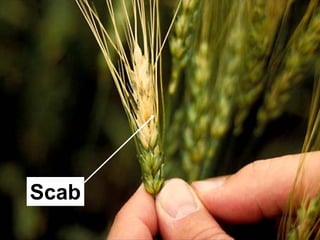
Scab (head blight)
Fusarium graminearum
 Favored by warm, wet weather during and
after flowering.
 Bleached heads or individual spikelets
 Superficial pink/orange mycelium/spores
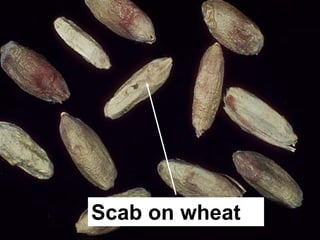
 Bleached heads contain scabby seed
(tombstones).
 Black lesions may be present at the base
of the head.
Scab
Head Scab
caused by
the fungus
Fusarium spp.
(pink or orange
spore mass)
Scab on wheat
Fusarium leaf spot
Wheat Scab Control
 No resistant varieties
 Plant varieties that differ in flowering
times
 Bury crop residue
 Chopping corn stalks down helps
 Crop rotation ( not corn or grain
sorghum)
 Foliar fungicides are not effective
Foliar and Head Diseases
 Glume Blotch – Stagonospora (Septoria)
nodorum. Found mostly on the lower
leaves and then on the heads. Hard to
scout for and fungus becomes more
aggressive as heading occurs. Favored
by frequent rains and mid-70s.
 Symptoms – On glume are chocolate-
brown, with small, black pycnidia and are
diagnostic as seed become mature. Grain
may be extremely shriveled.
Glume blotchLeaf blotch
Septoria tritici Stagonospora nodorum
Glume Blotch
Leaf Blotch
Stagonospora leaf blotch with pycnidia
Stem rust Leaf rust
Puccinia graminis Puccinia recondita
Use Resistant
Varieties for
Control of
Leaf Rust
and/or foliar
fungicides
Stripe Rust of Wheat
Stripe Rust
 Caused by Puccinia striiformis
 Symptoms appear early in the spring.
 Rust pustules are yellow and arranged into
long conspicuous stripes.
 Spores are blown in from warmer areas.
 Disease development is most rapid under cool,
wet weather.
 Varieties differ widely in susceptible.
 Fungicides (triazoles) are effective if applied
before disease infects upper leaves.
Powdery Mildew
Erysiphe graminis
Powdery Mildew on Wheat
Erysiphe graminis
Foliar Disease Control in
Wheat
 Use foliar fungicides if
appropriate
 Rotate crops
 Plow under old crop residue if
appropriate
 Treat seed with fungicides
 Use tolerant varieties if available
Take-all showing the
white head symptom
This can be confused
with head scab
Take-all fungus
in young wheat
roots showing the
black root rot
Symptom.
Caused by:
Gaeumannomyces
graminis
healthy infected
Take-all
Rotted stems &
roots
Take-all
Dark hyphae in roots
Gaeumannomyces graminis
Take-All Disease Control
 Later plantings are better
 Use Ammonium Nitrate
 Fertilize early
 Use higher rates of fertilizer
 Do not lime take-all infested soil
 Rotate with other crops, corn may
produce scab in wheat
Barley Yellow Dwarf Virus
 Transmitted by several species of aphids
 Fall infection causes the greater yield
loss.
 Symptoms usually do not show up until
spring.
 Symptoms: Stunted, poorly tillered across
a field. Yellow, red or purple coloration of
leaves after extended warm weather in
April
Barley Yellow Dwarf Virus
Barley Yellow Dwarf VirusBarley Yellow Dwarf VirusBarley Yellow Dwarf VirusBarley Yellow Dwarf Virus
Greenbug aphids
BYDV CONTROL IN WHEAT
With seed treatments of Imidacloprid insecticide
WTES, Jackson, TN 1993-2001
Yields in bushels/acre
Gaucho 480
F
1993 1994 1995 1996 1997 1998 1999 2000 2001
Untreated 62 96 40 69 65 48 78 72 73
1.0 oz 66 99 44 68 59 60 78 75 80
1.5 oz 67 103 50 63 62 58 78 76 76
Increase 1.0
oz
4 3 4 0 0 12 0 3 7
Increase 1.5
oz
6 7 10 0 0 10 0 4 3
BYDV Control
Avoid early planting
There are no resistant
varieties
Use insecticide to control fall
aphids
Wheat Streak
Mosaic Virus
Spread by the
Wheat leaf curl
mite
Curl mite
Wheat curl mite, vector of Wheat Streak Mosaic
Virus
Control of WSMV
 Control the Wheat Curl mite
 Break the “green bridge”
 Destroy volunteer wheat
 Burn down any grasses 2 weeks
before planting wheat.
Wheat Spindle Streak Virus
(WSSV)
Spread by the soil-borne
Fungus Polymyxa graminis
Use resistant varieties.
Damage is usually not
severe, especially when
temperatures stay above
65 F.
Control
Seed Treatments for
Disease Control in Wheat
Six Reasons to Treat Wheat Seed
with a Fungicide
6. To reduce loose smut
5. To reduce powdery mildew
4. To reduce seedling disease
3. To increase germination
2. To reduce scab
1. To increase yield
Seed Treatment Fungicides
 Seed rots & seedling diseases (Rhizoctonia,
Fusarium): Charter (Triticonazole), captan,
difenoconazole (Dividend), fludioxonil
(Maxim), PCNB, tebuconazole (Raxil), thiram
 Damping-off diseases ( Pythium spp.):
metalaxyl, mefenoxam
 Smuts ( loose smut ): carboxin,
difenoconazole, tebuconazole
 A combination material is needed, especially
for adverse planting conditions or no-till.
aphids
BARLEY YELLOW DWARF
(BYD)
 SPREAD BY AT LEAST 20 APHIDS SPP.
 MAJOR APHIDS: OAT BIRD-
CHERRY,CORN LEAF, ENGLISH GRAIN,
GREENBUG, AND RICE ROOT APHID
 FIVE PROMINENT STRAINS OF BYDV:
RMV, RPV, MAV, PAV, SGV
 OVER 80 GRASS SPECIES ARE
SUSCEPTIBLE.
Why Should Aphids be Controlled
in the Fall ?
 Aphids carry the Barley Yellow Dwarf
Virus (BYDV), and young seedlings
are very susceptible.
 Yield loss can be significant in some
years.
 Once aphids feed on young
seedlings, it is too late to control
BYD.
 Scouting for aphids is difficult in the
fall.
BYD CONTROL IN WHEAT
With seed treatments of imidacloprid (Gaucho) insecticide
A.Y. Chambers,WTES, Jackson, TN 1993-2001
Yields in bushels/acre; rate in ozs./cwt
Gaucho 480 1993 1994 1995 1996 1997 1998 1999 2000 2001
Untreated 62 96 40 69 65 48 78 72 73
1.0 oz 66 99 44 68 59 60 78 75 80
1.5 oz 67 103 50 63 62 58 78 76 76
Increase
1.0 oz
4 3 4 0 0 12 0 3 7
Increase 1.5
oz
6 7 10 0 0 10 0 4 3
BYD Control
Avoid early planting.
There are no resistant varieties.
Use insecticides to control fall
aphids.
Spring aphids do not cause as
much damage.
Summary of Wheat Disease Control
Practices
• Plant after Oct. 15.
• Use recommended resistant varieties.
• Treat seed with fungicide and insecticide to
control aphids in the fall.
• Wheat after corn may provide inoculum for scab
• Do not lime Take-All infected fields, acid soils
have less Take-All.
• Burn down any “green bridge” 2 weeks before
planting.
• Treat with foliar fungicides when wheat prices
and disease conditions warrant their use.

wheat diseases

  • 1.
    Wheat Disease Identification andControl MELVIN NEWMAN, Professor Plant Pathologist Entomology and Plant Pathology Department UNIVERSITY OF TENNESSEE 2009
  • 2.
    Objectives  To presentdetailed information on key identification symptoms of wheat diseases.  To discuss control measures of the most important wheat disease.  To present related research data for control.
  • 3.
    Scab (head blight) Fusariumgraminearum  Favored by warm, wet weather during and after flowering.  Bleached heads or individual spikelets  Superficial pink/orange mycelium/spores  Bleached heads contain scabby seed (tombstones).  Black lesions may be present at the base of the head.
  • 4.
  • 5.
    Head Scab caused by thefungus Fusarium spp. (pink or orange spore mass)
  • 6.
  • 7.
  • 8.
    Wheat Scab Control No resistant varieties  Plant varieties that differ in flowering times  Bury crop residue  Chopping corn stalks down helps  Crop rotation ( not corn or grain sorghum)  Foliar fungicides are not effective
  • 9.
    Foliar and HeadDiseases  Glume Blotch – Stagonospora (Septoria) nodorum. Found mostly on the lower leaves and then on the heads. Hard to scout for and fungus becomes more aggressive as heading occurs. Favored by frequent rains and mid-70s.  Symptoms – On glume are chocolate- brown, with small, black pycnidia and are diagnostic as seed become mature. Grain may be extremely shriveled.
  • 10.
    Glume blotchLeaf blotch Septoriatritici Stagonospora nodorum
  • 11.
  • 12.
    Leaf Blotch Stagonospora leafblotch with pycnidia
  • 13.
    Stem rust Leafrust Puccinia graminis Puccinia recondita Use Resistant Varieties for Control of Leaf Rust and/or foliar fungicides
  • 14.
  • 15.
    Stripe Rust  Causedby Puccinia striiformis  Symptoms appear early in the spring.  Rust pustules are yellow and arranged into long conspicuous stripes.  Spores are blown in from warmer areas.  Disease development is most rapid under cool, wet weather.  Varieties differ widely in susceptible.  Fungicides (triazoles) are effective if applied before disease infects upper leaves.
  • 16.
  • 17.
    Powdery Mildew onWheat Erysiphe graminis
  • 18.
    Foliar Disease Controlin Wheat  Use foliar fungicides if appropriate  Rotate crops  Plow under old crop residue if appropriate  Treat seed with fungicides  Use tolerant varieties if available
  • 19.
    Take-all showing the whitehead symptom This can be confused with head scab
  • 20.
    Take-all fungus in youngwheat roots showing the black root rot Symptom. Caused by: Gaeumannomyces graminis healthy infected
  • 21.
  • 22.
    Take-all Dark hyphae inroots Gaeumannomyces graminis
  • 23.
    Take-All Disease Control Later plantings are better  Use Ammonium Nitrate  Fertilize early  Use higher rates of fertilizer  Do not lime take-all infested soil  Rotate with other crops, corn may produce scab in wheat
  • 24.
    Barley Yellow DwarfVirus  Transmitted by several species of aphids  Fall infection causes the greater yield loss.  Symptoms usually do not show up until spring.  Symptoms: Stunted, poorly tillered across a field. Yellow, red or purple coloration of leaves after extended warm weather in April
  • 25.
  • 26.
    Barley Yellow DwarfVirusBarley Yellow Dwarf VirusBarley Yellow Dwarf VirusBarley Yellow Dwarf Virus
  • 27.
  • 28.
    BYDV CONTROL INWHEAT With seed treatments of Imidacloprid insecticide WTES, Jackson, TN 1993-2001 Yields in bushels/acre Gaucho 480 F 1993 1994 1995 1996 1997 1998 1999 2000 2001 Untreated 62 96 40 69 65 48 78 72 73 1.0 oz 66 99 44 68 59 60 78 75 80 1.5 oz 67 103 50 63 62 58 78 76 76 Increase 1.0 oz 4 3 4 0 0 12 0 3 7 Increase 1.5 oz 6 7 10 0 0 10 0 4 3
  • 29.
    BYDV Control Avoid earlyplanting There are no resistant varieties Use insecticide to control fall aphids
  • 30.
    Wheat Streak Mosaic Virus Spreadby the Wheat leaf curl mite Curl mite
  • 31.
    Wheat curl mite,vector of Wheat Streak Mosaic Virus
  • 32.
    Control of WSMV Control the Wheat Curl mite  Break the “green bridge”  Destroy volunteer wheat  Burn down any grasses 2 weeks before planting wheat.
  • 33.
    Wheat Spindle StreakVirus (WSSV) Spread by the soil-borne Fungus Polymyxa graminis Use resistant varieties. Damage is usually not severe, especially when temperatures stay above 65 F. Control
  • 34.
  • 35.
    Six Reasons toTreat Wheat Seed with a Fungicide 6. To reduce loose smut 5. To reduce powdery mildew 4. To reduce seedling disease 3. To increase germination 2. To reduce scab 1. To increase yield
  • 36.
    Seed Treatment Fungicides Seed rots & seedling diseases (Rhizoctonia, Fusarium): Charter (Triticonazole), captan, difenoconazole (Dividend), fludioxonil (Maxim), PCNB, tebuconazole (Raxil), thiram  Damping-off diseases ( Pythium spp.): metalaxyl, mefenoxam  Smuts ( loose smut ): carboxin, difenoconazole, tebuconazole  A combination material is needed, especially for adverse planting conditions or no-till.
  • 37.
  • 38.
    BARLEY YELLOW DWARF (BYD) SPREAD BY AT LEAST 20 APHIDS SPP.  MAJOR APHIDS: OAT BIRD- CHERRY,CORN LEAF, ENGLISH GRAIN, GREENBUG, AND RICE ROOT APHID  FIVE PROMINENT STRAINS OF BYDV: RMV, RPV, MAV, PAV, SGV  OVER 80 GRASS SPECIES ARE SUSCEPTIBLE.
  • 39.
    Why Should Aphidsbe Controlled in the Fall ?  Aphids carry the Barley Yellow Dwarf Virus (BYDV), and young seedlings are very susceptible.  Yield loss can be significant in some years.  Once aphids feed on young seedlings, it is too late to control BYD.  Scouting for aphids is difficult in the fall.
  • 40.
    BYD CONTROL INWHEAT With seed treatments of imidacloprid (Gaucho) insecticide A.Y. Chambers,WTES, Jackson, TN 1993-2001 Yields in bushels/acre; rate in ozs./cwt Gaucho 480 1993 1994 1995 1996 1997 1998 1999 2000 2001 Untreated 62 96 40 69 65 48 78 72 73 1.0 oz 66 99 44 68 59 60 78 75 80 1.5 oz 67 103 50 63 62 58 78 76 76 Increase 1.0 oz 4 3 4 0 0 12 0 3 7 Increase 1.5 oz 6 7 10 0 0 10 0 4 3
  • 41.
    BYD Control Avoid earlyplanting. There are no resistant varieties. Use insecticides to control fall aphids. Spring aphids do not cause as much damage.
  • 42.
    Summary of WheatDisease Control Practices • Plant after Oct. 15. • Use recommended resistant varieties. • Treat seed with fungicide and insecticide to control aphids in the fall. • Wheat after corn may provide inoculum for scab • Do not lime Take-All infected fields, acid soils have less Take-All. • Burn down any “green bridge” 2 weeks before planting. • Treat with foliar fungicides when wheat prices and disease conditions warrant their use.