WHAT’S ON
YOUR CLOUD?
Workload Deployment Strategies
for Private and Hybrid Clouds
RESEARCH AND ANALYSIS PROVIDED
BY TECHNOLOGY BUSINESS RESEARCH
Contents
I. Private Cloud: Making IT a business partner vs. capacity provider	 3
II. 	Adoption will grow in breadth and depth	 4
	 Delivery Methods – Private and Hybrid Clouds	 5
III. How service partners are helping accelerate adoption	 6
IV. BizCloud’s alignment with the drivers and barriers of private cloud adoption	 6
	 Customer Highlight: H.D. Smith	 7
V. Summary	 8
	 Private and Hybrid Cloud Workload Migration as a Business Driver	 8
VI. Definitions	 9
	 Cloud Delivery Methods	 9
About TBR	 10
BASED ON TBR RESEARCH FINDINGS FUNDED BY CSC, CISCO AND EMC
3
I. Private Cloud: Making IT a business partner vs. 	
	 capacity provider
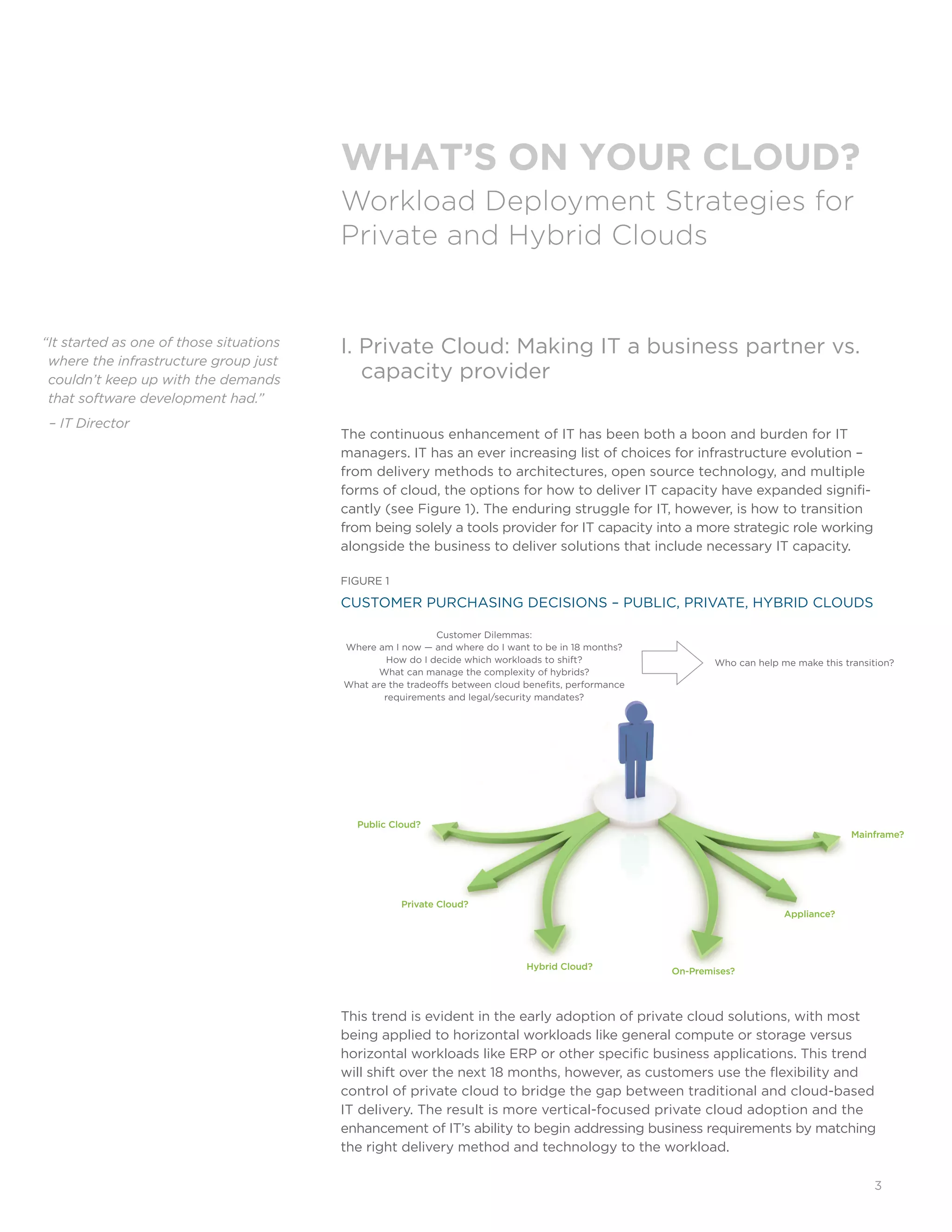
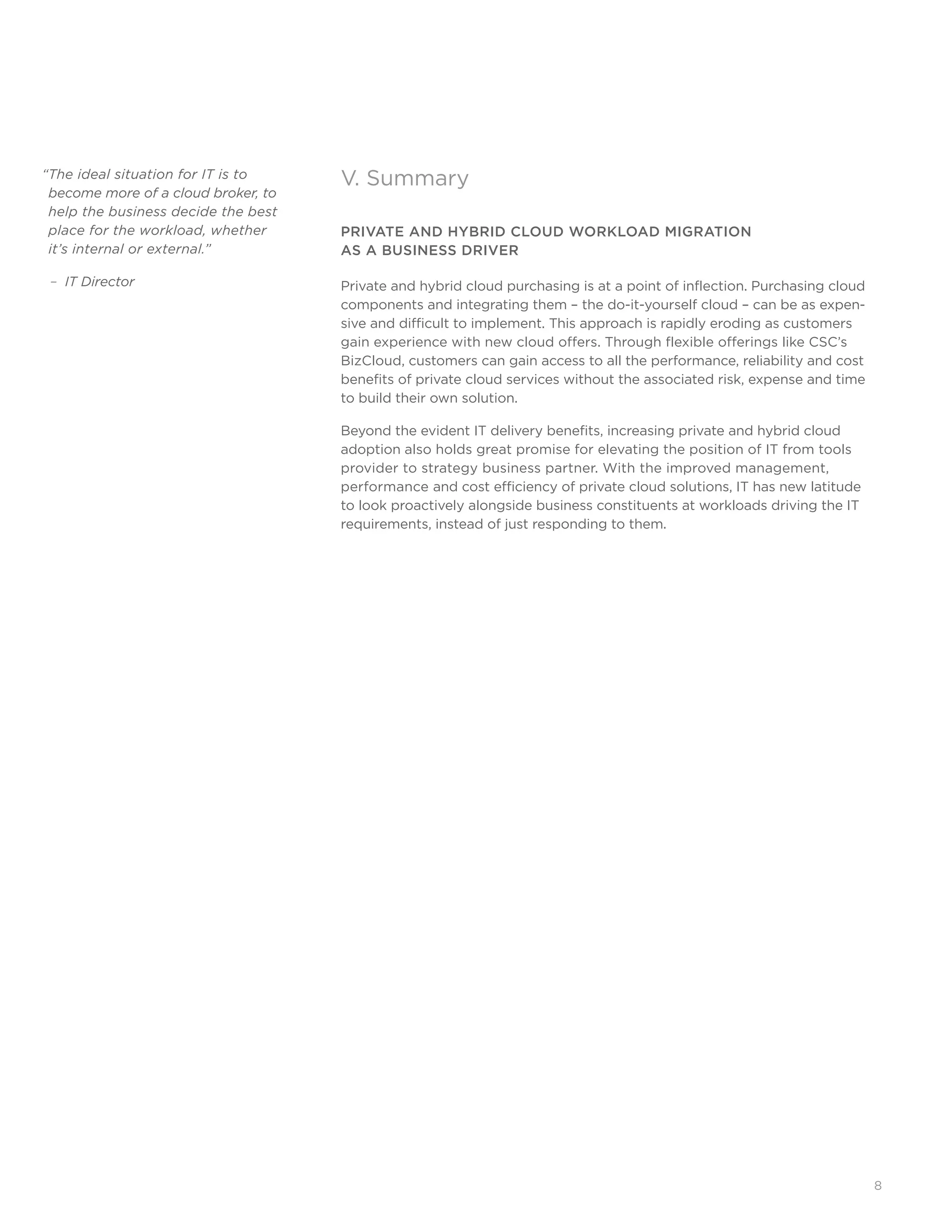
The continuous enhancement of IT has been both a boon and burden for IT
managers. IT has an ever increasing list of choices for infrastructure evolution –
from delivery methods to architectures, open source technology, and multiple
forms of cloud, the options for how to deliver IT capacity have expanded signifi-
cantly (see Figure 1). The enduring struggle for IT, however, is how to transition
from being solely a tools provider for IT capacity into a more strategic role working
alongside the business to deliver solutions that include necessary IT capacity.
FIGURE 1
CUSTOMER PURCHASING DECISIONS – PUBLIC, PRIVATE, HYBRID CLOUDS
This trend is evident in the early adoption of private cloud solutions, with most
being applied to horizontal workloads like general compute or storage versus
horizontal workloads like ERP or other specific business applications. This trend
will shift over the next 18 months, however, as customers use the flexibility and
control of private cloud to bridge the gap between traditional and cloud-based
IT delivery. The result is more vertical-focused private cloud adoption and the
enhancement of IT’s ability to begin addressing business requirements by matching
the right delivery method and technology to the workload.
“It started as one of those situations
where the infrastructure group just
couldn’t keep up with the demands
that software development had.”
– IT Director
WHAT’S ON YOUR CLOUD?
Workload Deployment Strategies for
Private and Hybrid Clouds
Private Cloud?
Hybrid Cloud?
Public Cloud?
On-Premises?
Mainframe?
Appliance?
Customer Dilemmas:
Where am I now — and where do I want to be in 18 months?
How do I decide which workloads to shift?
What can manage the complexity of hybrids?
What are the tradeoffs between cloud benefits, performance
requirements and legal/security mandates?
Who can help me make this transition?
4
II. Adoption will grow in breadth and depth
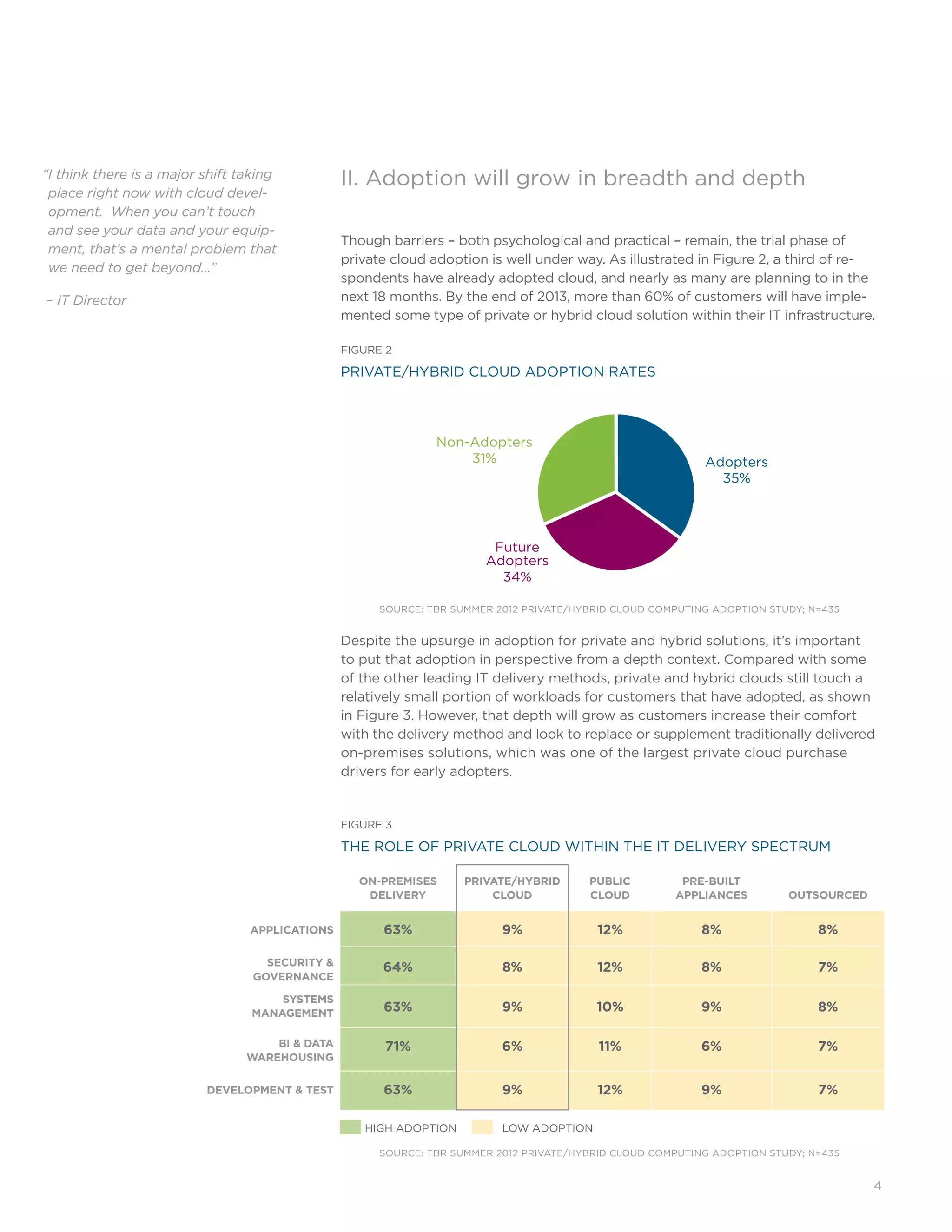
Though barriers – both psychological and practical – remain, the trial phase of
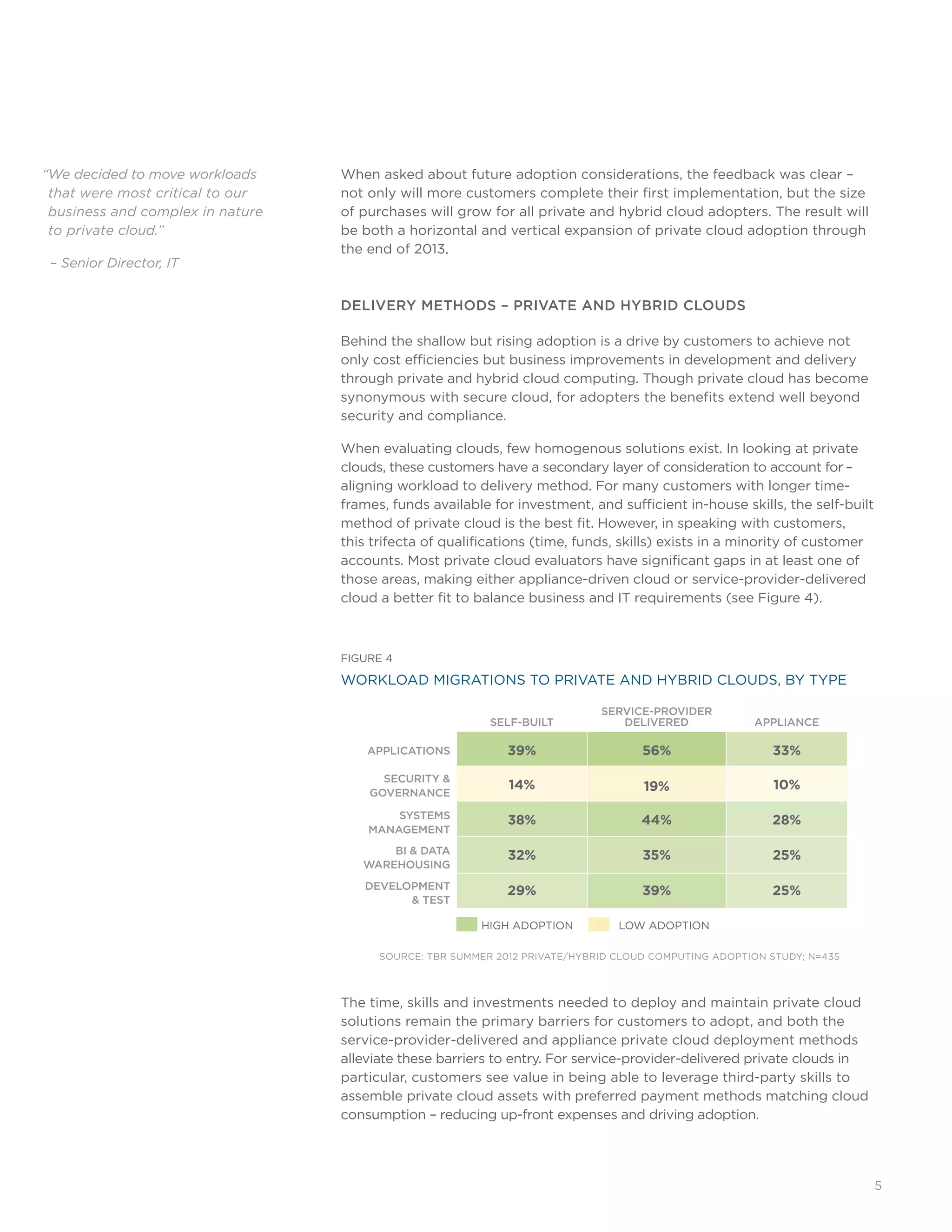
private cloud adoption is well under way. As illustrated in Figure 2, a third of re-
spondents have already adopted cloud, and nearly as many are planning to in the
next 18 months. By the end of 2013, more than 60% of customers will have imple-
mented some type of private or hybrid cloud solution within their IT infrastructure.
FIGURE 2
PRIVATE/HYBRID CLOUD ADOPTION RATES
SOURCE: TBR SUMMER 2012 PRIVATE/HYBRID CLOUD COMPUTING ADOPTION STUDY; N=435
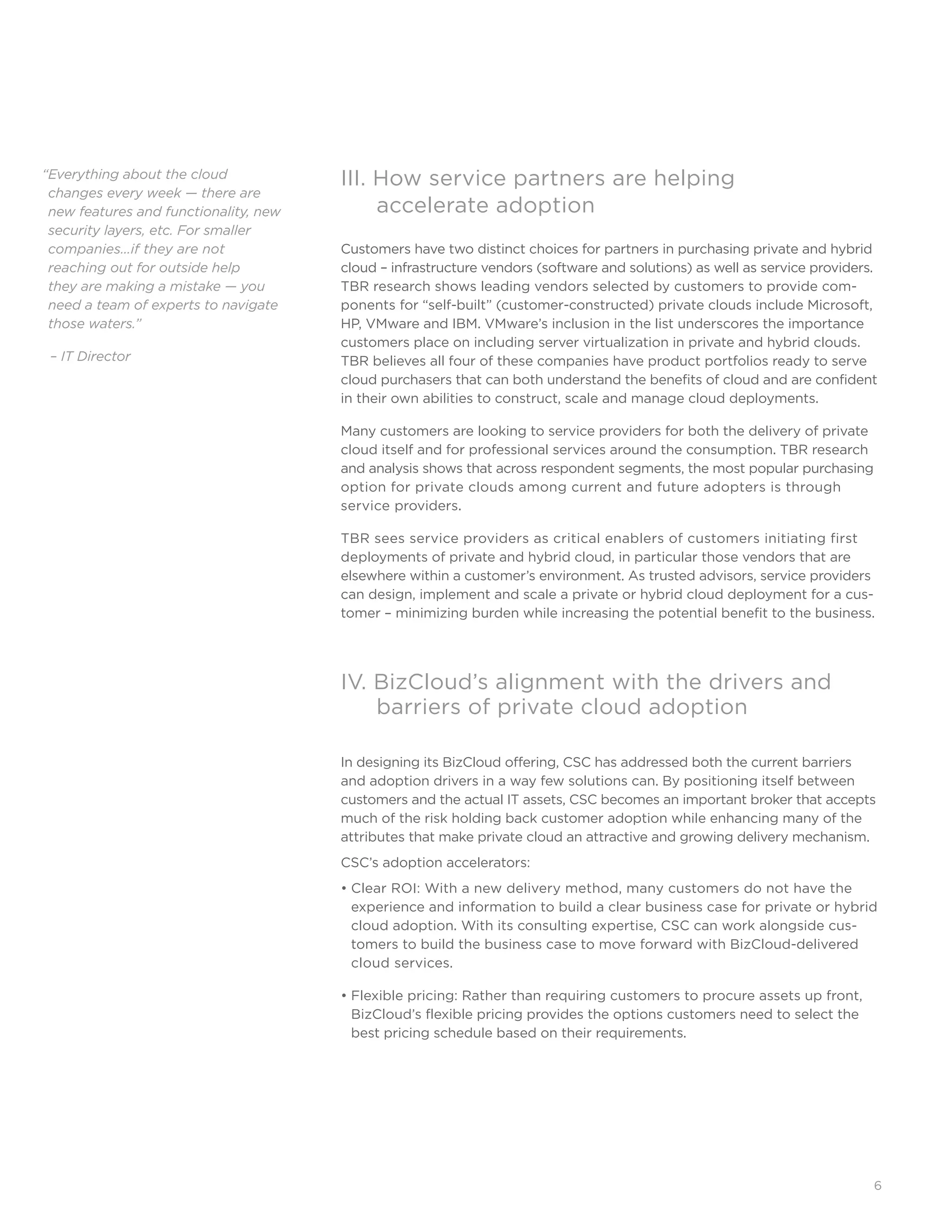
Despite the upsurge in adoption for private and hybrid solutions, it’s important
to put that adoption in perspective from a depth context. Compared with some
of the other leading IT delivery methods, private and hybrid clouds still touch a
relatively small portion of workloads for customers that have adopted, as shown
in Figure 3. However, that depth will grow as customers increase their comfort
with the delivery method and look to replace or supplement traditionally delivered
on-premises solutions, which was one of the largest private cloud purchase
drivers for early adopters.
FIGURE 3
THE ROLE OF PRIVATE CLOUD WITHIN THE IT DELIVERY SPECTRUM
“I think there is a major shift taking
place right now with cloud devel-
opment. When you can’t touch
and see your data and your equip-
ment, that’s a mental problem that
we need to get beyond…”
– IT Director
Non-Adopters
31% Adopters
35%
Future
Adopters
34%
ON-PREMISES
DELIVERY
PRIVATE/HYBRID
CLOUD
PUBLIC
CLOUD
PRE-BUILT
APPLIANCES OUTSOURCED
APPLICATIONS 63% 9% 12% 8% 8%
SECURITY 
GOVERNANCE
64% 8% 12% 8% 7%
SYSTEMS
MANAGEMENT
63% 9% 10% 9% 8%
BI  DATA
WAREHOUSING
71% 6% 11% 6% 7%
DEVELOPMENT  TEST 63% 9% 12% 9% 7%
LOW ADOPTIONHIGH ADOPTION
SOURCE: TBR SUMMER 2012 PRIVATE/HYBRID CLOUD COMPUTING ADOPTION STUDY; N=435
5
When asked about future adoption considerations, the feedback was clear –
not only will more customers complete their first implementation, but the size
of purchases will grow for all private and hybrid cloud adopters. The result will
be both a horizontal and vertical expansion of private cloud adoption through
the end of 2013.
DELIVERY METHODS – PRIVATE AND HYBRID CLOUDS
Behind the shallow but rising adoption is a drive by customers to achieve not
only cost efficiencies but business improvements in development and delivery
through private and hybrid cloud computing. Though private cloud has become
synonymous with secure cloud, for adopters the benefits extend well beyond
security and compliance.
When evaluating clouds, few homogenous solutions exist. In looking at private
clouds, these customers have a secondary layer of consideration to account for –
aligning workload to delivery method. For many customers with longer time-
frames, funds available for investment, and sufficient in-house skills, the self-built
method of private cloud is the best fit. However, in speaking with customers,
this trifecta of qualifications (time, funds, skills) exists in a minority of customer
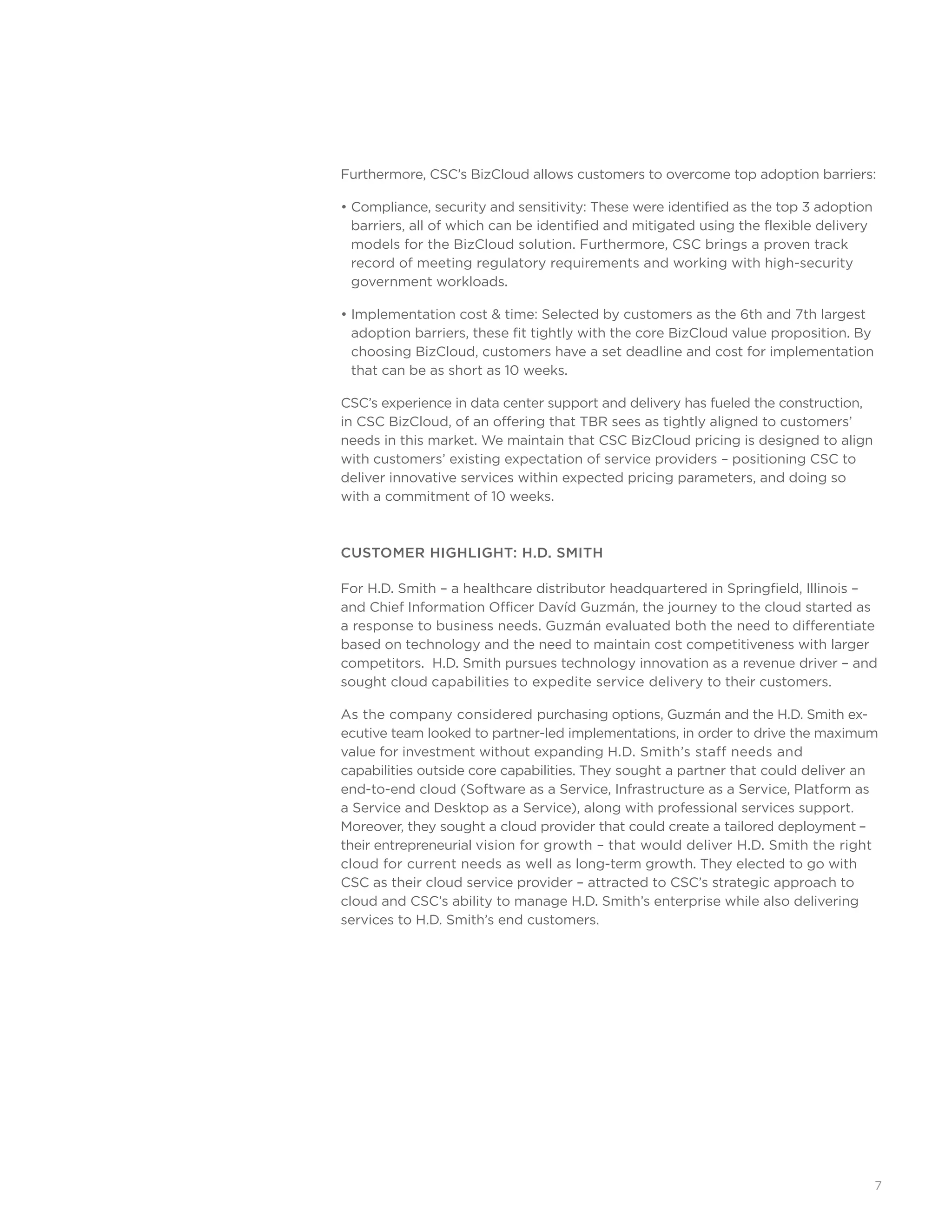
accounts. Most private cloud evaluators have significant gaps in at least one of
those areas, making either appliance-driven cloud or service-provider-delivered
cloud a better fit to balance business and IT requirements (see Figure 4).
FIGURE 4
WORKLOAD MIGRATIONS TO PRIVATE AND HYBRID CLOUDS, BY TYPE
SOURCE: TBR SUMMER 2012 PRIVATE/HYBRID CLOUD COMPUTING ADOPTION STUDY; N=435
The time, skills and investments needed to deploy and maintain private cloud
solutions remain the primary barriers for customers to adopt, and both the
service-provider-delivered and appliance private cloud deployment methods
alleviate these barriers to entry. For service-provider-delivered private clouds in
particular, customers see value in being able to leverage third-party skills to
assemble private cloud assets with preferred payment methods matching cloud
consumption – reducing up-front expenses and driving adoption.
“We decided to move workloads
that were most critical to our
business and complex in nature
to private cloud.” 		
– Senior Director, IT
SELF-BUILT
SERVICE-PROVIDER
DELIVERED APPLIANCE
APPLICATIONS 39% 56% 33%
SECURITY 
GOVERNANCE
14% 19% 10%
SYSTEMS
MANAGEMENT
38% 44% 28%
BI  DATA
WAREHOUSING
32% 35% 25%
DEVELOPMENT
 TEST
29% 39% 25%
LOW ADOPTIONHIGH ADOPTION
6
III. How service partners are helping
	 accelerate adoption
Customers have two distinct choices for partners in purchasing private and hybrid
cloud – infrastructure vendors (software and solutions) as well as service providers.
TBR research shows leading vendors selected by customers to provide com-
ponents for “self-built” (customer-constructed) private clouds include Microsoft,
HP, VMware and IBM. VMware’s inclusion in the list underscores the importance
customers place on including server virtualization in private and hybrid clouds.
TBR believes all four of these companies have product portfolios ready to serve
cloud purchasers that can both understand the benefits of cloud and are confident
in their own abilities to construct, scale and manage cloud deployments.
Many customers are looking to service providers for both the delivery of private
cloud itself and for professional services around the consumption. TBR research
and analysis shows that across respondent segments, the most popular purchasing
option for private clouds among current and future adopters is through 	
service providers.
TBR sees service providers as critical enablers of customers initiating first
deployments of private and hybrid cloud, in particular those vendors that are
elsewhere within a customer’s environment. As trusted advisors, service providers
can design, implement and scale a private or hybrid cloud deployment for a cus-
tomer – minimizing burden while increasing the potential benefit to the business.
IV. BizCloud’s alignment with the drivers and 		
	 barriers of private cloud adoption
In designing its BizCloud offering, CSC has addressed both the current barriers
and adoption drivers in a way few solutions can. By positioning itself between
customers and the actual IT assets, CSC becomes an important broker that accepts
much of the risk holding back customer adoption while enhancing many of the
attributes that make private cloud an attractive and growing delivery mechanism.
CSC’s adoption accelerators:
• Clear ROI: With a new delivery method, many customers do not have the 	
experience and information to build a clear business case for private or hybrid
cloud adoption. With its consulting expertise, CSC can work alongside cus-
tomers to build the business case to move forward with BizCloud-delivered
cloud services.
• Flexible pricing: Rather than requiring customers to procure assets up front,
BizCloud’s flexible pricing provides the options customers need to select the
best pricing schedule based on their requirements.
“Everything about the cloud
changes every week — there are
new features and functionality, new
security layers, etc. For smaller
companies…if they are not 	
reaching out for outside help 	
they are making a mistake — you
need a team of experts to navigate
those waters.”
– IT Director
7
Furthermore, CSC’s BizCloud allows customers to overcome top adoption barriers:
• Compliance, security and sensitivity: These were identified as the top 3 adoption
barriers, all of which can be identified and mitigated using the flexible delivery
models for the BizCloud solution. Furthermore, CSC brings a proven track
record of meeting regulatory requirements and working with high-security
government workloads.
• Implementation cost  time: Selected by customers as the 6th and 7th largest
adoption barriers, these fit tightly with the core BizCloud value proposition. By
choosing BizCloud, customers have a set deadline and cost for implementation
that can be as short as 10 weeks.
CSC’s experience in data center support and delivery has fueled the construction,
in CSC BizCloud, of an offering that TBR sees as tightly aligned to customers’
needs in this market. We maintain that CSC BizCloud pricing is designed to align
with customers’ existing expectation of service providers – positioning CSC to
deliver innovative services within expected pricing parameters, and doing so
with a commitment of 10 weeks.
CUSTOMER HIGHLIGHT: H.D. SMITH
For H.D. Smith – a healthcare distributor headquartered in Springfield, Illinois –
and Chief Information Officer Davíd Guzmán, the journey to the cloud started as
a response to business needs. Guzmán evaluated both the need to differentiate
based on technology and the need to maintain cost competitiveness with larger
competitors. H.D. Smith pursues technology innovation as a revenue driver – and
sought cloud capabilities to expedite service delivery to their customers.
As the company considered purchasing options, Guzmán and the H.D. Smith ex-
ecutive team looked to partner-led implementations, in order to drive the maximum
value for investment without expanding H.D. Smith’s staff needs and 	
capabilities outside core capabilities. They sought a partner that could deliver an
end-to-end cloud (Software as a Service, Infrastructure as a Service, Platform as
a Service and Desktop as a Service), along with professional services support.
Moreover, they sought a cloud provider that could create a tailored deployment –
their entrepreneurial vision for growth – that would deliver H.D. Smith the right
cloud for current needs as well as long-term growth. They elected to go with
CSC as their cloud service provider – attracted to CSC’s strategic approach to
cloud and CSC’s ability to manage H.D. Smith’s enterprise while also delivering
services to H.D. Smith’s end customers.
8
V. Summary
PRIVATE AND HYBRID CLOUD WORKLOAD MIGRATION 			
AS A BUSINESS DRIVER
Private and hybrid cloud purchasing is at a point of inflection. Purchasing cloud
components and integrating them – the do-it-yourself cloud – can be as expen-
sive and difficult to implement. This approach is rapidly eroding as customers
gain experience with new cloud offers. Through flexible offerings like CSC’s
BizCloud, customers can gain access to all the performance, reliability and cost
benefits of private cloud services without the associated risk, expense and time
to build their own solution.
Beyond the evident IT delivery benefits, increasing private and hybrid cloud
adoption also holds great promise for elevating the position of IT from tools
provider to strategy business partner. With the improved management, 	
performance and cost efficiency of private cloud solutions, IT has new latitude
to look proactively alongside business constituents at workloads driving the IT
requirements, instead of just responding to them.
“The ideal situation for IT is to 	
become more of a cloud broker, to
help the business decide the best
place for the workload, whether
it’s internal or external.”
– IT Director
9
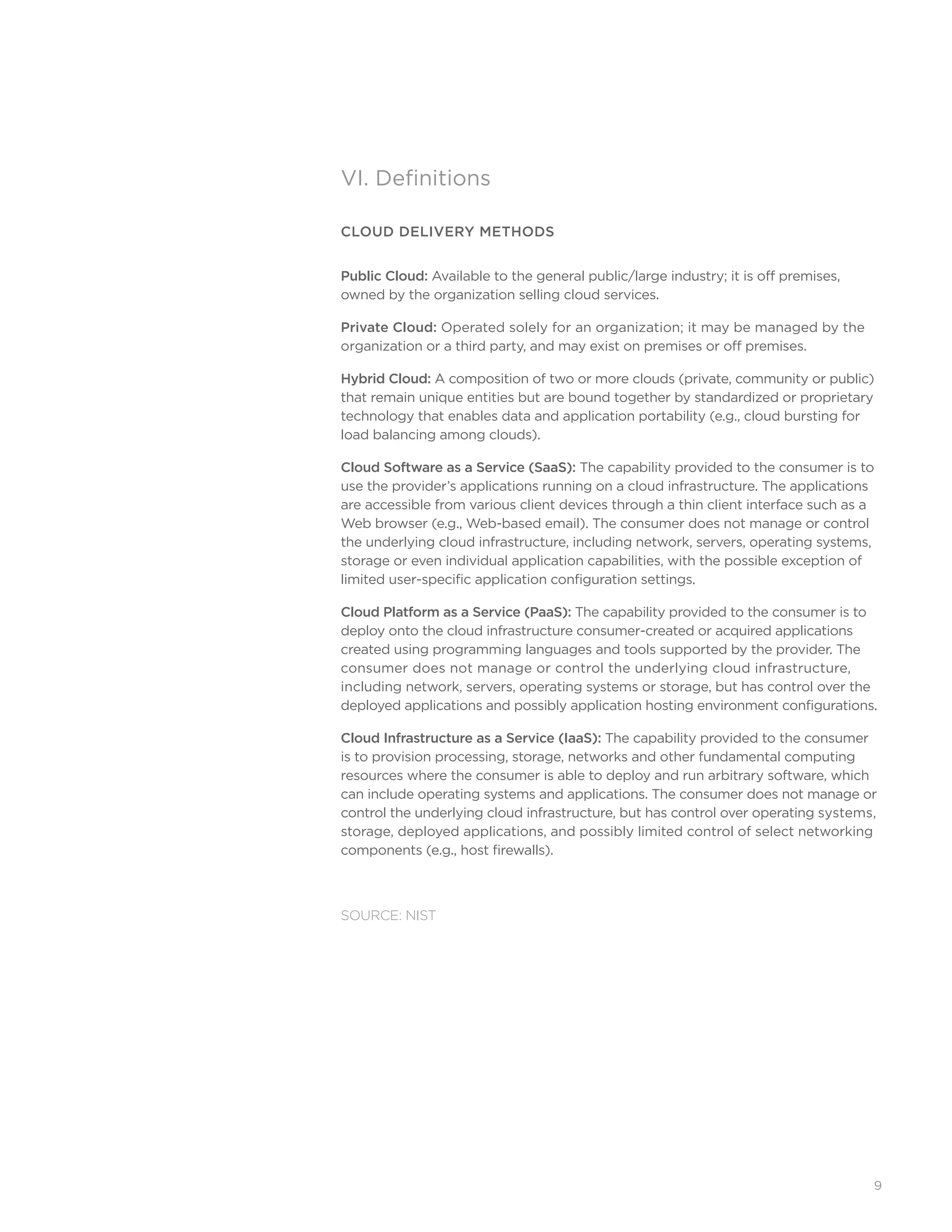
VI. Definitions
CLOUD DELIVERY METHODS
Public Cloud: Available to the general public/large industry; it is off premises,
owned by the organization selling cloud services.
Private Cloud: Operated solely for an organization; it may be managed by the
organization or a third party, and may exist on premises or off premises.
Hybrid Cloud: A composition of two or more clouds (private, community or public)
that remain unique entities but are bound together by standardized or proprietary
technology that enables data and application portability (e.g., cloud bursting for
load balancing among clouds).
Cloud Software as a Service (SaaS): The capability provided to the consumer is to
use the provider’s applications running on a cloud infrastructure. The applications
are accessible from various client devices through a thin client interface such as a
Web browser (e.g., Web-based email). The consumer does not manage or control
the underlying cloud infrastructure, including network, servers, operating systems,
storage or even individual application capabilities, with the possible exception of
limited user-specific application configuration settings.
Cloud Platform as a Service (PaaS): The capability provided to the consumer is to
deploy onto the cloud infrastructure consumer-created or acquired applications
created using programming languages and tools supported by the provider. The
consumer does not manage or control the underlying cloud infrastructure,
including network, servers, operating systems or storage, but has control over the
deployed applications and possibly application hosting environment configurations.
Cloud Infrastructure as a Service (IaaS): The capability provided to the consumer
is to provision processing, storage, networks and other fundamental computing
resources where the consumer is able to deploy and run arbitrary software, which
can include operating systems and applications. The consumer does not manage or
control the underlying cloud infrastructure, but has control over operating systems,
storage, deployed applications, and possibly limited control of select networking
components (e.g., host firewalls).
SOURCE: NIST
10
About TBR
Technology Business Research, Inc. (TBR) is a leading independent technology
market research and consulting firm specializing in the business and financial analy-
ses of hardware, software, networking equipment, wireless, portal and professional
services vendors. Serving a global clientele, TBR provides timely and accurate mar-
ket research and business intelligence in a format that is uniquely tailored to clients’
needs. TBR analysts are available to further address client-specific issues or infor-
mation needs on an inquiry or proprietary consulting basis.
FOR MORE INFORMATION
TBR has been empowering corporate decision makers since 1996. For more
information, visit www.tbri.com.
This report is based on information made available to the public by the vendor and other public sources. No 	
representation is made that this information is accurate or complete. Technology Business Research will not be held
liable or responsible for any decisions that are made based on this information. The information contained in this
report and all other TBR products is not and should not be construed to be investment advice. TBR does not make
any recommendations or provide any advice regarding the value, purchase, sale or retention of securities. This report is
copyright-protected and supplied for the sole use of the recipient. Contact Technology Business Research, Inc. for
permission to reproduce.
© 2012 Computer Sciences Corporation. All rights reserved.
Trademarks and registered trademarks are the properties of their respective owners.
LEARN MORE
www.csc.com/cloud
Follow us on Facebook and Twitter

White Paper: What's on Your Cloud? Workload Deployment Strategies for Private and Hybrid Clouds

  • 1.
    WHAT’S ON YOUR CLOUD? WorkloadDeployment Strategies for Private and Hybrid Clouds RESEARCH AND ANALYSIS PROVIDED BY TECHNOLOGY BUSINESS RESEARCH
  • 2.
    Contents I. Private Cloud:Making IT a business partner vs. capacity provider 3 II. Adoption will grow in breadth and depth 4 Delivery Methods – Private and Hybrid Clouds 5 III. How service partners are helping accelerate adoption 6 IV. BizCloud’s alignment with the drivers and barriers of private cloud adoption 6 Customer Highlight: H.D. Smith 7 V. Summary 8 Private and Hybrid Cloud Workload Migration as a Business Driver 8 VI. Definitions 9 Cloud Delivery Methods 9 About TBR 10 BASED ON TBR RESEARCH FINDINGS FUNDED BY CSC, CISCO AND EMC
  • 3.
    3 I. Private Cloud:Making IT a business partner vs. capacity provider The continuous enhancement of IT has been both a boon and burden for IT managers. IT has an ever increasing list of choices for infrastructure evolution – from delivery methods to architectures, open source technology, and multiple forms of cloud, the options for how to deliver IT capacity have expanded signifi- cantly (see Figure 1). The enduring struggle for IT, however, is how to transition from being solely a tools provider for IT capacity into a more strategic role working alongside the business to deliver solutions that include necessary IT capacity. FIGURE 1 CUSTOMER PURCHASING DECISIONS – PUBLIC, PRIVATE, HYBRID CLOUDS This trend is evident in the early adoption of private cloud solutions, with most being applied to horizontal workloads like general compute or storage versus horizontal workloads like ERP or other specific business applications. This trend will shift over the next 18 months, however, as customers use the flexibility and control of private cloud to bridge the gap between traditional and cloud-based IT delivery. The result is more vertical-focused private cloud adoption and the enhancement of IT’s ability to begin addressing business requirements by matching the right delivery method and technology to the workload. “It started as one of those situations where the infrastructure group just couldn’t keep up with the demands that software development had.” – IT Director WHAT’S ON YOUR CLOUD? Workload Deployment Strategies for Private and Hybrid Clouds Private Cloud? Hybrid Cloud? Public Cloud? On-Premises? Mainframe? Appliance? Customer Dilemmas: Where am I now — and where do I want to be in 18 months? How do I decide which workloads to shift? What can manage the complexity of hybrids? What are the tradeoffs between cloud benefits, performance requirements and legal/security mandates? Who can help me make this transition?
  • 4.
    4 II. Adoption willgrow in breadth and depth Though barriers – both psychological and practical – remain, the trial phase of private cloud adoption is well under way. As illustrated in Figure 2, a third of re- spondents have already adopted cloud, and nearly as many are planning to in the next 18 months. By the end of 2013, more than 60% of customers will have imple- mented some type of private or hybrid cloud solution within their IT infrastructure. FIGURE 2 PRIVATE/HYBRID CLOUD ADOPTION RATES SOURCE: TBR SUMMER 2012 PRIVATE/HYBRID CLOUD COMPUTING ADOPTION STUDY; N=435 Despite the upsurge in adoption for private and hybrid solutions, it’s important to put that adoption in perspective from a depth context. Compared with some of the other leading IT delivery methods, private and hybrid clouds still touch a relatively small portion of workloads for customers that have adopted, as shown in Figure 3. However, that depth will grow as customers increase their comfort with the delivery method and look to replace or supplement traditionally delivered on-premises solutions, which was one of the largest private cloud purchase drivers for early adopters. FIGURE 3 THE ROLE OF PRIVATE CLOUD WITHIN THE IT DELIVERY SPECTRUM “I think there is a major shift taking place right now with cloud devel- opment. When you can’t touch and see your data and your equip- ment, that’s a mental problem that we need to get beyond…” – IT Director Non-Adopters 31% Adopters 35% Future Adopters 34% ON-PREMISES DELIVERY PRIVATE/HYBRID CLOUD PUBLIC CLOUD PRE-BUILT APPLIANCES OUTSOURCED APPLICATIONS 63% 9% 12% 8% 8% SECURITY GOVERNANCE 64% 8% 12% 8% 7% SYSTEMS MANAGEMENT 63% 9% 10% 9% 8% BI DATA WAREHOUSING 71% 6% 11% 6% 7% DEVELOPMENT TEST 63% 9% 12% 9% 7% LOW ADOPTIONHIGH ADOPTION SOURCE: TBR SUMMER 2012 PRIVATE/HYBRID CLOUD COMPUTING ADOPTION STUDY; N=435
  • 5.
    5 When asked aboutfuture adoption considerations, the feedback was clear – not only will more customers complete their first implementation, but the size of purchases will grow for all private and hybrid cloud adopters. The result will be both a horizontal and vertical expansion of private cloud adoption through the end of 2013. DELIVERY METHODS – PRIVATE AND HYBRID CLOUDS Behind the shallow but rising adoption is a drive by customers to achieve not only cost efficiencies but business improvements in development and delivery through private and hybrid cloud computing. Though private cloud has become synonymous with secure cloud, for adopters the benefits extend well beyond security and compliance. When evaluating clouds, few homogenous solutions exist. In looking at private clouds, these customers have a secondary layer of consideration to account for – aligning workload to delivery method. For many customers with longer time- frames, funds available for investment, and sufficient in-house skills, the self-built method of private cloud is the best fit. However, in speaking with customers, this trifecta of qualifications (time, funds, skills) exists in a minority of customer accounts. Most private cloud evaluators have significant gaps in at least one of those areas, making either appliance-driven cloud or service-provider-delivered cloud a better fit to balance business and IT requirements (see Figure 4). FIGURE 4 WORKLOAD MIGRATIONS TO PRIVATE AND HYBRID CLOUDS, BY TYPE SOURCE: TBR SUMMER 2012 PRIVATE/HYBRID CLOUD COMPUTING ADOPTION STUDY; N=435 The time, skills and investments needed to deploy and maintain private cloud solutions remain the primary barriers for customers to adopt, and both the service-provider-delivered and appliance private cloud deployment methods alleviate these barriers to entry. For service-provider-delivered private clouds in particular, customers see value in being able to leverage third-party skills to assemble private cloud assets with preferred payment methods matching cloud consumption – reducing up-front expenses and driving adoption. “We decided to move workloads that were most critical to our business and complex in nature to private cloud.” – Senior Director, IT SELF-BUILT SERVICE-PROVIDER DELIVERED APPLIANCE APPLICATIONS 39% 56% 33% SECURITY GOVERNANCE 14% 19% 10% SYSTEMS MANAGEMENT 38% 44% 28% BI DATA WAREHOUSING 32% 35% 25% DEVELOPMENT TEST 29% 39% 25% LOW ADOPTIONHIGH ADOPTION
  • 6.
    6 III. How servicepartners are helping accelerate adoption Customers have two distinct choices for partners in purchasing private and hybrid cloud – infrastructure vendors (software and solutions) as well as service providers. TBR research shows leading vendors selected by customers to provide com- ponents for “self-built” (customer-constructed) private clouds include Microsoft, HP, VMware and IBM. VMware’s inclusion in the list underscores the importance customers place on including server virtualization in private and hybrid clouds. TBR believes all four of these companies have product portfolios ready to serve cloud purchasers that can both understand the benefits of cloud and are confident in their own abilities to construct, scale and manage cloud deployments. Many customers are looking to service providers for both the delivery of private cloud itself and for professional services around the consumption. TBR research and analysis shows that across respondent segments, the most popular purchasing option for private clouds among current and future adopters is through service providers. TBR sees service providers as critical enablers of customers initiating first deployments of private and hybrid cloud, in particular those vendors that are elsewhere within a customer’s environment. As trusted advisors, service providers can design, implement and scale a private or hybrid cloud deployment for a cus- tomer – minimizing burden while increasing the potential benefit to the business. IV. BizCloud’s alignment with the drivers and barriers of private cloud adoption In designing its BizCloud offering, CSC has addressed both the current barriers and adoption drivers in a way few solutions can. By positioning itself between customers and the actual IT assets, CSC becomes an important broker that accepts much of the risk holding back customer adoption while enhancing many of the attributes that make private cloud an attractive and growing delivery mechanism. CSC’s adoption accelerators: • Clear ROI: With a new delivery method, many customers do not have the experience and information to build a clear business case for private or hybrid cloud adoption. With its consulting expertise, CSC can work alongside cus- tomers to build the business case to move forward with BizCloud-delivered cloud services. • Flexible pricing: Rather than requiring customers to procure assets up front, BizCloud’s flexible pricing provides the options customers need to select the best pricing schedule based on their requirements. “Everything about the cloud changes every week — there are new features and functionality, new security layers, etc. For smaller companies…if they are not reaching out for outside help they are making a mistake — you need a team of experts to navigate those waters.” – IT Director
  • 7.
    7 Furthermore, CSC’s BizCloudallows customers to overcome top adoption barriers: • Compliance, security and sensitivity: These were identified as the top 3 adoption barriers, all of which can be identified and mitigated using the flexible delivery models for the BizCloud solution. Furthermore, CSC brings a proven track record of meeting regulatory requirements and working with high-security government workloads. • Implementation cost time: Selected by customers as the 6th and 7th largest adoption barriers, these fit tightly with the core BizCloud value proposition. By choosing BizCloud, customers have a set deadline and cost for implementation that can be as short as 10 weeks. CSC’s experience in data center support and delivery has fueled the construction, in CSC BizCloud, of an offering that TBR sees as tightly aligned to customers’ needs in this market. We maintain that CSC BizCloud pricing is designed to align with customers’ existing expectation of service providers – positioning CSC to deliver innovative services within expected pricing parameters, and doing so with a commitment of 10 weeks. CUSTOMER HIGHLIGHT: H.D. SMITH For H.D. Smith – a healthcare distributor headquartered in Springfield, Illinois – and Chief Information Officer Davíd Guzmán, the journey to the cloud started as a response to business needs. Guzmán evaluated both the need to differentiate based on technology and the need to maintain cost competitiveness with larger competitors. H.D. Smith pursues technology innovation as a revenue driver – and sought cloud capabilities to expedite service delivery to their customers. As the company considered purchasing options, Guzmán and the H.D. Smith ex- ecutive team looked to partner-led implementations, in order to drive the maximum value for investment without expanding H.D. Smith’s staff needs and capabilities outside core capabilities. They sought a partner that could deliver an end-to-end cloud (Software as a Service, Infrastructure as a Service, Platform as a Service and Desktop as a Service), along with professional services support. Moreover, they sought a cloud provider that could create a tailored deployment – their entrepreneurial vision for growth – that would deliver H.D. Smith the right cloud for current needs as well as long-term growth. They elected to go with CSC as their cloud service provider – attracted to CSC’s strategic approach to cloud and CSC’s ability to manage H.D. Smith’s enterprise while also delivering services to H.D. Smith’s end customers.
  • 8.
    8 V. Summary PRIVATE ANDHYBRID CLOUD WORKLOAD MIGRATION AS A BUSINESS DRIVER Private and hybrid cloud purchasing is at a point of inflection. Purchasing cloud components and integrating them – the do-it-yourself cloud – can be as expen- sive and difficult to implement. This approach is rapidly eroding as customers gain experience with new cloud offers. Through flexible offerings like CSC’s BizCloud, customers can gain access to all the performance, reliability and cost benefits of private cloud services without the associated risk, expense and time to build their own solution. Beyond the evident IT delivery benefits, increasing private and hybrid cloud adoption also holds great promise for elevating the position of IT from tools provider to strategy business partner. With the improved management, performance and cost efficiency of private cloud solutions, IT has new latitude to look proactively alongside business constituents at workloads driving the IT requirements, instead of just responding to them. “The ideal situation for IT is to become more of a cloud broker, to help the business decide the best place for the workload, whether it’s internal or external.” – IT Director
  • 9.
    9 VI. Definitions CLOUD DELIVERYMETHODS Public Cloud: Available to the general public/large industry; it is off premises, owned by the organization selling cloud services. Private Cloud: Operated solely for an organization; it may be managed by the organization or a third party, and may exist on premises or off premises. Hybrid Cloud: A composition of two or more clouds (private, community or public) that remain unique entities but are bound together by standardized or proprietary technology that enables data and application portability (e.g., cloud bursting for load balancing among clouds). Cloud Software as a Service (SaaS): The capability provided to the consumer is to use the provider’s applications running on a cloud infrastructure. The applications are accessible from various client devices through a thin client interface such as a Web browser (e.g., Web-based email). The consumer does not manage or control the underlying cloud infrastructure, including network, servers, operating systems, storage or even individual application capabilities, with the possible exception of limited user-specific application configuration settings. Cloud Platform as a Service (PaaS): The capability provided to the consumer is to deploy onto the cloud infrastructure consumer-created or acquired applications created using programming languages and tools supported by the provider. The consumer does not manage or control the underlying cloud infrastructure, including network, servers, operating systems or storage, but has control over the deployed applications and possibly application hosting environment configurations. Cloud Infrastructure as a Service (IaaS): The capability provided to the consumer is to provision processing, storage, networks and other fundamental computing resources where the consumer is able to deploy and run arbitrary software, which can include operating systems and applications. The consumer does not manage or control the underlying cloud infrastructure, but has control over operating systems, storage, deployed applications, and possibly limited control of select networking components (e.g., host firewalls). SOURCE: NIST
  • 10.
    10 About TBR Technology BusinessResearch, Inc. (TBR) is a leading independent technology market research and consulting firm specializing in the business and financial analy- ses of hardware, software, networking equipment, wireless, portal and professional services vendors. Serving a global clientele, TBR provides timely and accurate mar- ket research and business intelligence in a format that is uniquely tailored to clients’ needs. TBR analysts are available to further address client-specific issues or infor- mation needs on an inquiry or proprietary consulting basis. FOR MORE INFORMATION TBR has been empowering corporate decision makers since 1996. For more information, visit www.tbri.com. This report is based on information made available to the public by the vendor and other public sources. No representation is made that this information is accurate or complete. Technology Business Research will not be held liable or responsible for any decisions that are made based on this information. The information contained in this report and all other TBR products is not and should not be construed to be investment advice. TBR does not make any recommendations or provide any advice regarding the value, purchase, sale or retention of securities. This report is copyright-protected and supplied for the sole use of the recipient. Contact Technology Business Research, Inc. for permission to reproduce. © 2012 Computer Sciences Corporation. All rights reserved. Trademarks and registered trademarks are the properties of their respective owners. LEARN MORE www.csc.com/cloud Follow us on Facebook and Twitter