PUBLIC
CLOUD
PUBLIC
CLOUD
in association with
Survey conducted by IDG Connect on behalf of EMC
STATE OF
HYBRID CLOUD
PRIVATE
CLOUD
PRIVATE
CLOUD
2
in association with
IDG Connect is the demand generation
division of International Data Group (IDG),
the world’s largest technology media
company. Established in 2005, it utilises
access to 38 million business decision
makers’details to unite technology
marketers with relevant targets from
any country in the world. Committed to
engaging a disparate global IT audience
with truly localised messaging, IDG
Connect also publishes market specific
thought leadership papers on behalf of
its clients, and produces research for B2B
marketers worldwide.
www.idgconnect.com
INTRODUCTION
...the more recent emergence of the hybrid cloud now
looks set to attract more attention from enterprise IT
departments.
“ “
Global business spending on infrastructure and services related to the
cloud is forecast to hit $235.1bn by 2017 according to IHS Technology,
up from $174.2bn in 2014 and $145.2bn in 2013. Countries within
the Asia Pacific (APAC) region will account for a significant portion of
that spend, with a Gartner survey of chief information officers (CIOs)
in 2014 identifying cloud computing as their top spending priority
fuelled by an average budgetary increase of 0.9% year on year.
A growing portion of that expenditure is likely to be spent on hybrid
cloud platforms specifically. Gartner predicted in October 2013 that
many existing private cloud deployments will gradually give way to
hybrid clouds, and that nearly half of all enterprises will have hybrid
clouds by 2018. IDC too has predicted greater adoption of hybrid
cloud models in the longer term which would contribute to an
increase in both public and private cloud service consumption.
Early cloud service delivery models centred on off-premise platforms
that store data and applications on shared, multi-tenanted server
architecture have proved popular amongst businesses of all sizes. But
many organisations, particularly larger corporates, remain wary about
committing mission critical applications, and sensitive information
governed by data privacy regulation, to third party hosting facilities,
one reason why many have preferred on-premise, private clouds for
certain applications.
The more recent emergence of hybrid cloud – designed to combine
the speed of provisioning and flexibility advantages that have driven
so many organisations to lease on-demand, public cloud services and
the enhanced security, reliability and performance associated with
on-premise applications and services – now looks set to attract more
attention from enterprise IT departments.
Whether those analyst predictions prove accurate or not, the
reality is that the broader cloud market is on the cusp of significant
diversification, with all forms of cloud delivery – including various
flavours of public, private and hybrid - likely to attract a greater portion
of enterprise IT budgets. Most organisations will continue to use a
mixture of different cloud services models for different applications
and workloads according to the specific security, performance and
reliability requirements of each, and enterprise spending on each is set
to increase.
IDG Connect surveyed 600 organisations based in Australia, China,
Malaysia, New Zealand, Thailand, Singapore and Indonesia, all of which
employed 500 people or more with 62% having headcounts in excess
of 1,000 staff and 9% 10,000 or more. The majority of those polled
(57%) worked in front facing, hands-on IT roles with the remainder
made up of C-level executives. The insurance industry represented the
single largest vertical (12%), followed by finance (11%), education (8%)
and electronics (7%).
The results provide a snapshot of current usage of, and attitudes
to, on- and off-premise public, private and hybrid cloud service
provision in specific territories within the Asia Pacific (APAC) region,
and highlight perceived benefits, barriers to adoption and future
investment plans.
State of Hybrid Cloud
Introduction
Research Highlights
Current Cloud Usage
Objectives
Barriers to Public Cloud
Workloads
Cost Strategies
Barriers to Hybrid Cloud
On Demand Provisioning
Future Cloud Plans
Conclusion
About EMC
3
in association with
IDG Connect is the demand generation
division of International Data Group (IDG),
the world’s largest technology media
company. Established in 2005, it utilises
access to 38 million business decision
makers’details to unite technology
marketers with relevant targets from
any country in the world. Committed to
engaging a disparate global IT audience
with truly localised messaging, IDG
Connect also publishes market specific
thought leadership papers on behalf of
its clients, and produces research for B2B
marketers worldwide.
www.idgconnect.com
RESEARCH HIGHLIGHTS
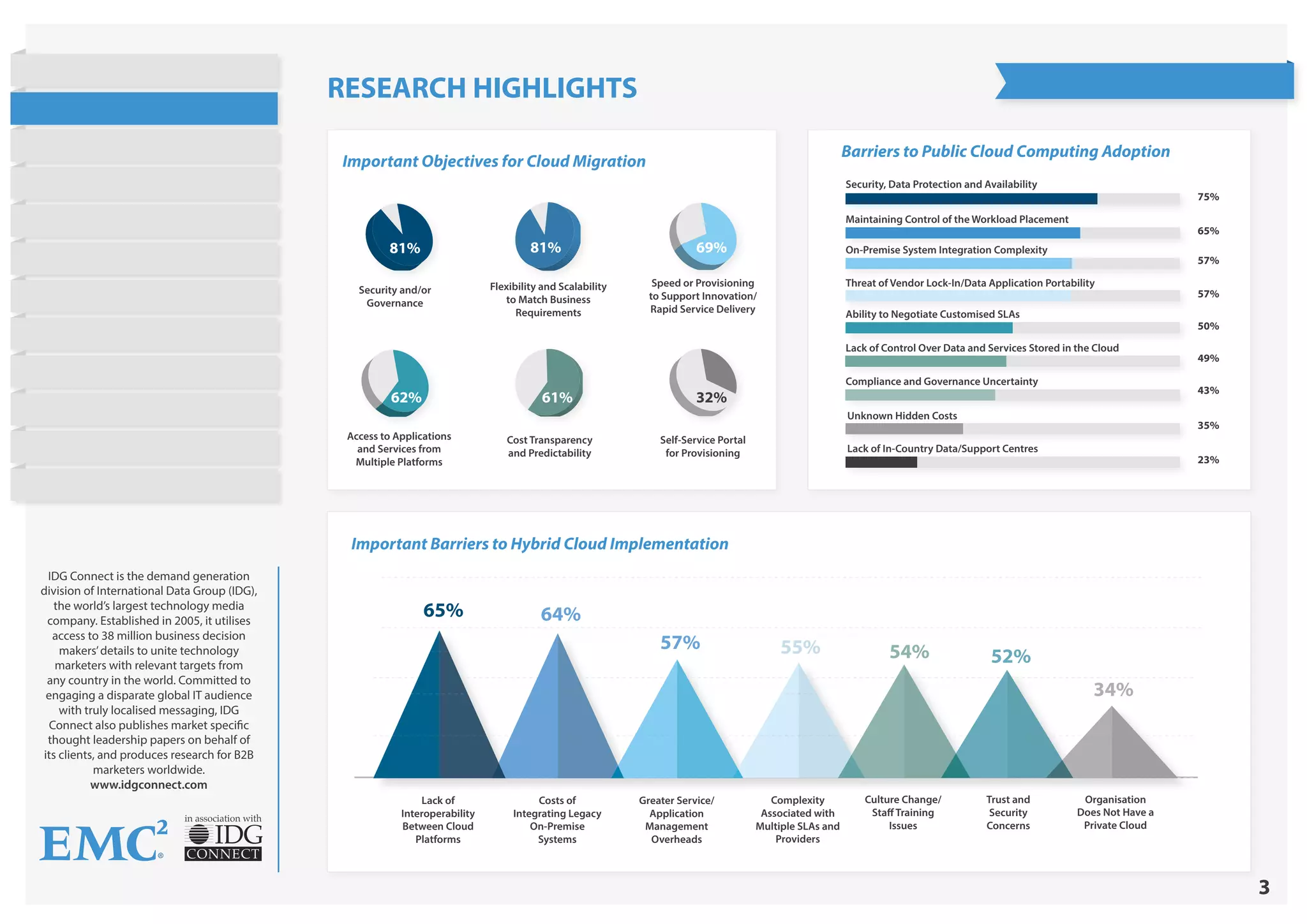
Important Barriers to Hybrid Cloud Implementation
Important Objectives for Cloud Migration
Barriers to Public Cloud Computing Adoption
Security and/or
Governance
Speed or Provisioning
to Support Innovation/
Rapid Service Delivery
Flexibility and Scalability
to Match Business
Requirements
Cost Transparency
and Predictability
Access to Applications
and Services from
Multiple Platforms
Self-Service Portal
for Provisioning
Security, Data Protection and Availability
Lack of Control Over Data and Services Stored in the Cloud
Threat of Vendor Lock-In/Data Application Portability
On-Premise System Integration Complexity
Maintaining Control of the Workload Placement
Ability to Negotiate Customised SLAs
Compliance and Governance Uncertainty
Unknown Hidden Costs
Lack of In-Country Data/Support Centres
75%
65%
57%
57%
50%
49%
43%
35%
23%
81% 81% 69%
62% 61% 32%
Lack of
Interoperability
Between Cloud
Platforms
Costs of
Integrating Legacy
On-Premise
Systems
Greater Service/
Application
Management
Overheads
Complexity
Associated with
Multiple SLAs and
Providers
Culture Change/
Staff Training
Issues
Trust and
Security
Concerns
Organisation
Does Not Have a
Private Cloud
65% 64%
57% 55% 54% 52%
34%
State of Hybrid Cloud
Research Highlights
Introduction
Current Cloud Usage
Objectives
Barriers to Public Cloud
Workloads
Cost Strategies
Barriers to Hybrid Cloud
On Demand Provisioning
Future Cloud Plans
Conclusion
About EMC
4
in association with
IDG Connect is the demand generation
division of International Data Group (IDG),
the world’s largest technology media
company. Established in 2005, it utilises
access to 38 million business decision
makers’details to unite technology
marketers with relevant targets from
any country in the world. Committed to
engaging a disparate global IT audience
with truly localised messaging, IDG
Connect also publishes market specific
thought leadership papers on behalf of
its clients, and produces research for B2B
marketers worldwide.
www.idgconnect.com
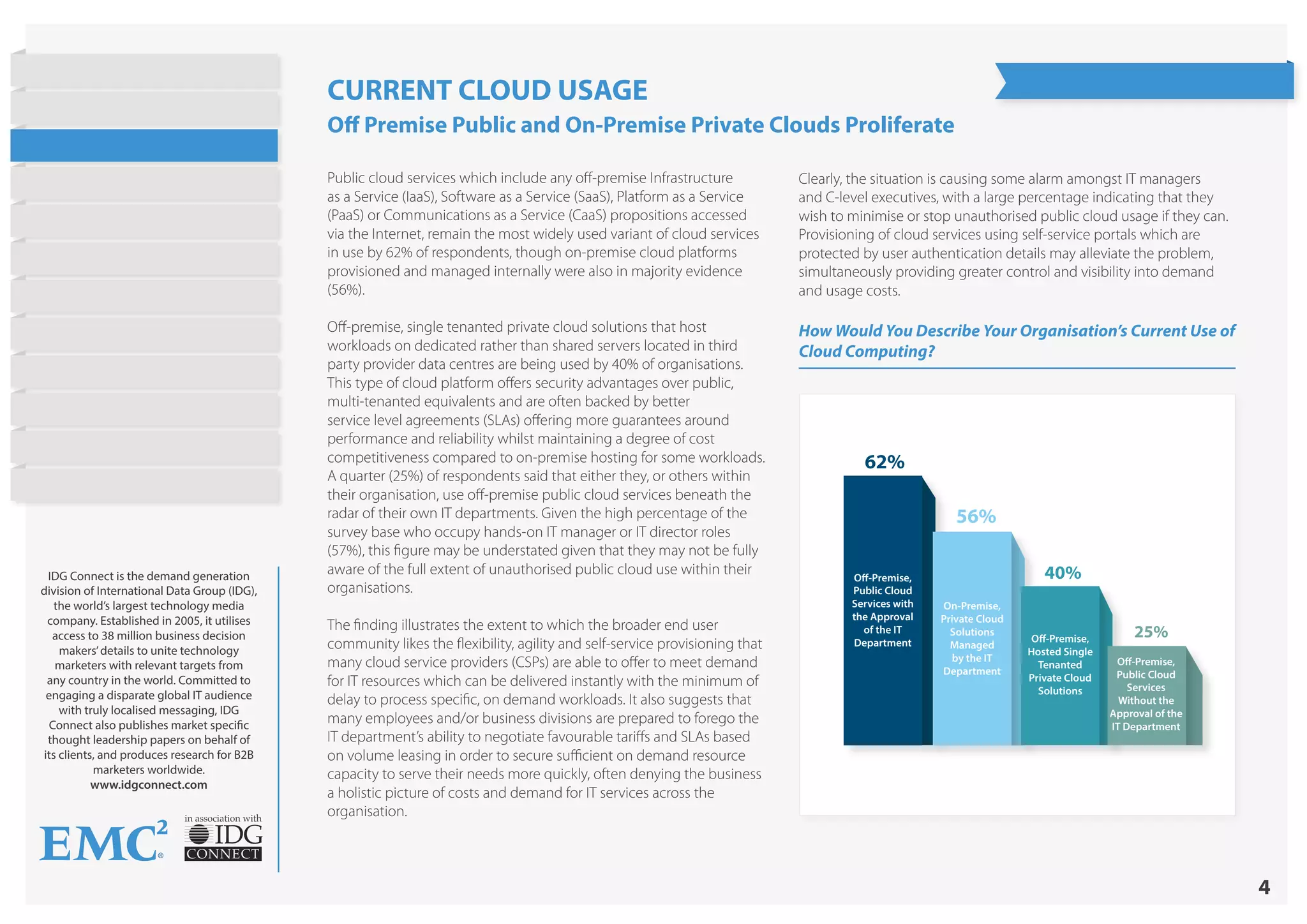
How Would You Describe Your Organisation’s Current Use of
Cloud Computing?
62%
56%
40%
25%
Off-Premise,
Public Cloud
Services with
the Approval
of the IT
Department
On-Premise,
Private Cloud
Solutions
Managed
by the IT
Department
Off-Premise,
Hosted Single
Tenanted
Private Cloud
Solutions
Off-Premise,
Public Cloud
Services
Without the
Approval of the
IT Department
CURRENT CLOUD USAGE
Off Premise Public and On-Premise Private Clouds Proliferate
Public cloud services which include any off-premise Infrastructure
as a Service (IaaS), Software as a Service (SaaS), Platform as a Service
(PaaS) or Communications as a Service (CaaS) propositions accessed
via the Internet, remain the most widely used variant of cloud services
in use by 62% of respondents, though on-premise cloud platforms
provisioned and managed internally were also in majority evidence
(56%).
Off-premise, single tenanted private cloud solutions that host
workloads on dedicated rather than shared servers located in third
party provider data centres are being used by 40% of organisations.
This type of cloud platform offers security advantages over public,
multi-tenanted equivalents and are often backed by better
service level agreements (SLAs) offering more guarantees around
performance and reliability whilst maintaining a degree of cost
competitiveness compared to on-premise hosting for some workloads.
A quarter (25%) of respondents said that either they, or others within
their organisation, use off-premise public cloud services beneath the
radar of their own IT departments. Given the high percentage of the
survey base who occupy hands-on IT manager or IT director roles
(57%), this figure may be understated given that they may not be fully
aware of the full extent of unauthorised public cloud use within their
organisations.
The finding illustrates the extent to which the broader end user
community likes the flexibility, agility and self-service provisioning that
many cloud service providers (CSPs) are able to offer to meet demand
for IT resources which can be delivered instantly with the minimum of
delay to process specific, on demand workloads. It also suggests that
many employees and/or business divisions are prepared to forego the
IT department’s ability to negotiate favourable tariffs and SLAs based
on volume leasing in order to secure sufficient on demand resource
capacity to serve their needs more quickly, often denying the business
a holistic picture of costs and demand for IT services across the
organisation.
Clearly, the situation is causing some alarm amongst IT managers
and C-level executives, with a large percentage indicating that they
wish to minimise or stop unauthorised public cloud usage if they can.
Provisioning of cloud services using self-service portals which are
protected by user authentication details may alleviate the problem,
simultaneously providing greater control and visibility into demand
and usage costs.
State of Hybrid Cloud
Research Highlights
Introduction
Current Cloud Usage
Objectives
Barriers to Public Cloud
Workloads
Cost Strategies
Barriers to Hybrid Cloud
On Demand Provisioning
Future Cloud Plans
Conclusion
About EMC
5
in association with
IDG Connect is the demand generation
division of International Data Group (IDG),
the world’s largest technology media
company. Established in 2005, it utilises
access to 38 million business decision
makers’details to unite technology
marketers with relevant targets from
any country in the world. Committed to
engaging a disparate global IT audience
with truly localised messaging, IDG
Connect also publishes market specific
thought leadership papers on behalf of
its clients, and produces research for B2B
marketers worldwide.
www.idgconnect.com
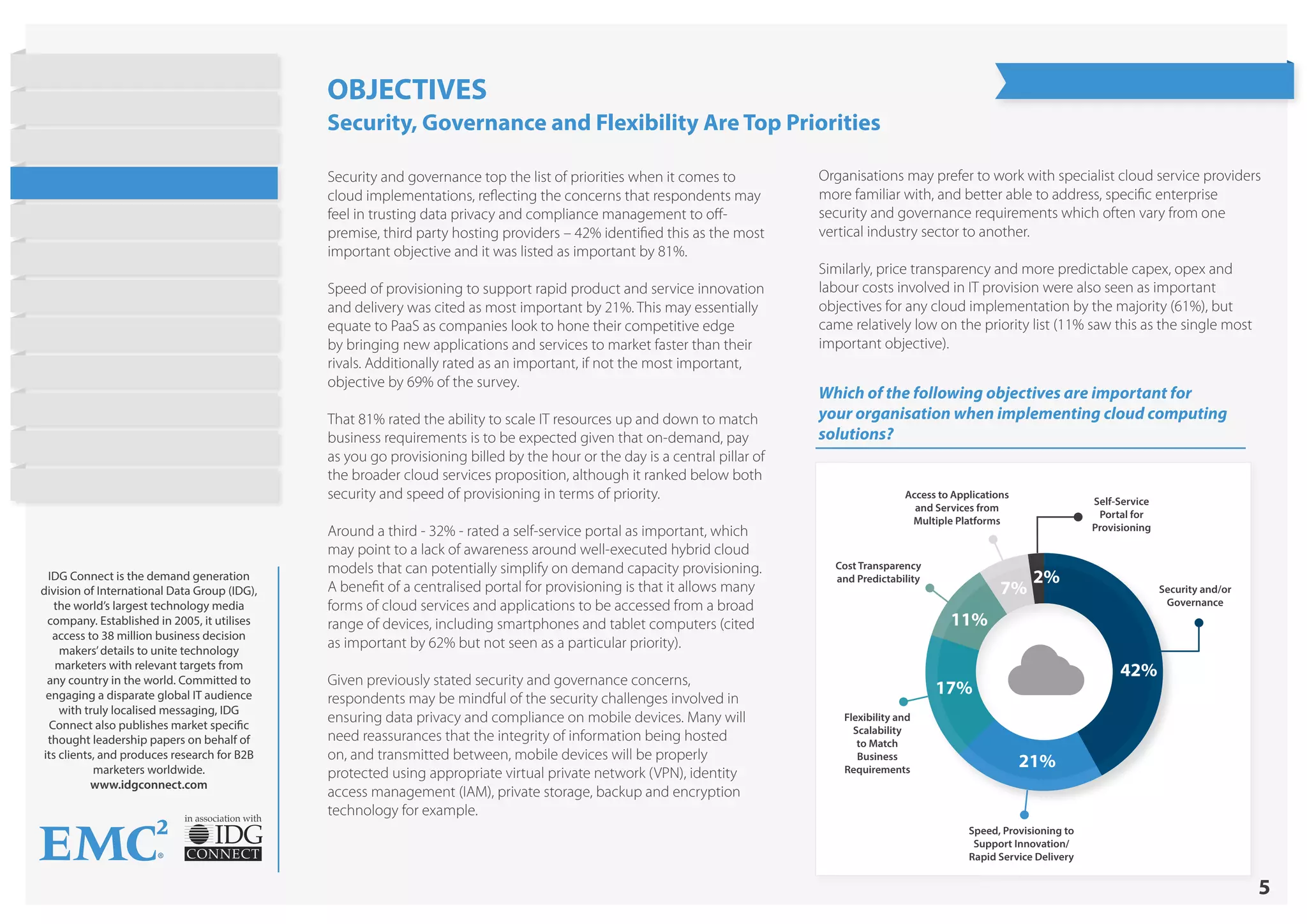
Which of the following objectives are important for
your organisation when implementing cloud computing
solutions?
Security and/or
Governance
Speed, Provisioning to
Support Innovation/
Rapid Service Delivery
Flexibility and
Scalability
to Match
Business
Requirements
Cost Transparency
and Predictability
Access to Applications
and Services from
Multiple Platforms
Self-Service
Portal for
Provisioning
42%
21%
17%
11%
7%
2%
OBJECTIVES
Security, Governance and Flexibility Are Top Priorities
Security and governance top the list of priorities when it comes to
cloud implementations, reflecting the concerns that respondents may
feel in trusting data privacy and compliance management to off-
premise, third party hosting providers – 42% identified this as the most
important objective and it was listed as important by 81%.
Speed of provisioning to support rapid product and service innovation
and delivery was cited as most important by 21%. This may essentially
equate to PaaS as companies look to hone their competitive edge
by bringing new applications and services to market faster than their
rivals. Additionally rated as an important, if not the most important,
objective by 69% of the survey.
That 81% rated the ability to scale IT resources up and down to match
business requirements is to be expected given that on-demand, pay
as you go provisioning billed by the hour or the day is a central pillar of
the broader cloud services proposition, although it ranked below both
security and speed of provisioning in terms of priority.
Around a third - 32% - rated a self-service portal as important, which
may point to a lack of awareness around well-executed hybrid cloud
models that can potentially simplify on demand capacity provisioning.
A benefit of a centralised portal for provisioning is that it allows many
forms of cloud services and applications to be accessed from a broad
range of devices, including smartphones and tablet computers (cited
as important by 62% but not seen as a particular priority).
Given previously stated security and governance concerns,
respondents may be mindful of the security challenges involved in
ensuring data privacy and compliance on mobile devices. Many will
need reassurances that the integrity of information being hosted
on, and transmitted between, mobile devices will be properly
protected using appropriate virtual private network (VPN), identity
access management (IAM), private storage, backup and encryption
technology for example.
Organisations may prefer to work with specialist cloud service providers
more familiar with, and better able to address, specific enterprise
security and governance requirements which often vary from one
vertical industry sector to another.
Similarly, price transparency and more predictable capex, opex and
labour costs involved in IT provision were also seen as important
objectives for any cloud implementation by the majority (61%), but
came relatively low on the priority list (11% saw this as the single most
important objective).
State of Hybrid Cloud
Research Highlights
Introduction
Current Cloud Usage
Objectives
Barriers to Public Cloud
Workloads
Cost Strategies
Barriers to Hybrid Cloud
On Demand Provisioning
Future Cloud Plans
Conclusion
About EMC
6
in association with
IDG Connect is the demand generation
division of International Data Group (IDG),
the world’s largest technology media
company. Established in 2005, it utilises
access to 38 million business decision
makers’details to unite technology
marketers with relevant targets from
any country in the world. Committed to
engaging a disparate global IT audience
with truly localised messaging, IDG
Connect also publishes market specific
thought leadership papers on behalf of
its clients, and produces research for B2B
marketers worldwide.
www.idgconnect.com
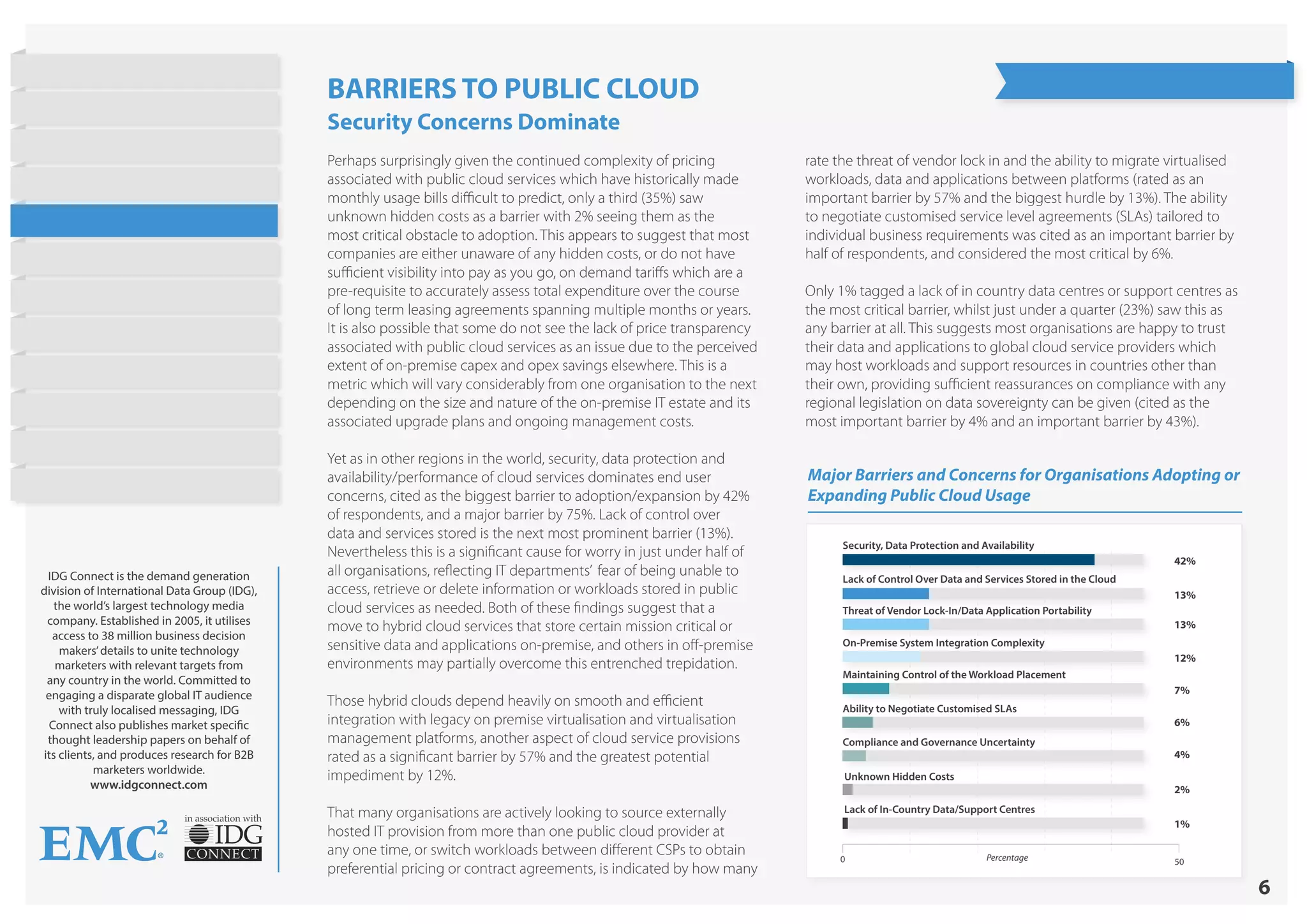
Major Barriers and Concerns for Organisations Adopting or
Expanding Public Cloud Usage
Security, Data Protection and Availability
Lack of Control Over Data and Services Stored in the Cloud
Threat of Vendor Lock-In/Data Application Portability
On-Premise System Integration Complexity
Maintaining Control of the Workload Placement
Ability to Negotiate Customised SLAs
Compliance and Governance Uncertainty
Unknown Hidden Costs
Lack of In-Country Data/Support Centres
42%
13%
13%
12%
7%
6%
4%
2%
1%
0 50Percentage
Perhaps surprisingly given the continued complexity of pricing
associated with public cloud services which have historically made
monthly usage bills difficult to predict, only a third (35%) saw
unknown hidden costs as a barrier with 2% seeing them as the
most critical obstacle to adoption. This appears to suggest that most
companies are either unaware of any hidden costs, or do not have
sufficient visibility into pay as you go, on demand tariffs which are a
pre-requisite to accurately assess total expenditure over the course
of long term leasing agreements spanning multiple months or years.
It is also possible that some do not see the lack of price transparency
associated with public cloud services as an issue due to the perceived
extent of on-premise capex and opex savings elsewhere. This is a
metric which will vary considerably from one organisation to the next
depending on the size and nature of the on-premise IT estate and its
associated upgrade plans and ongoing management costs.
Yet as in other regions in the world, security, data protection and
availability/performance of cloud services dominates end user
concerns, cited as the biggest barrier to adoption/expansion by 42%
of respondents, and a major barrier by 75%. Lack of control over
data and services stored is the next most prominent barrier (13%).
Nevertheless this is a significant cause for worry in just under half of
all organisations, reflecting IT departments’ fear of being unable to
access, retrieve or delete information or workloads stored in public
cloud services as needed. Both of these findings suggest that a
move to hybrid cloud services that store certain mission critical or
sensitive data and applications on-premise, and others in off-premise
environments may partially overcome this entrenched trepidation.
Those hybrid clouds depend heavily on smooth and efficient
integration with legacy on premise virtualisation and virtualisation
management platforms, another aspect of cloud service provisions
rated as a significant barrier by 57% and the greatest potential
impediment by 12%.
That many organisations are actively looking to source externally
hosted IT provision from more than one public cloud provider at
any one time, or switch workloads between different CSPs to obtain
preferential pricing or contract agreements, is indicated by how many
rate the threat of vendor lock in and the ability to migrate virtualised
workloads, data and applications between platforms (rated as an
important barrier by 57% and the biggest hurdle by 13%). The ability
to negotiate customised service level agreements (SLAs) tailored to
individual business requirements was cited as an important barrier by
half of respondents, and considered the most critical by 6%.
Only 1% tagged a lack of in country data centres or support centres as
the most critical barrier, whilst just under a quarter (23%) saw this as
any barrier at all. This suggests most organisations are happy to trust
their data and applications to global cloud service providers which
may host workloads and support resources in countries other than
their own, providing sufficient reassurances on compliance with any
regional legislation on data sovereignty can be given (cited as the
most important barrier by 4% and an important barrier by 43%).
BARRIERS TO PUBLIC CLOUD
Security Concerns Dominate
State of Hybrid Cloud
Research Highlights
Introduction
Current Cloud Usage
Objectives
Barriers to Public Cloud
Workloads
Cost Strategies
Barriers to Hybrid Cloud
On Demand Provisioning
Future Cloud Plans
Conclusion
About EMC
7
in association with
IDG Connect is the demand generation
division of International Data Group (IDG),
the world’s largest technology media
company. Established in 2005, it utilises
access to 38 million business decision
makers’details to unite technology
marketers with relevant targets from
any country in the world. Committed to
engaging a disparate global IT audience
with truly localised messaging, IDG
Connect also publishes market specific
thought leadership papers on behalf of
its clients, and produces research for B2B
marketers worldwide.
www.idgconnect.com
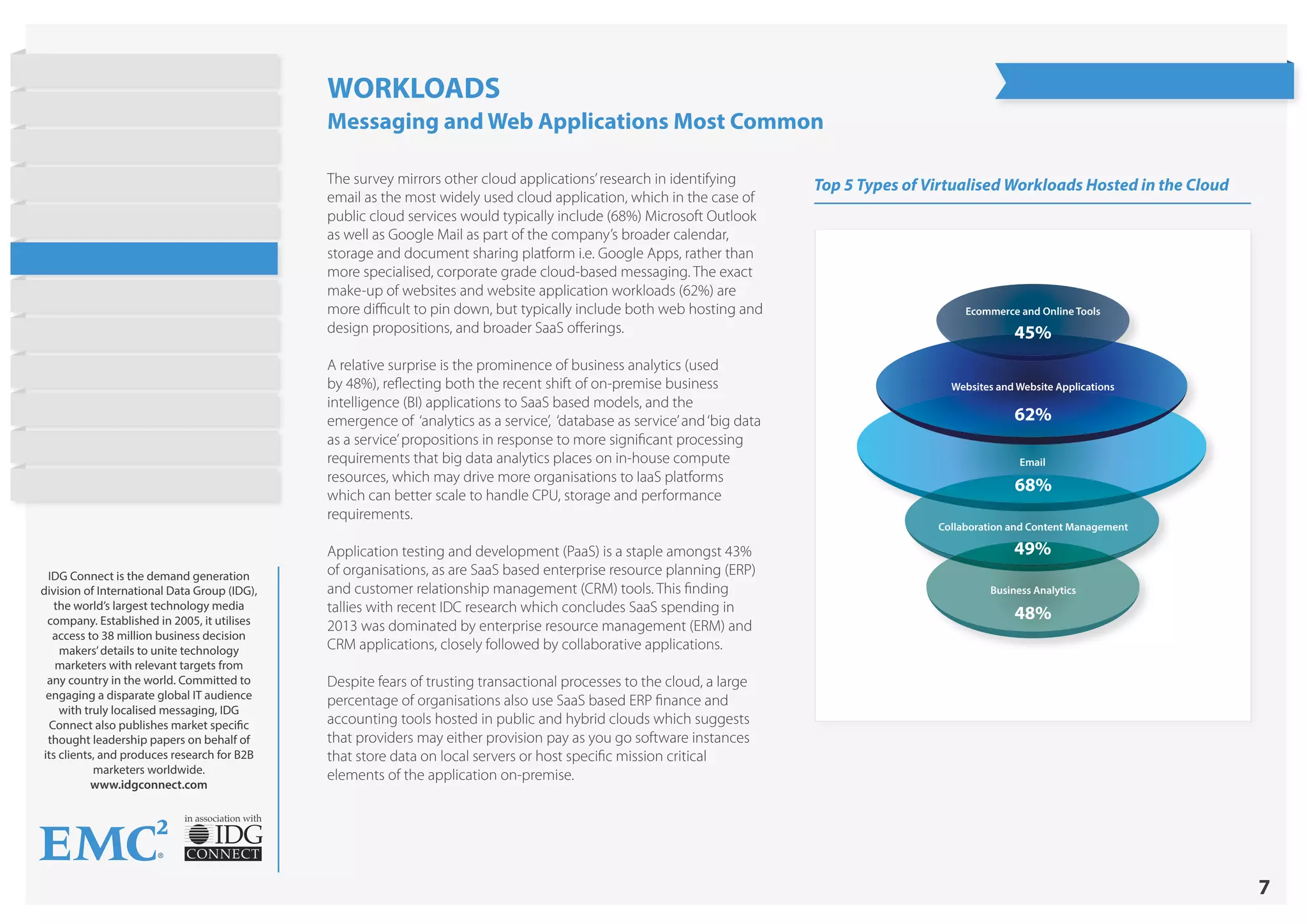
Top 5 Types of Virtualised Workloads Hosted in the Cloud
45%
Ecommerce and Online Tools
62%
Websites and Website Applications
68%
Email
49%
Collaboration and Content Management
48%
Business Analytics
WORKLOADS
Messaging and Web Applications Most Common
The survey mirrors other cloud applications’research in identifying
email as the most widely used cloud application, which in the case of
public cloud services would typically include (68%) Microsoft Outlook
as well as Google Mail as part of the company’s broader calendar,
storage and document sharing platform i.e. Google Apps, rather than
more specialised, corporate grade cloud-based messaging. The exact
make-up of websites and website application workloads (62%) are
more difficult to pin down, but typically include both web hosting and
design propositions, and broader SaaS offerings.
A relative surprise is the prominence of business analytics (used
by 48%), reflecting both the recent shift of on-premise business
intelligence (BI) applications to SaaS based models, and the
emergence of ‘analytics as a service’, ‘database as service’and‘big data
as a service’propositions in response to more significant processing
requirements that big data analytics places on in-house compute
resources, which may drive more organisations to IaaS platforms
which can better scale to handle CPU, storage and performance
requirements.
Application testing and development (PaaS) is a staple amongst 43%
of organisations, as are SaaS based enterprise resource planning (ERP)
and customer relationship management (CRM) tools. This finding
tallies with recent IDC research which concludes SaaS spending in
2013 was dominated by enterprise resource management (ERM) and
CRM applications, closely followed by collaborative applications.
Despite fears of trusting transactional processes to the cloud, a large
percentage of organisations also use SaaS based ERP finance and
accounting tools hosted in public and hybrid clouds which suggests
that providers may either provision pay as you go software instances
that store data on local servers or host specific mission critical
elements of the application on-premise.
State of Hybrid Cloud
Research Highlights
Introduction
Current Cloud Usage
Objectives
Barriers to Public Cloud
Workloads
Cost Strategies
Barriers to Hybrid Cloud
On Demand Provisioning
Future Cloud Plans
Conclusion
About EMC
8
in association with
IDG Connect is the demand generation
division of International Data Group (IDG),
the world’s largest technology media
company. Established in 2005, it utilises
access to 38 million business decision
makers’details to unite technology
marketers with relevant targets from
any country in the world. Committed to
engaging a disparate global IT audience
with truly localised messaging, IDG
Connect also publishes market specific
thought leadership papers on behalf of
its clients, and produces research for B2B
marketers worldwide.
www.idgconnect.com
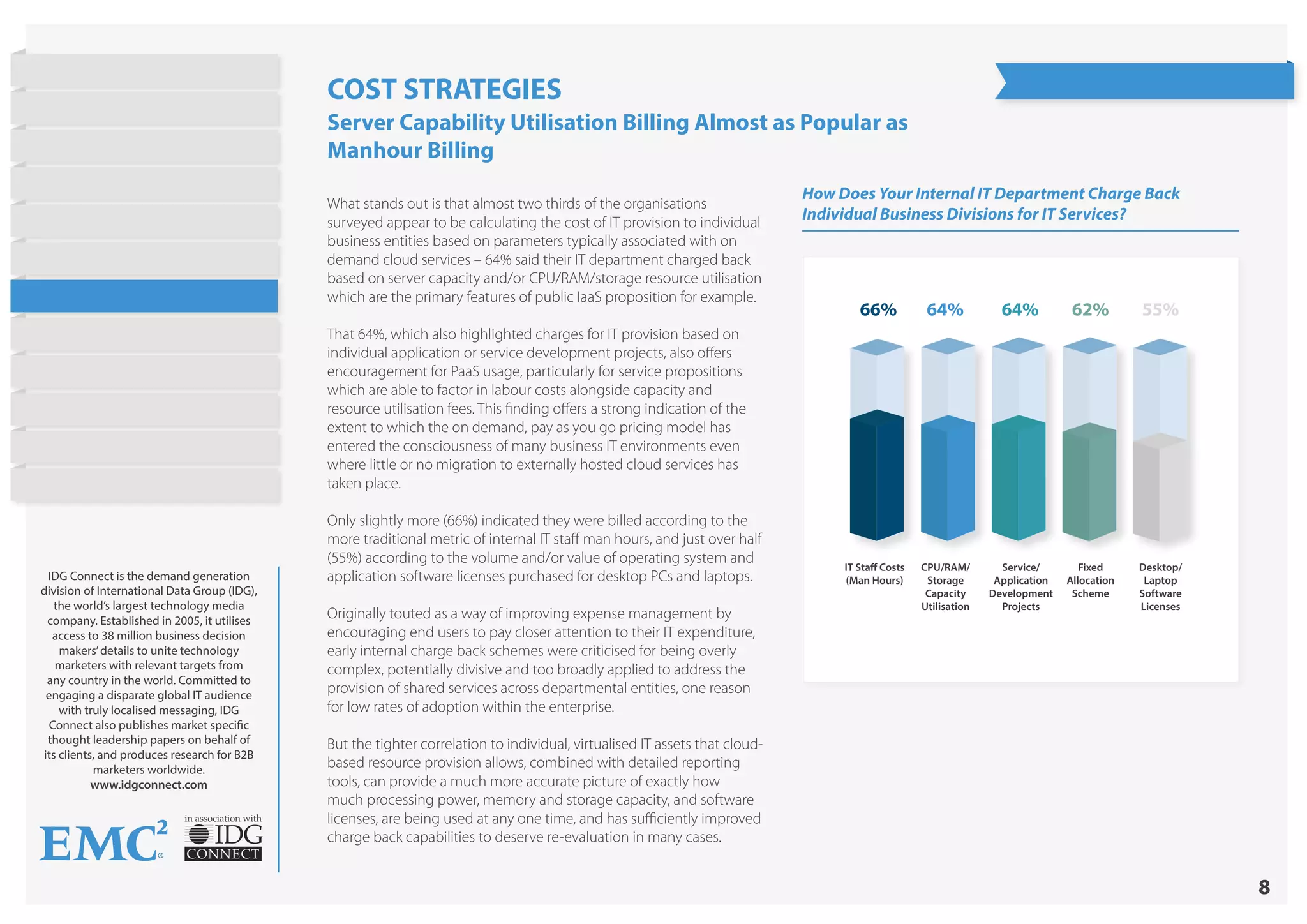
How Does Your Internal IT Department Charge Back
Individual Business Divisions for IT Services?
IT Staff Costs
(Man Hours)
CPU/RAM/
Storage
Capacity
Utilisation
Service/
Application
Development
Projects
Fixed
Allocation
Scheme
Desktop/
Laptop
Software
Licenses
66% 64% 64% 62% 55%
COST STRATEGIES
Server Capability Utilisation Billing Almost as Popular as
Manhour Billing
What stands out is that almost two thirds of the organisations
surveyed appear to be calculating the cost of IT provision to individual
business entities based on parameters typically associated with on
demand cloud services – 64% said their IT department charged back
based on server capacity and/or CPU/RAM/storage resource utilisation
which are the primary features of public IaaS proposition for example.
That 64%, which also highlighted charges for IT provision based on
individual application or service development projects, also offers
encouragement for PaaS usage, particularly for service propositions
which are able to factor in labour costs alongside capacity and
resource utilisation fees. This finding offers a strong indication of the
extent to which the on demand, pay as you go pricing model has
entered the consciousness of many business IT environments even
where little or no migration to externally hosted cloud services has
taken place.
Only slightly more (66%) indicated they were billed according to the
more traditional metric of internal IT staff man hours, and just over half
(55%) according to the volume and/or value of operating system and
application software licenses purchased for desktop PCs and laptops.
Originally touted as a way of improving expense management by
encouraging end users to pay closer attention to their IT expenditure,
early internal charge back schemes were criticised for being overly
complex, potentially divisive and too broadly applied to address the
provision of shared services across departmental entities, one reason
for low rates of adoption within the enterprise.
But the tighter correlation to individual, virtualised IT assets that cloud-
based resource provision allows, combined with detailed reporting
tools, can provide a much more accurate picture of exactly how
much processing power, memory and storage capacity, and software
licenses, are being used at any one time, and has sufficiently improved
charge back capabilities to deserve re-evaluation in many cases.
State of Hybrid Cloud
Research Highlights
Introduction
Current Cloud Usage
Objectives
Barriers to Public Cloud
Workloads
Cost Strategies
Barriers to Hybrid Cloud
On Demand Provisioning
Future Cloud Plans
Conclusion
About EMC
9
in association with
IDG Connect is the demand generation
division of International Data Group (IDG),
the world’s largest technology media
company. Established in 2005, it utilises
access to 38 million business decision
makers’details to unite technology
marketers with relevant targets from
any country in the world. Committed to
engaging a disparate global IT audience
with truly localised messaging, IDG
Connect also publishes market specific
thought leadership papers on behalf of
its clients, and produces research for B2B
marketers worldwide.
www.idgconnect.com
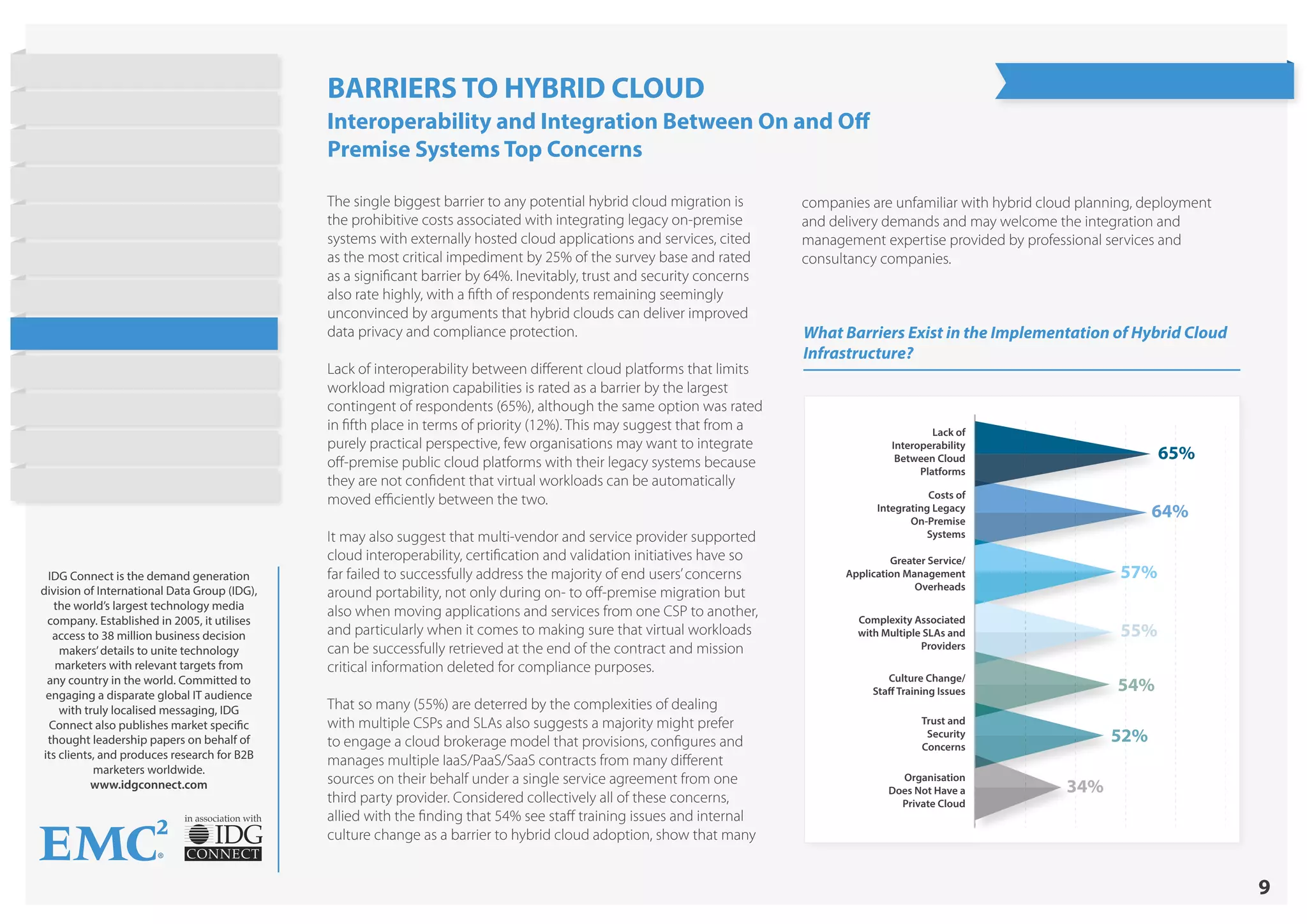
What Barriers Exist in the Implementation of Hybrid Cloud
Infrastructure?
Lack of
Interoperability
Between Cloud
Platforms
Costs of
Integrating Legacy
On-Premise
Systems
Greater Service/
Application Management
Overheads
Complexity Associated
with Multiple SLAs and
Providers
Culture Change/
Staff Training Issues
Trust and
Security
Concerns
Organisation
Does Not Have a
Private Cloud
65%
64%
57%
55%
54%
52%
34%
BARRIERS TO HYBRID CLOUD
Interoperability and Integration Between On and Off
Premise Systems Top Concerns
The single biggest barrier to any potential hybrid cloud migration is
the prohibitive costs associated with integrating legacy on-premise
systems with externally hosted cloud applications and services, cited
as the most critical impediment by 25% of the survey base and rated
as a significant barrier by 64%. Inevitably, trust and security concerns
also rate highly, with a fifth of respondents remaining seemingly
unconvinced by arguments that hybrid clouds can deliver improved
data privacy and compliance protection.
Lack of interoperability between different cloud platforms that limits
workload migration capabilities is rated as a barrier by the largest
contingent of respondents (65%), although the same option was rated
in fifth place in terms of priority (12%). This may suggest that from a
purely practical perspective, few organisations may want to integrate
off-premise public cloud platforms with their legacy systems because
they are not confident that virtual workloads can be automatically
moved efficiently between the two.
It may also suggest that multi-vendor and service provider supported
cloud interoperability, certification and validation initiatives have so
far failed to successfully address the majority of end users’concerns
around portability, not only during on- to off-premise migration but
also when moving applications and services from one CSP to another,
and particularly when it comes to making sure that virtual workloads
can be successfully retrieved at the end of the contract and mission
critical information deleted for compliance purposes.
That so many (55%) are deterred by the complexities of dealing
with multiple CSPs and SLAs also suggests a majority might prefer
to engage a cloud brokerage model that provisions, configures and
manages multiple IaaS/PaaS/SaaS contracts from many different
sources on their behalf under a single service agreement from one
third party provider. Considered collectively all of these concerns,
allied with the finding that 54% see staff training issues and internal
culture change as a barrier to hybrid cloud adoption, show that many
companies are unfamiliar with hybrid cloud planning, deployment
and delivery demands and may welcome the integration and
management expertise provided by professional services and
consultancy companies.
State of Hybrid Cloud
Research Highlights
Introduction
Current Cloud Usage
Objectives
Barriers to Public Cloud
Workloads
Cost Strategies
Barriers to Hybrid Cloud
On Demand Provisioning
Future Cloud Plans
Conclusion
About EMC
10
in association with
IDG Connect is the demand generation
division of International Data Group (IDG),
the world’s largest technology media
company. Established in 2005, it utilises
access to 38 million business decision
makers’details to unite technology
marketers with relevant targets from
any country in the world. Committed to
engaging a disparate global IT audience
with truly localised messaging, IDG
Connect also publishes market specific
thought leadership papers on behalf of
its clients, and produces research for B2B
marketers worldwide.
www.idgconnect.com
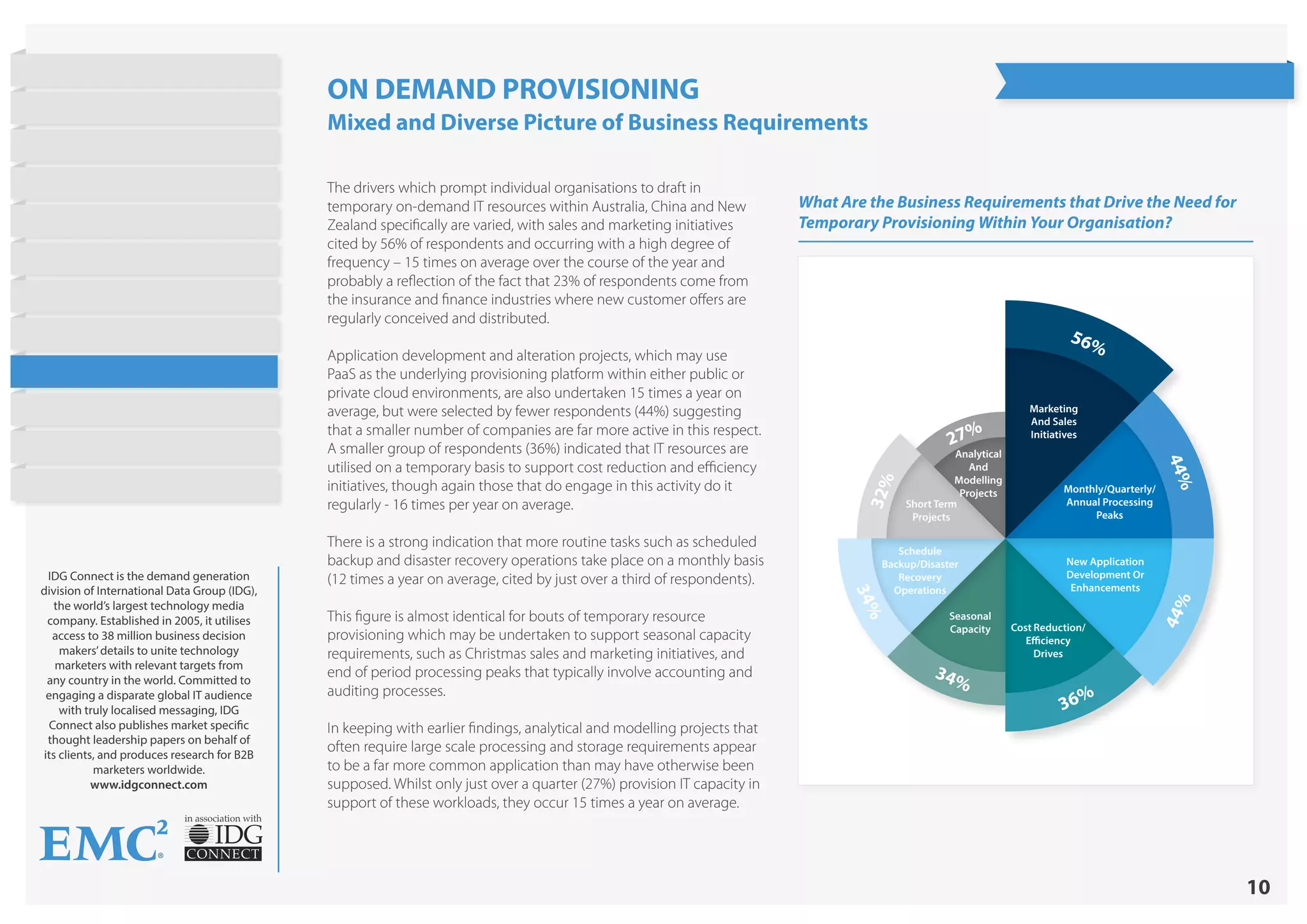
What Are the Business Requirements that Drive the Need for
Temporary Provisioning Within Your Organisation?
Analytical
And
Modelling
Projects
27%
Short Term
Projects
34%
32%
34%
36%
44%
44%
56%
Marketing
And Sales
Initiatives
Monthly/Quarterly/
Annual Processing
Peaks
New Application
Development Or
Enhancements
Cost Reduction/
Efficiency
Drives
Seasonal
Capacity
Schedule
Backup/Disaster
Recovery
Operations
ON DEMAND PROVISIONING
Mixed and Diverse Picture of Business Requirements
The drivers which prompt individual organisations to draft in
temporary on-demand IT resources within Australia, China and New
Zealand specifically are varied, with sales and marketing initiatives
cited by 56% of respondents and occurring with a high degree of
frequency – 15 times on average over the course of the year and
probably a reflection of the fact that 23% of respondents come from
the insurance and finance industries where new customer offers are
regularly conceived and distributed.
Application development and alteration projects, which may use
PaaS as the underlying provisioning platform within either public or
private cloud environments, are also undertaken 15 times a year on
average, but were selected by fewer respondents (44%) suggesting
that a smaller number of companies are far more active in this respect.
A smaller group of respondents (36%) indicated that IT resources are
utilised on a temporary basis to support cost reduction and efficiency
initiatives, though again those that do engage in this activity do it
regularly - 16 times per year on average.
There is a strong indication that more routine tasks such as scheduled
backup and disaster recovery operations take place on a monthly basis
(12 times a year on average, cited by just over a third of respondents).
This figure is almost identical for bouts of temporary resource
provisioning which may be undertaken to support seasonal capacity
requirements, such as Christmas sales and marketing initiatives, and
end of period processing peaks that typically involve accounting and
auditing processes.
In keeping with earlier findings, analytical and modelling projects that
often require large scale processing and storage requirements appear
to be a far more common application than may have otherwise been
supposed. Whilst only just over a quarter (27%) provision IT capacity in
support of these workloads, they occur 15 times a year on average.
State of Hybrid Cloud
Research Highlights
Introduction
Current Cloud Usage
Objectives
Barriers to Public Cloud
Workloads
Cost Strategies
Barriers to Hybrid Cloud
On Demand Provisioning
Future Cloud Plans
Conclusion
About EMC
11
in association with
IDG Connect is the demand generation
division of International Data Group (IDG),
the world’s largest technology media
company. Established in 2005, it utilises
access to 38 million business decision
makers’details to unite technology
marketers with relevant targets from
any country in the world. Committed to
engaging a disparate global IT audience
with truly localised messaging, IDG
Connect also publishes market specific
thought leadership papers on behalf of
its clients, and produces research for B2B
marketers worldwide.
www.idgconnect.com
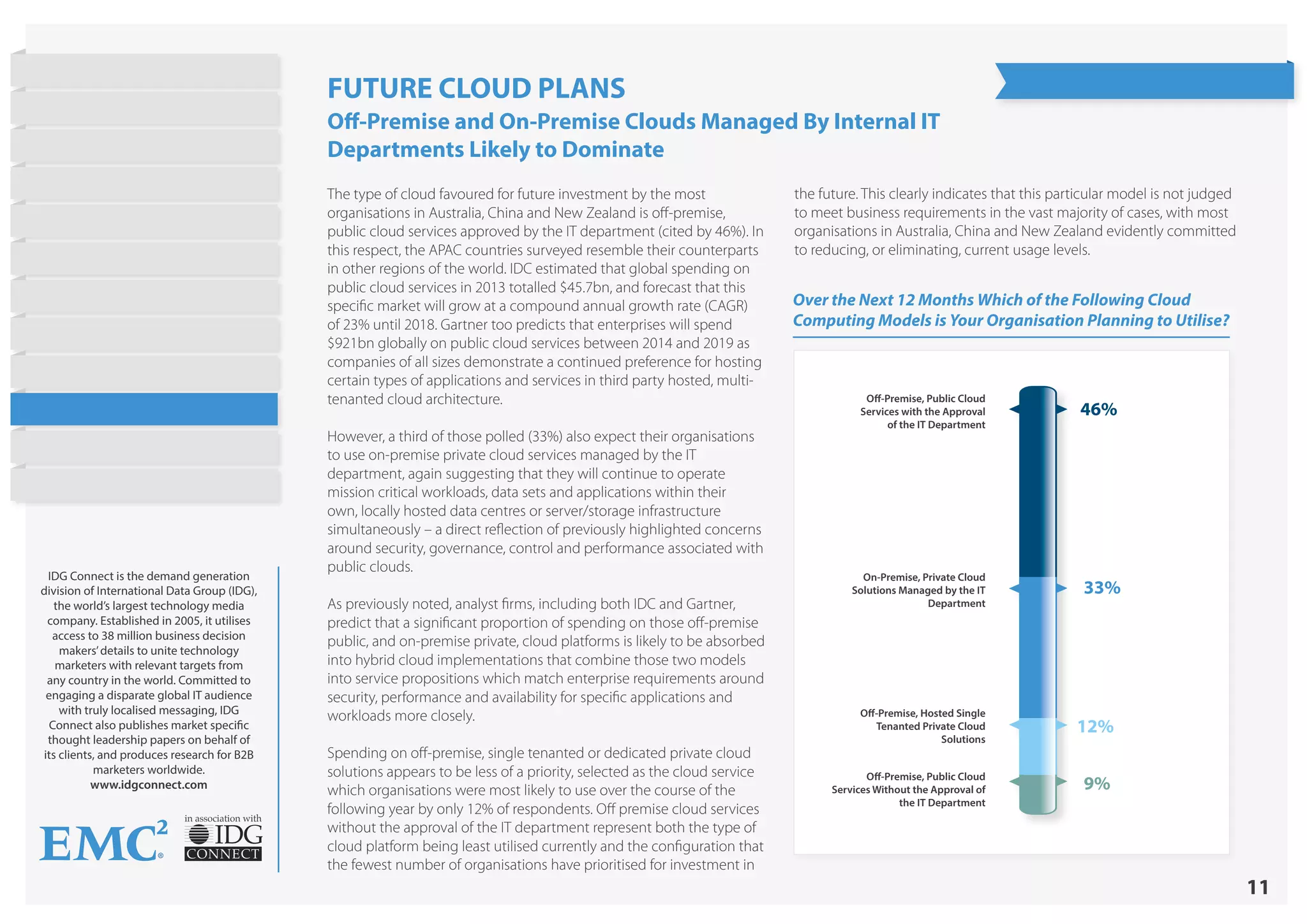
Over the Next 12 Months Which of the Following Cloud
Computing Models is Your Organisation Planning to Utilise?
Off-Premise, Public Cloud
Services with the Approval
of the IT Department
On-Premise, Private Cloud
Solutions Managed by the IT
Department
Off-Premise, Hosted Single
Tenanted Private Cloud
Solutions
Off-Premise, Public Cloud
Services Without the Approval of
the IT Department
46%
33%
12%
9%
FUTURE CLOUD PLANS
Off-Premise and On-Premise Clouds Managed By Internal IT
Departments Likely to Dominate
The type of cloud favoured for future investment by the most
organisations in Australia, China and New Zealand is off-premise,
public cloud services approved by the IT department (cited by 46%). In
this respect, the APAC countries surveyed resemble their counterparts
in other regions of the world. IDC estimated that global spending on
public cloud services in 2013 totalled $45.7bn, and forecast that this
specific market will grow at a compound annual growth rate (CAGR)
of 23% until 2018. Gartner too predicts that enterprises will spend
$921bn globally on public cloud services between 2014 and 2019 as
companies of all sizes demonstrate a continued preference for hosting
certain types of applications and services in third party hosted, multi-
tenanted cloud architecture.
However, a third of those polled (33%) also expect their organisations
to use on-premise private cloud services managed by the IT
department, again suggesting that they will continue to operate
mission critical workloads, data sets and applications within their
own, locally hosted data centres or server/storage infrastructure
simultaneously – a direct reflection of previously highlighted concerns
around security, governance, control and performance associated with
public clouds.
As previously noted, analyst firms, including both IDC and Gartner,
predict that a significant proportion of spending on those off-premise
public, and on-premise private, cloud platforms is likely to be absorbed
into hybrid cloud implementations that combine those two models
into service propositions which match enterprise requirements around
security, performance and availability for specific applications and
workloads more closely.
Spending on off-premise, single tenanted or dedicated private cloud
solutions appears to be less of a priority, selected as the cloud service
which organisations were most likely to use over the course of the
following year by only 12% of respondents. Off premise cloud services
without the approval of the IT department represent both the type of
cloud platform being least utilised currently and the configuration that
the fewest number of organisations have prioritised for investment in
the future. This clearly indicates that this particular model is not judged
to meet business requirements in the vast majority of cases, with most
organisations in Australia, China and New Zealand evidently committed
to reducing, or eliminating, current usage levels.
State of Hybrid Cloud
Research Highlights
Introduction
Current Cloud Usage
Objectives
Barriers to Public Cloud
Workloads
Cost Strategies
Barriers to Hybrid Cloud
On Demand Provisioning
Future Cloud Plans
Conclusion
About EMC
12
in association with
IDG Connect is the demand generation
division of International Data Group (IDG),
the world’s largest technology media
company. Established in 2005, it utilises
access to 38 million business decision
makers’details to unite technology
marketers with relevant targets from
any country in the world. Committed to
engaging a disparate global IT audience
with truly localised messaging, IDG
Connect also publishes market specific
thought leadership papers on behalf of
its clients, and produces research for B2B
marketers worldwide.
www.idgconnect.com
CONCLUSION
The survey shows that organisations within Australia, China, Malaysia,
New Zealand, Singapore, Indonesia and Thailand have very definite
expectations around security, speed of provisioning, flexibility, cost
efficiencies and device access when it comes to implementing cloud
solutions, objectives which determine the cloud platforms they use
currently, and those they are most likely to deploy in the future.
That off-premise public and on-premise private are the two cloud
service delivery models prioritised for 2014/2015 by 79% of the
survey base appears to open up a clear opportunity for hybrid cloud
providers providing they offer a cost effective way to seamlessly
integrate them into a secure, managed service package and/or meld
multiple public cloud propositions into a single contract under a form
of cloud brokerage model.
Gaining customer trust in, and familiarity with, the hybrid model
appears to be the ultimate key to any success. Respondents worry
that the cost and complexity of integrating off-premise public
cloud services with on-premise server, storage and network
architecture to support efficient migration, management and
monitoring of virtual workloads between two environments that
lack certified interoperability will limit hybrid cloud adoption within
their organisation. Many also fear losing control of infrastructure,
applications and data stored beyond the borders of their own data
centres and remain unconvinced that third party hosting facilities can
provide sufficient security, governance and reliability guarantees to
facilitate efficient delivery of mission critical workloads.
Convincing IT departments of the merits of on-demand billing should
be less problematic, though CSPs must be careful to outline all service
charges up front and give stakeholders clear visibility into future
provisioning costs. Many organisations within APAC countries already
appear to calculate the cost of IT service provision based on granular
usage of individual hardware and software elements. Cloud orientated
internal charging schemes that see individual business departments
being billed for services according to their utilisation of processing,
memory and storage capacity appear well embedded within most
organisations, as are PaaS/SaaS related tariffing for application
development and software delivery, in most cases favoured marginally
above fixed allocation and software licensing schemes.
SaaS-based email and web hosting are the two applications trusted
to public or hybrid clouds by the majority of organisations, whilst
temporary, on demand IT resources are most likely to be provisioned
in support of sales and marketing initiatives, end of period processing
peaks, and the development or enhancement of new applications
or services. This indicates that cloud service usage is tied closely to
both regular capacity requirements at set times of the year and short
term projects commissioned on an ad-hoc basis often in support of
customer facing and/or revenue generating activity.
In each case, those CSPs which take the time to familiarise themselves
with the usage and application requirements of individual businesses
and tailor their cloud propositions to match are those most likely to
win business within the target territories.
State of Hybrid Cloud
Research Highlights
Introduction
Current Cloud Usage
Objectives
Barriers to Public Cloud
Workloads
Cost Strategies
Barriers to Hybrid Cloud
On Demand Provisioning
Future Cloud Plans
Conclusion
About EMC
13
in association with
IDG Connect is the demand generation
division of International Data Group (IDG),
the world’s largest technology media
company. Established in 2005, it utilises
access to 38 million business decision
makers’details to unite technology
marketers with relevant targets from
any country in the world. Committed to
engaging a disparate global IT audience
with truly localised messaging, IDG
Connect also publishes market specific
thought leadership papers on behalf of
its clients, and produces research for B2B
marketers worldwide.
www.idgconnect.com
ABOUT EMC
EMC is a global leader in enabling businesses and service providers
to transform their operations and deliver information technology as
a service. Fundamental to this transformation is cloud computing.
Through innovative products and services, EMC accelerates the
journey to cloud computing, helping IT departments to store, manage,
protect and analyse their most valuable asset — information — in a
more agile, trusted and cost-efficient way.
Built on 40,000 hours of engineering in EMC’s lab, EMC’s Enterprise
Hybrid Cloud unites the strengths of private and public cloud in a
single, fully interoperable solution in as few as 28 days. The solution
delivers infrastructure-as-a-service, fully automated with a self-service
portal for application developers and system administrators to
consume IT services, through private and public clouds. It also includes
operational monitoring and financial transparency enabling bill-back
or show-back to the business of IT services consumption.
The EMC Enterprise Hybrid Cloud is an engineered solution with three
critical elements:
1) End-to-end integration and testing
2) Pre-defined infrastructure services
3) Workflows to automate provisioning via self-service portal
With an open choice of Hybrid Cloud Solutions that support software
suites from VMware, Microsoft and Openstack solutions, the EMC
Enterprise Hybrid Cloud allows organisations to:
• Put applications in the right cloud with the right cost, security,
reliability and performance, allowing movement between clouds as
business needs evolve, while addressing varying SLA and security
requirements.
• Respond to your business immediately by offering standardised
infrastructure and application services delivery in hours rather than
months.
• Enable business agility. End users can quickly test or adopt new
applications, unaided and directly from an automated, self service
portal. Making IT operational actions, such as scaling applications, just
a click away.
• Clearly show IT’s value through financial transparency of the true
costs of IT services to demonstrate value while charging business units
only for what they use.
• Make your resources elastic. Automated provisioning and
decommissioning allows users and administrators to add or reduce
storage, compute resources, security and data protection on the fly
without manual intervention.
• Support today’s and tomorrow’s applications. By connecting private
and public cloud resources, IT can manage traditional and next
generation applications in a consistent and seamless way, enabling
users to access those apps on a device of their choice.
To accelerate deployment of the EMC Hybrid Cloud, EMC offers expert
workshops, consulting services and training to help customers no
matter where they are in their cloud planning and deployment.
Providing performance, security, control, choice, agility and efficiency,
EMC’s Enterprise Hybrid Cloud gives companies all they need to
balance the workloads of today and prepare for the mobile, social and
analytics applications of tomorrow.
For more information:
Website: www.australia.emc.com/cloud
Phone:	 1800 653 565
Email:	info_anz@emc.com
State of Hybrid Cloud
Research Highlights
Introduction
Current Cloud Usage
Objectives
Barriers to Public Cloud
Workloads
Cost Strategies
Barriers to Hybrid Cloud
On Demand Provisioning
Future Cloud Plans
Conclusion
About EMC

EMC APAC State of Hybrid Cloud

  • 1.
    PUBLIC CLOUD PUBLIC CLOUD in association with Surveyconducted by IDG Connect on behalf of EMC STATE OF HYBRID CLOUD PRIVATE CLOUD PRIVATE CLOUD
  • 2.
    2 in association with IDGConnect is the demand generation division of International Data Group (IDG), the world’s largest technology media company. Established in 2005, it utilises access to 38 million business decision makers’details to unite technology marketers with relevant targets from any country in the world. Committed to engaging a disparate global IT audience with truly localised messaging, IDG Connect also publishes market specific thought leadership papers on behalf of its clients, and produces research for B2B marketers worldwide. www.idgconnect.com INTRODUCTION ...the more recent emergence of the hybrid cloud now looks set to attract more attention from enterprise IT departments. “ “ Global business spending on infrastructure and services related to the cloud is forecast to hit $235.1bn by 2017 according to IHS Technology, up from $174.2bn in 2014 and $145.2bn in 2013. Countries within the Asia Pacific (APAC) region will account for a significant portion of that spend, with a Gartner survey of chief information officers (CIOs) in 2014 identifying cloud computing as their top spending priority fuelled by an average budgetary increase of 0.9% year on year. A growing portion of that expenditure is likely to be spent on hybrid cloud platforms specifically. Gartner predicted in October 2013 that many existing private cloud deployments will gradually give way to hybrid clouds, and that nearly half of all enterprises will have hybrid clouds by 2018. IDC too has predicted greater adoption of hybrid cloud models in the longer term which would contribute to an increase in both public and private cloud service consumption. Early cloud service delivery models centred on off-premise platforms that store data and applications on shared, multi-tenanted server architecture have proved popular amongst businesses of all sizes. But many organisations, particularly larger corporates, remain wary about committing mission critical applications, and sensitive information governed by data privacy regulation, to third party hosting facilities, one reason why many have preferred on-premise, private clouds for certain applications. The more recent emergence of hybrid cloud – designed to combine the speed of provisioning and flexibility advantages that have driven so many organisations to lease on-demand, public cloud services and the enhanced security, reliability and performance associated with on-premise applications and services – now looks set to attract more attention from enterprise IT departments. Whether those analyst predictions prove accurate or not, the reality is that the broader cloud market is on the cusp of significant diversification, with all forms of cloud delivery – including various flavours of public, private and hybrid - likely to attract a greater portion of enterprise IT budgets. Most organisations will continue to use a mixture of different cloud services models for different applications and workloads according to the specific security, performance and reliability requirements of each, and enterprise spending on each is set to increase. IDG Connect surveyed 600 organisations based in Australia, China, Malaysia, New Zealand, Thailand, Singapore and Indonesia, all of which employed 500 people or more with 62% having headcounts in excess of 1,000 staff and 9% 10,000 or more. The majority of those polled (57%) worked in front facing, hands-on IT roles with the remainder made up of C-level executives. The insurance industry represented the single largest vertical (12%), followed by finance (11%), education (8%) and electronics (7%). The results provide a snapshot of current usage of, and attitudes to, on- and off-premise public, private and hybrid cloud service provision in specific territories within the Asia Pacific (APAC) region, and highlight perceived benefits, barriers to adoption and future investment plans. State of Hybrid Cloud Introduction Research Highlights Current Cloud Usage Objectives Barriers to Public Cloud Workloads Cost Strategies Barriers to Hybrid Cloud On Demand Provisioning Future Cloud Plans Conclusion About EMC
  • 3.
    3 in association with IDGConnect is the demand generation division of International Data Group (IDG), the world’s largest technology media company. Established in 2005, it utilises access to 38 million business decision makers’details to unite technology marketers with relevant targets from any country in the world. Committed to engaging a disparate global IT audience with truly localised messaging, IDG Connect also publishes market specific thought leadership papers on behalf of its clients, and produces research for B2B marketers worldwide. www.idgconnect.com RESEARCH HIGHLIGHTS Important Barriers to Hybrid Cloud Implementation Important Objectives for Cloud Migration Barriers to Public Cloud Computing Adoption Security and/or Governance Speed or Provisioning to Support Innovation/ Rapid Service Delivery Flexibility and Scalability to Match Business Requirements Cost Transparency and Predictability Access to Applications and Services from Multiple Platforms Self-Service Portal for Provisioning Security, Data Protection and Availability Lack of Control Over Data and Services Stored in the Cloud Threat of Vendor Lock-In/Data Application Portability On-Premise System Integration Complexity Maintaining Control of the Workload Placement Ability to Negotiate Customised SLAs Compliance and Governance Uncertainty Unknown Hidden Costs Lack of In-Country Data/Support Centres 75% 65% 57% 57% 50% 49% 43% 35% 23% 81% 81% 69% 62% 61% 32% Lack of Interoperability Between Cloud Platforms Costs of Integrating Legacy On-Premise Systems Greater Service/ Application Management Overheads Complexity Associated with Multiple SLAs and Providers Culture Change/ Staff Training Issues Trust and Security Concerns Organisation Does Not Have a Private Cloud 65% 64% 57% 55% 54% 52% 34% State of Hybrid Cloud Research Highlights Introduction Current Cloud Usage Objectives Barriers to Public Cloud Workloads Cost Strategies Barriers to Hybrid Cloud On Demand Provisioning Future Cloud Plans Conclusion About EMC
  • 4.
    4 in association with IDGConnect is the demand generation division of International Data Group (IDG), the world’s largest technology media company. Established in 2005, it utilises access to 38 million business decision makers’details to unite technology marketers with relevant targets from any country in the world. Committed to engaging a disparate global IT audience with truly localised messaging, IDG Connect also publishes market specific thought leadership papers on behalf of its clients, and produces research for B2B marketers worldwide. www.idgconnect.com How Would You Describe Your Organisation’s Current Use of Cloud Computing? 62% 56% 40% 25% Off-Premise, Public Cloud Services with the Approval of the IT Department On-Premise, Private Cloud Solutions Managed by the IT Department Off-Premise, Hosted Single Tenanted Private Cloud Solutions Off-Premise, Public Cloud Services Without the Approval of the IT Department CURRENT CLOUD USAGE Off Premise Public and On-Premise Private Clouds Proliferate Public cloud services which include any off-premise Infrastructure as a Service (IaaS), Software as a Service (SaaS), Platform as a Service (PaaS) or Communications as a Service (CaaS) propositions accessed via the Internet, remain the most widely used variant of cloud services in use by 62% of respondents, though on-premise cloud platforms provisioned and managed internally were also in majority evidence (56%). Off-premise, single tenanted private cloud solutions that host workloads on dedicated rather than shared servers located in third party provider data centres are being used by 40% of organisations. This type of cloud platform offers security advantages over public, multi-tenanted equivalents and are often backed by better service level agreements (SLAs) offering more guarantees around performance and reliability whilst maintaining a degree of cost competitiveness compared to on-premise hosting for some workloads. A quarter (25%) of respondents said that either they, or others within their organisation, use off-premise public cloud services beneath the radar of their own IT departments. Given the high percentage of the survey base who occupy hands-on IT manager or IT director roles (57%), this figure may be understated given that they may not be fully aware of the full extent of unauthorised public cloud use within their organisations. The finding illustrates the extent to which the broader end user community likes the flexibility, agility and self-service provisioning that many cloud service providers (CSPs) are able to offer to meet demand for IT resources which can be delivered instantly with the minimum of delay to process specific, on demand workloads. It also suggests that many employees and/or business divisions are prepared to forego the IT department’s ability to negotiate favourable tariffs and SLAs based on volume leasing in order to secure sufficient on demand resource capacity to serve their needs more quickly, often denying the business a holistic picture of costs and demand for IT services across the organisation. Clearly, the situation is causing some alarm amongst IT managers and C-level executives, with a large percentage indicating that they wish to minimise or stop unauthorised public cloud usage if they can. Provisioning of cloud services using self-service portals which are protected by user authentication details may alleviate the problem, simultaneously providing greater control and visibility into demand and usage costs. State of Hybrid Cloud Research Highlights Introduction Current Cloud Usage Objectives Barriers to Public Cloud Workloads Cost Strategies Barriers to Hybrid Cloud On Demand Provisioning Future Cloud Plans Conclusion About EMC
  • 5.
    5 in association with IDGConnect is the demand generation division of International Data Group (IDG), the world’s largest technology media company. Established in 2005, it utilises access to 38 million business decision makers’details to unite technology marketers with relevant targets from any country in the world. Committed to engaging a disparate global IT audience with truly localised messaging, IDG Connect also publishes market specific thought leadership papers on behalf of its clients, and produces research for B2B marketers worldwide. www.idgconnect.com Which of the following objectives are important for your organisation when implementing cloud computing solutions? Security and/or Governance Speed, Provisioning to Support Innovation/ Rapid Service Delivery Flexibility and Scalability to Match Business Requirements Cost Transparency and Predictability Access to Applications and Services from Multiple Platforms Self-Service Portal for Provisioning 42% 21% 17% 11% 7% 2% OBJECTIVES Security, Governance and Flexibility Are Top Priorities Security and governance top the list of priorities when it comes to cloud implementations, reflecting the concerns that respondents may feel in trusting data privacy and compliance management to off- premise, third party hosting providers – 42% identified this as the most important objective and it was listed as important by 81%. Speed of provisioning to support rapid product and service innovation and delivery was cited as most important by 21%. This may essentially equate to PaaS as companies look to hone their competitive edge by bringing new applications and services to market faster than their rivals. Additionally rated as an important, if not the most important, objective by 69% of the survey. That 81% rated the ability to scale IT resources up and down to match business requirements is to be expected given that on-demand, pay as you go provisioning billed by the hour or the day is a central pillar of the broader cloud services proposition, although it ranked below both security and speed of provisioning in terms of priority. Around a third - 32% - rated a self-service portal as important, which may point to a lack of awareness around well-executed hybrid cloud models that can potentially simplify on demand capacity provisioning. A benefit of a centralised portal for provisioning is that it allows many forms of cloud services and applications to be accessed from a broad range of devices, including smartphones and tablet computers (cited as important by 62% but not seen as a particular priority). Given previously stated security and governance concerns, respondents may be mindful of the security challenges involved in ensuring data privacy and compliance on mobile devices. Many will need reassurances that the integrity of information being hosted on, and transmitted between, mobile devices will be properly protected using appropriate virtual private network (VPN), identity access management (IAM), private storage, backup and encryption technology for example. Organisations may prefer to work with specialist cloud service providers more familiar with, and better able to address, specific enterprise security and governance requirements which often vary from one vertical industry sector to another. Similarly, price transparency and more predictable capex, opex and labour costs involved in IT provision were also seen as important objectives for any cloud implementation by the majority (61%), but came relatively low on the priority list (11% saw this as the single most important objective). State of Hybrid Cloud Research Highlights Introduction Current Cloud Usage Objectives Barriers to Public Cloud Workloads Cost Strategies Barriers to Hybrid Cloud On Demand Provisioning Future Cloud Plans Conclusion About EMC
  • 6.
    6 in association with IDGConnect is the demand generation division of International Data Group (IDG), the world’s largest technology media company. Established in 2005, it utilises access to 38 million business decision makers’details to unite technology marketers with relevant targets from any country in the world. Committed to engaging a disparate global IT audience with truly localised messaging, IDG Connect also publishes market specific thought leadership papers on behalf of its clients, and produces research for B2B marketers worldwide. www.idgconnect.com Major Barriers and Concerns for Organisations Adopting or Expanding Public Cloud Usage Security, Data Protection and Availability Lack of Control Over Data and Services Stored in the Cloud Threat of Vendor Lock-In/Data Application Portability On-Premise System Integration Complexity Maintaining Control of the Workload Placement Ability to Negotiate Customised SLAs Compliance and Governance Uncertainty Unknown Hidden Costs Lack of In-Country Data/Support Centres 42% 13% 13% 12% 7% 6% 4% 2% 1% 0 50Percentage Perhaps surprisingly given the continued complexity of pricing associated with public cloud services which have historically made monthly usage bills difficult to predict, only a third (35%) saw unknown hidden costs as a barrier with 2% seeing them as the most critical obstacle to adoption. This appears to suggest that most companies are either unaware of any hidden costs, or do not have sufficient visibility into pay as you go, on demand tariffs which are a pre-requisite to accurately assess total expenditure over the course of long term leasing agreements spanning multiple months or years. It is also possible that some do not see the lack of price transparency associated with public cloud services as an issue due to the perceived extent of on-premise capex and opex savings elsewhere. This is a metric which will vary considerably from one organisation to the next depending on the size and nature of the on-premise IT estate and its associated upgrade plans and ongoing management costs. Yet as in other regions in the world, security, data protection and availability/performance of cloud services dominates end user concerns, cited as the biggest barrier to adoption/expansion by 42% of respondents, and a major barrier by 75%. Lack of control over data and services stored is the next most prominent barrier (13%). Nevertheless this is a significant cause for worry in just under half of all organisations, reflecting IT departments’ fear of being unable to access, retrieve or delete information or workloads stored in public cloud services as needed. Both of these findings suggest that a move to hybrid cloud services that store certain mission critical or sensitive data and applications on-premise, and others in off-premise environments may partially overcome this entrenched trepidation. Those hybrid clouds depend heavily on smooth and efficient integration with legacy on premise virtualisation and virtualisation management platforms, another aspect of cloud service provisions rated as a significant barrier by 57% and the greatest potential impediment by 12%. That many organisations are actively looking to source externally hosted IT provision from more than one public cloud provider at any one time, or switch workloads between different CSPs to obtain preferential pricing or contract agreements, is indicated by how many rate the threat of vendor lock in and the ability to migrate virtualised workloads, data and applications between platforms (rated as an important barrier by 57% and the biggest hurdle by 13%). The ability to negotiate customised service level agreements (SLAs) tailored to individual business requirements was cited as an important barrier by half of respondents, and considered the most critical by 6%. Only 1% tagged a lack of in country data centres or support centres as the most critical barrier, whilst just under a quarter (23%) saw this as any barrier at all. This suggests most organisations are happy to trust their data and applications to global cloud service providers which may host workloads and support resources in countries other than their own, providing sufficient reassurances on compliance with any regional legislation on data sovereignty can be given (cited as the most important barrier by 4% and an important barrier by 43%). BARRIERS TO PUBLIC CLOUD Security Concerns Dominate State of Hybrid Cloud Research Highlights Introduction Current Cloud Usage Objectives Barriers to Public Cloud Workloads Cost Strategies Barriers to Hybrid Cloud On Demand Provisioning Future Cloud Plans Conclusion About EMC
  • 7.
    7 in association with IDGConnect is the demand generation division of International Data Group (IDG), the world’s largest technology media company. Established in 2005, it utilises access to 38 million business decision makers’details to unite technology marketers with relevant targets from any country in the world. Committed to engaging a disparate global IT audience with truly localised messaging, IDG Connect also publishes market specific thought leadership papers on behalf of its clients, and produces research for B2B marketers worldwide. www.idgconnect.com Top 5 Types of Virtualised Workloads Hosted in the Cloud 45% Ecommerce and Online Tools 62% Websites and Website Applications 68% Email 49% Collaboration and Content Management 48% Business Analytics WORKLOADS Messaging and Web Applications Most Common The survey mirrors other cloud applications’research in identifying email as the most widely used cloud application, which in the case of public cloud services would typically include (68%) Microsoft Outlook as well as Google Mail as part of the company’s broader calendar, storage and document sharing platform i.e. Google Apps, rather than more specialised, corporate grade cloud-based messaging. The exact make-up of websites and website application workloads (62%) are more difficult to pin down, but typically include both web hosting and design propositions, and broader SaaS offerings. A relative surprise is the prominence of business analytics (used by 48%), reflecting both the recent shift of on-premise business intelligence (BI) applications to SaaS based models, and the emergence of ‘analytics as a service’, ‘database as service’and‘big data as a service’propositions in response to more significant processing requirements that big data analytics places on in-house compute resources, which may drive more organisations to IaaS platforms which can better scale to handle CPU, storage and performance requirements. Application testing and development (PaaS) is a staple amongst 43% of organisations, as are SaaS based enterprise resource planning (ERP) and customer relationship management (CRM) tools. This finding tallies with recent IDC research which concludes SaaS spending in 2013 was dominated by enterprise resource management (ERM) and CRM applications, closely followed by collaborative applications. Despite fears of trusting transactional processes to the cloud, a large percentage of organisations also use SaaS based ERP finance and accounting tools hosted in public and hybrid clouds which suggests that providers may either provision pay as you go software instances that store data on local servers or host specific mission critical elements of the application on-premise. State of Hybrid Cloud Research Highlights Introduction Current Cloud Usage Objectives Barriers to Public Cloud Workloads Cost Strategies Barriers to Hybrid Cloud On Demand Provisioning Future Cloud Plans Conclusion About EMC
  • 8.
    8 in association with IDGConnect is the demand generation division of International Data Group (IDG), the world’s largest technology media company. Established in 2005, it utilises access to 38 million business decision makers’details to unite technology marketers with relevant targets from any country in the world. Committed to engaging a disparate global IT audience with truly localised messaging, IDG Connect also publishes market specific thought leadership papers on behalf of its clients, and produces research for B2B marketers worldwide. www.idgconnect.com How Does Your Internal IT Department Charge Back Individual Business Divisions for IT Services? IT Staff Costs (Man Hours) CPU/RAM/ Storage Capacity Utilisation Service/ Application Development Projects Fixed Allocation Scheme Desktop/ Laptop Software Licenses 66% 64% 64% 62% 55% COST STRATEGIES Server Capability Utilisation Billing Almost as Popular as Manhour Billing What stands out is that almost two thirds of the organisations surveyed appear to be calculating the cost of IT provision to individual business entities based on parameters typically associated with on demand cloud services – 64% said their IT department charged back based on server capacity and/or CPU/RAM/storage resource utilisation which are the primary features of public IaaS proposition for example. That 64%, which also highlighted charges for IT provision based on individual application or service development projects, also offers encouragement for PaaS usage, particularly for service propositions which are able to factor in labour costs alongside capacity and resource utilisation fees. This finding offers a strong indication of the extent to which the on demand, pay as you go pricing model has entered the consciousness of many business IT environments even where little or no migration to externally hosted cloud services has taken place. Only slightly more (66%) indicated they were billed according to the more traditional metric of internal IT staff man hours, and just over half (55%) according to the volume and/or value of operating system and application software licenses purchased for desktop PCs and laptops. Originally touted as a way of improving expense management by encouraging end users to pay closer attention to their IT expenditure, early internal charge back schemes were criticised for being overly complex, potentially divisive and too broadly applied to address the provision of shared services across departmental entities, one reason for low rates of adoption within the enterprise. But the tighter correlation to individual, virtualised IT assets that cloud- based resource provision allows, combined with detailed reporting tools, can provide a much more accurate picture of exactly how much processing power, memory and storage capacity, and software licenses, are being used at any one time, and has sufficiently improved charge back capabilities to deserve re-evaluation in many cases. State of Hybrid Cloud Research Highlights Introduction Current Cloud Usage Objectives Barriers to Public Cloud Workloads Cost Strategies Barriers to Hybrid Cloud On Demand Provisioning Future Cloud Plans Conclusion About EMC
  • 9.
    9 in association with IDGConnect is the demand generation division of International Data Group (IDG), the world’s largest technology media company. Established in 2005, it utilises access to 38 million business decision makers’details to unite technology marketers with relevant targets from any country in the world. Committed to engaging a disparate global IT audience with truly localised messaging, IDG Connect also publishes market specific thought leadership papers on behalf of its clients, and produces research for B2B marketers worldwide. www.idgconnect.com What Barriers Exist in the Implementation of Hybrid Cloud Infrastructure? Lack of Interoperability Between Cloud Platforms Costs of Integrating Legacy On-Premise Systems Greater Service/ Application Management Overheads Complexity Associated with Multiple SLAs and Providers Culture Change/ Staff Training Issues Trust and Security Concerns Organisation Does Not Have a Private Cloud 65% 64% 57% 55% 54% 52% 34% BARRIERS TO HYBRID CLOUD Interoperability and Integration Between On and Off Premise Systems Top Concerns The single biggest barrier to any potential hybrid cloud migration is the prohibitive costs associated with integrating legacy on-premise systems with externally hosted cloud applications and services, cited as the most critical impediment by 25% of the survey base and rated as a significant barrier by 64%. Inevitably, trust and security concerns also rate highly, with a fifth of respondents remaining seemingly unconvinced by arguments that hybrid clouds can deliver improved data privacy and compliance protection. Lack of interoperability between different cloud platforms that limits workload migration capabilities is rated as a barrier by the largest contingent of respondents (65%), although the same option was rated in fifth place in terms of priority (12%). This may suggest that from a purely practical perspective, few organisations may want to integrate off-premise public cloud platforms with their legacy systems because they are not confident that virtual workloads can be automatically moved efficiently between the two. It may also suggest that multi-vendor and service provider supported cloud interoperability, certification and validation initiatives have so far failed to successfully address the majority of end users’concerns around portability, not only during on- to off-premise migration but also when moving applications and services from one CSP to another, and particularly when it comes to making sure that virtual workloads can be successfully retrieved at the end of the contract and mission critical information deleted for compliance purposes. That so many (55%) are deterred by the complexities of dealing with multiple CSPs and SLAs also suggests a majority might prefer to engage a cloud brokerage model that provisions, configures and manages multiple IaaS/PaaS/SaaS contracts from many different sources on their behalf under a single service agreement from one third party provider. Considered collectively all of these concerns, allied with the finding that 54% see staff training issues and internal culture change as a barrier to hybrid cloud adoption, show that many companies are unfamiliar with hybrid cloud planning, deployment and delivery demands and may welcome the integration and management expertise provided by professional services and consultancy companies. State of Hybrid Cloud Research Highlights Introduction Current Cloud Usage Objectives Barriers to Public Cloud Workloads Cost Strategies Barriers to Hybrid Cloud On Demand Provisioning Future Cloud Plans Conclusion About EMC
  • 10.
    10 in association with IDGConnect is the demand generation division of International Data Group (IDG), the world’s largest technology media company. Established in 2005, it utilises access to 38 million business decision makers’details to unite technology marketers with relevant targets from any country in the world. Committed to engaging a disparate global IT audience with truly localised messaging, IDG Connect also publishes market specific thought leadership papers on behalf of its clients, and produces research for B2B marketers worldwide. www.idgconnect.com What Are the Business Requirements that Drive the Need for Temporary Provisioning Within Your Organisation? Analytical And Modelling Projects 27% Short Term Projects 34% 32% 34% 36% 44% 44% 56% Marketing And Sales Initiatives Monthly/Quarterly/ Annual Processing Peaks New Application Development Or Enhancements Cost Reduction/ Efficiency Drives Seasonal Capacity Schedule Backup/Disaster Recovery Operations ON DEMAND PROVISIONING Mixed and Diverse Picture of Business Requirements The drivers which prompt individual organisations to draft in temporary on-demand IT resources within Australia, China and New Zealand specifically are varied, with sales and marketing initiatives cited by 56% of respondents and occurring with a high degree of frequency – 15 times on average over the course of the year and probably a reflection of the fact that 23% of respondents come from the insurance and finance industries where new customer offers are regularly conceived and distributed. Application development and alteration projects, which may use PaaS as the underlying provisioning platform within either public or private cloud environments, are also undertaken 15 times a year on average, but were selected by fewer respondents (44%) suggesting that a smaller number of companies are far more active in this respect. A smaller group of respondents (36%) indicated that IT resources are utilised on a temporary basis to support cost reduction and efficiency initiatives, though again those that do engage in this activity do it regularly - 16 times per year on average. There is a strong indication that more routine tasks such as scheduled backup and disaster recovery operations take place on a monthly basis (12 times a year on average, cited by just over a third of respondents). This figure is almost identical for bouts of temporary resource provisioning which may be undertaken to support seasonal capacity requirements, such as Christmas sales and marketing initiatives, and end of period processing peaks that typically involve accounting and auditing processes. In keeping with earlier findings, analytical and modelling projects that often require large scale processing and storage requirements appear to be a far more common application than may have otherwise been supposed. Whilst only just over a quarter (27%) provision IT capacity in support of these workloads, they occur 15 times a year on average. State of Hybrid Cloud Research Highlights Introduction Current Cloud Usage Objectives Barriers to Public Cloud Workloads Cost Strategies Barriers to Hybrid Cloud On Demand Provisioning Future Cloud Plans Conclusion About EMC
  • 11.
    11 in association with IDGConnect is the demand generation division of International Data Group (IDG), the world’s largest technology media company. Established in 2005, it utilises access to 38 million business decision makers’details to unite technology marketers with relevant targets from any country in the world. Committed to engaging a disparate global IT audience with truly localised messaging, IDG Connect also publishes market specific thought leadership papers on behalf of its clients, and produces research for B2B marketers worldwide. www.idgconnect.com Over the Next 12 Months Which of the Following Cloud Computing Models is Your Organisation Planning to Utilise? Off-Premise, Public Cloud Services with the Approval of the IT Department On-Premise, Private Cloud Solutions Managed by the IT Department Off-Premise, Hosted Single Tenanted Private Cloud Solutions Off-Premise, Public Cloud Services Without the Approval of the IT Department 46% 33% 12% 9% FUTURE CLOUD PLANS Off-Premise and On-Premise Clouds Managed By Internal IT Departments Likely to Dominate The type of cloud favoured for future investment by the most organisations in Australia, China and New Zealand is off-premise, public cloud services approved by the IT department (cited by 46%). In this respect, the APAC countries surveyed resemble their counterparts in other regions of the world. IDC estimated that global spending on public cloud services in 2013 totalled $45.7bn, and forecast that this specific market will grow at a compound annual growth rate (CAGR) of 23% until 2018. Gartner too predicts that enterprises will spend $921bn globally on public cloud services between 2014 and 2019 as companies of all sizes demonstrate a continued preference for hosting certain types of applications and services in third party hosted, multi- tenanted cloud architecture. However, a third of those polled (33%) also expect their organisations to use on-premise private cloud services managed by the IT department, again suggesting that they will continue to operate mission critical workloads, data sets and applications within their own, locally hosted data centres or server/storage infrastructure simultaneously – a direct reflection of previously highlighted concerns around security, governance, control and performance associated with public clouds. As previously noted, analyst firms, including both IDC and Gartner, predict that a significant proportion of spending on those off-premise public, and on-premise private, cloud platforms is likely to be absorbed into hybrid cloud implementations that combine those two models into service propositions which match enterprise requirements around security, performance and availability for specific applications and workloads more closely. Spending on off-premise, single tenanted or dedicated private cloud solutions appears to be less of a priority, selected as the cloud service which organisations were most likely to use over the course of the following year by only 12% of respondents. Off premise cloud services without the approval of the IT department represent both the type of cloud platform being least utilised currently and the configuration that the fewest number of organisations have prioritised for investment in the future. This clearly indicates that this particular model is not judged to meet business requirements in the vast majority of cases, with most organisations in Australia, China and New Zealand evidently committed to reducing, or eliminating, current usage levels. State of Hybrid Cloud Research Highlights Introduction Current Cloud Usage Objectives Barriers to Public Cloud Workloads Cost Strategies Barriers to Hybrid Cloud On Demand Provisioning Future Cloud Plans Conclusion About EMC
  • 12.
    12 in association with IDGConnect is the demand generation division of International Data Group (IDG), the world’s largest technology media company. Established in 2005, it utilises access to 38 million business decision makers’details to unite technology marketers with relevant targets from any country in the world. Committed to engaging a disparate global IT audience with truly localised messaging, IDG Connect also publishes market specific thought leadership papers on behalf of its clients, and produces research for B2B marketers worldwide. www.idgconnect.com CONCLUSION The survey shows that organisations within Australia, China, Malaysia, New Zealand, Singapore, Indonesia and Thailand have very definite expectations around security, speed of provisioning, flexibility, cost efficiencies and device access when it comes to implementing cloud solutions, objectives which determine the cloud platforms they use currently, and those they are most likely to deploy in the future. That off-premise public and on-premise private are the two cloud service delivery models prioritised for 2014/2015 by 79% of the survey base appears to open up a clear opportunity for hybrid cloud providers providing they offer a cost effective way to seamlessly integrate them into a secure, managed service package and/or meld multiple public cloud propositions into a single contract under a form of cloud brokerage model. Gaining customer trust in, and familiarity with, the hybrid model appears to be the ultimate key to any success. Respondents worry that the cost and complexity of integrating off-premise public cloud services with on-premise server, storage and network architecture to support efficient migration, management and monitoring of virtual workloads between two environments that lack certified interoperability will limit hybrid cloud adoption within their organisation. Many also fear losing control of infrastructure, applications and data stored beyond the borders of their own data centres and remain unconvinced that third party hosting facilities can provide sufficient security, governance and reliability guarantees to facilitate efficient delivery of mission critical workloads. Convincing IT departments of the merits of on-demand billing should be less problematic, though CSPs must be careful to outline all service charges up front and give stakeholders clear visibility into future provisioning costs. Many organisations within APAC countries already appear to calculate the cost of IT service provision based on granular usage of individual hardware and software elements. Cloud orientated internal charging schemes that see individual business departments being billed for services according to their utilisation of processing, memory and storage capacity appear well embedded within most organisations, as are PaaS/SaaS related tariffing for application development and software delivery, in most cases favoured marginally above fixed allocation and software licensing schemes. SaaS-based email and web hosting are the two applications trusted to public or hybrid clouds by the majority of organisations, whilst temporary, on demand IT resources are most likely to be provisioned in support of sales and marketing initiatives, end of period processing peaks, and the development or enhancement of new applications or services. This indicates that cloud service usage is tied closely to both regular capacity requirements at set times of the year and short term projects commissioned on an ad-hoc basis often in support of customer facing and/or revenue generating activity. In each case, those CSPs which take the time to familiarise themselves with the usage and application requirements of individual businesses and tailor their cloud propositions to match are those most likely to win business within the target territories. State of Hybrid Cloud Research Highlights Introduction Current Cloud Usage Objectives Barriers to Public Cloud Workloads Cost Strategies Barriers to Hybrid Cloud On Demand Provisioning Future Cloud Plans Conclusion About EMC
  • 13.
    13 in association with IDGConnect is the demand generation division of International Data Group (IDG), the world’s largest technology media company. Established in 2005, it utilises access to 38 million business decision makers’details to unite technology marketers with relevant targets from any country in the world. Committed to engaging a disparate global IT audience with truly localised messaging, IDG Connect also publishes market specific thought leadership papers on behalf of its clients, and produces research for B2B marketers worldwide. www.idgconnect.com ABOUT EMC EMC is a global leader in enabling businesses and service providers to transform their operations and deliver information technology as a service. Fundamental to this transformation is cloud computing. Through innovative products and services, EMC accelerates the journey to cloud computing, helping IT departments to store, manage, protect and analyse their most valuable asset — information — in a more agile, trusted and cost-efficient way. Built on 40,000 hours of engineering in EMC’s lab, EMC’s Enterprise Hybrid Cloud unites the strengths of private and public cloud in a single, fully interoperable solution in as few as 28 days. The solution delivers infrastructure-as-a-service, fully automated with a self-service portal for application developers and system administrators to consume IT services, through private and public clouds. It also includes operational monitoring and financial transparency enabling bill-back or show-back to the business of IT services consumption. The EMC Enterprise Hybrid Cloud is an engineered solution with three critical elements: 1) End-to-end integration and testing 2) Pre-defined infrastructure services 3) Workflows to automate provisioning via self-service portal With an open choice of Hybrid Cloud Solutions that support software suites from VMware, Microsoft and Openstack solutions, the EMC Enterprise Hybrid Cloud allows organisations to: • Put applications in the right cloud with the right cost, security, reliability and performance, allowing movement between clouds as business needs evolve, while addressing varying SLA and security requirements. • Respond to your business immediately by offering standardised infrastructure and application services delivery in hours rather than months. • Enable business agility. End users can quickly test or adopt new applications, unaided and directly from an automated, self service portal. Making IT operational actions, such as scaling applications, just a click away. • Clearly show IT’s value through financial transparency of the true costs of IT services to demonstrate value while charging business units only for what they use. • Make your resources elastic. Automated provisioning and decommissioning allows users and administrators to add or reduce storage, compute resources, security and data protection on the fly without manual intervention. • Support today’s and tomorrow’s applications. By connecting private and public cloud resources, IT can manage traditional and next generation applications in a consistent and seamless way, enabling users to access those apps on a device of their choice. To accelerate deployment of the EMC Hybrid Cloud, EMC offers expert workshops, consulting services and training to help customers no matter where they are in their cloud planning and deployment. Providing performance, security, control, choice, agility and efficiency, EMC’s Enterprise Hybrid Cloud gives companies all they need to balance the workloads of today and prepare for the mobile, social and analytics applications of tomorrow. For more information: Website: www.australia.emc.com/cloud Phone: 1800 653 565 Email: info_anz@emc.com State of Hybrid Cloud Research Highlights Introduction Current Cloud Usage Objectives Barriers to Public Cloud Workloads Cost Strategies Barriers to Hybrid Cloud On Demand Provisioning Future Cloud Plans Conclusion About EMC