What Is A Chicano?
By Cheech Marin
05/03/2012
What is a Chicano?
Who the hell knows?
To me, you have to declare yourself a Chicano in
order to be a Chicano. That makes a
Chicano a Mexican-American with a defiant
political attitude that centers on his or
her right to self-definition. I’m a Chicano because I
say I am.
But no Chicano will agree with me because one of
the characteristics of being
Chicano is you don’t agree with anybody, or
anything. And certainly not another
Chicano. We are the only tribe that has all chiefs
and no Indians. But don’t ever
insult a Chicano about being a Chicano
because then all the otherChicanos will be
on you with a vengeance. They will even fight each to
be first in line to support you.
It’s not a category that appears on any U.S. Census
survey. You can check White,
African-American, Native-American, Asian, Pacific
Islander and even Hispanic
(which Chicanos hate). But thereis no little box
you can check that says Chicano.
However, you can get a Ph.D. in Chicano Studies
from Harvard and a multitude of
otheruniversities. You can cash retirementchecks from
those same prestigious
universities after having taught Chicano Studies
for 20 years, but therestill no
official recognition from the government.
No wonder Chicanos are confused.
So where did the word Chicano come from?
Again, no two Chicanos can agree, so
here is my definition what I think. In true
Chicano fashion, this should be the official
version.
The word “Chicano” was originally a derisive term
from Mexicans to otherMexicans
living in the United States. The concept was
that those Mexicans living in the U.S.
were no longer truly Mexicanos because they had
given up their country by living in
Houston, Los Angeles, “Guada La Habra,” or some
othercity. They were now
somethingelse and somethingless. Little satellite
Mexicans living in a foreign
country. They were somethingsmall. They were chicos.
They were now Chicanos.
If you livednear the U.S.-Mexican border, the term
was more or less an insult, but
always somekind of insult. In the earlydays,
the connotation of calling someone a
Chicano was that they were poor, illiterate, destitute
people living in tin shacks
along the border. As soon as they could get a
car loan and could move farther away
from the border, the term became less of an insult
over the years. But the
resentment still lingered.
Some ask “Why can’tyou people just all be
Hispanic?” Same reason that all white
people can’tjust be called English. Just because
you speak English or Spanish does
not mean that you are one group. Hispanic is a
census term that somedildoin a
government office made up to include all
Spanish-speaking brown people. It is
especially annoying to Chicanos because it is a
catch-all term that includes the
Spanish conqueror. By definition, it favors
European cultural invasion, not
indigenous roots. It also includes all Latino
groups, which brings us together
because Hispanic annoys all Latino groups.
Why? Because they’re Latino and it’s part of
their nature. (Aren’t you glad you
asked?)
So what is a “Latino?” (It’s like opening Pandora’s
box, huh?) “Latino” is refers to all
Spanish-speaking people in the “New World” -
South Americans, Central Americans,
Mexicans,and Brazilians (even though they speak
Portuguese). All those groups and
their descendents living in the United States
want to be called Latinos to recognize
their Indian roots.
Mexicans call it having the “Nopal” in their face,
that prickly pear cactus with big flat
leaves that Mexicans eat, revere, and thinkthey look
like. When you go to Mexico
and walk down the street in Mexico City, it’s
like walking through a Nopal cactus
garden. Nopal is everywhere.
For Latinos who don’t want to be so “Nopalese,”
there’s always “Mexican-American.”
Or the dreaded “Hispanic” that should only be
used when faced with complete
befuddlement from the person asking what you are.
Because I am the only official version of what
being Chicano is, I say Mexican-
American is the politicallycorrect middle ground
between Hispanic and Chicano.
Like in the song I wrote to be sung by a
Chicano trying to be P.C. “Mexican-
Americans; don’t like to just get into gang fights;
they like flowers and music; and
white girls named Debbie too.”
All those names made it confusing for me
growing up. I livedin an all-black
neighborhood, followed by an all-white one, and other
kids in the always called me
Mexican in both neighborhoods.
It never bothered me until one day I thought to
myself “Hey, wait a minute, I’m not
Mexican.”I’ve never even been to Mexico and I
don’t speak Spanish. Sure, I eat
Mexican food at family gatherings where all of
the adults speak Spanish, but I eat
Cheerios and pizza and hamburgers more. No,
I’m definitely not a “Mexican.” Maybe
I was “Mexican-ish,” just like somepeople were “Jew-
ish.”
These thoughts all ran through my mind when I
chased down an alley by five young
African-American kids. “Yo, Messican!” they called
out in their patois. I stopped in
my tracks and spun around. “I’m not a Mexican!”
I shouted defiantly. They stopped
too, then stared at me. The leader spoke, “Fool!
What you talking ‘bout? You Mexican
as a taco. Lookat you.”
“No,”, I said. “To be a Mexican, you have to be
from Mexico. You’re African-American.
Are you from Africa?”
“N—. You crazy. I’m from South-Central, just like
you.”
“That’s exactly what I’m talking about!” I said.
“Did anybody knock on your door and
ask you did you want to be African-American?”
“Hell no! The social workers don’t even knock
on our door, they too scared,” he said,
cracking everyone up.
“Then why you letting people call you whatever
they want? What do you want to be
called?” I asked.
He looked at the others, thought about it
for a few seconds and then said proudly,
“I’m a Blood.”
“Ooo-kay,” I said making it up as I went
along. “Then you’re a Blood-American.”
That seemed to go over well. They all nodded. “Yeah,
we Blood-American.”
“Well, then go out and be the best Blood-Americans
that you can be. Peace, brothers,
I got to blow.” I walked awayand so did
they. Self-identification saved the day. Yet, I
still was dissatisfied with what I wanted to call
myself.
When I got home, therewas a partygoing
on. A bunch of relatives had come over
for
dinner and everybody was sitting around
gabbing and drinking beer. My Uncle Rudy
was in the middle of a story: “So, I took
the car into the dealer and he said, ‘Yeah,
the
repairs gonna run you about $250.’ Two-fifty?
Estas loco? Hell, just give me a pair of
pliers and sometin foil. I’ll fix it - I’m a
Chicano mechanic. Two-fifty, mis nalgas.”
And that was the defining epiphany. A Chicano was
someone who could do anything.
A Chicano was someone who wasn’t going to
get ripped off. He was Uncle Rudy. He
was industrious, inventive, and he wants another
beer. So I got my Uncle Rudy
another beer because, on that day, he showed me
that I was a Chicano. Hispanic my
ass, I’ve been a Chicano ever since.
‘Mosquita y Mari’ is about us
07/04/2011 Gabriel Lerner
http://www.hispanicla.com/mosquita-y-mari-its-about-us-19986
We met at the corner of Pacific and Gage, in
the heartof Huntington Park. It was still
morning and the whole area was filled with
beckoningstorefronts and extravagant
cafés, but best of all was the crowd parading up
and down the boulevard; young
mothers pushing little ones in strollers, couples in
seemingly happy reunions,
salesmen and office workers taking a break,
and La Raza. Because this is a Latino
Barrio.
And this is where director Aurora Guerrero is
going to shoot her first feature film,
“Mosquita y Mari.” “When people thinkabout
Latinos they oftenimagine East Los
Angeles, Boyle Heights. They imagine a world of
gangsters and cholos. Of
stereotypes,” says Guerrero, who was born in San
Francisco after her parents
emigrated from Mexico. They met in the Mission barrio,
where she initially wanted
to film the movie. That’s where her rootsare,
and her script is personal. It happened
to her.
“Mosquita y Mari.” is the storyof two 15-
years-old high school students, Yolanda
Ontiveros and Mari Rodriguez, who forge a
relationship sparked by sexual attraction
and develop a friendship which reflects important
and still-pressing issues: single
mothers who need the help of their eldest daughters to
get by; undocumented
immigrants who must accept living in the
shadows due to their legal status; high
school students who want to break through despite
social and economic
impediments and fulfill the golden dream of
going to college.
And also Homophobia: the ignorance, the difficulty
encountered when parents and
children try to communicate about such a taboo
subject. “I want to talk about
sexuality. I am attracted to the power of the
[actual] violence within silence, a
mixture so common in the reaction of
parents…because in my house, we didn’t
talk”,
says Guerrero, who stares with the open, direct
and sincere gaze of the dreamer.
And her parents’ dreams got lost. “Life turned
into work… which was not always
humane.” For 18 years, the Mexican restaurant they
owned in Berkeley united the
family. This is where each of the 3 siblings
worked sincethe age of 8. “They were
always thinking of us,” she stated. “That’s why
they didn’t go back to Guadalajara.”
The way Guerrero speaks is a mirror of her
generation: the cordial Spanish learned
in the fields flowing into in the common
Spanglish of today and into standard
English.
“Here I like the big cities; in Mexico I
like the rural areas.” Aurora Guerrero is a
symbol of so many Hispanics born here to
immigrantparents, and “Mosquita y Mari”
will reflect this, for Los Angeles and for the whole
world to see. And she hopes her
film will open the debate about Homophobia among
Latinos.
The concept is being expressed in the storywith
the innocence and tenderness of
everyday behavior. With the intimacy of suggestion;
nothing explicit. With the
gentleness and softness of a quinceañera,
“Mosquita y Mari” is not about coming
out,
but about coming of age,” she says. “Not
homosexuality, but adolescence.”
However, according to a study published by
GLSEN, Gay, Lesbian and Straight
Education Network published last September with the
participation of 7,200 LGBT
students between 13 and 21 years, eightof every
10 of them where verbally
harassed because of their sexual orientation, four
were physicallyattacked, and six
felt threatened in school. That’s another
important reason to pay attention to this
movie.
The project is supported by the Huntington Park
chapter of CBE, Communities for a
Better Environment. Oncecompleted, the movie
will be shown at a series of events
designed to promote dialogue in the community.
In short, it is an idea that exceeds the
personal storytold by a new Chicana
filmmaker. And it may come to the rest of
the world very soon. “We want to start
shooting by the end of June, for 20 days,
here, in Huntington Park.”
But thereis a problem.
“Our dream budget was about a quarter of a
million dollars.” Through the Latino
Public Broadcasting, the Sundance Institute, and a
Ford Foundation fellowship, they
received start-up funding which was a fraction of
the total needed. The rest has to
come through contributions from the community.
Like its internet site states, fans of
independent films“willhave a unique opportunity to
bring this film to life during
the 30-day campaign that started on April 26th
and ends at the end of May.”
The clock is ticking. There is not much
time,and the need is urgent.
If everything goes well, the movie will be ready
for the next Sundance Festival, says
Guerrero with hopefulness.
“I want young people to learnfrom this movie,
because I didn’t have it when I was a
girl… they didn’t tell me that a woman can
direct a movie,” stated Guerrero, who is
also an adjunct professor of Art Appreciation and
Psychology at San Jose’s National
Hispanic University. Guerrero won an award from
HBO and the New York
International Latino Film Festival (NYILFF) for her
shortfilms. She created “Pura
Lengua” (2005) and “Viernes Girl”(2005) and
participated in the production of
“Real Women HaveCurves” (2002) and La
Mission (2009).
The new Latino film in the United States had
several good starts. A few years ago,
titlessuch as “Real Women…” broke through
the wide markets and showed —
together with family scenes, laborproblems and the
presence of gangs — a cheerful
combination of grace and comedy. Some of
them, like “Stand and Deliver” (1988) or
“Walkout” (2006, for TV), were about historical
episodes of overcoming and
rebellion. Others, like “American Me” (1992), focused
on the problems of youth in
poor neighborhoods,where the abundance of drugs
and the anguish of the
immigrantexperience added to impoverishment
and convergence of youth
criminals, crime and an alleged honor code and
loyalty within these.
”Mosquita y Mari” is a project that takesan
extrastep forward, attempting to show
the reality inside the Latino community that is
not shown everyday. Not an absolute
reality, but one that is sensitive, intimate. The story
takesplace in Huntington Park,
the veteran city with an absolute Latino majority to
the southeast of Los Angeles.
There is where Yolanda and Mari met.
Yolanda, the only daughter of immigrantworkers, wants
to continue her studies and
become a professional. Mari has to work so that
her mother and two sisters can
survive.
In school, Mari’s sense of justice leadsher to
rescue Yolanda from an incident in
which Las Cuatas, twin sisters and childhood friends
of hers for whom everything is
fiestas, boys and texting, are implicated. Their
friendship evolves after this, and
takesus to a new place with a surprise ending.
Homegirls, Cholas, and Pachucas in Cinema: Taking over the
Public Sphere
Author(s): Rosa Linda Fregoso
Source: California History, Vol. 74, No. 3, Mexican Americans
in California (Fall, 1995), pp.
316-327
Published by: University of California Press in association with
the California Historical
Society
Stable URL: https://www.jstor.org/stable/25177514
Accessed: 31-01-2019 20:44 UTC
JSTOR is a not-for-profit service that helps scholars,
researchers, and students discover, use, and build upon a wide
range of content in a trusted digital archive. We use information
technology and tools to increase productivity and
facilitate new forms of scholarship. For more information about
JSTOR, please contact [email protected]
Your use of the JSTOR archive indicates your acceptance of the
Terms & Conditions of Use, available at
https://about.jstor.org/terms
California Historical Society, University of California Press are
collaborating with JSTOR
to digitize, preserve and extend access to California History
This content downloaded from 128.114.34.22 on Thu, 31 Jan
2019 20:44:32 UTC
All use subject to https://about.jstor.org/terms
^^^^^^^^^^^^^^^^^^^^^^^^^^^^^I^P_^^^^^^^^^^^^^^^^^^^^^^^
V B Wm ' ___^_________l
___________________________________________________
"""H^^^^^^^^^^^^^^^^^^B i i __^_____v______l
__^_^_^_^_^_^_^_^_^__________________________________
___________i_i^^
__^_^_^_^_^_^_^_^_^_^_^_k&"__________________________
___
^____^_______________________________________________
_________________
_________________________________________^T^^^^^lVlS9
316 CALIFORNIA HISTORY
This content downloaded from 128.114.34.22 on Thu, 31 Jan
2019 20:44:32 UTC
All use subject to https://about.jstor.org/terms
Homegirls, Cholas, and Pachucas
in Cinema
TAKING OVER THE PUBLIC SPHERE
by Rosa Linda Fregoso
Introduction
We have seen her body painted next to Aztec gods
on murals, recognizable by her style: hair in a long,
ratted and sprayed beehive, draping over her shoul
ders; her face caked with make-up and shellacked
lipstick. Her body adorns the hood of lowrider cars.
Or, with a permed, curly, layered hairstyle, ruby-red
polished nails, short tight skirt and haltertop, reveal
ing the body's full curves, she's inside the lowrider
magazine as a pin-up. And her image gazes back at
us from under a crisp, white tee shirt where she rests
as a tattoo on the body of a man. This production of
the pachuca as an image for public and private con
sumption permeates many facets of Chicano cultural
politics. And I wonder what is being played out on
the body of the pachuca?
The production of her image predates the current
fascination and commodification of the "gangsta"
style in mainstream popular culture. So too does her
performance in public as a social subject. Since the
1930s, pachucas, the predecessors of cholas and of
today's homegirls, have hung out in the public
domain of barrios like Maravilla, in southern Cali
Copyright 1995, by Rosa Linda Fregoso.
[At left] Draping themselves seductively over the jukebox and
El Pachuco (Edward James Olmos) in the 1981 film Zoot Suit,
these pachucas (left to right: Candice Silva, Anacani Eschever
ria, and Bertha Oropeza) are predecessors of the "gangsta"
style
in mainstream popular culture. Courtesy Universal Studios.
fornia, as members of girls' clubs, or what is cur
rently referred to as girl gangs. Yet she stands figu
ratively on the margins of literacy and film
testimonies on la pachucada, subservient to mascu
line versions of the gangsta life and lifestyle. The vio
lence and abuse she has witnessed remains
unknown to us. Characterized as a deviant in stud
ies about adolescent girl gangs, her story remains
untold and untheorized.1 Throughout this discus
sion, I will explore what it is that the pachuca-chola
homegirl as an historical subject and as a producer
of meaning?that is, a creator rather than merely an
object of meaning?offers to feminist discourse, and
what she teaches us about opposition and resistance,
not just to la vida loca (the crazy life), but to la vida
dura (the hard life).
The Girls My Mother Warned Me About2
Where I grew up in South Texas, pachucas were the
objects of parental scorn. As a young Catholic-school
girl, I was both fearful of and fascinated by pachu
cas. They went to public schools, hung out mostly
at corner stores, smoked cigarettes, wore lots of
make-up, were loud in public and quick to start a
fight. My first lesson in sex education came from a
pachuca named Mary Ester.
With peroxide-orange hair, big, light-brown eyes
circled by Maybelline black eye-liner, eyebrows
shaped and painted like wings, reddish-orange lips,
and a teased beehive hairdo that my mother said was
a nest for cockroaches, Mary Ester was a guera (light
skinned girl) who lived across the street from my
gramma's house in Corpus Christi. I once heard she
FALL 1995 317
This content downloaded from 128.114.34.22 on Thu, 31 Jan
2019 20:44:32 UTC
All use subject to https://about.jstor.org/terms
was my Tio's movida (lover). Yet what I remember
most about Mary Ester was how she disturbed my
childhood innocence, teaching me the meaning of
that popular lyric, "Let me tell you about the birds
and the bees." One day I was walking down the
street with her when Mary Ester asked me about the
due date for my mother's baby. "What baby?" I
responded. "The one in her stomach, mensa
(dummy). That's why she's so fat... .Don't you know
anything about the birds and the bees?" I didn't,
except that they were somehow related to "a thing
called love." Several hours later I stood in the mid
dle of my gramma's dark, enclosed kitchen, before
the tribunal of my mother, gramma, and Tio Pepe.
I was proud of my sudden deconstruction of that
song about the birds and the bees. And with the
bright-eyed innocence of a nine-year-old girl, I
shared that new knowledge with these family mem
bers, whose judgmental looks shamed me. I was
silenced and punished immediately for knowing
where babies come from. Yet I never forgot Mary
Ester's casual frankness, nor her role in unlocking
my sexual curiosity. I was always fascinated by that
pachuca masquerade she wore in public, by how she
had made her face into her canvas. She died several
years later of a drug overdose.
Another pachuca named Gloria taught me the
meaning of female solidarity. When I was fifteen
years old, gang-banging was spreading throughout
Corpus. Gang-banging referred to group rape: a
group of guys getting a girl high on drugs, driving
her to the beach, then raping and abandoning her.
One Saturday night, I was hanging around the
Carousel dancehall, stoned on "reds," walking from
car to car, smoking, drinking, and listening to music.
Gloria and a friend were there as well. Gloria did
not like me. I could tell by the way she glared at me.
I was friends with her ex-boyfriend, one of two
brothers I knew who were pachuco drug dealers. That
Saturday night one of the brothers invited me to go
cruising: "Maybe the beach," he said. Right before
I entered that tan Chevrolet station wagon, Gloria
drove up and yelled, "Get in the car. I'm gonna take
you for a ride." I don't know what stirred inside me,
but without hesitating or protesting, I followed Glo
ria's command. She took me home and on the way
told me that the guys, including my friends the two
brothers, were "preparing a gang-banging" with me
as their victim. I knew she was right. The hurt and
terror I felt drove me away from my Carousel hang
out. I even quit doing drugs. And all that summer I
wondered why Gloria had intervened to save me.
What I didn't understand then was Gloria's gift to
me: a pachucas sense of female solidarity.
In some Chicano familias, mothers warn their
daughters about lesbians. In mine, I was cautioned
about pachucas?por ser muchachas corrientes y calle
jeras (cheap, street-roaming girls). They fought like
guys and would stand up to anybody's provocation.
And, most of all, the street was their turf. Indeed,
the street constitutes the social geography of urban
space, the arena where pachucas apprehend public
life. But the streets are also contested semiotic ter
rains within the public sphere, functioning, in the
words of philosopher Nancy Fraser, as "culturally
specific rhetorical lenses that filter and alter the
utterances they frame."3 In the eyes of parents, the
streets are sites of danger, where young girls become
pachucas and callejeras (street-roamers). For pachu
cas, the street is an arena where they appropriate
public space. Refusing to stay in the place assigned
to them by Chicano society, pachucas are trespassers
in public spaces, violating the boundaries of femi
ninity.
In my childhood, pachucas were often viewed by
adults as transgressive girls who disturbed private
and public patriarchy, la familia, and the Catholic
church. They threatened the foundations of la
familia's gendered structure by speaking and acting
in the public sphere. Mary Ester disrupted my fam
ily's acquiescence to the Church's moral prohibitions
regarding sexuality. In public, she spoke openly
about her sexual knowledge. And, on the streets of
Corpus Christi as well, Gloria subverted patriarchal
mysogyny. She had intervened to stop men from
inflicting their powerful violence and privilege on
my body. In public spaces, both of these young
women exhibited this mastery over and resistance
to the sanctimony of patriarchal culture and religion.
I now understand the reason for parental scorn.
In their appropriation of the public sphere, pachucas
set a "bad" example. Most importantly, in their
rebellion, pachucas failed to do what the Chicano
family demands of girls and women. They rejected
and challenged parental norms by refusing to stay
inside the home. Their provocative language and
dress style served to further refute la familias author
ity. Boldly displaying their sexuality, pachucas
318 CALIFORNIA HISTORY
This content downloaded from 128.114.34.22 on Thu, 31 Jan
2019 20:44:32 UTC
All use subject to https://about.jstor.org/terms
refused to be confined by domesticity. The pachuca
is therefore the body that marks the limits of lafamilia
and is also the one who introduces disorder into its
essentially patriarchal project.
Gendered Territoriality
The confinement of girls and women to domestic
ity is not endemic to Chicano familias, but is an
inherent feature of modern capitalist societies, as
well as others throughout history. It is intimately
linked to women's subordination in societies that, as
Nancy Fraser explains, are premised on both the sep
aration of the public from the private spheres, as well
as on the "separation of the official economic sphere
from the domestic sphere and the enclaving of child
rearing from the rest of social labor."4
Fraser's work on contemporary social theory is
particularly useful for exploring the construction
and enactment of social and cultural identities within
the public sphere. She takes issue with the tendency
in feminist scholarship to collapse the entire arena
outside the home into the single concept of the
"public sphere." Following the theoretical model
developed by Jurgen Habermas, Fraser conceptual
izes classic capitalist societies as comprised of two
levels of interrelated public /private separations:
"systems" and "lifeworld spheres." At the level of
systems, the division is between the State, as a "pub
lic" system, and the "(official) capitalist economy"
as a "private" system of market relations. At the level
of lifeworld spheres, the division separates family,
or "private" lifeworld sphere, from the "public"
lifeworld sphere, which Fraser defines as a "space
of political opinion formation and participation."5 In
this manner Fraser departs from feminist theorists
who define the private realm solely in terms of the
home or the family. In Fraser's view, the private
realm is more than the home, for the private encom
passes both official economy of paid employment
(the private system of market relations) as well as
the family (the private lifeworld sphere).
Thus for Fraser, the public sphere is not an "arena
of market relations." Rather it is comprised of the
State (as a public system) and the public lifeworld
sphere. With this qualification in mind, Fraser
defines the public sphere as an arena of "discursive
relations." In Fraser's words,
It [the public sphere] designates a theater in mod
ern societies in which political participation is
enacted through the medium of talk. It is the space
in which citizens deliberate about their common
affairs, hence, an institutionalized arena of discur
sive interaction.6
The distinction Fraser makes between the two lev
els of public/private separations is important to my
work because in order to support their families, Chi
cana working-class women are allowed to work
outside the home in the "private" official economy
of paid employment. My concern in this paper is
with the social and cultural prohibition of women's
access to the public sphere of the "streets" and "dis
cursive relations."
Giving Jurgen Habermas's insights a feminist
twist, Fraser explores the gendered aspects of each
of these spheres. She explicitly underscores the mas
culine sub-text (premises) of the citizen's role in the
public sphere and the feminine sub-text of the child
rearing role in the familial or private lifeworld
sphere. According to Fraser, in defining citizenship,
modern capitalist societies invest a higher value on
the soldiering role rather than on what she terms
"life-fostering child-rearing." In so doing, modern
societies privilege the public (masculine) citizen-sub
ject in the formation of the nation-state. Indeed, male
dominance is intrinsic rather than accidental to clas
sic capitalism precisely because it is structural and
"premised on the separation of waged labor and the
state from childrearing and the household." It is an
institutional arrangement, namely, the domestication
and separation of childrearing and household work
from the rest of social labor, that for Fraser marks
"the linchpin of modern women's subordination."7
As Fraser adds, it is in the public sphere as citizens
and in the private (official) economic sphere as pro
ducers that men are the privileged subjects of dis
course and social relations. In sharp contrast,
women's role and function are confined to the pri
vate domestic sphere of the family and consump
tion.8
Within Chicano culture, the subordination of
women is exacerbated by a dual legacy, Catholicism
and the particularities of the Spanish conquest. If in
our current era, Mexican Catholics continue to be
subjected to the Church's regulation of women's
public and private behavior, as the recent debates on
reproduction make evident, the Catholic church's
FALL 1995 319
This content downloaded from 128.114.34.22 on Thu, 31 Jan
2019 20:44:32 UTC
All use subject to https://about.jstor.org/terms
power in proscribing women's comportment was
even greater in the years prior to independence or
the secularization of Mexican society in the nine
teenth century.
With respect to the confinement of Chicano girls
and women to the home, Jean Franco's study of gen
der and representation in Mexico offers a valuable
insight. Franco traces the immobility of women in
Latin American society, what she terms their "terri
toriality" within Latin America, not simply to
Catholic hegemony but to the inheritance of Span
ish pre-Cortesian culture:
Here we should keep in mind the privatized and
inward looking Hispanic house and the fact that the
virtual confinement of married women to the home
had not only been required by the Church but was
also intended to insure the purity of blood that
Spanish society had imposed after the war against
the Moors.9
Even though Chicanas are permitted to work out
side the home, as potential wives young Chicanas are
instructed to view the home as "female" and the pub
lic sphere of the streets and discursive relations as
"male" terrain. Thus the origin of Chicanas' territo
riality, their immobility, their confinement to the
home, can be traced essentially to earlier prohibitions
against miscegenation. A masculine project indeed!
Masking as a concern for their safety, the confinement
of girls to the home is first and foremost about pro
tecting sexual property, about policing sexuality. And
this is precisely the masculine familial project that
pachucas interrupted and disrupted. Their bodies
refused to be contained by domesticity or limited by
the prevailing orthodoxy of appropriate female
behavior.
Chicana Urban Identities in Literature
Chicana feminists have interpreted familial, lit
erary, and oral narratives through symbolic icons
and archetypes such as La Malinche, La Llorona (the
wailing woman), La Virgen de Guadalupe, identifying
these as prototypes occurring frequently in patriar
chal discourse about women. Whether figured as the
self-renounced female, la madre abnegada (the suf
fering mother), the passive virgin, or in portraits of
female treachery or sexual promiscuity, these views
of women, assigned a one-dimensionality, are invari
ably sublimated into symbolic icons and archetypes
of Mexican femaleness. However, the recognition of
symbolism in Chicana urban identities has been
shamefully neglected by the same feminists. The
pachuca-chola-homegirl, as primary actress within the
Chicano family tale, has escaped the attention of Chi
cana feminists. She has appeared, though, in liter
ary works by writers such as Carmen Tafoya, Laura
del Fuego, and Mary Helen Ponce.10 It is in Laura del
Fuego's recent book Maravilla that the subversive
potential of pachuca sexuality is explicitly brought
into focus.
Maravilla tells the story of a young pachuca grow
ing up in East Los Angeles during the 1960s. A mem
ber of the "Las Belltones East LA" girls' gang, the
main character, Consuela, or "Cece," challenges
Catholic prohibitions against corporal pleasure.
Exploring her own body and affirming it as the site
of sexual pleasure, she openly circumvents Catholi
cism. In an early part of the novel, Cece innocently
experiences her first sexual encounter in her home
with a girlfriend, Liz. As a further affront to Chicano
patriarchal values, Cece openly combines her inter
est in boyfriends with an attraction to and admira
tion of girls.
While Maravilla stops before consummating
homosexual desires, scenes of Cece's homoerotic
pleasures and her homosocial bonds with other
girls nonetheless disclose the novel's homosexual
subtext. In this manner, Laura del Fuego's Maravilla
openly introduces disorder into the Chicano family's
essentially masculine and heterosexual project. By
hanging out with girlfriends, cruising the streets or
fighting rival gangs, Cece and her cohort of pachu
cas refuse to be contained in the home or limited by
the prevailing views of female comportment. As a
pachuca, Cece openly expresses a young woman's
sexual pleasures and desires despite Chicano cul
ture's prohibitions. Unfortunately, the pachuca as
social subject would appear quite differently on the
screen in the gang genre film.
Screening the Homegirl
Early debates in cinema studies underscored the
invisibility, but also the visibility, of certain kinds of
images about Chicanas and Chicanos in mainstream
320 CALIFORNIA HISTORY
This content downloaded from 128.114.34.22 on Thu, 31 Jan
2019 20:44:32 UTC
All use subject to https://about.jstor.org/terms
_____________________________________________K ^
^I'^^^^^I^HBI^^^^^^^^^^^^^^^^^^^^^^^^^^^^^^^^^H
^^^^^^^^^^^^^^^^ t. -; -
?^^^^^^B|W^^^BH^^^^^^^BiM__^_^_^_^_^_^_^_^_^_^_^_^_^
_^_^_i
_____________________ ._-___-_-_-_-_-_-_-_-
____^^^^^^^^^^^^^^^^^^H
_____________________________________________________
____Hli' -^^^H^^^^^^^^^^^^^^^^^^^^^^^^^^^^^^^^^^^^^^l
Sad Girl (Angel Aviles, and ^|^^^^^^^^^^^^^^^^^F/
Ernesto (Jacob Vargas) fall in ^^^^^^^^^^^^^^^^^^^^^^^H #;
"%*" ''%'/%'' "*"
_^_^_^_^_^_^_^_^_^_^_^_^_^_^_^_^_^_^_^_^_^_^_^_^_^_^_^
_^_^_^_^_^_^_^_^_^_B _f_^_ll_ir'-T'fe''*'.Tt -
ifc^^^^H||^?KS^3BMBiilil
media. The gangsta motif, for instance, had been
deployed extensively since the 1940s as the way to
make Chicanos visible in U.S. popular culture. And
this deployment has not been the sole purview of
dominant culture, for, in contesting mainstream rep
resentations, Chicano filmmakers such as Luis
Valdez and E.J. Olmos resort as well to the gangsta
motif. As usual, mainstream and oppositional films
succeed in marginalizing the female gang member
vis a vis the male character. Yet despite the erasure
and denial of the chola as narrative subject, what does
stand out is her figuration in peculiar kinds of ways.
When I was a child, the term pachuca was used inter
changeably with "puta" (prostitute). There is a scene
in Luis Valdez's classic film Zoot Suit where the
mother of the main character, upon witnessing her
daughter's 1940s pachuca dress style, makes precisely
that equation by saying: "Pareces puta...pachuca!"
Thus, the fusion of the pachuca dress style with that
of the hooker motivates me to read the image of the
pachuca-chola-homegirl through historical and cul
tural discourses as well as through social and femi
nist theorizing about the subject, in order to analyze
and interpret the visual strategies chosen to con
FALL 1995 321
This content downloaded from 128.114.34.22 on Thu, 31 Jan
2019 20:44:32 UTC
All use subject to https://about.jstor.org/terms
struct her image in cinema, in those frames where she
figures as an object of cultural discourse. What is being
played out by the use of the body of a homegirl? What
kinds of social and cultural meanings is masculinist
ideology mapping onto her image?
In mainstream "gangxploitation" films like Boule
vard Nights, The Warriors, and Bound by Honor (also
called Blood In, Blood Out), the pachuca is incidental to
the narrative, appearing textually as an appendage,
as a female prop draped around the body of a male
gang member. In the 1988 film Colors, by Dennis Hop
per, the homegirl has a speaking part, the semblance
of a narrative voice. A film about Chicano gangs in
Los Angeles, Colors is told from the point of view of
the Los Angeles Police Department. The motif of
miscegenation is a major sub-text, dealing with the
romance between Chicana homegirl Luisa (played by
the Cuban actress Maria Conchita Alonzo), and
Danny (played by Sean Perm). In the first part of the
film, Luisa appears as the nice, subservient, sexy-but
not-too-promiscuous girl from the barrio?a de
meanor designed to emphasize her passivity, thereby
making the brown woman appealing to the white cop.
By operating as the translator for the gang world, the
homegirl facilitates white male penetration into the
world of the other. However, as we learn by the sec
ond half of the film, Luisa's accommodation has been
just a masquerade.
Responding to a drive-by shooting in the barrio,
Danny and other law enforcers walk in on a party
at a gang member's home. As Danny approaches the
bedroom, a black man walks out. Inside the room
Danny finds Luisa, who has shed her previous
homely "good-girl" attire. Danny watches as Luisa,
in heavy make-up, teased hair, wearing the provoca
tive dress typical of cholas, is donning her hose. To
Danny's dismay, Luisa violently and aggressively
confronts him as he walks out of the house.
Luisa's initial subservience in the film masks the
underside of a native woman, for as the bedroom
scene illustrates, passivity and accommodation fig
ure as disguise. Beneath the passive acquiescence,
Luisa surfaces as a hypersexual object?the embod
iment of unbridled sexuality, betrayal, and deceit. The
end of the film demonizes Luisa, reinscribing her as
a threat to the white race, an inscription serving to
legitimize U.S. society's historic prohibition of mixed
race unions. Yet, the film also recapitulates Holly
wood's fascination with the motif of miscegenation
and the "forbidden other": the mythic native women
figured in Colors as the homegirl of the studio's imag
ination.
Does the pachuca-chola-homegirl fare any better in
Chicano productions? Partly in response to films
such as Colors, Chicano cultural workers have focused
their attention on countering the pejorative image of
pachucos as incorrigible deviants within the dominant
culture and media. In poetry, theater, and film, this
refashioning of the pachuco as urban warrior and
anti-hero has centered exclusively on male identities.
(I have written elsewhere about his reformulation, as
well as the production of the historical subject of Chi
cano nationalism.)11 This masculine subject found its
narrative expression in characters of the public sphere:
males operating outside the home, in the streets, in
the recording industry, and as urban warriors against
threatening external institutional forces such as the
police, the media, and the state. Chicano feature
length productions are marked by a strict gender divi
sion between the public sphere and the private
domestic sphere, thereby creating an artificial sepa
ration between them. Despite critiques by feminists
about the role such separation plays in the subordi
nation of women, the stories told by Chicano films
are particularly forceful in affirming and adhering to
that gendered social division. For example, while Chi
cano male identity is depicted as a product of the pub
lic sphere, the female identity is absent from that
space. Her presence is contained in domesticity as a
mother, wife, girlfriend, caretaker. Just as in the expe
riential realm, so too in Chicano media representation,
woman's containment to the private sphere is but
tressed by the social forces of the Church and la
familia?forces dictating a specific, limited environ
ment for Chicanas.
The pachuca has appeared in two such films: Zoot
Suit and American Me. In Zoot Suit, she is again
imaged in terms of the strategy of containment,
appearing only in limited scenes and roles. Conse
quently, for all the differences in politics between Col
ors and Zoot Suit, both are akin in their imagery of
the homegirl.12 While three pachucas have speaking
parts in Zoot Suit, my focus is on Berta, who appears
in the dance hall and whose love-interest is the
main character, Hank. Berta is depicted as a pathetic,
"not-chosen-as-the-anointed" lover of Hank. She is
promiscuous, exaggerating her character traits as a
pachuca.
322 CALIFORNIA HISTORY
This content downloaded from 128.114.34.22 on Thu, 31 Jan
2019 20:44:32 UTC
All use subject to https://about.jstor.org/terms
Berta's overstated pachuca style is best evident
when she approaches Hank and Delia on the dance
floor. Obviously drunk, Berta circles around the
dancing couple, hanging onto Hank, who openly
expresses his annoyance. Berta's provocative facial
and bodily gestures make explicitly obvious her jeal
ousy of Delia and desire for Hank. Directing rude
and obnoxious comments to the couple as she flaunts
her body, Berta ends by saying: "I hope she [Delia]
knows the difference between being cool and being
culo [piece of ass]."
As noted earlier, Hank's sister also exhibits the
style of the pachuca, yet it is Berta who embodies the
lifestyle: she is in control of her own sexual desires.
Yet, the filmmaker deploys a standard "virgen/ -
whore" distinction in order to punish Berta for
exhibiting her desires in public. She is reprimanded
for her transgression through an imaging strategy
that ridicules her, depicting her as exaggerated and
hypersexed. By deploying this narrow strategy of
containment, the filmmaker prohibits any mean
ingful expression of Berta's complex sexuality. In so
doing, Zoot Suit illustrates the extent to which female
desires and explicit female sexuality threaten the
familial order. Yet as the impropriety of her cloth
ing style and her provocative gestures and language
illustrate, Berta represents a threat to both la familial
and the Church's orthodoxy of female comport
ment. Just as in the social realm, the pachuca of Zoot
Suit figures as a subject whose personal style and
lifestyle, whose very presence on the dance floor,
contest her exclusion from the public sphere.
In the film American Me, the homegirl, Julie
(Evelina Fernandez), appears as a veterana, that is to
say not as an actual, but as a former, rehabilitated,
chola. In this film we witness a distinct form of the
"strategy of containment," for her status as former
chola demonstrates the filmmaker's inability to han
dle the inscription of a chola on the screen. While the
chola is part of Julie's past identity, she does not man
ifest that aspect of her character on the screen.
Indeed, throughout the film Julie has masked this
identity, remaking herself into a different form of
femaleness: a mother. What is most significant about
the film's articulation of the "strategy of contain
ment" is the site where Julie's identity as a chola is
made known to the movie audience.
Toward the end of the film, Julie is in her bedroom
dressing for work. Viewers hear the voice-over of
Santana's farewell letter. A shot of Julie combing her
hair before a mirror ends as she stares at her hand.
There, between her thumb and index finger, is an
insignia testifying to her membership in la primera
gang. Before leaving the room, Julie covers the cross
tattoo on her hand with skin-toned make-up.
By masquerading and shielding the mark on her
body, Julie demonstrates the extent to which social
identity is not stable but is, rather, a production that
is fluid and provisional. Yet because the act of veil
ing and unveiling her identity takes place in the
space of the bedroom, the film locates the chola sub
ject in the private sphere of domesticity. By pro
hibiting its unveiling in the public sphere, American
Me exemplifies and suggests just how threatening
the performance of chola identity can be to Chicano
society. The film reinforces society's censure, that the
Chicana can only be a chola in the interior space of
the bedroom.
I concluded my book, The Bronze Screen, with an
evaluation of the modern Chicana's untold con
flicts as portrayed in the film American Me. Lament
ing the film's erasure of the female subject, I ended
with the following words:
Who is this new subject, this Chicana whom Edward
James Olmos claims is the heroine of American Me,
the hope in our barrios? His story ends before hers
can begin. In the final close-up shot of a cross tat
tooed on Julie's hand resides her untold story. It is
the history of Chicana membership in gangs that
unfolds not on the screen, but in my mind. The final
weathered look in Julie's eyes sparks the painful
silent memory of the female gang members I have
known: Chicanas surviving and resisting la vida
dura (the hard life). I often wonder why the story of
Julie's oppression and resistance, why the pain of her
rape is not up there, on the Hollywood screen, look
ing at me.13
That story of Chicanas surviving la vida dura
would appear on screen in 1994. Three decades after
Herbert Biberman's feature film, Salt of the Earth,
focused exclusively on Chicana identities on the
screen, another white director attempted a similar
project. Allison Anders's Mi Vida Loca tells the story
of young Chicana gang members, homegirls with
names like Mousie, Sad Girl, and Whisper, who live
in Echo Park, Los Angeles. As I have written else
where, 14 Mi Vida Loca is a splendid contradiction. It
is the first commercial film to focus entirely on Chi
FALL 1995 323
This content downloaded from 128.114.34.22 on Thu, 31 Jan
2019 20:44:32 UTC
All use subject to https://about.jstor.org/terms
cana gang members. The film faithfully renders the
style, stance, posture, gestures, mannerisms, and
speech of so many pachucas-cholas-homegirls I have
known throughout the years. Yet its daring and
gritty realism is very partial in its one-sided view of
la vida loca, or what I prefer to call la vida dura.
Reviews of the film have been mixed.15 Profes
sional film critics have trashed Mi Vida Loca on polit
ical and ideological grounds. Writing for the Los
Angeles Times, Kevin Thomas points to the film
maker's paternalism as well as to the fact that the
film confirms negative stereotypes of Chicanas as
welfare dependents. Pat Dowell further blasts the
film's nihilism, its downbeat resolution. It should
come as no surprise that a Latina critic would launch
the usual "negative stereotype" accusation. Writing
on behalf of the "Latino" community, Rose Arrieta
disapproves of the film for playing "on every stereo
type 'mainstream' America thinks about urban gang
life," and urges the portrayal of Chicanos as some
thing else besides gang members.16 In the United
States, as well as abroad, others fault the film for
depicting teenagers without ambition, "drifting
downward into chaos and dead-end lives."17
I am less concerned with these types of objections,
as hopelessness and helplessness are, in fact, per
vasive among inner city youth. Therefore, unless we
deal directly with the very serious social and eco
nomic problems of the inner city, a positive or uplift
ing ending to a gang film would make no difference
in the lives of young gang members. Even though I
too desire the production of films that show Chicanas
and Chicanos as characters other than gang mem
bers, filmmakers such as Anders cannot be held
Public and private spheres overlap: a domestic scene in Mi
Vida Loca is disrupted
when homegirl Whisper (left) gives Sad Girl a gun to use in her
impending show
down with Mousie. Courtesy Sony Pictures Classics.
324 CALIFORNIA HISTORY
This content downloaded from 128.114.34.22 on Thu, 31 Jan
2019 20:44:32 UTC
All use subject to https://about.jstor.org/terms
responsible for the widespread dissemination of
these images in popular culture. While it is true that
in choosing a subject, Anders took advantage of the
current fascination and commodification of the
gangsta style in mainstream culture, Mi Vida Loca is
not the usual gangxploitation film.
In fact, Mi Vida Loca is the first Hollywood film to
take homegirls seriously, detailing the gangsta life
of the Echo Park Locas. At first glance, it seems as
though the story is told from a homegirl point of
view. The film opens with frames of the iconogra
phy of a vibrant barrio. It portrays homegirls who
are fiercely independent, struggling as single teenage
mothers whose boyfriends or husbands have ended
up in prison or in the grave. In terms of the "poli
tics of representation," that is, in the context of other
portrayals of Chicana homegirls, Mi Vida Loca
appears to have all of the essential ingredients.
In the first place, through its exclusive focus on
relations among teenage girls, the film enables a Chi
cana homosocial (same-sex social relations) per
spective to emerge for the first time on the big
screen. The film begins by telling the story of two
childhood friends, Sad Girl and Mousie (Angie
Aviles and Seidy Lopez). The girls are lifelong
friends whose friendship ends when they both end
up pregnant by the same homeboy, Ernesto (Jacob
Vargas). Mousie and Sad Girl's fatal showdown at
a barrio vacant lot has a surprise resolution when
Ernesto is gunned-down by one of his despised
customers, a white female druggie. This ironic twist
in the plot propels the story in a different direction
and opens up a space for narrating a tale of female
bonding and collectivity, not just between Sad Girl
and Mousie, but among the homegirls in general.
It is Giggles, a veterana just released from prison,
whose words about female solidarity consolidate the
homosocial space created in the film. On their trip
home after picking up Giggles from prison, the
Echo Park Locas stop for a bite to eat. Inside the
diner, as the homegirls share news about their lives,
an argument about Ernesto erupts between Sad Girl
and Mousie. Giggles interrupts them with the fol
lowing words: "Girls, you don't ever throw down
with a homegirl over a guy. Guys come and go. They
ain't worth it." From this point on, Mi Vida Loca
unfolds as a sisterhood saga, portraying young Chi
canas whose lives are marked by camaraderie, affec
tion, struggle, and survival.
The film is shot in a style Anders calls "romantic
realism," where camera movement follows charac
ters' emotions. The film's cinematographer, Rodrigo
Garcia (son of writer Gabriel Garcia Marquez), effec
tively mixes low-angle close-ups with opalescent
and luminous shots. Structurally, the film disrupts
conventional narrative coherence. Rather than pre
senting a single unifying thread, Mi Vida Loca fea
tures three interlocking stories, giving the film its
episodic quality. Besides the main storyline
described earlier, another plot features an epistolary
romance between La Blue Eyes and El Duran,who
is in prison. A final plot line revolves around Ernesto,
a young Chicano obsessed with a lowrider truck.
The film's ethnographic-documentary texture
derives from its use of six different narrators. Voice
over narration is often self-reflexive, exhibiting a sub
jective quality. At other times the narration is
informational and descriptive, further accentuating
the film's ethnographic-documentary character.
Another significant feature of the film derives from
the fact that multiple narrators, framing shifting
points of view, disrupt the audience's natural iden
tification with a single cinematic position. Textual
reality is presented first through Sad Girl's point of
view, then through Mousie's vision, followed by
Ernesto's, so that identification with spectators shifts
from one character to another. For example, at one
point, the story is told from Ernesto's point of view.
When he is killed, the audience's attention is shifted
back to a homegirl point of view. Thus, in contrast
to the single narrative point of view and/or char
acter identification typical in most conventional
films, Mi Vida Loca constructs multiple positions from
which viewers can identify with its narrative real
ity. In so doing, the film offers a collective subjectivity
that challenges the individualism typical in Chicano
gang-films. In other words, by depicting subject
formation through shifting perspectives, the film
enables a space for collective Chicana urban identi
ties neglected in other films about gangs.
Yet for all its feminist politics, its aesthetic and nar
rative innovations, Mi Vida Loca succumbs in some
respects to conventional film antics. Sad Girl's final
statement, "Women don't use weapons to prove a
point; women use weapons for love," has the melo
dramatic flavor of a Mexican soap opera. And the
final scene, which depicts the drive-by shooting of
Sleepy's daughter, gives the film a classic Hollywood
FALL 1995 325
This content downloaded from 128.114.34.22 on Thu, 31 Jan
2019 20:44:32 UTC
All use subject to https://about.jstor.org/terms
ending. More substantive critiques of the film come
from the gang members themselves, who have taken
issue with the filmmaker's depiction of their lives.
Among Chicana homegirls' objections to the film are
that 1) homegirls don't get pregnant from the same
guy, they have more respect than that; 2) a home
boy does not become obsessed over a lowrider truck
at the expense of his kids' welfare; and 3) rival gangs
fight over turf, never over a car.18 At the San Fran
cisco Film Festival's screening of the film in 1994,
during the question and answer session, the fol
lowing comments by a member of Oakland's Da
Crew girls' gang were directed at Anders:
The movie was really down.. .Why didn't you show
the girls really throwing down? And why did they
throw down over a boy? You know, we wouldn't
throw down over a guy.
These may seem to be minor quibbles with the film's
storyline, but the critiques by Chicana homegirls
underscore, albeit in a coded form, the central prob
lem of the film. Chicana gang members did not object
to how they were portrayed as much as they objected
to the details of their narratives. In fact, the film's
three interlocking stories reflect autobiographical
experiences from the life of the filmmaker. A victim
of unrequited love, Allison Anders discussed her
decision to transform a romantic episode in her past
into the epistolary affair between La Blue Eyes and
El Duran. A short script written by her former
boyfriend, Kurt Voss, inspired the lowrider truck
segment. Anders also said that the sub-plot in which
the two homegirls discover they both have become
pregnant after having intercourse with the same man
is taken from a story that her daughter heard on the
streets.
In Mi Vida Loca, Chicana homegirls are portrayed
as independent and self-sufficient young women
whose survival depends on a bond and camaraderie
with their cohorts. For them, a strong family bond is
not an option, since the Chicano family is portrayed
as either dysfunctional or non-existent in their lives.
And this is part of the film's problem, for while the
heterosexual nuclear family may not figure promi
nently in the lives of these women, in reality there is
an alternative form of family unit operative in the bar
rio. Anders misses the reality that the sisterhood so
eloquently captured in the film is not created in a vac
uum. Those who decide to create stories and films
about Chicanas ought to understand that the girls'
survival in the barrio depends heavily on the kinship
of older, compassionate, and understanding women
who have also resisted and survived la vida dura. For
reasons that are unclear, Anders chose to portray Chi
cana teenagers as self-sufficient, having little inter
action with adults. Untold is the story of the elaborate
extended family of mothers, grandmothers, and
aunts, who visit them in jail, bail them out, help
deliver, feed, and take care of their babies. At the San
Francisco Film Festival's screening of the film, Anders
told the audience: "My goal was to humanize people
who don't get represented on the screen." And while
Anders misses crucial elements of Chicana homegirl
reality, Mi Vida Loca nonetheless serves as an effective
vehicle for my discussion of the pachuca-chola-home
girl, because the film opens up a space for the refash
ioning of Chicana urban identities.
What is the nature of that space that Mi Vida Loca
opens up for viewers? As we know, social identities
are both produced and constituted experientially, in
the public sphere as well as within and through rep
resentational forms.19 In cultural forms and practices,
the formation of identity is also depicted for us tex
tually in their stories about the process. As the images
on the screen demonstrate, the film challenges the arti
ficial division between the public and the private
spheres, where men and women are "assigned"
"appropriate" terrain. In the film, the production of
Chicana urban identities takes place simultaneously
on the "streets" and in the domestic site of the "home"
thereby positing the physical aspect of the homegirl
as a disruption of those spaces restricted by gender.
One scene in the film in particular obliterates the pub
lic/private split completely. In an interior domestic
scene, the veterana Giggles organizes the Echo Park
Locas. At this meeting, a dozen or so homegirls sit
around the living room, smoking, drinking beer, and
discussing the main issue before them: what should
be done with Ernesto's truck. Earlier, their male coun
terparts had met on the streets in a vacant lot to con
sider this same issue, whereas the Locas met inside
a home. Yet, in this particular case, the home is not
linked to women's subordination and containment.
Instead, the film transforms this privatized space of
the home into a public sphere of "discursive interac
tion." Departing from the usual treatment in Chicano
films, the home in Mi Vida Loca functions as the arena
where, through the medium of talk, homegirls are act
326 CALIFORNIA HISTORY
This content downloaded from 128.114.34.22 on Thu, 31 Jan
2019 20:44:32 UTC
All use subject to https://about.jstor.org/terms
_P? _ _>
_a_J___H________________________________P_I_B__m>_.
'!- . %;: ' *jiLJ|k ! jHn * ______________rJ_^4HP^I__t k H_t *
E. _Hi.ll_^_^_^_^_^_^_H_^__HK<~' j|__ *4__v _ _' > ''-
^^_R^_P_r ^^^_^K -t^" ..j^*- ^H
Hl^H^BI_^^^^^^^^^^^BL__i_f^ JHlr Pit $ ly^,r ^^BBlL *#"
I * ^^_^_H_1____P________________HL - 1^" _ -ajfc.L^''^
j&fcal^^ ?_ _j___j^_'_ _______________________ -4 TW "?
r___.^^_____M__P___PW-H_^_P_r__l_^_k H'if 1 - __k
iJ8l_lfff__ __rS^ff^ _i_r_t_^^W^^^^^^^^^^^ML _fl__l_i__P_
E__H________K^P_k,,_r i T____F
__^__H_fl__________^HHI_^^__R - ?EMUF
mV9^^^^^^^^^^^^^E_H_^B^_^^_^__^ __l^__^__^__^__^__n
f_B___________l__.
B_^^^l_^^Hi_^^^^^^^^^^^^^^^^^^H^ <7J_BB
^__^__^__^__^H__^__^__HH__^__I__^__^__^__^__^__^__^__
^__^__^__^__^__^__^__^__V^ __IPr ~ !^^it__H
J_|______________H_^_-_H-_-_-_-_-_-_-_-_-_-_^_-_-_!^_E7
'"" -, .^tfW_
_______^_________________________________________^^__
________^^ "*{&* ^^______________H
__________________________P-^
^K^^Pt^BHj^^K^^^mM^^^^B^^^^^^^^^K^ "'*
_____________________!
___________________________________
._____________________ ______ ^______Hi^__i_______i^
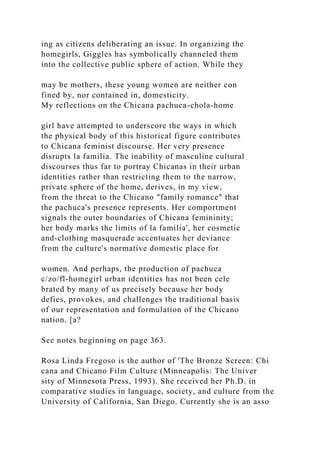
In an experience of female solidarity, the homegirls
prevent Mousie and Sad Girl from "throwing down
over a guy" in Mi Vida Loca. Courtesy Sony Pictures
Classics.
ing as citizens deliberating an issue. In organizing the
homegirls, Giggles has symbolically channeled them
into the collective public sphere of action. While they
may be mothers, these young women are neither con
fined by, nor contained in, domesticity.
My reflections on the Chicana pachuca-chola-home
girl have attempted to underscore the ways in which
the physical body of this historical figure contributes
to Chicana feminist discourse. Her very presence
disrupts la familia. The inability of masculine cultural
discourses thus far to portray Chicanas in their urban
identities rather than restricting them to the narrow,
private sphere of the home, derives, in my view,
from the threat to the Chicano "family romance" that
the pachuca's presence represents. Her comportment
signals the outer boundaries of Chicana femininity;
her body marks the limits of la familia', her cosmetic
and-clothing masquerade accentuates her deviance
from the culture's normative domestic place for
women. And perhaps, the production of pachuca
c/zo/fl-homegirl urban identities has not been cele
brated by many of us precisely because her body
defies, provokes, and challenges the traditional basis
of our representation and formulation of the Chicano
nation. [a?
See notes beginning on page 363.
Rosa Linda Fregoso is the author of 'The Bronze Screen: Chi
cana and Chicano Film Culture (Minneapolis: The Univer
sity of Minnesota Press, 1993). She received her Ph.D. in
comparative studies in language, society, and culture from the
University of California, San Diego. Currently she is an asso
ciate professor in women's studies at the University of Cali
fornia, Davis, teaching courses in film, feminism, and cultural
studies.
FALL 1995 327
This content downloaded from 128.114.34.22 on Thu, 31 Jan
2019 20:44:32 UTC
All use subject to https://about.jstor.org/terms
Contentsp. 316p. 317p. 318p. 319p. 320p. 321p. 322p. 323p.
324p. 325p. 326p. 327Issue Table of ContentsCalifornia
History, Vol. 74, No. 3 (Fall, 1995) pp. 225-368Front
MatterCalifornians: Rupert Garcia, ArtistTurning Points:
Mexican Americans in California History: Introduction to the
Special Issue [pp. 226-229]Neither Activists nor Victims:
Mexican Women's Historical Discourse: The Case of San Diego,
1820-1850 [pp. 230-243]"Just Put on That Padua Hills Smile":
The Mexican Players and the Padua Hills Theatre, 1931-1974
[pp. 244-261]"I Work for My Daughter's Future":
Entrepreneurship and Mexican American Women [pp. 262-
279]"Dodgers Béisbol Is on the Air": The Development and
Impact of the Dodgers Spanish-Language Broadcasts, 1958-
1994 [pp. 280-289]The Origins of Chicano Cultural Thought:
Visions and Paradigms: Romano's Culturalism, Alurista's
Aesthetics, and Acuña's Communalism [pp. 290-305]Moving
Still [pp. 306-315]Homegirls, Cholas, and Pachucas in Cinema:
Taking over the Public Sphere [pp. 316-327]Quetzalcoatl in San
Jose: Conflict over a Commemoration [pp. 328-
339]ReviewsReview: untitled [pp. 340-341]Review: untitled
[pp. 342-343]Review: untitled [pp. 343-343]Review: untitled
[pp. 344-345]Review: untitled [pp. 345-345]Review: untitled
[pp. 346-346]Review: untitled [pp. 346-347]Review: untitled
[pp. 348-349]Review: untitled [pp. 350-350]California
Checklist [pp. 352-353]Notes [to the Articles within This Issue]
[pp. 355-364]Back Matter
WhatIsAChicanoByCheechMarin05032012Whatis.docx

WhatIsAChicanoByCheechMarin05032012Whatis.docx

  • 1.
    What Is AChicano? By Cheech Marin 05/03/2012 What is a Chicano? Who the hell knows? To me, you have to declare yourself a Chicano in order to be a Chicano. That makes a Chicano a Mexican-American with a defiant political attitude that centers on his or her right to self-definition. I’m a Chicano because I say I am. But no Chicano will agree with me because one of the characteristics of being Chicano is you don’t agree with anybody, or anything. And certainly not another Chicano. We are the only tribe that has all chiefs and no Indians. But don’t ever insult a Chicano about being a Chicano because then all the otherChicanos will be on you with a vengeance. They will even fight each to be first in line to support you. It’s not a category that appears on any U.S. Census survey. You can check White, African-American, Native-American, Asian, Pacific Islander and even Hispanic (which Chicanos hate). But thereis no little box you can check that says Chicano. However, you can get a Ph.D. in Chicano Studies
  • 2.
    from Harvard anda multitude of otheruniversities. You can cash retirementchecks from those same prestigious universities after having taught Chicano Studies for 20 years, but therestill no official recognition from the government. No wonder Chicanos are confused. So where did the word Chicano come from? Again, no two Chicanos can agree, so here is my definition what I think. In true Chicano fashion, this should be the official version. The word “Chicano” was originally a derisive term from Mexicans to otherMexicans living in the United States. The concept was that those Mexicans living in the U.S. were no longer truly Mexicanos because they had given up their country by living in Houston, Los Angeles, “Guada La Habra,” or some othercity. They were now somethingelse and somethingless. Little satellite Mexicans living in a foreign country. They were somethingsmall. They were chicos. They were now Chicanos. If you livednear the U.S.-Mexican border, the term was more or less an insult, but always somekind of insult. In the earlydays, the connotation of calling someone a Chicano was that they were poor, illiterate, destitute people living in tin shacks along the border. As soon as they could get a car loan and could move farther away from the border, the term became less of an insult
  • 3.
    over the years.But the resentment still lingered. Some ask “Why can’tyou people just all be Hispanic?” Same reason that all white people can’tjust be called English. Just because you speak English or Spanish does not mean that you are one group. Hispanic is a census term that somedildoin a government office made up to include all Spanish-speaking brown people. It is especially annoying to Chicanos because it is a catch-all term that includes the Spanish conqueror. By definition, it favors European cultural invasion, not indigenous roots. It also includes all Latino groups, which brings us together because Hispanic annoys all Latino groups. Why? Because they’re Latino and it’s part of their nature. (Aren’t you glad you asked?) So what is a “Latino?” (It’s like opening Pandora’s box, huh?) “Latino” is refers to all Spanish-speaking people in the “New World” - South Americans, Central Americans, Mexicans,and Brazilians (even though they speak Portuguese). All those groups and their descendents living in the United States want to be called Latinos to recognize their Indian roots.
  • 4.
    Mexicans call ithaving the “Nopal” in their face, that prickly pear cactus with big flat leaves that Mexicans eat, revere, and thinkthey look like. When you go to Mexico and walk down the street in Mexico City, it’s like walking through a Nopal cactus garden. Nopal is everywhere. For Latinos who don’t want to be so “Nopalese,” there’s always “Mexican-American.” Or the dreaded “Hispanic” that should only be used when faced with complete befuddlement from the person asking what you are. Because I am the only official version of what being Chicano is, I say Mexican- American is the politicallycorrect middle ground between Hispanic and Chicano. Like in the song I wrote to be sung by a Chicano trying to be P.C. “Mexican- Americans; don’t like to just get into gang fights; they like flowers and music; and white girls named Debbie too.” All those names made it confusing for me growing up. I livedin an all-black neighborhood, followed by an all-white one, and other kids in the always called me Mexican in both neighborhoods. It never bothered me until one day I thought to myself “Hey, wait a minute, I’m not Mexican.”I’ve never even been to Mexico and I don’t speak Spanish. Sure, I eat Mexican food at family gatherings where all of the adults speak Spanish, but I eat
  • 5.
    Cheerios and pizzaand hamburgers more. No, I’m definitely not a “Mexican.” Maybe I was “Mexican-ish,” just like somepeople were “Jew- ish.” These thoughts all ran through my mind when I chased down an alley by five young African-American kids. “Yo, Messican!” they called out in their patois. I stopped in my tracks and spun around. “I’m not a Mexican!” I shouted defiantly. They stopped too, then stared at me. The leader spoke, “Fool! What you talking ‘bout? You Mexican as a taco. Lookat you.” “No,”, I said. “To be a Mexican, you have to be from Mexico. You’re African-American. Are you from Africa?” “N—. You crazy. I’m from South-Central, just like you.” “That’s exactly what I’m talking about!” I said. “Did anybody knock on your door and ask you did you want to be African-American?” “Hell no! The social workers don’t even knock on our door, they too scared,” he said, cracking everyone up. “Then why you letting people call you whatever they want? What do you want to be called?” I asked.
  • 6.
    He looked atthe others, thought about it for a few seconds and then said proudly, “I’m a Blood.” “Ooo-kay,” I said making it up as I went along. “Then you’re a Blood-American.” That seemed to go over well. They all nodded. “Yeah, we Blood-American.” “Well, then go out and be the best Blood-Americans that you can be. Peace, brothers, I got to blow.” I walked awayand so did they. Self-identification saved the day. Yet, I still was dissatisfied with what I wanted to call myself. When I got home, therewas a partygoing on. A bunch of relatives had come over for dinner and everybody was sitting around gabbing and drinking beer. My Uncle Rudy was in the middle of a story: “So, I took the car into the dealer and he said, ‘Yeah, the repairs gonna run you about $250.’ Two-fifty? Estas loco? Hell, just give me a pair of pliers and sometin foil. I’ll fix it - I’m a Chicano mechanic. Two-fifty, mis nalgas.” And that was the defining epiphany. A Chicano was someone who could do anything. A Chicano was someone who wasn’t going to get ripped off. He was Uncle Rudy. He was industrious, inventive, and he wants another
  • 7.
    beer. So Igot my Uncle Rudy another beer because, on that day, he showed me that I was a Chicano. Hispanic my ass, I’ve been a Chicano ever since. ‘Mosquita y Mari’ is about us 07/04/2011 Gabriel Lerner http://www.hispanicla.com/mosquita-y-mari-its-about-us-19986 We met at the corner of Pacific and Gage, in the heartof Huntington Park. It was still morning and the whole area was filled with beckoningstorefronts and extravagant cafés, but best of all was the crowd parading up and down the boulevard; young mothers pushing little ones in strollers, couples in seemingly happy reunions, salesmen and office workers taking a break, and La Raza. Because this is a Latino Barrio. And this is where director Aurora Guerrero is going to shoot her first feature film, “Mosquita y Mari.” “When people thinkabout Latinos they oftenimagine East Los Angeles, Boyle Heights. They imagine a world of gangsters and cholos. Of stereotypes,” says Guerrero, who was born in San Francisco after her parents emigrated from Mexico. They met in the Mission barrio, where she initially wanted to film the movie. That’s where her rootsare,
  • 8.
    and her scriptis personal. It happened to her. “Mosquita y Mari.” is the storyof two 15- years-old high school students, Yolanda Ontiveros and Mari Rodriguez, who forge a relationship sparked by sexual attraction and develop a friendship which reflects important and still-pressing issues: single mothers who need the help of their eldest daughters to get by; undocumented immigrants who must accept living in the shadows due to their legal status; high school students who want to break through despite social and economic impediments and fulfill the golden dream of going to college. And also Homophobia: the ignorance, the difficulty encountered when parents and children try to communicate about such a taboo subject. “I want to talk about sexuality. I am attracted to the power of the [actual] violence within silence, a mixture so common in the reaction of parents…because in my house, we didn’t talk”, says Guerrero, who stares with the open, direct and sincere gaze of the dreamer. And her parents’ dreams got lost. “Life turned into work… which was not always humane.” For 18 years, the Mexican restaurant they owned in Berkeley united the family. This is where each of the 3 siblings worked sincethe age of 8. “They were
  • 9.
    always thinking ofus,” she stated. “That’s why they didn’t go back to Guadalajara.” The way Guerrero speaks is a mirror of her generation: the cordial Spanish learned in the fields flowing into in the common Spanglish of today and into standard English. “Here I like the big cities; in Mexico I like the rural areas.” Aurora Guerrero is a symbol of so many Hispanics born here to immigrantparents, and “Mosquita y Mari” will reflect this, for Los Angeles and for the whole world to see. And she hopes her film will open the debate about Homophobia among Latinos. The concept is being expressed in the storywith the innocence and tenderness of everyday behavior. With the intimacy of suggestion; nothing explicit. With the gentleness and softness of a quinceañera, “Mosquita y Mari” is not about coming out, but about coming of age,” she says. “Not homosexuality, but adolescence.” However, according to a study published by GLSEN, Gay, Lesbian and Straight Education Network published last September with the participation of 7,200 LGBT students between 13 and 21 years, eightof every
  • 10.
    10 of themwhere verbally harassed because of their sexual orientation, four were physicallyattacked, and six felt threatened in school. That’s another important reason to pay attention to this movie. The project is supported by the Huntington Park chapter of CBE, Communities for a Better Environment. Oncecompleted, the movie will be shown at a series of events designed to promote dialogue in the community. In short, it is an idea that exceeds the personal storytold by a new Chicana filmmaker. And it may come to the rest of the world very soon. “We want to start shooting by the end of June, for 20 days, here, in Huntington Park.” But thereis a problem. “Our dream budget was about a quarter of a million dollars.” Through the Latino Public Broadcasting, the Sundance Institute, and a Ford Foundation fellowship, they received start-up funding which was a fraction of the total needed. The rest has to come through contributions from the community. Like its internet site states, fans of independent films“willhave a unique opportunity to bring this film to life during the 30-day campaign that started on April 26th and ends at the end of May.” The clock is ticking. There is not much
  • 11.
    time,and the needis urgent. If everything goes well, the movie will be ready for the next Sundance Festival, says Guerrero with hopefulness. “I want young people to learnfrom this movie, because I didn’t have it when I was a girl… they didn’t tell me that a woman can direct a movie,” stated Guerrero, who is also an adjunct professor of Art Appreciation and Psychology at San Jose’s National Hispanic University. Guerrero won an award from HBO and the New York International Latino Film Festival (NYILFF) for her shortfilms. She created “Pura Lengua” (2005) and “Viernes Girl”(2005) and participated in the production of “Real Women HaveCurves” (2002) and La Mission (2009). The new Latino film in the United States had several good starts. A few years ago, titlessuch as “Real Women…” broke through the wide markets and showed — together with family scenes, laborproblems and the presence of gangs — a cheerful combination of grace and comedy. Some of them, like “Stand and Deliver” (1988) or “Walkout” (2006, for TV), were about historical episodes of overcoming and rebellion. Others, like “American Me” (1992), focused
  • 12.
    on the problemsof youth in poor neighborhoods,where the abundance of drugs and the anguish of the immigrantexperience added to impoverishment and convergence of youth criminals, crime and an alleged honor code and loyalty within these. ”Mosquita y Mari” is a project that takesan extrastep forward, attempting to show the reality inside the Latino community that is not shown everyday. Not an absolute reality, but one that is sensitive, intimate. The story takesplace in Huntington Park, the veteran city with an absolute Latino majority to the southeast of Los Angeles. There is where Yolanda and Mari met. Yolanda, the only daughter of immigrantworkers, wants to continue her studies and become a professional. Mari has to work so that her mother and two sisters can survive. In school, Mari’s sense of justice leadsher to rescue Yolanda from an incident in which Las Cuatas, twin sisters and childhood friends of hers for whom everything is fiestas, boys and texting, are implicated. Their friendship evolves after this, and takesus to a new place with a surprise ending.
  • 13.
    Homegirls, Cholas, andPachucas in Cinema: Taking over the Public Sphere Author(s): Rosa Linda Fregoso Source: California History, Vol. 74, No. 3, Mexican Americans in California (Fall, 1995), pp. 316-327 Published by: University of California Press in association with the California Historical Society Stable URL: https://www.jstor.org/stable/25177514 Accessed: 31-01-2019 20:44 UTC JSTOR is a not-for-profit service that helps scholars, researchers, and students discover, use, and build upon a wide range of content in a trusted digital archive. We use information technology and tools to increase productivity and facilitate new forms of scholarship. For more information about JSTOR, please contact [email protected] Your use of the JSTOR archive indicates your acceptance of the Terms & Conditions of Use, available at https://about.jstor.org/terms California Historical Society, University of California Press are collaborating with JSTOR to digitize, preserve and extend access to California History This content downloaded from 128.114.34.22 on Thu, 31 Jan 2019 20:44:32 UTC All use subject to https://about.jstor.org/terms
  • 14.
    ^^^^^^^^^^^^^^^^^^^^^^^^^^^^^I^P_^^^^^^^^^^^^^^^^^^^^^^^ V B Wm' ___^_________l ___________________________________________________ """H^^^^^^^^^^^^^^^^^^B i i __^_____v______l __^_^_^_^_^_^_^_^_^__________________________________ ___________i_i^^ __^_^_^_^_^_^_^_^_^_^_^_k&"__________________________ ___ ^____^_______________________________________________ _________________ _________________________________________^T^^^^^lVlS9 316 CALIFORNIA HISTORY This content downloaded from 128.114.34.22 on Thu, 31 Jan 2019 20:44:32 UTC All use subject to https://about.jstor.org/terms Homegirls, Cholas, and Pachucas in Cinema TAKING OVER THE PUBLIC SPHERE by Rosa Linda Fregoso
  • 15.
    Introduction We have seenher body painted next to Aztec gods on murals, recognizable by her style: hair in a long, ratted and sprayed beehive, draping over her shoul ders; her face caked with make-up and shellacked lipstick. Her body adorns the hood of lowrider cars. Or, with a permed, curly, layered hairstyle, ruby-red polished nails, short tight skirt and haltertop, reveal ing the body's full curves, she's inside the lowrider magazine as a pin-up. And her image gazes back at us from under a crisp, white tee shirt where she rests as a tattoo on the body of a man. This production of the pachuca as an image for public and private con sumption permeates many facets of Chicano cultural politics. And I wonder what is being played out on the body of the pachuca? The production of her image predates the current fascination and commodification of the "gangsta" style in mainstream popular culture. So too does her performance in public as a social subject. Since the 1930s, pachucas, the predecessors of cholas and of today's homegirls, have hung out in the public domain of barrios like Maravilla, in southern Cali Copyright 1995, by Rosa Linda Fregoso. [At left] Draping themselves seductively over the jukebox and El Pachuco (Edward James Olmos) in the 1981 film Zoot Suit, these pachucas (left to right: Candice Silva, Anacani Eschever ria, and Bertha Oropeza) are predecessors of the "gangsta" style
  • 16.
    in mainstream popularculture. Courtesy Universal Studios. fornia, as members of girls' clubs, or what is cur rently referred to as girl gangs. Yet she stands figu ratively on the margins of literacy and film testimonies on la pachucada, subservient to mascu line versions of the gangsta life and lifestyle. The vio lence and abuse she has witnessed remains unknown to us. Characterized as a deviant in stud ies about adolescent girl gangs, her story remains untold and untheorized.1 Throughout this discus sion, I will explore what it is that the pachuca-chola homegirl as an historical subject and as a producer of meaning?that is, a creator rather than merely an object of meaning?offers to feminist discourse, and what she teaches us about opposition and resistance, not just to la vida loca (the crazy life), but to la vida dura (the hard life). The Girls My Mother Warned Me About2 Where I grew up in South Texas, pachucas were the objects of parental scorn. As a young Catholic-school girl, I was both fearful of and fascinated by pachu cas. They went to public schools, hung out mostly at corner stores, smoked cigarettes, wore lots of make-up, were loud in public and quick to start a fight. My first lesson in sex education came from a pachuca named Mary Ester. With peroxide-orange hair, big, light-brown eyes circled by Maybelline black eye-liner, eyebrows shaped and painted like wings, reddish-orange lips, and a teased beehive hairdo that my mother said was a nest for cockroaches, Mary Ester was a guera (light skinned girl) who lived across the street from my
  • 17.
    gramma's house inCorpus Christi. I once heard she FALL 1995 317 This content downloaded from 128.114.34.22 on Thu, 31 Jan 2019 20:44:32 UTC All use subject to https://about.jstor.org/terms was my Tio's movida (lover). Yet what I remember most about Mary Ester was how she disturbed my childhood innocence, teaching me the meaning of that popular lyric, "Let me tell you about the birds and the bees." One day I was walking down the street with her when Mary Ester asked me about the due date for my mother's baby. "What baby?" I responded. "The one in her stomach, mensa (dummy). That's why she's so fat... .Don't you know anything about the birds and the bees?" I didn't, except that they were somehow related to "a thing called love." Several hours later I stood in the mid dle of my gramma's dark, enclosed kitchen, before the tribunal of my mother, gramma, and Tio Pepe. I was proud of my sudden deconstruction of that song about the birds and the bees. And with the bright-eyed innocence of a nine-year-old girl, I shared that new knowledge with these family mem bers, whose judgmental looks shamed me. I was silenced and punished immediately for knowing where babies come from. Yet I never forgot Mary Ester's casual frankness, nor her role in unlocking my sexual curiosity. I was always fascinated by that pachuca masquerade she wore in public, by how she had made her face into her canvas. She died several
  • 18.
    years later ofa drug overdose. Another pachuca named Gloria taught me the meaning of female solidarity. When I was fifteen years old, gang-banging was spreading throughout Corpus. Gang-banging referred to group rape: a group of guys getting a girl high on drugs, driving her to the beach, then raping and abandoning her. One Saturday night, I was hanging around the Carousel dancehall, stoned on "reds," walking from car to car, smoking, drinking, and listening to music. Gloria and a friend were there as well. Gloria did not like me. I could tell by the way she glared at me. I was friends with her ex-boyfriend, one of two brothers I knew who were pachuco drug dealers. That Saturday night one of the brothers invited me to go cruising: "Maybe the beach," he said. Right before I entered that tan Chevrolet station wagon, Gloria drove up and yelled, "Get in the car. I'm gonna take you for a ride." I don't know what stirred inside me, but without hesitating or protesting, I followed Glo ria's command. She took me home and on the way told me that the guys, including my friends the two brothers, were "preparing a gang-banging" with me as their victim. I knew she was right. The hurt and terror I felt drove me away from my Carousel hang out. I even quit doing drugs. And all that summer I wondered why Gloria had intervened to save me. What I didn't understand then was Gloria's gift to me: a pachucas sense of female solidarity. In some Chicano familias, mothers warn their daughters about lesbians. In mine, I was cautioned about pachucas?por ser muchachas corrientes y calle jeras (cheap, street-roaming girls). They fought like
  • 19.
    guys and wouldstand up to anybody's provocation. And, most of all, the street was their turf. Indeed, the street constitutes the social geography of urban space, the arena where pachucas apprehend public life. But the streets are also contested semiotic ter rains within the public sphere, functioning, in the words of philosopher Nancy Fraser, as "culturally specific rhetorical lenses that filter and alter the utterances they frame."3 In the eyes of parents, the streets are sites of danger, where young girls become pachucas and callejeras (street-roamers). For pachu cas, the street is an arena where they appropriate public space. Refusing to stay in the place assigned to them by Chicano society, pachucas are trespassers in public spaces, violating the boundaries of femi ninity. In my childhood, pachucas were often viewed by adults as transgressive girls who disturbed private and public patriarchy, la familia, and the Catholic church. They threatened the foundations of la familia's gendered structure by speaking and acting in the public sphere. Mary Ester disrupted my fam ily's acquiescence to the Church's moral prohibitions regarding sexuality. In public, she spoke openly about her sexual knowledge. And, on the streets of Corpus Christi as well, Gloria subverted patriarchal mysogyny. She had intervened to stop men from inflicting their powerful violence and privilege on my body. In public spaces, both of these young women exhibited this mastery over and resistance to the sanctimony of patriarchal culture and religion.
  • 20.
    I now understandthe reason for parental scorn. In their appropriation of the public sphere, pachucas set a "bad" example. Most importantly, in their rebellion, pachucas failed to do what the Chicano family demands of girls and women. They rejected and challenged parental norms by refusing to stay inside the home. Their provocative language and dress style served to further refute la familias author ity. Boldly displaying their sexuality, pachucas 318 CALIFORNIA HISTORY This content downloaded from 128.114.34.22 on Thu, 31 Jan 2019 20:44:32 UTC All use subject to https://about.jstor.org/terms refused to be confined by domesticity. The pachuca is therefore the body that marks the limits of lafamilia and is also the one who introduces disorder into its essentially patriarchal project. Gendered Territoriality The confinement of girls and women to domestic ity is not endemic to Chicano familias, but is an inherent feature of modern capitalist societies, as well as others throughout history. It is intimately linked to women's subordination in societies that, as Nancy Fraser explains, are premised on both the sep aration of the public from the private spheres, as well as on the "separation of the official economic sphere from the domestic sphere and the enclaving of child
  • 21.
    rearing from therest of social labor."4 Fraser's work on contemporary social theory is particularly useful for exploring the construction and enactment of social and cultural identities within the public sphere. She takes issue with the tendency in feminist scholarship to collapse the entire arena outside the home into the single concept of the "public sphere." Following the theoretical model developed by Jurgen Habermas, Fraser conceptual izes classic capitalist societies as comprised of two levels of interrelated public /private separations: "systems" and "lifeworld spheres." At the level of systems, the division is between the State, as a "pub lic" system, and the "(official) capitalist economy" as a "private" system of market relations. At the level of lifeworld spheres, the division separates family, or "private" lifeworld sphere, from the "public" lifeworld sphere, which Fraser defines as a "space of political opinion formation and participation."5 In this manner Fraser departs from feminist theorists who define the private realm solely in terms of the home or the family. In Fraser's view, the private realm is more than the home, for the private encom passes both official economy of paid employment (the private system of market relations) as well as the family (the private lifeworld sphere). Thus for Fraser, the public sphere is not an "arena of market relations." Rather it is comprised of the State (as a public system) and the public lifeworld sphere. With this qualification in mind, Fraser defines the public sphere as an arena of "discursive relations." In Fraser's words,
  • 22.
    It [the publicsphere] designates a theater in mod ern societies in which political participation is enacted through the medium of talk. It is the space in which citizens deliberate about their common affairs, hence, an institutionalized arena of discur sive interaction.6 The distinction Fraser makes between the two lev els of public/private separations is important to my work because in order to support their families, Chi cana working-class women are allowed to work outside the home in the "private" official economy of paid employment. My concern in this paper is with the social and cultural prohibition of women's access to the public sphere of the "streets" and "dis cursive relations." Giving Jurgen Habermas's insights a feminist twist, Fraser explores the gendered aspects of each of these spheres. She explicitly underscores the mas culine sub-text (premises) of the citizen's role in the public sphere and the feminine sub-text of the child rearing role in the familial or private lifeworld sphere. According to Fraser, in defining citizenship, modern capitalist societies invest a higher value on the soldiering role rather than on what she terms "life-fostering child-rearing." In so doing, modern societies privilege the public (masculine) citizen-sub ject in the formation of the nation-state. Indeed, male dominance is intrinsic rather than accidental to clas sic capitalism precisely because it is structural and "premised on the separation of waged labor and the state from childrearing and the household." It is an institutional arrangement, namely, the domestication
  • 23.
    and separation ofchildrearing and household work from the rest of social labor, that for Fraser marks "the linchpin of modern women's subordination."7 As Fraser adds, it is in the public sphere as citizens and in the private (official) economic sphere as pro ducers that men are the privileged subjects of dis course and social relations. In sharp contrast, women's role and function are confined to the pri vate domestic sphere of the family and consump tion.8 Within Chicano culture, the subordination of women is exacerbated by a dual legacy, Catholicism and the particularities of the Spanish conquest. If in our current era, Mexican Catholics continue to be subjected to the Church's regulation of women's public and private behavior, as the recent debates on reproduction make evident, the Catholic church's FALL 1995 319 This content downloaded from 128.114.34.22 on Thu, 31 Jan 2019 20:44:32 UTC All use subject to https://about.jstor.org/terms power in proscribing women's comportment was even greater in the years prior to independence or the secularization of Mexican society in the nine teenth century. With respect to the confinement of Chicano girls and women to the home, Jean Franco's study of gen der and representation in Mexico offers a valuable insight. Franco traces the immobility of women in
  • 24.
    Latin American society,what she terms their "terri toriality" within Latin America, not simply to Catholic hegemony but to the inheritance of Span ish pre-Cortesian culture: Here we should keep in mind the privatized and inward looking Hispanic house and the fact that the virtual confinement of married women to the home had not only been required by the Church but was also intended to insure the purity of blood that Spanish society had imposed after the war against the Moors.9 Even though Chicanas are permitted to work out side the home, as potential wives young Chicanas are instructed to view the home as "female" and the pub lic sphere of the streets and discursive relations as "male" terrain. Thus the origin of Chicanas' territo riality, their immobility, their confinement to the home, can be traced essentially to earlier prohibitions against miscegenation. A masculine project indeed! Masking as a concern for their safety, the confinement of girls to the home is first and foremost about pro tecting sexual property, about policing sexuality. And this is precisely the masculine familial project that pachucas interrupted and disrupted. Their bodies refused to be contained by domesticity or limited by the prevailing orthodoxy of appropriate female behavior. Chicana Urban Identities in Literature Chicana feminists have interpreted familial, lit erary, and oral narratives through symbolic icons and archetypes such as La Malinche, La Llorona (the
  • 25.
    wailing woman), LaVirgen de Guadalupe, identifying these as prototypes occurring frequently in patriar chal discourse about women. Whether figured as the self-renounced female, la madre abnegada (the suf fering mother), the passive virgin, or in portraits of female treachery or sexual promiscuity, these views of women, assigned a one-dimensionality, are invari ably sublimated into symbolic icons and archetypes of Mexican femaleness. However, the recognition of symbolism in Chicana urban identities has been shamefully neglected by the same feminists. The pachuca-chola-homegirl, as primary actress within the Chicano family tale, has escaped the attention of Chi cana feminists. She has appeared, though, in liter ary works by writers such as Carmen Tafoya, Laura del Fuego, and Mary Helen Ponce.10 It is in Laura del Fuego's recent book Maravilla that the subversive potential of pachuca sexuality is explicitly brought into focus. Maravilla tells the story of a young pachuca grow ing up in East Los Angeles during the 1960s. A mem ber of the "Las Belltones East LA" girls' gang, the main character, Consuela, or "Cece," challenges Catholic prohibitions against corporal pleasure. Exploring her own body and affirming it as the site of sexual pleasure, she openly circumvents Catholi cism. In an early part of the novel, Cece innocently experiences her first sexual encounter in her home with a girlfriend, Liz. As a further affront to Chicano patriarchal values, Cece openly combines her inter est in boyfriends with an attraction to and admira tion of girls. While Maravilla stops before consummating
  • 26.
    homosexual desires, scenesof Cece's homoerotic pleasures and her homosocial bonds with other girls nonetheless disclose the novel's homosexual subtext. In this manner, Laura del Fuego's Maravilla openly introduces disorder into the Chicano family's essentially masculine and heterosexual project. By hanging out with girlfriends, cruising the streets or fighting rival gangs, Cece and her cohort of pachu cas refuse to be contained in the home or limited by the prevailing views of female comportment. As a pachuca, Cece openly expresses a young woman's sexual pleasures and desires despite Chicano cul ture's prohibitions. Unfortunately, the pachuca as social subject would appear quite differently on the screen in the gang genre film. Screening the Homegirl Early debates in cinema studies underscored the invisibility, but also the visibility, of certain kinds of images about Chicanas and Chicanos in mainstream 320 CALIFORNIA HISTORY This content downloaded from 128.114.34.22 on Thu, 31 Jan 2019 20:44:32 UTC All use subject to https://about.jstor.org/terms _____________________________________________K ^ ^I'^^^^^I^HBI^^^^^^^^^^^^^^^^^^^^^^^^^^^^^^^^^H ^^^^^^^^^^^^^^^^ t. -; - ?^^^^^^B|W^^^BH^^^^^^^BiM__^_^_^_^_^_^_^_^_^_^_^_^_^ _^_^_i
  • 27.
    _____________________ ._-___-_-_-_-_-_-_-_- ____^^^^^^^^^^^^^^^^^^H _____________________________________________________ ____Hli' -^^^H^^^^^^^^^^^^^^^^^^^^^^^^^^^^^^^^^^^^^^l SadGirl (Angel Aviles, and ^|^^^^^^^^^^^^^^^^^F/ Ernesto (Jacob Vargas) fall in ^^^^^^^^^^^^^^^^^^^^^^^H #; "%*" ''%'/%'' "*" _^_^_^_^_^_^_^_^_^_^_^_^_^_^_^_^_^_^_^_^_^_^_^_^_^_^_^ _^_^_^_^_^_^_^_^_^_B _f_^_ll_ir'-T'fe''*'.Tt - ifc^^^^H||^?KS^3BMBiilil media. The gangsta motif, for instance, had been deployed extensively since the 1940s as the way to make Chicanos visible in U.S. popular culture. And this deployment has not been the sole purview of dominant culture, for, in contesting mainstream rep resentations, Chicano filmmakers such as Luis Valdez and E.J. Olmos resort as well to the gangsta motif. As usual, mainstream and oppositional films succeed in marginalizing the female gang member vis a vis the male character. Yet despite the erasure and denial of the chola as narrative subject, what does stand out is her figuration in peculiar kinds of ways. When I was a child, the term pachuca was used inter changeably with "puta" (prostitute). There is a scene in Luis Valdez's classic film Zoot Suit where the mother of the main character, upon witnessing her daughter's 1940s pachuca dress style, makes precisely that equation by saying: "Pareces puta...pachuca!"
  • 28.
    Thus, the fusionof the pachuca dress style with that of the hooker motivates me to read the image of the pachuca-chola-homegirl through historical and cul tural discourses as well as through social and femi nist theorizing about the subject, in order to analyze and interpret the visual strategies chosen to con FALL 1995 321 This content downloaded from 128.114.34.22 on Thu, 31 Jan 2019 20:44:32 UTC All use subject to https://about.jstor.org/terms struct her image in cinema, in those frames where she figures as an object of cultural discourse. What is being played out by the use of the body of a homegirl? What kinds of social and cultural meanings is masculinist ideology mapping onto her image? In mainstream "gangxploitation" films like Boule vard Nights, The Warriors, and Bound by Honor (also called Blood In, Blood Out), the pachuca is incidental to the narrative, appearing textually as an appendage, as a female prop draped around the body of a male gang member. In the 1988 film Colors, by Dennis Hop per, the homegirl has a speaking part, the semblance of a narrative voice. A film about Chicano gangs in Los Angeles, Colors is told from the point of view of the Los Angeles Police Department. The motif of miscegenation is a major sub-text, dealing with the romance between Chicana homegirl Luisa (played by the Cuban actress Maria Conchita Alonzo), and Danny (played by Sean Perm). In the first part of the
  • 29.
    film, Luisa appearsas the nice, subservient, sexy-but not-too-promiscuous girl from the barrio?a de meanor designed to emphasize her passivity, thereby making the brown woman appealing to the white cop. By operating as the translator for the gang world, the homegirl facilitates white male penetration into the world of the other. However, as we learn by the sec ond half of the film, Luisa's accommodation has been just a masquerade. Responding to a drive-by shooting in the barrio, Danny and other law enforcers walk in on a party at a gang member's home. As Danny approaches the bedroom, a black man walks out. Inside the room Danny finds Luisa, who has shed her previous homely "good-girl" attire. Danny watches as Luisa, in heavy make-up, teased hair, wearing the provoca tive dress typical of cholas, is donning her hose. To Danny's dismay, Luisa violently and aggressively confronts him as he walks out of the house. Luisa's initial subservience in the film masks the underside of a native woman, for as the bedroom scene illustrates, passivity and accommodation fig ure as disguise. Beneath the passive acquiescence, Luisa surfaces as a hypersexual object?the embod iment of unbridled sexuality, betrayal, and deceit. The end of the film demonizes Luisa, reinscribing her as a threat to the white race, an inscription serving to legitimize U.S. society's historic prohibition of mixed race unions. Yet, the film also recapitulates Holly wood's fascination with the motif of miscegenation and the "forbidden other": the mythic native women figured in Colors as the homegirl of the studio's imag ination.
  • 30.
    Does the pachuca-chola-homegirlfare any better in Chicano productions? Partly in response to films such as Colors, Chicano cultural workers have focused their attention on countering the pejorative image of pachucos as incorrigible deviants within the dominant culture and media. In poetry, theater, and film, this refashioning of the pachuco as urban warrior and anti-hero has centered exclusively on male identities. (I have written elsewhere about his reformulation, as well as the production of the historical subject of Chi cano nationalism.)11 This masculine subject found its narrative expression in characters of the public sphere: males operating outside the home, in the streets, in the recording industry, and as urban warriors against threatening external institutional forces such as the police, the media, and the state. Chicano feature length productions are marked by a strict gender divi sion between the public sphere and the private domestic sphere, thereby creating an artificial sepa ration between them. Despite critiques by feminists about the role such separation plays in the subordi nation of women, the stories told by Chicano films are particularly forceful in affirming and adhering to that gendered social division. For example, while Chi cano male identity is depicted as a product of the pub lic sphere, the female identity is absent from that space. Her presence is contained in domesticity as a mother, wife, girlfriend, caretaker. Just as in the expe riential realm, so too in Chicano media representation, woman's containment to the private sphere is but tressed by the social forces of the Church and la
  • 31.
    familia?forces dictating aspecific, limited environ ment for Chicanas. The pachuca has appeared in two such films: Zoot Suit and American Me. In Zoot Suit, she is again imaged in terms of the strategy of containment, appearing only in limited scenes and roles. Conse quently, for all the differences in politics between Col ors and Zoot Suit, both are akin in their imagery of the homegirl.12 While three pachucas have speaking parts in Zoot Suit, my focus is on Berta, who appears in the dance hall and whose love-interest is the main character, Hank. Berta is depicted as a pathetic, "not-chosen-as-the-anointed" lover of Hank. She is promiscuous, exaggerating her character traits as a pachuca. 322 CALIFORNIA HISTORY This content downloaded from 128.114.34.22 on Thu, 31 Jan 2019 20:44:32 UTC All use subject to https://about.jstor.org/terms Berta's overstated pachuca style is best evident when she approaches Hank and Delia on the dance floor. Obviously drunk, Berta circles around the dancing couple, hanging onto Hank, who openly expresses his annoyance. Berta's provocative facial and bodily gestures make explicitly obvious her jeal ousy of Delia and desire for Hank. Directing rude and obnoxious comments to the couple as she flaunts her body, Berta ends by saying: "I hope she [Delia] knows the difference between being cool and being
  • 32.
    culo [piece ofass]." As noted earlier, Hank's sister also exhibits the style of the pachuca, yet it is Berta who embodies the lifestyle: she is in control of her own sexual desires. Yet, the filmmaker deploys a standard "virgen/ - whore" distinction in order to punish Berta for exhibiting her desires in public. She is reprimanded for her transgression through an imaging strategy that ridicules her, depicting her as exaggerated and hypersexed. By deploying this narrow strategy of containment, the filmmaker prohibits any mean ingful expression of Berta's complex sexuality. In so doing, Zoot Suit illustrates the extent to which female desires and explicit female sexuality threaten the familial order. Yet as the impropriety of her cloth ing style and her provocative gestures and language illustrate, Berta represents a threat to both la familial and the Church's orthodoxy of female comport ment. Just as in the social realm, the pachuca of Zoot Suit figures as a subject whose personal style and lifestyle, whose very presence on the dance floor, contest her exclusion from the public sphere. In the film American Me, the homegirl, Julie (Evelina Fernandez), appears as a veterana, that is to say not as an actual, but as a former, rehabilitated, chola. In this film we witness a distinct form of the "strategy of containment," for her status as former chola demonstrates the filmmaker's inability to han dle the inscription of a chola on the screen. While the chola is part of Julie's past identity, she does not man ifest that aspect of her character on the screen. Indeed, throughout the film Julie has masked this identity, remaking herself into a different form of
  • 33.
    femaleness: a mother.What is most significant about the film's articulation of the "strategy of contain ment" is the site where Julie's identity as a chola is made known to the movie audience. Toward the end of the film, Julie is in her bedroom dressing for work. Viewers hear the voice-over of Santana's farewell letter. A shot of Julie combing her hair before a mirror ends as she stares at her hand. There, between her thumb and index finger, is an insignia testifying to her membership in la primera gang. Before leaving the room, Julie covers the cross tattoo on her hand with skin-toned make-up. By masquerading and shielding the mark on her body, Julie demonstrates the extent to which social identity is not stable but is, rather, a production that is fluid and provisional. Yet because the act of veil ing and unveiling her identity takes place in the space of the bedroom, the film locates the chola sub ject in the private sphere of domesticity. By pro hibiting its unveiling in the public sphere, American Me exemplifies and suggests just how threatening the performance of chola identity can be to Chicano society. The film reinforces society's censure, that the Chicana can only be a chola in the interior space of the bedroom. I concluded my book, The Bronze Screen, with an evaluation of the modern Chicana's untold con flicts as portrayed in the film American Me. Lament ing the film's erasure of the female subject, I ended with the following words:
  • 34.
    Who is thisnew subject, this Chicana whom Edward James Olmos claims is the heroine of American Me, the hope in our barrios? His story ends before hers can begin. In the final close-up shot of a cross tat tooed on Julie's hand resides her untold story. It is the history of Chicana membership in gangs that unfolds not on the screen, but in my mind. The final weathered look in Julie's eyes sparks the painful silent memory of the female gang members I have known: Chicanas surviving and resisting la vida dura (the hard life). I often wonder why the story of Julie's oppression and resistance, why the pain of her rape is not up there, on the Hollywood screen, look ing at me.13 That story of Chicanas surviving la vida dura would appear on screen in 1994. Three decades after Herbert Biberman's feature film, Salt of the Earth, focused exclusively on Chicana identities on the screen, another white director attempted a similar project. Allison Anders's Mi Vida Loca tells the story of young Chicana gang members, homegirls with names like Mousie, Sad Girl, and Whisper, who live in Echo Park, Los Angeles. As I have written else where, 14 Mi Vida Loca is a splendid contradiction. It is the first commercial film to focus entirely on Chi FALL 1995 323 This content downloaded from 128.114.34.22 on Thu, 31 Jan 2019 20:44:32 UTC All use subject to https://about.jstor.org/terms
  • 35.
    cana gang members.The film faithfully renders the style, stance, posture, gestures, mannerisms, and speech of so many pachucas-cholas-homegirls I have known throughout the years. Yet its daring and gritty realism is very partial in its one-sided view of la vida loca, or what I prefer to call la vida dura. Reviews of the film have been mixed.15 Profes sional film critics have trashed Mi Vida Loca on polit ical and ideological grounds. Writing for the Los Angeles Times, Kevin Thomas points to the film maker's paternalism as well as to the fact that the film confirms negative stereotypes of Chicanas as welfare dependents. Pat Dowell further blasts the film's nihilism, its downbeat resolution. It should come as no surprise that a Latina critic would launch the usual "negative stereotype" accusation. Writing on behalf of the "Latino" community, Rose Arrieta disapproves of the film for playing "on every stereo type 'mainstream' America thinks about urban gang life," and urges the portrayal of Chicanos as some thing else besides gang members.16 In the United States, as well as abroad, others fault the film for depicting teenagers without ambition, "drifting downward into chaos and dead-end lives."17 I am less concerned with these types of objections, as hopelessness and helplessness are, in fact, per vasive among inner city youth. Therefore, unless we deal directly with the very serious social and eco nomic problems of the inner city, a positive or uplift ing ending to a gang film would make no difference in the lives of young gang members. Even though I too desire the production of films that show Chicanas
  • 36.
    and Chicanos ascharacters other than gang mem bers, filmmakers such as Anders cannot be held Public and private spheres overlap: a domestic scene in Mi Vida Loca is disrupted when homegirl Whisper (left) gives Sad Girl a gun to use in her impending show down with Mousie. Courtesy Sony Pictures Classics. 324 CALIFORNIA HISTORY This content downloaded from 128.114.34.22 on Thu, 31 Jan 2019 20:44:32 UTC All use subject to https://about.jstor.org/terms responsible for the widespread dissemination of these images in popular culture. While it is true that in choosing a subject, Anders took advantage of the current fascination and commodification of the gangsta style in mainstream culture, Mi Vida Loca is not the usual gangxploitation film. In fact, Mi Vida Loca is the first Hollywood film to take homegirls seriously, detailing the gangsta life of the Echo Park Locas. At first glance, it seems as though the story is told from a homegirl point of view. The film opens with frames of the iconogra phy of a vibrant barrio. It portrays homegirls who are fiercely independent, struggling as single teenage mothers whose boyfriends or husbands have ended up in prison or in the grave. In terms of the "poli tics of representation," that is, in the context of other portrayals of Chicana homegirls, Mi Vida Loca appears to have all of the essential ingredients.
  • 37.
    In the firstplace, through its exclusive focus on relations among teenage girls, the film enables a Chi cana homosocial (same-sex social relations) per spective to emerge for the first time on the big screen. The film begins by telling the story of two childhood friends, Sad Girl and Mousie (Angie Aviles and Seidy Lopez). The girls are lifelong friends whose friendship ends when they both end up pregnant by the same homeboy, Ernesto (Jacob Vargas). Mousie and Sad Girl's fatal showdown at a barrio vacant lot has a surprise resolution when Ernesto is gunned-down by one of his despised customers, a white female druggie. This ironic twist in the plot propels the story in a different direction and opens up a space for narrating a tale of female bonding and collectivity, not just between Sad Girl and Mousie, but among the homegirls in general. It is Giggles, a veterana just released from prison, whose words about female solidarity consolidate the homosocial space created in the film. On their trip home after picking up Giggles from prison, the Echo Park Locas stop for a bite to eat. Inside the diner, as the homegirls share news about their lives, an argument about Ernesto erupts between Sad Girl and Mousie. Giggles interrupts them with the fol lowing words: "Girls, you don't ever throw down with a homegirl over a guy. Guys come and go. They ain't worth it." From this point on, Mi Vida Loca unfolds as a sisterhood saga, portraying young Chi canas whose lives are marked by camaraderie, affec tion, struggle, and survival. The film is shot in a style Anders calls "romantic
  • 38.
    realism," where cameramovement follows charac ters' emotions. The film's cinematographer, Rodrigo Garcia (son of writer Gabriel Garcia Marquez), effec tively mixes low-angle close-ups with opalescent and luminous shots. Structurally, the film disrupts conventional narrative coherence. Rather than pre senting a single unifying thread, Mi Vida Loca fea tures three interlocking stories, giving the film its episodic quality. Besides the main storyline described earlier, another plot features an epistolary romance between La Blue Eyes and El Duran,who is in prison. A final plot line revolves around Ernesto, a young Chicano obsessed with a lowrider truck. The film's ethnographic-documentary texture derives from its use of six different narrators. Voice over narration is often self-reflexive, exhibiting a sub jective quality. At other times the narration is informational and descriptive, further accentuating the film's ethnographic-documentary character. Another significant feature of the film derives from the fact that multiple narrators, framing shifting points of view, disrupt the audience's natural iden tification with a single cinematic position. Textual reality is presented first through Sad Girl's point of view, then through Mousie's vision, followed by Ernesto's, so that identification with spectators shifts from one character to another. For example, at one point, the story is told from Ernesto's point of view. When he is killed, the audience's attention is shifted back to a homegirl point of view. Thus, in contrast to the single narrative point of view and/or char acter identification typical in most conventional films, Mi Vida Loca constructs multiple positions from
  • 39.
    which viewers canidentify with its narrative real ity. In so doing, the film offers a collective subjectivity that challenges the individualism typical in Chicano gang-films. In other words, by depicting subject formation through shifting perspectives, the film enables a space for collective Chicana urban identi ties neglected in other films about gangs. Yet for all its feminist politics, its aesthetic and nar rative innovations, Mi Vida Loca succumbs in some respects to conventional film antics. Sad Girl's final statement, "Women don't use weapons to prove a point; women use weapons for love," has the melo dramatic flavor of a Mexican soap opera. And the final scene, which depicts the drive-by shooting of Sleepy's daughter, gives the film a classic Hollywood FALL 1995 325 This content downloaded from 128.114.34.22 on Thu, 31 Jan 2019 20:44:32 UTC All use subject to https://about.jstor.org/terms ending. More substantive critiques of the film come from the gang members themselves, who have taken issue with the filmmaker's depiction of their lives. Among Chicana homegirls' objections to the film are that 1) homegirls don't get pregnant from the same guy, they have more respect than that; 2) a home boy does not become obsessed over a lowrider truck at the expense of his kids' welfare; and 3) rival gangs fight over turf, never over a car.18 At the San Fran cisco Film Festival's screening of the film in 1994,
  • 40.
    during the questionand answer session, the fol lowing comments by a member of Oakland's Da Crew girls' gang were directed at Anders: The movie was really down.. .Why didn't you show the girls really throwing down? And why did they throw down over a boy? You know, we wouldn't throw down over a guy. These may seem to be minor quibbles with the film's storyline, but the critiques by Chicana homegirls underscore, albeit in a coded form, the central prob lem of the film. Chicana gang members did not object to how they were portrayed as much as they objected to the details of their narratives. In fact, the film's three interlocking stories reflect autobiographical experiences from the life of the filmmaker. A victim of unrequited love, Allison Anders discussed her decision to transform a romantic episode in her past into the epistolary affair between La Blue Eyes and El Duran. A short script written by her former boyfriend, Kurt Voss, inspired the lowrider truck segment. Anders also said that the sub-plot in which the two homegirls discover they both have become pregnant after having intercourse with the same man is taken from a story that her daughter heard on the streets. In Mi Vida Loca, Chicana homegirls are portrayed as independent and self-sufficient young women whose survival depends on a bond and camaraderie with their cohorts. For them, a strong family bond is not an option, since the Chicano family is portrayed as either dysfunctional or non-existent in their lives. And this is part of the film's problem, for while the heterosexual nuclear family may not figure promi
  • 41.
    nently in thelives of these women, in reality there is an alternative form of family unit operative in the bar rio. Anders misses the reality that the sisterhood so eloquently captured in the film is not created in a vac uum. Those who decide to create stories and films about Chicanas ought to understand that the girls' survival in the barrio depends heavily on the kinship of older, compassionate, and understanding women who have also resisted and survived la vida dura. For reasons that are unclear, Anders chose to portray Chi cana teenagers as self-sufficient, having little inter action with adults. Untold is the story of the elaborate extended family of mothers, grandmothers, and aunts, who visit them in jail, bail them out, help deliver, feed, and take care of their babies. At the San Francisco Film Festival's screening of the film, Anders told the audience: "My goal was to humanize people who don't get represented on the screen." And while Anders misses crucial elements of Chicana homegirl reality, Mi Vida Loca nonetheless serves as an effective vehicle for my discussion of the pachuca-chola-home girl, because the film opens up a space for the refash ioning of Chicana urban identities. What is the nature of that space that Mi Vida Loca opens up for viewers? As we know, social identities are both produced and constituted experientially, in the public sphere as well as within and through rep resentational forms.19 In cultural forms and practices, the formation of identity is also depicted for us tex tually in their stories about the process. As the images on the screen demonstrate, the film challenges the arti ficial division between the public and the private spheres, where men and women are "assigned"
  • 42.
    "appropriate" terrain. Inthe film, the production of Chicana urban identities takes place simultaneously on the "streets" and in the domestic site of the "home" thereby positing the physical aspect of the homegirl as a disruption of those spaces restricted by gender. One scene in the film in particular obliterates the pub lic/private split completely. In an interior domestic scene, the veterana Giggles organizes the Echo Park Locas. At this meeting, a dozen or so homegirls sit around the living room, smoking, drinking beer, and discussing the main issue before them: what should be done with Ernesto's truck. Earlier, their male coun terparts had met on the streets in a vacant lot to con sider this same issue, whereas the Locas met inside a home. Yet, in this particular case, the home is not linked to women's subordination and containment. Instead, the film transforms this privatized space of the home into a public sphere of "discursive interac tion." Departing from the usual treatment in Chicano films, the home in Mi Vida Loca functions as the arena where, through the medium of talk, homegirls are act 326 CALIFORNIA HISTORY This content downloaded from 128.114.34.22 on Thu, 31 Jan 2019 20:44:32 UTC All use subject to https://about.jstor.org/terms _P? _ _> _a_J___H________________________________P_I_B__m>_. '!- . %;: ' *jiLJ|k ! jHn * ______________rJ_^4HP^I__t k H_t * E. _Hi.ll_^_^_^_^_^_^_H_^__HK<~' j|__ *4__v _ _' > ''-
  • 43.
    ^^_R^_P_r ^^^_^K -t^"..j^*- ^H Hl^H^BI_^^^^^^^^^^^BL__i_f^ JHlr Pit $ ly^,r ^^BBlL *#" I * ^^_^_H_1____P________________HL - 1^" _ -ajfc.L^''^ j&fcal^^ ?_ _j___j^_'_ _______________________ -4 TW "? r___.^^_____M__P___PW-H_^_P_r__l_^_k H'if 1 - __k iJ8l_lfff__ __rS^ff^ _i_r_t_^^W^^^^^^^^^^^ML _fl__l_i__P_ E__H________K^P_k,,_r i T____F __^__H_fl__________^HHI_^^__R - ?EMUF mV9^^^^^^^^^^^^^E_H_^B^_^^_^__^ __l^__^__^__^__^__n f_B___________l__. B_^^^l_^^Hi_^^^^^^^^^^^^^^^^^^H^ <7J_BB ^__^__^__^__^H__^__^__HH__^__I__^__^__^__^__^__^__^__ ^__^__^__^__^__^__^__^__V^ __IPr ~ !^^it__H J_|______________H_^_-_H-_-_-_-_-_-_-_-_-_-_^_-_-_!^_E7 '"" -, .^tfW_ _______^_________________________________________^^__ ________^^ "*{&* ^^______________H __________________________P-^ ^K^^Pt^BHj^^K^^^mM^^^^B^^^^^^^^^K^ "'* _____________________! ___________________________________ ._____________________ ______ ^______Hi^__i_______i^ In an experience of female solidarity, the homegirls prevent Mousie and Sad Girl from "throwing down over a guy" in Mi Vida Loca. Courtesy Sony Pictures Classics.
  • 44.
    ing as citizensdeliberating an issue. In organizing the homegirls, Giggles has symbolically channeled them into the collective public sphere of action. While they may be mothers, these young women are neither con fined by, nor contained in, domesticity. My reflections on the Chicana pachuca-chola-home girl have attempted to underscore the ways in which the physical body of this historical figure contributes to Chicana feminist discourse. Her very presence disrupts la familia. The inability of masculine cultural discourses thus far to portray Chicanas in their urban identities rather than restricting them to the narrow, private sphere of the home, derives, in my view, from the threat to the Chicano "family romance" that the pachuca's presence represents. Her comportment signals the outer boundaries of Chicana femininity; her body marks the limits of la familia', her cosmetic and-clothing masquerade accentuates her deviance from the culture's normative domestic place for women. And perhaps, the production of pachuca c/zo/fl-homegirl urban identities has not been cele brated by many of us precisely because her body defies, provokes, and challenges the traditional basis of our representation and formulation of the Chicano nation. [a? See notes beginning on page 363. Rosa Linda Fregoso is the author of 'The Bronze Screen: Chi cana and Chicano Film Culture (Minneapolis: The Univer sity of Minnesota Press, 1993). She received her Ph.D. in comparative studies in language, society, and culture from the University of California, San Diego. Currently she is an asso
  • 45.
    ciate professor inwomen's studies at the University of Cali fornia, Davis, teaching courses in film, feminism, and cultural studies. FALL 1995 327 This content downloaded from 128.114.34.22 on Thu, 31 Jan 2019 20:44:32 UTC All use subject to https://about.jstor.org/terms Contentsp. 316p. 317p. 318p. 319p. 320p. 321p. 322p. 323p. 324p. 325p. 326p. 327Issue Table of ContentsCalifornia History, Vol. 74, No. 3 (Fall, 1995) pp. 225-368Front MatterCalifornians: Rupert Garcia, ArtistTurning Points: Mexican Americans in California History: Introduction to the Special Issue [pp. 226-229]Neither Activists nor Victims: Mexican Women's Historical Discourse: The Case of San Diego, 1820-1850 [pp. 230-243]"Just Put on That Padua Hills Smile": The Mexican Players and the Padua Hills Theatre, 1931-1974 [pp. 244-261]"I Work for My Daughter's Future": Entrepreneurship and Mexican American Women [pp. 262- 279]"Dodgers Béisbol Is on the Air": The Development and Impact of the Dodgers Spanish-Language Broadcasts, 1958- 1994 [pp. 280-289]The Origins of Chicano Cultural Thought: Visions and Paradigms: Romano's Culturalism, Alurista's Aesthetics, and Acuña's Communalism [pp. 290-305]Moving Still [pp. 306-315]Homegirls, Cholas, and Pachucas in Cinema: Taking over the Public Sphere [pp. 316-327]Quetzalcoatl in San Jose: Conflict over a Commemoration [pp. 328- 339]ReviewsReview: untitled [pp. 340-341]Review: untitled [pp. 342-343]Review: untitled [pp. 343-343]Review: untitled [pp. 344-345]Review: untitled [pp. 345-345]Review: untitled [pp. 346-346]Review: untitled [pp. 346-347]Review: untitled [pp. 348-349]Review: untitled [pp. 350-350]California Checklist [pp. 352-353]Notes [to the Articles within This Issue] [pp. 355-364]Back Matter