What is 5Sprinciple?
5S Training of Trainers for Training
Institutions
Training material No. 13
2.
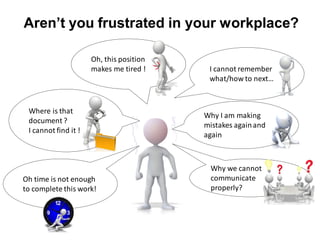
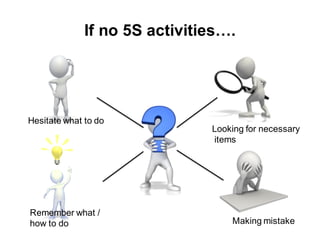
Aren’t you frustratedin your workplace?
I cannot remember
what/how to next…
Why I am making
mistakes againand
again
Oh, this position
makes me tired !
Where is that
document ?
I cannot find it !
Oh time is not enough
to complete this work!
Why we cannot
communicate
properly?
What is 5S?
• 5S is a philosophy and a way of organizing and
managing the workspace and work flow with the
intent to improve efficiency by eliminating waste,
improving flow and reducing process
unreasonableness.
It is for improvement of
working environment
8
9.
What is 5S?
• 5S activities are to create good working
environment through reduction of “Muri”,
“Mura”, and “Muda”
• It help to have a basis of strong management
of workplace
• What is “Muri”, “Mura”, and “Muda”?
– Muri : overburden, unreasonableness or absurdity
– Mura : unevenness or inconsistency, primarily
with physical matter and the human spiritual
condition
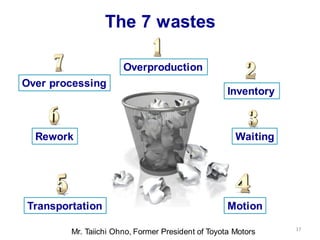
– Muda : activity which is wasteful or doesn’t add
value
Source: http://blog.5stoday.com/category/muri-mura-muda/
10.
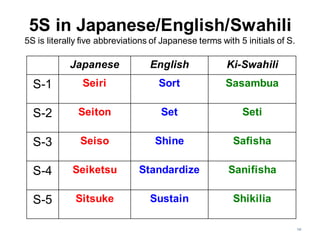
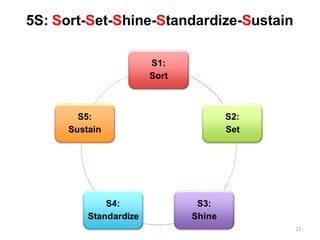
Japanese English Ki-Swahili
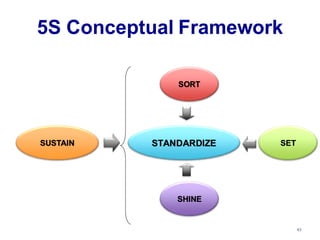
S-1Seiri Sort Sasambua
S-2 Seiton Set Seti
S-3 Seiso Shine Safisha
S-4 Seiketsu Standardize Sanifisha
S-5 Sitsuke Sustain Shikilia
5S in Japanese/English/Swahili
5S is literally five abbreviations of Japanese terms with 5 initials of S.
10
11.
Background on 5Sactivities
• The word “5S(five S)” was generalized in
1980’s in manufacturing sector in Japan,
as Toyota Production System (TPS)
became famous in the sector and “5S
activities” were set as one of the bases of
TPS
• Service industry started to used “5S” in
1990’s
12.
Background:
- National DemonstrationProject -
• NDP was designed to test TQM approach for
health care quality and safety improvement
• NDP was conducted in US (1989-1990) and
Japan (2000-2004)
• Many private hospitals in Asia, Europe, and
US are practicing KAIZEN-TQM approaches
for health care quality, hospitals management
and safety improvement
12
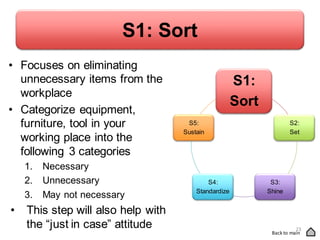
S1: Sort
• Focuseson eliminating
unnecessary items from the
workplace
• Categorize equipment,
furniture, tool in your
working place into the
following 3 categories
1. Necessary
2. Unnecessary
3. May not necessary
• This step will also help with
the “just in case” attitude
S1:
Sort
S2:
Set
S3:
Shine
S4:
Standardize
S5:
Sustain
23
Back to main
24.
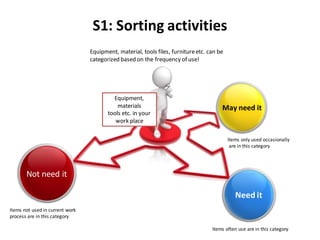
Equipment,
materials
tools etc. inyour
work place
Need it
May need it
Not need it
Equipment, material, tools files, furnitureetc. can be
categorized based on the frequency of use!
Items often use are in this category
Items not used in current work
process are in this category
Items only used occasionally
are in this category
S1: Sorting activities
25.
Examples of “Sorting”
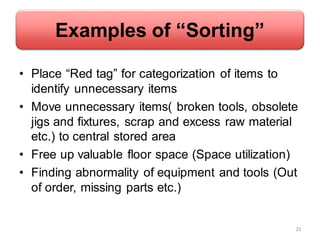
•Place “Red tag” for categorization of items to
identify unnecessary items
• Move unnecessary items( broken tools, obsolete
jigs and fixtures, scrap and excess raw material
etc.) to central stored area
• Free up valuable floor space (Space utilization)
• Finding abnormality of equipment and tools (Out
of order, missing parts etc.)
25
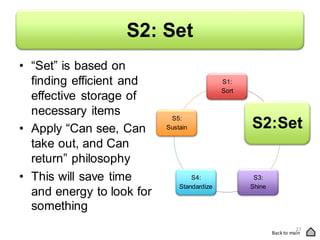
S2: Set
• “Set”is based on
finding efficient and
effective storage of
necessary items
• Apply “Can see, Can
take out, and Can
return” philosophy
• This will save time
and energy to look for
something
S1:
Sort
S2:Set
S3:
Shine
S4:
Standardize
S5:
Sustain
27
Back to main
28.
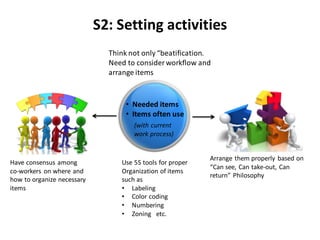
S2: Setting activities
•Needed items
• Items often use
Have consensus among
co-workers on where and
how to organize necessary
items
Arrange them properly based on
“Can see, Can take-out, Can
return” Philosophy
Use 5S tools for proper
Organization of items
such as
• Labeling
• Color coding
• Numbering
• Zoning etc.
Think not only “beatification.
Need to consider workflow and
arrange items
(with current
work process)
29.
Example of “Setting”activities
• Labeling , numbering, zoning for clear
identification of storage areas to keep
necessary items
• Set necessary items matching with
workflow to minimize unnecessary
movement and transportation time
29
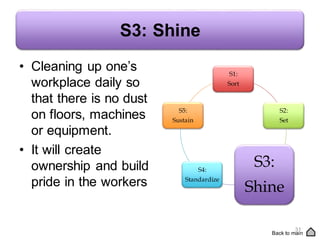
S3: Shine
• Cleaningup one’s
workplace daily so
that there is no dust
on floors, machines
or equipment.
• It will create
ownership and build
pride in the workers
S1:
Sort
S2:
Set
S3:
Shine
S4:
Standardize
S5:
Sustain
31
Back to main
32.
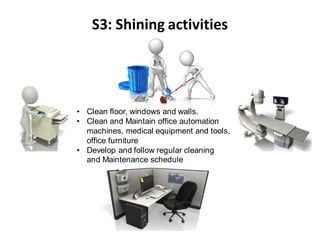
S3: Shining activities
•Clean floor, windows and walls.
• Clean and Maintain office automation
machines, medical equipment and tools,
office furniture
• Develop and follow regular cleaning
and Maintenance schedule
33.
Example of “Shining”activities
• Daily sweeping and mopping of floor,
bathroom, corridor etc.
• Regular cleaning and maintenance of
equipment and tools
• Periodical check for changes in equipment
and the service area such as: leaks,
vibration, misalignment, breakage etc.
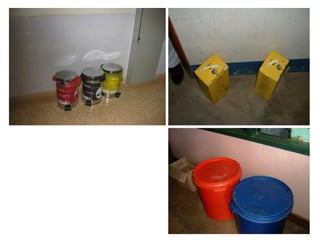
• IPC activities such as hand hygiene, waste
segregation are also part of shine
33
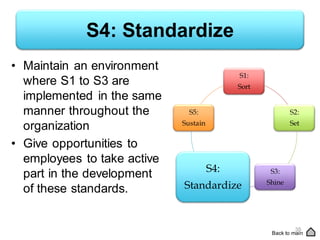
S4: Standardize
• Maintainan environment
where S1 to S3 are
implemented in the same
manner throughout the
organization
• Give opportunities to
employees to take active
part in the development
of these standards.
S1:
Sort
S2:
Set
S3:
Shine
S4:
Standardize
S5:
Sustain
35
Back to main
Example of “Standardize”
activities
•Work instructions, Standard Operating
Procedures (SOPs)
• Checklist development and regular usage
for SOPs
• Mechanism and format development for
ordering supplies, reporting etc
• Color coding for waste segregation
• Standardized common symbols
37
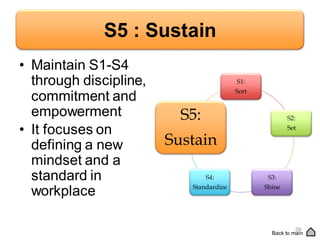
S5 : Sustain
•Maintain S1-S4
through discipline,
commitment and
empowerment
• It focuses on
defining a new
mindset and a
standard in
workplace
S1:
Sort
S2:
Set
S3:
Shine
S4:
Standardize
S5:
Sustain
39
Back to main
40.
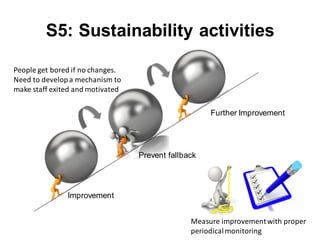
S5: Sustainability activities
Preventfallback
Improvement
Further Improvement
Measure improvementwith proper
periodicalmonitoring
People get bored if no changes.
Need to developa mechanism to
make staff exited and motivated
41.
Example of “Sustain”activities
• Regular progress reporting
• Refresher training
• Periodical evaluation of 5S activities with
proper advices for continuation and
further improvements
• Appreciation, recognition and awarding
on good 5S activities
• Reminder using 5S corner, new letters,
good practice sheet etc.
41
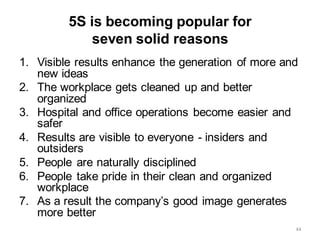
5S is becomingpopular for
seven solid reasons
1. Visible results enhance the generation of more and
new ideas
2. The workplace gets cleaned up and better
organized
3. Hospital and office operations become easier and
safer
4. Results are visible to everyone - insiders and
outsiders
5. People are naturally disciplined
6. People take pride in their clean and organized
workplace
7. As a result the company’s good image generates
more better
44
45.
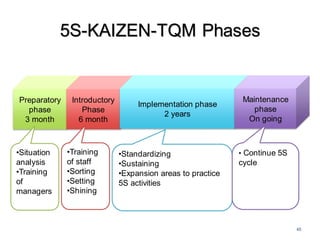
Preparatory
phase
3 month
Introductory
Phase
6 month
Implementationphase
2 years
Maintenance
phase
On going
•Situation
analysis
•Training
of
managers
•Training
of staff
•Sorting
•Setting
•Shining
•Standardizing
•Sustaining
•Expansion areas to practice
5S activities
• Continue 5S
cycle
5S-KAIZEN-TQM Phases
45
46.
Target of 5S
Targetsof Five-S include:
✓Zero changeovers leading to product/ service
diversification
✓Zero defects leading to higher quality
✓Zero waste leading to lower cost
✓Zero delays leading to on time delivery
✓Zero injuries promoting safety
✓Zero breakdowns bringing better
maintenance
46
47.
Remember (1/2)
• 5Simplementation can improve both working
environment and the service content.
– Benefits on WEI will be better realized as you go
along the training.
• Go systematically to implement S1-S5:
– Sort necessary & unnecessary items;
– Arrange items according to work flow;
– Make workplace and tools shining (daily
cleaning);
– Standardize “sort-set-shine” process; and
– Workers acquire positive attitude to sustain &
improve quality of health services.
47
48.
Remember (2/2)
• Effectivenessof 5S in improving health care
services content:
– Complement to patient safety efforts, e.g.,
• Minimizes chances of providing wrong
medicine, and treating wrong patients through
proper sorting (files, records) and appropriate
labeling (medicines, op-sites), as well as, use
of checklist to avoid leaving items (such as
gauze and scissors) by use of safe surgery
checklist.
– Contribute to better continuum of care, e.g.,
• Use of patient discharge checklists ensure
correct linkages to needed services.
48
49.
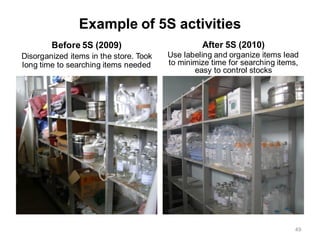
Example of 5Sactivities
Before 5S (2009)
Disorganized items in the store. Took
long time to searching items needed
After 5S (2010)
Use labeling and organize items lead
to minimize time for searching items,
easy to control stocks
49
50.
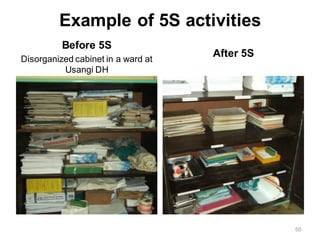
Example of 5Sactivities
Before 5S
Disorganized cabinet in a ward at
Usangi DH
After 5S
50
51.
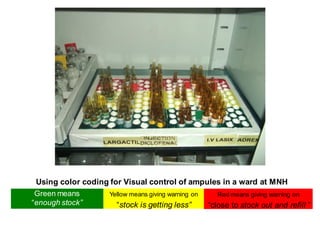
Using color codingfor Visual control of ampules in a ward at MNH
Green means
“enough stock”
Yellow means giving warning on
“stock is getting less”
Red means giving warning on
“close to stock out and refill ”
52.
Wrap-up
• Positive attitudeis very important for implementation
of 5S activities
• It is not “Cleaning Campaign”
• 5S activities are to create good working environment
through reduction of “Muri”(overburden),
“Mura”(unevenness), and “Muda”(waste)
• 5S can identify and reduce “abnormalities” and
“waste”, improve “team work”, “cleanness”, “safety”
and “productivity”
• It is a basis of organization management