B Y A D A M G R E E N E C PA
WHAT YOU NEED TO KNOW FOR
THE CPA EXAM
HISTORY AND OVERVIEW
The Uniform CPA Examination provide
reasonable assurance to Boards of
Accountancy (the state entities that have
statutory authority to issue licenses) that
those who pass the CPA Examination
possess the level of technical knowledge
and the skills necessary for initial
licensure in protection of the public
interest. Public interest is protected when
only qualified individuals are admitted into
the profession.
Related: PROMETRIC Tester
If you are not convinced of the need of a
CPA, Adam Greene CPA invites you to
follow this Link.
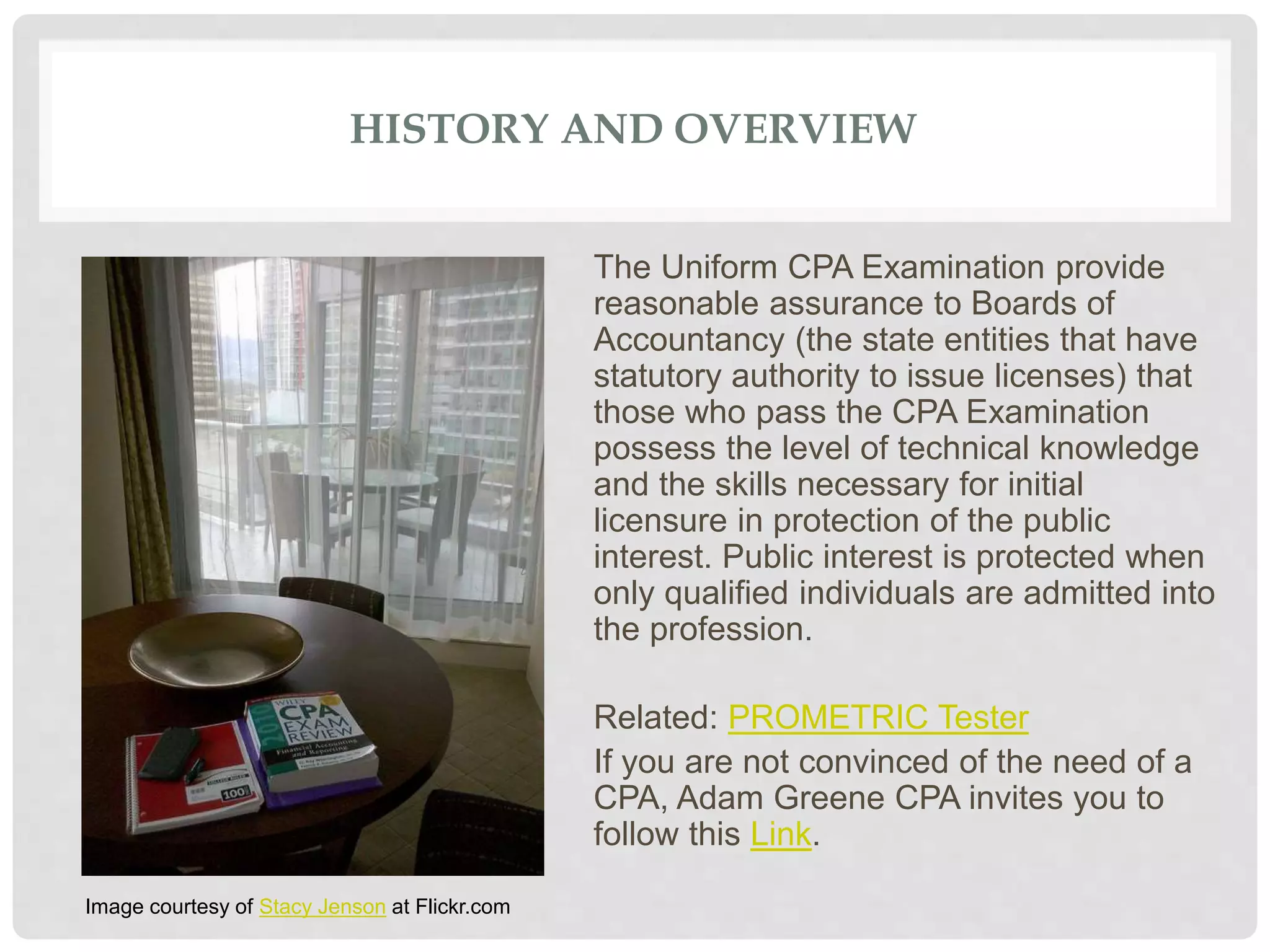
Image courtesy of Stacy Jenson at Flickr.com
HISTORY AND OVERVIEW
The Uniform CPA Examination developed from the examination that was
used for admission to membership in the American Institute of CPAs. In
1917, the Institute offered the examination for use in the licensure process
by Boards of Accountancy. At that time, Boards in three jurisdictions
accepted the invitation. It was not until 1952 that the examination was first
used in all jurisdictions. Until the end of 2003, the Uniform CPA
Examination was administered twice a year in the paper-and-pencil
format. In April 2004, the computer based CPA Examination was launched
and the paper-and-pencil examination was discontinued. In 2009, the
computer-based CPA Examination reached a milestone, one million
administrations. A new CPA Examination release is scheduled for 2017.
HISTORY AND OVERVIEW
The Uniform CPA Examination is the examination used by the regulatory
bodies of all fifty states, administered to people who wish to become U.S.
Certified Public Accountants. The CPA Exam is developed, maintained
and scored by the American Institute of Certified Public Accountants and
administered in partnership with the National Association of State Boards
of Accountancy. CPAs are the only licensed accounting professionals.
CPA licenses are issued by state boards of accountancy in the 55
jurisdictions – there is no national CPA licensure process in the U.S.
Since 1994, the exam is a four-section, two-day exam. Innovative
machine scoring test questions were incorporated to better assess the
skills needed by CPAs to protect the public. For the first time, proprietary
electronic calculators were provided to CPA candidates.
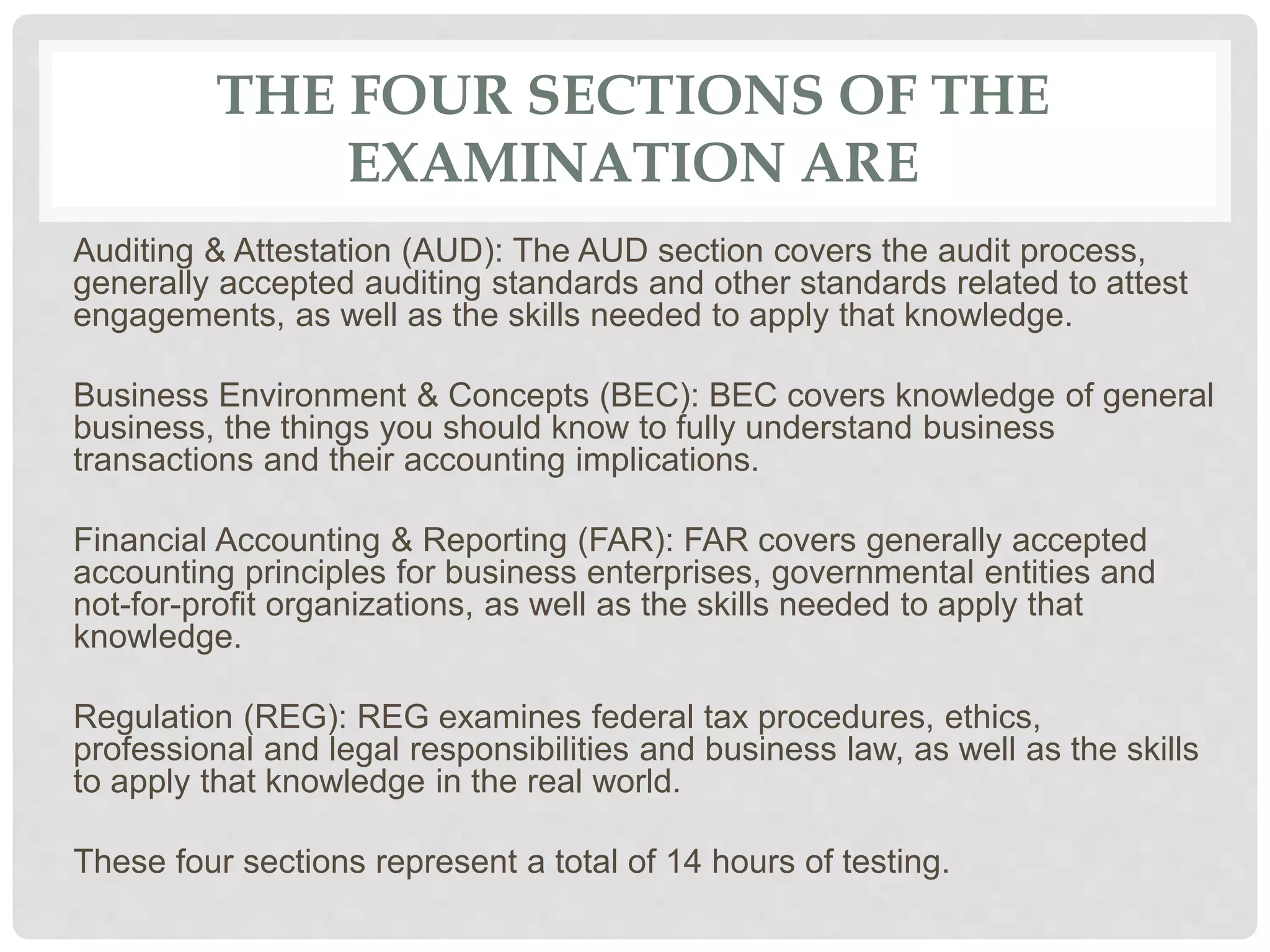
THE FOUR SECTIONS OF THE
EXAMINATION ARE
Auditing & Attestation (AUD): The AUD section covers the audit process,
generally accepted auditing standards and other standards related to attest
engagements, as well as the skills needed to apply that knowledge.
Business Environment & Concepts (BEC): BEC covers knowledge of general
business, the things you should know to fully understand business
transactions and their accounting implications.
Financial Accounting & Reporting (FAR): FAR covers generally accepted
accounting principles for business enterprises, governmental entities and
not-for-profit organizations, as well as the skills needed to apply that
knowledge.
Regulation (REG): REG examines federal tax procedures, ethics,
professional and legal responsibilities and business law, as well as the skills
to apply that knowledge in the real world.
These four sections represent a total of 14 hours of testing.
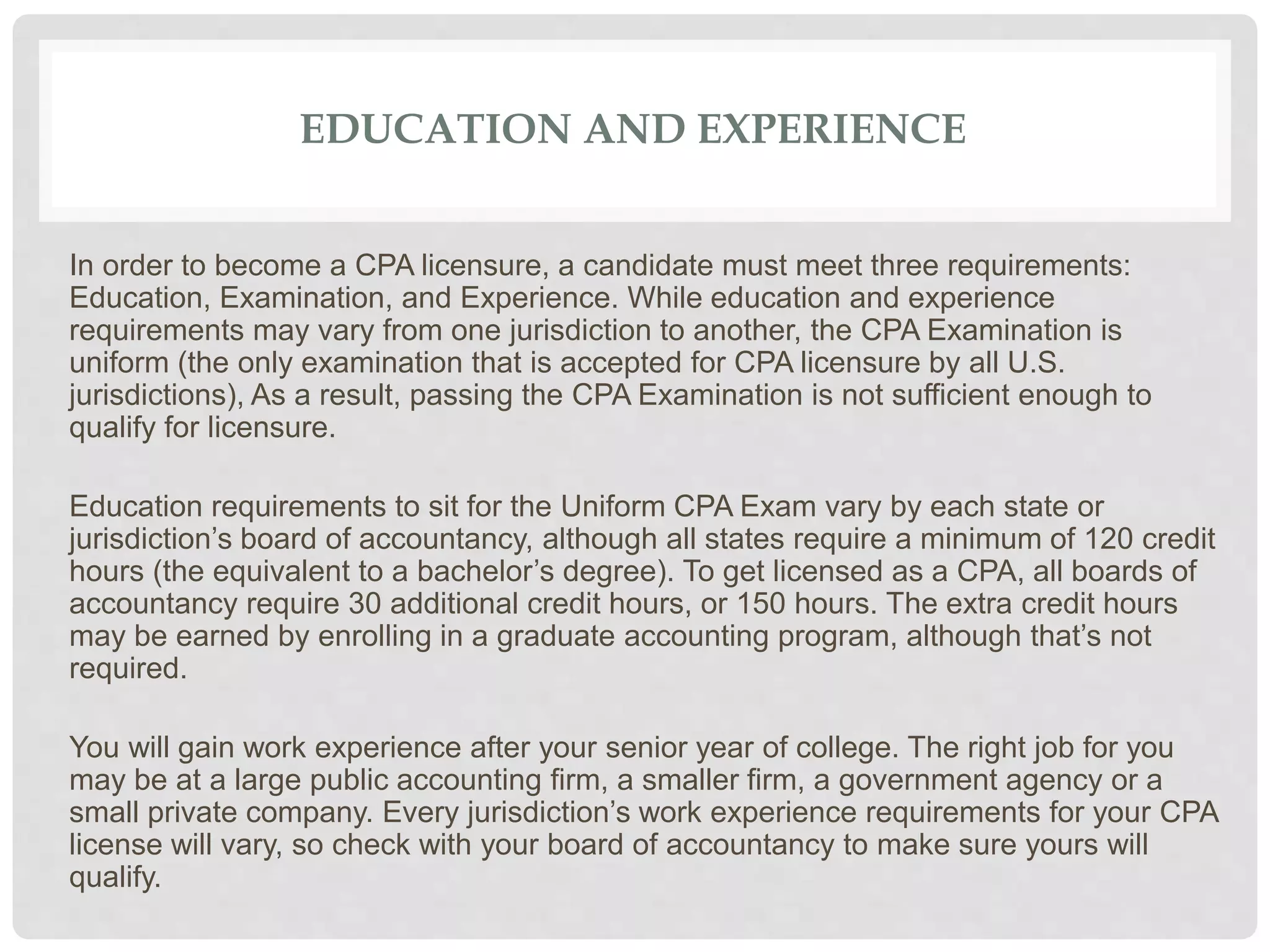
EDUCATION AND EXPERIENCE
In order to become a CPA licensure, a candidate must meet three requirements:
Education, Examination, and Experience. While education and experience
requirements may vary from one jurisdiction to another, the CPA Examination is
uniform (the only examination that is accepted for CPA licensure by all U.S.
jurisdictions), As a result, passing the CPA Examination is not sufficient enough to
qualify for licensure.
Education requirements to sit for the Uniform CPA Exam vary by each state or
jurisdiction’s board of accountancy, although all states require a minimum of 120 credit
hours (the equivalent to a bachelor’s degree). To get licensed as a CPA, all boards of
accountancy require 30 additional credit hours, or 150 hours. The extra credit hours
may be earned by enrolling in a graduate accounting program, although that’s not
required.
You will gain work experience after your senior year of college. The right job for you
may be at a large public accounting firm, a smaller firm, a government agency or a
small private company. Every jurisdiction’s work experience requirements for your CPA
license will vary, so check with your board of accountancy to make sure yours will
qualify.
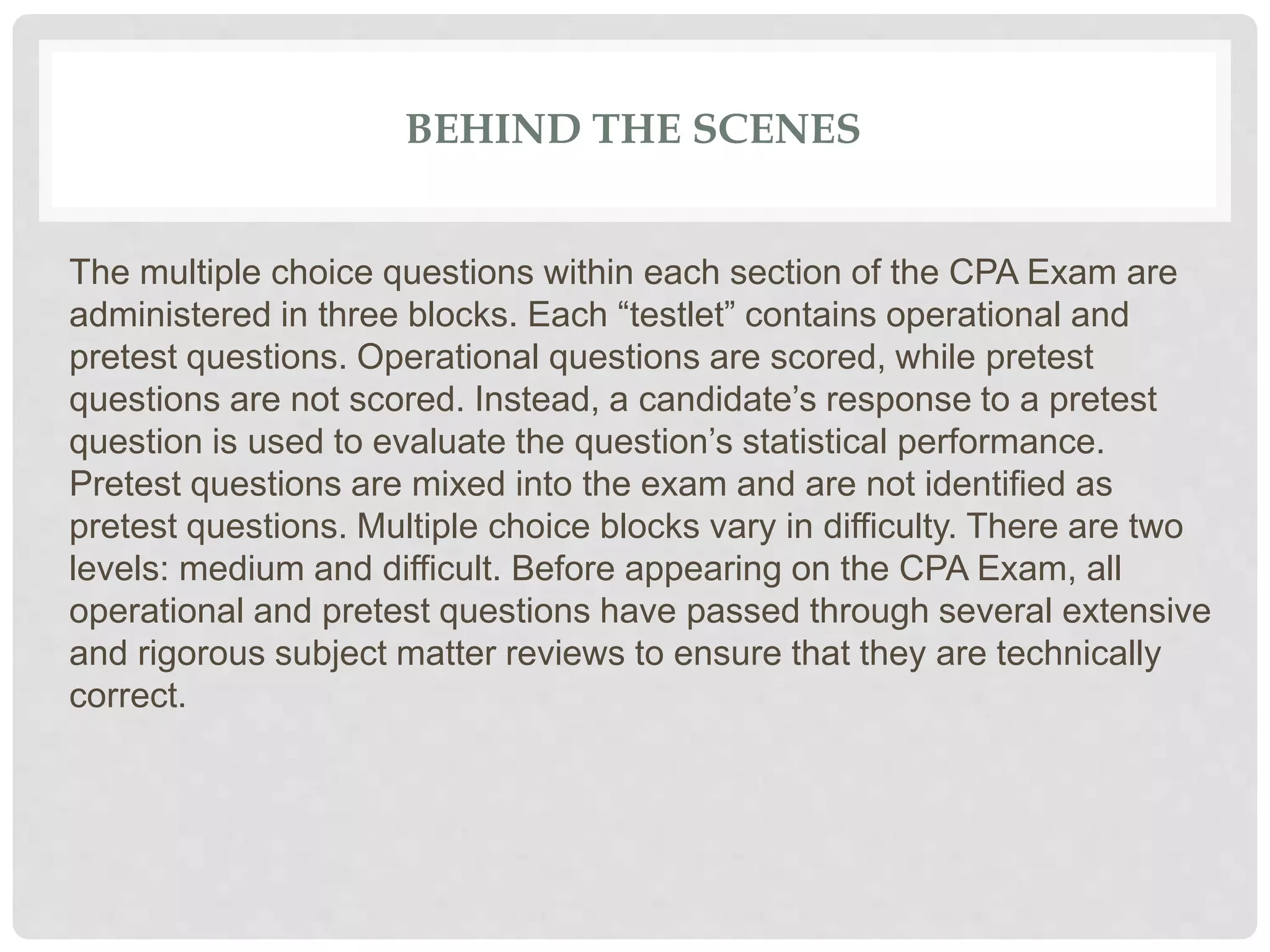
BEHIND THE SCENES
The multiple choice questions within each section of the CPA Exam are
administered in three blocks. Each “testlet” contains operational and
pretest questions. Operational questions are scored, while pretest
questions are not scored. Instead, a candidate’s response to a pretest
question is used to evaluate the question’s statistical performance.
Pretest questions are mixed into the exam and are not identified as
pretest questions. Multiple choice blocks vary in difficulty. There are two
levels: medium and difficult. Before appearing on the CPA Exam, all
operational and pretest questions have passed through several extensive
and rigorous subject matter reviews to ensure that they are technically
correct.
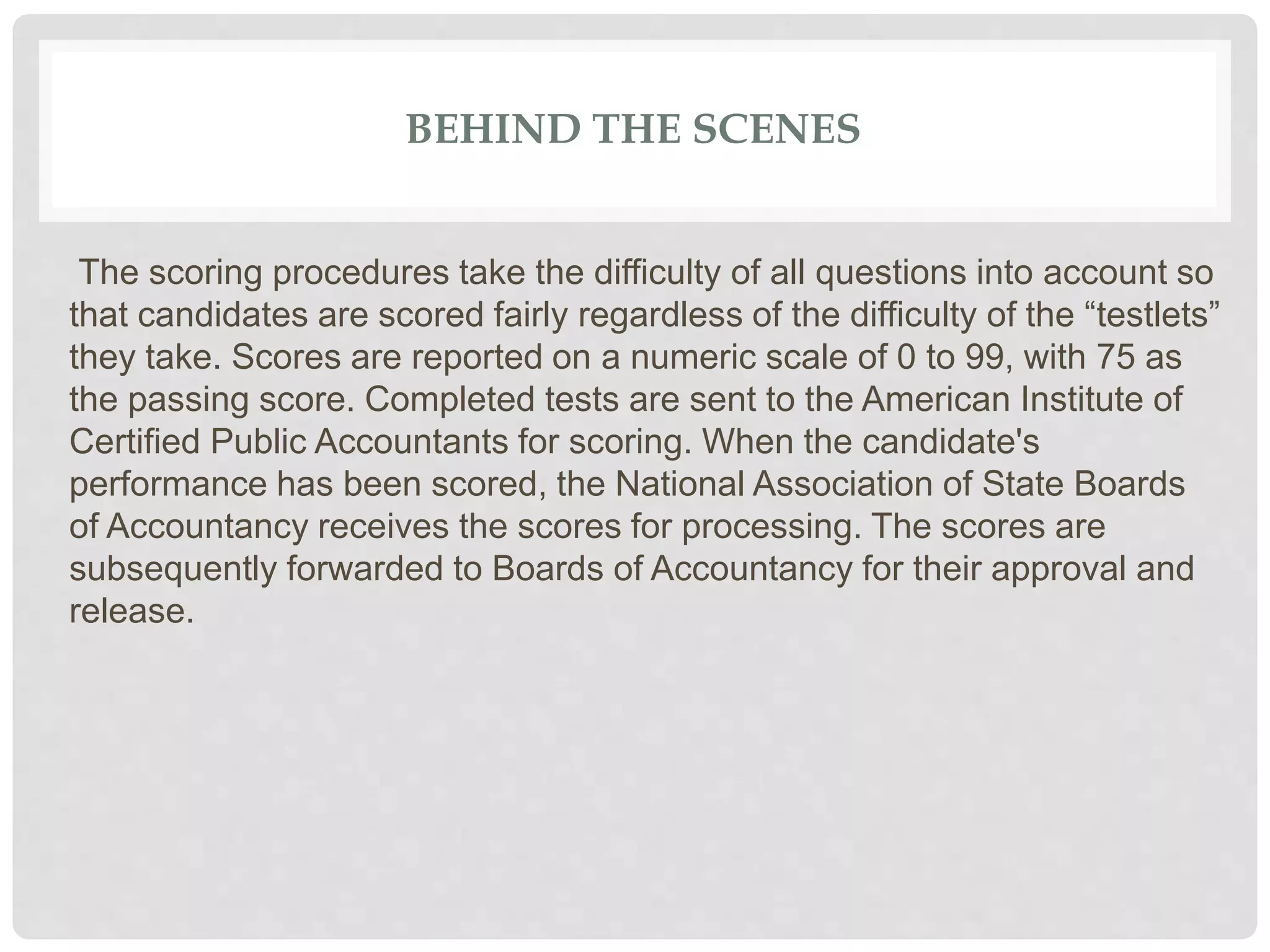
BEHIND THE SCENES
The scoring procedures take the difficulty of all questions into account so
that candidates are scored fairly regardless of the difficulty of the “testlets”
they take. Scores are reported on a numeric scale of 0 to 99, with 75 as
the passing score. Completed tests are sent to the American Institute of
Certified Public Accountants for scoring. When the candidate's
performance has been scored, the National Association of State Boards
of Accountancy receives the scores for processing. The scores are
subsequently forwarded to Boards of Accountancy for their approval and
release.

What you need to know for the CPA exam

  • 1.
    B Y AD A M G R E E N E C PA WHAT YOU NEED TO KNOW FOR THE CPA EXAM
  • 2.
    HISTORY AND OVERVIEW TheUniform CPA Examination provide reasonable assurance to Boards of Accountancy (the state entities that have statutory authority to issue licenses) that those who pass the CPA Examination possess the level of technical knowledge and the skills necessary for initial licensure in protection of the public interest. Public interest is protected when only qualified individuals are admitted into the profession. Related: PROMETRIC Tester If you are not convinced of the need of a CPA, Adam Greene CPA invites you to follow this Link. Image courtesy of Stacy Jenson at Flickr.com
  • 3.
    HISTORY AND OVERVIEW TheUniform CPA Examination developed from the examination that was used for admission to membership in the American Institute of CPAs. In 1917, the Institute offered the examination for use in the licensure process by Boards of Accountancy. At that time, Boards in three jurisdictions accepted the invitation. It was not until 1952 that the examination was first used in all jurisdictions. Until the end of 2003, the Uniform CPA Examination was administered twice a year in the paper-and-pencil format. In April 2004, the computer based CPA Examination was launched and the paper-and-pencil examination was discontinued. In 2009, the computer-based CPA Examination reached a milestone, one million administrations. A new CPA Examination release is scheduled for 2017.
  • 4.
    HISTORY AND OVERVIEW TheUniform CPA Examination is the examination used by the regulatory bodies of all fifty states, administered to people who wish to become U.S. Certified Public Accountants. The CPA Exam is developed, maintained and scored by the American Institute of Certified Public Accountants and administered in partnership with the National Association of State Boards of Accountancy. CPAs are the only licensed accounting professionals. CPA licenses are issued by state boards of accountancy in the 55 jurisdictions – there is no national CPA licensure process in the U.S. Since 1994, the exam is a four-section, two-day exam. Innovative machine scoring test questions were incorporated to better assess the skills needed by CPAs to protect the public. For the first time, proprietary electronic calculators were provided to CPA candidates.
  • 5.
    THE FOUR SECTIONSOF THE EXAMINATION ARE Auditing & Attestation (AUD): The AUD section covers the audit process, generally accepted auditing standards and other standards related to attest engagements, as well as the skills needed to apply that knowledge. Business Environment & Concepts (BEC): BEC covers knowledge of general business, the things you should know to fully understand business transactions and their accounting implications. Financial Accounting & Reporting (FAR): FAR covers generally accepted accounting principles for business enterprises, governmental entities and not-for-profit organizations, as well as the skills needed to apply that knowledge. Regulation (REG): REG examines federal tax procedures, ethics, professional and legal responsibilities and business law, as well as the skills to apply that knowledge in the real world. These four sections represent a total of 14 hours of testing.
  • 6.
    EDUCATION AND EXPERIENCE Inorder to become a CPA licensure, a candidate must meet three requirements: Education, Examination, and Experience. While education and experience requirements may vary from one jurisdiction to another, the CPA Examination is uniform (the only examination that is accepted for CPA licensure by all U.S. jurisdictions), As a result, passing the CPA Examination is not sufficient enough to qualify for licensure. Education requirements to sit for the Uniform CPA Exam vary by each state or jurisdiction’s board of accountancy, although all states require a minimum of 120 credit hours (the equivalent to a bachelor’s degree). To get licensed as a CPA, all boards of accountancy require 30 additional credit hours, or 150 hours. The extra credit hours may be earned by enrolling in a graduate accounting program, although that’s not required. You will gain work experience after your senior year of college. The right job for you may be at a large public accounting firm, a smaller firm, a government agency or a small private company. Every jurisdiction’s work experience requirements for your CPA license will vary, so check with your board of accountancy to make sure yours will qualify.
  • 7.
    BEHIND THE SCENES Themultiple choice questions within each section of the CPA Exam are administered in three blocks. Each “testlet” contains operational and pretest questions. Operational questions are scored, while pretest questions are not scored. Instead, a candidate’s response to a pretest question is used to evaluate the question’s statistical performance. Pretest questions are mixed into the exam and are not identified as pretest questions. Multiple choice blocks vary in difficulty. There are two levels: medium and difficult. Before appearing on the CPA Exam, all operational and pretest questions have passed through several extensive and rigorous subject matter reviews to ensure that they are technically correct.
  • 8.
    BEHIND THE SCENES Thescoring procedures take the difficulty of all questions into account so that candidates are scored fairly regardless of the difficulty of the “testlets” they take. Scores are reported on a numeric scale of 0 to 99, with 75 as the passing score. Completed tests are sent to the American Institute of Certified Public Accountants for scoring. When the candidate's performance has been scored, the National Association of State Boards of Accountancy receives the scores for processing. The scores are subsequently forwarded to Boards of Accountancy for their approval and release.