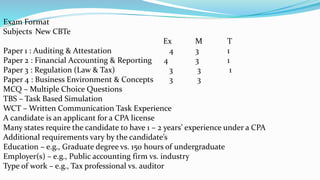
A Certified Public Accountant (CPA) is a qualified accountant who has passed the Uniform Certified Public Accountant Examination and met state-specific education and experience requirements. The CPA designation was established in 1896 in New York, and most states now require candidates to complete 150 semester hours of education, which often involves a combined bachelor's and master's program. There are various requirements for licensure, including education, examination, and relevant experience under a CPA.


![CPA exam
In order to become a CPA in the United States,
the candidate must sit for and pass the Uniform
Certified Public Accountant
Examination (Uniform CPA Exam), which is set
by theAmerican Institute of Certified Public
Accountants (AICPA) and administered by
the National Association of State Boards of
Accountancy (NASBA). The CPA designation
was first established in law in New York State
on April 17, 1896.[2]
Eligibility to sit for the Uniform CPA Exam is
determined by individual state boards of
accountancy. All states have adopted what is
known as the "150 hour rule" (150 college
semester units or the equivalent), which usually
requires an additional year of education past a
regular 4 year college degree, or a master's
degree. (As such, universities offer commonly
offer combined 5-year bachelor's/master's
degree programs, allowing a student to earn
both degrees while receiving the 150 hours
needed for exam eligibility.)](https://image.slidesharecdn.com/ppt-160401043637/85/CPA-Training-3-320.jpg)