www.theijbmt.com 101|Page
The International Journal of Business Management and Technology, Volume 3 Issue 4 July – August 2019
ISSN: 2581-3889
Research Article Open Access
What is the Intelligence Level Can Increase Employee
Performance PT. PLN?
Suprapto, Priyono, and Sri Kaidah
Faculty of Economics and Business, Mercu Buana University, Jakarta
ABSTRACT: In the business world, companies need high performance. Performance is the result or overall success rate
of a person over a period of time in carrying out tasks compared to various possibilities, such as predetermined
standards of work, targets, or criteria. The purpose of the study was to analyze the influence of intellectual intelligence,
emotional intelligence, and spiritual intelligence on employee performance. The population in this study were 63
employees of PT PLN (Persero). This study uses quantitative associative, with data analysis used is multiple linear
regression analysis. The results showed that both intellectual intelligence, emotional intelligence, and spiritual
intelligence had a positive and significant effect on employee performance. Intellectual intelligence has the greatest
influence on employee performance, followed by spiritual intelligence and emotional intelligence. Intellectual
intelligence, emotional intelligence and spiritual intelligence together have an effect of 52.4% on employee performance,
and the remaining 47.6% is influenced by other factors not explained in this study.
Keywords: Employee Performance, Intellectual Intelligence, Emotional Intelligence, Spiritual Intelligence
I. INTRODUCTION
Human resources (HR) is one of the key factors in economic reform, namely how to create qualified and skilled
human resources and highly competitive in global competition (Herminingsih, 2017). The position of HR, especially
about the quality of human resources in a larger system, namely organizational strategy. HR Employees or management
are increasingly recognized as strategic assets of an organization (Nurhayati, 2018).
The level of success of a company in managing the resources it has to be able to improve work efficiency and
effectiveness. The company's success and performance can be seen from the performance achieved by its employees,
therefore the company demands that its employees be able to display optimal performance because the poor
performance achieved by employees will affect the performance and success of the company as a whole (Sulastri et al.,
2016 ).
PT PLN (Persero) Sumatra Java Interconnection Development Unit Java is a company in the electricity sector
that is trusted in the construction of High Voltage Direct Current (HVDC) technology, which is the main transmission
cable placed under the sea to carry electrical power from one place to another place. Job Location Sumatra Java
Interconnection development work crosses 4 (four) provinces, namely: 1. South Sumatra 2. Lampung 3. Banten 4. West
Java. The Sumatra Sumatra Interconnection Development Unit PT PLN has competent human resources from various
educational backgrounds who carry out the day-to-day operational activities of the organization. Besides that, the
employee performance of the Sumatra Java Interconnection Development Unit PT PLN has a tendency to experience a
decline in performance.
According to Bangun (2015), performance (performance) is the result of work achieved by a person based on
job requirements (job requirements). One of the factors that influence the increase in HR performance through internal
factors (individual) employees, namely ability (ability). One's abilities are determined by the intelligence he possesses,
namely intellectual intelligence. According to Widodo (2012) in Sulastri, et al (2016) intellectual intelligence is
intellectual ability, analysis, logic, and ratio. This intelligence is the intelligence to receive, store, and process information
into facts. intellectual intelligence is the ability to solve problems or create a product that is valuable in one or several
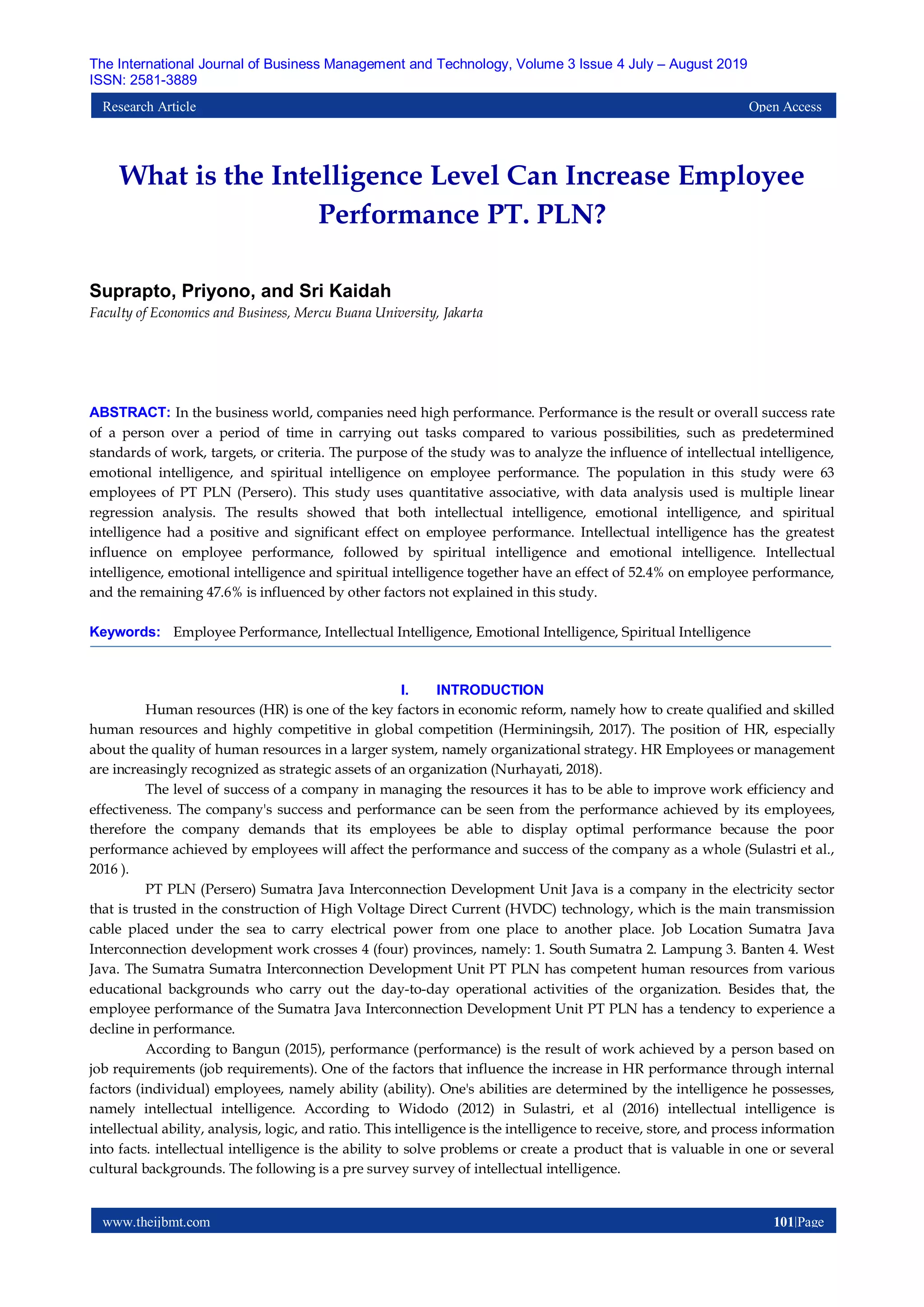
cultural backgrounds. The following is a pre survey survey of intellectual intelligence.
www.theijbmt.com 102|Page
What is the Intelligence Level Can Increase Employee Performance PT. PLN ?
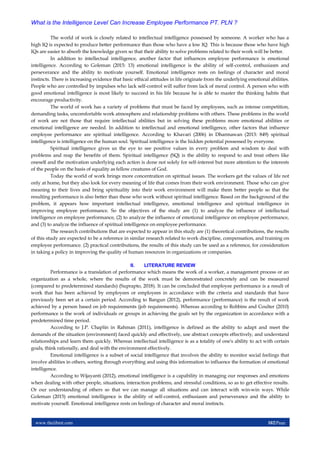
The world of work is closely related to intellectual intelligence possessed by someone. A worker who has a
high IQ is expected to produce better performance than those who have a low IQ. This is because those who have high
IQs are easier to absorb the knowledge given so that their ability to solve problems related to their work will be better.
In addition to intellectual intelligence, another factor that influences employee performance is emotional
intelligence. According to Goleman (2015: 13) emotional intelligence is the ability of self-control, enthusiasm and
perseverance and the ability to motivate yourself. Emotional intelligence rests on feelings of character and moral
instincts. There is increasing evidence that basic ethical attitudes in life originate from the underlying emotional abilities.
People who are controlled by impulses who lack self-control will suffer from lack of moral control. A person who with
good emotional intelligence is most likely to succeed in his life because he is able to master the thinking habits that
encourage productivity.
The world of work has a variety of problems that must be faced by employees, such as intense competition,
demanding tasks, uncomfortable work atmosphere and relationship problems with others. These problems in the world
of work are not those that require intellectual abilities but in solving these problems more emotional abilities or
emotional intelligence are needed. In addition to intellectual and emotional intelligence, other factors that influence
employee performance are spiritual intelligence. According to Khavari (2006) in Dharmawan (2013: 849) spiritual
intelligence is intelligence on the human soul. Spiritual intelligence is the hidden potential possessed by everyone.
Spiritual intelligence gives us the eye to see positive values in every problem and wisdom to deal with
problems and reap the benefits of them. Spiritual intelligence (SQ) is the ability to respond to and treat others like
oneself and the motivation underlying each action is done not solely for self-interest but more attention to the interests
of the people on the basis of equality as fellow creatures of God.
Today the world of work brings more concentration on spiritual issues. The workers get the values of life not
only at home, but they also look for every meaning of life that comes from their work environment. Those who can give
meaning to their lives and bring spirituality into their work environment will make them better people so that the
resulting performance is also better than those who work without spiritual intelligence. Based on the background of the
problem, it appears how important intellectual intelligence, emotional intelligence and spiritual intelligence in
improving employee performance. So the objectives of the study are (1) to analyze the influence of intellectual
intelligence on employee performance, (2) to analyze the influence of emotional intelligence on employee performance,
and (3) to analyze the influence of spiritual intelligence on employee performance.
The research contributions that are expected to appear in this study are (1) theoretical contributions, the results
of this study are expected to be a reference in similar research related to work discipline, compensation, and training on
employee performance. (2) practical contributions, the results of this study can be used as a reference, for consideration
in taking a policy in improving the quality of human resources in organizations or companies.
II. LITERATURE REVIEW
Performance is a translation of performance which means the work of a worker, a management process or an
organization as a whole, where the results of the work must be demonstrated concretely and can be measured
(compared to predetermined standards) (Suprapto, 2018). It can be concluded that employee performance is a result of
work that has been achieved by employees or employees in accordance with the criteria and standards that have
previously been set at a certain period. According to Bangun (2012), performance (performance) is the result of work
achieved by a person based on job requirements (job requirements). Whereas according to Robbins and Coulter (2010)
performance is the work of individuals or groups in achieving the goals set by the organization in accordance with a
predetermined time period.
According to J.P. Chaplin in Rahman (2011), intelligence is defined as the ability to adapt and meet the
demands of the situation (environment) faced quickly and effectively, use abstract concepts effectively, and understand
relationships and learn them quickly. Whereas intellectual intelligence is as a totality of one's ability to act with certain
goals, think rationally, and deal with the environment effectively.
Emotional intelligence is a subset of social intelligence that involves the ability to monitor social feelings that
involve abilities in others, sorting through everything and using this information to influence the formation of emotional
intelligence.
According to Wijayanti (2012), emotional intelligence is a capability in managing our responses and emotions
when dealing with other people, situations, interaction problems, and stressful conditions, so as to get effective results.
Or our understanding of others so that we can manage all situations and can interact with win-win ways. While
Goleman (2015) emotional intelligence is the ability of self-control, enthusiasm and perseverance and the ability to
motivate yourself. Emotional intelligence rests on feelings of character and moral instincts.
www.theijbmt.com 103|Page
What is the Intelligence Level Can Increase Employee Performance PT. PLN ?
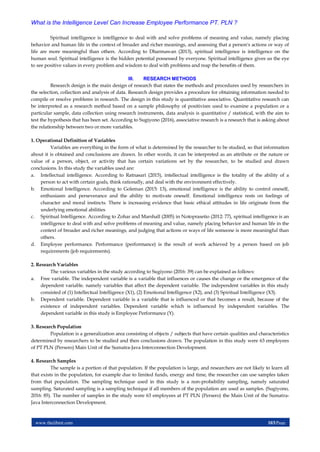
Spiritual intelligence is intelligence to deal with and solve problems of meaning and value, namely placing
behavior and human life in the context of broader and richer meanings, and assessing that a person's actions or way of
life are more meaningful than others. According to Dharmawan (2013), spiritual intelligence is intelligence on the
human soul. Spiritual intelligence is the hidden potential possessed by everyone. Spiritual intelligence gives us the eye
to see positive values in every problem and wisdom to deal with problems and reap the benefits of them.
III. RESEARCH METHODS
Research design is the main design of research that states the methods and procedures used by researchers in
the selection, collection and analysis of data. Research design provides a procedure for obtaining information needed to
compile or resolve problems in research. The design in this study is quantitative associative. Quantitative research can
be interpreted as a research method based on a sample philosophy of positivism used to examine a population or a
particular sample, data collection using research instruments, data analysis is quantitative / statistical, with the aim to
test the hypothesis that has been set. According to Sugiyono (2016), associative research is a research that is asking about
the relationship between two or more variables.
1. Operational Definition of Variables
Variables are everything in the form of what is determined by the researcher to be studied, so that information
about it is obtained and conclusions are drawn. In other words, it can be interpreted as an attribute or the nature or
value of a person, object, or activity that has certain variations set by the researcher, to be studied and drawn
conclusions. In this study the variables used are:
a. Intellectual intelligence. According to Ratnasari (2015), intellectual intelligence is the totality of the ability of a
person to act with certain goals, think rationally, and deal with the environment effectively.
b. Emotional Intelligence. According to Goleman (2015: 13), emotional intelligence is the ability to control oneself,
enthusiasm and perseverance and the ability to motivate oneself. Emotional intelligence rests on feelings of
character and moral instincts. There is increasing evidence that basic ethical attitudes in life originate from the
underlying emotional abilities
c. Spiritual Intelligence. According to Zohar and Marshall (2005) in Notoprasetio (2012: 77), spiritual intelligence is an
intelligence to deal with and solve problems of meaning and value, namely placing behavior and human life in the
context of broader and richer meanings, and judging that actions or ways of life someone is more meaningful than
others.
d. Employee performance. Performance (performance) is the result of work achieved by a person based on job
requirements (job requirements).
2. Research Variables
The various variables in the study according to Sugiyono (2016: 39) can be explained as follows:
a. Free variable. The independent variable is a variable that influences or causes the change or the emergence of the
dependent variable. namely variables that affect the dependent variable. The independent variables in this study
consisted of (1) Intellectual Intelligence (X1), (2) Emotional Intelligence (X2), and (3) Spiritual Intelligence (X3).
b. Dependent variable. Dependent variable is a variable that is influenced or that becomes a result, because of the
existence of independent variables. Dependent variable which is influenced by independent variables. The
dependent variable in this study is Employee Performance (Y).
3. Research Population
Population is a generalization area consisting of objects / subjects that have certain qualities and characteristics
determined by researchers to be studied and then conclusions drawn. The population in this study were 63 employees
of PT PLN (Persero) Main Unit of the Sumatra-Java Interconnection Development.
4. Research Samples
The sample is a portion of that population. If the population is large, and researchers are not likely to learn all
that exists in the population, for example due to limited funds, energy and time, the researcher can use samples taken
from that population. The sampling technique used in this study is a non-probability sampling, namely saturated
sampling. Saturated sampling is a sampling technique if all members of the population are used as samples. (Sugiyono,
2016: 85). The number of samples in the study were 63 employees at PT PLN (Persero) the Main Unit of the Sumatra-
Java Interconnection Development.
www.theijbmt.com 104|Page
What is the Intelligence Level Can Increase Employee Performance PT. PLN ?
5. Data Collection Techniques
Data collection techniques, in this study include the following:
a. Observation. Observation is a complex process, a process composed of various biological and psychological
processes. Two of the most important are the processes of observation and memory. In this study observational
researchers at PT. PLN (Persero) Main Unit of Sumatra-Java Interconnection Development, having its address at
Jalan Aipda KS. Tubun I / II Petamburan, West Jakarta.
b. Questionnaire / Questionnaire. Questionnaires are data collection techniques that are carried out by giving a set of
questions or written statements to the respondent to answer. The statements or questions in the questionnaire will
be measured using a Likert scale type
IV. RESULTS AND DISCUSSION
1). Multiple Linear Regression Test
Multiple linear regression analysis is an analysis to determine the effect or relationship linearly between
independent variables (intellectual intelligence, emotional intelligence, spiritual intelligence) on the dependent variable,
namely employee performance. Used to predict or predict the direction of the relationship of a dependent variable based
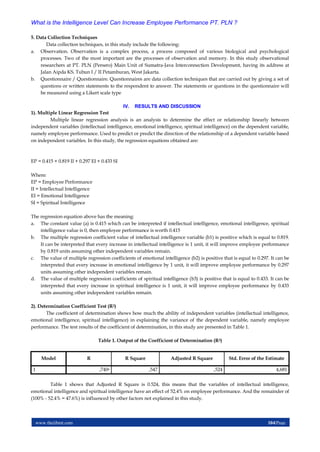
on independent variables. In this study, the regression equations obtained are:
EP = 0.415 + 0.819 II + 0.297 EI + 0.433 SI
Where:
EP = Employee Performance
II = Intellectual Intelligence
EI = Emotional Intelligence
SI = Spiritual Intelligence
The regression equation above has the meaning:
a. The constant value (a) is 0.415 which can be interpreted if intellectual intelligence, emotional intelligence, spiritual
intelligence value is 0, then employee performance is worth 0.415
b. The multiple regression coefficient value of intellectual intelligence variable (b1) is positive which is equal to 0.819.
It can be interpreted that every increase in intellectual intelligence is 1 unit, it will improve employee performance
by 0.819 units assuming other independent variables remain.
c. The value of multiple regression coefficients of emotional intelligence (b2) is positive that is equal to 0.297. It can be
interpreted that every increase in emotional intelligence by 1 unit, it will improve employee performance by 0.297
units assuming other independent variables remain.
d. The value of multiple regression coefficients of spiritual intelligence (b3) is positive that is equal to 0.433. It can be
interpreted that every increase in spiritual intelligence is 1 unit, it will improve employee performance by 0.433
units assuming other independent variables remain.
2). Determination Coefficient Test (R2)
The coefficient of determination shows how much the ability of independent variables (intellectual intelligence,
emotional intelligence, spiritual intelligence) in explaining the variance of the dependent variable, namely employee
performance. The test results of the coefficient of determination, in this study are presented in Table 1.
Table 1. Output of the Coefficient of Determination (R2)
Model R R Square Adjusted R Square Std. Error of the Estimate
1 ,740a ,547 ,524 4,681
Table 1 shows that Adjusted R Square is 0.524, this means that the variables of intellectual intelligence,
emotional intelligence and spiritual intelligence have an effect of 52.4% on employee performance. And the remainder of
(100% - 52.4% = 47.6%) is influenced by other factors not explained in this study.
www.theijbmt.com 105|Page
What is the Intelligence Level Can Increase Employee Performance PT. PLN ?
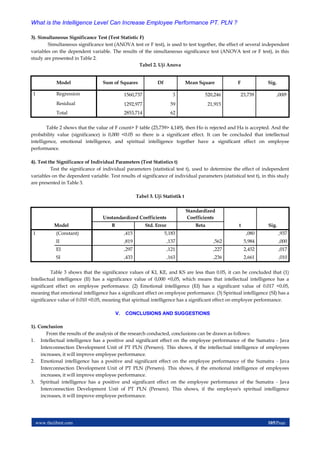
3). Simultaneous Significance Test (Test Statistic F)
Simultaneous significance test (ANOVA test or F test), is used to test together, the effect of several independent
variables on the dependent variable. The results of the simultaneous significance test (ANOVA test or F test), in this
study are presented in Table 2.
Tabel 2. Uji Anova
Model Sum of Squares Df Mean Square F Sig.
1 Regression 1560,737 3 520,246 23,739 ,000b
Residual 1292,977 59 21,915
Total 2853,714 62
Table 2 shows that the value of F count> F table (23,739> 4,149), then Ho is rejected and Ha is accepted. And the
probability value (significance) is 0,000 <0.05 so there is a significant effect. It can be concluded that intellectual
intelligence, emotional intelligence, and spiritual intelligence together have a significant effect on employee
performance.
4). Test the Significance of Individual Parameters (Test Statistics t)
Test the significance of individual parameters (statistical test t), used to determine the effect of independent
variables on the dependent variable. Test results of significance of individual parameters (statistical test t), in this study
are presented in Table 3.
Tabel 3. Uji Statistik t
Model
Unstandardized Coefficients
Standardized
Coefficients
t Sig.B Std. Error Beta
1 (Constant) ,415 5,183 ,080 ,937
II ,819 ,137 ,562 5,984 ,000
EI ,297 ,121 ,227 2,452 ,017
SI ,433 ,163 ,236 2,661 ,010
Table 3 shows that the significance values of KI, KE, and KS are less than 0.05, it can be concluded that (1)
Intellectual intelligence (II) has a significance value of 0,000 <0,05, which means that intellectual intelligence has a
significant effect on employee performance. (2) Emotional intelligence (EI) has a significant value of 0.017 <0.05,
meaning that emotional intelligence has a significant effect on employee performance. (3) Spiritual intelligence (SI) has a
significance value of 0.010 <0.05, meaning that spiritual intelligence has a significant effect on employee performance.
V. CONCLUSIONS AND SUGGESTIONS
1). Conclusion
From the results of the analysis of the research conducted, conclusions can be drawn as follows:
1. Intellectual intelligence has a positive and significant effect on the employee performance of the Sumatra - Java
Interconnection Development Unit of PT PLN (Persero). This shows, if the intellectual intelligence of employees
increases, it will improve employee performance.
2. Emotional intelligence has a positive and significant effect on the employee performance of the Sumatra - Java
Interconnection Development Unit of PT PLN (Persero). This shows, if the emotional intelligence of employees
increases, it will improve employee performance.
3. Spiritual intelligence has a positive and significant effect on the employee performance of the Sumatra - Java
Interconnection Development Unit of PT PLN (Persero). This shows, if the employee's spiritual intelligence
increases, it will improve employee performance.
www.theijbmt.com 106|Page
What is the Intelligence Level Can Increase Employee Performance PT. PLN ?
2). Suggestion
From the results of the analysis of the research conducted, the following suggestions can be made:
1. Companies are advised to hold discussions between employees and management on a regular basis to refresh the
details of employee jobs so that all problems can be well communicated.
2. Companies are advised to be able to disburse the work environment and form a better work environment by
increasing activities outside of work to refresh employees such as recitation, outbound, famgath, joint sports etc.
3. Companies are advised to more facilitate the development of employees outside the office eg educational assistance
in the form of cooperation with educational institutions related to employee development.
BIBLIOGRAPHY
[1.] Akimas, Hari Nugroho dan Ahmad Ali Bachri (2016). Pengaruh Kecerdasan Intelektual (IQ), Kecerdasan
Emosional (EQ), Kecerdasan Spiritual (SQ) Terhadap Kinerja Pegawai Inspektorat Provinsi Kalimantan Selatan.
Jurnal Wawasan Manajemen Vol. 4 No.3. 259-271
[2.] Bangun, Wilson. (2015). Manajemen Sumber Daya Manusia. Jakarta: Erlangga.
[3.] Chaudhry, Amjad Ali dan Abid Usman. (2011). An Investigation of the Relationship Between Employees'
Emotional Intelligence and Performance. African Journal of Business Management Vol. 5, 3556-3562.
[4.] Dessler, Gary. (2011). Manajemen Sumber Daya Manusia . Jakarta: Indeks.
[5.] Devi, Saloni. (2016). Impact of Spirituality and Emotional Intelligence on Employee Engagement. International
Journal of Applied Research Vol. 2, 321-325.
[6.] Dharmawan, Nyoman Ari Surya. (2013). Pengaruh Kecerdasaan Intelektual, Kecerdasaan Emosional dan
Kecerdasan Spiritual Pada Profesionalisme Kerja Auditor. Jurnal Universitas Pendidikan Ganesha.
[7.] Gardner, Howard. (2013). Multiple Intelligences. Jakarta: Daras.
[8.] Goleman, Daniel. (2015). Emotional Intelligences. Jakarta: Gramedia Pustaka.
[9.] Hanafi, Rustam. (2010). Spiritual Intelligence, Emotional Intelligence and Auditor's Performance. JAAI Vol. 14,
29-40.
[10.] Hasibuan, Malayu SP. (2013). Manajemen Sumber Daya Manusia. Jakarta: Bumi Aksara.
[11.] Hasibuan, Malayu SP. (2014). Manajemen Sumber Daya Manusia Edisi Revisi. Jakarta: Bumi Aksara.
[12.] Herminingsih, A. (2017). The Effects of Work Ethics, Transformational and Transactional Leadership on Work
Performance of Teachers. Journal Management Studies.
[13.] Mangkunegara, Anwar Prabu. (2015). Manajemen Sumber Daya Manusia Perusahaan. Jakarta: Remaja
Rosdakarya.
[14.] Marpaung, Rio dan Citra Rumondang (2013). Pengaruh Kecerdasan Intelektual, Kecerdasan Emosi dan
Kecerdasan Spiritual Terhadap Kinerja Karyawan PT. Angkasa Pura II Cabang SSK II Pekanbaru. Pekbis Jurnal
Vol. 5, 179-189.
[15.] Mathis, Robert L dan John H Jackson. (2012). Manajemen Sumber Daya Manusia Edisi Pertama. Jakarta: Salemba
Empat.
[16.] Motakallem, Azimeh. (2014). Role of Personality and Spiritual Intelligence in Predicting Work performance of
School Principals. International Journal of Basic Science & Applied Research Vol. 3 , 14-18.
[17.] Nggermanto, Agus. (2015). Kecerdasan Quantum (Quantum Quentient) Melejitkan IQ, ES & SQ. Jakarta: Nuansa
Cendikia.
[18.] Notoprasetio, Gunaeka Christina. (2012). Pengaruh Kecerdasaan Emosional dan Kecerdasaan Spiritual
Terhadap Kinerja Auditor Pada Kantor Akuntan Publik di Surabaya. Jurnal Ilmiah Mahasiswa Akuntansi Vol.1
No.4.
www.theijbmt.com 107|Page
What is the Intelligence Level Can Increase Employee Performance PT. PLN ?
[19.] Nurhayati, Mafizatun. (2018). The Effect of Several Demographic Factors On Entrepreneurial Intention. Journal
of Resources Development and Management. https://iiste.org/Journals
/index.php/JRDM/article/view/45119/46562
[20.] Priyatno, Duwi. (2014). SPSS 22 : Pengolah Data Terpraktis. Yogyakarta: Andi.
[21.] Rahman, Arif. (2011). Investasi Cerdas. Jakarta: Gagas Media.
[22.] Rahmasari, Lisda. (2012). Pengaruh Kecerdasan Intelektual, Kecerdaasan Emosi dan Kecerdasan Spiritual
Terhadap Kinerja Karyawan. Majalah Ilmiah Informatika Vol. 3 No.1. 1-20
[23.] Ratnasari, Sri Langgeng. (2015). Pengaruh Kecerdasan Intelektual, Kecerdaasan Emosional dan Kecerdasan
Spiritual Terhadap Kinerja Staff Departemen Quality Assurance PT. PEM Batam. Management Dynamics
Conference 5.
[24.] Riduwan dan Engkos Ahmad Kuncoro. (2014). Cara Menggunakan dan Memaknai Path Analysis (Analisis Jalur)
Cetakan Keenam. Bandung: Alfabeta.
[25.] Robbins, Stephen P dan Mary Coulter. (2010). Manajemen Edisi Kesepuluh. Jakarta: Erlangga.
[26.] Samsudin, Sadili. (2010). Manajemen Sumber Daya Manusia. Bandung: Pustaka Setia.
[27.] Sedarmayanti. (2015). Manajemen Sumber Daya Manusia, Reformasi Birokrasi dan Manajemen Pegawai Negeri Sipil .
Bandung: Refika Aditama.
[28.] Sholiha, Milatus, dkk. (2017). Pengaruh Kecerdasan Emosional dan Kecerdasan Spiritual Terhadap Kinerja
Guru SMP An-Nur Bululawang - Malang. Warta Ekonomi Vol. 7 No.17.
[29.] Solso, dkk. (2009). Psikologi Kognitif. Jakarta: Erlangga.
[30.] Sopiah, M. S. (2010). Metode Penelitian-pendekatan Praktis dalam Penelitian. Yogyakarta: Andi.
[31.] Sugiyono. (2014). Metode Penelitian Kuantitatif , Kualitatif dan R & D Cetakan 23. Bandung: Alfabeta.
[32.] Sulastri, dkk. (2016). Effect Intellectual Intelligence, Intelligence Emotional and Spiritual Intelligence On The
Performance Of Employees PT Tresnamuda Sejati Semarang. Journal Of Management Vol. 2.
[33.] Sumiyarsih, dkk. (2012). Hubungan Antara Kecerdasan Emosional dengan Organizational Citizen Behavior
(OCB) pada Karyawan CV. Aneka Ilmu Semarang. Jurnal Universitas Diponegoro Vol. 11 No. 1. 18-27
[34.] Suprapto and Herta, A. (2018). Entrepreneurship Education as the Molding of Entrepreneurial Attitudes: A
Case Study. International Journal of Economics and Business Administration Volume VI, Issue 3, 2018
[35.] Wijayanti, Gersontan Lewi. (2012). Peran Kecerdasaan Emosional dan Kecerdasan Spiritual Dalam
Meningkatkan Kinerja Auditor. Jurnal Ilmiah Mahasiswa Akuntansi Vol. 1. No.2.
[36.] Wirawan. (2013). Kepemimpinan, Teori, psikologi Perilaku Perilaku Organisasi , Aplikasi dan Penelitian. Jakarta: Raja
Grafindo Persada.
[37.] Zohar, Danar dan Ian Marshall. (2007). Kecerdasan Spiritual Edisi Revisi. Bandung: Mizan Pustaka.

What is the Intelligence Level Can Increase Employee Performance PT. PLN?

  • 1.
    www.theijbmt.com 101|Page The InternationalJournal of Business Management and Technology, Volume 3 Issue 4 July – August 2019 ISSN: 2581-3889 Research Article Open Access What is the Intelligence Level Can Increase Employee Performance PT. PLN? Suprapto, Priyono, and Sri Kaidah Faculty of Economics and Business, Mercu Buana University, Jakarta ABSTRACT: In the business world, companies need high performance. Performance is the result or overall success rate of a person over a period of time in carrying out tasks compared to various possibilities, such as predetermined standards of work, targets, or criteria. The purpose of the study was to analyze the influence of intellectual intelligence, emotional intelligence, and spiritual intelligence on employee performance. The population in this study were 63 employees of PT PLN (Persero). This study uses quantitative associative, with data analysis used is multiple linear regression analysis. The results showed that both intellectual intelligence, emotional intelligence, and spiritual intelligence had a positive and significant effect on employee performance. Intellectual intelligence has the greatest influence on employee performance, followed by spiritual intelligence and emotional intelligence. Intellectual intelligence, emotional intelligence and spiritual intelligence together have an effect of 52.4% on employee performance, and the remaining 47.6% is influenced by other factors not explained in this study. Keywords: Employee Performance, Intellectual Intelligence, Emotional Intelligence, Spiritual Intelligence I. INTRODUCTION Human resources (HR) is one of the key factors in economic reform, namely how to create qualified and skilled human resources and highly competitive in global competition (Herminingsih, 2017). The position of HR, especially about the quality of human resources in a larger system, namely organizational strategy. HR Employees or management are increasingly recognized as strategic assets of an organization (Nurhayati, 2018). The level of success of a company in managing the resources it has to be able to improve work efficiency and effectiveness. The company's success and performance can be seen from the performance achieved by its employees, therefore the company demands that its employees be able to display optimal performance because the poor performance achieved by employees will affect the performance and success of the company as a whole (Sulastri et al., 2016 ). PT PLN (Persero) Sumatra Java Interconnection Development Unit Java is a company in the electricity sector that is trusted in the construction of High Voltage Direct Current (HVDC) technology, which is the main transmission cable placed under the sea to carry electrical power from one place to another place. Job Location Sumatra Java Interconnection development work crosses 4 (four) provinces, namely: 1. South Sumatra 2. Lampung 3. Banten 4. West Java. The Sumatra Sumatra Interconnection Development Unit PT PLN has competent human resources from various educational backgrounds who carry out the day-to-day operational activities of the organization. Besides that, the employee performance of the Sumatra Java Interconnection Development Unit PT PLN has a tendency to experience a decline in performance. According to Bangun (2015), performance (performance) is the result of work achieved by a person based on job requirements (job requirements). One of the factors that influence the increase in HR performance through internal factors (individual) employees, namely ability (ability). One's abilities are determined by the intelligence he possesses, namely intellectual intelligence. According to Widodo (2012) in Sulastri, et al (2016) intellectual intelligence is intellectual ability, analysis, logic, and ratio. This intelligence is the intelligence to receive, store, and process information into facts. intellectual intelligence is the ability to solve problems or create a product that is valuable in one or several cultural backgrounds. The following is a pre survey survey of intellectual intelligence.
  • 2.
    www.theijbmt.com 102|Page What isthe Intelligence Level Can Increase Employee Performance PT. PLN ? The world of work is closely related to intellectual intelligence possessed by someone. A worker who has a high IQ is expected to produce better performance than those who have a low IQ. This is because those who have high IQs are easier to absorb the knowledge given so that their ability to solve problems related to their work will be better. In addition to intellectual intelligence, another factor that influences employee performance is emotional intelligence. According to Goleman (2015: 13) emotional intelligence is the ability of self-control, enthusiasm and perseverance and the ability to motivate yourself. Emotional intelligence rests on feelings of character and moral instincts. There is increasing evidence that basic ethical attitudes in life originate from the underlying emotional abilities. People who are controlled by impulses who lack self-control will suffer from lack of moral control. A person who with good emotional intelligence is most likely to succeed in his life because he is able to master the thinking habits that encourage productivity. The world of work has a variety of problems that must be faced by employees, such as intense competition, demanding tasks, uncomfortable work atmosphere and relationship problems with others. These problems in the world of work are not those that require intellectual abilities but in solving these problems more emotional abilities or emotional intelligence are needed. In addition to intellectual and emotional intelligence, other factors that influence employee performance are spiritual intelligence. According to Khavari (2006) in Dharmawan (2013: 849) spiritual intelligence is intelligence on the human soul. Spiritual intelligence is the hidden potential possessed by everyone. Spiritual intelligence gives us the eye to see positive values in every problem and wisdom to deal with problems and reap the benefits of them. Spiritual intelligence (SQ) is the ability to respond to and treat others like oneself and the motivation underlying each action is done not solely for self-interest but more attention to the interests of the people on the basis of equality as fellow creatures of God. Today the world of work brings more concentration on spiritual issues. The workers get the values of life not only at home, but they also look for every meaning of life that comes from their work environment. Those who can give meaning to their lives and bring spirituality into their work environment will make them better people so that the resulting performance is also better than those who work without spiritual intelligence. Based on the background of the problem, it appears how important intellectual intelligence, emotional intelligence and spiritual intelligence in improving employee performance. So the objectives of the study are (1) to analyze the influence of intellectual intelligence on employee performance, (2) to analyze the influence of emotional intelligence on employee performance, and (3) to analyze the influence of spiritual intelligence on employee performance. The research contributions that are expected to appear in this study are (1) theoretical contributions, the results of this study are expected to be a reference in similar research related to work discipline, compensation, and training on employee performance. (2) practical contributions, the results of this study can be used as a reference, for consideration in taking a policy in improving the quality of human resources in organizations or companies. II. LITERATURE REVIEW Performance is a translation of performance which means the work of a worker, a management process or an organization as a whole, where the results of the work must be demonstrated concretely and can be measured (compared to predetermined standards) (Suprapto, 2018). It can be concluded that employee performance is a result of work that has been achieved by employees or employees in accordance with the criteria and standards that have previously been set at a certain period. According to Bangun (2012), performance (performance) is the result of work achieved by a person based on job requirements (job requirements). Whereas according to Robbins and Coulter (2010) performance is the work of individuals or groups in achieving the goals set by the organization in accordance with a predetermined time period. According to J.P. Chaplin in Rahman (2011), intelligence is defined as the ability to adapt and meet the demands of the situation (environment) faced quickly and effectively, use abstract concepts effectively, and understand relationships and learn them quickly. Whereas intellectual intelligence is as a totality of one's ability to act with certain goals, think rationally, and deal with the environment effectively. Emotional intelligence is a subset of social intelligence that involves the ability to monitor social feelings that involve abilities in others, sorting through everything and using this information to influence the formation of emotional intelligence. According to Wijayanti (2012), emotional intelligence is a capability in managing our responses and emotions when dealing with other people, situations, interaction problems, and stressful conditions, so as to get effective results. Or our understanding of others so that we can manage all situations and can interact with win-win ways. While Goleman (2015) emotional intelligence is the ability of self-control, enthusiasm and perseverance and the ability to motivate yourself. Emotional intelligence rests on feelings of character and moral instincts.
  • 3.
    www.theijbmt.com 103|Page What isthe Intelligence Level Can Increase Employee Performance PT. PLN ? Spiritual intelligence is intelligence to deal with and solve problems of meaning and value, namely placing behavior and human life in the context of broader and richer meanings, and assessing that a person's actions or way of life are more meaningful than others. According to Dharmawan (2013), spiritual intelligence is intelligence on the human soul. Spiritual intelligence is the hidden potential possessed by everyone. Spiritual intelligence gives us the eye to see positive values in every problem and wisdom to deal with problems and reap the benefits of them. III. RESEARCH METHODS Research design is the main design of research that states the methods and procedures used by researchers in the selection, collection and analysis of data. Research design provides a procedure for obtaining information needed to compile or resolve problems in research. The design in this study is quantitative associative. Quantitative research can be interpreted as a research method based on a sample philosophy of positivism used to examine a population or a particular sample, data collection using research instruments, data analysis is quantitative / statistical, with the aim to test the hypothesis that has been set. According to Sugiyono (2016), associative research is a research that is asking about the relationship between two or more variables. 1. Operational Definition of Variables Variables are everything in the form of what is determined by the researcher to be studied, so that information about it is obtained and conclusions are drawn. In other words, it can be interpreted as an attribute or the nature or value of a person, object, or activity that has certain variations set by the researcher, to be studied and drawn conclusions. In this study the variables used are: a. Intellectual intelligence. According to Ratnasari (2015), intellectual intelligence is the totality of the ability of a person to act with certain goals, think rationally, and deal with the environment effectively. b. Emotional Intelligence. According to Goleman (2015: 13), emotional intelligence is the ability to control oneself, enthusiasm and perseverance and the ability to motivate oneself. Emotional intelligence rests on feelings of character and moral instincts. There is increasing evidence that basic ethical attitudes in life originate from the underlying emotional abilities c. Spiritual Intelligence. According to Zohar and Marshall (2005) in Notoprasetio (2012: 77), spiritual intelligence is an intelligence to deal with and solve problems of meaning and value, namely placing behavior and human life in the context of broader and richer meanings, and judging that actions or ways of life someone is more meaningful than others. d. Employee performance. Performance (performance) is the result of work achieved by a person based on job requirements (job requirements). 2. Research Variables The various variables in the study according to Sugiyono (2016: 39) can be explained as follows: a. Free variable. The independent variable is a variable that influences or causes the change or the emergence of the dependent variable. namely variables that affect the dependent variable. The independent variables in this study consisted of (1) Intellectual Intelligence (X1), (2) Emotional Intelligence (X2), and (3) Spiritual Intelligence (X3). b. Dependent variable. Dependent variable is a variable that is influenced or that becomes a result, because of the existence of independent variables. Dependent variable which is influenced by independent variables. The dependent variable in this study is Employee Performance (Y). 3. Research Population Population is a generalization area consisting of objects / subjects that have certain qualities and characteristics determined by researchers to be studied and then conclusions drawn. The population in this study were 63 employees of PT PLN (Persero) Main Unit of the Sumatra-Java Interconnection Development. 4. Research Samples The sample is a portion of that population. If the population is large, and researchers are not likely to learn all that exists in the population, for example due to limited funds, energy and time, the researcher can use samples taken from that population. The sampling technique used in this study is a non-probability sampling, namely saturated sampling. Saturated sampling is a sampling technique if all members of the population are used as samples. (Sugiyono, 2016: 85). The number of samples in the study were 63 employees at PT PLN (Persero) the Main Unit of the Sumatra- Java Interconnection Development.
  • 4.
    www.theijbmt.com 104|Page What isthe Intelligence Level Can Increase Employee Performance PT. PLN ? 5. Data Collection Techniques Data collection techniques, in this study include the following: a. Observation. Observation is a complex process, a process composed of various biological and psychological processes. Two of the most important are the processes of observation and memory. In this study observational researchers at PT. PLN (Persero) Main Unit of Sumatra-Java Interconnection Development, having its address at Jalan Aipda KS. Tubun I / II Petamburan, West Jakarta. b. Questionnaire / Questionnaire. Questionnaires are data collection techniques that are carried out by giving a set of questions or written statements to the respondent to answer. The statements or questions in the questionnaire will be measured using a Likert scale type IV. RESULTS AND DISCUSSION 1). Multiple Linear Regression Test Multiple linear regression analysis is an analysis to determine the effect or relationship linearly between independent variables (intellectual intelligence, emotional intelligence, spiritual intelligence) on the dependent variable, namely employee performance. Used to predict or predict the direction of the relationship of a dependent variable based on independent variables. In this study, the regression equations obtained are: EP = 0.415 + 0.819 II + 0.297 EI + 0.433 SI Where: EP = Employee Performance II = Intellectual Intelligence EI = Emotional Intelligence SI = Spiritual Intelligence The regression equation above has the meaning: a. The constant value (a) is 0.415 which can be interpreted if intellectual intelligence, emotional intelligence, spiritual intelligence value is 0, then employee performance is worth 0.415 b. The multiple regression coefficient value of intellectual intelligence variable (b1) is positive which is equal to 0.819. It can be interpreted that every increase in intellectual intelligence is 1 unit, it will improve employee performance by 0.819 units assuming other independent variables remain. c. The value of multiple regression coefficients of emotional intelligence (b2) is positive that is equal to 0.297. It can be interpreted that every increase in emotional intelligence by 1 unit, it will improve employee performance by 0.297 units assuming other independent variables remain. d. The value of multiple regression coefficients of spiritual intelligence (b3) is positive that is equal to 0.433. It can be interpreted that every increase in spiritual intelligence is 1 unit, it will improve employee performance by 0.433 units assuming other independent variables remain. 2). Determination Coefficient Test (R2) The coefficient of determination shows how much the ability of independent variables (intellectual intelligence, emotional intelligence, spiritual intelligence) in explaining the variance of the dependent variable, namely employee performance. The test results of the coefficient of determination, in this study are presented in Table 1. Table 1. Output of the Coefficient of Determination (R2) Model R R Square Adjusted R Square Std. Error of the Estimate 1 ,740a ,547 ,524 4,681 Table 1 shows that Adjusted R Square is 0.524, this means that the variables of intellectual intelligence, emotional intelligence and spiritual intelligence have an effect of 52.4% on employee performance. And the remainder of (100% - 52.4% = 47.6%) is influenced by other factors not explained in this study.
  • 5.
    www.theijbmt.com 105|Page What isthe Intelligence Level Can Increase Employee Performance PT. PLN ? 3). Simultaneous Significance Test (Test Statistic F) Simultaneous significance test (ANOVA test or F test), is used to test together, the effect of several independent variables on the dependent variable. The results of the simultaneous significance test (ANOVA test or F test), in this study are presented in Table 2. Tabel 2. Uji Anova Model Sum of Squares Df Mean Square F Sig. 1 Regression 1560,737 3 520,246 23,739 ,000b Residual 1292,977 59 21,915 Total 2853,714 62 Table 2 shows that the value of F count> F table (23,739> 4,149), then Ho is rejected and Ha is accepted. And the probability value (significance) is 0,000 <0.05 so there is a significant effect. It can be concluded that intellectual intelligence, emotional intelligence, and spiritual intelligence together have a significant effect on employee performance. 4). Test the Significance of Individual Parameters (Test Statistics t) Test the significance of individual parameters (statistical test t), used to determine the effect of independent variables on the dependent variable. Test results of significance of individual parameters (statistical test t), in this study are presented in Table 3. Tabel 3. Uji Statistik t Model Unstandardized Coefficients Standardized Coefficients t Sig.B Std. Error Beta 1 (Constant) ,415 5,183 ,080 ,937 II ,819 ,137 ,562 5,984 ,000 EI ,297 ,121 ,227 2,452 ,017 SI ,433 ,163 ,236 2,661 ,010 Table 3 shows that the significance values of KI, KE, and KS are less than 0.05, it can be concluded that (1) Intellectual intelligence (II) has a significance value of 0,000 <0,05, which means that intellectual intelligence has a significant effect on employee performance. (2) Emotional intelligence (EI) has a significant value of 0.017 <0.05, meaning that emotional intelligence has a significant effect on employee performance. (3) Spiritual intelligence (SI) has a significance value of 0.010 <0.05, meaning that spiritual intelligence has a significant effect on employee performance. V. CONCLUSIONS AND SUGGESTIONS 1). Conclusion From the results of the analysis of the research conducted, conclusions can be drawn as follows: 1. Intellectual intelligence has a positive and significant effect on the employee performance of the Sumatra - Java Interconnection Development Unit of PT PLN (Persero). This shows, if the intellectual intelligence of employees increases, it will improve employee performance. 2. Emotional intelligence has a positive and significant effect on the employee performance of the Sumatra - Java Interconnection Development Unit of PT PLN (Persero). This shows, if the emotional intelligence of employees increases, it will improve employee performance. 3. Spiritual intelligence has a positive and significant effect on the employee performance of the Sumatra - Java Interconnection Development Unit of PT PLN (Persero). This shows, if the employee's spiritual intelligence increases, it will improve employee performance.
  • 6.
    www.theijbmt.com 106|Page What isthe Intelligence Level Can Increase Employee Performance PT. PLN ? 2). Suggestion From the results of the analysis of the research conducted, the following suggestions can be made: 1. Companies are advised to hold discussions between employees and management on a regular basis to refresh the details of employee jobs so that all problems can be well communicated. 2. Companies are advised to be able to disburse the work environment and form a better work environment by increasing activities outside of work to refresh employees such as recitation, outbound, famgath, joint sports etc. 3. Companies are advised to more facilitate the development of employees outside the office eg educational assistance in the form of cooperation with educational institutions related to employee development. BIBLIOGRAPHY [1.] Akimas, Hari Nugroho dan Ahmad Ali Bachri (2016). Pengaruh Kecerdasan Intelektual (IQ), Kecerdasan Emosional (EQ), Kecerdasan Spiritual (SQ) Terhadap Kinerja Pegawai Inspektorat Provinsi Kalimantan Selatan. Jurnal Wawasan Manajemen Vol. 4 No.3. 259-271 [2.] Bangun, Wilson. (2015). Manajemen Sumber Daya Manusia. Jakarta: Erlangga. [3.] Chaudhry, Amjad Ali dan Abid Usman. (2011). An Investigation of the Relationship Between Employees' Emotional Intelligence and Performance. African Journal of Business Management Vol. 5, 3556-3562. [4.] Dessler, Gary. (2011). Manajemen Sumber Daya Manusia . Jakarta: Indeks. [5.] Devi, Saloni. (2016). Impact of Spirituality and Emotional Intelligence on Employee Engagement. International Journal of Applied Research Vol. 2, 321-325. [6.] Dharmawan, Nyoman Ari Surya. (2013). Pengaruh Kecerdasaan Intelektual, Kecerdasaan Emosional dan Kecerdasan Spiritual Pada Profesionalisme Kerja Auditor. Jurnal Universitas Pendidikan Ganesha. [7.] Gardner, Howard. (2013). Multiple Intelligences. Jakarta: Daras. [8.] Goleman, Daniel. (2015). Emotional Intelligences. Jakarta: Gramedia Pustaka. [9.] Hanafi, Rustam. (2010). Spiritual Intelligence, Emotional Intelligence and Auditor's Performance. JAAI Vol. 14, 29-40. [10.] Hasibuan, Malayu SP. (2013). Manajemen Sumber Daya Manusia. Jakarta: Bumi Aksara. [11.] Hasibuan, Malayu SP. (2014). Manajemen Sumber Daya Manusia Edisi Revisi. Jakarta: Bumi Aksara. [12.] Herminingsih, A. (2017). The Effects of Work Ethics, Transformational and Transactional Leadership on Work Performance of Teachers. Journal Management Studies. [13.] Mangkunegara, Anwar Prabu. (2015). Manajemen Sumber Daya Manusia Perusahaan. Jakarta: Remaja Rosdakarya. [14.] Marpaung, Rio dan Citra Rumondang (2013). Pengaruh Kecerdasan Intelektual, Kecerdasan Emosi dan Kecerdasan Spiritual Terhadap Kinerja Karyawan PT. Angkasa Pura II Cabang SSK II Pekanbaru. Pekbis Jurnal Vol. 5, 179-189. [15.] Mathis, Robert L dan John H Jackson. (2012). Manajemen Sumber Daya Manusia Edisi Pertama. Jakarta: Salemba Empat. [16.] Motakallem, Azimeh. (2014). Role of Personality and Spiritual Intelligence in Predicting Work performance of School Principals. International Journal of Basic Science & Applied Research Vol. 3 , 14-18. [17.] Nggermanto, Agus. (2015). Kecerdasan Quantum (Quantum Quentient) Melejitkan IQ, ES & SQ. Jakarta: Nuansa Cendikia. [18.] Notoprasetio, Gunaeka Christina. (2012). Pengaruh Kecerdasaan Emosional dan Kecerdasaan Spiritual Terhadap Kinerja Auditor Pada Kantor Akuntan Publik di Surabaya. Jurnal Ilmiah Mahasiswa Akuntansi Vol.1 No.4.
  • 7.
    www.theijbmt.com 107|Page What isthe Intelligence Level Can Increase Employee Performance PT. PLN ? [19.] Nurhayati, Mafizatun. (2018). The Effect of Several Demographic Factors On Entrepreneurial Intention. Journal of Resources Development and Management. https://iiste.org/Journals /index.php/JRDM/article/view/45119/46562 [20.] Priyatno, Duwi. (2014). SPSS 22 : Pengolah Data Terpraktis. Yogyakarta: Andi. [21.] Rahman, Arif. (2011). Investasi Cerdas. Jakarta: Gagas Media. [22.] Rahmasari, Lisda. (2012). Pengaruh Kecerdasan Intelektual, Kecerdaasan Emosi dan Kecerdasan Spiritual Terhadap Kinerja Karyawan. Majalah Ilmiah Informatika Vol. 3 No.1. 1-20 [23.] Ratnasari, Sri Langgeng. (2015). Pengaruh Kecerdasan Intelektual, Kecerdaasan Emosional dan Kecerdasan Spiritual Terhadap Kinerja Staff Departemen Quality Assurance PT. PEM Batam. Management Dynamics Conference 5. [24.] Riduwan dan Engkos Ahmad Kuncoro. (2014). Cara Menggunakan dan Memaknai Path Analysis (Analisis Jalur) Cetakan Keenam. Bandung: Alfabeta. [25.] Robbins, Stephen P dan Mary Coulter. (2010). Manajemen Edisi Kesepuluh. Jakarta: Erlangga. [26.] Samsudin, Sadili. (2010). Manajemen Sumber Daya Manusia. Bandung: Pustaka Setia. [27.] Sedarmayanti. (2015). Manajemen Sumber Daya Manusia, Reformasi Birokrasi dan Manajemen Pegawai Negeri Sipil . Bandung: Refika Aditama. [28.] Sholiha, Milatus, dkk. (2017). Pengaruh Kecerdasan Emosional dan Kecerdasan Spiritual Terhadap Kinerja Guru SMP An-Nur Bululawang - Malang. Warta Ekonomi Vol. 7 No.17. [29.] Solso, dkk. (2009). Psikologi Kognitif. Jakarta: Erlangga. [30.] Sopiah, M. S. (2010). Metode Penelitian-pendekatan Praktis dalam Penelitian. Yogyakarta: Andi. [31.] Sugiyono. (2014). Metode Penelitian Kuantitatif , Kualitatif dan R & D Cetakan 23. Bandung: Alfabeta. [32.] Sulastri, dkk. (2016). Effect Intellectual Intelligence, Intelligence Emotional and Spiritual Intelligence On The Performance Of Employees PT Tresnamuda Sejati Semarang. Journal Of Management Vol. 2. [33.] Sumiyarsih, dkk. (2012). Hubungan Antara Kecerdasan Emosional dengan Organizational Citizen Behavior (OCB) pada Karyawan CV. Aneka Ilmu Semarang. Jurnal Universitas Diponegoro Vol. 11 No. 1. 18-27 [34.] Suprapto and Herta, A. (2018). Entrepreneurship Education as the Molding of Entrepreneurial Attitudes: A Case Study. International Journal of Economics and Business Administration Volume VI, Issue 3, 2018 [35.] Wijayanti, Gersontan Lewi. (2012). Peran Kecerdasaan Emosional dan Kecerdasan Spiritual Dalam Meningkatkan Kinerja Auditor. Jurnal Ilmiah Mahasiswa Akuntansi Vol. 1. No.2. [36.] Wirawan. (2013). Kepemimpinan, Teori, psikologi Perilaku Perilaku Organisasi , Aplikasi dan Penelitian. Jakarta: Raja Grafindo Persada. [37.] Zohar, Danar dan Ian Marshall. (2007). Kecerdasan Spiritual Edisi Revisi. Bandung: Mizan Pustaka.