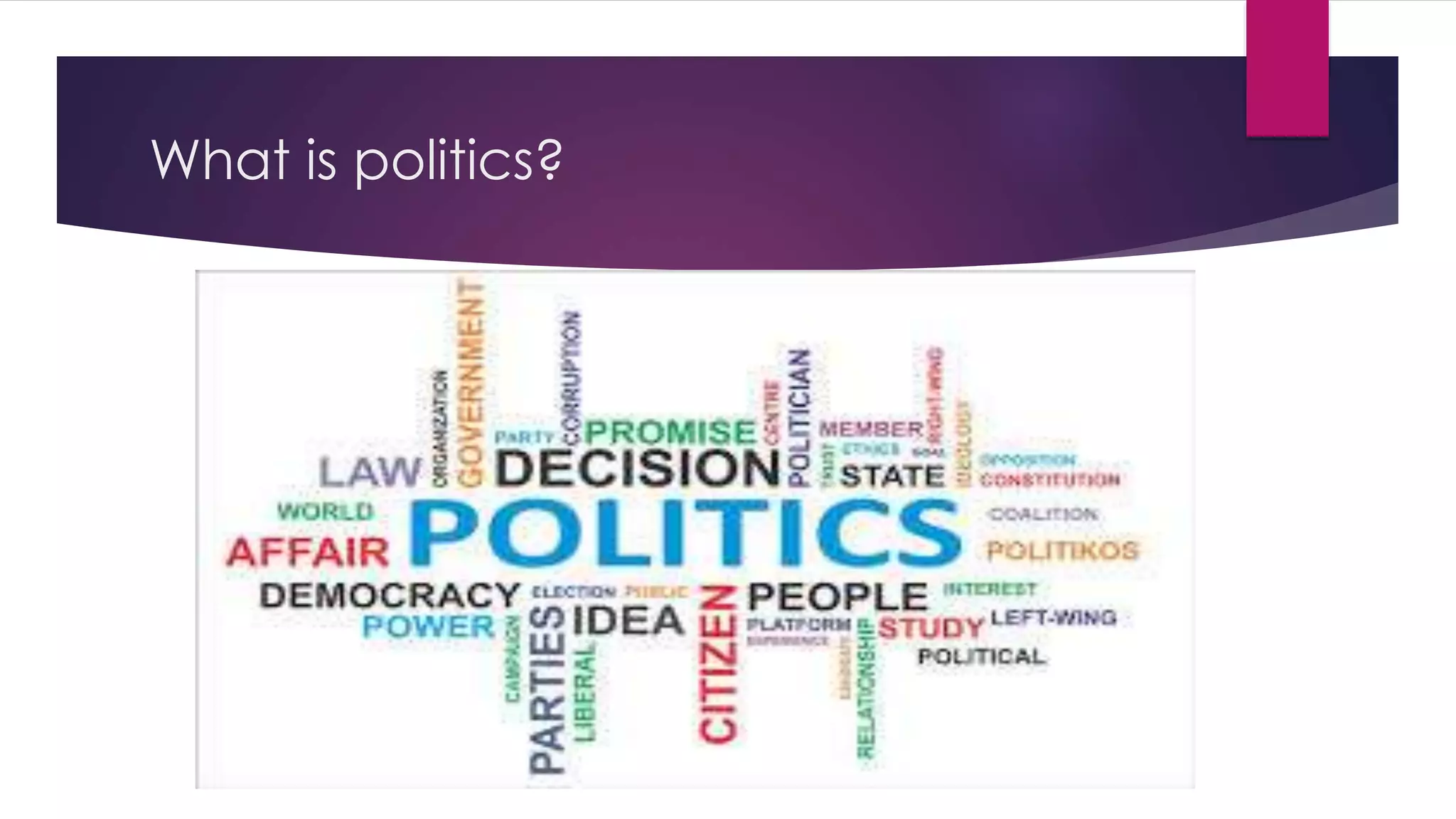
What is politics?
What is politics?
What is politics?
What is politics?
What is politics?
What is politics?
What is politics?
What is politics?
What is politics?
What is politics?
Introduction to Global Politics
KEY ISSUES/QUESTIONS:
 WHA IS MEANT BY GLOBAL POLITICS?
 HOW HAS INTERNATIONAL POLITCS BEEN TRANSFORMED
INTO GLOBAL POLITICS?
 WHAT IS GLOBALIZATION AND ITS IMPACTS ON WORLD
POLITICS?
 WHAT ARE THE DIFFERENT APPROACHES/LENSES TO STUDY
GLOBAL POLITICS?
 CONTINUITIES AND CHANGES IN 21ST CENTURY?
Global Politics
Global politics
The Westphalian state-system
 Peace of Westphalia (1648): End of the Thirty Years War in Europe
 Beginning of the modern state-system with strict loyalties and
identities
 2 main principles:
 States enjoy sovereign jurisdiction
 Relations bewteeen states are structured by acceptance of the
sovereign independence of all states (equality)
The nation state
What is a state?
A defined territory
A permanent population
An effective government
The capacity to enter into relations
with other states
The great debates of IR
Liberalists vs Realists
 1930-1950s
 Liberalists: Peaceful
cooperation
 Realists: inescapable
power politics
Behavioralists vs
tradionalists
 1960s
 Possibility of objective
‘laws’ of international
relations
Marxists vs the rest
 1970-1980s
 Interpreted
international relations
in economic terms
The mainstream perspectives
Realists
 Traced to Thucydides, Sun Tzu, Machiavelli,
Thomas Hobbes, etc
 Emphasis on power politcs
 Human nature: selfish, greedy
 Politics is structured by power and coercion
 States are key actors
 States pursue national interests, mainly security
 International anarchy, hence rely on self help
 Ethical considerations are irrelevant in foreign
policy
Liberals
 Immanuel Kant; Committed to
internationalism, Belief in ‘universal and
perpetual peace’
 Humans are rational and moral creatures
 Increasing prospect of peace & cooperation
 Mixed-actor model for global politics
 Trade and economic interdependence
make war less likely
 International law promotes good behavior
Critical perspectives
 Neo-Marxists: Highlight inequalities in the global capitalist system, through
which hegemonic powers such as the US dominate and exploit developing
countries
 Feminists: Have drawn attention to systematic and pervasive structures of
gender inequality that characterize global and every form of politics. Criticize
the ‘masculine’ assumptions of rivalry, power, competition, and conflict.
 Postcolonialists: Emphasized the cultural dimension of colonial rule; western
culture and political hegemony over the rest of the world still dominates
global politics
 Green politics: highlight environmental issues, critical of industrial growth and
of the obsession with economic growth
The two models of global politics
Globalization
 Complex, elusive and controversial term
 ‘It is the widening, intensifying, speeding up, and growing impact of world-wide interconnectedness’
(Held and McGrew, 1999)
 ‘The intensification of worldwide social relations that link distant localities in a way that local
happenings are shaped by events occuring many miles away and vice versa’. (Giddens, 1990)
 ‘The integration of national economies into the international economies through trade, direct foreign
investment, short term capital flow, international flow of workers and humanity generally, and the flow
of technology’. Bhagwati, 2004)
 Globalization has economic, political, social and cultural dimensions
Globalization: Myth or reality?
Hyperglobalists
 Digital revolution,
global financial system,
global commodities
 BORDERLESS World
 National borders and
national economies are
unworkable
The Sceptics
 Globalization is a
fantasy
 Bulk of economic
activity happens within
the state
 Just an ideological tool
and propaganda to
furhter market-oriented
economic agenda
Transformationalists
 Take the middle road
 Much has changed,
but not everything
 Most widely accepted
view
Approaches to Globalization
Realist view
 Sceptical view
 Increases economic
interdependence
 Globalization made by states,
for the states
 Mainly enhances and protects
the interest of Western states
 Leads to ‘mutual vulnerability’
rather than peace and
cooperation
Liberal view
 Positive attitude
 Positive sum game, i.e.,
benefits all
 Good for democracy, peace
and cooperation
 Has made Balance of Power
redundant
 States are losing their former
prominence
Critical views
 Negative or oppositional
stance
 Establishes a global capitalist
order which is exploitative
 Accepts that states have lost
power
 Creates ‘core’ and ‘periphery’
regions in the world
 Creates Gender inequality
(feminists)
End of topic activities
 Activity 1: Explain the following terms in your own
words:
 Anarchy, Collective dilemma, globalization,
interdependence, Power politics, Security dilemma,
Cosmopolitanism
 Give exmples from real life situations to explain these
concepts.
 Include a critical comment as well.
9/11: The day that
changed the world
Activity 2: Discuss, in about
500 words, the significance
of 9/11 in global politics.

What is politics?

  • 1.
  • 2.
  • 3.
  • 4.
  • 5.
  • 6.
  • 7.
  • 8.
  • 9.
  • 10.
  • 11.
    Introduction to GlobalPolitics KEY ISSUES/QUESTIONS:  WHA IS MEANT BY GLOBAL POLITICS?  HOW HAS INTERNATIONAL POLITCS BEEN TRANSFORMED INTO GLOBAL POLITICS?  WHAT IS GLOBALIZATION AND ITS IMPACTS ON WORLD POLITICS?  WHAT ARE THE DIFFERENT APPROACHES/LENSES TO STUDY GLOBAL POLITICS?  CONTINUITIES AND CHANGES IN 21ST CENTURY?
  • 12.
  • 13.
  • 14.
    The Westphalian state-system Peace of Westphalia (1648): End of the Thirty Years War in Europe  Beginning of the modern state-system with strict loyalties and identities  2 main principles:  States enjoy sovereign jurisdiction  Relations bewteeen states are structured by acceptance of the sovereign independence of all states (equality)
  • 15.
  • 16.
    What is astate? A defined territory A permanent population An effective government The capacity to enter into relations with other states
  • 17.
    The great debatesof IR Liberalists vs Realists  1930-1950s  Liberalists: Peaceful cooperation  Realists: inescapable power politics Behavioralists vs tradionalists  1960s  Possibility of objective ‘laws’ of international relations Marxists vs the rest  1970-1980s  Interpreted international relations in economic terms
  • 18.
    The mainstream perspectives Realists Traced to Thucydides, Sun Tzu, Machiavelli, Thomas Hobbes, etc  Emphasis on power politcs  Human nature: selfish, greedy  Politics is structured by power and coercion  States are key actors  States pursue national interests, mainly security  International anarchy, hence rely on self help  Ethical considerations are irrelevant in foreign policy Liberals  Immanuel Kant; Committed to internationalism, Belief in ‘universal and perpetual peace’  Humans are rational and moral creatures  Increasing prospect of peace & cooperation  Mixed-actor model for global politics  Trade and economic interdependence make war less likely  International law promotes good behavior
  • 19.
    Critical perspectives  Neo-Marxists:Highlight inequalities in the global capitalist system, through which hegemonic powers such as the US dominate and exploit developing countries  Feminists: Have drawn attention to systematic and pervasive structures of gender inequality that characterize global and every form of politics. Criticize the ‘masculine’ assumptions of rivalry, power, competition, and conflict.  Postcolonialists: Emphasized the cultural dimension of colonial rule; western culture and political hegemony over the rest of the world still dominates global politics  Green politics: highlight environmental issues, critical of industrial growth and of the obsession with economic growth
  • 20.
    The two modelsof global politics
  • 21.
    Globalization  Complex, elusiveand controversial term  ‘It is the widening, intensifying, speeding up, and growing impact of world-wide interconnectedness’ (Held and McGrew, 1999)  ‘The intensification of worldwide social relations that link distant localities in a way that local happenings are shaped by events occuring many miles away and vice versa’. (Giddens, 1990)  ‘The integration of national economies into the international economies through trade, direct foreign investment, short term capital flow, international flow of workers and humanity generally, and the flow of technology’. Bhagwati, 2004)  Globalization has economic, political, social and cultural dimensions
  • 22.
    Globalization: Myth orreality? Hyperglobalists  Digital revolution, global financial system, global commodities  BORDERLESS World  National borders and national economies are unworkable The Sceptics  Globalization is a fantasy  Bulk of economic activity happens within the state  Just an ideological tool and propaganda to furhter market-oriented economic agenda Transformationalists  Take the middle road  Much has changed, but not everything  Most widely accepted view
  • 23.
    Approaches to Globalization Realistview  Sceptical view  Increases economic interdependence  Globalization made by states, for the states  Mainly enhances and protects the interest of Western states  Leads to ‘mutual vulnerability’ rather than peace and cooperation Liberal view  Positive attitude  Positive sum game, i.e., benefits all  Good for democracy, peace and cooperation  Has made Balance of Power redundant  States are losing their former prominence Critical views  Negative or oppositional stance  Establishes a global capitalist order which is exploitative  Accepts that states have lost power  Creates ‘core’ and ‘periphery’ regions in the world  Creates Gender inequality (feminists)
  • 24.
    End of topicactivities  Activity 1: Explain the following terms in your own words:  Anarchy, Collective dilemma, globalization, interdependence, Power politics, Security dilemma, Cosmopolitanism  Give exmples from real life situations to explain these concepts.  Include a critical comment as well.
  • 25.
    9/11: The daythat changed the world Activity 2: Discuss, in about 500 words, the significance of 9/11 in global politics.