UNIPOLARITY IN INTERNATIONAL RELATIONS
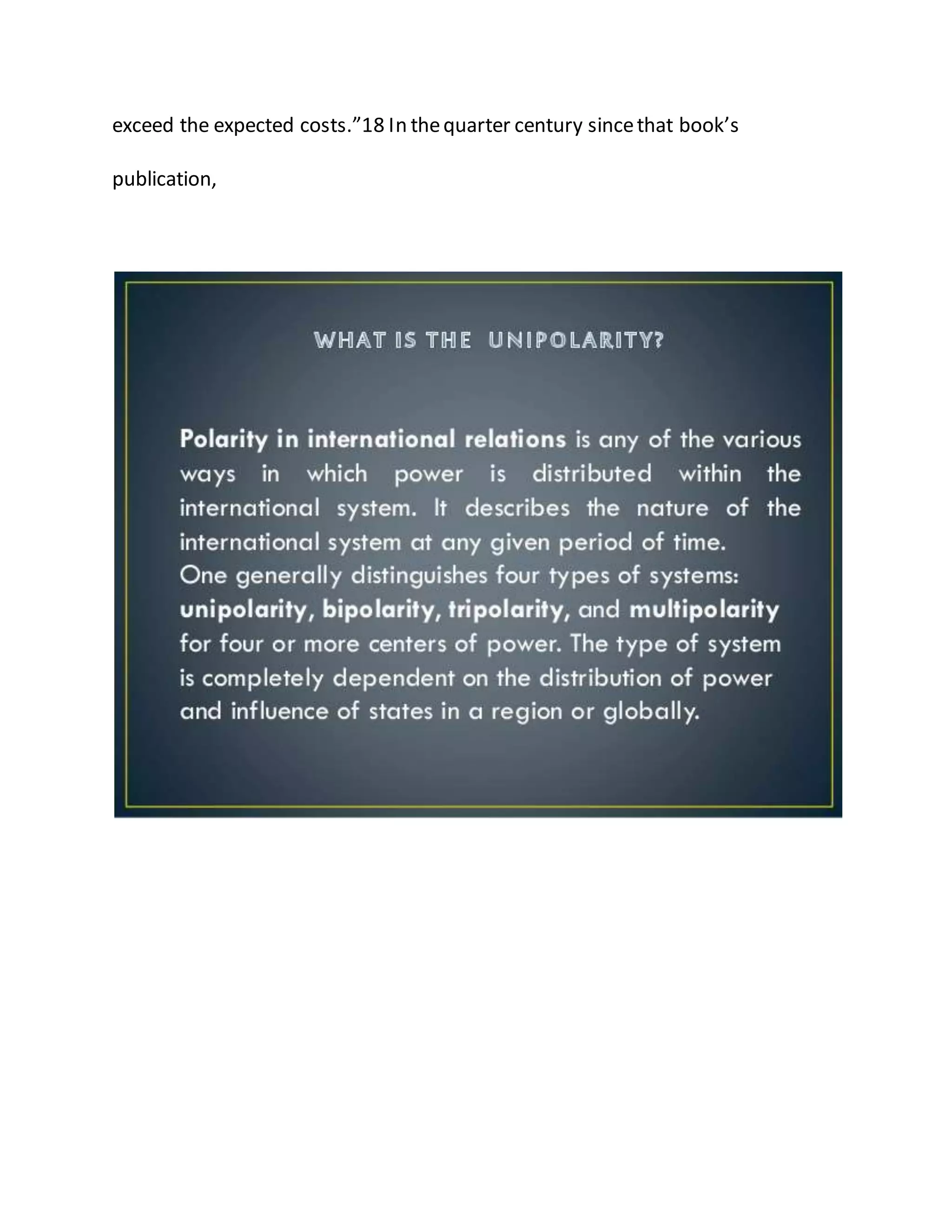
UNI polarity in international politics is a distribution of power in which one
state exercises most of the cultural, economic, and military influence.
As the array of articles in this special issueindicates, the effects of unipolarity are
potentially widespread. For purposes of analyticalclarity it is possibleto consider
these effects in three ways, in terms of (1) the behavior of the unipole, (2) the
actions of other states, and (3) the properties of the international systemitself.
Behavior of the Unipole The specific characteristics and dynamics of any unipolar
systemwill obviously depend on how the unipolar state behaves. But the
unipole’s behavior might be affected by incentives and constraints associated
with its structuralposition in the international system. Indeed, even the unipole’s
domestic politics and institutions—the immediate wellsprings of its behavior on
the international scene—might themselves change profoundly under the
influence of its position of primacy in the unipolarity and revisionism: is the
unipole a satisfied state? The stability of any international systemdepends
significantly on the degree to which the major powers are satisfied with the status
quo.17 In War and Change in World Politics, Robert Gilpin argued that leading
states “will attempt to change the international systemif the expected benefits
exceed the expected costs.”18 In thequarter century sincethat book’s
publication,
Unipolarity in international relations

Unipolarity in international relations

  • 1.
    UNIPOLARITY IN INTERNATIONALRELATIONS UNI polarity in international politics is a distribution of power in which one state exercises most of the cultural, economic, and military influence. As the array of articles in this special issueindicates, the effects of unipolarity are potentially widespread. For purposes of analyticalclarity it is possibleto consider these effects in three ways, in terms of (1) the behavior of the unipole, (2) the actions of other states, and (3) the properties of the international systemitself. Behavior of the Unipole The specific characteristics and dynamics of any unipolar systemwill obviously depend on how the unipolar state behaves. But the unipole’s behavior might be affected by incentives and constraints associated with its structuralposition in the international system. Indeed, even the unipole’s domestic politics and institutions—the immediate wellsprings of its behavior on the international scene—might themselves change profoundly under the influence of its position of primacy in the unipolarity and revisionism: is the unipole a satisfied state? The stability of any international systemdepends significantly on the degree to which the major powers are satisfied with the status quo.17 In War and Change in World Politics, Robert Gilpin argued that leading states “will attempt to change the international systemif the expected benefits
  • 2.
    exceed the expectedcosts.”18 In thequarter century sincethat book’s publication,