Mol adalah satuan dalam kimia yang digunakan untuk menyatakan jumlah partikel, seperti atom, molekul, atau ion dalam suatu zat. Satu mol menyatakan jumlah partikel sebanyak 6,022 × 10²³, yang dikenal sebagai bilangan Avogadro.
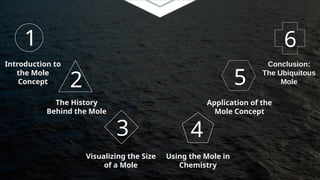
Introduction to
the Mole
Concept
1
2
34
5
6
The History
Behind the Mole
Visualizing the Size
of a Mole
Using the Mole in
Chemistry
Application of the
Mole Concept
Conclusion:
The Ubiquitous
Mole
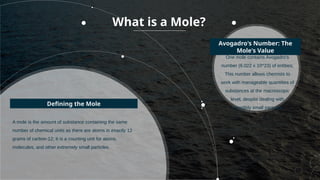
A mole isthe amount of substance containing the same
number of chemical units as there are atoms in exactly 12
grams of carbon-12; It is a counting unit for atoms,
molecules, and other extremely small particles.
One mole contains Avogadro's
number (6.022 x 10^23) of entities;
This number allows chemists to
work with manageable quantities of
substances at the macroscopic
level, despite dealing with
incredibly small particles.
Defining the Mole
Avogadro's Number: The
Mole's Value
What is a Mole?
5.
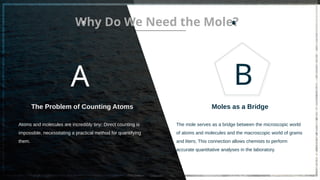
A
The Problem ofCounting Atoms
Atoms and molecules are incredibly tiny; Direct counting is
impossible, necessitating a practical method for quantifying
them.
B
The mole serves as a bridge between the microscopic world
of atoms and molecules and the macroscopic world of grams
and liters; This connection allows chemists to perform
accurate quantitative analyses in the laboratory.
Moles as a Bridge
Why Do We Need the Mole?
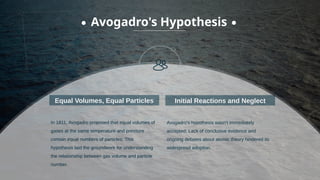
In 1811, Avogadroproposed that equal volumes of
gases at the same temperature and pressure
contain equal numbers of particles; This
hypothesis laid the groundwork for understanding
the relationship between gas volume and particle
number.
Equal Volumes, Equal Particles
Avogadro's Hypothesis
Avogadro's hypothesis wasn't immediately
accepted; Lack of conclusive evidence and
ongoing debates about atomic theory hindered its
widespread adoption.
Initial Reactions and Neglect
8.
Acceptance and
Recognition
01. 02.
La t e 1 9 t h C e n t u r y
Va l i d a t i o n
By the late 1860s, experimental evidence
validated Avogadro's hypothesis; This led to its
integration into atomic theory, solidifying
Avogadro's place in chemical history.
H o n o r i n g A v o g a d ro
The significance of Avogadro's work led to the
naming of Avogadro's number in his honor; It
acknowledges his contributions to
understanding the quantitative nature of matter.
The Sheer Magnitude
Avogadro'snumber is astronomically large, making it difficult to
conceptualize; Analogies are used to help grasp its immensity.
Understanding the Scale of 6.022 x 10^23
A mole of donuts would cover the Earth to a depth of 8
kilometers; This illustrates the vast quantity represented by a
single mole.
Moles of Donuts
11.
Real-World Comparisons
M ol e s o f B a s k e t b a l l s
A mole of basketballs would create a new planet
the size of the Earth; This emphasizes the scale
of Avogadro's number relative to familiar
objects.
M o l e s o f P e n n i e s
If you received a mole of pennies at birth and
spent a million dollars per second, you would
still have more than 99.99% of your money in
the bank at age 100; This showcases the
enduring value of such a large quantity.
Molar Mass
The molarmass of a substance is the mass of one
mole of that substance; It is typically expressed in
grams per mole (g/mol) and numerically equal to
the substance's atomic or molecular weight.
Defining Molar Mass
Molar mass serves as a conversion factor to
convert between mass and moles; This is crucial
for stoichiometry and quantitative analysis in
chemistry.
Converting Between Mass and
Moles
14.
Moles in EverydayLife
Chemists use the mole concept in a similar way that we use common units
like pounds or dozens; It allows for convenient handling of large quantities
of atoms or molecules.
Buying in Bulk
A "dozen" signifies 12 items, while a "mole" signifies 6.022 x 10^23 entities;
This parallel helps demystify the mole concept by relating it to familiar
measurement units.
Analogies to Familiar Units
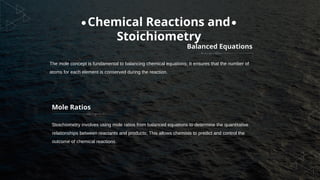
Mole Ratios
Stoichiometry involvesusing mole ratios from balanced equations to determine the quantitative
relationships between reactants and products; This allows chemists to predict and control the
outcome of chemical reactions.
Balanced Equations
The mole concept is fundamental to balancing chemical equations; It ensures that the number of
atoms for each element is conserved during the reaction.
Chemical Reactions and
Stoichiometry
17.
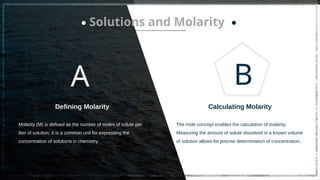
A
Defining Molarity
Molarity (M)is defined as the number of moles of solute per
liter of solution; It is a common unit for expressing the
concentration of solutions in chemistry.
B
The mole concept enables the calculation of molarity;
Measuring the amount of solute dissolved in a known volume
of solution allows for precise determination of concentration.
Calculating Molarity
Solutions and Molarity
The mole conceptis an essential tool for
every chemist, serving as a foundation for
quantitative analysis. It supports accurate
weighing and measuring of substances for
chemical experiments, enhancing precision
in research and industry.
Mole Concept as Cornerstone
21.
By linking themicroscopic world of atoms with the
macroscopic world of measurable quantities, the
mole facilitates groundbreaking research. It
enables the development of new technologies and
our understanding of the material world.
Linking Micro and Macro
Worlds
22.
The mole continuesto play a pivotal role in emerging fields
like nanotechnology; Precise control over nanoscale
materials depends on accurate quantification using the
mole concept.
The mole's importance will persist
as scientific understanding
deepens; It allows scientists to
explore new frontiers of chemistry,
ensuring its relevance for
innovations and discoveries in the
future.
Nanotechnology and Beyond
Advancing Scientific
Understanding
Future Applications