What is Drowning Prevention and
How Do YOU Do It?

NRPA Aquatics Conference - March 27, 2010
Presenter: Stephanie Shook, CPRP
American Red Cross National Headquarters
Drowning is the third leading cause of
unintentional injury death globally, after road
           traffic injuries and falls.

          World Health Organization
               www.who.int/en
Water Safety Poll


Do people not know or are they just
           being risky?
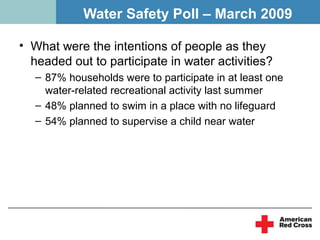
Water Safety Poll – March 2009

• What were the intentions of people as they
  headed out to participate in water activities?
   – 87% households were to participate in at least one
     water-related recreational activity last summer
   – 48% planned to swim in a place with no lifeguard
   – 54% planned to supervise a child near water
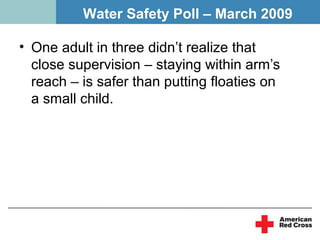
Water Safety Poll – March 2009

• One adult in three didn’t realize that
  close supervision – staying within arm’s
  reach – is safer than putting floaties on
  a small child.
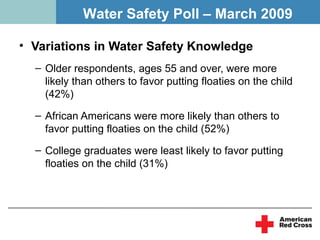
Water Safety Poll – March 2009

• Variations in Water Safety Knowledge
  – Older respondents, ages 55 and over, were more
    likely than others to favor putting floaties on the child
    (42%)

  – African Americans were more likely than others to
    favor putting floaties on the child (52%)
  – College graduates were least likely to favor putting
    floaties on the child (31%)
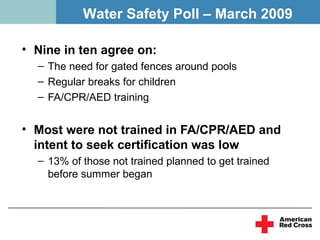
Water Safety Poll – March 2009

• Nine in ten agree on:
  – The need for gated fences around pools
  – Regular breaks for children
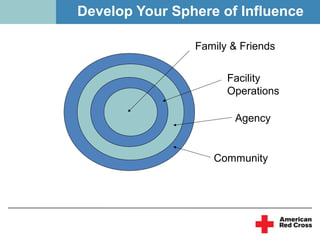
  – FA/CPR/AED training


• Most were not trained in FA/CPR/AED and
  intent to seek certification was low
  – 13% of those not trained planned to get trained
    before summer began
Water Safety Poll – March 2009

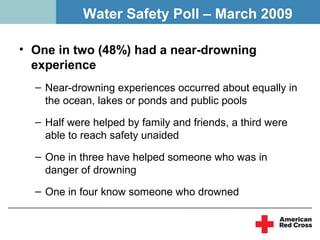
• One in two (48%) had a near-drowning
  experience
  – Near-drowning experiences occurred about equally in
    the ocean, lakes or ponds and public pools

  – Half were helped by family and friends, a third were
    able to reach safety unaided
  – One in three have helped someone who was in
    danger of drowning
  – One in four know someone who drowned
Water Safety Poll – March 2009

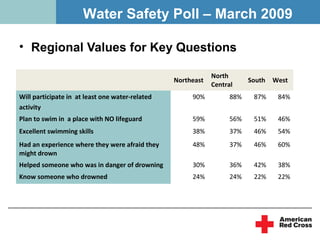
• Regional Values for Key Questions

                                                             North
                                                 Northeast               South   West
                                                             Central
Will participate in at least one water-related        90%          88%    87%     84%
activity
Plan to swim in a place with NO lifeguard             59%          56%    51%     46%
Excellent swimming skills                             38%          37%    46%     54%
Had an experience where they were afraid they         48%          37%    46%     60%
might drown
Helped someone who was in danger of drowning          30%          36%    42%     38%
Know someone who drowned                              24%          24%    22%     22%
ALERTS
ALERTS

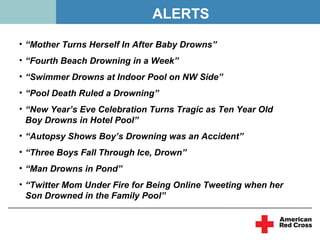
• “Mother Turns Herself In After Baby Drowns”
• “Fourth Beach Drowning in a Week”
• “Swimmer Drowns at Indoor Pool on NW Side”
• “Pool Death Ruled a Drowning”
• “New Year’s Eve Celebration Turns Tragic as Ten Year Old
  Boy Drowns in Hotel Pool”
• “Autopsy Shows Boy’s Drowning was an Accident”
• “Three Boys Fall Through Ice, Drown”
• “Man Drowns in Pond”
• “Twitter Mom Under Fire for Being Online Tweeting when her
  Son Drowned in the Family Pool”
Tip of the Iceburg

• Sound familiar?

• What are the headlines in your region?
Making a Difference

• “Operation Save a Life”
• Swim lesson partnership
• Small town with big town results
• Vamos a nadar
• Vietnamese community
Pickens County, South Carolina
Operation Save a Life

• The drowning deaths of three people who did
  not know how to swim spurred the community
  into action
   – An aunt, uncle and 8-year-old boy drowned in an
     above ground pool

• Partnership
   – YMCA - Pickens County American Red Cross
   – United Way - Safe Kids Upstate
   – Local law enforcement - Community leadership
Operation Save a Life

• Goals
  – Stopping needless drownings in backyard pools
  – To educate pool owners on the responsibilities that
    come with owning a pool


 “Instead of getting the community to come to us,
               we’re coming to them”
Operation Save a Life

• Water Safety Post Cards
   – 4,200 mailed to local and surrounding counties
   – 5,000 given to local law enforcement to distribute as needed
• Water Safety Tip Sheets
   – Placed near pool repair and upkeep items in pool supply stores
• Anchor Pools
   – Offering discounts on safety products
• Water Safety website created www.pcymca.net
   – Home safety checklists, rescue videos and educational materials
• A home water safety talk offered in the community
   – YMCA staff on hand to offer discounted lesson rates
Middle School Swim Lesson
         Program
     Gainesville, Georgia
Gainesville Middle School

• Nearly 40 people drowned in Georgia
  waters so far this year
• Too many drownings are happening on our
  lake
  – Cultural
  – Economic

• Partnership
  – Gainesville Middle School & Frances Meadows
    Aquatic and Community Center
Gainesville Middle School

• Goals
  – To provide Swimming lessons to all 6th graders
      • Swim Strokes
      • Survivor skills
      • Discover a new passion in the pool
• 400 students to take lessons each year

 “Of this week’s batch of 60 students, only 5 knew how to
                     swim prior to class.”
YMCA
Small Town Aquatics Program
     Fergus Falls, Minnesota
YMCA – Fergus Falls, MN

• Great facilities
• Great programs
• All is good and everybody is happy


“Expand the program to reach beyond city limits to include
     the people and beaches in the surrounding area?”
YMCA – Fergus Falls, MN

• Community characteristics:
  – West Central Minnesota has several thousand lakes
  – Otter Tail County
     • A beautiful swimming beach
     • No lifeguards on duty due to budget issues
  – Five summer camps
     • One camp taught small craft classes for campers
  – Two state parks offering canoe and kayak rentals
  – One resort with a sailing program on a lake 40 miles
    away
YMCA – Fergus Falls, MN

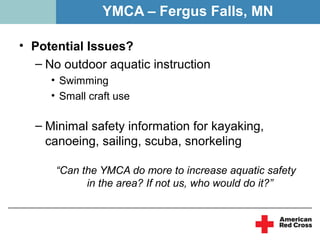
• Potential Issues?
  – No outdoor aquatic instruction
     • Swimming
     • Small craft use

  – Minimal safety information for kayaking,
    canoeing, sailing, scuba, snorkeling

      “Can the YMCA do more to increase aquatic safety
            in the area? If not us, who would do it?”
YMCA – Fergus Falls, MN

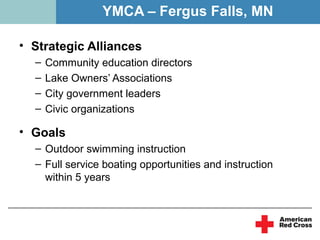
• Strategic Alliances
  –   Community education directors
  –   Lake Owners’ Associations
  –   City government leaders
  –   Civic organizations

• Goals
  – Outdoor swimming instruction
  – Full service boating opportunities and instruction
    within 5 years
YMCA – Fergus Falls, MN

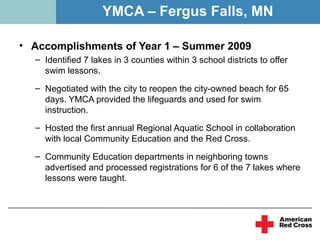
• Accomplishments of Year 1 – Summer 2009
  – Identified 7 lakes in 3 counties within 3 school districts to offer
    swim lessons.
  – Negotiated with the city to reopen the city-owned beach for 65
    days. YMCA provided the lifeguards and used for swim
    instruction.
  – Hosted the first annual Regional Aquatic School in collaboration
    with local Community Education and the Red Cross.
  – Community Education departments in neighboring towns
    advertised and processed registrations for 6 of the 7 lakes where
    lessons were taught.
YMCA – Fergus Falls, MN

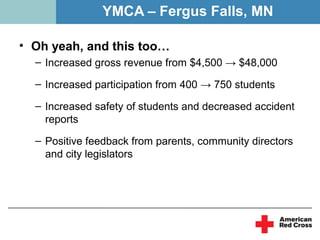
• Oh yeah, and this too…
  – Increased gross revenue from $4,500 → $48,000

  – Increased participation from 400 → 750 students

  – Increased safety of students and decreased accident
    reports

  – Positive feedback from parents, community directors
    and city legislators
Vamos a Nadar
(Let’s Go Swimming)
Sonoma County, California
Vamos a Nadar (Let’s go Swimming)

• The Hispanic community comprises 20% of the
  population, but accounts for 75% of the county’s
  drowning deaths.
• A disproportionate number of Latinos drown in
  Sonoma County’s rivers, lakes and pools.
Vamos a Nadar (Let’s go Swimming)

• Collaboration
  – City of San Rosa
  – American Red Cross Chapter, Sonoma and
    Mendocino Counties

• Goals
  – To make sure Latin children learn to swim
  – To teach the parents basic water safety skills
  – To change the mentality about water safety
Vamos a Nadar (Let’s go Swimming)

• Free day of activities (2004-2009)
  – Introductory swim lesson
  – Water safety presentation for parents
  – Rescue demonstrations (non-swimming rescues)
    using personal items and natural resources
  – Coupon from the Red Cross for a swim lesson
    session at any Sonoma County pool
  – 1,000+ children
  – 500 parents
  – One student is now a Lifeguard and Swim instructor
  – One student has gone on to advanced water camp
Drowning Prevention
Campaign in a Vietnamese
      Community
     Seattle, Washington
Drowning Prevention Campaign

• Asian-American children had the highest
  drowning death rate in Washington State
• Feedback
  – Focus groups
  – Community leaders
Drowning Prevention Campaign

• Goals
  – Community based campaign to:
    • Increase water-safe behaviors
    • Skills
    • Access to resources in a Vietnamese community

  – Promote 3 messages:
    • Swim in a Lifeguarded area
    • Learn to swim
    • Wear a life jacket
Drowning Prevention Campaign

• Informational presentations
  – Language schools
  – Head Start
  – Churches and temples

• Bilingual posters and brochures of
  lifeguarded beaches and pools
  – Local businesses
  – Vietnamese newspapers

• Free Vietnamese family swim lessons
Drowning Prevention Campaign

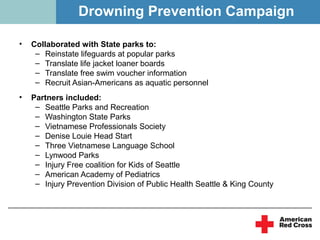
•   Collaborated with State parks to:
     – Reinstate lifeguards at popular parks
     – Translate life jacket loaner boards
     – Translate free swim voucher information
     – Recruit Asian-Americans as aquatic personnel
•   Partners included:
     – Seattle Parks and Recreation
     – Washington State Parks
     – Vietnamese Professionals Society
     – Denise Louie Head Start
     – Three Vietnamese Language School
     – Lynwood Parks
     – Injury Free coalition for Kids of Seattle
     – American Academy of Pediatrics
     – Injury Prevention Division of Public Health Seattle & King County
How Can YOU Influence Water
         Safety?
Develop Your Sphere of Influence

                Family & Friends


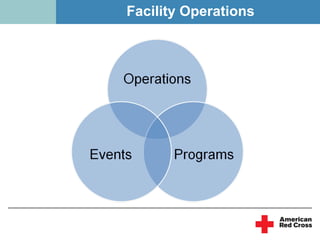
                      Facility
                      Operations

                        Agency


                   Community
Facility Operations
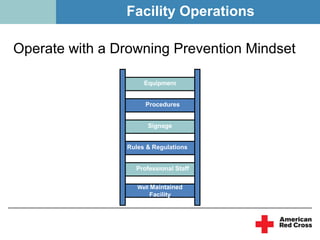
Facility Operations

Operate with a Drowning Prevention Mindset

                     Equipment


                     Procedures


                      Signage


                Rules & Regulations


                  Professional Staff


                   Well Maintained
                      Facility
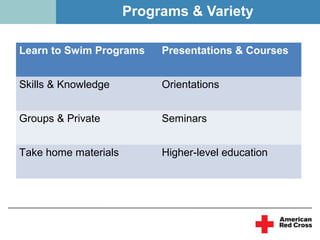
Programs & Variety

Learn to Swim Programs     Presentations & Courses


Skills & Knowledge         Orientations


Groups & Private           Seminars


Take home materials        Higher-level education
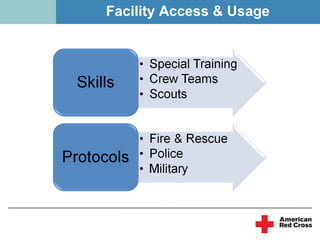
Facility Access & Usage
Agency-Wide Efforts
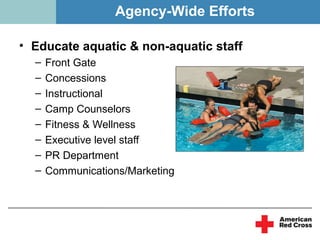
Agency-Wide Efforts

• Educate aquatic & non-aquatic staff
  –   Front Gate
  –   Concessions
  –   Instructional
  –   Camp Counselors
  –   Fitness & Wellness
  –   Executive level staff
  –   PR Department
  –   Communications/Marketing
Community Efforts
Community Efforts

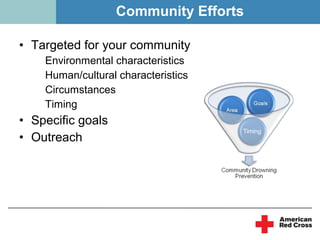
• Targeted for your community
  –   Environmental characteristics
  –   Human/cultural characteristics
  –   Circumstances
  –   Timing
• Specific goals
• Outreach
Community Efforts

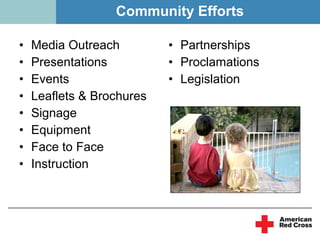
•   Media Outreach         • Partnerships
•   Presentations          • Proclamations
•   Events                 • Legislation
•   Leaflets & Brochures
•   Signage
•   Equipment
•   Face to Face
•   Instruction
Community Efforts


• Messaging
  – Specific
  – Address the needs of high-risk groups


        What exactly does supervision around
                  the water mean?
Community Efforts


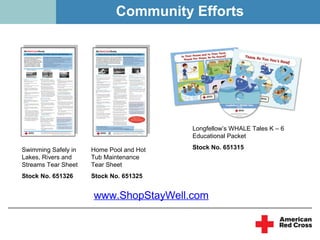
                                         Longfellow’s WHALE Tales K – 6
                                         Educational Packet

Swimming Safely in   Home Pool and Hot   Stock No. 651315
Lakes, Rivers and    Tub Maintenance
Streams Tear Sheet   Tear Sheet
Stock No. 651326     Stock No. 651325


                     www.ShopStayWell.com
Community Efforts


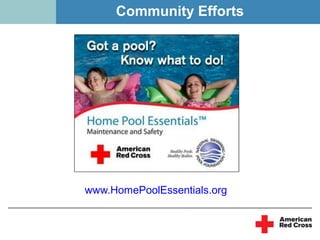
www.HomePoolEssentials.org
Your Neck of the Woods

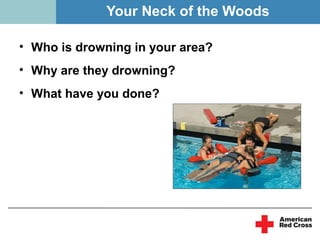
• Who is drowning in your area?
• Why are they drowning?
• What have you done?
Summary

• Big or small, just start!
• Walk the walk.
• Target your audience.
• Take it to them.
• Collaboration is important.
• Tell your story.
Questions?

What Is Drowning Prevention And How Do You Do It

  • 1.
    What is DrowningPrevention and How Do YOU Do It? NRPA Aquatics Conference - March 27, 2010 Presenter: Stephanie Shook, CPRP American Red Cross National Headquarters
  • 2.
    Drowning is thethird leading cause of unintentional injury death globally, after road traffic injuries and falls. World Health Organization www.who.int/en
  • 3.
    Water Safety Poll Dopeople not know or are they just being risky?
  • 4.
    Water Safety Poll– March 2009 • What were the intentions of people as they headed out to participate in water activities? – 87% households were to participate in at least one water-related recreational activity last summer – 48% planned to swim in a place with no lifeguard – 54% planned to supervise a child near water
  • 5.
    Water Safety Poll– March 2009 • One adult in three didn’t realize that close supervision – staying within arm’s reach – is safer than putting floaties on a small child.
  • 6.
    Water Safety Poll– March 2009 • Variations in Water Safety Knowledge – Older respondents, ages 55 and over, were more likely than others to favor putting floaties on the child (42%) – African Americans were more likely than others to favor putting floaties on the child (52%) – College graduates were least likely to favor putting floaties on the child (31%)
  • 7.
    Water Safety Poll– March 2009 • Nine in ten agree on: – The need for gated fences around pools – Regular breaks for children – FA/CPR/AED training • Most were not trained in FA/CPR/AED and intent to seek certification was low – 13% of those not trained planned to get trained before summer began
  • 8.
    Water Safety Poll– March 2009 • One in two (48%) had a near-drowning experience – Near-drowning experiences occurred about equally in the ocean, lakes or ponds and public pools – Half were helped by family and friends, a third were able to reach safety unaided – One in three have helped someone who was in danger of drowning – One in four know someone who drowned
  • 9.
    Water Safety Poll– March 2009 • Regional Values for Key Questions North Northeast South West Central Will participate in at least one water-related 90% 88% 87% 84% activity Plan to swim in a place with NO lifeguard 59% 56% 51% 46% Excellent swimming skills 38% 37% 46% 54% Had an experience where they were afraid they 48% 37% 46% 60% might drown Helped someone who was in danger of drowning 30% 36% 42% 38% Know someone who drowned 24% 24% 22% 22%
  • 10.
  • 11.
    ALERTS • “Mother TurnsHerself In After Baby Drowns” • “Fourth Beach Drowning in a Week” • “Swimmer Drowns at Indoor Pool on NW Side” • “Pool Death Ruled a Drowning” • “New Year’s Eve Celebration Turns Tragic as Ten Year Old Boy Drowns in Hotel Pool” • “Autopsy Shows Boy’s Drowning was an Accident” • “Three Boys Fall Through Ice, Drown” • “Man Drowns in Pond” • “Twitter Mom Under Fire for Being Online Tweeting when her Son Drowned in the Family Pool”
  • 12.
    Tip of theIceburg • Sound familiar? • What are the headlines in your region?
  • 13.
    Making a Difference •“Operation Save a Life” • Swim lesson partnership • Small town with big town results • Vamos a nadar • Vietnamese community
  • 14.
  • 15.
    Operation Save aLife • The drowning deaths of three people who did not know how to swim spurred the community into action – An aunt, uncle and 8-year-old boy drowned in an above ground pool • Partnership – YMCA - Pickens County American Red Cross – United Way - Safe Kids Upstate – Local law enforcement - Community leadership
  • 16.
    Operation Save aLife • Goals – Stopping needless drownings in backyard pools – To educate pool owners on the responsibilities that come with owning a pool “Instead of getting the community to come to us, we’re coming to them”
  • 17.
    Operation Save aLife • Water Safety Post Cards – 4,200 mailed to local and surrounding counties – 5,000 given to local law enforcement to distribute as needed • Water Safety Tip Sheets – Placed near pool repair and upkeep items in pool supply stores • Anchor Pools – Offering discounts on safety products • Water Safety website created www.pcymca.net – Home safety checklists, rescue videos and educational materials • A home water safety talk offered in the community – YMCA staff on hand to offer discounted lesson rates
  • 18.
    Middle School SwimLesson Program Gainesville, Georgia
  • 19.
    Gainesville Middle School •Nearly 40 people drowned in Georgia waters so far this year • Too many drownings are happening on our lake – Cultural – Economic • Partnership – Gainesville Middle School & Frances Meadows Aquatic and Community Center
  • 20.
    Gainesville Middle School •Goals – To provide Swimming lessons to all 6th graders • Swim Strokes • Survivor skills • Discover a new passion in the pool • 400 students to take lessons each year “Of this week’s batch of 60 students, only 5 knew how to swim prior to class.”
  • 21.
    YMCA Small Town AquaticsProgram Fergus Falls, Minnesota
  • 22.
    YMCA – FergusFalls, MN • Great facilities • Great programs • All is good and everybody is happy “Expand the program to reach beyond city limits to include the people and beaches in the surrounding area?”
  • 23.
    YMCA – FergusFalls, MN • Community characteristics: – West Central Minnesota has several thousand lakes – Otter Tail County • A beautiful swimming beach • No lifeguards on duty due to budget issues – Five summer camps • One camp taught small craft classes for campers – Two state parks offering canoe and kayak rentals – One resort with a sailing program on a lake 40 miles away
  • 24.
    YMCA – FergusFalls, MN • Potential Issues? – No outdoor aquatic instruction • Swimming • Small craft use – Minimal safety information for kayaking, canoeing, sailing, scuba, snorkeling “Can the YMCA do more to increase aquatic safety in the area? If not us, who would do it?”
  • 25.
    YMCA – FergusFalls, MN • Strategic Alliances – Community education directors – Lake Owners’ Associations – City government leaders – Civic organizations • Goals – Outdoor swimming instruction – Full service boating opportunities and instruction within 5 years
  • 26.
    YMCA – FergusFalls, MN • Accomplishments of Year 1 – Summer 2009 – Identified 7 lakes in 3 counties within 3 school districts to offer swim lessons. – Negotiated with the city to reopen the city-owned beach for 65 days. YMCA provided the lifeguards and used for swim instruction. – Hosted the first annual Regional Aquatic School in collaboration with local Community Education and the Red Cross. – Community Education departments in neighboring towns advertised and processed registrations for 6 of the 7 lakes where lessons were taught.
  • 27.
    YMCA – FergusFalls, MN • Oh yeah, and this too… – Increased gross revenue from $4,500 → $48,000 – Increased participation from 400 → 750 students – Increased safety of students and decreased accident reports – Positive feedback from parents, community directors and city legislators
  • 28.
    Vamos a Nadar (Let’sGo Swimming) Sonoma County, California
  • 29.
    Vamos a Nadar(Let’s go Swimming) • The Hispanic community comprises 20% of the population, but accounts for 75% of the county’s drowning deaths. • A disproportionate number of Latinos drown in Sonoma County’s rivers, lakes and pools.
  • 30.
    Vamos a Nadar(Let’s go Swimming) • Collaboration – City of San Rosa – American Red Cross Chapter, Sonoma and Mendocino Counties • Goals – To make sure Latin children learn to swim – To teach the parents basic water safety skills – To change the mentality about water safety
  • 31.
    Vamos a Nadar(Let’s go Swimming) • Free day of activities (2004-2009) – Introductory swim lesson – Water safety presentation for parents – Rescue demonstrations (non-swimming rescues) using personal items and natural resources – Coupon from the Red Cross for a swim lesson session at any Sonoma County pool – 1,000+ children – 500 parents – One student is now a Lifeguard and Swim instructor – One student has gone on to advanced water camp
  • 32.
    Drowning Prevention Campaign ina Vietnamese Community Seattle, Washington
  • 33.
    Drowning Prevention Campaign •Asian-American children had the highest drowning death rate in Washington State • Feedback – Focus groups – Community leaders
  • 34.
    Drowning Prevention Campaign •Goals – Community based campaign to: • Increase water-safe behaviors • Skills • Access to resources in a Vietnamese community – Promote 3 messages: • Swim in a Lifeguarded area • Learn to swim • Wear a life jacket
  • 35.
    Drowning Prevention Campaign •Informational presentations – Language schools – Head Start – Churches and temples • Bilingual posters and brochures of lifeguarded beaches and pools – Local businesses – Vietnamese newspapers • Free Vietnamese family swim lessons
  • 36.
    Drowning Prevention Campaign • Collaborated with State parks to: – Reinstate lifeguards at popular parks – Translate life jacket loaner boards – Translate free swim voucher information – Recruit Asian-Americans as aquatic personnel • Partners included: – Seattle Parks and Recreation – Washington State Parks – Vietnamese Professionals Society – Denise Louie Head Start – Three Vietnamese Language School – Lynwood Parks – Injury Free coalition for Kids of Seattle – American Academy of Pediatrics – Injury Prevention Division of Public Health Seattle & King County
  • 37.
    How Can YOUInfluence Water Safety?
  • 38.
    Develop Your Sphereof Influence Family & Friends Facility Operations Agency Community
  • 39.
  • 40.
    Facility Operations Operate witha Drowning Prevention Mindset Equipment Procedures Signage Rules & Regulations Professional Staff Well Maintained Facility
  • 41.
    Programs & Variety Learnto Swim Programs Presentations & Courses Skills & Knowledge Orientations Groups & Private Seminars Take home materials Higher-level education
  • 42.
  • 43.
  • 44.
    Agency-Wide Efforts • Educateaquatic & non-aquatic staff – Front Gate – Concessions – Instructional – Camp Counselors – Fitness & Wellness – Executive level staff – PR Department – Communications/Marketing
  • 45.
  • 46.
    Community Efforts • Targetedfor your community – Environmental characteristics – Human/cultural characteristics – Circumstances – Timing • Specific goals • Outreach
  • 47.
    Community Efforts • Media Outreach • Partnerships • Presentations • Proclamations • Events • Legislation • Leaflets & Brochures • Signage • Equipment • Face to Face • Instruction
  • 48.
    Community Efforts • Messaging – Specific – Address the needs of high-risk groups What exactly does supervision around the water mean?
  • 49.
    Community Efforts Longfellow’s WHALE Tales K – 6 Educational Packet Swimming Safely in Home Pool and Hot Stock No. 651315 Lakes, Rivers and Tub Maintenance Streams Tear Sheet Tear Sheet Stock No. 651326 Stock No. 651325 www.ShopStayWell.com
  • 50.
  • 51.
    Your Neck ofthe Woods • Who is drowning in your area? • Why are they drowning? • What have you done?
  • 52.
    Summary • Big orsmall, just start! • Walk the walk. • Target your audience. • Take it to them. • Collaboration is important. • Tell your story.
  • 53.

Editor's Notes

  • #3 We had a large number of drownings across this country this past summer and we all feel a shared sense of responsibility to do all we can to prevent these.
  • #4 So, let’s take a look at what people were thinking before the summer of 2009 started. The Red Cross did a telephone survey of 1,002 last March people across the country.
  • #5 What were people’s intentions as the swim season was approaching?
  • #8 It is interesting to note that although 9 in 10 think FA/CPR/Aed training is necessary, they were not planning to do so themselves?!
  • #11 Let’s take a look at some of the things that happened this past summer.
  • #13 All of these are just the tip of the iceburg. We are all very familiar with these type of headlines but what are the headlines in your area? BREAKOUT – each row spend 5 minutes discussing what issues are happening in your area – select 1 from those that we will use later in the session for the group to strategize about. For now, just pick the issue.
  • #14 All of these are just the tip of the iceburg. We are all very familiar with these type of headlines but what are the headlines in your area? BREAKOUT – each row spend 5 minutes discussing what issues are happening in your area – select 1 from those that we will use later in the session for the group to strategize about. For now, just pick the issue.
  • #23 an important part of drowning prevention, is that they went out an identified the need and got in front of all these tragedies. They looked for places where the problems could be rather than having to react.
  • #38 Lessons learned.
  • #43 It’s an important priority to provide space and opportunities for specialty rentals or trainings.
  • #52 BREAKOUT – rows get back together. From the issue you selected earlier – discuss either a real example you have of a drowning prevention effort in your community OR pick 3 things you can do as a prevention strategy for that issue – as a part of facility operations, at your agency, and in your community. Report out.
  • #53 Share you successes as well as your challenges so we all can learn from them and either implement, make better or make fit our circumstances.