Depth and Complexity An RUSD Best Practices  GATE Tune-Up
Depth Refers to approaching or studying something from the concrete to the abstract, from the known to the unknown. Requires students to examine topics by determining the facts, concepts, generalization, principles and theories related to them.
Depth Necessitates uncovering more details and new knowledge related to a topic of study. Encourages students to adopt perspectives and to see patterns in connections.
Depth has the following  major dimensions: Language of the Disciplines:   Specialized vocabulary, names of skills or tasks, tools used Details:   Attributes, parts, factors, variables Patterns:   Repetition, predictability Trends:   Influence, forces, direction Rules:   Structure, order, hierarchy, explanation Ethics:  Points of View, Different Opinions, judging Big Idea:  Generalization, principle, theory Unanswered Questions: Discrepancies, missing parts, unclear ideas, incomplete ideas
Complexity Includes making relationships, connecting other concepts, and layering. Why/how approach that connects and bridges to other disciplines to enhance the meaning of a unit of study.
Complexity encourages students to Relate concepts and ideas at a more sophisticated level See associations among diverse subjects, topics or levels Find multiple solutions from multiple points of view
Complexity has three  major dimensions: Relationships Over Time:  Between the past, present and future, and within a time period Relationships From Different Points of View:  Multiple Perspectives, opposing viewpoints, differing roles and knowledge Interdisciplinary Relationships:  With, between and across the disciplines
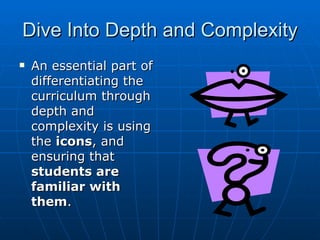
Dive Into Depth and Complexity An essential part of differentiating the curriculum through depth and complexity is using the  icons , and ensuring that  students are familiar with them .
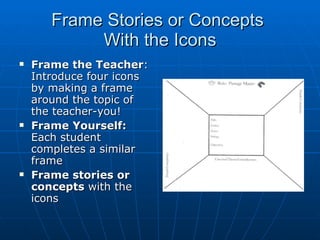
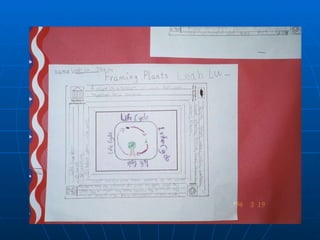
Frame Stories or Concepts  With the Icons Frame the Teacher : Introduce four icons by making a frame around the topic of the teacher-you! Frame Yourself:  Each student completes a similar frame Frame stories or concepts  with the icons
Use the Icons Within Your Lessons “ Look for ( appropriate icon ) in our lesson today on ( content area ).” Use the Big Idea to summarize or end lessons. Label your daily agenda and lesson plans with the icons. Have students label all work with the appropriate icons. Label all classroom work and charts with the icons.
Post a set of the icons clearly in your room This prompts integration into discussions, and shows students you value the icons as intellectual tools.
But remember,  we are not teaching the icons, we are teaching concepts to new levels of depth and complexity using pictures to stand for the thinking strategies.
Connecting Depth and Complexity to Higher Order Thinking Skills Each level of questions uses verbs  to describe the objectives desired. These  verbs, with companion descriptors, serve as thinking   keys  to activate the type of learning that will occur within the depth and complexity.
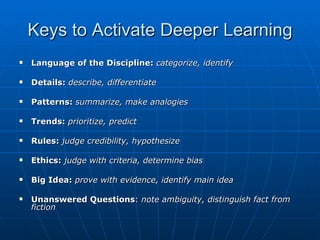
Keys to Activate Deeper Learning Language of the Discipline:   categorize, identify Details:   describe, differentiate Patterns:   summarize, make   analogies Trends:   prioritize, predict Rules:   judge credibility,   hypothesize Ethics:   judge with criteria, determine bias Big Idea:   prove with evidence, identify main idea Unanswered Questions :  note ambiguity, distinguish fact from fiction
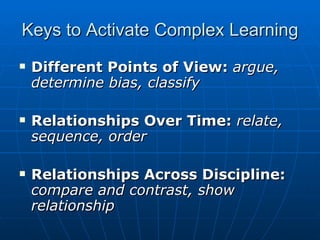
Keys to Activate Complex Learning Different Points of View:   argue, determine bias, classify Relationships Over Time:   relate, sequence, order Relationships Across Discipline:   compare and contrast, show relationship
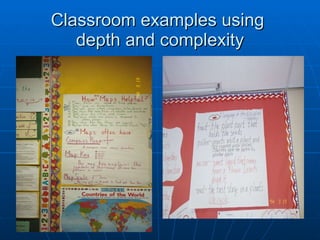
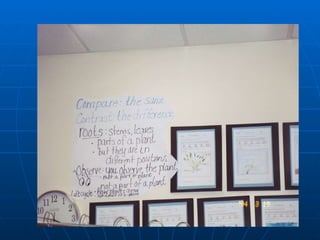
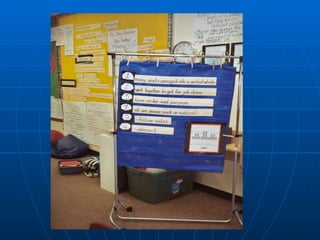
Classroom examples using  depth and complexity


What is Depth and Complexity?

  • 1.
    Depth and ComplexityAn RUSD Best Practices GATE Tune-Up
  • 2.
    Depth Refers toapproaching or studying something from the concrete to the abstract, from the known to the unknown. Requires students to examine topics by determining the facts, concepts, generalization, principles and theories related to them.
  • 3.
    Depth Necessitates uncoveringmore details and new knowledge related to a topic of study. Encourages students to adopt perspectives and to see patterns in connections.
  • 4.
    Depth has thefollowing major dimensions: Language of the Disciplines: Specialized vocabulary, names of skills or tasks, tools used Details: Attributes, parts, factors, variables Patterns: Repetition, predictability Trends: Influence, forces, direction Rules: Structure, order, hierarchy, explanation Ethics: Points of View, Different Opinions, judging Big Idea: Generalization, principle, theory Unanswered Questions: Discrepancies, missing parts, unclear ideas, incomplete ideas
  • 5.
    Complexity Includes makingrelationships, connecting other concepts, and layering. Why/how approach that connects and bridges to other disciplines to enhance the meaning of a unit of study.
  • 6.
    Complexity encourages studentsto Relate concepts and ideas at a more sophisticated level See associations among diverse subjects, topics or levels Find multiple solutions from multiple points of view
  • 7.
    Complexity has three major dimensions: Relationships Over Time: Between the past, present and future, and within a time period Relationships From Different Points of View: Multiple Perspectives, opposing viewpoints, differing roles and knowledge Interdisciplinary Relationships: With, between and across the disciplines
  • 8.
    Dive Into Depthand Complexity An essential part of differentiating the curriculum through depth and complexity is using the icons , and ensuring that students are familiar with them .
  • 9.
    Frame Stories orConcepts With the Icons Frame the Teacher : Introduce four icons by making a frame around the topic of the teacher-you! Frame Yourself: Each student completes a similar frame Frame stories or concepts with the icons
  • 10.
    Use the IconsWithin Your Lessons “ Look for ( appropriate icon ) in our lesson today on ( content area ).” Use the Big Idea to summarize or end lessons. Label your daily agenda and lesson plans with the icons. Have students label all work with the appropriate icons. Label all classroom work and charts with the icons.
  • 11.
    Post a setof the icons clearly in your room This prompts integration into discussions, and shows students you value the icons as intellectual tools.
  • 12.
    But remember, we are not teaching the icons, we are teaching concepts to new levels of depth and complexity using pictures to stand for the thinking strategies.
  • 13.
    Connecting Depth andComplexity to Higher Order Thinking Skills Each level of questions uses verbs to describe the objectives desired. These verbs, with companion descriptors, serve as thinking keys to activate the type of learning that will occur within the depth and complexity.
  • 14.
    Keys to ActivateDeeper Learning Language of the Discipline: categorize, identify Details: describe, differentiate Patterns: summarize, make analogies Trends: prioritize, predict Rules: judge credibility, hypothesize Ethics: judge with criteria, determine bias Big Idea: prove with evidence, identify main idea Unanswered Questions : note ambiguity, distinguish fact from fiction
  • 15.
    Keys to ActivateComplex Learning Different Points of View: argue, determine bias, classify Relationships Over Time: relate, sequence, order Relationships Across Discipline: compare and contrast, show relationship
  • 16.
    Classroom examples using depth and complexity
  • 17.
  • 18.
  • 19.