


What is Cross-Site Scripting (XSS)?
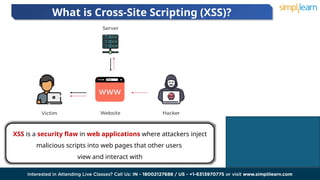
XSS is a security flaw in web applications where attackers inject
malicious scripts into web pages that other users
view and interact with
What is Cross-Site Scripting (XSS)?
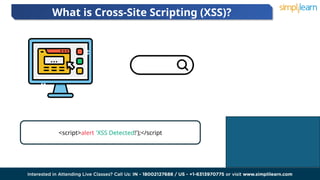
<script>alert('XSS Detected!');</script
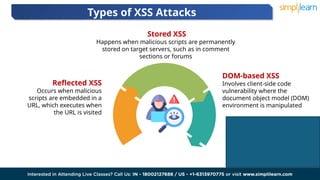
Reflected XSS
Occurs when malicious
scripts are embedded in a
URL, which executes when
the URL is visited
Stored XSS
Happens when malicious scripts are permanently
stored on target servers, such as in comment
sections or forums
DOM-based XSS
Involves client-side code
vulnerability where the
document object model (DOM)
environment is manipulated
Types of XSS Attacks
How XSS Attacks Work
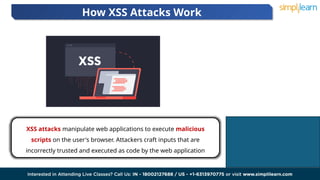
XSS attacks manipulate web applications to execute malicious
scripts on the user's browser. Attackers craft inputs that are
incorrectly trusted and executed as code by the web application
How XSS Attacks Work
Alex
Website
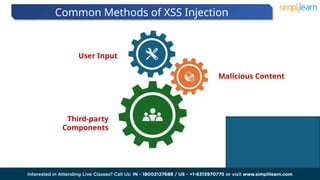
Third-party
Components
User Input
Malicious Content
Common Methods of XSS Injection
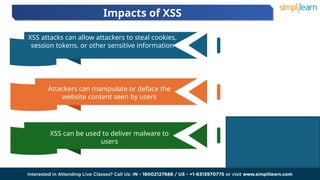
Impacts of XSS
OPTION 01
Attackers can manipulate or deface the
website content seen by users
OPTION 01
XSS can be used to deliver malware to
users
OPTION 01
XSS attacks can allow attackers to steal cookies,
session tokens, or other sensitive information
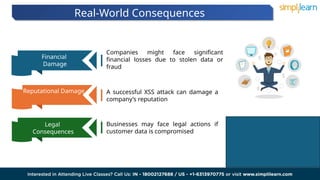
Real-World Consequences
OPTION 01
Reputational Damage
OPTION 01
Legal
Consequences
OPTION 01
Financial
Damage
Companies might face significant
financial losses due to stolen data or
fraud
A successful XSS attack can damage a
company’s reputation
Businesses may face legal actions if
customer data is compromised
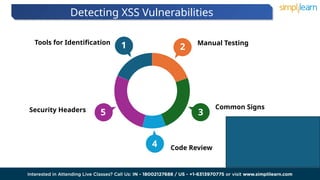
Detecting XSS Vulnerabilities
1 2
3
4
5
Security Headers Common Signs
Tools for Identification Manual Testing
Code Review
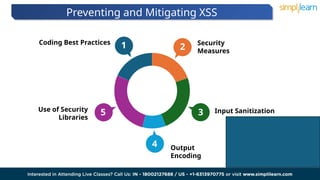
Preventing and Mitigating XSS
1 2
3
4
5
Use of Security
Libraries
Input Sanitization
Coding Best Practices Security
Measures
Output
Encoding

What Is Cross Site Scripting (XSS)? | Cross Site Scripting Explained |XSS Attack | Simplilearn

  • 2.
    What is Cross-SiteScripting (XSS)? XSS is a security flaw in web applications where attackers inject malicious scripts into web pages that other users view and interact with
  • 3.
    What is Cross-SiteScripting (XSS)? <script>alert('XSS Detected!');</script
  • 4.
    Reflected XSS Occurs whenmalicious scripts are embedded in a URL, which executes when the URL is visited Stored XSS Happens when malicious scripts are permanently stored on target servers, such as in comment sections or forums DOM-based XSS Involves client-side code vulnerability where the document object model (DOM) environment is manipulated Types of XSS Attacks
  • 5.
    How XSS AttacksWork XSS attacks manipulate web applications to execute malicious scripts on the user's browser. Attackers craft inputs that are incorrectly trusted and executed as code by the web application
  • 6.
    How XSS AttacksWork Alex Website
  • 7.
  • 8.
    Impacts of XSS OPTION01 Attackers can manipulate or deface the website content seen by users OPTION 01 XSS can be used to deliver malware to users OPTION 01 XSS attacks can allow attackers to steal cookies, session tokens, or other sensitive information
  • 9.
    Real-World Consequences OPTION 01 ReputationalDamage OPTION 01 Legal Consequences OPTION 01 Financial Damage Companies might face significant financial losses due to stolen data or fraud A successful XSS attack can damage a company’s reputation Businesses may face legal actions if customer data is compromised
  • 10.
    Detecting XSS Vulnerabilities 12 3 4 5 Security Headers Common Signs Tools for Identification Manual Testing Code Review
  • 11.
    Preventing and MitigatingXSS 1 2 3 4 5 Use of Security Libraries Input Sanitization Coding Best Practices Security Measures Output Encoding