INTERNET ADDICTION BY   MOHSINE WAHIB Master programme Computer Skills Pr. BELFAKIR
OUTLINE Introduction What is Addiction? What is Internet Addiction? Types of  Internet Addiction What makes internet use addictive? Symptoms Consequences
INTRODUCTION With the growing importance of the internet in everyday life, more and more people  are accessing various on-line resources each day. The world wide web  is informative, convenient, resourceful , fun,  but also potentially way for internet addiction.
WHAT IS ADDICTION ?
The term "addiction" is used in many contexts to describe an obsession, compulsion, or excessive psychological dependence, such as:  drug addiction  (e.g.  alcoholism ,  nicotine addiction ),  problem  gambling ,  crime ,  money ,  work addiction ,  compulsive overeating ,  Oniomania  (compulsive shopping),  computer addiction ,  video  game addiction ,  pornography addiction ,  television addiction , etc. http://en.wikipedia.org/wiki/Addiction
The term  addiction  is also sometimes applied to compulsions that are not substance-related, such as problem gambling and computer addiction. In these kinds of common usages, the term  addiction  is used to describe a recurring  compulsion  by an individual to engage in some specific activity, despite harmful consequences, as deemed by the user himself to his individual health, mental state, or social life. http://en.wikipedia.org/wiki/Addiction
WHAT IS INTERNET ADDICTION?
Studies on Internet addiction originated in the US by Dr. Kimberly Young, who presented the first research on Internet addiction in 1996 at the American Psychological Association’s annual conference held in Toronto in her paper “Internet Addiction: The Emergence of a New Disorder”.
“  Internet addiction is defined as the compulsive urge to continually use the Net, whether it be to spend hours surfing the Web, hang around in IRC chatrooms, or play on-line games.” In  Book Reviews ,  Chris Mitchell   Kimberly S. Young: Caught In The Net
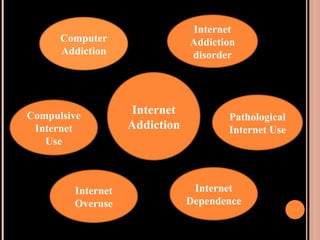
Internet Addiction Internet Addiction disorder Compulsive Internet Use Pathological Internet Use Internet Dependence Internet Overuse Computer Addiction
 
TYPES OF INTERNET ADDICTION
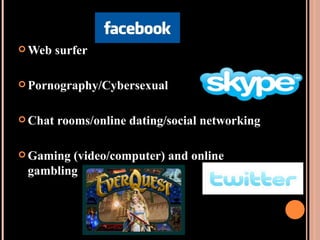
Web surfer Pornography/Cybersexual Chat rooms/online dating/social networking Gaming (video/computer) and online gambling
WHAT MAKES INTERNET USE ADDICTIVE?
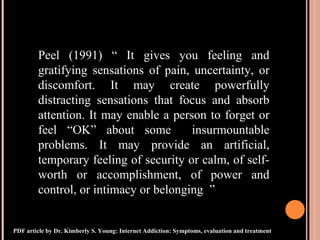
Peel (1991) “ It gives you feeling and gratifying sensations of pain, uncertainty, or discomfort. It may create powerfully distracting sensations that focus and absorb attention. It may enable a person to forget or feel “OK” about some  insurmountable problems. It may provide an artificial, temporary feeling of security or calm, of self-worth or accomplishment, of power and control, or intimacy or belonging  ” PDF article by Dr. Kimberly S. Young: Internet Addiction: Symptoms, evaluation and treatment
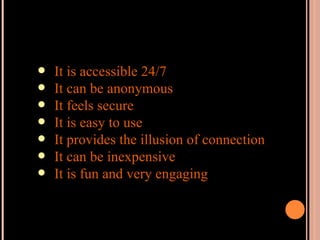
It is accessible 24/7 It can be anonymous It feels secure It is easy to use It provides the illusion of connection It can be inexpensive It is fun and very engaging
SYMPTOMS
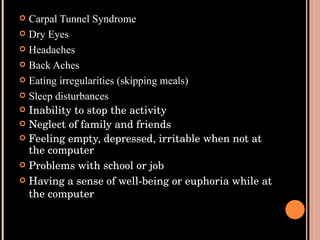
Carpal Tunnel Syndrome Dry Eyes Headaches Back Aches Eating irregularities (skipping meals) Sleep disturbances Inability to stop the activity Neglect of family and friends Feeling empty, depressed, irritable when not at the computer Problems with school or job Having a sense of well-being or euphoria while at the computer
CONSEQUENCES
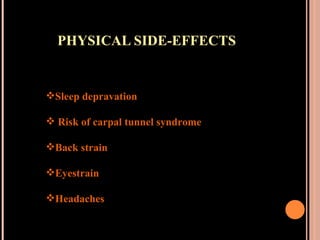
PHYSICAL SIDE-EFFECTS Sleep depravation Risk of carpal tunnel syndrome Back strain Eyestrain Headaches
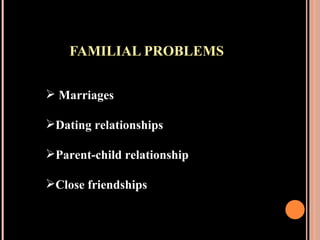
FAMILIAL PROBLEMS Marriages Dating relationships Parent-child relationship Close friendships
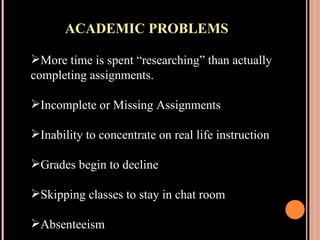
ACADEMIC PROBLEMS More time is spent “researching” than actually completing assignments. Incomplete or Missing Assignments Inability to concentrate on real life instruction Grades begin to decline Skipping classes to stay in chat room Absenteeism
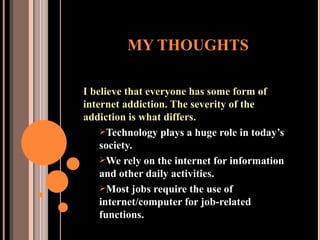
MY THOUGHTS I believe that everyone has some form of internet addiction. The severity of the addiction is what differs. Technology plays a huge role in today’s society. We rely on the internet for information and other daily activities. Most jobs require the use of internet/computer for job-related functions.
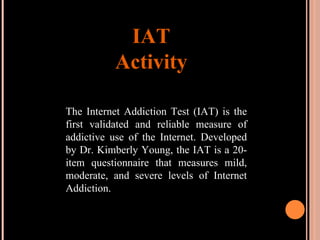
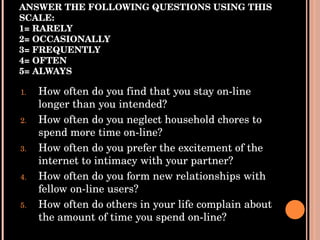
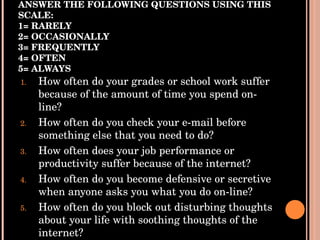
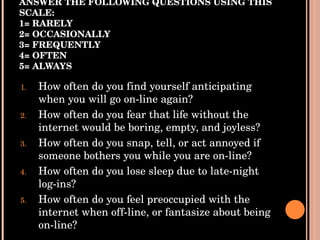
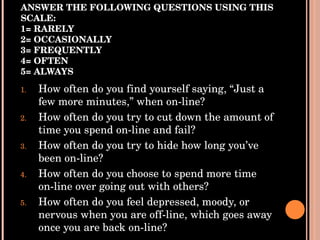
The Internet Addiction Test (IAT) is the first validated and reliable measure of addictive use of the Internet. Developed by Dr. Kimberly Young, the IAT is a 20-item questionnaire that measures mild, moderate, and severe levels of Internet Addiction. IAT Activity
ANSWER THE FOLLOWING QUESTIONS USING THIS SCALE: 1= RARELY 2= OCCASIONALLY 3= FREQUENTLY 4= OFTEN 5= ALWAYS How often do you find that you stay on-line longer than you intended? How often do you neglect household chores to spend more time on-line? How often do you prefer the excitement of the internet to intimacy with your partner? How often do you form new relationships with fellow on-line users? How often do others in your life complain about the amount of time you spend on-line?
ANSWER THE FOLLOWING QUESTIONS USING THIS SCALE: 1= RARELY 2= OCCASIONALLY 3= FREQUENTLY 4= OFTEN 5= ALWAYS How often do your grades or school work suffer because of the amount of time you spend on-line? How often do you check your e-mail before something else that you need to do? How often does your job performance or productivity suffer because of the internet? How often do you become defensive or secretive when anyone asks you what you do on-line? How often do you block out disturbing thoughts about your life with soothing thoughts of the internet?
ANSWER THE FOLLOWING QUESTIONS USING THIS SCALE: 1= RARELY 2= OCCASIONALLY 3= FREQUENTLY 4= OFTEN 5= ALWAYS How often do you find yourself anticipating when you will go on-line again?  How often do you fear that life without the internet would be boring, empty, and joyless? How often do you snap, tell, or act annoyed if someone bothers you while you are on-line? How often do you lose sleep due to late-night log-ins? How often do you feel preoccupied with the internet when off-line, or fantasize about being on-line?
ANSWER THE FOLLOWING QUESTIONS USING THIS SCALE: 1= RARELY 2= OCCASIONALLY 3= FREQUENTLY 4= OFTEN 5= ALWAYS How often do you find yourself saying, “Just a few more minutes,” when on-line? How often do you try to cut down the amount of time you spend on-line and fail? How often do you try to hide how long you’ve been on-line? How often do you choose to spend more time on-line over going out with others? How often do you feel depressed, moody, or nervous when you are off-line, which goes away once you are back on-line?
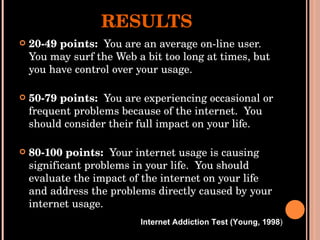
RESULTS 20-49 points:  You are an average on-line user. You may surf the Web a bit too long at times, but you have control over your usage. 50-79 points:  You are experiencing occasional or frequent problems because of the internet.  You should consider their full impact on your life. 80-100 points:  Your internet usage is causing significant problems in your life.  You should evaluate the impact of the internet on your life and address the problems directly caused by your internet usage. Internet Addiction Test (Young, 1998 )
Control yourself ! Use The Internet smart !
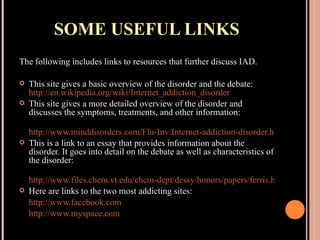
SOME USEFUL LINKS The following includes links to resources that further discuss IAD. This site gives a basic overview of the disorder and the debate:  http://en.wikipedia.org/wiki/Internet_addiction_disorder This site gives a more detailed overview of the disorder and discusses the symptoms, treatments, and other information: http://www.minddisorders.com/Flu-Inv/Internet-addiction-disorder.html This is a link to an essay that provides information about the disorder. It goes into detail on the debate as well as characteristics of the disorder: http://www.files.chem.vt.edu/chem-dept/dessy/honors/papers/ferris.html Here are links to the two most addicting sites: http://www.facebook.com http://www.myspace.com

Internet Addiction

  • 1.
  • 2.
    INTERNET ADDICTION BY MOHSINE WAHIB Master programme Computer Skills Pr. BELFAKIR
  • 3.
    OUTLINE Introduction Whatis Addiction? What is Internet Addiction? Types of Internet Addiction What makes internet use addictive? Symptoms Consequences
  • 4.
    INTRODUCTION With thegrowing importance of the internet in everyday life, more and more people are accessing various on-line resources each day. The world wide web is informative, convenient, resourceful , fun, but also potentially way for internet addiction.
  • 5.
  • 6.
    The term "addiction"is used in many contexts to describe an obsession, compulsion, or excessive psychological dependence, such as: drug addiction (e.g. alcoholism , nicotine addiction ), problem gambling , crime , money , work addiction , compulsive overeating , Oniomania (compulsive shopping), computer addiction , video game addiction , pornography addiction , television addiction , etc. http://en.wikipedia.org/wiki/Addiction
  • 7.
    The term addiction is also sometimes applied to compulsions that are not substance-related, such as problem gambling and computer addiction. In these kinds of common usages, the term addiction is used to describe a recurring compulsion by an individual to engage in some specific activity, despite harmful consequences, as deemed by the user himself to his individual health, mental state, or social life. http://en.wikipedia.org/wiki/Addiction
  • 8.
    WHAT IS INTERNETADDICTION?
  • 9.
    Studies on Internetaddiction originated in the US by Dr. Kimberly Young, who presented the first research on Internet addiction in 1996 at the American Psychological Association’s annual conference held in Toronto in her paper “Internet Addiction: The Emergence of a New Disorder”.
  • 10.
    “ Internetaddiction is defined as the compulsive urge to continually use the Net, whether it be to spend hours surfing the Web, hang around in IRC chatrooms, or play on-line games.” In Book Reviews , Chris Mitchell Kimberly S. Young: Caught In The Net
  • 11.
    Internet Addiction InternetAddiction disorder Compulsive Internet Use Pathological Internet Use Internet Dependence Internet Overuse Computer Addiction
  • 12.
  • 13.
  • 14.
    Web surfer Pornography/CybersexualChat rooms/online dating/social networking Gaming (video/computer) and online gambling
  • 15.
    WHAT MAKES INTERNETUSE ADDICTIVE?
  • 16.
    Peel (1991) “It gives you feeling and gratifying sensations of pain, uncertainty, or discomfort. It may create powerfully distracting sensations that focus and absorb attention. It may enable a person to forget or feel “OK” about some insurmountable problems. It may provide an artificial, temporary feeling of security or calm, of self-worth or accomplishment, of power and control, or intimacy or belonging ” PDF article by Dr. Kimberly S. Young: Internet Addiction: Symptoms, evaluation and treatment
  • 17.
    It is accessible24/7 It can be anonymous It feels secure It is easy to use It provides the illusion of connection It can be inexpensive It is fun and very engaging
  • 18.
  • 19.
    Carpal Tunnel SyndromeDry Eyes Headaches Back Aches Eating irregularities (skipping meals) Sleep disturbances Inability to stop the activity Neglect of family and friends Feeling empty, depressed, irritable when not at the computer Problems with school or job Having a sense of well-being or euphoria while at the computer
  • 20.
  • 21.
    PHYSICAL SIDE-EFFECTS Sleepdepravation Risk of carpal tunnel syndrome Back strain Eyestrain Headaches
  • 22.
    FAMILIAL PROBLEMS MarriagesDating relationships Parent-child relationship Close friendships
  • 23.
    ACADEMIC PROBLEMS Moretime is spent “researching” than actually completing assignments. Incomplete or Missing Assignments Inability to concentrate on real life instruction Grades begin to decline Skipping classes to stay in chat room Absenteeism
  • 24.
    MY THOUGHTS Ibelieve that everyone has some form of internet addiction. The severity of the addiction is what differs. Technology plays a huge role in today’s society. We rely on the internet for information and other daily activities. Most jobs require the use of internet/computer for job-related functions.

  • 25.
    The Internet AddictionTest (IAT) is the first validated and reliable measure of addictive use of the Internet. Developed by Dr. Kimberly Young, the IAT is a 20-item questionnaire that measures mild, moderate, and severe levels of Internet Addiction. IAT Activity

  • 26.
    ANSWER THE FOLLOWINGQUESTIONS USING THIS SCALE: 1= RARELY 2= OCCASIONALLY 3= FREQUENTLY 4= OFTEN 5= ALWAYS How often do you find that you stay on-line longer than you intended? How often do you neglect household chores to spend more time on-line? How often do you prefer the excitement of the internet to intimacy with your partner? How often do you form new relationships with fellow on-line users? How often do others in your life complain about the amount of time you spend on-line?
  • 27.
    ANSWER THE FOLLOWINGQUESTIONS USING THIS SCALE: 1= RARELY 2= OCCASIONALLY 3= FREQUENTLY 4= OFTEN 5= ALWAYS How often do your grades or school work suffer because of the amount of time you spend on-line? How often do you check your e-mail before something else that you need to do? How often does your job performance or productivity suffer because of the internet? How often do you become defensive or secretive when anyone asks you what you do on-line? How often do you block out disturbing thoughts about your life with soothing thoughts of the internet?
  • 28.
    ANSWER THE FOLLOWINGQUESTIONS USING THIS SCALE: 1= RARELY 2= OCCASIONALLY 3= FREQUENTLY 4= OFTEN 5= ALWAYS How often do you find yourself anticipating when you will go on-line again? How often do you fear that life without the internet would be boring, empty, and joyless? How often do you snap, tell, or act annoyed if someone bothers you while you are on-line? How often do you lose sleep due to late-night log-ins? How often do you feel preoccupied with the internet when off-line, or fantasize about being on-line?
  • 29.
    ANSWER THE FOLLOWINGQUESTIONS USING THIS SCALE: 1= RARELY 2= OCCASIONALLY 3= FREQUENTLY 4= OFTEN 5= ALWAYS How often do you find yourself saying, “Just a few more minutes,” when on-line? How often do you try to cut down the amount of time you spend on-line and fail? How often do you try to hide how long you’ve been on-line? How often do you choose to spend more time on-line over going out with others? How often do you feel depressed, moody, or nervous when you are off-line, which goes away once you are back on-line?
  • 30.
    RESULTS 20-49 points: You are an average on-line user. You may surf the Web a bit too long at times, but you have control over your usage. 50-79 points: You are experiencing occasional or frequent problems because of the internet. You should consider their full impact on your life. 80-100 points: Your internet usage is causing significant problems in your life. You should evaluate the impact of the internet on your life and address the problems directly caused by your internet usage. Internet Addiction Test (Young, 1998 )
  • 31.
    Control yourself !Use The Internet smart !
  • 32.
    SOME USEFUL LINKSThe following includes links to resources that further discuss IAD. This site gives a basic overview of the disorder and the debate: http://en.wikipedia.org/wiki/Internet_addiction_disorder This site gives a more detailed overview of the disorder and discusses the symptoms, treatments, and other information: http://www.minddisorders.com/Flu-Inv/Internet-addiction-disorder.html This is a link to an essay that provides information about the disorder. It goes into detail on the debate as well as characteristics of the disorder: http://www.files.chem.vt.edu/chem-dept/dessy/honors/papers/ferris.html Here are links to the two most addicting sites: http://www.facebook.com http://www.myspace.com